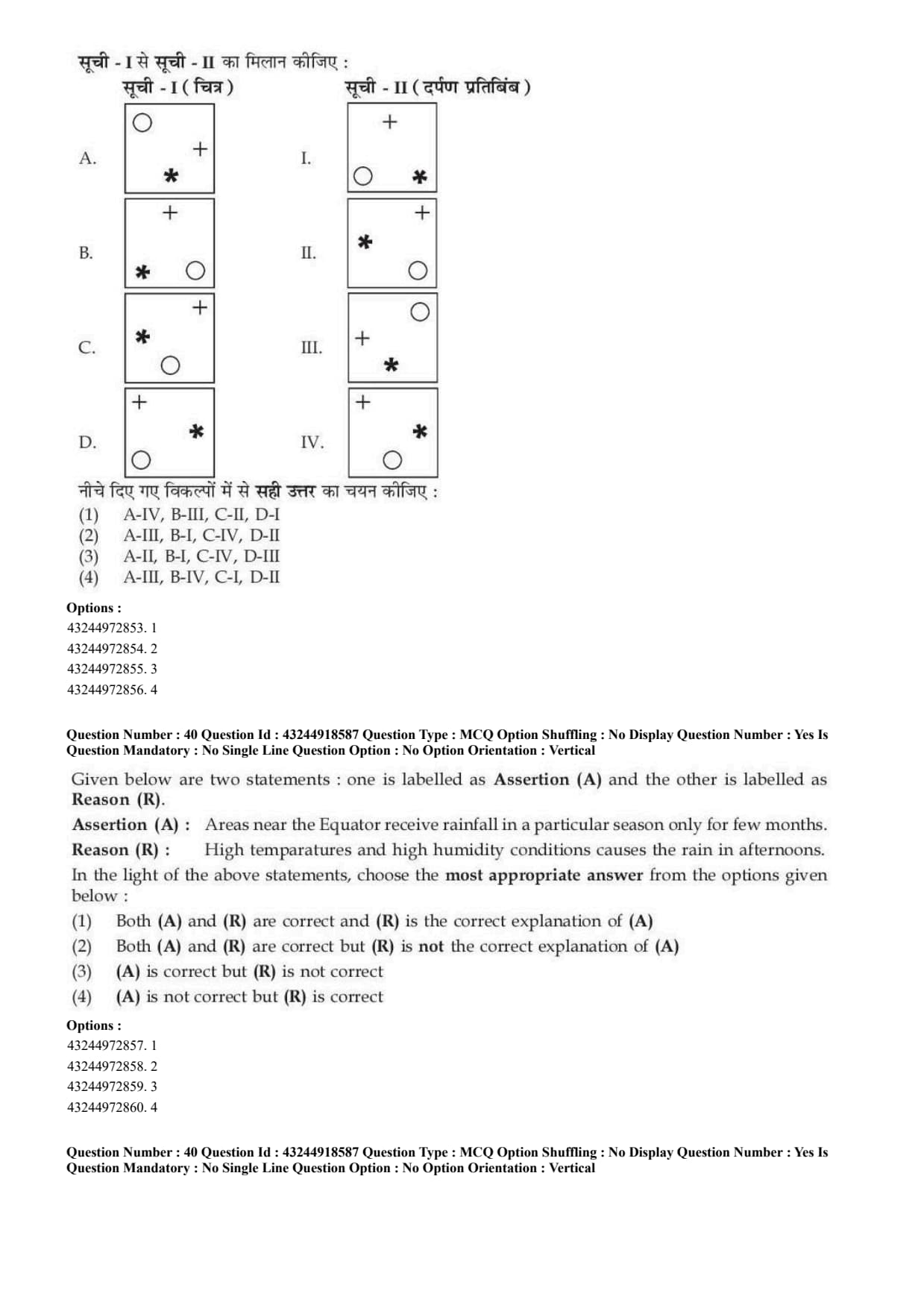
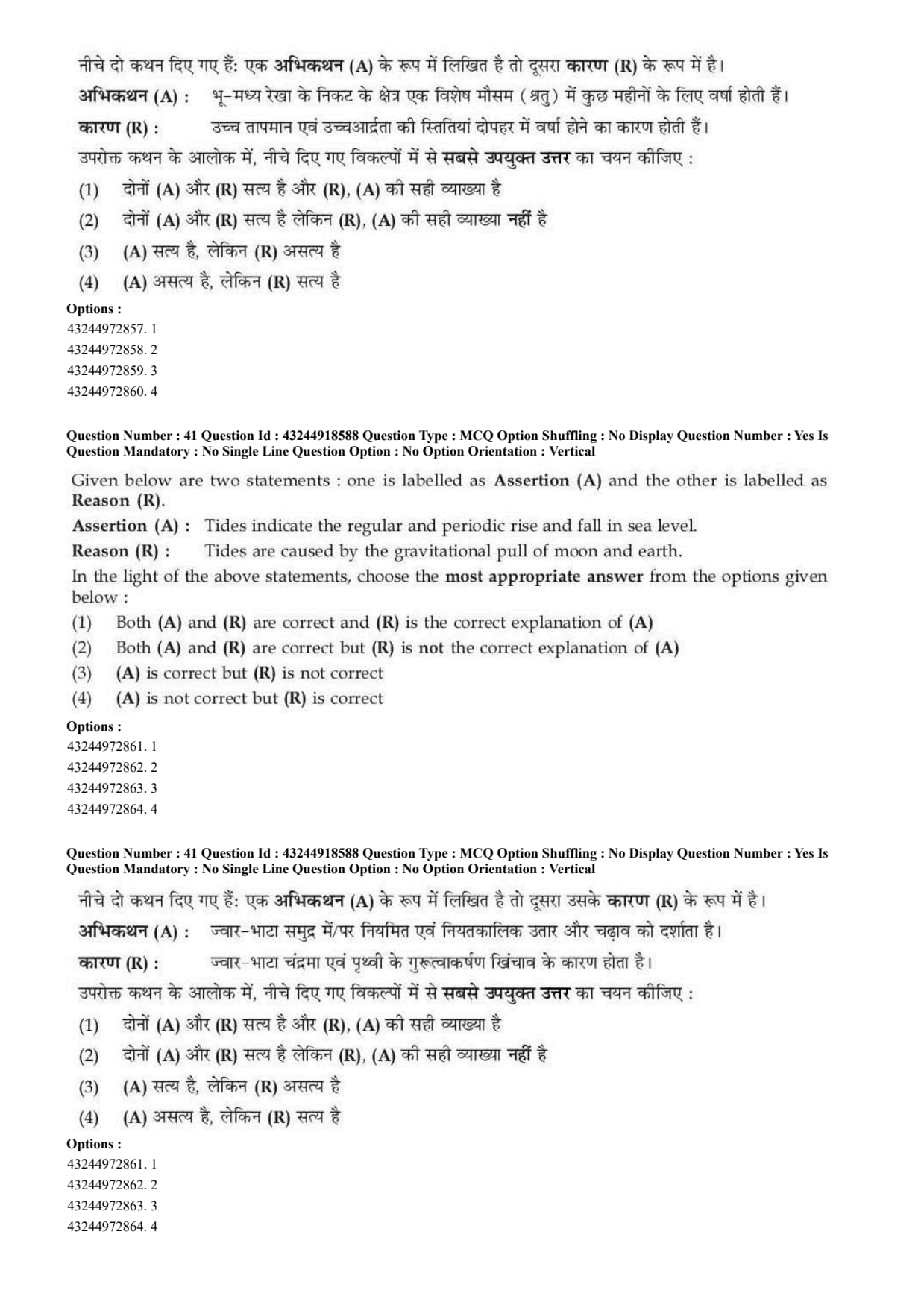
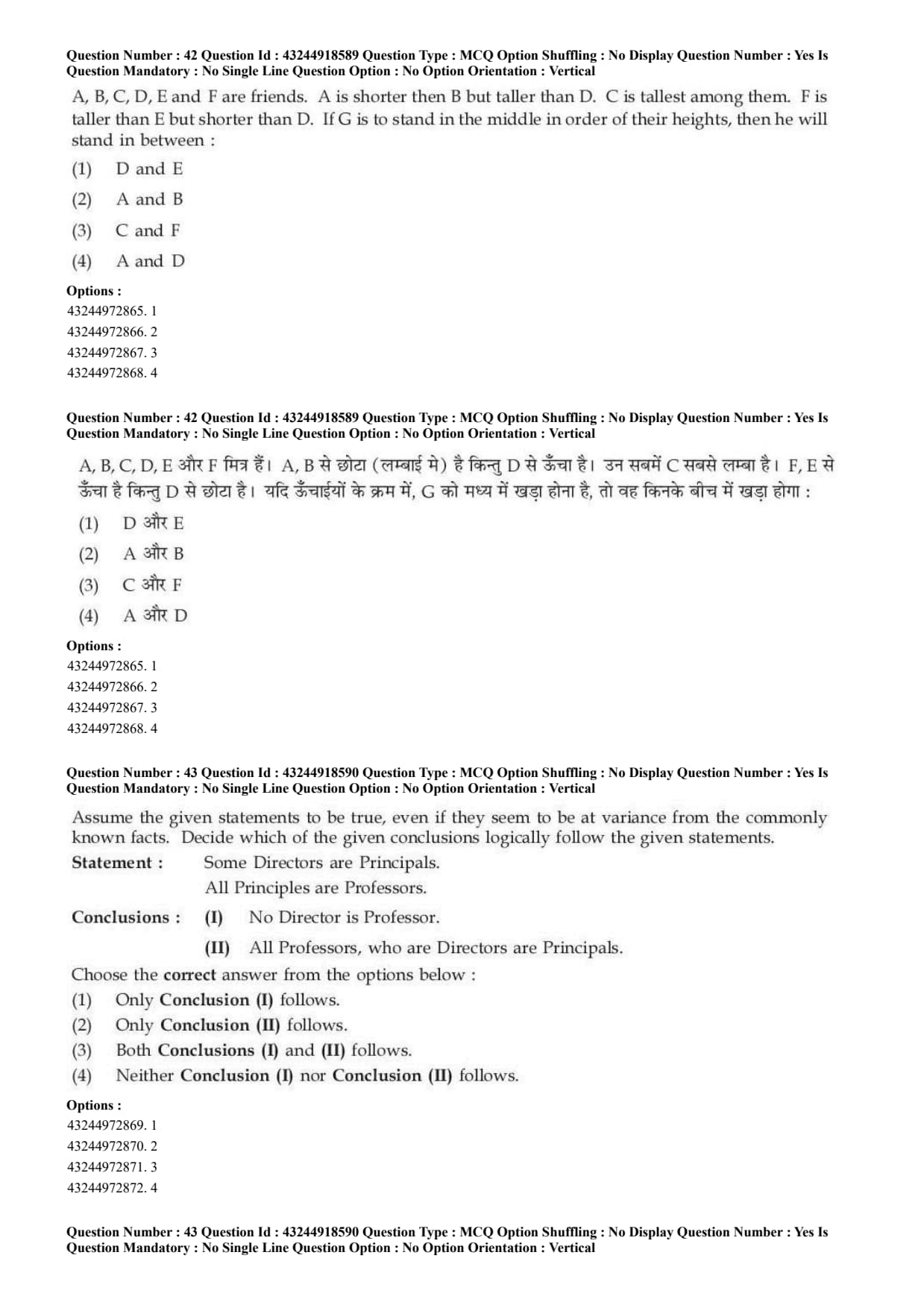
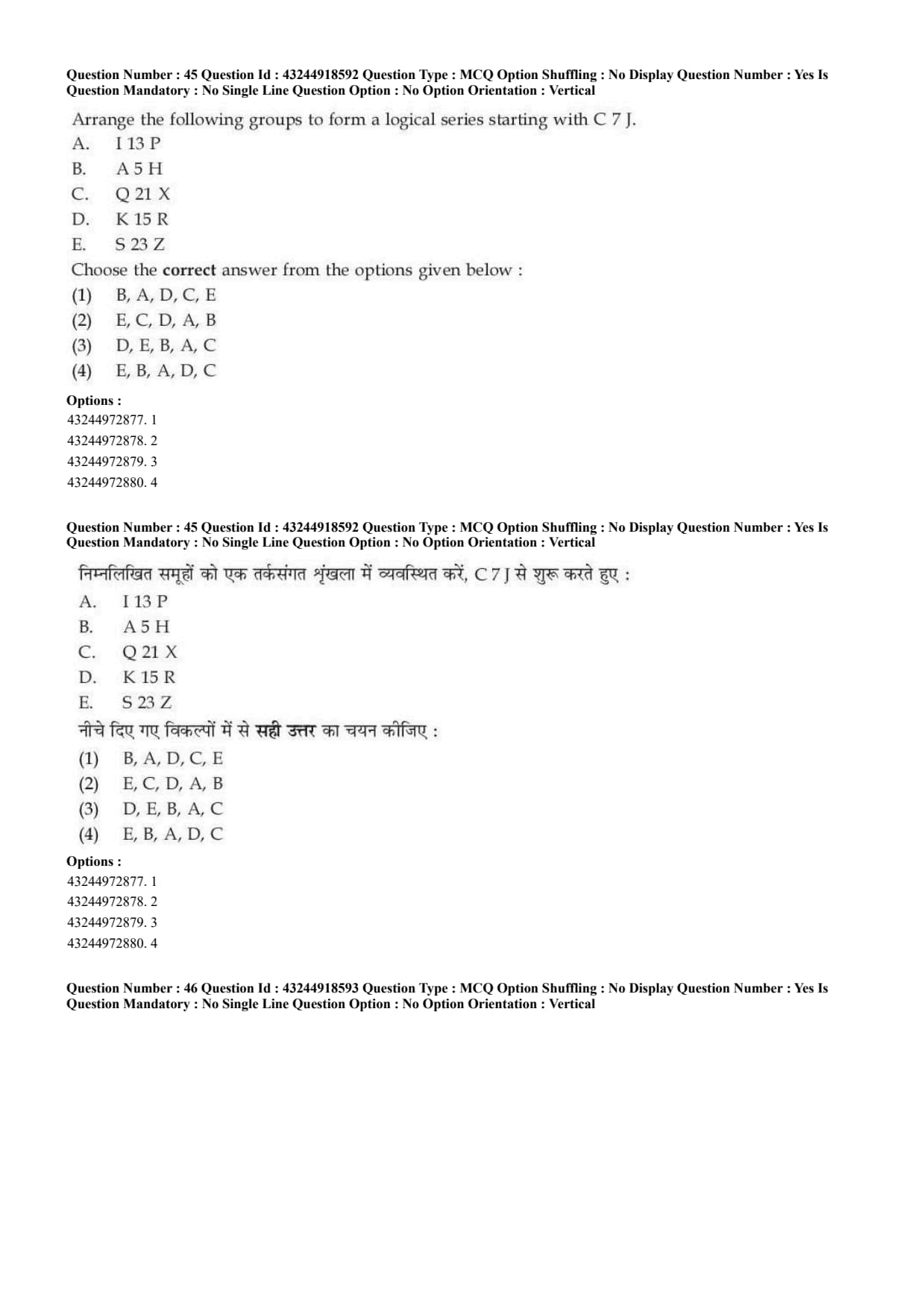
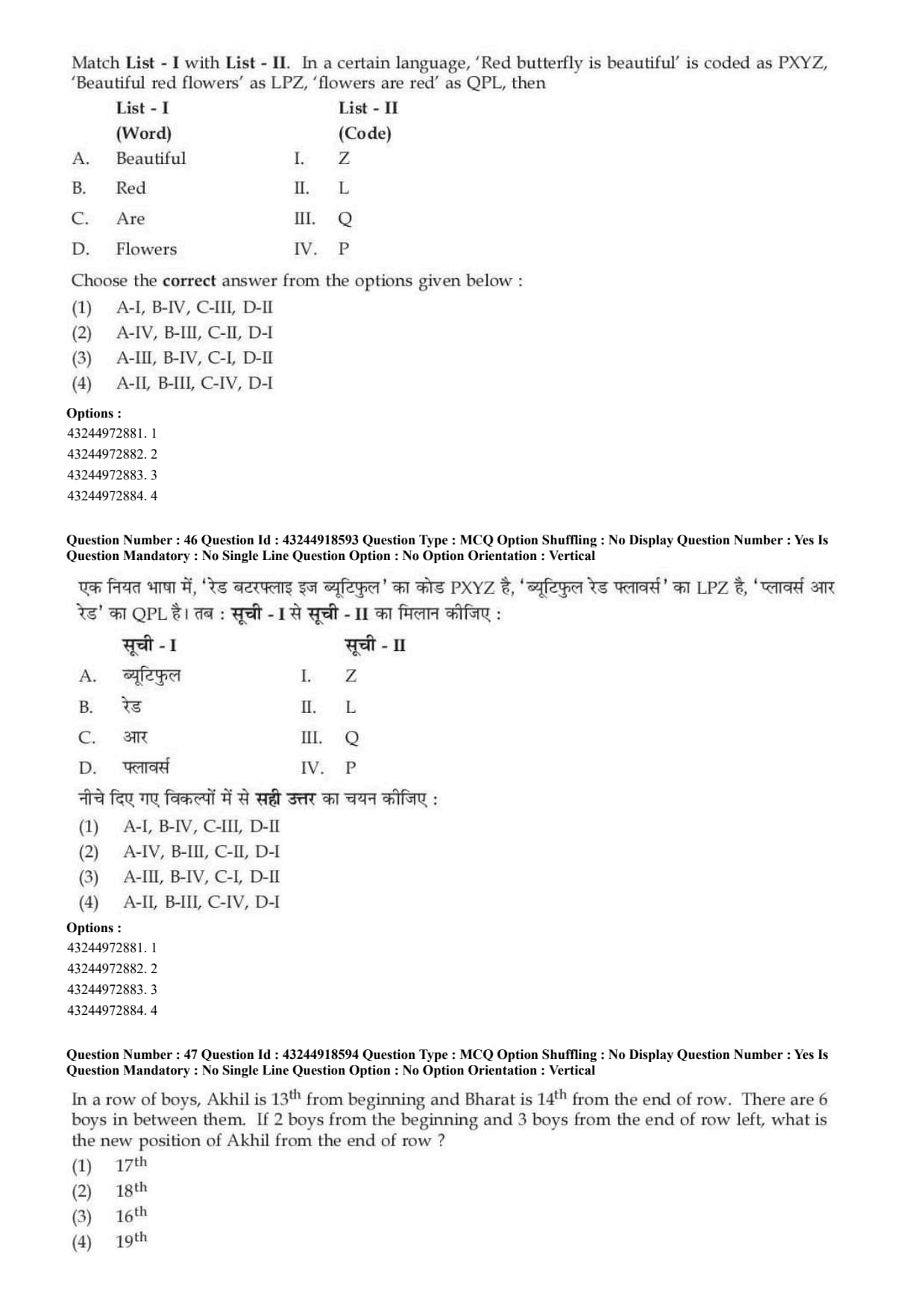
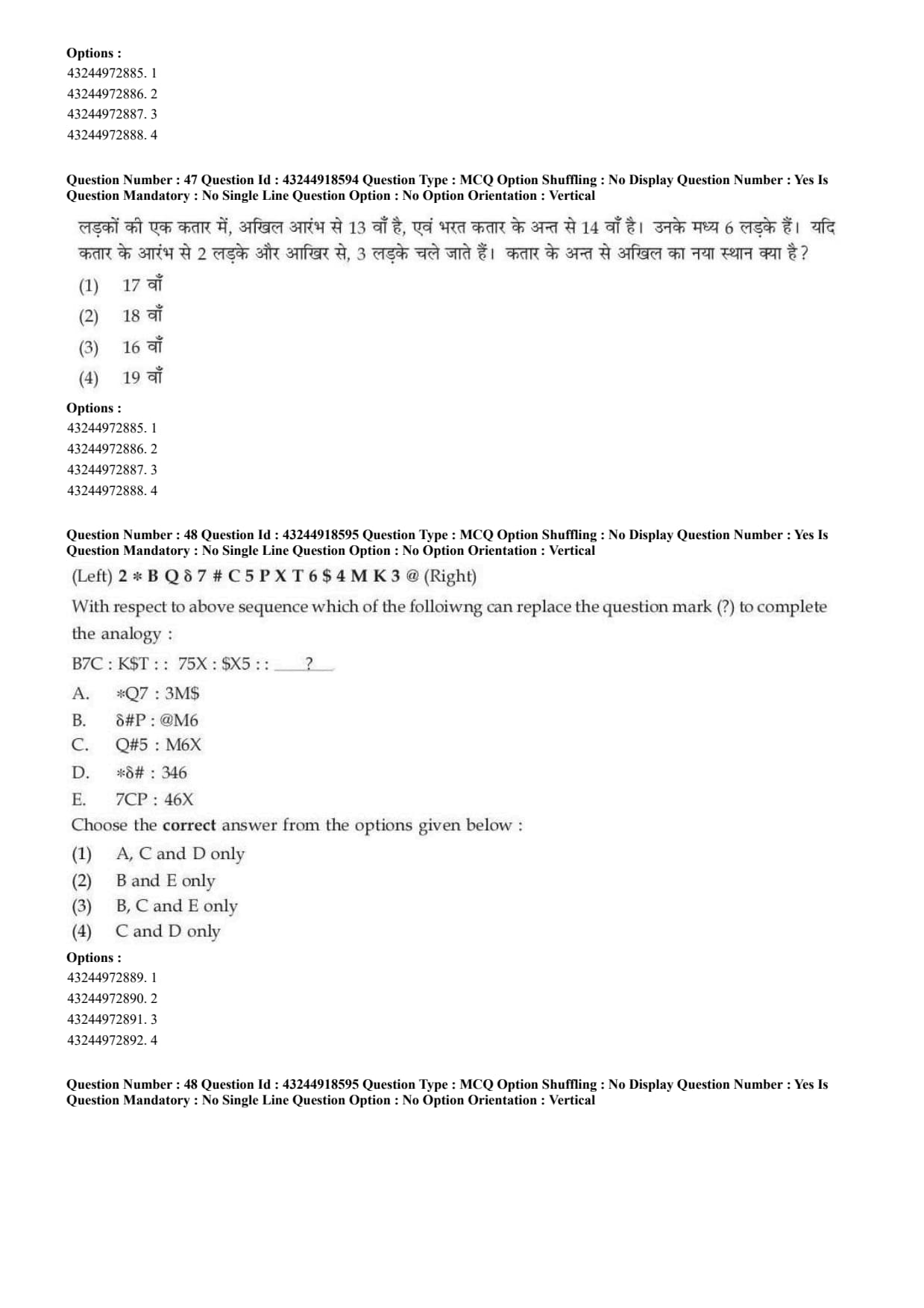
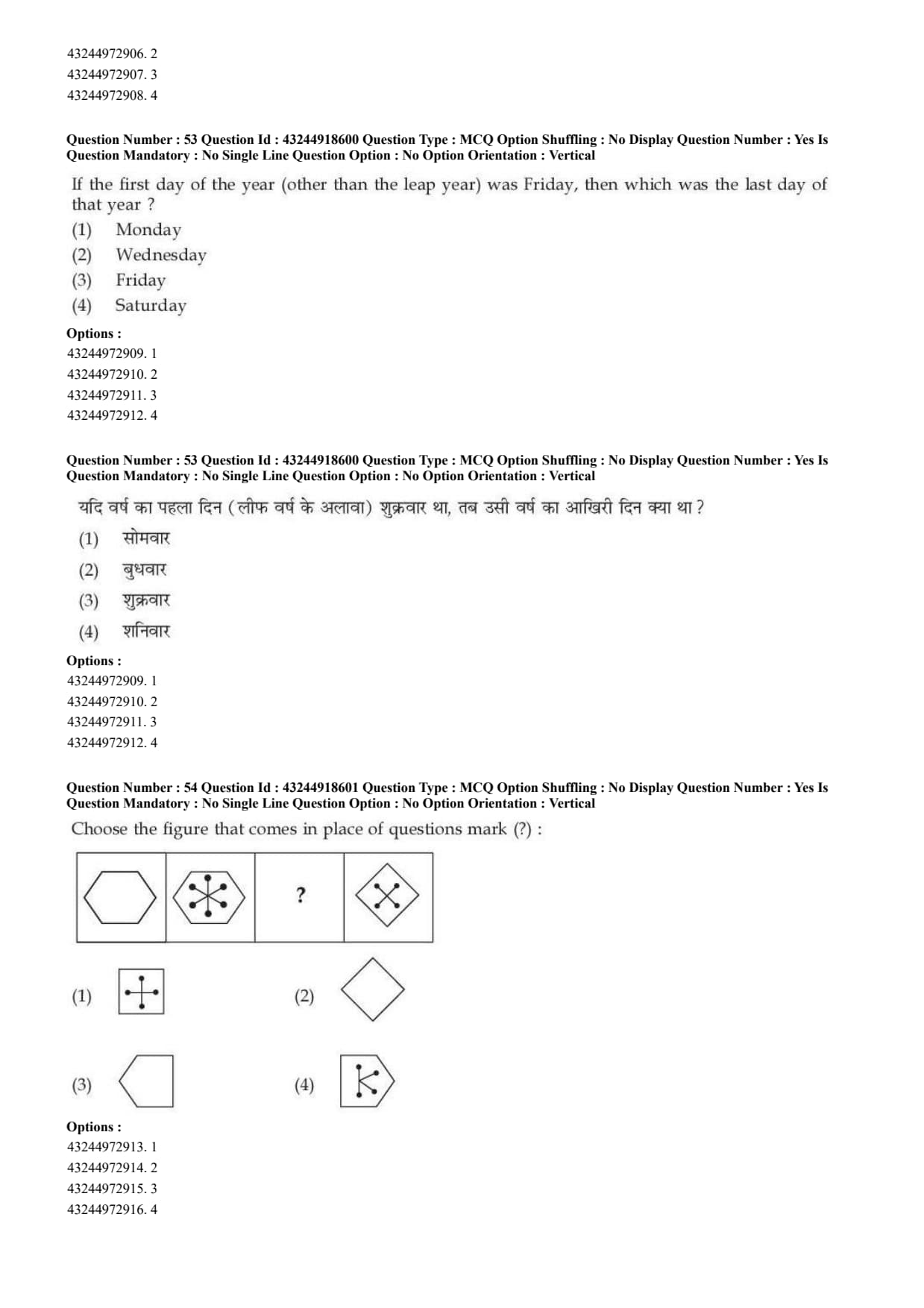
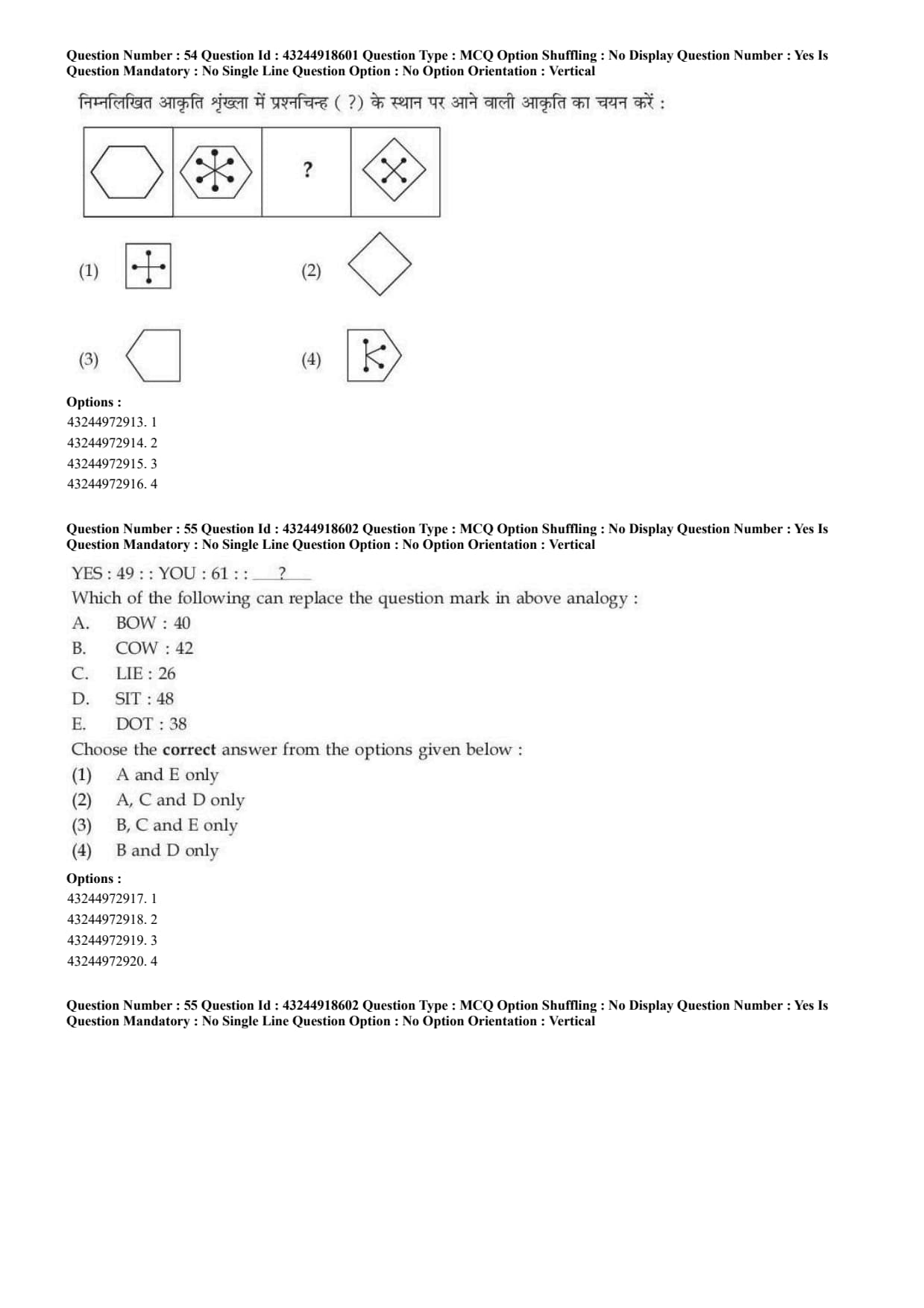
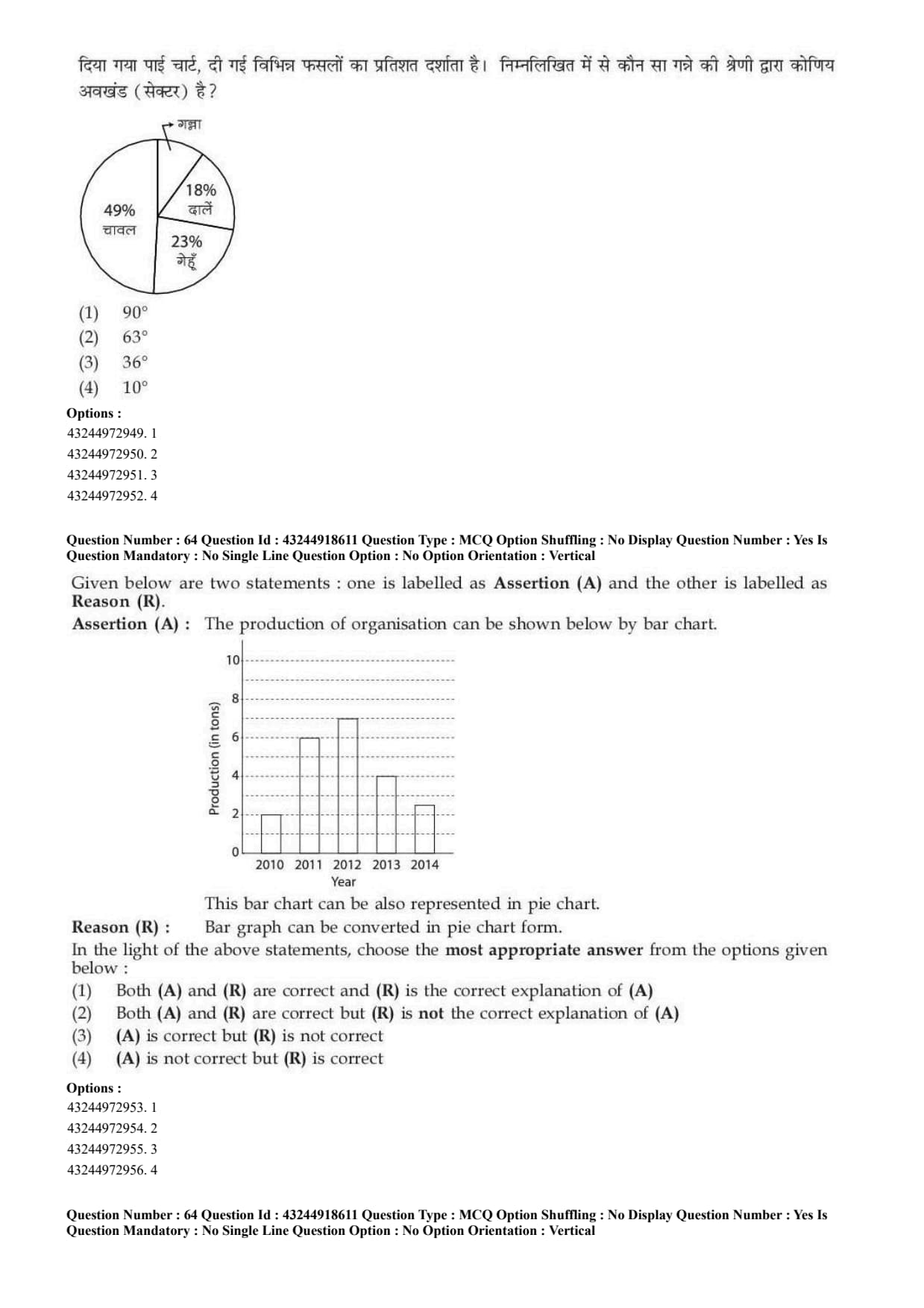
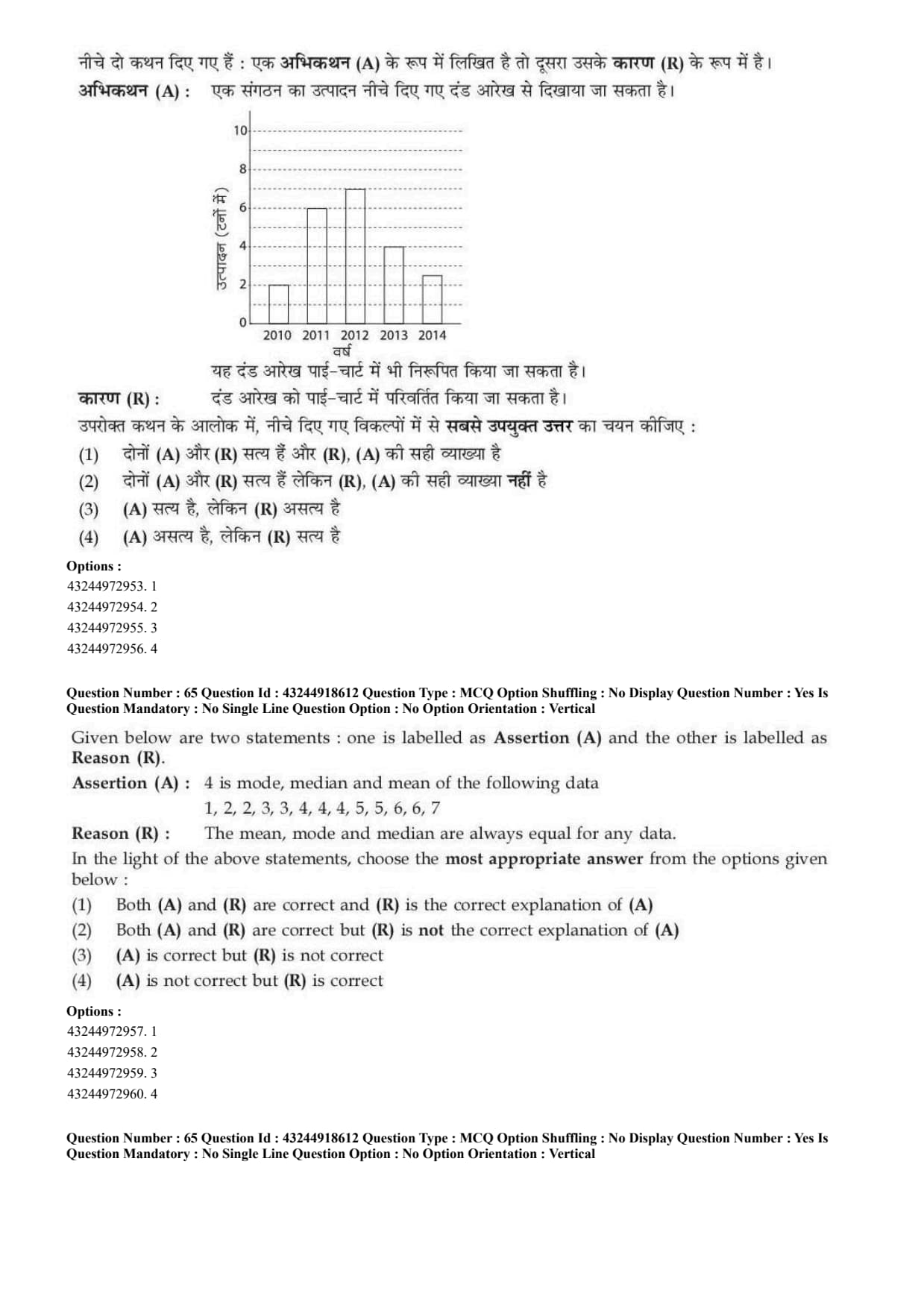
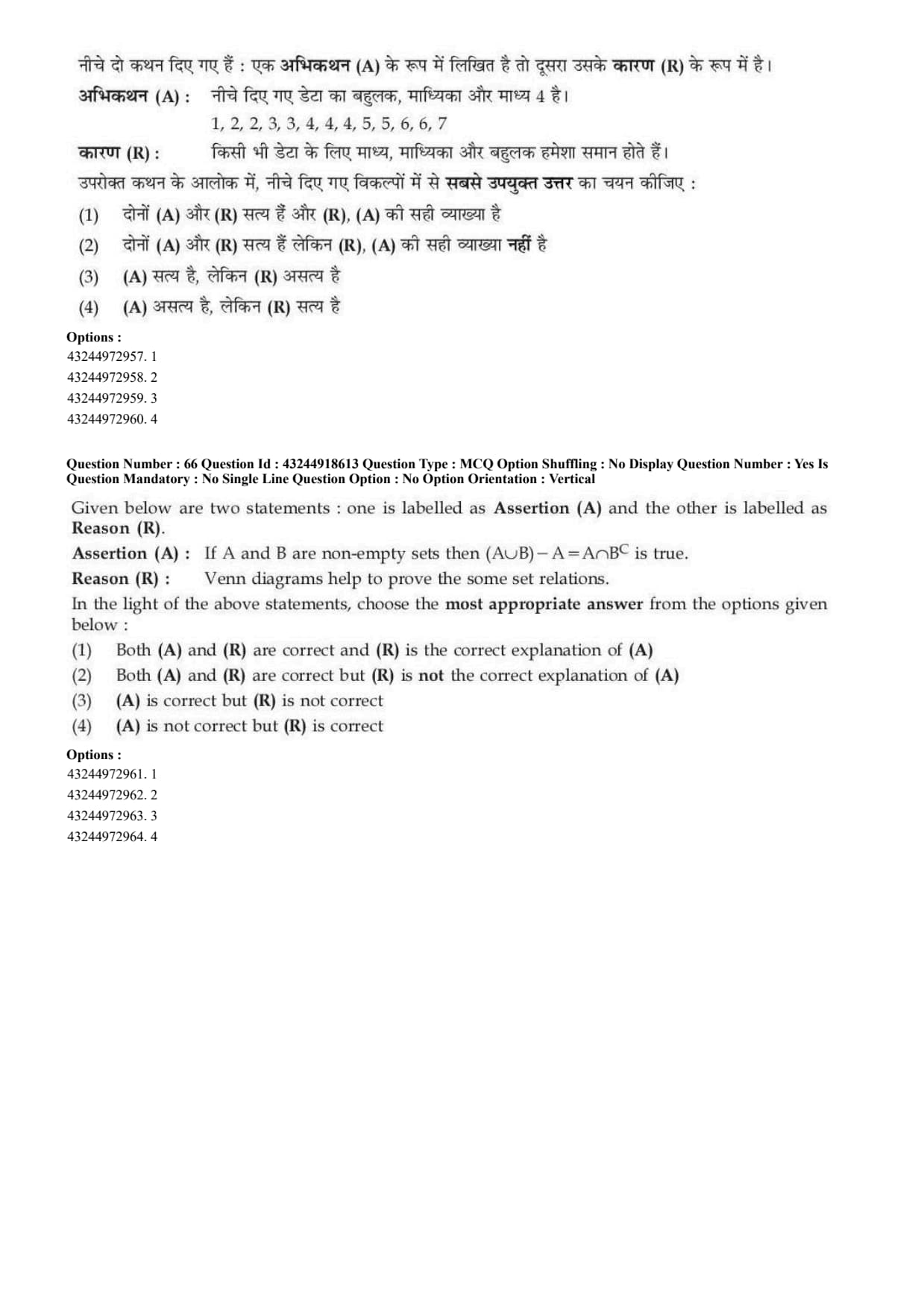
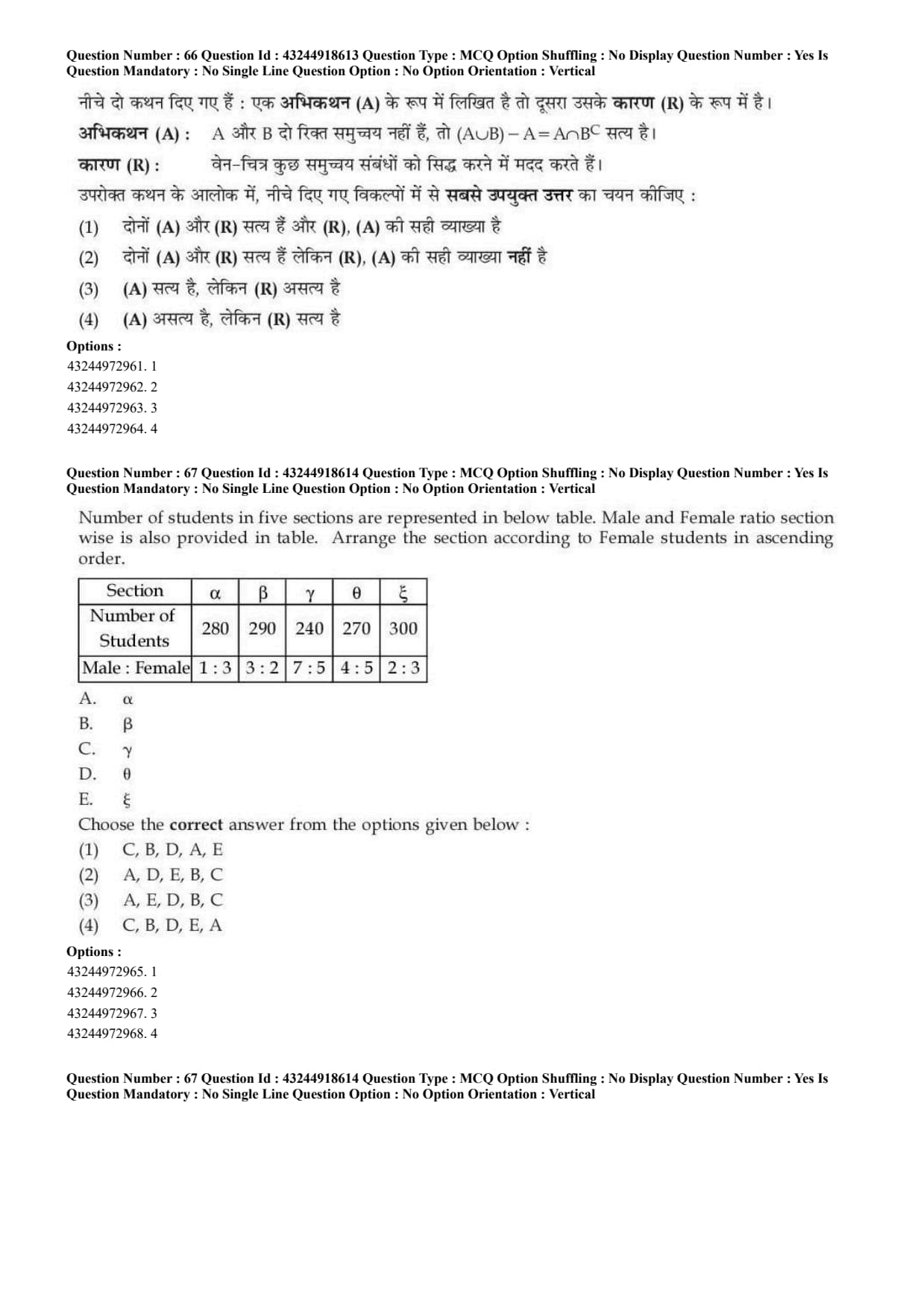
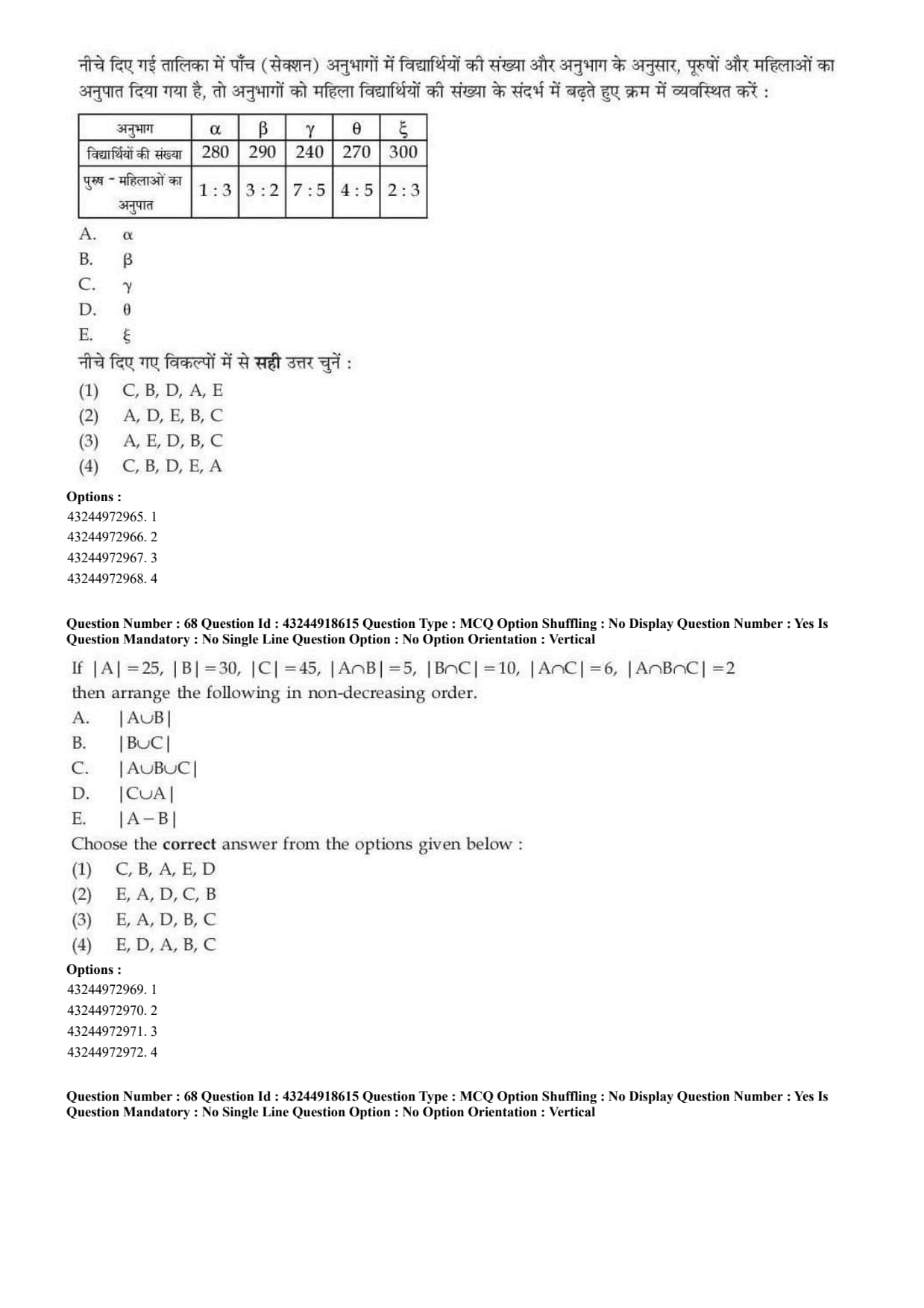
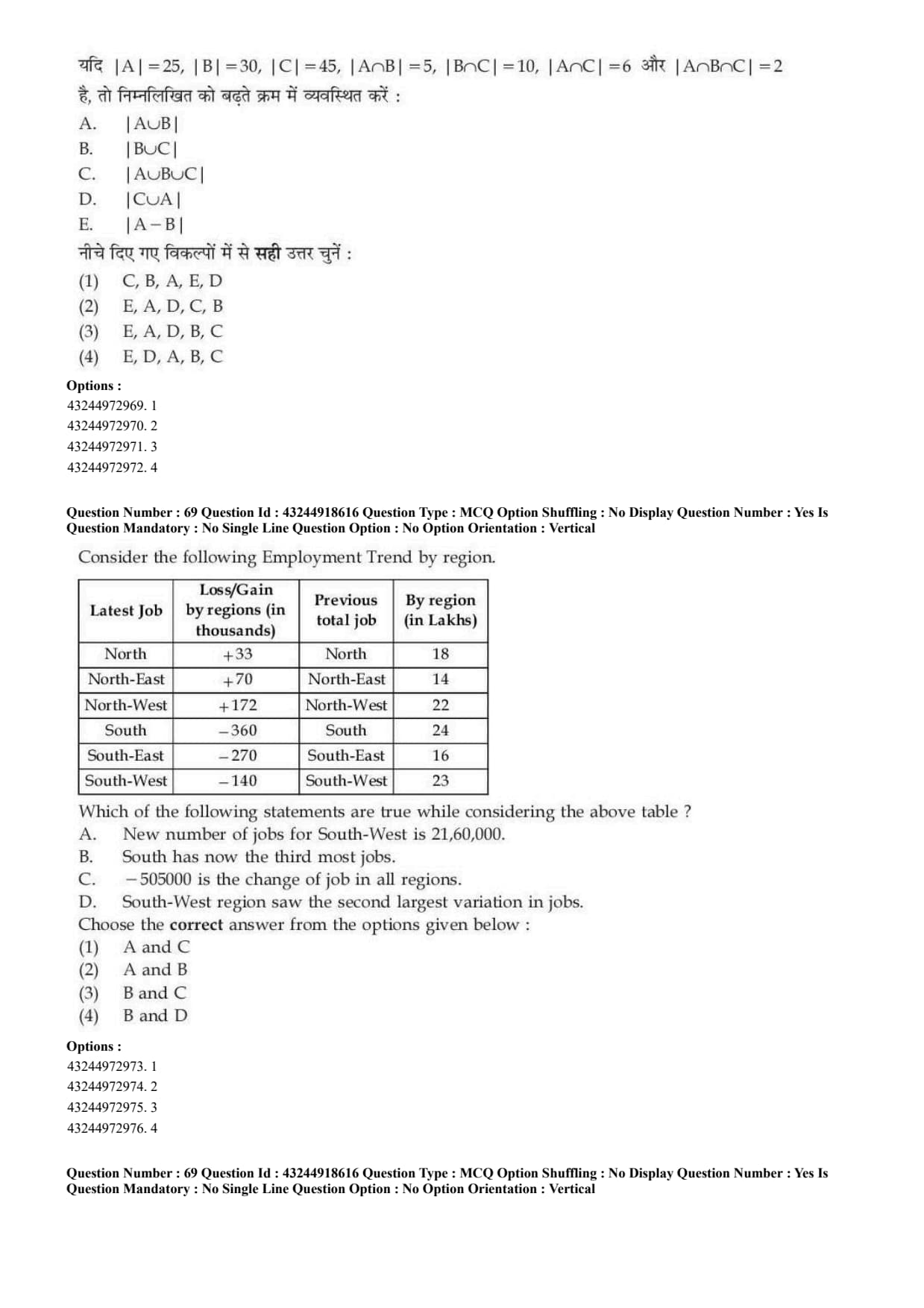
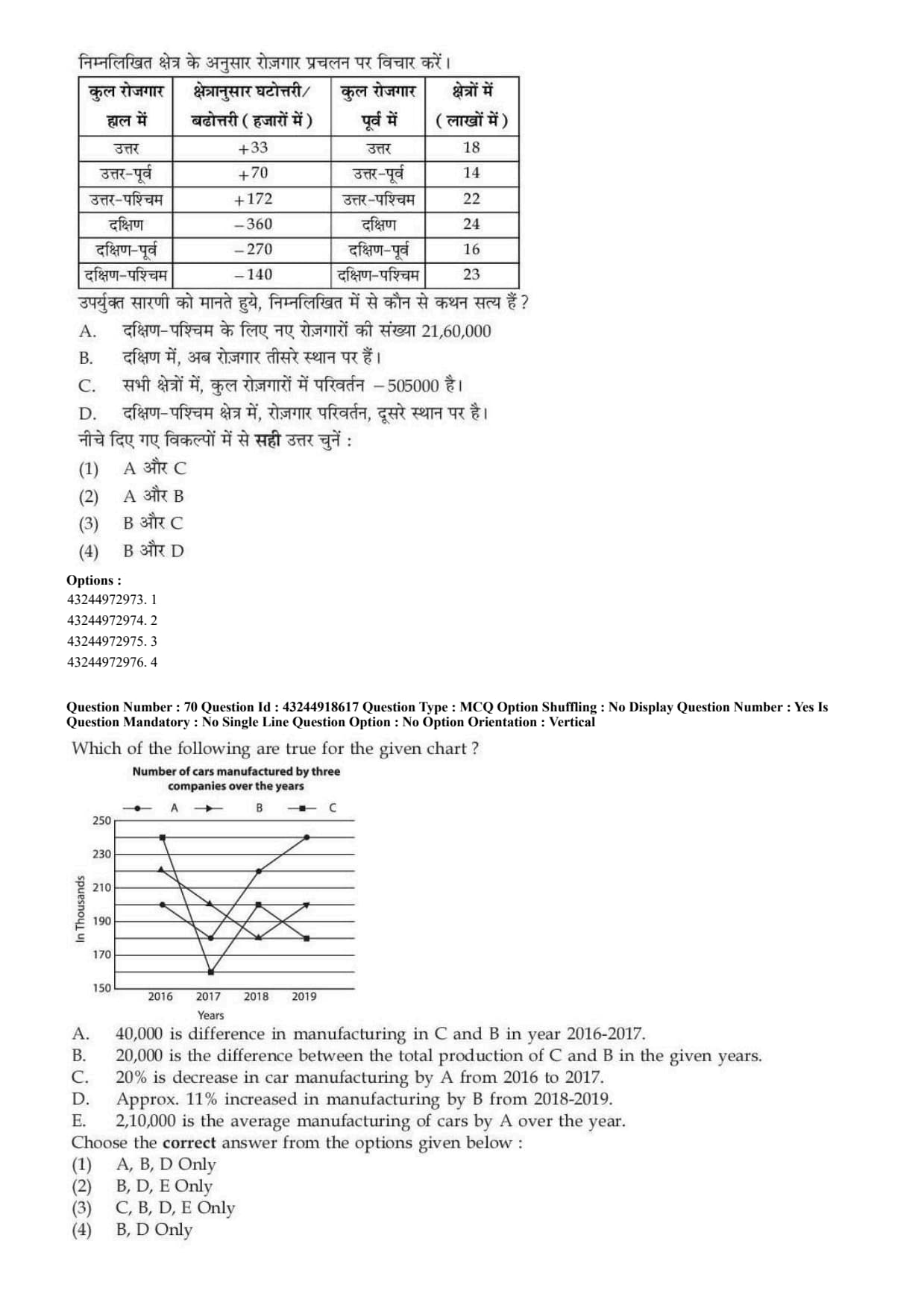
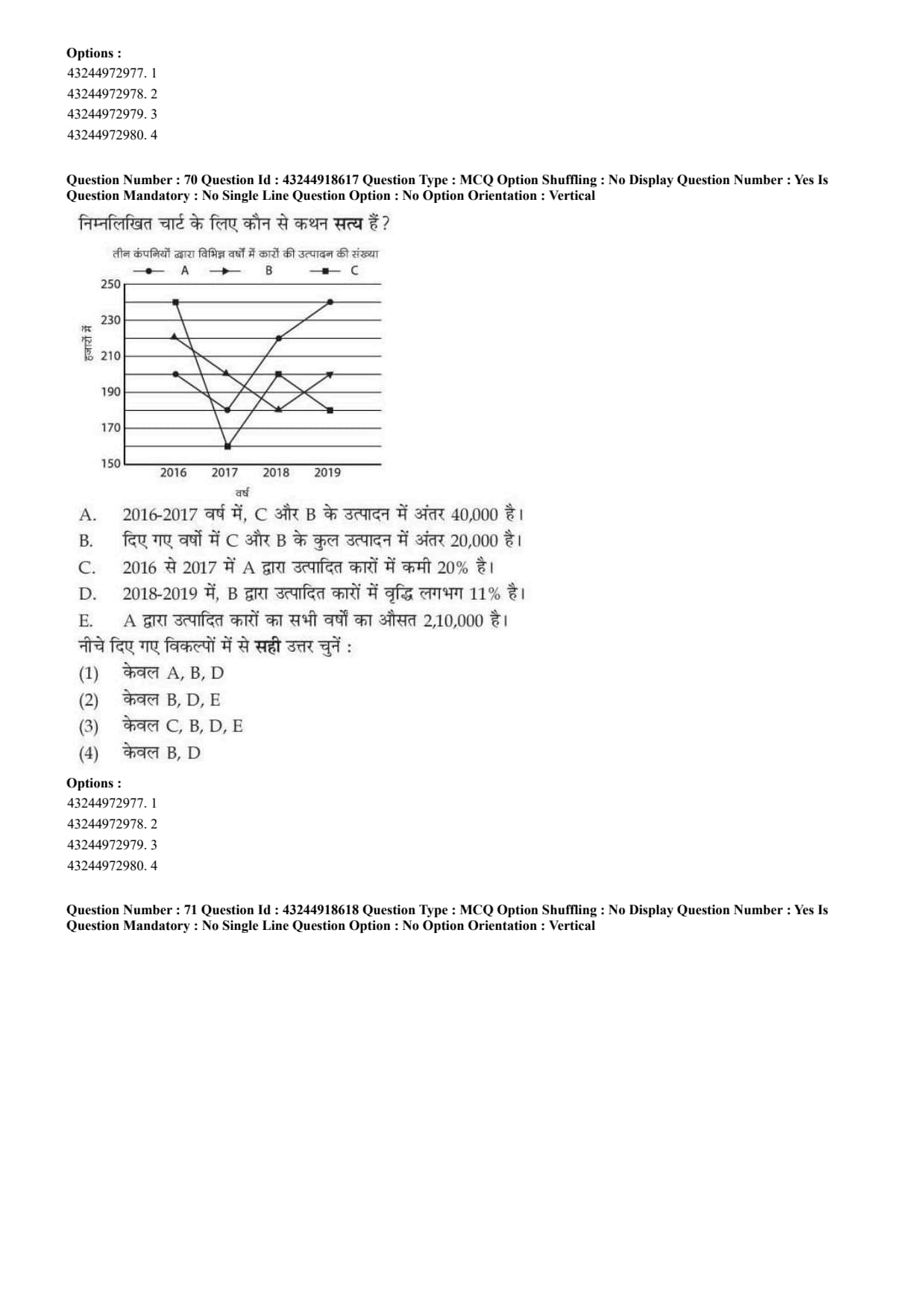
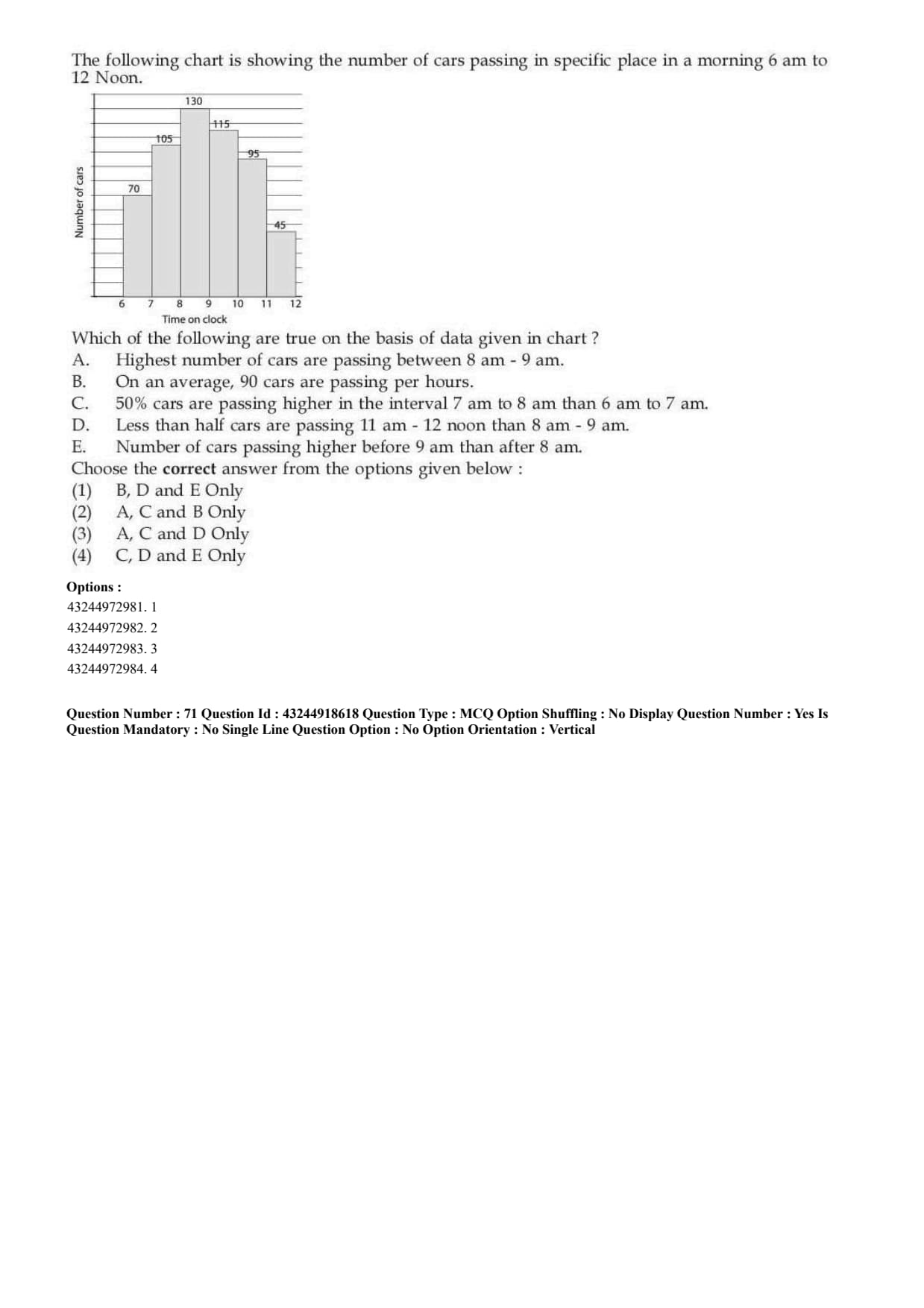
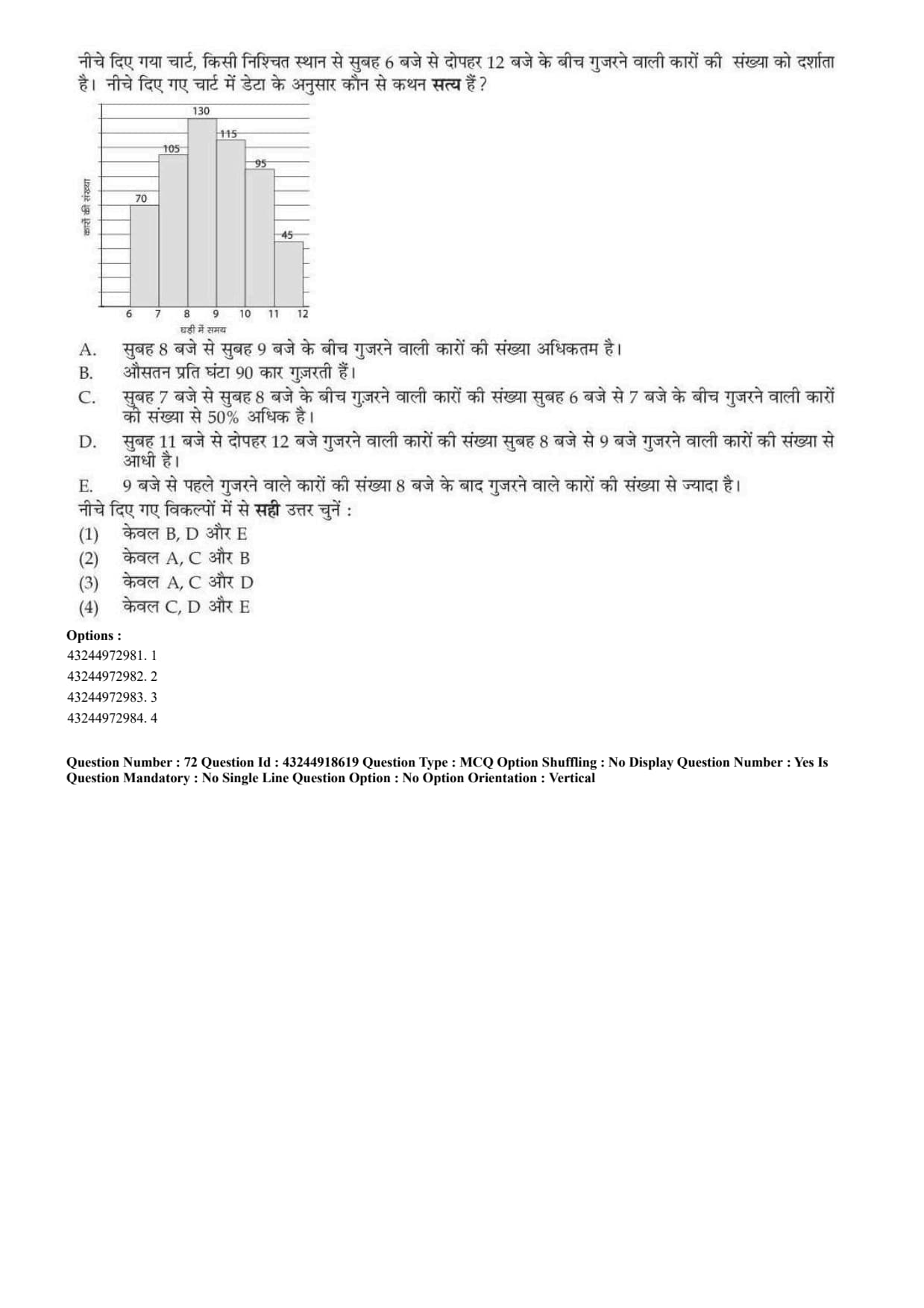
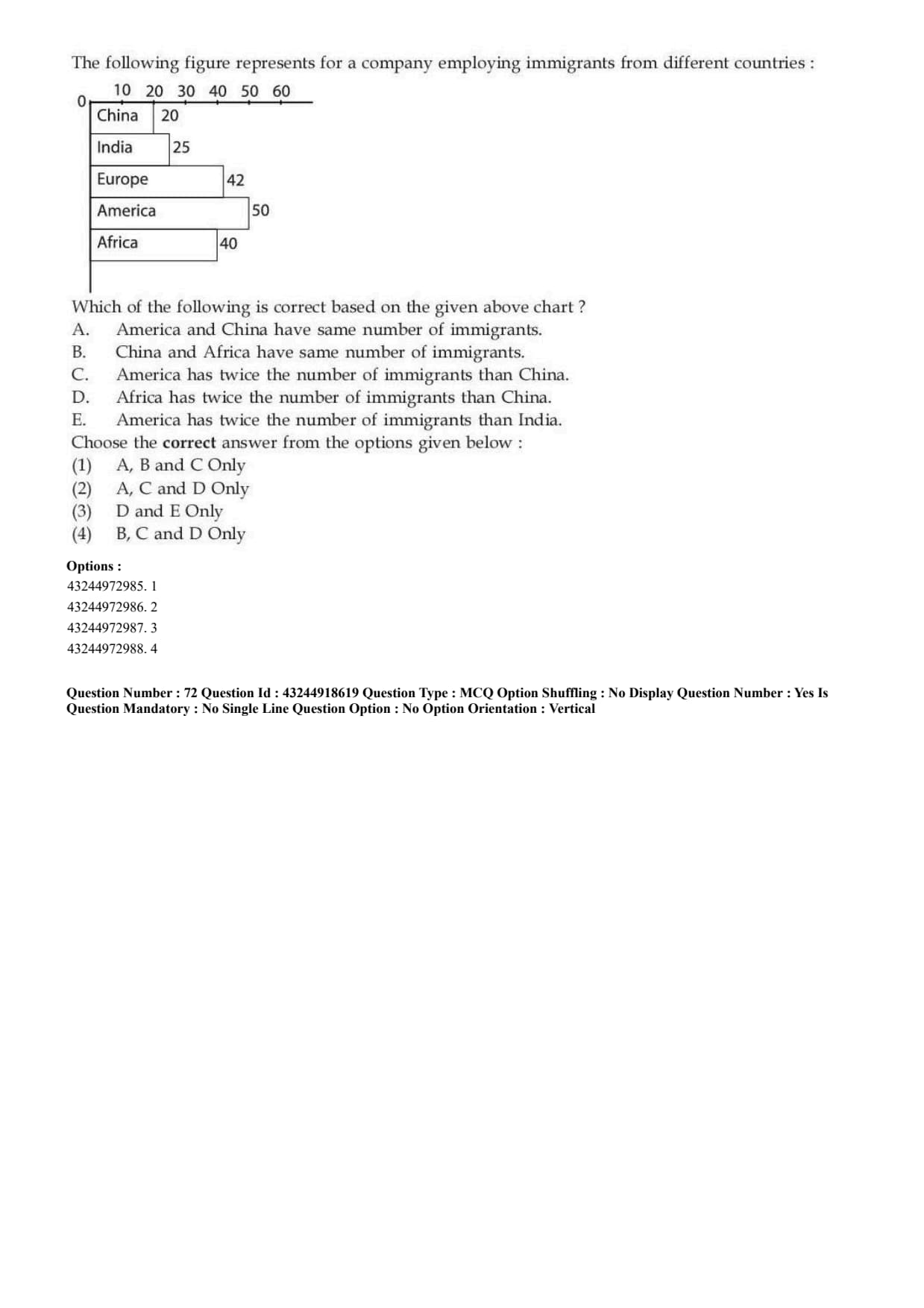
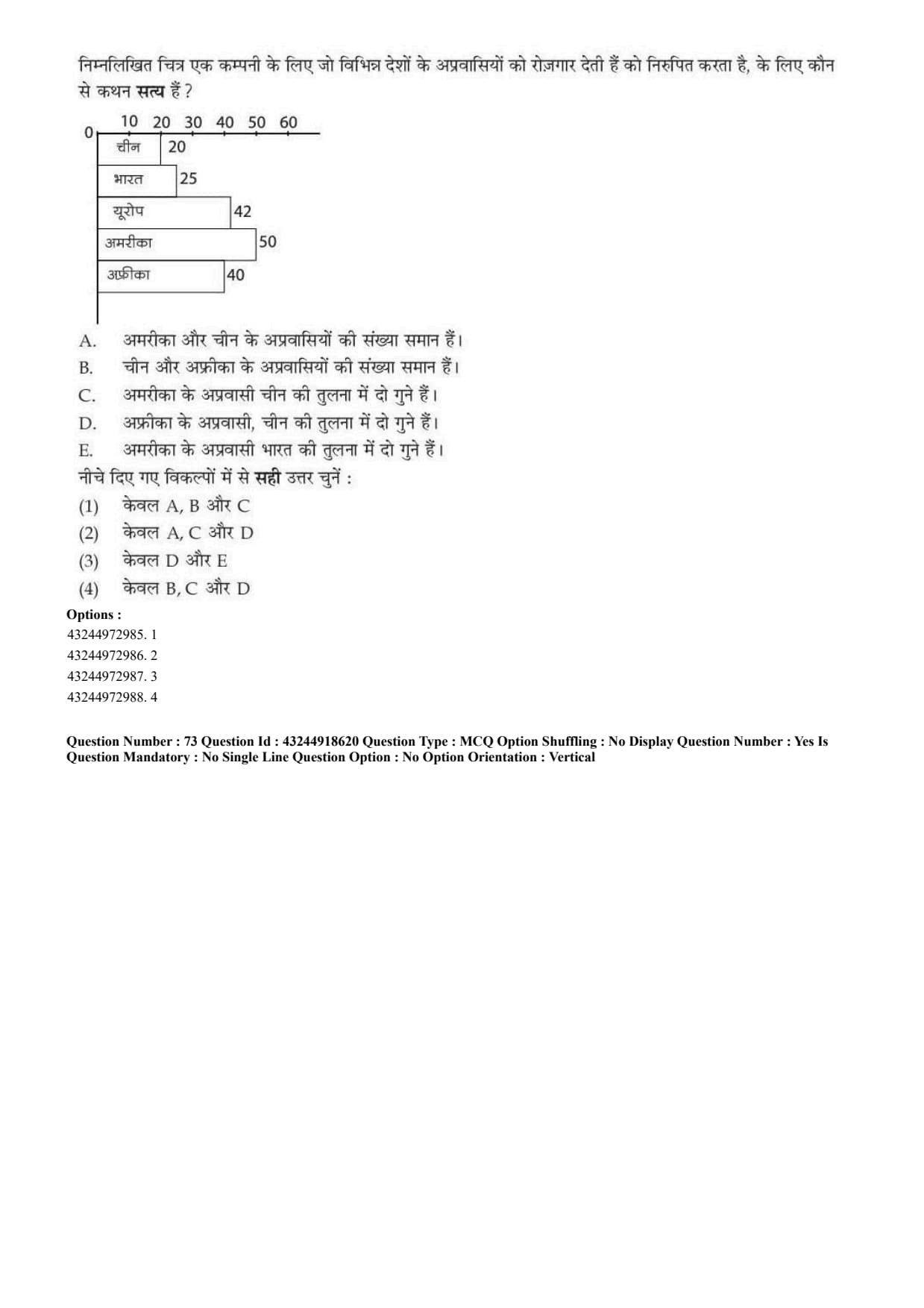
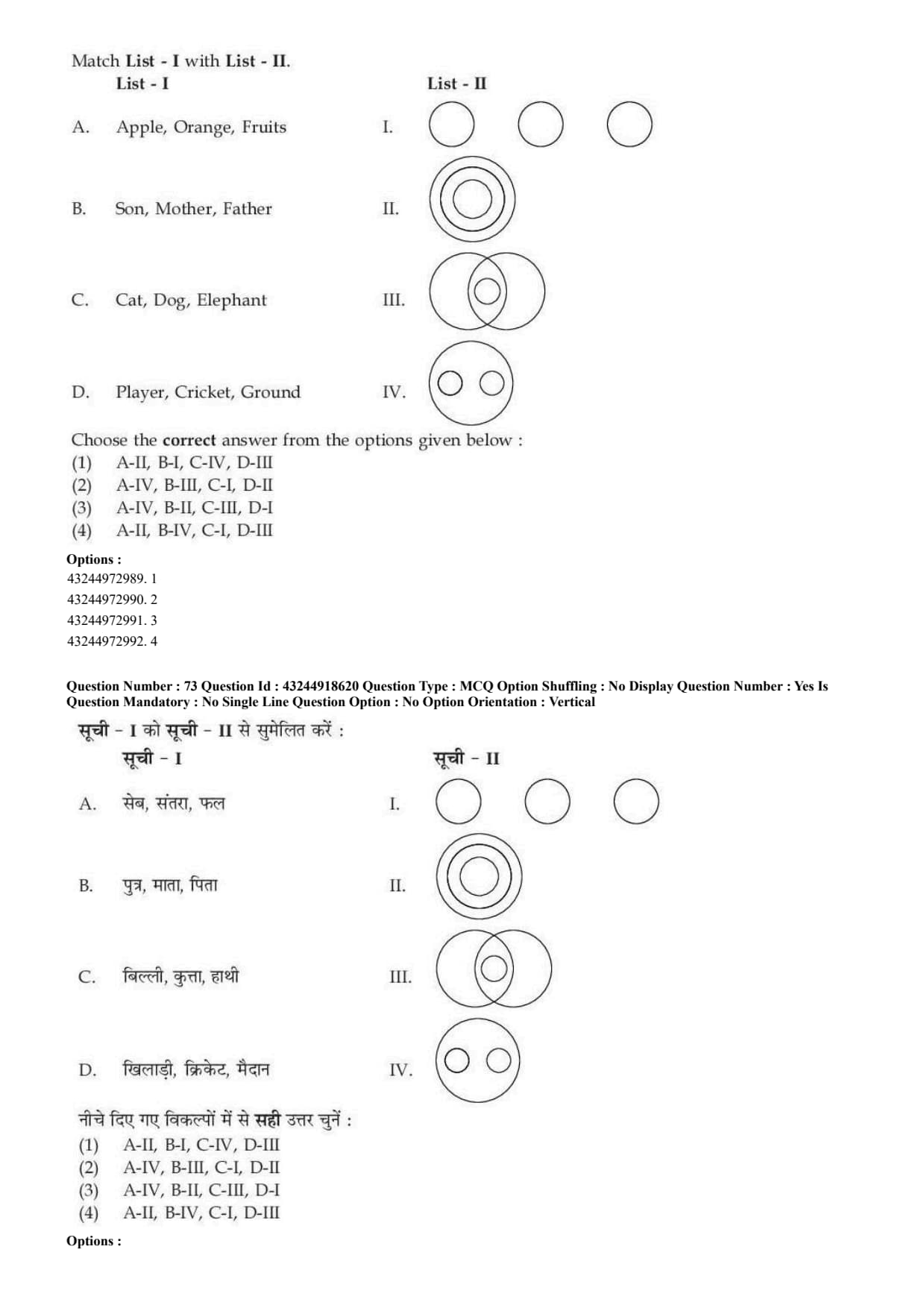
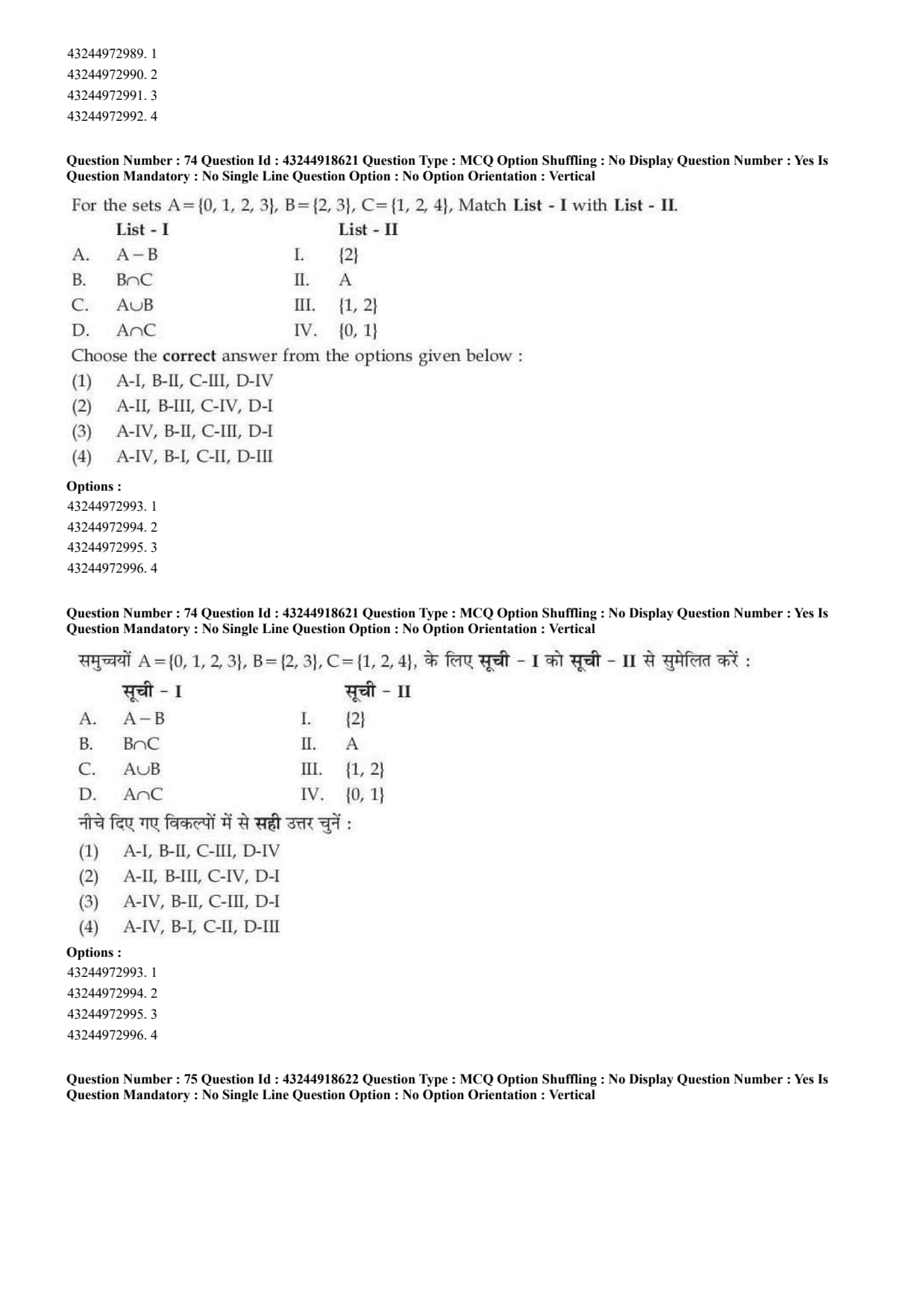
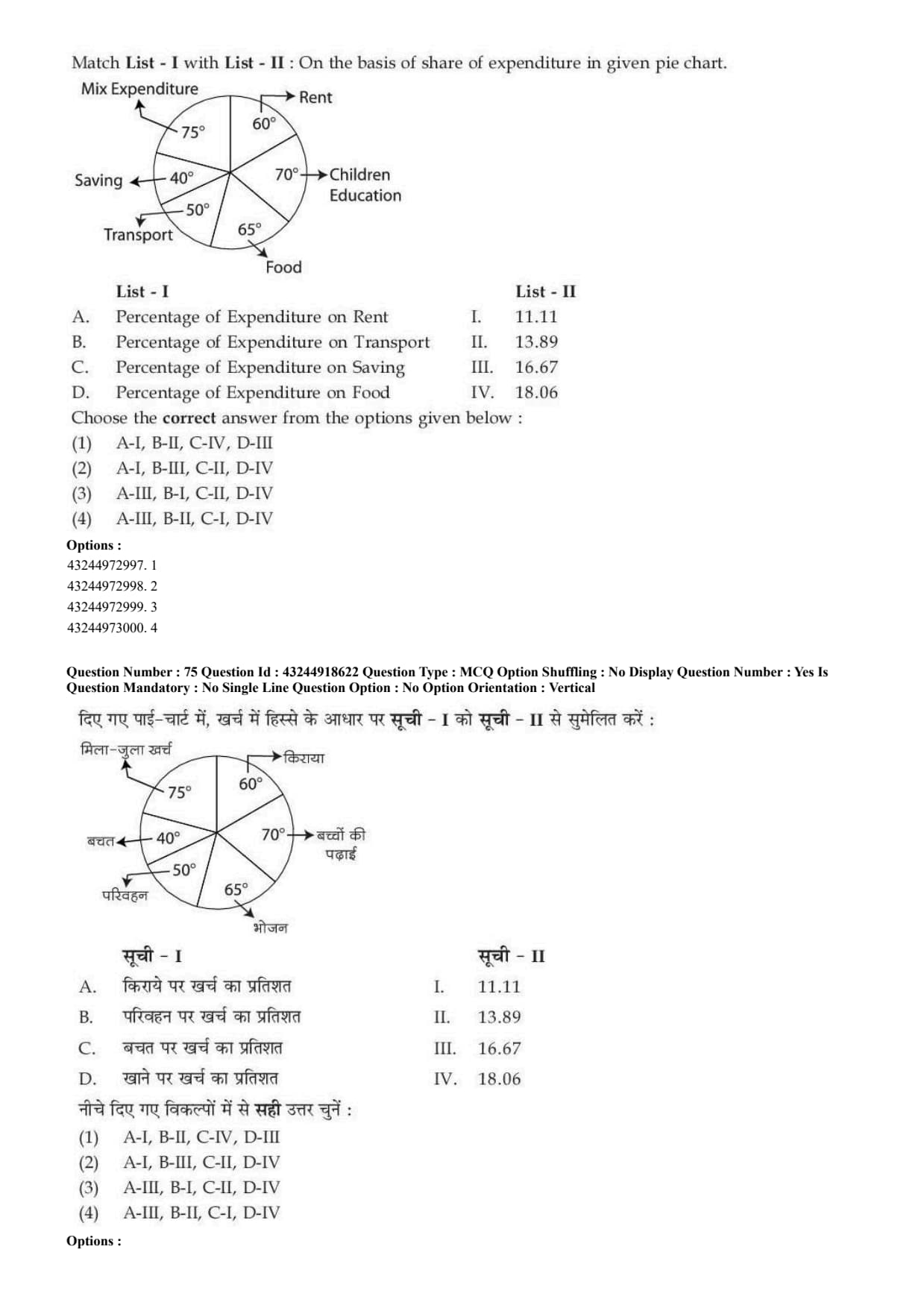
The National Testing Agency (NTA) conducted the CUET PG 2026 General Management (COQP12) exam on March 8, 2026, during Shift 2 (12:30 PM – 02:00 PM). This live update covers the CUET PG General Management 2026 question paper analysis, memory-based questions shared by candidates, and the direct link to download the CUET PG 2026 General Management question paper PDF with solutions.
Based on student feedback, the overall paper was Moderate, with most questions asked from management principles, business environment, quantitative aptitude, logical reasoning, and basic economics.
CUET PG General Management 2026 Question Paper with Solutions PDF
| CUET PG General Management 2026 Question Paper with Answer key | Download PDF | Check Solutions |
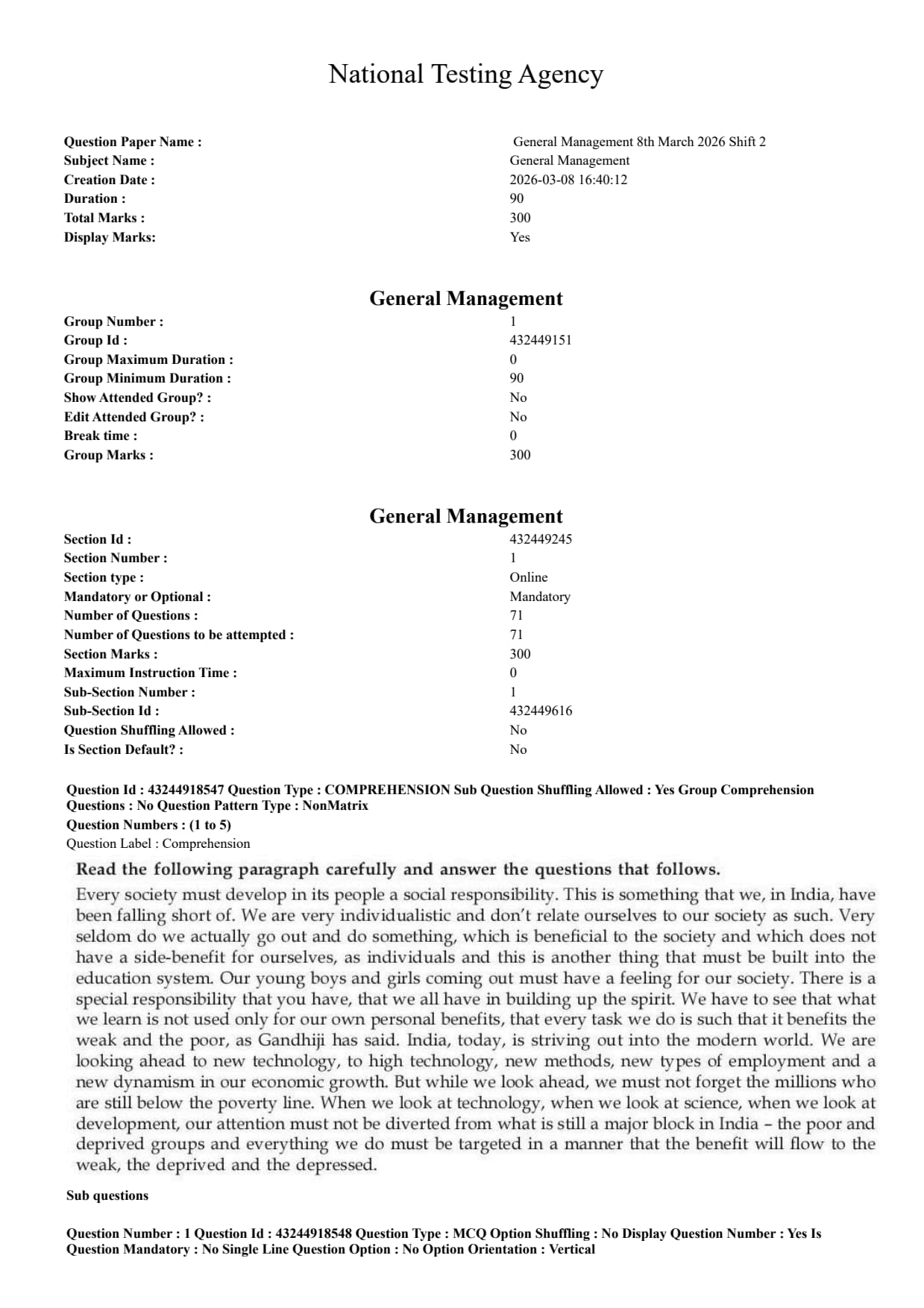
Read the following paragraph carefully and answer the questions that follow.
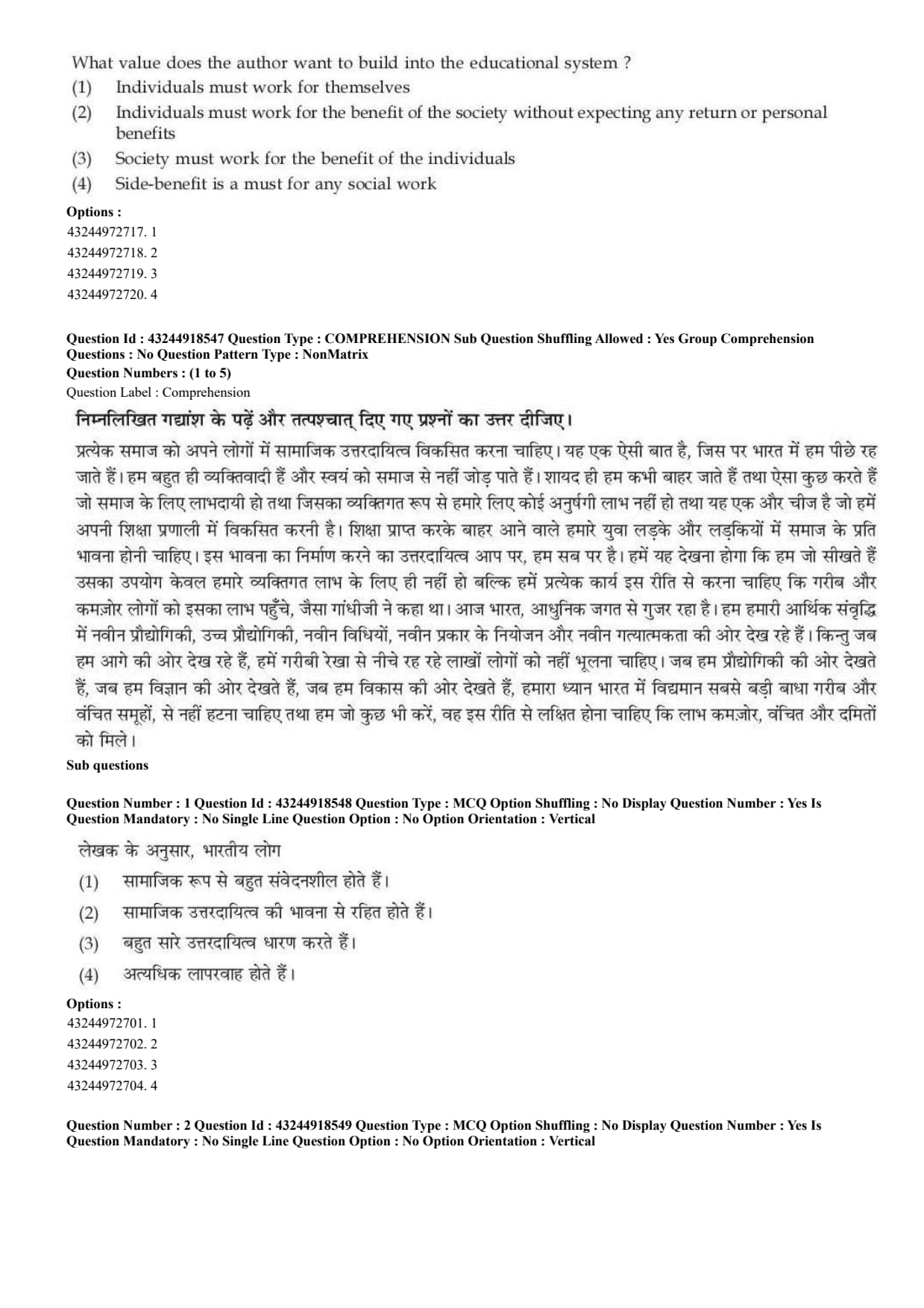
Every society must develop in its people a social responsibility. This is something that we, in India, have been falling short of. We are very individualistic and do not relate ourselves to our society as such. Very seldom do we actually go out and do something, which is beneficial to the society and which does not have a side-benefit for ourselves, as individuals and this is another thing that must be built into the education system. Our young boys and girls coming out must have a feeling for our society. There is a special responsibility that you have, that we all have in building up the spirit. We have to see that what we learn is not used only for our own personal benefits, that every task we do is such that it benefits the weak and the poor, as Gandhiji has said. India, today, is striving out into the modern world. We are looking ahead to new technology, to high technology, new methods, new types of employment and a new dynamism in our economic growth. But while we look ahead, we must not forget the millions who are still below the poverty line. When we look at technology, when we look at science, when we look at development, our attention must not be diverted from what is still a major block in India -- the poor and deprived groups and everything we do must be targeted in a manner that the benefit will flow to the weak, the deprived and the depressed.
Question 1:
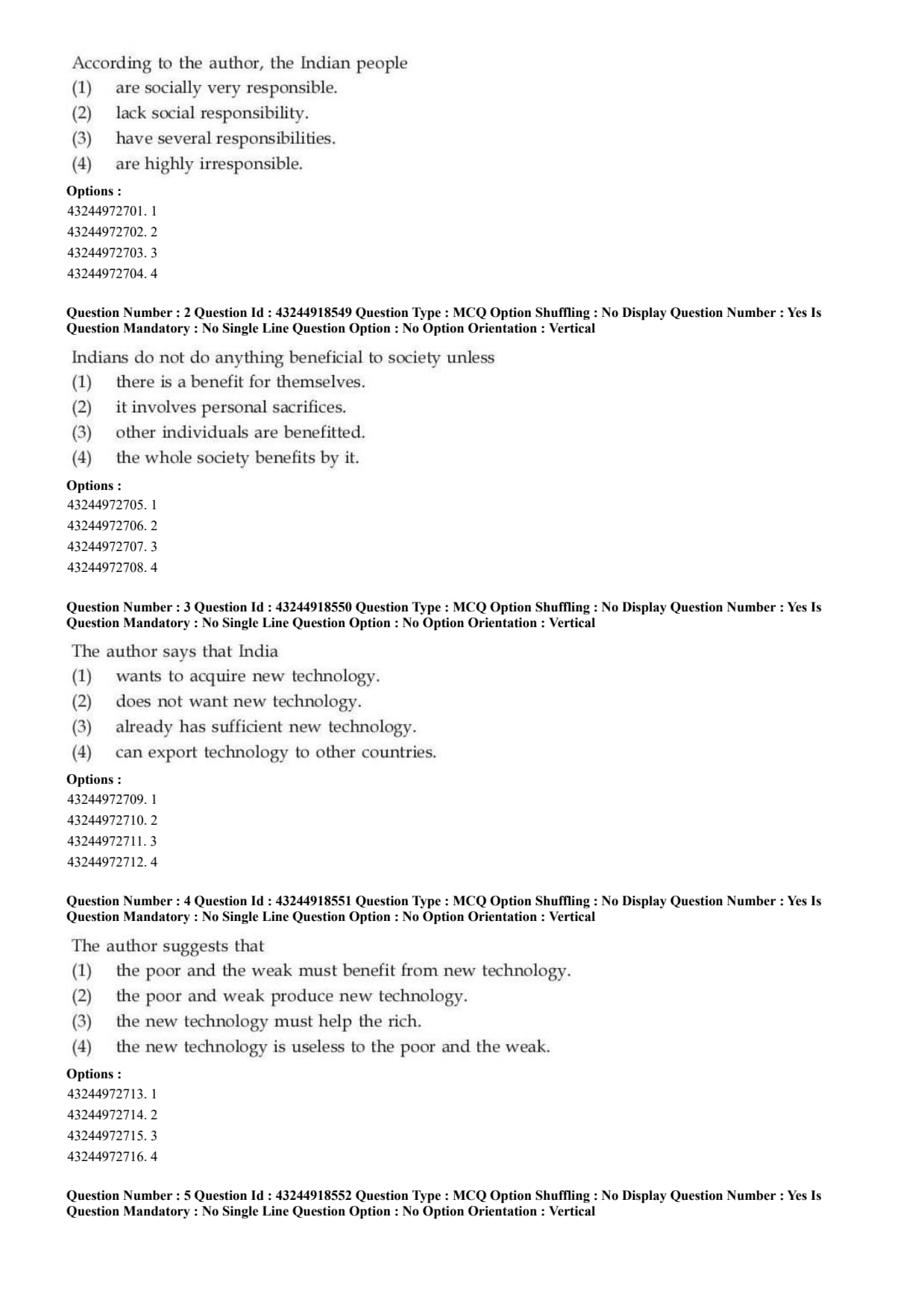
According to the author, the Indian people
View Solution
Step 1: Understanding the Question:
The question asks us to identify the author's opinion about the social responsibility of Indian people based on the given passage.
Step 2: Detailed Explanation:
The author begins by emphasizing that every society must develop social responsibility among its people.
The passage explicitly states that in India, people have been \textit{falling short in this regard.
The author further explains that Indians are often very individualistic and rarely engage in activities that benefit society without some personal gain.
This statement clearly indicates a deficiency in social responsibility rather than complete irresponsibility.
Option (A) contradicts the passage because the author does not praise Indians for being socially responsible.
Option (C) is partially true in a general sense, but it does not capture the specific message of the passage.
Option (D) is too extreme because the author says people are falling short, not that they are entirely irresponsible.
Therefore, the best interpretation is that the author believes Indians generally lack adequate social responsibility.
The passage also connects this deficiency to the need for educational reform and social awareness.
Hence, the correct answer is the option that directly reflects the author's criticism regarding social responsibility.
Step 3: Final Answer:
(B) lack social responsibility. Quick Tip: In reading comprehension, focus on the author's exact words such as ``falling short'' and ``very individualistic.'' These phrases often reveal the central idea and help eliminate extreme options.
Indians do not do anything beneficial to society unless
View Solution
Step 1: Understanding the Question:
We must identify the condition that the author associates with people performing socially beneficial actions.
Step 2: Detailed Explanation:
The passage states that people seldom do something beneficial to society that does not have a side-benefit for themselves.
This means personal gain often becomes the motivating factor behind social action.
Option (A) directly captures this idea by saying that there is a benefit for themselves.
Option (B) is incorrect because the author does not discuss sacrifice as the condition.
Option (C) is too vague and does not address the author's criticism regarding self-interest.
Option (D) is the opposite of the intended meaning because the issue is not whether society benefits, but whether individuals receive personal benefit.
The author uses this observation to argue that education should cultivate a genuine feeling for society and service.
Thus, the passage clearly supports the interpretation given in option (A).
Step 3: Final Answer:
(A) there is a benefit for themselves. Quick Tip: When answering comprehension questions, locate the sentence in the passage that most closely matches the wording of the question. This often provides the answer directly.
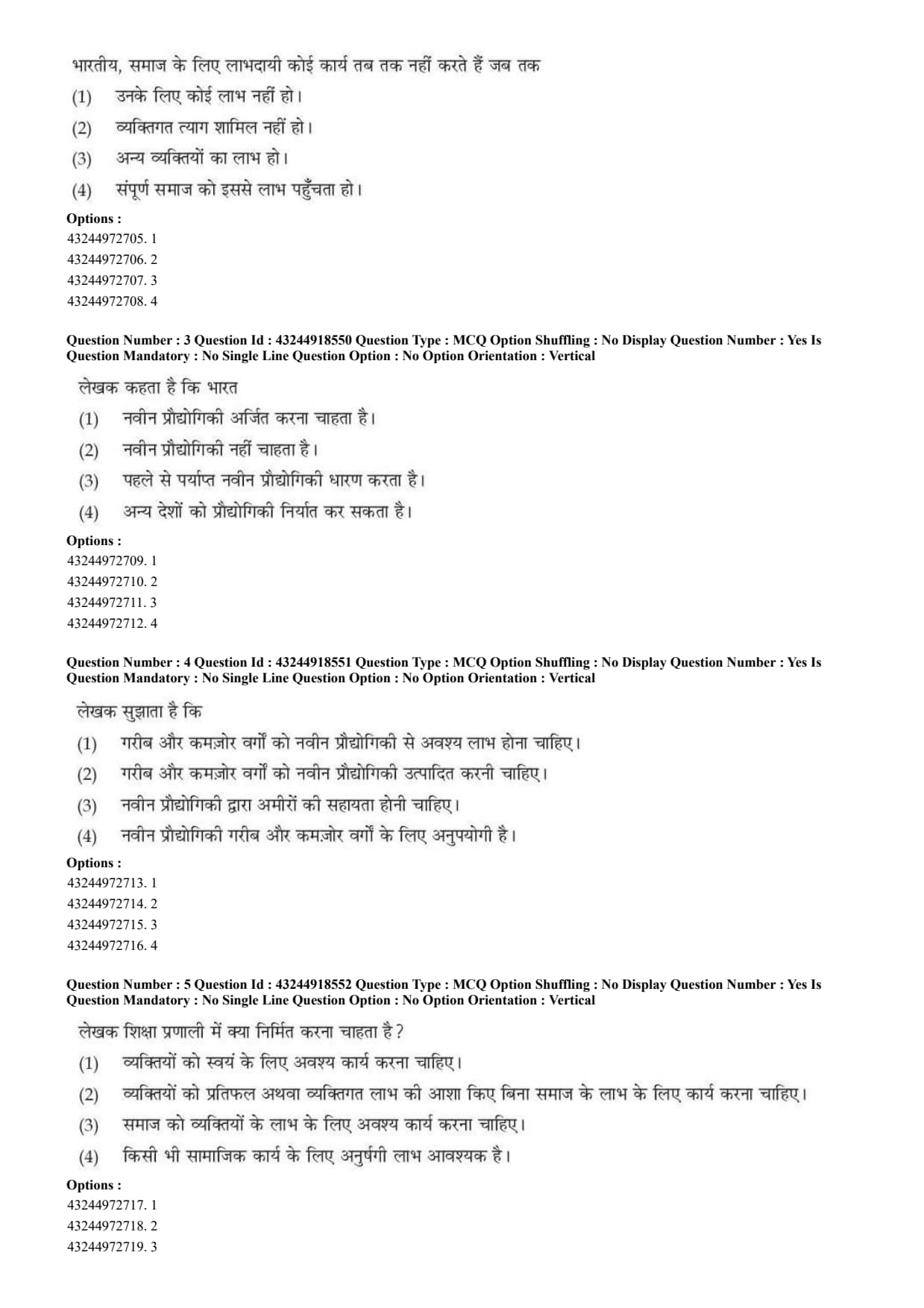
The author says that India
View Solution
Step 1: Understanding the Question:
This question asks us to identify what the author says about India's technological aspirations.
Step 2: Detailed Explanation:
The passage clearly states that India is striving into the modern world.
The author mentions looking ahead to new technology, high technology, new methods, and new forms of employment.
These statements indicate a desire to embrace technological progress and modernization.
Option (A) accurately reflects this viewpoint.
Option (B) is incorrect because the author explicitly supports moving toward new technology.
Option (C) is unsupported; nowhere does the passage say India already possesses sufficient technology.
Option (D) is also unsupported because the passage does not discuss exporting technology.
The important nuance is that while the author welcomes technological advancement, he also warns against forgetting the poor and deprived sections of society.
Therefore, the correct answer is option (A).
Step 3: Final Answer:
(A) wants to acquire new technology. Quick Tip: Pay attention to transition words like ``but.'' They often show that the author supports one idea while also adding a caution or limitation.
The author suggests that
View Solution
Step 1: Understanding the Question:
We need to determine the author's recommendation regarding technology and social welfare.
Step 2: Detailed Explanation:
The author repeatedly stresses that development should benefit the weak, the poor, and the deprived.
He warns that attention should not be diverted from the major problem of poverty while pursuing science and technology.
The passage concludes that everything we do should be targeted so that benefits flow to the weak and depressed sections.
Option (A) expresses exactly this idea.
Option (B) is incorrect because the passage does not discuss who creates technology.
Option (C) contradicts the author's concern for disadvantaged groups.
Option (D) is also incorrect because the author believes technology should be used to help them, not that it is useless to them.
Thus, the central message is inclusive development where technological progress reaches all sections of society.
Hence, option (A) is the correct answer.
Step 3: Final Answer:
(A) the poor and the weak must benefit from new technology. Quick Tip: In social-theme passages, identify the author's final emphasis. The concluding sentences frequently contain the main recommendation and help answer inference questions.
What value does the author want to build into the educational system?
View Solution
Step 1: Understanding the Question:
The question asks us to identify the educational value that the author believes should be developed among young people.
Step 2: Detailed Explanation:
The author states that social responsibility is something that must be built into the education system.
He criticizes the tendency to engage in social activities only when there is a personal advantage.
The passage says that young boys and girls should develop a feeling for society and use their learning not merely for personal benefit.
Gandhiji's idea is cited to emphasize service to the weak and the poor.
Option (B) perfectly summarizes this value of selfless social service.
Option (A) contradicts the author's criticism of excessive individualism.
Option (C) reverses the direction of responsibility described in the passage.
Option (D) is the exact attitude that the author wants to change through education.
Therefore, the educational system should nurture social commitment, empathy, and service without expectation of personal reward.
Hence, option (B) is the correct answer.
Step 3: Final Answer:
(B) Individuals must work for the benefit of society without expecting any return or personal benefit. Quick Tip: For value-based comprehension questions, identify the lesson the author wants readers to learn. This is usually repeated several times throughout the passage.
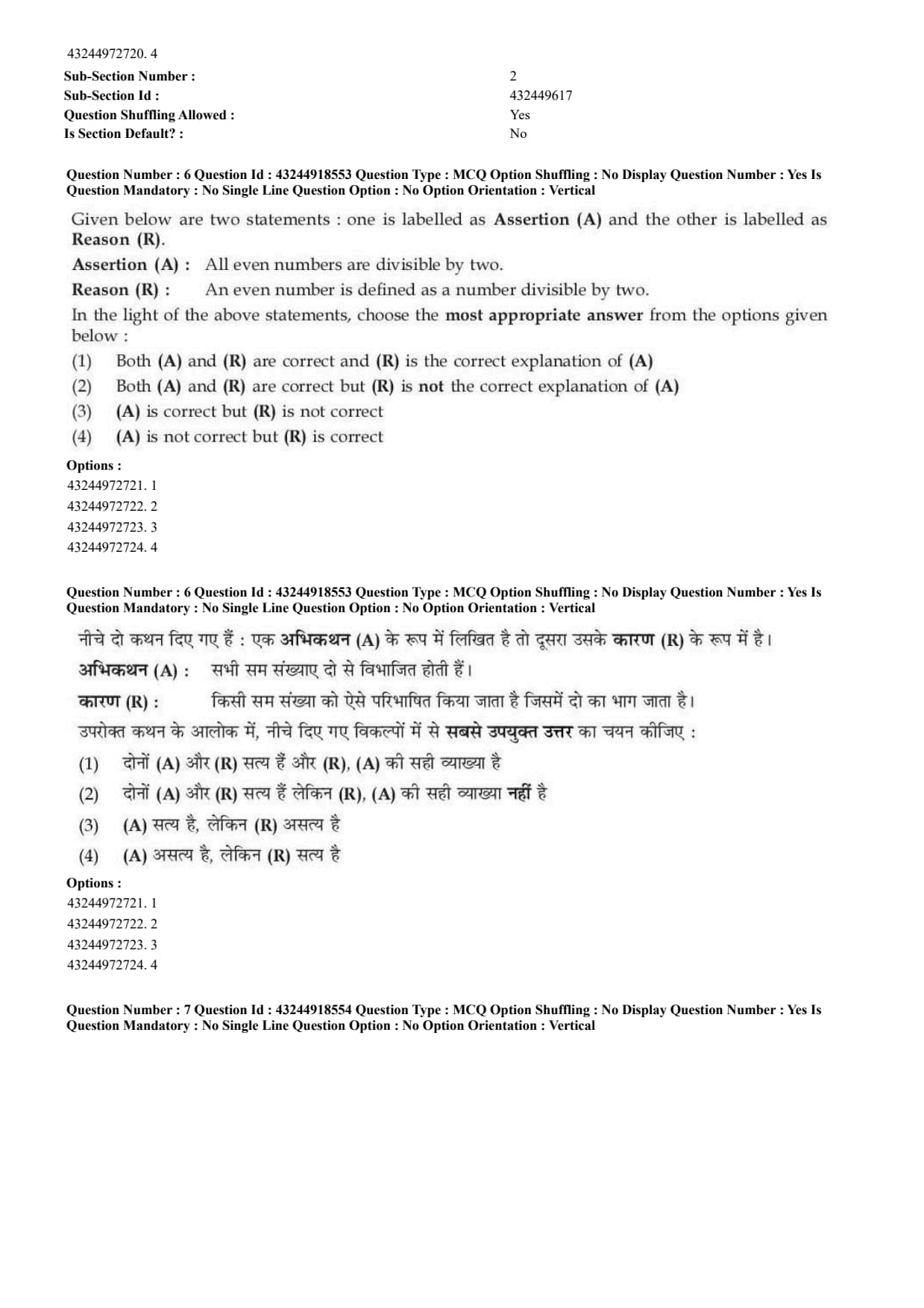
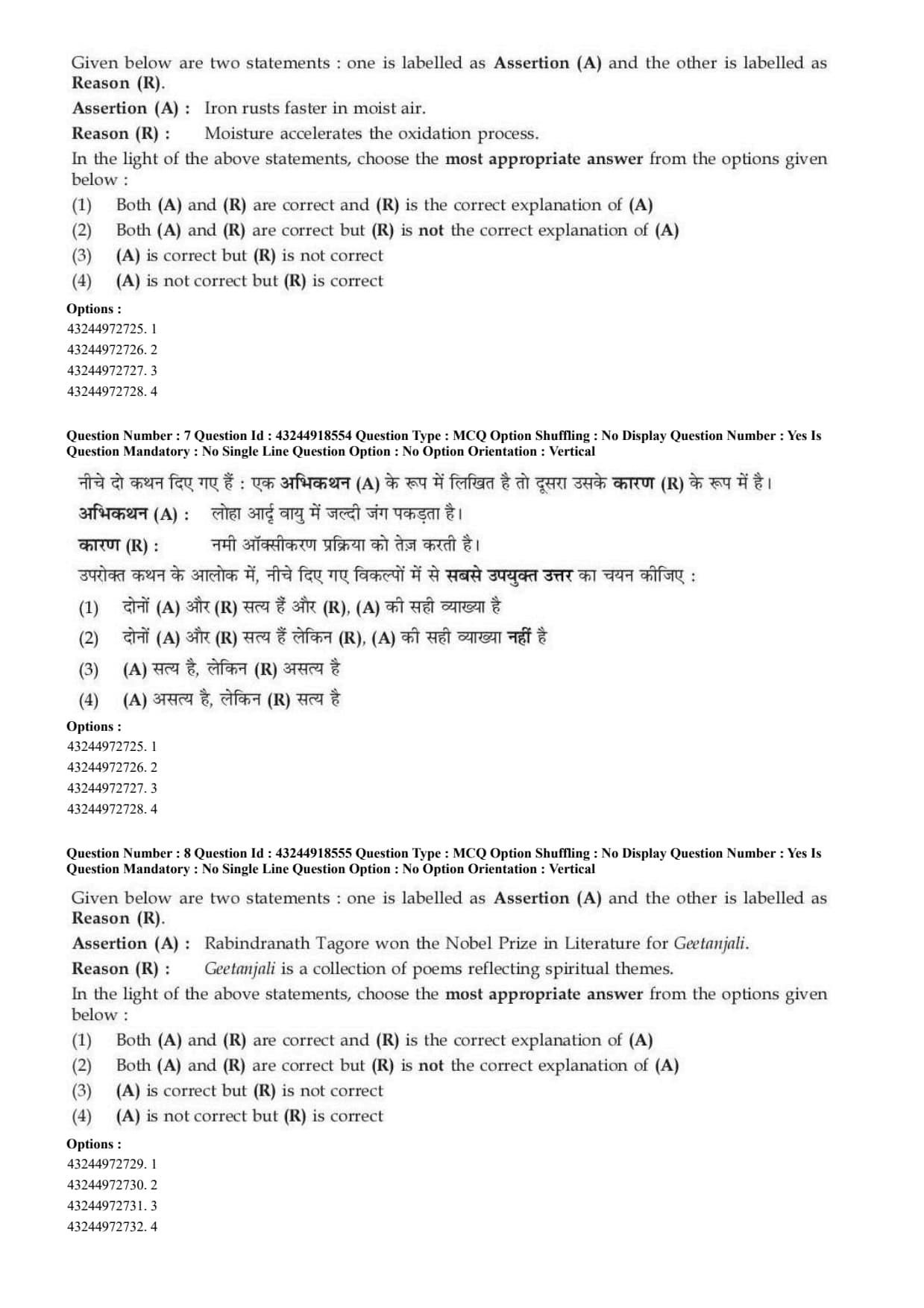
Given below are two statements: one is labelled as Assertion (A) and the other is labelled as Reason (R).
Assertion (A): All even numbers are divisible by two.
Reason (R): An even number is defined as a number divisible by two. In the light of the above statements, choose the most appropriate answer from the options given below.
View Solution
Step 1: Understanding the Question:
This is an assertion-reason question that tests the understanding of the mathematical definition of an even number.
Step 2: Key Formula or Approach:
A number is even if it can be written as \(2k\), where \(k\) is an integer.
Step 3: Detailed Explanation:
Assertion (A) states that all even numbers are divisible by two. This is true by definition.
Reason (R) states that an even number is defined as a number divisible by two. This is also true.
The reason directly explains why the assertion is true because the assertion is simply a restatement of the definition.
Examples such as \(4, 8,\) and \(20\) are all divisible by \(2\), and hence they are even numbers.
Since both statements are correct and the reason fully explains the assertion, the first option must be selected.
Step 4: Final Answer:
(A) Both (A) and (R) are correct and (R) is the correct explanation of (A). Quick Tip: In assertion-reason questions, first determine the truth of each statement separately, then check whether the reason actually explains the assertion.
Given below are two statements: one is labelled as Assertion (A) and the other is labelled as Reason (R).
Assertion (A): Iron rusts faster in moist air.
Reason (R): Moisture accelerates the oxidation process. In the light of the above statements, choose the most appropriate answer from the options given below.
View Solution
Step 1: Understanding the Question:
This assertion-reason question tests basic scientific understanding of rusting and oxidation.
Step 2: Key Formula or Approach:
Rusting is the oxidation of iron in the presence of oxygen and moisture.
Step 3: Detailed Explanation:
Assertion (A) is true because iron rusts more rapidly when moisture is present.
Reason (R) is also true because water acts as a medium that facilitates the oxidation reaction.
The reason directly explains the assertion.
In dry air, rusting occurs much more slowly, while in moist conditions the process accelerates significantly.
Therefore, both statements are true and the reason correctly explains the assertion.
Step 4: Final Answer:
(A) Both (A) and (R) are correct and (R) is the correct explanation of (A). Quick Tip: Remember that rusting requires both oxygen and moisture. Whenever moisture increases, the oxidation of iron generally becomes faster.
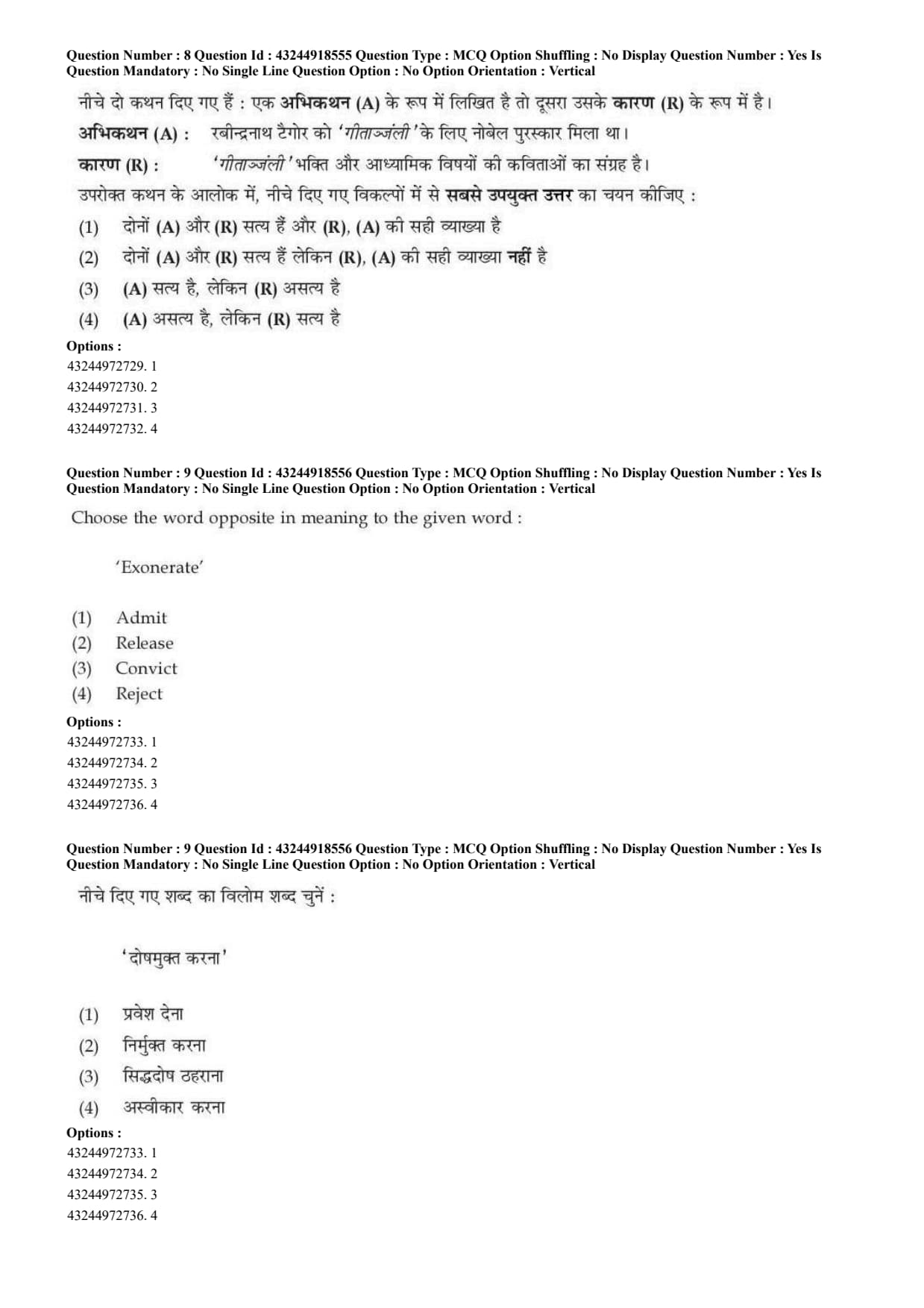
Given below are two statements: one is labelled as Assertion (A) and the other is labelled as Reason (R).
Assertion (A): Rabindranath Tagore won the Nobel Prize in Literature for Gitanjali.
Reason (R): Gitanjali is a collection of poems reflecting spiritual themes. In the light of the above statements, choose the most appropriate answer from the options given below.
View Solution
Step 1: Understanding the Question:
We must judge the truth of the assertion and reason and determine whether the reason explains the assertion.
Step 2: Detailed Explanation:
Assertion (A) is true. Rabindranath Tagore received the Nobel Prize in Literature in 1913, and \textit{Gitanjali was the work for which he became internationally celebrated.
Reason (R) is also true. \textit{Gitanjali contains poems with deep spiritual and philosophical themes.
However, the reason merely describes the nature of the work. It does not directly explain the historical fact that Tagore received the Nobel Prize.
Therefore, both statements are correct, but the explanatory relationship is absent.
Hence, the appropriate option is the second one.
Step 3: Final Answer:
(B) Both (A) and (R) are correct but (R) is not the correct explanation of (A). Quick Tip: In assertion-reason questions, do not assume that two true statements automatically have an explanatory relationship. Check whether the reason actually answers the question ``why''.
Choose the word opposite in meaning to the given word: `Exonerate'.
View Solution
Step 1: Understanding the Question:
This is a vocabulary question that asks for the antonym of the word ``Exonerate.''
Step 2: Detailed Explanation:
``Exonerate'' means to free someone from blame, guilt, or accusation.
The opposite idea is to declare someone guilty after legal or moral judgment.
``Convict'' means to find a person guilty of a crime, making it the direct antonym.
``Release'' is closer to the meaning of exonerate and therefore cannot be the opposite.
``Admit'' and ``Reject'' do not express the required legal opposite.
Thus, the best answer is option (C).
Step 3: Final Answer:
(C) Convict Quick Tip: For antonym questions, first identify the precise meaning of the given word and then choose the option that expresses the reverse idea in the same context.
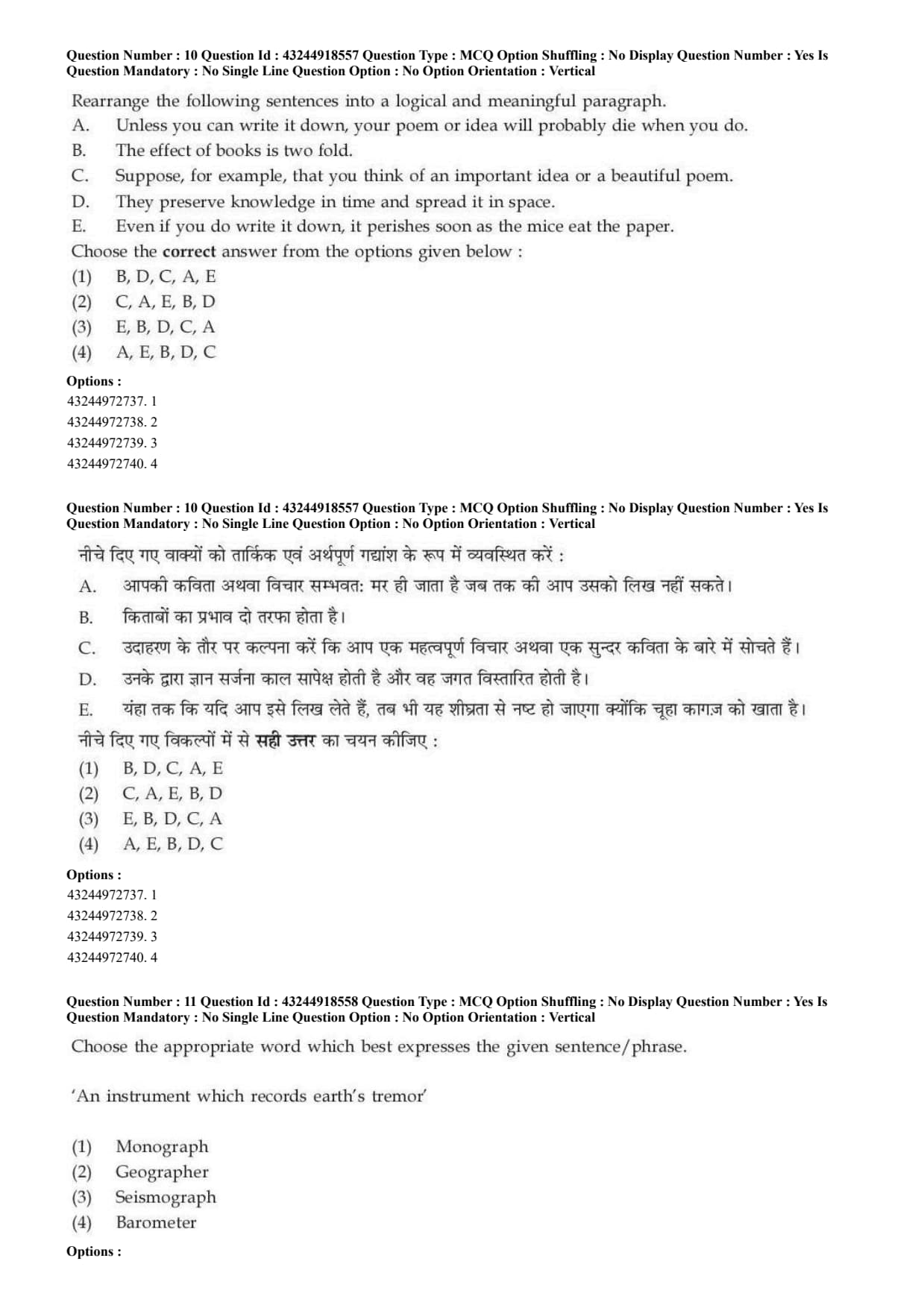
Rearrange the following sentences into a logical and meaningful paragraph.
A. Unless you can write it down, your poem or idea will probably die when you do.
B. The effect of books is two fold.
C. Suppose, for example, that you think of an important idea or a beautiful poem.
D. They preserve knowledge in time and spread it in space.
E. Even if you do write it down, it perishes as soon as the mice eat the paper.
Choose the correct answer from the options given below.
View Solution
Step 1: Understanding the Question:
This question tests the ability to arrange sentences into a coherent paragraph.
Step 2: Detailed Explanation:
Sentence B is the best opening because it introduces the topic: the twofold effect of books.
Sentence D naturally follows because it explains what those two effects are, namely preserving knowledge through time and spreading it across space.
Sentence C then provides an illustrative example by asking the reader to imagine an important idea or poem.
Sentence A logically follows because it says that if the idea is not written down, it may disappear with the thinker.
Sentence E continues the same line of thought by adding that even a written document can perish physically.
Thus, the sequence develops from a general statement to an explanation and then to a specific example and its consequences.
The most coherent arrangement is B, D, C, A, E.
Step 3: Final Answer:
(A) B, D, C, A, E Quick Tip: In sentence rearrangement, identify the introductory sentence first, then connect explanatory and example sentences through pronouns, logical flow, and continuity of ideas.
Choose the appropriate word which best expresses the given sentence/phrase:
'An instrument which records earth's tremor'
View Solution
Step 1: Understanding the Question:
The question is a standard one-word substitution from English vocabulary.
It asks for the specific scientific term used to describe an instrument that detects and records the vibrations, tremors, or seismic waves produced by an earthquake.
Step 2: Detailed Explanation:
Seismograph (Correct Option): A seismograph is an instrument that detects and records ground motion caused by earthquakes, volcanic eruptions, and other seismic sources. The word comes from the Greek words "seismos" meaning earthquake and "grapho" meaning to write. It consists of a sensor (seismometer) and a recording system.
Monograph: A monograph is a detailed written study, specialist work, or book on a single specialized subject or an aspect of it, usually written by a single author. It has no connection to geographical or geological measurements.
Geographer: A geographer is a scholar or scientist whose area of study is geography, the study of Earth's natural environment and human society. This is a profession, not an measuring instrument.
Barometer: A barometer is a scientific instrument used to measure atmospheric pressure, which is crucial for forecasting weather changes. It does not measure tectonic or seismic movements.
Step 3: Final Answer:
Based on the definitions of the options, the instrument that records earth's tremors is a seismograph.
Therefore, the correct choice is option (C).
Quick Tip: Look at the root words to decode unfamiliar terms:
"Seismo-" is a prefix derived from Greek, referring to earthquakes or vibrations.
"-graph" represents a recording or writing device.
Combining these yields "Seismograph", the instrument that records tremors.
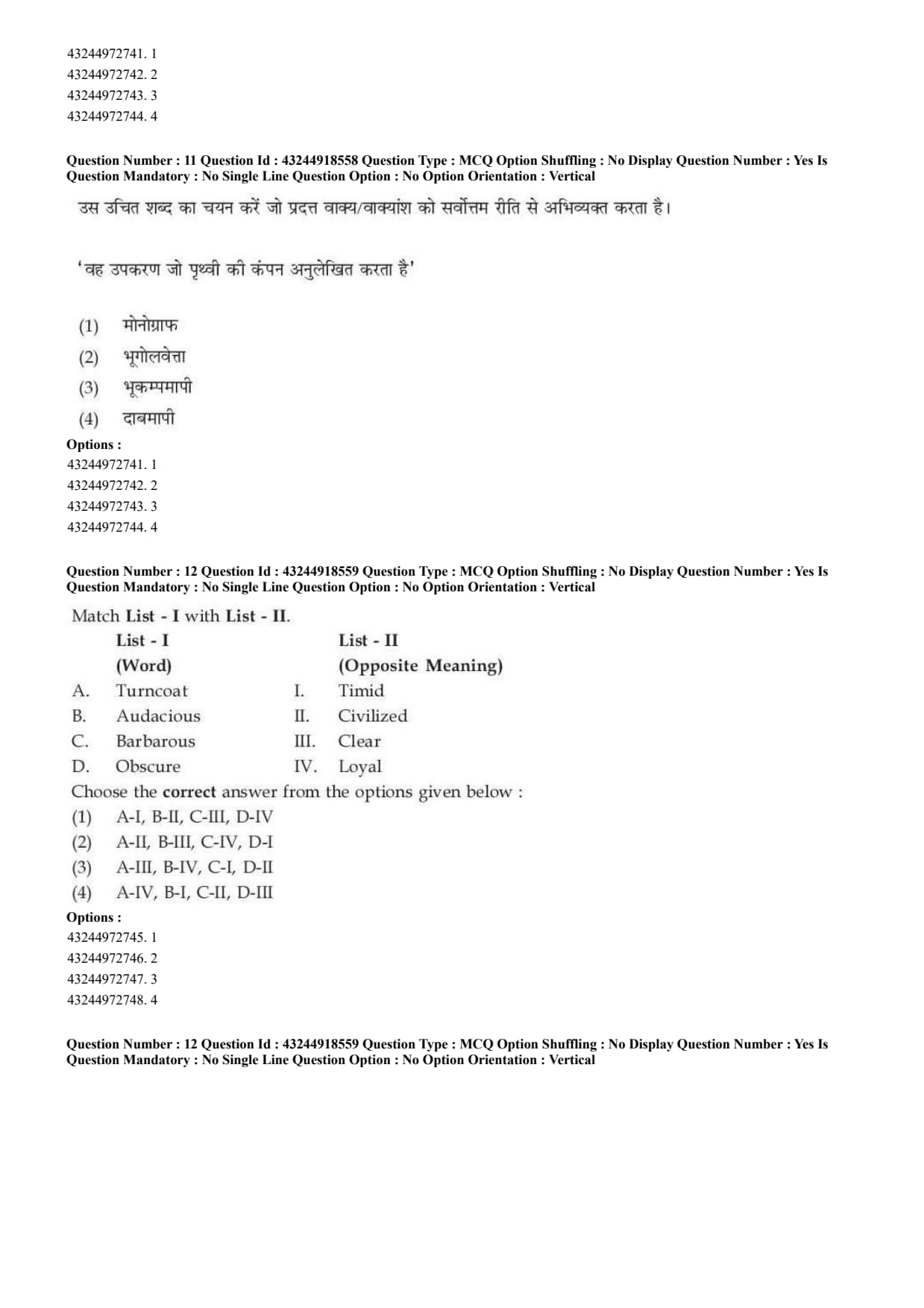
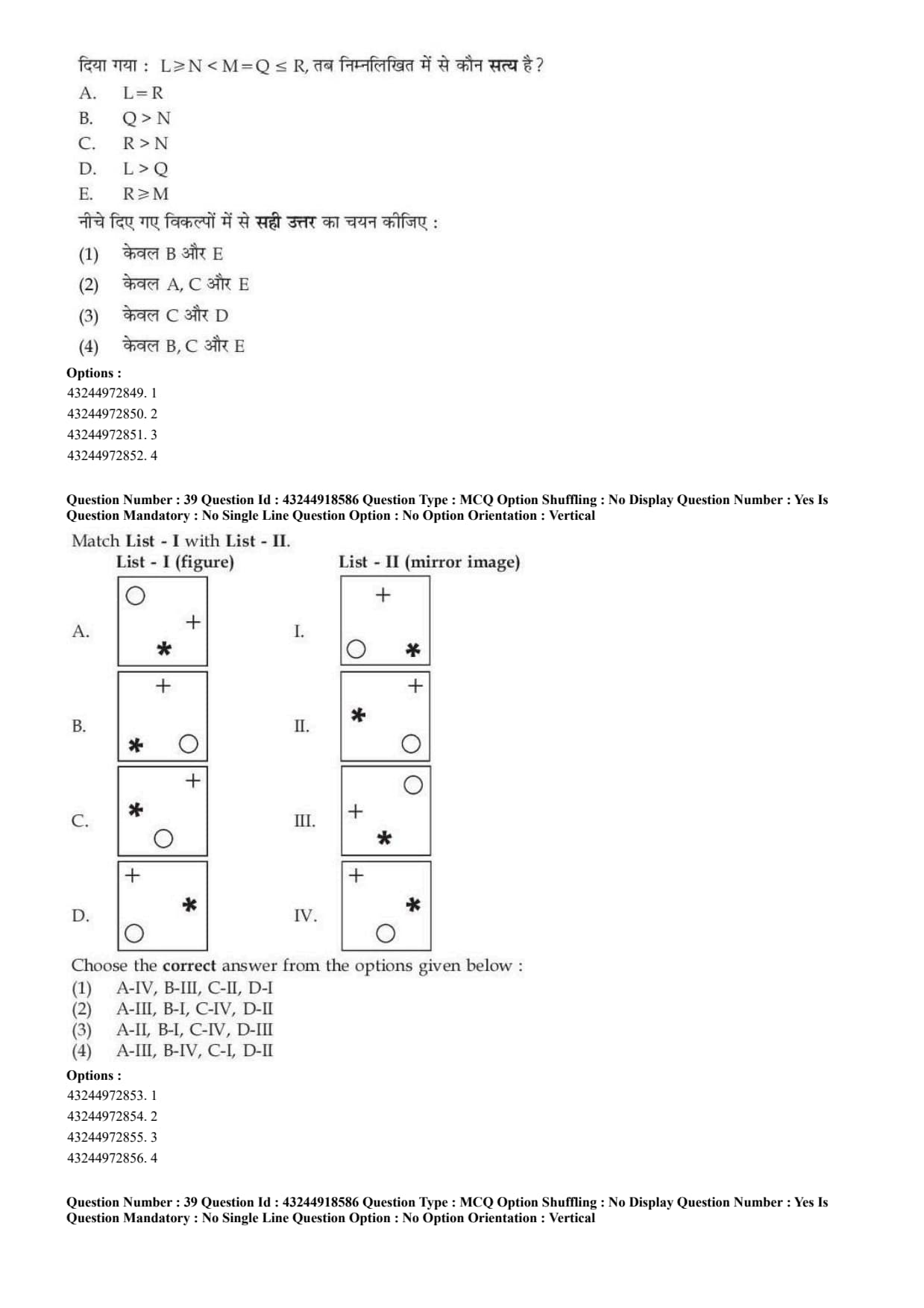
Match List - I with List - II.
Choose the correct answer from the options given below:
View Solution
Step 1: Understanding the Question:
The question requires matching vocabulary words in List-I with their direct antonyms (opposite meanings) provided in List-II.
Each word must be analyzed for its standard definition, and its direct contrast must be identified to determine the correct pairing.
Step 2: Detailed Explanation:
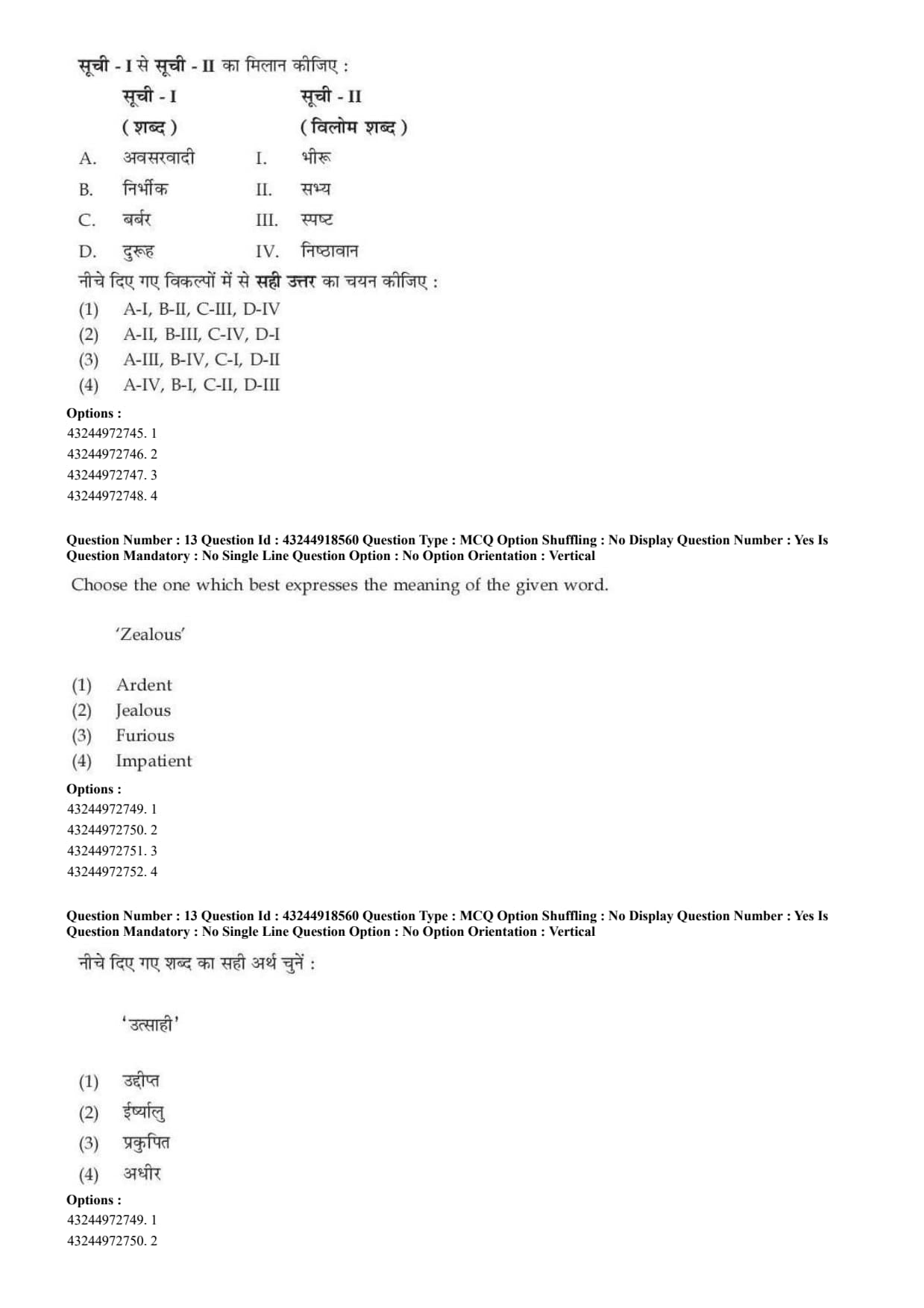
Turncoat (A): A turncoat is a person who deserts one party, cause, or alliance to join another. It represents disloyalty or betrayal. The exact opposite of a turncoat is a person who remains faithful, which is "Loyal" (IV). Therefore, A matches with IV.
Audacious (B): Audacious means showing a willingness to take surprisingly bold risks, or being extremely daring and courageous. The opposite of being bold or daring is being fearful or hesitant, which is "Timid" (I). Therefore, B matches with I.
Barbarous (C): Barbarous means extremely brutal, uncivilized, wild, or primitive. The direct opposite of a primitive or brutal state is being sophisticated, polite, and socialized, which is "Civilized" (II). Therefore, C matches with II.
Obscure (D): Obscure means not discovered or known about, uncertain, or difficult to see or understand. The opposite of something that is hidden or unclear is something that is easily understood or visible, which is "Clear" (III). Therefore, D matches with III.
Step 3: Final Answer:
By combining the matches:
A is paired with IV.
B is paired with I.
C is paired with II.
D is paired with III.
This matching sequence is represented in option (D).
Quick Tip: In match-the-following questions, begin with the easiest and most familiar words.
For example, "Obscure" is commonly used to describe unclear things, matching easily with "Clear".
Once you match one or two pairs, look at the options to eliminate incorrect combinations and save time during the exam.
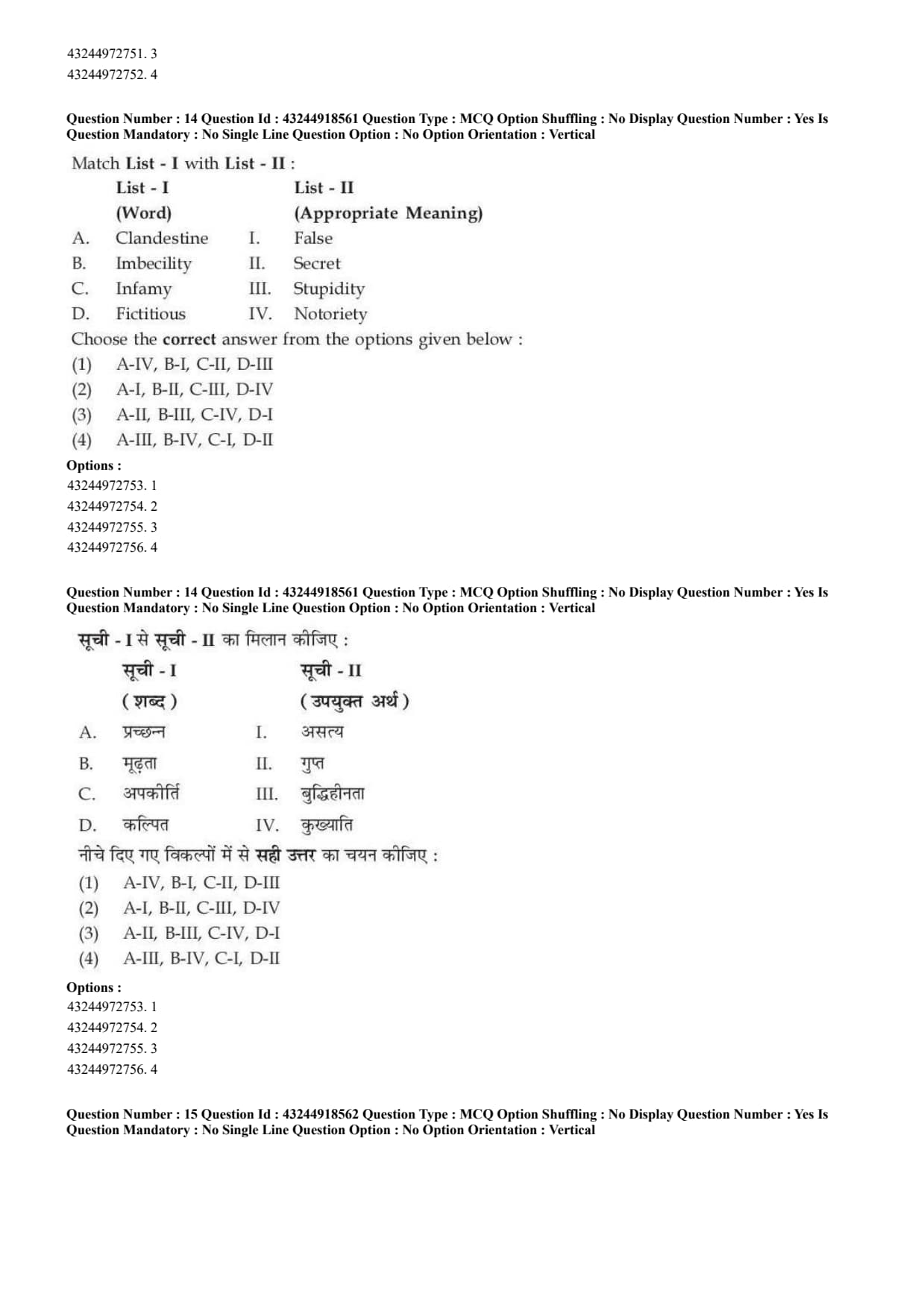
Choose the one which best expresses the meaning of the given word:
'Zealous'
View Solution
Step 1: Understanding the Question:
The question asks to identify the word that is a synonym or closely shares the same meaning as the word "Zealous".
This test assesses vocabulary strength and the ability to differentiate between similar-sounding words.
Step 2: Detailed Explanation:
Zealous: This adjective describes someone who has or shows great energy, passion, or enthusiasm in pursuit of a cause, objective, or activity. It is associated with positive devotion and earnestness.
Ardent (Correct Option): Ardent means very enthusiastic, passionate, or characterized by intense emotion or devotion. Since both "zealous" and "ardent" share the core meaning of deep passion and enthusiasm, they are direct synonyms.
Jealous: Jealous refers to feeling or showing envy of someone else's achievements, advantages, or possessions. Although "zealous" and "jealous" sound phonetically similar, their meanings are entirely different.
Furious: Furious means extremely angry, or full of wild, intense anger. It has a negative connotation of anger, which does not match the positive passion of zealous.
Impatient: Impatient means having or showing a tendency to be quickly irritated or provoked by delay or opposition. It describes a lack of patience, which is distinct from being enthusiastic.
Step 3: Final Answer:
Since "Ardent" best represents the meaning of passion and devotion represented by "Zealous", the correct option is (A).
Quick Tip: Beware of homophones and words that sound similar but have different meanings.
"Zealous" (passionate) and "Jealous" (envious) are common distractors used in exams due to their phonetic similarity.
Remember that "Zeal" relates to enthusiasm, while "Jealousy" relates to envy.
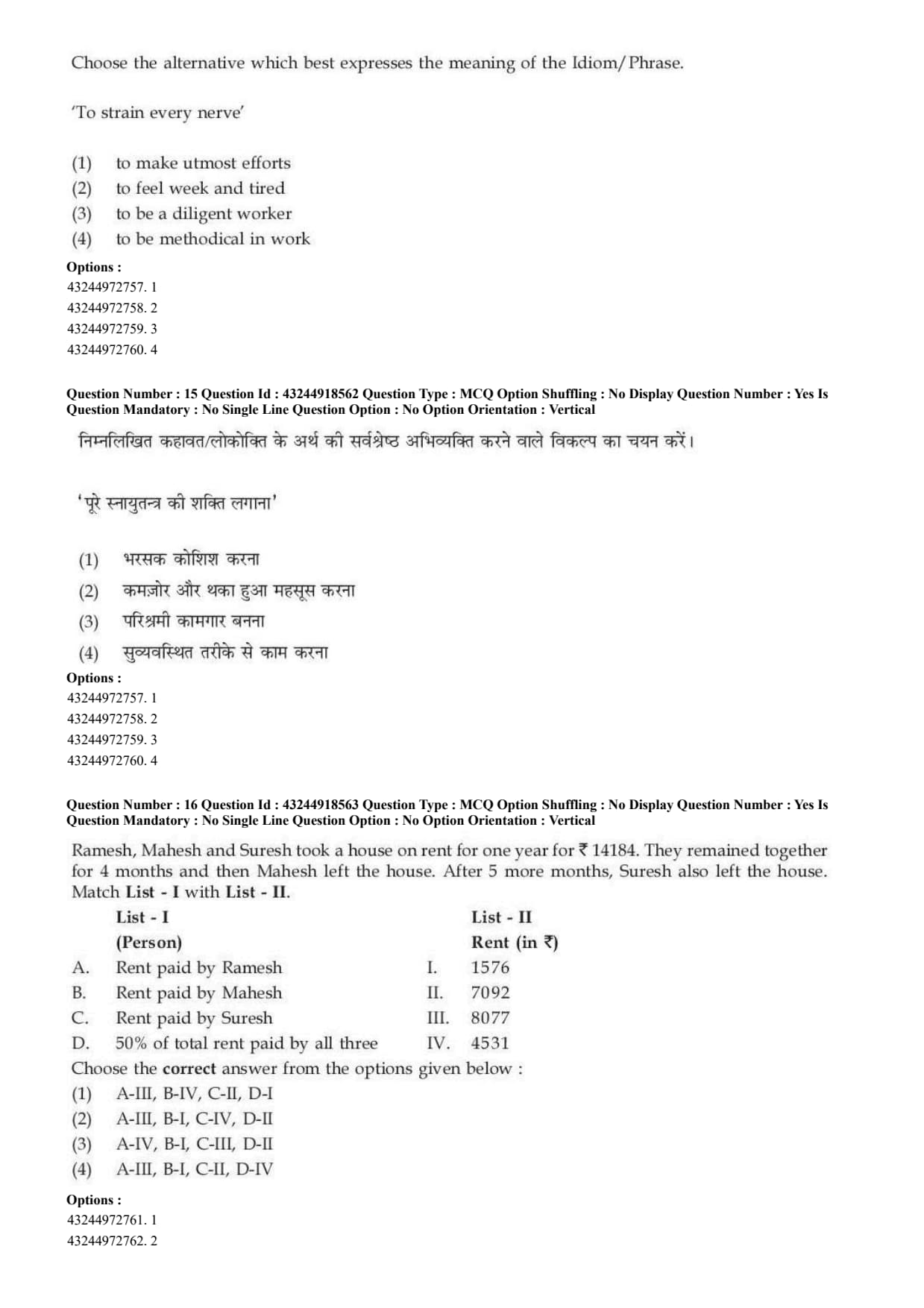
Match List - I with List - II.
Choose the correct answer from the options given below:
View Solution
Step 1: Understanding the Question:
This question asks to match vocabulary words in List-I with their appropriate meanings or synonyms listed in List-II.
Understanding the context and exact definitions of these descriptive English words is key to matching them correctly.
Step 2: Detailed Explanation:
Clandestine (A): This word describes an action or plan kept secret or done secretively, especially because it is illicit, unauthorized, or private. Its direct synonym is "Secret" (II). Thus, A matches with II.
Imbecility (B): Imbecility represents extreme foolishness, lack of intelligence, or weakness of mind. The closest meaning from List-II is "Stupidity" (III). Thus, B matches with III.
Infamy (C): Infamy is the state of being well-known for some bad quality, deed, or character. It is the condition of having an extremely bad reputation or being widely notorious. Hence, its matching synonym is "Notoriety" (IV). Thus, C matches with IV.
Fictitious (D): Fictitious means not real or true, being imaginary or fabricated, often for the purpose of deception. The word that represents this meaning is "False" (I). Thus, D matches with I.
Step 3: Final Answer:
Evaluating the derived matches:
A \(\rightarrow\) II
B \(\rightarrow\) III
C \(\rightarrow\) IV
D \(\rightarrow\) I
This specific grouping is present in option (C).
Quick Tip: Using contextual clues can make matches easy:
- "Fictitious" is related to "Fiction", which is not real or "False".
- "Infamous" is related to "Infamy", meaning someone known for bad reasons or "Notoriety".
Identifying these connections lets you solve match-the-following questions with high accuracy.
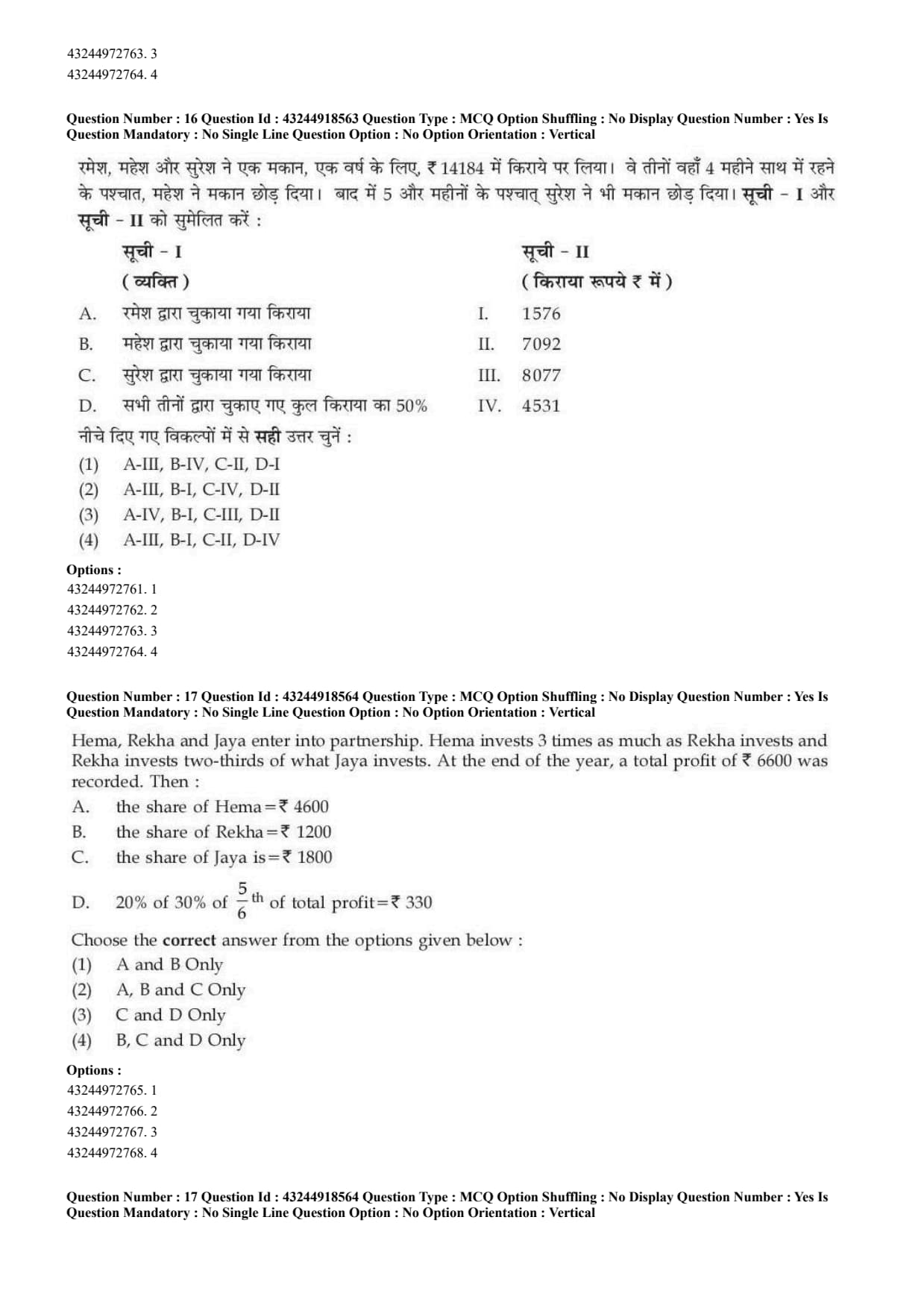
Choose the alternative which best expresses the meaning of the Idiom/Phrase:
'To strain every nerve'
View Solution
Step 1: Understanding the Question:
The question asks for the correct figurative meaning of the common English idiom "To strain every nerve".
Idiomatic expressions should not be interpreted literally; rather, their established figurative meanings must be identified.
Step 2: Detailed Explanation:
Meaning of the Idiom: The phrase "to strain every nerve" dates back to physical exertions where a person exerts their body so intensely that every muscle and nerve is tensed and working. In modern figurative language, it means to use all of one's strength, resources, energy, and determination to accomplish a difficult task or objective.
To make utmost efforts (Correct Option): This matches the definition precisely, representing the act of trying with the maximum possible energy, dedication, and determination.
To feel weak and tired: This option describes a physical state of exhaustion. While straining every nerve may lead to tiredness, the idiom itself refers to the active exertion of effort, not the passive feeling of exhaustion.
To be a diligent worker: Diligence represents steady, earnest, and energetic effort over time. While related, it refers to a general personality trait rather than a specific, intense attempt to achieve a task, which is what the idiom signifies.
To be methodical in work: Methodical work refers to being systematic, orderly, and organized. It does not carry the connotation of extreme exertion and struggle that the idiom implies.
Step 3: Final Answer:
The idiom "To strain every nerve" corresponds directly to "to make utmost efforts".
Therefore, the correct option is (A).
Quick Tip: Idioms involving physical body parts (like "nerves", "backbone", "finger", "shoulder") often describe the intensity of work or attitudes:
- "To strain every nerve" = to make the utmost effort.
- "To keep one's chin up" = to remain optimistic.
Visualizing the physical action can help you deduce the figurative meaning.
Ramesh, Mahesh and Suresh took a house on rent for one year for Rs 14184. They remained together for 4 months and then Mahesh left the house. After 5 more months, Suresh also left the house. Match List - I with List - II.
Choose the correct answer from the options given below:
View Solution
Step 1: Understanding the Question:
This is a problem based on the division of expenses (partnership concept).
Three individuals rent a house for a year (12 months), but they do not stay for the same duration.
The total rent must be shared among them in proportion to the time they spent in the house, with the rent for any period being shared equally among those residing there during that time.
Step 2: Key Formula or Approach:
The total rent is Rs 14184 for 1 year (12 months).
The monthly rent of the house is: \[ Monthly Rent = \frac{Total Rent}{12} \]
We divide the year into three distinct intervals based on who was occupying the house:
1. First 4 months: Ramesh, Mahesh, and Suresh are living together. Rent is split among 3 people.
2. Next 5 months (months 5 to 9): Ramesh and Suresh are living together (Mahesh has left). Rent is split among 2 people.
3. Remaining 3 months (months 10 to 12): Ramesh is living alone (Suresh has left). Rent is paid fully by Ramesh.
Step 3: Detailed Explanation:
Calculate Monthly Rent:
\[ Monthly Rent = \frac{14184}{12} = Rs 1182 per month. \]
Calculate Rent for Period 1 (First 4 months):
Total rent for these 4 months:
\[ 4 \times 1182 = Rs 4728 \]
Since all three (Ramesh, Mahesh, and Suresh) lived together, each pays an equal share:
\[ Share of each = \frac{4728}{3} = Rs 1576 \]
Calculate Rent for Period 2 (Next 5 months):
Total rent for these 5 months:
\[ 5 \times 1182 = Rs 5910 \]
Since only Ramesh and Suresh lived during this period, each pays:
\[ Share of each = \frac{5910}{2} = Rs 2955 \]
Calculate Rent for Period 3 (Last 3 months):
Total rent for these 3 months:
\[ 3 \times 1182 = Rs 3546 \]
Only Ramesh lived in the house, so he pays the entire amount:
\[ Ramesh's share for Period 3 = Rs 3546 \]
Calculate Total Rent Paid by Each Person:
Mahesh (B): He only lived during Period 1.
\[ Rent paid by Mahesh = Rs 1576 \]
This matches List-II (I).
Suresh (C): He lived during Period 1 and Period 2.
\[ Rent paid by Suresh = 1576 + 2955 = Rs 4531 \]
This matches List-II (IV).
Ramesh (A): He lived for all 12 months.
\[ Rent paid by Ramesh = 1576 + 2955 + 3546 = Rs 8077 \]
This matches List-II (III).
Calculate 50% of Total Rent (D):
\[ 50% of 14184 = 0.5 \times 14184 = Rs 7092 \]
This matches List-II (II).
Step 4: Final Answer:
Matching the items:
A \(\rightarrow\) III
B \(\rightarrow\) I
C \(\rightarrow\) IV
D \(\rightarrow\) II
This combination corresponds to option (B).
Quick Tip: For any partnership or sharing of expenses based on time duration, avoid dividing the total rent by the total "man-months" directly unless the problem statement specifies an alternate sharing scheme.
Break down the problem chronologically into intervals of constant occupancy and allocate rent for each period among the active tenants.
This systematic process prevents errors.
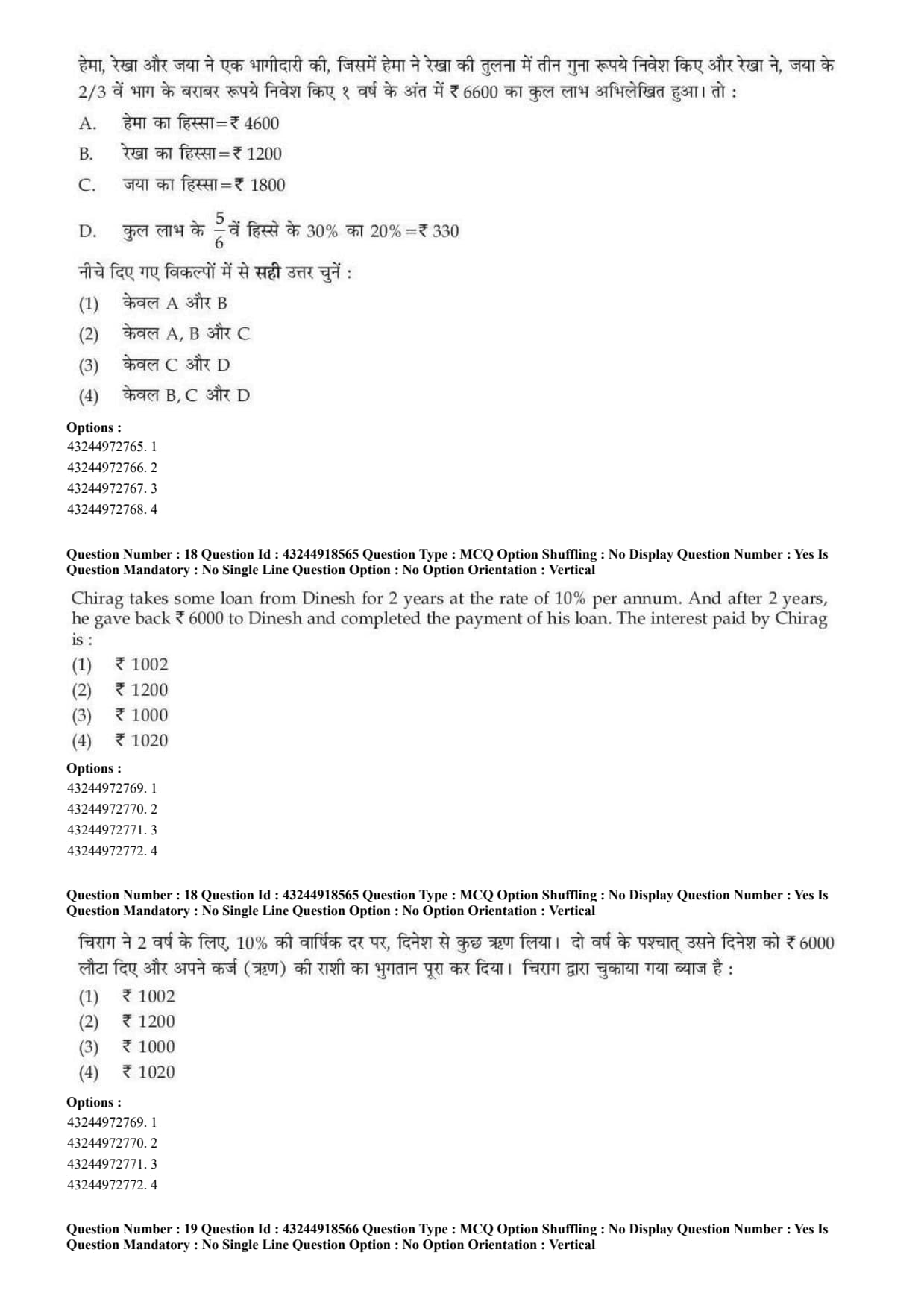
Hema, Rekha and Jaya enter into partnership. Hema invests 3 times as much as Rekha invests and Rekha invests two-thirds of what Jaya invests. At the end of the year, a total profit of Rs 6600 was recorded. Then :
A. the share of Hema = Rs 4600
B. the share of Rekha = Rs 1200
C. the share of Jaya is = Rs 1800
D. 20% of 30% of \(\frac{5}{6}th\) of total profit = Rs 330
Choose the correct answer from the options given below:
View Solution
Step 1: Understanding the Question:
This is a problem based on a partnership.
In a simple partnership, where the investment durations are equal, the profit is divided in the direct ratio of the investments made by each partner.
We need to determine the ratio of investment of the three partners, calculate their individual profit shares, and verify the statements.
Step 2: Key Formula or Approach:
1. Let Jaya's investment be \(J\).
2. Express Rekha's investment (\(R\)) and Hema's investment (\(H\)) in terms of \(J\):
\[ R = \frac{2}{3}J \]
\[ H = 3 \times R = 3 \times \frac{2}{3}J = 2J \]
3. Find the investment ratio \(H : R : J\).
4. Distribute the total profit of Rs 6600 according to this ratio.
Step 3: Detailed Explanation:
Calculate the Investment Ratio:
Let Jaya's investment be \(J = 3x\).
Then, Rekha's investment:
\[ R = \frac{2}{3}(3x) = 2x \]
Hema's investment:
\[ H = 3R = 3(2x) = 6x \]
Thus, the ratio of investments of Hema, Rekha, and Jaya is:
\[ H : R : J = 6x : 2x : 3x = 6 : 2 : 3 \]
Calculate Individual Profit Shares:
The sum of the ratio terms:
\[ 6 + 2 + 3 = 11 \]
Total profit to be distributed is Rs 6600.
One ratio unit corresponds to:
\[ \frac{6600}{11} = Rs 600 \]
Now, calculate the profit shares:
Hema's Share:
\[ 6 \times 600 = Rs 3600 \]
(This means Statement A is False, as it states Hema's share is Rs 4600).
Rekha's Share:
\[ 2 \times 600 = Rs 1200 \]
(This means Statement B is True).
Jaya's Share:
\[ 3 \times 600 = Rs 1800 \]
(This means Statement C is True).
Verify Statement D:
We need to calculate:
\[ 20% of 30% of \frac{5}{6}th of 6600 \]
First, find \(\frac{5}{6}th\) of the total profit:
\[ \frac{5}{6} \times 6600 = 5 \times 1100 = 5500 \]
Next, find 30% of 5500:
\[ \frac{30}{100} \times 5500 = 30 \times 55 = 1650 \]
Finally, find 20% of 1650:
\[ \frac{20}{100} \times 1650 = \frac{1}{5} \times 1650 = 330 \]
Since the calculated value is Rs 330, Statement D is True.
Step 4: Final Answer:
Statements B, C, and D are true, while Statement A is false.
Therefore, the correct option is (D).
Quick Tip: To avoid working with fractions, assume the initial variable is a multiple of the denominator.
In this case, since Rekha's investment is \(\frac{2}{3}\) of Jaya's, setting Jaya's investment as \(3x\) immediately eliminates fractions and simplifies calculations.
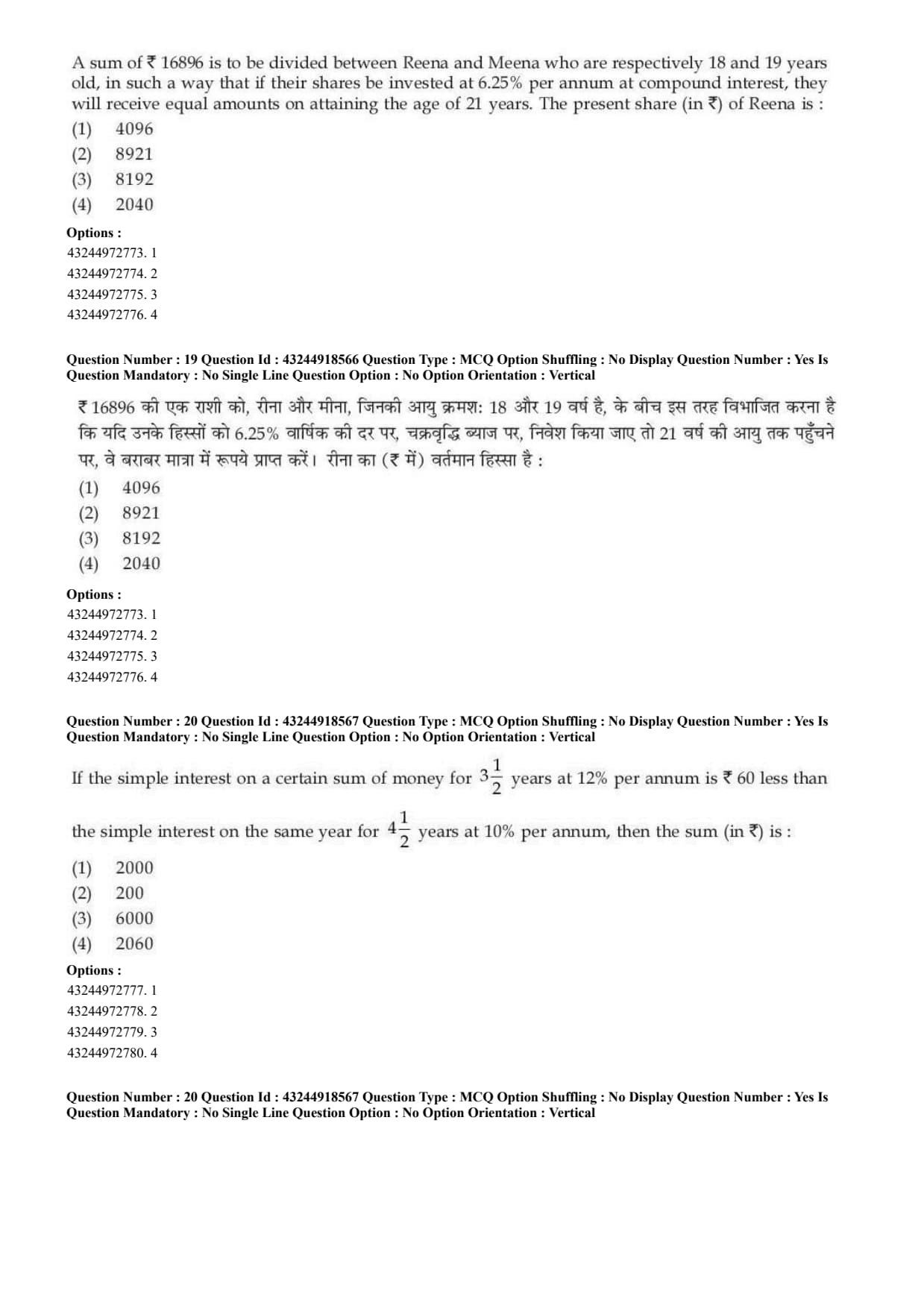
Chirag takes some loan from Dinesh for 2 years at the rate of 10% per annum. And after 2 years, he gave back Rs 6000 to Dinesh and completed the payment of his loan. The interest paid by Chirag is:
View Solution
Step 1: Understanding the Question:
This question involves simple interest on a loan.
Chirag borrows a principal sum (\(P\)) for a duration of 2 years at an interest rate of 10% per annum.
At the end of 2 years, he pays back the total accumulated amount (\(A\)) of Rs 6000 to settle the loan.
We need to determine the interest component of this final payment.
Step 2: Key Formula or Approach:
The relation between the Principal (\(P\)), Rate (\(R\)), Time (\(T\)), and Simple Interest (\(SI\)) is: \[ SI = \frac{P \times R \times T}{100} \]
The total Amount (\(A\)) returned is: \[ A = P + SI = P + \frac{P \times R \times T}{100} = P \left(1 + \frac{R \times T}{100}\right) \]
Once the Principal is calculated, the Interest can be found using: \[ SI = A - P \]
Step 3: Detailed Explanation:
Identify the Given Values:
Amount (\(A\)) paid = Rs 6000
Rate of interest (\(R\)) = 10% per annum
Time period (\(T\)) = 2 years
Calculate the Principal (\(P\)):
Using the amount formula:
\[ 6000 = P \left(1 + \frac{10 \times 2}{100}\right) \]
Simplify the expression inside the parenthesis:
\[ 6000 = P \left(1 + \frac{20}{100}\right) = P (1 + 0.2) \]
\[ 6000 = 1.2P \]
Now, solve for \(P\):
\[ P = \frac{6000}{1.2} = \frac{60000}{12} = 5000 \]
So, the principal amount borrowed was Rs 5000.
Calculate the Interest Component (\(SI\)):
\[ SI = A - P \]
\[ SI = 6000 - 5000 = 1000 \]
The interest paid by Chirag is Rs 1000.
Step 4: Final Answer:
The interest paid on the loan is Rs 1000.
Therefore, the correct option is (C).
Quick Tip: An alternate, quick way is to use percentages:
The simple interest for 2 years at 10% per annum is \(2 \times 10% = 20%\) of the principal.
So, the total amount returned is \(100% + 20% = 120%\) of the principal.
If \(120% = 6000\), then the interest (\(20%\)) is: \[ Interest = \frac{6000}{120} \times 20 = 50 \times 20 = 1000 \] This percentage approach is faster and less prone to calculation mistakes.
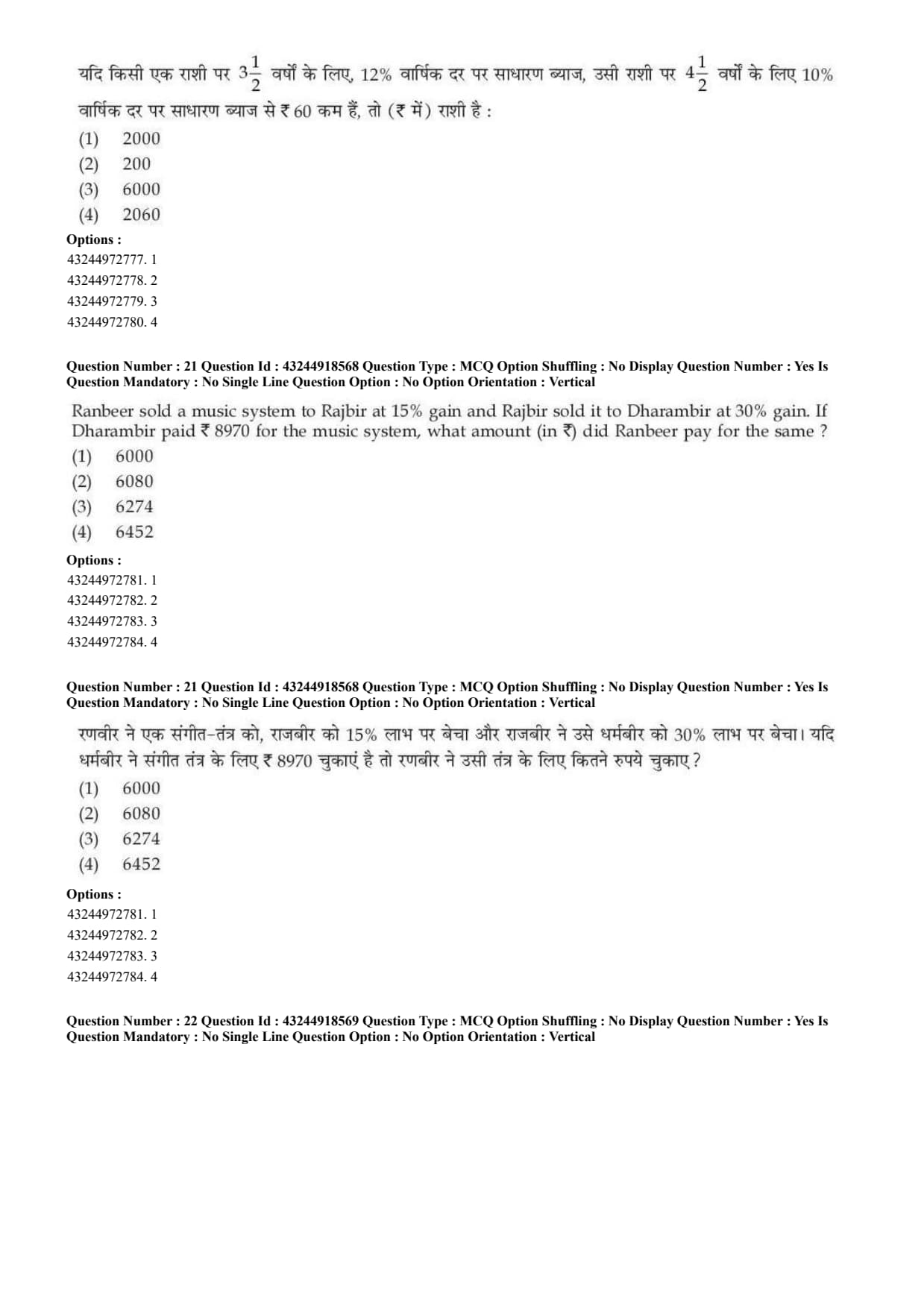
A sum of Rs 16896 is to be divided between Reena and Meena who are respectively 18 and 19 years old, in such a way that if their shares be invested at 6.25% per annum at compound interest, they will receive equal amounts on attaining the age of 21 years. The present share (in Rs) of Reena is:
View Solution
Step 1: Understanding the Question:
The problem is based on compound interest and the division of a sum between two individuals such that their future values after different periods of time are equal.
Reena is 18 years old, and Meena is 19 years old.
Both will receive their respective accumulated amounts when they reach 21 years of age.
This means Reena's share is invested for \(21 - 18 = 3\) years, while Meena's share is invested for \(21 - 19 = 2\) years.
Step 2: Key Formula or Approach:
The future value under compound interest is given by: \[ A = P \left(1 + \frac{R}{100}\right)^T \]
Let Reena's present share be \(R_p\) and Meena's present share be \(M_p\).
The total sum is: \[ R_p + M_p = 16896 \]
Since the final amounts they receive at age 21 are equal: \[ R_p \left(1 + \frac{r}{100}\right)^3 = M_p \left(1 + \frac{r}{100}\right)^2 \]
Step 3: Detailed Explanation:
Simplify the Equal Amount Equation:
Divide both sides by \(\left(1 + \frac{r}{100}\right)^2\):
\[ R_p \left(1 + \frac{r}{100}\right) = M_p \]
\[ \frac{R_p}{M_p} = \frac{1}{1 + \frac{r}{100}} \]
Substitute the Interest Rate (\(r\)):
Given, \(r = 6.25% = 6\frac{1}{4}% = \frac{25}{4}%\).
Therefore:
\[ \frac{r}{100} = \frac{25}{400} = \frac{1}{16} \]
Substitute this into the ratio equation:
\[ \frac{R_p}{M_p} = \frac{1}{1 + \frac{1}{16}} = \frac{1}{\frac{17}{16}} = \frac{16}{17} \]
So, the ratio of Reena's share to Meena's share is \(16 : 17\).
Divide the Total Sum (Rs 16896) in the Ratio \(16 : 17\):
The sum of the ratio parts is:
\[ 16 + 17 = 33 \]
Therefore, Reena's present share is:
\[ R_p = \frac{16}{33} \times 16896 \]
Let us divide 16896 by 33:
\[ 16896 \div 3 = 5632 \]
Now, divide 5632 by 11:
\[ 5632 \div 11 = 512 \]
So:
\[ R_p = 16 \times 512 = 8192 \]
Thus, Reena's present share is Rs 8192.
Step 4: Final Answer:
Reena's present share is Rs 8192.
Therefore, the correct option is (C).
Quick Tip: When two shares are invested at the same compound interest rate \(r\) for time periods differing by 1 year, the ratio of the share of the younger person to that of the older person is always: \[ \frac{Younger Share}{Older Share} = \frac{1}{1 + \frac{r}{100}} \] Since the rate is \(6.25% = \frac{1}{16}\), the ratio is directly \(\frac{16}{17}\).
This reduces calculation time.
If the simple interest on a certain sum of money for \(3\frac{1}{2}\) years at 12% per annum is Rs 60 less than the simple interest on the same sum for \(4\frac{1}{2}\) years at 10% per annum, then the sum (in Rs) is:
View Solution
Step 1: Understanding the Question:
This problem involves comparing two simple interest scenarios on the same principal sum (\(P\)).
In the first case, the money is lent for \(3.5\) years at 12% per annum.
In the second case, the same money is lent for \(4.5\) years at 10% per annum.
We are given that the interest from the first case is Rs 60 less than the interest from the second case. We need to find the principal sum (\(P\)).
Step 2: Key Formula or Approach:
The simple interest (\(SI\)) formula is: \[ SI = \frac{P \times R \times T}{100} \]
We set up the equations for both cases: \[ SI_1 = \frac{P \times R_1 \times T_1}{100} \] \[ SI_2 = \frac{P \times R_2 \times T_2}{100} \]
We are given that: \[ SI_2 - SI_1 = 60 \]
Step 3: Detailed Explanation:
Calculate the Effective Percentage Interest for Case 1:
Rate \(R_1 = 12%\) per annum
Time \(T_1 = 3\frac{1}{2} years = 3.5 years\)
The interest earned in Case 1 as a percentage of the principal is:
\[ R_1 \times T_1 = 12 \times 3.5 = 42% of P \]
So:
\[ SI_1 = 0.42P \]
Calculate the Effective Percentage Interest for Case 2:
Rate \(R_2 = 10%\) per annum
Time \(T_2 = 4\frac{1}{2} years = 4.5 years\)
The interest earned in Case 2 as a percentage of the principal is:
\[ R_2 \times T_2 = 10 \times 4.5 = 45% of P \]
So:
\[ SI_2 = 0.45P \]
Set up and Solve the Equation:
We are given:
\[ SI_2 - SI_1 = 60 \]
Substitute the percentage values:
\[ 45% of P - 42% of P = 60 \]
\[ 3% of P = 60 \]
\[ \frac{3}{100} \times P = 60 \]
Solve for \(P\):
\[ P = \frac{60 \times 100}{3} = 20 \times 100 = 2000 \]
So, the principal sum is Rs 2000.
Step 4: Final Answer:
The sum of money is Rs 2000.
Therefore, the correct option is (A).
Quick Tip: Using effective interest rate percentage (\(R \times T\)) simplifies the equation.
Case 1: \(12 \times 3.5 = 42%\).
Case 2: \(10 \times 4.5 = 45%\).
The difference is \(45% - 42% = 3%\).
Since \(3% = 60\), then \(100%\) (the full sum) is: \[ \frac{60}{3} \times 100 = 2000 \] This calculation can easily be done mentally during the exam.
Ranbeer sold a music system to Rajbir at 15% gain and Rajbir sold it to Dharambir at 30% gain. If Dharambir paid Rs 8970 for the music system, what amount (in Rs) did Ranbeer pay for the same?
View Solution
Step 1: Understanding the Question:
This is a successive transaction problem in profit and loss.
Ranbeer sells an item to Rajbir at a profit, and Rajbir subsequently sells it to Dharambir at another profit.
The final price paid by Dharambir is given, and we need to work backward to find the original cost price paid by Ranbeer.
Step 2: Key Formula or Approach:
Let the price Ranbeer paid be \(x\) (Ranbeer's Cost Price).
1. Ranbeer sells to Rajbir at a 15% gain:
\[ Rajbir's Cost Price = x \times \left(1 + \frac{15}{100}\right) = 1.15x \]
2. Rajbir sells to Dharambir at a 30% gain:
\[ Dharambir's Cost Price = Rajbir's Cost Price \times \left(1 + \frac{30}{100}\right) = 1.15x \times 1.30 \]
3. Equate this to the given price paid by Dharambir (Rs 8970) and solve for \(x\).
Step 3: Detailed Explanation:
Formulate the Equation:
\[ x \times 1.15 \times 1.30 = 8970 \]
Multiply the decimals:
\[ 1.15 \times 1.30 = 1.495 \]
So the equation becomes:
\[ 1.495x = 8970 \]
Solve for \(x\):
To eliminate decimals, multiply both the numerator and denominator by 1000:
\[ x = \frac{8970}{1.495} = \frac{8970 \times 1000}{1495} \]
Let us check if 1495 divides 8970:
\[ 1495 \times 6 = 8970 \]
Yes, it is exactly divisible:
\[ x = 6 \times 1000 = 6000 \]
Therefore, Ranbeer paid Rs 6000 for the music system.
Step 4: Final Answer:
The cost price for Ranbeer was Rs 6000.
Therefore, the correct option is (A).
Quick Tip: Using fractional representations can make calculation easier:
15% gain = factor of \(\frac{115}{100} = \frac{23}{20}\).
30% gain = factor of \(\frac{13}{10}\).
The equation is: \[ x \times \frac{23}{20} \times \frac{13}{10} = 8970 \] \[ x \times \frac{299}{200} = 8970 \] Since \(299 \times 3 = 897\), we can see that \(299 \times 30 = 8970\).
So: \[ x = 30 \times 200 = 6000 \] Working with fractions avoids tedious decimal division.
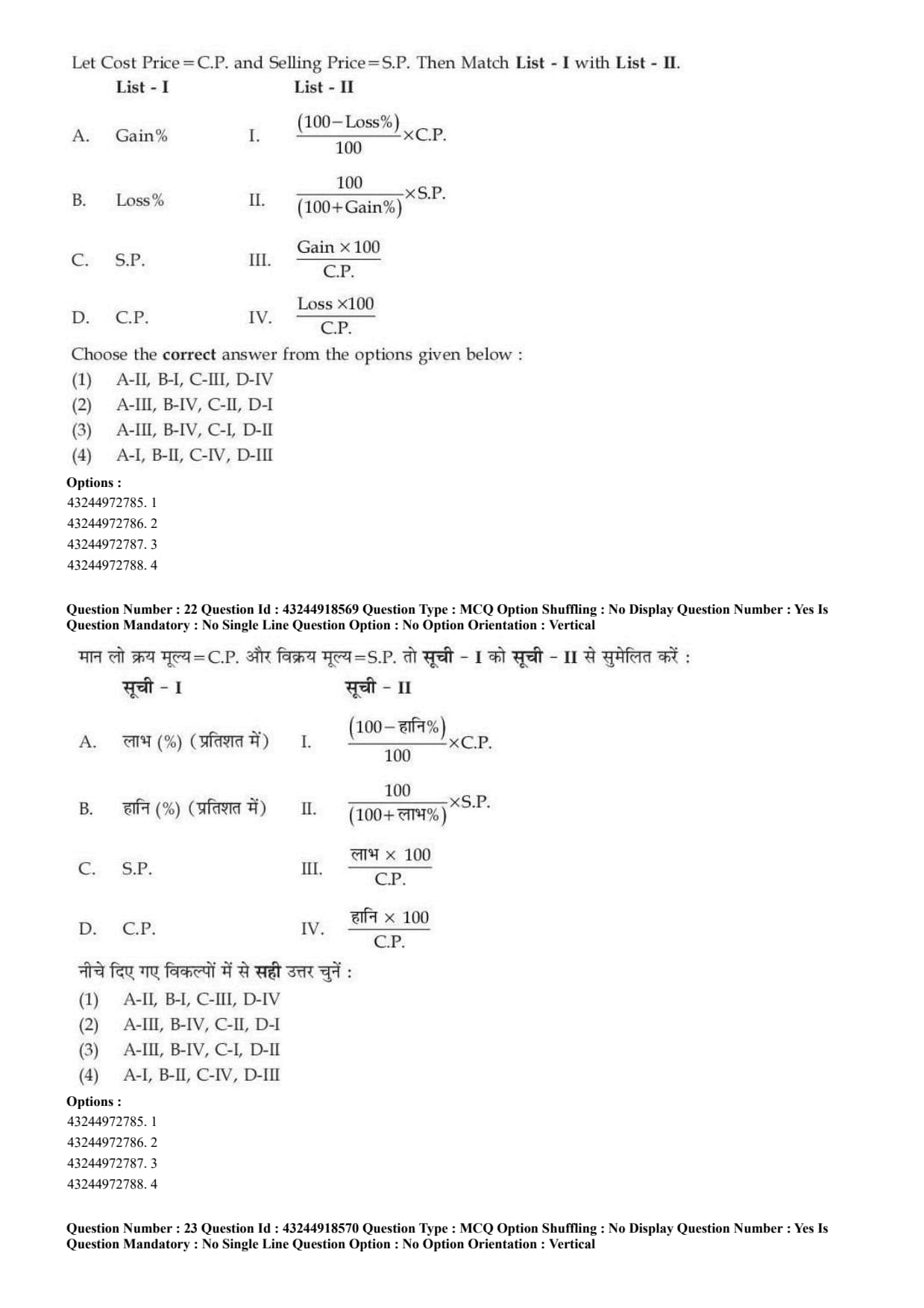
Let Cost Price = C.P. and Selling Price = S.P. Then Match List - I with List - II.
Choose the correct answer from the options given below:
View Solution
Step 1: Understanding the Question:
This question tests basic, fundamental mathematical formulas of Profit and Loss.
We need to match the standard expressions for Gain percentage, Loss percentage, Selling Price, and Cost Price with their mathematical formulations.
Step 2: Detailed Explanation:
Gain% (A): Gain percent is defined as the profit made divided by the Cost Price, multiplied by 100.
\[ Gain% = \frac{Gain \times 100}{C.P.} \]
This matches with formula III.
Loss% (B): Loss percent is defined as the loss incurred divided by the Cost Price, multiplied by 100.
\[ Loss% = \frac{Loss \times 100}{C.P.} \]
This matches with formula IV.
S.P. (C): When an item is sold at a loss, the Selling Price is calculated by reducing the Cost Price by the loss percentage.
\[ S.P. = \frac{(100 - Loss%)}{100} \times C.P. \]
This matches with formula I.
C.P. (D): When an item is sold at a gain, the Cost Price can be calculated using the Selling Price and the Gain percentage.
\[ C.P. = \frac{100}{(100 + Gain%)} \times S.P. \]
This matches with formula II.
Step 3: Final Answer:
The matching combination is:
A \(\rightarrow\) III
B \(\rightarrow\) IV
C \(\rightarrow\) I
D \(\rightarrow\) II
This sequence corresponds to option (C).
Quick Tip: Always remember that profit or loss percentages are calculated with the Cost Price (C.P.) as the base, unless stated otherwise.
Therefore, the formulas for both Gain% and Loss% must have C.P. in the denominator, which immediately links A to III and B to IV.
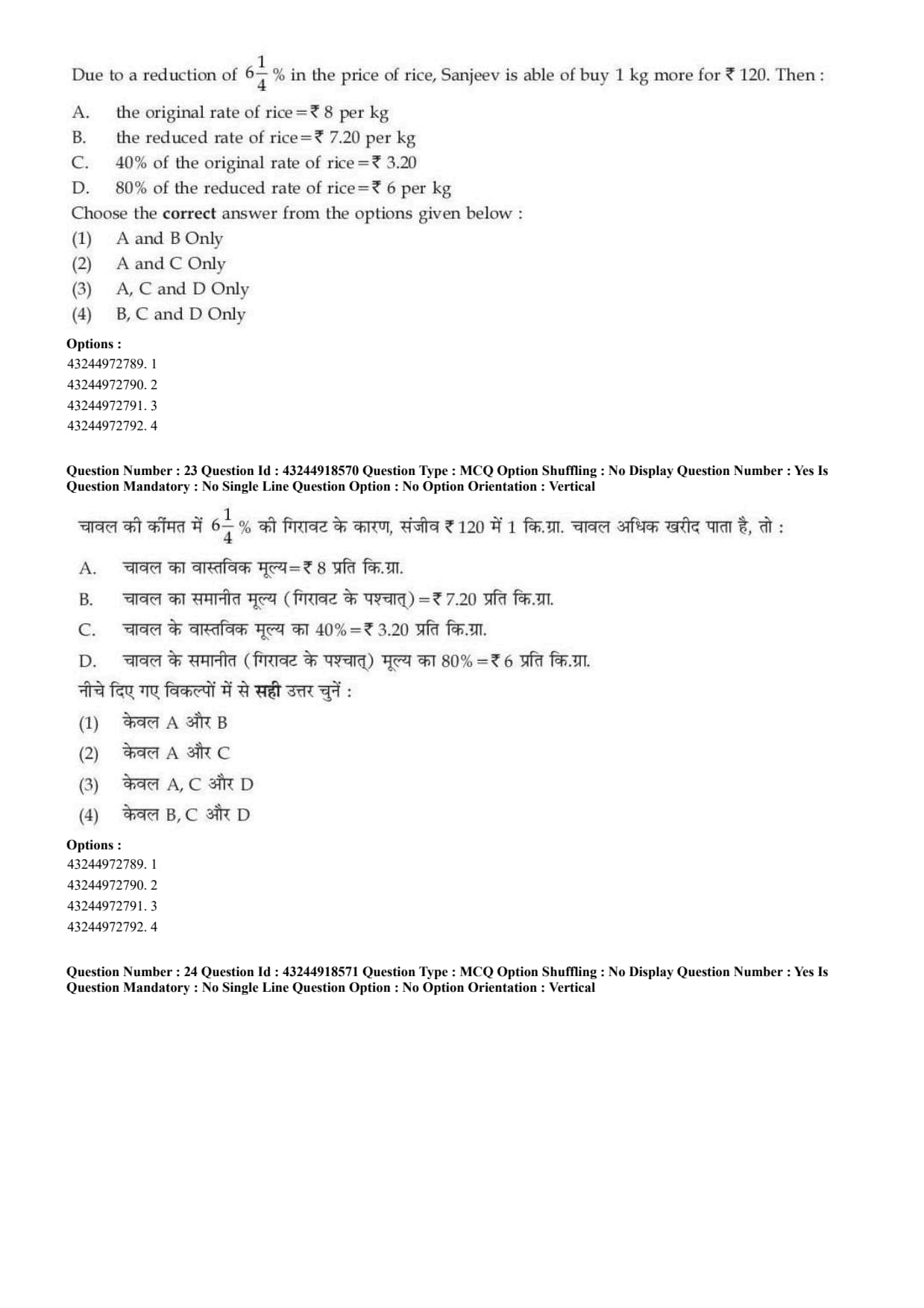
Due to a reduction of \(6\frac{1}{4}%\) in the price of rice, Sanjeev is able to buy \(1 kg\) more for Rs 120. Then :
A. the original rate of rice = Rs 8 per kg
B. the reduced rate of rice = Rs 7.20 per kg
C. 40% of the original rate of rice = Rs 3.20
D. 80% of the reduced rate of rice = Rs 6 per kg
Choose the correct answer from the options given below:
View Solution
Step 1: Understanding the Question:
This problem is based on the inverse relationship between the price of a commodity and its consumption when the total expenditure is constant.
The price of rice decreases, which allows a buyer to purchase more of it for the same total sum of Rs 120.
We need to calculate the original and reduced prices per kilogram and verify the truth value of the given statements.
Step 2: Key Formula or Approach:
1. Let the original price of rice be \(x\) per kg.
2. The percentage reduction in price is:
\[ 6\frac{1}{4}% = 6.25% = \frac{25}{400} = \frac{1}{16} \]
3. The reduced price is:
\[ x \left(1 - \frac{1}{16}\right) = \frac{15}{16}x \]
4. The quantity bought originally with Rs 120 is \(\frac{120}{x}\).
5. The quantity bought at the reduced price is \(\frac{120}{\frac{15}{16}x} = \frac{128}{x}\).
6. The difference in quantity is 1 kg:
\[ \frac{128}{x} - \frac{120}{x} = 1 \]
Step 3: Detailed Explanation:
Calculate the Original Rate (\(x\)):
Solve the quantity equation:
\[ \frac{128 - 120}{x} = 1 \]
\[ \frac{8}{x} = 1 \implies x = 8 \]
So, the original rate of rice is Rs 8 per kg.
(This means Statement A is True).
Calculate the Reduced Rate:
\[ Reduced Rate = \frac{15}{16} \times 8 = Rs 7.50 per kg \]
(This means Statement B is False, as it states the reduced rate is Rs 7.20).
Verify Statement C:
We need to find 40% of the original rate:
\[ 40% of 8 = \frac{40}{100} \times 8 = 0.4 \times 8 = Rs 3.20 \]
Since this matches Statement C, Statement C is True.
Verify Statement D:
We need to find 80% of the reduced rate:
\[ 80% of 7.50 = \frac{80}{100} \times 7.50 = 0.8 \times 7.5 = Rs 6.00 \]
Since this matches Statement D, Statement D is True.
Step 4: Final Answer:
Statements A, C, and D are true, while Statement B is false.
Therefore, the correct option is (C).
Quick Tip: Using fractional equivalents of percentages saves time:
A price reduction of \(\frac{1}{16}\) means the price ratio is \(16 : 15\).
Since expenditure is constant, the quantity ratio is the inverse: \(15 : 16\).
The difference in quantity is \(16 - 15 = 1\) ratio unit.
Since 1 ratio unit corresponds to 1 kg:
Original quantity = 15 kg.
Original price = \(\frac{120}{15} = Rs 8\) per kg.
This ratio method avoids any algebraic equations.
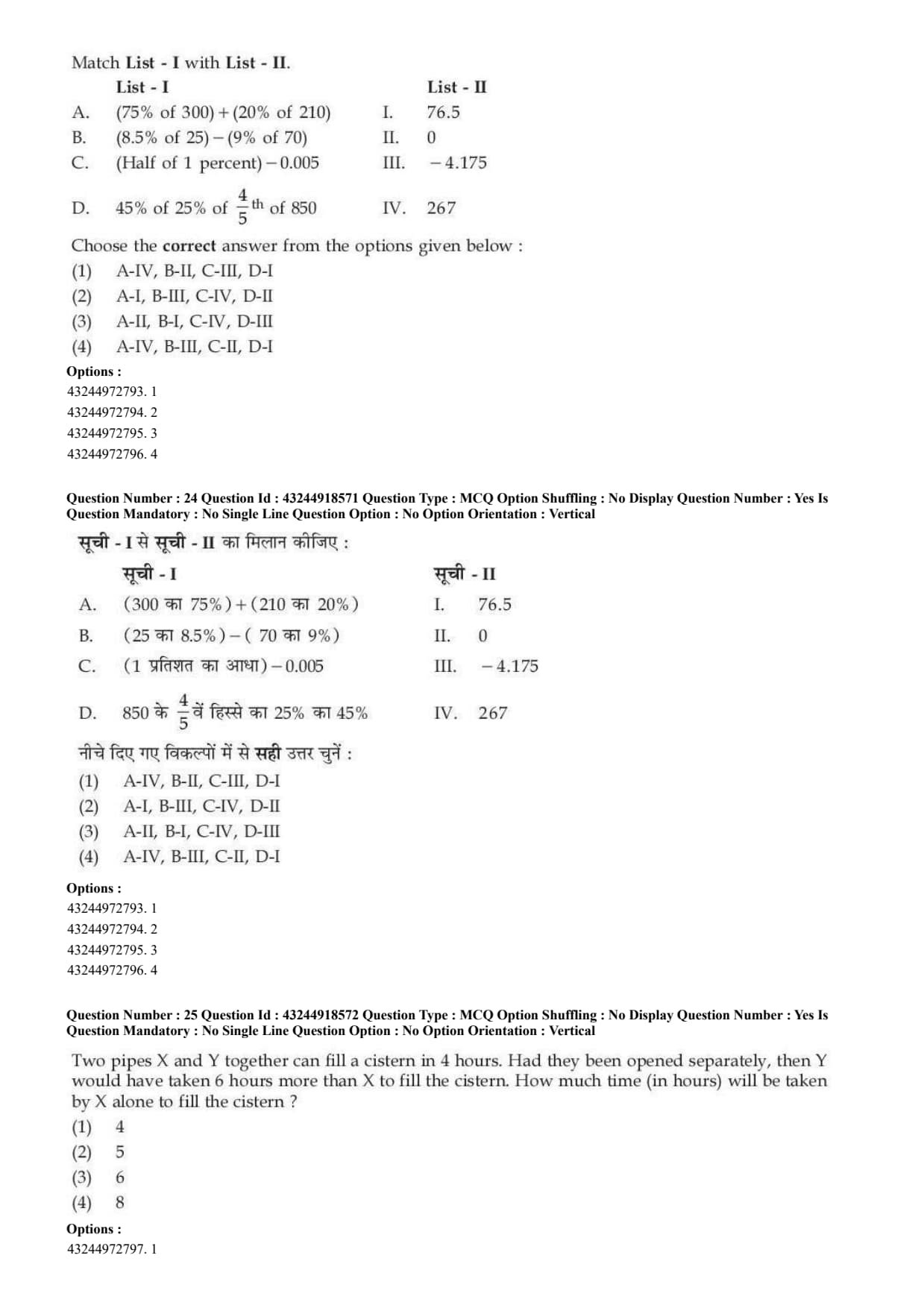
Match List - I with List - II.
Choose the correct answer from the options given below:
View Solution
Step 1: Understanding the Question:
This question requires performing arithmetic operations based on percentages and fractions for each expression in List-I and matching the resulting values with the numbers in List-II.
Step 2: Detailed Explanation:
Evaluate Expression A:
\[ (75% of 300) + (20% of 210) \]
\[ = \left(\frac{75}{100} \times 300\right) + \left(\frac{20}{100} \times 210\right) \]
\[ = (75 \times 3) + (2 \times 21) \]
\[ = 225 + 42 = 267 \]
This value matches List-II (IV).
Evaluate Expression B:
\[ (8.5% of 25) - (9% of 70) \]
\[ = \left(\frac{8.5}{100} \times 25\right) - \left(\frac{9}{100} \times 70\right) \]
\[ = \frac{212.5}{100} - \frac{630}{100} \]
\[ = 2.125 - 6.3 = -4.175 \]
This value matches List-II (III).
Evaluate Expression C:
"Half of 1 percent" can be expressed as:
\[ Half of 1% = 0.5% = \frac{0.5}{100} = 0.005 \]
Now, calculate the expression:
\[ (Half of 1 percent) - 0.005 = 0.005 - 0.005 = 0 \]
This value matches List-II (II).
Evaluate Expression D:
\[ 45% of 25% of \frac{4}{5}th of 850 \]
First, find \(\frac{4}{5}th\) of 850:
\[ \frac{4}{5} \times 850 = 4 \times 170 = 680 \]
Next, calculate 25% of 680:
\[ 25% of 680 = \frac{1}{4} \times 680 = 170 \]
Finally, calculate 45% of 170:
\[ \frac{45}{100} \times 170 = 4.5 \times 17 = 76.5 \]
This value matches List-II (I).
Step 3: Final Answer:
The matching pairs are:
A \(\rightarrow\) IV
B \(\rightarrow\) III
C \(\rightarrow\) II
D \(\rightarrow\) I
This combination corresponds to option (D).
Quick Tip: Start with Expression C because it is the simplest:
Half of 1% is \(0.5% = 0.005\). Subtracting 0.005 results in 0.
Matching C to II instantly eliminates two options, leaving only options (A) and (D).
Evaluating Expression A next completes the matching.
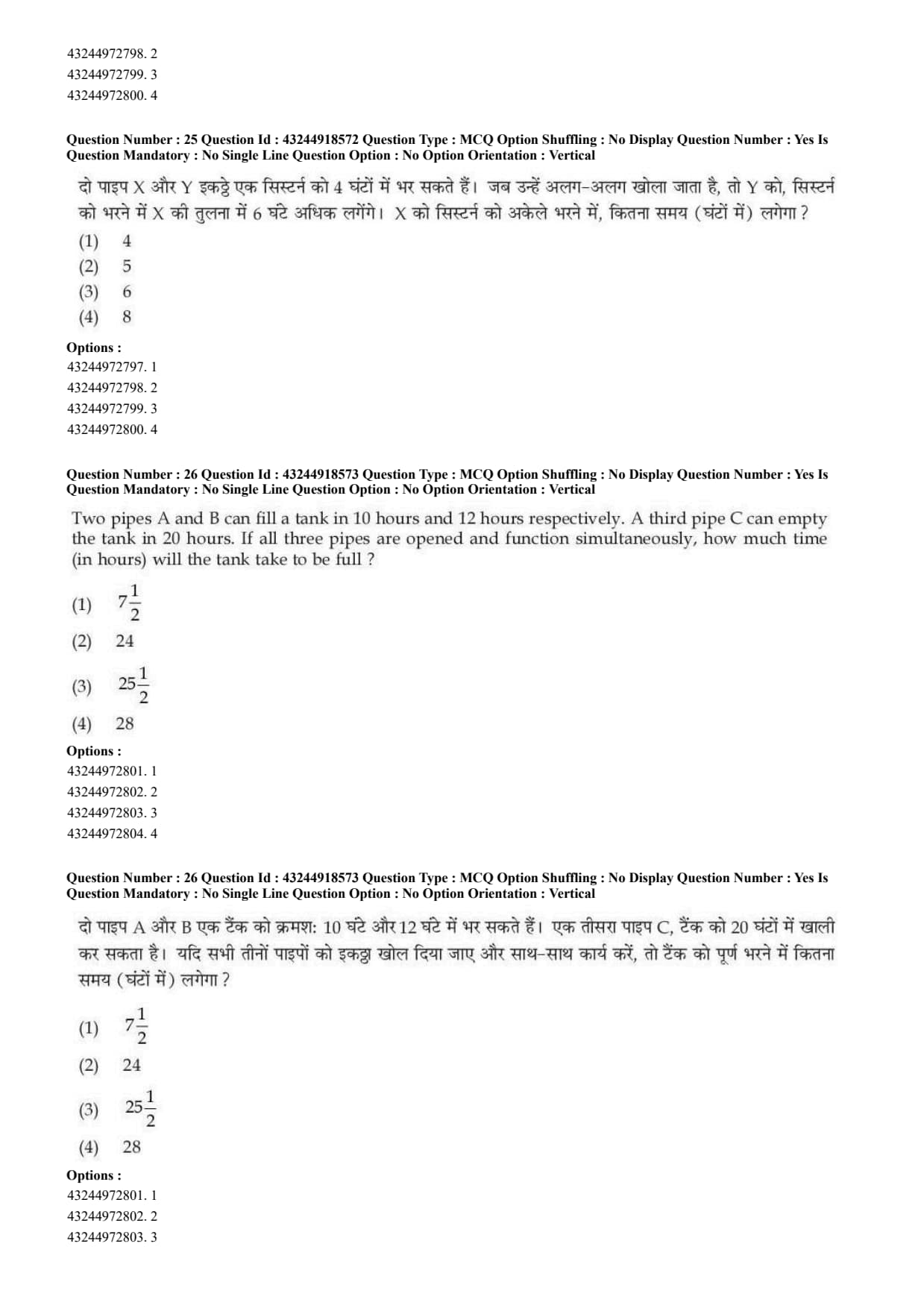
Two pipes X and Y together can fill a cistern in 4 hours. Had they been opened separately, then Y would have taken 6 hours more than X to fill the cistern. How much time (in hours) will be taken by X alone to fill the cistern?
View Solution
Step 1: Understanding the Question:
This problem belongs to the topic of Pipes and Cisterns (which is mathematically identical to Time and Work).
We are given the combined rate of two pipes filling a cistern, along with a relative difference in the time they take to fill the cistern individually.
We need to set up a quadratic equation and solve for the individual time taken by pipe X.
Step 2: Key Formula or Approach:
Let the time taken by pipe X alone to fill the cistern be \(t\) hours.
Since Y takes 6 hours more than X, the time taken by Y alone is \(t + 6\) hours.
The work done in one hour by X is \(\frac{1}{t}\) and by Y is \(\frac{1}{t + 6}\).
Together, they fill the cistern in 4 hours, so their combined one-hour work is \(\frac{1}{4}\).
The rate equation is: \[ \frac{1}{t} + \frac{1}{t + 6} = \frac{1}{4} \]
Step 3: Detailed Explanation:
Formulate the Equation:
Combine the fractions on the left-hand side:
\[ \frac{(t + 6) + t}{t(t + 6)} = \frac{1}{4} \]
\[ \frac{2t + 6}{t^2 + 6t} = \frac{1}{4} \]
Cross-multiply to remove the denominators:
\[ 4(2t + 6) = t^2 + 6t \]
\[ 8t + 24 = t^2 + 6t \]
Rearrange into a Standard Quadratic Equation:
Move all terms to one side:
\[ t^2 + 6t - 8t - 24 = 0 \]
\[ t^2 - 2t - 24 = 0 \]
Factorize the Quadratic Equation:
We look for two numbers that multiply to \(-24\) and add up to \(-2\). These numbers are \(-6\) and \(+4\):
\[ t^2 - 6t + 4t - 24 = 0 \]
\[ t(t - 6) + 4(t - 6) = 0 \]
\[ (t - 6)(t + 4) = 0 \]
This gives two possible values for \(t\):
\[ t = 6 \quad or \quad t = -4 \]
Since time cannot be negative, we reject \(t = -4\).
Thus, \(t = 6\) hours.
Step 4: Final Answer:
Pipe X alone takes 6 hours to fill the cistern.
Therefore, the correct option is (C).
Quick Tip: Instead of solving the quadratic equation, we can substitute the options directly into the equation:
Test option (C) \(t = 6\): \[ \frac{1}{6} + \frac{1}{6 + 6} = \frac{1}{6} + \frac{1}{12} = \frac{2 + 1}{12} = \frac{3}{12} = \frac{1}{4} \] Since this matches the required combined rate of \(\frac{1}{4}\), \(t = 6\) is correct.
Substituting options is often faster in multiple-choice exams.
Two pipes A and B can fill a tank in 10 hours and 12 hours respectively. A third pipe C can empty the tank in 20 hours. If all three pipes are opened and function simultaneously, how much time (in hours) will the tank take to be full?
View Solution
Step 1: Understanding the Question:
This is a problem based on multiple pipes operating simultaneously, with some performing positive work (inlet pipes filling the tank) and another performing negative work (outlet pipe emptying the tank).
Pipes A and B are inlet pipes, and pipe C is an outlet pipe.
We need to calculate the net rate of filling when all three are open together.
Step 2: Key Formula or Approach:
Let the rates of work done per hour by the three pipes be: \[ Rate of A = \frac{1}{10} \quad (positive work) \] \[ Rate of B = \frac{1}{12} \quad (positive work) \] \[ Rate of C = -\frac{1}{20} \quad (negative work) \]
When all three operate together, the combined rate of work is: \[ Net Rate = Rate of A + Rate of B - Rate of C \] \[ Net Rate = \frac{1}{10} + \frac{1}{12} - \frac{1}{20} \]
Step 3: Detailed Explanation:
Calculate the LCM of the Denominators:
We find the Least Common Multiple (LCM) of 10, 12, and 20 to simplify the sum of fractions:
Multiples of 10: 10, 20, 30, 40, 50, 60
Multiples of 12: 12, 24, 36, 48, 60
Multiples of 20: 20, 40, 60
The LCM is 60.
Let us assume the total capacity of the tank is 60 units.
Determine the Hourly Efficiencies:
Efficiency of Pipe A = \(\frac{60}{10} = +6 units/hour\)
Efficiency of Pipe B = \(\frac{60}{12} = +5 units/hour\)
Efficiency of Pipe C = \(\frac{60}{20} = -3 units/hour\)
Calculate the Net Hourly Work:
When all three pipes are open:
\[ Net Efficiency = 6 + 5 - 3 = 8 units/hour \]
Calculate the Total Time Required:
The time taken to fill the entire tank of 60 units is:
\[ Time = \frac{Total Capacity}{Net Efficiency} = \frac{60}{8} hours \]
Simplify the fraction by dividing both numerator and denominator by 4:
\[ Time = \frac{15}{2} hours = 7.5 hours = 7\frac{1}{2} hours \]
Step 4: Final Answer:
The tank will take \(7\frac{1}{2}\) hours to be full.
Therefore, the correct option is (A).
Quick Tip: Using the "Total Capacity" (LCM of time periods) method is often faster and less error-prone than adding fractions.
Setting the capacity as 60 units directly turns fractional additions into simple integer arithmetic (\(6 + 5 - 3 = 8\)).
Then simply divide \(60 / 8 = 7.5\).
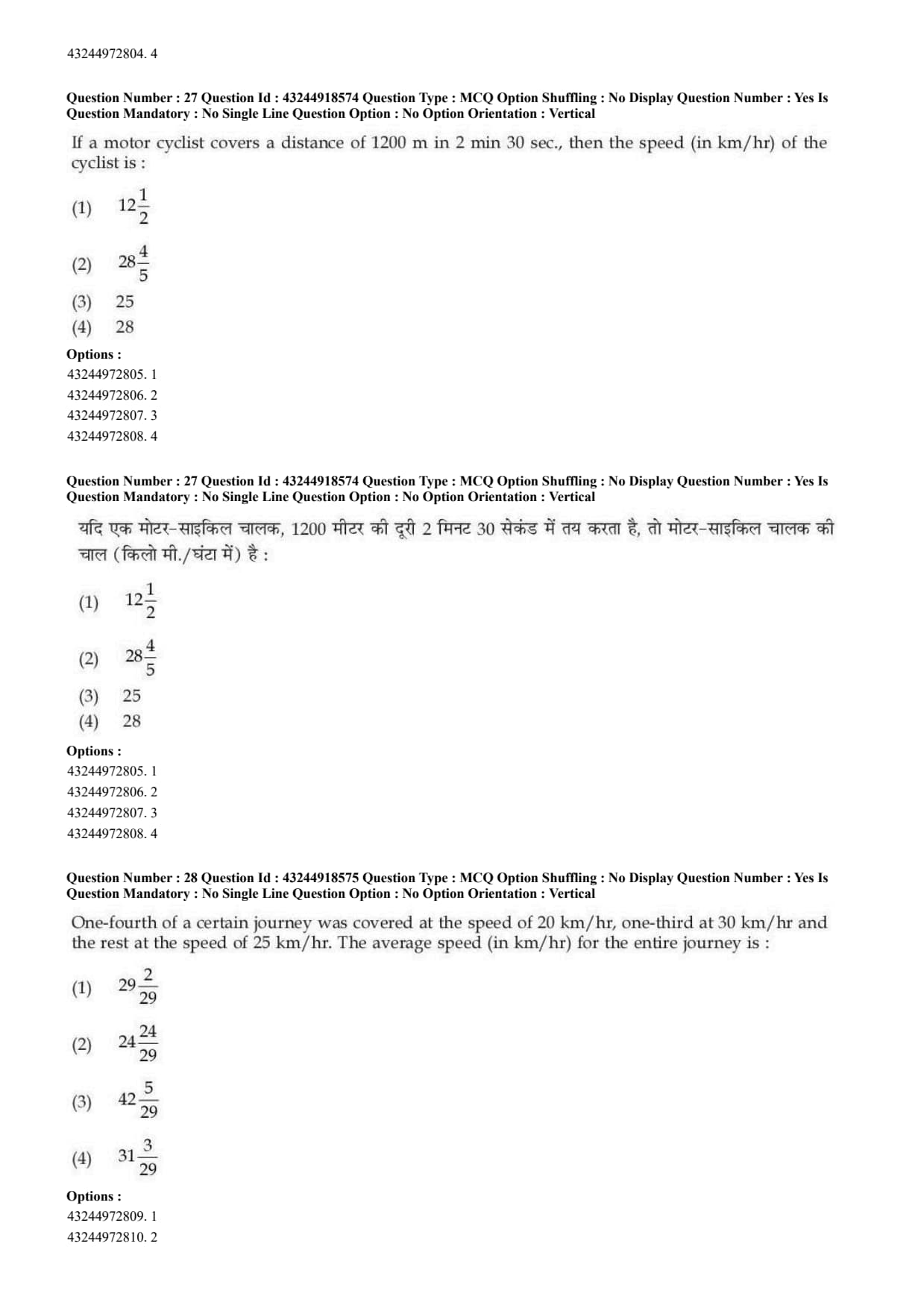
If a motor cyclist covers a distance of 1200 m in 2 min 30 sec., then the speed (in km/hr) of the cyclist is :
View Solution
Step 1: Understanding the Question:
This question belongs to the topic of Speed, Time, and Distance.
The basic physical relation defines speed as the distance covered per unit of time.
Here, the distance is provided in meters and the time is given in minutes and seconds.
We need to calculate the speed of the cyclist and convert the unit from meters per second (\(m/s\)) to kilometers per hour (\(km/hr\)).
Step 2: Key Formula or Approach:
The basic formula for speed (\(v\)) is:
\[ v = \frac{Distance (D)}{Time (T)} \]
To convert speed from \(m/s\) to \(km/hr\), we multiply the value by \(\frac{18}{5}\) because:
\[ 1 m/s = \frac{\frac{1}{1000} km}{\frac{1}{3600} hr} = \frac{3600}{1000} km/hr = \frac{18}{5} km/hr \]
Step 3: Detailed Explanation:
Convert Time into Seconds:
The given time is \(2 minutes and 30 seconds\).
Since \(1 minute = 60 seconds\):
\[ T = (2 \times 60) + 30 = 120 + 30 = 150 seconds \]
Calculate Speed in m/s:
The distance covered is \(D = 1200 m\).
Using the speed formula:
\[ v = \frac{1200}{150} = 8 m/s \]
Convert Speed to km/hr:
Multiply the speed in \(m/s\) by \(\frac{18}{5}\):
\[ v = 8 \times \frac{18}{5} = \frac{144}{5} km/hr \]
Express as a Mixed Fraction:
Divide \(144\) by \(5\):
\[ 144 = 28 \times 5 + 4 \]
Therefore:
\[ v = 28\frac{4}{5} km/hr \]
Step 4: Final Answer:
The speed of the motorcyclist is \(28\frac{4}{5} km/hr\).
Hence, the correct option is (B).
Quick Tip: To convert speed quickly between units:
- Multiply by \(\frac{18}{5}\) to convert \(m/s \rightarrow km/hr\).
- Multiply by \(\frac{5}{18}\) to convert \(km/hr \rightarrow m/s\).
Keep these ratios handy to solve speed problems rapidly.
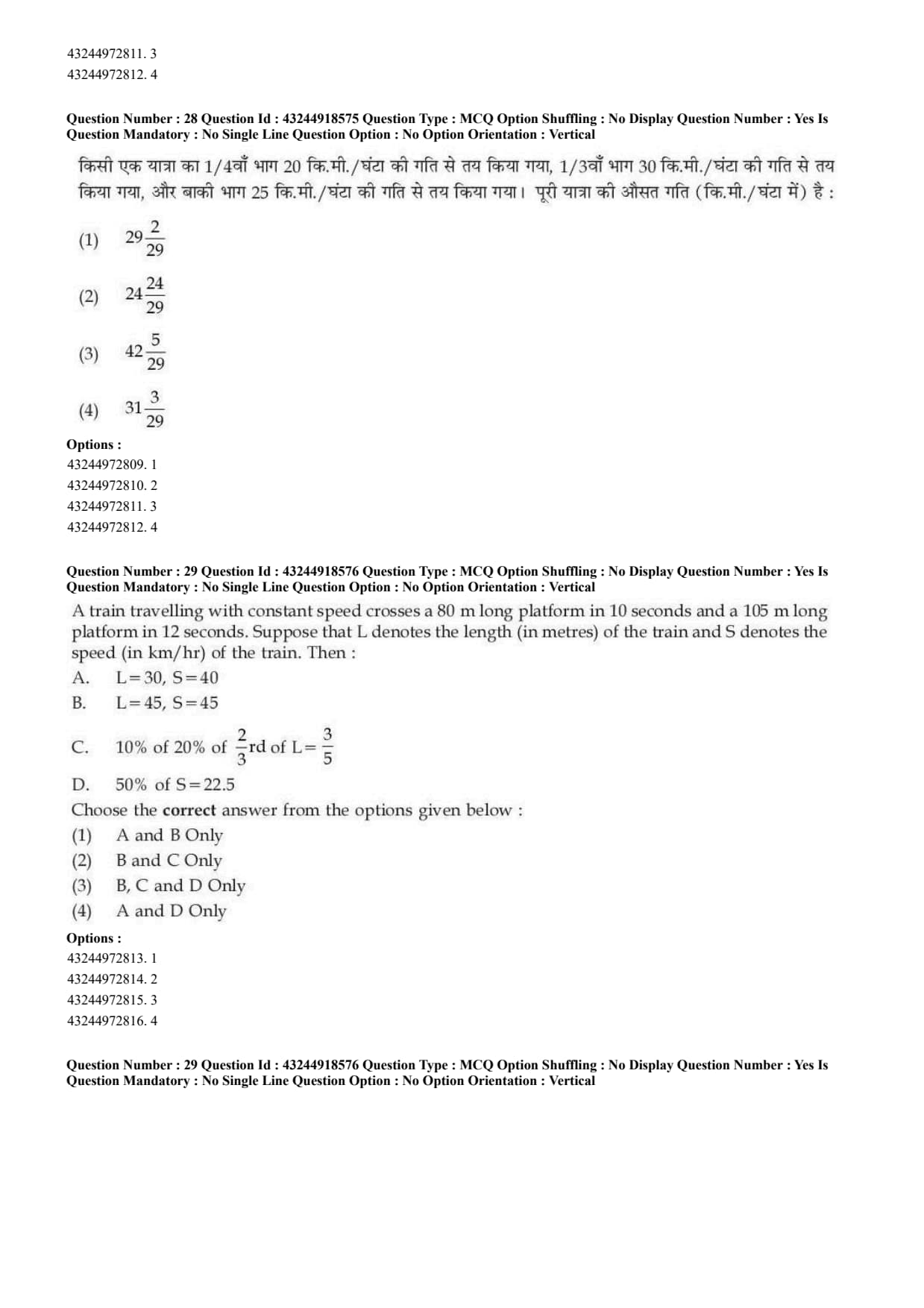
One-fourth of a certain journey was covered at the speed of 20 km/hr, one-third at 30 km/hr and the rest at the speed of 25 km/hr. The average speed (in km/hr) for the entire journey is :
View Solution
Step 1: Understanding the Question:
This problem is based on the concept of average speed.
Average speed is not simply the arithmetic mean of the individual speeds.
Instead, it is defined as the total distance traveled divided by the total time taken to cover that distance.
The journey is divided into three parts with different fractional distances and different speeds.
Step 2: Key Formula or Approach:
Let the total distance of the journey be \(d\).
The formula for average speed (\(v_{avg}\)) is:
\[ v_{avg} = \frac{Total Distance}{Total Time} = \frac{d}{t_1 + t_2 + t_3} \]
where \(t_1, t_2, t_3\) are the time intervals taken to complete each of the three stages of the journey.
For each stage, time is calculated as:
\[ t = \frac{Distance covered in that stage}{Speed of that stage} \]
Step 3: Detailed Explanation:
Define Distance Fractions and Speeds:
Let \(d\) be the total distance of the journey.
- Part 1: Distance \(d_1 = \frac{d}{4}\) covered at speed \(v_1 = 20 km/hr\).
- Part 2: Distance \(d_2 = \frac{d}{3}\) covered at speed \(v_2 = 30 km/hr\).
- Part 3: The remaining distance \(d_3\) is:
\[ d_3 = d - \left(\frac{d}{4} + \frac{d}{3}\right) = d \left(1 - \frac{7}{12}\right) = \frac{5d}{12} \]
This remaining distance is covered at speed \(v_3 = 25 km/hr\).
Calculate the Time taken for each part:
- Time for Part 1:
\[ t_1 = \frac{d/4}{20} = \frac{d}{80} hours \]
- Time for Part 2:
\[ t_2 = \frac{d/3}{30} = \frac{d}{90} hours \]
- Time for Part 3:
\[ t_3 = \frac{5d/12}{25} = \frac{5d}{12 \times 25} = \frac{d}{60} hours \]
Calculate Total Time (\(T\)):
\[ T = t_1 + t_2 + t_3 = d \left( \frac{1}{80} + \frac{1}{90} + \frac{1}{60} \right) \]
Find the Least Common Multiple (LCM) of \(80, 90,\) and \(60\), which is \(720\):
\[ T = d \left( \frac{9 + 8 + 12}{720} \right) = d \left( \frac{29}{720} \right) \]
Calculate Average Speed:
\[ v_{avg} = \frac{d}{T} = \frac{d}{d \left(\frac{29}{720}\right)} = \frac{720}{29} km/hr \]
Convert \(\frac{720}{29}\) into a mixed fraction:
\[ 720 = 29 \times 24 + 24 \]
Therefore:
\[ v_{avg} = 24\frac{24}{29} km/hr \]
Step 4: Final Answer:
The average speed for the entire journey is \(24\frac{24}{29} km/hr\).
Thus, the correct option is (B).
Quick Tip: To avoid working with fractions, assume a total distance that is a common multiple of the denominators.
For denominators \(4\), \(3\), and \(12\), let the total distance be \(1200 km\).
- Part 1: \(300 km\) at \(20 km/hr \rightarrow T_1 = 15 hours\).
- Part 2: \(400 km\) at \(30 km/hr \rightarrow T_2 = 13.33 hours\).
- Part 3: \(500 km\) at \(25 km/hr \rightarrow T_3 = 20 hours\).
Total time \(= 15 + \frac{40}{3} + 20 = 35 + \frac{40}{3} = \frac{145}{3} hours\).
Average speed \(= \frac{1200}{\frac{145}{3}} = \frac{3600}{145} = \frac{720}{29} = 24\frac{24}{29} km/hr\).
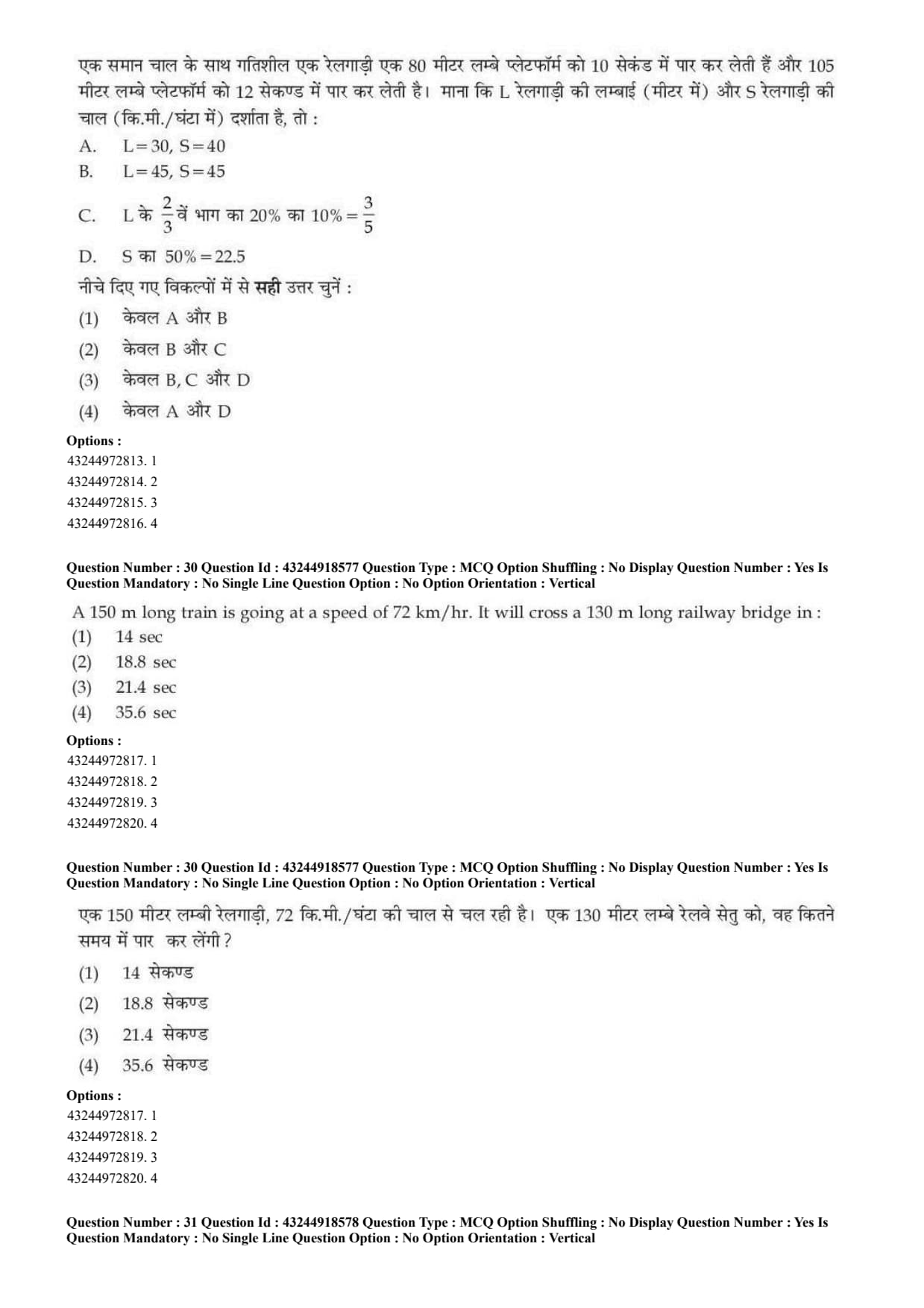
A train travelling with constant speed crosses a 80 m long platform in 10 seconds and a 105 m long platform in 12 seconds. Suppose that L denotes the length (in metres) of the train and S denotes the speed (in km/hr) of the train. Then :
A. L = 30, S = 40
B. L = 45, S = 45
C. 10% of 20% of \(\frac{2}{3}rd\) of L = \(\frac{3}{5}\)
D. 50% of S = 22.5
Choose the correct answer from the options given below :
View Solution
Step 1: Understanding the Question:
This problem deals with a train crossing platforms of different lengths.
When a train crosses a platform, the total distance covered by the train is equal to the sum of the length of the train and the length of the platform.
Using the given data of two different platforms crossed in different time intervals, we can set up a system of equations to solve for the train's length (\(L\)) and its speed (\(S\)).
Step 2: Key Formula or Approach:
Let \(L\) be the length of the train in meters, and \(v\) be its constant speed in meters per second (\(m/s\)).
The general relation is:
\[ Distance = Speed \times Time \]
For a platform of length \(P\):
\[ L + P = v \times t \]
Step 3: Detailed Explanation:
Set up the Equations:
- For the first platform (\(P_1 = 80 m\), \(t_1 = 10 s\)):
\[ L + 80 = 10v \quad \implies \quad L = 10v - 80 \quad ---(Eq 1) \]
- For the second platform (\(P_2 = 105 m\), \(t_2 = 12 s\)):
\[ L + 105 = 12v \quad \implies \quad L = 12v - 105 \quad ---(Eq 2) \]
Solve for Speed (\(v\) in m/s):
Equating Eq 1 and Eq 2:
\[ 10v - 80 = 12v - 105 \]
\[ 2v = 25 \quad \implies \quad v = 12.5 m/s \]
Calculate Train Length (\(L\) in meters):
Substitute \(v = 12.5\) into Eq 1:
\[ L = 10(12.5) - 80 = 125 - 80 = 45 meters \]
Calculate Speed (\(S\) in km/hr):
Convert \(v = 12.5 m/s\) to \(km/hr\) by multiplying by \(\frac{18}{5}\):
\[ S = 12.5 \times \frac{18}{5} = 2.5 \times 18 = 45 km/hr \]
Therefore:
\[ L = 45 and S = 45 \]
This proves Statement B is True, and Statement A is False.
Evaluate Statement C:
We calculate:
\[ 10% of 20% of \frac{2}{3} of L \]
\[ = \frac{10}{100} \times \frac{20}{100} \times \frac{2}{3} \times 45 \]
\[ = 0.1 \times 0.2 \times 30 = 0.02 \times 30 = 0.6 \]
Since \(0.6 = \frac{3}{5}\), Statement C is True.
Evaluate Statement D:
We calculate:
\[ 50% of S = 0.5 \times 45 = 22.5 \]
Since this matches the statement, Statement D is True.
Step 4: Final Answer:
Statements B, C, and D are true, while Statement A is false.
Therefore, the correct choice is option (C).
Quick Tip: Notice that the train takes \(2 seconds\) longer (\(12 s - 10 s\)) to cover the difference in platform lengths.
Difference in length \(= 105 m - 80 m = 25 m\).
Thus, the speed of the train is directly:
\[ v = \frac{25 m}{2 s} = 12.5 m/s = 45 km/hr \] Using this observation saves setting up complex simultaneous equations.
A 150 m long train is going at a speed of 72 km/hr. It will cross a 130 m long railway bridge in :
View Solution
Step 1: Understanding the Question:
The question asks for the time taken by a train of a given length to cross a bridge of a known length at a specified speed.
To completely cross the bridge, the rear end of the train must pass the far end of the bridge.
Thus, the total distance covered during this event is the sum of the train's length and the bridge's length.
Step 2: Key Formula or Approach:
The relation between distance, speed, and time is:
\[ Time (t) = \frac{Total Distance (D)}{Speed (v)} \]
The total distance is:
\[ D = Length of train (L_{train}) + Length of bridge (L_{bridge}) \]
The speed must be converted from \(km/hr\) to \(m/s\) to keep the units consistent.
Step 3: Detailed Explanation:
Calculate Total Distance (\(D\)):
Given:
Length of train \(= 150 m\)
Length of bridge \(= 130 m\)
\[ D = 150 + 130 = 280 meters \]
Convert Speed to m/s:
The speed of the train is \(72 km/hr\).
To convert to \(m/s\), multiply by \(\frac{5}{18}\):
\[ v = 72 \times \frac{5}{18} = 4 \times 5 = 20 m/s \]
Calculate the Time Taken (\(t\)):
Use the time formula:
\[ t = \frac{D}{v} = \frac{280}{20} = 14 seconds \]
Step 4: Final Answer:
The train will cross the bridge in \(14 seconds\).
Therefore, the correct option is (A).
Quick Tip: Always remember that a speed of \(18 km/hr\) is exactly equal to \(5 m/s\).
Since \(72 km/hr\) is \(4 \times 18\), the speed in \(m/s\) must be \(4 \times 5 = 20 m/s\).
Remembering multiples of \(18\) helps perform unit conversions instantly.
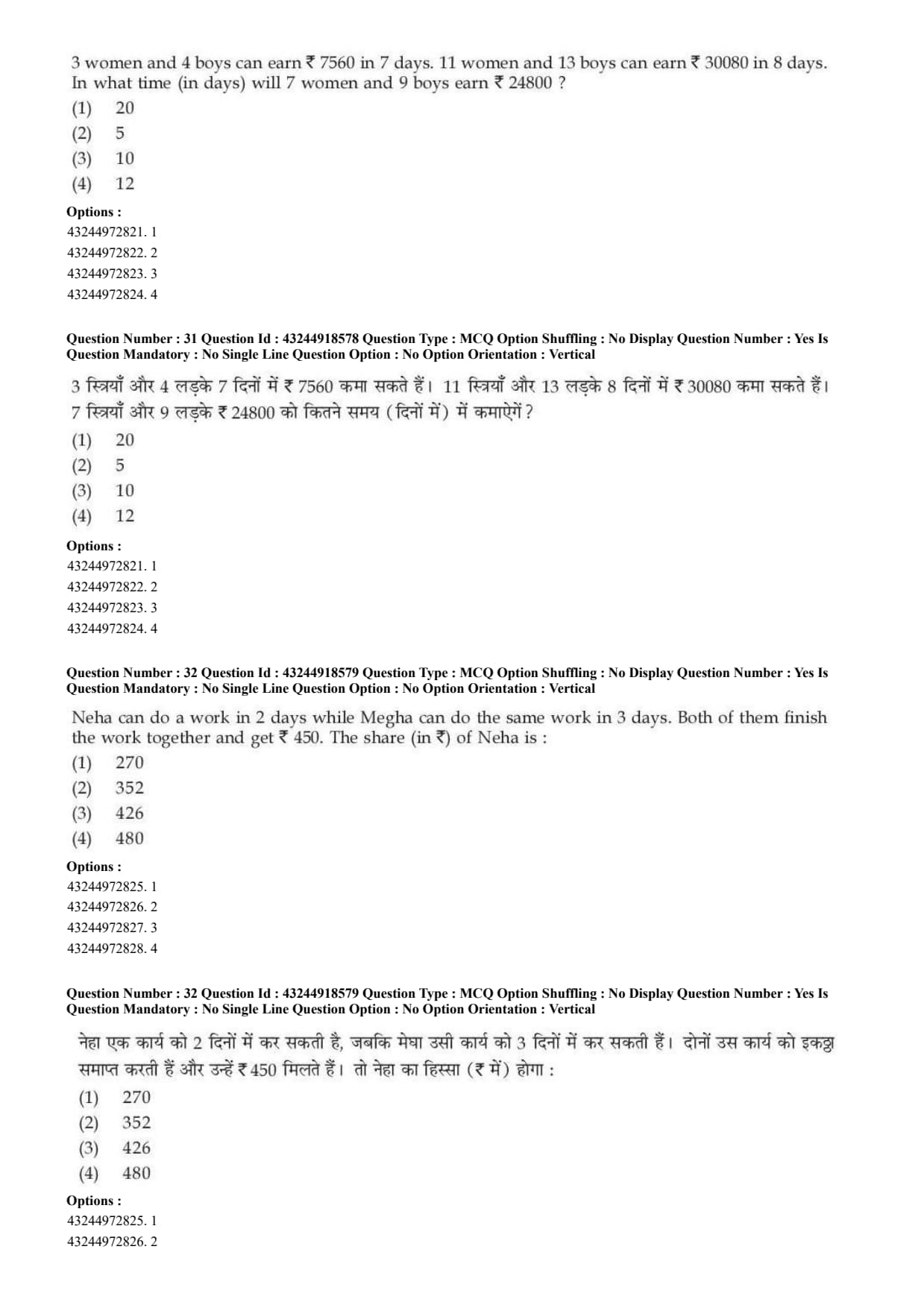
3 women and 4 boys can earn Rs 7560 in 7 days. 11 women and 13 boys can earn Rs 30080 in 8 days. In what time (in days) will 7 women and 9 boys earn Rs 24800 ?
View Solution
Step 1: Understanding the Question:
This problem is based on the work, wages, and efficiency of different groups of workers (women and boys).
We are given the total earnings of two different combinations of women and boys over different numbers of days.
From this, we must determine the individual daily earnings of one woman and one boy, and then use those values to calculate how long it takes a third combination to earn a specific amount.
Step 2: Key Formula or Approach:
Let the daily earning of a woman be \(W\) and that of a boy be \(B\).
The total earnings are given by:
\[ Earnings = (Number of workers \times Daily earning of each) \times Number of days \]
We can set up linear simultaneous equations to solve for \(W\) and \(B\).
Step 3: Detailed Explanation:
Formulate the Equations:
- Case 1: 3 women and 4 boys earn Rs 7560 in 7 days.
Daily earning of the group:
\[ 3W + 4B = \frac{7560}{7} = 1080 \quad ---(Eq 1) \]
- Case 2: 11 women and 13 boys earn Rs 30080 in 8 days.
Daily earning of the group:
\[ 11W + 13B = \frac{30080}{8} = 3760 \quad ---(Eq 2) \]
Solve the Linear System:
Multiply Eq 1 by 11 and Eq 2 by 3 to eliminate \(W\):
\[ 33W + 44B = 11880 \quad ---(Eq 3) \]
\[ 33W + 39B = 11280 \quad ---(Eq 4) \]
Subtract Eq 4 from Eq 3:
\[ 5B = 600 \quad \implies \quad B = 120 \]
Substitute \(B = 120\) into Eq 1:
\[ 3W + 4(120) = 1080 \]
\[ 3W + 480 = 1080 \]
\[ 3W = 600 \quad \implies \quad W = 200 \]
So, a woman earns Rs 200 daily, and a boy earns Rs 120 daily.
Calculate Daily Earnings of the New Group:
The new group consists of 7 women and 9 boys.
Their combined daily earning is:
\[ Daily Earning = 7W + 9B = 7(200) + 9(120) = 1400 + 1080 = 2480 Rs/day \]
Calculate the Required Days:
To find the time needed to earn Rs 24800:
\[ Number of days = \frac{Target earnings}{Daily earnings} = \frac{24800}{2480} = 10 days \]
Step 4: Final Answer:
The group of 7 women and 9 boys will earn the target amount in 10 days.
Therefore, the correct option is (C).
Quick Tip: Double check the arithmetic coefficients:
Notice that the target amount Rs 24800 is exactly 10 times the daily group rate Rs 2480.
In competitive exams, numbers are often chosen to divide cleanly, which can help confirm that your intermediate steps are correct.
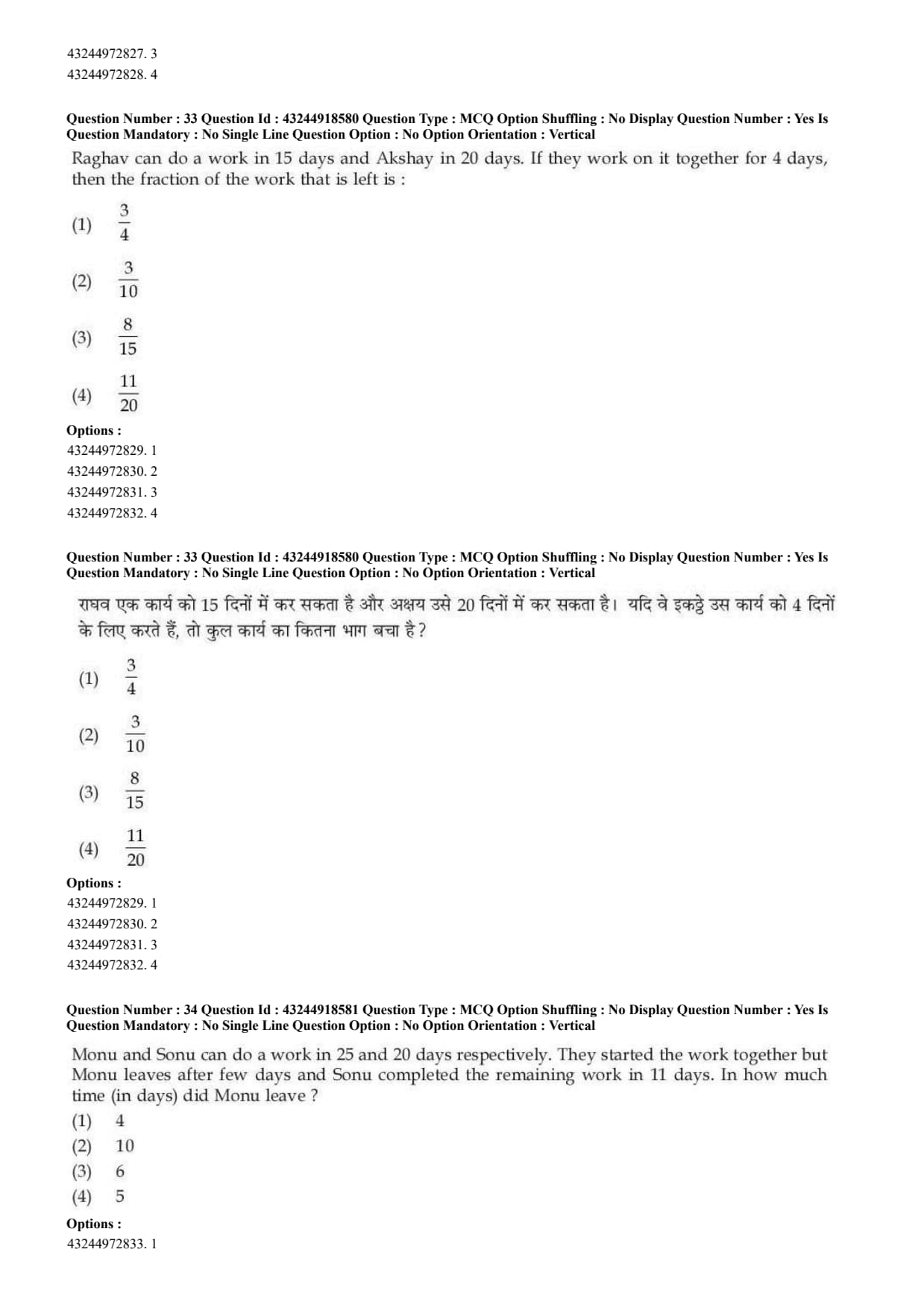
Neha can do a work in 2 days while Megha can do the same work in 3 days. Both of them finish the work together and get Rs 450. The share (in Rs) of Neha is :
View Solution
Step 1: Understanding the Question:
This question relates to the distribution of wages among workers based on their rates of work.
When multiple people work together to complete a task, their wages are distributed in the ratio of the amount of work each person does.
Since they work together for the same duration, the work done by each is directly proportional to their individual efficiencies (work rates).
Step 2: Key Formula or Approach:
The rate of work of a person is inversely proportional to the time they take to complete the work alone.
If Neha takes \(T_N\) days and Megha takes \(T_M\) days, the ratio of their efficiencies is:
\[ E_N : E_M = \frac{1}{T_N} : \frac{1}{T_M} = T_M : T_N \]
Wages are distributed in this efficiency ratio.
Step 3: Detailed Explanation:
Identify Individual Time and Efficiency:
- Time taken by Neha (\(T_N\)) \(= 2 days\).
- Time taken by Megha (\(T_M\)) \(= 3 days\).
The ratio of their work rates (efficiencies) is:
\[ Neha's Rate : Megha's Rate = \frac{1}{2} : \frac{1}{3} \]
Multiply by \(6\) to get integer ratios:
\[ Ratio = 3 : 2 \]
Distribute the Total Wages:
The total wages earned together is Rs 450.
The sum of the ratio parts is \(3 + 2 = 5\) parts.
Neha's share of the wages corresponds to \(3\) out of these \(5\) parts:
\[ Neha's Share = 450 \times \frac{3}{5} \]
\[ Neha's Share = 90 \times 3 = 270 Rs \]
Step 4: Final Answer:
The share of Neha is Rs 270.
Thus, the correct option is (A).
Quick Tip: For two workers, the wage ratio is simply the reverse of their time ratio:
Since Neha and Megha take \(2\) and \(3\) days, their wages must be divided in the ratio \(3 : 2\).
Since Neha is faster, she gets the larger portion of the Rs 450 (i.e., more than half).
This immediately eliminates options B, C, and D, which are either incorrect or exceed the total budget of Rs 450!
Raghav can do a work in 15 days and Akshay in 20 days. If they work on it together for 4 days, then the fraction of the work that is left is :
View Solution
Step 1: Understanding the Question:
This is a standard time and work problem.
Two individuals are working on the same task with different rates.
We are asked to find the fraction of total work that remains incomplete after both have worked together for a specified number of days.
Step 2: Key Formula or Approach:
Let the total work be represented as \(1\) unit.
1. Raghav's 1-day work \(= \frac{1}{15}\).
2. Akshay's 1-day work \(= \frac{1}{20}\).
3. Combined 1-day work \(= \frac{1}{15} + \frac{1}{20}\).
4. Work done in 4 days \(= 4 \times (Combined 1-day work)\).
5. Remaining work \(= 1 - (Work completed)\).
Step 3: Detailed Explanation:
Calculate Combined 1-day Work:
\[ Combined 1-day work = \frac{1}{15} + \frac{1}{20} \]
Find the LCM of \(15\) and \(20\), which is \(60\):
\[ Combined 1-day work = \frac{4 + 3}{60} = \frac{7}{60} \]
Calculate Work Done in 4 days:
Both work together for 4 days:
\[ Work done in 4 days = 4 \times \frac{7}{60} = \frac{7}{15} \]
Calculate the Remaining Work:
The fraction of work left is:
\[ Work left = 1 - \frac{7}{15} = \frac{15 - 7}{15} = \frac{8}{15} \]
Step 4: Final Answer:
The fraction of the work that is left is \(\frac{8}{15}\).
Hence, the correct option is (C).
Quick Tip: Using the total units of work method makes this simpler:
Let total work be \(60 units\) (LCM of \(15\) and \(20\)).
- Raghav's rate \(= 4 units/day\).
- Akshay's rate \(= 3 units/day\).
Together they do \(= 4 + 3 = 7 units/day\).
In 4 days they complete \(= 4 \times 7 = 28 units\).
Remaining work \(= 60 - 28 = 32 units\).
Fraction left \(= \frac{32}{60} = \frac{8}{15}\).
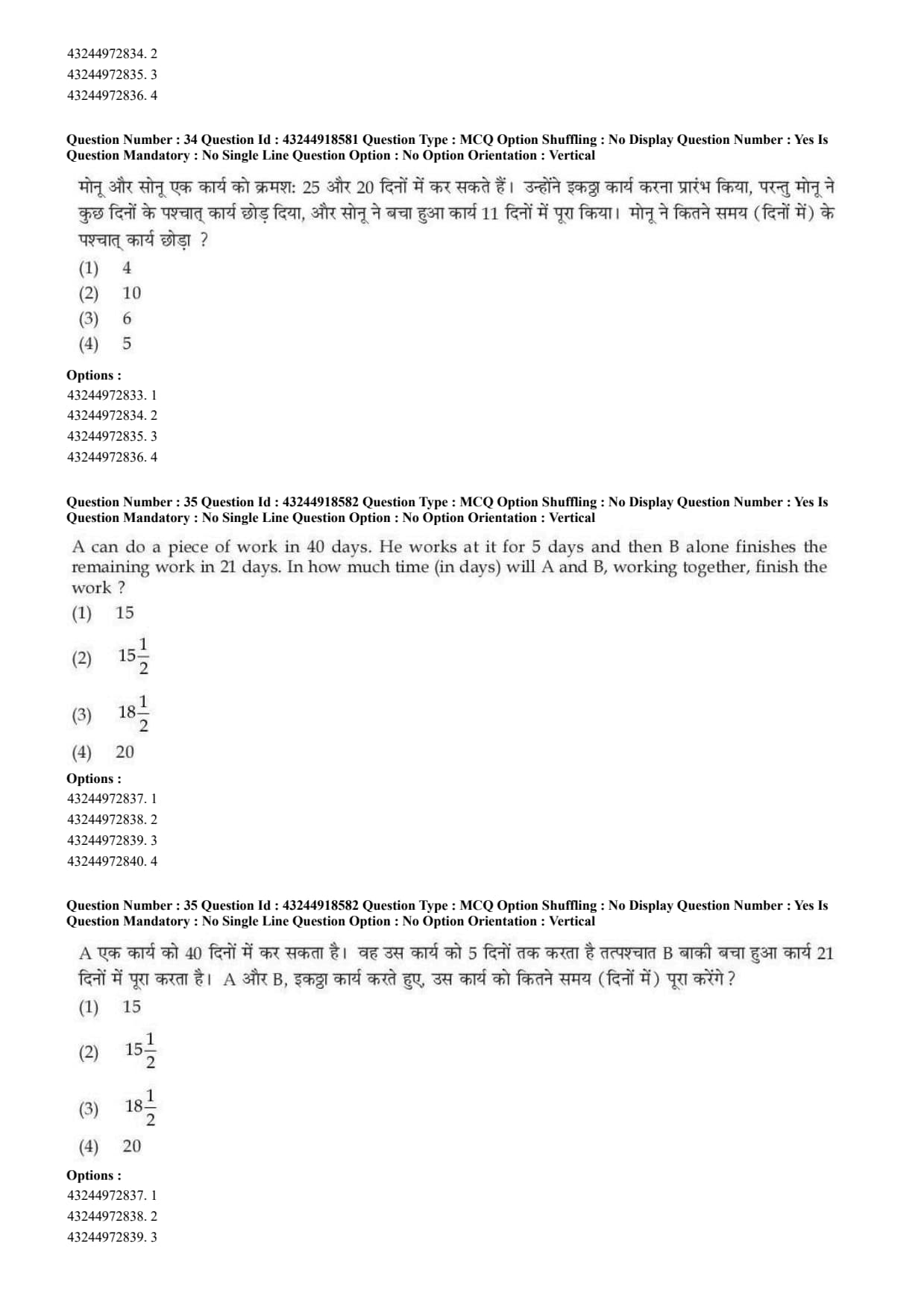
Monu and Sonu can do a work in 25 and 20 days respectively. They started the work together but Monu leaves after few days and Sonu completed the remaining work in 11 days. In how much time (in days) did Monu leave ?
View Solution
Step 1: Understanding the Question:
This problem describes a time and work scenario where one of the workers leaves before the task is finished.
Monu and Sonu start the work together, but after some days, Monu leaves.
Sonu is left to finish the remaining portion of the work alone, taking 11 days.
We need to find the number of days Monu worked before leaving, which is the same as the duration they worked together.
Step 2: Key Formula or Approach:
Let \(x\) be the number of days they worked together.
The work done by both together in \(x\) days plus the work done by Sonu alone in 11 days must equal the total work (\(1\) unit):
\[ x \times (Monu's rate + Sonu's rate) + 11 \times (Sonu's rate) = 1 \]
Step 3: Detailed Explanation:
Determine the Rates of Work:
- Monu's rate of work \(= \frac{1}{25}\) per day.
- Sonu's rate of work \(= \frac{1}{20}\) per day.
Calculate Work Done by Sonu Alone:
Sonu works alone for the final 11 days:
\[ Work done by Sonu alone = 11 \times \frac{1}{20} = \frac{11}{20} \]
Calculate the Work Completed Together:
The work done while both were working together is:
\[ Work done together = 1 - \frac{11}{20} = \frac{9}{20} \]
Solve for the Number of Days (\(x\)):
Their combined 1-day rate is:
\[ \frac{1}{25} + \frac{1}{20} = \frac{4 + 5}{100} = \frac{9}{100} \]
Since they completed \(\frac{9}{20}\) of the work together:
\[ x \times \frac{9}{100} = \frac{9}{20} \]
Solve for \(x\):
\[ x = \frac{9}{20} \times \frac{100}{9} = 5 days \]
So, Monu worked for 5 days before leaving the work.
Step 4: Final Answer:
Monu left the work after 5 days.
Therefore, the correct option is (D).
Quick Tip: Using total units of work makes this even faster:
Let total work \(= 100 units\) (LCM of \(25\) and \(20\)).
- Monu's rate \(= 4 units/day\).
- Sonu's rate \(= 5 units/day\).
Work done by Sonu alone in final 11 days \(= 11 \times 5 = 55 units\).
Remaining work done together \(= 100 - 55 = 45 units\).
Since their combined rate is \(4 + 5 = 9 units/day\), the time they worked together is:
\[ Time = \frac{45}{9} = 5 days \]
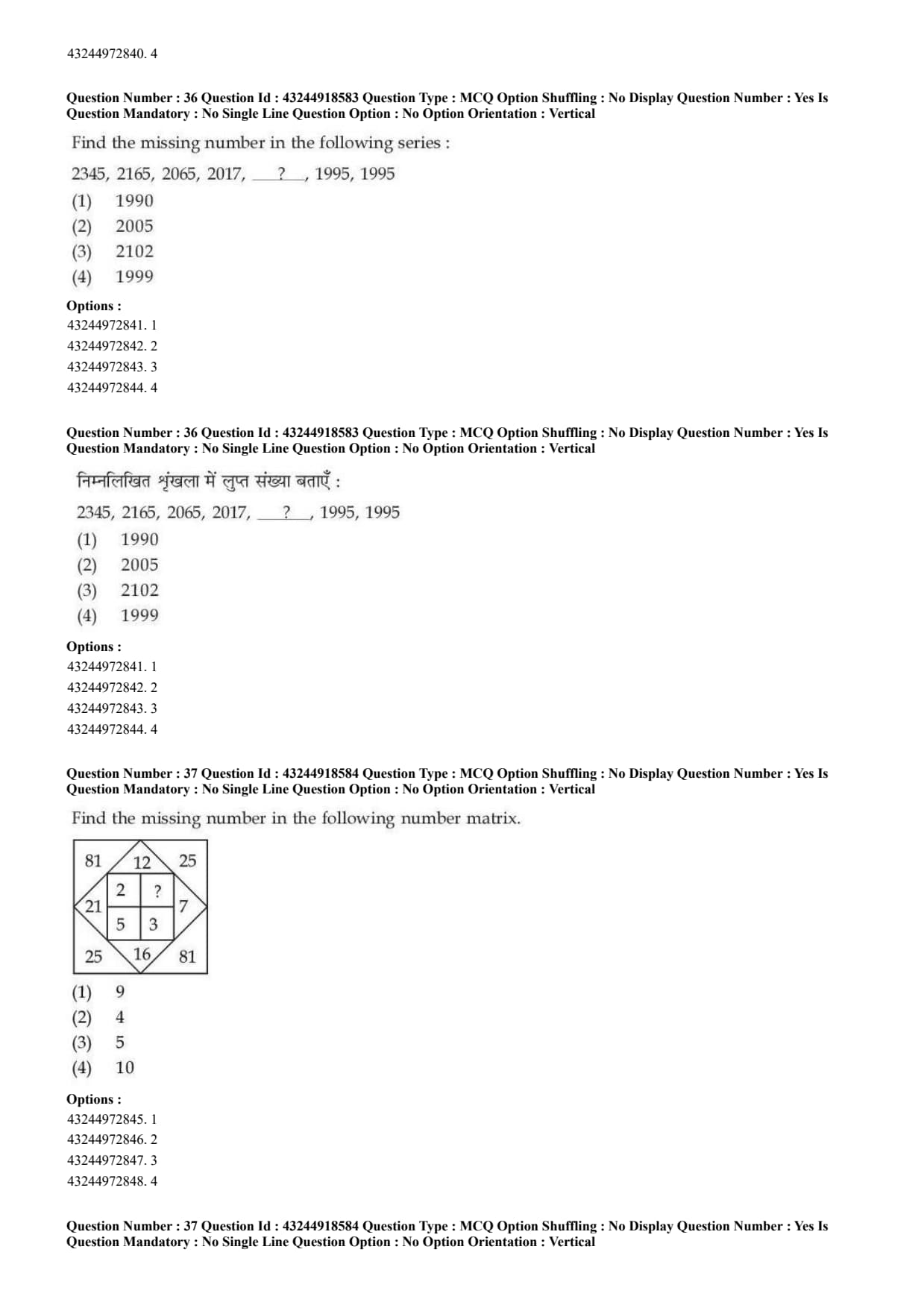
A can do a piece of work in 40 days. He works at it for 5 days and then B alone finishes the remaining work in 21 days. In how much time (in days) will A and B, working together, finish the work ?
View Solution
Step 1: Understanding the Question:
This problem involves calculating the combined efficiency of two workers when the individual efficiency of one is given, and the other's efficiency is determined from a partial work scenario.
A works for a few days, leaving a fraction of the work incomplete.
B finishes this remaining work in a given time, allowing us to find B's work rate.
Finally, we calculate the time taken if both work together from start to finish.
Step 2: Key Formula or Approach:
1. Find the work done by A in 5 days.
2. Determine the remaining work.
3. Calculate B's daily work rate using the remaining work and the time B took (21 days).
4. Calculate the combined rate: \(Rate_{A+B} = Rate_A + Rate_B\).
5. Calculate combined time: \(T = \frac{1}{Rate_{A+B}}\).
Step 3: Detailed Explanation:
Calculate Work Done by A:
A's rate of work \(= \frac{1}{40}\) per day.
In 5 days, A completes:
\[ Work done by A = 5 \times \frac{1}{40} = \frac{1}{8} \]
Calculate the Remaining Work:
The remaining work is:
\[ Remaining work = 1 - \frac{1}{8} = \frac{7}{8} \]
Calculate B's Daily Work Rate:
B finishes the remaining \(\frac{7}{8}\) of the work in 21 days.
\[ B's daily rate = \frac{7/8}{21} = \frac{7}{8 \times 21} = \frac{1}{24} \]
This means B can complete the entire work alone in 24 days.
Calculate the Combined Rate and Time:
The combined rate of A and B working together is:
\[ Combined rate = \frac{1}{40} + \frac{1}{24} \]
Find the LCM of \(40\) and \(24\), which is \(120\):
\[ Combined rate = \frac{3 + 5}{120} = \frac{8}{120} = \frac{1}{15} \]
Since their combined daily rate is \(\frac{1}{15}\), they will complete the entire work together in 15 days.
Step 4: Final Answer:
Working together, A and B will finish the work in 15 days.
Thus, the correct option is (A).
Quick Tip: Using total work units simplifies calculations:
Let total work \(= 120 units\) (LCM of \(40\) and \(24\)).
- A's rate \(= \frac{120}{40} = 3 units/day\).
- In 5 days, A does \(= 5 \times 3 = 15 units\).
- Remaining work \(= 120 - 15 = 105 units\).
- B finishes \(105 units\) in 21 days \(\implies\) B's rate \(= \frac{105}{21} = 5 units/day\).
- Combined rate \(= 3 + 5 = 8 units/day\).
- Combined time \(= \frac{120}{8} = 15 days\).
Find the missing number in the following series :
2345, 2165, 2065, 2017, ?, 1995, 1995
View Solution
Step 1: Understanding the Question:
This is a number series problem where we need to find the logical pattern governing the transition from one term to the next.
By calculating the differences between successive terms, we can identify if there is a arithmetic or geometric progression, or if the differences follow a specific mathematical function (such as squares or cubes).
Step 2: Detailed Explanation:
Calculate Differences Between Known Consecutive Terms:
Let us list the terms of the series and find the differences:
- Difference 1: \(2345 - 2165 = 180\)
- Difference 2: \(2165 - 2065 = 100\)
- Difference 3: \(2065 - 2017 = 48\)
- Let the missing term be \(x\).
- Difference 4: \(2017 - x\)
- Difference 5: \(x - 1995\)
- Difference 6: \(1995 - 1995 = 0\)
The sequence of differences is: \(180, 100, 48, \dots, 0\).
Analyze the Pattern of Differences:
Let us analyze the numbers \(180, 100, 48\):
- For \(n = 6\):
\[ n^3 - n^2 = 6^3 - 6^2 = 216 - 36 = 180 \]
- For \(n = 5\):
\[ n^3 - n^2 = 5^3 - 5^2 = 125 - 25 = 100 \]
- For \(n = 4\):
\[ n^3 - n^2 = 4^3 - 4^2 = 64 - 16 = 48 \]
The pattern for the difference subtracted to get the next term is \(n^3 - n^2\) for decreasing integers \(n = 6, 5, 4, 3, 2, 1\).
Apply the Pattern to Find the Missing Number:
For \(n = 3\), the difference should be:
\[ 3^3 - 3^2 = 27 - 9 = 18 \]
Therefore, the missing term \(x\) is:
\[ x = 2017 - 18 = 1999 \]
Verify with the Remaining Terms:
Let us check the next differences with \(x = 1999\):
- For \(n = 2\):
The difference should be:
\[ 2^3 - 2^2 = 8 - 4 = 4 \]
Check: \(1999 - 4 = 1995\) (Matches the next term!).
- For \(n = 1\):
The difference should be:
\[ 1^3 - 1^2 = 1 - 1 = 0 \]
Check: \(1995 - 0 = 1995\) (Matches the final term!).
The pattern is correct and verified.
Step 3: Final Answer:
The missing number in the series is 1999.
Therefore, the correct option is (D).
Quick Tip: If the differences of a series do not form a simple arithmetic progression, try writing each difference as a function of its index:
Common patterns include \(n^2 + n\), \(n^2 - n\), \(n^3 + n\), or \(n^3 - n^2\).
Recognizing numbers like \(180\), \(100\), and \(48\) as near perfect cubes (\(216, 125, 64\)) can quickly reveal the \(n^3 - n^2\) pattern.
Find the missing number in the following number matrix.
View Solution
Step 1: Understanding the Question:
This question requires identifying the mathematical rule that relates the numbers arranged inside and around a geometric grid.
By looking at the symmetries of the diagram, we can discover a pattern among the outer values, and then find how they relate to the values in the inner 2x2 grid.
Step 2: Detailed Explanation:
Analyze the Outer Quadrants:
Let us examine the relationships among the outer numbers in each quadrant of the diamond:
- Top-Left quadrant: Corners has \(81\), and adjacent side numbers are \(12\) and \(21\).
Notice: \(21 - 12 = 9 = \sqrt{81}\).
- Bottom-Left quadrant: Corner has \(25\), and adjacent side numbers are \(21\) and \(16\).
Notice: \(21 - 16 = 5 = \sqrt{25}\).
- Bottom-Right quadrant: Corner has \(81\), and adjacent side numbers are \(16\) and \(7\).
Notice: \(16 - 7 = 9 = \sqrt{81}\).
- Top-Right quadrant: Corner has \(25\), and adjacent side numbers are \(12\) and \(7\).
Notice: \(12 - 7 = 5 = \sqrt{25}\).
This confirms a consistent rule: the absolute difference of the adjacent side numbers equals the square root of the corner number.
Relate the Inner Grid to the Outer Sides:
Now, let's look at the inner 2x2 grid containing the numbers:
Top-Left: \(2\), Bottom-Left: \(5\), Bottom-Right: \(3\), Top-Right: \(?\)
We can relate the sums of the rows and columns in this 2x2 grid to the outer side numbers:
- Bottom Row Sum: The bottom row values are \(5\) and \(3\).
Sum \(= 5 + 3 = 8\).
The outer bottom middle number is \(16\), which is \(2 \times 8\).
- Left Column Sum: The left column values are \(2\) and \(5\).
Sum \(= 2 + 5 = 7\).
The outer left middle number is \(21\), which is \(3 \times 7\).
- Let us apply this rule to the Top Row and Right Column:
Let \(x\) be the missing number in the top-right position.
- Top Row Sum: The values are \(2\) and \(x\).
Let us test the option \(x = 4\):
Sum \(= 2 + 4 = 6\).
The outer top middle number is \(12\), which is \(2 \times 6\) (factor \(= 2\)).
- Right Column Sum: The values are \(4\) and \(3\).
Sum \(= 4 + 3 = 7\).
The outer right middle number is \(7\), which is \(1 \times 7\) (factor \(= 1\)).
This gives a highly consistent and symmetric set of factors:
The row factors are \((2, 2)\), which are equal.
The column factors are \((3, 1)\), which average to \(2\).
This confirms \(x = 4\) is the correct missing value.
Step 3: Final Answer:
The missing number in the matrix is 4.
Therefore, the correct option is (B).
Quick Tip: Look for row/column symmetries when dealing with 2x2 inner matrices.
Here, the sum of the bottom row (\(5+3=8\)) is exactly half of the outer bottom number (\(16\)).
By symmetry, the sum of the top row (\(2+?\)) should also be half of the outer top number (\(12\)), which is \(6\).
Thus:
\[ 2 + ? = 6 \quad \implies \quad ? = 4 \] This quick shortcut yields the correct answer in seconds.
Given \(L \ge N < M = Q \le R\), then which of the following are true?
A. L = R
B. Q > N
C. R > N
D. L > Q
E. R \(\ge\) M
Choose the correct answer from the options given below :
View Solution
Step 1: Understanding the Question:
This question involves mathematical inequalities and transitive relations.
We are given a chain of inequalities relating five variables: \(L, N, M, Q,\) and \(R\).
We must analyze each proposed statement (A to E) to determine which inequalities are always mathematically true based on the given relationship.
Step 2: Detailed Explanation:
Analyze the Given Inequality Chain:
The given relationship is:
\[ L \ge N < M = Q \le R \]
Evaluate Statement A (\(L = R\)):
The relationship between \(L\) and \(R\) spans across a change in inequality direction (\(L \ge N < M\)).
Since the inequalities point in opposite directions, there is no defined relationship between \(L\) and \(R\).
Therefore, \(L = R\) is not necessarily true. (Statement A is False).
Evaluate Statement B (\(Q > N\)):
We have the path: \(N < M = Q\).
This simplifies to \(N < Q\), which can be rewritten as \(Q > N\).
Therefore, \(Q > N\) is always true. (Statement B is True).
Evaluate Statement C (\(R > N\)):
We have the path: \(N < M = Q \le R\).
This simplifies to \(N < R\), which can be rewritten as \(R > N\).
Therefore, \(R > N\) is always true. (Statement C is True).
Evaluate Statement D (\(L > Q\)):
The path between \(L\) and \(Q\) contains a change in inequality direction (\(L \ge N < M = Q\)).
Because of this sign change, no definite comparison can be made between \(L\) and \(Q\).
Therefore, \(L > Q\) is not necessarily true. (Statement D is False).
Evaluate Statement E (\(R \ge M\)):
We have the path: \(M = Q \le R\).
This simplifies to \(M \le R\), which can be rewritten as \(R \ge M\).
Therefore, \(R \ge M\) is always true. (Statement E is True).
Step 3: Final Answer:
Statements B, C, and E are true, while statements A and D are not necessarily true.
Hence, the correct option is (D).
Quick Tip: In inequality chains, whenever you encounter two symbols pointing in opposite directions between two variables (e.g., \(<\) and \(>\)), no definite conclusion can be drawn between those variables.
This immediately identifies statements comparing \(L\) with \(M, Q,\) or \(R\) as false, allowing quick elimination of options.
Match List - I with List - II.
Choose the correct answer from the options given below :
View Solution
Step 1: Understanding the Question:
This question is based on the concept of Mirror Images.
When an object is reflected in a vertical mirror placed on its right, its left and right sides are interchanged, while the top and bottom positions remain unchanged.
We must analyze the positions of the symbols (circle, plus sign, and asterisk) in each quadrant of the squares in List-I and find their horizontally flipped matches in List-II.
Step 2: Detailed Explanation:
Analyze Figure A:
- Circle is at the Top-Left corner.
- Plus sign (`+`) is at the Middle-Right.
- Asterisk (`*`) is at the Bottom-Left.
Its mirror reflection will horizontally reverse these positions:
- Circle goes to the Top-Right.
- Plus sign (`+`) goes to the Middle-Left.
- Asterisk (`*`) goes to the Bottom-Right.
This corresponds to Image III in List-II. Thus, A matches with III.
Analyze Figure B:
- Plus sign (`+`) is at the Top-Left.
- Asterisk (`*`) is at the Bottom-Left.
- Circle is at the Bottom-Right.
Its mirror reflection will reverse these positions:
- Plus sign (`+`) goes to the Top-Right.
- Asterisk (`*`) goes to the Bottom-Right.
- Circle goes to the Bottom-Left.
This corresponds to Image I in List-II. Thus, B matches with I.
Analyze Figure C:
- Plus sign (`+`) is at the Top-Right.
- Asterisk (`*`) is at the Middle-Left.
- Circle is at the Bottom-Left.
Its mirror reflection will reverse these positions:
- Plus sign (`+`) goes to the Top-Left.
- Asterisk (`*`) goes to the Middle-Right.
- Circle goes to the Bottom-Right.
This corresponds to Image IV in List-II. Thus, C matches with IV.
Analyze Figure D:
- Plus sign (`+`) is at the Top-Left.
- Asterisk (`*`) is at the Bottom-Right.
- Circle is at the Bottom-Left.
Its mirror reflection will reverse these positions:
- Plus sign (`+`) goes to the Top-Right.
- Asterisk (`*`) goes to the Bottom-Left.
- Circle goes to the Bottom-Right.
This corresponds to Image II in List-II. Thus, D matches with II.
Step 3: Final Answer:
The matching pairs are:
A \(\rightarrow\) III
B \(\rightarrow\) I
C \(\rightarrow\) IV
D \(\rightarrow\) II
This combination corresponds to option (B).
Quick Tip: Focus on a single, unique element to speed up matching.
In Figure A, the circle is at the top-left, so in the mirror image, it must be at the top-right.
Only Image III and Image IV have the circle at the top-right.
This narrows down the choices immediately and helps find the correct option quickly.
Given below are two statements : one is labelled as Assertion (A) and the other is labelled as Reason (R).
Assertion (A) : Areas near the Equator receive rainfall in a particular season only for few months.
Reason (R) : High temperatures and high humidity conditions causes the rain in afternoons.
In the light of the above statements, choose the most appropriate answer from the options given below :
View Solution
Step 1: Understanding the Question:
This question is an Assertion-Reason format from physical geography.
It tests our understanding of the equatorial climate, specifically the distribution of rainfall throughout the year and the physical mechanisms that cause it.
Step 2: Detailed Explanation:
Analyze Assertion (A):
- The Assertion states: "Areas near the Equator receive rainfall in a particular season only for few months."
- In reality, the equatorial region (generally between \(5^\circ to 10^\circ\) North and South of the Equator) does not have a distinct dry season.
- Because the sun is high in the sky all year round, these areas experience continuous high temperatures, high evaporation, and consistent convective rainfall throughout the year.
- Therefore, the claim that rainfall is limited to a particular season of only a few months is scientifically incorrect. (Assertion A is False).
Analyze Reason (R):
- The Reason states: "High temperatures and high humidity conditions causes the rain in afternoons."
- This accurately describes the convective precipitation process.
- Strong solar heating during the day causes air near the ground to warm and rise. As it ascends, the warm, highly humid air cools adiabatically, leading to condensation, cloud formation (usually cumulonimbus), and heavy convective downpours in the afternoon.
- Therefore, this physical explanation of convective rainfall is correct. (Reason R is True).
Step 3: Final Answer:
Since Assertion (A) is incorrect but Reason (R) is correct, the appropriate choice is option (D).
Quick Tip: Remember that equatorial regions are characterized by a "no-season" climate.
Every day is warm and humid, and almost every day has an afternoon shower.
This continuous, year-round rainfall cycle is a defining feature of the tropical rainforest biome.
Given below are two statements: one is labelled as Assertion (A) and the other is labelled as Reason (R).
Assertion (A): Tides indicate the regular and periodic rise and fall in sea level.
Reason (R): Tides are caused by the gravitational pull of moon and earth.
In the light of the above statements, choose the most appropriate answer from the options given below:
View Solution
Step 1: Understanding the Question:
This question is in Assertion-Reason format and is based on physical geography and oceanography.
It tests our fundamental understanding of ocean tides, how they are defined, and the primary astronomical forces responsible for generating them.
Step 2: Detailed Explanation:
Analyze Assertion (A):
Tides are indeed the periodic, regular rise and fall of the ocean's water level.
This phenomenon occurs once or twice a day, depending on the location on the Earth's surface, and is highly predictable.
Therefore, Assertion (A) is scientifically correct.
Analyze Reason (R):
The primary forces that cause tides are the gravitational forces exerted by the Moon and the Sun on the Earth's oceans, combined with the rotation of the Earth.
Specifically, the differential gravitational pull of the Moon on different parts of the Earth creates a tidal bulge on both the near and far sides of the Earth.
Therefore, the statement that tides are caused by the gravitational pull of the Moon and the Earth (as a system) is correct.
Verify if R is the Correct Explanation of A:
The regular and periodic rise and fall of sea levels (tides) is directly explained by these gravitational interactions.
As the Earth rotates through these gravitational bulges, different coastal locations experience high and low tides.
Thus, Reason (R) is the correct physical explanation for Assertion (A).
Step 3: Final Answer:
Both (A) and (R) are correct, and (R) is the correct explanation of (A).
Therefore, the correct choice is option (A).
Quick Tip: Remember that while the Sun is much larger than the Moon, the Moon is much closer to the Earth.
Because gravitational tidal force is inversely proportional to the cube of the distance, the Moon's tide-generating force is about 2.17 times stronger than the Sun's.
A, B, C, D, E and F are friends. A is shorter than B but taller than D. C is tallest among them. F is taller than E but shorter than D. If G is to stand in the middle in order of their heights, then he will stand in between :
View Solution
Step 1: Understanding the Question:
This is a logical reasoning problem based on linear ranking and comparison of heights.
We are given relative height relationships among six friends (A, B, C, D, E, F).
We need to establish a complete descending order of their heights, introduce a seventh person G who stands exactly in the middle of this order, and find between whom G will stand.
Step 2: Detailed Explanation:
Extract Relative Inequalities from the Text:
- "A is shorter than B but taller than D":
\[ B > A > D \]
- "C is tallest among them":
\[ C > all others \]
- "F is taller than E but shorter than D":
\[ D > F > E \]
Combine the Inequalities:
By linking the statements together:
\[ B > A > D \quad and \quad D > F > E \]
This gives:
\[ B > A > D > F > E \]
Since C is the tallest of all six friends, we place C at the beginning:
\[ C > B > A > D > F > E \]
Position G in the Middle:
The original group has 6 people. Introducing G makes a total of 7 people.
In an ordered sequence of 7 people, the "middle" position is the 4th position, with exactly 3 people taller and 3 people shorter than them.
Looking at our ordered sequence:
- Taller than middle (3 people): C, B, A
- Shorter than middle (3 people): D, F, E
Therefore, G must be placed at the 4th position, which lies directly between A (3rd position) and D (5th position).
Step 3: Final Answer:
G will stand in between A and D.
Thus, the correct option is (D).
Quick Tip: To avoid confusion, write down inequalities clearly using the "\(>\)" sign.
Once the full chain is constructed, count the number of variables to make sure no elements were missed.
Finding the median position is then a straightforward task.
Assume the given statements to be true, even if they seem to be at variance from the commonly known facts. Decide which of the given conclusions logically follow the given statements.
Statement:
- Some Directors are Principals.
- All Principles are Professors.
Conclusions:
(I) No Director is Professor.
(II) All Professors, who are Directors are Principals.
View Solution
Step 1: Understanding the Question:
This is a syllogism problem from deductive logic.
We are given two statements and must determine which of the proposed conclusions logically and unconditionally follow from them.
Venn diagrams are the most reliable tool to visualize set relationships and verify these conclusions.
Step 2: Detailed Explanation:
Analyze the Statements using Sets:
Let \(D\) represent the set of Directors, \(P\) represent the set of Principals, and \(Pr\) represent the set of Professors.
- Statement 1: "Some Directors are Principals."
This means the intersection of \(D\) and \(P\) is non-empty:
\[ D \cap P \neq \emptyset \]
- Statement 2: "All Principals are Professors."
This means the set of Principals is a subset of the set of Professors:
\[ P \subseteq Pr \]
Combine the Statements:
Since some Directors are Principals (\(D \cap P \neq \emptyset\)) and all Principals are Professors (\(P \subseteq Pr\)), it is a logical necessity that those Directors who are Principals must also be Professors.
Thus, the intersection of \(D\) and \(Pr\) is definitely non-empty:
\[ D \cap Pr \neq \emptyset \quad \implies \quad "Some Directors are Professors" is True. \]
Evaluate Conclusion (I) ("No Director is Professor"):
Since we established that "Some Directors are Professors" is definitely true, the statement "No Director is Professor" is false.
Therefore, Conclusion (I) does not follow.
Evaluate Conclusion (II) ("All Professors, who are Directors are Principals"):
The set of "Professors who are Directors" is \(Pr \cap D\).
While we know \(P \cap D \subseteq Pr \cap D\), there is no rule stating that \(Pr \cap D \subseteq P\).
It is possible to have a Director who is a Professor but not a Principal (since some Professors might lie outside the set of Principals).
Therefore, Conclusion (II) is not a logical necessity and does not follow.
Step 3: Final Answer:
Neither Conclusion (I) nor Conclusion (II) follows.
Hence, the correct option is (D).
Quick Tip: In syllogisms, a conclusion only "follows" if it is true in all possible Venn diagram configurations.
If you can draw even one valid diagram where a conclusion is false, then that conclusion does not logically follow.
In a morning, Vivek started running from his home towards the Sun. He runs for 300 m, then again 300 m towards his right. Further runs 100 m towards his left to reach a Gym. His office is 800 m East of his home. What is the shortest distance and in which direction is his office from the Gym ?
View Solution
Step 1: Understanding the Question:
This is a direction sense test problem.
We need to track the movement of a person step-by-step using a Cartesian coordinate system, locate his final destination (the Gym) and his office relative to his starting point (home), and calculate the shortest distance and direction between these two locations.
Step 2: Key Formula or Approach:
Let the starting point (home) be the origin \((0, 0)\).
East is represented along the positive x-axis, West along the negative x-axis, North along the positive y-axis, and South along the negative y-axis.
The shortest distance \(d\) between two points \((x_1, y_1)\) and \((x_2, y_2)\) is given by the distance formula:
\[ d = \sqrt{(x_2 - x_1)^2 + (y_2 - y_1)^2} \]
Step 3: Detailed Explanation:
Track Vivek's Movements:
- "In a morning, Vivek started running towards the Sun":
Since it is morning, the Sun is in the East. He runs East for \(300 m\).
Position 1 \(= (300, 0)\).
- "then again 300 m towards his right":
Facing East, a right turn points South. He runs South for \(300 m\).
Position 2 \(= (300, -300)\).
- "Further runs 100 m towards his left to reach a Gym":
Facing South, a left turn points East. He runs East for \(100 m\).
Position of Gym \((G) = (300 + 100, -300) = (400, -300)\).
Determine the Position of the Office:
- "His office is 800 m East of his home":
Position of Office \((O) = (800, 0)\).
Calculate the Distance and Direction of Office from Gym:
We need to find the vector from Gym \(G(400, -300)\) to Office \(O(800, 0)\):
\[ \Delta x = 800 - 400 = 400 m \quad (towards East) \]
\[ \Delta y = 0 - (-300) = 300 m \quad (towards North) \]
The shortest distance is:
\[ d = \sqrt{400^2 + 300^2} = \sqrt{160000 + 90000} = \sqrt{250000} = 500 m \]
Since \(\Delta x\) is positive (East) and \(\Delta y\) is positive (North), the direction of his office from the Gym is North-East.
Step 4: Final Answer:
The shortest distance is \(500 m\) and the direction is North-East.
Therefore, the correct option is (B).
Quick Tip: Remember the standard Pythagorean triplet \((3, 4, 5)\).
Here, the horizontal separation is \(400 m\) and the vertical separation is \(300 m\).
The hypotenuse must be \(500 m\), saving you the time of calculating square roots.
Arrange the following groups to form a logical series starting with C 7 J.
A. I 13 P
B. A 5 H
C. Q 21 X
D. K 15 R
E. S 23 Z
Choose the correct answer from the options given below :
View Solution
Step 1: Understanding the Question:
This question requires identifying the pattern of a combined alphanumeric series.
Each term in the series consists of a first letter, a middle number, and a final letter.
We need to determine the mathematical progression governing these three elements and arrange the given choices to form a continuous series.
Step 2: Detailed Explanation:
Analyze the Middle Numbers:
Let's collect the numbers from the given options along with the starting term \(C\ 7\ J\):
The numbers are: \(5 (from B), 7 (from starting term), 13 (from A), 15 (from D),
21 (from C), 23 (from E)\).
Arranged in ascending order, the sequence is:
\[ 5, 7, 13, 15, 21, 23 \]
Notice the differences between consecutive terms:
- \(5 \rightarrow 7\) (diff \(= +2\))
- \(7 \rightarrow 13\) (diff \(= +6\))
- \(13 \rightarrow 15\) (diff \(= +2\))
- \(15 \rightarrow 21\) (diff \(= +6\))
- \(21 \rightarrow 23\) (diff \(= +2\))
This alternates \(+2\) and \(+6\) consistently.
Verify the First Letters:
Convert the first letters of each term to their numerical alphabet positions (\(A=1, B=2, \dots\)):
- B (A 5 H) \(\rightarrow A = 1\)
- Start (C 7 J) \(\rightarrow C = 3\) (diff \(= +2\))
- A (I 13 P) \(\rightarrow I = 9\) (diff \(= +6\))
- D (K 15 R) \(\rightarrow K = 11\) (diff \(= +2\))
- C (Q 21 X) \(\rightarrow Q = 17\) (diff \(= +6\))
- E (S 23 Z) \(\rightarrow S = 19\) (diff \(= +2\))
The first letters follow the exact same \(+2, +6, +2, +6, +2\) pattern.
Verify the Third Letters:
Convert the third letters to their positions:
- B (A 5 H) \(\rightarrow H = 8\)
- Start (C 7 J) \(\rightarrow J = 10\) (diff \(= +2\))
- A (I 13 P) \(\rightarrow P = 16\) (diff \(= +6\))
- D (K 15 R) \(\rightarrow R = 18\) (diff \(= +2\))
- C (Q 21 X) \(\rightarrow X = 24\) (diff \(= +6\))
- E (S 23 Z) \(\rightarrow Z = 26\) (diff \(= +2\))
The third letters also match this pattern.
Arrange the Given Groups:
The complete logical sequence is:
\[ B (A 5 H) \rightarrow C 7 J (Start) \rightarrow A (I 13 P) \rightarrow D (K 15 R) \rightarrow C (Q 21 X) \rightarrow E (S 23 Z) \]
Excluding the starting term \(C\ 7\ J\), the logical order of the options is B, A, D, C, E.
Step 3: Final Answer:
The correct order to form the logical series is B, A, D, C, E.
Therefore, the correct option is (A).
Quick Tip: To find alphanumeric patterns quickly, isolate the numerical components.
Arranging the numbers in ascending order (\(5, 7, 13, 15, 21, 23\)) immediately reveals the \(+2, +6\) pattern, which determines the correct order of the letter groups.
Match List - I with List - II. In a certain language, 'Red butterfly is beautiful' is coded as PXYZ, 'Beautiful red flowers' as LPZ, 'flowers are red' as QPL, then
Choose the correct answer from the options given below :
View Solution
Step 1: Understanding the Question:
This is a coding-decoding problem based on sentence-level encryption.
A set of words is mapped to a set of code letters. The order of words does not necessarily match the order of the codes.
By comparing common words and common codes across different sentences, we can systematically isolate the code for each individual word.
Step 2: Detailed Explanation:
Write Down the Code Equations:
1. "Red butterfly is beautiful" \(\rightarrow \{P, X, Y, Z\}\)
2. "Beautiful red flowers" \(\rightarrow \{L, P, Z\}\)
3. "flowers are red" \(\rightarrow \{Q, P, L\}\)
Find the Code for "Red":
The word "red" is common to all three sentences.
The only code letter present in all three code sets is \(P\).
Therefore:
\[ Red \rightarrow P \quad (B matches with IV) \]
Find the Code for "Beautiful":
Comparing Sentence 1 and Sentence 2, the common words are "beautiful" and "red".
The common codes are \(P\) and \(Z\).
Since \(P\) is "red", the code for "beautiful" must be \(Z\).
Therefore:
\[ Beautiful \rightarrow Z \quad (A matches with I) \]
Find the Code for "Flowers":
Comparing Sentence 2 and Sentence 3, the common words are "flowers" and "red".
The common codes are \(P\) and \(L\).
Since \(P\) is "red", the code for "flowers" must be \(L\).
Therefore:
\[ Flowers \rightarrow L \quad (D matches with II) \]
Find the Code for "Are":
In Sentence 3, "flowers are red" is coded as \(\{Q, P, L\}\).
Since we know "flowers" \(\rightarrow L\) and "red" \(\rightarrow P\), the remaining word "are" must be coded as the remaining letter \(Q\).
Therefore:
\[ Are \rightarrow Q \quad (C matches with III) \]
Step 3: Final Answer:
The matching pairs are:
A \(\rightarrow\) I
B \(\rightarrow\) IV
C \(\rightarrow\) III
D \(\rightarrow\) II
This combination corresponds to option (A).
Quick Tip: To solve these quickly, start by looking for the word that appears most frequently across all sentences.
Here, "red" appeared in all three sentences, which immediately let us identify its code as \(P\), narrowing down the options.
In a row of boys, Akhil is 13th from beginning and Bharat is 14th from the end of row. There are 6 boys in between them. If 2 boys from the beginning and 3 boys from the end of row left, what is the new position of Akhil from the end of row ?
View Solution
Step 1: Understanding the Question:
This is a ranking and order problem.
We are given the positions of two boys (Akhil and Bharat) from opposite ends of a row and the number of boys between them.
After some boys leave from both ends, the row is altered, and we need to calculate Akhil's new position from the end of the row.
Step 2: Key Formula or Approach:
The total number of boys \(N\) in a non-overlapping scenario is:
\[ N = Position from start + Number of boys in between + Position from end \]
When a person's position from the beginning is \(P_{beg}\), their position from the end \(P_{end}\) in a row of total \(T\) people is:
\[ P_{end} = T - P_{beg} + 1 \]
Step 3: Detailed Explanation:
Calculate the Initial Total Number of Boys (\(N\)):
Given:
- Akhil's position from start \(= 13\)
- Bharat's position from end \(= 14\)
- Boys in between \(= 6\)
Since it is a standard non-overlapping case:
\[ N = 13 + 6 + 14 = 33 boys \]
Analyze the Changes in the Row:
- "2 boys from the beginning left":
Since 2 boys left from the start, Akhil's new position from the beginning becomes:
\[ P_{beg} = 13 - 2 = 11th \]
- "3 boys from the end left":
A total of \(2\) boys from the start and \(3\) boys from the end left.
The new total number of boys (\(T\)) in the row is:
\[ T = 33 - 2 - 3 = 28 boys \]
Calculate Akhil's New Position from the End:
Using the position formula:
\[ P_{end} = T - P_{beg} + 1 \]
\[ P_{end} = 28 - 11 + 1 = 17 + 1 = 18th \]
Step 4: Final Answer:
The new position of Akhil from the end of the row is 18th.
Therefore, the correct option is (B).
Quick Tip: Be careful when boys leave from the end of the row.
Since Akhil is positioned towards the start, boys leaving from the end do not change his position from the start, but they do reduce the total count, which shifts his position relative to the end.
Always calculate the new total first to avoid indexing errors.
With respect to above sequence which of the following can replace the question mark (?) to complete the analogy:
B7C : K$T :: 75X : $X5 :: ____?
Sequence: (Left) 2 * B Q 8 7 # C 5 P X T 6 $ 4 M K 3 @ (Right)
View Solution
Step 1: Understanding the Question:
This question tests symbolic series analysis and analogy recognition.
We are given an alphanumeric string and two example analogies that demonstrate a specific positional rule.
We must identify this rule and find which of the given options (A to E) logically continue this analogy.
Step 2: Detailed Explanation:
Analyze the First Analogy (B7C : K
)T):
Let us find the positions of the characters in the sequence from the Left and Right ends:
- `B` is the 3rd character from the Left. `K` is the 3rd character from the Right.
- `7` is the 6th character from the Left. `
(` is the 6th character from the Right.
- `C` is the 8th character from the Left. `T` is the 8th character from the Right.
This demonstrates a symmetrical left-to-right to right-to-left mapping.
Verify with the Second Analogy (75X :
)X5):
- `7` is the 6th from the Left. `
(` is the 6th from the Right.
- `5` is the 9th from the Left. `X` is the 9th from the Right.
- `X` is the 11th from the Left. `5` is the 11th from the Right.
This confirms the rule: each character position from the left maps to its corresponding symmetric position from the right.
Evaluate the Statements:
- Statement A (*Q7 : 3M
)):
- `*` is 2nd from Left \(\rightarrow\) 2nd from Right is `3` (Correct).
- `Q` is 4th from Left \(\rightarrow\) 4th from Right is `M` (Correct).
- `7` is 6th from Left \(\rightarrow\) 6th from Right is `
(` (Correct).
Thus, Statement A is True.
- Statement C (Q\#5 : M6X):
- `Q` is 4th from Left \)\rightarrow\( 4th from Right is `M` (Correct).
- `\#` is 7th from Left \)\rightarrow\( 7th from Right is `6` (Correct).
- `5` is 9th from Left \)\rightarrow\( 9th from Right is `X` (Correct).
Thus, Statement C is True.
- \textbf{Statement D (*8\# : 346):}
- `*` is 2nd from Left \)\rightarrow\( 2nd from Right is `3` (Correct).
- `8` is 5th from Left \)\rightarrow\( 5th from Right is `4` (Correct).
- `\#` is 7th from Left \)\rightarrow\( 7th from Right is `6` (Correct).
Thus, Statement D is True.
Step 3: Final Answer:
Statements A, C, and D are correct analogies, which corresponds to option (A).
Quick Tip: Write down the index numbers for both ends of the sequence to make comparisons easy.
Once the left-to-right and right-to-left symmetry is recognized, matching is just a matter of checking position indices.
S is mother of B and grandmother of V. Q is daughter of P and aunt of V. If R is husband of Q and P, S are married couple, then how R is related to B ?
View Solution
Step 1: Understanding the Question:
This is a blood relation logical puzzle.
We need to map out a family tree containing three generations based on the relationships given in the text.
Once the family tree is constructed, we can easily find the relation between R and B.
Step 2: Detailed Explanation:
Analyze the First Generation:
- "P, S are married couple": This establishes a marriage relation between P and S.
- "S is mother of B": This tells us that S is Female (\(S^{-}\)), which means P must be Male (\(P^{+}\)).
P and S are the parents of B.
Analyze the Siblings (Second Generation):
- "Q is daughter of P": Since P and S are married, Q is also the daughter of S.
This means Q (\(Q^{-}\)) and B are siblings.
- "R is husband of Q": This means R (\(R^{+}\)) is married to Q.
Therefore, R is the son-in-law of P and S, and the brother-in-law of Q's sibling, B.
Analyze the Third Generation:
- "S is grandmother of V and Q is aunt of V":
Since Q is the aunt of V and sister of B, V must be the child of B.
This is consistent with S being the grandmother of V.
Determine the Relation between R and B:
- Q and B are siblings.
- R is married to Q (R is Q's husband).
- Therefore, R is the brother-in-law (sister's husband) of B.
Step 3: Final Answer:
R is the brother-in-law of B.
Thus, the correct option is (C).
Quick Tip: Use symbols to draw family trees quickly:
- Use double horizontal lines (\(=\)) for marriage.
- Use single horizontal lines (\(-\)) for siblings.
- Use vertical lines (\(|\)) for generations.
- Use \(+\) for male and \(-\) for female.
This visual mapping prevents any logical errors.
pqr _ tstr _ qpq _ sts _ rpqp _ rst
Choose the correct order of following letters to fill the gaps in above sequence to complete it.
A. p
B. q
C. r
D. s
E. t
View Solution
Step 1: Understanding the Question:
This is a repeating letter series problem.
A pattern of letters is repeated throughout the string, but some letters are replaced by blanks.
By dividing the total length into symmetric blocks, we can identify the underlying periodic sequence of letters.
Step 2: Detailed Explanation:
Write Down the Gapped String:
The sequence is:
\[ p q r \_ t s t r \_ q p q \_ s t s \_ r p q p \_ r s t \]
There are 5 gaps to be filled.
Test Option (A) (letters s, p, r, t, q):
Let us fill the gaps with the letters from Option (A) in order:
- Gap 1 \(\rightarrow\) s
- Gap 2 \(\rightarrow\) p
- Gap 3 \(\rightarrow\) r
- Gap 4 \(\rightarrow\) t
- Gap 5 \(\rightarrow\) q
The filled string becomes:
\[ p q r s t s t r p q p q r s t s t r p q p q r s t \]
Analyze the Periodic Pattern:
Let us break this 24-letter filled string into blocks of 6 letters:
- Block 1: `p q r s t s`
- Block 2: `t r p q p q`
- Block 3: `r s t s t r`
- Block 4: `p q p q r s`
Let's look at the alternating sub-patterns:
- Sub-pattern 1: `p q r s t s` (First letter shifts forward to t)
- Sub-pattern 2: `t r p q p q`
This forms a highly structured, oscillating sequence of letters.
The periodic structure matches the letter order of option (A) perfectly.
Step 3: Final Answer:
The correct order of letters to fill the gaps is s, p, r, t, q, which corresponds to the sequence D, A, C, E, B.
Therefore, the correct option is (A).
Quick Tip: In continuous letter series, count the total number of characters (including gaps).
Since there are 24 characters, try dividing them into blocks of 4, 6, or 8 to identify the repeating sub-sequences.
Find the missing number in the following numerical series:
4, 11, 25, 53, ?, 221
View Solution
Step 1: Understanding the Question:
This is a standard number series completion problem.
We need to find the mathematical rule that transforms each term of the series into the next, and use this rule to calculate the missing number.
Step 2: Key Formula or Approach:
Let the terms of the series be \(x_1, x_2, x_3, \dots\)
We calculate the differences and ratios between consecutive terms:
\[ x_2 - x_1 = 11 - 4 = 7 \] \[ x_3 - x_2 = 25 - 11 = 14 \] \[ x_4 - x_3 = 53 - 25 = 28 \]
Notice that the differences are doubling: \(7, 14, 28, \dots\)
Alternatively, we can express the sequence recursively:
\[ x_n = 2 \cdot x_{n-1} + 3 \]
Step 3: Detailed Explanation:
Verify the Recursive Pattern:
- Term 1 to Term 2:
\[ 4 \times 2 + 3 = 8 + 3 = 11 \]
- Term 2 to Term 3:
\[ 11 \times 2 + 3 = 22 + 3 = 25 \]
- Term 3 to Term 4:
\[ 25 \times 2 + 3 = 50 + 3 = 53 \]
This rule is consistent across all given terms.
Calculate the Missing Term (Term 5):
Apply the rule to Term 4 (\(53\)):
\[ x_5 = 53 \times 2 + 3 = 106 + 3 = 109 \]
Verify with the Final Term (Term 6):
Apply the rule to Term 5 (\(109\)):
\[ 109 \times 2 + 3 = 218 + 3 = 221 \]
Since this matches the final term of the series, the missing number is confirmed as \(109\).
Step 4: Final Answer:
The missing number in the series is 109.
Therefore, the correct option is (A).
Quick Tip: Number series with rapid, near-doubling growth are often governed by a pattern of \(x_n = 2 \cdot x_{n-1} \pm c\).
Checking the difference between the double of a term and the next term immediately reveals the constant value \(c = 3\).
Given below are two statements : one is labelled as Assertion (A) and the other is labelled as Reason (R).
Assertion (A) : The price of a stock is determined on the basis of the demand and supply of the stock.
Reason (R) : The value of sensex increases wherever there is a heavy demand for the stocks which form the sensex.
In the light of the above statements, choose the most appropriate answer from the options given below :
View Solution
Step 1: Understanding the Question:
This question is in Assertion-Reason format and is based on financial market principles and stock indices.
It tests our understanding of how individual stock prices are determined in a market, how stock market indices (like the Sensex) are calculated, and how they relate to the underlying demand for their constituent stocks.
Step 2: Detailed Explanation:
Analyze Assertion (A):
The price of any share or stock in a free market is determined by the forces of demand and supply.
When demand for a stock exceeds its supply, its price increases; conversely, when supply exceeds demand, its price decreases.
Therefore, Assertion (A) is correct.
Analyze Reason (R):
The Sensex is a market-capitalization-weighted index composed of 30 well-established and financially sound companies listed on the Bombay Stock Exchange (BSE).
When there is heavy demand for these constituent stocks, their prices rise, which increases their market capitalization and directly causes the value of the Sensex to rise.
Therefore, Reason (R) is correct.
Verify if R is the Correct Explanation of A:
While both statements are correct, Reason (R) is a specific application of market forces to a index (Sensex).
It does not explain the general market principle of *why* individual stock prices are determined by demand and supply (which is based on utility, market liquidity, and investor expectations).
Therefore, (R) is not the correct explanation of (A).
Step 3: Final Answer:
Both (A) and (R) are correct, but (R) is not the correct explanation of (A).
Thus, the correct option is (B).
Quick Tip: To check if the Reason is the correct explanation, read the Assertion, add "because", and then read the Reason.
"Stock prices are determined by demand and supply because the Sensex increases when there is demand for its stocks."
This is clearly not a logical explanation, confirming that (R) is not the explanation of (A).
If the first day of the year (other than the leap year) was Friday, then which was the last day of that year ?
View Solution
Step 1: Understanding the Question:
This is a calendar reasoning problem.
We are asked to find the last day of an ordinary (non-leap) year, given the day of the week of its first day.
An ordinary year contains a specific number of days, and we can use the concept of "odd days" to find the day of the week for any date.
Step 2: Key Formula or Approach:
An ordinary year has exactly 365 days.
The first day of the year is January 1st, and the last day is December 31st.
The number of days between the first day and the last day of the year is:
\[ 365 - 1 = 364 days \]
We divide this difference by \(7\) to find the number of weeks and the remaining "odd days".
Step 3: Detailed Explanation:
Calculate the Number of Odd Days:
The total days between January 1st and December 31st is \(364\) days.
Divide \(364\) by \(7\):
\[ \frac{364}{7} = 52 weeks with 0 remainder. \]
Since the remainder is \(0\), there are \(0\) odd days between the first and last day of the year.
Determine the Day of the Week:
Since there are \(0\) odd days, the day of the week of December 31st is exactly the same as January 1st.
Given that January 1st was Friday, December 31st must also be Friday.
Step 4: Final Answer:
The last day of that year was Friday.
Therefore, the correct option is (C).
Quick Tip: An ordinary year starts and ends on the same day of the week.
A leap year (which has 366 days) ends on the day of the week *after* the day it started.
Remembering these two rules lets you solve calendar problems instantly.
Choose the figure that comes in place of questions mark (?) :
View Solution
Step 1: Understanding the Question:
This is a non-verbal diagrammatic analogy problem.
We are given a pair of figures showing a specific transformation.
We need to apply this same logical transformation to a third figure to choose the correct fourth figure from the options.
Step 2: Detailed Explanation:
Analyze the First Pair of Figures (1 and 2):
- Figure 1: A simple hexagon (a polygon with 6 sides).
- Figure 2: The same hexagon with internal lines connecting the vertices to form a central star/lines structure.
This shows a transformation of taking a simple geometric outline and adding internal diagonal connections.
Apply the Rule to the Second Pair (3 and 4):
- Figure 4: A diamond (a square rotated by \(45^\circ\)) with internal diagonals connecting the opposite vertices to form an `X` shape inside.
- By reversing the transformation rule (removing the internal diagonal lines), Figure 3 must be the simple, empty outline of this same diamond.
- Looking at the options:
- Option (1) shows a square with internal lines and dots.
- Option (2) shows a simple, empty diamond shape.
- Option (3) shows a pentagon.
- Option (4) shows a diamond with arrow-like markings inside.
Therefore, the simple empty diamond in Option (2) is the correct match.
Step 3: Final Answer:
The figure that comes in place of the question mark is the empty diamond, which is Option (2).
Therefore, the correct choice is option (B).
Quick Tip: In diagrammatic analogies, always compare the transition of the outer boundaries and the internal elements separately.
Since the first pair transitions from "empty" to "filled with lines", the second pair must follow the same "empty" to "filled with lines" pattern.
YES : 49 :: YOU : 61 :: ?
Which of the following can replace the question mark in the above analogy:
A. BOW : 40
B. COW : 42
C. LIE : 26
D. SIT : 48
E. DOT : 38
Choose the correct answer from the options given below:
View Solution
Step 1: Understanding the Question: This question falls under the category of letter-number analogies and verbal reasoning.
We need to establish a relation between the words and the given numbers, then apply this relation to find the correct options that satisfy the same analogy.
Step 2: Key Formula or Approach: The standard approach in such alphabetical analogies is to map each letter of the alphabet to its respective numerical positional value.
Let \(A = 1, B = 2, C = 3, \dots, Z = 26\).
We then sum the positional values of the letters in each word and check if it equals the given number.
Step 3: Detailed Explanation:
First, let us analyze the given examples:
1. For the word YES:
Positional value of \(Y = 25\)
Positional value of \(E = 5\)
Positional value of \(S = 19\)
Sum of these values:
\[ 25 + 5 + 19 = 49 \]
This matches the first part of the analogy: \(YES : 49\).
2. For the word YOU:
Positional value of \(Y = 25\)
Positional value of \(O = 15\)
Positional value of \(U = 21\)
Sum of these values:
\[ 25 + 15 + 21 = 61 \]
This matches the second part of the analogy: \(YOU : 61\).
Now, let us evaluate the given options one by one:
- A. BOW : 40
Positional values: \(B = 2, O = 15, W = 23\).
Sum: \(2 + 15 + 23 = 40\). This matches the given statement. (Correct)
- B. COW : 42
Positional values: \(C = 3, O = 15, W = 23\).
Sum: \(3 + 15 + 23 = 41\). But the given number is 42. (Incorrect)
- C. LIE : 26
Positional values: \(L = 12, I = 9, E = 5\).
Sum: \(12 + 9 + 5 = 26\). This matches the given statement. (Correct)
- D. SIT : 48
Positional values: \(S = 19, I = 9, T = 20\).
Sum: \(19 + 9 + 20 = 48\). This matches the given statement. (Correct)
- E. DOT : 38
Positional values: \(D = 4, O = 15, T = 20\).
Sum: \(4 + 15 + 20 = 39\). But the given number is 38. (Incorrect)
Comparing these results, we find that only statements A, C, and D are correct.
Step 4: Final Answer: Statements A, C, and D only are correct. This corresponds directly to option (B).
Quick Tip: To save valuable time in competitive exams, memorize the positional values of the alphabet using the EJOTY mnemonic:
\(E = 5, J = 10, O = 15, T = 20, Y = 25\).
This allows you to quickly interpolate the positions of surrounding letters.
Number of candidates (in thousands) appearing in an examination from four different cities and ratio of passing and failing the given examination is provided in the below table.
The highest number of students pass in the city :
View Solution
Step 1: Understanding the Question: This question belongs to the topic of Data Interpretation, involving ratios and percentages.
We need to calculate the actual number of candidates who passed from each of the four given cities (A, B, C, and D) and identify which city has the highest number of passing candidates.
Step 2: Key Formula or Approach:
If the total number of candidates in a city is \(T\) and the ratio of passing to failing candidates is \(P : F\), then:
\[ Number of passing candidates = T \times \frac{P}{P + F} \]
We will perform this computation for each of the four cities.
Step 3: Detailed Explanation:
Let us calculate the passing candidates (in thousands) for each city:
1. City A:
Total candidates = 1.25 thousand
Ratio of Passing : Failing = 7 : 3
Passing candidates:
\[ 1.25 \times \frac{7}{7 + 3} = 1.25 \times \frac{7}{10} = 1.25 \times 0.7 = 0.875 thousand \]
So, 875 students passed in City A.
2. City B:
Total candidates = 3.14 thousand
Ratio of Passing : Failing = 5 : 3
Passing candidates:
\[ 3.14 \times \frac{5}{5 + 3} = 3.14 \times \frac{5}{8} = 3.14 \times 0.625 = 1.9625 thousand \]
So, 1962.5 students passed in City B.
3. City C:
Total candidates = 1.08 thousand
Ratio of Passing : Failing = 4 : 5
Passing candidates:
\[ 1.08 \times \frac{4}{4 + 5} = 1.08 \times \frac{4}{9} = 1.08 \times 0.4444 = 0.48 thousand \]
So, 480 students passed in City C.
4. City D:
Total candidates = 2.27 thousand
Ratio of Passing : Failing = 1 : 3
Passing candidates:
\[ 2.27 \times \frac{1}{1 + 3} = 2.27 \times \frac{1}{4} = 2.27 \times 0.25 = 0.5675 thousand \]
So, 567.5 students passed in City D.
Comparing the results:
- City A: 0.875 thousand
- City B: 1.9625 thousand
- City C: 0.48 thousand
- City D: 0.5675 thousand
The highest value is 1.9625 thousand, which occurs in City B.
Step 4: Final Answer: City B has the highest number of students passing. This corresponds to option (A).
Quick Tip: Always do a quick visual check of the total values.
City B has by far the largest overall candidate base (3.14 thousand) and a passing fraction of over half (5/8 = 62.5%).
This makes it the obvious choice even with a rough approximation, saving you calculation time!
Study the following table: Number of pages printed by 5 printers.
In percentage how much less is smallest number of printed pages in any day than the largest number of printed pages any other or same day?
View Solution
Step 1: Understanding the Question: This question is based on tabular analysis and percentages.
We need to find the absolute minimum and the absolute maximum number of pages printed across all printers on any day.
Then, we compute the percentage by which this minimum value is less than the maximum value.
Step 2: Key Formula or Approach:
First, locate the minimum value (\(V_{min}\)) and the maximum value (\(V_{max}\)) from the given table.
Then, use the percentage change formula:
\[ Percentage Less = \left(\frac{V_{max} - V_{min}}{V_{max}}\right) \times 100 \]
Step 3: Detailed Explanation:
Let us scan the dataset to find the respective values:
- Scanning all rows and columns for the smallest value:
We observe that on Thursday, Printer A prints only 89 pages. Checking all other values, this is indeed the lowest value.
So, \(V_{min} = 89\).
- Scanning all rows and columns for the largest value:
We observe that on Friday, Printer C prints 257 pages. Checking all other values, this is indeed the highest value.
So, \(V_{max} = 257\).
Now, let us calculate the percentage difference:
The difference between these two values is:
\[ Difference = 257 - 89 = 168 \]
Now, we find how much less this is relative to the largest value:
\[ Percentage Less = \left(\frac{168}{257}\right) \times 100 \]
\[ Percentage Less \approx 0.65369 \times 100 \approx 65.37% \]
Rounding off to the nearest option, we get approximately 65%.
Step 4: Final Answer: The smallest number of pages is approximately 65% less than the largest number of pages, which corresponds to option (B).
Quick Tip: To estimate quickly during exams without complete long division:
\(257 \approx 260\), and \(168 \approx 170\).
\(170 / 260 = 17 / 26 \approx 65%\), which directly matches the 65% option.
In Mathematics paper, the number of students' obtained marks are distributed in the given figure and total marks of this paper is 200. What is percentage (round off) of student who are Ist division if 60% mark are set for first division?
View Solution
Step 1: Understanding the Question: This question is based on a histogram depicting frequency distribution of marks.
We must find the total number of students and then the number of students who scored enough to secure a first division (at least 60% of the maximum marks).
Step 2: Key Formula or Approach:
1. First Division Marks threshold:
\[ M_{threshold} = Total Marks \times 60% \]
2. Sum the frequencies of all intervals to get the total number of students (\(N_{total}\)).
3. Sum the frequencies of intervals that are greater than or equal to the threshold mark (\(N_{1st}\)).
4. Calculate the required percentage:
\[ Percentage = \left(\frac{N_{1st}}{N_{total}}\right) \times 100 \]
Step 3: Detailed Explanation:
- Step 3.1: Finding the threshold mark:
Total marks = 200
Threshold mark = \(200 \times 0.60 = 120\) marks.
Therefore, students scoring 120 marks or above are placed in the first division.
- Step 3.2: Finding the total number of students (\(N_{total}\)):
Let us sum the heights of all the bars in the given histogram:
- \(20-40\) interval: 10 students
- \(40-60\) interval: 18 students
- \(60-80\) interval: 32 students
- \(80-100\) interval: 45 students
- \(100-120\) interval: 60 students
- \(120-140\) interval: 75 students
- \(140-160\) interval: 55 students
- \(160-180\) interval: 40 students
- \(180-200\) interval: 15 students
Summing these frequencies:
\[ N_{total} = 10 + 18 + 32 + 45 + 60 + 75 + 55 + 40 + 15 = 350 \]
- Step 3.3: Finding the number of students in the first division (\(N_{1st}\)):
These are the students in the intervals starting from 120 up to 200:
- \(120-140\) interval: 75 students
- \(140-160\) interval: 55 students
- \(160-180\) interval: 40 students
- \(180-200\) interval: 15 students
Summing these frequencies:
\[ N_{1st} = 75 + 55 + 40 + 15 = 185 \]
- Step 3.4: Calculating the percentage:
\[ Percentage = \left(\frac{185}{350}\right) \times 100 \]
\[ Percentage = \frac{1850}{35} \approx 52.857% \]
Rounding off to the nearest integer gives 53%.
Step 4: Final Answer: The percentage of students in the first division is approximately 53%, which matches option (B).
Quick Tip: Notice that 185 out of 350 is slightly more than half because half of 350 is 175.
Thus, the answer must be slightly greater than 50%.
Looking at the options, only 53% satisfies this condition without any complex calculations.
If the following venn diagram represents number of players in games (Cricket, Hockey and Football), then which of the following is percentage of players in a game whose number of players are 7 less than the Football game?
View Solution
Step 1: Understanding the Question: This question uses Venn diagrams and percentages.
We must first understand the distribution of players, find the number of players in the Football game, determine the game having 7 fewer players, and calculate its percentage representation relative to the total number of players.
Step 2: Key Formula or Approach:
1. Identify all individual values from the Venn diagram regions:
Hockey-only = 41
Football-only = 25
Cricket-only = 18
Intersection region = 7
2. Sum all values to find the total number of players (\(N_{total}\)).
3. Find the reference value (Football game = 25).
4. Find the targeted game value: \(25 - 7 = 18\) (which corresponds to Cricket).
5. Find the percentage of this targeted game:
\[ Percentage = \left(\frac{Targeted Game Players}{N_{total}}\right) \times 100 \]
Step 3: Detailed Explanation:
- Let us sum all the disjoint regions representing the players to get the total headcount:
\[ N_{total} = 41 (Hockey) + 18 (Cricket) + 7 (Intersection) + 25 (Football) = 91 \]
- The number of players indicated in the Football region is 25.
- We are looking for the game whose player count is 7 less than Football:
\[ Targeted count = 25 - 7 = 18 \]
Comparing this value to the diagram, 18 corresponds to the Cricket game.
- Now, we compute the percentage of Cricket players out of the total pool of players:
\[ Percentage of Cricket players = \left(\frac{18}{91}\right) \times 100 \]
\[ Percentage \approx 0.1978 \times 100 \approx 19.78% \]
This is extremely close to 20%. Thus, the approximate value is 20%.
Step 4: Final Answer: The percentage of players in that game is approximately 20%, matching option (C).
Quick Tip: To divide by 91 quickly in your head, recognize that 18 out of 90 is exactly 20%.
Since 91 is very close to 90, the result must be extremely close to 20%.
This allows you to select the correct option instantly.
The total production of crops in a year occured 2,50,000 tonne. In the following pie chart, the percentage of production of various crops is given.
Which of the following is the production of other crops (in tonnes)?
View Solution
Step 1: Understanding the Question: This question is based on Data Interpretation using a pie chart.
We are given the total production of crops and the individual percentages of specific crops.
We need to find the percentage of "Other crops" first, and then calculate its equivalent weight in tonnes.
Step 2: Key Formula or Approach:
1. A complete pie chart represents 100% of the total.
2. Therefore:
\[ Percentage of Other crops = 100% - \sum (Percentages of all known crops) \]
3. Weight of other crops = \(Percentage of Other crops \times Total Production \)
Step 3: Detailed Explanation:
- Let us sum the percentages of the given crops from the chart:
- Sugarcane = 9%
- Rice = 23%
- Pulse = 18%
- Wheat = 13%
Sum of these known percentages:
\[ Sum = 9% + 23% + 18% + 13% = 63% \]
- Now, let us calculate the percentage of "Other crops":
\[ Other crops % = 100% - 63% = 37% \]
- Given that the total crop production is 2,50,000 tonnes:
The production of other crops is:
\[ Production = \frac{37}{100} \times 2,50,000 \]
\[ Production = 37 \times 2,500 \]
\[ Production = 92,500 tonnes \]
Step 4: Final Answer: The production of other crops is 92,500 tonnes, which is option (C).
Quick Tip: Multiplying by 25 is equivalent to dividing by 4 and appending zeros.
So, \(37 \times 2500 = \frac{37}{4} \times 10,000 = 9.25 \times 10,000 = 92,500\).
This simplifies the final calculation significantly!
For the following table of marks (in percentages) of 5 students in Maths, Physics and Chemistry.
Here 400 marks for each subject, which of the following is difference of marks between the highest marks and lowest marks in any subject of any student?
View Solution
Step 1: Understanding the Question: This question involves analyzing percentage values in a table.
The maximum marks for each subject are 400.
We need to find the absolute highest percentage scored by any student in any subject and the absolute lowest percentage scored by any student in any subject, calculate their difference in percentage, and then find the corresponding marks.
Step 2: Key Formula or Approach:
1. Scan the entire table to find:
\[ P_{max} = Maximum percentage in the entire table \]
\[ P_{min} = Minimum percentage in the entire table \]
2. Difference in marks:
\[ Difference = (P_{max} - P_{min})% \times 400 \]
Alternatively, calculate the marks individually and then subtract.
Step 3: Detailed Explanation:
- Let us identify the highest percentage in the table:
By looking at all values:
Maths: 75, 81, 53, 79, 59
Physics: 70, 85, 79, 48, 53
Chemistry: 79, 70, 48, 81, 64
The absolute maximum value is 85% (scored by student 2 in Physics).
So, \(P_{max} = 85%\).
- Let us identify the lowest percentage in the table:
The absolute minimum value is 48% (scored by student 4 in Physics and student 3 in Chemistry).
So, \(P_{min} = 48%\).
- Now, let us calculate the percentage difference:
\[ Percentage difference = 85% - 48% = 37% \]
- Since the maximum marks for each subject are 400, the absolute difference in marks is:
\[ Difference in marks = 37% of 400 = \frac{37}{100} \times 400 \]
\[ Difference in marks = 37 \times 4 = 148 \]
Let us double check with individual calculations:
- Highest marks = \(85% of 400 = 340\)
- Lowest marks = \(48% of 400 = 192\)
- Difference = \(340 - 192 = 148\)
The two methods yield the exact same answer.
Step 4: Final Answer: The difference in marks is 148, which is option (D).
Quick Tip: To avoid working with large numbers, always compute the percentage difference first and then convert it into actual marks at the very end.
This saves extra multiplication steps!
In the given chart which of the following represents the number of students who study more than one subjects (Hindi or Maths or English)?
View Solution
Step 1: Understanding the Question: This question is based on Venn diagram analysis.
We are asked to find the total number of students who are studying more than one subject.
"More than one subject" means studying exactly two subjects or all three subjects.
Step 2: Key Formula or Approach:
In a 3-set Venn diagram representing sets \(M\) (Maths), \(H\) (Hindi), and \(E\) (English):
The regions representing students studying "more than one subject" are the intersections of the sets:
- Students studying Maths and Hindi only
- Students studying Maths and English only
- Students studying Hindi and English only
- Students studying all three subjects (Maths, Hindi, and English)
We sum the numbers corresponding to these four intersecting regions.
Step 3: Detailed Explanation:
Let us observe the given Venn diagram:
- The region containing 5 represents the intersection of Mathematics and Hindi (but not English).
- The region containing 15 represents the intersection of Mathematics and English (but not Hindi).
- The region containing 10 represents the intersection of Hindi and English (but not Mathematics).
- The region containing 20 at the center represents the intersection of all three subjects (Mathematics, Hindi, and English).
Now, let us calculate the total sum of these intersection regions:
\[ Total students studying > 1 subject = 5 + 15 + 10 + 20 \]
\[ Total = 50 \]
Let us verify that we did not include any single-subject student:
- Only Mathematics = 25 (Excluded)
- Only Hindi = 15 (Excluded)
- Only English = 35 (Excluded)
These are excluded because they study only one subject.
Hence, the calculated sum of 50 is correct.
Step 4: Final Answer: The number of students studying more than one subject is 50, which corresponds to option (D).
Quick Tip: Be careful with the phrasing! "More than one" strictly means 2 or more.
Always exclude the outer, non-overlapping regions representing single subjects when solving such problems.
The given pie chart shows the percentage of various crops. Which of the following is the angle sector by the sugarcane category?
View Solution
Step 1: Understanding the Question: This question involves converting percentage values from a pie chart into central sector angles.
We must first find the percentage representing Sugarcane and then convert it into degrees of a circle.
Step 2: Key Formula or Approach:
1. The sum of all percentages in a pie chart is 100%.
2. Therefore:
\[ Sugarcane Percentage = 100% - \sum (Percentages of all other categories) \]
3. The total central angle of a circle is 360\(^{\circ}\).
4. To convert any percentage \(P\) to a sector angle \(\theta\):
\[ \theta = \frac{P}{100} \times 360^{\circ} \]
Step 3: Detailed Explanation:
- Let us sum the given percentages of all other crops from the chart:
- Rice = 49%
- Pulses = 18%
- Wheat = 23%
Summing these percentages:
\[ Sum = 49% + 18% + 23% = 90% \]
- Now, let us calculate the percentage for Sugarcane:
\[ Sugarcane % = 100% - 90% = 10% \]
- Next, we convert this 10% into a sector angle:
\[ Sector Angle = \frac{10}{100} \times 360^{\circ} \]
\[ Sector Angle = 0.10 \times 360^{\circ} = 36^{\circ} \]
Step 4: Final Answer: The sector angle of the sugarcane category is 36\(^{\circ}\), matching option (C).
Quick Tip: Remember that 10% of any number is simply obtained by shifting the decimal point one place to the left.
Since the total angle of a circle is 360\(^{\circ}\), 10% of it is immediately 36\(^{\circ}\).
Given below are two statements: one is labelled as Assertion (A) and the other is labelled as Reason (R).
Assertion (A): The production of organisation can be shown below by bar chart.
This bar chart can be also represented in pie chart.
Reason (R): Bar graph can be converted in pie chart form.
In the light of the above statements, choose the most appropriate answer from the options given below:
View Solution
Step 1: Understanding the Question: This is an Assertion-Reasoning type question based on statistical representation of data.
We need to verify if the statement in Assertion (A) is correct, if the statement in Reason (R) is correct, and if (R) logically explains why (A) is correct.
Step 2: Key Formula or Approach:
- Evaluate Assertion (A): Check if the data represented in the bar chart (production over different years) can also be represented using a pie chart.
- Evaluate Reason (R): Check if it is a general mathematical fact that bar graph data can be converted into a pie chart.
- Assess the relationship: Does the capability of conversion explain why the data was originally shown or can be shown by a bar chart?
Step 3: Detailed Explanation:
- Evaluating Assertion (A):
The given bar chart represents the production (in tons) of an organization across different years: 2010 (2 tons), 2011 (6 tons), 2012 (7 tons), 2013 (4 tons), and 2014 (3 tons).
Since these values represent parts of a finite total production, they can easily be expressed as percentages or degrees of a whole.
Therefore, this data can indeed be represented in the form of a pie chart. Thus, Assertion (A) is correct.
- Evaluating Reason (R):
A bar chart representing discrete categories with absolute positive values can always be converted into a pie chart by calculating the relative contribution of each category to the total.
Hence, the statement "Bar graph can be converted in pie chart form" is a true general statement. Thus, Reason (R) is correct.
- Evaluating the Connection:
While both statements are true, the reason (R) does not explain the physical presentation of the bar chart in the assertion.
The bar chart is chosen to represent data across continuous time blocks (years) where discrete annual comparison is the primary focus.
Thus, R is not the correct explanation of A.
Step 4: Final Answer: Both (A) and (R) are correct but (R) is not the correct explanation of (A), which matches option (B).
Quick Tip: To check if the Reason is the correct explanation, read them together using "because":
"The production can be shown by a bar chart... BECAUSE a bar graph can be converted into a pie chart."
This does not make logical sense, confirming that (R) is not the explanation of (A).
Given below are two statements: one is labelled as Assertion (A) and the other is labelled as Reason (R).
Assertion (A): 4 is mode, median and mean of the following data: 1, 2, 2, 3, 3, 4, 4, 4, 4, 5, 5, 6, 6, 7
Reason (R): The mean, mode and median are always equal for any data.
In the light of the above statements, choose the most appropriate answer from the options given below:
View Solution
Step 1: Understanding the Question: This is an Assertion-Reasoning question based on the measures of central tendency (Mean, Median, and Mode).
We need to calculate these parameters for the given dataset and evaluate the validity of both statements.
Step 2: Key Formula or Approach:
- Mean (\(\mu\)) = \(\frac{\sum x_i}{N}\)
- Median = The middle value of the sorted data (or the average of the two middle values if \(N\) is even).
- Mode = The value that appears with the highest frequency.
- Evaluate Reason (R): Decide if the mean, median, and mode are always equal for any dataset.
Step 3: Detailed Explanation:
- Step 3.1: Let us analyze Assertion (A):
The given data is already sorted:
\[ 1, 2, 2, 3, 3, 4, 4, 4, 4, 5, 5, 6, 6, 7 \]
Total number of observations, \(N = 14\).
1. Mean Calculation:
Sum of observations:
\[ \sum x = 1 + 2 + 2 + 3 + 3 + 4 + 4 + 4 + 4 + 5 + 5 + 6 + 6 + 7 = 56 \]
\[ Mean = \frac{56}{14} = 4 \]
2. Median Calculation:
Since \(N = 14\) is even, the median is the average of the \(7^{th}\) and \(8^{th}\) terms:
\(7^{th}\) term = 4
\(8^{th}\) term = 4
\[ Median = \frac{4 + 4}{2} = 4 \]
3. Mode Calculation:
The frequency of each number is:
- 1 appears 1 time
- 2 appears 2 times
- 3 appears 2 times
- 4 appears 4 times
- 5 appears 2 times
- 6 appears 2 times
- 7 appears 1 time
Since 4 appears most frequently (4 times), the mode is 4.
Since Mean = 4, Median = 4, and Mode = 4, Assertion (A) is correct.
- Step 3.2: Let us analyze Reason (R):
The mean, median, and mode are only equal for perfectly symmetric, unimodal distributions.
For asymmetric (skewed) data, these three measures are generally different.
Therefore, the statement "The mean, mode and median are always equal for any data" is false.
Step 4: Final Answer: (A) is correct but (R) is not correct, which corresponds to option (C).
Quick Tip: Any statement containing absolute words like "always" or "never" in mathematics is highly likely to be false.
Knowing this allows you to immediately identify Reason (R) as false without further analysis!
Given below are two statements: one is labelled as Assertion (A) and the other is labelled as Reason (R).
Assertion (A): If A and B are non-empty sets then (A \(\cup\) B) - A = A \(\cap\) B\(^{C}\) is true.
Reason (R): Venn diagrams help to prove the some set relations.
In the light of the above statements, choose the most appropriate answer from the options given below:
View Solution
Step 1: Understanding the Question: This question is based on set theory operations and identities.
We need to test the algebraic identity presented in Assertion (A) and the statement in Reason (R).
Step 2: Key Formula or Approach:
We can simplify set expressions using set laws:
1. Set difference law: \(X - Y = X \cap Y^C\)
2. Distributive and De Morgan's laws.
Let us simplify LHS and RHS of Assertion (A) to check if they are identical.
Step 3: Detailed Explanation:
- Evaluating Assertion (A):
LHS:
\[ (A \cup B) - A \]
Using the set difference law:
\[ (A \cup B) - A = (A \cup B) \cap A^C \]
Applying the distributive law:
\[ (A \cup B) \cap A^C = (A \cap A^C) \cup (B \cap A^C) \]
Since \(A \cap A^C = \emptyset\):
\[ \emptyset \cup (B \cap A^C) = B \cap A^C = B - A \]
So, LHS represents elements that are only in B (excluding those in A).
RHS:
\[ A \cap B^C = A - B \]
RHS represents elements that are only in A (excluding those in B).
Since \(B - A \neq A - B\) for general non-empty sets \(A\) and \(B\) (unless \(A = B\)), the assertion statement is incorrect.
Thus, Assertion (A) is not correct.
- Evaluating Reason (R):
Venn diagrams are visual representations of sets and are widely used to verify or prove fundamental relationships between sets.
Therefore, the statement "Venn diagrams help to prove some set relations" is correct.
Since Assertion (A) is false and Reason (R) is true, we conclude that option (D) is the correct answer.
Step 4: Final Answer: (A) is not correct but (R) is correct, matching option (D).
Quick Tip: If you are unsure of the algebraic laws of set theory during an exam, quickly sketch a 2-circle Venn diagram.
Shade \((A \cup B) - A\) (which is only the B region) and \(A \cap B^C\) (which is only the A region).
You will immediately see they do not overlap, proving Assertion (A) is false!
Number of students in five sections are represented in below table. Male and Female ratio section wise is also provided in table. Arrange the section according to Female students in ascending order.
Choose the correct answer from the options given below:
View Solution
Step 1: Understanding the Question: This question involves processing tabular data by applying ratios to absolute numbers.
We need to calculate the actual number of female students in each of the five given sections (\(\alpha, \beta, \gamma, \theta, \xi\)) and then arrange the sections in ascending order (smallest to largest) of these counts.
Step 2: Key Formula or Approach:
If the total number of students in a section is \(S\) and the ratio of males to females is \(M : F\), then:
\[ Number of Female Students = S \times \frac{F}{M + F} \]
Step 3: Detailed Explanation:
Let us calculate the female students in each section:
1. Section \(\alpha\) (corresponds to A):
Total students = 280
Male : Female = 1 : 3
Female students:
\[ 280 \times \frac{3}{1 + 3} = 280 \times \frac{3}{4} = 70 \times 3 = 210 \]
2. Section \(\beta\) (corresponds to B):
Total students = 290
Male : Female = 3 : 2
Female students:
\[ 290 \times \frac{2}{3 + 2} = 290 \times \frac{2}{5} = 58 \times 2 = 116 \]
3. Section \(\gamma\) (corresponds to C):
Total students = 240
Male : Female = 7 : 5
Female students:
\[ 240 \times \frac{5}{7 + 5} = 240 \times \frac{5}{12} = 20 \times 5 = 100 \]
4. Section \(\theta\) (corresponds to D):
Total students = 270
Male : Female = 4 : 5
Female students:
\[ 270 \times \frac{5}{4 + 5} = 270 \times \frac{5}{9} = 30 \times 5 = 150 \]
5. Section \(\xi\) (corresponds to E):
Total students = 300
Male : Female = 2 : 3
Female students:
\[ 300 \times \frac{3}{2 + 3} = 300 \times \frac{3}{5} = 60 \times 3 = 180 \]
Now, let us list the sections with their respective female counts:
- Section \(\gamma\) (C) = 100
- Section \(\beta\) (B) = 116
- Section \(\theta\) (D) = 150
- Section \(\xi\) (E) = 180
- Section \(\alpha\) (A) = 210
Arranging these counts in ascending order (smallest to largest):
\[ 100 < 116 < 150 < 180 < 210 \]
Which corresponds to the order:
\[ \gamma \rightarrow \beta \rightarrow \theta \rightarrow \xi \rightarrow \alpha \]
In terms of letters: C, B, D, E, A.
Step 4: Final Answer: The sections arranged in ascending order of female students is C, B, D, E, A, which corresponds to option (D).
Quick Tip: To save calculation steps, check extreme cases first.
Section \(\gamma\) has only 5/12 females (less than half of 240, so < 120), making it the lowest.
Section \(\alpha\) has 3/4 females (75% of 280 = 210), making it the highest.
Looking at the options, only option (D) starts with C and ends with A!
If \(|A| = 25, |B| = 30, |C| = 45, |A \cap B| = 5, |B \cap C| = 10, |A \cap C| = 6, |A \cap B \cap C| = 2\) then arrange the following in non-decreasing order:
A. \(|A \cup B|\)
B. \(|B \cup C|\)
C. \(|A \cup B \cup C|\)
D. \(|C \cup A|\)
E. \(|A - B|\)
Choose the correct answer from the options given below:
View Solution
Step 1: Understanding the Question: This question is based on set operations and cardinality.
We are given the individual sizes of three sets and their intersections.
We need to compute the cardinalities for several set combinations and arrange them in non-decreasing (ascending) order.
Step 2: Key Formula or Approach:
1. Cardinality of union of two sets:
\[ |X \cup Y| = |X| + |Y| - |X \cap Y| \]
2. Cardinality of union of three sets:
\[ |A \cup B \cup C| = |A| + |B| + |C| - |A \cap B| - |B \cap C| - |A \cap C| + |A \cap B \cap C| \]
3. Cardinality of set difference:
\[ |A - B| = |A| - |A \cap B| \]
Step 3: Detailed Explanation:
Let us calculate the value for each item:
- Calculation of A: \(|A \cup B|\)
\[ |A \cup B| = |A| + |B| - |A \cap B| \]
\[ |A \cup B| = 25 + 30 - 5 = 50 \]
- Calculation of B: \(|B \cup C|\)
\[ |B \cup C| = |B| + |C| - |B \cap C| \]
\[ |B \cup C| = 30 + 45 - 10 = 65 \]
- Calculation of C: \(|A \cup B \cup C|\)
\[ |A \cup B \cup C| = 25 + 30 + 45 - 5 - 10 - 6 + 2 \]
\[ |A \cup B \cup C| = 100 - 21 + 2 = 81 \]
- Calculation of D: \(|C \cup A|\)
\[ |C \cup A| = |C| + |A| - |C \cap A| \]
\[ |C \cup A| = 45 + 25 - 6 = 64 \]
- Calculation of E: \(|A - B|\)
\[ |A - B| = |A| - |A \cap B| \]
\[ |A - B| = 25 - 5 = 20 \]
Summarizing the calculated values:
- A = 50
- B = 65
- C = 81
- D = 64
- E = 20
Now, let us arrange these values in ascending (non-decreasing) order:
\[ 20 < 50 < 64 < 65 < 81 \]
Which corresponds to the order:
\[ E \rightarrow A \rightarrow D \rightarrow B \rightarrow C \]
Step 4: Final Answer: The correct non-decreasing order is E, A, D, B, C, matching option (C).
Quick Tip: We know that \(|A-B| = 20\) must be the smallest value as it is only a subset of \(A\) (size 25).
Also, the union of all three sets, \(|A \cup B \cup C| = 81\), must logically be the largest value.
Thus, the sequence must begin with E and end with C.
Looking at the options, only (C) and (D) satisfy this, and verifying the order of D (64) < B (65) points uniquely to (C).
Consider the following Employment Trend by region.
Which of the following statements are true while considering the above table?
A. New number of jobs for South-West is 21,60,000.
B. South has now the third most jobs.
C. \(-505000\) is the change of job in all regions.
D. South-West region saw the second largest variation in jobs.
Choose the correct answer from the options given below:
View Solution
Step 1: Understanding the Question: This question requires a comprehensive interpretation of statistical changes and previous totals in tabular form.
We need to evaluate the accuracy of statements A, B, C, and D based on calculations of job growth or decline in each region.
Step 2: Key Formula or Approach:
1. Variations are given in thousands (e.g., \(+33\) means \(+33,000\)).
2. Previous totals are given in Lakhs (e.g., \(18 Lakhs = 1,800,000\)).
3. New jobs = \(Previous jobs + Variation\).
4. Variation magnitude is evaluated using absolute values.
Step 3: Detailed Explanation:
Let us calculate the new job count for all regions:
- North:
Previous = 18 Lakhs = 1,800,000.
Variation = \(+33,000\).
New Total = \(1,800,000 + 33,000 = 1,833,000\).
- North-East:
Previous = 14 Lakhs = 1,400,000.
Variation = \(+70,000\).
New Total = \(1,400,000 + 70,000 = 1,470,000\).
- North-West:
Previous = 22 Lakhs = 2,200,000.
Variation = \(+172,000\).
New Total = \(2,200,000 + 172,000 = 2,372,000\).
- South:
Previous = 24 Lakhs = 2,400,000.
Variation = \(-360,000\).
New Total = \(2,400,000 - 360,000 = 2,040,000\).
- South-East:
Previous = 16 Lakhs = 1,600,000.
Variation = \(-270,000\).
New Total = \(1,600,000 - 270,000 = 1,330,000\).
- South-West:
Previous = 23 Lakhs = 2,300,000.
Variation = \(-140,000\).
New Total = \(2,300,000 - 140,000 = 2,160,000\).
Let us now analyze each statement:
- Statement A: "New number of jobs for South-West is 21,60,000."
We calculated the new total for South-West as 2,160,000. This is exactly correct. (True)
- Statement B: "South has now the third most jobs."
Let us list the new totals in descending order:
1. North-West: 2,372,000
2. South-West: 2,160,000
3. South: 2,040,000
4. North: 1,833,000
5. North-East: 1,470,000
6. South-East: 1,330,000
Indeed, South (2,040,000) is in third place. This statement is correct. (True)
- Statement C: "\(-505000\) is the change of job in all regions."
Let us sum up all job variations:
\[ Total change = +33 + 70 + 172 - 360 - 270 - 140 (in thousands) \]
\[ Total change = 275 - 770 = -495 thousand = -495,000 \]
Since the actual change is \(-495,000\), this statement is incorrect. (False)
- Statement D: "South-West region saw the second largest variation in jobs."
Let us write down the absolute variations in descending order:
1. South: 360,000
2. South-East: 270,000
3. North-West: 172,000
4. South-West: 140,000
The second largest variation was in South-East (270,000), not South-West. This statement is incorrect. (False)
Therefore, only statements A and B are true.
Step 4: Final Answer: Statements A and B are true, which corresponds to option (B).
Quick Tip: Keep track of units carefully! Variations are given "in thousands" while original counts are given "in Lakhs".
Converting everything to standard numerals at the start prevents errors.
Which of the following are true for the given chart?
A. 40,000 is difference in manufacturing in C and B in year 2016-2017.
B. 20,000 is the difference between the total production of C and B in the given years.
C. 20% is decrease in car manufacturing by A from 2016 to 2017.
D. Approx. 11% increased in manufacturing by B from 2018-2019.
E. 2,10,000 is the average manufacturing of cars by A over the year.
Choose the correct answer from the options given below:
View Solution
Step 1: Understanding the Question: This question requires interpreting a multi-line graph showcasing car production by three companies (A, B, and C) over four years (2016 to 2019).
We need to extract the precise data values from the graph to evaluate statements A, B, C, D, and E.
Step 2: Key Formula or Approach:
Let A be represented by the solid line with circle markers, B by the line with triangle markers, and C by the line with square markers.
- For Company A:
2016 = 200, 2017 = 160, 2018 = 230, 2019 = 250 (in thousands)
- For Company B:
2016 = 180, 2017 = 210, 2018 = 180, 2019 = 200 (in thousands)
- For Company C:
2016 = 210, 2017 = 190, 2018 = 210, 2019 = 180 (in thousands)
Step 3: Detailed Explanation:
Let us evaluate each statement based on these values:
- Statement A: "40,000 is difference in manufacturing in C and B in year 2016-2017."
In 2016, B = 180, C = 210 (diff = 30).
In 2017, B = 210, C = 190 (diff = 20).
Neither difference is 40,000. (False)
- Statement B: "20,000 is the difference between the total production of C and B in the given years."
Total B = \(180 + 210 + 180 + 200 = 770 thousand\).
Total C = \(210 + 190 + 210 + 180 = 790 thousand\).
Difference = \(790 - 770 = 20 thousand = 20,000\). (True)
- Statement C: "20% is decrease in car manufacturing by A from 2016 to 2017."
In 2016, A = 200. In 2017, A = 160.
Decrease = \(200 - 160 = 40\).
Percentage Decrease:
\[ \frac{40}{200} \times 100 = 20% \]
This is correct. (True)
- Statement D: "Approx. 11% increased in manufacturing by B from 2018-2019."
In 2018, B = 180. In 2019, B = 200.
Increase = \(200 - 180 = 20\).
Percentage Increase:
\[ \frac{20}{180} \times 100 \approx 11.11% \approx 11% \]
This is correct. (True)
- Statement E: "2,10,000 is the average manufacturing of cars by A over the year."
Total production for A = \(200 + 160 + 230 + 250 = 840 thousand\).
Average manufacturing:
\[ \frac{840}{4} = 210 thousand = 2,10,000 \]
This is correct. (True)
Thus, statements B, C, D, and E are correct.
Step 4: Final Answer: Statements C, B, D, and E are correct, which corresponds to option (C).
Quick Tip: To quickly verify Statement E:
The sum is 840. Dividing 840 by 4 yields exactly 210.
This confirms Statement E is correct and eliminates any options that do not include E, leaving only (B) and (C).
The following chart is showing the number of cars passing in specific place in a morning 6 am to 12 Noon.
Which of the following are true on the basis of data given in chart?
A. Highest number of cars are passing between 8 am - 9 am.
B. On an average, 90 cars are passing per hours.
C. 50% cars are passing higher in the interval 7 am to 8 am than 6 am to 7 am.
D. Less than half cars are passing 11 am - 12 noon than 8 am - 9 am.
E. Number of cars passing higher before 9 am than after 8 am.
Choose the correct answer from the options given below:
View Solution
Step 1: Understanding the Question: This question uses a bar chart of hourly car frequencies from 6:00 AM to 12:00 Noon.
We need to extract the data values for each interval and analyze the accuracy of the five comparative statements.
Step 2: Key Formula or Approach:
1. Read the bar values for each hour:
- 6-7 AM: 70 cars
- 7-8 AM: 105 cars
- 8-9 AM: 130 cars
- 9-10 AM: 115 cars
- 10-11 AM: 95 cars
- 11-12 Noon: 45 cars
2. Perform calculations for average, percentages, and inequalities.
Step 3: Detailed Explanation:
Let us evaluate each statement:
- Statement A: "Highest number of cars are passing between 8 am - 9 am."
Comparing all values, 130 is the peak. This is between 8 am and 9 am. (True)
- Statement B: "On an average, 90 cars are passing per hours."
Let us sum the cars over all 6 hours:
\[ Total = 70 + 105 + 130 + 115 + 95 + 45 = 560 \]
\[ Average = \frac{560}{6} \approx 93.33 cars per hour \]
The average is 93.33, not 90. (False)
- Statement C: "50% cars are passing higher in the interval 7 am to 8 am than 6 am to 7 am."
6-7 AM = 70 cars. 7-8 AM = 105 cars.
Increase = \(105 - 70 = 35\).
Percentage Increase:
\[ \frac{35}{70} \times 100 = 50% \]
This is correct. (True)
- Statement D: "Less than half cars are passing 11 am - 12 noon than 8 am - 9 am."
8-9 AM = 130 cars. Half of this count is 65.
11-12 Noon = 45 cars.
Since \(45 < 65\), it is indeed less than half. (True)
- Statement E: "Number of cars passing higher before 9 am than after 8 am."
Before 9 AM (6-9 AM) = \(70 + 105 + 130 = 305\).
After 8 AM (8-12 Noon) = \(130 + 115 + 95 + 45 = 385\).
Since \(305 < 385\), the count is not higher before 9 AM. (False)
Thus, statements A, C, and D are correct.
Step 4: Final Answer: Statements A, C, and D are correct, matching option (C).
Quick Tip: Checking Statement C is extremely fast: \(105 - 70 = 35\), which is exactly half of 70, meaning a 50% increase.
Knowing C is true immediately eliminates option (A) and narrows the choices down.
The following figure represents for a company employing immigrants from different countries:
Which of the following is correct based on the given above chart?
A. America and China have same number of immigrants.
B. China and Africa have same number of immigrants.
C. America has twice the number of immigrants than China.
D. Africa has twice the number of immigrants than China.
E. America has twice the number of immigrants than India.
Choose the correct answer from the options given below:
View Solution
Step 1: Understanding the Question: This question is based on interpreting a horizontal bar chart that represents the numbers of immigrants from different countries.
We must read the exact numbers for each country and verify the comparative relationships.
Step 2: Key Formula or Approach:
First, identify the values for each country from the chart:
- China = 20
- India = 25
- Europe = 42
- America = 50
- Africa = 40
Next, evaluate each statement.
Step 3: Detailed Explanation:
Let us evaluate the statements:
- Statement A: "America and China have same number of immigrants."
America = 50, China = 20. They are not equal. (False)
- Statement B: "China and Africa have same number of immigrants."
China = 20, Africa = 40. They are not equal. (False)
- Statement C: "America has twice the number of immigrants than China."
America = 50, China = 20. Twice of China is \(2 \times 20 = 40\). This does not equal 50. (False)
- Statement D: "Africa has twice the number of immigrants than China."
Africa = 40, China = 20. Twice of China is \(2 \times 20 = 40\). This equals Africa's count. (True)
- Statement E: "America has twice the number of immigrants than India."
America = 50, India = 25. Twice of India is \(2 \times 25 = 50\). This equals America's count. (True)
Therefore, only statements D and E are true.
Step 4: Final Answer: Only statements D and E are correct, which corresponds to option (C).
Quick Tip: A quick glance at the bar lengths tells you that America's bar (50) is twice as long as India's bar (25), confirming E is true.
Also, Africa's bar (40) is twice as long as China's (20), confirming D is true.
Match List - I with List - II.
Choose the correct answer from the options given below:
View Solution
Step 1: Understanding the Question: This question is based on representing relationships between items using Venn diagrams.
We need to analyze the logical relationship between the terms in each list item and match them to the correct geometric layout in List-II.
Step 2: Key Formula or Approach:
Let us logically evaluate the categories in List-I:
- A. Apple, Orange, Fruits: Apples and Oranges are two completely different, disjoint types of fruits, but both belong entirely to the broader category of "Fruits".
- B. Son, Mother, Father: Father, Mother, and Son are individual distinct relations. However, in some contexts, there could be partial logical overlap (e.g., a father is also a son to someone).
- C. Cat, Dog, Elephant: These are three entirely different animal species with absolutely no logical overlap.
- D. Player, Cricket, Ground: A Player plays Cricket on a Ground. These represent nested/concentric concepts (a player is part of the game of cricket, which takes place on a playground).
Step 3: Detailed Explanation:
Let us match each category to the diagram layouts:
1. A. Apple, Orange, Fruits:
Since Apple and Orange are distinct types of fruits, they are shown as two disjoint circles inside a larger circle (which represents Fruits).
This corresponds to IV.
2. C. Cat, Dog, Elephant:
Since there is absolutely no overlap between these three species, they must be represented by three completely disjoint circles.
This corresponds to I.
3. D. Player, Cricket, Ground:
These are nested concepts. A player is involved in cricket, and cricket is played on a ground.
This can be represented by concentric circles.
This corresponds to II.
4. B. Son, Mother, Father:
This corresponds to the remaining layout, which is III (partially overlapping relationships).
Putting it all together, we get:
A-IV, B-III, C-I, D-II.
Step 4: Final Answer: This matched list corresponds directly to option (B).
Quick Tip: Cat, Dog, and Elephant are completely disjoint, meaning they must match layout I (three separate circles).
Matching C to I immediately narrows down your choices, saving you valuable time!
For the sets A = {0, 1, 2, 3}, B = {2, 3}, C = {1, 2, 4}, Match List - I with List - II.
Choose the correct answer from the options given below:
View Solution
Step 1: Understanding the Question: This question is based on basic operations of Set Theory.
We are given three finite sets: \(A\), \(B\), and \(C\).
We need to perform operations like Set Union, Set Intersection, and Set Difference, and then match the results with the options in List-II.
Step 2: Key Formula or Approach:
- Union (\(\cup\)): Combines all unique elements from both sets.
- Intersection (\(\cap\)): Contains only elements common to both sets.
- Difference (\(-\)): Contains elements present in the first set but not in the second.
Let us evaluate each set operation in List-I.
Step 3: Detailed Explanation:
Let us perform the calculations:
- A. \(A - B\):
We remove any elements of set \(B\) from set \(A\):
\[ A = \{0, 1, 2, 3\}, \quad B = \{2, 3\} \]
\[ A - B = \{0, 1\} \]
This matches with IV.
- B. \(B \cap C\):
We find the common elements between \(B\) and \(C\):
\[ B = \{2, 3\}, \quad C = \{1, 2, 4\} \]
The only common element is 2.
\[ B \cap C = \{2\} \]
This matches with I.
- C. \(A \cup B\):
We combine all elements from \(A\) and \(B\):
\[ A = \{0, 1, 2, 3\}, \quad B = \{2, 3\} \]
\[ A \cup B = \{0, 1, 2, 3\} = A \]
This matches with II.
- D. \(A \cap C\):
We find the common elements between \(A\) and \(C\):
\[ A = \{0, 1, 2, 3\}, \quad C = \{1, 2, 4\} \]
The common elements are 1 and 2.
\[ A \cap C = \{1, 2\} \]
This matches with III.
Summarizing the matching:
- A matches with IV
- B matches with I
- C matches with II
- D matches with III
Thus, the correct sequence is A-IV, B-I, C-II, D-III.
Step 4: Final Answer: The correct option is (D).
Quick Tip: Notice that set \(B = \{2, 3\}\) is a subset of \(A = \{0, 1, 2, 3\}\).
Because \(B \subseteq A\), their union \(A \cup B\) must be equal to \(A\) itself.
Therefore, C matches II, which immediately narrows down the options.
Match List - I with List - II: On the basis of share of expenditure in given pie chart.
Choose the correct answer from the options given below:
View Solution
Step 1: Understanding the Question: This question involves converting degrees from a pie chart into percentage values.
We need to compute the percentage of expenditure for the categories of Rent, Transport, Saving, and Food, and match them with the options in List-II.
Step 2: Key Formula or Approach:
The total angle at the center of a pie chart is 360\(^{\circ}\).
To convert any sector angle \(\theta\) (in degrees) to a percentage \(P\):
\[ P = \left(\frac{\theta}{360}\right) \times 100% \]
Step 3: Detailed Explanation:
Let us calculate the percentages for each category:
- A. Percentage of Expenditure on Rent:
Rent sector angle = 60\(^{\circ}\).
\[ Percentage = \left(\frac{60}{360}\right) \times 100% = \frac{1}{6} \times 100% \approx 16.67% \]
This matches with III.
- B. Percentage of Expenditure on Transport:
Transport sector angle = 50\(^{\circ}\).
\[ Percentage = \left(\frac{50}{360}\right) \times 100% = \frac{5}{36} \times 100% \approx 13.89% \]
This matches with II.
- C. Percentage of Expenditure on Saving:
Saving sector angle = 40\(^{\circ}\).
\[ Percentage = \left(\frac{40}{360}\right) \times 100% = \frac{1}{9} \times 100% \approx 11.11% \]
This matches with I.
- D. Percentage of Expenditure on Food:
Food sector angle = 65\(^{\circ}\).
\[ Percentage = \left(\frac{65}{360}\right) \times 100% = \frac{65}{3.6} \approx 18.06% \]
This matches with IV.
Summarizing the matching:
- A matches with III
- B matches with II
- C matches with I
- D matches with IV
Therefore, the matching order is A-III, B-II, C-I, D-IV.
Step 4: Final Answer: The correct matched list is (D).
Quick Tip: Simple fractions are easy to remember:
\(1/9\) is exactly \(11.11%\). Since the Saving angle of 40\(^{\circ}\) is exactly \(1/9\) of 360\(^{\circ}\), Saving must be \(11.11%\).
This quickly pairs C with I, eliminating several options!
CUET PG General Management Question Paper 2026: Unit-Wise Weightage
| Unit Name | Approx. Questions | Difficulty |
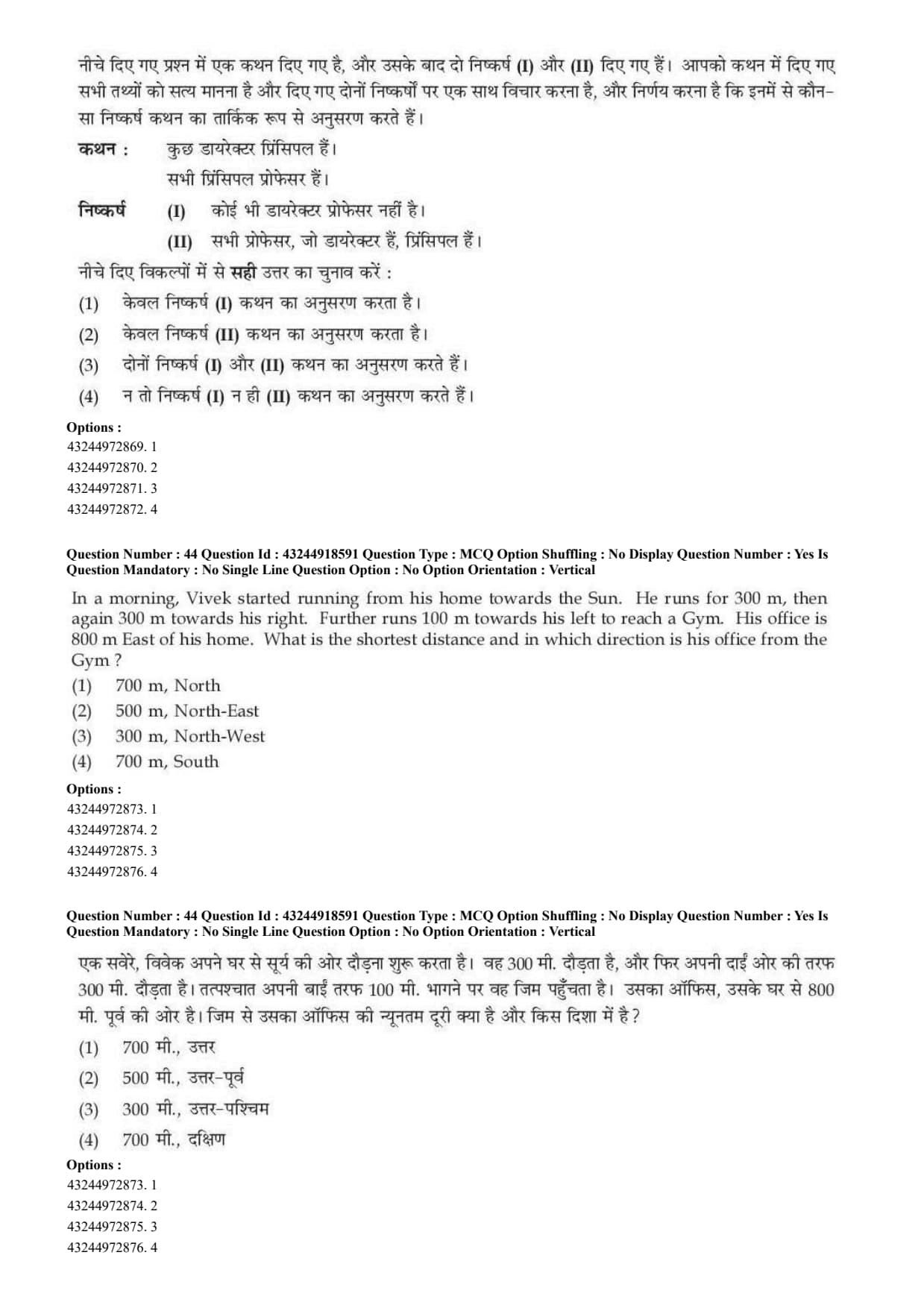
| Principles of Management & Management Thinkers | 12–14 | Moderate |
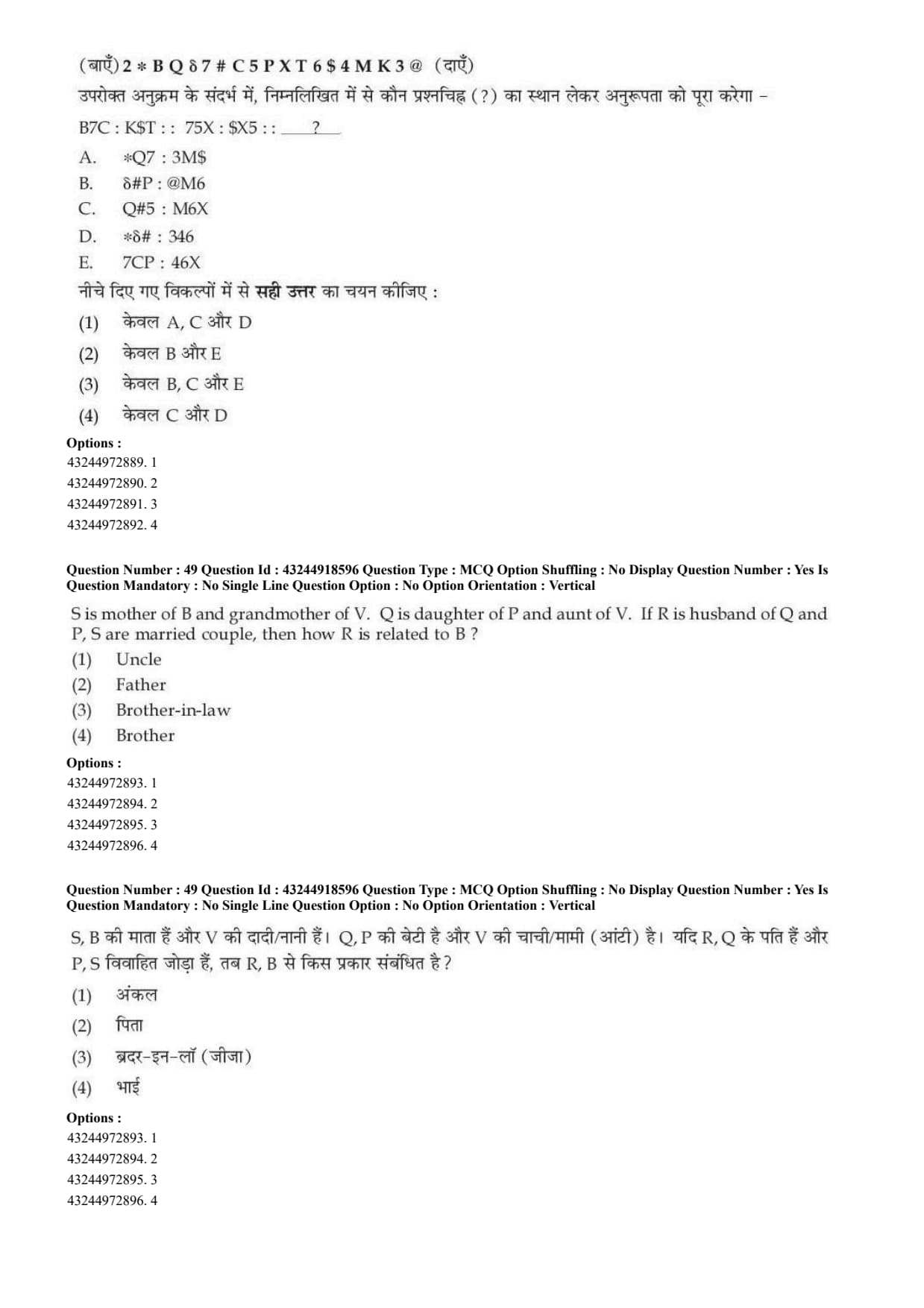
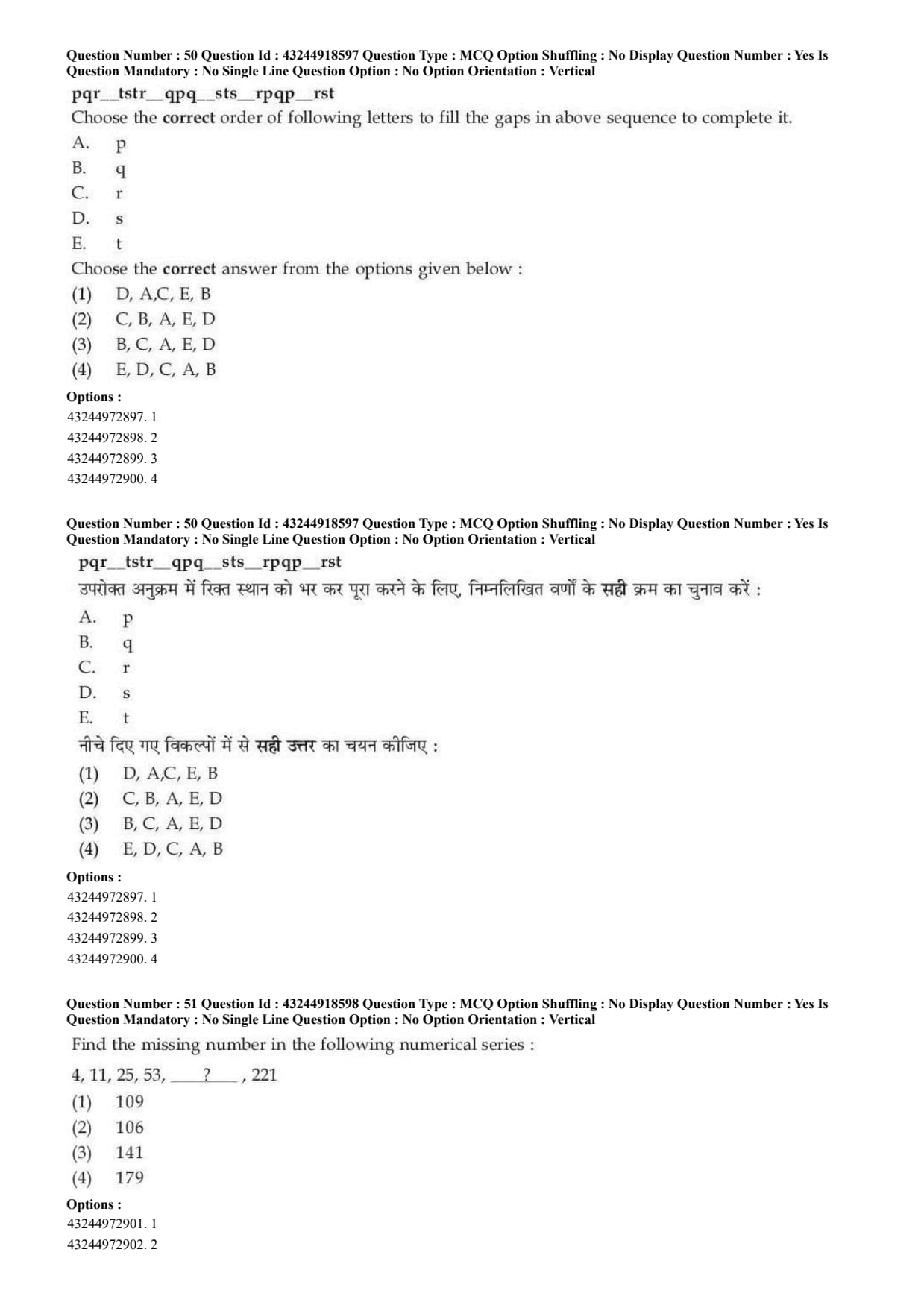
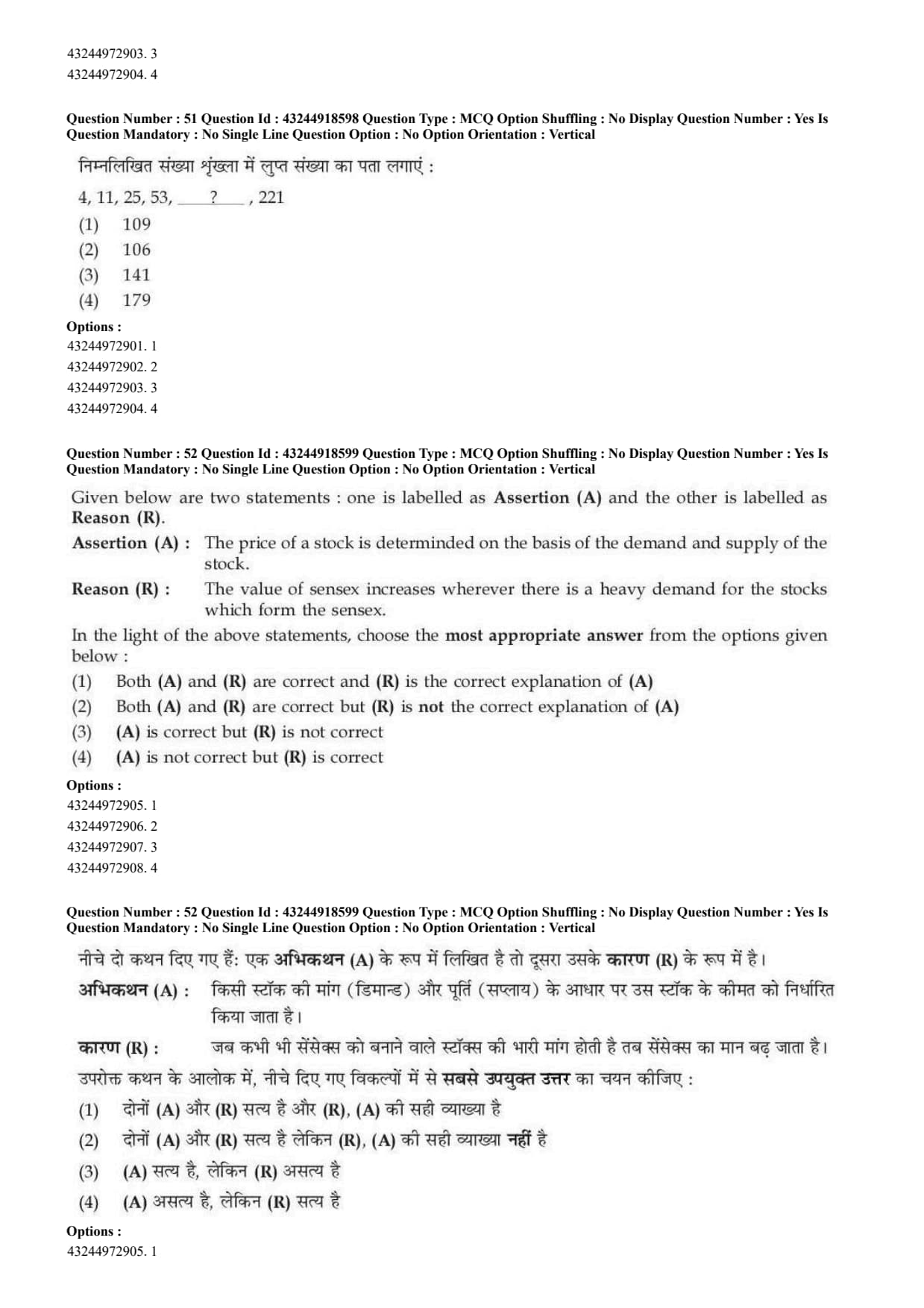
| Organizational Behaviour (Motivation, Leadership, Communication) | 10–12 | Easy–Moderate |
| Marketing Management (Concepts, 4Ps, Consumer Behaviour) | 8–10 | Moderate |
| Financial & Accounting Basics | 8–10 | Moderate |
| Human Resource Management | 6–8 | Easy |
| Business Environment, Entrepreneurship & Business Ethics | 6–8 | Moderate |





Comments