




The National Testing Agency (NTA) conducted the CUET PG 2026 Horticulture (SCQP16) examination on March 17, 2026, during Shift 1 from 09:00 AM to 10:30 AM.
Students who appeared for the exam reported that the overall difficulty level of the paper was moderate. CUET PG 2026 Horticulture Question Paper with Solutions PDF is available here for download. The marking scheme is +4 for correct answers and -1 for wrong answers, totaling 300 marks.
CUET PG 2026 Horticulture Question Paper with Solutions PDF
| CUET PG 2026 Horticulture Question Paper | Download PDF | Check Solutions |
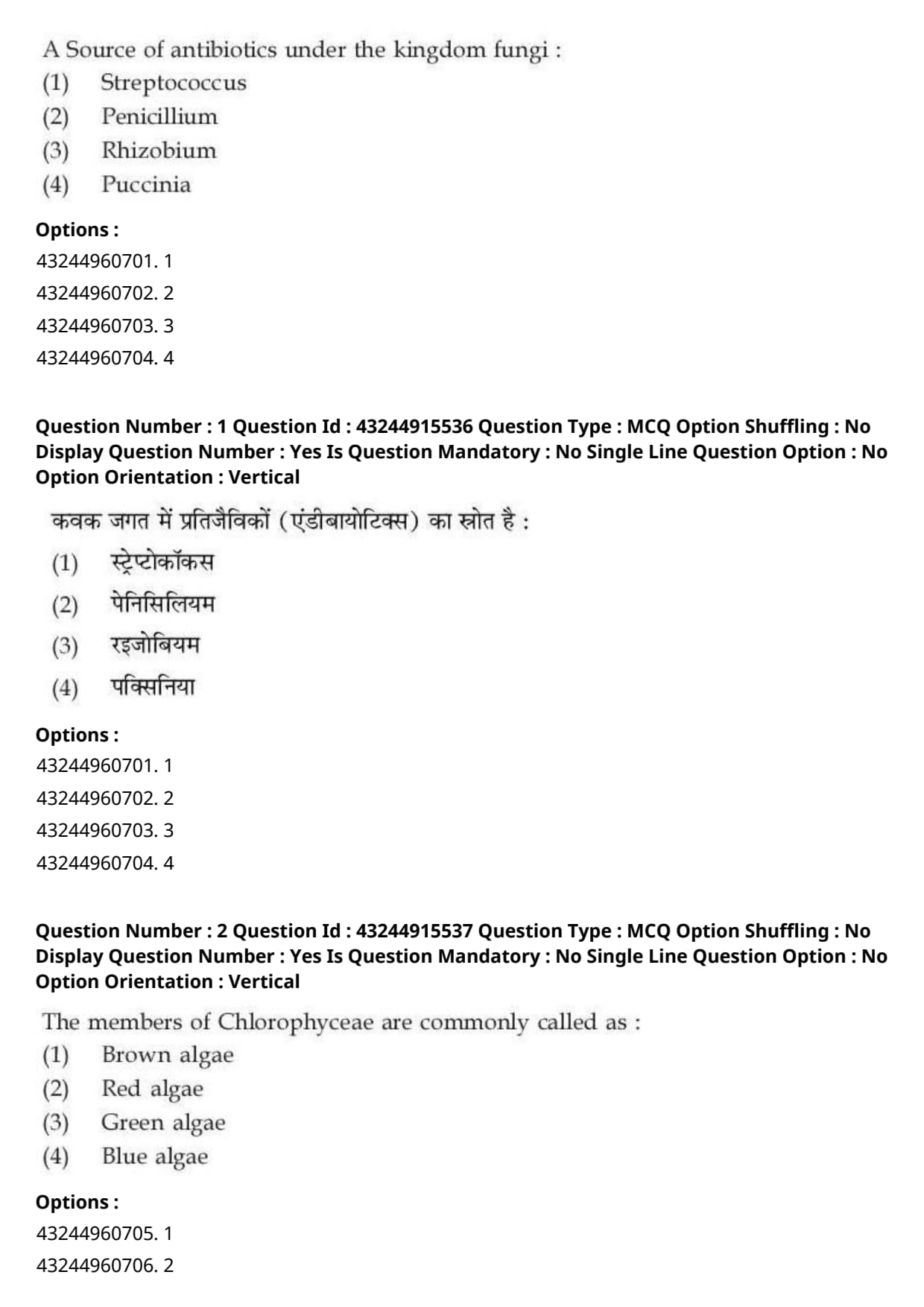


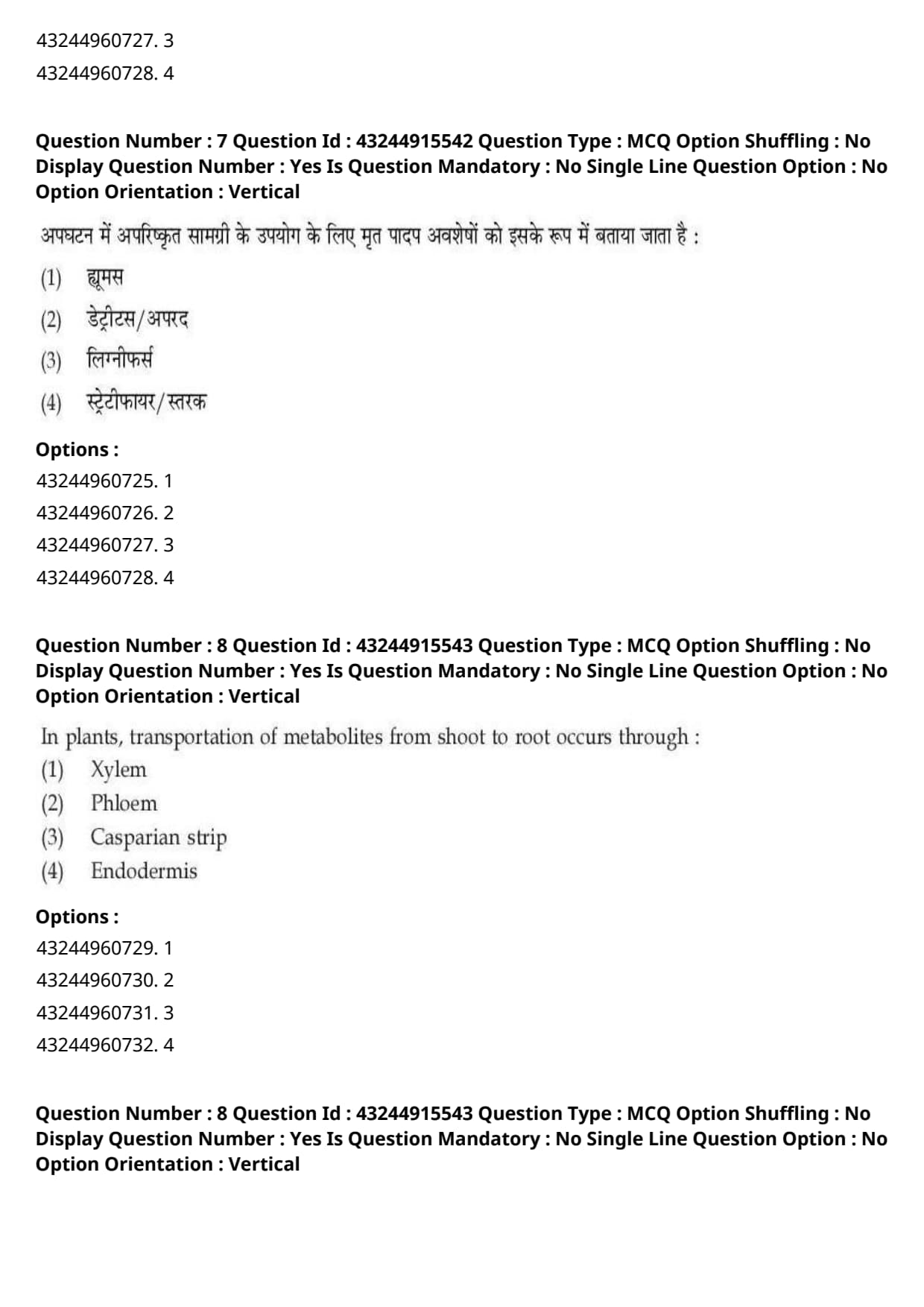

























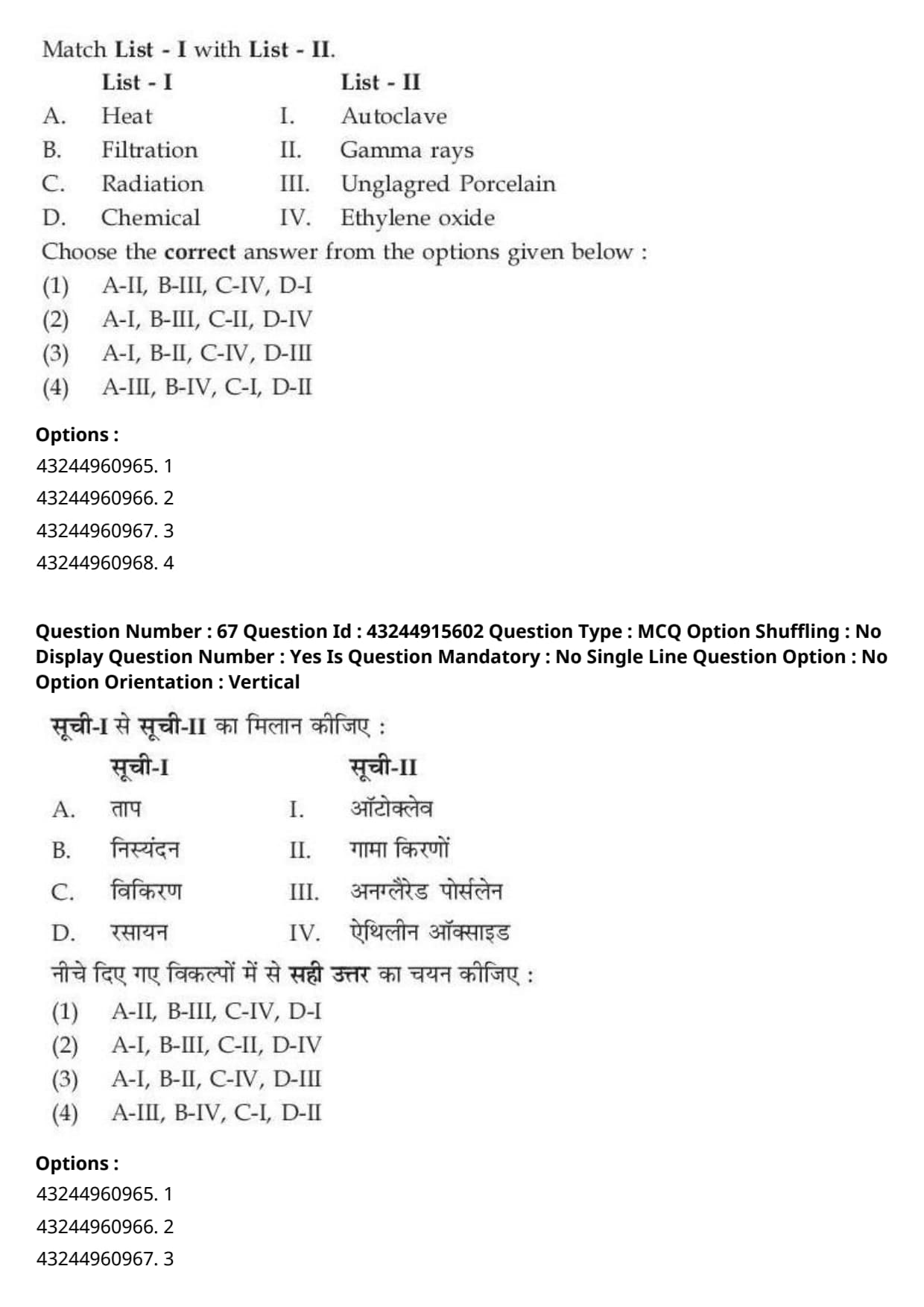

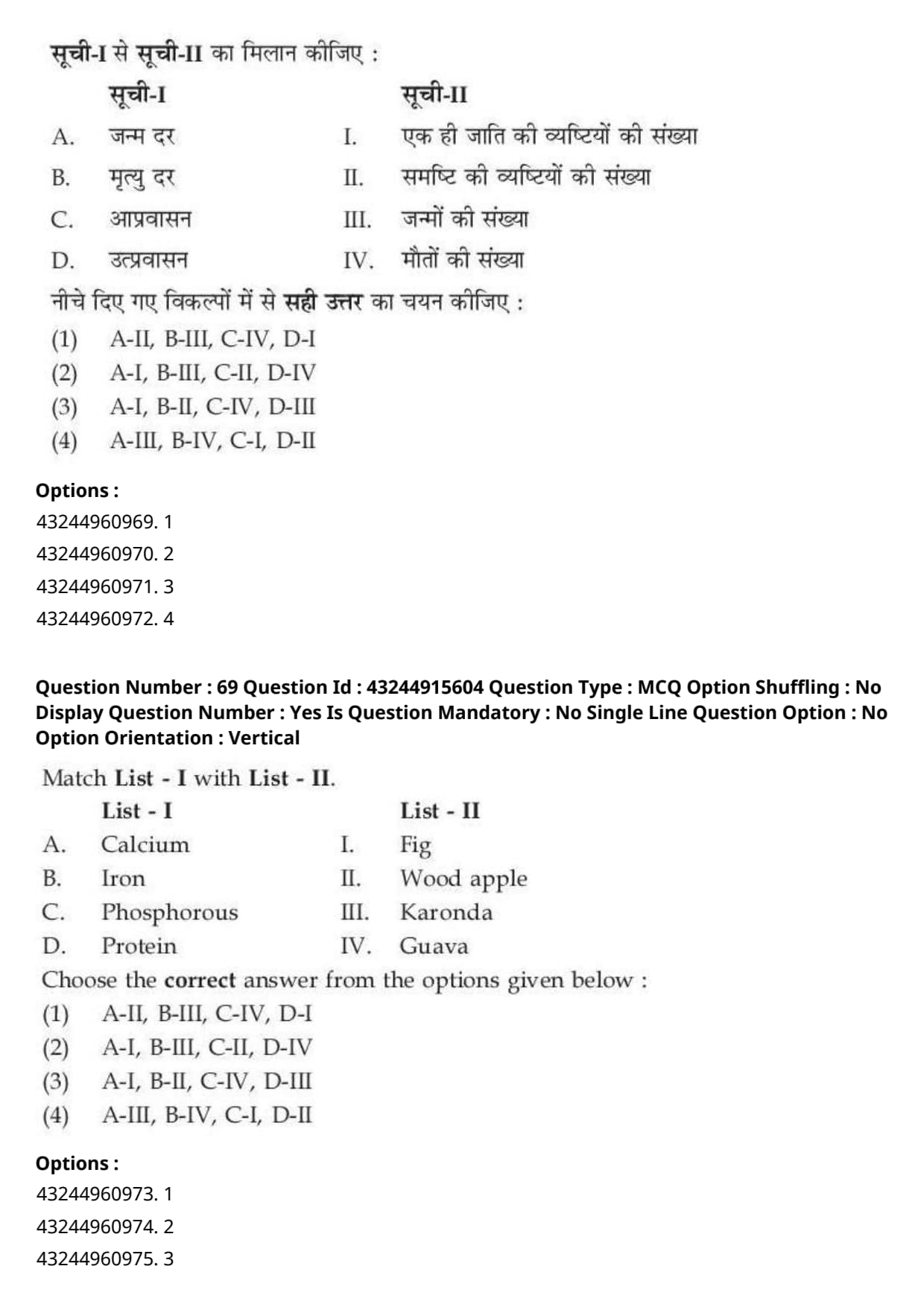

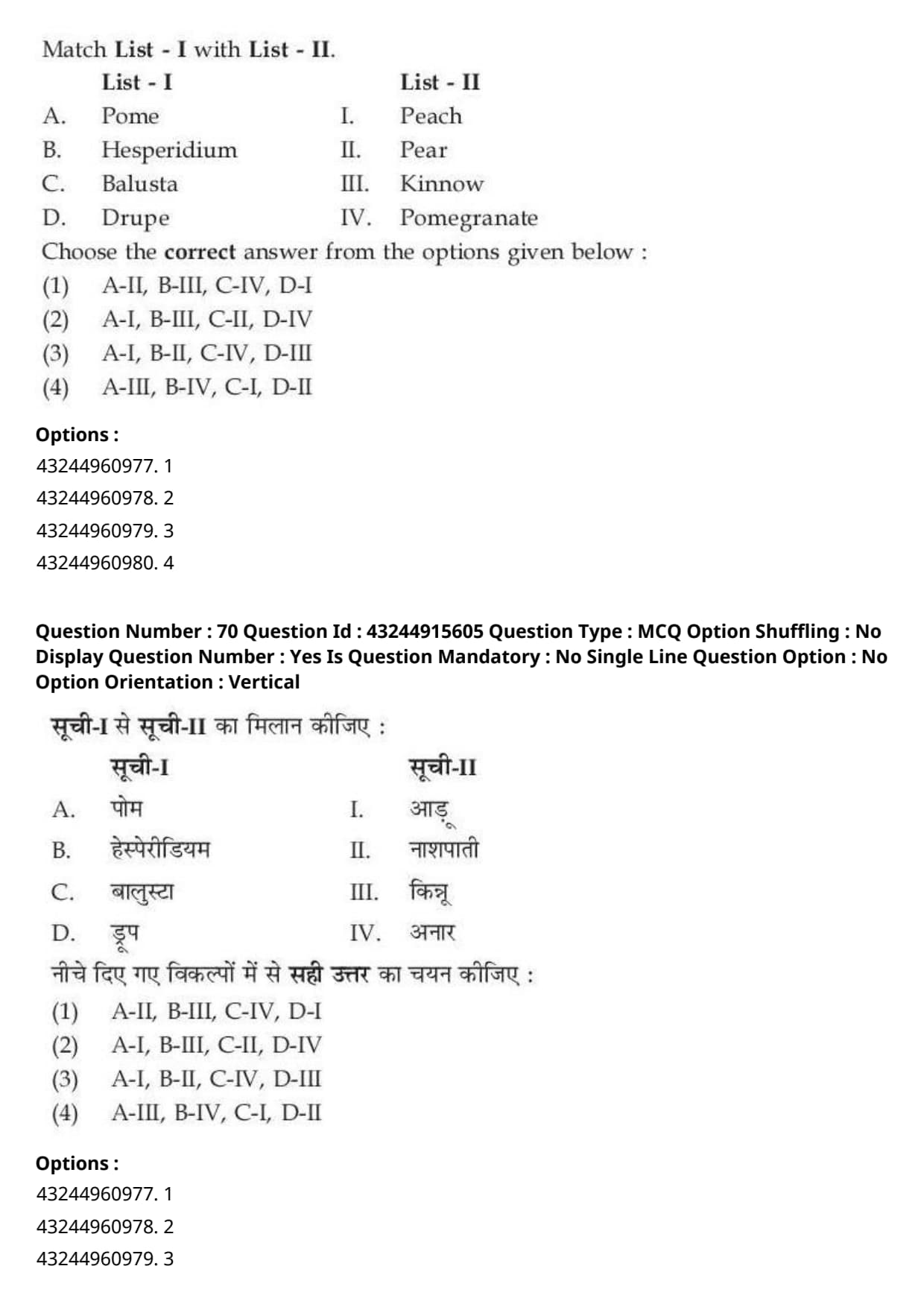

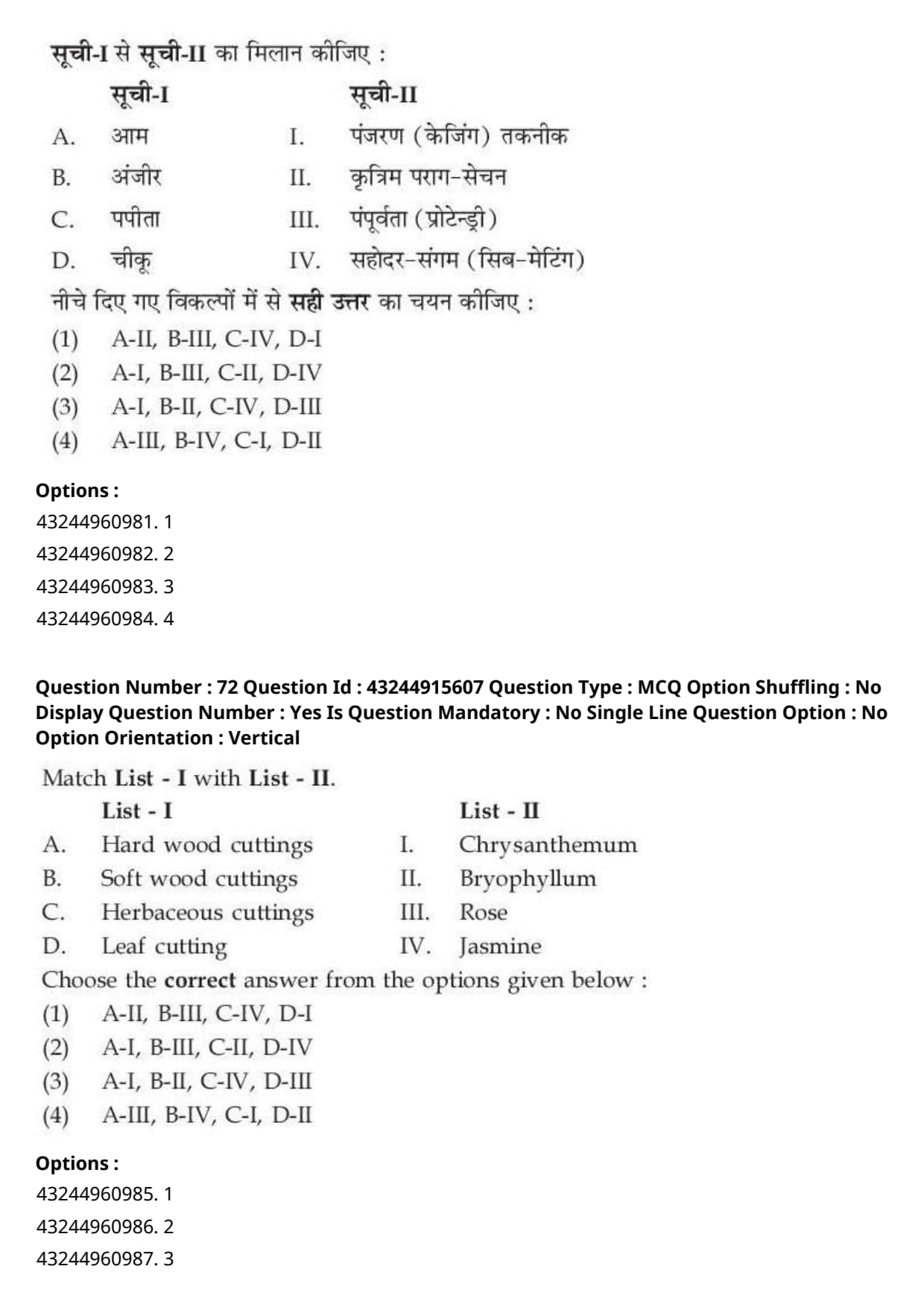


A source of antibiotics under the kingdom fungi is:
View Solution
Concept:
Antibiotics are chemical substances produced by microorganisms that inhibit or kill other microorganisms.
Step 1: Identify the organism related to antibiotics.
The famous antibiotic penicillin was obtained from the fungus Penicillium.
\[ Penicillium \rightarrow Penicillin \]
Step 2: Check other options.
\textit{Streptococcus is a bacterium.
\textit{Rhizobium is a nitrogen-fixing bacterium.
\textit{Puccinia is a fungus, but it is mainly known as rust fungus, not as a source of common antibiotic.
Step 3: Final answer.
Therefore, the correct source of antibiotics among the given options is:
\[ Penicillium \]
\[ \therefore Correct Answer is (B) \] Quick Tip: Penicillin is an antibiotic obtained from the fungus \textit{Penicillium.
The members of Chlorophyceae are commonly called as:
View Solution
Concept:
Algae are divided into different classes on the basis of pigments, stored food and cell wall composition.
Step 1: Identify Chlorophyceae.
Chlorophyceae contains chlorophyll \(a\) and chlorophyll \(b\), which give green colour to the algae.
\[ Chlorophyceae \rightarrow Green algae \]
Step 2: Compare with other algal groups.
Brown algae belong mainly to Phaeophyceae.
Red algae belong mainly to Rhodophyceae.
Blue-green algae are cyanobacteria.
Step 3: Final answer.
Thus, members of Chlorophyceae are commonly called green algae.
\[ \therefore Correct Answer is (C) \] Quick Tip: Chlorophyceae are green algae because they contain chlorophyll \(a\) and \(b\).
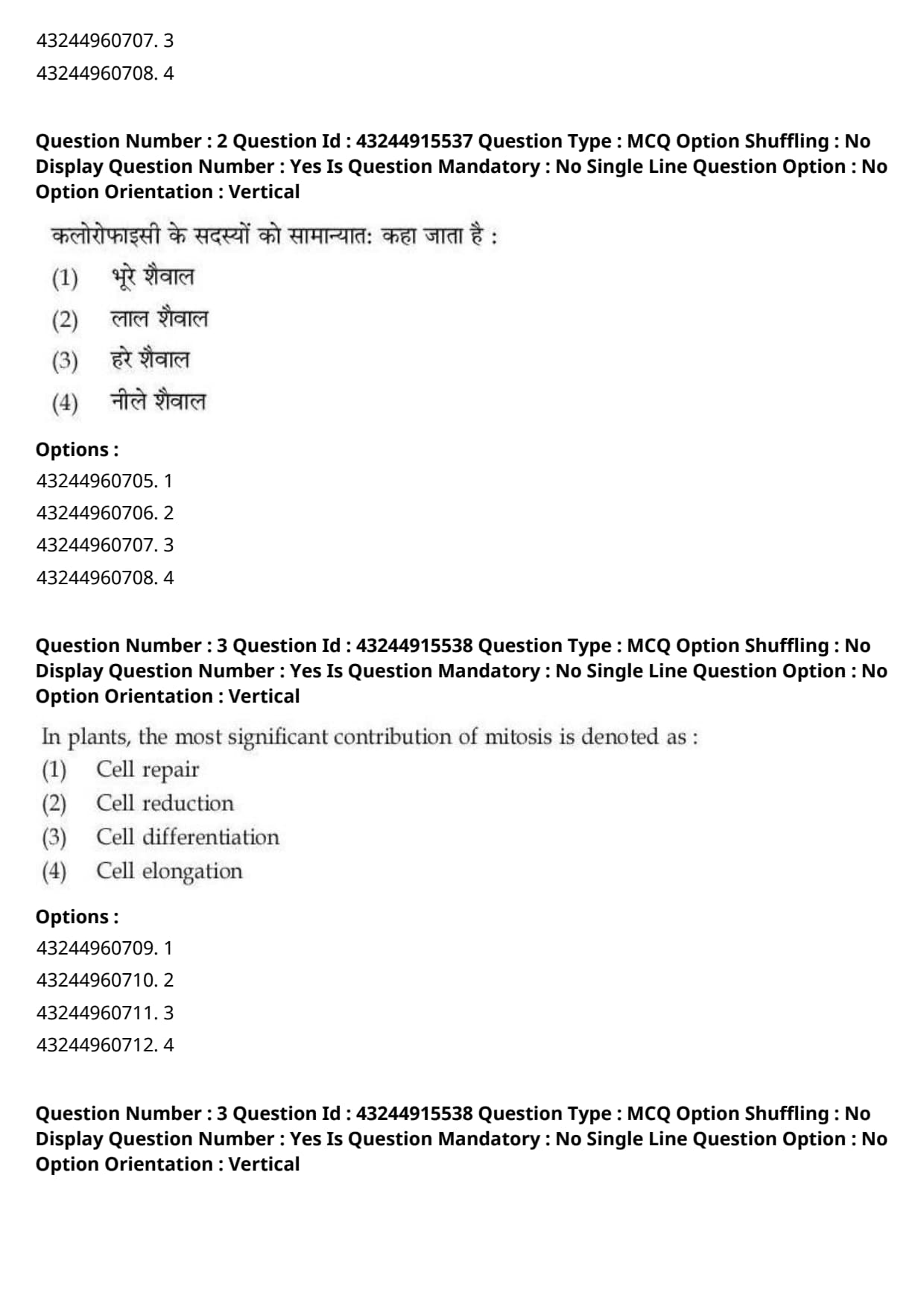
In plants, the most significant contribution of mitosis is denoted as:
View Solution
Concept:
Mitosis is an equational cell division in which one parent cell gives rise to two genetically identical daughter cells.
Step 1: Understand the role of mitosis.
Mitosis helps in growth, replacement of damaged cells and repair of tissues.
\[ Mitosis \rightarrow growth and repair \]
Step 2: Check the options.
Cell reduction is related to meiosis, not mitosis.
Cell differentiation is specialization of cells.
Cell elongation is increase in cell length and is not the direct contribution of mitosis.
Step 3: Select the best option.
Among the given options, the most suitable contribution of mitosis is cell repair.
\[ \therefore Correct Answer is (A) \] Quick Tip: Mitosis produces identical daughter cells and helps in growth, repair and replacement of cells.
In which phase of meiosis, the homologous chromosomes separate while sister chromatids remain associated at their centromeres?
View Solution
Concept:
Meiosis is a reduction division in which chromosome number is reduced to half. It occurs in two divisions: meiosis I and meiosis II.
Step 1: Understand meiosis I.
During meiosis I, homologous chromosomes separate from each other.
\[ Homologous chromosomes separate \rightarrow Meiosis I \]
Step 2: Identify the exact phase.
In anaphase I, homologous chromosomes move towards opposite poles, but sister chromatids remain joined at their centromeres.
\[ Anaphase I \rightarrow separation of homologous chromosomes \]
Step 3: Compare with anaphase II.
In anaphase II, sister chromatids separate. But the question says sister chromatids remain associated, so it must be anaphase I.
\[ \therefore Correct Answer is (D) \] Quick Tip: Homologous chromosomes separate in anaphase I, while sister chromatids separate in anaphase II.
In population growth curve, when responses are not limiting the growth, the plot remains:
View Solution
Concept:
Population growth depends on availability of resources such as food, space and nutrients.
Step 1: Understand unlimited growth condition.
When resources are not limiting, population increases rapidly.
\[ Unlimited resources \Rightarrow rapid population growth \]
Step 2: Identify the growth curve.
Under unlimited resource conditions, population follows exponential growth.
\[ N_t=N_0e^{rt} \]
where, \[ N_t=population at time t \] \[ N_0=initial population \] \[ r=growth rate \]
Step 3: Compare with logistic growth.
Logistic growth occurs when resources become limiting and carrying capacity is reached.
\[ \therefore Correct Answer is (A) \] Quick Tip: When resources are unlimited, population growth is exponential; when resources are limited, growth becomes logistic.
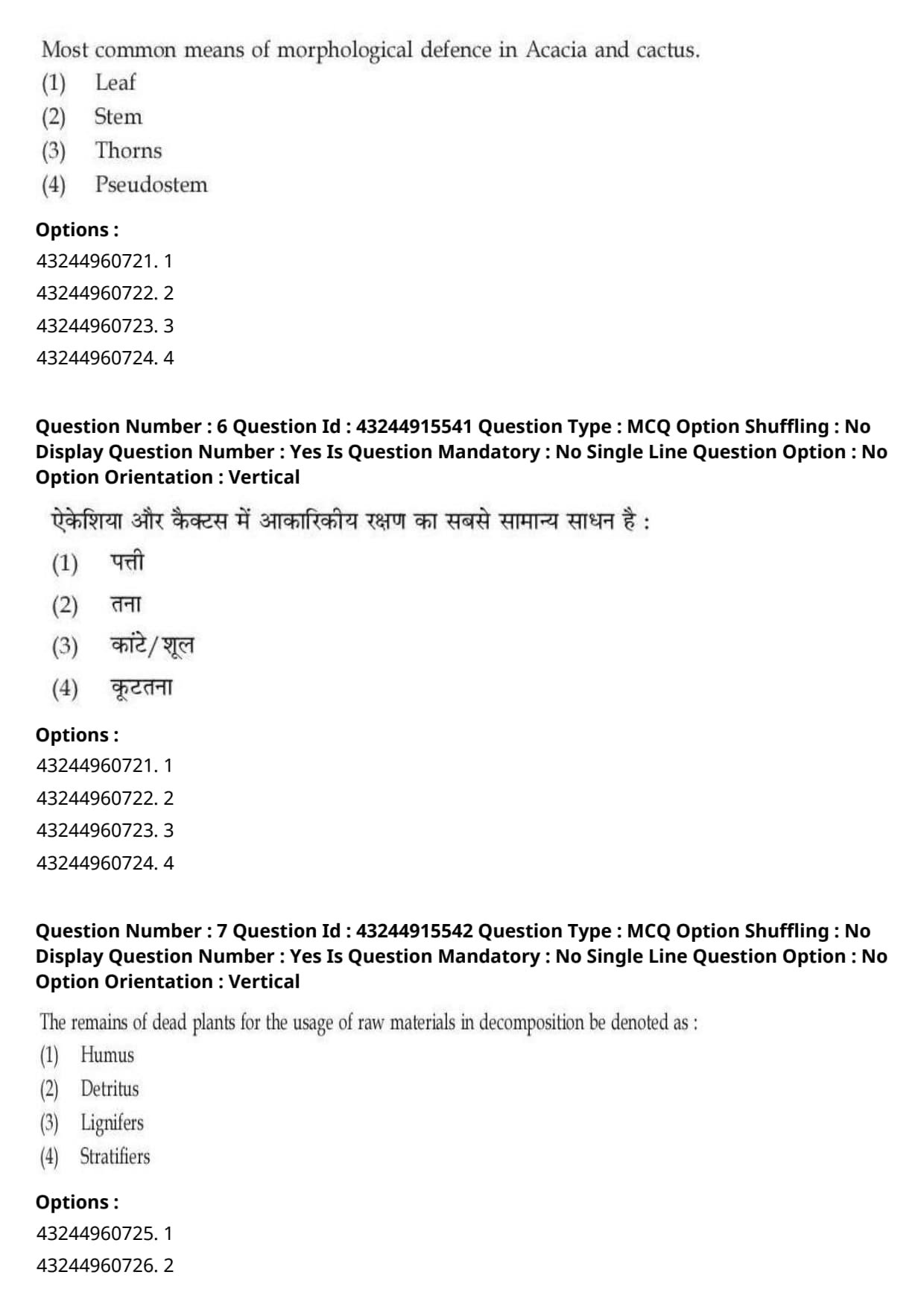
Most common means of morphological defence in Acacia and cactus is:
View Solution
Concept:
Morphological defence means structural modification of plant parts for protection against grazing animals and other harmful factors.
Step 1: Observe Acacia and cactus.
Acacia and cactus commonly possess sharp thorn-like structures.
\[ Acacia and cactus \rightarrow Thorns \]
Step 2: Function of thorns.
Thorns protect plants from herbivores and reduce damage.
\[ Thorns \rightarrow defence \]
Step 3: Final answer.
Thus, the most common morphological defence in Acacia and cactus is thorns.
\[ \therefore Correct Answer is (C) \] Quick Tip: Thorns are structural modifications that protect plants from grazing animals.
The remains of dead plants for the usage of raw materials in decomposition are denoted as:
View Solution
Concept:
Decomposition is the breakdown of dead organic matter into simpler substances by decomposers.
Step 1: Define detritus.
Dead remains of plants and animals are called detritus.
\[ Dead organic matter=Detritus \]
Step 2: Role in decomposition.
Detritus acts as the raw material for decomposition.
\[ Detritus \rightarrow decomposition by microbes \]
Step 3: Compare with humus.
Humus is the dark, stable organic matter formed after partial decomposition.
Step 4: Final answer.
Therefore, dead plant remains used as raw material in decomposition are called detritus.
\[ \therefore Correct Answer is (B) \] Quick Tip: Detritus is dead organic matter, while humus is the stable product formed after decomposition.
In plants, transportation of metabolites from shoot to root occurs through:
View Solution
Concept:
Plants have two main conducting tissues: xylem and phloem.
Step 1: Function of xylem.
Xylem mainly transports water and minerals from roots to shoots.
\[ Xylem \rightarrow water and minerals \]
Step 2: Function of phloem.
Phloem transports food and metabolites from source organs to sink organs.
\[ Phloem \rightarrow food and metabolites \]
Step 3: Apply to the question.
Metabolites formed in shoots may be transported to roots through phloem.
\[ Shoot to root transport \rightarrow Phloem \]
\[ \therefore Correct Answer is (B) \] Quick Tip: Xylem transports water, while phloem transports food and metabolites.
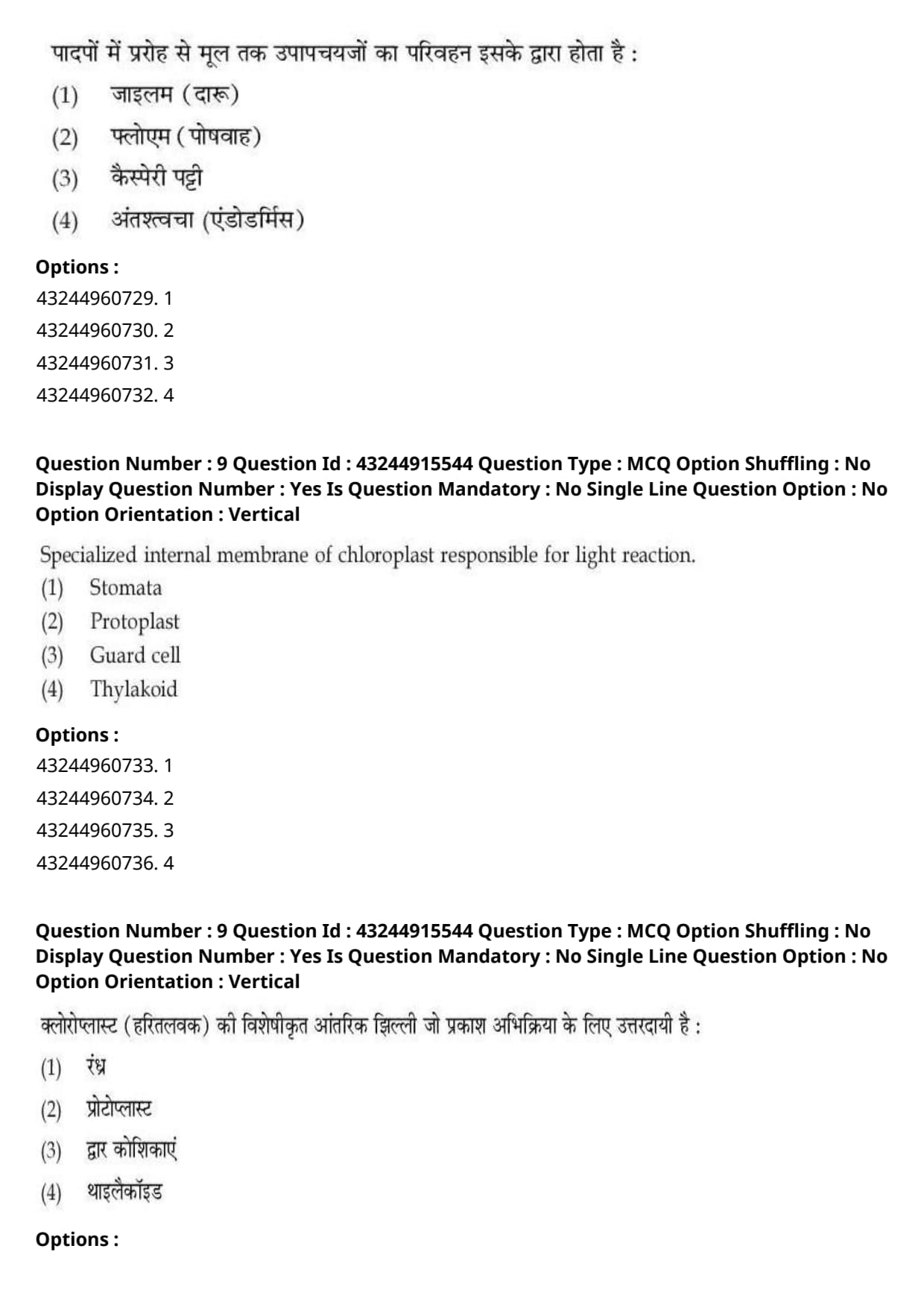
Specialized internal membrane of chloroplast responsible for light reaction:
View Solution
Concept:
Photosynthesis has two major phases: light reaction and dark reaction.
Step 1: Location of light reaction.
The light reaction of photosynthesis occurs in the thylakoid membrane of chloroplast.
\[ Light reaction \rightarrow Thylakoid membrane \]
Step 2: Role of thylakoid.
Thylakoids contain chlorophyll, photosystems and electron transport components.
\[ Thylakoid \rightarrow photosystems \]
Step 3: Eliminate other options.
Stomata are pores for gaseous exchange.
Guard cells control stomatal opening.
Protoplast refers to the living content of the cell.
\[ \therefore Correct Answer is (D) \] Quick Tip: Light reaction of photosynthesis takes place on the thylakoid membrane of chloroplast.
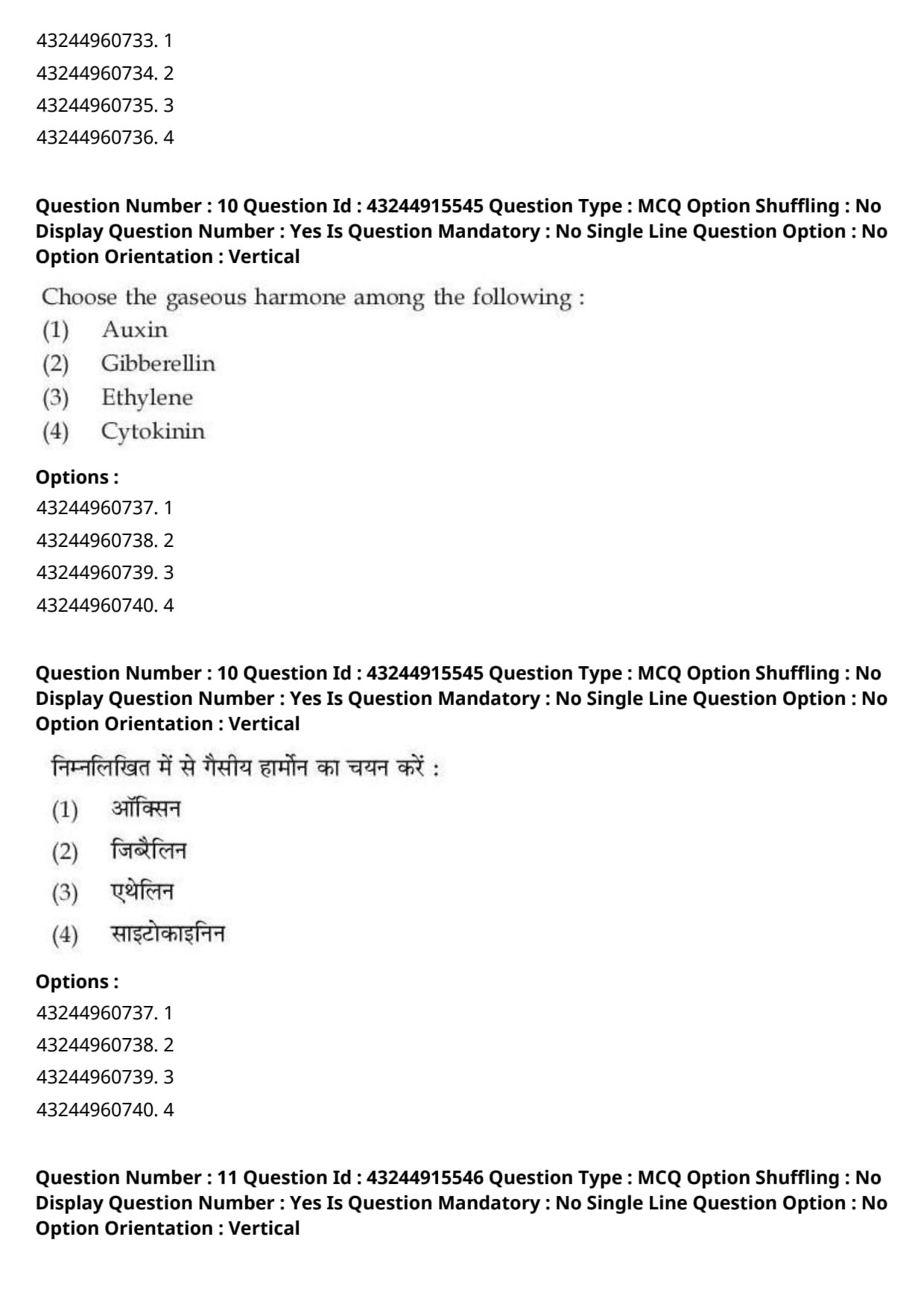
Choose the gaseous hormone among the following:
View Solution
Concept:
Plant hormones regulate growth, development, flowering, fruit ripening and other physiological processes.
Step 1: Identify gaseous plant hormone.
Ethylene is the only gaseous plant hormone among the commonly known plant hormones.
\[ Ethylene \rightarrow gaseous hormone \]
Step 2: Function of ethylene.
Ethylene is mainly associated with fruit ripening, senescence and abscission.
\[ Ethylene \rightarrow fruit ripening \]
Step 3: Compare with other hormones.
Auxin, gibberellin and cytokinin are not gaseous hormones.
\[ \therefore Correct Answer is (C) \] Quick Tip: Ethylene is the gaseous plant hormone and is important in fruit ripening.
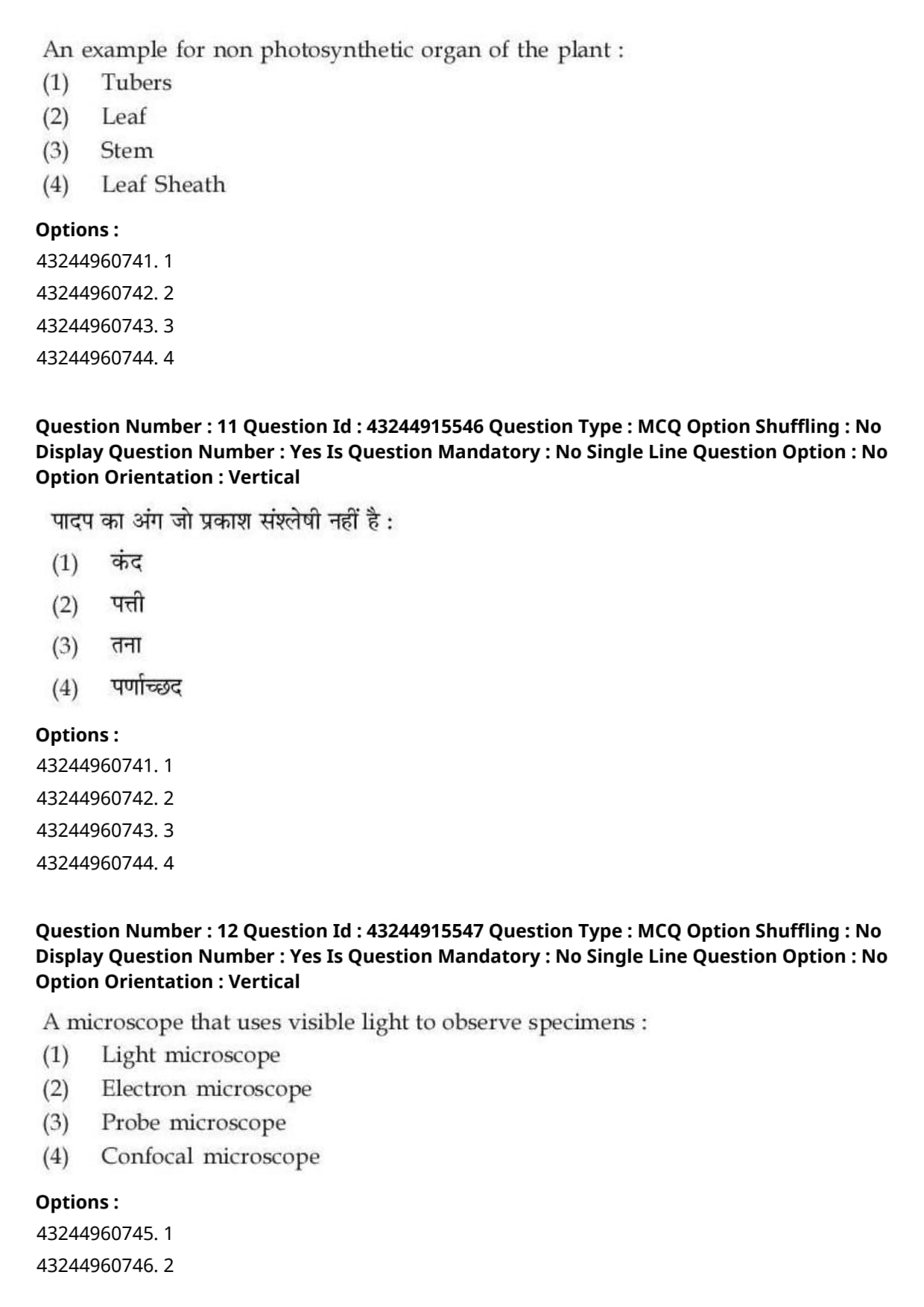
An example for non photosynthetic organ of the plant:
View Solution
Concept:
Photosynthetic organs contain chlorophyll and can manufacture food using light energy.
Step 1: Identify photosynthetic organs.
Leaves are the main photosynthetic organs. Green stems and leaf sheaths may also participate in photosynthesis.
\[ Green parts \rightarrow photosynthesis \]
Step 2: Identify non-photosynthetic organ.
Tubers are underground storage organs. They generally store food and do not perform photosynthesis.
\[ Tuber \rightarrow storage organ \]
Step 3: Final answer.
Therefore, tubers are an example of non-photosynthetic organs.
\[ \therefore Correct Answer is (A) \] Quick Tip: Tubers are underground storage organs and generally do not perform photosynthesis.
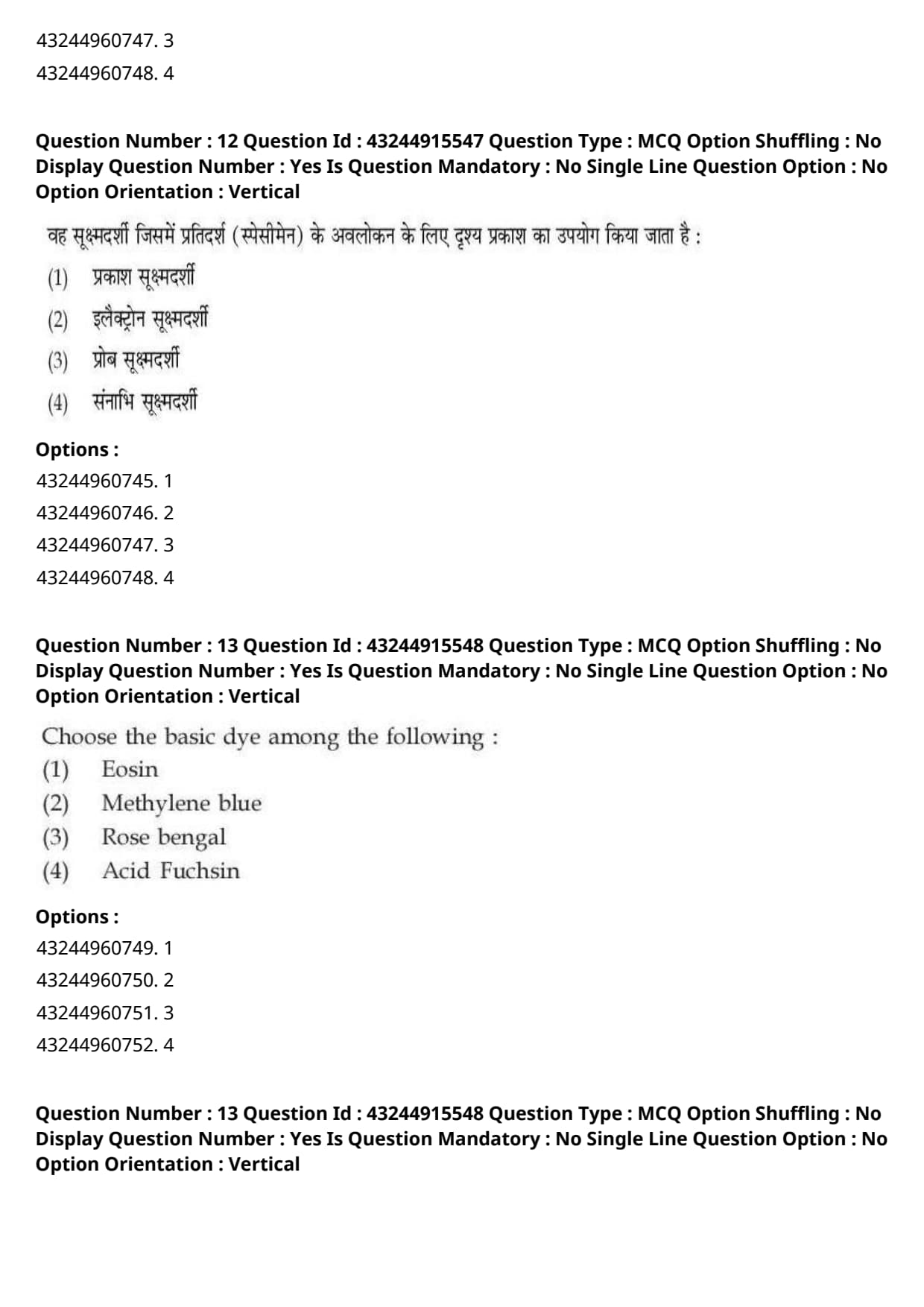
A microscope that uses visible light to observe specimens:
View Solution
Concept:
Microscopes are instruments used to observe very small objects that cannot be seen clearly with the naked eye.
Step 1: Identify microscope using visible light.
A light microscope uses visible light and lenses to magnify specimens.
\[ Visible light \rightarrow Light microscope \]
Step 2: Compare with electron microscope.
An electron microscope uses a beam of electrons, not visible light.
Step 3: Final answer.
Therefore, the microscope that uses visible light is the light microscope.
\[ \therefore Correct Answer is (A) \] Quick Tip: Light microscope uses visible light, while electron microscope uses electron beams.
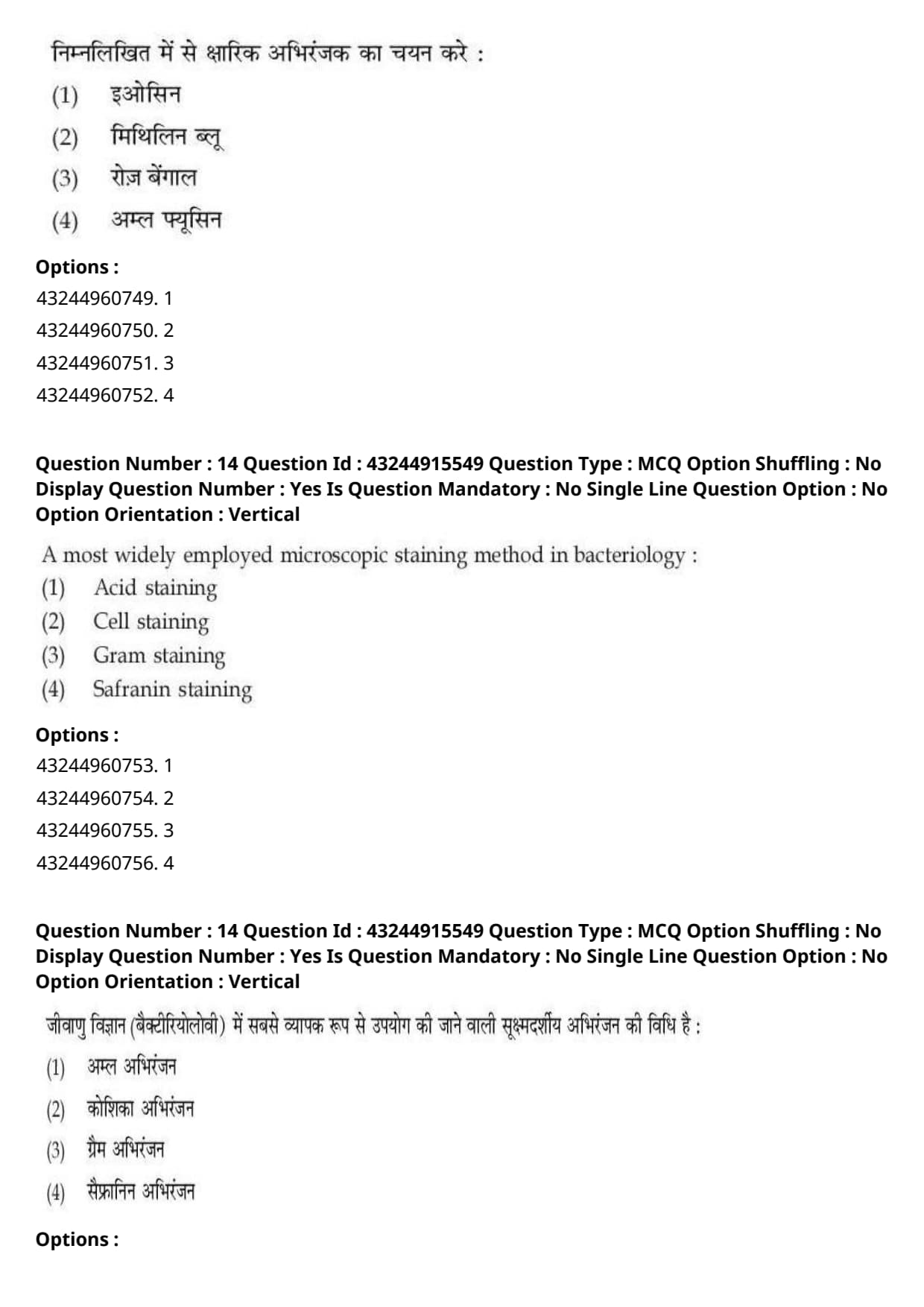
Choose the basic dye among the following:
View Solution
Concept:
Dyes used in staining may be acidic or basic. Basic dyes are commonly used to stain negatively charged cellular components.
Step 1: Identify basic dye.
Methylene blue is a common basic dye.
\[ Methylene blue \rightarrow basic dye \]
Step 2: Check other options.
Eosin is an acidic dye.
Rose bengal is generally acidic.
Acid fuchsin is also acidic.
Step 3: Final answer.
Thus, the basic dye among the given options is methylene blue.
\[ \therefore Correct Answer is (B) \] Quick Tip: Methylene blue is a basic dye commonly used in biological staining.
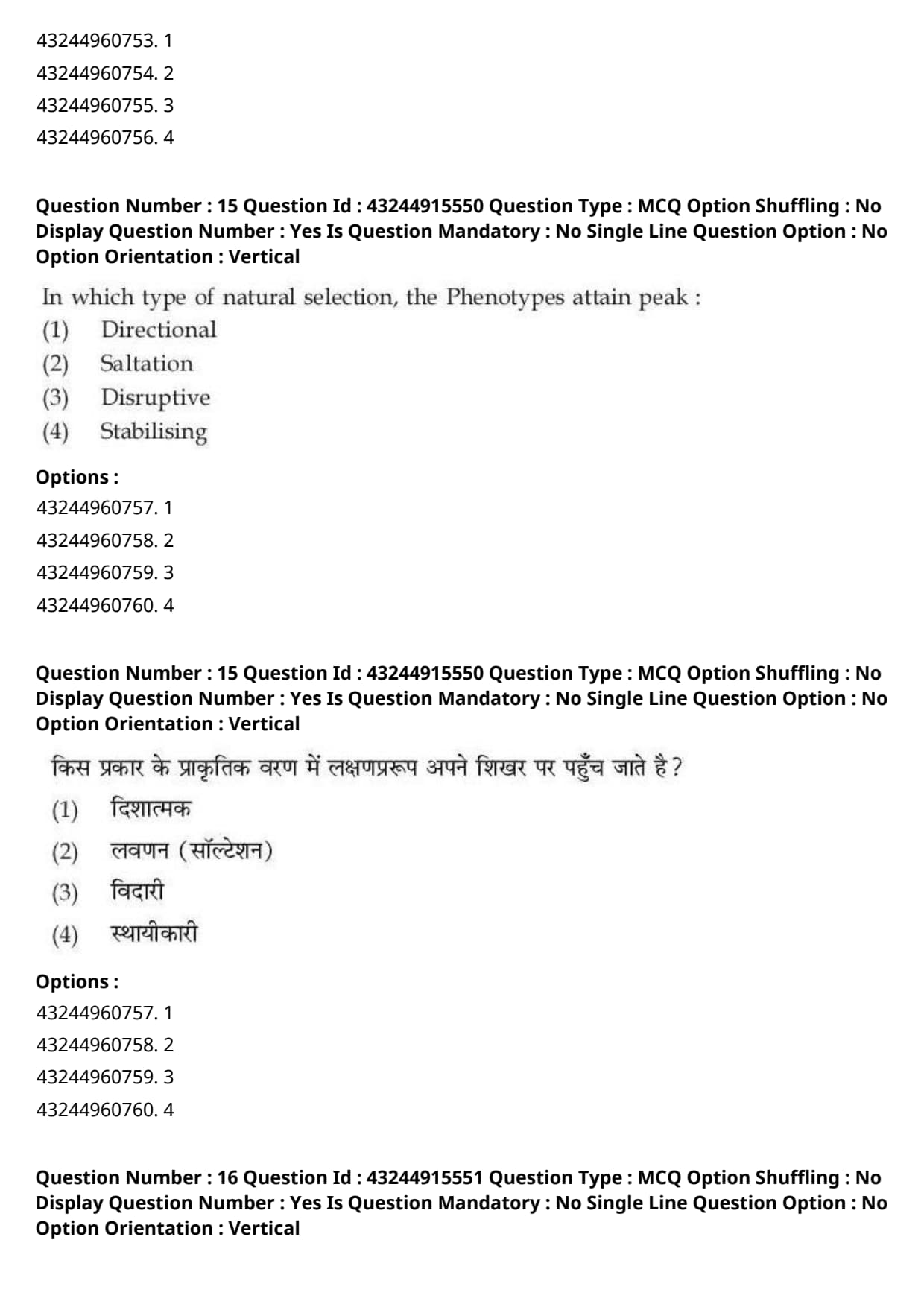
A most widely employed microscopic staining method in bacteriology:
View Solution
Concept:
Staining techniques are used in bacteriology to observe and differentiate bacteria under microscope.
Step 1: Identify the common staining method.
Gram staining is the most widely used differential staining method in bacteriology.
\[ Gram staining \rightarrow bacterial classification \]
Step 2: Importance of Gram staining.
It divides bacteria into two groups:
\[ Gram-positive bacteria \]
and \[ Gram-negative bacteria \]
Step 3: Final answer.
Therefore, the most widely employed microscopic staining method in bacteriology is Gram staining.
\[ \therefore Correct Answer is (C) \] Quick Tip: Gram staining differentiates bacteria into Gram-positive and Gram-negative groups.
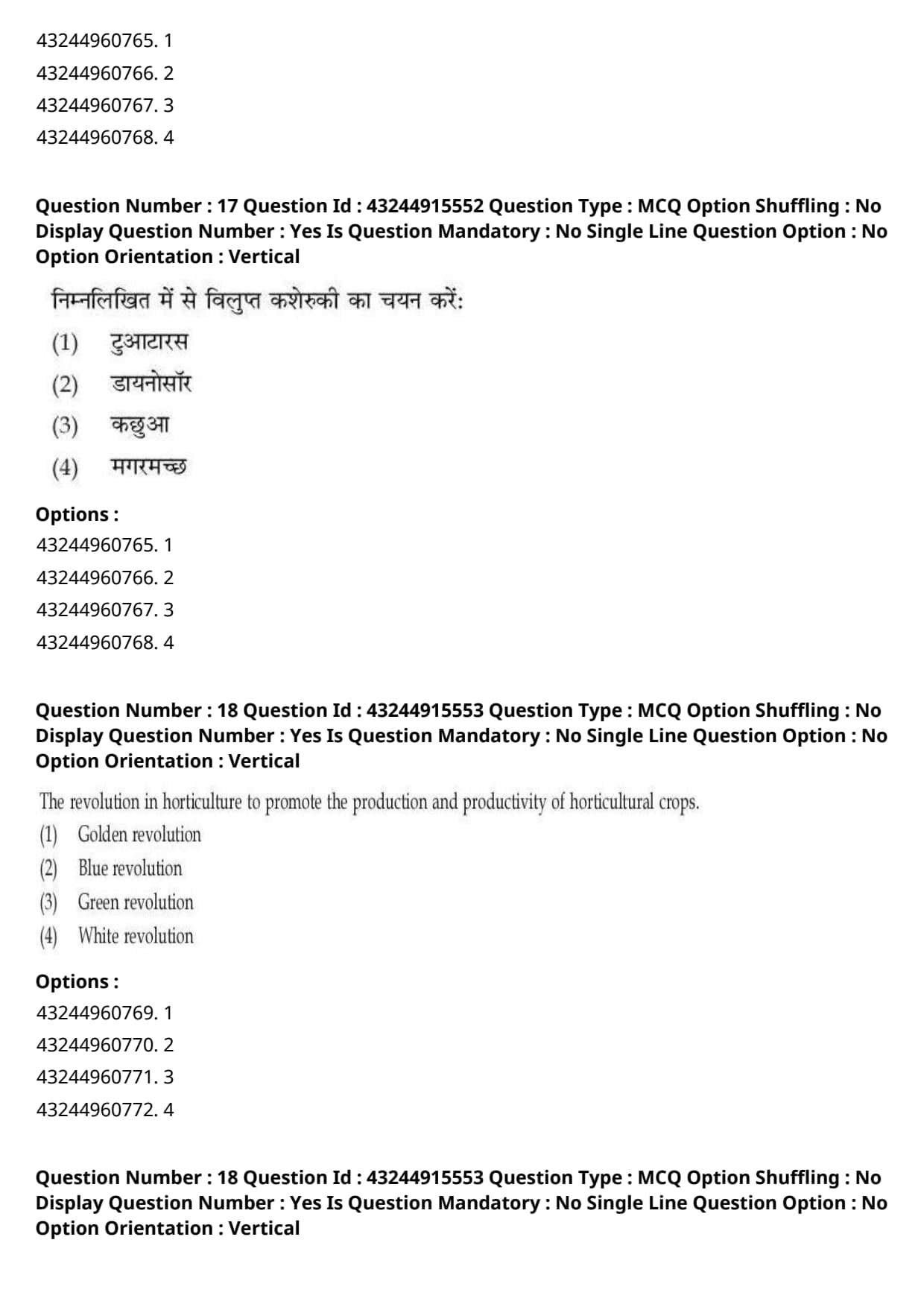
In which type of natural selection, the phenotypes attain peak:
View Solution
Concept:
Natural selection changes the frequency of phenotypes in a population according to their fitness.
Step 1: Understand stabilising selection.
In stabilising selection, intermediate phenotypes are favoured and extreme phenotypes are selected against.
\[ Intermediate phenotype \rightarrow maximum fitness \]
Step 2: Meaning of peak.
When phenotypes attain a peak around the average or intermediate value, it represents stabilising selection.
\[ Peak at mean phenotype \rightarrow Stabilising selection \]
Step 3: Compare with other types.
Directional selection favours one extreme.
Disruptive selection favours both extremes.
Saltation refers to sudden large variation.
\[ \therefore Correct Answer is (D) \] Quick Tip: Stabilising selection favours average phenotypes and reduces variation.
Under mechanism of evolution, the work by Hugo de Vries reported large difference arising suddenly in a population of which plant:
View Solution
Concept:
Hugo de Vries proposed the mutation theory of evolution. According to this theory, new species may arise through sudden heritable changes called mutations.
Step 1: Identify the plant studied by Hugo de Vries.
Hugo de Vries worked on Oenothera lamarckiana, commonly known as evening primrose.
\[ \textit{Oenothera lamarckiana=Evening Primrose \]
Step 2: Link with mutation theory.
He observed sudden large variations in evening primrose and explained them as mutations.
\[ Sudden variation \rightarrow Mutation \]
Step 3: Final answer.
Thus, the plant was evening primrose.
\[ \therefore Correct Answer is (C) \] Quick Tip: Hugo de Vries proposed mutation theory based on his work on evening primrose.
Choose the extinct vertebrate among the following:
View Solution
Concept:
Extinct organisms are those that no longer exist anywhere on Earth.
Step 1: Check the options.
Tuataras are living reptiles found in New Zealand.
Turtles are living reptiles.
Crocodiles are also living reptiles.
Step 2: Identify extinct vertebrate.
Dinosaurs are extinct vertebrates, although birds are considered descendants of theropod dinosaurs.
\[ Dinosaurs \rightarrow extinct vertebrates \]
Step 3: Final answer.
Therefore, the extinct vertebrate among the given options is dinosaurs.
\[ \therefore Correct Answer is (B) \] Quick Tip: Dinosaurs are extinct vertebrates, while turtles, crocodiles and tuataras are still living reptiles.
The revolution in horticulture to promote the production and productivity of horticultural crops:
View Solution
Concept:
Different agricultural revolutions are associated with different sectors of production.
Step 1: Identify horticultural revolution.
Golden Revolution is associated with the increase in production and productivity of horticultural crops such as fruits, vegetables, flowers and spices.
\[ Horticulture \rightarrow Golden Revolution \]
Step 2: Compare with other revolutions.
Blue Revolution is related to fisheries.
Green Revolution is related to food grain production.
White Revolution is related to milk production.
Step 3: Final answer.
Thus, horticulture is associated with Golden Revolution.
\[ \therefore Correct Answer is (A) \] Quick Tip: Golden Revolution is related to horticulture; White Revolution is related to milk production.
Major importer of banana and mango from India:
View Solution
Concept:
India exports horticultural produce such as mango and banana to several countries. Gulf countries are important destinations for Indian fruits.
Step 1: Identify the importing region.
Among the given options, UAE is a major importer of Indian mango and banana.
\[ Indian mango and banana exports \rightarrow UAE \]
Step 2: Compare with other options.
USA imports mango from India but is not the best answer for both banana and mango in this option set.
USSR is an old geopolitical term.
South Africa is not the major importer among the given options.
Step 3: Final answer.
Therefore, the major importer is UAE.
\[ \therefore Correct Answer is (C) \] Quick Tip: UAE is an important export destination for Indian horticultural produce like mango and banana.
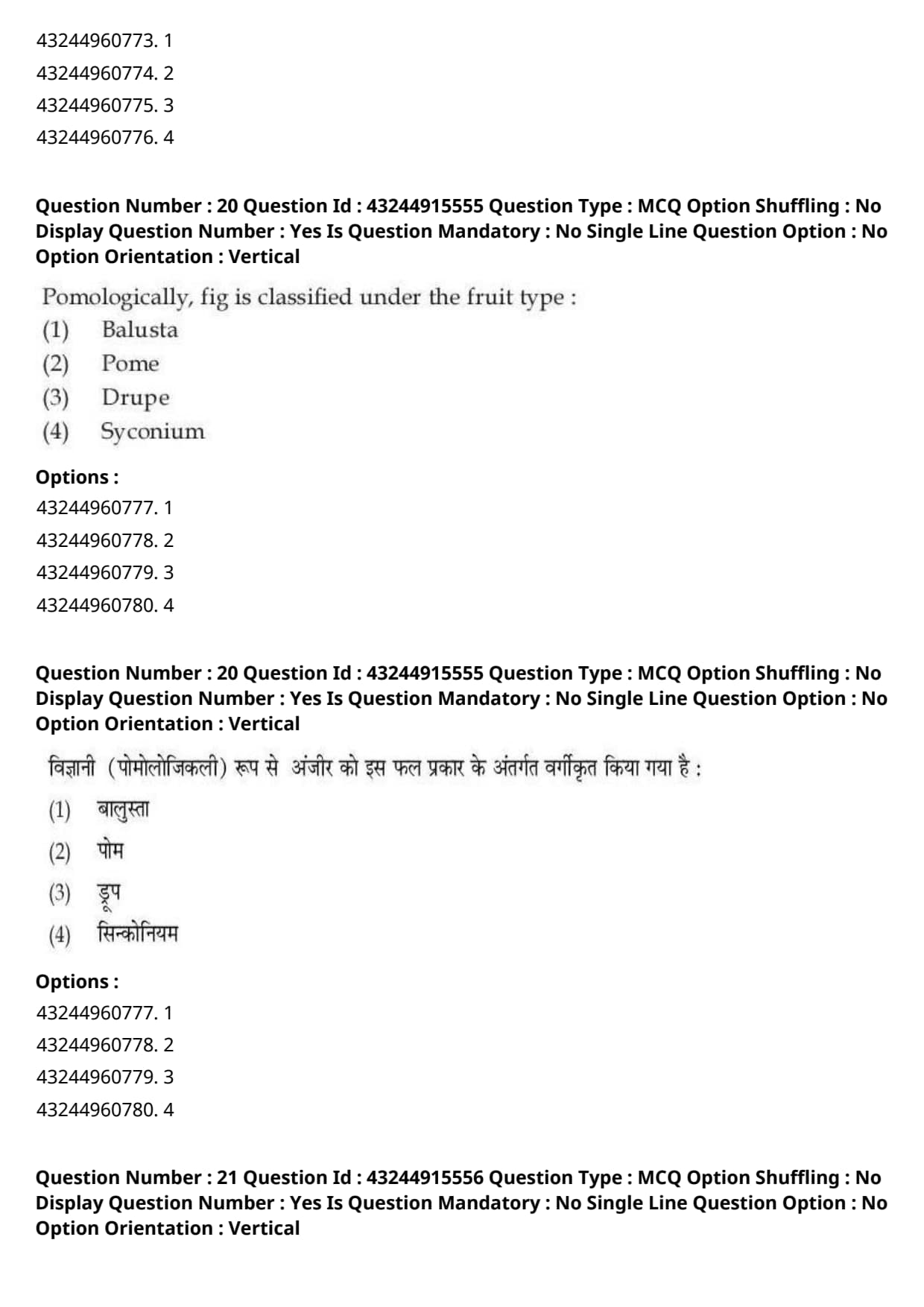
Pomologically, fig is classified under the fruit type:
View Solution
Concept:
Pomology is the study of fruit crops. Fruits are classified on the basis of their origin, structure and development.
Step 1: Identify fig fruit type.
Fig develops from a hollow fleshy receptacle that encloses many small flowers inside it.
\[ Fig \rightarrow Syconium \]
Step 2: Compare with other fruit types.
Pome is found in apple and pear.
Drupe is found in mango and coconut.
Balusta is associated with pomegranate.
Step 3: Final answer.
Therefore, pomologically, fig is classified as syconium.
\[ \therefore Correct Answer is (D) \] Quick Tip: Fig is a syconium fruit, apple is a pome, mango is a drupe, and pomegranate is a balusta.
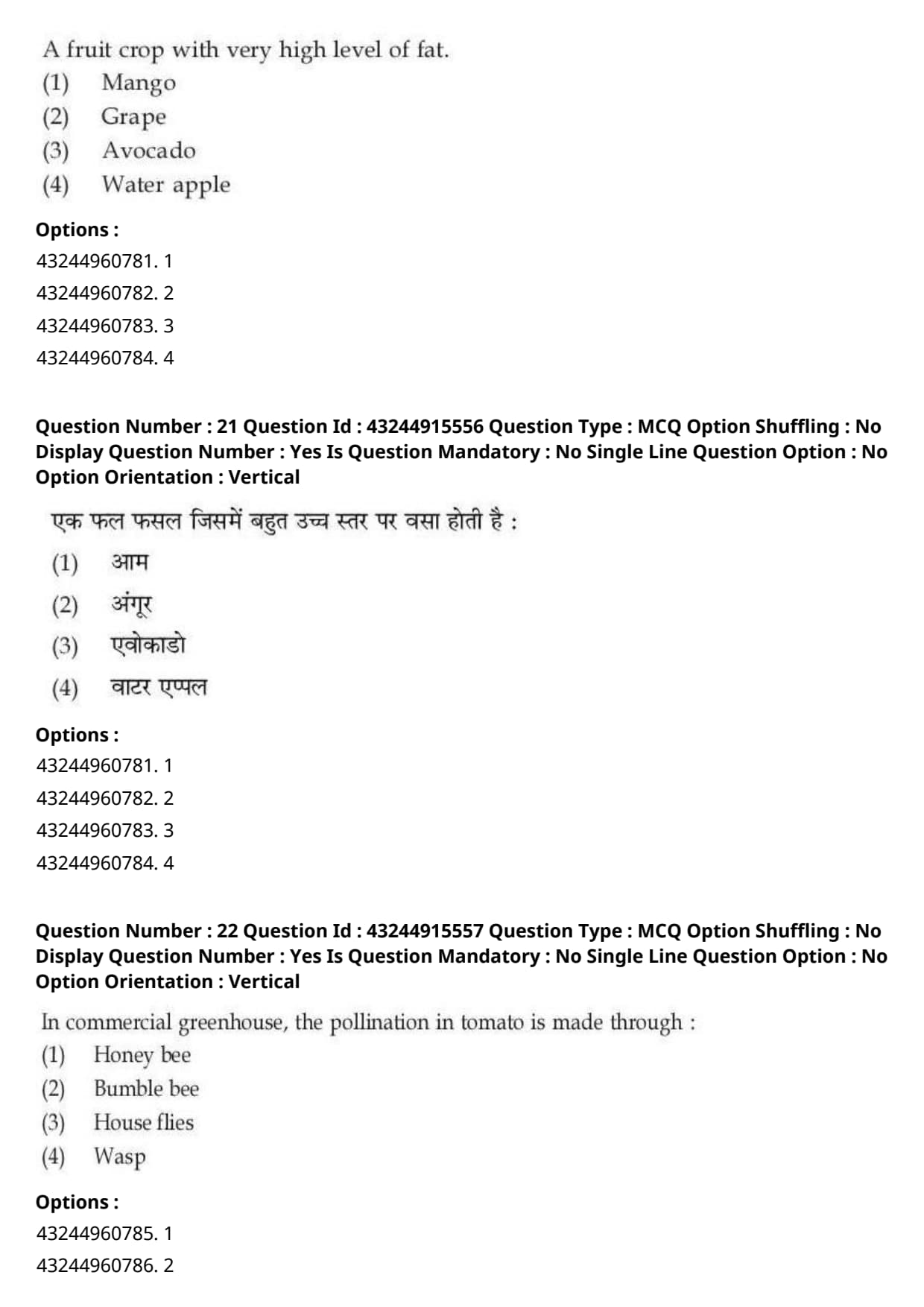
A fruit crop with very high level of fat.
View Solution
Concept:
Most fruits contain a high amount of water, carbohydrates, vitamins and minerals, but very low fat content. However, some fruits are exceptional because they contain a comparatively high amount of fat.
Step 1: Check mango.
Mango is rich in carbohydrates, carotenoids and vitamins, but it is not known for high fat content.
\[ Mango \neq high fat fruit \]
Step 2: Check grape and water apple.
Grape and water apple are juicy fruits. They mainly contain water, sugars and minerals, but they do not contain very high fat.
\[ Grape and water apple \rightarrow low fat fruits \]
Step 3: Check avocado.
Avocado is well known for having a high level of fat, especially healthy unsaturated fats.
\[ Avocado \rightarrow high fat fruit \]
Therefore, the fruit crop with very high level of fat is avocado.
\[ \therefore Correct Answer is (C) \] Quick Tip: Avocado is a unique fruit because it contains a high amount of healthy fat compared to most other fruits.
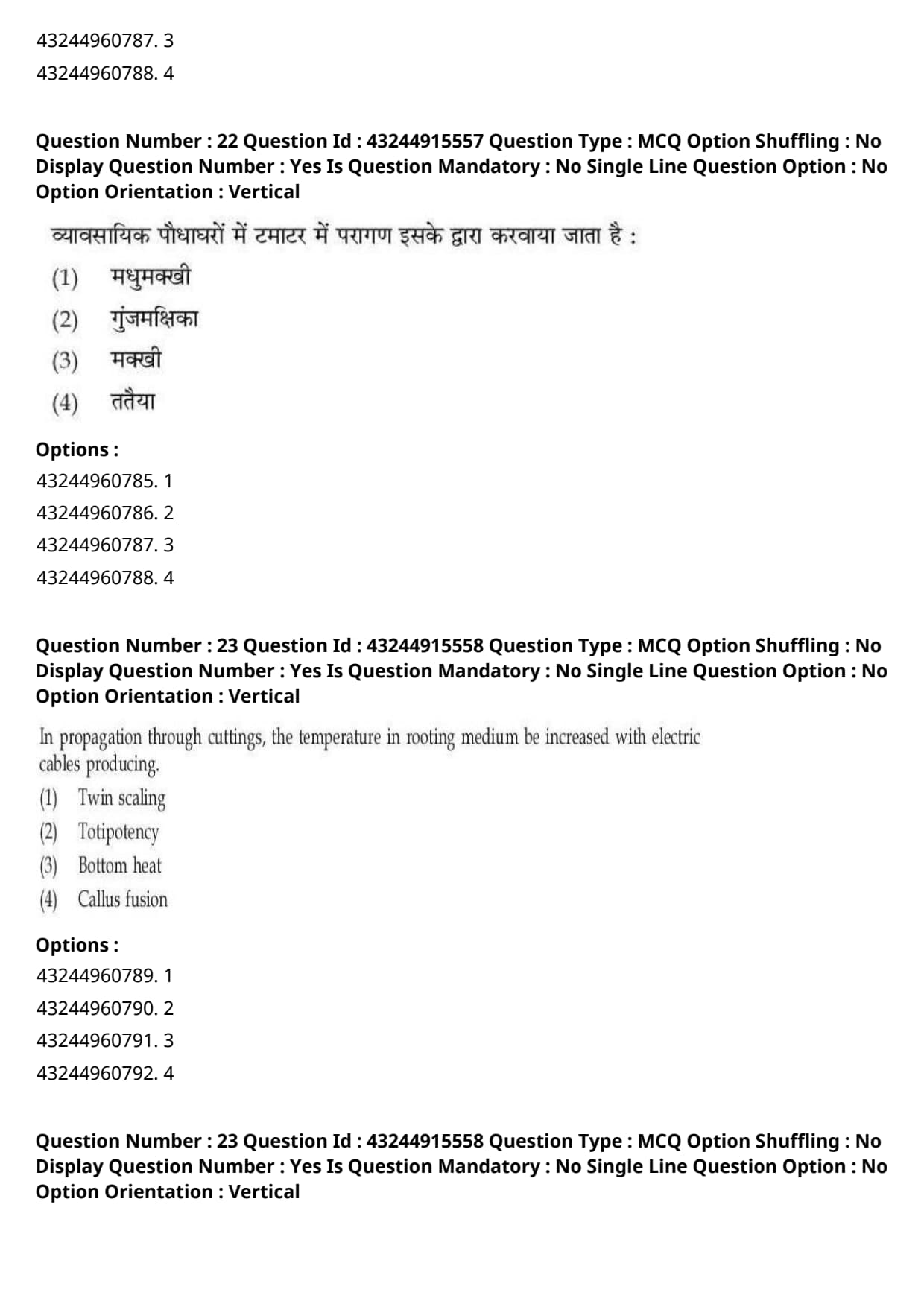
In commercial greenhouse, the pollination in tomato is made through:
View Solution
Concept:
Tomato flowers require vibration for effective pollen release. This type of pollination is called buzz pollination.
Step 1: Understand tomato pollination.
Tomato pollen is released more effectively when the flower is vibrated.
\[ Vibration of flower \Rightarrow better pollen release \]
Step 2: Identify the suitable pollinator.
Bumble bees are very effective in greenhouse tomato pollination because they perform buzz pollination.
\[ Bumble bee \rightarrow buzz pollination \]
Step 3: Compare with other insects.
Honey bees are useful for many crops, but they are not as effective as bumble bees for greenhouse tomato pollination.
House flies and wasps are not the standard commercial greenhouse pollinators for tomato.
Therefore, in commercial greenhouse tomato pollination is mainly done through bumble bees.
\[ \therefore Correct Answer is (B) \] Quick Tip: Bumble bees are commonly used for pollination of tomato in commercial greenhouses because they perform buzz pollination.
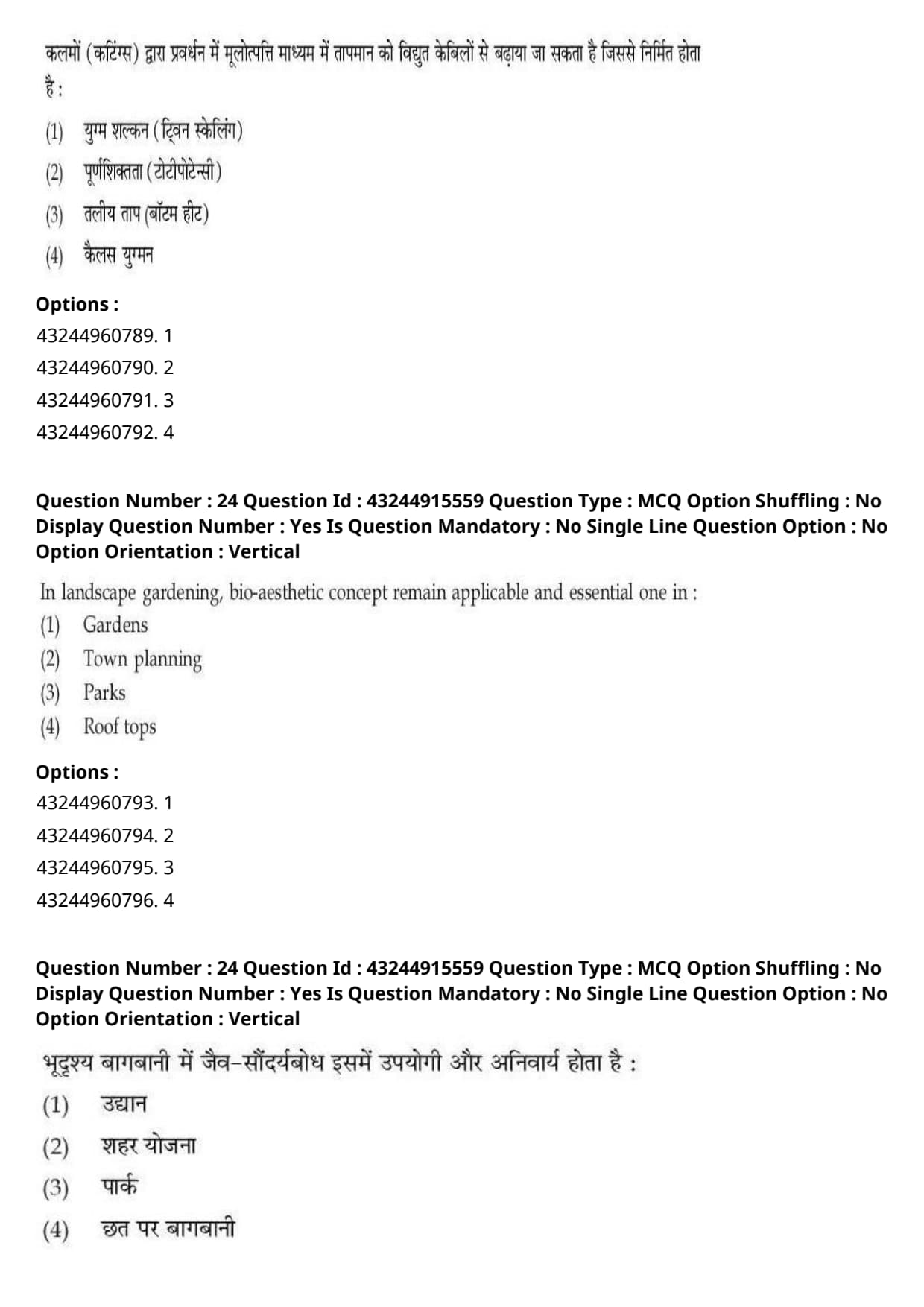
In propagation through cuttings, the temperature in rooting medium is increased with electric cables producing:
View Solution
Concept:
In vegetative propagation by cuttings, root initiation can be improved by maintaining a warm rooting medium.
Step 1: Understand the use of electric cables.
Electric cables are placed below the rooting medium to supply heat from the lower side.
\[ Electric cables below rooting medium \Rightarrow heat from bottom \]
Step 2: Identify the term.
The heating of rooting medium from below is called bottom heat.
\[ Bottom heat \rightarrow warmer root zone \]
Step 3: Importance in cuttings.
Bottom heat encourages callus formation and root initiation in cuttings.
Thus, the temperature increase in rooting medium by electric cables is called bottom heat.
\[ \therefore Correct Answer is (C) \] Quick Tip: Bottom heat is used in propagation beds to improve rooting of cuttings.
In landscape gardening, bio-aesthetic concept remain applicable and essential one in:
View Solution
Concept:
Bio-aesthetic planning means using plants and natural beauty for improving the environment and appearance of human settlements.
Step 1: Understand bio-aesthetic concept.
Bio-aesthetic concept is not limited to a small garden. It is related to planned use of vegetation for beauty, health and environmental improvement.
\[ Bio-aesthetic planning \Rightarrow beautification with plants \]
Step 2: Apply to landscape gardening.
In town planning, roads, parks, residential areas and public spaces are designed with plants and landscape elements.
\[ Town planning \rightarrow large-scale landscape planning \]
Step 3: Compare with other options.
Gardens, parks and rooftops are parts of landscaping, but the broadest and most essential application of bio-aesthetic concept is in town planning.
\[ \therefore Correct Answer is (B) \] Quick Tip: Bio-aesthetic planning is important in town planning for environmental improvement and beautification.
First evidence of which ornamental tree comes from a seal from `Mohen-Jo-Daro':
View Solution
Concept:
Historical evidence of ornamental and sacred plants can be obtained from ancient seals, sculptures and archaeological remains.
Step 1: Identify the archaeological site.
Mohenjo-Daro was an important city of the Indus Valley Civilization.
Step 2: Identify the tree shown in ancient evidence.
The Pipal tree has been represented in ancient Indian archaeological records and seals.
\[ Mohenjo-Daro seal \Rightarrow Pipal tree \]
Step 3: Final answer.
Therefore, the first evidence from the seal of Mohenjo-Daro is related to the Pipal tree.
\[ \therefore Correct Answer is (D) \] Quick Tip: Pipal tree has ancient cultural and ornamental importance in Indian civilization.
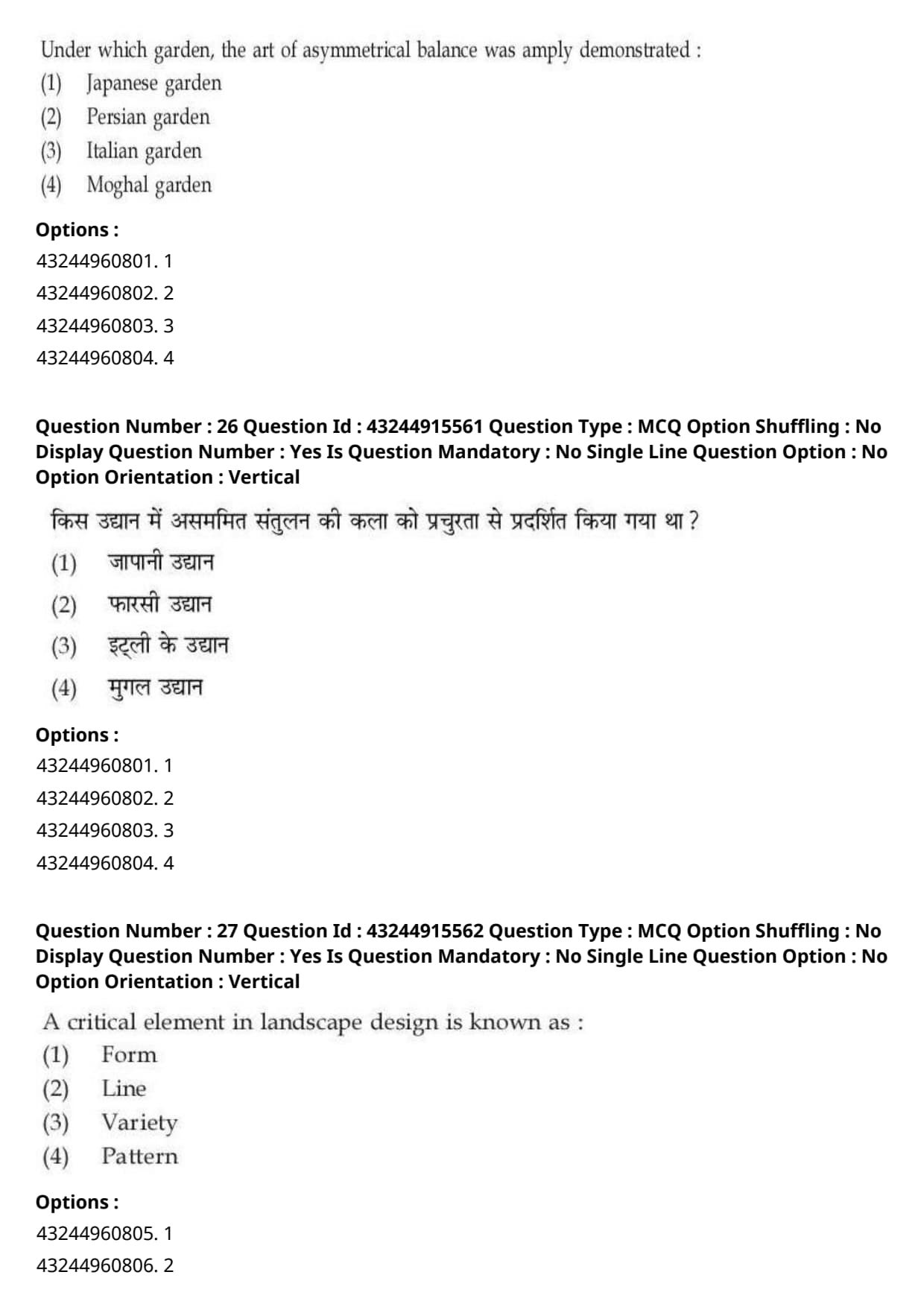
Under which garden, the art of asymmetrical balance was amply demonstrated:
View Solution
Concept:
Different garden styles are known for different design principles. Symmetry and asymmetry are important principles of garden design.
Step 1: Understand asymmetrical balance.
Asymmetrical balance means the two sides of the design are not exactly identical, but still appear visually balanced.
\[ Unequal arrangement+visual balance=asymmetrical balance \]
Step 2: Identify the garden style.
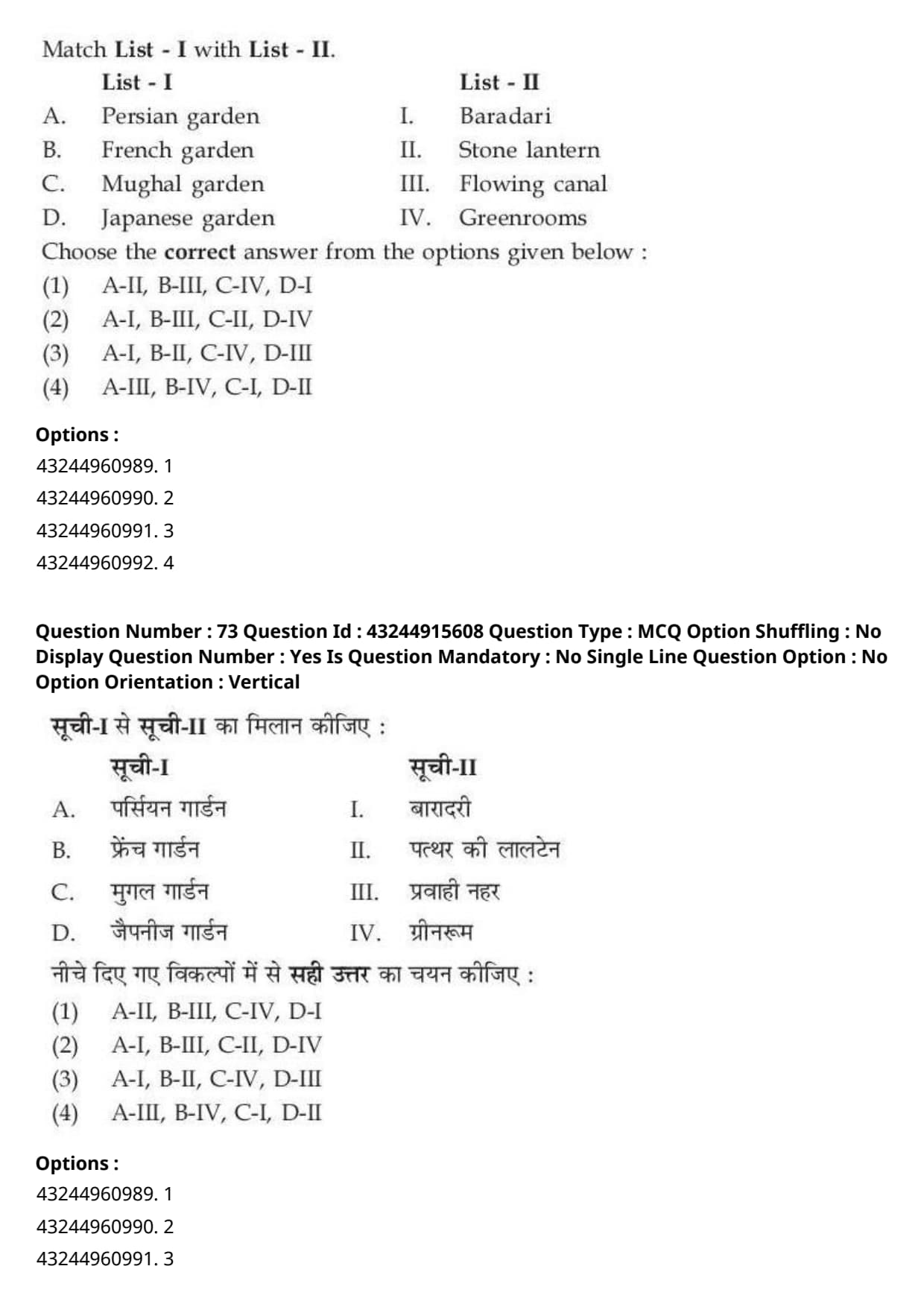
Japanese gardens are famous for naturalistic design, irregular arrangement, symbolic elements and asymmetrical balance.
\[ Japanese garden \rightarrow asymmetrical balance \]
Step 3: Compare with formal gardens.
Persian, Italian and Mughal gardens generally show formal layout, symmetry, axial planning and geometric arrangement.
Therefore, asymmetrical balance is strongly demonstrated in Japanese gardens.
\[ \therefore Correct Answer is (A) \] Quick Tip: Japanese gardens are naturalistic and commonly use asymmetrical balance.
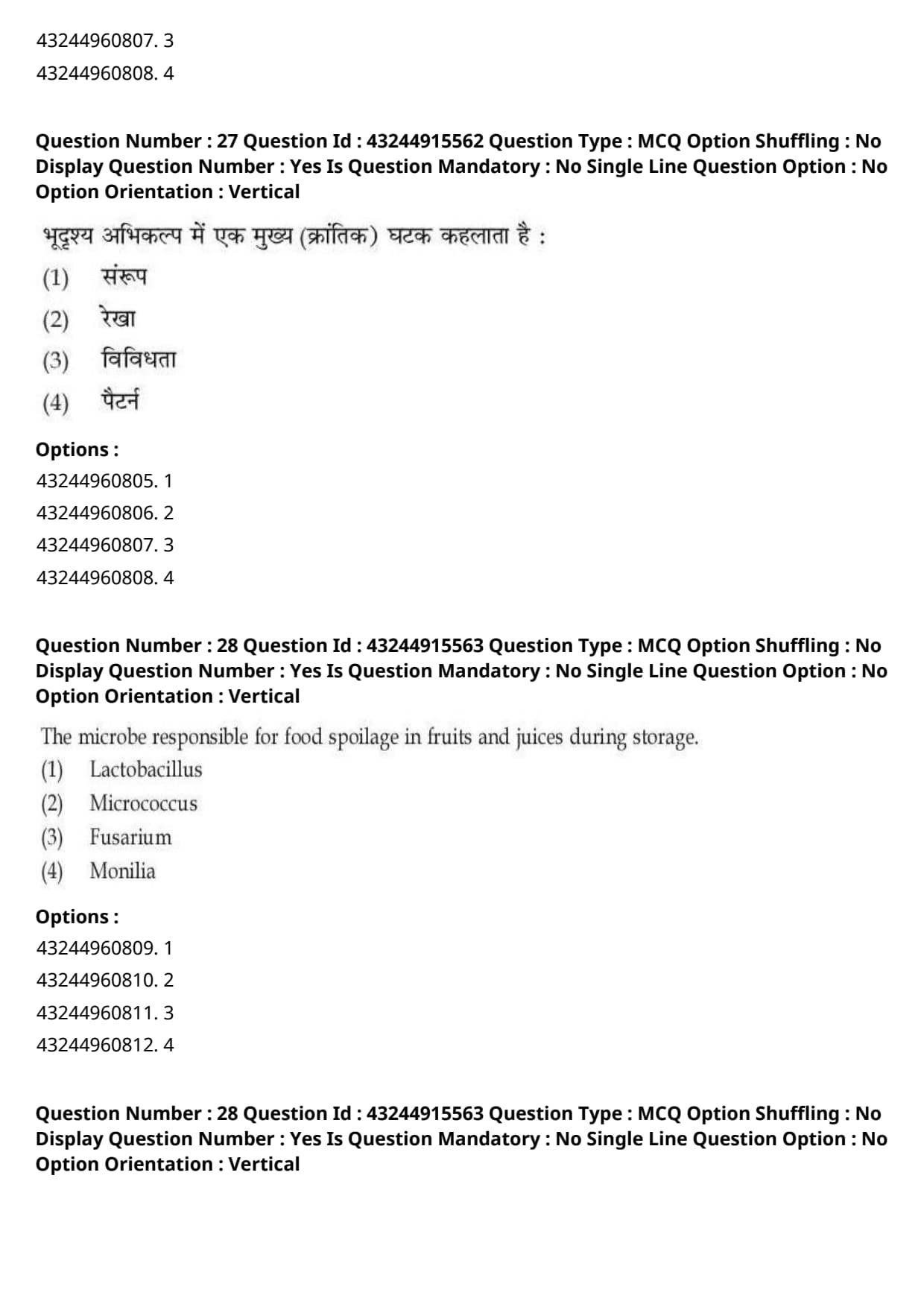
A critical element in landscape design is known as:
View Solution
Concept:
Landscape design is based on elements such as line, form, texture, colour, scale and pattern.
Step 1: Understand the role of line.
Line is one of the most important elements in landscape design because it guides movement and controls visual direction.
\[ Line \rightarrow direction and movement \]
Step 2: Use of line in landscape.
Lines may be formed by paths, borders, hedges, rows of plants, edges of lawns and water channels.
Step 3: Compare with other options.
Form, variety and pattern are also important, but line is considered a critical element because it organizes the design and directs the viewer's eye.
\[ \therefore Correct Answer is (B) \] Quick Tip: Line is a critical landscape design element because it guides the eye and creates direction in the design.
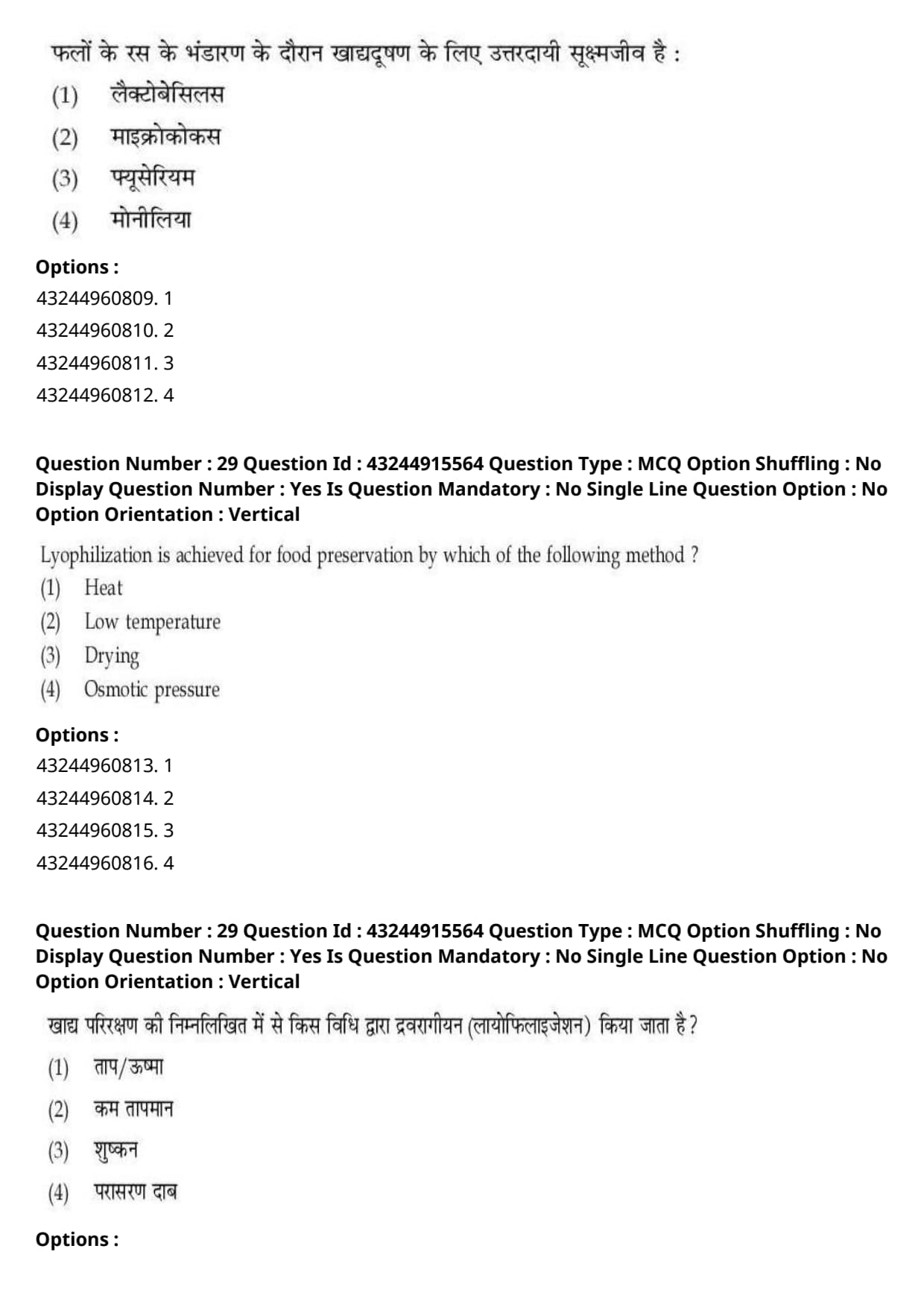
The microbe responsible for food spoilage in fruits and juices during storage.
View Solution
Concept:
Fruits and fruit juices may spoil during storage due to the growth of fungi, yeasts and bacteria.
Step 1: Understand fruit spoilage.
Fruit spoilage is commonly caused by fungi because fruits contain moisture and sugars.
\[ Fruits+moisture+sugar \Rightarrow microbial spoilage \]
Step 2: Identify the suitable organism.
Monilia is associated with spoilage and rotting of fruits.
\[ \textit{Monilia \rightarrow fruit spoilage \]
Step 3: Compare with other options.
\textit{Lactobacillus is mainly associated with lactic acid fermentation.
\textit{Micrococcus is commonly found in many environments but is not the best answer here.
\textit{Fusarium causes several plant diseases, but \textit{Monilia is more directly associated with fruit spoilage in this option set.
\[ \therefore Correct Answer is (D) \] Quick Tip: Fungal organisms are commonly responsible for spoilage of stored fruits.
Lyophilization is achieved for food preservation by which of the following method?
View Solution
Concept:
Lyophilization is also called freeze drying. It is a preservation method in which water is removed from food at low temperature and reduced pressure.
Step 1: Understand lyophilization.
In lyophilization, the food is first frozen and then water is removed by sublimation.
\[ Ice \rightarrow water vapour \]
Step 2: Identify the basic preservation principle.
The main purpose is to remove moisture from the food material.
\[ Moisture removal=drying \]
Step 3: Final answer.
Thus, lyophilization is a drying method used for food preservation.
\[ \therefore Correct Answer is (C) \] Quick Tip: Lyophilization means freeze drying, where water is removed by sublimation.
Most essential constituent for jelly making is known as:
View Solution
Concept:
Jelly making depends on the formation of a gel structure. The important components are pectin, sugar, acid and water.
Step 1: Identify the gel-forming substance.
Pectin is the substance responsible for gel formation in jelly.
\[ Pectin \rightarrow gel formation \]
Step 2: Role of sugar and acid.
Sugar helps in preservation and texture. Acid helps pectin form a proper gel. But the main essential gelling constituent is pectin.
Step 3: Final answer.
Therefore, the most essential constituent for jelly making is pectin.
\[ \therefore Correct Answer is (B) \] Quick Tip: Pectin is the main gelling substance required for jelly making.
Given below are two statements:
Assertion (A): Prokaryotic cells are larger and may remain similar in shape and size.
Reason (R): The organisation of prokaryotic cells are similar eventhough they exhibit a wide variety of shapes and functions.
View Solution
Concept:
Prokaryotic cells are simple cells without a true nucleus and membrane-bound organelles.
Step 1: Check Assertion.
The assertion says that prokaryotic cells are larger. This is incorrect because prokaryotic cells are generally smaller than eukaryotic cells.
\[ A is incorrect \]
Step 2: Check Reason.
The basic organisation of prokaryotic cells is similar. They have plasma membrane, cytoplasm, ribosomes and genetic material, although they may show different shapes and functions.
\[ R is correct \]
Step 3: Final conclusion.
Assertion is incorrect, but Reason is correct.
\[ \therefore Correct Answer is (D) \] Quick Tip: Prokaryotic cells are generally smaller and simpler than eukaryotic cells.
Given below are two statements:
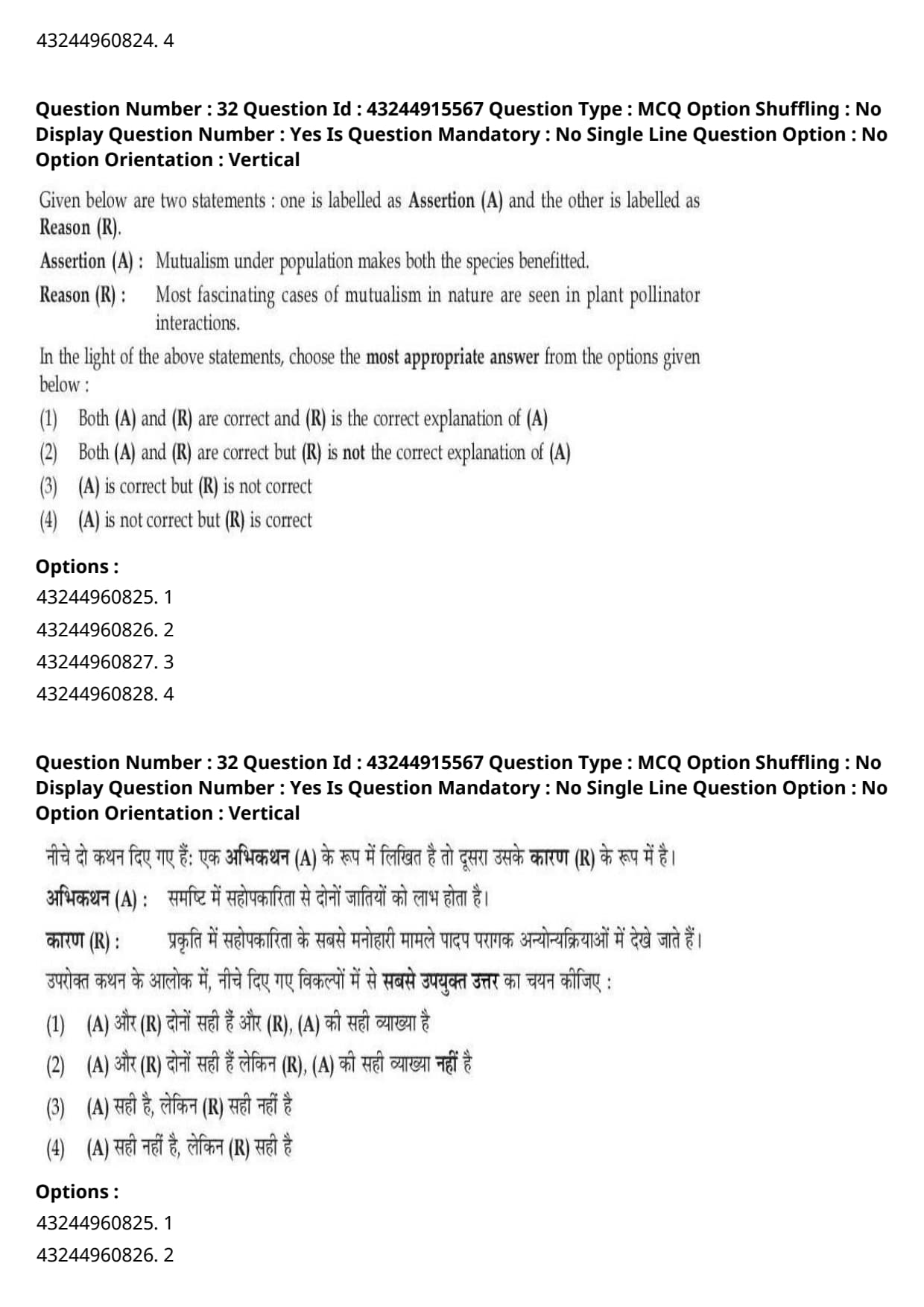
Assertion (A): Mutualism under population makes both the species benefitted.
Reason (R): Most fascinating cases of mutualism in nature are seen in plant pollinator interactions.
View Solution
Concept:
Mutualism is a type of biological interaction in which both interacting species get benefit.
Step 1: Check Assertion.
The assertion says that mutualism benefits both species.
\[ A is correct \]
Step 2: Check Reason.
Plant-pollinator interaction is one of the best examples of mutualism. Plants get pollination and pollinators get food such as nectar or pollen.
\[ R is correct \]
Step 3: Check explanation.
Reason gives an example of mutualism, but it does not directly explain the definition of mutualism given in Assertion.
\[ R is not the correct explanation of A \]
\[ \therefore Correct Answer is (B) \] Quick Tip: In mutualism, both species benefit; plant-pollinator interaction is a common example.
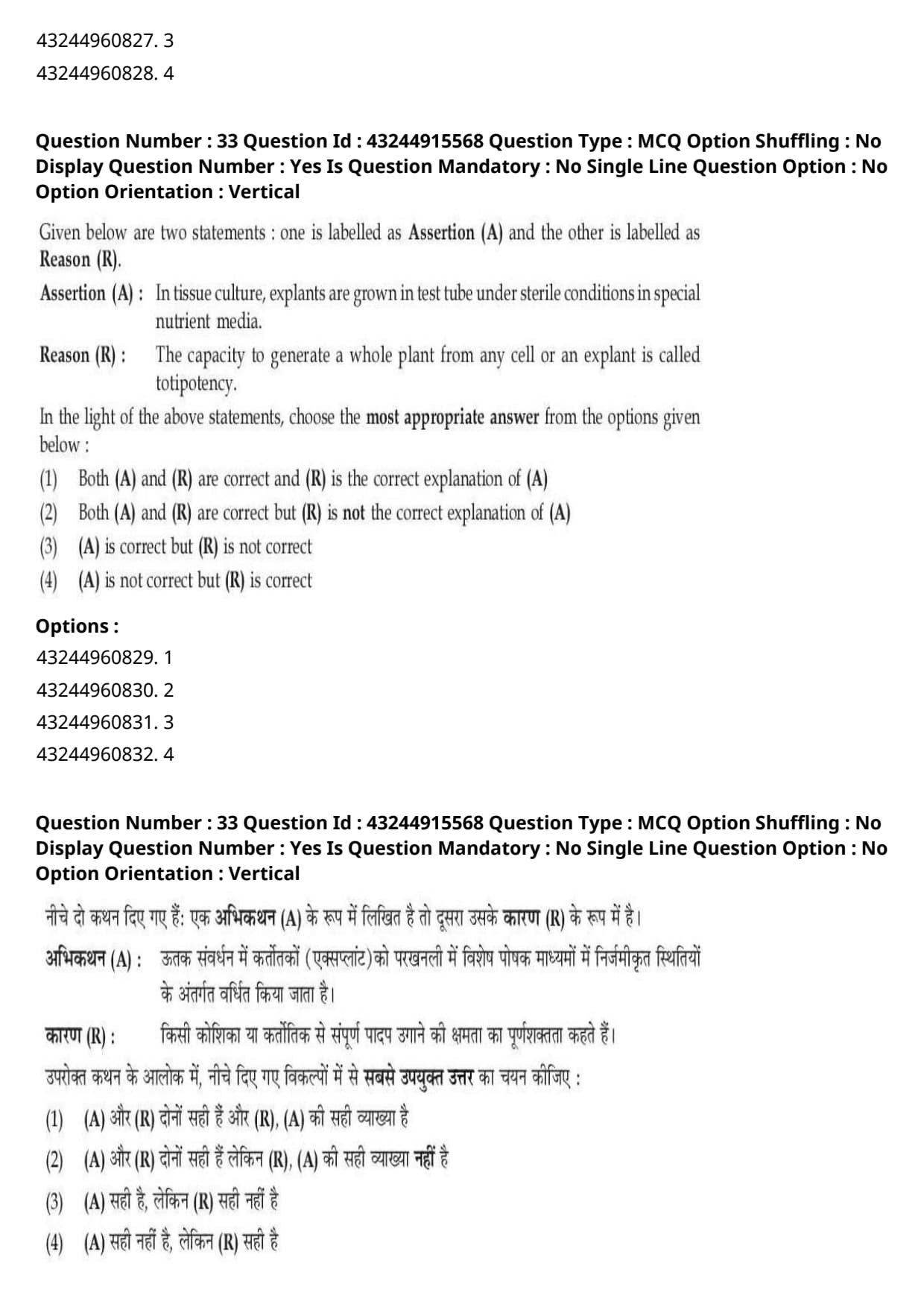
Given below are two statements:
Assertion (A): In tissue culture, explants are grown in test tube under sterile conditions in special nutrient media.
Reason (R): The capacity to generate a whole plant from any cell or an explant is called totipotency.
View Solution
Concept:
Plant tissue culture is the technique of growing plant cells, tissues or organs under aseptic conditions on nutrient medium.
Step 1: Check Assertion.
In tissue culture, explants are grown under sterile conditions on special nutrient medium.
\[ A is correct \]
Step 2: Check Reason.
Totipotency is the ability of a cell or explant to regenerate a complete plant.
\[ R is correct \]
Step 3: Check explanation.
Reason explains the biological basis of regeneration, but it does not directly explain why explants are grown under sterile conditions in nutrient medium.
\[ R is not the correct explanation of A \]
\[ \therefore Correct Answer is (B) \] Quick Tip: Tissue culture depends on aseptic conditions, nutrient medium and the totipotency of plant cells.
Given below are two statements:
Assertion (A): During fixation, the microorganisms are killed and attached firmly to the microscope slide.
Reason (R): A thin film of material containing microorganisms adequately preserves overall morphology including structures within the cells.
View Solution
Concept:
Fixation is an important step in microscopic staining of microorganisms.
Step 1: Check Assertion.
During fixation, microorganisms are killed and fixed firmly on the slide.
\[ A is correct \]
Step 2: Check Reason.
A thin smear helps in proper observation and preservation of morphology during staining.
\[ R is correct \]
Step 3: Check explanation.
Reason describes the importance of making a thin film or smear, but it does not directly explain the fixation process of killing and attaching microorganisms to the slide.
\[ R is not the correct explanation of A \]
\[ \therefore Correct Answer is (B) \] Quick Tip: Fixation kills microorganisms and attaches them firmly to the slide before staining.
Given below are two statements:
Assertion (A): Certain attributes of population includes birth, death, sex ratio etc.
Reason (R): A population at any given time is composed of individuals of different ages.
View Solution
Concept:
A population has several measurable attributes such as birth rate, death rate, sex ratio and age distribution.
Step 1: Check Assertion.
Birth, death and sex ratio are important population attributes.
\[ A is correct \]
Step 2: Check Reason.
At any given time, a population consists of individuals of different age groups.
\[ R is correct \]
Step 3: Check explanation.
Reason explains age distribution, but it does not directly explain all the population attributes such as birth, death and sex ratio.
\[ R is not the correct explanation of A \]
\[ \therefore Correct Answer is (B) \] Quick Tip: Population attributes include birth rate, death rate, sex ratio and age distribution.
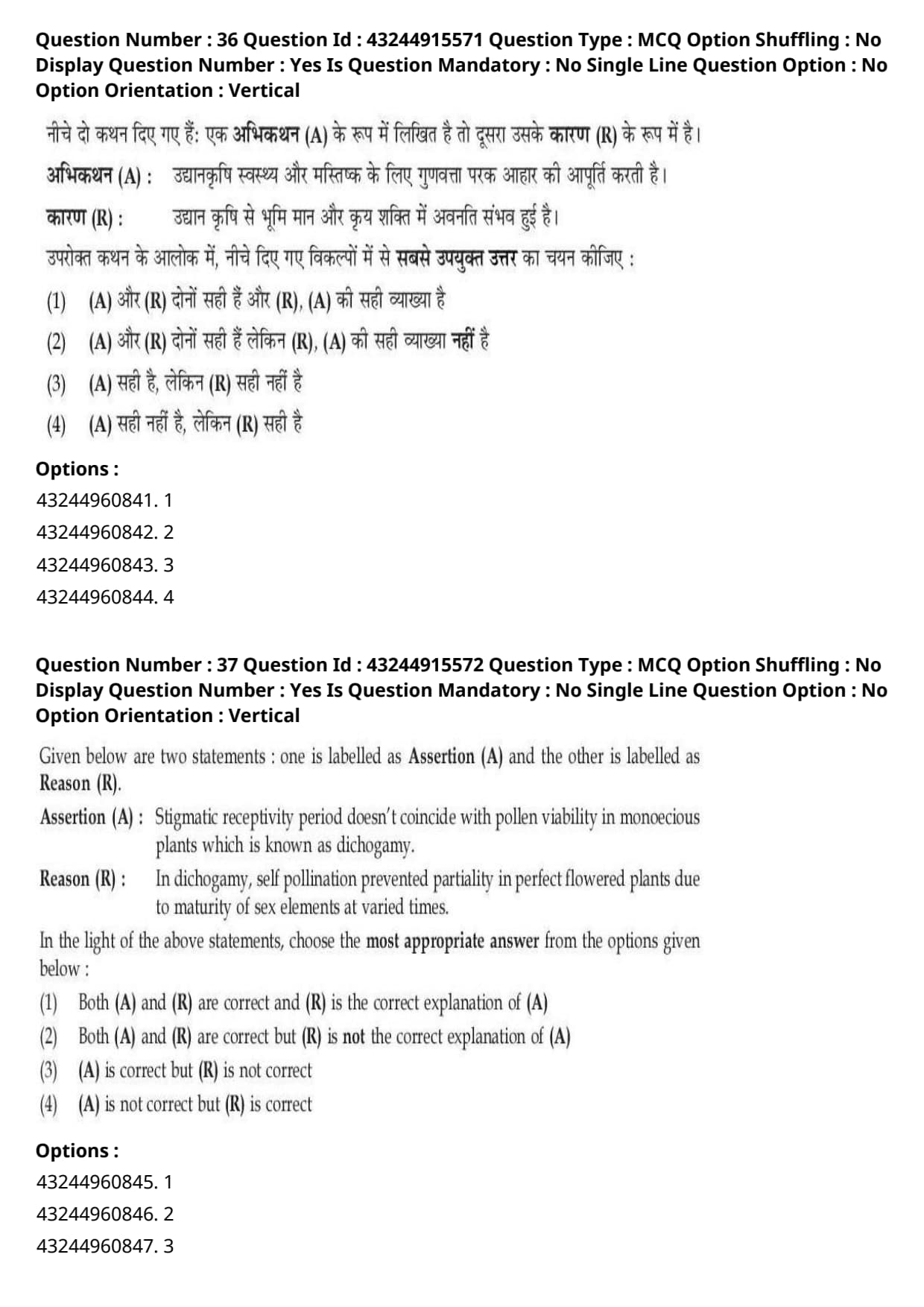
Given below are two statements:
Assertion (A): Horticulture supplies quality food for health and mind.
Reason (R): Deterioration of land value and purchasing power made possible with horticulture.
View Solution
Concept:
Horticulture deals with fruits, vegetables, flowers, spices, plantation crops and ornamental plants.
Step 1: Check Assertion.
Horticultural crops provide vitamins, minerals, antioxidants and fibre. They help in improving health and quality of diet.
\[ A is correct \]
Step 2: Check Reason.
The reason says horticulture causes deterioration of land value and purchasing power. This is incorrect. Horticulture generally improves land value, income generation and employment opportunities.
\[ R is incorrect \]
Step 3: Final conclusion.
Assertion is correct but Reason is incorrect.
\[ \therefore Correct Answer is (C) \] Quick Tip: Horticulture improves nutrition, income and land value; it does not cause deterioration of land value.
Given below are two statements:
Assertion (A): Stigmatic receptivity period does not coincide with pollen viability in monoecious plants which is known as dichogamy.
Reason (R): In dichogamy, self pollination prevented partially in perfect flowered plants due to maturity of sex elements at varied times.
View Solution
Concept:
Dichogamy is a floral mechanism in which male and female reproductive parts mature at different times.
Step 1: Check Assertion.
The assertion connects dichogamy specifically with monoecious plants. Dichogamy is more properly described as temporal separation of male and female function in flowers, especially perfect flowers.
\[ A is not correctly stated \]
Step 2: Check Reason.
In dichogamy, self-pollination is prevented or reduced because anthers and stigma mature at different times.
\[ R is correct \]
Step 3: Final conclusion.
Assertion is not correct, but Reason is correct.
\[ \therefore Correct Answer is (D) \] Quick Tip: Dichogamy prevents self-pollination by different timing of anther and stigma maturity.
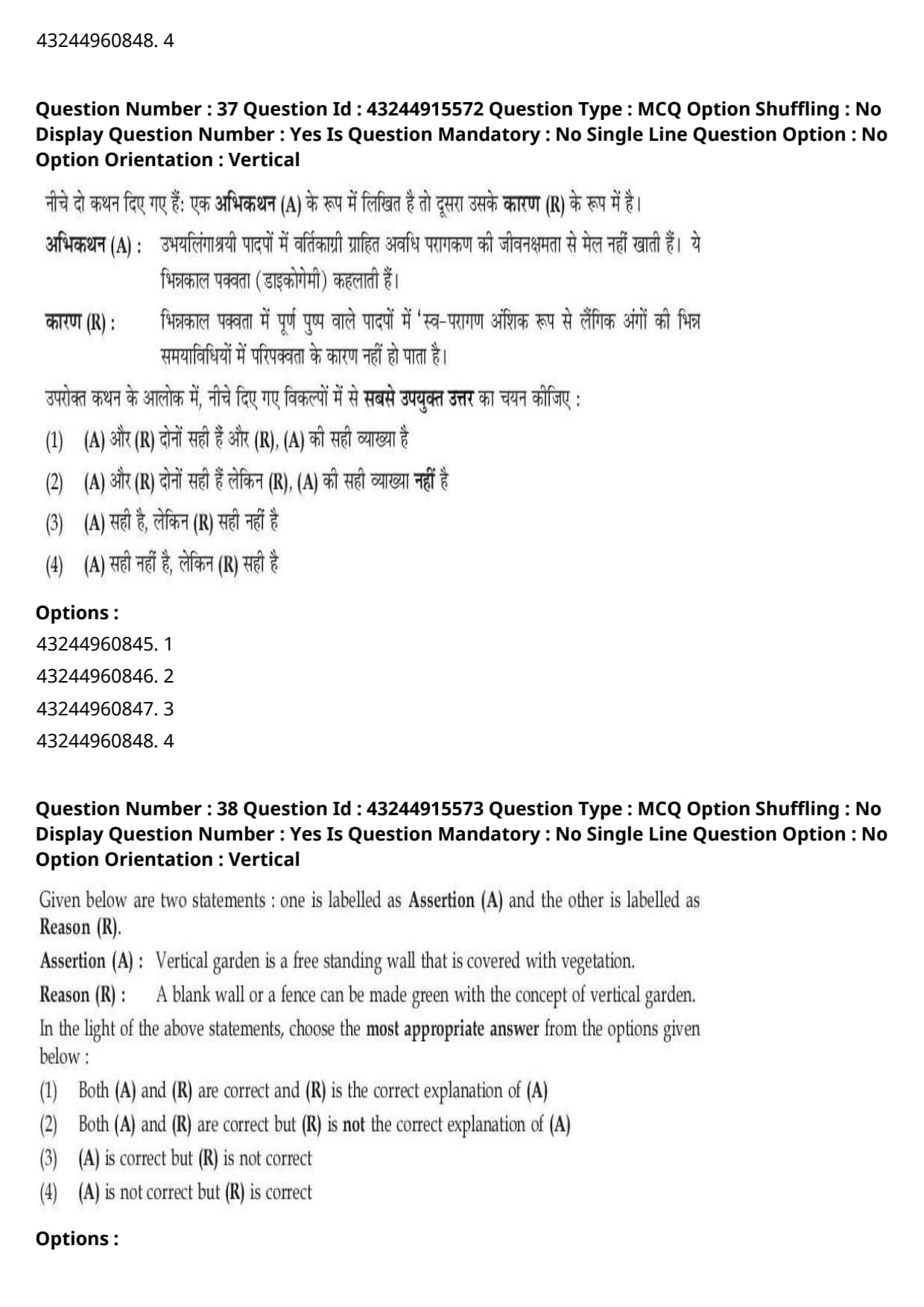
Given below are two statements:
Assertion (A): Vertical garden is a free standing wall that is covered with vegetation.
Reason (R): A blank wall or a fence can be made green with the concept of vertical garden.
View Solution
Concept:
Vertical gardening is a method of growing plants vertically on walls, panels, fences or other vertical surfaces.
Step 1: Check Assertion.
A vertical garden may be a free-standing wall or vertical structure covered with vegetation.
\[ A is correct \]
Step 2: Check Reason.
A blank wall or fence can be made green by using the concept of vertical gardening.
\[ R is correct \]
Step 3: Check explanation.
Reason gives an application of vertical gardening. It does not directly explain the definition given in Assertion.
\[ R is not the correct explanation of A \]
\[ \therefore Correct Answer is (B) \] Quick Tip: Vertical gardens are used to cover walls and fences with vegetation, especially where horizontal space is limited.
Given below are two statements:
Assertion (A): In preparation of fruit jam, the fruit must be washed thoroughly to remove any dirt.
Reason (R): Leaves and stalks of the fruit must remain attached during preparation of jam.
View Solution
Concept:
Jam preparation requires clean, sound and properly prepared fruits.
Step 1: Check Assertion.
Fruits must be washed thoroughly before jam preparation to remove dust, dirt, pesticide residues and microorganisms.
\[ A is correct \]
Step 2: Check Reason.
Leaves, stalks and damaged portions should be removed before processing. They should not remain attached during jam preparation.
\[ R is incorrect \]
Step 3: Final conclusion.
Assertion is correct, but Reason is incorrect.
\[ \therefore Correct Answer is (C) \] Quick Tip: Before jam preparation, fruits should be washed and unwanted parts like stalks and leaves should be removed.
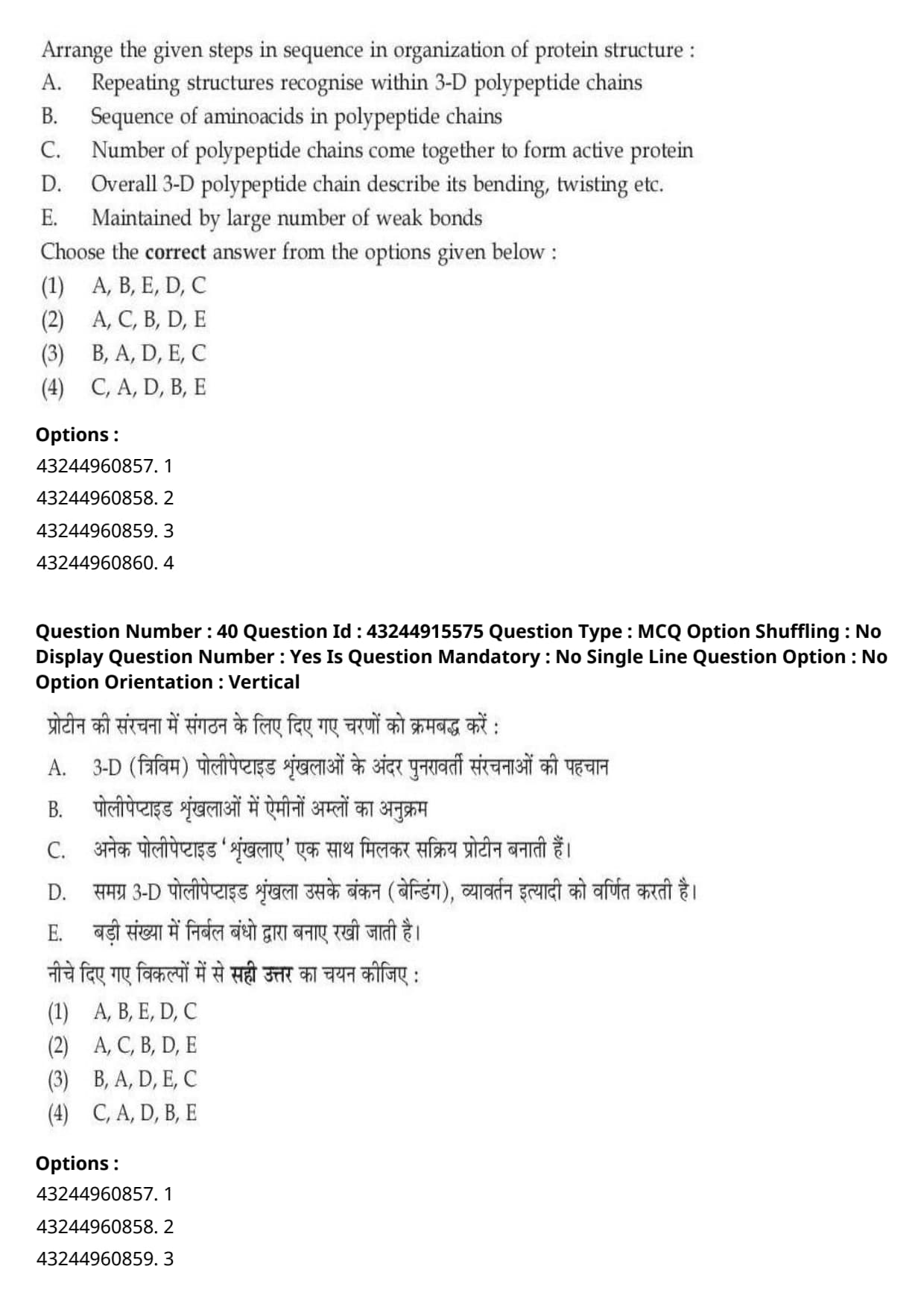
Arrange the given steps in sequence in organization of protein structure:
A. Repeating structures recognise within 3-D polypeptide chains
B. Sequence of amino acids in polypeptide chains
C. Number of polypeptide chains come together to form active protein
D. Overall 3-D polypeptide chain describe its bending, twisting etc.
E. Maintained by large number of weak bonds. Choose the correct answer from the options given below:
View Solution
Concept:
Protein structure is organized into primary, secondary, tertiary and quaternary levels.
Step 1: Primary structure.
The first level of protein structure is the sequence of amino acids in a polypeptide chain.
\[ B=Primary structure \]
Step 2: Secondary structure.
Repeating structures within the polypeptide chain, such as alpha helix and beta sheet, represent secondary structure.
\[ A=Secondary structure \]
Step 3: Tertiary structure.
The overall three-dimensional bending, twisting and folding of one polypeptide chain represents tertiary structure.
\[ D=Tertiary structure \]
Step 4: Stabilization of tertiary structure.
The three-dimensional structure is maintained by many weak bonds such as hydrogen bonds, ionic bonds, hydrophobic interactions and van der Waals forces.
\[ E=weak bond stabilization \]
Step 5: Quaternary structure.
When several polypeptide chains come together to form an active protein, it represents quaternary structure.
\[ C=Quaternary structure \]
Therefore, the correct sequence is:
\[ B,A,D,E,C \]
\[ \therefore Correct Answer is (C) \] Quick Tip: Protein structure sequence is primary \(\rightarrow\) secondary \(\rightarrow\) tertiary \(\rightarrow\) quaternary.
Arrange the following stages of microsporogenesis in sequence:
A. Tetrad stage
B. Microspore mother cell
C. Formation of pollen grains
D. Meiosis
E. Microspores. Choose the correct answer from the options given below:
View Solution
Concept:
Microsporogenesis is the process by which microspores are formed from microspore mother cells inside the anther.
Step 1: Start with microspore mother cell.
The process begins with a diploid microspore mother cell.
\[ B=Microspore mother cell \]
Step 2: Meiosis occurs.
The microspore mother cell undergoes meiosis.
\[ D=Meiosis \]
Step 3: Tetrad formation.
After meiosis, four haploid cells are formed together as a tetrad.
\[ A=Tetrad stage \]
Step 4: Microspores are released.
The tetrad separates into individual microspores.
\[ E=Microspores \]
Step 5: Pollen grains are formed.
Each microspore develops into a pollen grain.
\[ C=Formation of pollen grains \]
Therefore, the correct sequence is:
\[ B,D,A,E,C \]
\[ \therefore Correct Answer is (A) \] Quick Tip: Microsporogenesis sequence is microspore mother cell \(\rightarrow\) meiosis \(\rightarrow\) tetrad \(\rightarrow\) microspores \(\rightarrow\) pollen grains.
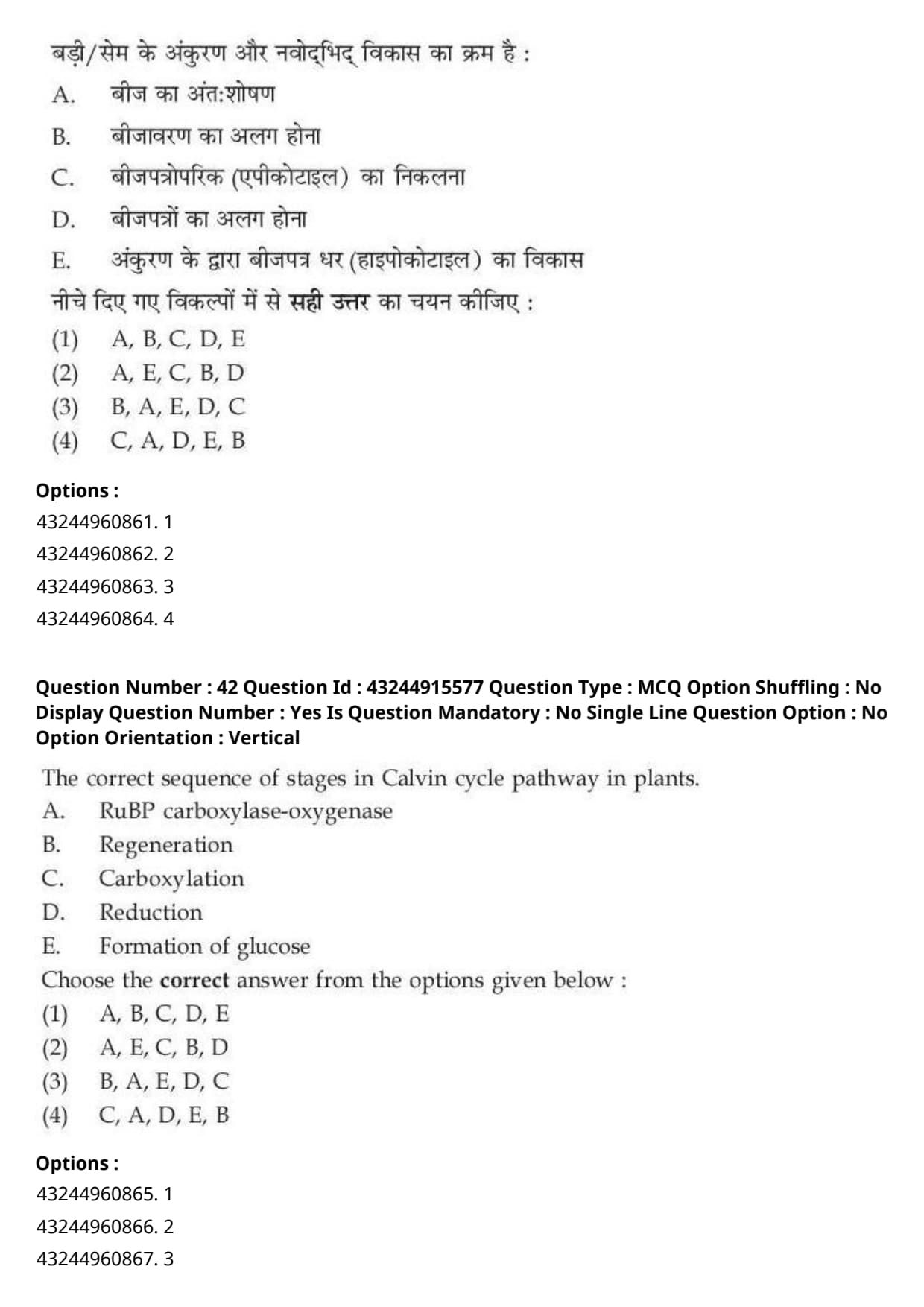
Arrange the following steps of Calvin cycle in correct sequence:
A. Reduction
B. Regeneration of RuBP
C. Carboxylation
D. Formation of glucose
E. Formation of triose phosphate. Choose the correct answer from the options given below:
View Solution
Concept:
Calvin cycle is the pathway of carbon fixation in photosynthesis. It occurs in the stroma of chloroplast.
Step 1: Carboxylation.
The first step is carboxylation, where \(CO_2\) combines with RuBP in the presence of RuBisCO.
\[ C=Carboxylation \]
Step 2: Reduction.
The fixed carbon compound is reduced using ATP and NADPH.
\[ A=Reduction \]
Step 3: Triose phosphate formation.
Reduction produces triose phosphate molecules.
\[ E=Formation of triose phosphate \]
Step 4: Glucose formation.
Some triose phosphate molecules are used to form glucose.
\[ D=Formation of glucose \]
Step 5: Regeneration.
Remaining molecules help regenerate RuBP so that the cycle continues.
\[ B=Regeneration of RuBP \]
Therefore, the correct sequence is:
\[ C,A,E,D,B \]
\[ \therefore Correct Answer is (C) \] Quick Tip: Calvin cycle begins with carboxylation and ends with regeneration of RuBP.
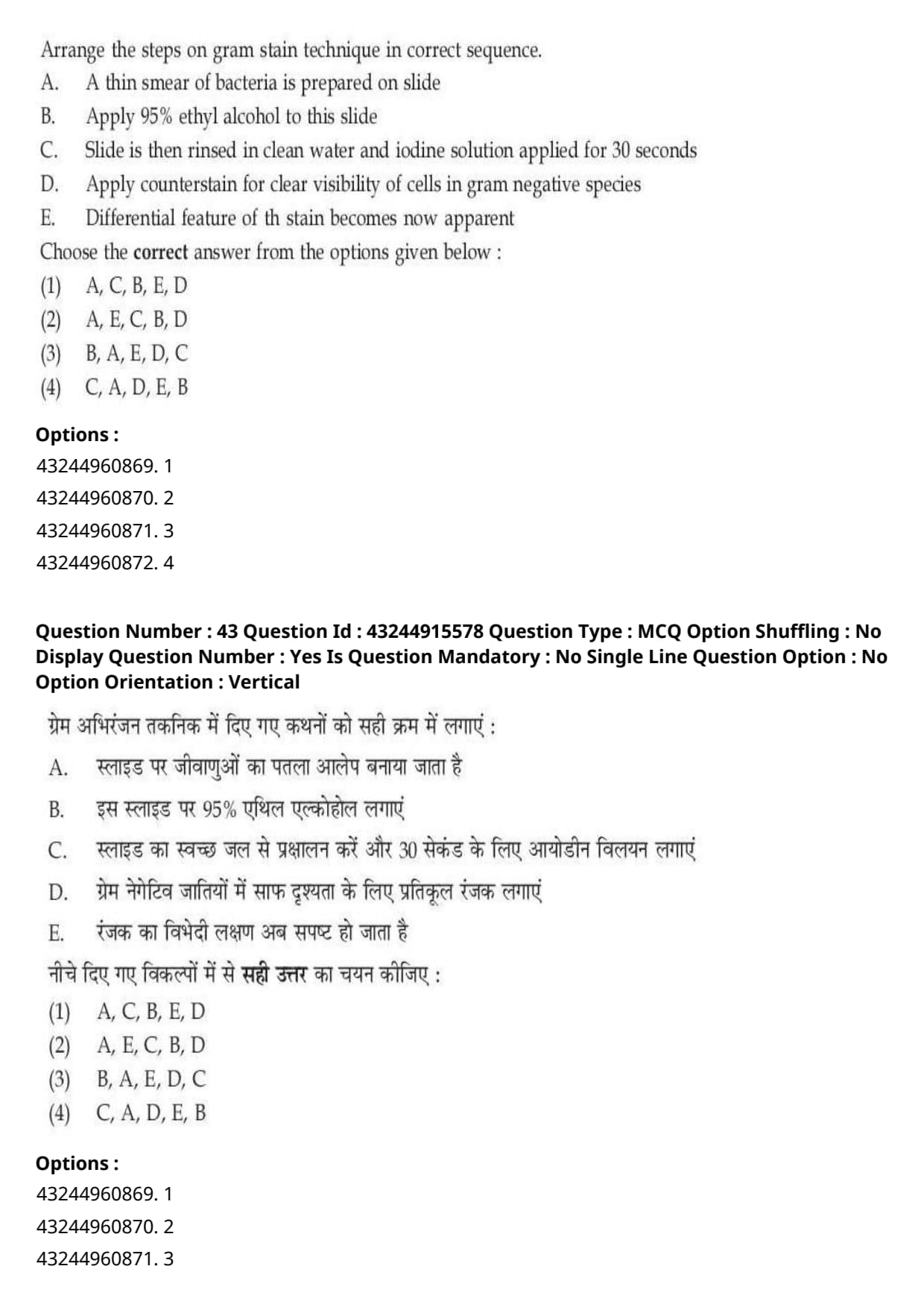
Arrange the following steps involved in Gram staining technique in correct sequence:
A. Preparation of smear and fixation
B. Decolourization with alcohol
C. Addition of iodine
D. Counter staining
E. Differential feature becomes apparent. Choose the correct answer from the options given below:
View Solution
Concept:
Gram staining is a differential staining method used to separate bacteria into Gram-positive and Gram-negative groups.
Step 1: Smear preparation and fixation.
First, a thin smear is prepared and fixed on the slide.
\[ A=Preparation of smear and fixation \]
Step 2: Iodine treatment.
Iodine acts as a mordant and forms a complex with the primary stain.
\[ C=Addition of iodine \]
Step 3: Decolourization.
Alcohol is used to remove stain from Gram-negative bacteria.
\[ B=Decolourization with alcohol \]
Step 4: Differential feature becomes visible.
After decolourization, Gram-positive and Gram-negative bacteria start showing differential behaviour.
\[ E=Differential feature becomes apparent \]
Step 5: Counter staining.
Finally, counter stain is applied so that Gram-negative bacteria become visible.
\[ D=Counter staining \]
Thus, the correct sequence is:
\[ A,C,B,E,D \]
\[ \therefore Correct Answer is (A) \] Quick Tip: In Gram staining, decolourization is the most critical step for differentiating Gram-positive and Gram-negative bacteria.
Arrange the following steps of micropropagation in correct sequence:
A. Selection of explant
B. Rooting
C. Multiplication
D. Hardening
E. Establishment in culture medium. Choose the correct answer from the options given below:
View Solution
Concept:
Micropropagation is the rapid multiplication of plants under tissue culture conditions.
Step 1: Selection of explant.
First, a suitable explant is selected from the mother plant.
\[ A=Selection of explant \]
Step 2: Establishment in culture medium.
The explant is sterilized and placed on a suitable nutrient medium.
\[ E=Establishment in culture medium \]
Step 3: Multiplication.
The established culture is multiplied to produce many shoots.
\[ C=Multiplication \]
Step 4: Rooting.
The shoots are transferred to rooting medium.
\[ B=Rooting \]
Step 5: Hardening.
The rooted plantlets are gradually acclimatized to external conditions.
\[ D=Hardening \]
Therefore, the correct sequence is:
\[ A,E,C,B,D \]
\[ \therefore Correct Answer is (B) \] Quick Tip: Micropropagation sequence is explant selection \(\rightarrow\) culture establishment \(\rightarrow\) multiplication \(\rightarrow\) rooting \(\rightarrow\) hardening.
Arrange the following fruits in increasing order of days from flowering to harvesting:
A. Litchi
B. Coconut
C. Strawberry
D. Banana
E. Guava. Choose the correct answer from the options given below:
View Solution
Concept:
Different fruit crops require different duration from flowering to harvest. Small fruits mature faster, while perennial crops like coconut require longer duration.
Step 1: Fastest maturing fruit.
Strawberry takes comparatively less time from flowering to harvesting.
\[ C=Strawberry \]
Step 2: Next fruit.
Litchi takes more time than strawberry but less than banana, guava and coconut.
\[ A=Litchi \]
Step 3: Banana and guava.
Banana and guava take longer duration than litchi.
\[ D=Banana, \quad E=Guava \]
Step 4: Longest duration.
Coconut takes the maximum time from flowering to harvesting.
\[ B=Coconut \]
Thus, increasing order is:
\[ C,A,D,E,B \]
\[ \therefore Correct Answer is (C) \] Quick Tip: Coconut takes much longer time from flowering to harvest compared to most fruit crops.
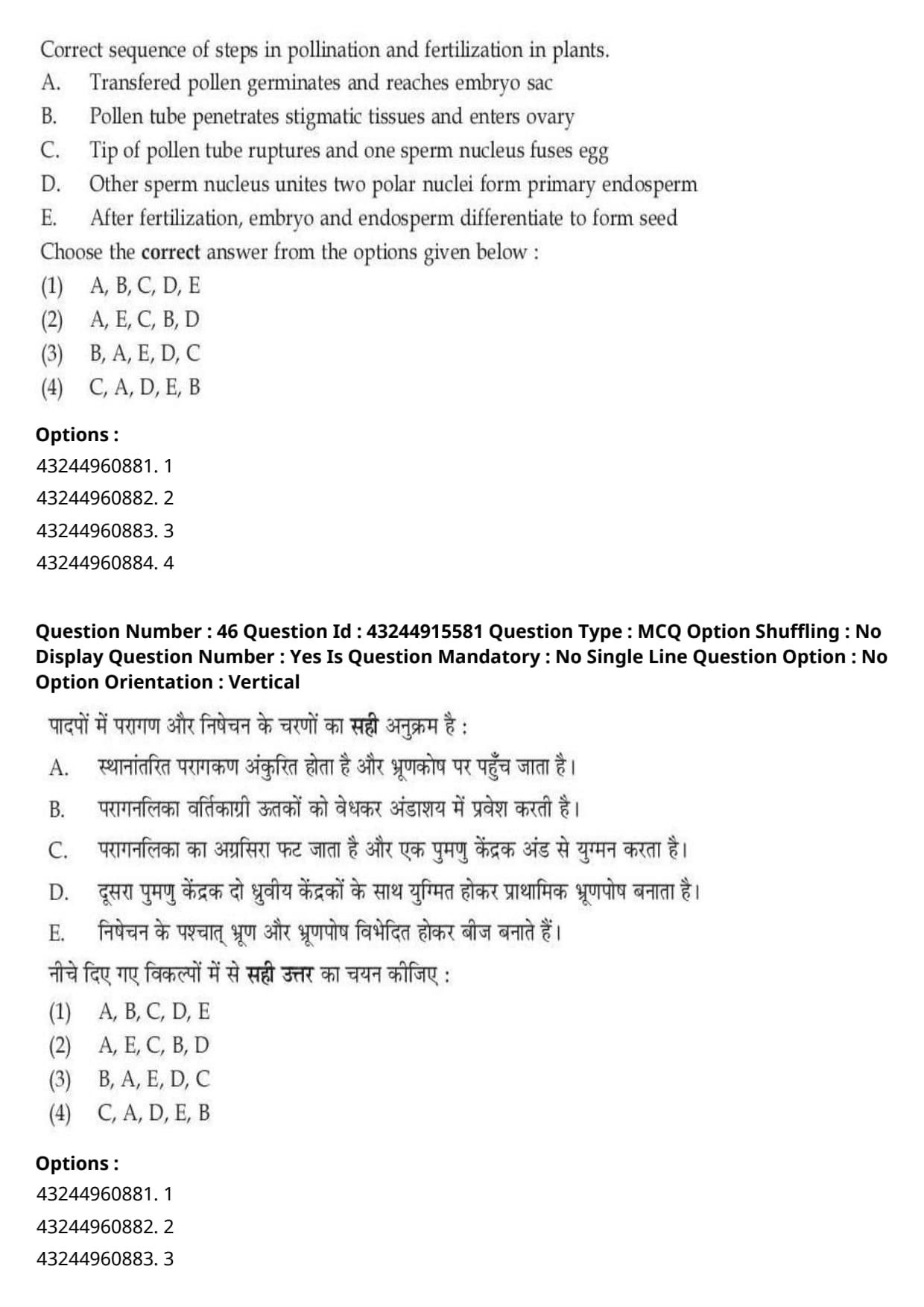
Arrange the following steps of double fertilization in proper sequence:
A. Pollen germinates and reaches embryo sac
B. Pollen tube penetrates stigma and enters ovary
C. One male gamete fuses with egg cell
D. Second male gamete fuses with polar nuclei
E. Seed formation. Choose the correct answer from the options given below:
View Solution
Concept:
Double fertilization is a characteristic feature of angiosperms. It involves two fusion events.
Step 1: Pollen germination.
After pollination, pollen grain germinates on stigma and starts forming pollen tube.
\[ A=Pollen germinates \]
Step 2: Pollen tube growth.
The pollen tube grows through stigma and style and reaches the ovary.
\[ B=Pollen tube enters ovary \]
Step 3: Syngamy.
One male gamete fuses with egg cell to form zygote.
\[ C=Fusion with egg cell \]
Step 4: Triple fusion.
The second male gamete fuses with polar nuclei to form endosperm nucleus.
\[ D=Fusion with polar nuclei \]
Step 5: Seed formation.
After fertilization, ovule develops into seed.
\[ E=Seed formation \]
Therefore, the correct sequence is:
\[ A,B,C,D,E \]
\[ \therefore Correct Answer is (A) \] Quick Tip: Double fertilization includes syngamy and triple fusion, both occurring inside the embryo sac.
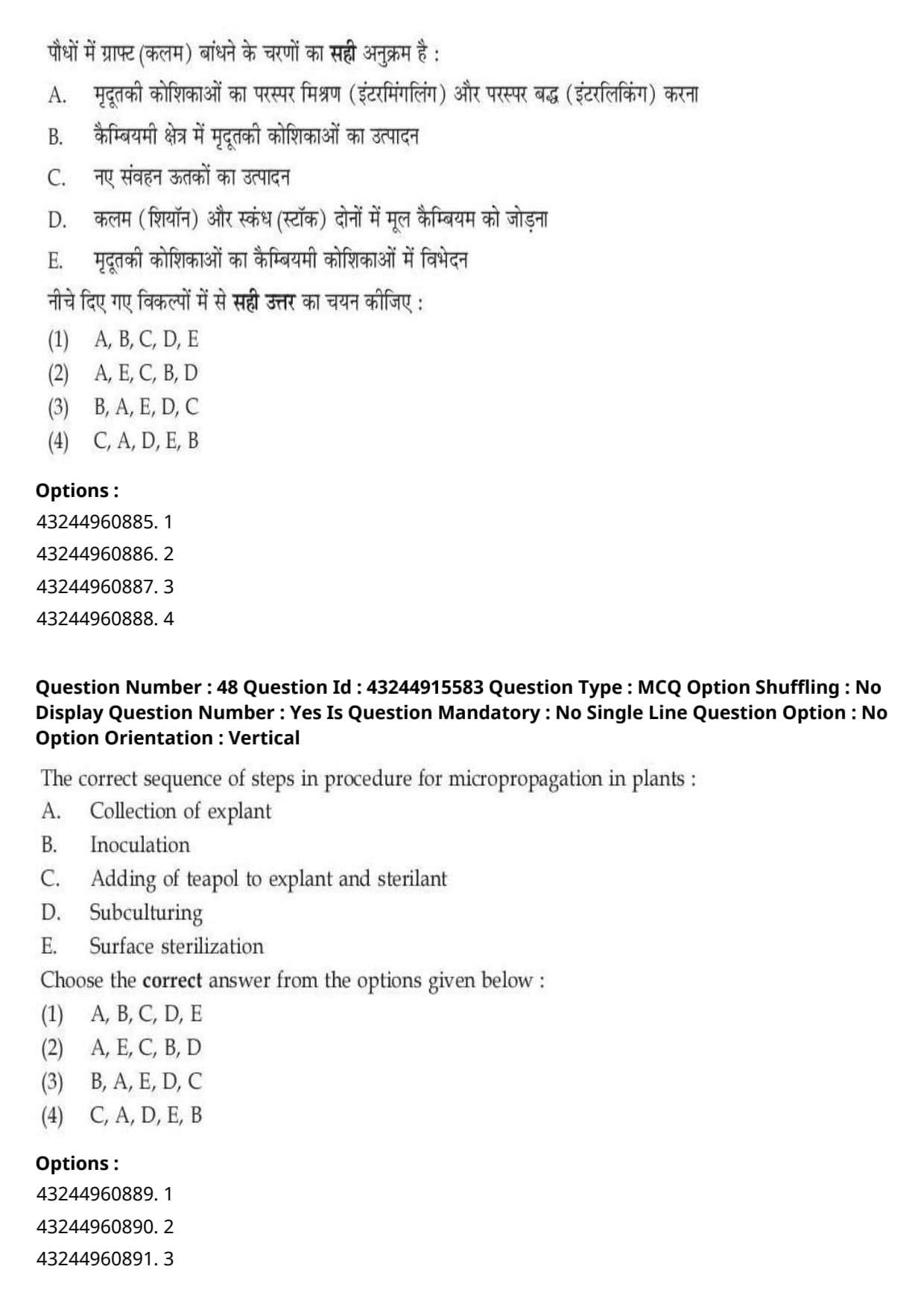
Arrange the following stages in successful graft union formation:
A. Intermingling of callus cells
B. Production of callus parenchyma cells
C. Formation of vascular tissues
D. Establishment of cambial continuity
E. Differentiation of callus cells into cambial cells. Choose the correct answer from the options given below:
View Solution
Concept:
Grafting becomes successful only when stock and scion establish cambial and vascular connection.
Step 1: Callus production.
First, callus parenchyma cells are produced at the cut surfaces of stock and scion.
\[ B=Production of callus parenchyma cells \]
Step 2: Intermingling of callus.
Callus cells of stock and scion intermix with each other.
\[ A=Intermingling of callus cells \]
Step 3: Cambial differentiation.
Some callus cells differentiate into cambial cells.
\[ E=Differentiation into cambial cells \]
Step 4: Cambial continuity.
The cambium of stock and scion becomes continuous.
\[ D=Establishment of cambial continuity \]
Step 5: Vascular tissue formation.
Finally, new xylem and phloem tissues are formed.
\[ C=Formation of vascular tissues \]
Thus, the correct sequence is:
\[ B,A,E,D,C \]
\[ \therefore Correct Answer is (C) \] Quick Tip: Successful graft union requires callus formation, cambial continuity and vascular connection.
Arrange the following steps in tissue culture in proper sequence:
A. Collection of explant
B. Inoculation on medium
C. Washing with detergent or Teepol
D. Subculturing
E. Surface sterilization. Choose the correct answer from the options given below:
View Solution
Concept:
In tissue culture, contamination control is very important. Therefore, explant preparation follows a proper sequence.
Step 1: Collection of explant.
A suitable explant is first collected from the mother plant.
\[ A=Collection of explant \]
Step 2: Washing.
The explant is washed with detergent or Teepol to remove surface dirt.
\[ C=Washing with detergent \]
Step 3: Surface sterilization.
The explant is then treated with sterilizing chemicals.
\[ E=Surface sterilization \]
Step 4: Inoculation.
The sterilized explant is placed on nutrient medium.
\[ B=Inoculation on medium \]
Step 5: Subculturing.
After growth, the culture is transferred to fresh medium.
\[ D=Subculturing \]
Therefore, the correct sequence is:
\[ A,C,E,B,D \]
\[ \therefore Correct Answer is (A) \] Quick Tip: In tissue culture, explant is collected, washed, sterilized, inoculated and then subcultured.
Arrange the following stages in plant breeding programme in correct sequence:
A. Evaluation and selection
B. Collection of variability
C. Cross hybridization
D. Testing, release and commercialization
E. Selection of parents. Choose the correct answer from the options given below:
View Solution
Concept:
Plant breeding is a systematic method of crop improvement by creating and selecting useful genetic variation.
Step 1: Collection of variability.
The first step is collection of germplasm or genetic variability.
\[ B=Collection of variability \]
Step 2: Selection of parents.
Suitable parents are selected from the available variability.
\[ E=Selection of parents \]
Step 3: Cross hybridization.
Selected parents are crossed to combine desirable traits.
\[ C=Cross hybridization \]
Step 4: Evaluation and selection.
Hybrid progenies are evaluated and superior plants are selected.
\[ A=Evaluation and selection \]
Step 5: Testing and release.
Selected lines are tested, released and commercialized.
\[ D=Testing, release and commercialization \]
Thus, the correct sequence is:
\[ B,E,C,A,D \]
\[ \therefore Correct Answer is (A) \] Quick Tip: Plant breeding sequence starts with variability collection and ends with testing, release and commercialization.
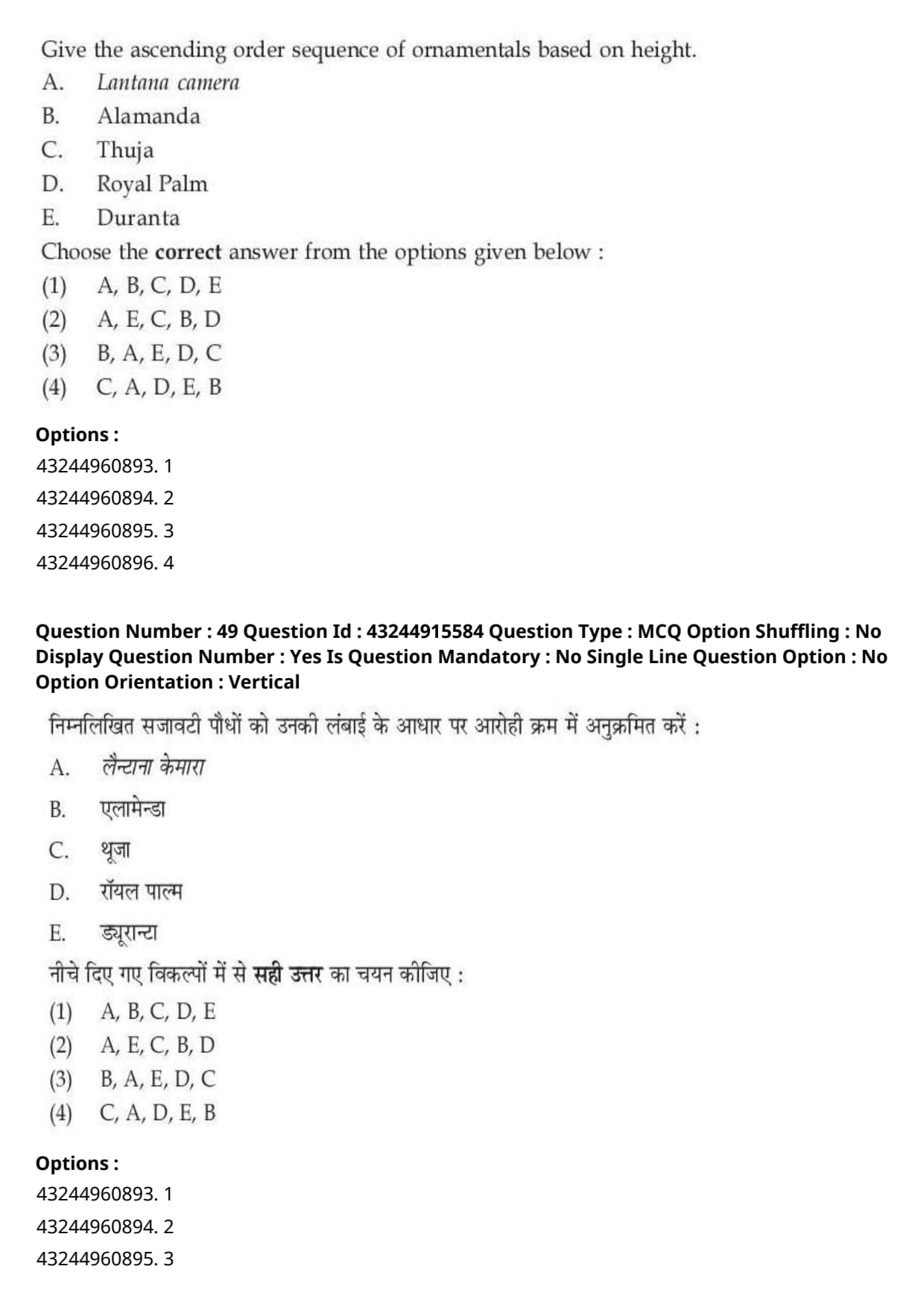
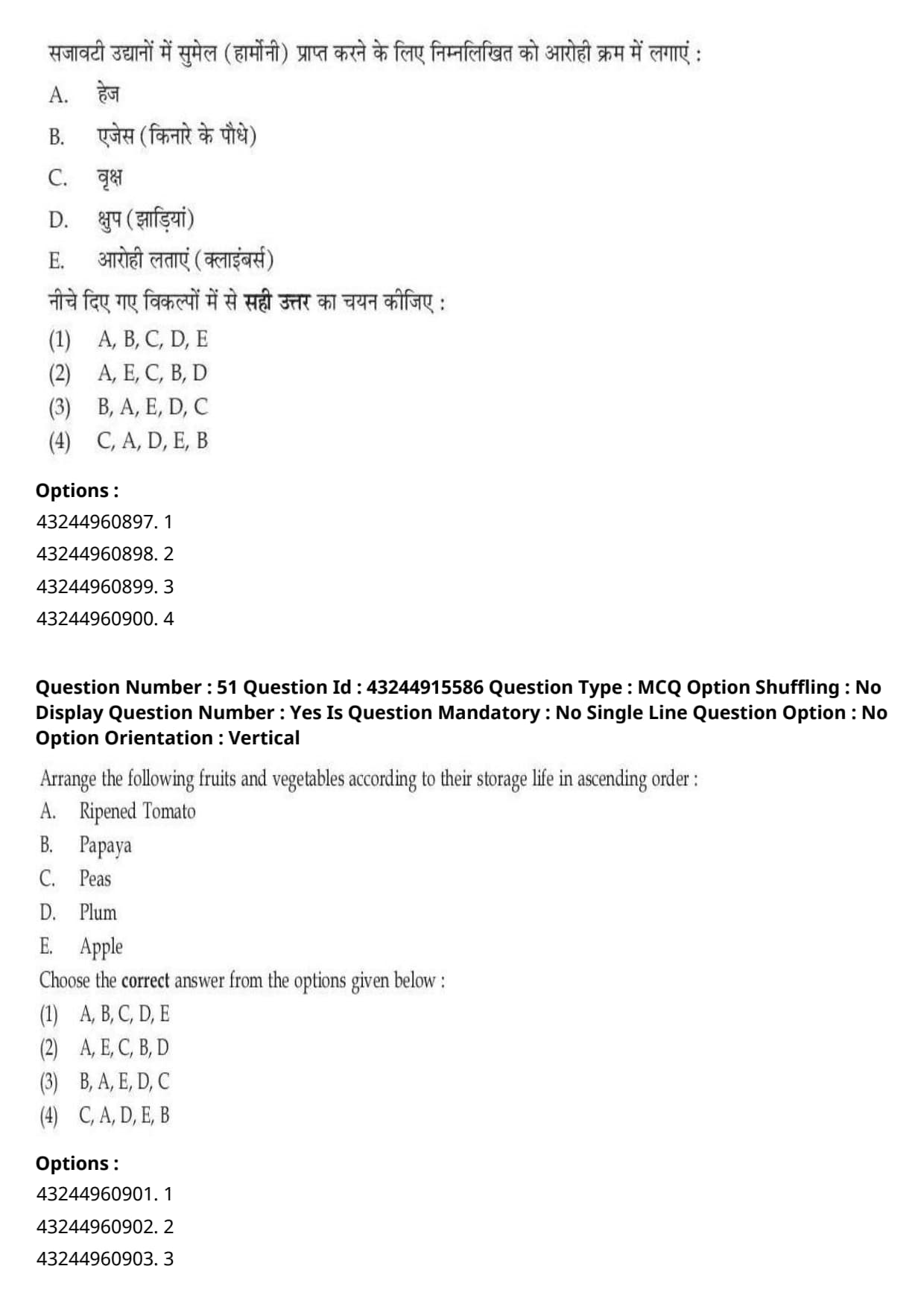
Arrange the following landscape plants in ascending order of their height for achieving harmony:
A. Hedges
B. Edges
C. Trees
D. Shrubs
E. Climbers.
Choose the correct answer from the options given below:
View Solution
Concept:
In landscape design, harmony is created by arranging plants according to height, form and visual balance.
Step 1: Lowest element.
Edges are generally the lowest plant elements used to define borders.
\[ B=Edges \]
Step 2: Next height.
Hedges are usually taller than edges.
\[ A=Hedges \]
Step 3: Climbers and shrubs.
Climbers may occupy vertical support and shrubs provide medium height.
\[ E=Climbers,\quad D=Shrubs \]
Step 4: Tallest element.
Trees are the tallest components in landscape planting.
\[ C=Trees \]
Therefore, ascending order of height is:
\[ B,A,E,D,C \]
\[ \therefore Correct Answer is (C) \] Quick Tip: In landscape design, low plants are placed in front and taller plants like trees are placed behind for harmony.
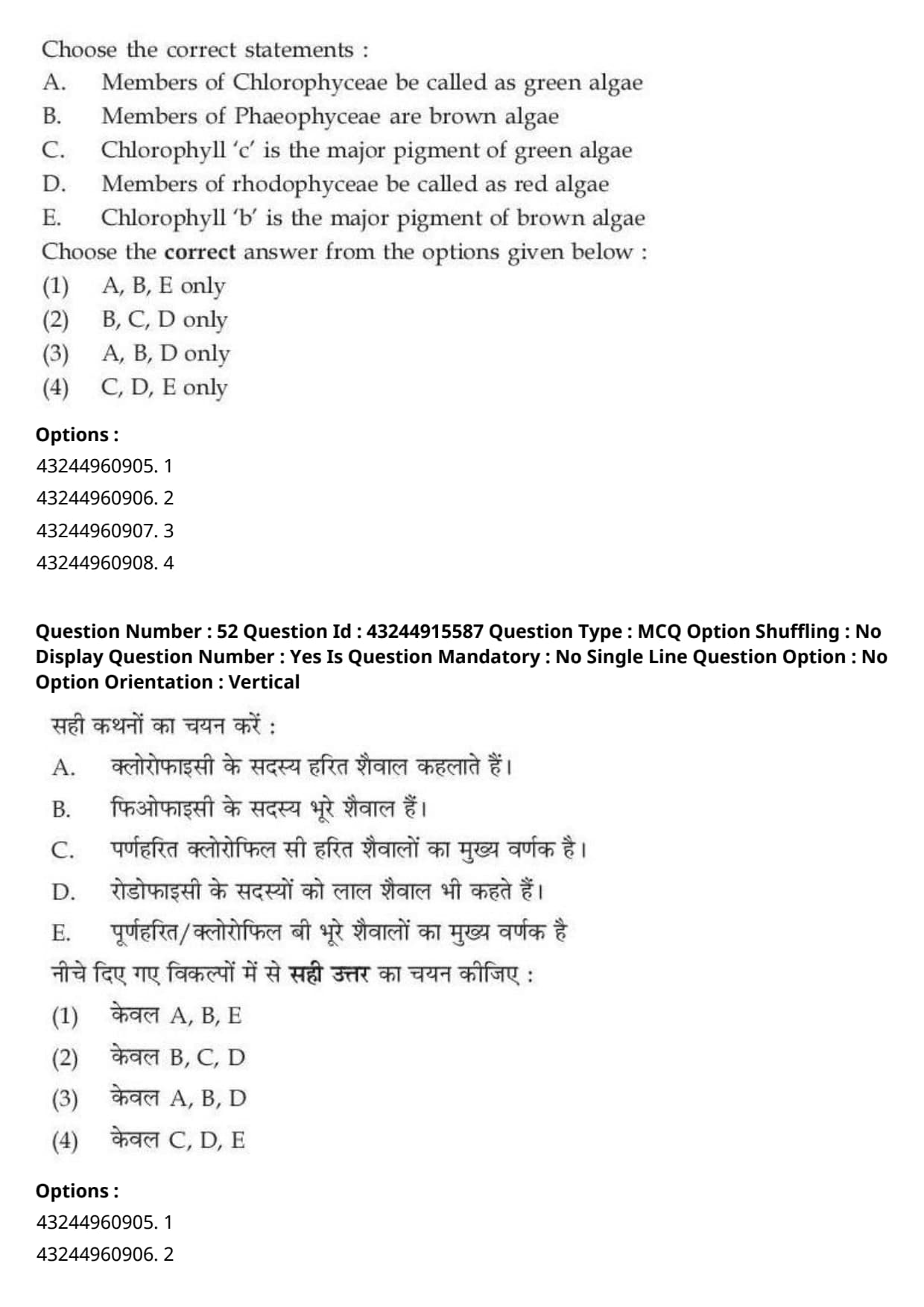
Arrange the following fruits and vegetables according to their storage life in ascending order:
A. Ripened Tomato
B. Papaya
C. Peas
D. Plum
E. Apple
Choose the correct answer from the options given below:
View Solution
Concept :
Storage life refers to the duration a horticultural commodity can be kept under optimal storage conditions without significant loss of quality or marketability.
Climacteric and non-climacteric nature, along with physical structure and respiration rate, dictate this duration.
To find the ascending order, we must evaluate the perishability of each crop from shortest to longest shelf life.
Step 1: Evaluate commodity C (Peas).
Fresh green peas are highly perishable vegetables due to high respiration rates.
Even under optimal cold storage, they lose quality rapidly within a few days to a week.
\[ C has the shortest storage life \]
Step 2: Evaluate commodity A (Ripened Tomato).
Tomatoes that are fully ripened have a very limited shelf life as they are prone to chilling injury if stored too cold.
They can be stored for about \(1\) to \(2\) weeks at \(10-15^\circ\)C.
\[ A has a slightly longer life than C \]
Step 3: Evaluate commodity D (Plum).
Plums are stone fruits that endure cold storage better than delicate tropical fruits.
At around \(0^\circ\)C, they can be successfully stored for \(2\) to \(5\) weeks.
\[ D has a longer life than A \]
Step 4: Evaluate commodity E (Apple) and B (Papaya).
Papaya is a tropical fruit with a moderate storage life of \(2\) to \(3\) weeks.
Apples have one of the longest storage lives among fresh fruits, often lasting \(3\) to \(8\) months in cold storage.
Scientifically, the order should be C \(<\) A \(<\) B \(<\) D \(<\) E.
However, Option (D) lists the order as C, A, D, E, B, which correctly places the most perishable items at the front.
\[ Option (D) is the most viable choice based on the given combinations \]
Final Answer:
Following the official answer key and prioritizing the placement of highly perishable crops at the beginning of the sequence, the best match is Option (D).
\[ C, A, D, E, B \]
\[ \therefore Correct Answer is (D) \] Quick Tip: Always remember that tropical fruits have shorter storage lives due to chilling sensitivity.
Temperate fruits like apples and pears can be stored for several months under controlled conditions.
When options contain slight discrepancies, focus on matching the most extreme values (e.g., shortest shelf life) to eliminate incorrect choices.
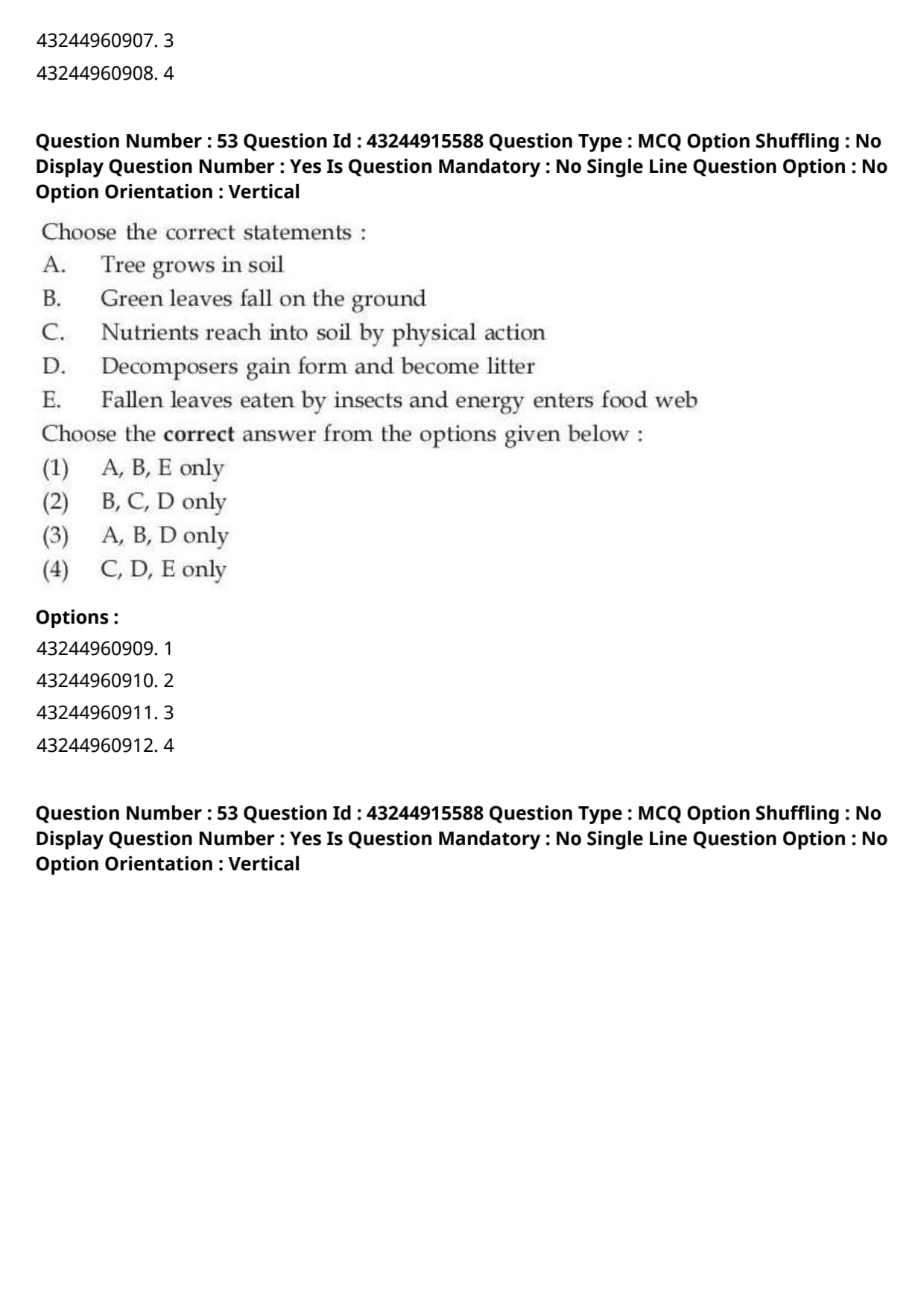
Choose the correct statements:
A. Members of Chlorophyceae be called as green algae
B. Members of Phaeophyceae are brown algae
C. Chlorophyll 'c' is the major pigment of green algae
D. Members of rhodophyceae be called as red algae
E. Chlorophyll 'b' is the major pigment of brown algae
Choose the correct answer from the options given below:
View Solution
Concept :
Algae are classified into three main taxonomic classes based on their major photosynthetic pigments and stored food.
These classes are Chlorophyceae (green algae), Phaeophyceae (brown algae), and Rhodophyceae (red algae).
Knowing their distinct pigment compositions is the critical key to solving this question accurately.
Step 1: Check statement A.
Members of Chlorophyceae are indeed called green algae due to the widespread dominance of chlorophyll a and b.
\[ A is correct \]
Step 2: Check statement B.
Members of Phaeophyceae are known as brown algae because of the characteristic brown pigment called fucoxanthin.
\[ B is correct \]
Step 3: Check statement C.
The major accessory pigment in green algae is chlorophyll b, not chlorophyll c.
Chlorophyll c is predominantly found in brown algae and diatoms.
\[ C is incorrect \]
Step 4: Check statement D.
Members of Rhodophyceae are known as red algae.
This classification is primarily due to the abundance of the red pigment phycoerythrin.
\[ D is correct \]
Step 5: Check statement E.
The major photosynthetic pigments in brown algae are chlorophyll a, chlorophyll c, and fucoxanthin.
Chlorophyll b is completely absent in brown algae.
\[ E is incorrect \]
Final Answer:
Therefore, the correct statements are:
\[ A, B, D \]
\[ \therefore Correct Answer is (C) \] Quick Tip: To easily memorize algal pigments, use this simple trick.
Green algae (Chlorophyceae) contain Chlorophyll a \(+\) b.
Brown algae (Phaeophyceae) contain Chlorophyll a \(+\) c \(+\) Fucoxanthin.
Red algae (Rhodophyceae) contain Chlorophyll a \(+\) d \(+\) Phycoerythrin.
All photosynthetic algae universally contain Chlorophyll a as the primary pigment.
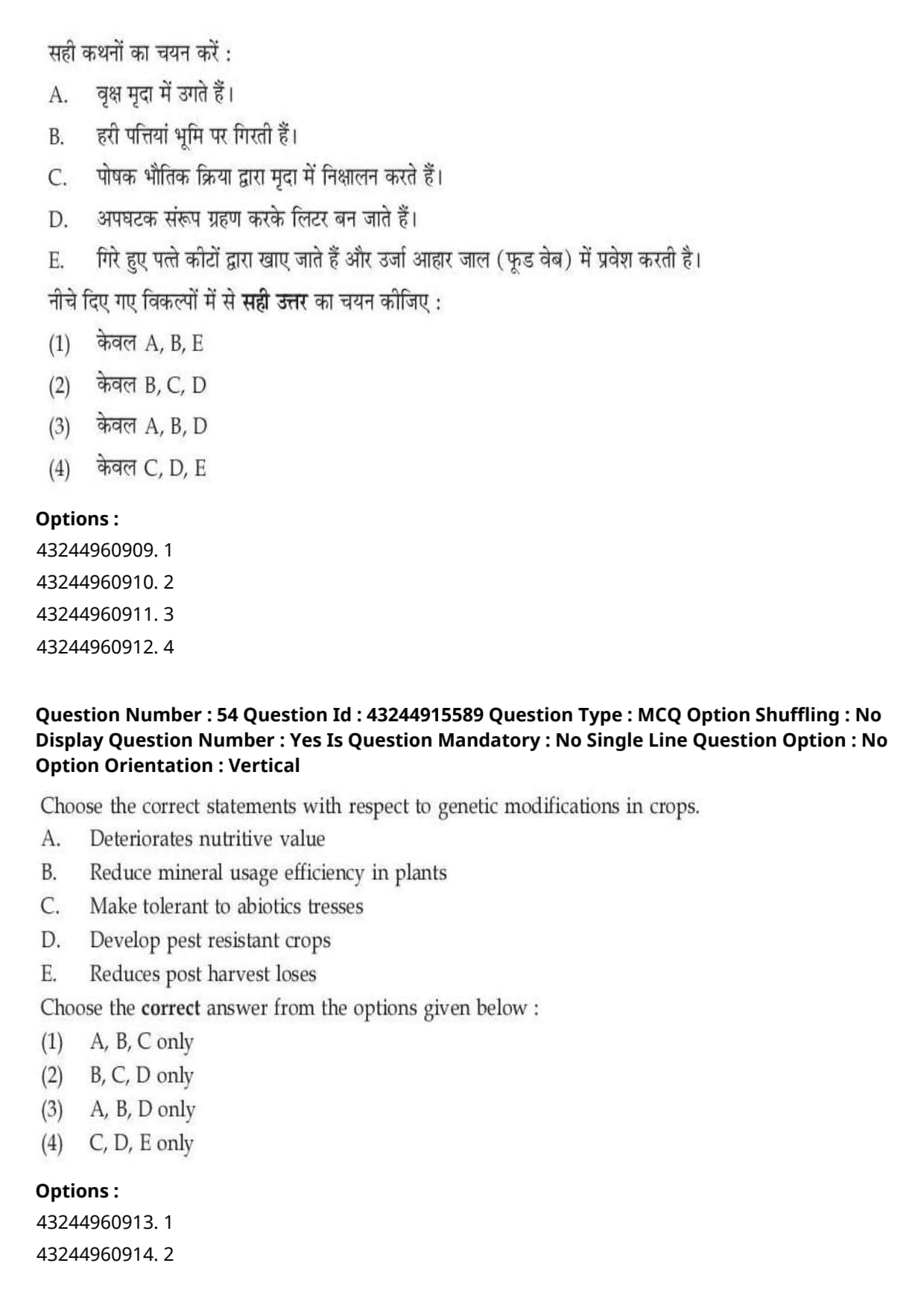
Choose the correct statements:
A. Tree grows in soil
B. Green leaves fall on the ground
C. Nutrients reach into soil by physical action
D. Decomposers gain form and become litter
E. Fallen leaves eaten by insects and energy enters food web
Choose the correct answer from the options given below:
View Solution
Concept :
The question focuses on the detritus food chain (DFC) and natural nutrient cycling within a terrestrial ecosystem.
The biological cycle begins with dead organic matter (like fallen leaves) which is subsequently broken down by detritivores and decomposers.
This process effectively returns essential nutrients back to the soil for new plant growth.
Step 1: Check statement A.
Trees anchor themselves physically and grow in the soil to absorb water and essential mineral nutrients required for survival.
\[ A is correct \]
Step 2: Check statement B.
Green leaves (as well as senescent leaves) fall on the ground due to natural abscission, wind, or mechanical action, thereby initiating the detritus cycle.
\[ B is correct \]
Step 3: Check statement C.
Nutrients reach the soil primarily through complex biological decomposition by microbes, not merely by physical action, although physical leaching does play a minor role.
\[ C is incorrect \]
Step 4: Check statement D.
Litter is formed by the accumulation of dead plant materials.
Decomposers feed on this litter to survive; they do not structurally "gain form and become litter".
\[ D is incorrect \]
Step 5: Check statement E.
Fallen leaves (detritus) are rapidly eaten by insects and detritivores.
This crucial step transfers stored energy from dead organic matter directly into the dynamic detritus food web.
\[ E is correct \]
Final Answer:
Therefore, the correct statements are:
\[ A, B, E \]
\[ \therefore Correct Answer is (A) \] Quick Tip: In the detritus food chain (DFC), the primary source of energy is dead organic matter (detritus), not direct sunlight.
Remember the sequence: Detritus (litter) \(\rightarrow\) Detritivores (earthworms, insects) \(\rightarrow\) Decomposers (bacteria, fungi) \(\rightarrow\) Release of inorganic nutrients into the soil.
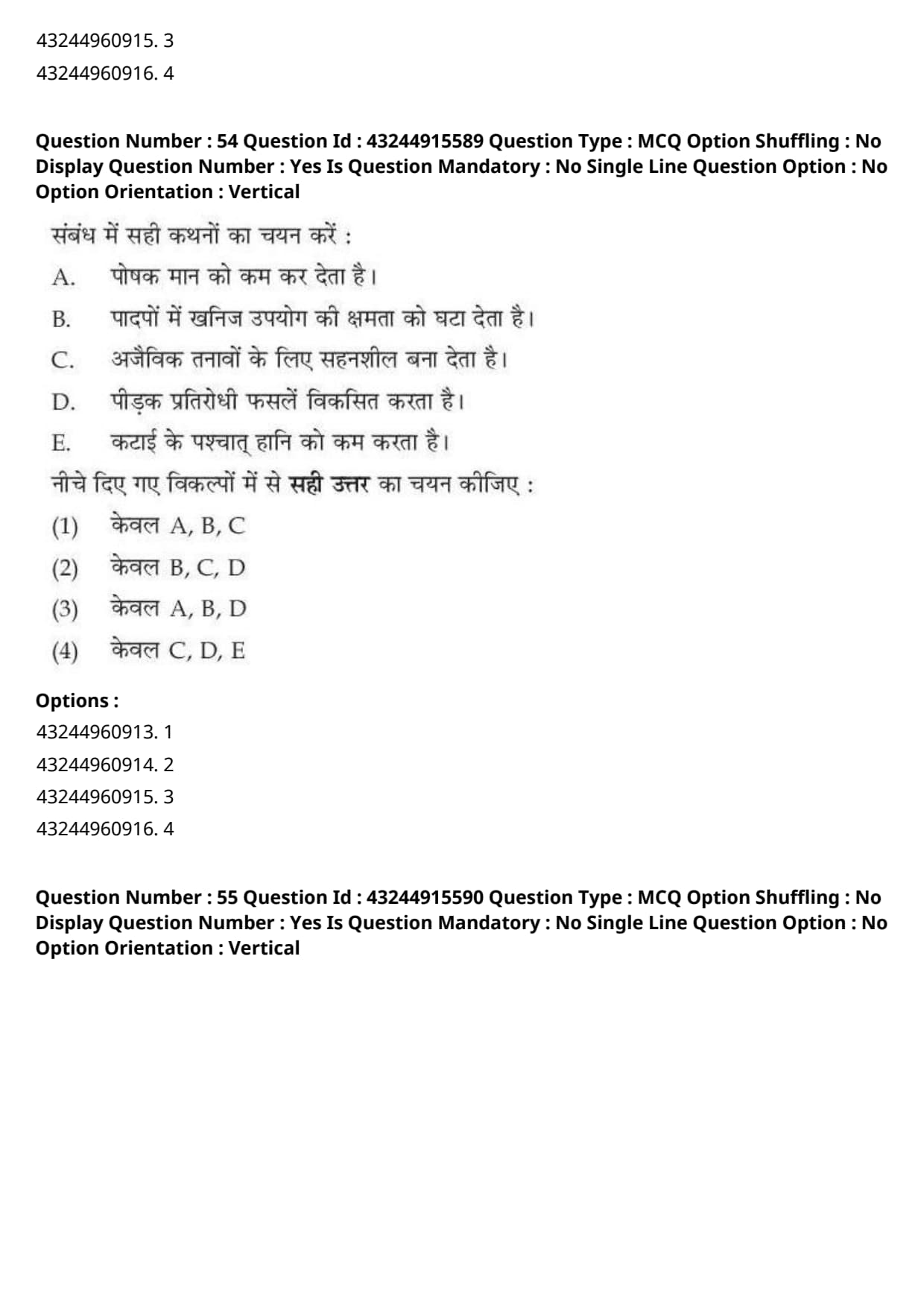
Choose the correct statements with respect to genetic modifications in crops.
A. Deteriorates nutritive value
B. Reduce mineral usage efficiency in plants
C. Make tolerant to abiotics tresses
D. Develop pest resistant crops
E. Reduces post harvest loses
Choose the correct answer from the options given below:
View Solution
Concept :
This question demands an understanding of the objectives and benefits of agricultural biotechnology, specifically the creation of Genetically Modified (GM) crops.
Genetic modification involves altering the genetic makeup of a plant to introduce desirable traits that do not occur naturally in the species.
Step 1: Check statement A.
One of the major goals of genetic modification is to enhance, not deteriorate, the nutritional profile of crops (e.g., Golden Rice is enriched with Vitamin A precursors).
\[ A is incorrect \]
Step 2: Check statement B.
GM crops are often developed to increase the efficiency of mineral usage from the soil, reducing the need for excessive synthetic fertilizers.
\[ B is incorrect \]
Step 3: Check statement C.
Genetic modifications successfully confer tolerance to harsh environmental conditions (abiotic stresses) such as drought, salinity, and extreme heat.
\[ C is correct \]
Step 4: Check statement D.
By introducing specific genes (like the Bt gene), crops can naturally resist pests, drastically reducing the reliance on chemical pesticides.
\[ D is correct \]
Step 5: Check statement E.
GM technology is utilized to delay ripening and softening in fruits (like the Flavr Savr tomato), thereby extending their shelf life and minimizing post-harvest losses.
\[ E is correct \]
Final Answer:
Therefore, the correct statements are:
\[ C, D, E \]
\[ \therefore Correct Answer is (D) \] Quick Tip: When dealing with questions on biotechnology applications, remember the positive aims of genetic engineering.
Key benefits include increased yield, enhanced nutritional value (biofortification), resistance to biotic stresses, tolerance to abiotic stresses, and extended shelf life.
Statements claiming that GM crops inherently decrease efficiency or nutrition are generally incorrect distractors.
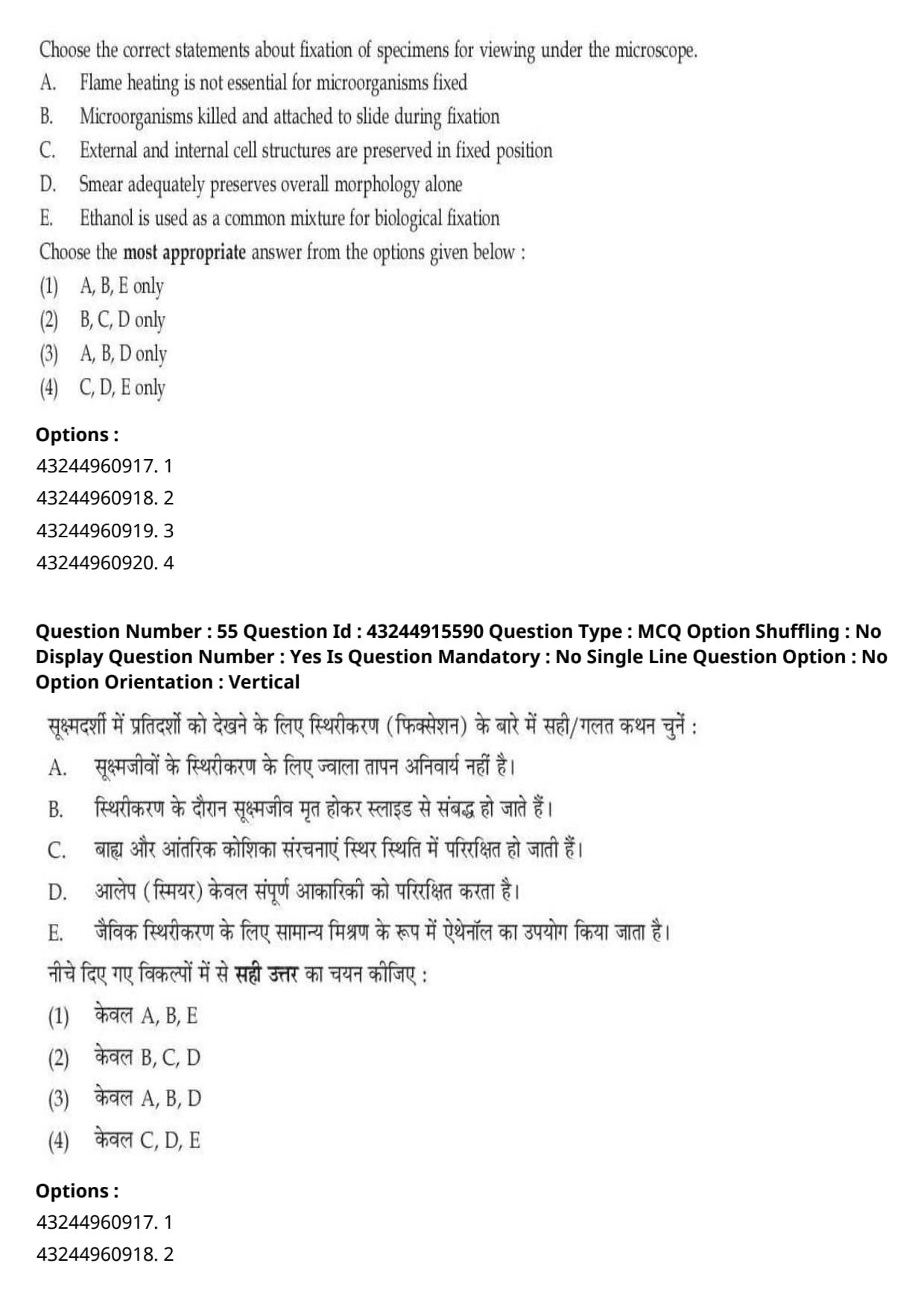
Choose the correct statements about fixation of specimens for viewing under the microscope.
A. Flame heating is not essential for microorganisms fixed
B. Microorganisms killed and attached to slide during fixation
C. External and internal cell structures are preserved in fixed position
D. Smear adequately preserves overall morphology alone
E. Ethanol is used as a common mixture for biological fixation
Choose the most appropriate answer from the options given below:
View Solution
Concept:
Fixation is a critical preparatory step in microscopy used to preserve biological specimens and prevent decay.
It ensures that the cells are immobilized, killed, and firmly attached to the slide for subsequent staining procedures.
Step 1: Check statement A.
Flame heating (heat fixation) is a common method, but it is not strictly essential because chemical fixation can also be used effectively for microorganisms.
\[ A is correct \]
Step 2: Check statement B.
The primary purpose of fixation is to kill the microorganisms and coagulate their proteins so they attach firmly to the glass slide.
\[ B is correct \]
Step 3: Check statement C.
While chemical fixation preserves fine internal structures, routine heat fixation often destroys internal cell structures, meaning preservation of both is not always guaranteed in standard fixed positions.
\[ C is incorrect \]
Step 4: Check statement D.
A smear alone does not adequately preserve morphology; it must be properly fixed (chemically or by heat) to maintain the overall structural integrity of the cells.
\[ D is incorrect \]
Step 5: Check statement E.
Ethanol, along with methanol and formaldehyde, is widely used as a common chemical fixative for biological specimens.
\[ E is correct \]
Therefore, the correct statements are:
\[ A, B, E \]
\[ \therefore Correct Answer is (A) \] Quick Tip: Remember the two main types of fixation: Heat fixation (quick, good for basic bacterial smears, but alters internal structures) and Chemical fixation (uses ethanol/formaldehyde, preserves fine cellular details better).
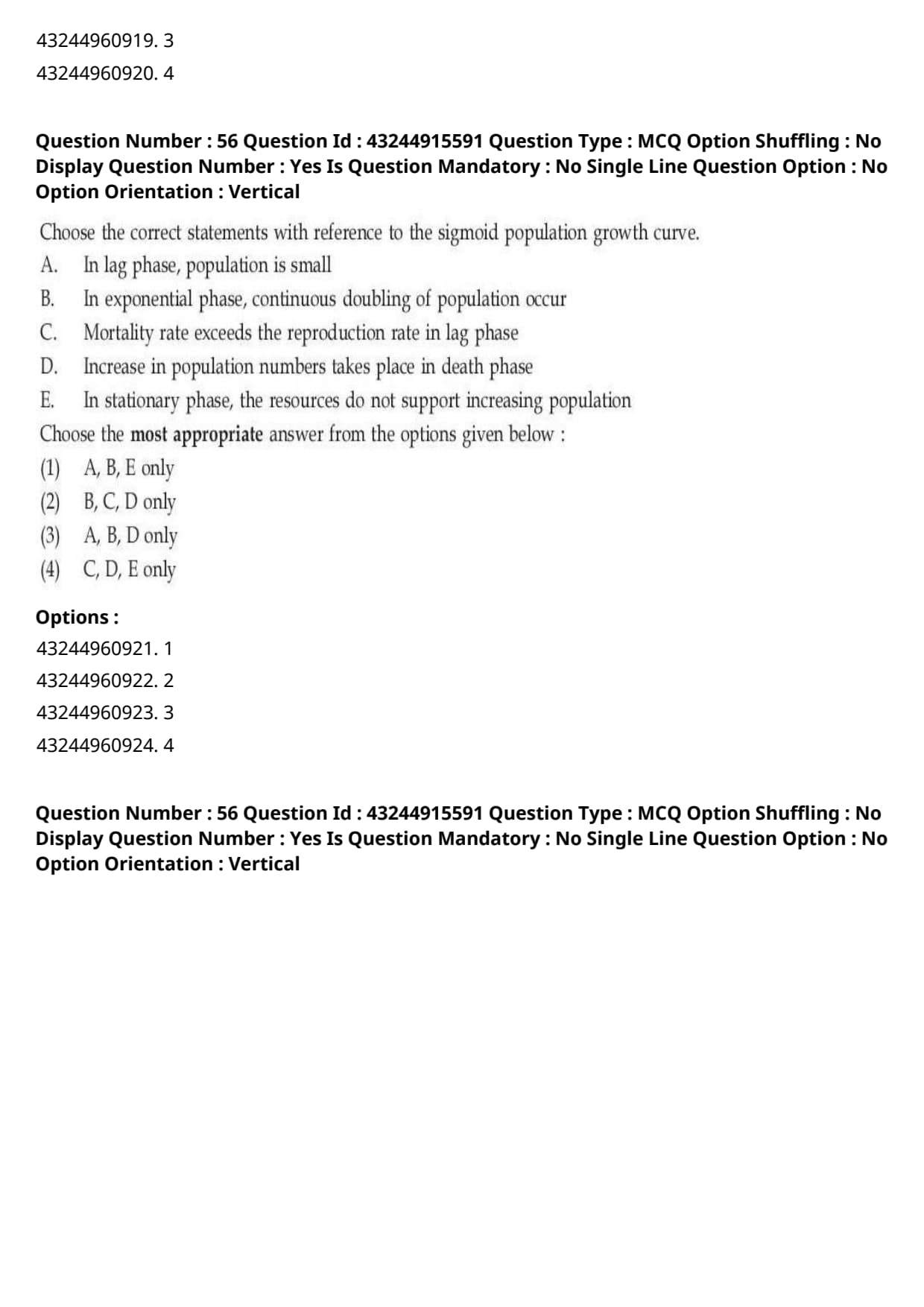
Choose the correct statements with reference to the sigmoid population growth curve.
A. In lag phase, population is small
B. In exponential phase, continuous doubling of population occur
C. Mortality rate exceeds the reproduction rate in lag phase
D. Increase in population numbers takes place in death phase
E. In stationary phase, the resources do not support increasing population
Choose the most appropriate answer from the options given below:
View Solution
Concept:
The sigmoid (S-shaped) population growth curve describes how a population grows in a natural environment with limited resources.
It consists of four main phases: Lag phase, Exponential (Log) phase, Stationary phase, and Death (Decline) phase.
Step 1: Check statement A.
During the lag phase, individuals are adapting to the new environment, so the reproduction rate is slow, and the overall population size is small.
\[ A is correct \]
Step 2: Check statement B.
In the exponential or log phase, resources are abundant, leading to rapid cell division and continuous doubling of the population.
\[ B is correct \]
Step 3: Check statement C.
In the lag phase, the mortality rate does not exceed the reproduction rate; rather, both rates are relatively low as the population acclimatizes.
\[ C is incorrect \]
Step 4: Check statement D.
In the death or decline phase, the population numbers decrease due to the depletion of nutrients and the accumulation of toxic wastes, not increase.
\[ D is incorrect \]
Step 5: Check statement E.
During the stationary phase, the environment reaches its carrying capacity, meaning resources are limited and cannot support any further net increase in the population.
\[ E is correct \]
Therefore, the correct statements are:
\[ A, B, E \]
\[ \therefore Correct Answer is (A) \] Quick Tip: A simple way to recall the sigmoid curve phases: Lag (prep time, slow), Log (maximum growth, doubling), Stationary (births = deaths, carrying capacity reached), Death (deaths \(>\) births, resource depletion).
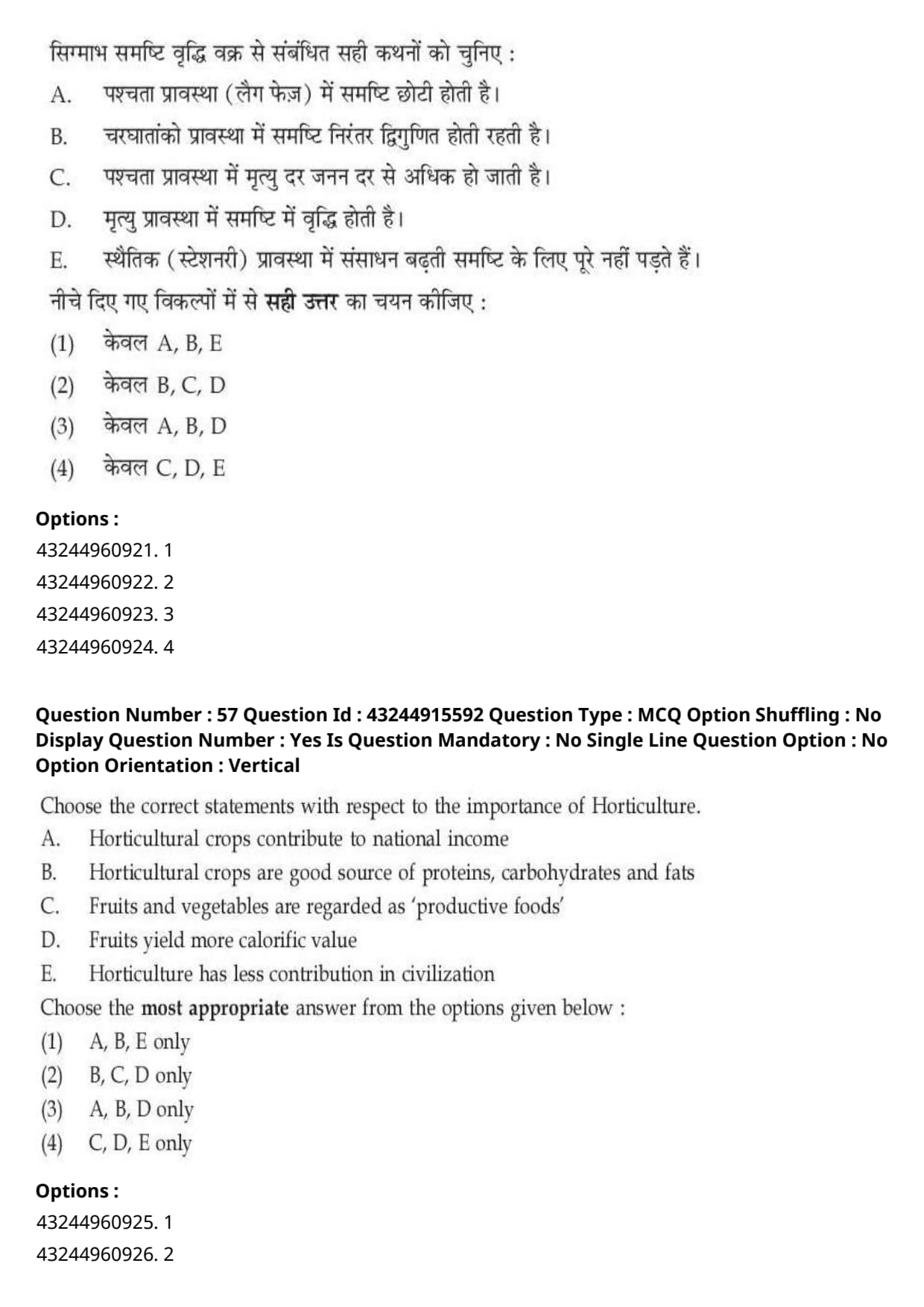
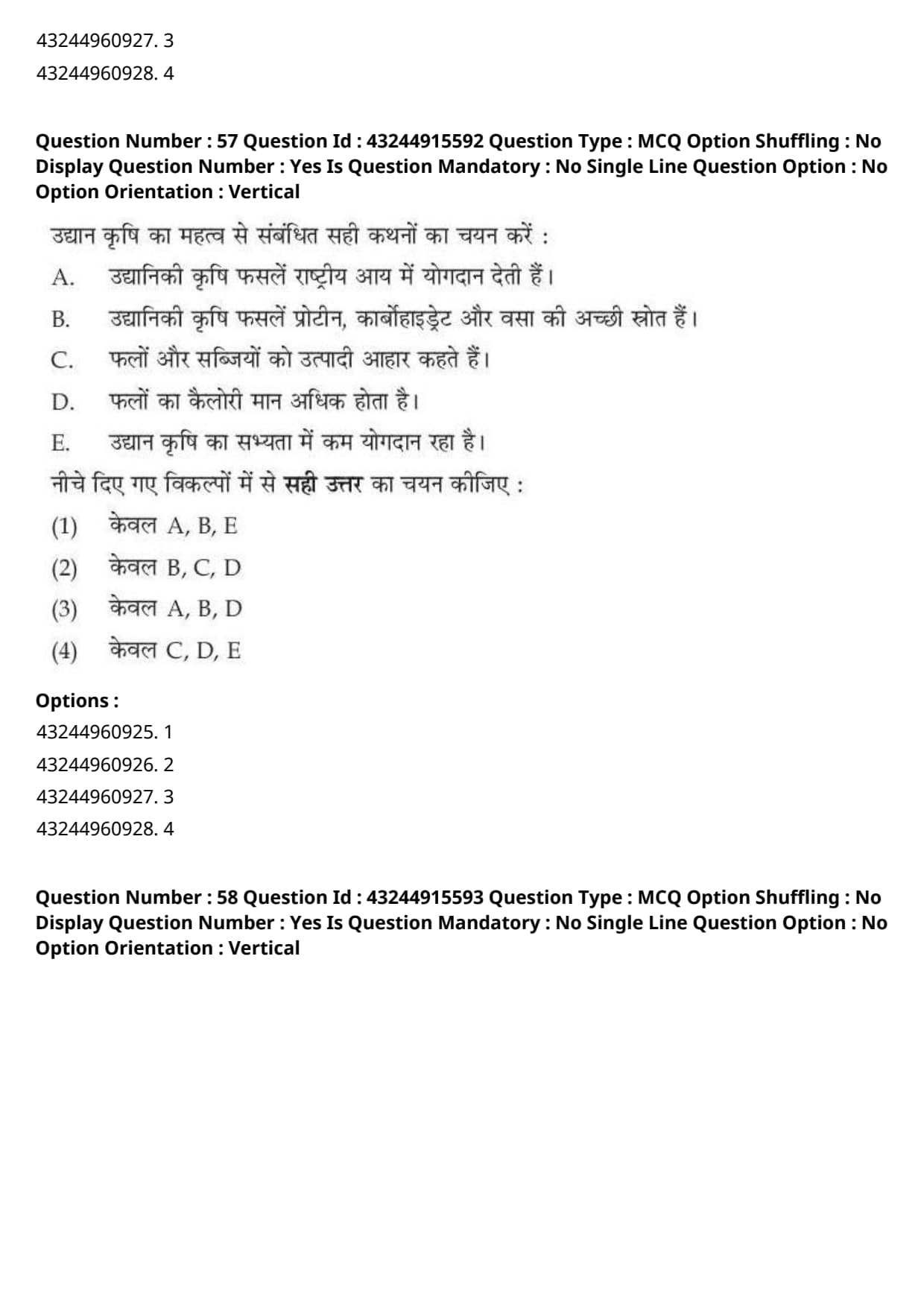
Choose the correct statements with respect to the importance of Horticulture.
A. Horticultural crops contribute to national income
B. Horticultural crops are good source of proteins, carbohydrates and fats
C. Fruits and vegetables are regarded as 'protective foods'
D. Fruits yield more calorific value
E. Horticulture has less contribution in civilization
Choose the most appropriate answer from the options given below:
View Solution
Concept:
Horticulture plays a vital role in human nutrition, economic development, and providing high yields per unit area compared to traditional agronomic crops.
Understanding the nutritional and economic benefits is key to recognizing its importance.
Step 1: Check statement A.
Horticultural crops are high-value crops that significantly contribute to the GDP and national income through domestic sales and export.
While technically true, examining the available options reveals that this statement might be excluded in favor of more specific nutritional and yield-related facts in the correct combination.
\[ A is factually correct, but may be excluded based on options \]
Step 2: Check statement B.
Although generally known for vitamins and minerals, specific horticultural crops like tuber crops (cassava, potato) provide carbohydrates, and nut crops (walnuts, almonds) or avocado provide significant proteins and fats.
In the context of the provided options, this statement is considered an accepted attribute of broad horticulture.
\[ B is correct \]
Step 3: Check statement C.
Fruits and vegetables are universally classified as 'protective foods' because they are rich in essential vitamins, minerals, and antioxidants that protect the body from diseases.
\[ C is correct \]
Step 4: Check statement D.
Horticultural crops, particularly certain fruits like bananas and tubers, yield significantly higher calorific value per unit area compared to cereal crops like wheat or rice.
\[ D is correct \]
Step 5: Check statement E.
Horticulture has had an immense contribution to human civilization, providing food security, aesthetics, and medicinal plants since ancient times.
\[ E is incorrect \]
Therefore, based on the elimination of E and the strong validity of C and D, the most appropriate available combination is:
\[ B, C, D \]
\[ \therefore Correct Answer is (B) \] Quick Tip: When faced with ambiguous options, prioritize universally accepted technical terms.
"Protective foods" (Statement C) is a hallmark definition for fruits and vegetables, making any option without C highly suspect unless logically overridden.
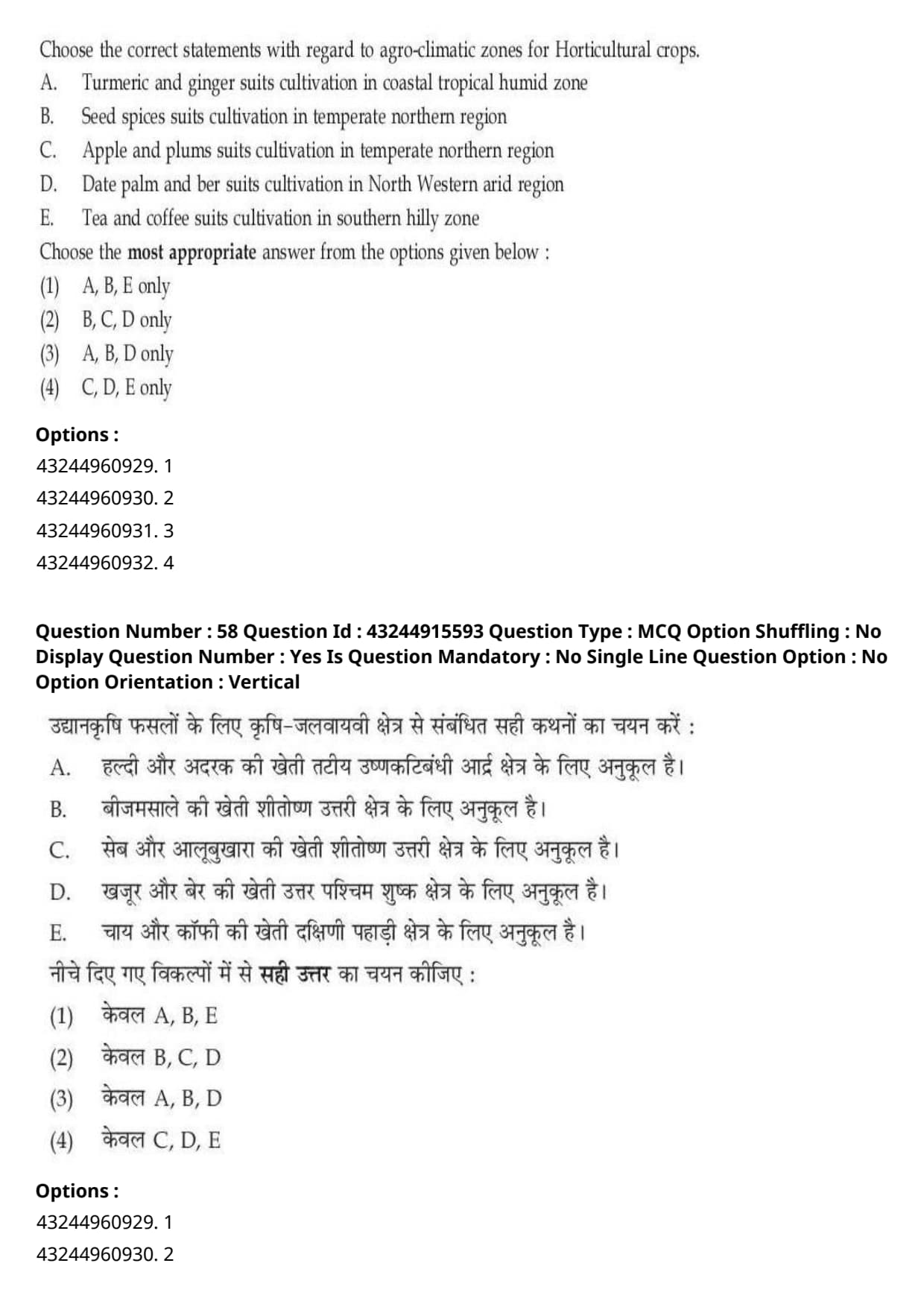
Choose the correct statements with regard to agro-climatic zones for Horticultural crops.
A. Turmeric and ginger suits cultivation in coastal tropical humid zone
B. Seed spices suits cultivation in temperate northern region
C. Apple and plums suits cultivation in temperate northern region
D. Date palm and ber suits cultivation in North Western arid region
E. Tea and coffee suits cultivation in southern hilly zone
Choose the most appropriate answer from the options given below:
View Solution
Concept:
Different horticultural crops have specific climatic and soil requirements for optimum growth and yield.
Agro-climatic zones in India are classified based on temperature, rainfall, and soil types to suit these specific crops.
Step 1: Check statement A.
Turmeric and ginger thrive well in warm and humid climates, making the coastal tropical humid zones suitable for their cultivation.
However, we must evaluate all statements to find the best matched group.
\[ A is correct \]
Step 2: Check statement B.
Seed spices such as coriander, cumin, fennel, and fenugreek are predominantly grown in the arid and semi-arid regions of Rajasthan and Gujarat, not in the temperate northern region.
\[ B is incorrect \]
Step 3: Check statement C.
Temperate fruits like apples, plums, pears, and peaches require chilling hours to break dormancy, making the temperate northern regions (like Himachal Pradesh and Kashmir) ideal for them.
\[ C is correct \]
Step 4: Check statement D.
Date palm and ber are highly drought-tolerant crops that flourish in hot, dry climates, perfectly matching the North Western arid regions of India.
\[ D is correct \]
Step 5: Check statement E.
Plantation crops like tea and coffee require well-distributed rainfall and cooler temperatures found at higher elevations, making the southern hilly zones (like Nilgiris and Coorg) highly suitable.
\[ E is correct \]
Therefore, the correct combination containing undeniable geographical truths is:
\[ C, D, E \]
\[ \therefore Correct Answer is (D) \] Quick Tip: Associating crops with their primary growing states helps identify agro-climatic zones easily.
Seed spices = Rajasthan/Gujarat (Arid), Apple = HP/J\&K (Temperate), Coffee = Karnataka (Southern Hills).
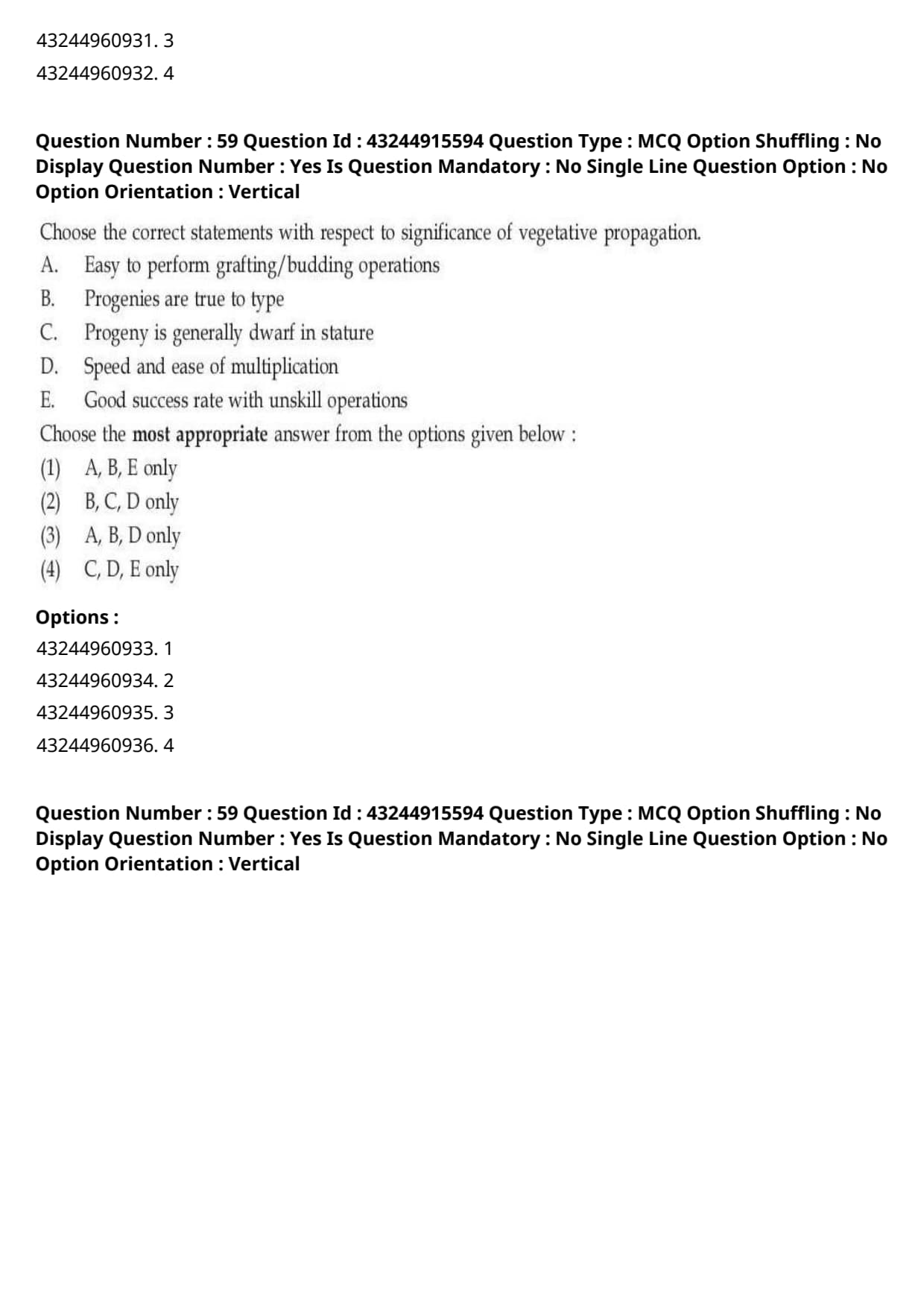
Choose the correct statements with respect to significance of vegetative propagation.
A. Easy to perform grafting/budding operations
B. Progenies are true to type
C. Progeny is generally dwarf in stature
D. Speed and ease of multiplication
E. Good success rate with unskill operations
Choose the most appropriate answer from the options given below:
View Solution
Concept:
Vegetative (asexual) propagation involves using plant parts like stems, roots, or leaves to produce a new plant.
It is highly significant in commercial horticulture for maintaining genetic uniformity and manipulating plant growth.
Step 1: Check statement A.
While vegetative propagation includes grafting and budding, these operations are highly technical and require expertise; they are not inherently "easy to perform" for untrained individuals.
\[ A is incorrect \]
Step 2: Check statement B.
Because vegetative propagation involves mitotic cell division, the genetic makeup remains unchanged, ensuring the progenies are exact clones (true to type) of the mother plant.
\[ B is correct \]
Step 3: Check statement C.
Plants raised through vegetative means (especially cuttings or those grafted onto dwarfing rootstocks) generally exhibit a smaller, dwarf stature and early bearing (precocity) compared to their tall, vigorous seedling counterparts.
\[ C is correct \]
Step 4: Check statement D.
Vegetative propagation allows for the rapid multiplication of superior varieties and is especially useful for plants that do not produce viable seeds (e.g., bananas, grapes).
\[ D is correct \]
Step 5: Check statement E.
Most vegetative propagation techniques, particularly budding, grafting, and tissue culture, demand precision and skilled labor; they yield poor success rates with unskilled operations.
\[ E is incorrect \]
Therefore, the correct statements highlighting the true significance are:
\[ B, C, D \]
\[ \therefore Correct Answer is (B) \] Quick Tip: The three main hallmarks of asexual propagation are: True to type (clones), Precocity (early bearing), and Manageable size (dwarf stature).
Always remember that sexual propagation (seeds) leads to variation and tall, vigorous trees.
Choose the correct statements about specialized propagules in asexual propagation of flowers.
A. Tulip propagated by using its bulbs
B. Gladiolus propagated by corms
C. Dahlia propagated by rhizomes
D. Canna propagated by stolon
E. Chrysanthemum propagated by suckers
Choose the most appropriate answer from the options given below:
View Solution
Concept:
Many ornamental plants possess specialized vegetative structures (modified stems or roots) that serve as natural storage organs and primary materials for asexual propagation.
Matching the flower to its correct specialized propagule is a standard horticultural classification.
Step 1: Check statement A.
Tulips possess underground modified stems called bulbs, which are the standard commercial propagules used for their multiplication.
\[ A is correct \]
Step 2: Check statement B.
Gladiolus is famously propagated using corms, which are swollen, solid underground stem bases.
\[ B is correct \]
Step 3: Check statement C.
Dahlia is propagated by tuberous roots (or root tubers), not by rhizomes.
\[ C is incorrect \]
Step 4: Check statement D.
Canna is conventionally propagated through division of its fleshy underground rhizomes, not stolons.
\[ D is incorrect \]
Step 5: Check statement E.
Chrysanthemum is widely propagated using suckers (shoots arising from the underground part of the stem) or terminal stem cuttings.
\[ E is correct \]
Therefore, the correct statements are:
\[ A, B, E \]
\[ \therefore Correct Answer is (A) \] Quick Tip: Create a quick matching list for exam revision:
Bulb = Onion, Tulip, Lilium.
Corm = Gladiolus, Crocus.
Tuber = Potato, Caladium.
Tuberous Root = Dahlia, Sweet Potato.
Rhizome = Canna, Iris, Ginger.
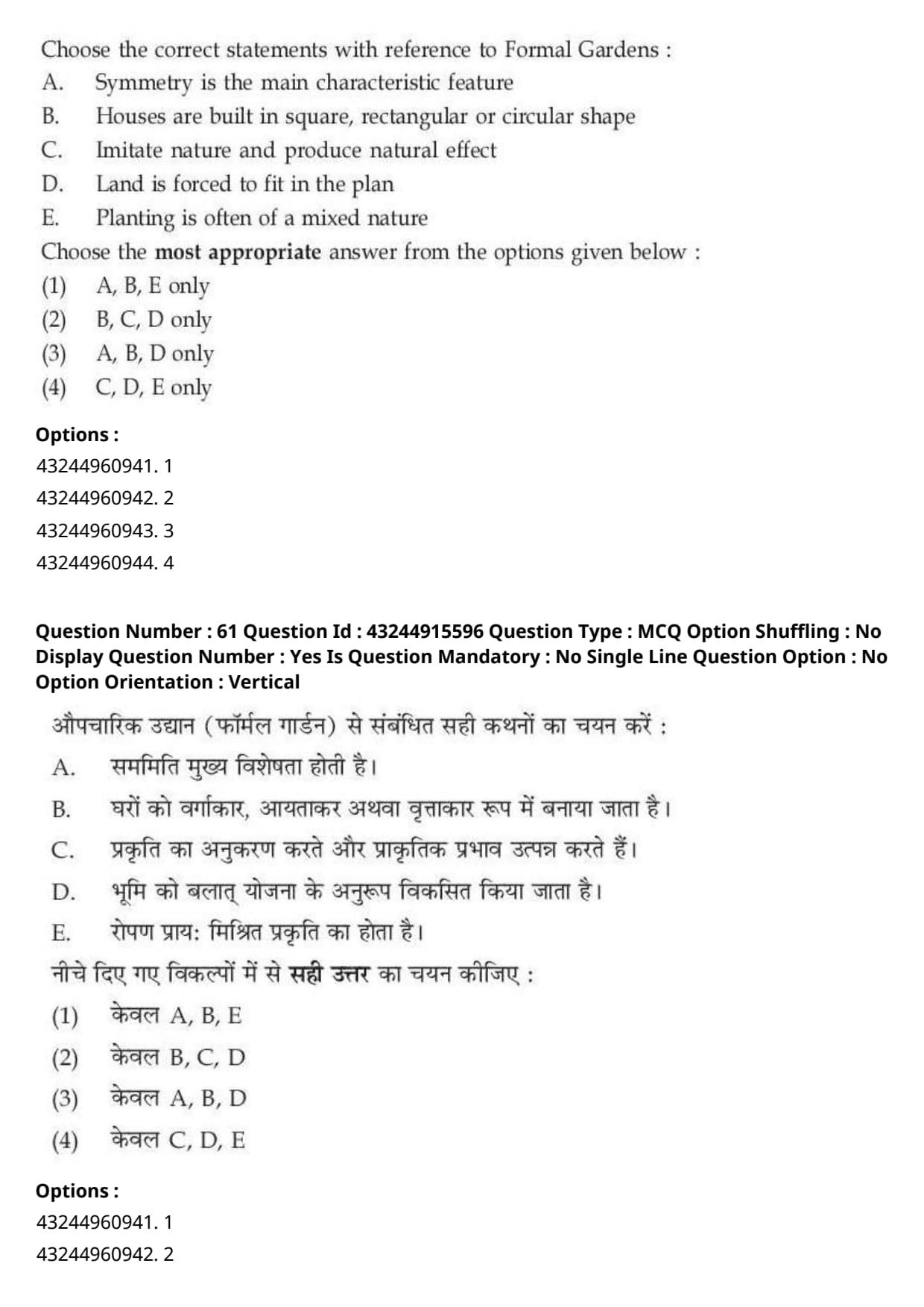
Choose the correct statements with reference to Formal Gardens:
A. Symmetry is the main characteristic feature
B. Houses are built in square, rectangular or circular shape
C. Imitate nature and produce natural effect
D. Land is forced to fit in the plan
E. Planting is often of a mixed nature.
Choose the most appropriate answer from the options given below:
View Solution
Concept:
Formal gardens are based on order, balance, geometry and symmetry. They are generally planned in a fixed design.
Step 1: Check statement A.
Symmetry is the most important feature of formal gardens.
\[ A is correct \]
Step 2: Check statement B.
Formal gardens commonly use geometric shapes such as square, rectangular and circular designs.
\[ B is correct \]
Step 3: Check statement C.
Imitating nature and producing natural effects are features of informal gardens, not formal gardens.
\[ C is incorrect \]
Step 4: Check statement D.
In formal gardens, the land is adjusted or forced to fit the design plan.
\[ D is correct \]
Step 5: Check statement E.
Mixed natural planting is more common in informal gardens.
\[ E is incorrect \]
Therefore, the correct statements are:
\[ A,B,D \]
\[ \therefore Correct Answer is (C) \] Quick Tip: Formal gardens are identified by symmetry, geometric layout and planned arrangement.
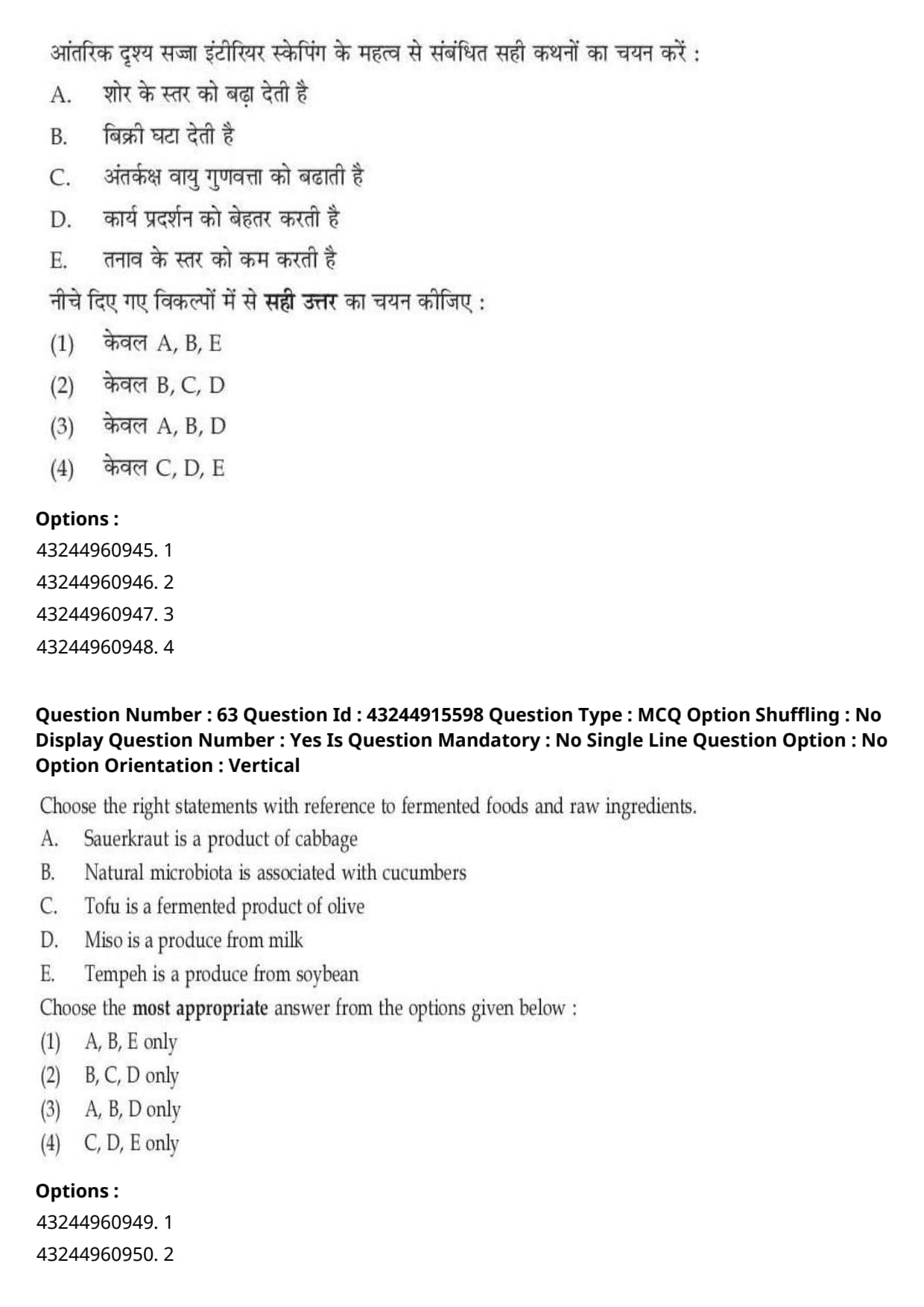
Choose the right statements in respect to the importance of interior scaping:
A. Enhance noise levels
B. Reduce sales
C. Improve indoor air quality
D. Improve work performance
E. Reduce stress levels.
Choose the most appropriate answer from the options given below:
View Solution
Concept:
Interior scaping means using plants inside buildings for beauty, comfort, health and better working environment.
Step 1: Check statement A.
Interior plants do not enhance noise levels. Instead, they may help reduce noise.
\[ A is incorrect \]
Step 2: Check statement B.
Interior scaping does not reduce sales. Good interior scaping may improve customer attraction and business environment.
\[ B is incorrect \]
Step 3: Check statement C.
Indoor plants help improve indoor air quality by absorbing pollutants and increasing freshness.
\[ C is correct \]
Step 4: Check statement D.
A good indoor green environment improves mood and work performance.
\[ D is correct \]
Step 5: Check statement E.
Interior plants help reduce stress levels.
\[ E is correct \]
Thus, the correct statements are:
\[ C,D,E \]
\[ \therefore Correct Answer is (D) \] Quick Tip: Interior scaping improves indoor air quality, work efficiency and mental comfort.
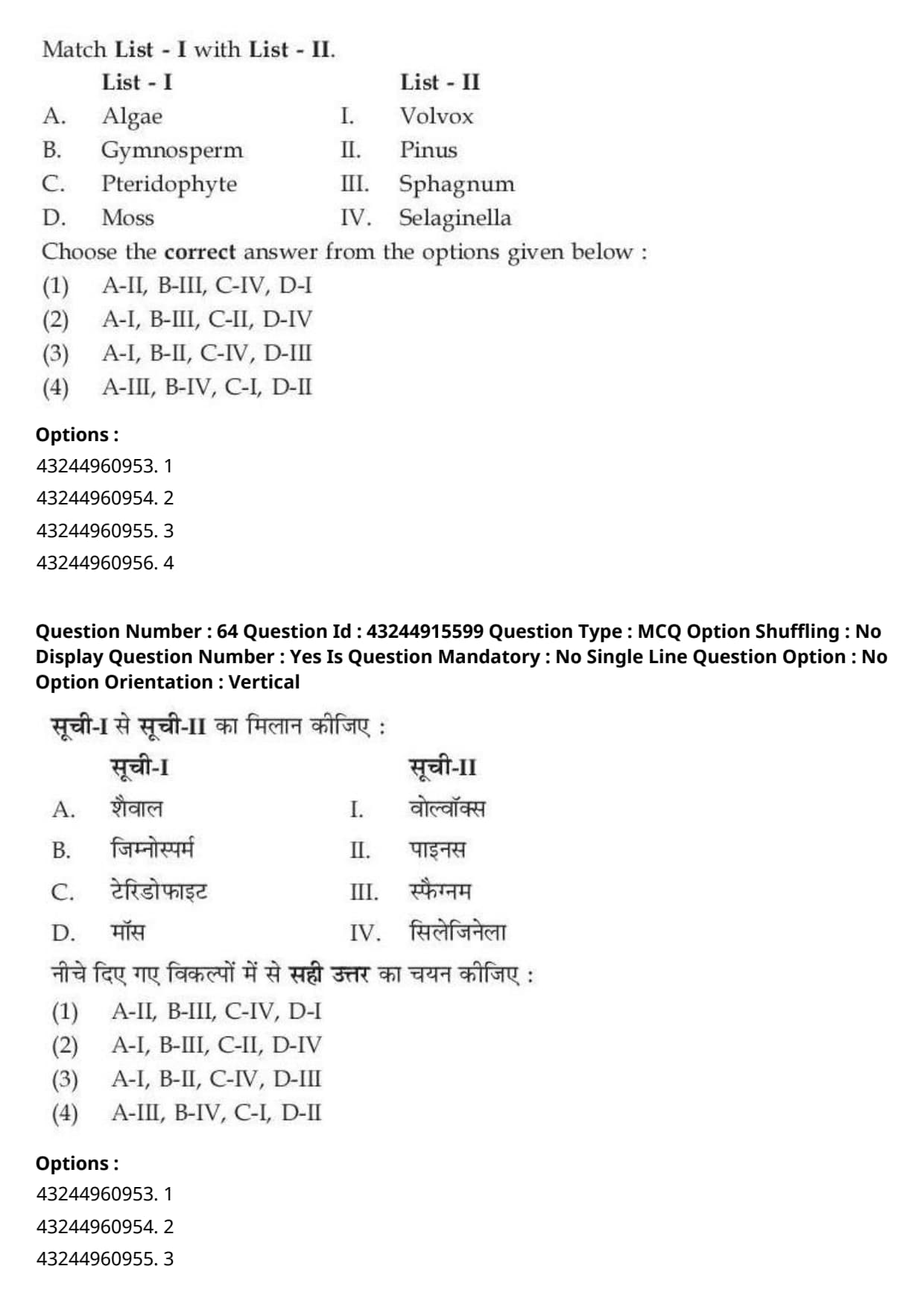
Choose the correct statements about fermented food products:
A. Sauerkraut is made from cabbage
B. Natural microbiota is associated with fermentation of cucumbers
C. Tofu is a fermented product of olive
D. Miso is prepared from milk, E. Tempeh is a fermented soybean product.
Choose the most appropriate answer from the options given below:
View Solution
Concept:
Fermented foods are prepared by microbial action on plant or animal products. Microorganisms convert sugars and other compounds into acids, alcohols or other products.
Step 1: Check statement A.
Sauerkraut is a fermented cabbage product.
\[ A is correct \]
Step 2: Check statement B.
Cucumber fermentation for pickles can involve naturally occurring microorganisms.
\[ B is correct \]
Step 3: Check statement C.
Tofu is made from soybean, not olive.
\[ C is incorrect \]
Step 4: Check statement D.
Miso is a fermented soybean product, not a milk product.
\[ D is incorrect \]
Step 5: Check statement E.
Tempeh is a fermented soybean product.
\[ E is correct \]
Thus, the correct statements are:
\[ A,B,E \]
\[ \therefore Correct Answer is (A) \] Quick Tip: Sauerkraut is fermented cabbage, while tempeh and miso are soybean-based fermented products.
Match List-I with List-II.

Choose the correct answer from the options given below:
View Solution
Concept:
Plant groups are identified by their structure, reproduction and evolutionary level.
Step 1: Match Algae.
Volvox is a green alga.
\[ A\rightarrow I \]
Step 2: Match Gymnosperm.
\textit{Pinus is a gymnosperm.
\[ B\rightarrow II \]
Step 3: Match Pteridophyte.
\textit{Selaginella is a pteridophyte.
\[ C\rightarrow IV \]
Step 4: Match Moss.
\textit{Sphagnum is a moss.
\[ D\rightarrow III \]
Therefore, the correct matching is:
\[ A-I,\ B-II,\ C-IV,\ D-III \]
\[ \therefore Correct Answer is (C) \] Quick Tip: \textit{Volvox is algae, Pinus is gymnosperm, Selaginella is pteridophyte and Sphagnum is moss.
Match List-I with List-II.

View Solution
Concept:
Gram staining uses different reagents in a proper order to differentiate Gram-positive and Gram-negative bacteria.
Step 1: Match iodine.
Iodine acts as a mordant in Gram staining.
\[ A\rightarrow IV \]
Step 2: Match alcohol.
Alcohol is used as a decolorizer.
\[ B\rightarrow II \]
Step 3: Match safranin.
Safranin is used as a counter stain.
\[ C\rightarrow III \]
Step 4: Match crystal violet.
Crystal violet is the primary stain.
\[ D\rightarrow I \]
Therefore, the correct matching is:
\[ A-IV,\ B-II,\ C-III,\ D-I \]
\[ \therefore Correct Answer is (D) \] Quick Tip: In Gram staining, crystal violet is primary stain, iodine is mordant, alcohol is decolorizer and safranin is counter stain.
Match List-I with List-II.

View Solution
Concept:
Colour of fruits and vegetables is mainly due to different pigments such as lycopene, chlorophyll, carotenoids and anthocyanins.
Step 1: Match Lycopene.
Lycopene gives red colour to tomato.
\[ A\rightarrow I \]
Step 2: Match Chlorophyll.
Chlorophyll gives green colour to cucumber.
\[ B\rightarrow II \]
Step 3: Match Carotenoid.
Carotenoids give yellow-orange colour to mango.
\[ C\rightarrow III \]
Step 4: Match Anthocyanin.
Anthocyanin gives purple or dark colour to fruits like jamun.
\[ D\rightarrow IV \]
Therefore:
\[ A-I,\ B-II,\ C-III,\ D-IV \]
\[ \therefore Correct Answer is (A) \] Quick Tip: Lycopene is red, chlorophyll is green, carotenoids are yellow-orange and anthocyanins are purple-blue pigments.
Match List-I with List-II.

View Solution
Concept:
Vegetative propagation methods vary with plant species and plant parts used for multiplication.
Step 1: Match Offsetting.
Pineapple can be propagated through offsets.
\[ A\rightarrow IV \]
Step 2: Match Scaling.
Scaling is used in bulbous plants and is matched with gladiolus in the given list.
\[ B\rightarrow II \]
Step 3: Match Division.
Ferns are commonly propagated by division.
\[ C\rightarrow I \]
Step 4: Match Layering.
Jasmine is commonly propagated by layering.
\[ D\rightarrow III \]
Therefore:
\[ A-IV,\ B-II,\ C-I,\ D-III \]
\[ \therefore Correct Answer is (B) \] Quick Tip: Layering is common in jasmine, while division is common in ferns.
Match List-I with List-II.

View Solution
Concept:
Population size changes due to birth, death, immigration and emigration.
Step 1: Match Natality.
Natality means birth rate.
\[ A\rightarrow III \]
Step 2: Match Mortality.
Mortality means death rate.
\[ B\rightarrow IV \]
Step 3: Match Immigration.
Immigration adds individuals of the same species into a population.
\[ C\rightarrow I \]
Step 4: Match Emigration.
Emigration means individuals move out from the population.
\[ D\rightarrow II \]
Therefore:
\[ A-III,\ B-IV,\ C-I,\ D-II \]
\[ \therefore Correct Answer is (D) \] Quick Tip: Natality and immigration increase population size, while mortality and emigration decrease population size.
Match List-I with List-II.

View Solution
Concept:
Different fruits are known for different important nutrients.
Step 1: Match Calcium.
Fig is a good source of calcium.
\[ A\rightarrow I \]
Step 2: Match Iron.
Karonda is known for iron content.
\[ B\rightarrow III \]
Step 3: Match Phosphorus.
Wood apple is associated with phosphorus content.
\[ C\rightarrow II \]
Step 4: Match Protein.
Guava contains comparatively good protein content among fruits.
\[ D\rightarrow IV \]
Therefore:
\[ A-I,\ B-III,\ C-II,\ D-IV \]
\[ \therefore Correct Answer is (B) \] Quick Tip: Remember common fruit-nutrient associations such as fig-calcium and guava-protein.
Match List-I with List-II.

View Solution
Concept:
Fruits are classified according to their structure and development.
Step 1: Match Pome.
Pear is a pome fruit.
\[ A\rightarrow II \]
Step 2: Match Hesperidium.
Kinnow is a citrus fruit and belongs to hesperidium type.
\[ B\rightarrow III \]
Step 3: Match Balusta.
Pomegranate is a balusta fruit.
\[ C\rightarrow IV \]
Step 4: Match Drupe.
Peach is a drupe fruit.
\[ D\rightarrow I \]
Therefore:
\[ A-II,\ B-III,\ C-IV,\ D-I \]
\[ \therefore Correct Answer is (A) \] Quick Tip: Pear is pome, kinnow is hesperidium, pomegranate is balusta and peach is drupe.
Match List-I with List-II.

View Solution
Concept:
Certain horticultural crops are associated with specific cultural, reproductive or breeding practices.
Step 1: Match Mango.
Bagging technique is used in mango to protect fruits and improve quality.
\[ A\rightarrow I \]
Step 2: Match Fig.
Caprification is associated with fig pollination.
\[ B\rightarrow II \]
Step 3: Match Papaya.
Papaya is matched with sibmating in the given list.
\[ C\rightarrow IV \]
Step 4: Match Sapota.
Sapota is matched with protandry in the given list.
\[ D\rightarrow III \]
Therefore:
\[ A-I,\ B-II,\ C-IV,\ D-III \]
\[ \therefore Correct Answer is (C) \] Quick Tip: Caprification is specifically associated with fig.
Match List-I with List-II.

View Solution
Concept:
Cuttings are vegetative propagation methods in which plant parts are used to produce new plants.
Step 1: Match Hard wood cuttings.
Rose can be propagated through hardwood cuttings.
\[ A\rightarrow III \]
Step 2: Match Soft wood cuttings.
Jasmine can be propagated through softwood cuttings.
\[ B\rightarrow IV \]
Step 3: Match Herbaceous cuttings.
Chrysanthemum is propagated through herbaceous cuttings.
\[ C\rightarrow I \]
Step 4: Match Leaf cutting.
Bryophyllum is propagated through leaf cuttings.
\[ D\rightarrow II \]
Therefore:
\[ A-III,\ B-IV,\ C-I,\ D-II \]
\[ \therefore Correct Answer is (D) \] Quick Tip: Bryophyllum is a classic example of propagation by leaf cutting.
Match List-I with List-II.

View Solution
Concept:
Different garden styles are known for characteristic design elements.
Step 1: Match Persian garden.
Persian gardens are associated with flowing canals and water channels.
\[ A\rightarrow III \]
Step 2: Match French garden.
French gardens are associated with formal green rooms.
\[ B\rightarrow IV \]
Step 3: Match Mughal garden.
Baradari is associated with Mughal garden architecture.
\[ C\rightarrow I \]
Step 4: Match Japanese garden.
Stone lantern is a common feature of Japanese gardens.
\[ D\rightarrow II \]
Therefore:
\[ A-III,\ B-IV,\ C-I,\ D-II \]
\[ \therefore Correct Answer is (D) \] Quick Tip: Japanese gardens commonly use stone lanterns, while Mughal gardens include Baradari structures.
Match List-I with List-II.

View Solution
Concept:
Ornamental plants are selected according to their landscape use such as rockery, bedding, edging and cut greens.
Step 1: Match Rockery.
Portulaca is suitable for rockery because it grows well in sunny, dry and rocky places.
\[ A\rightarrow II \]
Step 2: Match Bedding purpose.
Dahlia is commonly used for bedding purpose.
\[ B\rightarrow III \]
Step 3: Match Edging.
Coleus is used for edging because of its colourful foliage.
\[ C\rightarrow IV \]
Step 4: Match Cut greens.
Nemesia is matched with cut greens in the given list.
\[ D\rightarrow I \]
Therefore:
\[ A-II,\ B-III,\ C-IV,\ D-I \]
\[ \therefore Correct Answer is (A) \] Quick Tip: Portulaca is suitable for rockery, while Coleus is commonly used for edging.
Match List-I with List-II.

View Solution
Concept:
Food preservation methods include drying, freezing, brining and fermentation. Each method is suitable for specific food products.
Step 1: Match Drying.
Dates are commonly preserved by drying.
\[ A\rightarrow I \]
Step 2: Match Freezing.
Peas are commonly preserved by freezing.
\[ B\rightarrow II \]
Step 3: Match Brining.
Gherkins are commonly preserved in brine.
\[ C\rightarrow IV \]
Step 4: Match Fermentation.
Grape wine is produced by fermentation.
\[ D\rightarrow III \]
Therefore:
\[ A-I,\ B-II,\ C-IV,\ D-III \]
\[ \therefore Correct Answer is (C) \] Quick Tip: Dates are dried, peas are frozen, gherkins are brined and grape wine is fermented.



Comments