




The Class 10 History Chapter 1 The Rise of Nationalism in Europe PYQ compilation has 32 board-paper questions worth 117 marks across 4 CBSE cycles (2023 to 2026), sorted by marks (1 to 5) and by year, latest first.
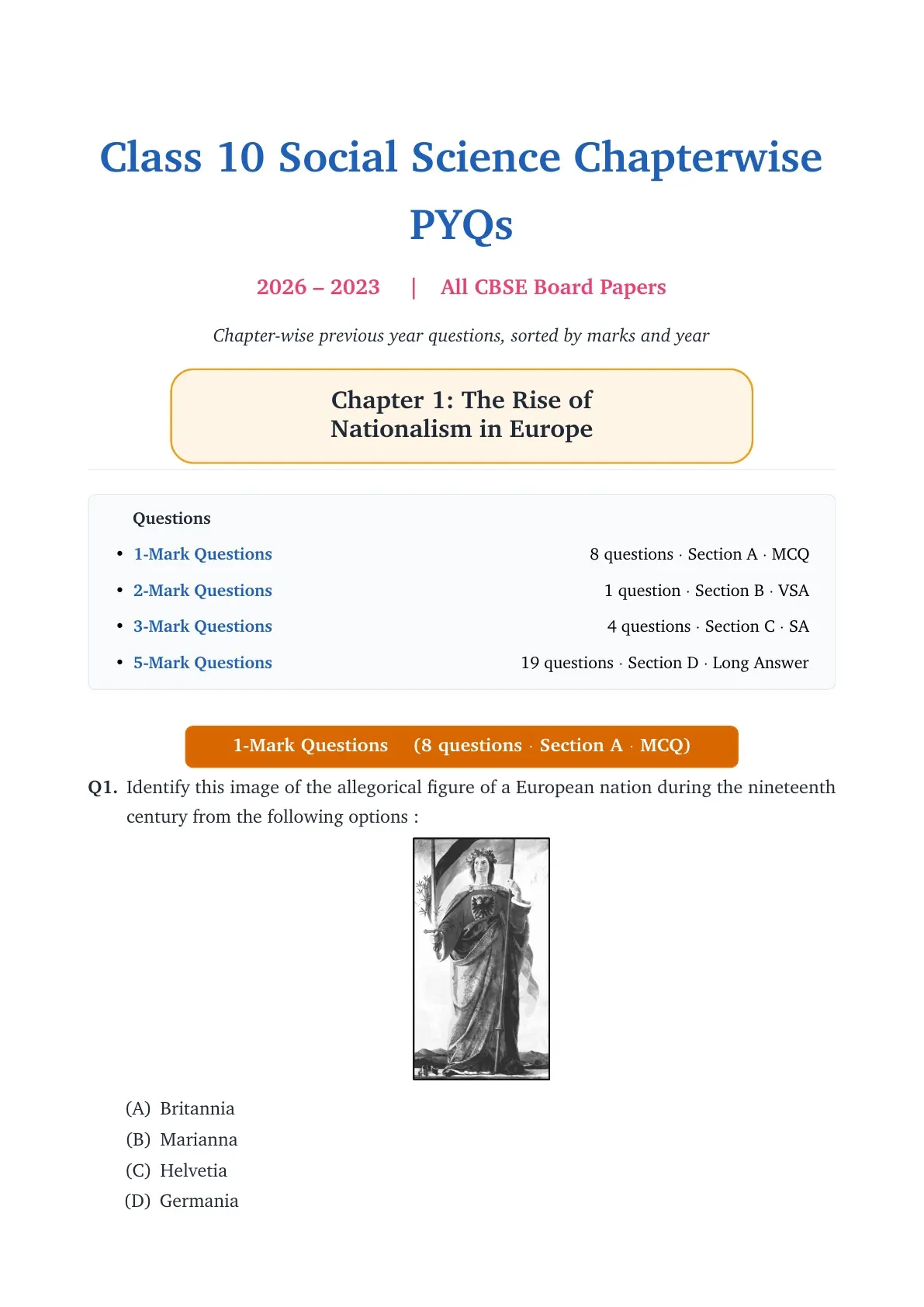
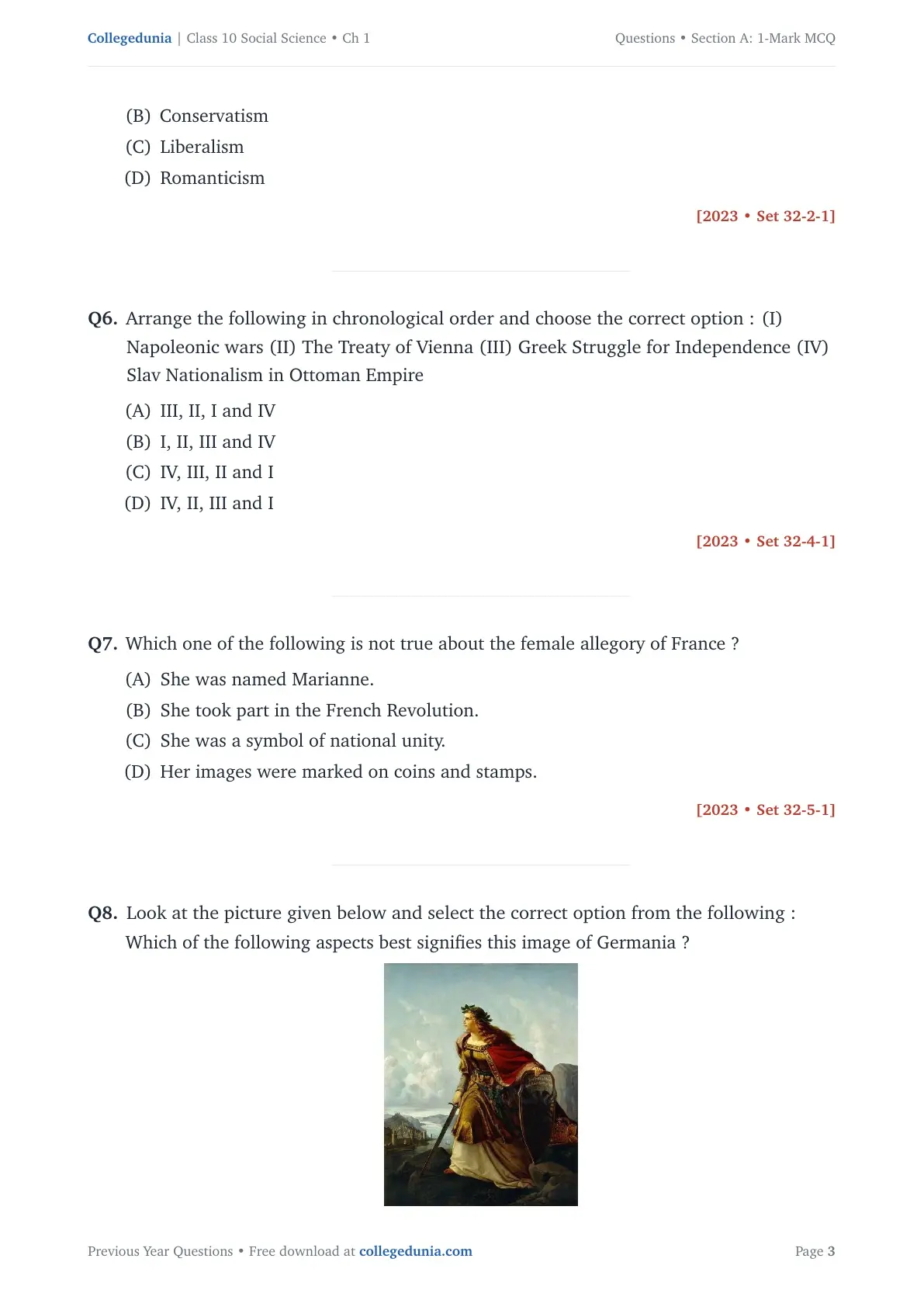
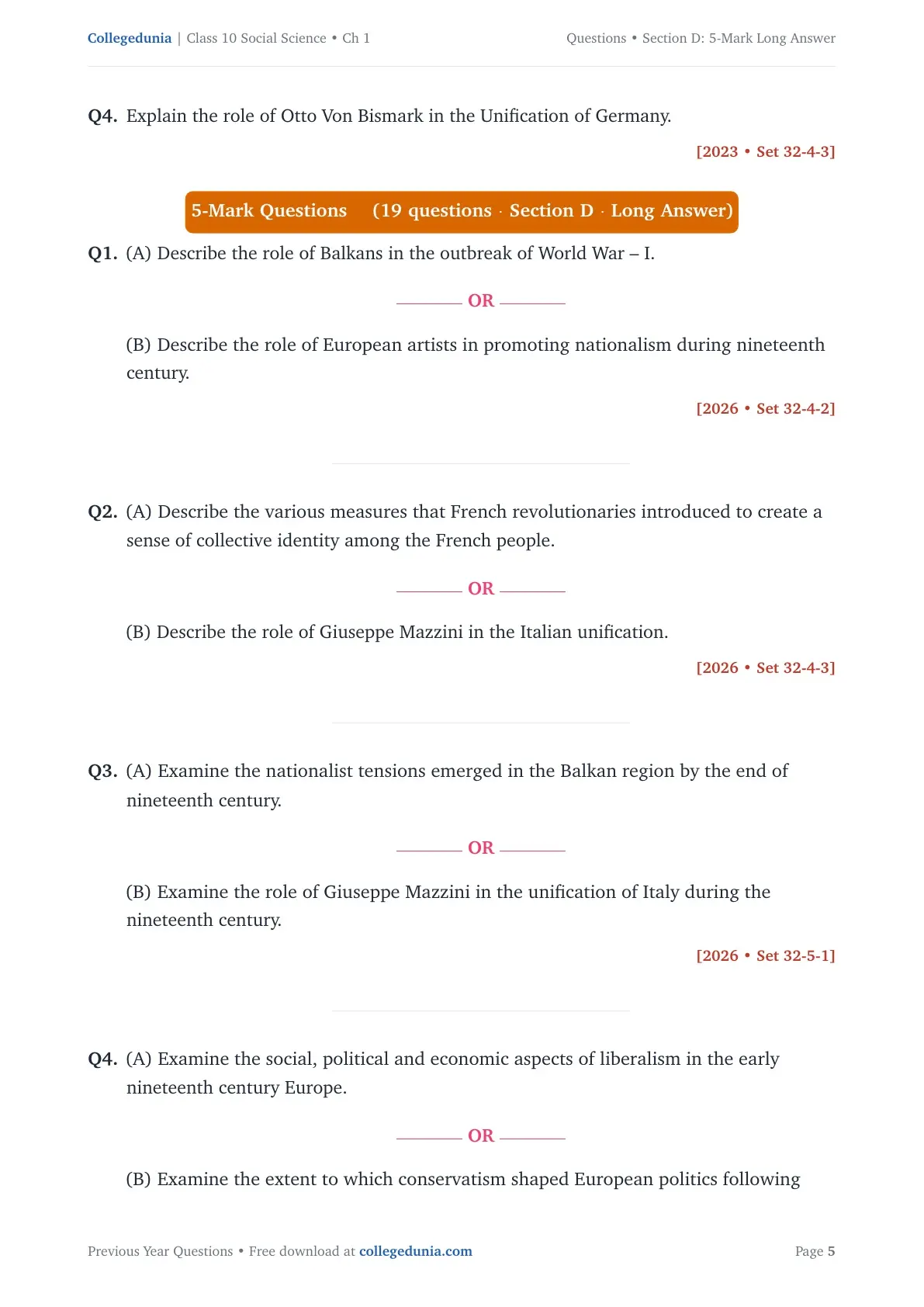
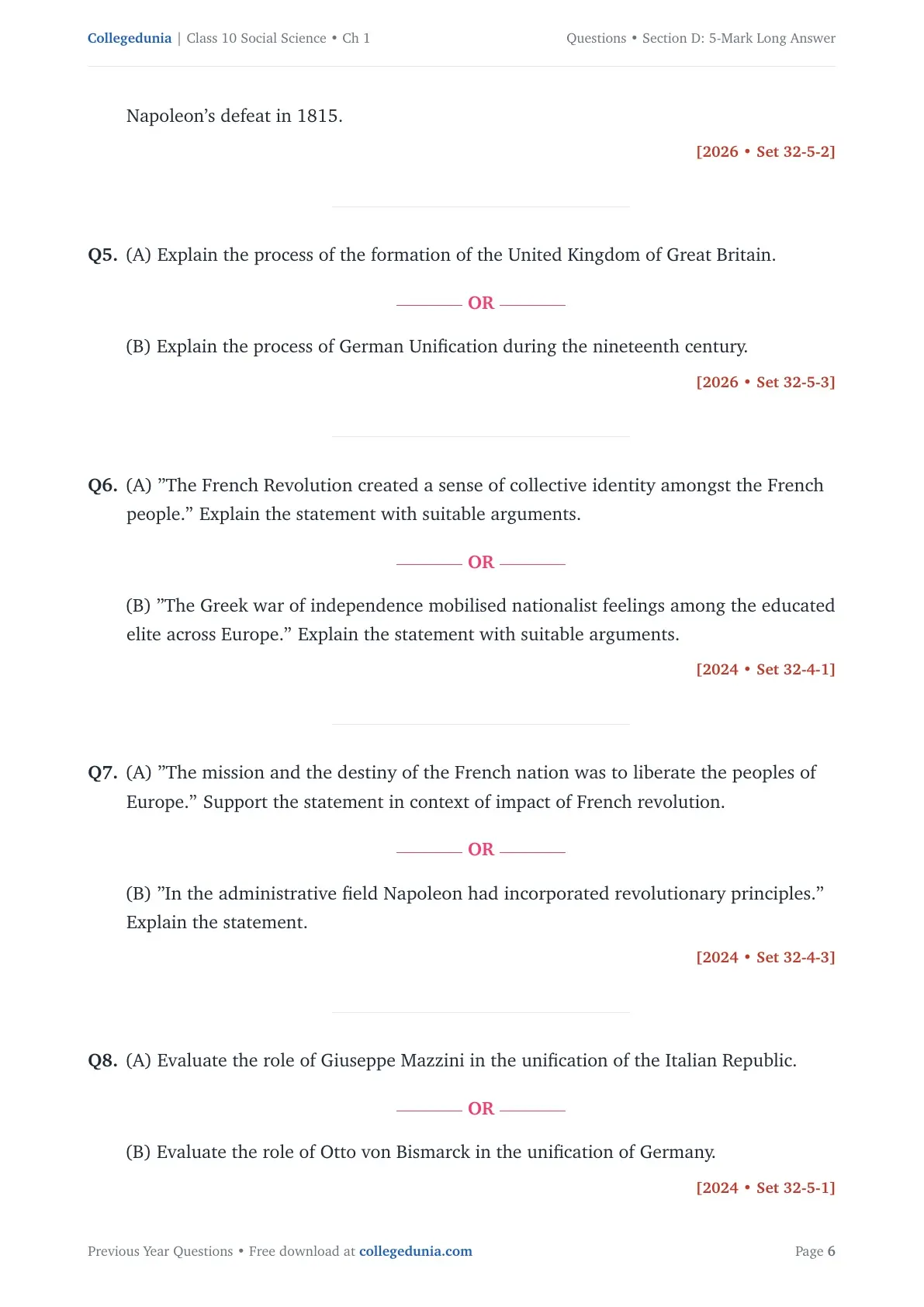
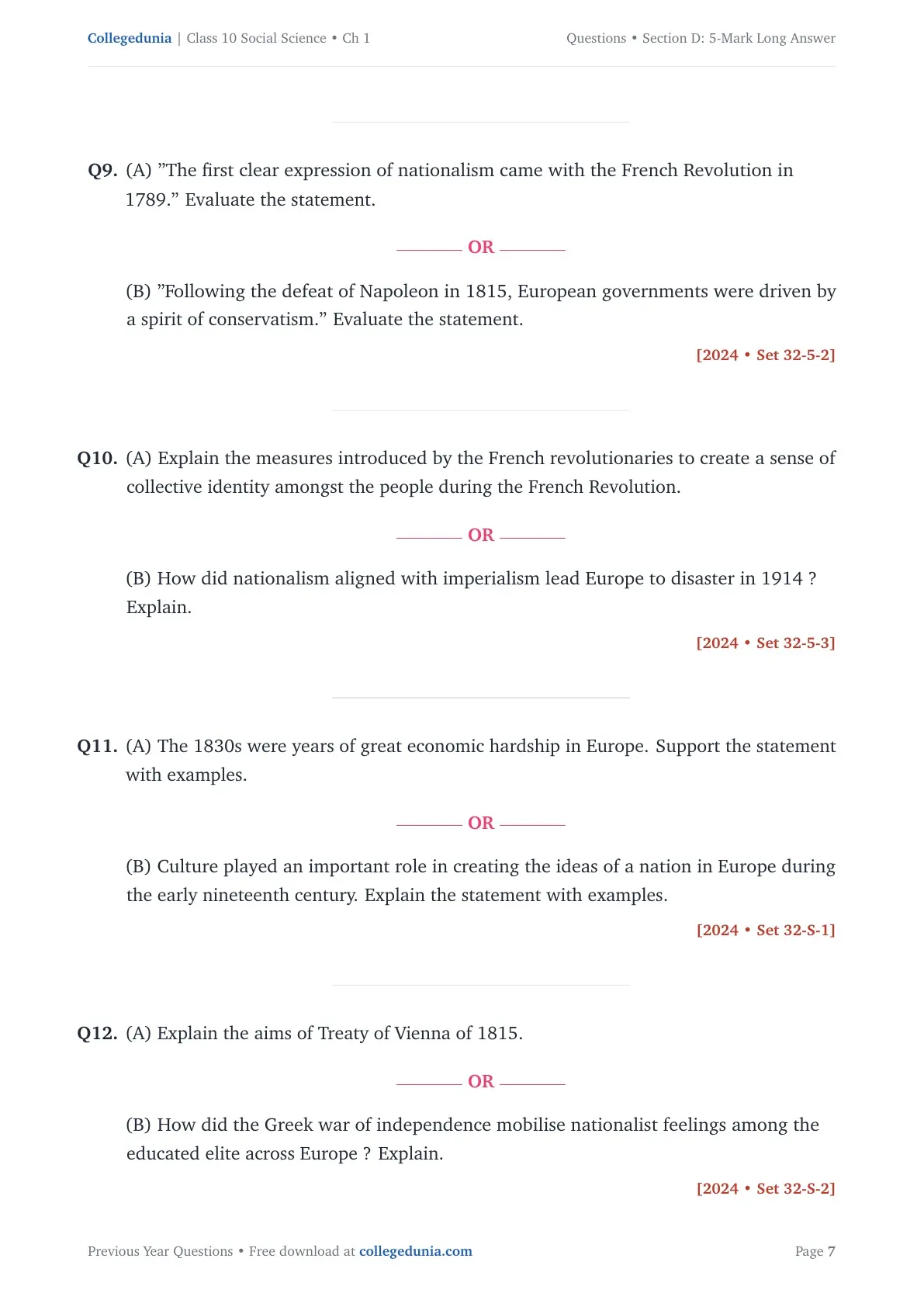
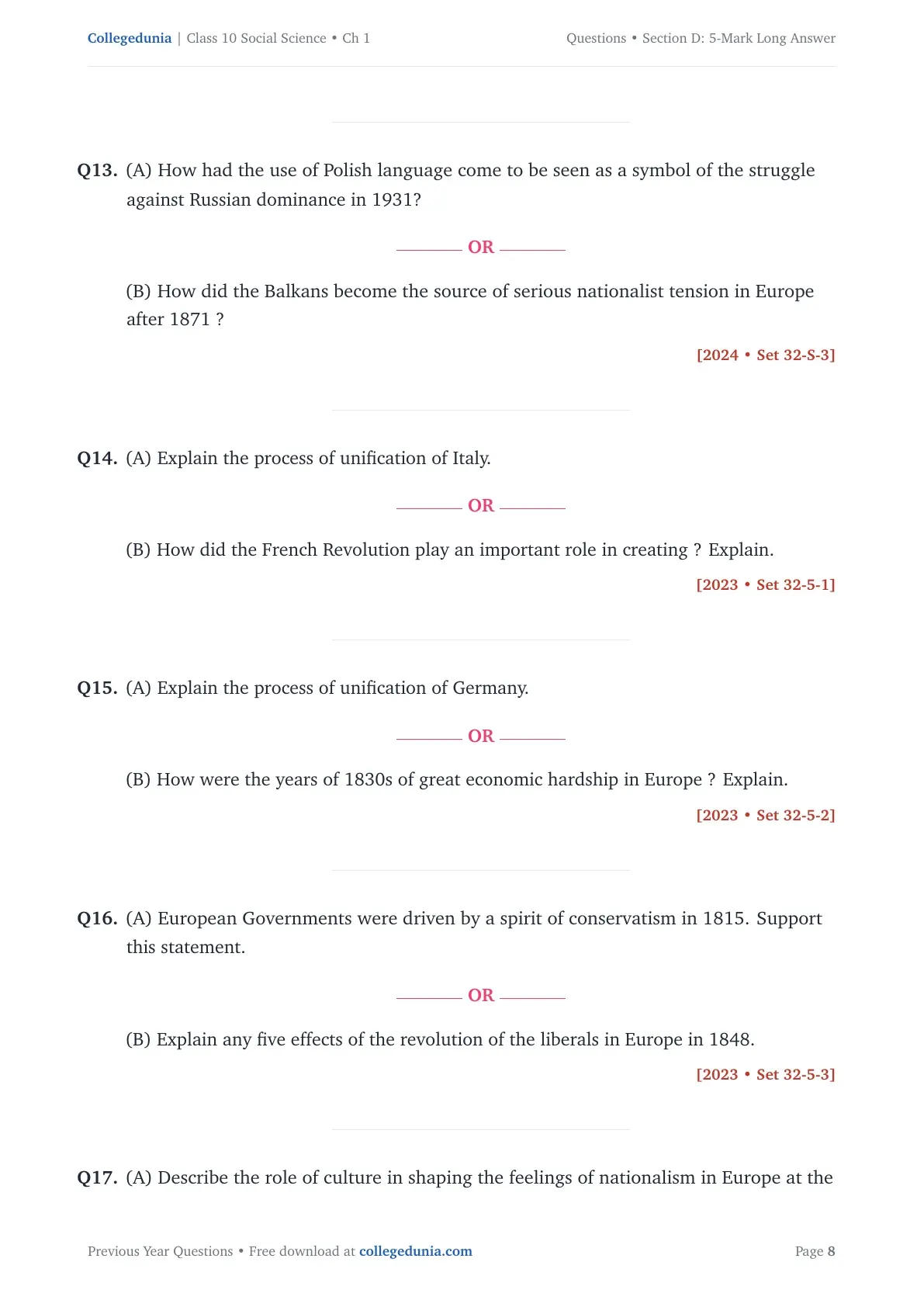
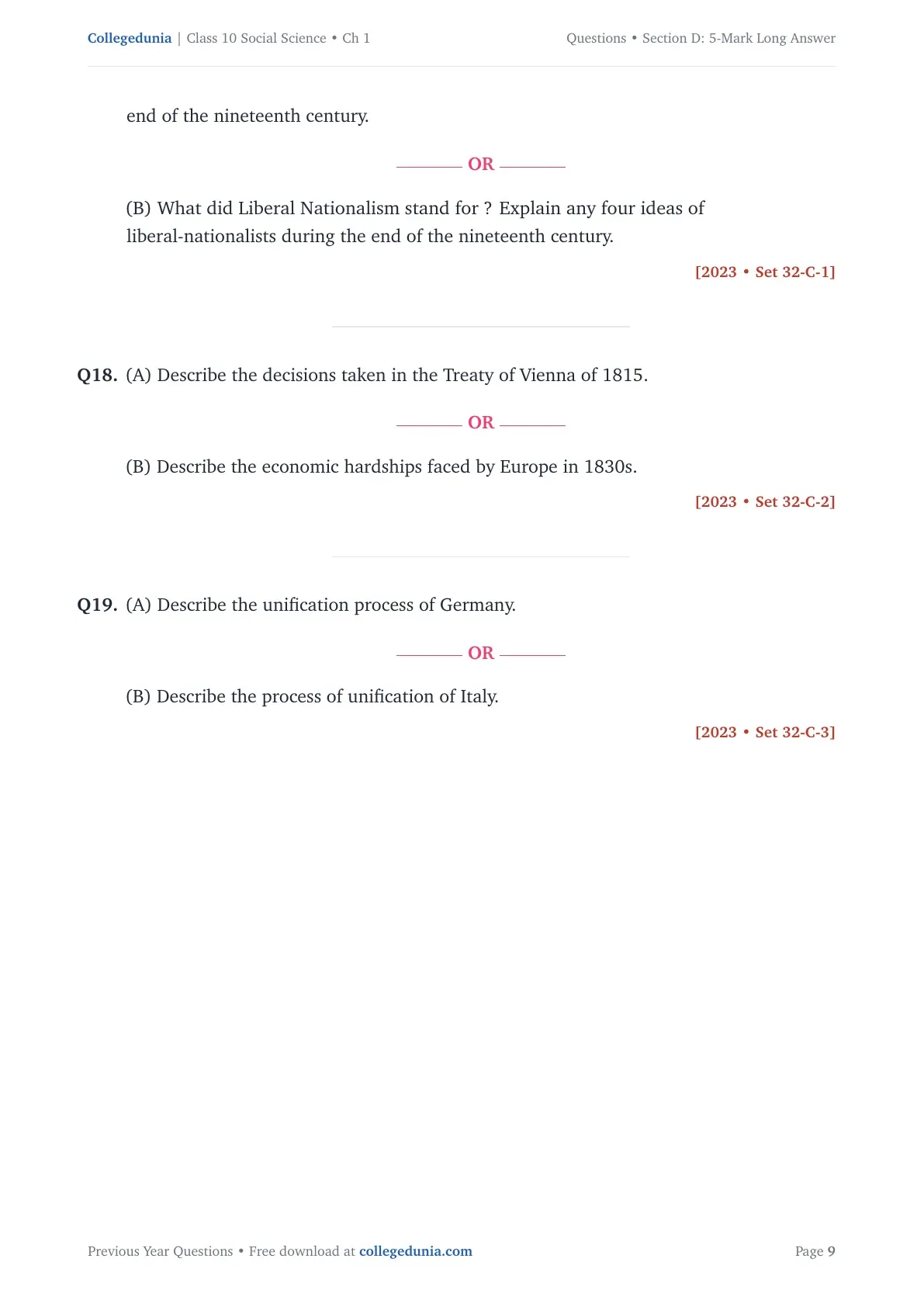
- 32 unique questions pulled from 13 CBSE set codes, main papers and compartment papers both.
- Every question carries its source tag in the format [Year • Set 32-X-Y], so you always know which paper it came from.
- Marks-sorted: Section A MCQs first, then the 2-mark, 3-mark and 5-mark bands in the order the CBSE paper presents them.
- Both allegory images included, cropped straight from the original question papers, so the picture-based MCQs are answerable as printed.
- Free 9-page PDF, no sign-up, aligned to the 2026-27 CBSE Class 10 Social Science syllabus.
What the Rise of Nationalism in Europe PYQs Cover
The 32-question compilation maps the whole of the first History chapter of India and the Contemporary World II. The arc runs from the French Revolution and the Napoleonic Code, through the conservative order the Treaty of Vienna put in place in 1815, on to the liberal and romantic currents of the 1830s and 1848, and finally to the unification of Germany and Italy and the Balkan tensions that fed the First World War.
Two things stand out once you see four years of papers side by side. First, this chapter almost always supplies a 5-mark long answer in the History portion of the paper, and 19 of the 32 questions in this PDF are exactly that. Second, the 1-mark slot is nearly always a chronology question, an allegory picture, or a one-line identification such as who hosted the Vienna Congress.
Marks-wise Distribution of the Chapter 1 PYQs
The table below shows how the 32 questions split across the CBSE marks bands. Use it to decide how much of your revision time each band deserves.
| Marks | Questions | Total Marks | CBSE Section | Type |
|---|---|---|---|---|
| 1 mark | 8 | 8 | Section A | MCQ, chronology and picture-based |
| 2 mark | 1 | 2 | Section B | VSA |
| 3 mark | 4 | 12 | Section C | SA |
| 5 mark | 19 | 95 | Section D | Long Answer, almost always with an OR |
| Total | 32 | 117 | – | – |
Roughly 81 per cent of the marks in this compilation sit in the 5-mark band. If you have one evening for Chapter 1, spend it writing long answers, not on MCQ drill.
Year-wise Spread of the Nationalism in Europe PYQs
The compilation pulls from four CBSE board cycles, main and compartment papers both.
- 2026 (6 questions): Sets 32-4-1, 32-4-2, 32-4-3, 32-5-1, 32-5-2, 32-5-3. Germany and Italy unification, the Balkans and the First World War, the role of European artists, liberalism and conservatism, and the formation of the United Kingdom of Great Britain.
- 2025 (2 questions): Set 32-S. A chronology MCQ built on the Treaty of Constantinople and the Napoleonic Civil Code, plus a 3-mark on the unification of Italy with the Greek War of Independence as the OR.
- 2024 (10 questions): Sets 32-4, 32-5 and 32-S. The heaviest year in the set, with the Vienna Congress MCQ, the French Revolution collective-identity long answer, and the Mazzini versus Bismarck pairing.
- 2023 (14 questions): Sets 32-2, 32-4, 32-5 and the 32-C compartment papers. This is where the Marianne and Germania allegory MCQs come from, along with four separate long answers on unification.
Topic Frequency in the Chapter 1 Board Questions
The 32 questions cluster into eight topic buckets. The table ranks them by how often CBSE set a question on that topic between 2023 and 2026.
| Rank | Topic Cluster | Questions | Typical Marks Band |
|---|---|---|---|
| 1 | Conservatism and the Treaty of Vienna | 7 | 1 and 5 mark |
| 1 | The making of Germany and Italy (Bismarck, Cavour, Mazzini, Garibaldi) | 7 | 3 and 5 mark |
| 3 | The French Revolution and the idea of the nation | 5 | 3 and 5 mark |
| 4 | Visualising the nation (Marianne, Germania) | 3 | 1 mark |
| 4 | Culture and romantic nationalism | 3 | 5 mark |
| 4 | Chronology of European nationalism | 3 | 1 mark |
| 7 | Liberal nationalism | 2 | 2 and 3 mark |
| 7 | Nationalism, imperialism and the Balkans | 2 | 5 mark |
The Questions CBSE Keeps Repeating
Four years of papers make the repeats obvious. These are the ones worth writing out in full before the exam.
- Describe the process of the unification of Germany, or of Italy. It appears in 2023 (32-C-3), 2023 (32-5-1 and 32-5-2), 2024 (32-5-1) and again in 2026 (32-4-1 and 32-5-3). No other question in this chapter comes close.
- The measures the French revolutionaries used to create a sense of collective identity. Set in 2023, 2024 and 2026, sometimes as a 3-mark, more often as a 5-mark.
- The Treaty of Vienna of 1815 and the spirit of conservatism that followed. Asked as a 1-mark MCQ (who hosted the Vienna Congress, which ideology drove European governments after Napoleon) and as a 5-mark description of the treaty's decisions.
- The Greek War of Independence and how it mobilised nationalist feeling. Almost always the OR branch of a French Revolution question.
- The 1830s as years of economic hardship in Europe. Set in both 2023 and 2024, usually as the OR alternative.
Marks-Band Attempt Strategy
The PDF is ordered marks-ascending so you can practise in the order the paper presents the questions.
- 1-mark MCQs: 45 seconds each. The chronology questions are the trap. Fix four anchor dates in your head, 1789 for the French Revolution, 1804 for the Napoleonic Civil Code, 1815 for Vienna, 1871 for German unification, and every ordering question falls out.
- 2-mark VSA: Two points, 40 words, no introduction. Examiners award per point, not per paragraph.
- 3-mark SA: Three distinct points inside 60 words. For "explain the role of Bismarck", the three points are Prussian leadership, the three wars, and the 1871 proclamation at Versailles.
- 5-mark long answer: Five points inside 120 words, and read both branches of the OR before you commit. Allocate 10 to 12 minutes.
Common Mistakes in the Nationalism in Europe Answers
- Mixing up Mazzini, Cavour and Garibaldi. Mazzini is the thinker and the secret societies, Cavour is the diplomacy and the alliance with France, Garibaldi is the armed volunteers in the south.
- Writing the unification of Germany as a list of dates with no mention of Prussia leading the process, which is the point the marking scheme rewards.
- Calling Marianne the allegory of Germany. Marianne is France, Germania is Germany. The picture MCQs turn on exactly this.
- Treating liberalism as only a political idea. In the nineteenth century it was political, social and economic all at once, and the 2026 paper asked for all three.
- Answering only one branch of an OR question and then answering the other as well. You get marked on one, and the time is gone.
How to Use the Chapter 1 PYQ PDF
The 32 questions work best as a three-pass plan:
- Pass 1: Attempt the 8 one-mark MCQs cold. Every one you miss points at a date or a name you have not fixed yet.
- Pass 2: Write the 2-mark and 4 three-mark answers to the word limit. Count your words the first few times, then stop counting.
- Pass 3: Work through the 19 five-mark questions. Many share content, so once you can write unification of Germany and unification of Italy properly, a third of the band is already covered.
Every question carries its [Year • Set] tag, so if you want to simulate one paper rather than the whole chapter, filter by the set code.
All Class 10 History Chapter PYQ PDFs
India and the Contemporary World II has five chapters. Chapterwise PYQ compilations for the rest are being built the same way, from the official CBSE papers.
| Chapter | Topic | Previous Year Questions |
|---|---|---|
| Chapter 1 | The Rise of Nationalism in Europe | PYQ PDF |
| Chapter 2 | Nationalism in India | Coming soon |
| Chapter 3 | The Making of a Global World | Coming soon |
| Chapter 4 | The Age of Industrialisation | Coming soon |
| Chapter 5 | Print Culture and the Modern World | Coming soon |
Class 10 History Chapter 1 The Rise of Nationalism in Europe PYQ FAQs
Ques. How many previous year questions are in the Class 10 History Chapter 1 PYQ PDF?
Ans. The PDF has 32 unique questions worth 117 marks, taken from CBSE board papers between 2023 and 2026. Near-duplicate questions that repeat across set variants of the same paper have been collapsed, so the same question never appears twice.
Ques. Does the PDF include the answers?
Ans. No. This compilation is the questions only, exactly as CBSE printed them, with the year and set code under each one. That is deliberate: writing your own answer first and then checking it against the NCERT chapter is what actually builds the 5-mark answer.
Ques. Which CBSE papers were used to build it?
Ans. Thirteen set codes across four cycles: 32-2, 32-4 and 32-5 (main papers) and 32-C and 32-S (compartment papers), from 2023, 2024, 2025 and 2026. The compartment papers matter because CBSE often reuses their long answers in the next main paper.
Ques. Which topic carries the most weight in the board paper?
Ans. Two topics tie at the top with seven questions each: the unification of Germany and Italy, and conservatism with the Treaty of Vienna. Between them they account for roughly 44 per cent of the compilation.
Ques. Are these questions still valid for the 2026-27 syllabus?
Ans. Yes. The Rise of Nationalism in Europe stays in the 2026-27 CBSE Class 10 Social Science syllabus as the first chapter of the History unit, and the marking pattern of one Section A MCQ plus a 5-mark long answer has held steady since 2023.
Ques. How many marks is this chapter worth in the CBSE Class 10 exam?
Ans. History carries 20 marks of the 80-mark theory paper, split across five chapters. Chapter 1 typically contributes 6 to 8 marks, usually one 1-mark MCQ and one 5-mark long answer, sometimes a 3-mark short answer instead.
Ques. Do the picture-based questions work in the PDF?
Ans. Yes. Both allegory images, the Germania painting from the 2023 compartment paper and the one from the 2026 paper, have been cropped from the original question papers and placed with their questions, so you see exactly what the candidate in the exam hall saw.



Comments