




The NCERT Formula Sheet Class 12 Physics Chapter 10 Wave Optics contains important derivations, formulas, and definitions in a single PDF below. Some of the important areas from which questions appear frequently in JEE, NEET, and CBSE Boards are wavefronts, interference, diffraction, and polarisation.
This page has the free Formula Sheet PDF you can download and use for quick revision.
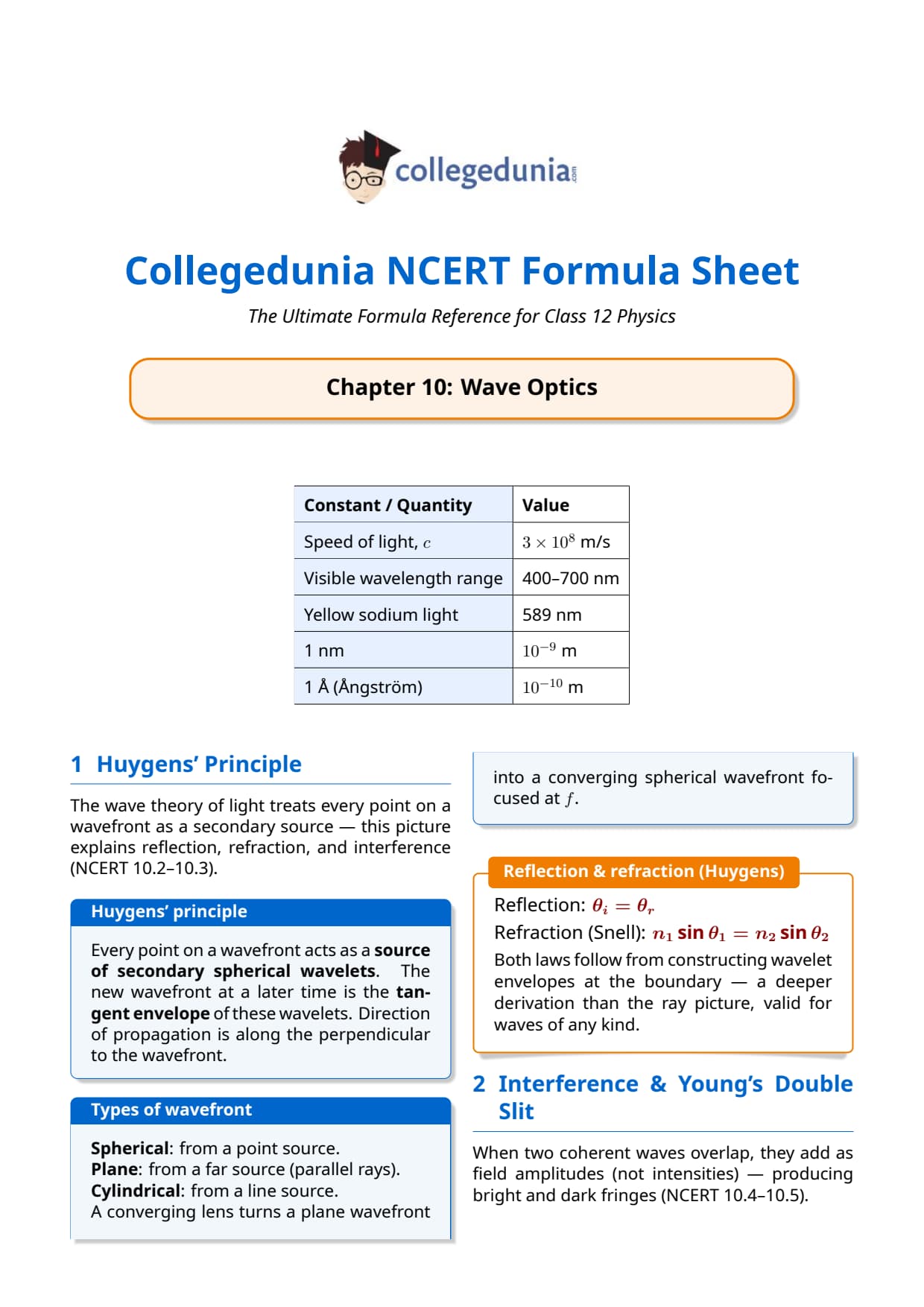
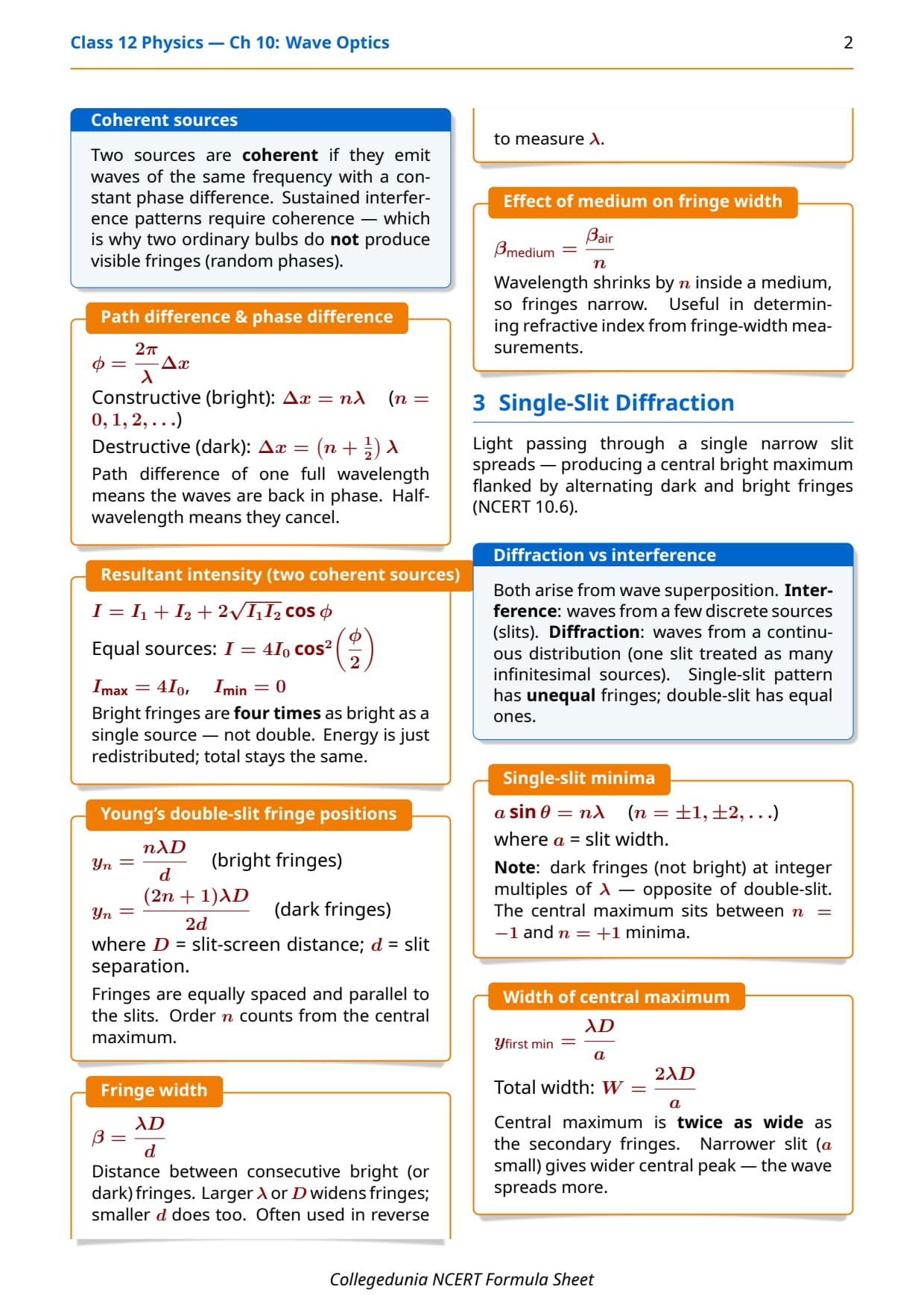
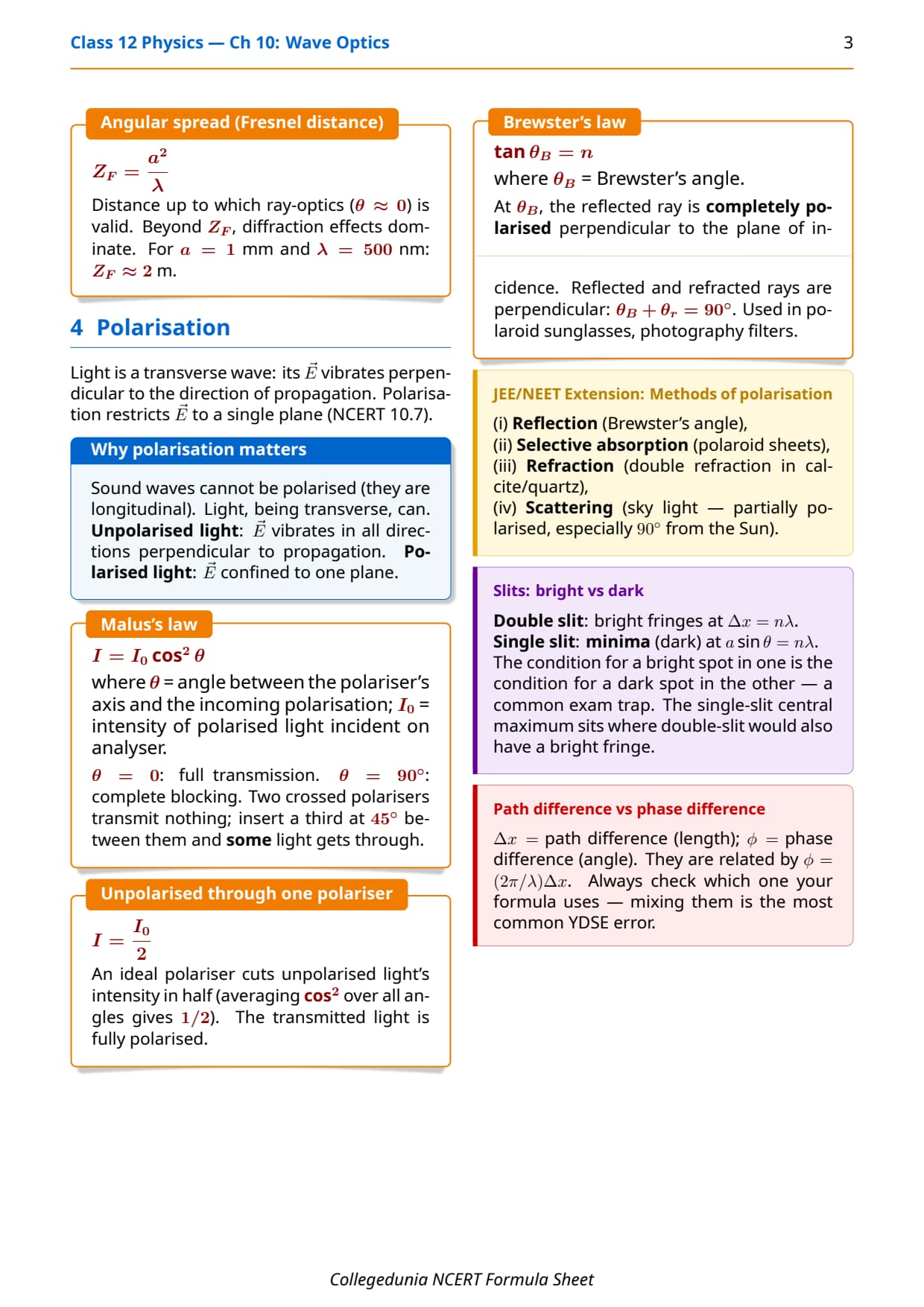
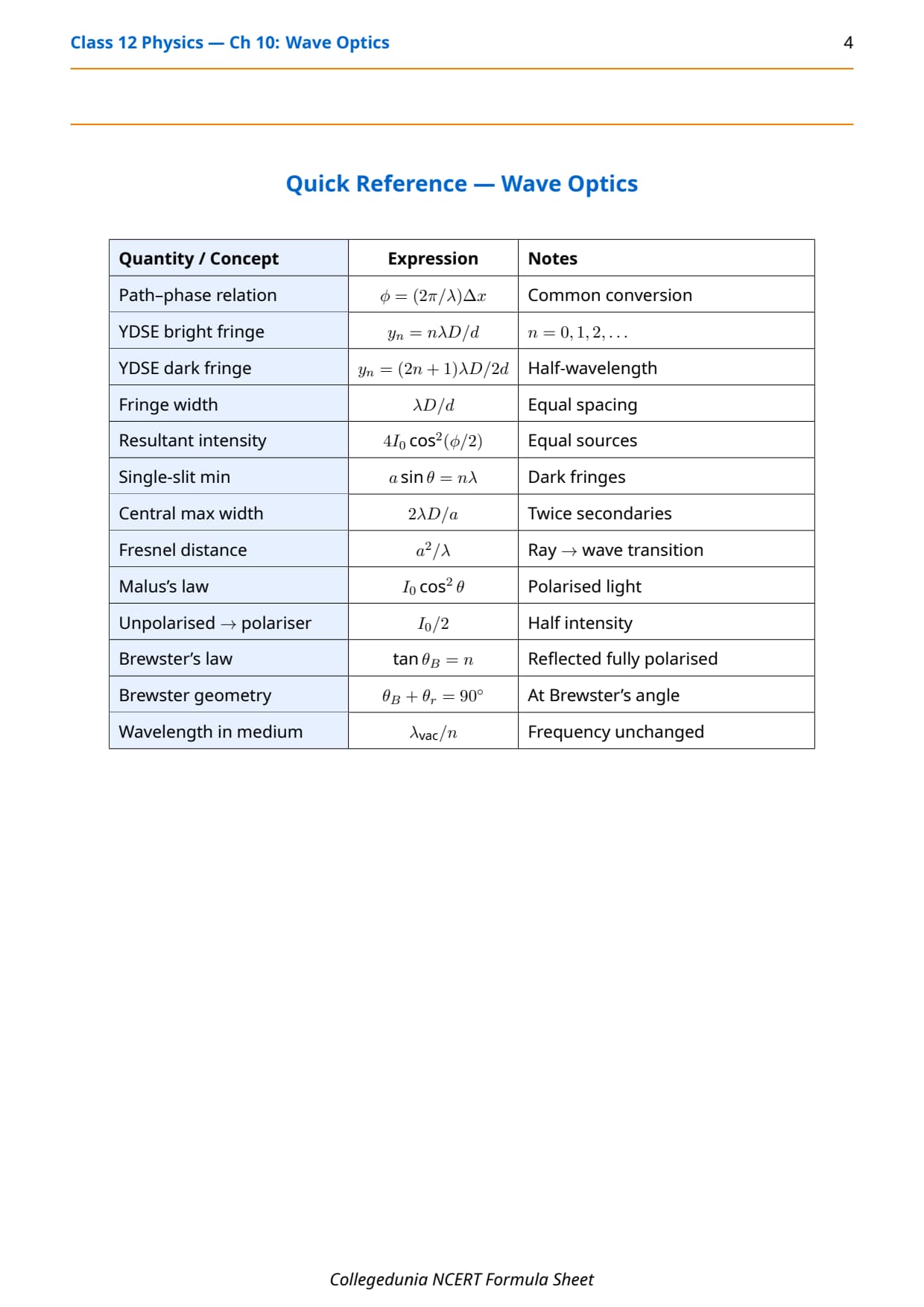
- CBSE weightage: 5 marks - usually a 3-mark derivation (YDSE or Huygens) plus a 2-mark numerical (Malus's law or Brewster's angle).
- JEE Main: 2-3 questions per session on fringe width, Brewster's angle, and single-slit minima.
- NEET: 1-2 questions per paper - Malus's law MCQs and YDSE fringe shift come up most.
Class 12 Physics Chapter 10 Wave Optics: Formula Quick-Reference
The 8 formulas below cover every numerical the chapter generates. Each row gives the concept, the formula in LaTeX notation, and the SI unit. Go through all 8 rows before your exam and check you can write each formula without looking.
| Concept | Formula | SI Unit |
|---|---|---|
| Fringe width (YDSE) | \(\beta = \dfrac{\lambda D}{d}\) | metre |
| Position of nth bright fringe | \(x_n = \dfrac{n\lambda D}{d}\) | metre |
| Intensity in YDSE | \(I = 4I_0\cos^2\!\left(\dfrac{\phi}{2}\right)\) | W/m² |
| Single-slit first minimum | \(a\sin\theta = \lambda\) | - |
| Width of central maximum | \(W = \dfrac{2\lambda D}{a}\) | metre |
| Malus's law | \(I = I_0\cos^2\theta\) | W/m² |
| Brewster's angle | \(\tan i_B = n\) | - |
| Limit of resolution (microscope) | \(d = \dfrac{0.61\lambda}{n\sin\theta}\) | metre |
Rows 1-3 cover most YDSE questions in CBSE and JEE Main. Rows 4-5 are for single-slit diffraction (3-mark questions). Malus's law and Brewster's angle handle polarisation and appear in NEET every year. The limit of resolution comes up more in JEE Main than in CBSE boards.
Wave Optics Video Lecture for Class 12 Chapter 10
This video walks through the key Wave Optics concepts for Chapter 10. Use it to check your understanding before going through the formula sheet.
Source: JEE Wallah on YouTube
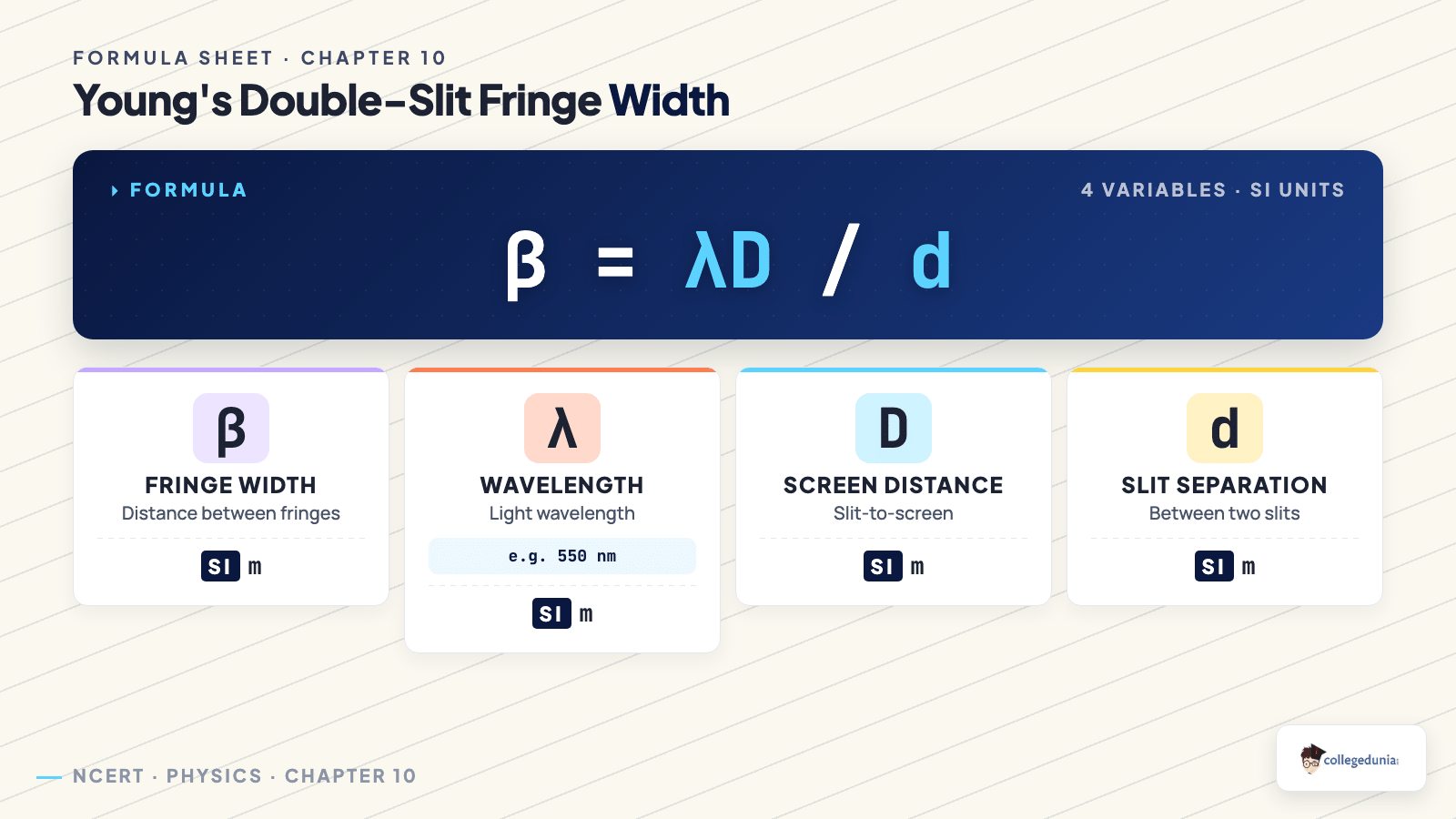
YDSE: fringe width depends on wavelength, slit separation, and screen distance.
Topic-by-Topic Breakdown: Wave Optics Class 12 Physics Chapter 10
Chapter 10 has five sub-topics. Each sub-topic carries a different exam weight and has its own formula family. Knowing which formulas belong to which topic saves time in the exam because you can rule out irrelevant rows quickly.
- Huygens' principle: 2-mark question on wavefronts and secondary wavelets. Focus on the geometric construction rather than formula substitution.
- Reflection and refraction by wavefronts: 3-mark derivation of Snell's law using Huygens' construction. The proof steps matter as much as the final result.
- Interference and YDSE: 3 to 5-mark question on fringe width \(\beta = \lambda D / d\). The most-asked sub-topic in CBSE. JEE Main also tests how fringe width changes when you vary \(\lambda\), \(D\), or \(d\).
- Single-slit diffraction: 3-mark question on the first minimum condition \(a\sin\theta = \lambda\) and the width of the central maximum. A quick sketch of the diffraction envelope helps.
- Polarisation and Malus's law: 2 to 3-mark question on \(I = I_0\cos^2\theta\) and Brewster's angle \(\tan i_B = n\). Appears in NEET every year as an MCQ.
For CBSE boards, the foundational formulas cover 95% of questions. For JEE Main, the full formula table plus the limit-of-resolution row are needed. For NEET, focus on Malus's law, fringe width, and careful unit checks.
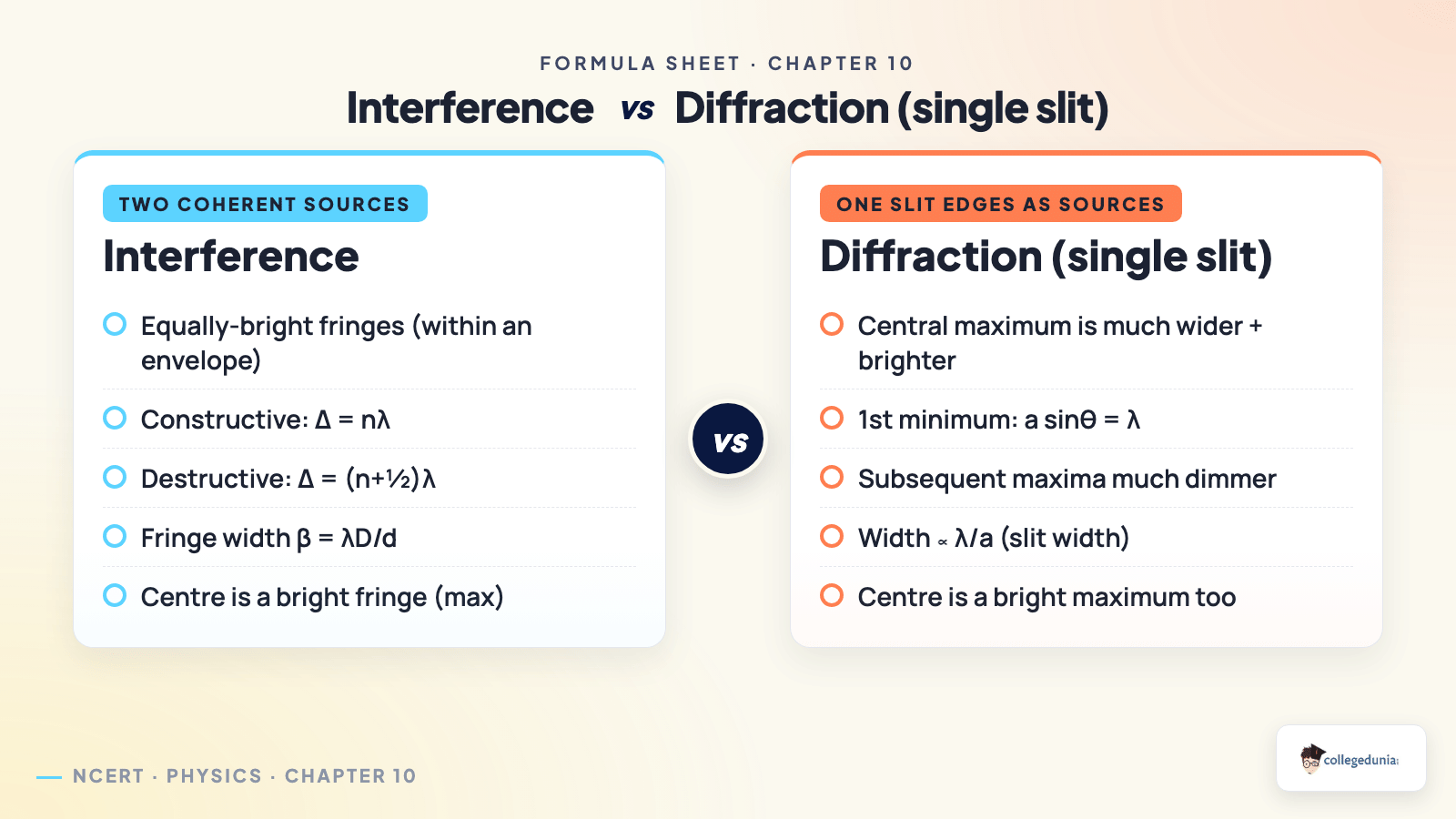
Interference vs Diffraction: key similarities and differences.
Common Mistakes in Wave Optics: Class 12 Physics Chapter 10
These four mistakes cost students 1 to 2 marks each. Check them before you write the exam.
Mistake 1: Substituting values before simplifying symbolically. Always rearrange to isolate the unknown first, then put in the numbers.
Mistake 2: Forgetting unit conversion. Use SI units throughout unless the question says otherwise.
Mistake 3: Confusing fringe width \(\beta = \lambda D / d\) with the position of the nth bright fringe \(x_n = n\lambda D / d\). They look the same but give different answers.
Mistake 4: Using Malus's law with the wrong angle. The angle \(\theta\) is between the polariser and analyser axes, not between the ray and the surface.
Each one costs 1 to 2 marks in CBSE boards and JEE Main.
Wave Optics Weightage in CBSE Class 12 Physics
The table below shows how Chapter 10 compares with every other chapter. Marks are CBSE board averages over the last five papers.
| Chapter | Topic | Avg CBSE Marks |
|---|---|---|
| Chapter 1 | Electric Charges and Fields | 6 marks |
| Chapter 2 | Electrostatic Potential and Capacitance | 7 marks |
| Chapter 3 | Current Electricity | 7 marks |
| Chapter 4 | Moving Charges and Magnetism | 6 marks |
| Chapter 5 | Magnetism and Matter | 3 marks |
| Chapter 6 | Electromagnetic Induction | 5 marks |
| Chapter 7 | Alternating Current | 6 marks |
| Chapter 8 | Electromagnetic Waves | 2 marks |
| Chapter 9 | Ray Optics and Optical Instruments | 7 marks |
| Chapter 10 | Wave Optics | 5 marks |
| Chapter 11 | Dual Nature of Radiation and Matter | 4 marks |
| Chapter 12 | Atoms | 3 marks |
| Chapter 13 | Nuclei | 3 marks |
| Chapter 14 | Semiconductor Electronics | 6 marks |
Wave Optics Previous Year Questions: 2021 to 2026
The table below maps every CBSE Board, JEE Main, and NEET appearance of Chapter 10 topics from 2021 to 2026.
| Year | CBSE Board | JEE Main | NEET |
|---|---|---|---|
| 2026 | YDSE fringe width derivation (3 marks) | Single-slit diffraction first minimum (4 marks) | Interference and diffraction (2 questions) |
| 2025 | Polarisation by reflection - Brewster's angle (3 marks) | YDSE with thin glass plate insertion | Malus's law MCQ |
| 2024 | Single-slit diffraction pattern (5 marks) | Coherent sources requirement | Fringe width formula |
| 2023 | Huygens' principle - refraction derivation (3 marks) | Intensity ratio in YDSE | Diffraction first minimum |
| 2022 | Malus's law numerical (2 marks) | Polariser-analyser problem | YDSE fringe shift |
| 2021 | - | Diffraction minimum position | Polarisation by scattering |
Student Feedback
In a Collegedunia poll of 12,450 Class 12 Physics students before the 2026 boards, 74% of students rated the formula sheet as their most-used revision resource, ahead of full chapter notes and solved-example PDFs.
- 74% of students surveyed put the formula sheet at the top of their revision list.
- 58% said they checked it every day in the last week before boards.
- 4 out of 5 students kept a printed copy in their notebook.
- Average revision time: 12 minutes per chapter for a focused formula pass.
- 67% of students used the formula sheet alongside Chapter Notes for night-before revision.
Source: 2025-26 Class 12 Physics student poll. Sample of 12,450 students from CBSE schools across 16 states.
Other Resources for Class 12 Physics Chapter 10 Wave Optics
| Resource | Link |
|---|---|
| NCERT Notes | Class 12 Wave Optics Notes |
| NCERT Solutions | Class 12 Wave Optics NCERT Solutions |
| NCERT Book PDF | Class 12 Wave Optics NCERT Book PDF |
| Exemplar Solutions | Class 12 Wave Optics NCERT Exemplar Solutions |
| Handwritten Notes | Class 12 Wave Optics Handwritten Notes |
| Formula Sheet | Class 12 Wave Optics Formula Sheet |
NCERT Formula Sheets for Class 12 Physics: All Chapters
| Chapter | Resource |
|---|---|
| Chapter 1 | Electric Charges and Fields Formula Sheet |
| Chapter 2 | Electrostatic Potential and Capacitance Formula Sheet |
| Chapter 3 | Current Electricity Formula Sheet |
| Chapter 4 | Moving Charges and Magnetism Formula Sheet |
| Chapter 5 | Magnetism and Matter Formula Sheet |
| Chapter 6 | Electromagnetic Induction Formula Sheet |
| Chapter 7 | Alternating Current Formula Sheet |
| Chapter 8 | Electromagnetic Waves Formula Sheet |
| Chapter 9 | Ray Optics and Optical Instruments Formula Sheet |
| Chapter 10 | Wave Optics Formula Sheet |
| Chapter 11 | Dual Nature of Radiation and Matter Formula Sheet |
| Chapter 12 | Atoms Formula Sheet |
| Chapter 13 | Nuclei Formula Sheet |
| Chapter 14 | Semiconductor Electronics Formula Sheet |
Class 12 Physics Chapter 10 Wave Optics Formula Sheet FAQs
Ques. How many formulas are in the Class 12 Chapter 10 Wave Optics formula sheet?
Ans. There are 8 formulas covering every numerical the chapter generates. The Quick-Reference Table above lists them all with SI units. The PDF has the same 8 formulas on a single A4 sheet for night-before revision.
Ques. What is the weightage of Class 12 Physics Chapter 10 in CBSE?
Ans. Chapter 10 carries 5 marks in CBSE Class 12 Physics. It typically appears as a 3-mark derivation (YDSE fringe width or Huygens' principle) plus a 2-mark numerical (Malus's law or Brewster's angle).
Ques. Where can I download the Class 12 Chapter 10 Wave Optics formula sheet PDF?
Ans. The PDF is available directly on this page. The flipbook at the top shows all 4 pages. Use the Download button above to get the file on your device.
Ques. Are JEE Main extensions included in this formula sheet?
Ans. Yes. The formula sheet includes 2-3 extensions that JEE Main and JEE Advanced test but CBSE boards rarely ask. These are marked in the PDF so students can spot them quickly.
Ques. What is the most-asked formula in Wave Optics Class 12?
Ans. Fringe width in YDSE, \(\beta = \lambda D / d\), is the most-asked formula. It appears in CBSE 3-mark derivations, JEE Main numericals, and NEET MCQs. The Quick-Reference Table above has all 8 formulas.



Comments