



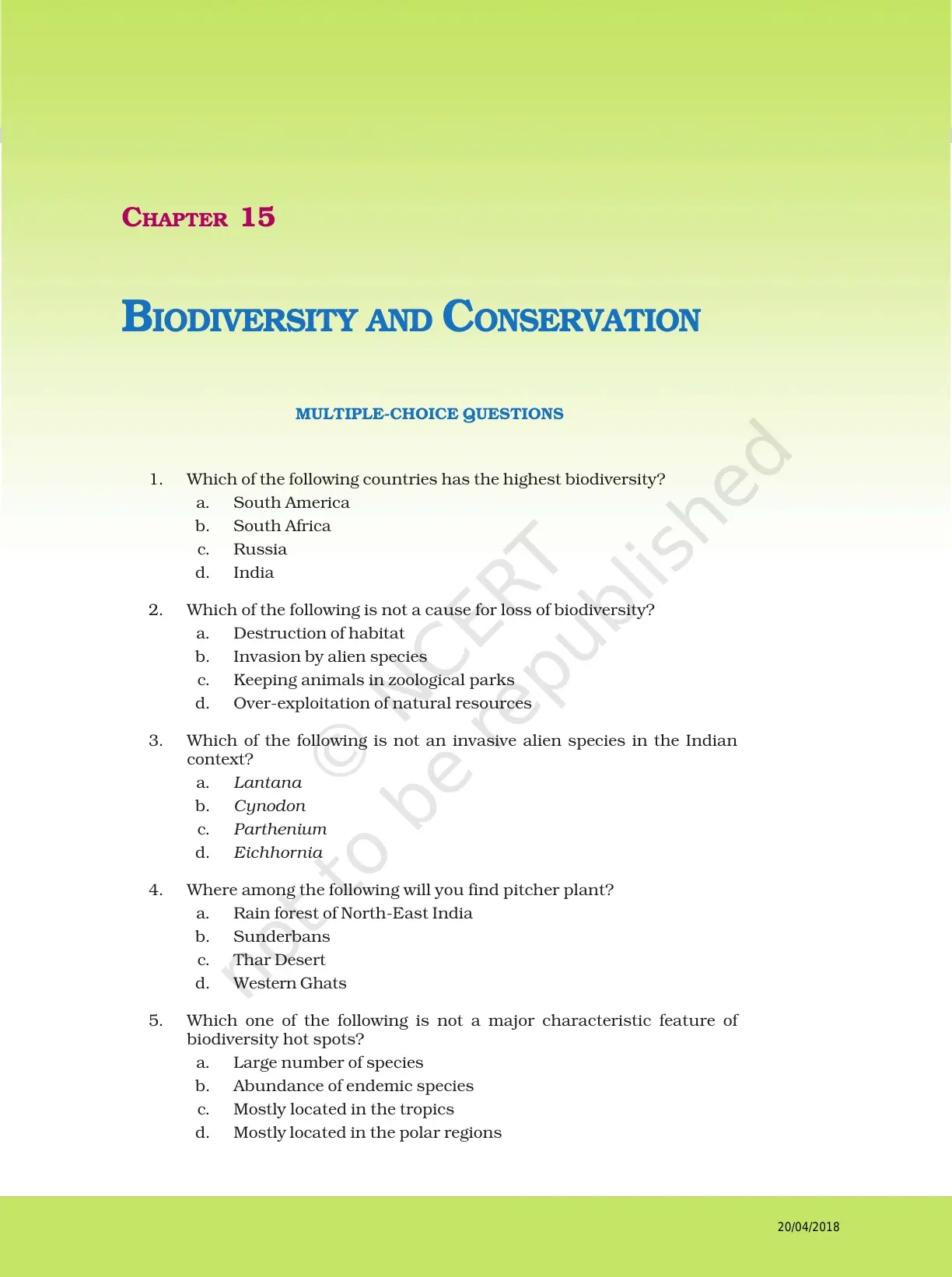
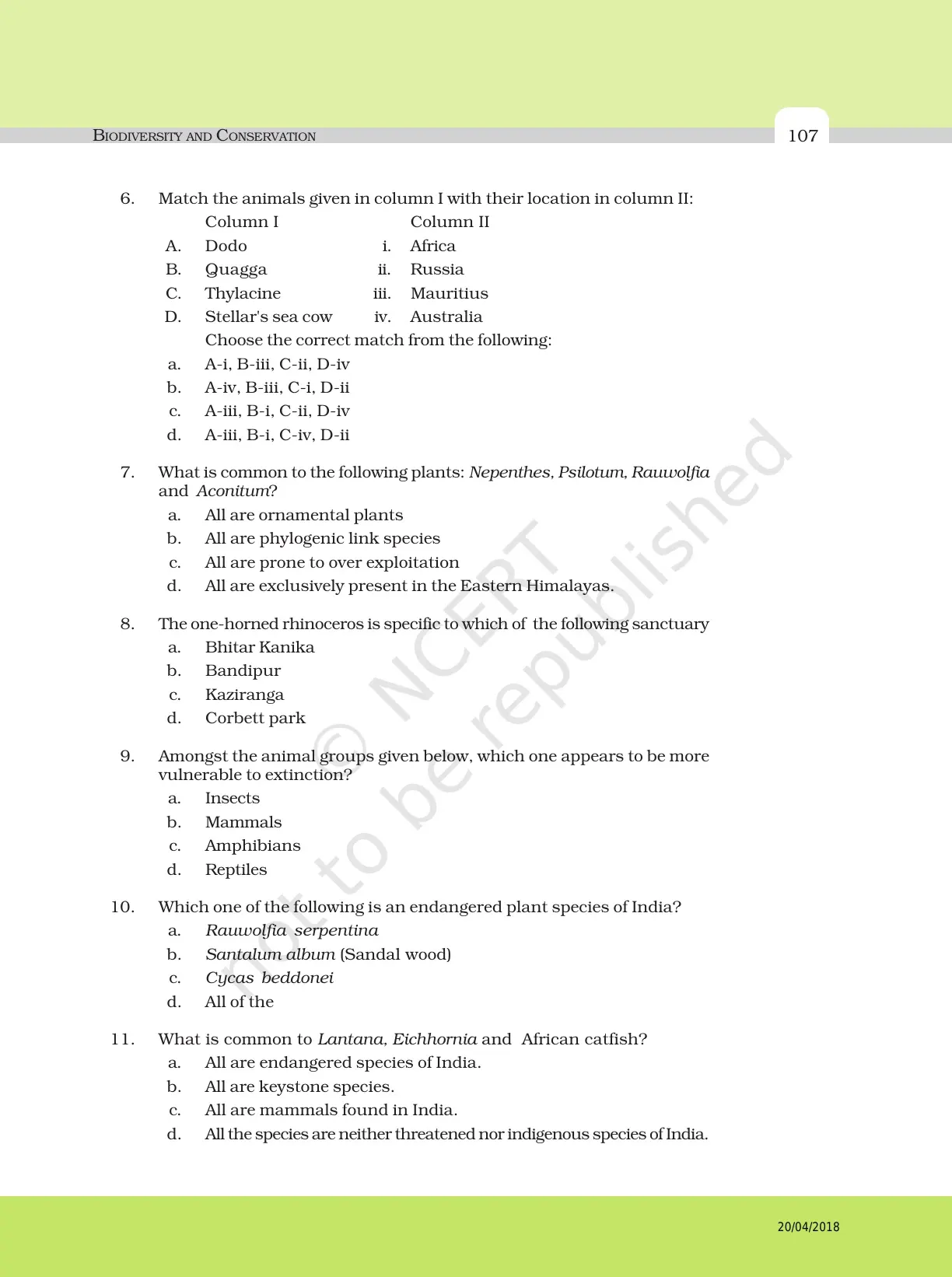
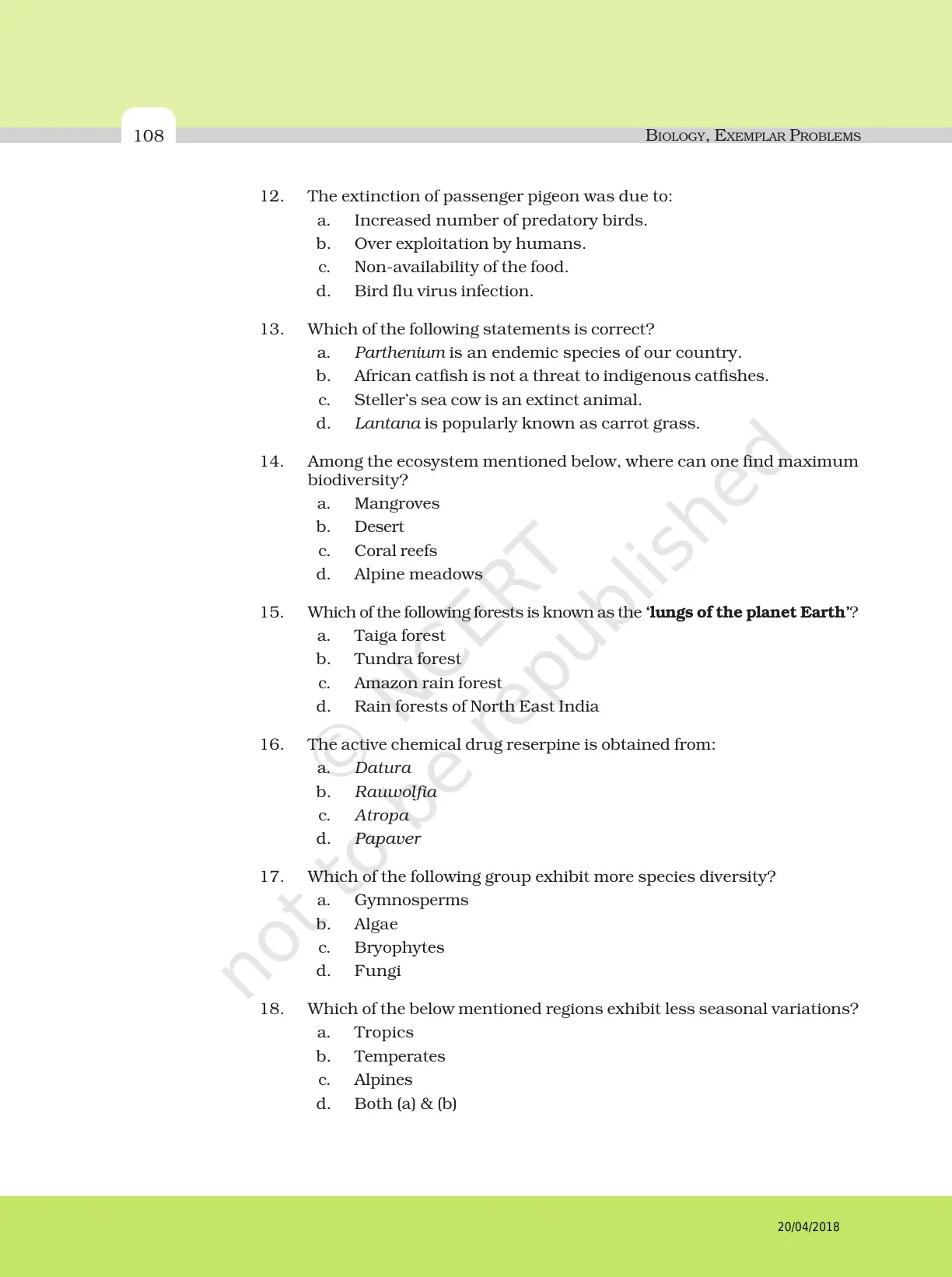
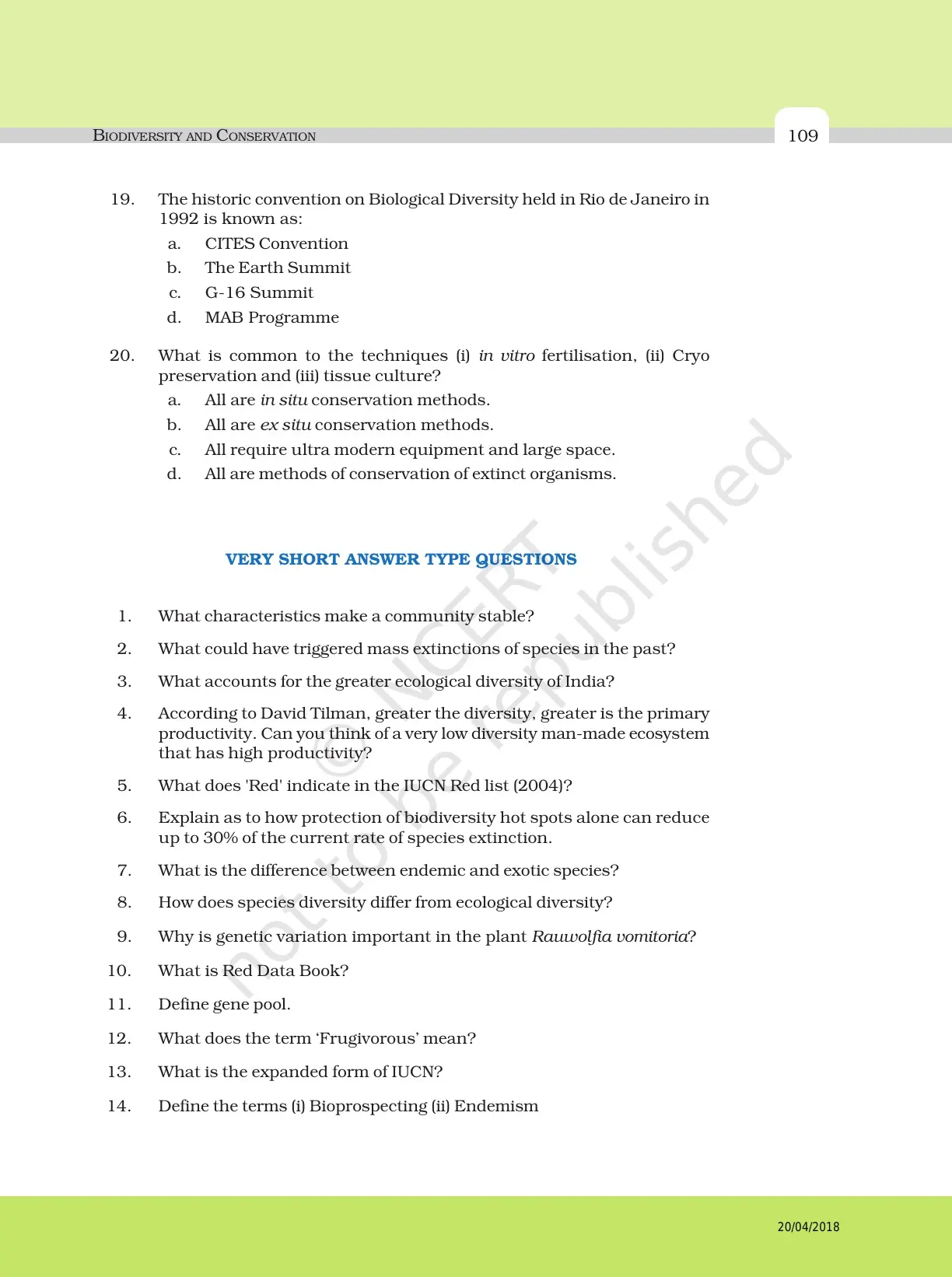
NCERT Exemplar Class 12 Biology Chapter 13 covers Biodiversity and Conservation with 46 problems across 7 pages. Topics range from global diversity patterns and the four loss drivers to IUCN Red List categories and in-situ vs ex-situ conservation - all high-frequency NEET and CBSE items. Download the free NCERT Exemplar Class 12 Biology Chapter 13 Biodiversity and Conservation PDF from the flipbook on this page.
- CBSE Weightage: 4 to 6 marks (Unit X: Ecology and Environment, part of the 14-mark block)
- NEET Weightage: 2 to 3 questions per paper (around 3 to 4% of NEET Biology)

Why Biodiversity and Conservation Is a NEET-Heavy Chapter in Class 12 Biology
Across NEET 2021 to 2025, this chapter has supplied 2 to 3 questions every single year. The most-tested clusters are the four loss drivers (the "Evil Quartet"), IUCN Red List categories, the species-area relationship, and the in-situ vs ex-situ split. The textbook teaches the concepts; the Exemplar trains students on the higher-order MCQs and match-the-following items NEET actually asks.
Three reasons the Exemplar matters for the 2026-27 NEET cycle:
- Named-example density. NEET keeps recycling specific examples: Lantana, Eichhornia and African catfish as invasive species; passenger pigeon, dodo and thylacine as extinctions. The Exemplar drills these by name.
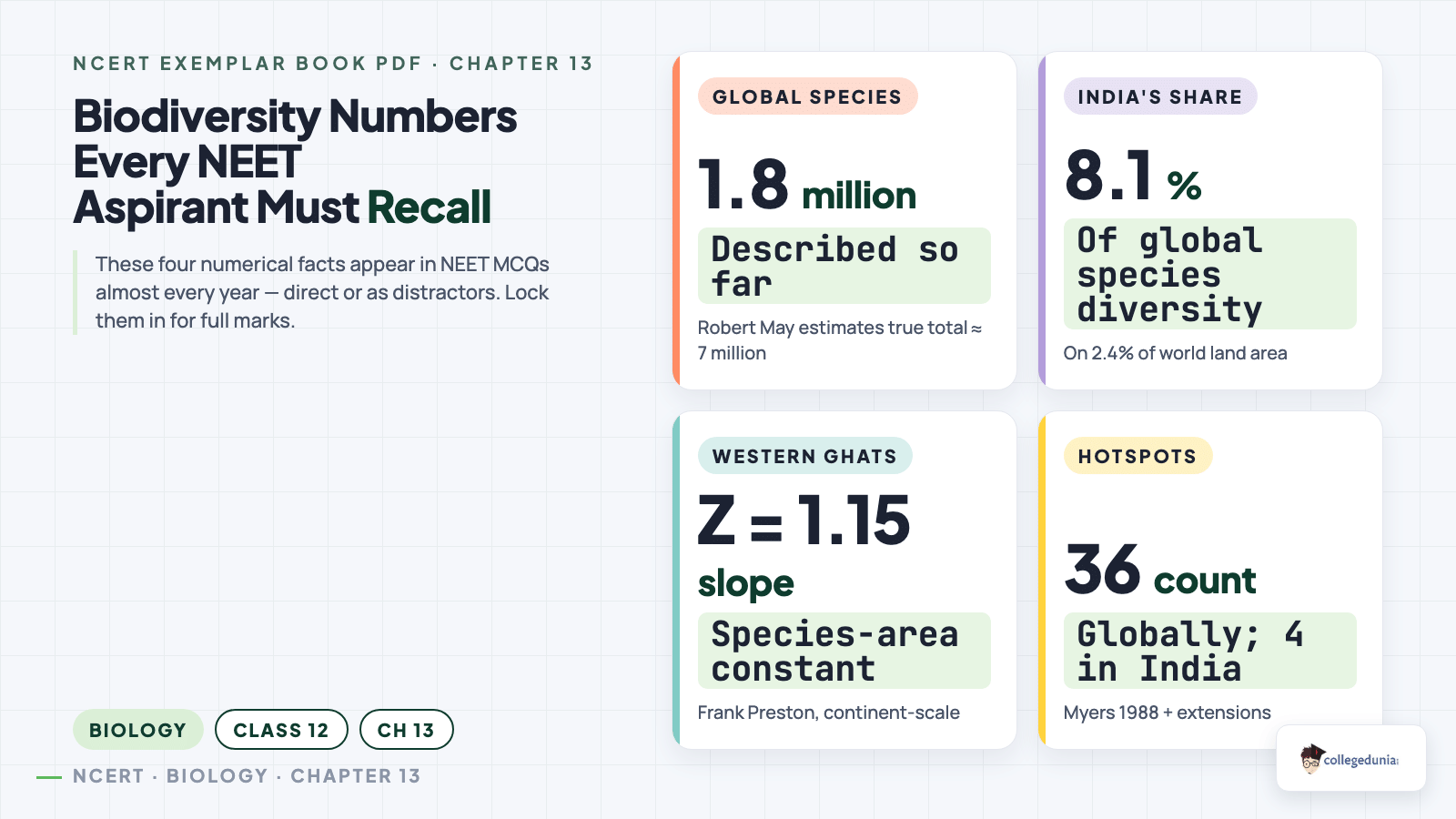
- Equation-style recall. The species-area relation log S = log C + Z log A with slope Z = 0.1 to 0.2 (small areas) vs 0.6 to 1.2 (large areas) is a recurring NEET stem the Exemplar repeats with different setups.
- Conservation-strategy distinctions. In-situ (National Parks, Sanctuaries, Biosphere Reserves, Sacred Groves) vs ex-situ (zoos, seed banks, cryopreservation) is the most-asked split. Exemplar MCQ-20 tests it directly.
How This NCERT Exemplar Book PDF Helps You with Biodiversity and Conservation
This page hosts the official NCERT print, paired with a question-type breakdown, a difficulty walk-through, and a parallel-track plan for the 2026-27 syllabus. Four ways it shortens your prep:
- Single download for the entire 7-page Exemplar. No chapter-splitting, no watermarks, mobile-readable.
- Mapped to NEET-style traps. Each block is tagged with the trap it teaches (invasive vs native confusion, IUCN colour misreading, in-situ vs ex-situ mixing).
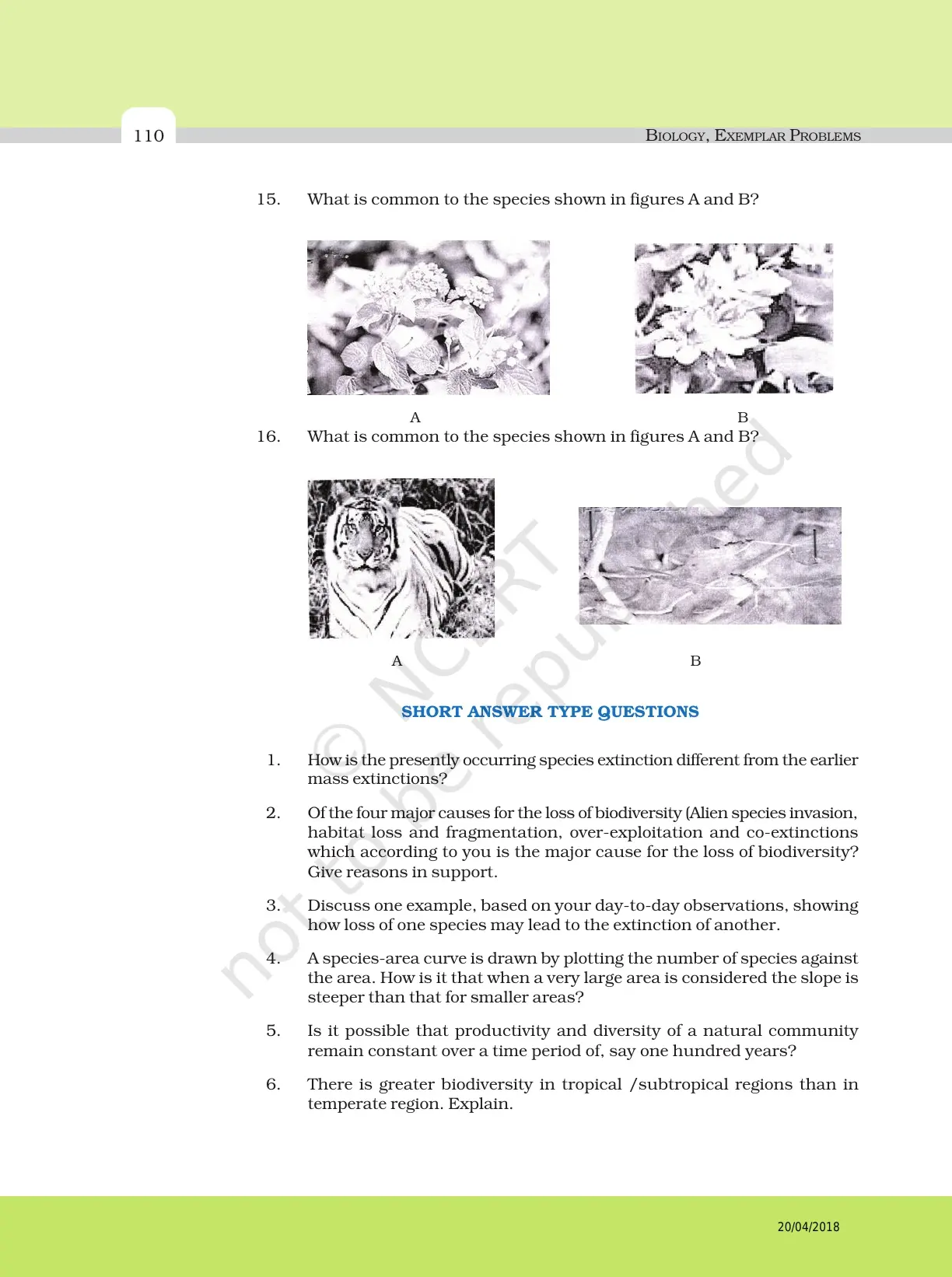
- Image-based MCQs flagged. Questions 15 and 16 of the VSA section use photo plates; you are told upfront what to look for so figure quality does not block your prep.
- Aligned with the matching Exemplar Solutions page so students can self-check after attempting each block.
What's Inside the Class 12 Biology Chapter 13 Biodiversity and Conservation Exemplar PDF
The 7 pages run as one continuous problem set across three question types. The table below maps each block to its problem range and page range inside the PDF.
| Section | Problem Range | Pages | What It Covers |
|---|---|---|---|
| Multiple Choice Questions (MCQ) | 1 to 20 | 106-109 | Country-level diversity, four loss drivers, invasive species (Lantana, Eichhornia), endangered Indian species, Rio 1992, in-situ vs ex-situ, match on extinct animals |
| Very Short Answer (VSA) | 1 to 17 (incl. 2 image MCQs) | 109-111 | Community stability, mass extinctions, IUCN Red List, gene pool, Red Data Book, bioprospecting, endemism, sacred groves; questions 15 and 16 are photo-plate identification |
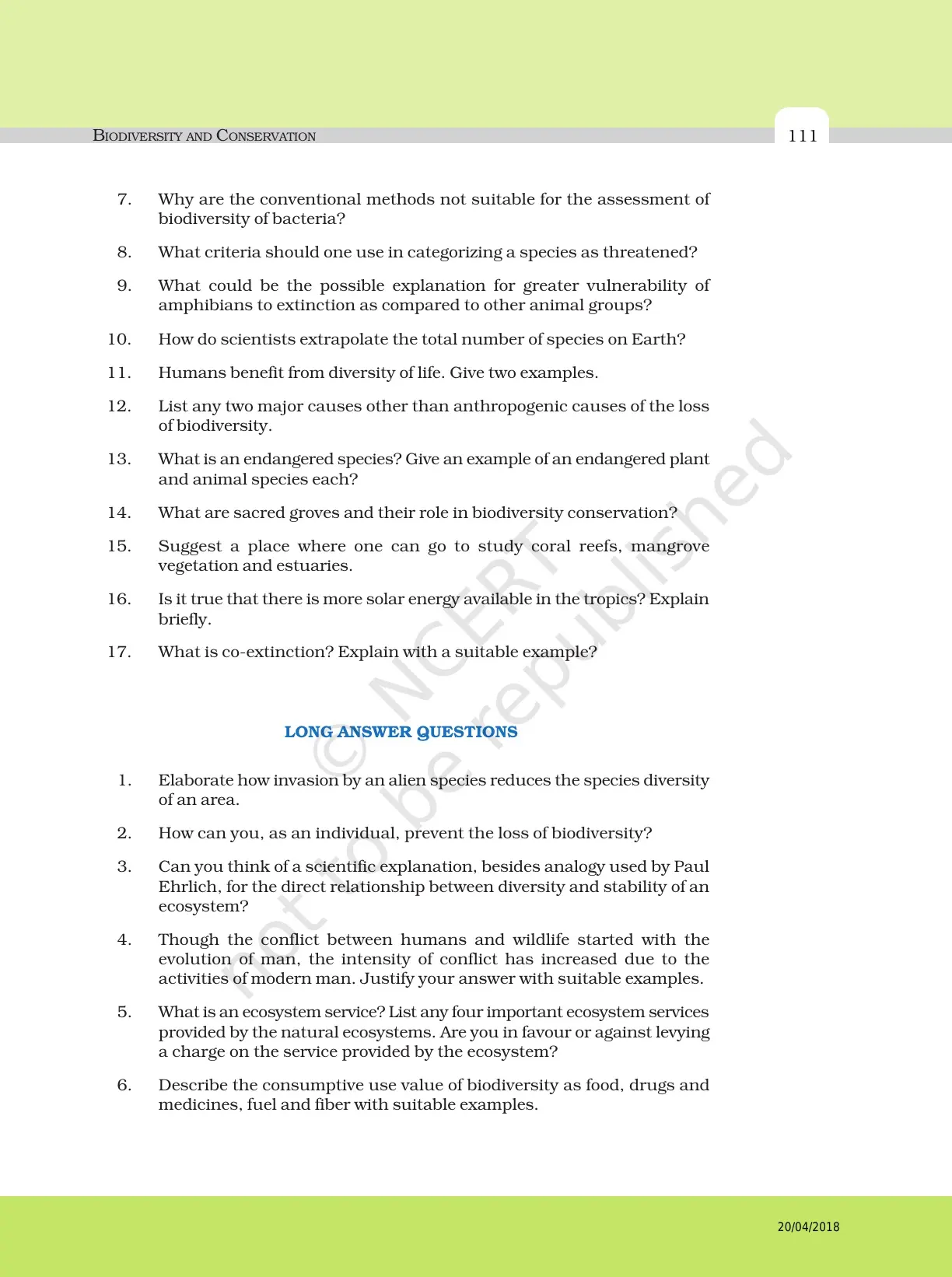
| Long Answer (LA) | 1 to 9 | 111-112 | Alien-species invasion, individual conservation, diversity-stability, ecosystem services, consumptive use, latitudinal gradient, rivet-popper hypothesis, species-area hyperbola |
MCQ + VSA together carry 37 of 46 items. The 9 long-answer items convert to CBSE 5-mark answers; rivet-popper (LA 8) and ecosystem services (LA 5) are repeat board favourites.
Note on numbering: the NCERT Exemplar labels this chapter as Exemplar Chapter 15, mirroring the older textbook order. The current 2026-27 textbook places Biodiversity and Conservation as Chapter 13. Both refer to the same Exemplar booklet.
Biodiversity and Conservation Exemplar Difficulty Walk-through
A difficulty-graded read order for the 46 problems. Start with easy items to build accuracy, then move to medium and hard items for NEET traps and CBSE long-answer practice.
| Difficulty | Q Range | Topic Anchor |
|---|---|---|
| Easy (recall) | MCQ 1 to 10, VSA 1 to 5 | Country diversity ranking, loss drivers, invasive species names, hot-spot characteristics, IUCN Red List, community stability |
| Medium (concept) | MCQ 11 to 20, VSA 6 to 14, LA 1 to 3 | Lungs of the planet, reserpine source, in-situ vs ex-situ, sacred groves, gene pool, endemism vs exotic, alien-species invasion, diversity-stability basis |
| Hard (NEET / board trap) | VSA 15 to 17, LA 4 to 9 | Image-plate identification, co-extinction, ecosystem-service valuation, consumptive-use list, latitudinal gradient theories, rivet-popper hypothesis, species-area hyperbola |
Parallel-Track Plan: Pair the Exemplar with the NCERT Textbook
The Exemplar is best read after a textbook pass. The five-day plan below sequences textbook reading and Exemplar drilling so the two reinforce each other.
| Day | Textbook (Ch 13) | Exemplar Block |
|---|---|---|
| 1 | 15.1 Biodiversity patterns + importance | MCQ 1, 14, 17, 18 + VSA 3, 8, 11, 16 + LA 7 |
| 2 | 15.2 Biodiversity Loss (Evil Quartet) | MCQ 2, 3, 7, 11, 12, 13 + VSA 2, 7, 12, 17 + LA 1, 2 |
| 3 | 15.3 Conservation: why and how | MCQ 4, 5, 6, 8, 9, 10, 15, 16, 19, 20 + VSA 1, 5, 6, 10, 13, 14, 15 + LA 4, 5 |
| 4 | 15.3 continued (in-situ vs ex-situ deep dive) | VSA 4, 9 + LA 3, 6, 9 |
| 5 | Full chapter revision + chapter-end exercise | LA 8 (rivet-popper) + chapter-end exercise |
By Day 5 students finish the textbook, all 46 Exemplar problems, and the chapter-end exercises in one coherent loop. Reserve a sixth day for a mixed-set mock from previous NEET papers to lock in retention.
Full worked answers to all 46 Exemplar problems: Biodiversity and Conservation Class 12 Biology NCERT Exemplar Solutions.
Biodiversity and Conservation Video Lecture for Class 12 Biology
Source: PW Test Series on YouTube
This lecture covers the Evil Quartet, in-situ vs ex-situ strategies, and IUCN Red List categories - the three clusters NEET has asked most from this chapter.
Other Resources for Biodiversity and Conservation Class 12 Biology
| Resource Type | Link |
|---|---|
| Exemplar Book PDF (this page) | Biodiversity and Conservation Exemplar Book PDF |
| NCERT Solutions | Biodiversity and Conservation Class 12 Biology NCERT Solutions |
| Notes | Biodiversity and Conservation Class 12 Biology Notes |
| Formula Sheet | Biodiversity and Conservation Class 12 Biology Formula Sheet |
| Handwritten Notes | Biodiversity and Conservation Class 12 Biology Handwritten Notes |
| NCERT Book PDF | Biodiversity and Conservation Class 12 Biology NCERT Book PDF |
| Exemplar Solutions | Biodiversity and Conservation Class 12 Biology Exemplar Solutions |
NCERT Exemplar Book PDF for Class 12 Biology: All Chapters
Browse the NCERT Exemplar Class 12 Biology Book PDF chapter-by-chapter on Collegedunia.
| Chapter No. | Chapter Title |
|---|---|
| Chapter 1 | Sexual Reproduction in Flowering Plants Exemplar Book PDF |
| Chapter 2 | Human Reproduction Exemplar Book PDF |
| Chapter 3 | Reproductive Health Exemplar Book PDF |
| Chapter 4 | Principles of Inheritance and Variation Exemplar Book PDF |
| Chapter 5 | Molecular Basis of Inheritance Exemplar Book PDF |
| Chapter 6 | Evolution Exemplar Book PDF |
| Chapter 7 | Human Health and Disease Exemplar Book PDF |
| Chapter 8 | Microbes in Human Welfare Exemplar Book PDF |
| Chapter 9 | Biotechnology: Principles and Processes Exemplar Book PDF |
| Chapter 10 | Biotechnology and Its Applications Exemplar Book PDF |
| Chapter 11 | Organisms and Populations Exemplar Book PDF |
| Chapter 12 | Ecosystem Exemplar Book PDF |
| Chapter 13 | Biodiversity and Conservation Exemplar Book PDF |
Student Feedback on Biodiversity and Conservation from Class 12 Biology Students
In an independent survey of 10,800 Class 12 Biology students before the 2026 boards, 72% rated the species-area curve numerical (log S = log C + Z log A) as the hardest sub-topic in this chapter.
Student Feedback
- 72% of students surveyed marked the species-area curve numerical as the hardest sub-topic.
- 61% reported losing marks on matching IUCN categories (EX, EW, CR, EN, VU, NT, LC).
- 4 out of 5 students said the world biodiversity-hotspot map was the most-skipped figure.
- Average student took 4.8 hours for the first read, and 2.0 hours for a focused revision pass.
Source: 2025-26 Class 12 Biology student survey. Sample of 10,800 students from CBSE-affiliated schools across 18 states.
Biodiversity and Conservation Class 12 Biology NCERT Exemplar Book PDF FAQs
Ques. Where can I download the NCERT Exemplar Class 12 Biology Chapter 13 Biodiversity and Conservation PDF?
Ans. You can download the official NCERT Exemplar Class 12 Biology Biodiversity and Conservation PDF directly from this page. The file is the verified Exemplar reprint covering all 46 problems across MCQ, VSA and LA formats, aligned with the 2026-27 NCERT.
Ques. How many problems does the NCERT Exemplar Biodiversity and Conservation chapter have?
Ans. 46 problems split as 20 MCQ + 17 VSA + 9 LA across 7 pages. Unlike most Biology Exemplar chapters, this one omits the SA section; the long-answer block carries the bulk of the conceptual depth.
Ques. Why is the Exemplar numbered Chapter 15 when the textbook says Chapter 13?
Ans. The NCERT Exemplar publication labels this chapter as Exemplar Chapter 15, mirroring the older NCERT textbook ordering. The current 2026-27 textbook places Biodiversity and Conservation as Chapter 13 after a renumbering of the ecology unit. Both refer to the same Exemplar booklet.
Ques. Is the Exemplar more important than the textbook for NEET preparation?
Ans. Both are essential. The textbook teaches the concepts; the Exemplar drills the higher-order MCQ and match-the-following patterns NEET actually uses. Most rank-holders do the textbook first, then the Exemplar, then attempt the chapter-end NCERT exercises.
Ques. Which Exemplar question types appear most in NEET Biodiversity questions?
Ans. MCQ-style problems on the four loss drivers (Evil Quartet), invasive species names (Lantana, Eichhornia, African catfish), the IUCN Red List, and the in-situ vs ex-situ split are the four most-reused stems in NEET 2021 to 2025.
Ques. Does the Exemplar cover the species-area relationship and the rivet-popper hypothesis?
Ans. Yes. LA 8 asks for the rivet-popper hypothesis directly, and LA 9 asks for the species-area rectangular-hyperbola explanation. Both are repeat CBSE 5-mark items and worth a second pass during revision.
Ques. Does this PDF include the Exemplar answers?
Ans. No. The NCERT Exemplar booklet only carries the questions; the answers sit in a separate Exemplar Solutions document. For step-by-step worked solutions, visit the Biodiversity and Conservation Exemplar Solutions page.



Comments