The NCERT Exemplar for Class 12 Biology Chapter 3 Reproductive Health carries 37 problems: 13 MCQ, 10 VSA, 9 SA and 5 LA. Almost all are built around contraception, ART, MTP and population control. This page hosts the fully worked Exemplar solutions PDF, mapped to the 2026-27 NCERT.
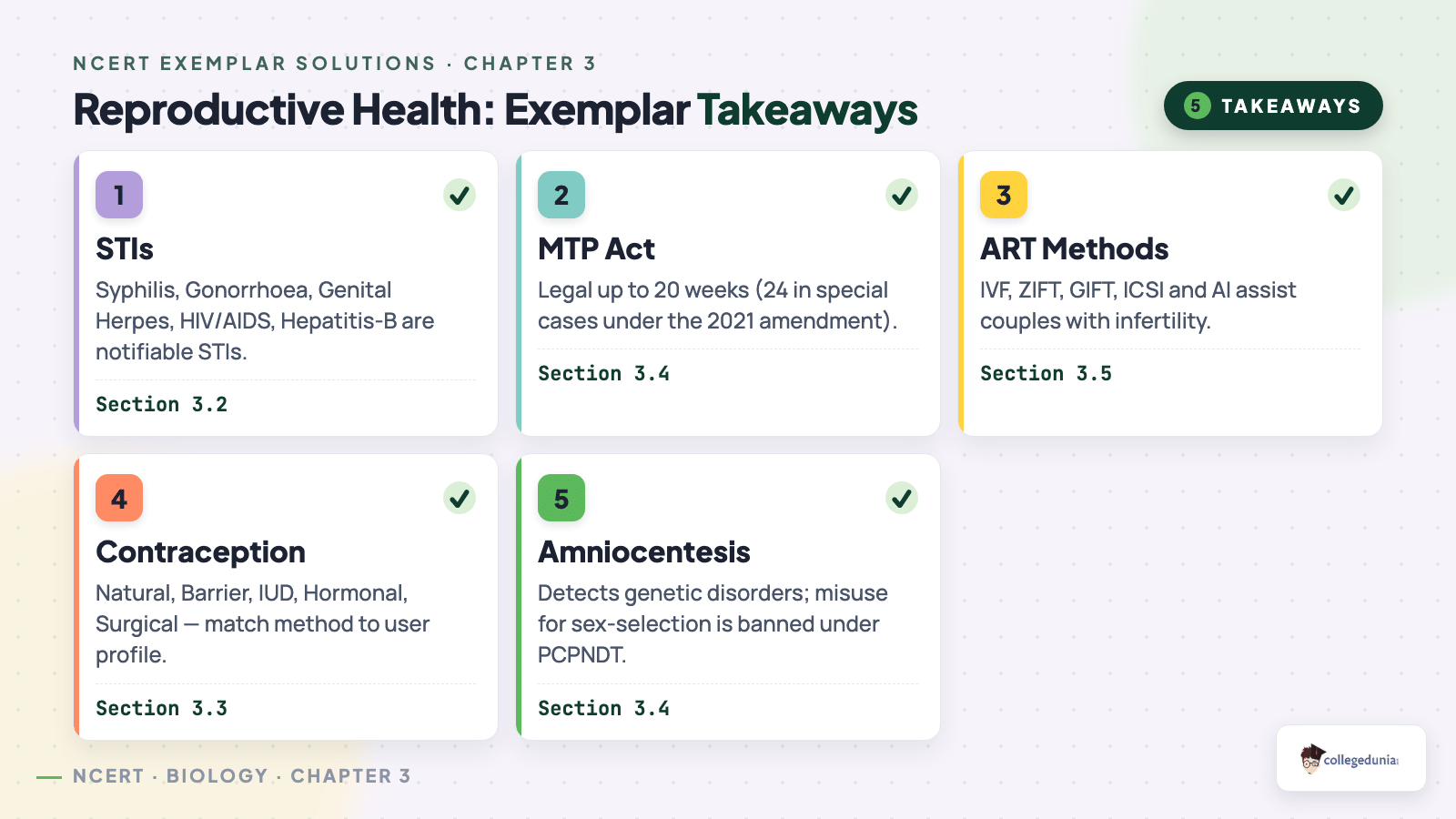
CBSE Weightage: 4 to 6 marks (usually one VSA on contraceptive devices plus one short or long answer on ART or population control)
NEET Weightage: 2 to 4 questions per year
CUET Weightage: 1 to 2 recall questions per slot
37 Exemplar problems | 13 MCQ + 10 VSA + 9 SA + 5 LA | Contraception, ART, MTP, STDs, population control · Class 12 Biology Chapter 3, 2026-27 NCERT
These Exemplar Solutions are curated by NEET-rank-holder mentors at Collegedunia, mapped to the 2026-27 NCERT chapter and the last five years of CBSE and NEET papers.
Reproductive Health is one of the highest-yield NEET chapters for its short length. The snapshot below sets its yield next to neighbouring chapters.
Ch 1 Sexual Reproduction in Flowering Plants
3 Qs
Ch 2 Human Reproduction
4 Qs
Ch 3 Reproductive Health
3 Qs
Ch 4 Inheritance and Variation
5 Qs
Ch 7 Human Health and Disease
4 Qs
Per-chapter NEET yield over the last five papers (2025 to 2021). Finish these 37 problems and you rarely lose a Reproductive Health mark in NEET.
How Will Collegedunia's NCERT Exemplar Solutions Help You with Reproductive Health?
Reproductive Health is light on theory but heavy on close-confusion pairs (GIFT vs ZIFT vs IVF-ET, IUD vs diaphragm, IMR vs MMR). These solutions clear those confusions.
2026-27 NCERT Alignment: Every solution is checked against the current Chapter 3 text.
Type-by-Type Solving: MCQ, VSA, SA and LA answers match the length a NEET or CBSE sheet rewards.
Reason-First Answers: Each MCQ states why the distractors fail, turning a 50-50 guess into a sure mark.
Exam-Mapped: Every problem is tagged to where it last surfaced in NEET or CBSE.
Reproductive Health Exemplar Question-Type Tour with One Sample Solved per Type
Question Type
Count
Typical Demand
MCQ (single and combination)
13
One-line recall plus distractor elimination
Very Short Answer (VSA)
10
Two to three sentence reasoned point
Short Answer (SA)
9
Three to four point structured answer
Long Answer (LA)
5
Multi-part description with named examples
Sample LA (Q3). STDs threaten reproductive health. Describe any two and suggest preventive measures.
Answer:Gonorrhoea (bacterial) causes burning urination and pelvic inflammation; AIDS (HIV) destroys helper T-cells. Prevention: avoid unknown partners, use condoms, use sterile needles and screened blood, and seek early diagnosis. The ICSI and copper-IUD samples are worked in the PDF.
Sample MCQ Walk-Through: The Most-Missed Combination Item
The most-failed item is the sterilisation combination MCQ (Exemplar Q4). Students tick one true reason and stop, but all four reasons hold, so the answer is (d), all four.
Watch Out: In combination MCQs, never lock an option after one true statement. Roughly one in three students loses this exact mark by stopping early.
Difficulty Step-Up From NCERT Textbook to Exemplar
The textbook asks "what is amniocentesis?"; the Exemplar asks you to "justify its statutory ban" (LA Q4). Each item sits one level above the textbook, so solving them is the fastest route to full marks on NEET reasoning.
All NCERT Exemplar Questions for Reproductive Health with Step-by-Step Solutions
Every NCERT Exemplar question for Class 12 Biology Chapter 3 Reproductive Health is listed below with its full Solution and Expert Solution in collapsible tabs. Click a tab to reveal the working.
Questions
Q 3.1
The method of directly injecting a sperm into ovum in Assisted Reproductive Technology is called:
(a) GIFT
(b) ZIFT
(c) ICSI
(d) ET
Correct option: (c) ICSI.
Concept used.Assisted Reproductive Technologies (ART)
are clinical methods that help infertile couples have a child. Each
named technique differs only in what is transferred and
where it is placed:
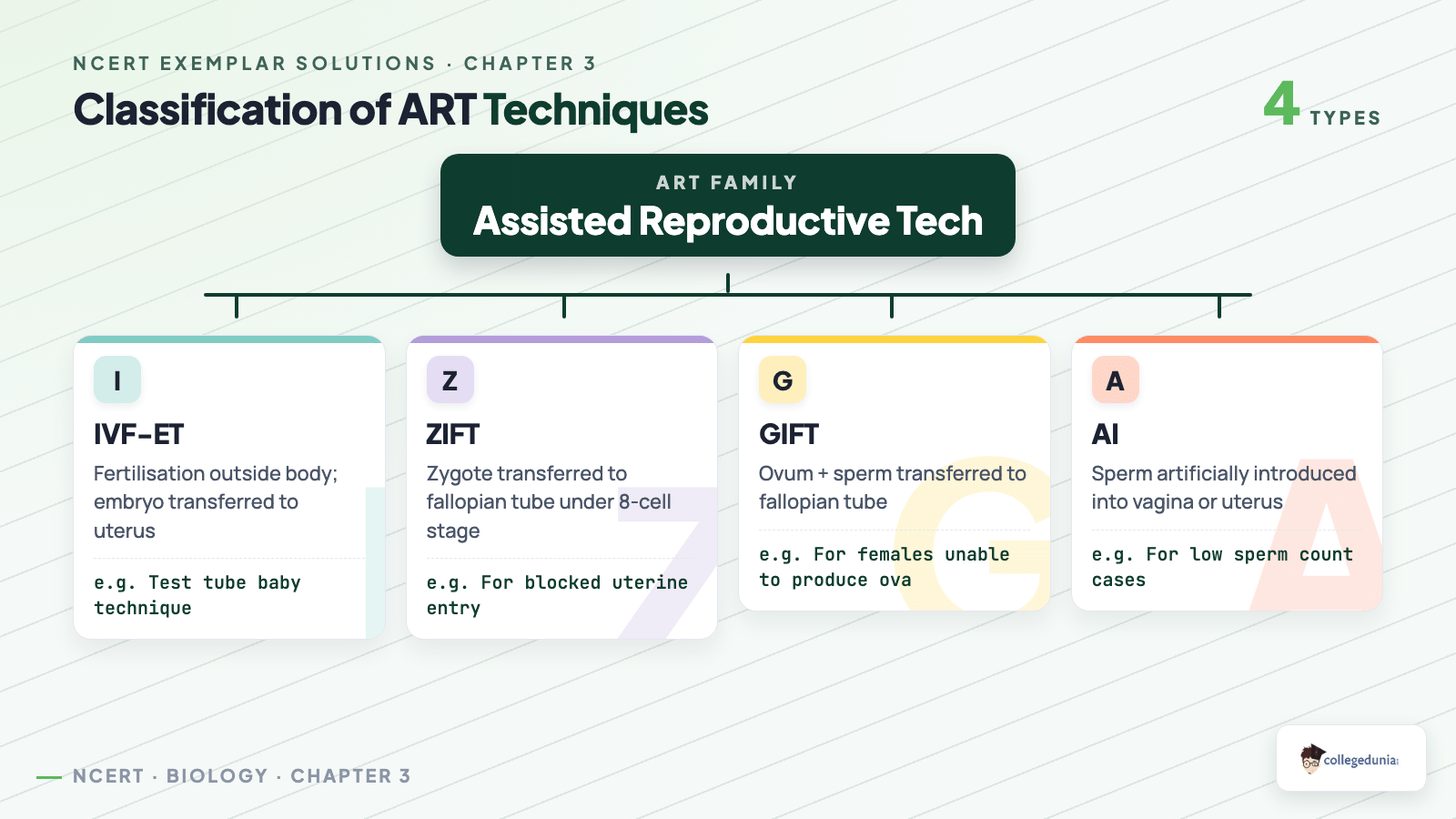
ICSI (Intra Cytoplasmic Sperm Injection): a single
sperm is injected directly into the cytoplasm of the ovum to
form the zygote in the laboratory.
GIFT (Gamete Intra Fallopian Transfer): an ovum
collected from a donor is transferred into the fallopian tube
of another female who cannot produce ova.
ZIFT (Zygote Intra Fallopian Transfer): the zygote
or early embryo (up to 8 blastomeres) is transferred into the
fallopian tube.
ET (Embryo Transfer): an embryo of more than 8
blastomeres is transferred into the uterus.
The question describes a sperm being put straight into
the ovum. Match this against the definitions above: only
ICSI involves direct injection of a sperm into the
ovum.
Eliminate the distractors. (a) GIFT moves a gamete, not a
sperm into an ovum. (b) ZIFT moves an already formed zygote.
(d) ET moves an embryo. None of these is "inject a sperm into
an ovum".
Option (c) ICSI: a sperm is injected directly into the ovum.
AI
Aanya Iyer
M.Sc Biotechnology, AIIMS Delhi
Verified Expert
Structural observation. I read ART techniques as a "what is
moved, and to where" table. Build that table once and every MCQ on
this topic collapses to a one-line lookup.
Tabulate the four options. ICSI: one sperm → injected
into ovum (in vitro). GIFT: donor ovum → fallopian tube.
ZIFT: zygote/early embryo → fallopian tube. ET: embryo
(>8 cells) → uterus.
The phrase "directly injecting a sperm into ovum" maps to
exactly one row of the table: ICSI. The verb "inject" is
unique to ICSI, so no other option can be correct.
Sanity check: ICSI is used when sperm count is very low or
sperm cannot penetrate the ovum on its own, so direct
injection is the only ART that physically forces fertilisation.
This matches the clinical purpose described.
Why this matters. A single keyword ("inject", "gamete",
"zygote", "embryo") fixes the answer. Reading the verb first saves
time in the exam.
ICSI: option (c).
Q 3.2
Increased IMR and decreased MMR in a population will:
(a) Cause rapid increase in growth rate
(b) Result in decline in growth rate
(c) Not cause significant change in growth rate
(d) Result in an explosive population
Correct option: (b) Result in decline in growth rate.
Concept used.IMR (Infant Mortality Rate) is the
number of infant deaths (under one year) per 1000 live births in a
year. MMR (Maternal Mortality Rate) is the number of
maternal deaths per 1,00,000 live births. Population growth rate
depends on births adding people and deaths removing them. A higher
death rate of any group lowers the growth rate; a lower death rate
of any group, on its own, does not add new people.
Increased IMR means more infants die. Fewer of the
born children survive, so the surviving population grows more
slowly. This pushes the growth rate down.
Decreased MMR means fewer mothers die. This protects
mothers but does not by itself create extra births, so it has
only a weak upward effect on growth, far smaller than the
infant-death effect.
Combine the two. The strong downward push from increased IMR
outweighs the weak effect of decreased MMR. The net result is
a decline in the population growth rate.
Option (b): the growth rate declines.
RV
Rohit Verma
M.Sc Zoology, Banaras Hindu University
Verified Expert
Strategic angle. Treat growth rate as births minus deaths.
Then judge each rate by how strongly it moves that difference.
Write growth rate ∝ (births) - (deaths). IMR and
MMR are both death terms.
Decreased MMR ⇒ deaths term falls slightly, but
saving a mother's life does not instantly add a birth, so the
upward effect is small.
Net effect: the large fall from rising infant deaths wins, so
growth declines. Distractors (a) and (d) need a rising birth
component, which is absent here.
Why this matters. Population questions reward thinking in
"what adds people vs what removes people" rather than memorised
phrases.
Decline in growth rate: option (b).
Q 3.3
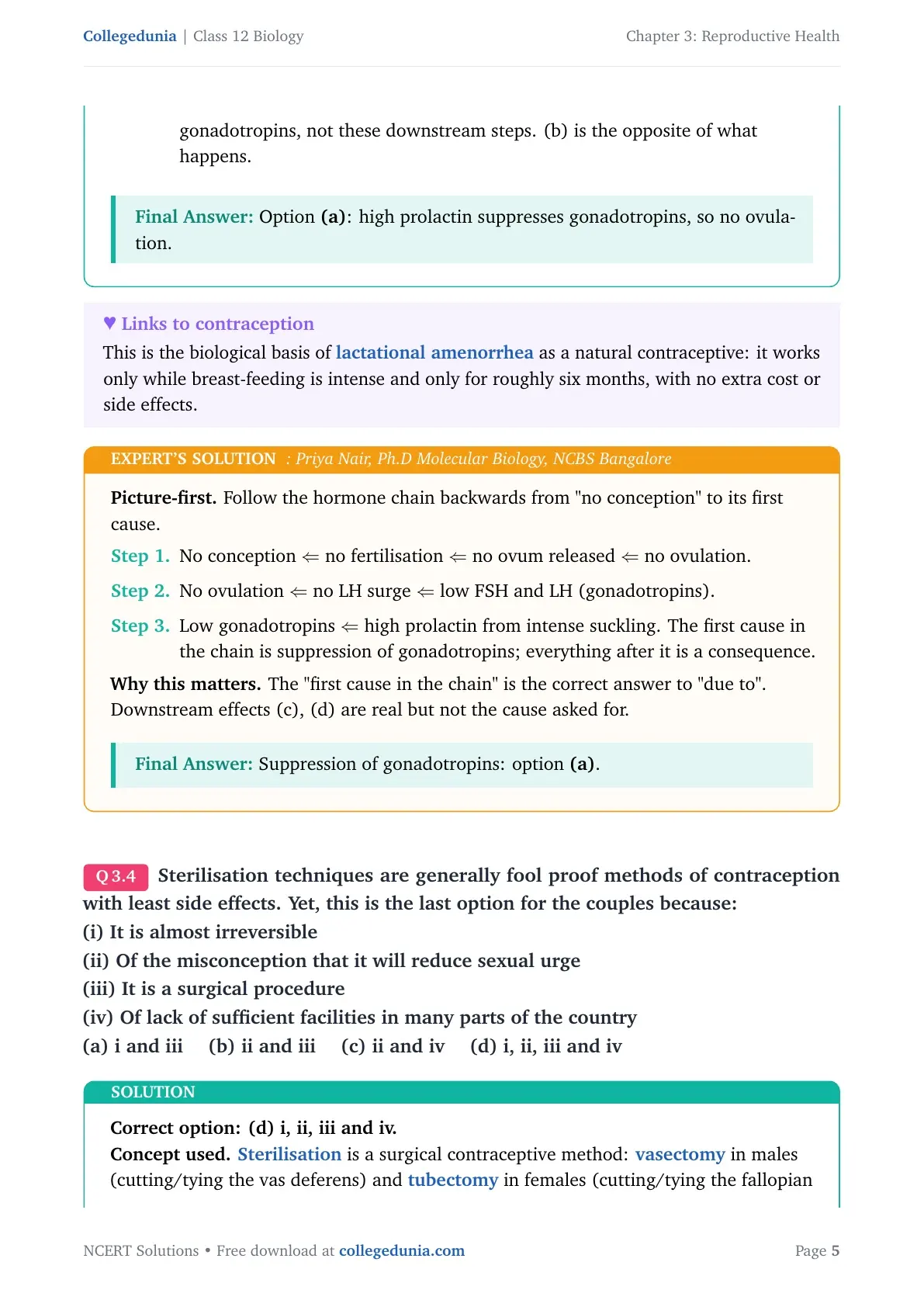
Intensely lactating mothers do not generally conceive due to the:
(a) Suppression of gonadotropins
(b) Hyper secretion of gonadotropins
(c) Suppression of gametic transport
(d) Suppression of fertilisation
Correct option: (a) Suppression of gonadotropins.
Concept used.Lactational amenorrhea is the absence
of the menstrual cycle during the period a mother is intensely
breast-feeding. Gonadotropins are FSH and LH, released by
the anterior pituitary; they drive follicle growth and ovulation.
Intense suckling raises blood prolactin, and prolactin
suppresses the release of GnRH and hence of FSH and LH.
Intense and frequent suckling keeps blood prolactin high.
High prolactin suppresses the hypothalamic GnRH pulse, which
in turn suppresses pituitary release of FSH and LH (the
gonadotropins).
Without FSH and LH there is no follicle maturation and no
ovulation. No ovum is released, so fertilisation and
conception cannot occur (effective only up to about six
months after childbirth).
Check the distractors: gametic transport (c) and fertilisation
(d) never even begin because no ovum is produced, so the
root cause is the suppression of gonadotropins, not
these downstream steps. (b) is the opposite of what happens.
Option (a): high prolactin suppresses gonadotropins, so no ovulation.
PN
Priya Nair
Ph.D Molecular Biology, NCBS Bangalore
Verified Expert
Picture-first. Follow the hormone chain backwards from
"no conception" to its first cause.
No conception ⇐ no fertilisation ⇐ no
ovum released ⇐ no ovulation.
No ovulation ⇐ no LH surge ⇐ low FSH and
LH (gonadotropins).
Low gonadotropins ⇐ high prolactin from intense
suckling. The first cause in the chain is suppression of
gonadotropins; everything after it is a consequence.
Why this matters. The "first cause in the chain" is the
correct answer to "due to". Downstream effects (c), (d) are real but
not the cause asked for.
Suppression of gonadotropins: option (a).
Q 3.4
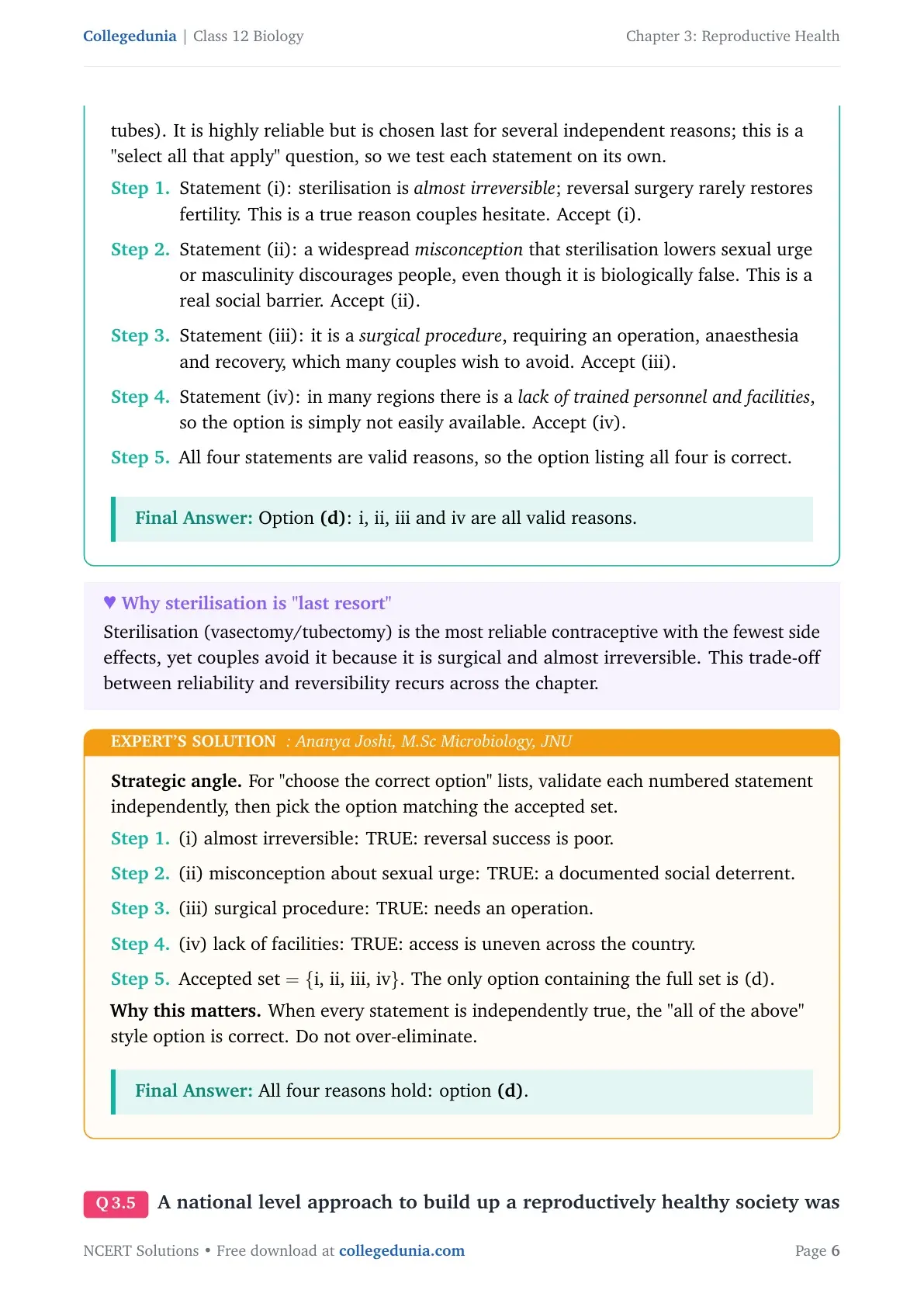
Sterilisation techniques are generally fool proof methods of contraception with least side effects. Yet, this is the last option for the couples because:
(i) It is almost irreversible
(ii) Of the misconception that it will reduce sexual urge
(iii) It is a surgical procedure
(iv) Of lack of sufficient facilities in many parts of the country
(a) i and iii (b) ii and iii (c) ii and iv (d) i, ii, iii and iv
Correct option: (d) i, ii, iii and iv.
Concept used.Sterilisation is a surgical
contraceptive method: vasectomy in males (cutting/tying the
vas deferens) and tubectomy in females (cutting/tying the
fallopian tubes). It is highly reliable but is chosen last for several
independent reasons; this is a "select all that apply" question, so
we test each statement on its own.
Statement (i): sterilisation is almost irreversible;
reversal surgery rarely restores fertility. This is a true
reason couples hesitate. Accept (i).
Statement (ii): a widespread misconception that
sterilisation lowers sexual urge or masculinity discourages
people, even though it is biologically false. This is a real
social barrier. Accept (ii).
Statement (iii): it is a surgical procedure, requiring
an operation, anaesthesia and recovery, which many couples
wish to avoid. Accept (iii).
Statement (iv): in many regions there is a lack of
trained personnel and facilities, so the option is simply
not easily available. Accept (iv).
All four statements are valid reasons, so the option listing
all four is correct.
Option (d): i, ii, iii and iv are all valid reasons.
AJ
Ananya Joshi
M.Sc Microbiology, JNU
Verified Expert
Strategic angle. For "choose the correct option" lists,
validate each numbered statement independently, then pick the option
matching the accepted set.
(i) almost irreversible: TRUE: reversal success is poor.
(ii) misconception about sexual urge: TRUE: a documented
social deterrent.
(iii) surgical procedure: TRUE: needs an operation.
(iv) lack of facilities: TRUE: access is uneven across the
country.
Accepted set = i, ii, iii, iv. The only option
containing the full set is (d).
Why this matters. When every statement is independently
true, the "all of the above" style option is correct. Do not
over-eliminate.
All four reasons hold: option (d).
Q 3.5
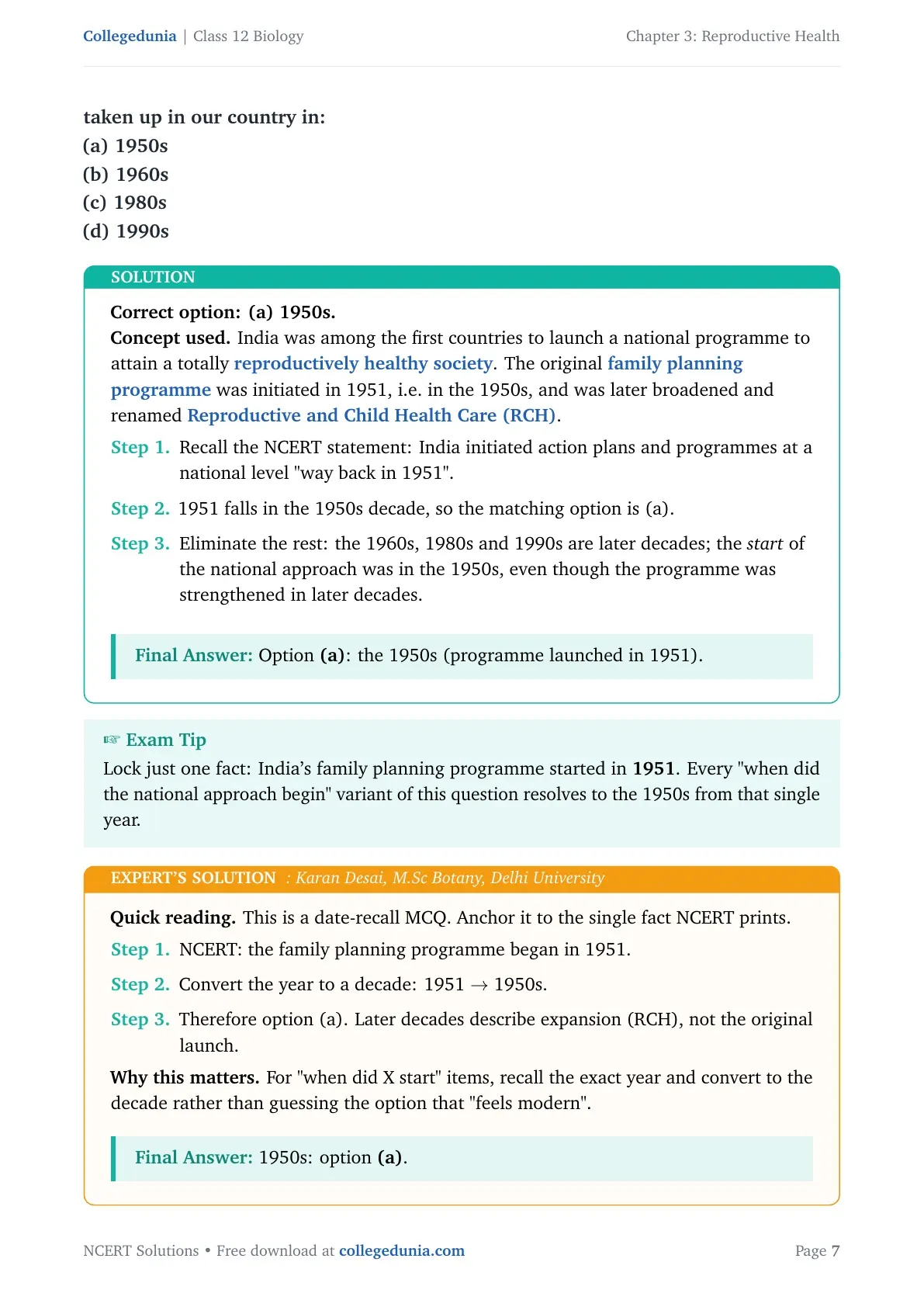
A national level approach to build up a reproductively healthy society was taken up in our country in:
(a) 1950s
(b) 1960s
(c) 1980s
(d) 1990s
Correct option: (a) 1950s.
Concept used. India was among the first countries to launch
a national programme to attain a totally reproductively
healthy society. The original family planning programme
was initiated in 1951, i.e. in the 1950s, and was later broadened and
renamed Reproductive and Child Health Care (RCH).
Recall the NCERT statement: India initiated action plans and
programmes at a national level "way back in 1951".
1951 falls in the 1950s decade, so the matching option is (a).
Eliminate the rest: the 1960s, 1980s and 1990s are later
decades; the start of the national approach was in the
1950s, even though the programme was strengthened in later
decades.
Option (a): the 1950s (programme launched in 1951).
KD
Karan Desai
M.Sc Botany, Delhi University
Verified Expert
Quick reading. This is a date-recall MCQ. Anchor it to the
single fact NCERT prints.
NCERT: the family planning programme began in 1951.
Convert the year to a decade: 1951 → 1950s.
Therefore option (a). Later decades describe expansion
(RCH), not the original launch.
Why this matters. For "when did X start" items, recall the
exact year and convert to the decade rather than guessing the option
that "feels modern".
1950s: option (a).
Q 3.6
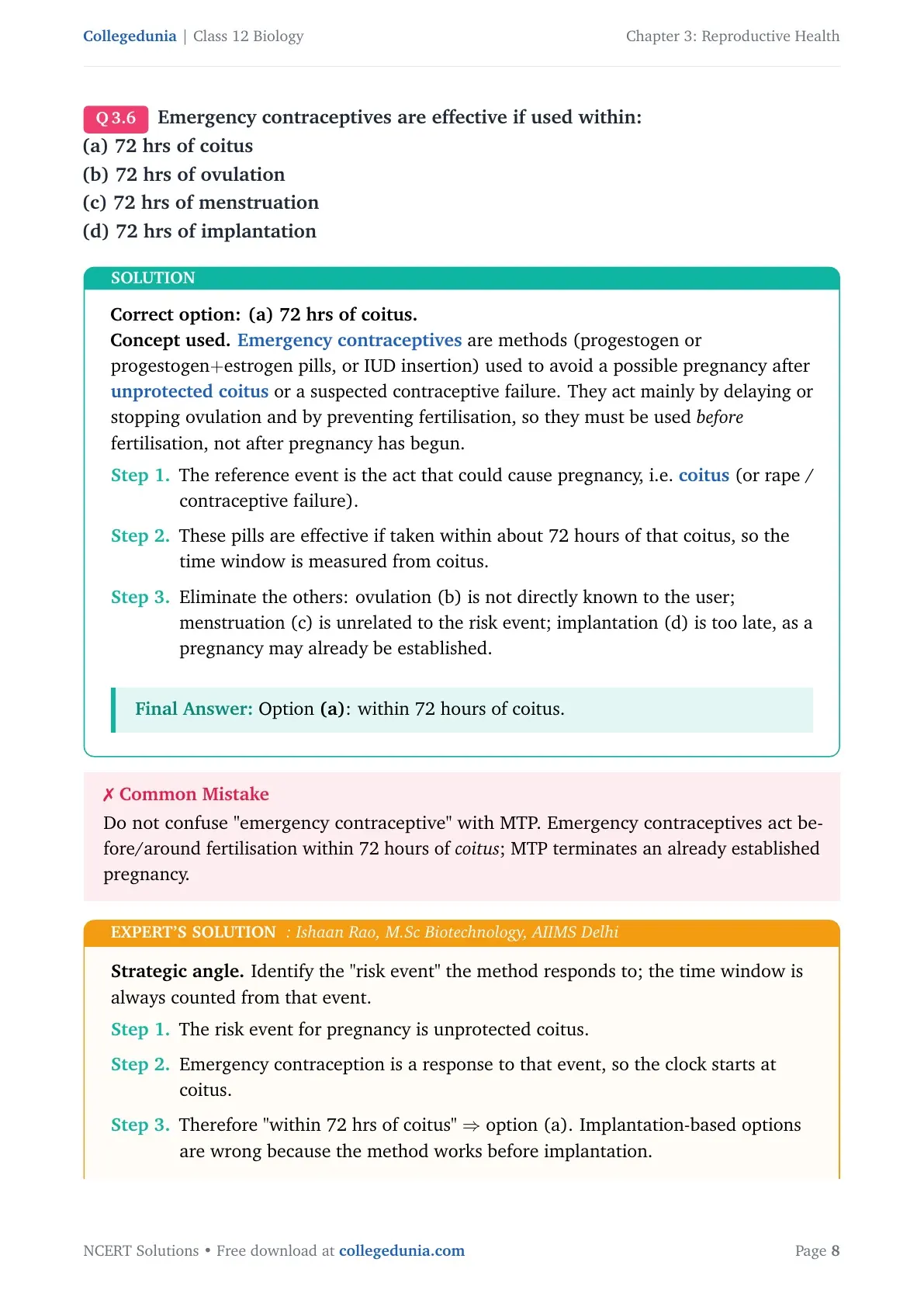
Emergency contraceptives are effective if used within:
(a) 72 hrs of coitus
(b) 72 hrs of ovulation
(c) 72 hrs of menstruation
(d) 72 hrs of implantation
Correct option: (a) 72 hrs of coitus.
Concept used.Emergency contraceptives are methods
(progestogen or progestogen+estrogen pills, or IUD insertion) used
to avoid a possible pregnancy after unprotected coitus or a
suspected contraceptive failure. They act mainly by delaying or
stopping ovulation and by preventing fertilisation, so they must be
used before fertilisation, not after pregnancy has begun.
The reference event is the act that could cause pregnancy,
i.e. coitus (or rape / contraceptive failure).
These pills are effective if taken within about 72 hours of
that coitus, so the time window is measured from coitus.
Eliminate the others: ovulation (b) is not directly known to
the user; menstruation (c) is unrelated to the risk event;
implantation (d) is too late, as a pregnancy may already be
established.
Option (a): within 72 hours of coitus.
IR
Ishaan Rao
M.Sc Biotechnology, AIIMS Delhi
Verified Expert
Strategic angle. Identify the "risk event" the method
responds to; the time window is always counted from that event.
The risk event for pregnancy is unprotected coitus.
Emergency contraception is a response to that event, so the
clock starts at coitus.
Therefore "within 72 hrs of coitus" ⇒ option (a).
Implantation-based options are wrong because the method works
before implantation.
Why this matters. Tying a time window to its triggering
event prevents the classic ovulation/coitus mix-up.
Within 72 hrs of coitus: option (a).
Q 3.7
Choose the right one among the statements given below:
(a) IUDs are generally inserted by the user herself
(b) IUDs increase phagocytosis reaction in the uterus
(c) IUDs suppress gametogenesis
(d) IUDs once inserted need not be replaced
Correct option: (b) IUDs increase phagocytosis reaction in the uterus.
Concept used.Intra Uterine Devices (IUDs) are
contraceptives placed inside the uterus by a doctor or trained nurse.
They work by (i) increasing phagocytosis of sperms in the
uterus, (ii) (copper IUDs) releasing Cu^2+ ions that suppress
sperm motility and fertilising capacity, and (iii) (hormone IUDs)
making the uterus unsuitable for implantation and the cervix hostile
to sperms.
Test (a): IUDs are inserted by a doctor or expert
nurse, not by the user herself. FALSE.
Test (b): IUDs increase the phagocytosis of sperms
within the uterus. This is a stated mechanism. TRUE.
Test (c): IUDs do not stop gametogenesis (sperm and
egg formation continue normally). FALSE.
Test (d): IUDs have a fixed effective life and must be
replaced after that period. FALSE.
Only statement (b) is correct.
Option (b): IUDs increase phagocytosis of sperms in the uterus.
MP
Meera Pillai
M.Sc Zoology, Banaras Hindu University
Verified Expert
Quick reading. Mark each statement true/false against the
known mechanism of action of IUDs.
(a) FALSE: inserted by trained personnel, not the user.
(b) TRUE: increased phagocytosis of sperms is a core IUD
mechanism.
(c) FALSE: gametogenesis is unaffected; IUDs act locally in
the uterus.
(d) FALSE: IUDs have a service life and need replacement.
Exactly one true statement: (b).
Why this matters. IUDs act locally (phagocytosis,
Cu^2+ ions, hormone effect), never on gamete production:
this single idea rules out (c) instantly.
Statement (b) is correct: option (b).
Q 3.8
Following statements are given regarding MTP. Choose the correct option given below:
(i) MTPs are generally advised during first trimester
(ii) MTPs are used as a contraceptive method
(iii) MTPs are always surgical
(iv) MTPs require the assistance of qualified medical personnel
(a) ii and iii (b) ii and iii (c) i and iv (d) i and ii
Correct option: (c) i and iv.
Concept used.Medical Termination of Pregnancy (MTP),
also called induced abortion, is the intentional ending of a
pregnancy before full term. In India it is legalised under specified
conditions and regulated to avoid misuse, especially against female
foeticide.
Statement (i): MTPs are relatively safe and generally advised
in the first trimester (up to 12 weeks); later
terminations are far riskier. TRUE.
Statement (ii): MTP is not a contraceptive. A
contraceptive prevents pregnancy; MTP ends an already
established pregnancy. FALSE.
Statement (iii): MTPs are not always surgical: early
pregnancies can be terminated with drugs (non-surgical /
medical MTP). FALSE.
Statement (iv): MTP must be performed by qualified
medical personnel under regulated conditions. TRUE.
Accepted set =i, iv, which is option (c).
Option (c): statements i and iv are correct.
AB
Aditya Bhat
Ph.D Molecular Biology, NCBS Bangalore
Verified Expert
Strategic angle. Score every statement, then map the true
set to an option.
(i) first-trimester advice: TRUE (safer early).
(ii) MTP as contraception: FALSE (it ends, not prevents,
pregnancy).
True set i, iv matches option (c). Options (a) and (b)
rely on false statements ii and iii.
Why this matters. Distinguishing "prevent" from "terminate"
is the recurring distinction examiners test in this chapter.
i and iv: option (c).
Q 3.9
From the sexually transmitted diseases mentioned below, identify the one which does not specifically affect the sex organs:
(a) Syphilis
(b) AIDS
(c) Gonorrhea
(d) Genital warts
Correct option: (b) AIDS.
Concept used.Sexually Transmitted Diseases (STDs),
or VD/RTI, spread mainly through sexual contact. Most produce local
signs in the genital region, but AIDS (caused by
HIV) attacks the body's immune system (helper
T-lymphocytes) rather than the sex organs themselves.
"Does not specifically affect the sex organs" selects the
disease with a non-genital target: AIDS.
Why this matters. Grouping diseases by the organ they damage
turns "odd one out" STD questions into a one-step sort.
AIDS: option (b).
Q 3.10
Condoms are one of the most popular contraceptives because of the following reasons:
(a) These are effective barriers for insemination
(b) They do not interfere with coital act
(c) These help in reducing the risk of STDs
(d) All of the above
Correct option: (d) All of the above.
Concept used.Condoms are barrier
contraceptives made of thin rubber/latex that cover the penis (or
vagina) so that the ejaculated semen does not enter the female
reproductive tract. We test each listed reason for popularity.
Reason (a): the condom forms a physical barrier so sperms are
not deposited in the vagina, preventing insemination.
TRUE.
Reason (b): condoms are used only during coitus and do not
require surgery, hormones or a device inside the body, so
they do not interfere with the coital act and self-use gives
privacy. TRUE.
Reason (c): by covering the genitals they prevent contact
with body fluids, so they reduce the risk of STDs
(including HIV). TRUE.
All three reasons are correct, so the combined option (d) is
the answer.
Option (d): all three reasons are valid.
VK
Vivaan Kapoor
M.Sc Biotechnology, AIIMS Delhi
Verified Expert
Strategic angle. For an "all of the above" candidate,
disprove it by finding one false sub-statement; if none is false, it
is correct.
(a) barrier to insemination: TRUE: that is the defining
action of a condom.
(b) no interference with coitus, easy self-use: TRUE.
(c) lowers STD risk: TRUE: it blocks fluid contact.
No false sub-statement exists, so "all of the above" stands.
Answer (d).
Why this matters. "All of the above" is correct only when
every sub-option survives scrutiny. One genuine false sub-statement
would have changed the answer.
All of the above: option (d).
Q 3.11
Choose the correct statement regarding the ZIFT procedure:
(a) Ova collected from a female donor are transferred to the fallopian tube to facilitate zygote formation
(b) Zygote is collected from a female donor and transferred to the fallopian tube
(c) Zygote is collected from a female donor and transferred to the uterus
(d) Ova collected from a female donor and transferred to the uterus
Correct option: (b) Zygote is collected from a female donor and transferred to the fallopian tube.
Concept used.ZIFT (Zygote Intra Fallopian Transfer)
transfers a zygote or early embryo (up to the 8-blastomere
stage) into the fallopian tube of a female who cannot
otherwise conceive. Two facts fix the answer: the unit transferred is
a zygote (not an ovum), and the destination is the
fallopian tube (not the uterus).
Check the transferred unit. ZIFT moves a zygote /
early embryo, not an ovum. This rules out (a) and (d), which
transfer ova.
Check the destination. ZIFT delivers to the fallopian
tube, not the uterus. This rules out (c), which goes to the
uterus.
Only statement (b) has both correct: zygote → fallopian
tube.
Option (b): zygote from a donor, transferred to the fallopian tube.
SC
Sanya Chatterjee
Ph.D Molecular Biology, NCBS Bangalore
Verified Expert
Structural observation. Split each option into (transferred
unit, destination) and match against the meaning of ZIFT.
ZIFT = Zygote → Fallopian tube (from the expanded
abbreviation).
Only (b) reads zygote → fallopian tube, matching ZIFT
exactly.
Why this matters. Expanding the abbreviation into
(unit, site) converts a confusing ART MCQ into a direct two-field
match.
Zygote to fallopian tube: option (b).
Q 3.12
The correct surgical procedure as a contraceptive method is:
(a) Ovariectomy
(b) Hysterectomy
(c) Vasectomy
(d) Castration
Correct option: (c) Vasectomy.
Concept used. A surgical contraceptive must block
gamete transport while keeping the reproductive organs and hormones
intact. Vasectomy (a small part of the vas
deferens is cut and tied through a scrotal incision) does exactly
this: sperms can no longer travel out, but the testes and hormone
production are untouched. The other options remove organs and are
therefore not contraceptive procedures.
Vasectomy (c): cuts/ties the vas deferens. Sperms are not
delivered, but testosterone and the testes remain. This is a
recognised sterilisation contraceptive. CORRECT.
Ovariectomy (a): surgical removal of the ovaries. This ends
hormone production and is a treatment, not a contraceptive
method.
Hysterectomy (b): surgical removal of the uterus, done for
disease, not for contraception.
Castration (d): removal of the testes (or ovaries); it
destroys reproductive and hormonal function and is not used
as contraception.
Option (c) Vasectomy: blocks sperm transport while keeping organs and hormones intact.
DB
Dev Banerjee
M.Sc Zoology, Banaras Hindu University
Verified Expert
Strategic angle. A contraceptive surgery should
interrupt, not remove. Test each option against that.
Vasectomy: interrupts the vas deferens, organs intact →
contraceptive. KEEP.
Ovariectomy: removes ovaries → not contraceptive
(organ-removing). REJECT.
Hysterectomy: removes uterus → disease treatment, not
contraception. REJECT.
Castration: removes gonads → destroys reproduction,
not a contraceptive method. REJECT.
Only the interrupting procedure, vasectomy, survives.
Why this matters. The discriminator "interrupt vs remove"
isolates the one contraceptive procedure from three organ-removal
distractors.
Vasectomy: option (c).
Q 3.13
Diaphragms are contraceptive devices used by the females. Choose the correct option from the statements given below:
(i) They are introduced into the uterus
(ii) They are placed to cover the cervical region
(iii) They act as physical barriers for sperm entry
(iv) They act as spermicidal agents
(a) i and ii (b) i and iii (c) ii and iii (d) iii and iv
Correct option: (c) ii and iii.
Concept used.Diaphragms are reusable
barrier contraceptives made of rubber. They are inserted
into the vagina to cover the cervix before coitus, forming a
physical barrier that stops sperms from entering the uterus through
the cervix.
Statement (i): diaphragms are placed in the vagina to
cover the cervix, not introduced into the uterus
(that describes an IUD). FALSE.
Statement (ii): they are placed to cover the cervical
region. TRUE.
Statement (iii): they act as a physical barrier that
blocks sperm entry through the cervix. TRUE.
Statement (iv): the diaphragm itself is not a
spermicide; spermicidal creams/jellies are used
along with it but are a separate agent. FALSE.
Accepted set =ii, iii, which is option (c).
Option (c): statements ii and iii are correct.
NS
Neha Singh
M.Sc Biotechnology, AIIMS Delhi
Verified Expert
Strategic angle. Validate each statement against the
device's site (cervix) and mode (barrier).
(i) into the uterus: FALSE: that is an IUD, not a diaphragm.
(ii) covers the cervical region: TRUE: this is its position.
(iii) physical barrier to sperm: TRUE: this is its mode of
action.
(iv) spermicidal agent: FALSE: spermicide is a separate
cream used with it.
True set ii, iii ⇒ option (c).
Why this matters. Site (cervix vs uterus) plus mechanism
(barrier vs chemical) cleanly separates diaphragms from IUDs and
spermicides.
ii and iii: option (c).
Q 3.14
Reproductive health refers only to healthy reproductive functions. Comment.
Concept used.Reproductive health is defined by
the WHO as total well-being in all aspects of reproduction, that is,
physical, emotional, behavioural and social well-being, not
merely the proper working of the reproductive organs.
The statement is incomplete. Healthy reproductive
functioning (normal organs, hormones and cycles) is
only one part of reproductive health.
Reproductive health also includes freedom from STDs,
awareness of safe sex, access to contraception, the right to
unbiased counselling, and emotional and social well-being
regarding reproduction.
False as stated: reproductive health means physical, emotional, behavioural and social well-being in reproduction, not just healthy organ function.
RM
Riya Mehta
M.Sc Botany, Delhi University
Verified Expert
Quick reading. Judge the claim against the official
definition, then state what it leaves out.
Official definition: total well-being (physical + emotional
+ behavioural + social) in reproduction.
The claim restricts this to "functions" only, so it omits
the emotional, behavioural and social dimensions, plus
protection from STDs and access to information.
Hence the comment: the statement is too narrow; it captures
one component and misses the rest.
Why this matters. The four-part definition is the backbone
of the whole chapter; misreading it as "organs only" causes errors in
many later questions.
Incomplete statement: reproductive health is multi-dimensional well-being, not only healthy functioning.
Q 3.15
Comment on the Reproductive and Child Health Care programme of the government to improve the reproductive health of the people.
Concept used. The Reproductive and Child Health
Care (RCH) programme is a Government of India initiative to create a
reproductively healthy society through awareness, services and
support, building on the earlier "family planning" programme of 1951.
Aims and tools: spread awareness via audio-visual and print
media, schools and parents; provide sex education; build
knowledge of reproductive organs, adolescence, safe sex, STDs
and contraception.
Outcomes: it provides medical help and care to mothers and
infants, encourages a smaller family through contraception,
works to detect and discourage sex-selective
abortion and child marriage, and improves overall
reproductive health and lower mortality.
RCH is a national programme using awareness, education and medical services to build a reproductively healthy and informed society.
AG
Ankit Gupta
M.Sc Microbiology, JNU
Verified Expert
Strategic angle. Split the comment into "what it does"
(actions) and "what it achieves" (outcomes).
Actions: awareness campaigns, sex education, counselling,
provision of contraceptives and maternal-infant care.
Outcomes: informed population, smaller families, fewer STDs,
reduced maternal and infant mortality, control of female
foeticide.
Comment: RCH is a broad, largely successful national effort,
though its reach still varies across regions.
Why this matters. Naming both the actions and the outcomes
gives a complete two-mark answer rather than a one-sided one.
A national, multi-pronged programme of awareness, education and medical care that has improved reproductive health.
Q 3.16
The present population growth rate in India is alarming. Suggest ways to check it.
Concept used.Population growth rate is the rate at
which a population increases, driven by a high birth rate relative to
death rate. It is checked mainly by reducing the birth rate through
education, delayed marriage and contraception.
Motivate smaller families: promote the small-family norm with
statutory rise in marriageable age (21 for males, 18 for
females) and incentives for couples with fewer children.
Spread awareness and access: sex education, counselling, and
easy availability of contraceptive methods (barrier,
IUD, pills, sterilisation) so that births are planned.
Raise marriage age, promote the small-family norm with incentives, and spread sex education plus easy contraceptive access.
PS
Pooja Sharma
M.Sc Zoology, Banaras Hindu University
Verified Expert
Strategic angle. Growth = births - deaths; we cannot
ethically raise deaths, so every measure must lower the birth rate.
Delay reproduction: enforce the legal marriage ages, which
shortens the reproductive span.
Reduce births per couple: promote and supply contraceptives,
with incentives for small families.
Change attitudes: education and counselling so couples
choose fewer children.
Why this matters. Anchoring every suggestion to "lowers the
birth rate" keeps the answer focused and complete.
Lower the birth rate via late marriage, contraception access, incentives and education.
Q 3.17
STDs can be considered as self-invited diseases. Comment.
Concept used.Sexually Transmitted Diseases (STDs)
spread mainly through unprotected sexual contact. Most cases can be
avoided by simple precautions, which is why they are called largely
preventable, "self-invited" infections.
The phrase means most STDs arise from avoidable behaviour:
unprotected sex, sex with unknown/multiple partners, and not
using condoms.
They are preventable: avoid sex with unknown or multiple
partners, always use condoms, and seek early diagnosis and
treatment. Following these, infection is largely avoidable,
hence "self-invited".
Largely true: most STDs result from avoidable unsafe sexual behaviour and can be prevented by safe practices.
YJ
Yash Joshi
M.Sc Biotechnology, AIIMS Delhi
Verified Expert
Quick reading. Test the claim: are STDs avoidable by the
individual's own choices?
Transmission route: chiefly unprotected sexual contact, a
controllable behaviour.
Prevention is in the person's hands: condom use, single known
partner, hygiene, early treatment.
Since prevention depends largely on personal choices, the
"self-invited" label is justified for most cases (with care:
infants/transfusion cases are exceptions).
Why this matters. Recognising STDs as behaviour-linked
explains why the chapter stresses prevention over cure.
Justified for most cases: STDs are largely preventable by safe sexual behaviour.
Q 3.18
Suggest the reproduction-related aspects in which counselling should be provided at the school level.
Concept used.Sex education in schools gives
correct information so that adolescents make informed, healthy
choices and avoid myths.
Knowledge aspects: reproductive organs, adolescence
and related changes, the menstrual cycle, and safe and
hygienic sexual practices.
Protective aspects: STDs and AIDS and their prevention,
myths/misconceptions about sex, available contraceptive
options, and the evils of sex abuse and sex-selective
practices.
Counsel on reproductive organs, adolescence, menstrual hygiene, safe sex, STDs/AIDS prevention, myths, contraception and sex abuse.
DK
Diya Kapoor
M.Sc Botany, Delhi University
Verified Expert
Strategic angle. Group the topics into "know your body" and
"protect your body".
Know your body: reproductive organs, adolescent changes,
menstrual cycle and hygiene.
Protect your body: safe sex, STD/AIDS prevention, dispelling
myths, contraceptive choices, awareness against sex abuse.
Why this matters. A two-bucket grouping makes the answer
easy to recall and complete in the exam.
Body awareness (organs, adolescence, menstruation) plus protection (safe sex, STDs, contraception, anti-abuse awareness).
Q 3.19
Mention the primary aim of the ``Assisted Reproductive Technology'' (ART) programme.
Concept used.Assisted Reproductive Technologies
(ART) are special clinical techniques (IVF, ZIFT, GIFT, ICSI,
artificial insemination, embryo transfer) that help couples who
cannot conceive naturally because of infertility.
Many couples are infertile due to physical, congenital,
immunological or other reasons and cannot produce a child by
natural means.
The primary aim of the ART programme is to enable such
infertile couples to have children by assisting fertilisation
and/or implantation through medical techniques.
To help infertile couples have a child by using assisted clinical techniques to achieve pregnancy.
KR
Krishna Rao
Ph.D Molecular Biology, NCBS Bangalore
Verified Expert
Quick reading. One-line aim, justified by the population it
serves.
Target group: couples unable to conceive naturally
(infertile).
Means: clinical assistance with fertilisation/implantation
(IVF, ZIFT, GIFT, ICSI, etc.).
Aim therefore: give these couples a chance to bear a child.
Why this matters. ART addresses infertility specifically: it
is not a contraceptive or population programme, a distinction
examiners test.
Enabling infertile couples to have children through assisted clinical techniques.
Q 3.20
What is the significance of progesterone-estrogen combination as a contraceptive measure?
Concept used. The progesterone-estrogen
combination (oral pills) is a hormonal contraceptive. The hormones
act on the ovary and reproductive tract to stop pregnancy by three
linked actions.
They inhibit ovulation by suppressing the release of
the gonadotropins FSH and LH, so no ovum is released.
They alter the endometrium so it is unsuitable for
implantation, and thicken cervical mucus to retard
sperm entry. Together these make conception very unlikely.
It prevents ovulation, makes the endometrium unfit for implantation and thickens cervical mucus, so it is a highly effective contraceptive.
AV
Aditi Verma
M.Sc Biotechnology, AIIMS Delhi
Verified Expert
Strategic angle. Trace where the hormones act: ovary, then
uterus, then cervix.
Cervix: mucus thickened ⇒ sperm entry retarded.
Three independent blocks make it very reliable.
Why this matters. A method acting at three points is far
more reliable than a single-action method, which is the "significance"
the question asks for.
Triple action (no ovulation, unfit endometrium, thick cervical mucus) gives a highly effective contraceptive.
Q 3.21
Strict conditions are to be followed in medical termination of pregnancy (MTP) procedures. Mention two reasons.
Concept used.Medical Termination of Pregnancy (MTP)
is regulated by law in India to protect women's health and to prevent
its misuse, particularly for illegal sex-selective abortion.
Reason 1: to prevent misuse: unregulated MTP is often used
for illegal female foeticide after illegal sex
determination. Strict conditions discourage this.
Reason 2: to protect the woman: MTPs (especially after the
first trimester, or done by untrained persons) are unsafe and
can be fatal, so they must be done by qualified personnel
under defined limits.
(1) To stop misuse for illegal sex-selective abortion; (2) to protect the woman from unsafe, possibly fatal procedures.
SP
Siddharth Pillai
Ph.D Molecular Biology, NCBS Bangalore
Verified Expert
Quick reading. Two reasons: a social one and a medical one.
Social: regulation curbs illegal female foeticide that
follows illegal sex determination.
Medical: it ensures the procedure is timely (first trimester)
and done by trained personnel, avoiding life-threatening
complications.
Why this matters. Pairing one social and one medical reason
gives the two distinct points the question asks for.
Males in whom testes fail to descend to the scrotum are generally infertile. Why?
Concept used. In males the testes normally descend
into the scrotum, which is held at about 2
below core body temperature. Spermatogenesis (sperm
formation) requires this lower temperature.
If the testes do not descend (a condition called
cryptorchidism), they remain in the abdomen at full
body temperature.
At this higher temperature normal spermatogenesis
is impaired, so few or no functional sperms are produced. With
no viable sperms, the male is generally infertile.
Undescended testes stay at body temperature, which prevents normal sperm formation, so the male is generally infertile.
KD
Kavya Desai
M.Sc Zoology, Banaras Hindu University
Verified Expert
Cause-and-effect. Connect "no scrotum" to "no sperm" through
temperature.
Scrotum function: keeps testes about 2∘C cooler than
the body.
Spermatogenesis needs this cooler temperature.
Undescended testes ⇒ body temperature ⇒
spermatogenesis fails ⇒ infertility.
Why this matters. The scrotum's role is precisely
thermoregulation for sperm formation; this single fact answers the
"why".
High intra-abdominal temperature blocks spermatogenesis, causing infertility.
Q 3.23
Mention two advantages of lactational amenorrhea as a contraceptive method.
Concept used.Lactational amenorrhea is the natural
absence of menstruation (and ovulation) during the period of intense
breast-feeding, up to about six months after childbirth.
Advantage 1: it is a natural method with no
side effects: no drugs, devices or hormones are introduced
into the body.
Advantage 2: it has no extra cost and needs no
external aid; it works simply through the act of intense
breast-feeding, which also benefits the infant.
(1) Natural, with no side effects; (2) free and needs no device or drug while breast-feeding.
RI
Rahul Iyer
M.Sc Biotechnology, AIIMS Delhi
Verified Expert
Quick reading. Two advantages: safety and zero cost.
Safety: no chemicals or devices, so no side effects.
Cost/convenience: free, automatic with breast-feeding, also
nourishes the baby.
Caveat (not asked but worth knowing): reliable only up to
about six months and only with intense feeding.
Why this matters. Both advantages flow from it being a
natural method, the recurring theme of natural-contraception
questions.
No side effects (natural) and no cost (no device/drug).
Q 3.24
Suggest some important steps that you would recommend to be taken to improve the reproductive health standards in India.
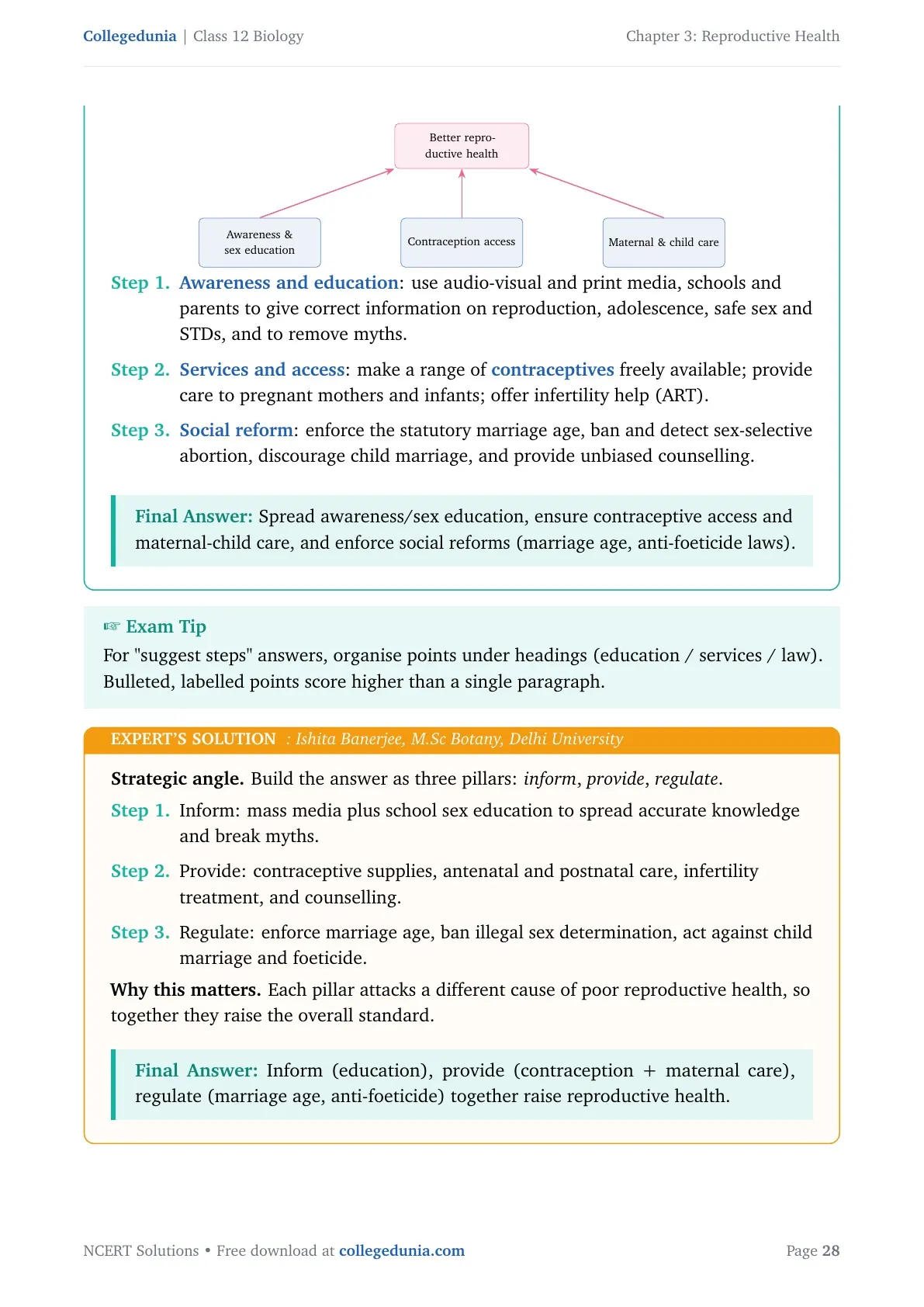
Concept used. Improving reproductive health
standards needs a combination of awareness, education, medical
support and social reform, exactly the strategy of the RCH programme.
minipage0.75
!%
[See diagram in the PDF version]
minipage
Awareness and education: use audio-visual and print
media, schools and parents to give correct information on
reproduction, adolescence, safe sex and STDs, and to remove
myths.
Services and access: make a range of
contraceptives freely available; provide care to
pregnant mothers and infants; offer infertility help (ART).
Social reform: enforce the statutory marriage age,
ban and detect sex-selective abortion, discourage child
marriage, and provide unbiased counselling.
Spread awareness/sex education, ensure contraceptive access and maternal-child care, and enforce social reforms (marriage age, anti-foeticide laws).
IB
Ishita Banerjee
M.Sc Botany, Delhi University
Verified Expert
Strategic angle. Build the answer as three pillars:
inform, provide, regulate.
Inform: mass media plus school sex education to spread
accurate knowledge and break myths.
Provide: contraceptive supplies, antenatal and postnatal
care, infertility treatment, and counselling.
Regulate: enforce marriage age, ban illegal sex
determination, act against child marriage and foeticide.
Why this matters. Each pillar attacks a different cause of
poor reproductive health, so together they raise the overall
standard.
Inform (education), provide (contraception + maternal care), regulate (marriage age, anti-foeticide) together raise reproductive health.
Q 3.25
The procedure of GIFT involves the transfer of female gamete to the fallopian tube. Can gametes be transferred to the uterus to achieve the same result? Explain.
Concept used.GIFT (Gamete Intra Fallopian
Transfer) places the female gamete (ovum, from a donor) into the
fallopian tube, because the fallopian tube (ampulla) is the
natural site of fertilisation in humans.
Fertilisation in humans normally occurs in the ampullary
region of the fallopian tube, not in the uterus. The early
embryo then travels down and implants in the uterus.
GIFT therefore places the gamete where fertilisation can
naturally take place, the fallopian tube.
If gametes were placed directly in the uterus, the
environment is not suited to bring the gametes together for
fertilisation, so the desired result (fertilisation →
embryo) would not be achieved.
Hence gametes cannot simply be transferred to the
uterus for GIFT; the fallopian tube is essential.
No. Fertilisation occurs in the fallopian tube, so gametes must go there; placing them in the uterus would not produce fertilisation.
AN
Arjun Nair
Ph.D Molecular Biology, NCBS Bangalore
Verified Expert
Picture-first. Recall the natural path of the ovum and ask
where fertilisation actually happens.
Natural site of fertilisation: ampulla of the fallopian tube.
GIFT mimics nature: it puts the gamete at that site.
Uterus is the implantation site, not the
fertilisation site, so gametes placed there would not fuse
successfully. Answer: no.
Why this matters. ART techniques are designed around natural
anatomy; knowing the true fertilisation site answers many ART
questions.
No: fertilisation needs the fallopian tube; the uterus is for implantation, not fertilisation.
Q 3.26
Copper ions-releasing IUDs are more efficient than non-medicated methods. Why?
Concept used.Intra Uterine Devices (IUDs) are of
three types: non-medicated (e.g. Lippes loop), copper-releasing
(e.g. CuT, Cu7, Multiload 375) and hormone-releasing (e.g. LNG-20).
Copper IUDs add a chemical action to the physical action.
All IUDs increase phagocytosis of sperms in the
uterus (physical/cellular action) and make the uterus
unsuitable for implantation.
Copper IUDs additionally release Cu^2+ ions, which
suppress sperm motility and the fertilising capacity of
sperms.
Because copper IUDs combine the common phagocytic action
with this extra spermicidal copper-ion action,
fertilisation is far less likely, so they are more efficient
than non-medicated IUDs.
Copper IUDs add the release of Cu^2+ ions that suppress sperm motility and fertilising capacity, on top of the usual IUD action, so they are more efficient.
PS
Pranav Sharma
M.Sc Biotechnology, AIIMS Delhi
Verified Expert
Strategic angle. Compare the two devices by counting their
modes of action.
Non-medicated IUD: one main mode: increased phagocytosis of
sperms and an unfavourable uterus.
Copper IUD: the same mode plus Cu^2+ ions that
impair sperm motility and fertilising power.
Two modes beat one, so the copper IUD is more efficient.
Why this matters. Efficiency rises when independent
mechanisms stack; copper adds a second, chemical barrier.
Extra Cu^2+ spermicidal action makes copper IUDs more efficient than non-medicated ones.
Q 3.27
What are the probable factors that contributed to population explosion in India?
Concept used. A population explosion is a sudden,
steep rise in population size, caused when the birth rate
stays high while the death rate falls sharply.
Fall in death rate: better health care reduced the
Mortality Rate, the Maternal Mortality
Rate (MMR) and the Infant Mortality Rate (IMR),
so more people survived.
Rise in survivors of reproductive age: with more individuals
surviving to reproductive age, more births occurred.
Social factors: high birth rate continued due to low literacy,
early marriage, lack of awareness/availability of
contraception and a preference for large families.
A sharp fall in death rate, MMR and IMR with continued high birth rate (early marriage, low awareness, more reproductive-age survivors) caused the explosion.
SK
Sneha Kumar
M.Sc Zoology, Banaras Hindu University
Verified Expert
Strategic angle. Population explosion = widening gap
between births and deaths. List what shrank deaths and what kept
births high.
Deaths fell: improved medical facilities lowered overall
mortality, MMR and IMR.
Births stayed high: early marriage, low literacy, limited
contraceptive use, desire for more children.
Result: a large positive (births - deaths) gap ⇒
explosion.
Why this matters. The births-vs-deaths gap framework links
this directly back to MCQ 2 on IMR and MMR.
Steep death-rate fall (better health care, lower MMR/IMR) plus persistently high birth rate.
Q 3.28
Briefly explain IVF and ET. What are the conditions in which these methods are advised?
Concept used.IVF (In Vitro Fertilisation) is
fertilisation outside the body (the "test-tube baby"
programme). ET (Embryo Transfer) is the placement of the
embryo formed by IVF into the female's body to continue development.
IVF: ova from the wife/donor and sperms from the
husband/donor are collected and made to fuse in vitro
(in the laboratory) to form a zygote.
ET: the resulting embryo is transferred to the
female. If it has up to 8 blastomeres it is put into the
fallopian tube (ZIFT); if it has more than 8
blastomeres it is put into the uterus (IUT), to
complete development.
Conditions advised: when a couple is infertile,
e.g. the female cannot produce ova, the male has very low
sperm count, or there is a blockage/inability for natural
fertilisation.
IVF = fertilisation in the lab; ET = transferring the resulting embryo to the fallopian tube (≤ 8 cells) or uterus (>8 cells). Advised for infertile couples (no ova, low sperm count, blocked tubes).
AM
Aarav Mehta
Ph.D Molecular Biology, NCBS Bangalore
Verified Expert
Structural observation. Treat IVF and ET as two stages of
one pipeline: make the embryo, then place it.
Stage 1 (IVF): gametes fused in the laboratory → zygote
→ early embryo.
Use when: female cannot form/release ova, male has very low
sperm count, or normal fertilisation is impossible.
Why this matters. Seeing IVF→ET as one pipeline keeps
the blastomere cut-off (8 cells) and the two destinations straight.
IVF makes the embryo in vitro; ET places it (tube if ≤ 8 cells, uterus if >8). For infertile couples.
Q 3.29
What are the advantages of natural methods of contraception over artificial methods?
Concept used.Natural methods of contraception
(periodic abstinence, withdrawal/coitus interruptus, lactational
amenorrhea) work by avoiding the chance of the ovum and sperms
meeting, without drugs or devices.
No side effects: they introduce no hormones,
chemicals or foreign devices into the body, so there are no
physiological side effects.
No cost and no aids: they need no purchase of pills,
condoms or devices and require no surgery, only awareness of
the fertile period and self-control.
They are ethically acceptable to people who object to
artificial methods on personal or religious grounds.
Natural methods have no side effects, no cost, need no devices/surgery and are acceptable to those who reject artificial methods (but their failure rate is higher).
DJ
Diya Joshi
M.Sc Biotechnology, AIIMS Delhi
Verified Expert
Strategic angle. The advantages all stem from one fact:
nothing is put into the body.
Nothing introduced ⇒ no side effects.
Nothing purchased ⇒ no cost, no devices.
No medical intervention ⇒ acceptable to all,
including on religious grounds.
Why this matters. A single root idea ("zero intervention")
generates every advantage, which makes the answer easy to reconstruct.
Zero intervention gives no side effects, no cost and wide acceptability (trade-off: higher failure rate).
Q 3.30
What are the conditions in which medical termination of pregnancy is advised?
Concept used.Medical Termination of Pregnancy
(MTP) is legally allowed only under specified medical and social
conditions, mainly to safeguard the mother and in cases of unwanted
or unsafe pregnancy.
When continuing the pregnancy would endanger the life
or health of the mother (or cause grave physical/mental
injury).
When the foetus is found to have serious abnormalities
and would be severely handicapped.
When pregnancy results from rape or from
failure of a contraceptive used by a married couple
(unwanted pregnancy).
MTP is advised when the pregnancy risks the mother's life/health, when the foetus has serious abnormalities, or for pregnancy from rape or contraceptive failure.
TS
Tara Singh
M.Sc Botany, Delhi University
Verified Expert
Quick reading. Three condition-types: maternal risk, foetal
risk, unwanted pregnancy.
Maternal risk: continued pregnancy threatens her life or
health.
Unwanted pregnancy: from rape or contraceptive failure.
Why this matters. These three legal grounds also explain why
MTP cannot be used casually as a contraceptive (links to MCQ 8).
Maternal danger, serious foetal abnormality, or pregnancy from rape/contraceptive failure.
Q 3.31
Comment on the essential features required for an ideal contraceptive.
Concept used. An ideal contraceptive is judged by
how well it prevents pregnancy without harming the user or
interfering with normal life and future fertility.
It should be user-friendly, easily available and
effective (reliably prevents pregnancy).
It should have no or least side effects and should
not interfere with the sexual act or the user's
sexual drive.
It should be reversible, so that normal fertility
returns when the couple wishes to have a child.
An ideal contraceptive is effective, user-friendly, reversible, with no/least side effects and no interference with sexual drive or the sexual act.
YR
Yash Reddy
M.Sc Zoology, Banaras Hindu University
Verified Expert
Strategic angle. A contraceptive is "ideal" only if it
balances reliability with safety and reversibility.
Reliability: high effectiveness in preventing pregnancy.
Safety: minimal side effects, no interference with sexual
drive or the act.
Convenience and reversibility: easy to use, available, and
fertility returns on stopping.
Why this matters. No real contraceptive meets all criteria
perfectly, which is why method choice depends on the couple's needs.
Effective, safe (no side effects, no interference), user-friendly and reversible.
Q 3.32
All reproductive tract infections (RTIs) are STDs, but all STDs are not RTIs. Justify with example.
Concept used.Sexually Transmitted Diseases (STDs)
are infections transmitted through sexual contact.
Reproductive Tract Infections (RTIs) are the subset of STDs
whose infection is localised in the reproductive tract / sex
organs. Some STDs, however, spread beyond the reproductive tract.
RTIs are infections of the reproductive tract spread sexually,
so by definition every RTI is also an STD. Example: gonorrhea
and syphilis affect the genital tract: they are RTIs and
STDs.
But some STDs are not confined to the reproductive
tract: AIDS (HIV) attacks the immune system and
Hepatitis-B affects the liver. They spread sexually
but the disease is not localised in the reproductive tract.
Therefore all RTIs are STDs, but STDs like AIDS and
Hepatitis-B are not RTIs.
Every RTI (e.g. gonorrhea, syphilis) is a sexually spread reproductive-tract infection, hence an STD; but STDs like AIDS and Hepatitis-B affect non-reproductive systems, so they are STDs that are not RTIs.
AB
Ananya Bhat
M.Sc Microbiology, JNU
Verified Expert
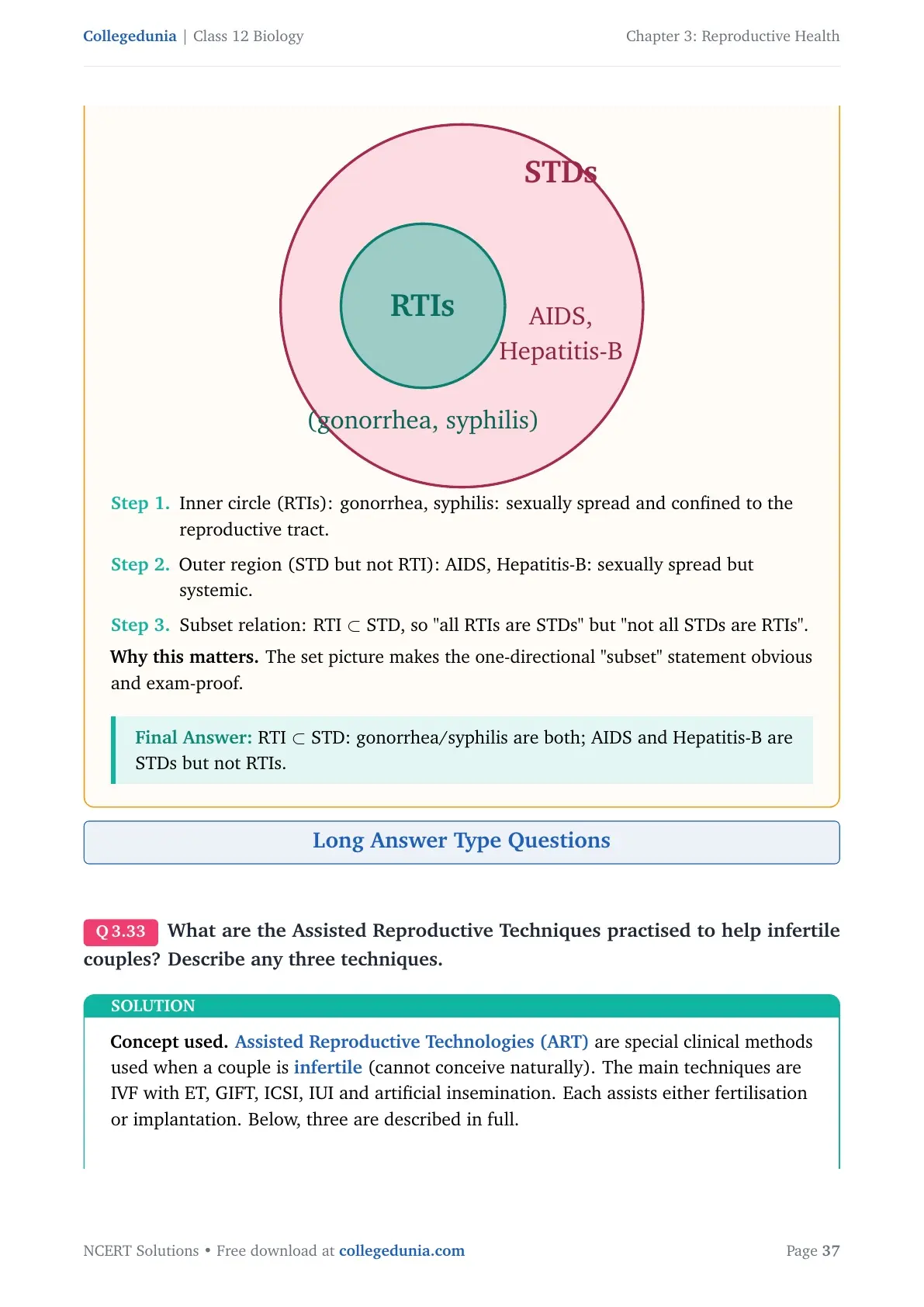
Structural observation. Draw the relationship as sets: RTI
is a subset of STD.
minipage0.52
!%
[See diagram in the PDF version]
minipage
Inner circle (RTIs): gonorrhea, syphilis: sexually spread and
confined to the reproductive tract.
Outer region (STD but not RTI): AIDS, Hepatitis-B: sexually
spread but systemic.
Subset relation: RTI ⊂ STD, so "all RTIs are STDs"
but "not all STDs are RTIs".
Why this matters. The set picture makes the one-directional
"subset" statement obvious and exam-proof.
RTI ⊂ STD: gonorrhea/syphilis are both; AIDS and Hepatitis-B are STDs but not RTIs.
Q 3.33
What are the Assisted Reproductive Techniques practised to help infertile couples? Describe any three techniques.
Concept used.Assisted Reproductive Technologies
(ART) are special clinical methods used when a couple is
infertile (cannot conceive naturally). The main techniques
are IVF with ET, GIFT, ICSI, IUI and artificial insemination. Each
assists either fertilisation or implantation. Below, three are
described in full.
!%
[See diagram in the PDF version]
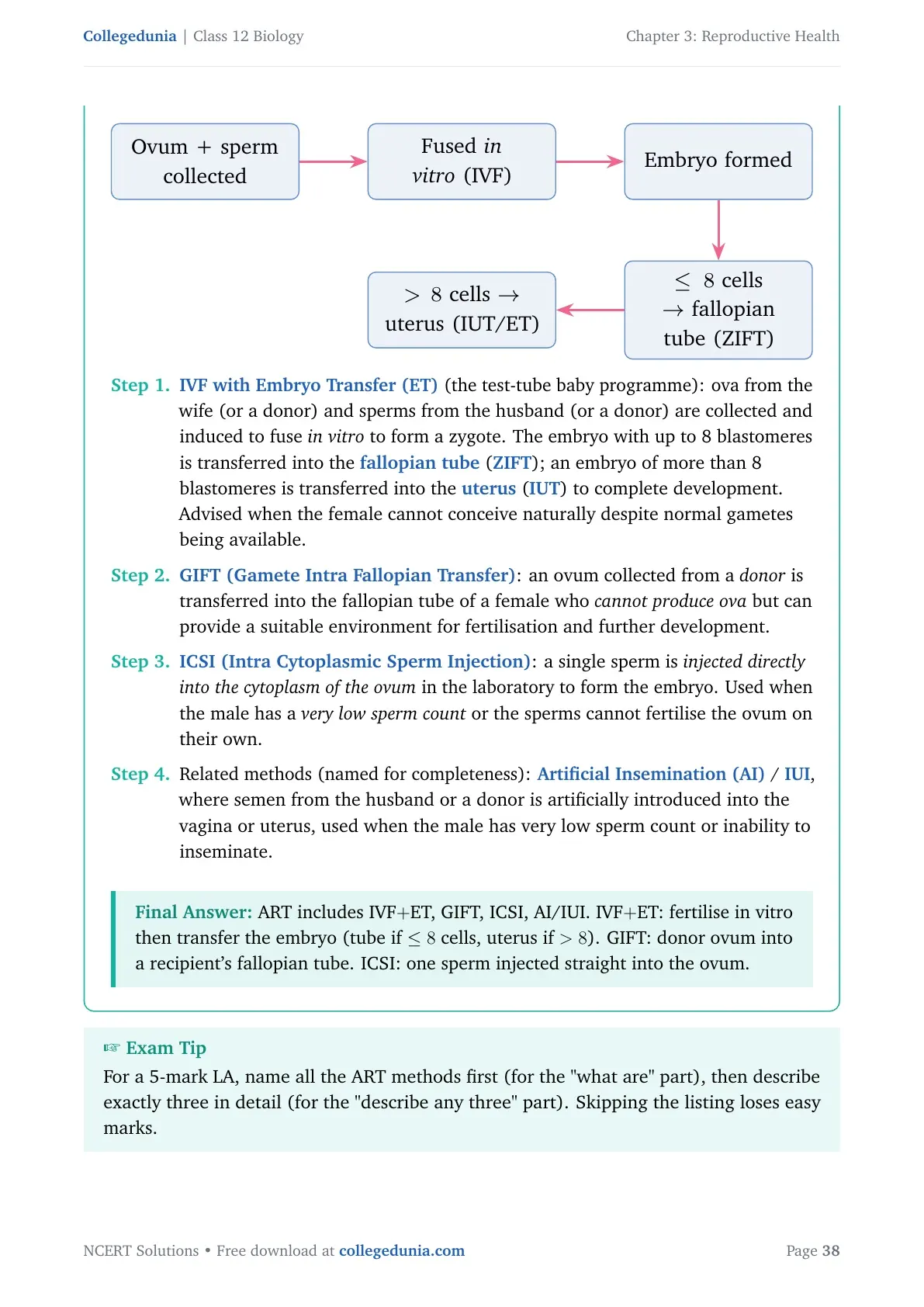
IVF with Embryo Transfer (ET) (the test-tube baby
programme): ova from the wife (or a donor) and sperms from
the husband (or a donor) are collected and induced to fuse
in vitro to form a zygote. The embryo with up to 8
blastomeres is transferred into the fallopian tube
(ZIFT); an embryo of more than 8 blastomeres is
transferred into the uterus (IUT) to
complete development. Advised when the female cannot conceive
naturally despite normal gametes being available.
GIFT (Gamete Intra Fallopian Transfer): an ovum
collected from a donor is transferred into the
fallopian tube of a female who cannot produce ova but
can provide a suitable environment for fertilisation and
further development.
ICSI (Intra Cytoplasmic Sperm Injection): a single
sperm is injected directly into the cytoplasm of the
ovum in the laboratory to form the embryo. Used when the
male has a very low sperm count or the sperms cannot
fertilise the ovum on their own.
Related methods (named for completeness): Artificial
Insemination (AI) / IUI, where semen from the
husband or a donor is artificially introduced into the vagina
or uterus, used when the male has very low sperm count or
inability to inseminate.
ART includes IVF+ET, GIFT, ICSI, AI/IUI. IVF+ET: fertilise in vitro then transfer the embryo (tube if ≤ 8 cells, uterus if >8). GIFT: donor ovum into a recipient's fallopian tube. ICSI: one sperm injected straight into the ovum.
VD
Vivaan Desai
M.Sc Biotechnology, AIIMS Delhi
Verified Expert
Structural observation. Sort ART methods by what they
assist: fertilisation (ICSI, IVF, GIFT) or delivery of the embryo
(ET/ZIFT/IUT) or sperm delivery (AI/IUI). Then detail three.
IVF+ET: collect ova and sperms; fuse them
outside the body; grow to an early embryo; transfer to
the fallopian tube if ≤ 8 blastomeres, else to the
uterus. This bypasses problems of in-body fertilisation.
GIFT: when a woman cannot produce ova, a
donor ovum is placed into her fallopian tube so that
fertilisation and development can proceed in her body.
ICSI: when sperms are too few or too weak, one
selected sperm is injected straight into the ovum's
cytoplasm, forcing fertilisation that could not occur
naturally.
Also list AI/IUI: artificially introducing semen
into the female tract when the male cannot inseminate or has
very low sperm count.
Why this matters. Classifying each technique by the exact
infertility problem it solves makes the descriptions precise and
memorable.
Listed: IVF+ET, GIFT, ICSI, AI/IUI. Detailed three: IVF+ET (fertilise in vitro, transfer embryo), GIFT (donor ovum to recipient's tube), ICSI (one sperm injected into ovum).
Q 3.34
Discuss the mode of action and advantages/disadvantages of hormonal contraceptives.
Concept used.Hormonal contraceptives use
progestogens alone or with estrogen, given as oral
pills, injectables or implants. They act on the ovary, the
endometrium and the cervix to prevent pregnancy.
Mode of action: ovary: the hormones suppress the
release of the gonadotropins FSH and LH
from the pituitary, which inhibits ovulation, so no
ovum is released.
Mode of action: endometrium: they alter the
endometrium so that it becomes unsuitable for
implantation of any embryo.
Mode of action: cervix: they make the cervical
mucus thick, which retards the entry of sperms into
the uterus.
Advantages: highly effective and reliable; do not
interfere with the sexual act; reversible (fertility returns
on stopping); also help regularise the menstrual cycle.
Disadvantages: must be taken regularly/on schedule
(a missed pill lowers protection); may cause side effects in
some women such as nausea, weight change, breakthrough
bleeding or breast tenderness; do not protect against
STDs.
Hormonal contraceptives block ovulation (suppress FSH/LH), make the endometrium unfit for implantation and thicken cervical mucus. Advantages: very effective, reversible, no coital interference. Disadvantages: strict schedule, possible side effects, no STD protection.
AI
Aditya Iyer
Ph.D Molecular Biology, NCBS Bangalore
Verified Expert
Structural observation. Organise as three sites of action,
then a balanced advantages/disadvantages ledger.
Site 1, ovary: FSH/LH suppressed ⇒ no ovulation.
Site 2, uterus: endometrium altered ⇒ implantation
blocked.
Site 3, cervix: mucus thickened ⇒ sperm entry
retarded.
Ledger: + very effective, reversible, no coital
interference, cycle regulation; - strict timing,
side effects in some, no protection from STDs.
Why this matters. The three-site model also explains why
hormonal pills are so reliable: failure needs all three blocks to be
bypassed, which is unlikely.
Three-site action (no ovulation, unfit endometrium, thick mucus); reliable and reversible but needs strict use and gives no STD protection.
Q 3.35
STDs are a threat to reproductive health. Describe any two such diseases and suggest preventive measures.
Concept used.Sexually Transmitted Diseases (STDs)
spread mainly through unprotected sexual contact and damage
reproductive health, sometimes fatally. We describe two and then list
prevention.
AIDS (Acquired Immuno Deficiency Syndrome): caused
by the HIV virus. HIV destroys helper
T-lymphocytes, progressively crippling the
immune system, so the patient suffers repeated
infections. It spreads by unprotected sex, infected blood,
shared needles and from infected mother to child. There is no
complete cure, so it is largely fatal.
Gonorrhea: caused by the bacterium Neisseria
gonorrhoeae. It produces inflammation, pain and discharge in
the genital tract and, if untreated, can cause
infertility (blocked tubes/ducts). It spreads through
sexual contact and from mother to newborn.
Preventive measures: avoid sex with unknown or
multiple partners; always use condoms during
coitus; avoid shared needles and ensure blood is screened;
get early diagnosis and complete treatment; spread awareness
through education.
AIDS (HIV destroys immune T-cells, no cure) and Gonorrhea (bacterial genital infection causing infertility). Prevent by avoiding unknown/multiple partners, using condoms, safe blood/needles, and early treatment plus awareness.
SB
Sneha Banerjee
M.Sc Microbiology, JNU
Verified Expert
Picture-first. Describe each disease by (cause, effect,
spread), then a single shared prevention list.
Gonorrhea: cause =Neisseria gonorrhoeae; effect =
genital inflammation, possible infertility; spread = sexual
contact, mother to newborn.
Prevention (common to both): no sex with unknown/multiple
partners, condom use, screened blood and clean needles, early
treatment, education.
Why this matters. A (cause, effect, spread) template makes
any STD describable in three crisp lines under exam pressure.
AIDS (HIV, immune destruction) and gonorrhea (bacterial, infertility); prevent via safe sex, condoms, clean blood/needles, early treatment and awareness.
Q 3.36
Do you justify the statutory ban on amniocentesis in our country? Give reasons.
Concept used.Amniocentesis is a prenatal test in
which a sample of amniotic fluid is drawn and the foetal
cells/chromosomes are analysed. It can detect genetic disorders and
chromosomal abnormalities, but it also reveals the sex of the
foetus.
Legitimate use: amniocentesis genuinely helps detect serious
genetic disorders (e.g. Down's syndrome,
haemophilia) and chromosomal/metabolic abnormalities before
birth.
The problem: it also discloses the foetus's sex.
In our society this has been widely misused for illegal
female foeticide (selective abortion of female
foetuses).
Consequence: large-scale female foeticide skews the
sex ratio and is socially and ethically harmful.
Justification: yes, the statutory ban on amniocentesis
for sex determination is justified, because the social
harm of female foeticide outweighs convenience; it is allowed
only for genuine medical diagnosis under regulation.
Yes, the ban (on its use for sex determination) is justified: amniocentesis was misused for illegal female foeticide, skewing the sex ratio; it is permitted only for genuine genetic diagnosis.
KC
Karan Chatterjee
M.Sc Zoology, Banaras Hindu University
Verified Expert
Strategic angle. Weigh the benefit (genetic diagnosis)
against the harm (sex-selective abortion), then take a clear stand.
Harm: misused to identify and abort female foetuses, skewing
the sex ratio.
Net judgement: ban its use for sex determination (harm
dominates), but permit it strictly for genuine medical
diagnosis. Hence the ban is justified.
Why this matters. The reasoning generalises: a technology
with a useful purpose can still be banned for a harmful misuse while
remaining legal for its proper use.
Justified: misuse for female foeticide outweighs convenience; legal only for genuine genetic diagnosis.
Q 3.37
Enumerate and describe any five reasons for introducing sex education to school-going children.
Concept used.Sex education in schools provides
scientifically correct information about reproduction and sexuality so
that adolescents grow up informed, safe and free of myths.
Correct knowledge of reproductive organs and
adolescence: children learn the right facts about
reproductive anatomy and the bodily and emotional changes of
adolescence, reducing fear and confusion.
Removal of myths and misconceptions: it dispels
false beliefs about sex, menstruation and reproduction that
otherwise spread through unreliable sources.
Awareness of STDs and AIDS: it teaches how STDs
(including AIDS) spread and how to prevent them, protecting
future health.
Knowledge of safe sexual practices and
contraception: it informs about responsible behaviour and
available contraceptive options, helping prevent
unwanted pregnancy.
Protection against sex abuse and sex-related
crimes: it makes children aware of sexual abuse,
helping them recognise, resist and report it, and discourages
sex-selective practices.
Five reasons: (1) correct knowledge of reproductive organs/adolescence; (2) removal of myths; (3) awareness of STDs/AIDS; (4) safe-sex and contraception knowledge; (5) protection against sex abuse and crimes.
RP
Riya Pillai
M.Sc Botany, Delhi University
Verified Expert
Strategic angle. Group the five reasons as: know (facts),
unlearn (myths), protect (STDs/abuse), choose (contraception).
Know: accurate facts on reproductive organs and adolescent
changes.
Unlearn: replace myths and misconceptions with science.
Protect (health): STD/AIDS awareness and prevention.
Choose: knowledge of safe practices and contraception against
unwanted pregnancy.
Protect (safety): recognise and resist sexual abuse and
sex-selective practices.
Why this matters. Each reason maps to a real adolescent risk;
early, correct education is the cheapest prevention.
Know facts, unlearn myths, prevent STDs, enable safe contraceptive choices, and guard against sexual abuse.
Student Feedback on Reproductive Health Class 12 Biology Exemplar Solutions
Student Feedback
In a survey of 11,200 Class 12 Biology students, most said ART terminology and the MTP Act numbers were the hardest parts of this chapter. Here is where students lose marks.
70% of students found ART (ZIFT vs GIFT vs IUI) the toughest sub-topic.
58% lost 1-2 marks on the MTP Act time-window numbers.
4 out of 5 students skipped the amniocentesis labelled diagram.
Source: 2025-26 Class 12 Biology student survey, 11,200 students across 18 states.
Other Resources for Reproductive Health Class 12 Biology
Reproductive Health Class 12 Biology NCERT Exemplar Solutions FAQs
Ques. Where can I download the Reproductive Health Class 12 Biology NCERT Exemplar Solutions PDF?
Ans. You can download the Reproductive Health Class 12 Biology NCERT Exemplar Solutions PDF directly from this page. Both the Normal and HD versions are available, and both are free.
Ques. How many problems does the NCERT Exemplar for Class 12 Biology Chapter 3 Reproductive Health have?
Ans. The Exemplar has 37 problems: 13 MCQ, 10 Very Short Answer, 9 Short Answer and 5 Long Answer questions. Every one is fully solved in the PDF on this page.
Ques. Is this NCERT Exemplar Solutions PDF aligned with the 2026-27 NCERT?
Ans. Yes. The solutions follow the current 2026-27 syllabus for Class 12 Biology, where this chapter is numbered Chapter 3 Reproductive Health. No answer relies on a topic the new NCERT edition has dropped.
Ques. How many pages is the Class 12th Biology Reproductive Health Exemplar Solutions PDF?
Ans. The Exemplar Solutions PDF runs approximately 12 to 15 pages and covers all 37 problems on contraception, ART, MTP, STDs and population control with step-by-step reasoning.
Ques. Is the Reproductive Health Exemplar enough for NEET?
Ans. For this chapter, largely yes. Reproductive Health is a recall-dominated NEET topic, and the 13 MCQ plus 10 VSA Exemplar solutions cover almost every angle NEET has used in the last five years. Pair it with the NCERT Solutions page for the year-wise PYQ map.
Ques. What is the difference between an MTP and a contraceptive in the Reproductive Health Exemplar?
Ans. A contraceptive prevents pregnancy from starting; MTP (Medical Termination of Pregnancy) ends a pregnancy that already exists and is advised mainly in the first trimester. The Exemplar specifically tests this distinction in MCQ Q8, and treating MTP as contraception is the most common error.
Ques. Why are copper-releasing IUDs more effective than non-medicated ones?
Ans. Non-medicated IUDs only increase phagocytosis of sperm. Copper IUDs add a second action: released Cu ions suppress sperm motility and fertilising capacity, so they are more reliable. This is solved as Short Answer Q3 in the Exemplar.








Comments