




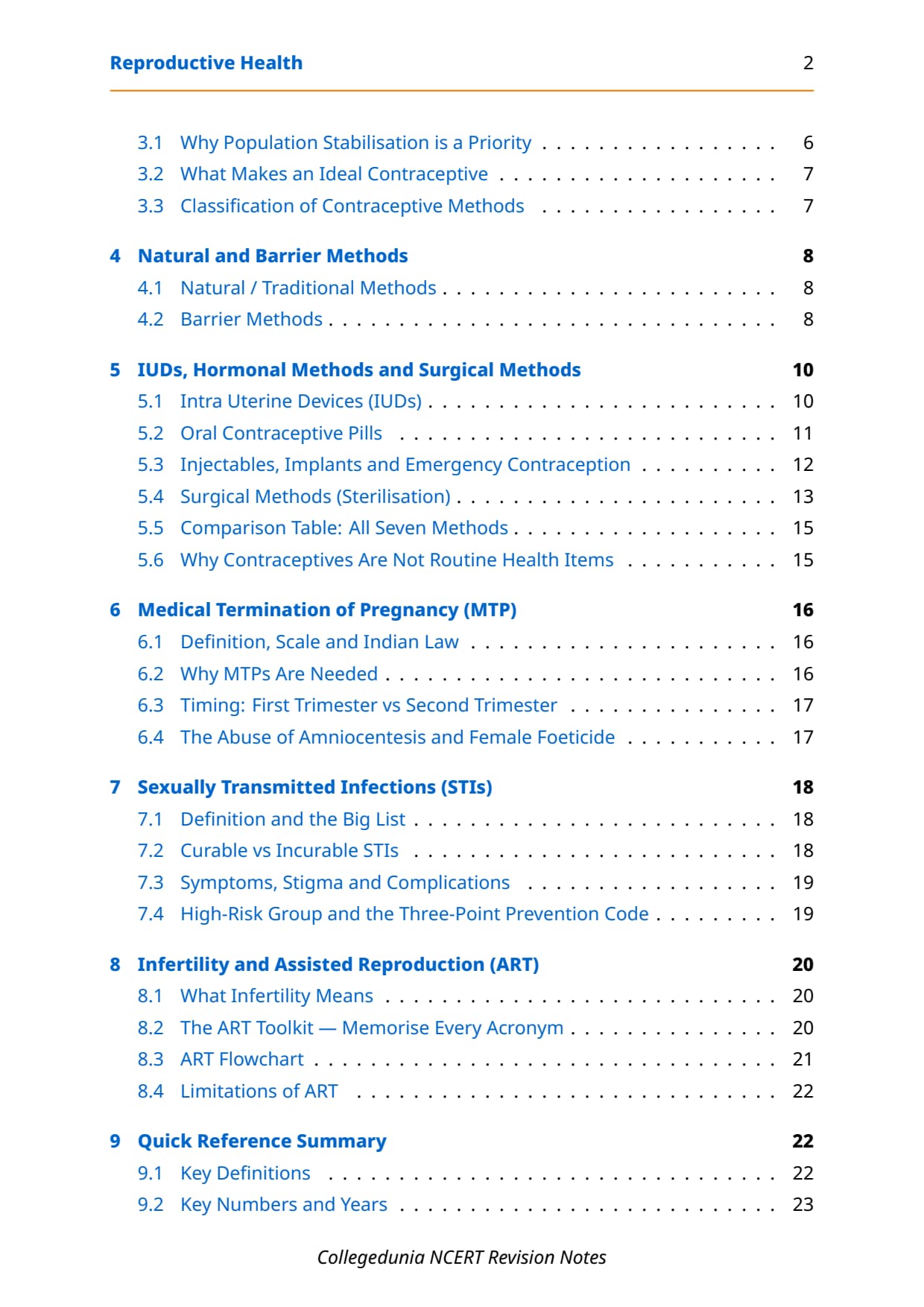
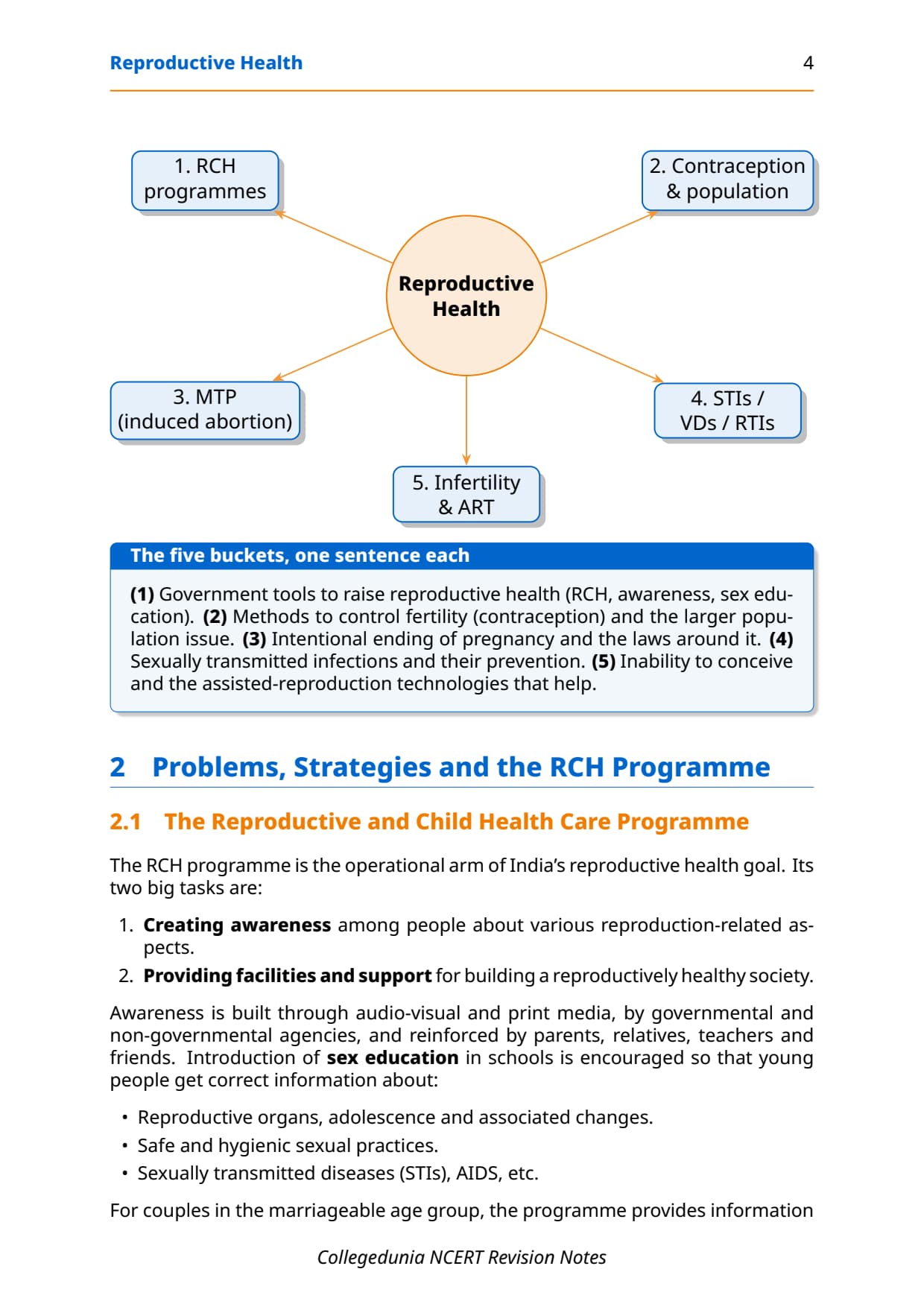
The 2026-27 NCERT keeps Chapter 3 Reproductive Health intact but trims dated demographic data, retaining RCH programmes, contraception, MTP, STIs, infertility and ART. These reproductive health class 12 notes map every retained sub-topic so you revise only what CBSE and NEET still examine.

- CBSE Weightage: 4 to 6 marks (Unit VI, Reproduction)
- NEET Weightage: 2 to 4 questions per year (strong source of single-statement and assertion-reason items)
- CUET Weightage: 1 to 2 questions, mostly fact-recall on contraception and STIs
These notes are prepared by subject experts, mapped to the 2026-27 NCERT, and checked against the last five years of CBSE and NEET papers.
Also Check:
Reproductive Health Video Lecture for Class 12 Biology
Source: Magnet Brains on YouTube
How will Collegedunia's Reproductive Health Class 12 Notes Help You?
This chapter is heavy on definitions, so well-organised notes save the most time. They give you:
- 2026-27 NCERT alignment with trimmed demographic figures flagged;
- quotable tables for contraceptives, STIs and ART, just how NEET frames questions;
- quick revision strips after each sub-topic for last-day recall.
Sub-Topic Weightage Map: Reproductive Health Class 12 Biology
This table shows which parts carry the most marks across recent CBSE and NEET papers.
| Sub-topic | Weightage | CBSE / NEET Frequency |
|---|---|---|
| Contraceptive methods and classification | High | Almost yearly |
| Sexually transmitted infections (STIs) | High | 4 of last 5 years |
| Assisted reproductive technology (IVF, ZIFT, GIFT, ICSI) | Medium | 3 of last 5 years |
| Medical Termination of Pregnancy and amniocentesis | Medium | 3 of last 5 years |
| Reproductive health problems and RCH strategies | Medium | 2 of last 5 years |
| Population explosion and birth control | Low | 1 of last 5 years |
Reproductive Health Topic-by-Topic Notes for Class 12 Biology
Each sub-topic below follows the NCERT order, with a quick recall tip after the key ones.
Reproductive Health: Definition and RCH Programmes
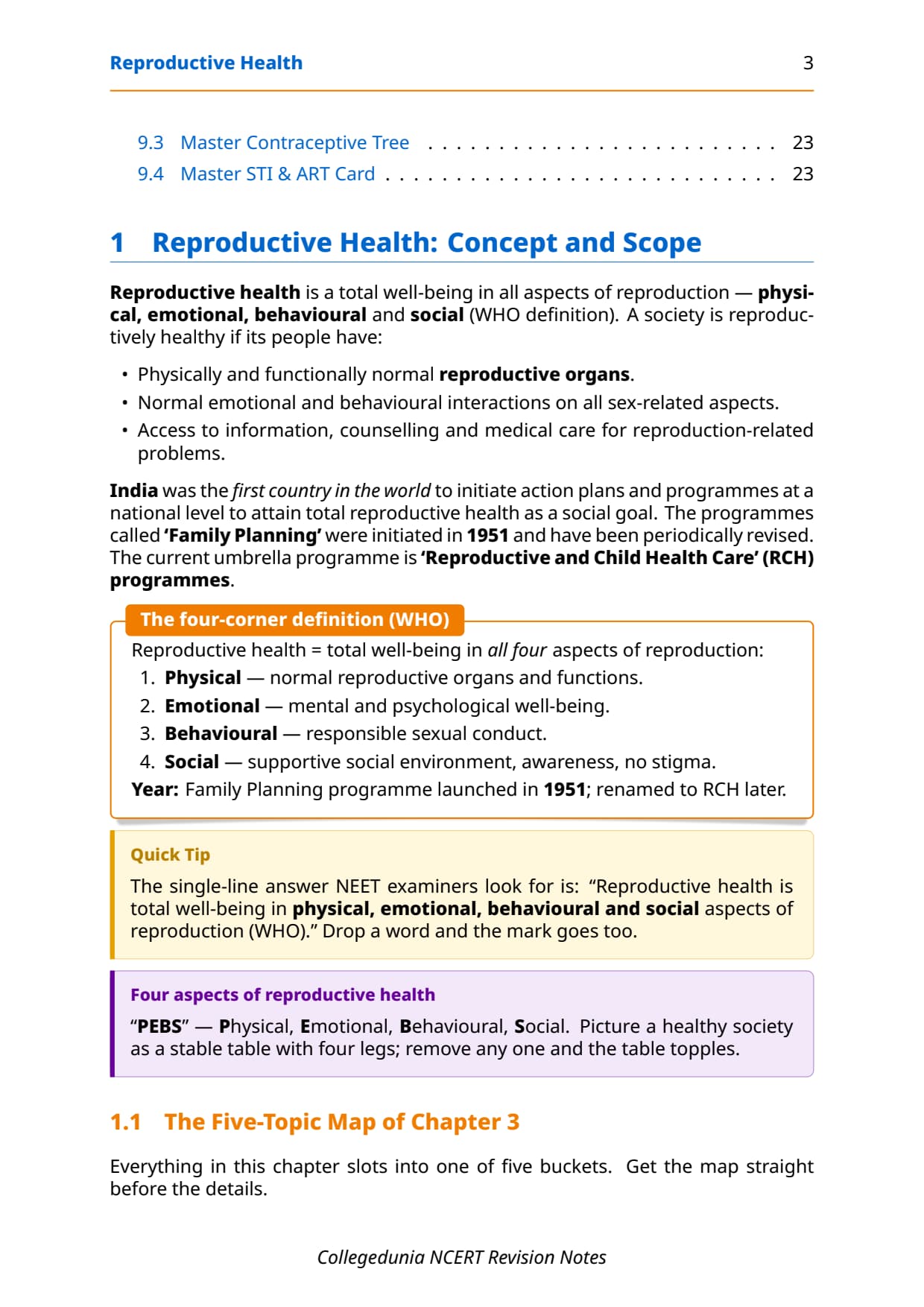
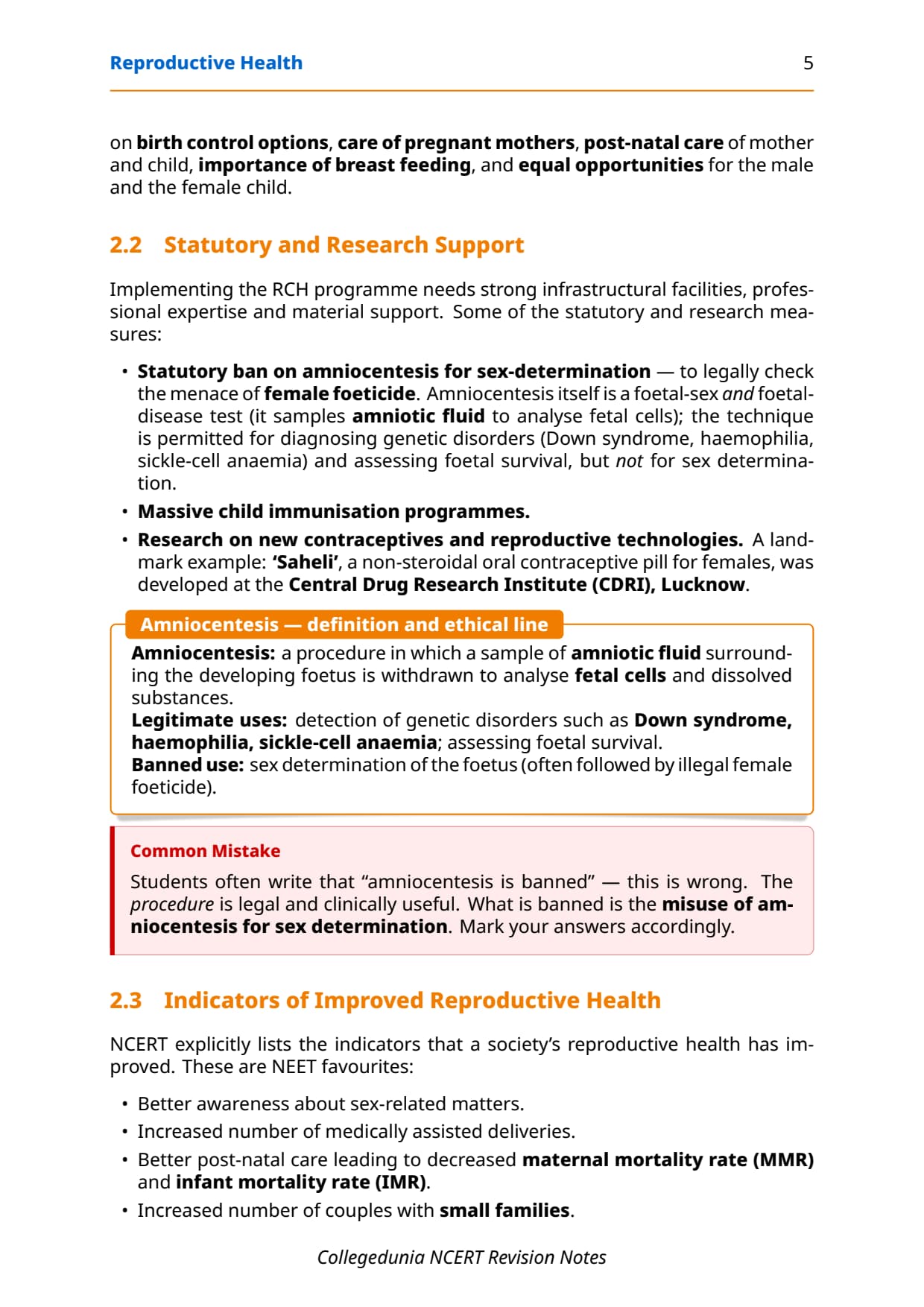
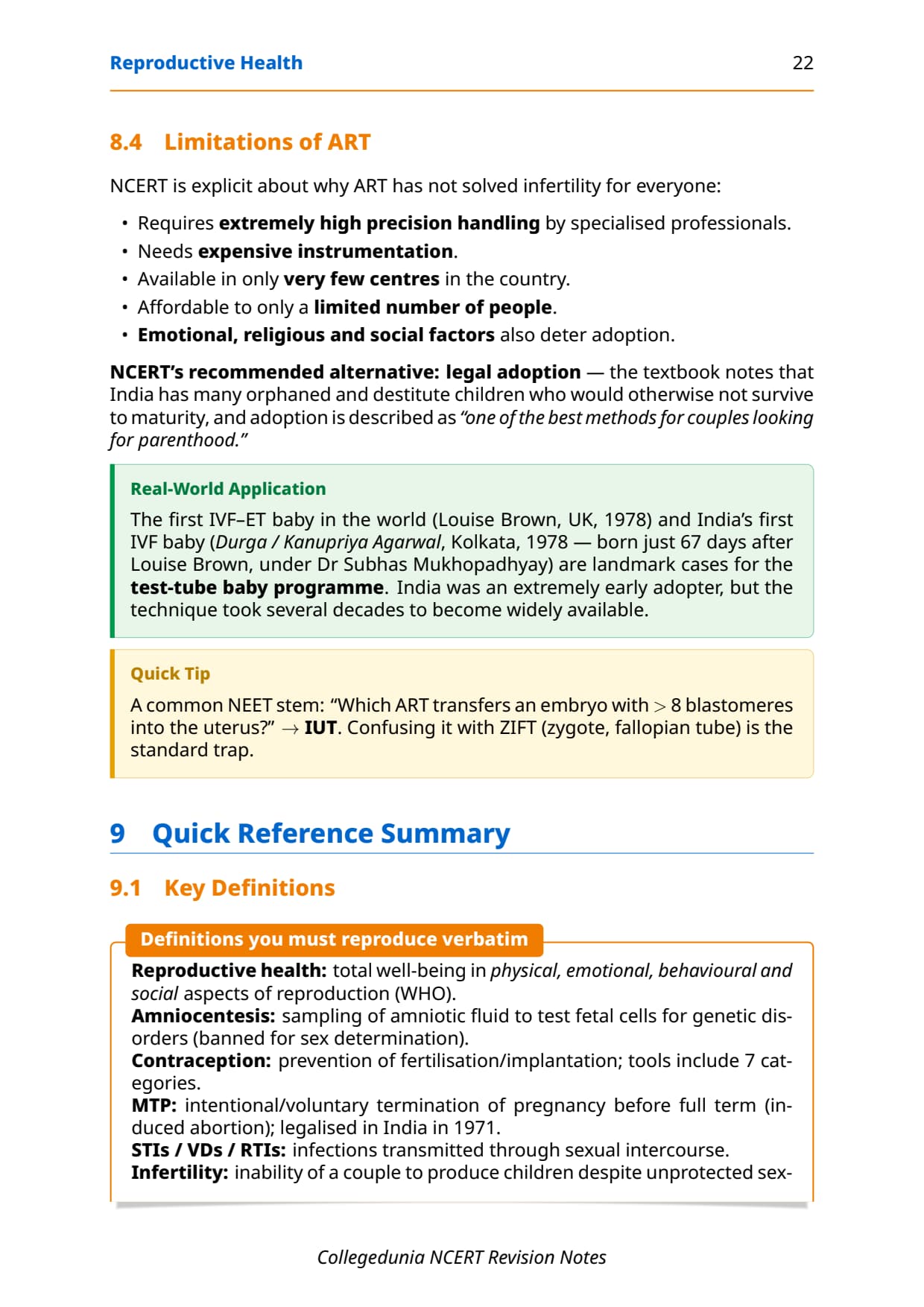
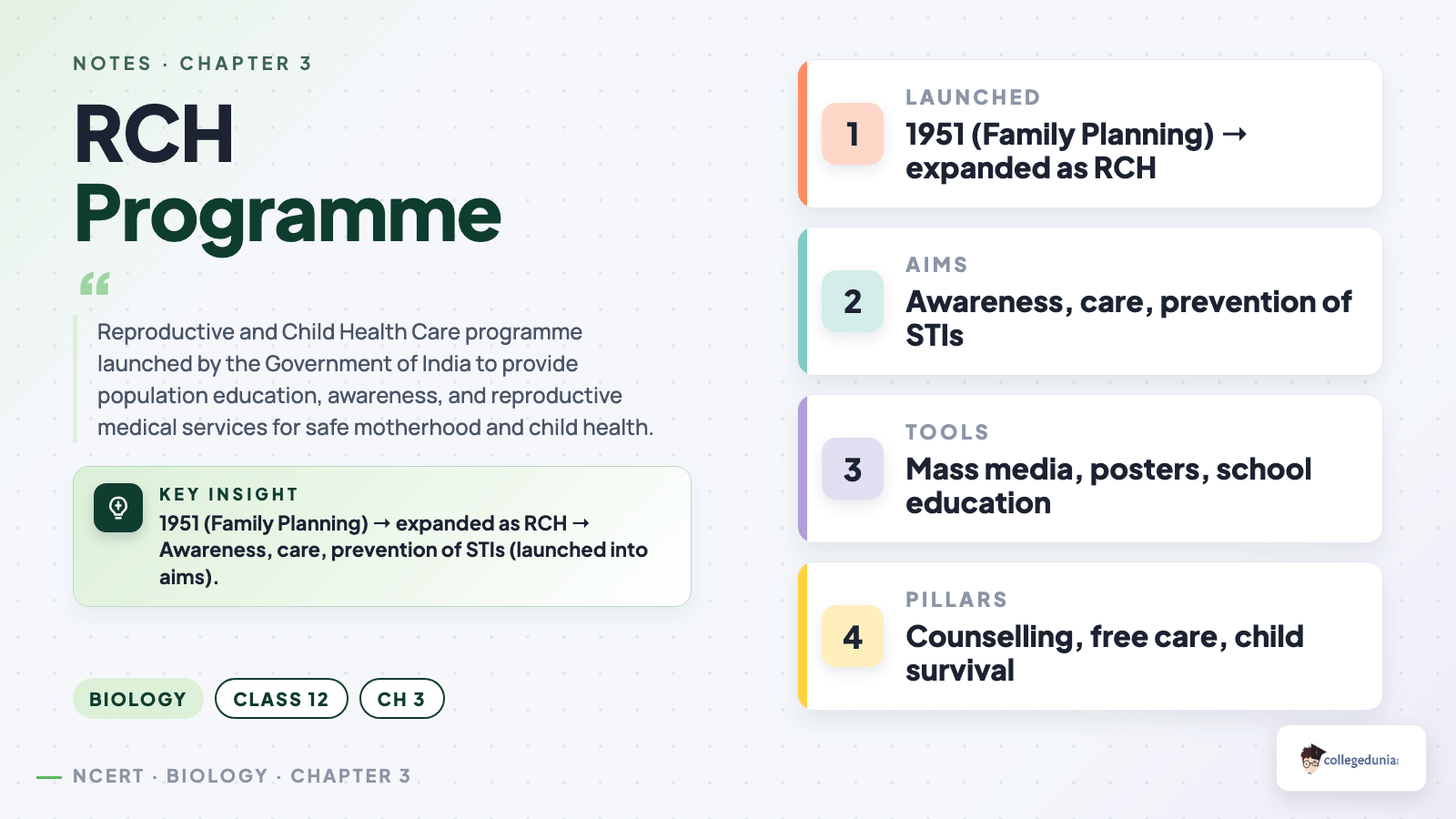
As per the World Health Organisation, reproductive health means total well-being in reproduction: physical, emotional, behavioural and social. India was among the first to start national programmes, first Family Planning (1951), now broadened as Reproductive and Child Health Care (RCH). These work through awareness, sex education, antenatal and postnatal care, safe delivery and infection control, lowering maternal and infant mortality.
Population Explosion and Why Birth Control Is Needed
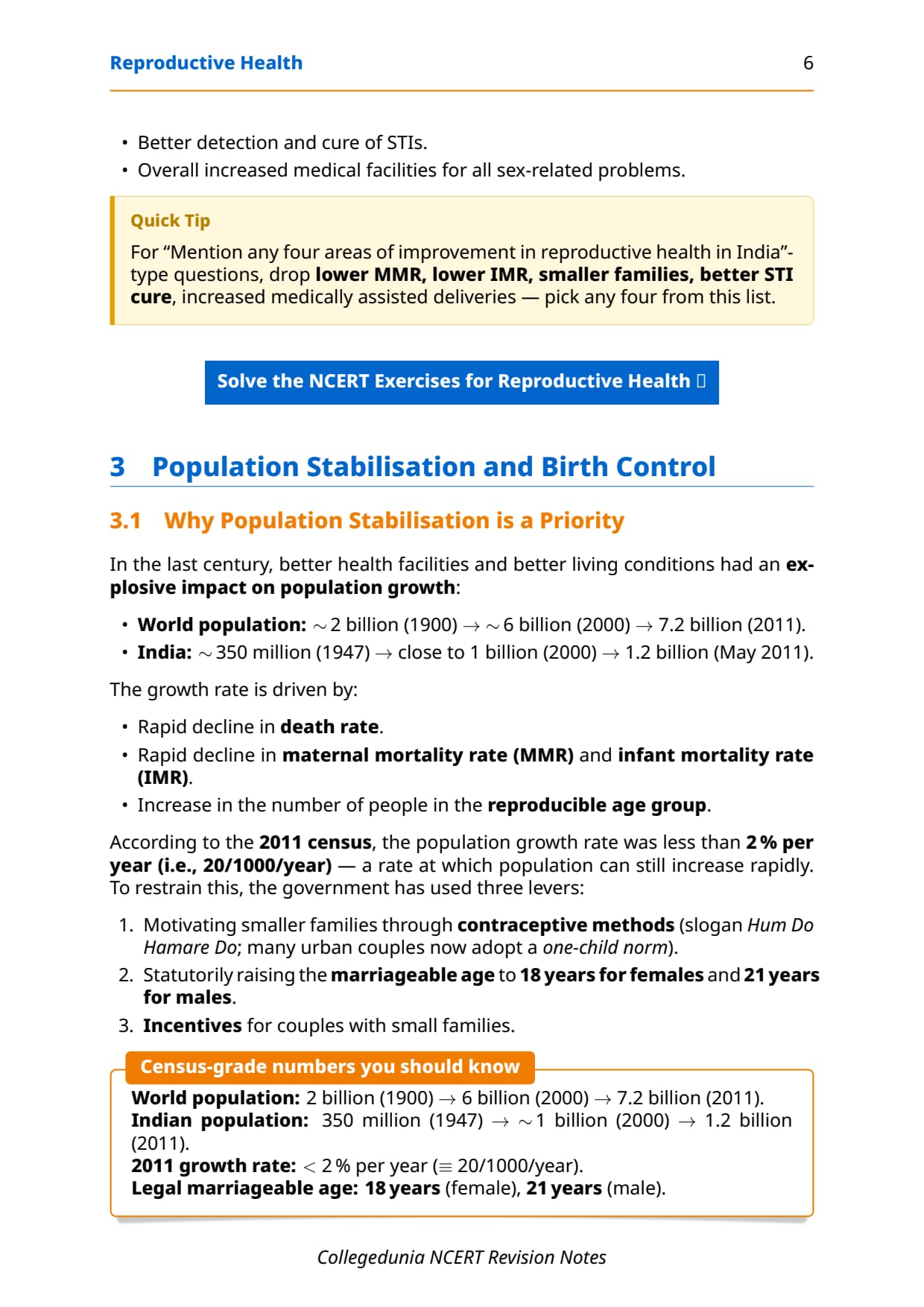
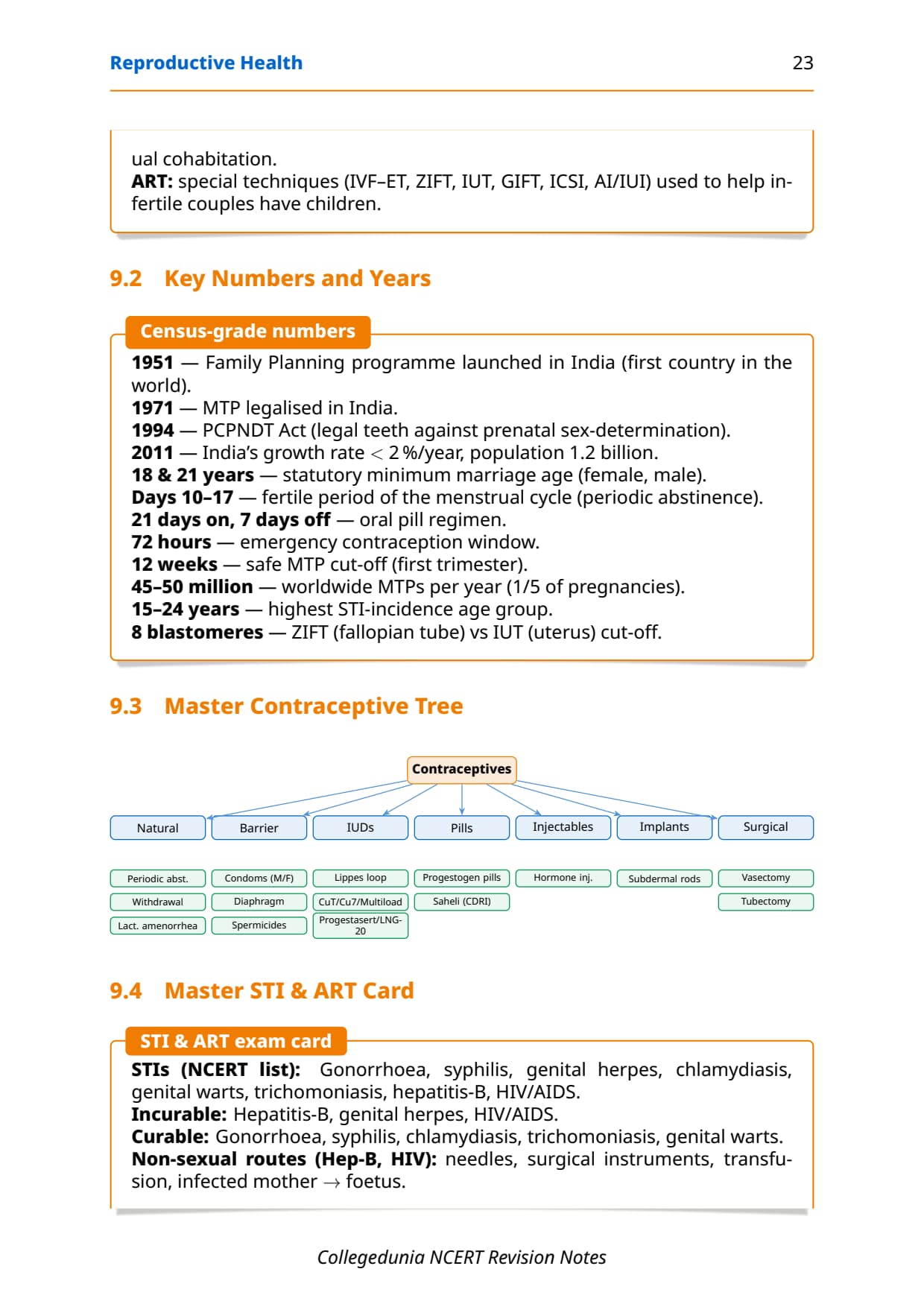
Population grew fast as mortality rates fell while the reproducible-age group rose, so NCERT treats stabilisation as a priority. A higher marriageable age (18 for females, 21 for males) and smaller families help. Contraception lets a couple delay or prevent pregnancy without harming fertility.
Contraceptive Methods: Natural, Barrier, IUDs, Oral Pills, Surgical
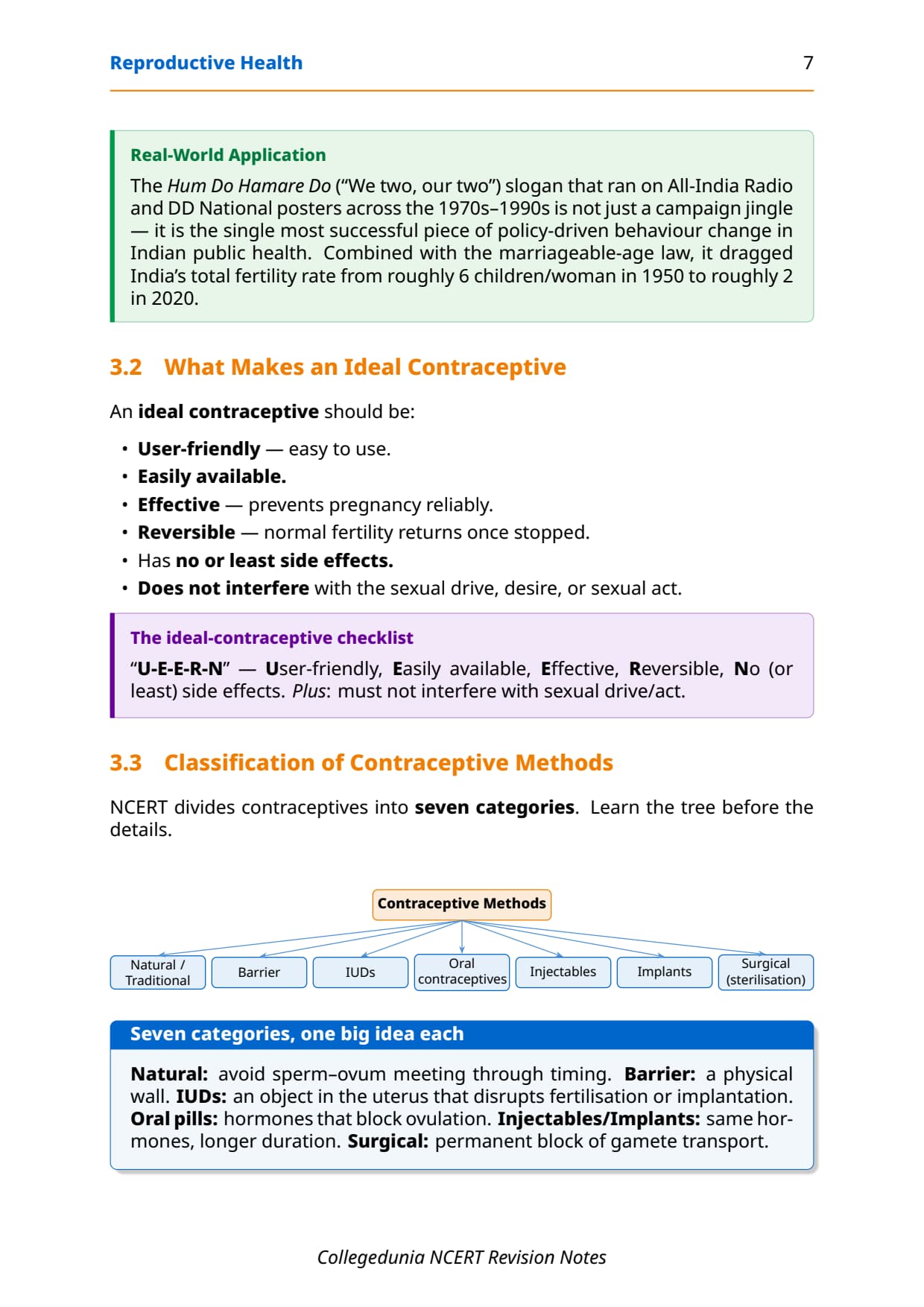
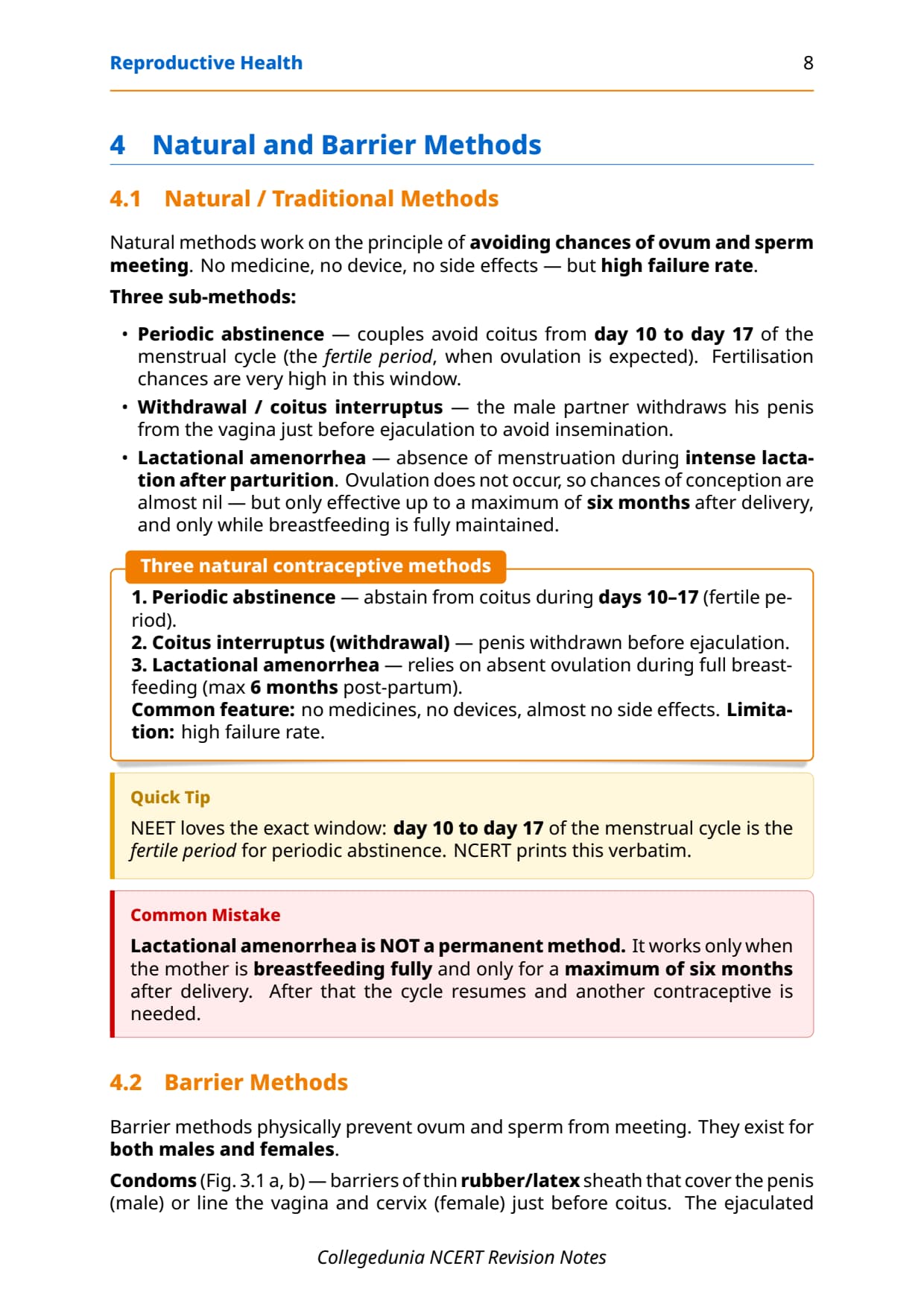
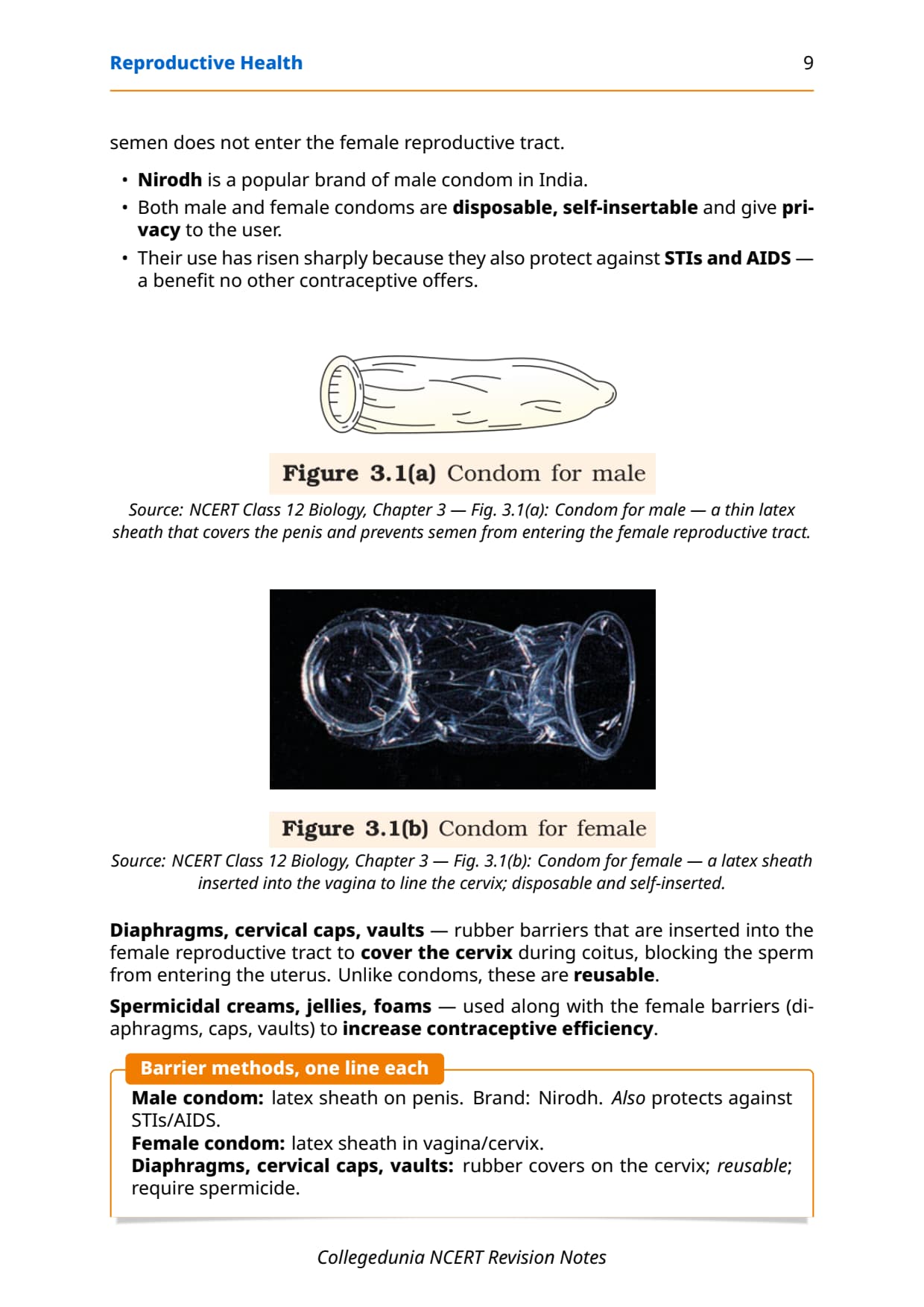
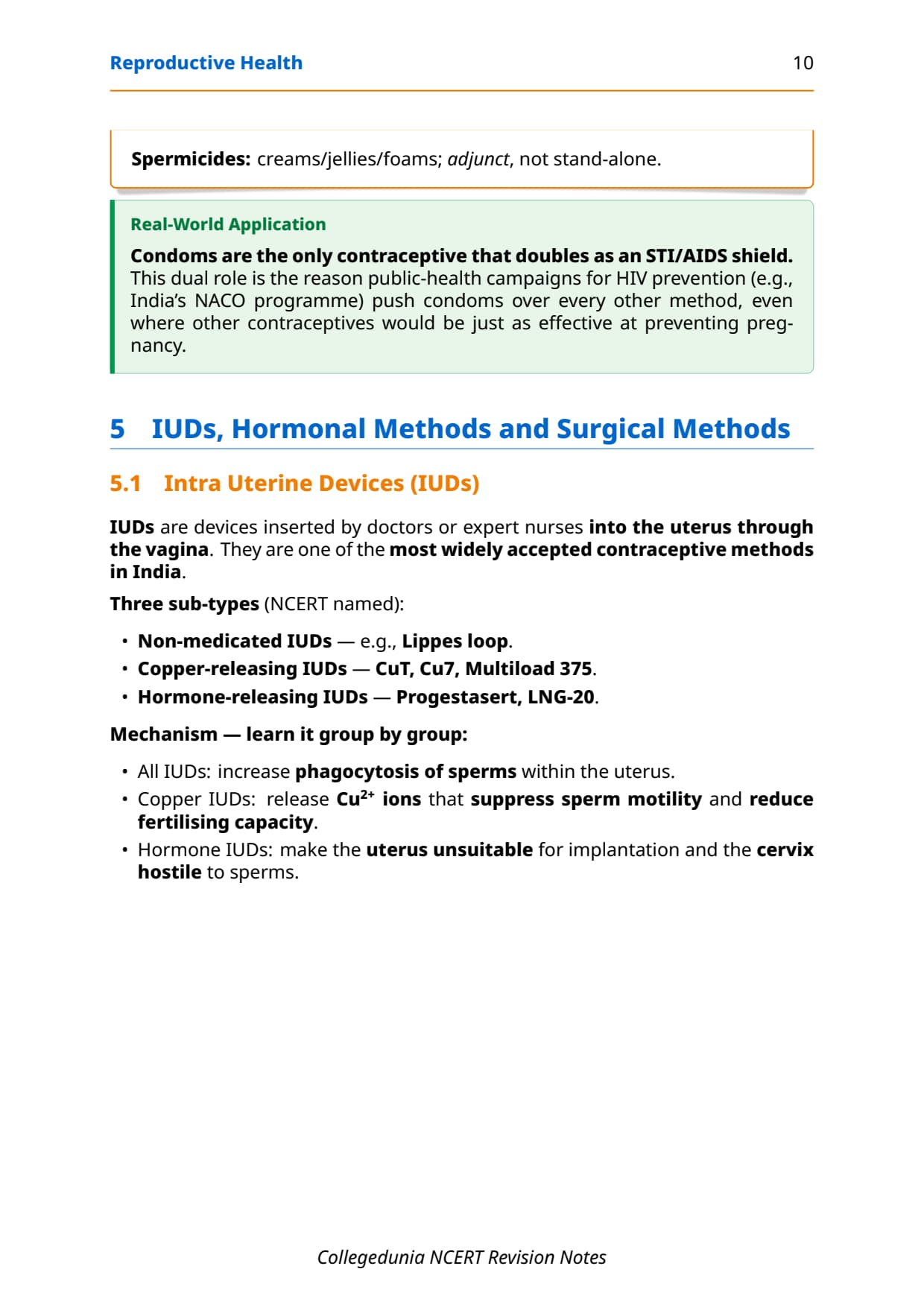
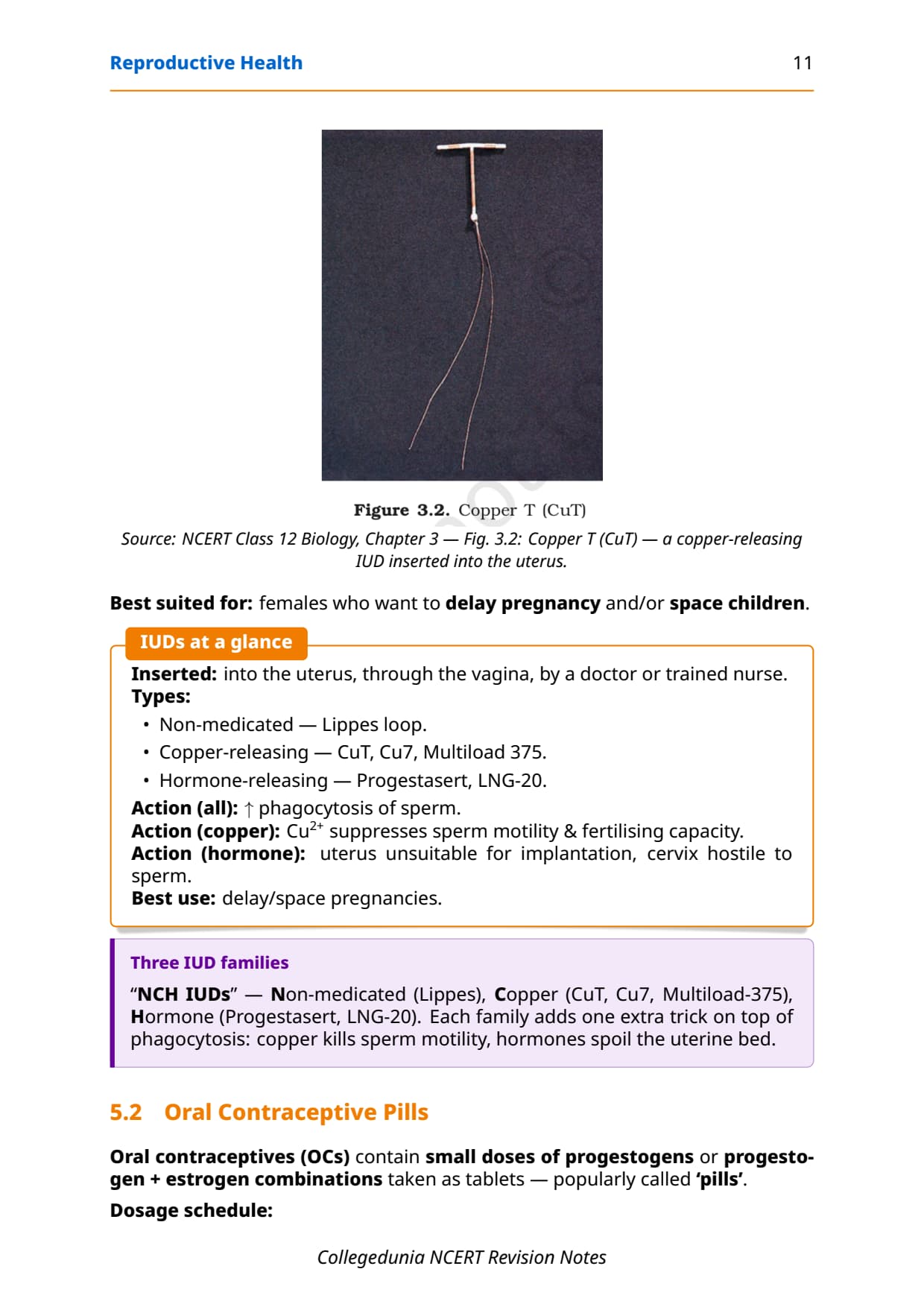
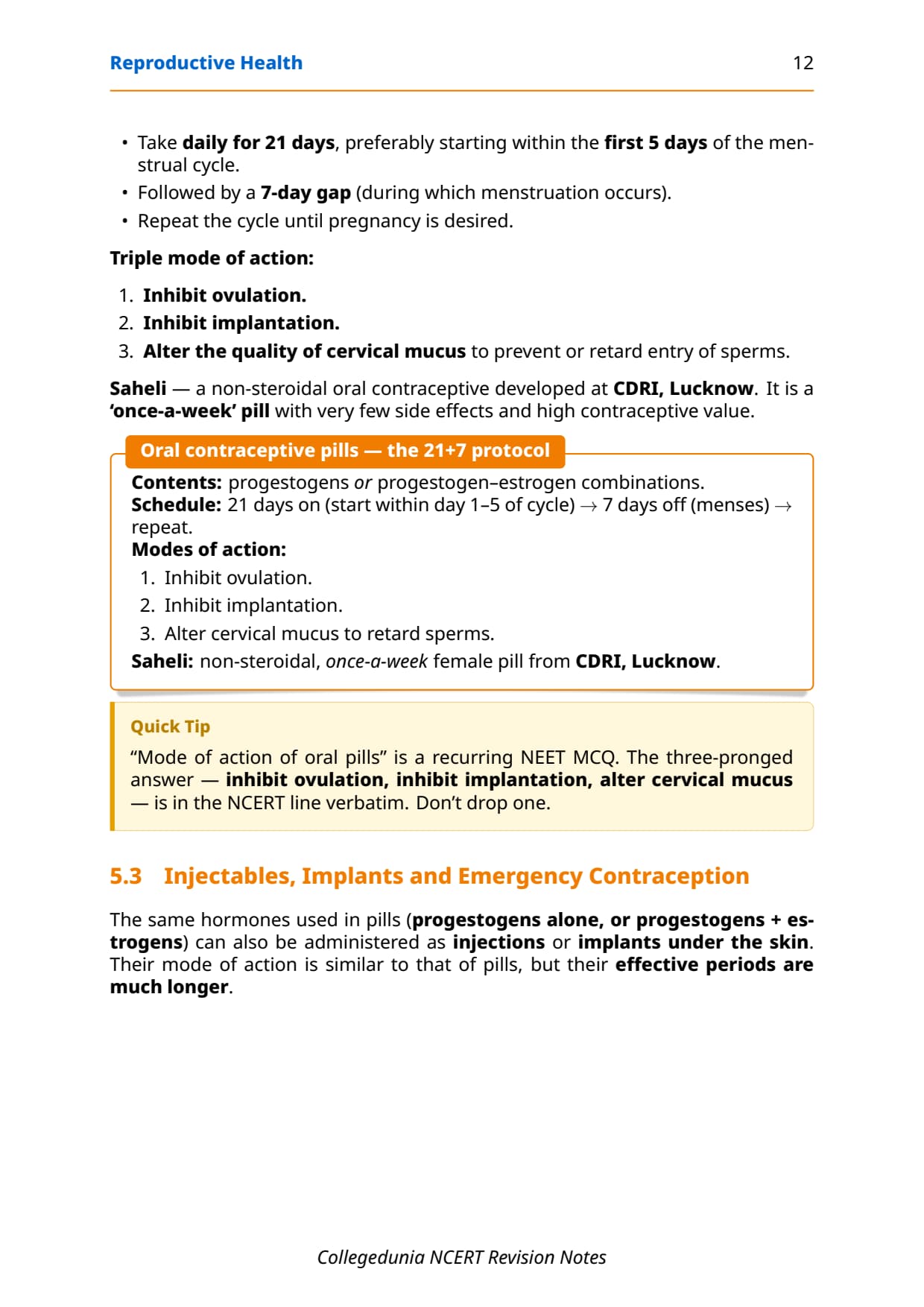
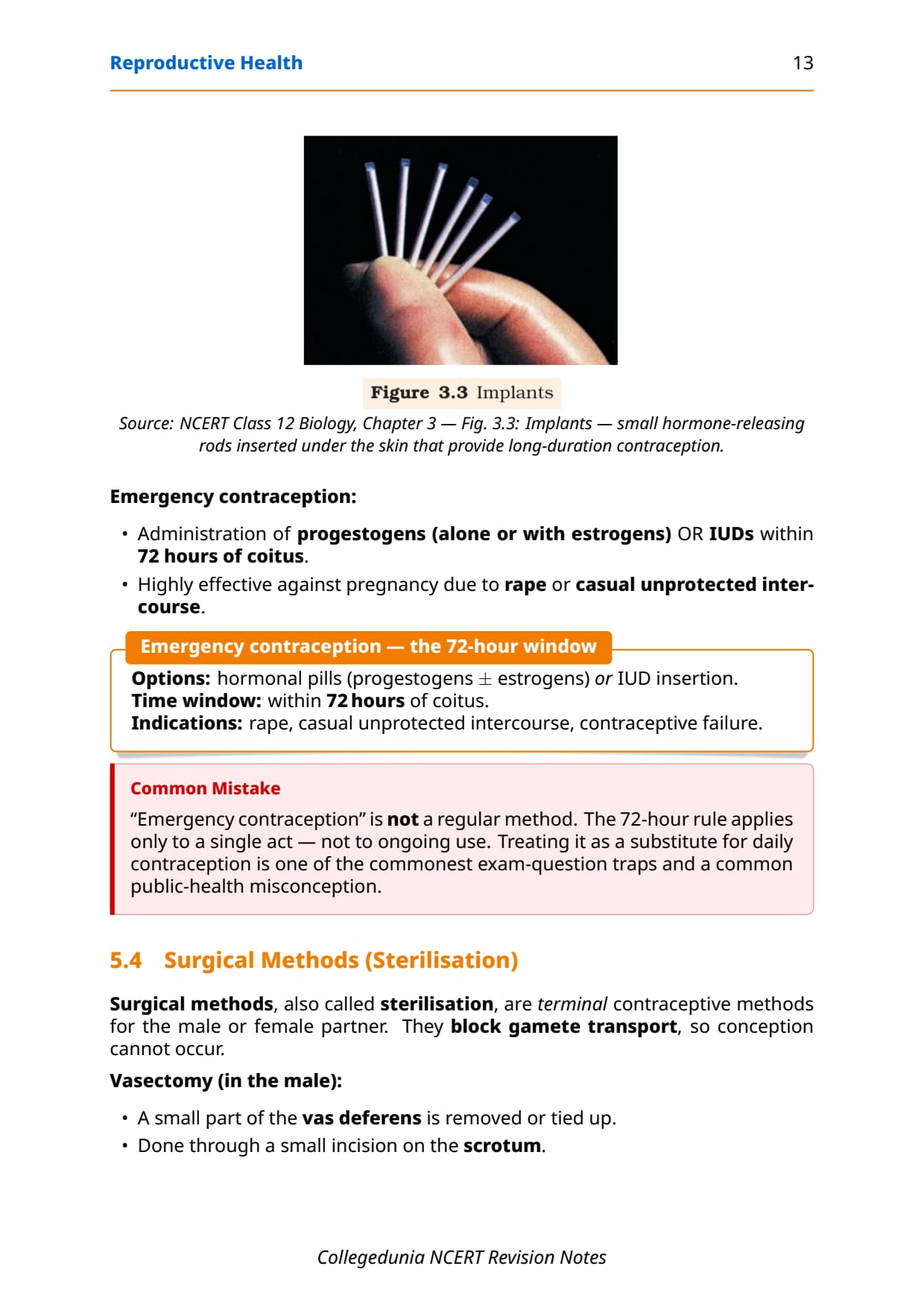
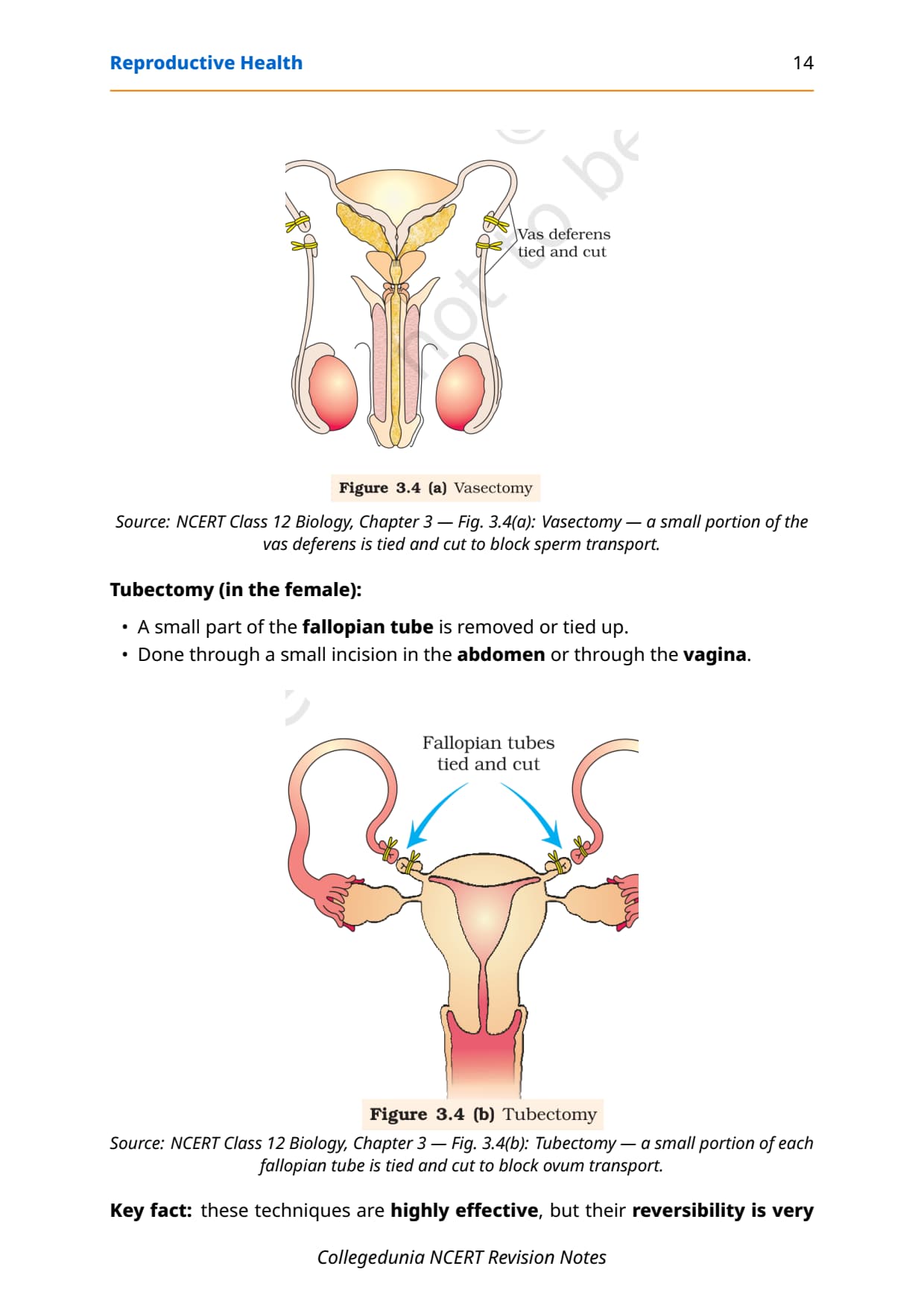
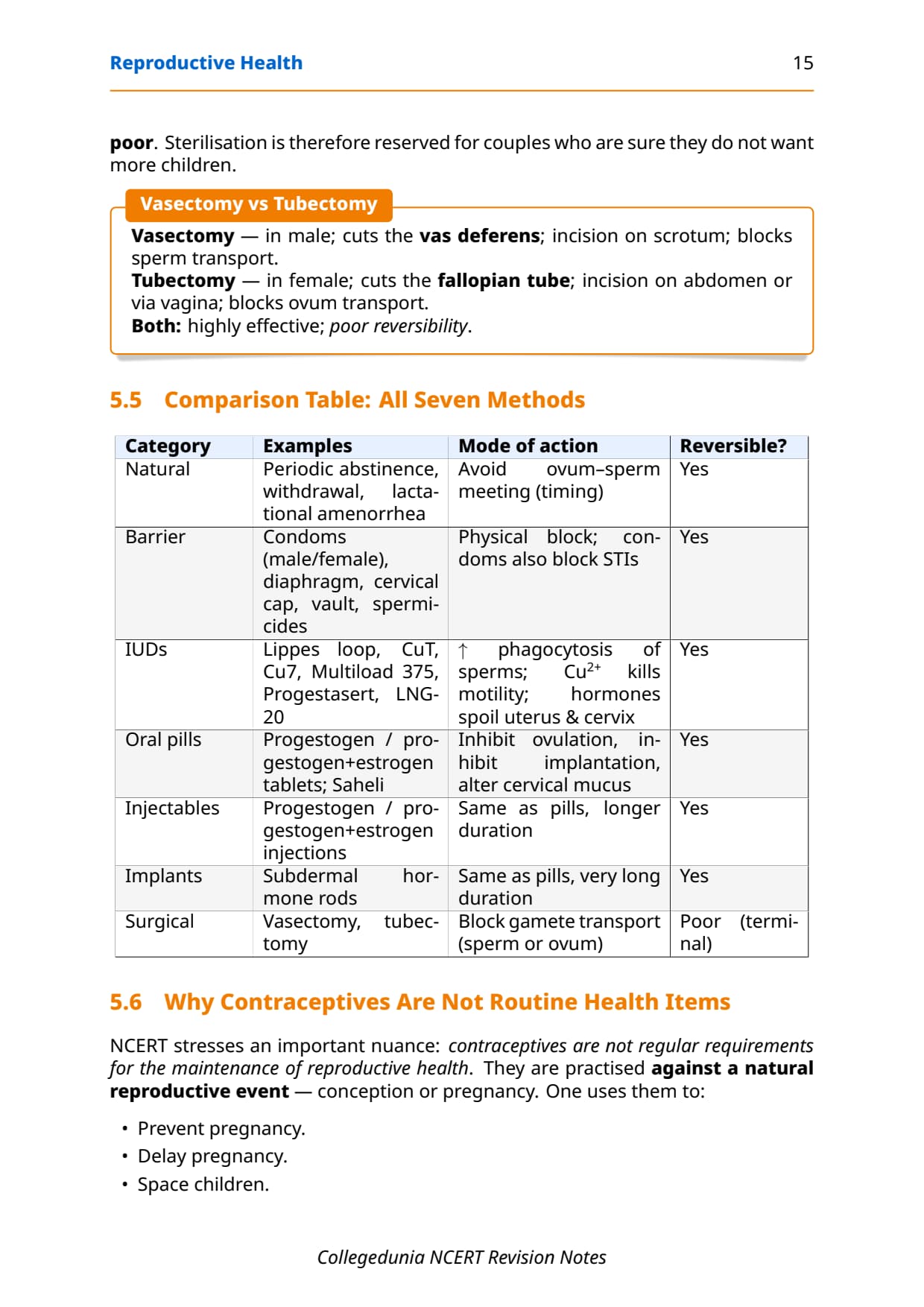
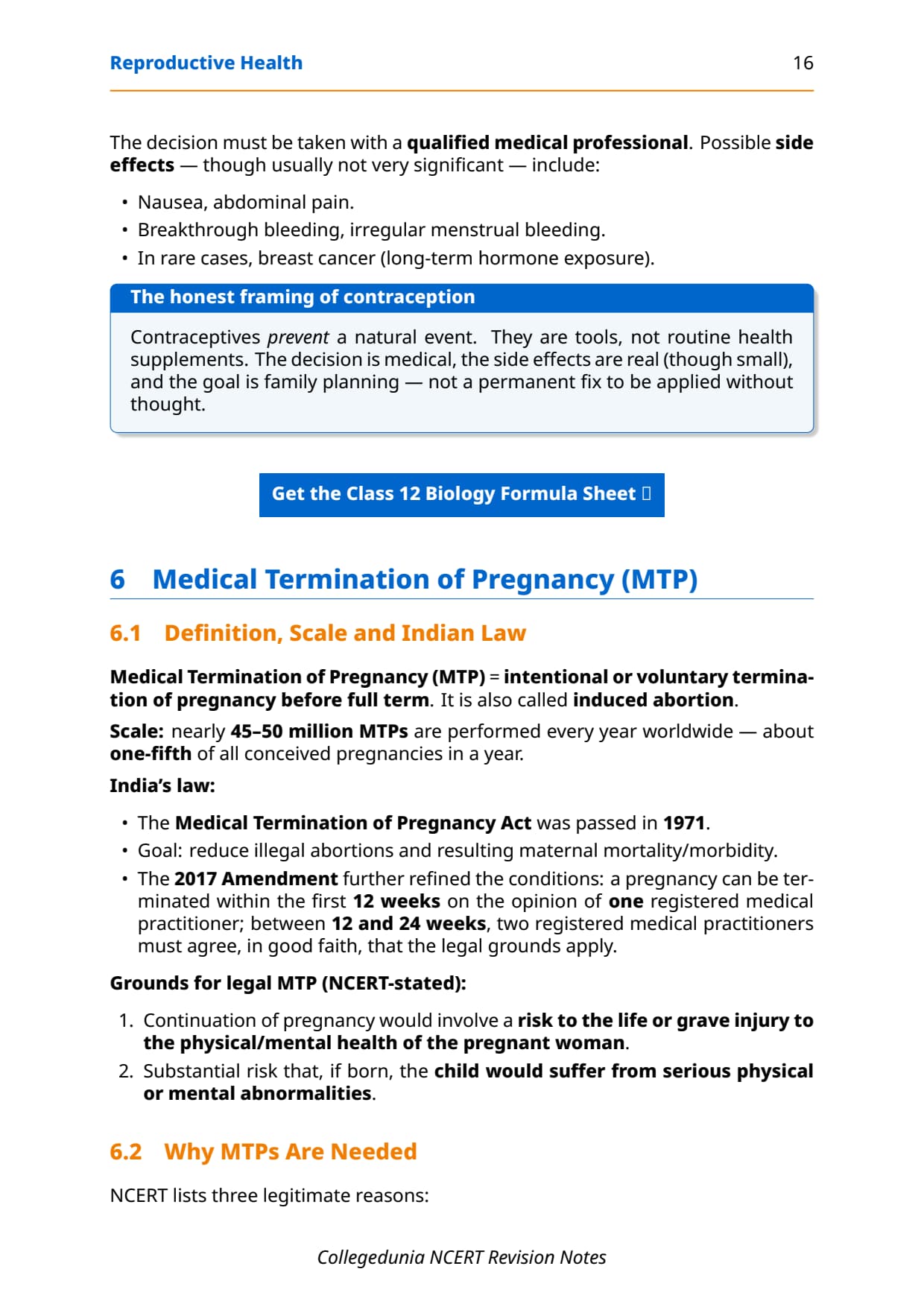
An ideal contraceptive is user-friendly, effective, reversible and side-effect-free. The chapter groups methods into natural (periodic abstinence, withdrawal, lactational amenorrhoea), barrier (condoms, diaphragms, cervical caps), intra-uterine devices (CuT and other copper- or hormone-releasing IUDs), oral pills (such as Saheli), injectables and implants, and surgical sterilisation (vasectomy, tubectomy). Emergency contraception within 72 hours can prevent pregnancy.
Medical Termination of Pregnancy (MTP) and the Amniocentesis Concern
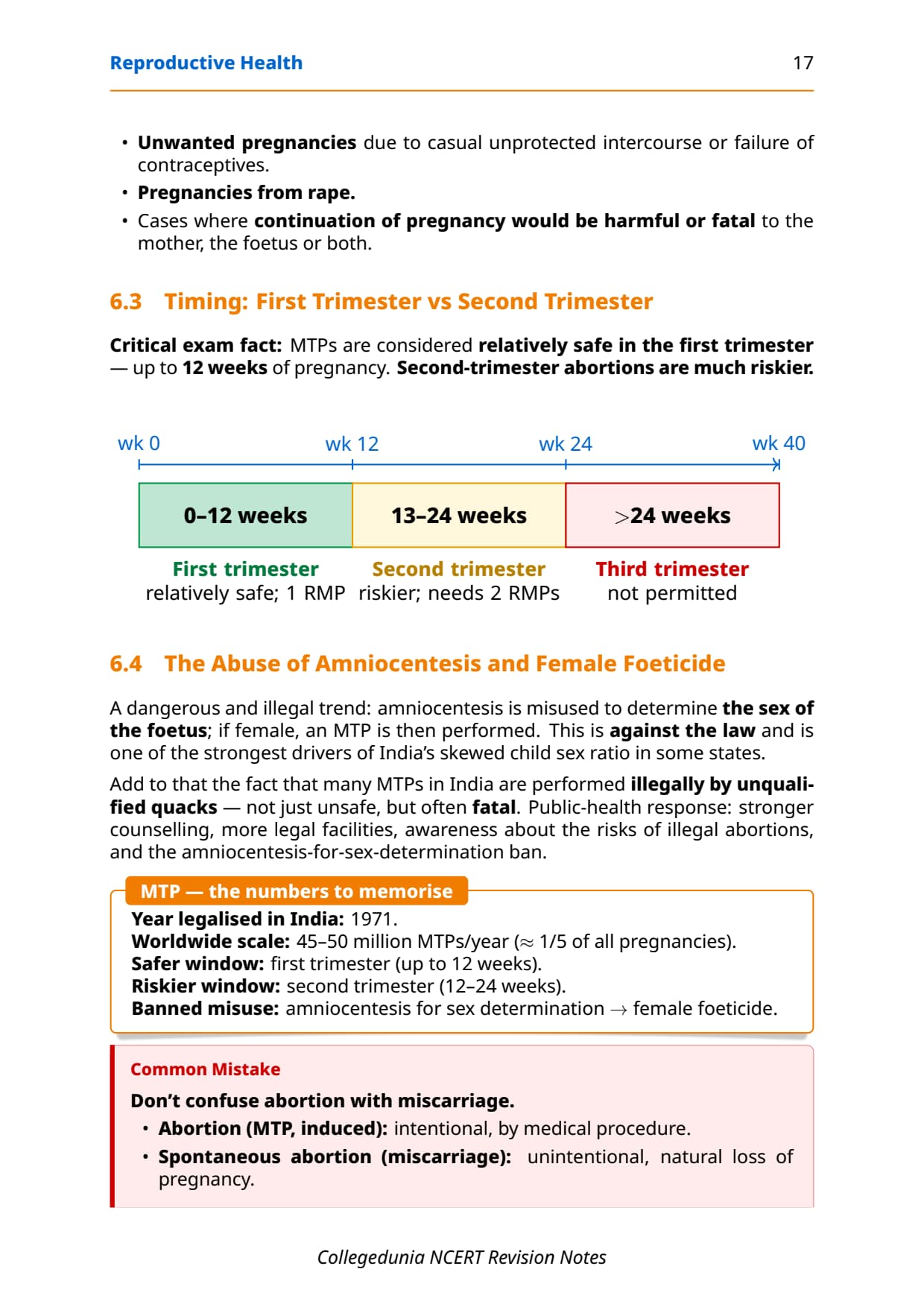
MTP, or induced abortion, ends a pregnancy before full term. India legalised it in 1971 with conditions to curb misuse. It is fairly safe up to the first trimester (12 weeks) and far riskier later. It is allowed when a pregnancy harms the mother or fetus, or follows rape or contraceptive failure. Amniocentesis, a foetal genetic test, is also misused for illegal sex determination.
Sexually Transmitted Infections (STIs)
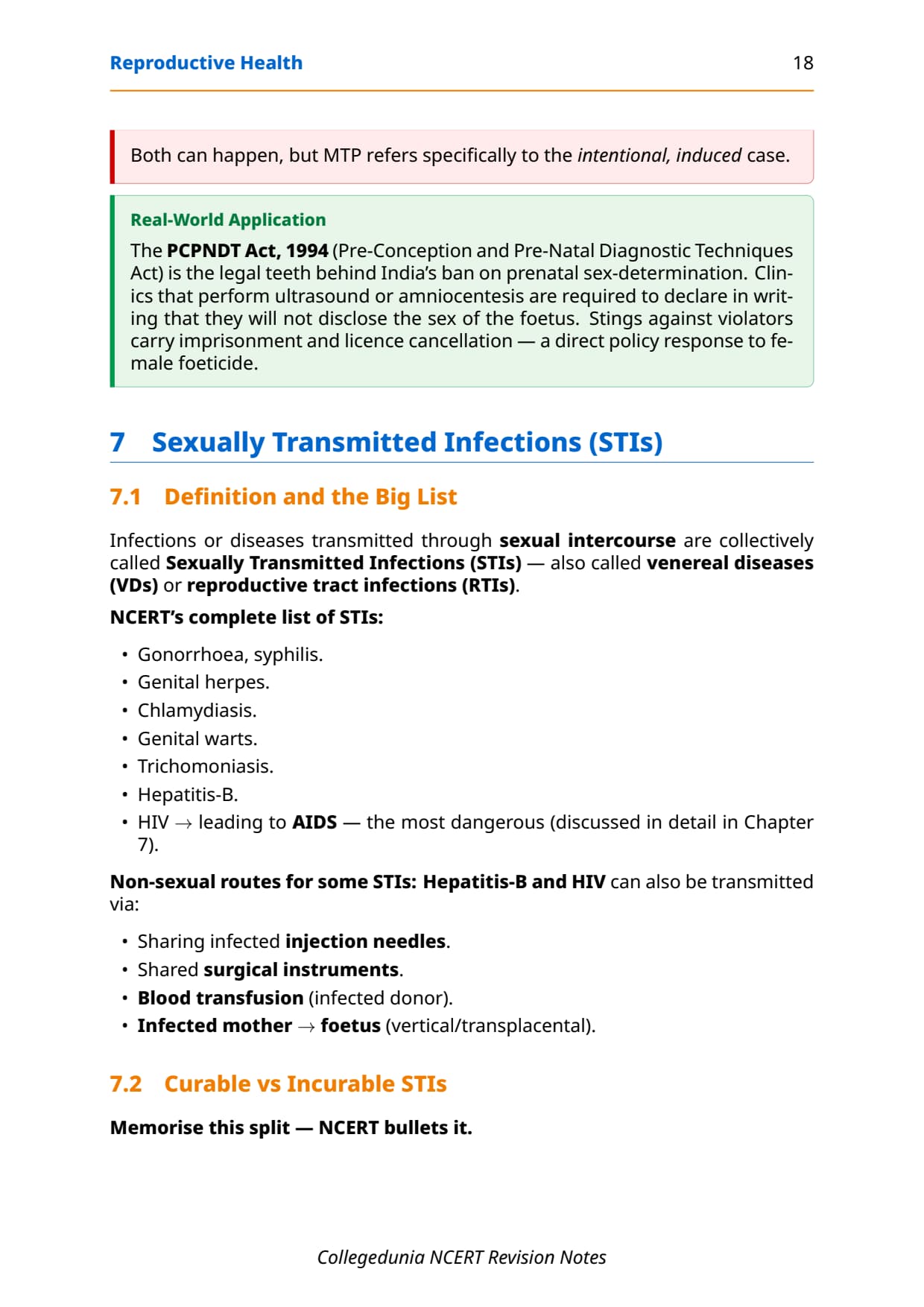
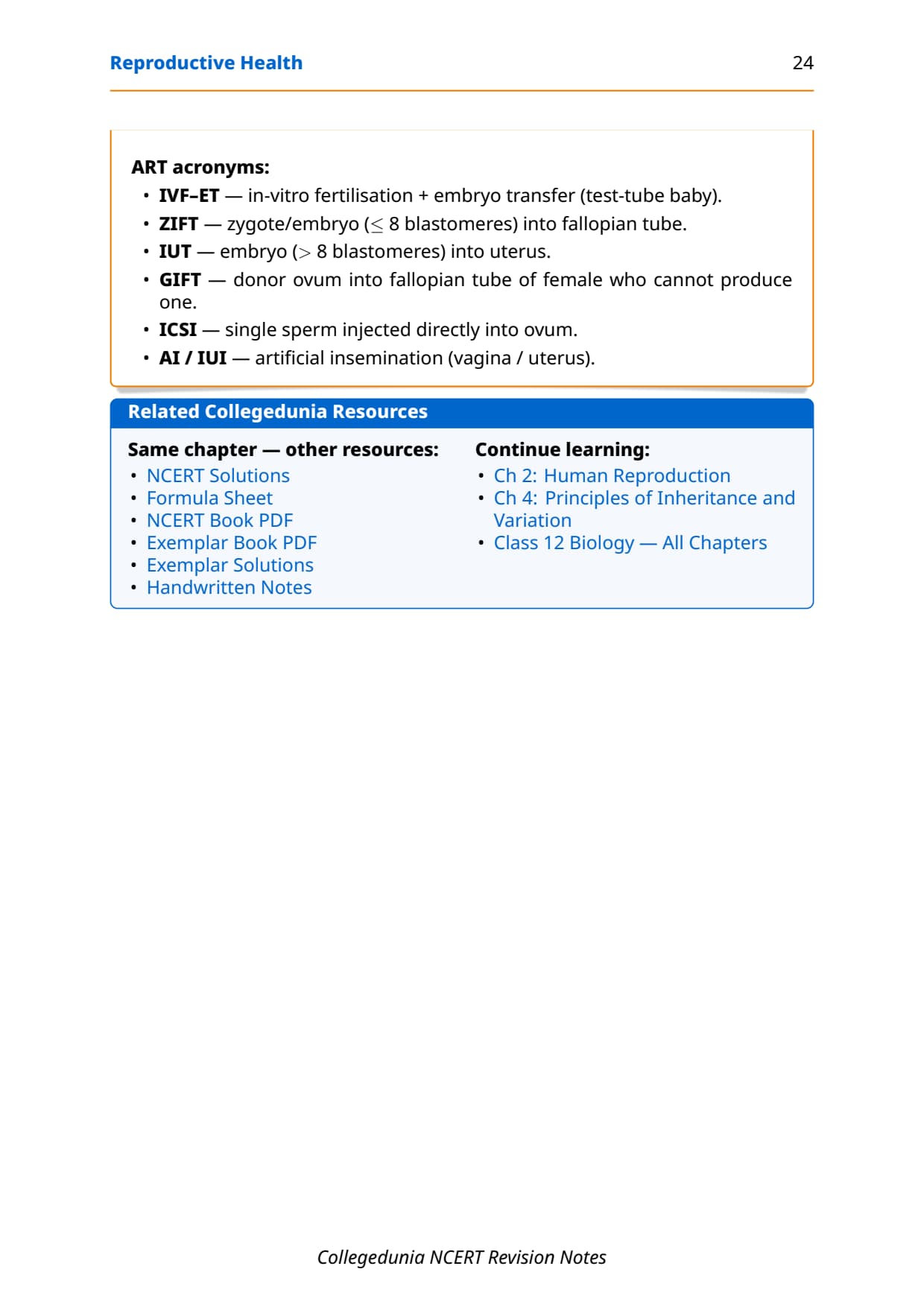
Infections passed through sexual contact are sexually transmitted infections (STIs) or venereal diseases. NCERT lists gonorrhoea, syphilis, genital herpes, chlamydiasis, genital warts, trichomoniasis, hepatitis B and HIV/AIDS. Early symptoms are often mild (itching, discharge, slight pain), so they go unnoticed and can lead to pelvic inflammatory disease, infertility or cancer. Condoms, a single partner and early diagnosis are the key preventive steps.
Infertility and Assisted Reproductive Technologies (ART)
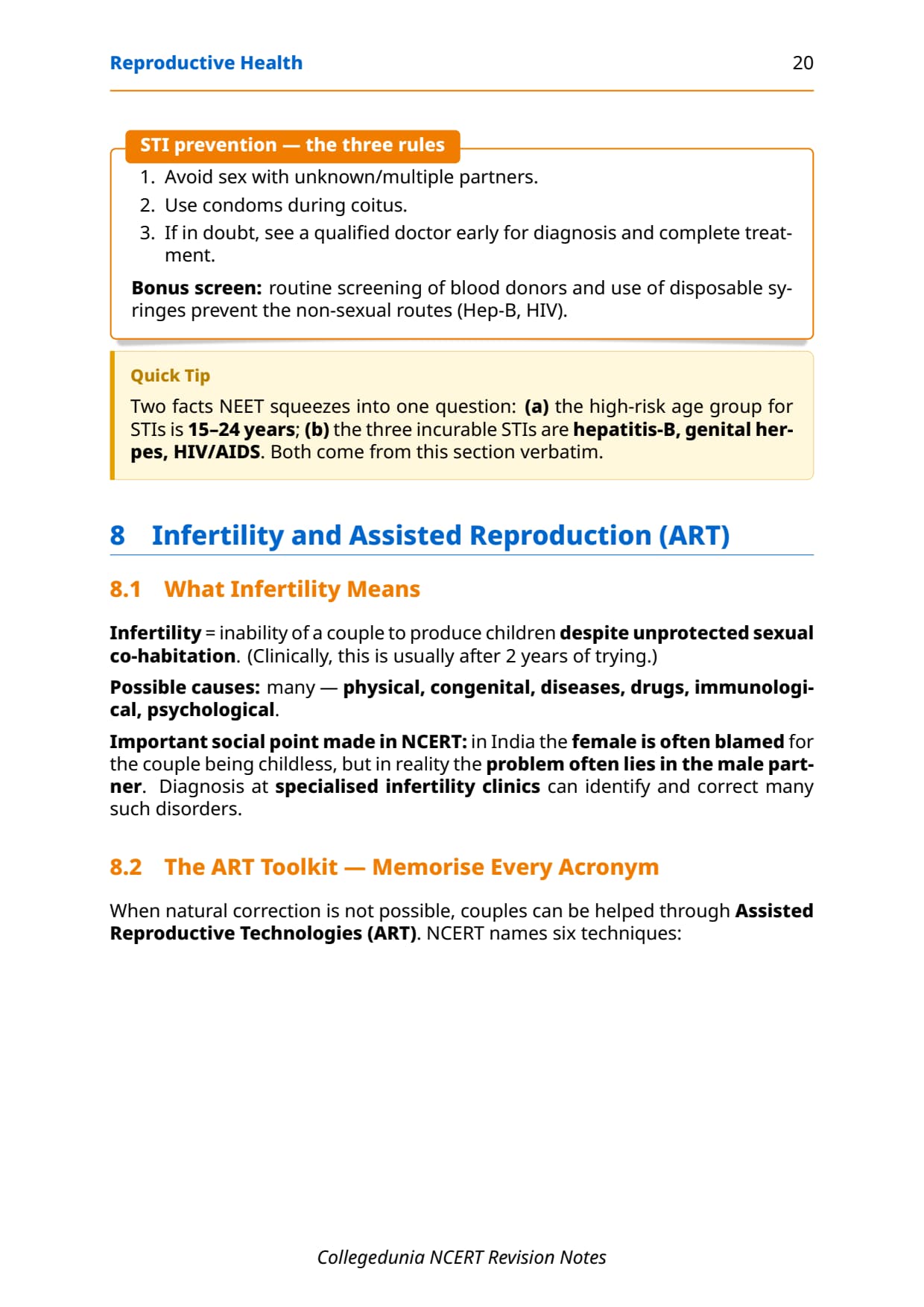
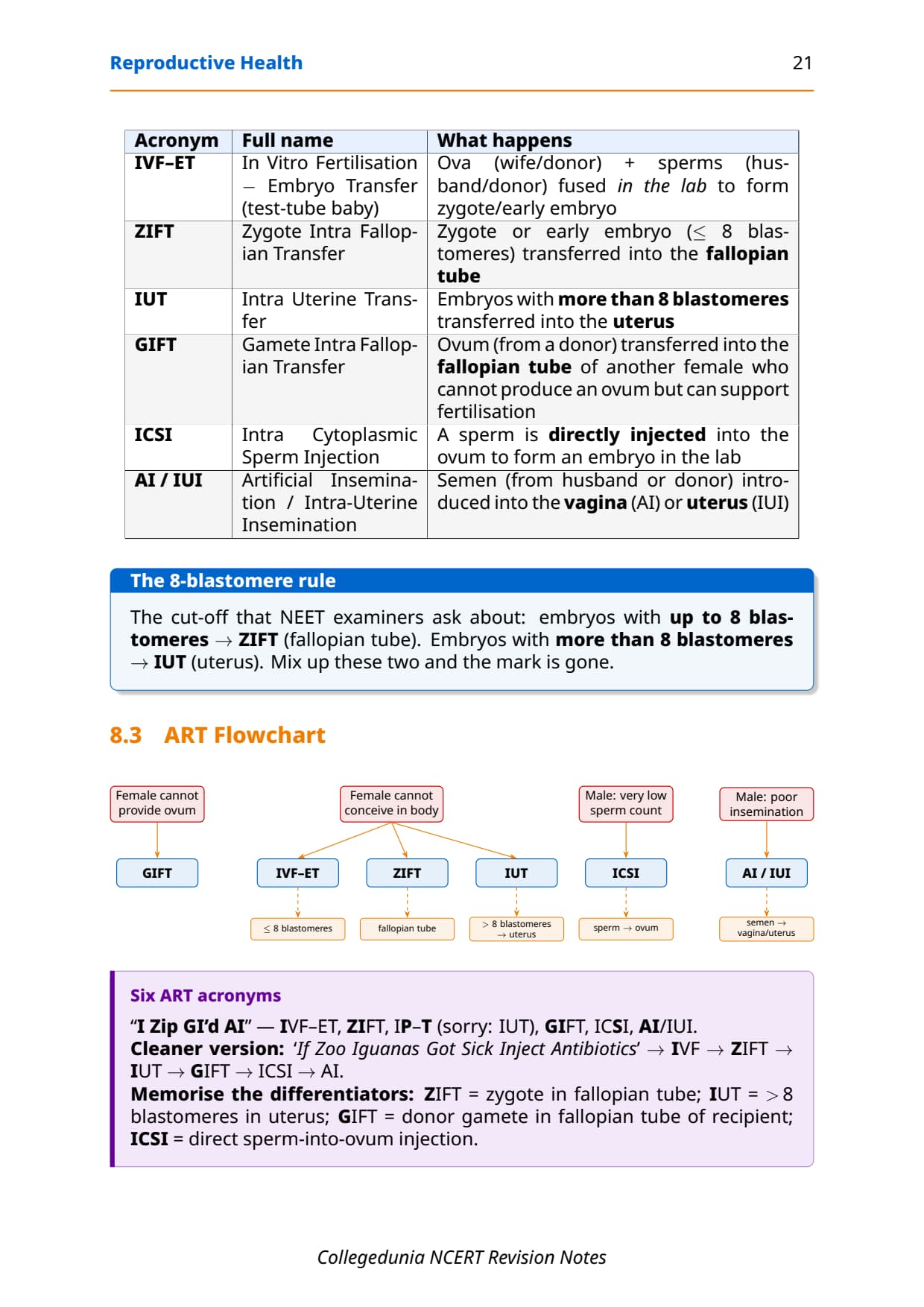
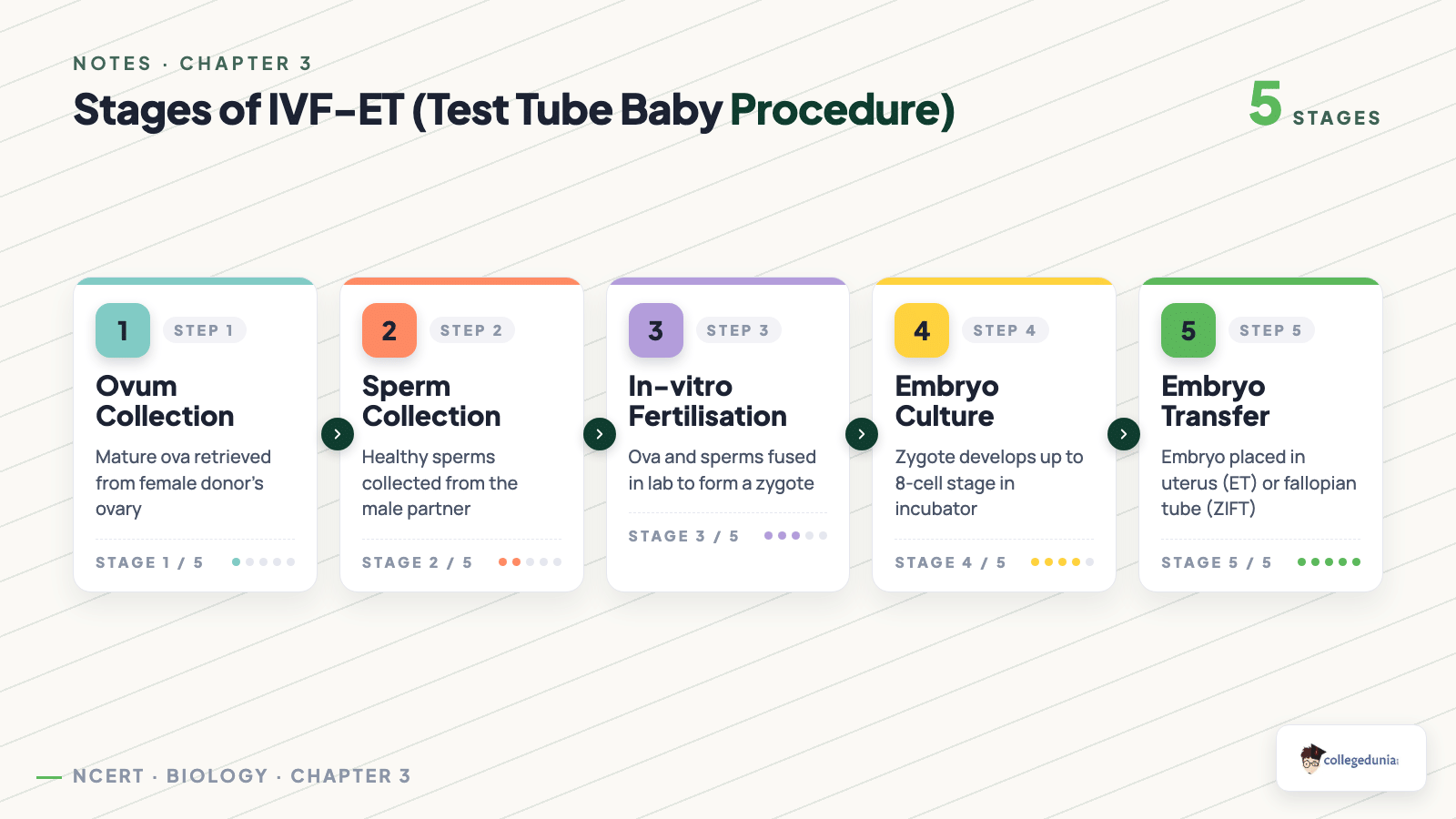
Couples who cannot conceive after unprotected sex are infertile; the cause may be male, female or both. Assisted reproductive technologies (ART) help them: in vitro fertilisation with embryo transfer (the "test-tube baby" route), ZIFT (zygote intra-fallopian transfer), GIFT (gamete intra-fallopian transfer), ICSI (intra-cytoplasmic sperm injection), AI (artificial insemination) and IUI (intra-uterine insemination). Adoption is also a sound option.
Reproductive Health Reasoning Lines Examiners Expect in Class 12 Boards
This chapter has no maths derivations; CBSE rewards a few cause-and-effect lines instead. The "why oral pills work" point (progestogen blocks ovulation and implantation and alters cervical mucus) is the most commonly tested.
Most Repeated Reproductive Health Questions in CBSE Class 12 Boards (2025 to 2021)
These questions recur in CBSE papers; mastering them covers most of the chapter's marks.
- CBSE 2025 (3-mark): Explain any two ART techniques that help infertile couples.
- CBSE 2024 (2-mark): Why is amniocentesis for sex determination banned in India?
- CBSE 2023 (3-mark): List the symptoms and two complications of any one STI.
- CBSE 2023 (2-mark): Differentiate IUDs and oral pills by their mode of action.
- CBSE 2022 (3-mark): State the conditions under which MTP is recommended.
- CBSE 2021 (2-mark): Define reproductive health as per WHO.
Full year-wise PYQ map and marking scheme: Reproductive Health Class 12 Biology NCERT Solutions
Reproductive Health Class 12: Prerequisite Concepts to Revise First
Reproductive Health builds on the previous chapter's physiology, so a quick recap helps.
- Reproductive systems: why sterilisation cuts the vas deferens or fallopian tube.
- Menstrual cycle and hormones: how oral pills suppress ovulation.
- Fertilisation and implantation: how IUDs and emergency contraception act.
- Gametogenesis: the basis of AI, IUI and ICSI.
Related Links:
- Human Reproduction Class 12 Biology Notes
- Sexual Reproduction in Flowering Plants Class 12 Biology Notes
Real-World Applications of Reproductive Health (Class 12th Biology)
This chapter is among the most applicable; its concepts shape real policy.
- Family-welfare programmes: the RCH framework drives antenatal-care and safe-delivery schemes.
- Fertility clinics and IVF: the ART techniques here underlie test-tube-baby and surrogacy services.
- STI control campaigns: condom-promotion and early-diagnosis drives apply the prevention points here.
- PCPNDT enforcement: the legal limit on amniocentesis curbs sex-selective abortion.
How Reproductive Health Connects to Other Class 12 Biology Chapters
These links build one mental map for the Reproduction and Health units.
| Connected Chapter | Shared Concept |
|---|---|
| Chapter 2 Human Reproduction | Physiology that contraception and ART act on |
| Chapter 7 Human Health and Disease | HIV/AIDS and immunity, overlapping with STIs |
| Chapter 4 Inheritance and Variation | Genetic disorders found by amniocentesis |
| Chapter 11 Organisms and Populations | Population growth and birth/death rates |
Student Feedback
In a survey of 11,200 Class 12 Biology students, most found ART terminology the hardest part of this chapter:
- 70% of students marked ART (ZIFT vs GIFT vs IUI) terminology as the hardest sub-topic.
- 58% lost 1-2 marks on the MTP Act time-window numbers.
- 4 out of 5 students skipped the amniocentesis labelled diagram in their answer sheet.
- Average student took 4.9 hours for the first read and 2.0 hours for a revision pass.
Source: 2025-26 Biology survey of 11,200 students across 18 states.
Other Resources for Reproductive Health Class 12 Biology
Use these companion pages to revise the chapter in other formats.
| Resource | Link |
|---|---|
| Notes (this page) | Reproductive Health Notes |
| NCERT Solutions | Reproductive Health Class 12 Biology NCERT Solutions |
| Formula Sheet | Reproductive Health Class 12 Biology Formula Sheet |
| NCERT Book PDF | Reproductive Health Class 12 Biology NCERT Book PDF |
| Exemplar Solutions | Reproductive Health Class 12 Biology NCERT Exemplar Solutions |
| Handwritten Notes | Reproductive Health Class 12 Biology Handwritten Notes |
| Exemplar Book PDF | Reproductive Health Class 12 Biology NCERT Exemplar Book PDF |
NCERT Notes for Class 12 Biology: All Chapters
Use this table to revise the full Biology notes series chapter by chapter.
| Chapter | Resource |
|---|---|
| Chapter 1 | Sexual Reproduction in Flowering Plants Notes |
| Chapter 2 | Human Reproduction Notes |
| Chapter 3 | Reproductive Health Notes |
| Chapter 4 | Principles of Inheritance and Variation Notes |
| Chapter 5 | Molecular Basis of Inheritance Notes |
| Chapter 6 | Evolution Notes |
| Chapter 7 | Human Health and Disease Notes |
| Chapter 8 | Microbes in Human Welfare Notes |
| Chapter 9 | Biotechnology - Principles and Processes Notes |
| Chapter 10 | Biotechnology and Its Applications Notes |
| Chapter 11 | Organisms and Populations Notes |
| Chapter 12 | Ecosystem Notes |
| Chapter 13 | Biodiversity and Conservation Notes |
Reproductive Health Class 12 Biology Notes FAQs
Ques. Where can I download the Reproductive Health Class 12 notes PDF?
Ans. You can download the Reproductive Health Class 12 Biology notes PDF directly from this page. Both the Normal and HD versions are available and both are free.
Ques. Are these Reproductive Health Class 12 notes aligned with the 2026-27 NCERT?
Ans. Yes. These notes follow the current 2026-27 syllabus for Class 12 Biology. The new edition retains RCH programmes, contraception, MTP, STIs, infertility and ART, and trims only the older demographic statistics.
Ques. How many pages is the Class 12th Biology Reproductive Health notes PDF?
Ans. The notes PDF runs approximately 22 pages and covers reproductive health and RCH, population control, every contraceptive class, MTP, STIs, infertility and assisted reproductive technologies.
Ques. What are the most important topics in Reproductive Health Class 12 for NEET?
Ans. For NEET, focus on contraceptive methods and their modes of action, sexually transmitted infections, the MTP timeline, and the ART abbreviations IVF, ZIFT, GIFT and ICSI, as these generate the most single-statement and assertion-reason questions.
Ques. Is amniocentesis banned in India?
Ans. No. Amniocentesis is a legitimate test for foetal genetic disorders. Only its use for sex determination is illegal under the PCPNDT Act, because that misuse led to female foeticide.
Ques. How is reproductive health defined in Class 12 Biology?
Ans. As per the World Health Organisation, reproductive health is total well-being in all aspects of reproduction, that is physical, emotional, behavioural and social well-being.
Ques. How much weightage does Reproductive Health carry in the CBSE Class 12 board exam?
Ans. Reproductive Health typically carries 4 to 6 marks in the CBSE Class 12 Biology board exam, mostly through short-answer questions on contraception, STIs and ART.



Comments