




These notes on Class 12 Chemistry Chapter 7 Alcohols, Phenols and Ethers organise the chapter for fast revision. This page hosts the notes PDF.
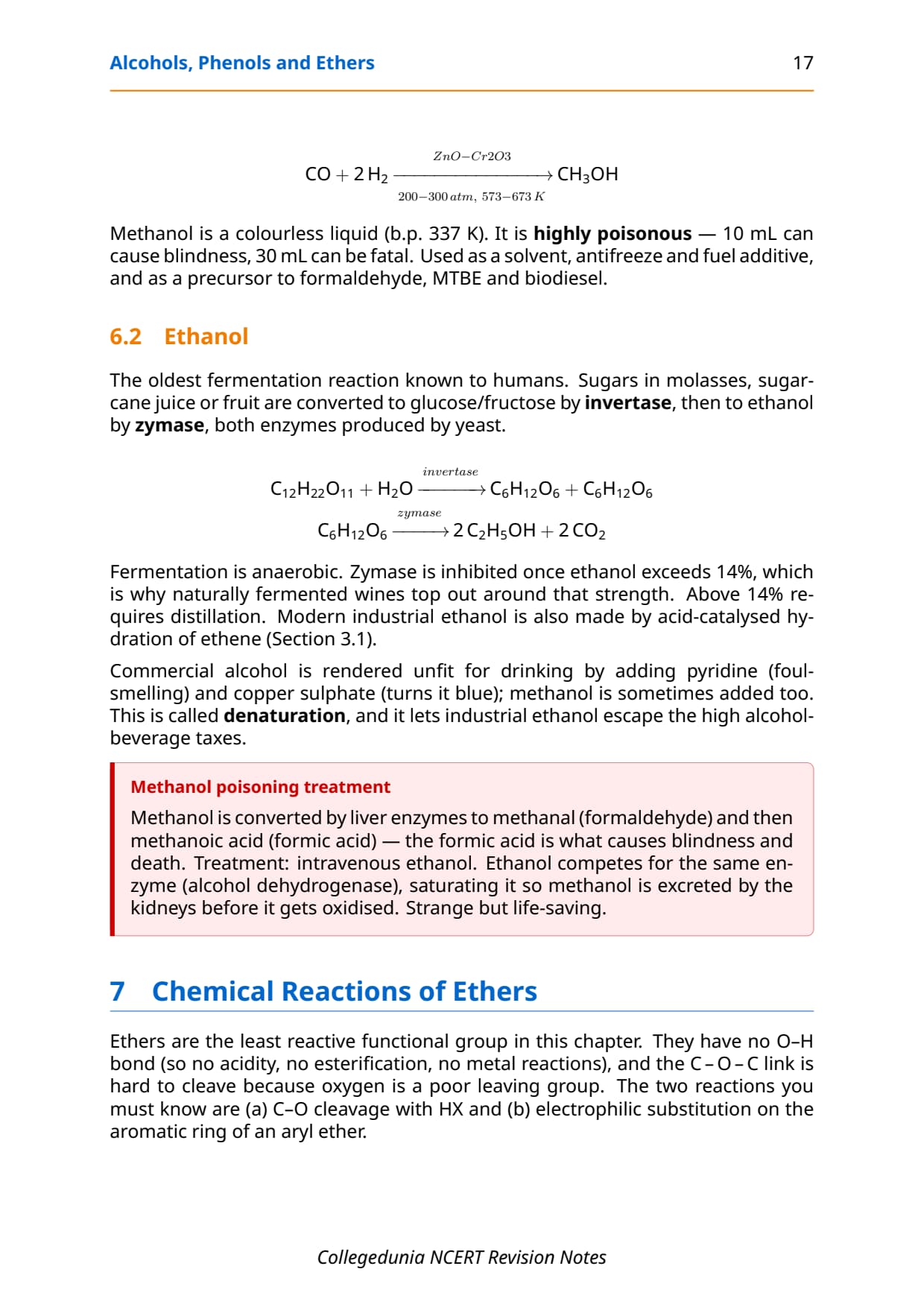
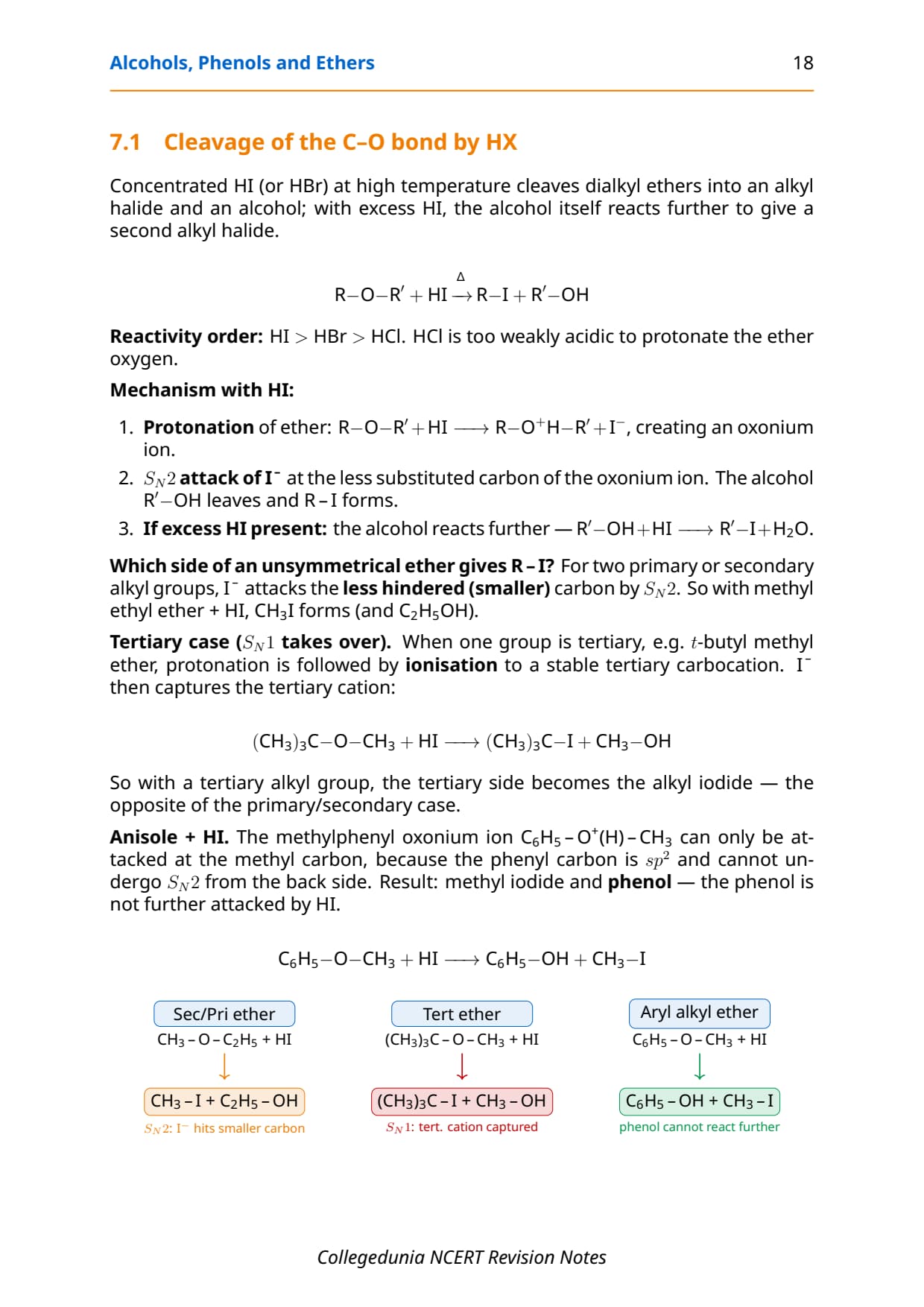
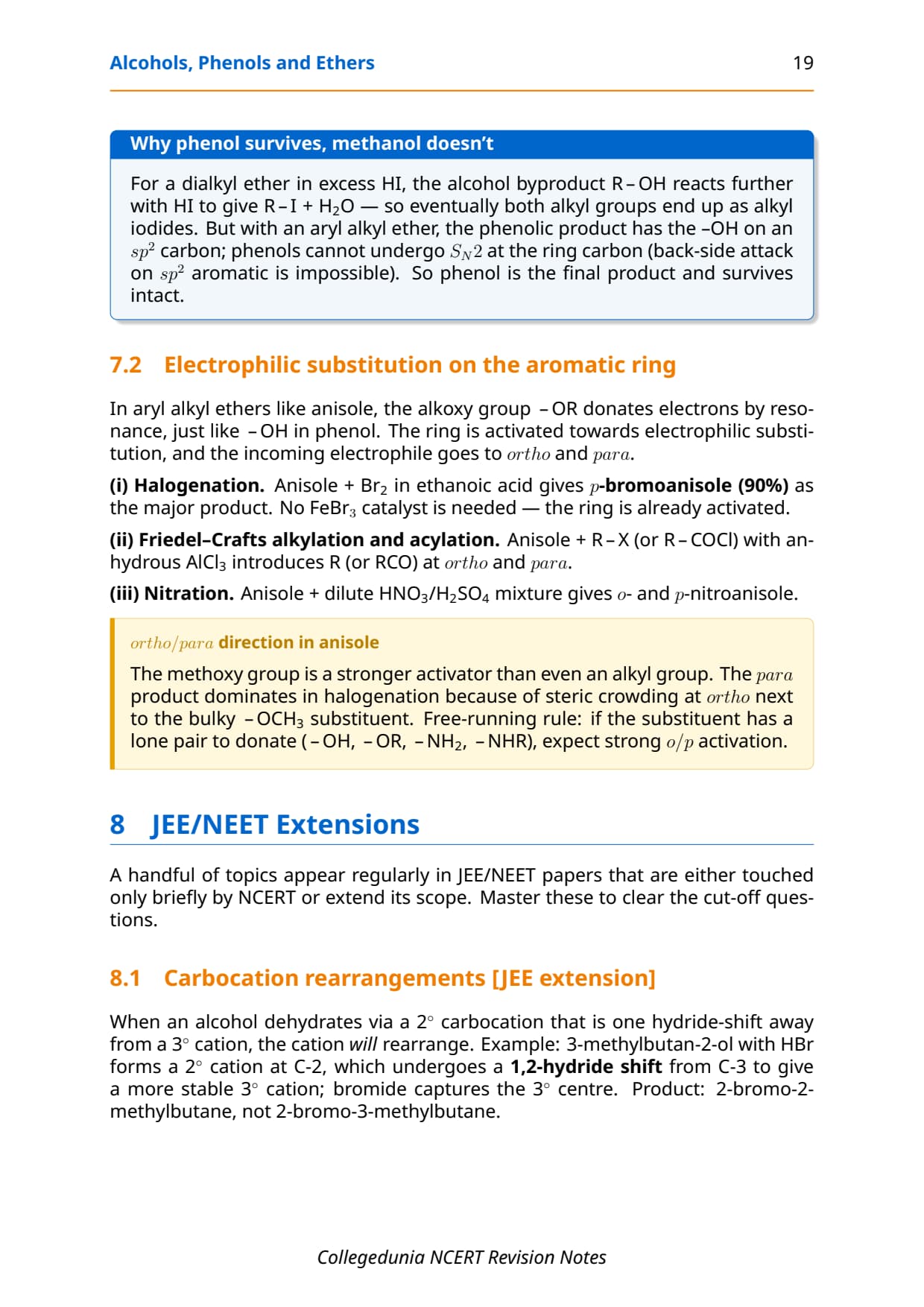
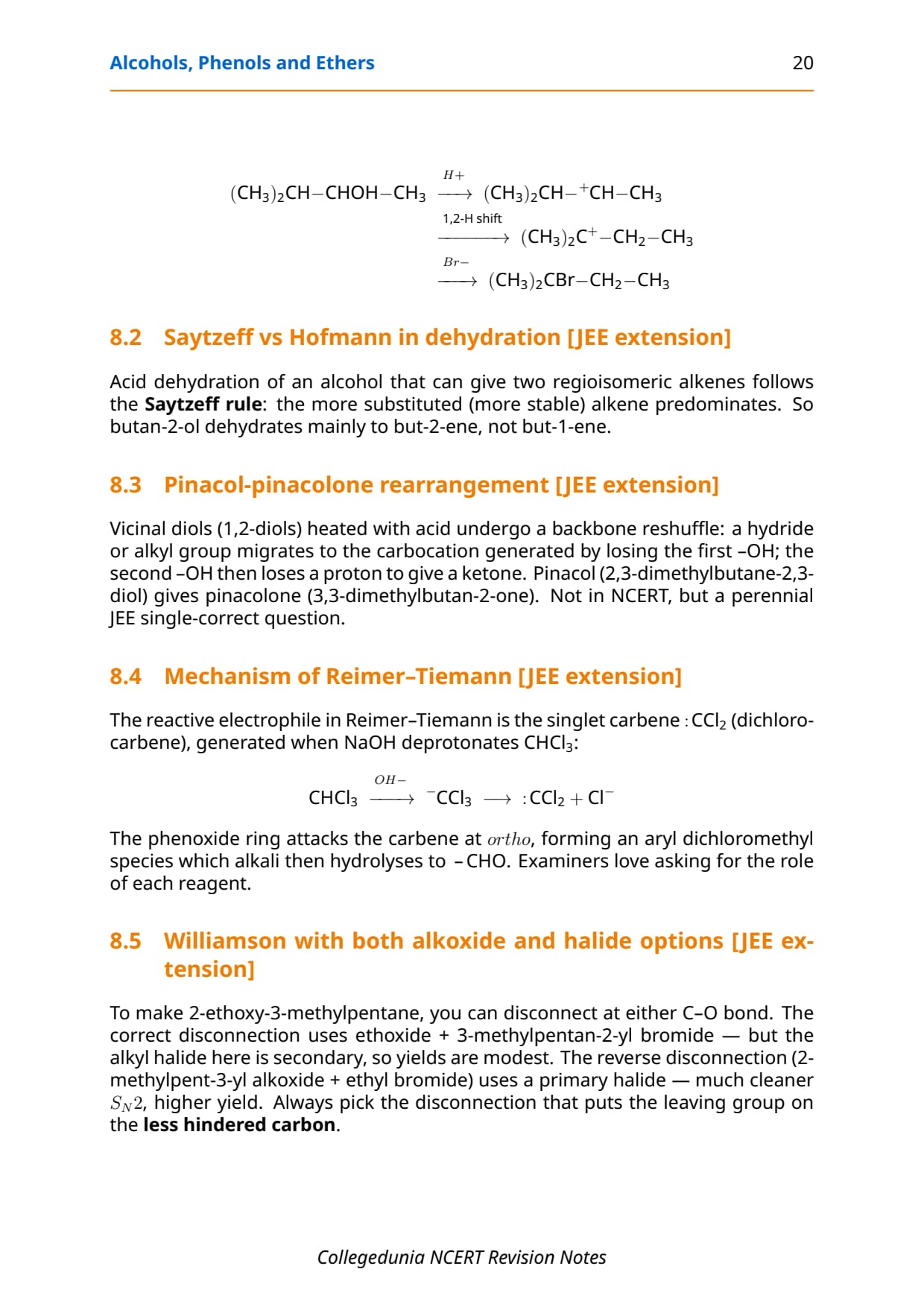
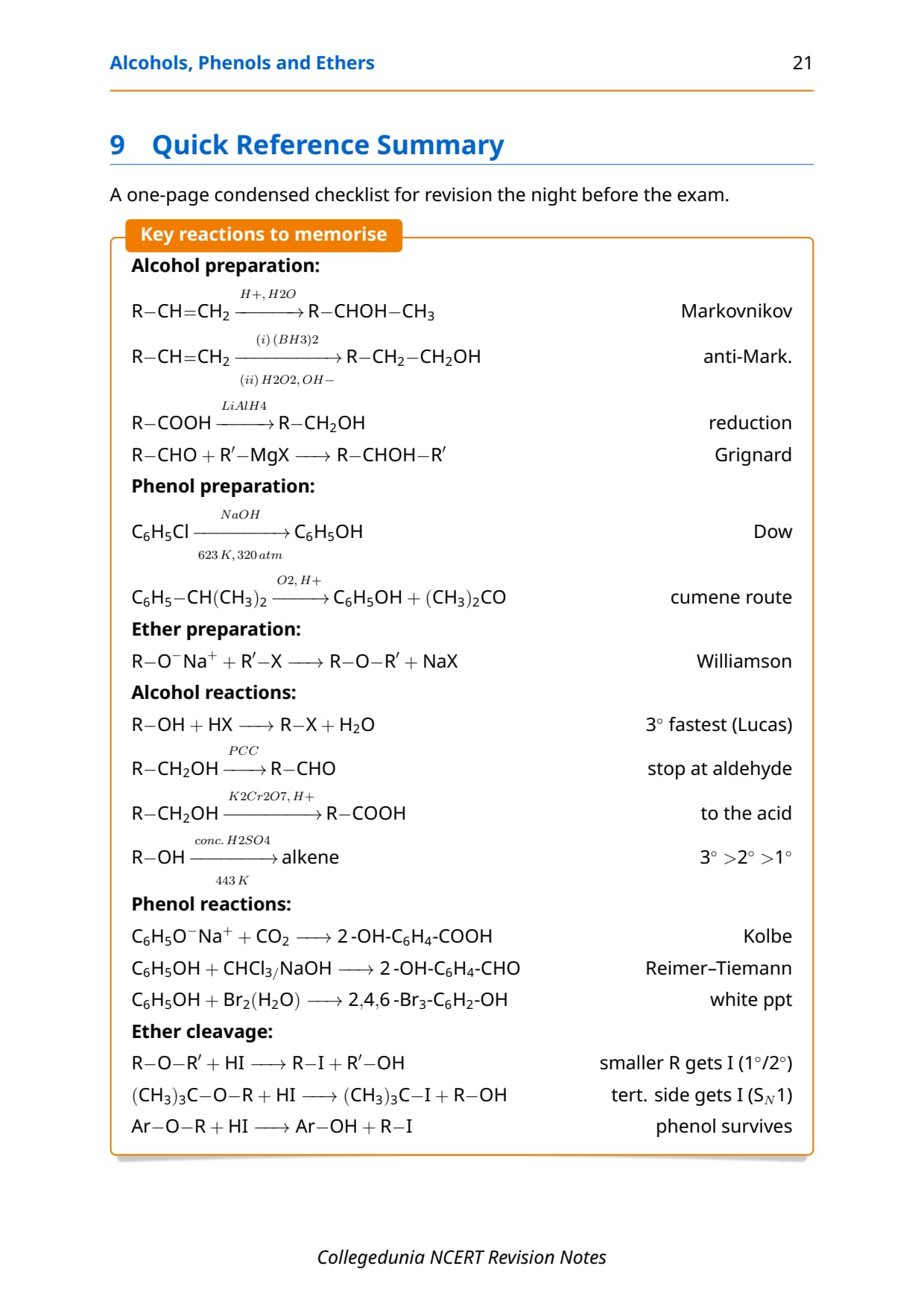
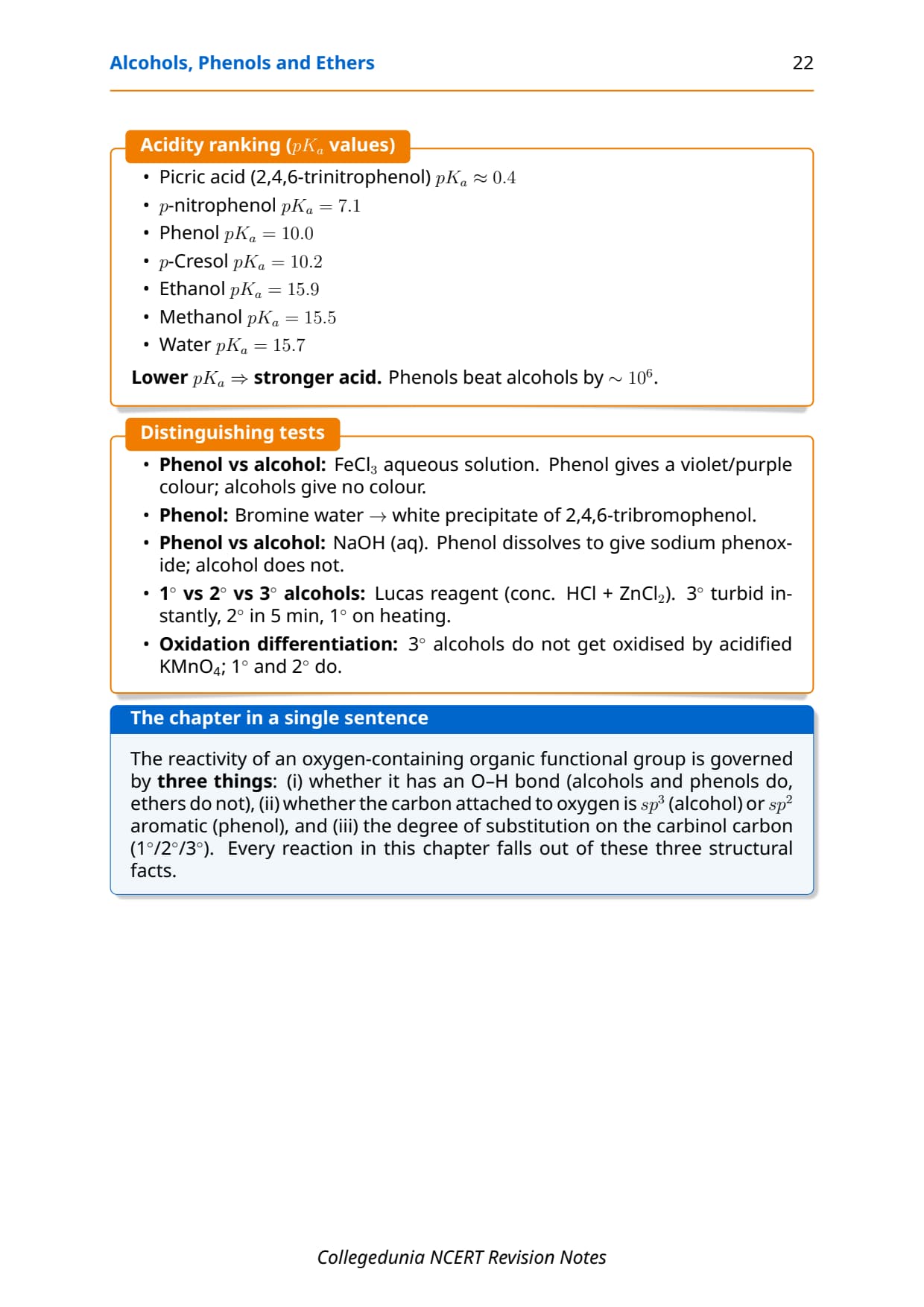
It covers the weightage map, every mechanism, and the most-repeated Board questions.
- CBSE Boards: 4 to 6 marks, usually one 3-mark mechanism (Williamson or dehydration) plus one 2-mark distinguishing test.
- JEE Main: 1 to 2 questions per shift on Reimer-Tiemann, Kolbe, acidity order, and the Lucas test.
- NEET: 2 to 3 questions per year on phenol-vs-alcohol acidity, oxidation products, and identification tests.
Alcohols, Phenols and Ethers Class 12 Topic-wise Weightage for CBSE Boards
This mark distribution is averaged across CBSE, JEE Main, and NEET papers (2021-2025). It shows which sub-topics to revise first.
| Sub-Topic | NCERT Section | CBSE Marks | JEE / NEET Question Frequency |
|---|---|---|---|
| Reactions of Alcohols (dehydration, oxidation, esterification) | 7.6 | 2 - 3 | Very High |
| Reactions of Phenols (Reimer-Tiemann, Kolbe, EAS) | 7.6 | 2 - 3 | Very High |
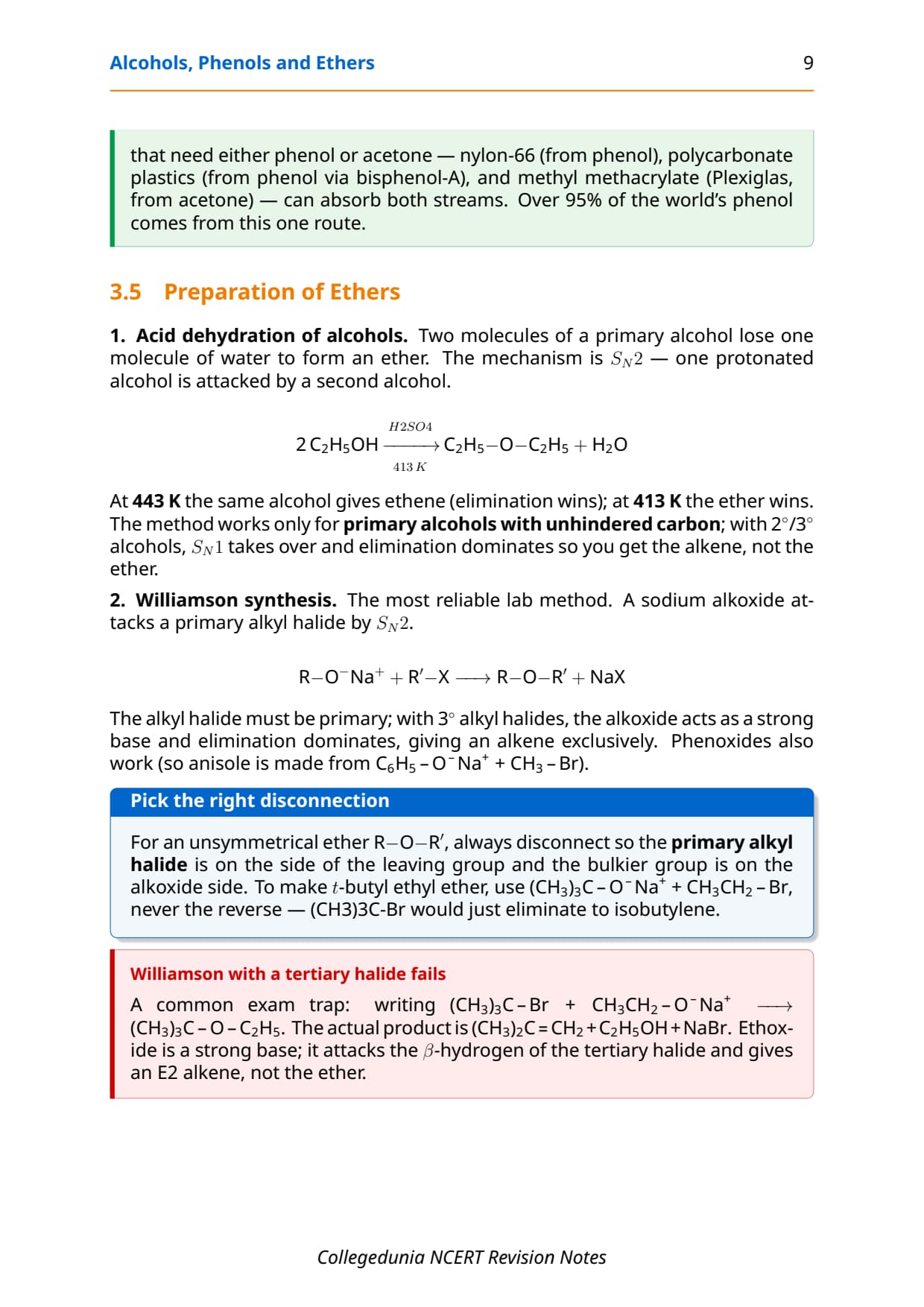
| Williamson Ether Synthesis | 7.9 | 2 - 3 | High |
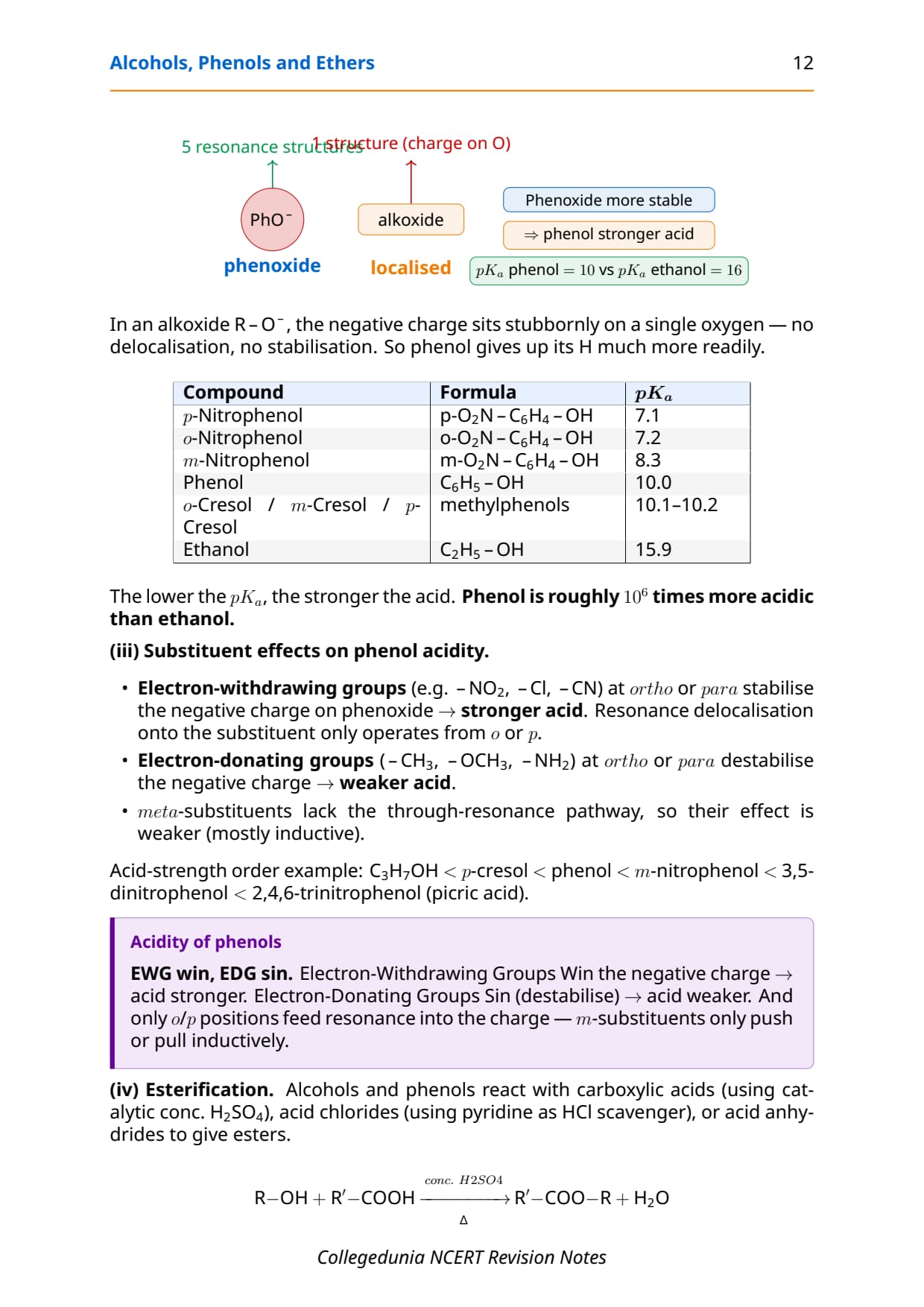
| Acidity of Phenols / Substituent Effects | 7.5 | 1 - 2 | High |
| Preparation Methods (alkenes, carbonyls, Grignard) | 7.3 | 1 - 2 | Medium |
| Distinguishing Tests (Lucas, Victor Meyer, Iodoform) | 7.6 | 1 - 2 | Medium |
Alcohols, Phenols and Ethers Class 12 Chemistry Video Lecture
Source: Magnet Brains on YouTube
Alcohols, Phenols and Ethers Topic-by-Topic Notes for Class 12 Chemistry
Each sub-section maps to a numbered NCERT section.
How will Collegedunia's NCERT Notes Help You with Alcohols, Phenols and Ethers?
These Notes target the three things students lose most marks on: the alcohol-water-phenol acidity order, a distinguishing-test chart (Lucas, Victor Meyer, Iodoform, FeCl3) with each colour change, and a named-reaction wall.
Class 12 Chemistry Ch 7 Important Named Reactions and Distinguishing Tests
These seven cover every synthesis CBSE has asked since 2021.
| Name | Reactants → Products | Conditions / Use |
|---|---|---|
| Williamson Ether Synthesis | R-ONa + R'-X → R-O-R' | SN2 on primary R'-X |
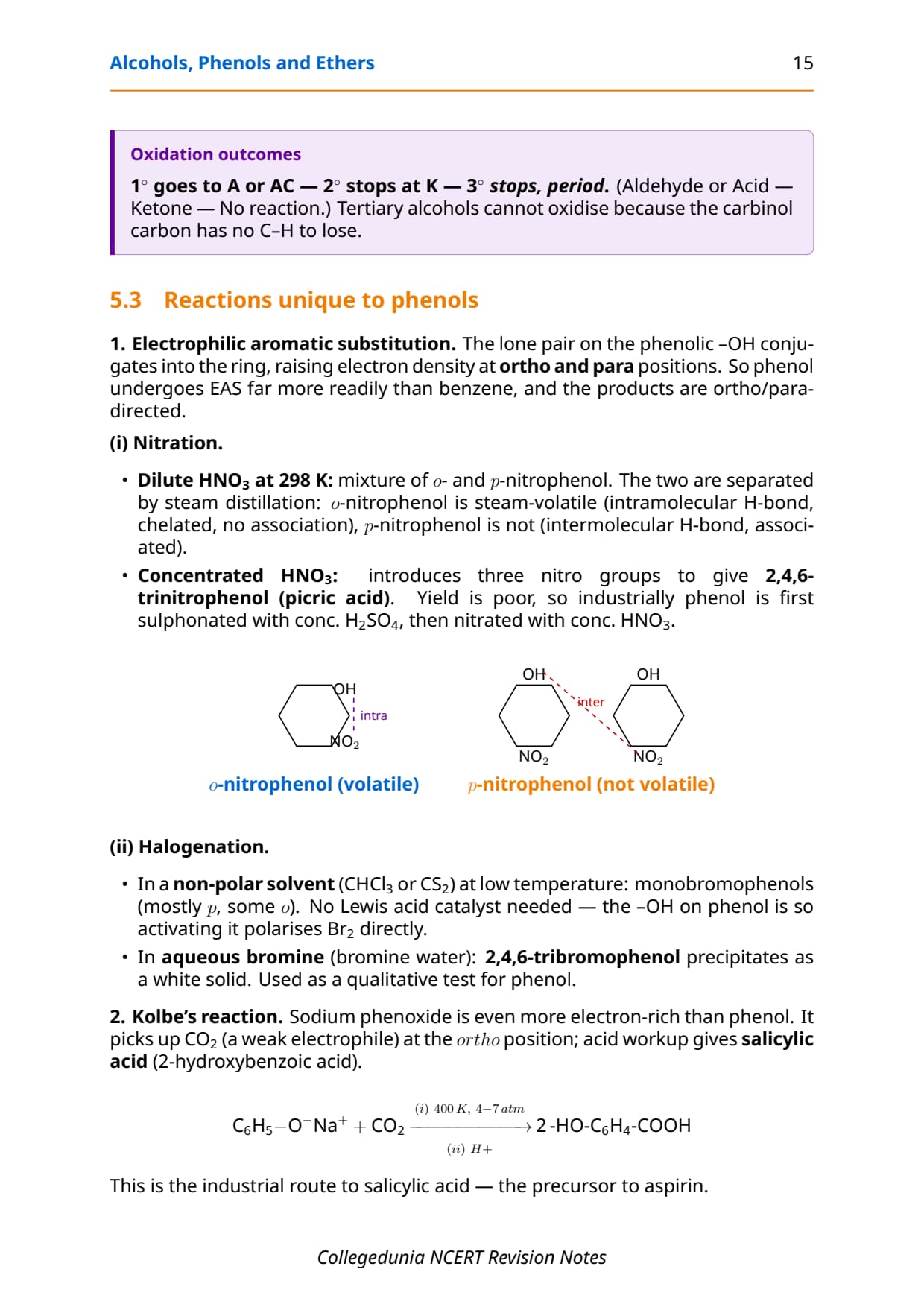
| Kolbe Reaction | C6H5ONa + CO2 → salicylic acid | 400 K, 6 atm; then H+ |
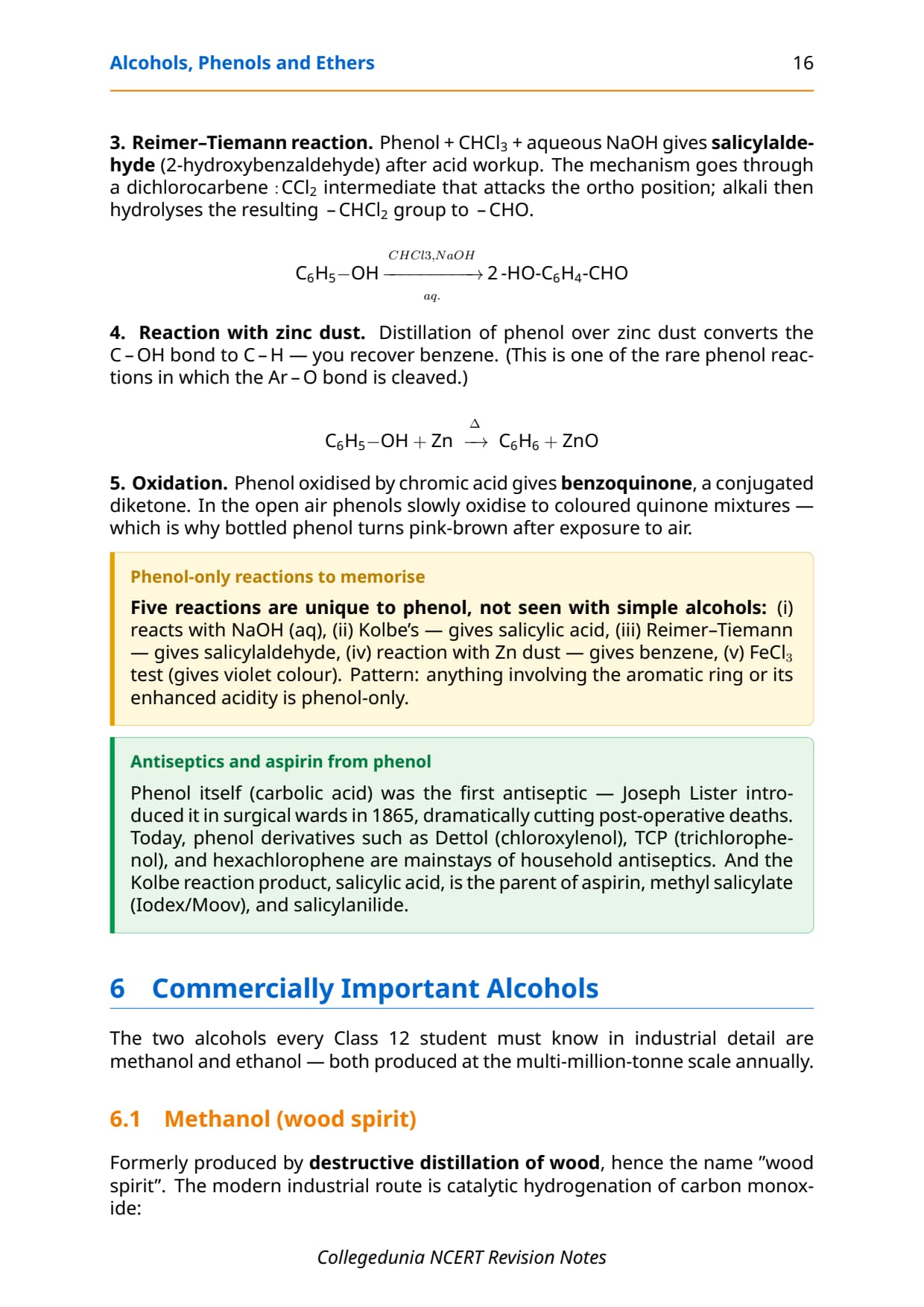
| Reimer-Tiemann | C6H5OH + CHCl3/NaOH → salicylaldehyde | 340 K reflux, then H+ |
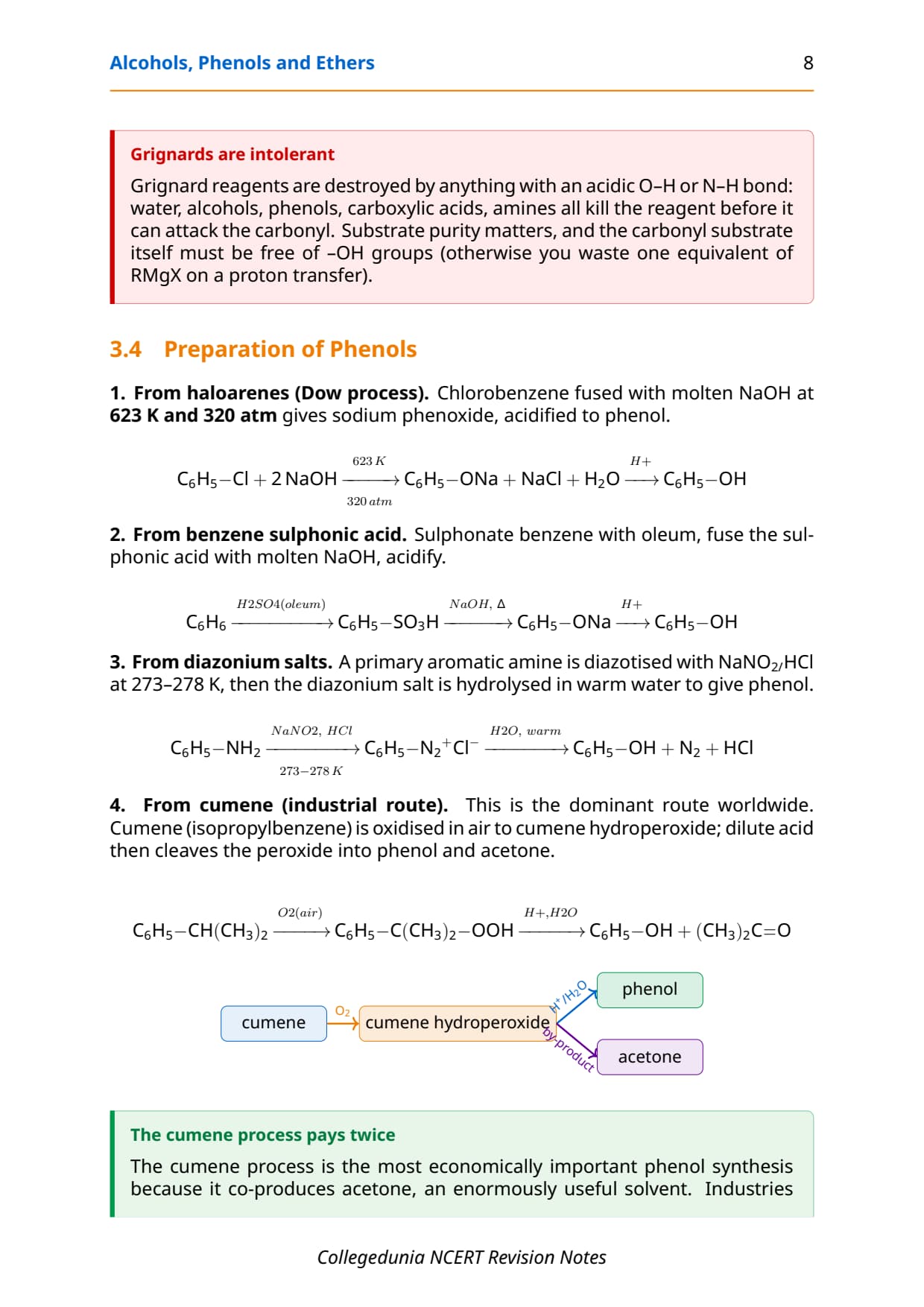
| Cumene Process | cumene → cumene hydroperoxide → phenol + acetone | Aerial O2, then dilute H2SO4 |
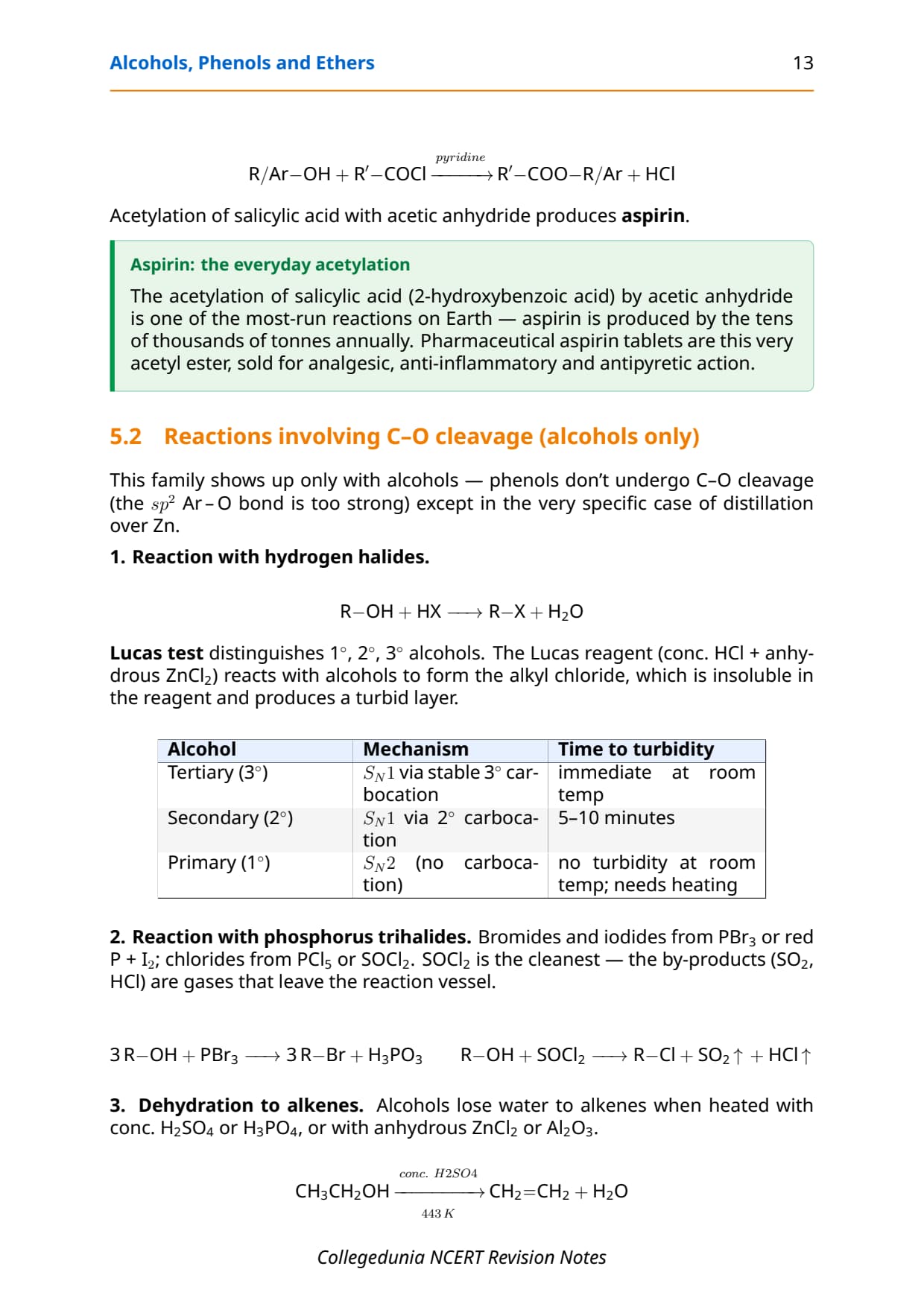
| Lucas Test | ROH + HCl/ZnCl2 → R-Cl (turbidity) | 3o instant; 2o 5 min; 1o on heating |
| Victor Meyer Test | ROH → R-I → R-NO2 → nitrolic acid | 1o red, 2o blue, 3o colourless |
| Iodoform Test | CH3CH(OH)-R + I2/NaOH → CHI3 (yellow) | Only for ethanol and methyl-carbinols |
Memorise the colour changes and reagents; CBSE asked "Identify A, B, C" in 4 of the last 5 papers.
Important Derivations and Mechanisms in 12th Chemistry Chapter 7
The Notes PDF works these five mechanisms in full, the ones most likely in CBSE 3- and 5-mark slots.
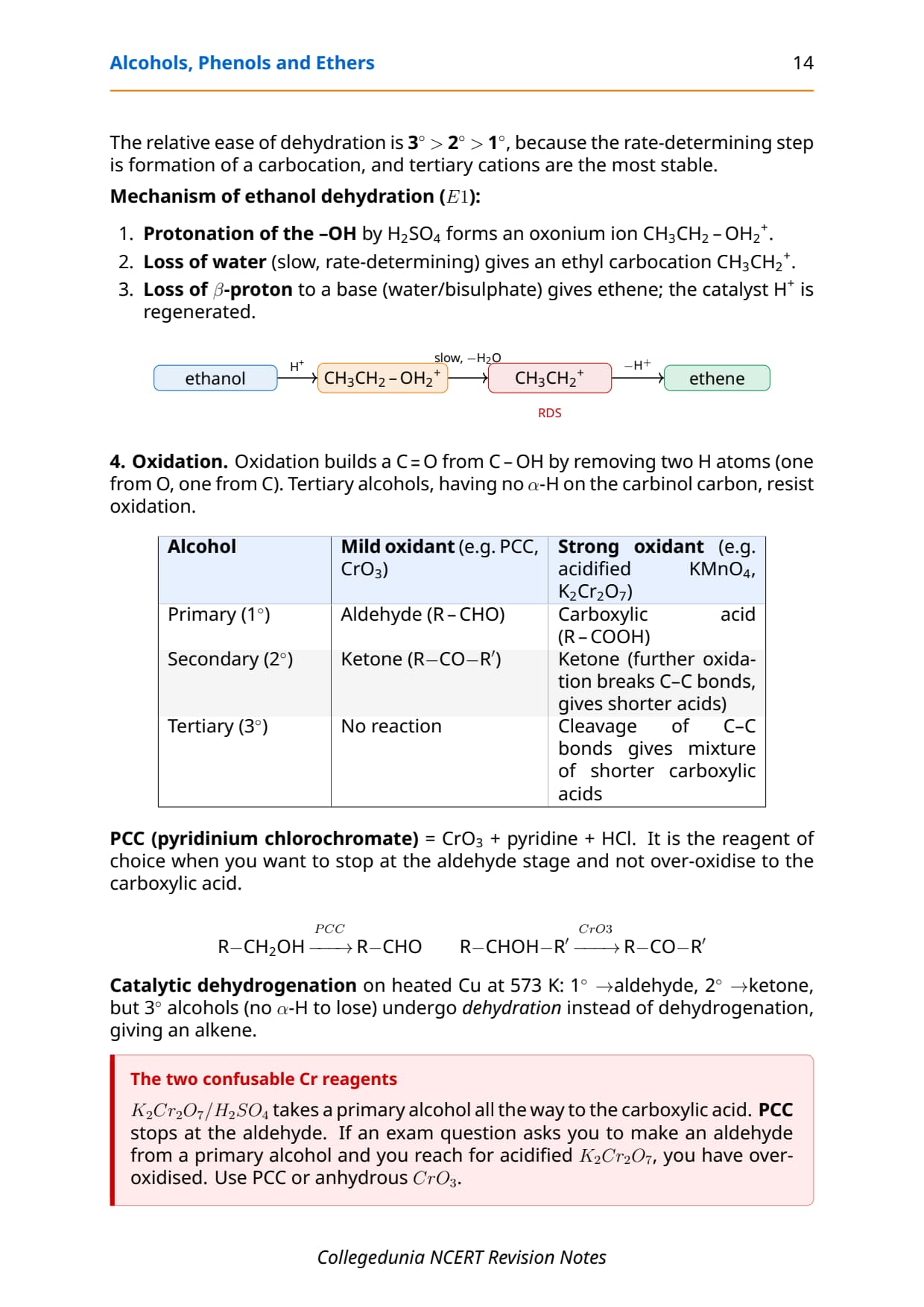
- Dehydration of ethanol (E1): protonation, water loss to carbocation, beta-H+ loss gives ethene.
- Williamson synthesis (SN2): alkoxide attacks the haloalkane backside.
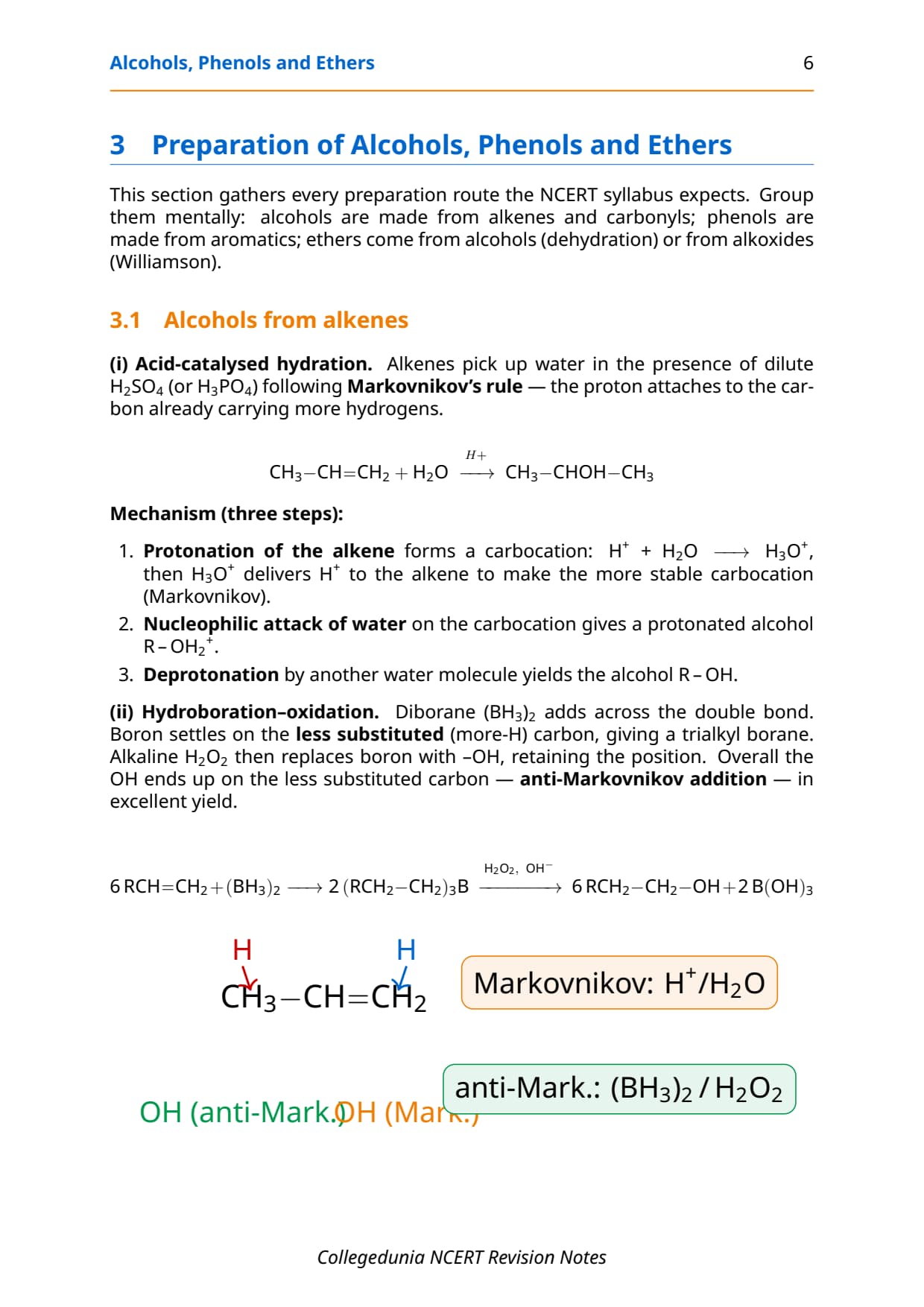
- Hydration of alkene: protonation to stabler carbocation, water attacks, gives Markovnikov alcohol.
- Ether cleavage with HI: protonation, then SN2 by I- on the less-substituted carbon.
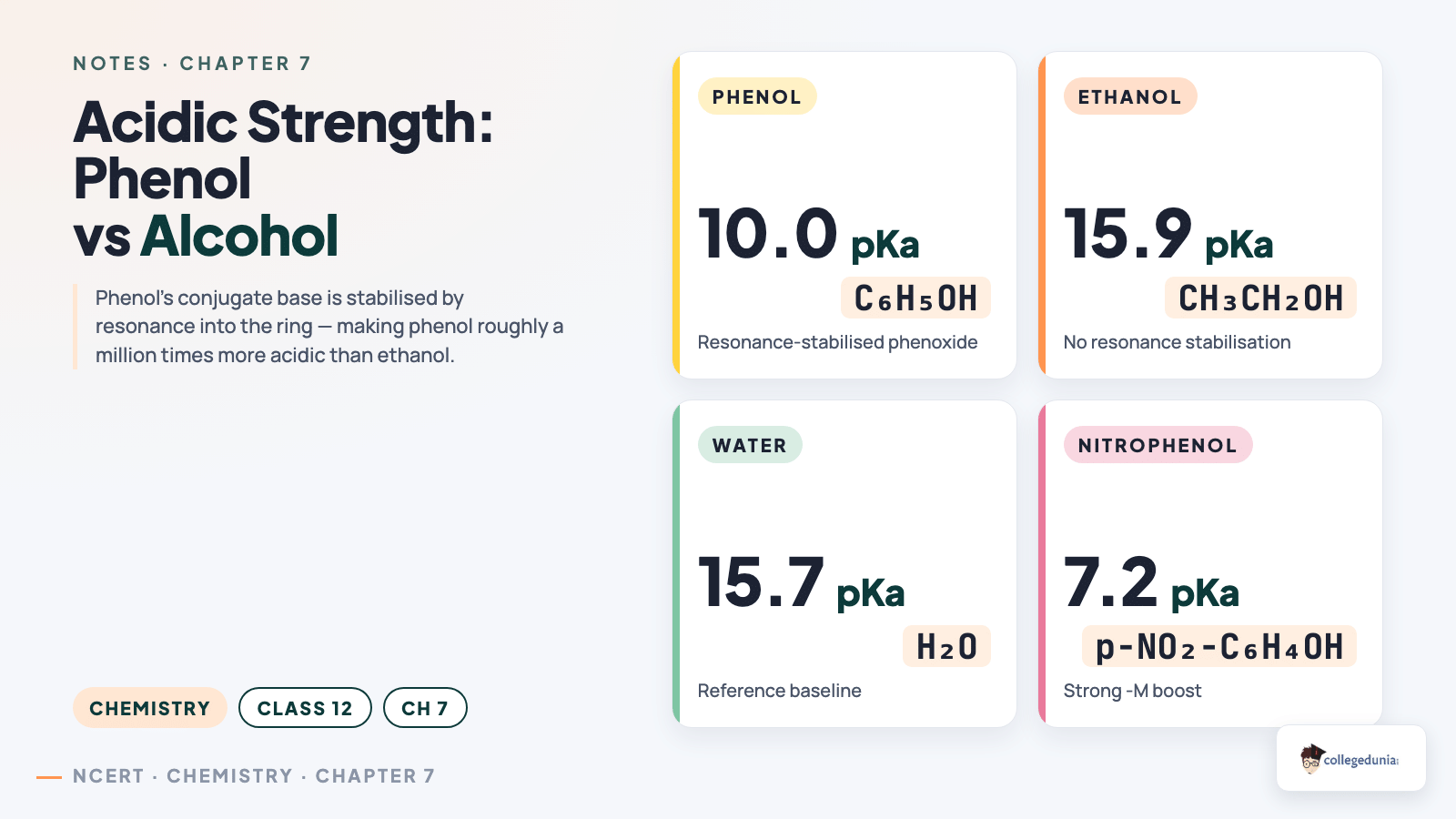
- Acidity of phenol: phenoxide delocalises charge to ortho and para, stabilising the conjugate base.
Class 12 Chemistry Alcohols Phenols and Ethers Common Misconceptions
These four traps cost students marks every year.
| Common wrong belief | Correct framing |
|---|---|
| "Phenol is a weaker acid than water." | Phenol (pKa 10) is more acidic than water (pKa 15.7); phenoxide is resonance-stabilised. |
| "All alcohols give the iodoform test." | Only ethanol and -CH(OH)-CH3 alcohols give it. Methanol does not. |
| "Williamson works with 1o, 2o, and 3o haloalkanes." | Only primary work; 2o/3o undergo E2 with the alkoxide. |
| "Anisole + HI gives iodobenzene + methanol." | Gives phenol + methyl iodide; the phenyl-O bond resists cleavage. |
Phenol Acidity vs Alcohol: Picric Acid Preparation and Substituent Effects
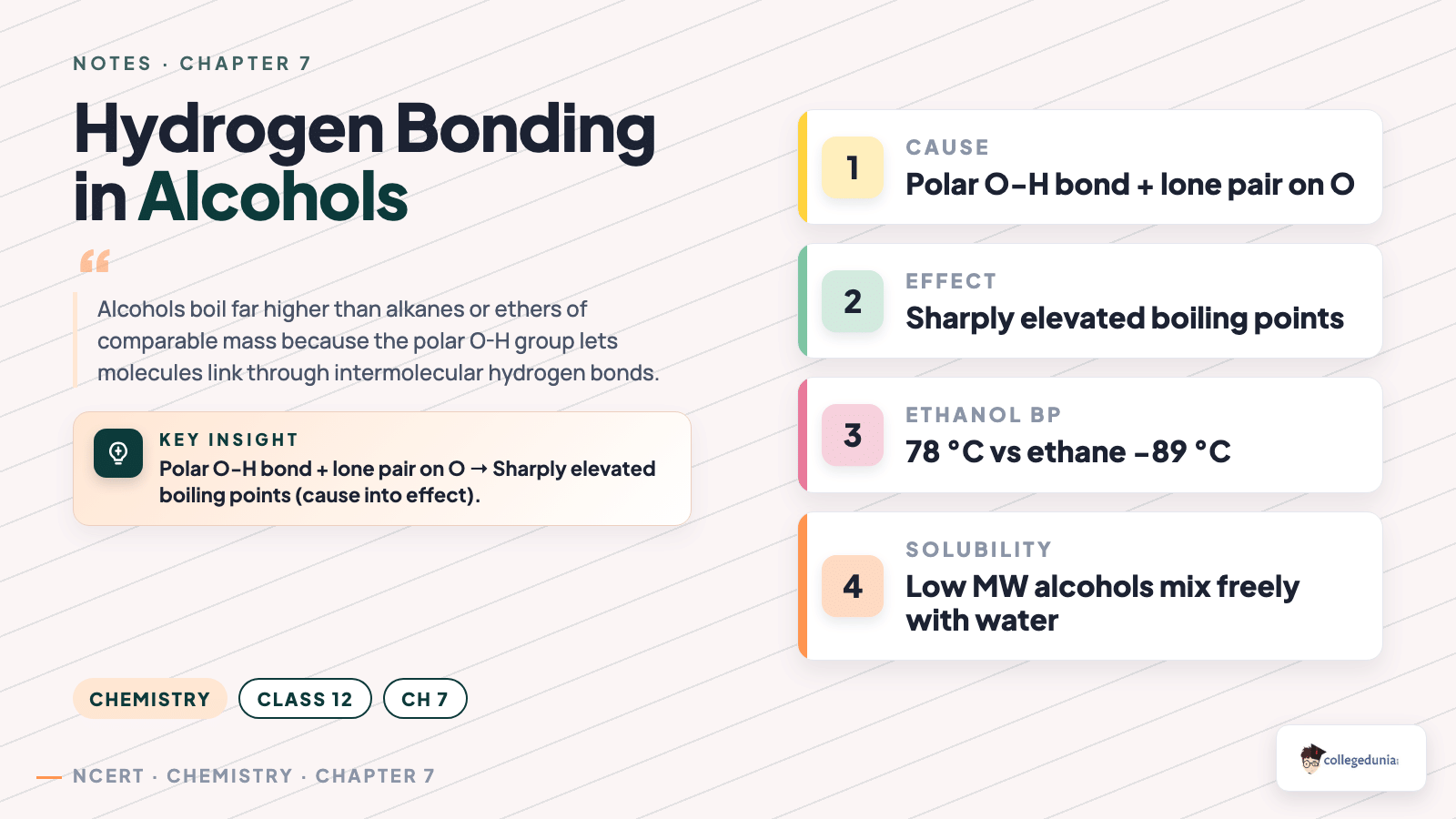
This is the highest-yield comparison in the chapter. Phenoxide is resonance-stabilised (charge spread onto two ortho and one para carbon); alkoxide is not.
- EWG (NO2, X, CN) at o/p: raise acidity by stabilising phenoxide.
- Picric acid: stepwise nitration of phenol gives 2,4,6-trinitrophenol (pKa 0.4), stronger than acetic acid.
- EDG (CH3, OCH3) at o/p: lower acidity; p-cresol is weaker than phenol.
- Meta EWGs: act only by induction; m-nitrophenol is intermediate.
Alcohols, Phenols and Ethers Top 5 Formulae for Quick Recall
These five surface most often in CBSE and JEE numericals. The full master table is on the Formula Sheet page.
| Concept | Quick Recall |
|---|---|
| Phenol acidity vs alcohol | Ka(phenol) approximately 106 times Ka(ethanol) |
| Alcohol reactivity with HX | 3o > 2o > 1o (carbocation stability) |
| Williamson best route | bulkier alkyl → alkoxide; smaller alkyl → haloalkane |
| Lucas reagent | conc. HCl + anhyd. ZnCl2; turbidity time distinguishes 1o / 2o / 3o |
| Phenol with neutral FeCl3 | violet colouration; positive test for phenols (alcohols do not respond) |
Full master table: Alcohols, Phenols and Ethers Class 12 Chemistry Formula Sheet
Student Feedback
In a Collegedunia poll of 1,080 Class 12 students, 81% said the named-reaction and distinguishing-test tables were the most useful part of these Notes, and 3 in 4 revised the phenol-acidity chart the night before their Chemistry paper.
Other Resources for Alcohols, Phenols and Ethers Class 12 Chemistry
| Resource | Link |
|---|---|
| NCERT Solutions | Alcohols, Phenols and Ethers Class 12 Chemistry NCERT Solutions |
| Formula Sheet | Alcohols, Phenols and Ethers Class 12 Chemistry Formula Sheet |
| NCERT Book PDF | Alcohols, Phenols and Ethers Class 12 Chemistry NCERT Book PDF |
| Handwritten Notes | Alcohols, Phenols and Ethers Class 12 Chemistry Handwritten Notes |
| Exemplar Solutions | Alcohols, Phenols and Ethers Class 12 Chemistry Exemplar Solutions |
| Exemplar Book PDF | Alcohols, Phenols and Ethers Class 12 Chemistry Exemplar Book PDF |
| Notes | Alcohols, Phenols and Ethers Class 12 Chemistry Notes |
NCERT Notes for Class 12 Chemistry: All Chapters
Continue revising the rest of the Class 12 Chemistry NCERT with the chapter-wise Notes library below.
| Chapter | Notes Page |
|---|---|
| Chapter 1 | Solutions Notes |
| Chapter 2 | Electrochemistry Notes |
| Chapter 3 | Chemical Kinetics Notes |
| Chapter 4 | The d- and f-Block Elements Notes |
| Chapter 5 | Coordination Compounds Notes |
| Chapter 6 | Haloalkanes and Haloarenes Notes |
| Chapter 7 | Alcohols, Phenols and Ethers Notes |
| Chapter 8 | Aldehydes, Ketones and Carboxylic Acids Notes |
| Chapter 9 | Amines Notes |
| Chapter 10 | Biomolecules Notes |
Alcohols, Phenols and Ethers Class 12 Notes FAQs
Ques. How many marks does Chapter 7 Alcohols, Phenols and Ethers carry in the CBSE Class 12 board exam?
Ans. Chapter 7 carries 4 to 6 marks in the CBSE Class 12 Chemistry board exam, averaged across the last five board papers. The marks are typically split as one 3-mark mechanism or reaction-equation question plus one 2-mark distinguishing-test or short-answer question.
Ques. Why is phenol more acidic than ethanol?
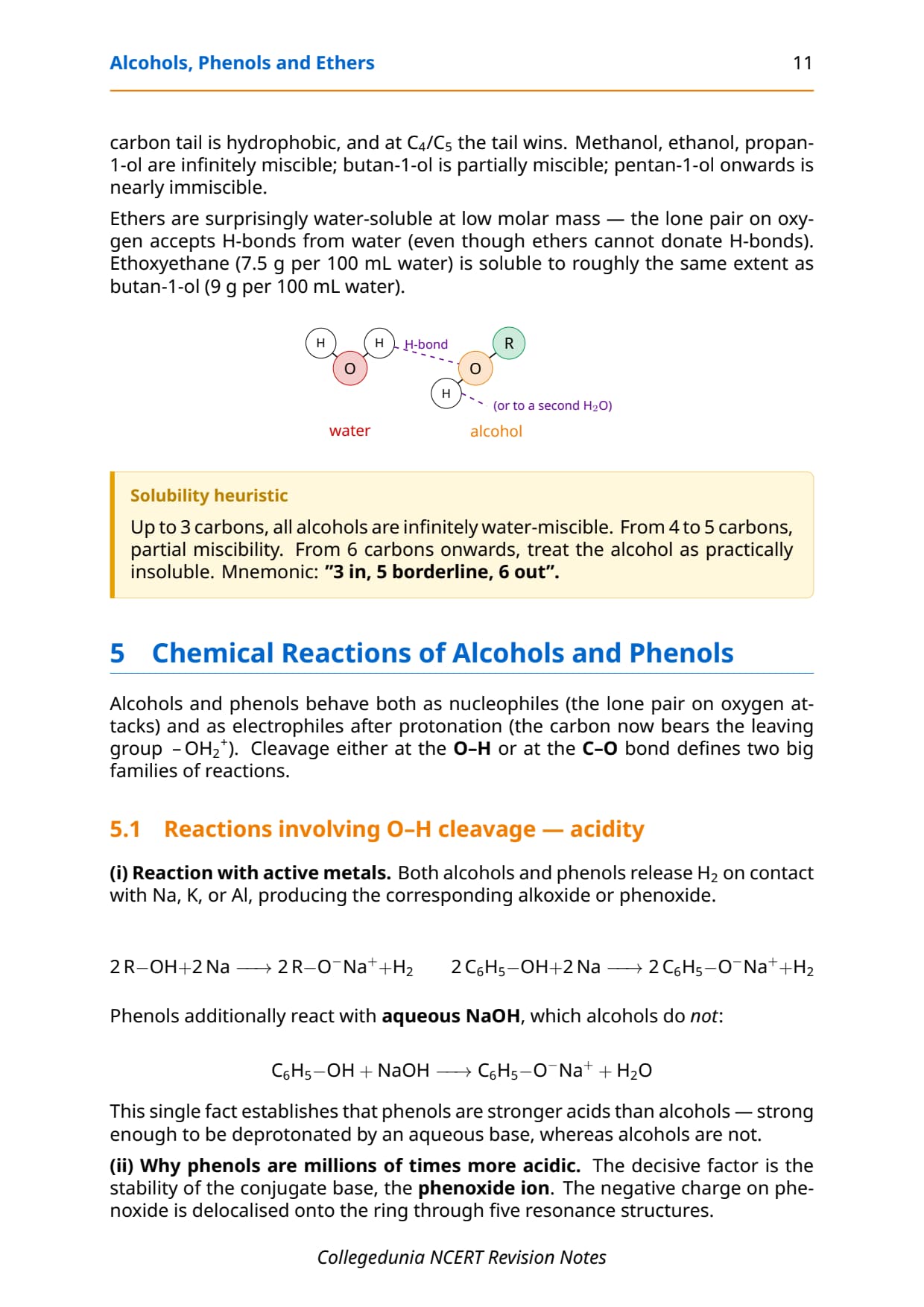
Ans. Phenol is more acidic because the phenoxide ion is resonance-stabilised: the negative charge on the oxygen is delocalised over the ortho and para positions of the benzene ring. The ethoxide ion has no such delocalisation, so it is a less stable conjugate base. As a result, phenol (pKa approximately 10) is about 106 times more acidic than ethanol (pKa approximately 16).
Ques. What is the Williamson ether synthesis, and why does it use only primary haloalkanes?
Ans. Williamson synthesis prepares ethers by reacting a sodium alkoxide with a haloalkane through an SN2 mechanism. Only primary haloalkanes work because secondary and tertiary substrates undergo E2 elimination with the strong base / strong nucleophile alkoxide, giving alkenes instead of ethers. For an unsymmetrical ether, always derive the alkoxide from the bulkier alkyl group.
Ques. What products are formed when anisole reacts with HI?
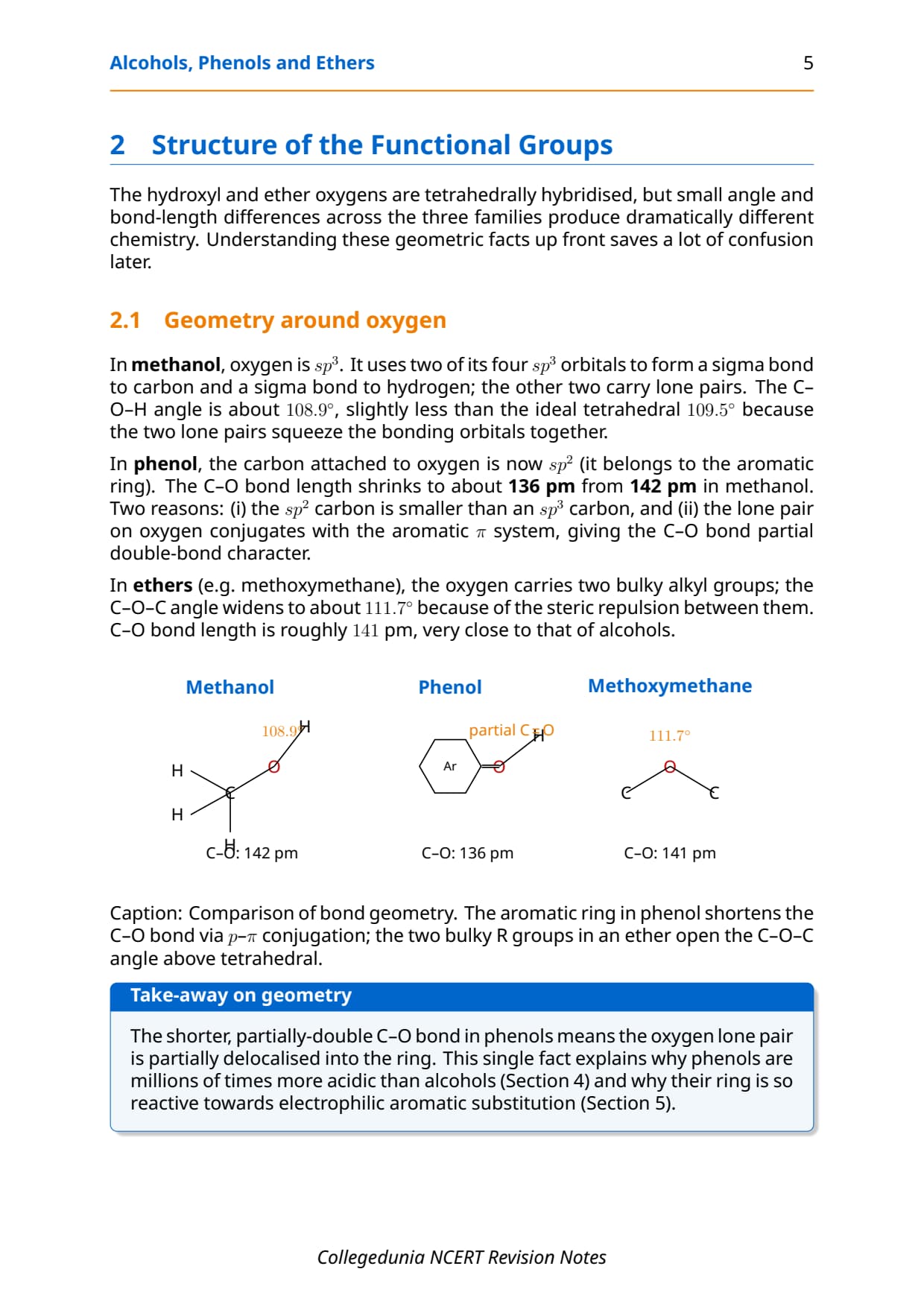
Ans. Anisole (C6H5-O-CH3) reacts with concentrated HI to give phenol and methyl iodide. The phenyl-oxygen bond never cleaves because of partial double-bond character from the lone-pair conjugation of oxygen into the ring. The reaction proceeds by SN2 attack of iodide on the methyl carbon.
Ques. How do you distinguish between primary, secondary, and tertiary alcohols using the Lucas test?
Ans. Mix the alcohol with the Lucas reagent (concentrated HCl plus anhydrous ZnCl2) at room temperature. Tertiary alcohols give cloudiness or turbidity immediately because the tertiary carbocation forms fast. Secondary alcohols give turbidity within 5 to 10 minutes. Primary alcohols give no turbidity at room temperature and require heating.
Ques. What are the products of the Reimer-Tiemann and Kolbe reactions on phenol?
Ans. Reimer-Tiemann gives salicylaldehyde (2-hydroxybenzaldehyde) on treatment of phenol with CHCl3 and aqueous NaOH followed by dilute acid. Kolbe gives salicylic acid (2-hydroxybenzoic acid) when sodium phenoxide reacts with CO2 at 400 K and 6 atm, followed by acidification. Both are ortho-substitution reactions on the phenoxide.
Ques. What is the cumene process and the Dow process for preparing phenol?
Ans. The cumene process oxidises cumene (isopropylbenzene) with atmospheric O2 to cumene hydroperoxide, then acidifies with dilute H2SO4 to give phenol and acetone as the valuable co-product; this is the major industrial route. The Dow process hydrolyses chlorobenzene with NaOH at 623 K and 320 atm followed by acidification, giving phenol; it is an older industrial route that needs extreme temperature and pressure. CBSE always asks you to name acetone as the cumene by-product.
Ques. How is hydroboration-oxidation different from acid-catalysed Markovnikov hydration?
Ans. Hydroboration-oxidation uses B2H6 / THF followed by alkaline H2O2 and gives the anti-Markovnikov alcohol with syn-addition stereochemistry, no carbocation, no rearrangement. Acid-catalysed Markovnikov hydration uses dilute H2SO4 and gives the Markovnikov alcohol via a carbocation intermediate, which may rearrange. Hydroboration is the preferred CBSE 3-mark answer when the question asks for a rearrangement-free preparation of a primary alcohol.
Ques. How is picric acid prepared from phenol?
Ans. Picric acid (2,4,6-trinitrophenol) is prepared by stepwise nitration of phenol. Treatment with dilute HNO3 gives ortho- and para-nitrophenol; further nitration with more concentrated HNO3 gives 2,4-dinitrophenol; and final nitration with concentrated HNO3 + H2SO4 gives picric acid. With pKa 0.4, picric acid is stronger than acetic acid because three -NO2 groups stabilise the conjugate base by resonance and -I.
Ques. What is the Saytzeff rule for dehydration of alcohols?
Ans. Saytzeff's rule says that in an E1 dehydration, the more-substituted alkene (the more stable one) is the major product. For 2-methylbutan-2-ol with conc. H2SO4 at 443 K, the major product is 2-methylbut-2-ene (trisubstituted), not 2-methylbut-1-ene. Alkene stability follows hyperconjugation: more alpha-H atoms means more hyperconjugative stabilisation.
Ques. Why does PCC stop a primary alcohol at the aldehyde stage while KMnO4 goes all the way to the carboxylic acid?
Ans. PCC (pyridinium chlorochromate) in dichloromethane is a mild non-aqueous oxidant; it abstracts only the alpha-H and stops at R-CHO because the aldehyde is not soluble in CH2Cl2 to undergo further oxidation. KMnO4 is a strong aqueous oxidant: the aldehyde hydrates to R-CH(OH)2 in water, and further oxidation of the hydrate gives R-COOH. The Collegedunia notes flag PCC as the only "stop-at-aldehyde" reagent.
Ques. Where can I download the Class 12 Chemistry Chapter 7 Alcohols, Phenols and Ethers notes PDF for free?
Ans. You can download the complete 23-page Class 12 Chemistry Chapter 7 Notes PDF for free from the download card at the top of this page. The PDF is mapped to the 2026-27 NCERT print and includes all named reactions (Lucas, Williamson, Reimer-Tiemann, Kolbe, cumene, Dow), full mechanisms, distinguishing tests (Lucas, Victor-Meyer, ferric chloride, iodoform), and a quick-recall summary on the last page.



Comments