




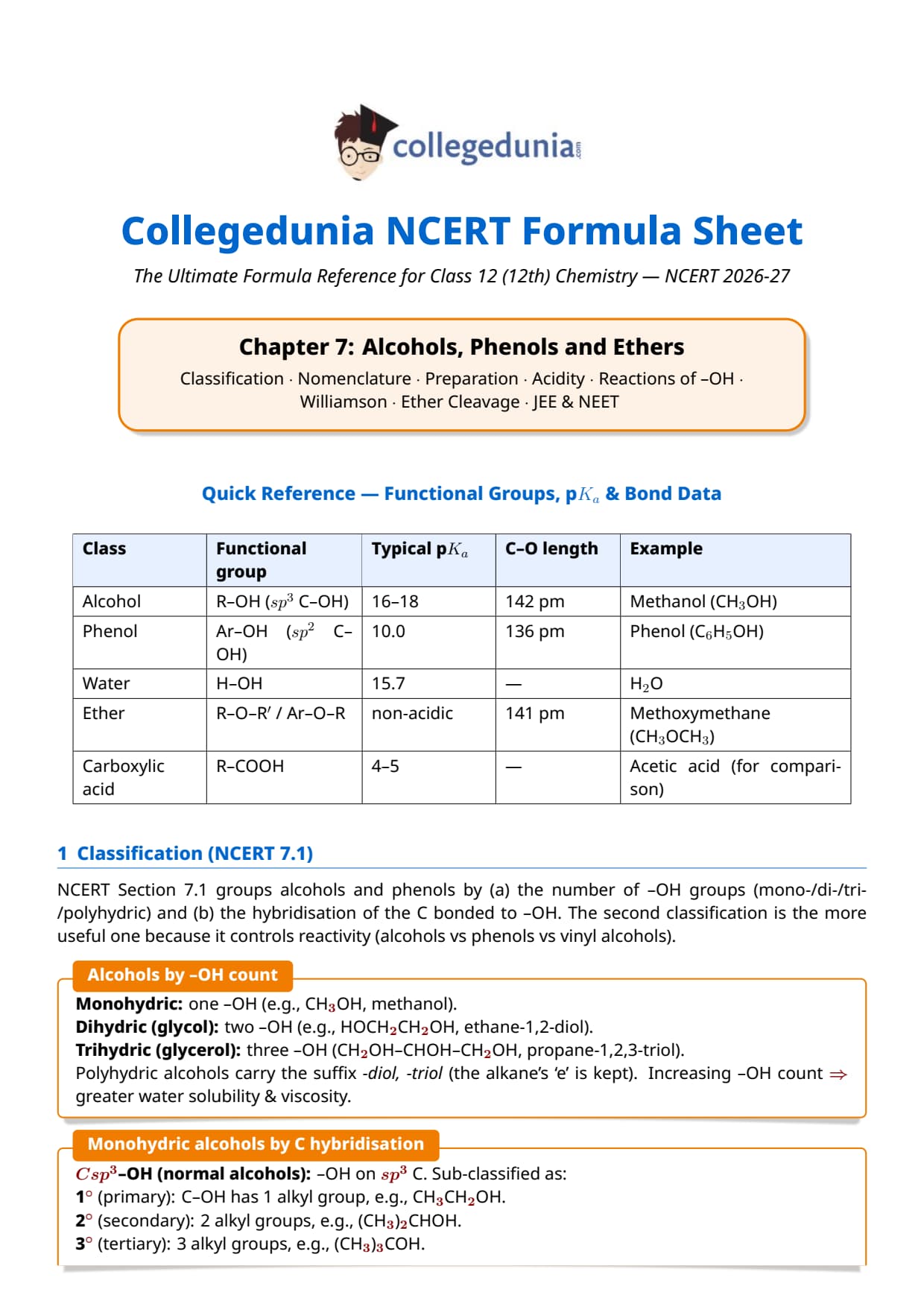
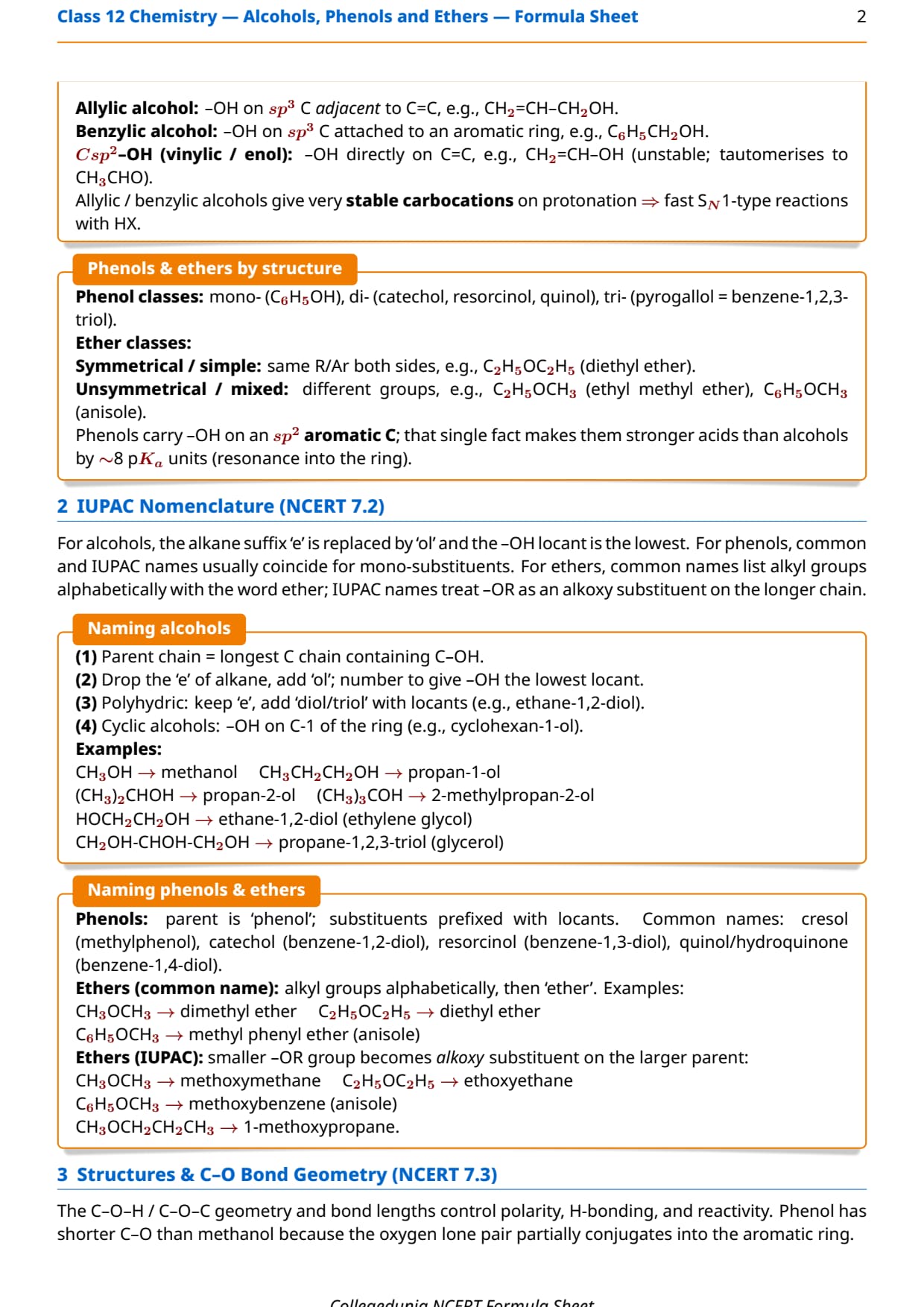
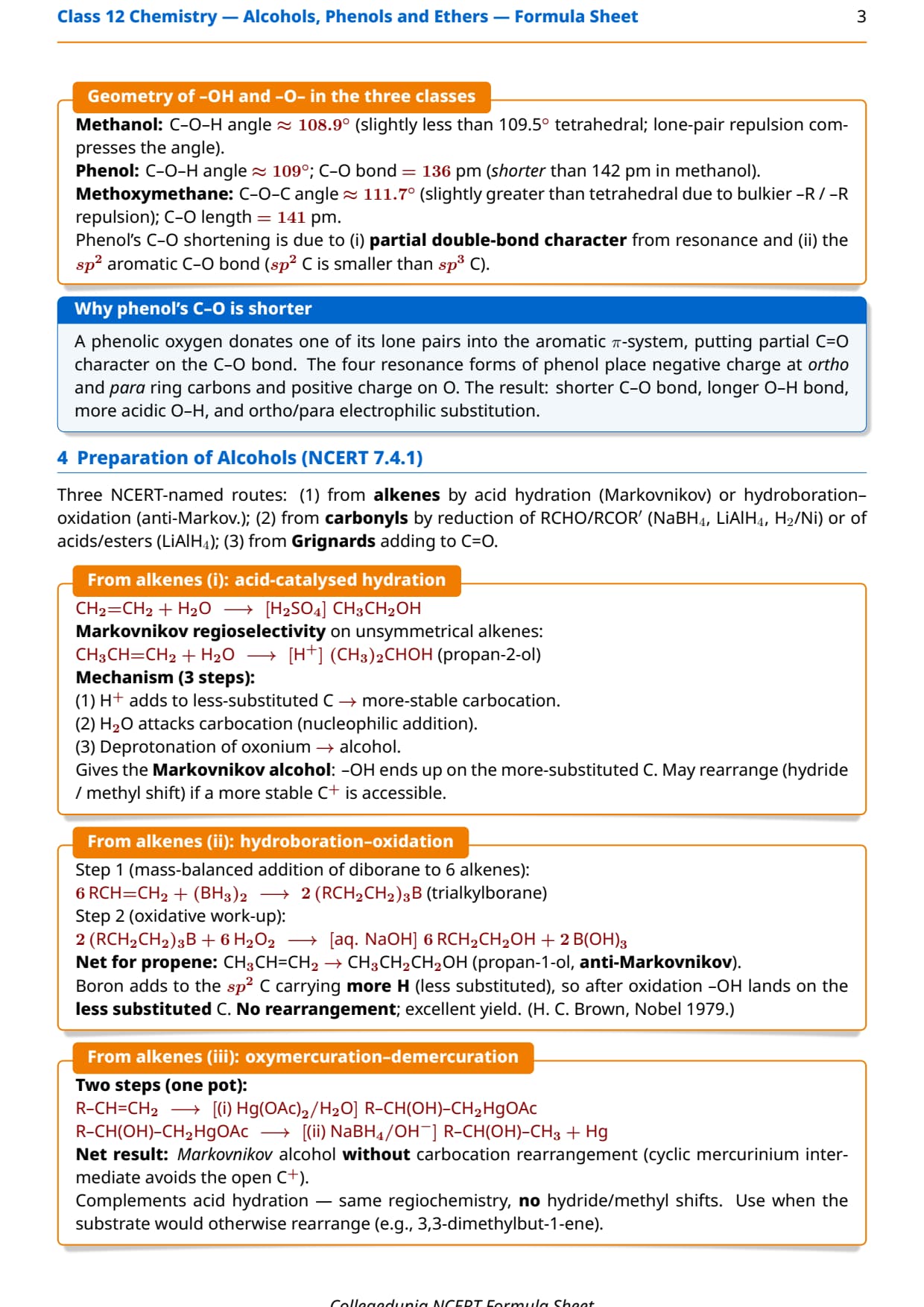
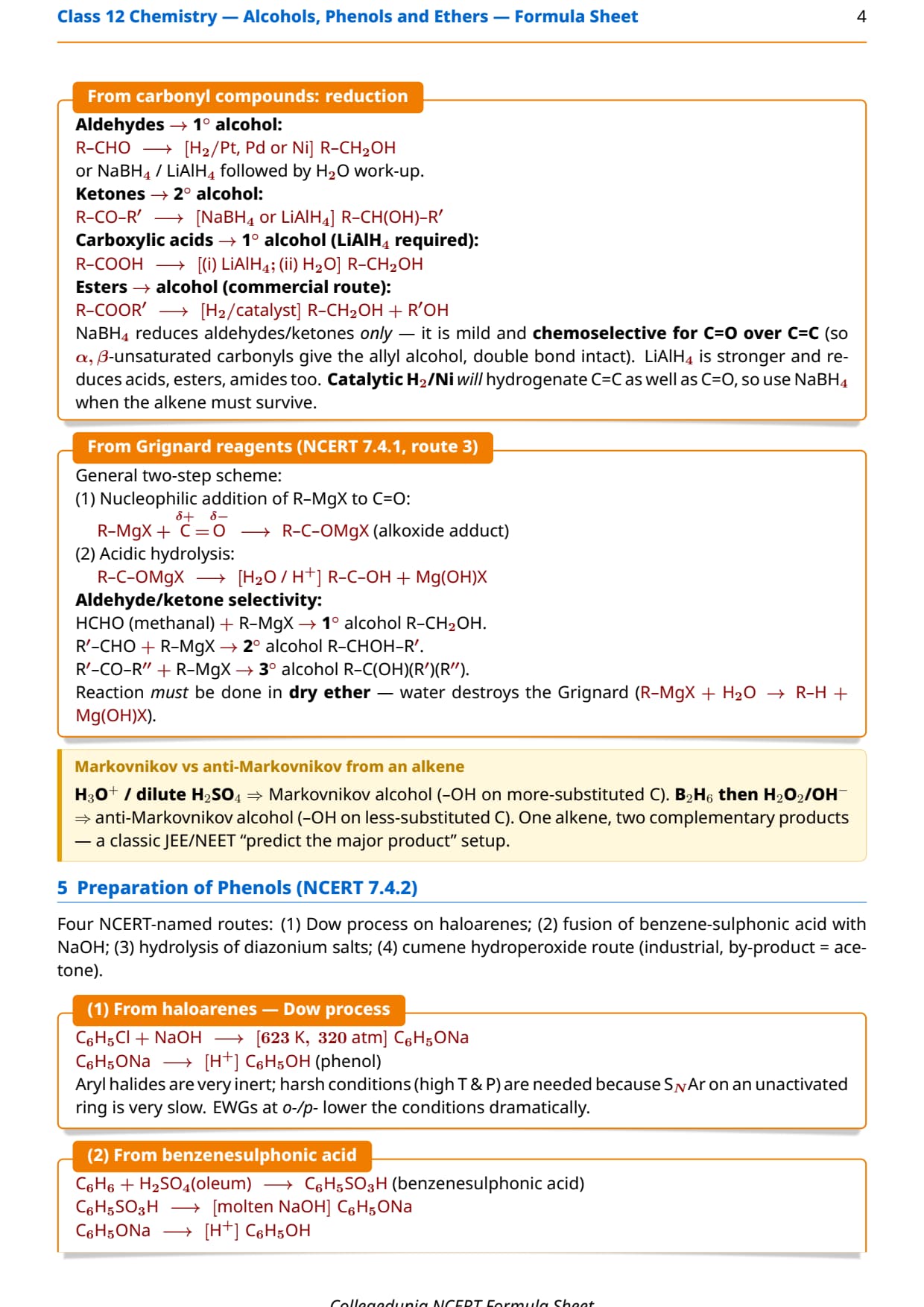
This Collegedunia formula sheet packs every named reaction, acidity trend, and preparation route of Class 12 Chemistry Chapter 7 Alcohols, Phenols and Ethers onto one revision page, matched to the 2026-27 NCERT.
- CBSE Weightage: 4 to 6 marks
- JEE Main Weightage: 3 to 4 questions per paper
- NEET Weightage: 2 to 3 questions per year
Curated by subject experts, mapped to the 2026-27 NCERT, and refined against the last five years of CBSE, JEE Main, and NEET papers.
Also Check:
- Alcohols, Phenols and Ethers Class 12 Chemistry Notes
- Alcohols, Phenols and Ethers Class 12 Chemistry NCERT Solutions
Why Alcohols, Phenols and Ethers Matters in Class 12 Chemistry
This chapter is the launchpad for the organic block. Acidity trends and the named reactions of phenol carry into Chapters 8 and 9.
Alcohols, Phenols and Ethers Class 12 Chemistry Explained
Source: Magnet Brains on YouTube
How This Alcohols, Phenols and Ethers Formula Sheet Helps You
- 2026-27 aligned: Every reaction and trend matches Sections 7.1 to 7.6.
- One-page printable: The master table fits a single A4 sheet.
- Named-reaction tagged: Each prep lists reagent, condition, and product.
Alcohols, Phenols and Ethers Symbol and Notation Glossary
The glossary below locks in every symbol used in the master table.
| Symbol | Meaning |
|---|---|
| R-OH | Generic alcohol (OH on sp3 C) |
| Ar-OH | Phenol (OH on aromatic C) |
| R-O-R' | Ether; R = R' symmetrical, R ≠ R' unsymmetrical |
| 1° / 2° / 3° | Alcohol class by the C bearing OH |
| RO- / ArO- | Alkoxide / phenoxide (resonance-stabilised) ions |
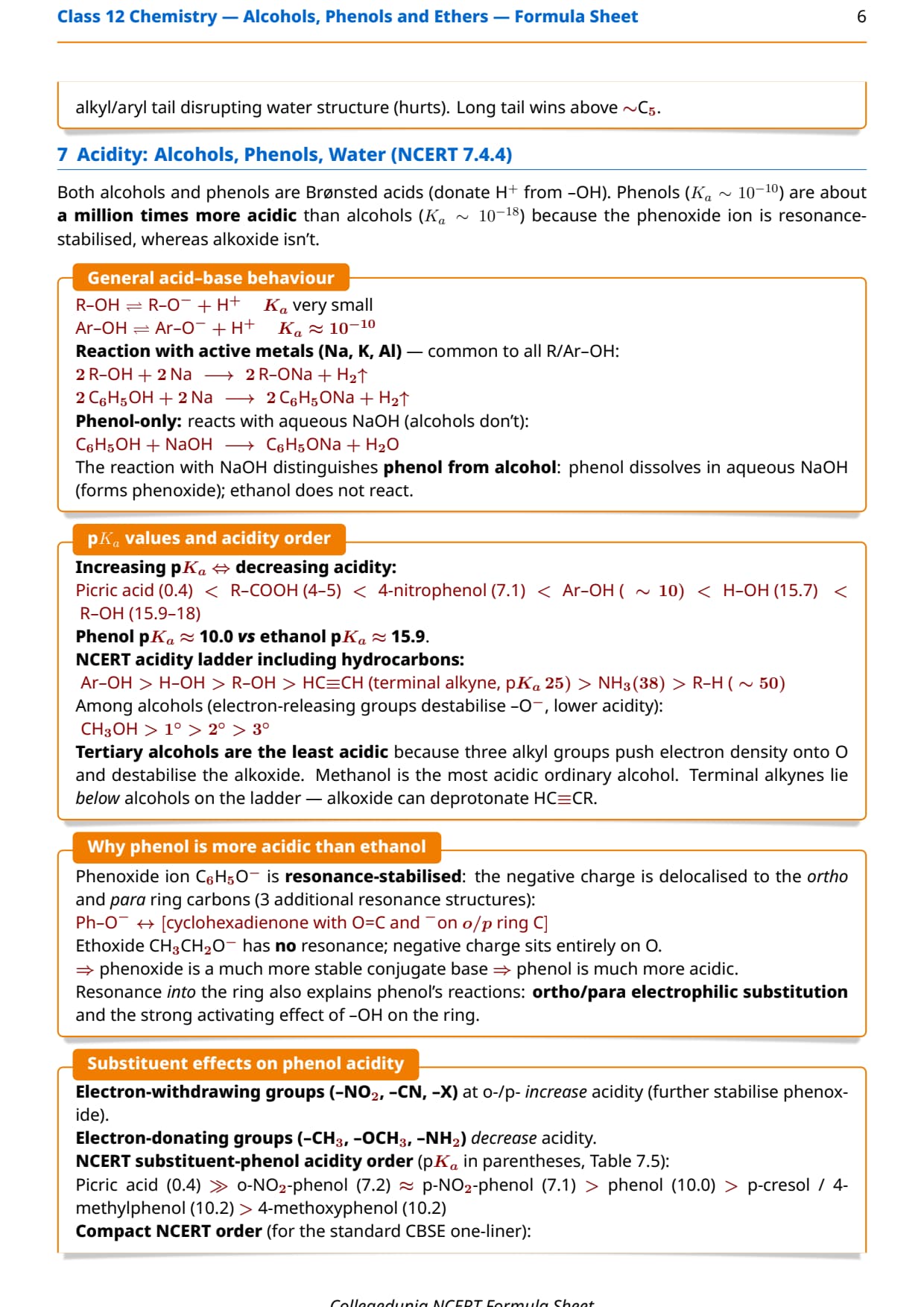
| pKa | Acidity index; lower = stronger acid (R-OH ~16, Ar-OH ~10) |
| RMgX | Grignard reagent; source of R- |
| LiAlH4 | Strong hydride; reduces -COOH, -CHO, -COR to R-OH |
Alcohols, Phenols and Ethers All Important Formulae and Reactions for Class 12 Chemistry
The master table lists every high-yield formula, named reaction, and trend with its NCERT section.
| Concept / Reaction | Formula / Equation | Conditions | Ref |
|---|---|---|---|
| General formulae | CnH2n+1OH; C6H5-OH; R-O-R' | alcohol / phenol / ether | 7.1 |
| Alcohol from alkene (hydration) | CH2=CH2 + H2O → C2H5OH | dil. H2SO4; Markovnikov | 7.3 |
| Hydroboration-oxidation | R-CH=CH2 → R-CH2-CH2OH | (BH3)2, then H2O2/OH-; anti-Markovnikov | 7.3 |
| Carbonyl reduction | R-CHO → 1° R-OH; R-CO-R' → 2° R-OH | H2/Ni or LiAlH4 | 7.3 |
| Acid to alcohol | R-COOH → R-CH2-OH | LiAlH4 or B2H6 | 7.3 |
| Grignard route | R-MgX + carbonyl → alcohol | dry ether; HCHO→1°, RCHO→2°, ketone→3° | 7.3 |
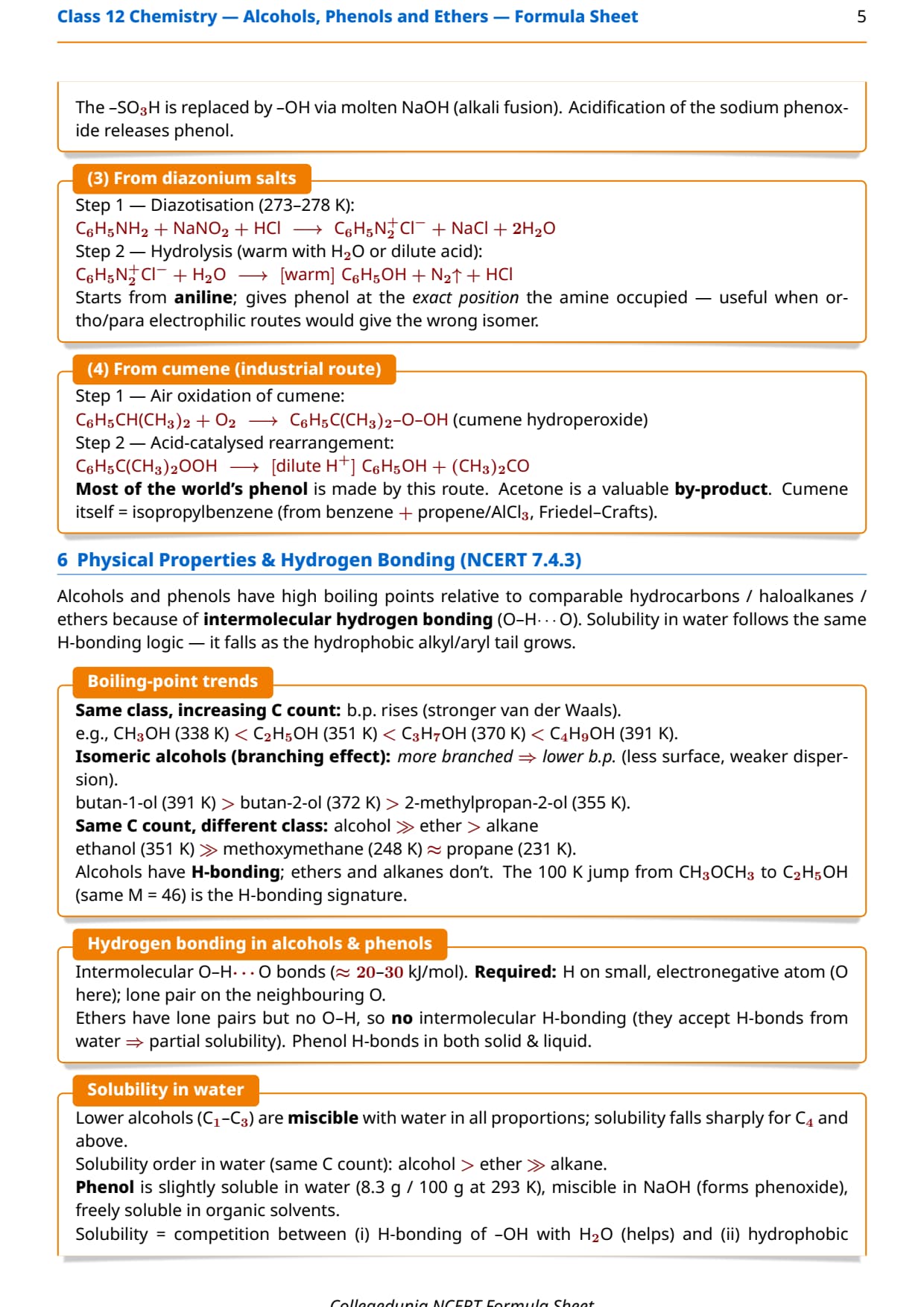
| Phenol from cumene | C6H5CH(CH3)2 → C6H5OH + (CH3)2CO | O2, then H+; main industrial route | 7.3 |
| Phenol from chlorobenzene (Dow) | C6H5Cl + NaOH → C6H5OH | 623 K, 320 atm | 7.3 |
| Boiling point trend | R-OH > R-O-R' > R-X | H-bonding only in R-OH | 7.2 |
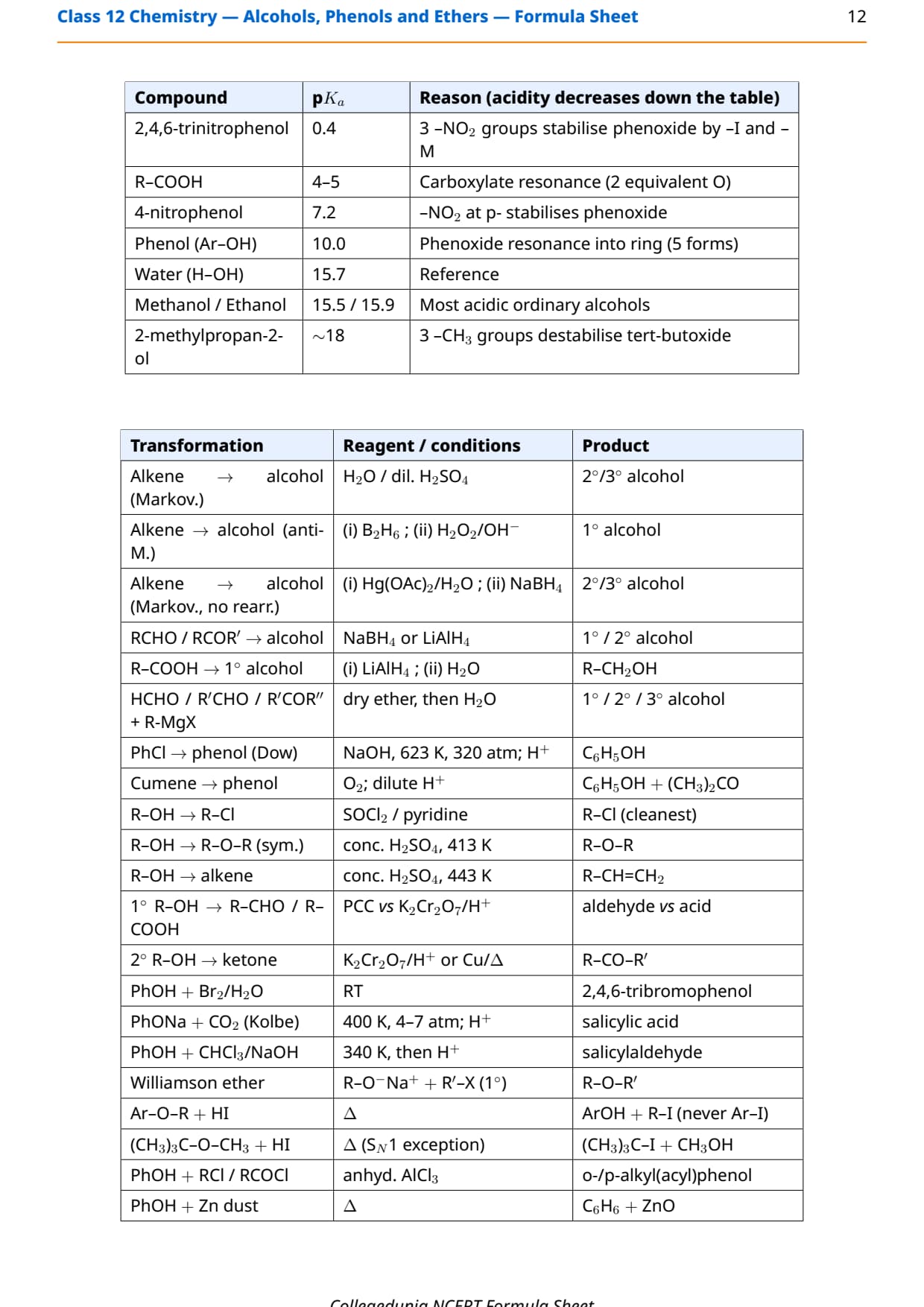
| Acidity: R-OH vs Ar-OH | pKa: R-OH ~16, Ar-OH ~10 | Ar-OH ~106x more acidic | 7.4 |
| Acidity order of alcohols | 1° > 2° > 3° | +I effect lowers acidity | 7.4 |
| R-OH with Na | 2R-OH + 2Na → 2RONa + H2↑ | test for -OH | 7.4 |
| Ar-OH with NaOH | Ar-OH + NaOH → ArONa + H2O | phenol dissolves in alkali; alcohols do not | 7.4 |
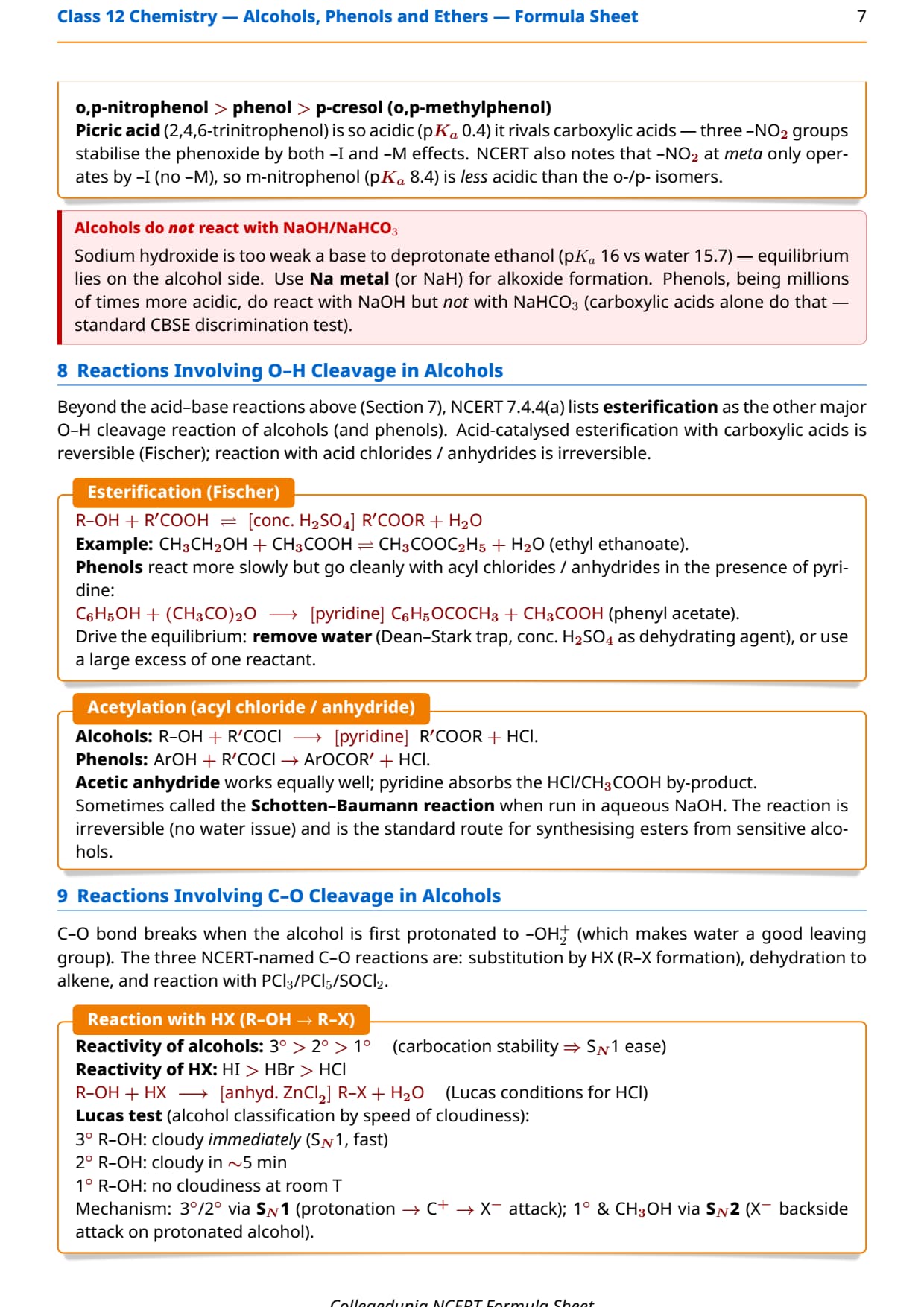
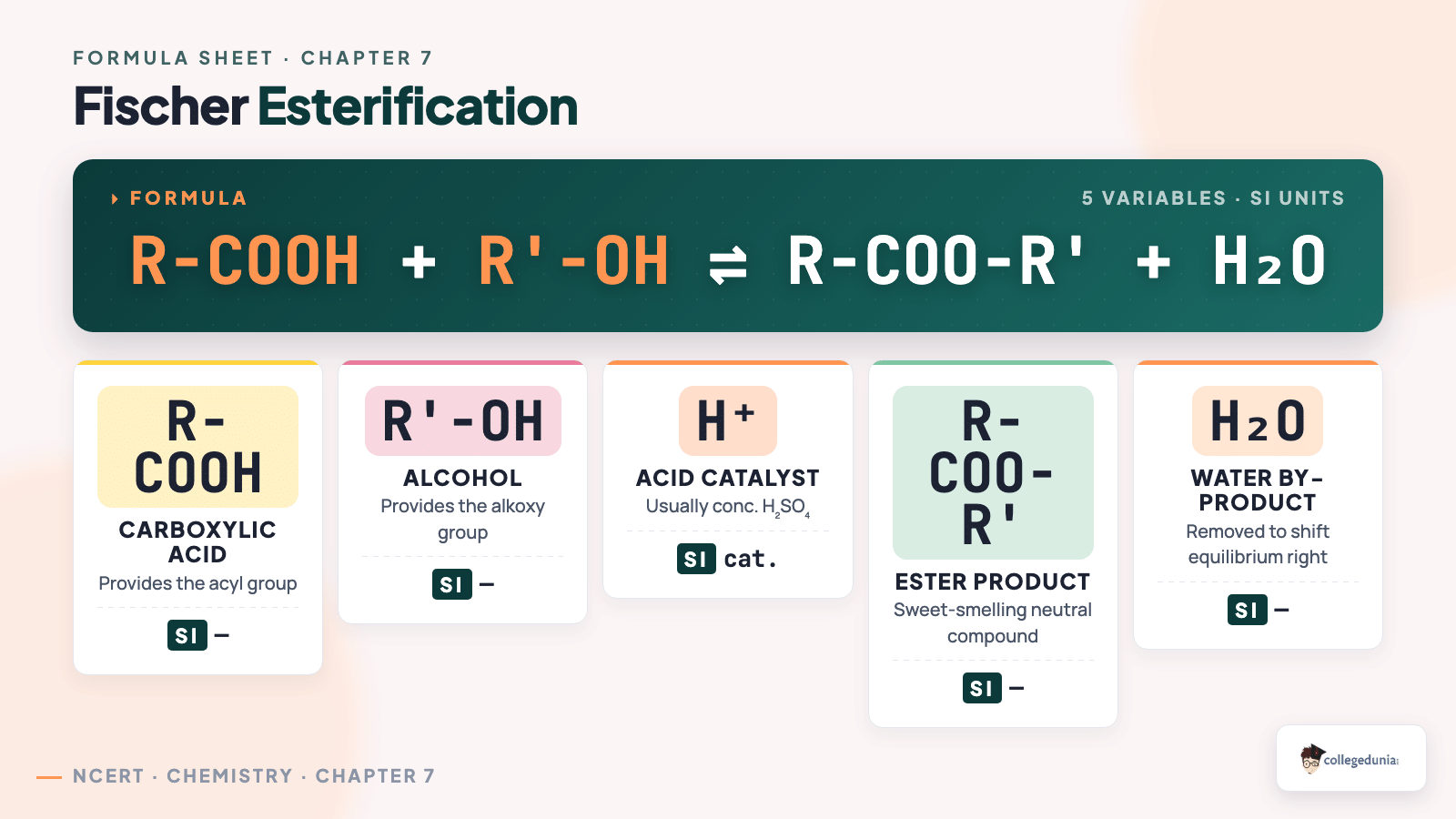
| Esterification | R-OH + R'COOH → ester; Ar-OH + R'COCl → ester | conc. H2SO4; phenol needs acid chloride | 7.4 |
| R-OH to R-X | R-OH + HX / PX3 / SOCl2 → R-X | HCl needs ZnCl2 (Lucas); 3°>2°>1° | 7.4 |
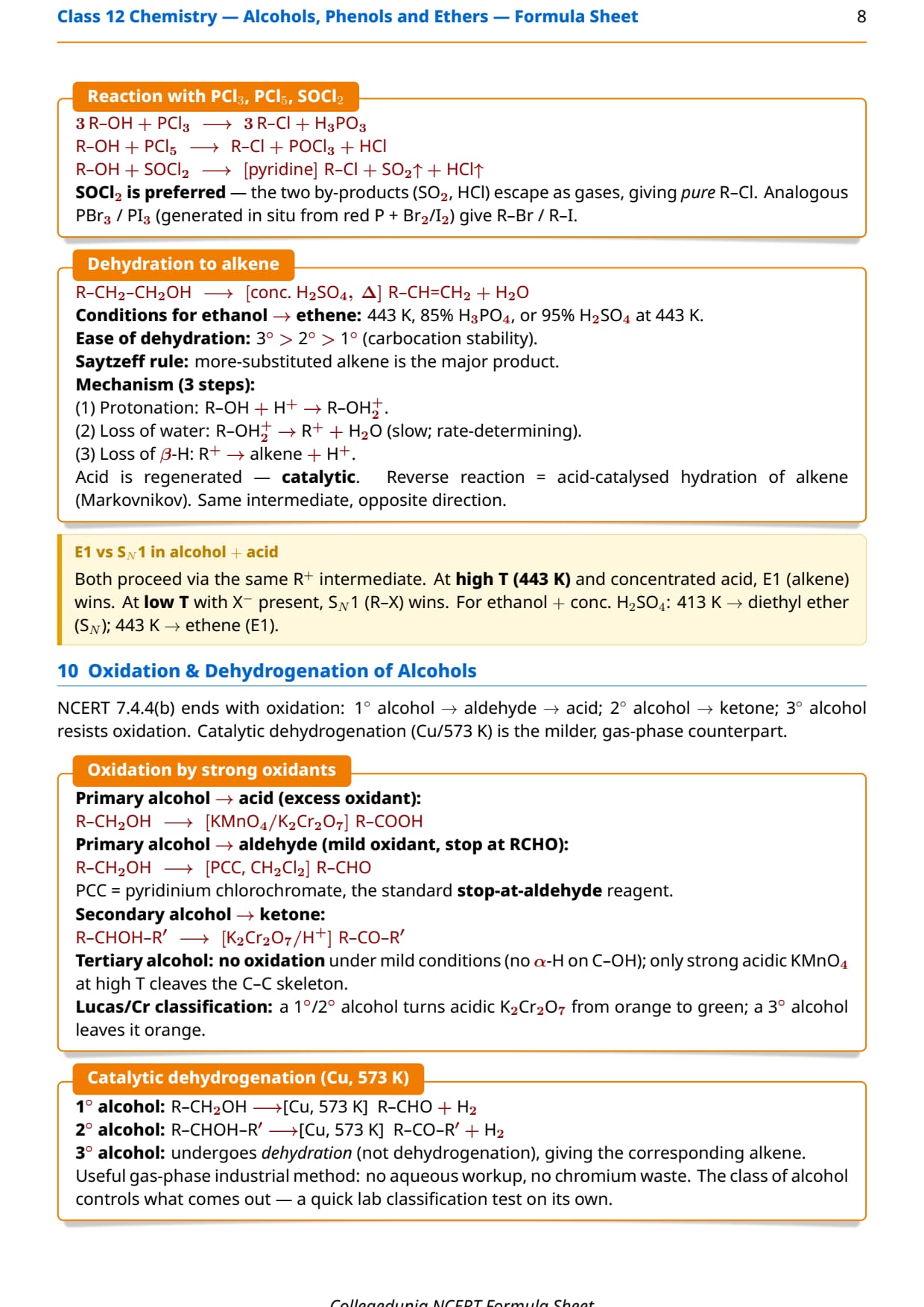
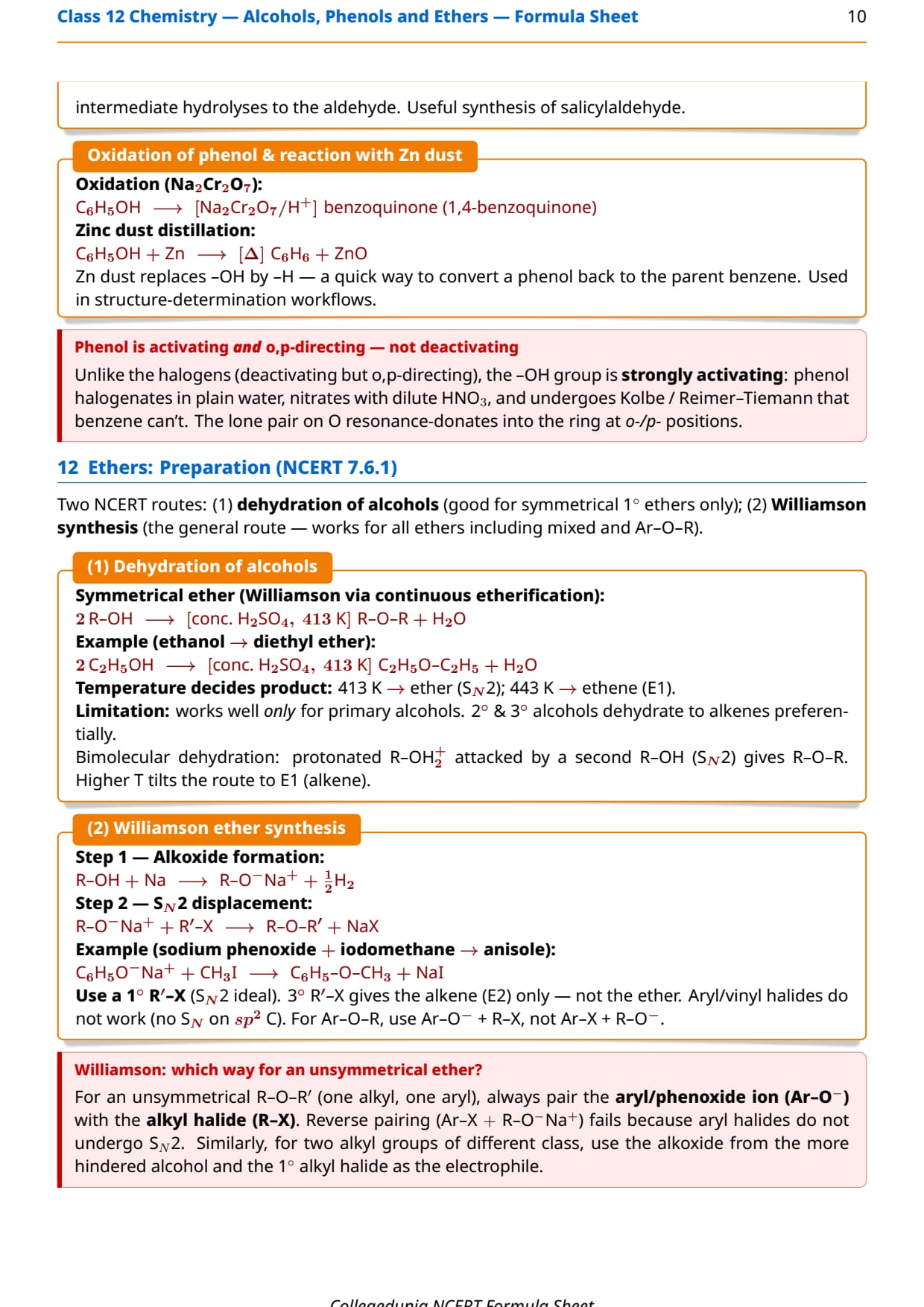
| Dehydration (temperature lever) | 413 K → ether; 443 K → alkene | conc. H2SO4; alkene is Saytzeff | 7.4 |
| Oxidation of 1° R-OH | PCC → R-CHO; KMnO4 → R-COOH | PCC is mild; KMnO4 vigorous | 7.4 |
| Oxidation of 2° R-OH | R-CHOH-R' → R-CO-R' | KMnO4 / Na2Cr2O7 | 7.4 |
| Iodoform test | R-CHOH-CH3 + I2/NaOH → CHI3↓ | yellow ppt; CH3-CHOH- group | 7.4 |
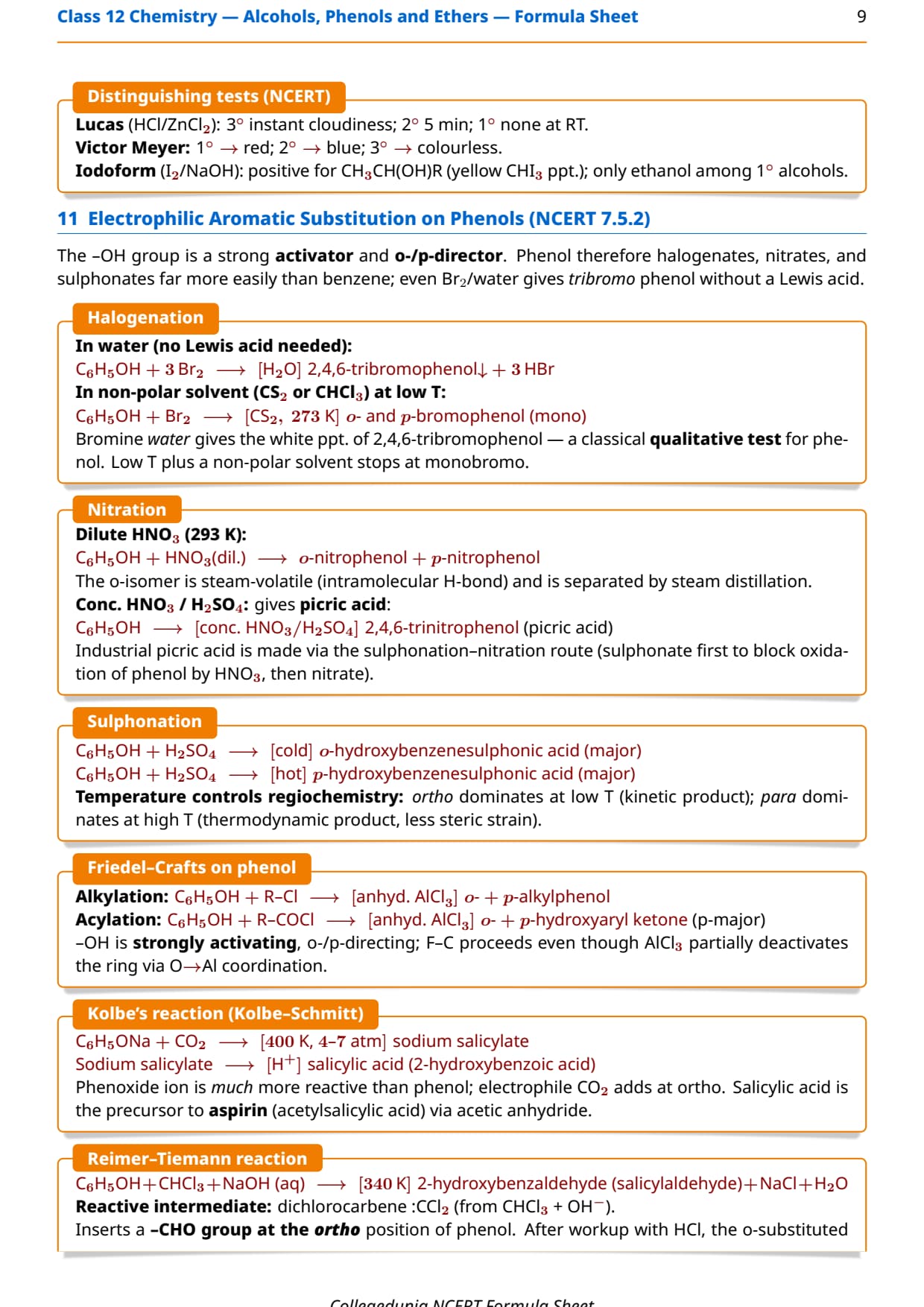
| Bromination of phenol | water → 2,4,6-tribromophenol; CS2 → mono | aq. Br2 (white ppt, test) | 7.5 |
| Nitration of phenol | dil HNO3 → o-/p-nitrophenol; conc → picric acid | o-isomer steam-volatile | 7.5 |
| Kolbe's reaction | ArONa + CO2 → salicylic acid | 400 K, 4-7 atm, then H+ | 7.5 |
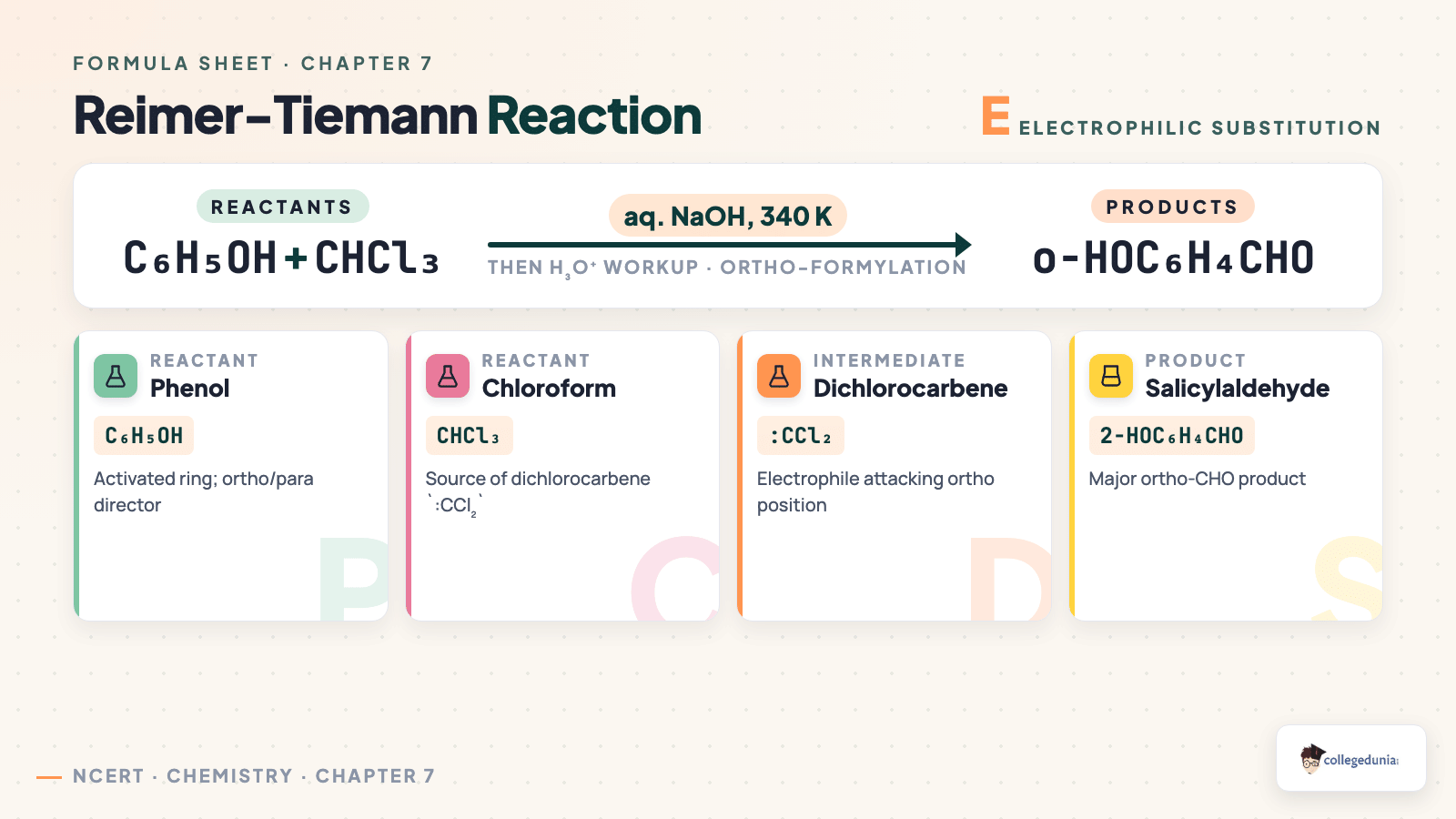
| Reimer-Tiemann reaction | C6H5OH + CHCl3 + NaOH → salicylaldehyde | -CHO at ortho | 7.5 |
| Williamson synthesis | R-ONa + R'-X → R-O-R' | SN2; R'-X must be 1° (3° gives alkene) | 7.6 |
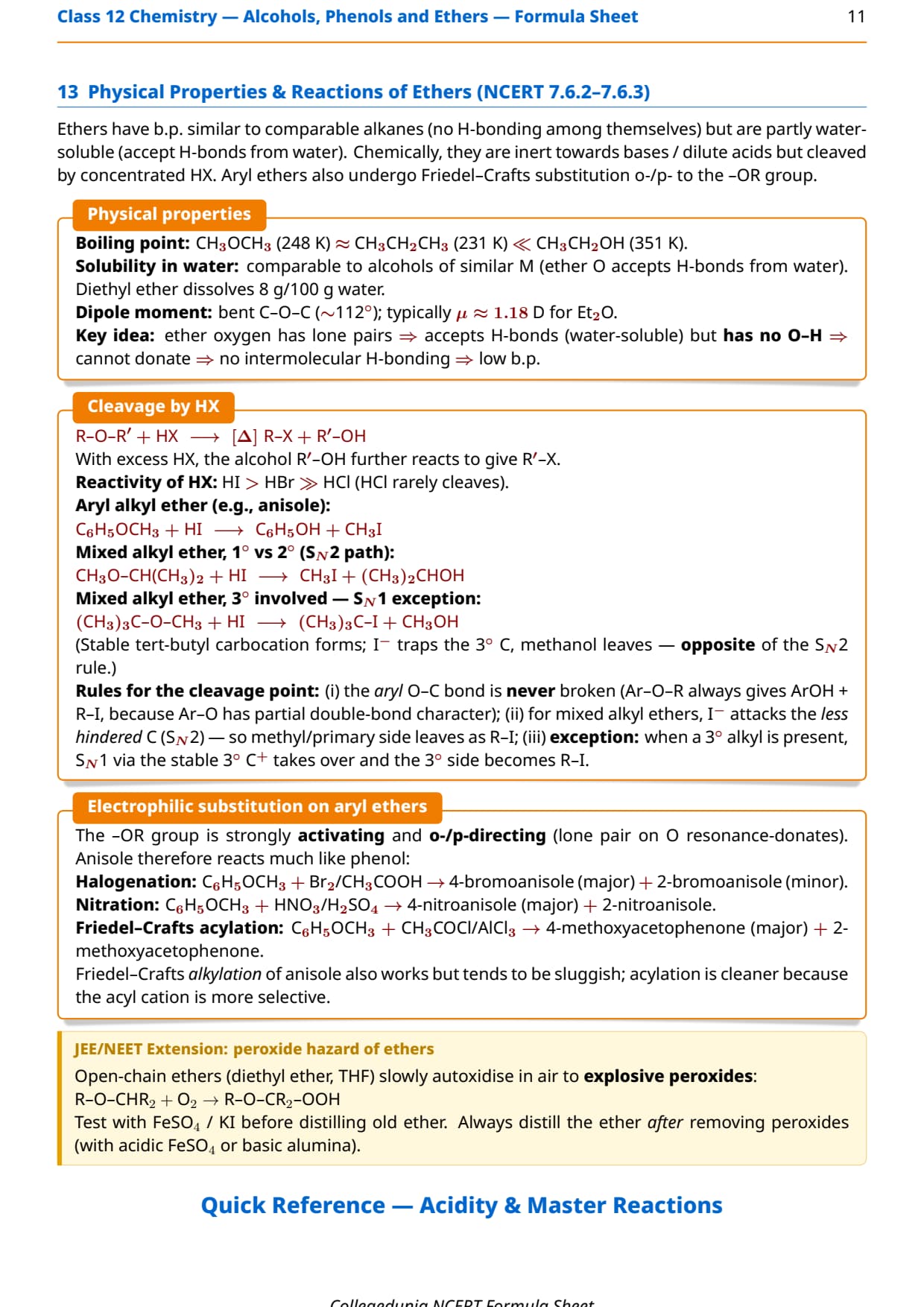
| Ether cleavage with HI | C6H5-O-CH3 + HI → C6H5OH + CH3I | I- attacks -CH3, not aryl C | 7.6 |
Anchor dehydration questions on temperature: conc. H2SO4 at 413 K gives ether, at 443 K gives alkene. Mixing 413 K and 443 K is the most common 1-mark slip.
Acidity and Boiling Point Reference Table for Alcohols, Phenols and Ethers
These two trends power most 1-mark MCQs on the chapter.
| Compound | pKa | Note |
|---|---|---|
| Ethanol | ~16 | reference 1° alcohol (b.p. 351 K) |
| tert-Butanol | ~19 | weakest acid in the alcohol set |
| Phenol | ~10 | 106x more acidic than ethanol (b.p. 455 K) |
| p-Nitrophenol | ~7.2 | -NO2 (-M) increases acidity |
| Picric acid | ~0.4 | stronger than acetic acid |
| Diethyl ether | - | no O-H, so low b.p. (308 K) |
One-Shot Revision Tips for Class 12 Chemistry Alcohols, Phenols and Ethers
- Lucas test: 3° turbid at once, 2° in 5 to 10 min, 1° only on heating. Reagent: conc. HCl + ZnCl2.
- Iodoform test: positive only for CH3-CHOH-R (ethanol, propan-2-ol); methanol and propan-1-ol do not react.
- Phenol needs an acid chloride or anhydride to form esters, because its O lone pair is delocalised into the ring.
- Anisole + HI: only -CH3 is cleaved; the aryl C-O bond is too strong.
Student Feedback
In a Collegedunia poll of 900 Class 12 students, 78% said the phenol named reactions (Kolbe, Reimer-Tiemann, cumene) were the hardest part of this chapter to recall in the exam.
Other Resources for Alcohols, Phenols and Ethers Class 12 Chemistry
- Alcohols, Phenols and Ethers Class 12 Chemistry Formula Sheet
- Alcohols, Phenols and Ethers Class 12 Chemistry NCERT Solutions
- Alcohols, Phenols and Ethers Class 12 Chemistry Notes
- Alcohols, Phenols and Ethers Class 12 Chemistry NCERT Book PDF
- Alcohols, Phenols and Ethers Class 12 Chemistry NCERT Exemplar Book PDF
- Alcohols, Phenols and Ethers Class 12 Chemistry NCERT Exemplar Solutions
- Alcohols, Phenols and Ethers Class 12 Chemistry Handwritten Notes
NCERT Formula Sheet for Class 12 Chemistry: All Chapters
Jump to the formula sheet for any other chapter of Class 12 Chemistry below.
| Chapter | Resource |
|---|---|
| Chapter 1 | Solutions Formula Sheet |
| Chapter 2 | Electrochemistry Formula Sheet |
| Chapter 3 | Chemical Kinetics Formula Sheet |
| Chapter 4 | d- and f-Block Elements Formula Sheet |
| Chapter 5 | Coordination Compounds Formula Sheet |
| Chapter 6 | Haloalkanes and Haloarenes Formula Sheet |
| Chapter 8 | Aldehydes, Ketones and Carboxylic Acids Formula Sheet |
| Chapter 9 | Amines Formula Sheet |
| Chapter 10 | Biomolecules Formula Sheet |
Alcohols, Phenols and Ethers Class 12 Chemistry Formula Sheet FAQs
Ques. Where can I download the Alcohols, Phenols and Ethers Class 12 Chemistry Formula Sheet PDF?
Ans. You can download the Alcohols, Phenols and Ethers Class 12 Chemistry Formula Sheet PDF directly from this Collegedunia page. Both the Normal and HD versions are available and free of cost.
Ques. Is this Formula Sheet aligned with the 2026-27 NCERT?
Ans. Yes. This page reflects the current 2026-27 syllabus for Class 12 Chemistry. Alcohols, Phenols and Ethers is fully retained in the new edition with no formula cuts; every relation in Sections 7.1 to 7.6 of the NCERT remains examinable.
Ques. How many pages is the Class 12th Chemistry Alcohols, Phenols and Ethers Formula Sheet PDF?
Ans. The Formula Sheet PDF runs approximately 8 to 9 pages and covers the master reaction table, symbol glossary, acidity / boiling-point reference, quick-fact MCQ cards, and four common numerical pattern templates.
Ques. Why is phenol more acidic than ethanol?
Ans. The phenoxide ion (C6H5-O-) is stabilised by resonance: the negative charge is delocalised onto the ortho and para carbons of the benzene ring, spreading it over multiple atoms. The ethoxide ion has no such delocalisation, so the negative charge stays fully on one oxygen. The resonance-stabilised phenoxide is roughly 106 times more stable than ethoxide, which is why phenol has pKa 10 and ethanol pKa 16.
Ques. What products are formed when ethanol is heated with conc. H2SO4 at 413 K and 443 K?
Ans. At 413 K (140 °C), conc. H2SO4 catalyses intermolecular dehydration of ethanol to give diethyl ether: 2 C2H5-OH → C2H5-O-C2H5 + H2O. At 443 K (170 °C), the same acid catalyses intramolecular dehydration to give ethene: C2H5-OH → C2H4 + H2O. The temperature is the only variable that flips the outcome.
Ques. What is the Williamson ether synthesis and when does it fail?
Ans. Williamson synthesis is the SN2 reaction of a sodium alkoxide with an alkyl halide: R-O-Na+ + R'-X → R-O-R' + NaX. It is the standard route for unsymmetrical ethers. It fails when R'-X is a tertiary (3°) halide because steric crowding pushes the reaction to E2 elimination, giving an alkene instead. The fix is to choose the 1° halide as R'-X and put the bulkier group on the alkoxide.
Ques. Why does anisole + HI give phenol and methyl iodide, not iodobenzene and methanol?
Ans. When anisole (C6H5-O-CH3) reacts with HI, the I- nucleophile attacks the methyl carbon (SN2 at sp3 C), not the aryl carbon (sp2, locked in the aromatic ring). The aryl C-O bond has partial double-bond character from lone-pair donation into the ring, making it too strong to cleave. The products are therefore C6H5-OH (phenol) + CH3-I (methyl iodide).
Ques. What is the Reimer-Tiemann reaction and what product does it give?
Ans. The Reimer-Tiemann reaction treats phenol with chloroform (CHCl3) in the presence of aqueous NaOH to introduce a -CHO group at the ortho position of the ring, giving salicylaldehyde (2-hydroxybenzaldehyde). Mechanism: NaOH deprotonates CHCl3 to dichlorocarbene (:CCl2), which attacks the activated phenoxide at the ortho carbon; subsequent hydrolysis of -CCl2H gives -CHO. The reaction is examinable in both CBSE and JEE Main.
Ques. What is the Kolbe reaction for preparing salicylic acid from phenol?
Ans. Sodium phenoxide is heated with CO2 at 400 K and 4 to 7 atm; the carboxylate intermediate is acidified to give salicylic acid (2-hydroxybenzoic acid). The mechanism involves electrophilic attack of CO2 on the activated ortho carbon of the phenoxide. The Kolbe reaction is the industrial route to salicylic acid, the precursor of aspirin.
Ques. What are the cumene process and Dow process for preparing phenol?
Ans. The cumene process oxidises cumene (isopropylbenzene) with atmospheric O2 to cumene hydroperoxide, then acidifies to give phenol and acetone (valuable co-product). The Dow process hydrolyses chlorobenzene with NaOH at 623 K and 320 atm to give phenol. Cumene is the dominant industrial route today because acetone offsets the cost.
Ques. How is picric acid (2,4,6-trinitrophenol) prepared from phenol?
Ans. Picric acid is prepared by stepwise nitration of phenol: dilute HNO3 gives ortho/para-nitrophenol; more concentrated HNO3 gives 2,4-dinitrophenol; final nitration with conc. HNO3 + H2SO4 gives picric acid (pKa 0.4), stronger than acetic acid. Three -NO2 groups stabilise the conjugate base by resonance and -I effects.
Ques. What is hydroboration-oxidation, and how does it give the anti-Markovnikov alcohol?
Ans. Hydroboration-oxidation uses B2H6 in THF followed by alkaline H2O2 on an alkene. The boron attaches to the less-substituted carbon (anti-Markovnikov), and oxidation replaces it with -OH without rearrangement. The reaction is concerted and syn-additive, so no carbocation forms and no Wagner-Meerwein rearrangement is possible. This makes it CBSE's preferred 3-mark answer when the question demands a rearrangement-free preparation.
Ques. How does PCC differ from KMnO4 when oxidising a primary alcohol?
Ans. PCC (pyridinium chlorochromate) in dichloromethane is a mild oxidant that stops at R-CHO; KMnO4 is a strong aqueous oxidant that overshoots to R-COOH because the aldehyde hydrates in water and is oxidised further. For secondary alcohols, both reagents give the ketone (no further oxidation easily). Tertiary alcohols resist both because there is no alpha-H.
Ques. What is the Saytzeff rule for the acid-catalysed dehydration of alcohols?
Ans. Saytzeff's rule says that in an E1 dehydration, the more-substituted (more stable) alkene is the major product. 2-Methylbutan-2-ol with conc. H2SO4 at 443 K gives 2-methylbut-2-ene (trisubstituted) as the major product over 2-methylbut-1-ene (disubstituted). Alkene stability follows hyperconjugation: more alpha-H atoms mean more hyperconjugative stabilisation.
Ques. Why does bromination of phenol with Br2 water give 2,4,6-tribromophenol while Br2/CS2 at low temperature gives mono-substituted product?
Ans. In water, the phenol partially ionises to phenoxide, which is much more activated than phenol itself; the highly activated ring undergoes triple electrophilic substitution at the 2, 4 and 6 positions to give 2,4,6-tribromophenol (white precipitate) very fast. In CS2 (a non-polar solvent) at low temperature, ionisation is suppressed and the reaction stops at the mono-bromo stage, giving a mixture of o- and p-bromophenol.
Ques. What is the Lucas test, and how does it distinguish 1°, 2°, and 3° alcohols?
Ans. The Lucas test mixes the alcohol with Lucas reagent (concentrated HCl + anhydrous ZnCl2) at room temperature. Tertiary alcohols give immediate turbidity because the 3° carbocation forms fast; secondary alcohols give turbidity in 5 to 10 minutes; primary alcohols give no turbidity at room temperature and need heating. The Lucas test is the standard CBSE / JEE Main / NEET distinction question for the chapter.



Comments