




Inside the NCERT Notes for Class 8 Mathematics Chapter 3 A Story of Numbers, you will trace counting from tally marks to place value. The notes follow the 2026-27 Ganita Prakash textbook and explain bases, landmark numbers, zero, and early numeral systems with clear comparisons.
- Core idea: number systems use fixed objects, names, or symbols to represent quantities.
- Key skills: read Roman, Egyptian, Mesopotamian, Mayan, Chinese, and Hindu numerals.
- Revision focus: bases, landmark numbers, place value, and zero as a placeholder.
Chapter3AStoryofNumbersNotes.pdf?page=1&dpi=150)
Chapter3AStoryofNumbersNotes.pdf?page=2&dpi=150)
Chapter3AStoryofNumbersNotes.pdf?page=3&dpi=150)
Chapter3AStoryofNumbersNotes.pdf?page=4&dpi=150)
Chapter3AStoryofNumbersNotes.pdf?page=5&dpi=150)
Chapter3AStoryofNumbersNotes.pdf?page=6&dpi=150)
Chapter3AStoryofNumbersNotes.pdf?page=7&dpi=150)
Chapter3AStoryofNumbersNotes.pdf?page=8&dpi=150)
Chapter3AStoryofNumbersNotes.pdf?page=9&dpi=150)
Chapter3AStoryofNumbersNotes.pdf?page=10&dpi=150)
Chapter3AStoryofNumbersNotes.pdf?page=11&dpi=150)
Chapter3AStoryofNumbersNotes.pdf?page=12&dpi=150)
Chapter3AStoryofNumbersNotes.pdf?page=13&dpi=150)
Chapter3AStoryofNumbersNotes.pdf?page=14&dpi=150)
Chapter3AStoryofNumbersNotes.pdf?page=15&dpi=150)
Chapter3AStoryofNumbersNotes.pdf?page=16&dpi=150)
Chapter3AStoryofNumbersNotes.pdf?page=17&dpi=150)
Chapter3AStoryofNumbersNotes.pdf?page=18&dpi=150)
Chapter3AStoryofNumbersNotes.pdf?page=19&dpi=150)
Chapter3AStoryofNumbersNotes.pdf?page=20&dpi=150)
Chapter3AStoryofNumbersNotes.pdf?page=21&dpi=150)
Chapter3AStoryofNumbersNotes.pdf?page=22&dpi=150)
Chapter3AStoryofNumbersNotes.pdf?page=23&dpi=150)
Chapter3AStoryofNumbersNotes.pdf?page=24&dpi=150)
Chapter3AStoryofNumbersNotes.pdf?page=25&dpi=150)
Chapter3AStoryofNumbersNotes.pdf?page=26&dpi=150)
Chapter3AStoryofNumbersNotes.pdf?page=27&dpi=150)
Chapter3AStoryofNumbersNotes.pdf?page=28&dpi=150)
Chapter3AStoryofNumbersNotes.pdf?page=29&dpi=150)
Chapter3AStoryofNumbersNotes.pdf?page=30&dpi=150)
Chapter3AStoryofNumbersNotes.pdf?page=31&dpi=150)
Chapter3AStoryofNumbersNotes_flat_MobileCard.pdf?page=1&dpi=150)
Chapter3AStoryofNumbersNotes_flat_MobileCard.pdf?page=2&dpi=150)
Chapter3AStoryofNumbersNotes_flat_MobileCard.pdf?page=3&dpi=150)
Chapter3AStoryofNumbersNotes_flat_MobileCard.pdf?page=4&dpi=150)
Chapter3AStoryofNumbersNotes_flat_MobileCard.pdf?page=5&dpi=150)
Chapter3AStoryofNumbersNotes_flat_MobileCard.pdf?page=6&dpi=150)
Chapter3AStoryofNumbersNotes_flat_MobileCard.pdf?page=7&dpi=150)
Chapter3AStoryofNumbersNotes_flat_MobileCard.pdf?page=8&dpi=150)
Chapter3AStoryofNumbersNotes_flat_MobileCard.pdf?page=9&dpi=150)
Chapter3AStoryofNumbersNotes_flat_MobileCard.pdf?page=10&dpi=150)
Chapter3AStoryofNumbersNotes_flat_MobileCard.pdf?page=11&dpi=150)
Chapter3AStoryofNumbersNotes_flat_MobileCard.pdf?page=12&dpi=150)
Chapter3AStoryofNumbersNotes_flat_MobileCard.pdf?page=13&dpi=150)
Chapter3AStoryofNumbersNotes_flat_MobileCard.pdf?page=14&dpi=150)
Chapter3AStoryofNumbersNotes_flat_MobileCard.pdf?page=15&dpi=150)
Chapter3AStoryofNumbersNotes_flat_MobileCard.pdf?page=16&dpi=150)
Chapter3AStoryofNumbersNotes_flat_MobileCard.pdf?page=17&dpi=150)
Chapter3AStoryofNumbersNotes_flat_MobileCard.pdf?page=18&dpi=150)
Chapter3AStoryofNumbersNotes_flat_MobileCard.pdf?page=19&dpi=150)
Chapter3AStoryofNumbersNotes_flat_MobileCard.pdf?page=20&dpi=150)
Chapter3AStoryofNumbersNotes_flat_MobileCard.pdf?page=21&dpi=150)
Chapter3AStoryofNumbersNotes_flat_MobileCard.pdf?page=22&dpi=150)
Chapter3AStoryofNumbersNotes_flat_MobileCard.pdf?page=23&dpi=150)
Chapter3AStoryofNumbersNotes_flat_MobileCard.pdf?page=24&dpi=150)
Chapter3AStoryofNumbersNotes_flat_MobileCard.pdf?page=25&dpi=150)
Chapter3AStoryofNumbersNotes_flat_MobileCard.pdf?page=26&dpi=150)
Chapter3AStoryofNumbersNotes_flat_MobileCard.pdf?page=27&dpi=150)
Chapter3AStoryofNumbersNotes_flat_MobileCard.pdf?page=28&dpi=150)
Chapter3AStoryofNumbersNotes_flat_MobileCard.pdf?page=29&dpi=150)
Chapter3AStoryofNumbersNotes_flat_MobileCard.pdf?page=30&dpi=150)
Chapter3AStoryofNumbersNotes_flat_MobileCard.pdf?page=31&dpi=150)
Chapter3AStoryofNumbersNotes_flat_MobileCard.pdf?page=32&dpi=150)
Chapter3AStoryofNumbersNotes_flat_MobileCard.pdf?page=33&dpi=150)
Chapter3AStoryofNumbersNotes_flat_MobileCard.pdf?page=34&dpi=150)
Chapter3AStoryofNumbersNotes_flat_MobileCard.pdf?page=35&dpi=150)
Chapter3AStoryofNumbersNotes_flat_MobileCard.pdf?page=36&dpi=150)
Chapter3AStoryofNumbersNotes_flat_MobileCard.pdf?page=37&dpi=150)
Chapter3AStoryofNumbersNotes_flat_MobileCard.pdf?page=38&dpi=150)
Chapter3AStoryofNumbersNotes_flat_MobileCard.pdf?page=39&dpi=150)
Chapter3AStoryofNumbersNotes_flat_MobileCard.pdf?page=40&dpi=150)
Chapter3AStoryofNumbersNotes_flat_MobileCard.pdf?page=41&dpi=150)
Chapter3AStoryofNumbersNotes_flat_MobileCard.pdf?page=42&dpi=150)
Chapter3AStoryofNumbersNotes_flat_MobileCard.pdf?page=43&dpi=150)
These A Story of Numbers notes are checked against the 2026-27 NCERT chapter and use its examples for clear revision.
A Story of Numbers Core Ideas Every Class 8 Student Should Know
A number system uses a fixed sequence of objects, sounds, names, or written symbols. A numeral is the written form used to show a number. Early people counted food, animals, trade goods, days, and seasons long before modern digits existed.
- One-to-one mapping: match each object with one stick, sound, or mark.
- Tally marks: make one mark for each object being counted.
- Grouping: collect smaller counts into useful groups such as 2, 5, 10, or 20.
- Landmark numbers: use familiar reference values to build larger numbers.
The symbol is not the number itself. Different civilisations could show the same quantity with very different numerals.
A Story of Numbers Chapter Overview
Source: Magnet Brains on YouTube
Early Number Systems in A Story of Numbers and What They Added
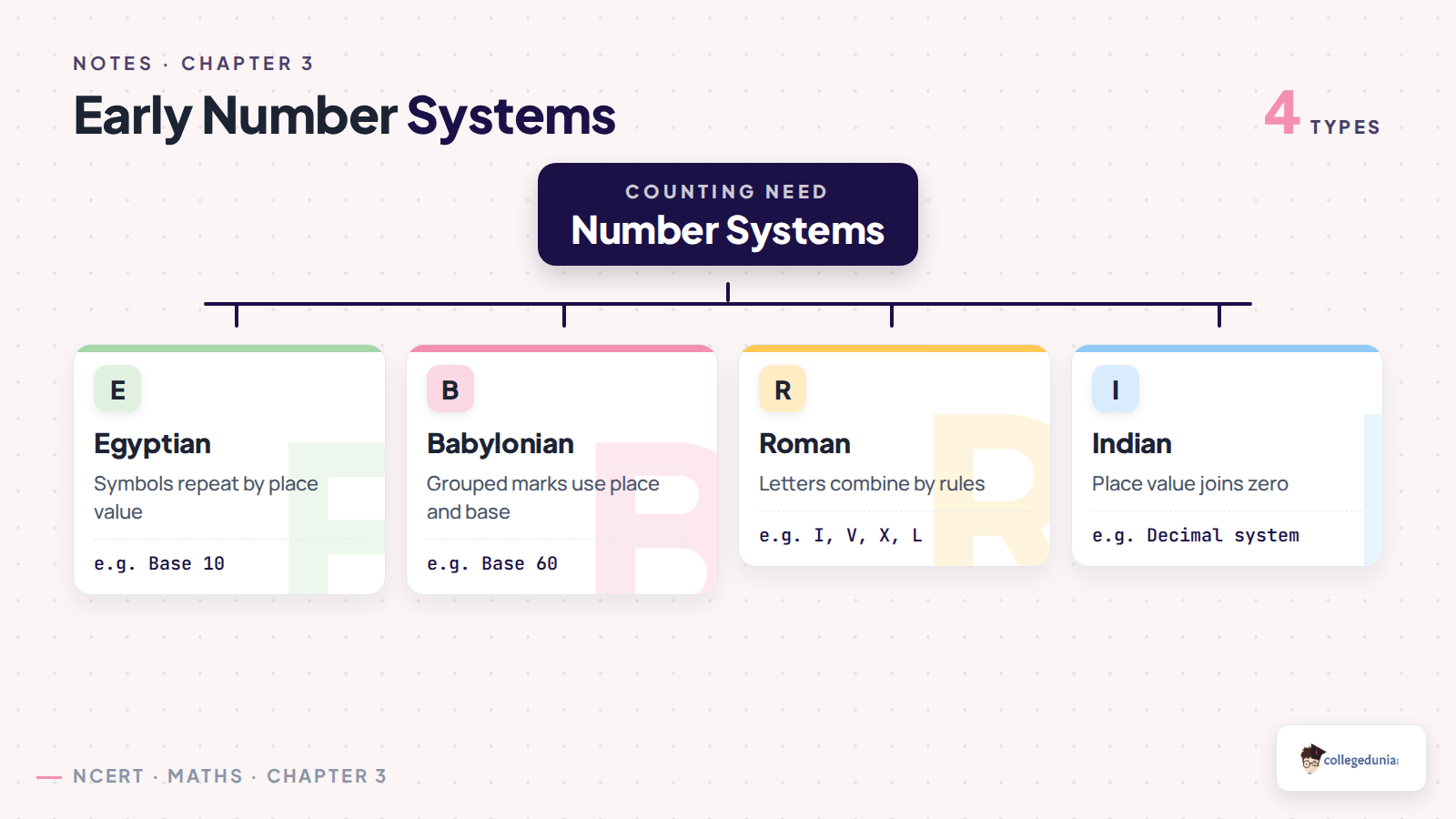
The 2026-27 NCERT chapter follows the main ideas behind number representation. Each system solved an earlier problem, but some still made arithmetic slow.
| System or method | Main idea | Limitation |
|---|---|---|
| Body parts and tally marks | One object matches one body point or mark | Long records need many marks |
| Gumulgal names | Numbers are built by counting in twos | Long names become difficult for large values |
| Roman numerals | I, V, X, L, C, D, and M mark useful values | Multiplication and division are difficult |
| Egyptian numerals | Powers of 10 act as landmark numbers | Every new power needs a new symbol |
| Mesopotamian numerals | Position shows powers of 60 | Blank places can make a numeral unclear |
| Hindu numerals | Ten digits and place value show every number | Place values must be read correctly |
Base and Landmark Numbers Explained with Simple Examples
A base tells us the repeated group size used to build landmark numbers. In a base-n system, where n means the group size, the landmarks are powers of n.
- Base 10 uses 1, 10, 100, 1000, and later powers of 10.
- Base 2 uses 1, 2, 4, 8, 16, and later powers of 2.
- Mesopotamian numerals used base 60, also called the sexagesimal system.
- Roman numerals use landmark values, but these values are not powers of one base.
A base system makes grouping regular. This regular pattern also makes written calculations easier.
Place Value and Zero in the Hindu Number System
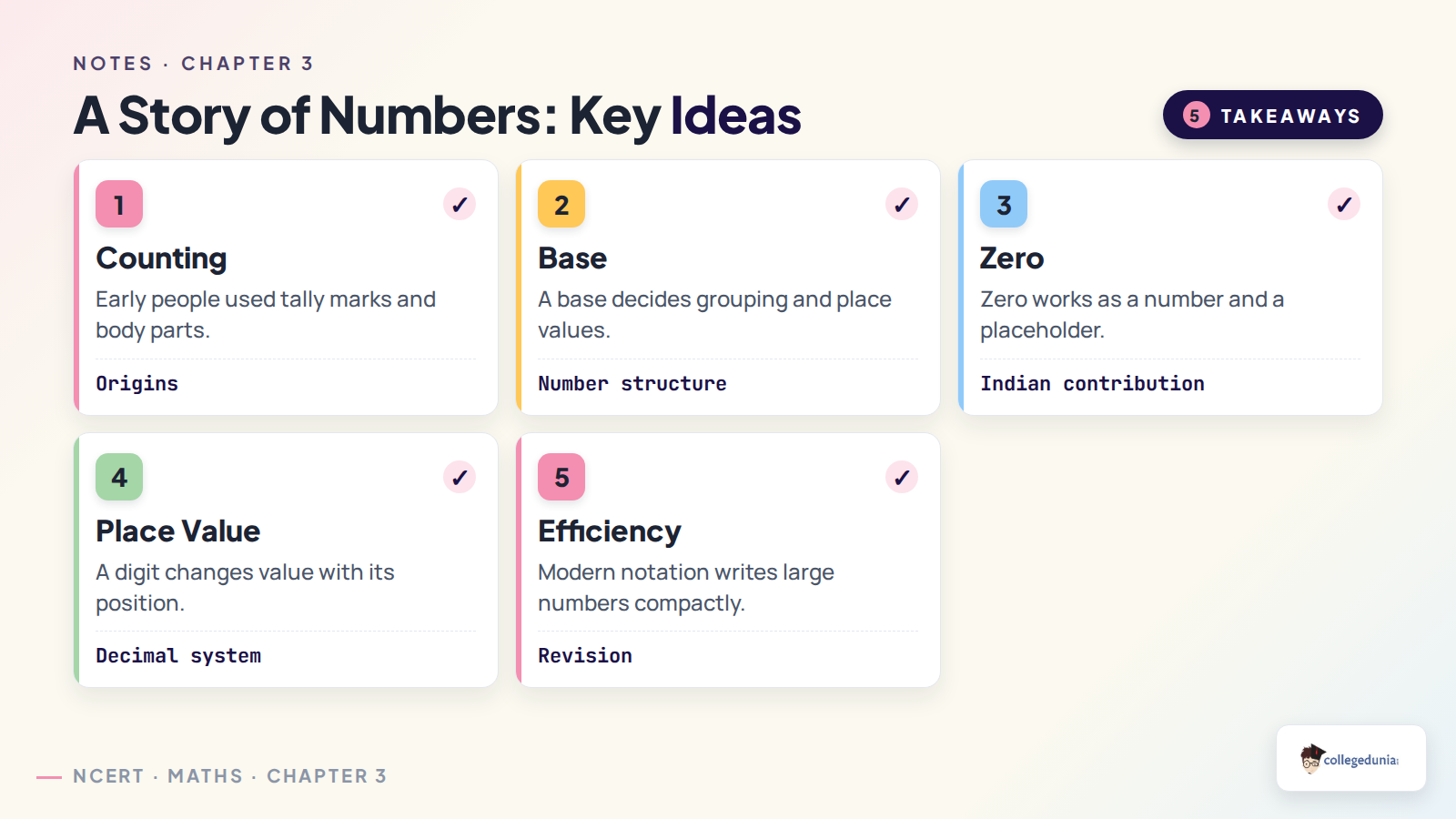
In a place value system, a symbol gets its value from its position. In 375, the digit 3 means three hundreds. The digit 7 means seven tens, and 5 means five ones.
Zero fills an empty position and removes doubt. It also works as a number in arithmetic. Without zero, 305 could be confused with 35. The Hindu system uses only the digits 0 to 9 to write every whole number.
Common Confusions in the A Story of Numbers Chapter
Students often mix up related terms because they appear together. Use these short checks before solving the Figure it Out questions.
- Number vs numeral: a number is a quantity; a numeral is its written representation.
- Base vs place value: the base sets landmarks; position selects the landmark used.
- Zero vs blank: zero clearly records an empty place; a blank may be missed.
- Roman vs Hindu numerals: Roman symbols have fixed values; Hindu digits change value by position.
Ask what each position means before reading a numeral. This works for base 10, base 2, and base 60.
A Story of Numbers Student Feedback and Revision Plan
In a Collegedunia poll of 10,360 Class 8 students conducted before the 2026 examinations, students found place value easier after comparing two numeral systems.
Source: 2026-27 Class 8 Mathematics student poll. Sample of 10,360 students from CBSE schools.
- Make a timeline from tally marks to the Hindu number system.
- Write one example for every numeral system in the chapter.
- Compare Roman fixed symbols with Hindu place value.
- Finish with base 2, base 5, and base 8 practice.
A Story of Numbers Related Class 8 Mathematics Resources
Use the official chapter for activities, then check solutions after trying each question yourself.
| Resource | How it helps |
|---|---|
| A Story of Numbers Class 8 NCERT Solutions | Check answers to the Figure it Out activities. |
| A Story of Numbers Class 8 NCERT Book PDF | Read the official examples, maps, and numeral diagrams. |
| A Story of Numbers Class 8 Handwritten Notes | Review the main systems through shorter visual notes. |
NCERT Notes for Class 8 Mathematics Part 1: All Chapters
The table links each Mathematics Part 1 chapter to its matching Collegedunia notes page.
| Chapter | Notes |
|---|---|
| Chapter 1 | A Square and a Cube Class 8 Notes |
| Chapter 2 | Power Play Class 8 Notes |
| Chapter 3 | A Story of Numbers Class 8 Notes |
| Chapter 4 | Quadrilaterals Class 8 Notes |
| Chapter 5 | Number Play Class 8 Notes |
| Chapter 6 | We Distribute, Yet Things Multiply Class 8 Notes |
| Chapter 7 | Proportional Reasoning-1 Class 8 Notes |
A Story of Numbers Class 8 Mathematics Notes FAQs
Ques. What is a number system?
Ans. A number system is a fixed sequence of objects, names, sounds, or symbols used to represent quantities.
Ques. What are landmark numbers?
Ans. Landmark numbers are easy reference values used to group and represent other numbers. Roman numerals use 1, 5, 10, 50, and more.
Ques. What does base-n mean in A Story of Numbers?
Ans. Base-n means that powers of a group size n act as landmark numbers. Base 10 uses powers of 10.
Ques. Why is zero needed in a place value system?
Ans. Zero marks an empty position. It makes numerals such as 305 clear and prevents different place values from being confused.
Ques. Why is the Hindu number system used worldwide?
Ans. It writes every number clearly with ten digits, uses place value, and supports quick arithmetic. Zero acts as both a placeholder and a number.
Ques. Are these A Story of Numbers notes based on the 2026-27 NCERT?
Ans. Yes. The notes follow the 2026-27 Ganita Prakash chapter, including early numeral systems, base, place value, and zero.



Comments