




Chapter 2 Human Reproduction covers gametogenesis, the menstrual cycle, fertilisation, and parturition in the Class 12 Biology 2026-27 NCERT. The chapter carries 6 to 8 marks in CBSE Board exams and 3 to 4 questions in NEET every year. This page hosts the Collegedunia Human Reproduction Class 12 Biology Formula Sheet PDF, free to download and view.
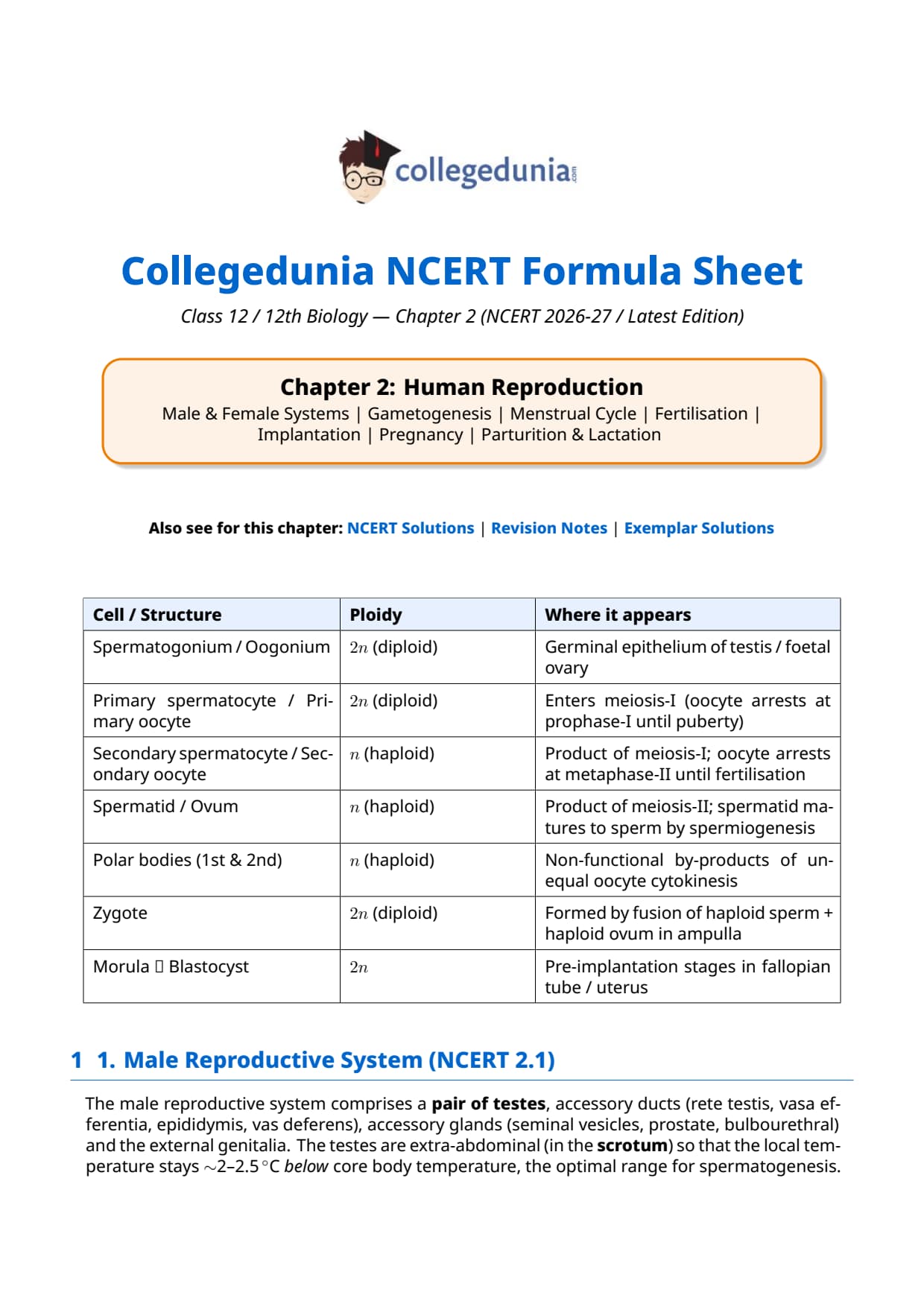
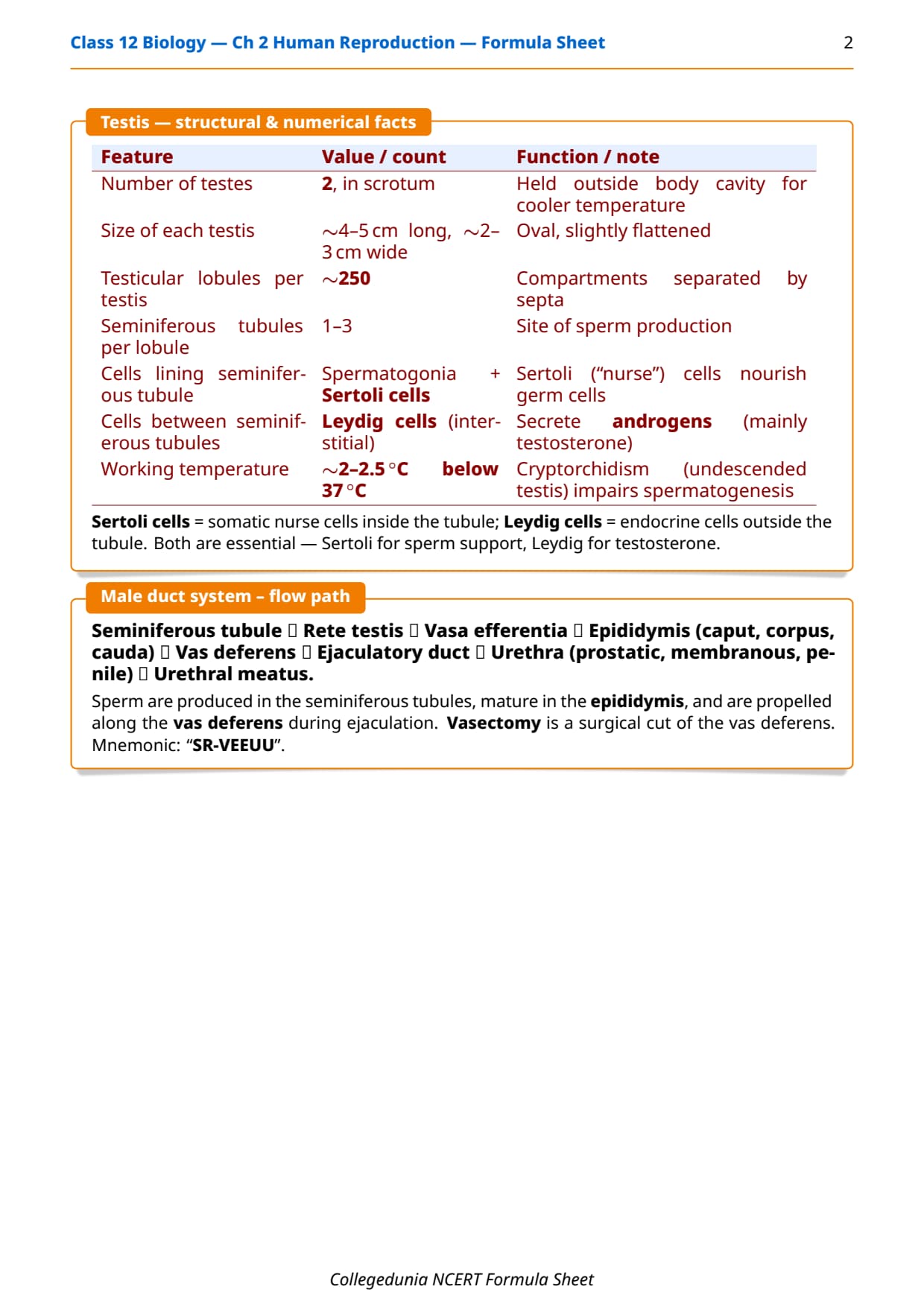
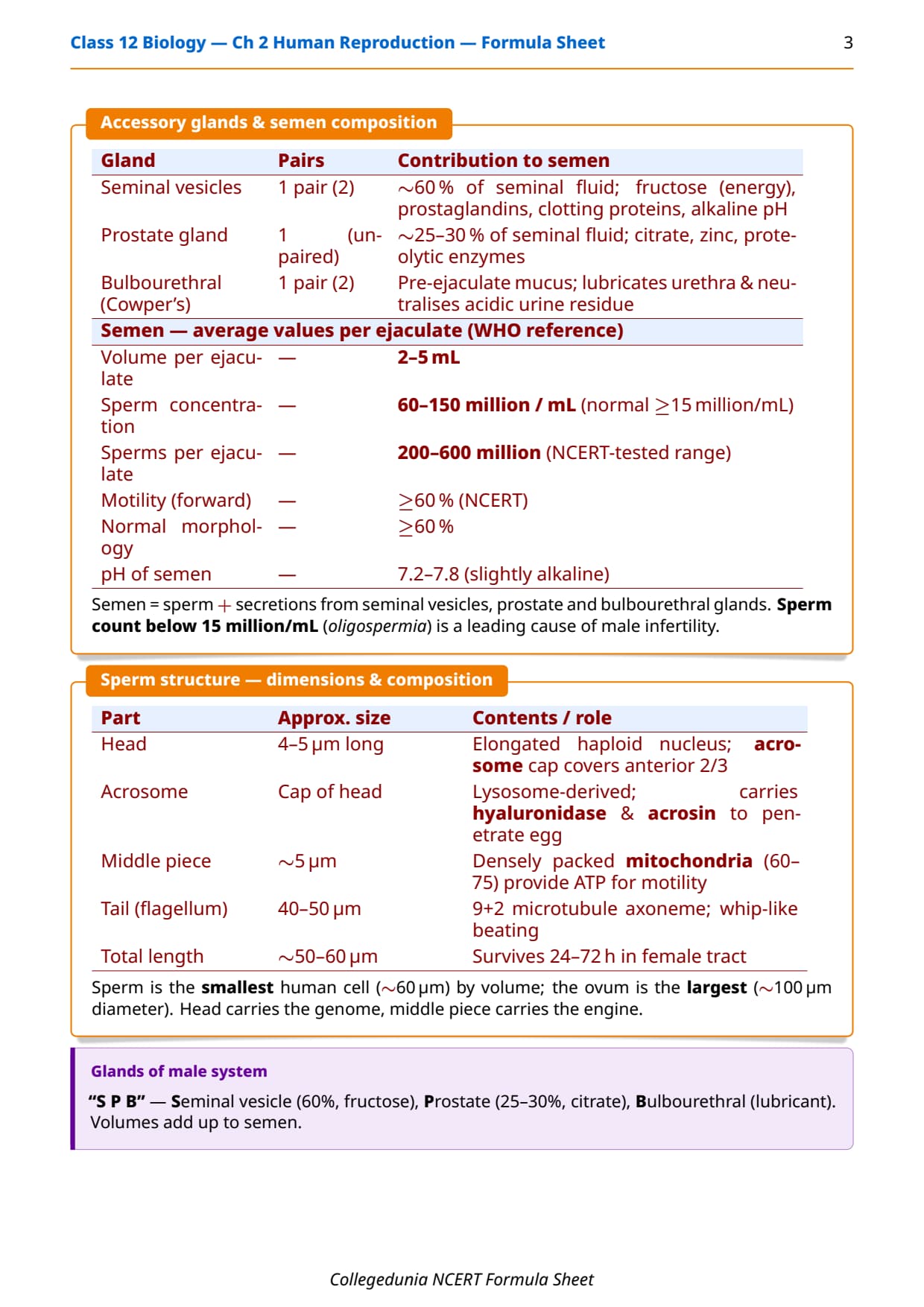
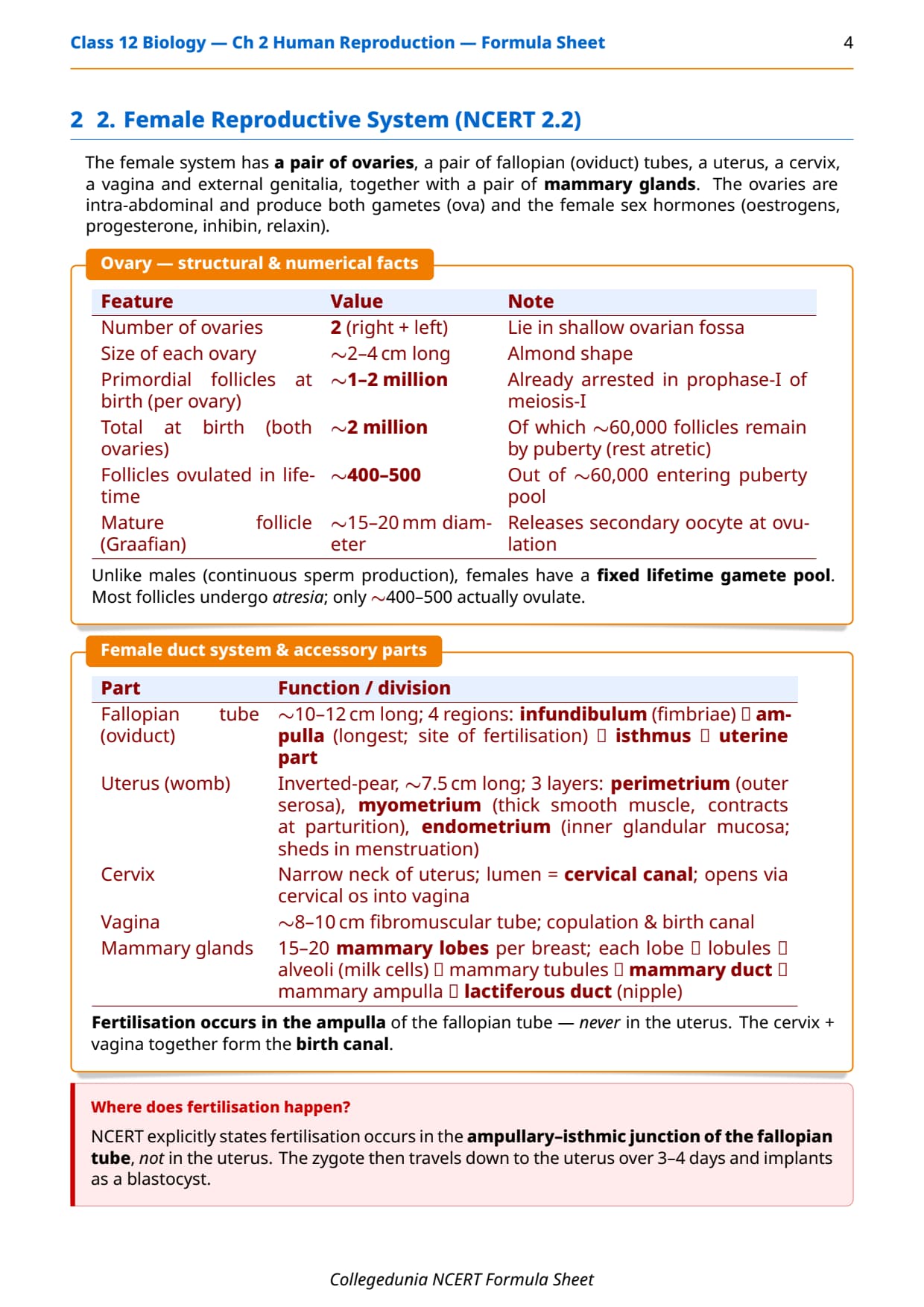

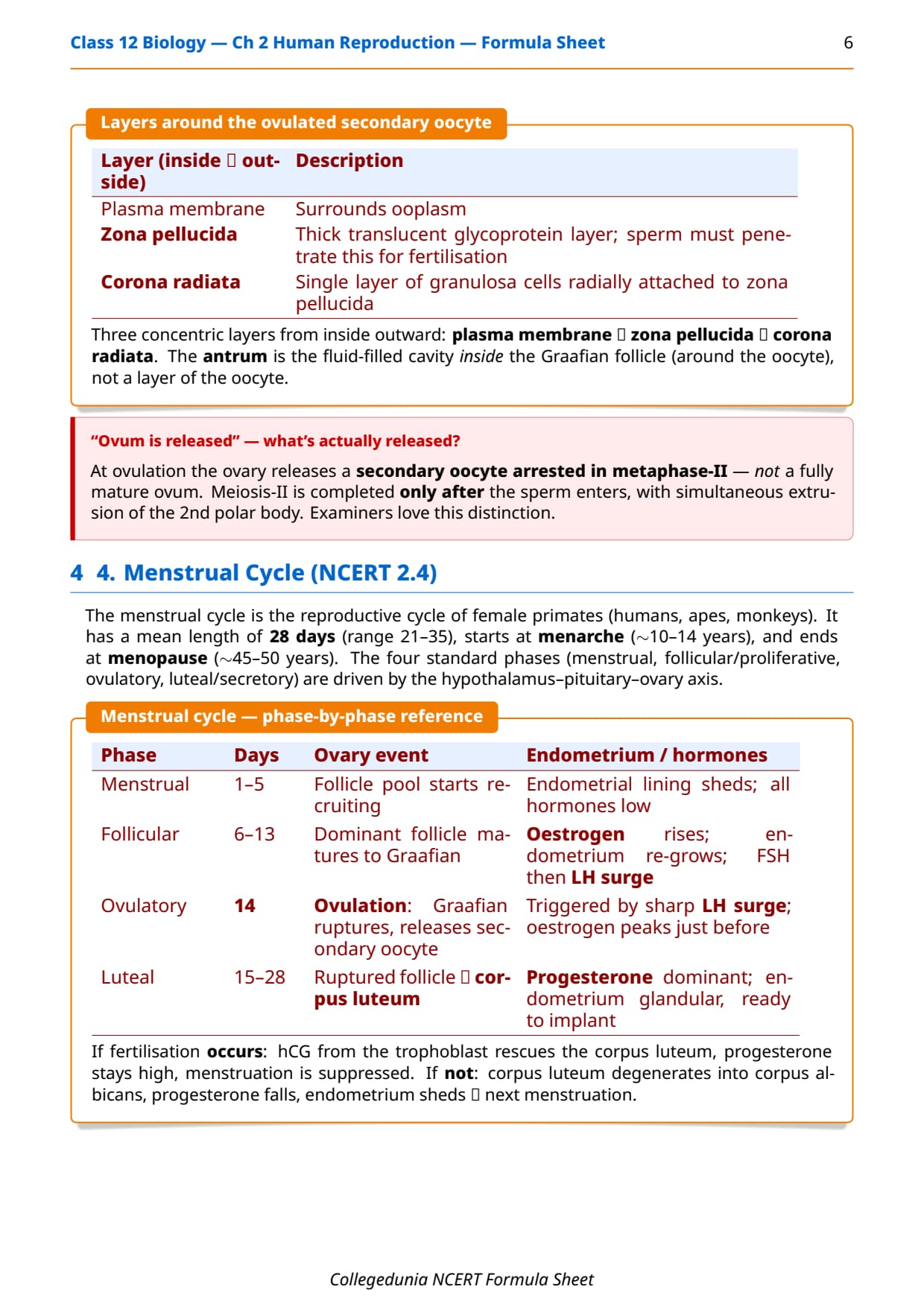
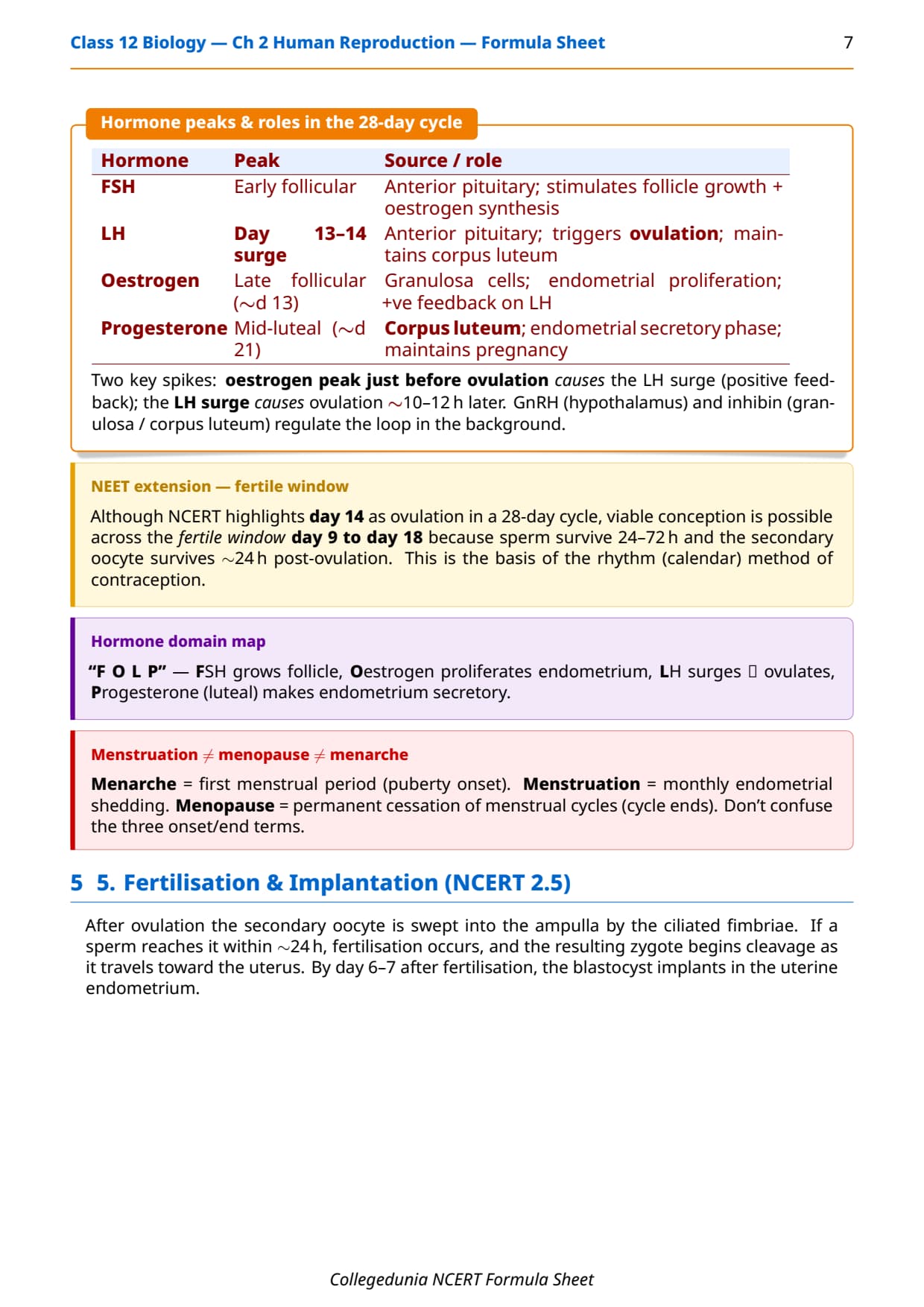
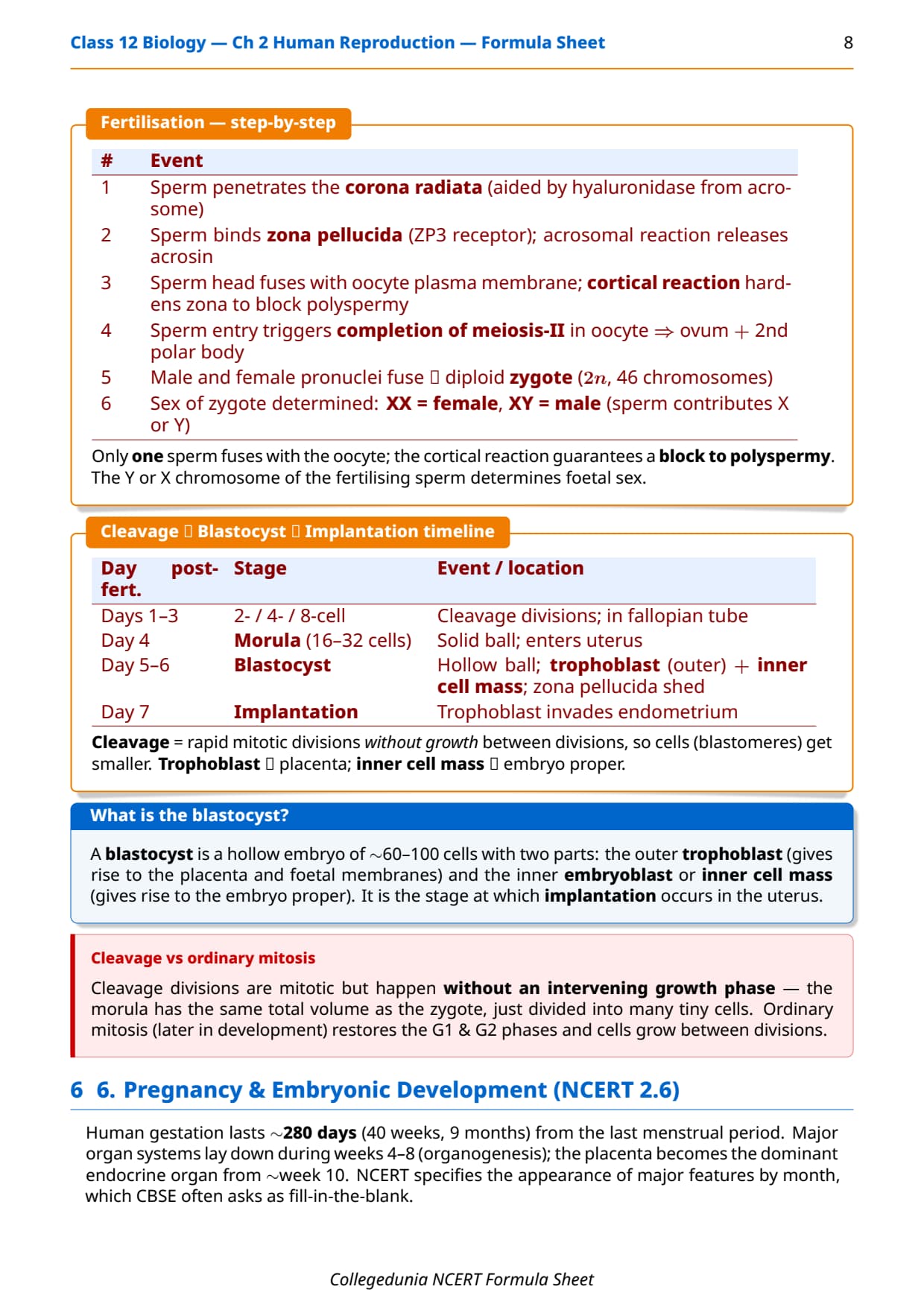
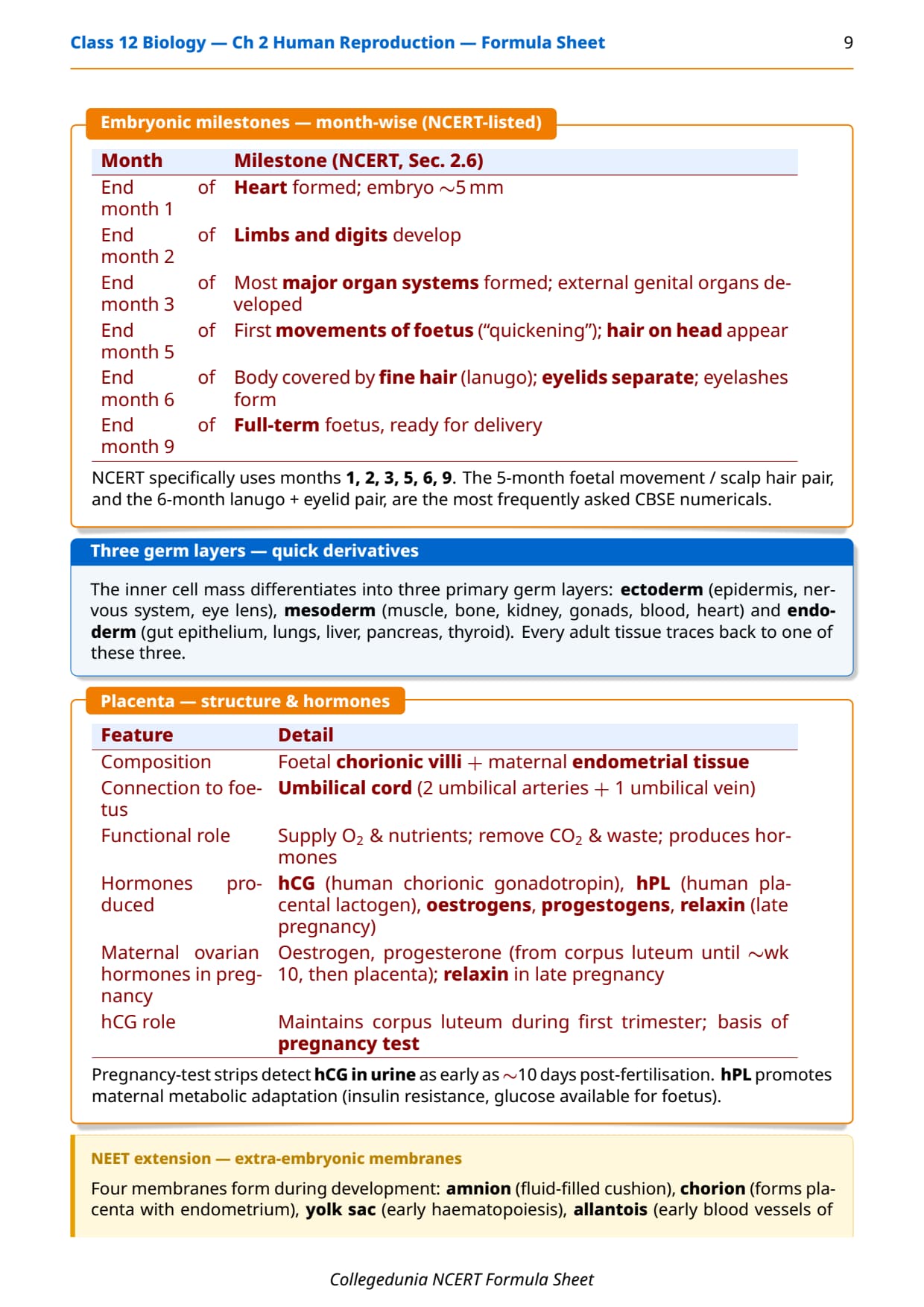
- CBSE Weightage: 6 to 8 marks (Unit Reproduction)
- NEET Weightage: 3 to 4 questions per year (consistent recall block)
Human Reproduction Video Lecture for Class 12 Biology
Source: Magnet Brains on YouTube
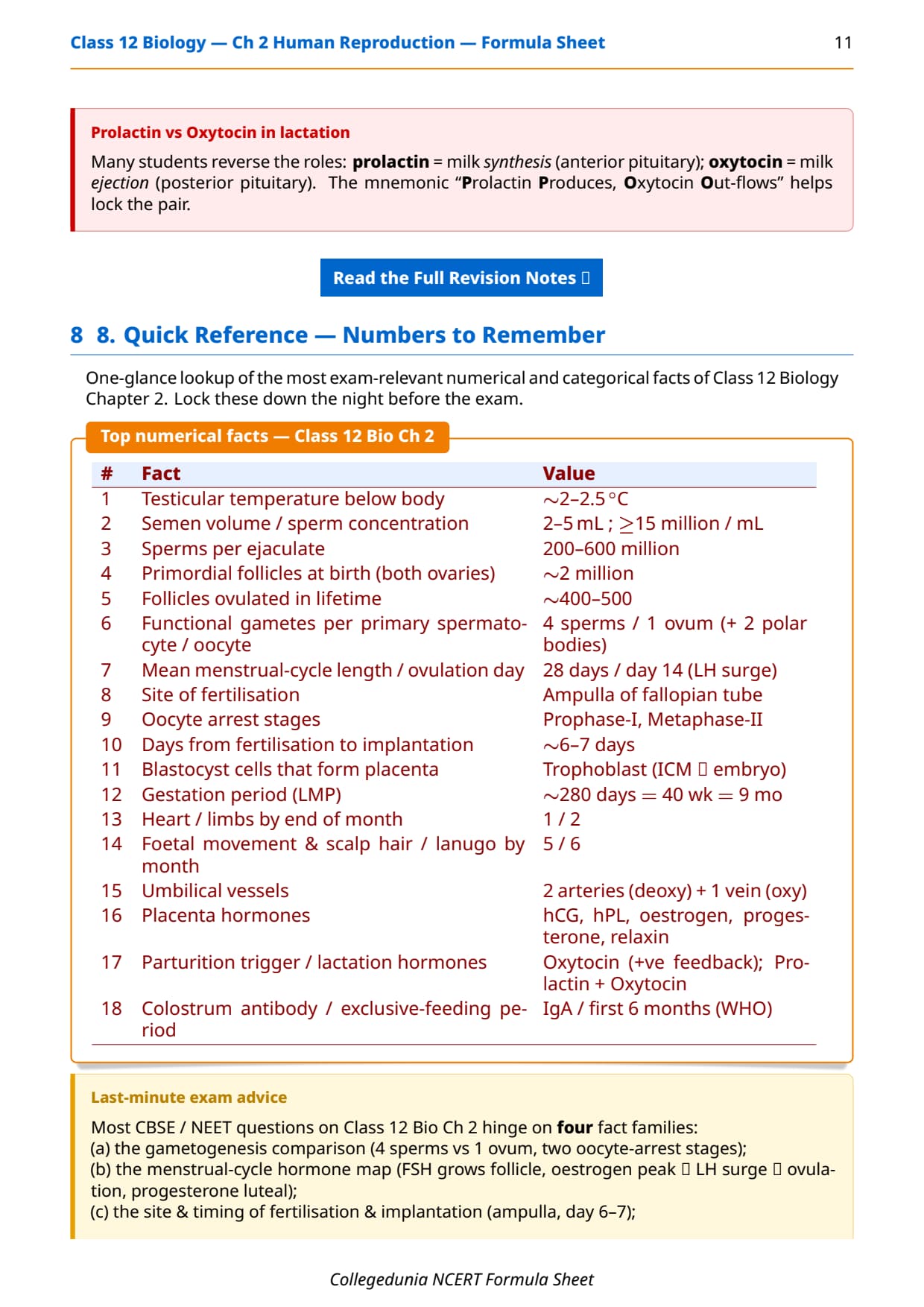
All Formulas and Numerical Facts of Human Reproduction at a Glance
The table below collapses every count, ploidy value, hormone, and duration from NCERT Sections 2.1 to 2.5 into one quick-lookup reference.
| Concept | Value / Formula | Units | NCERT section |
|---|---|---|---|
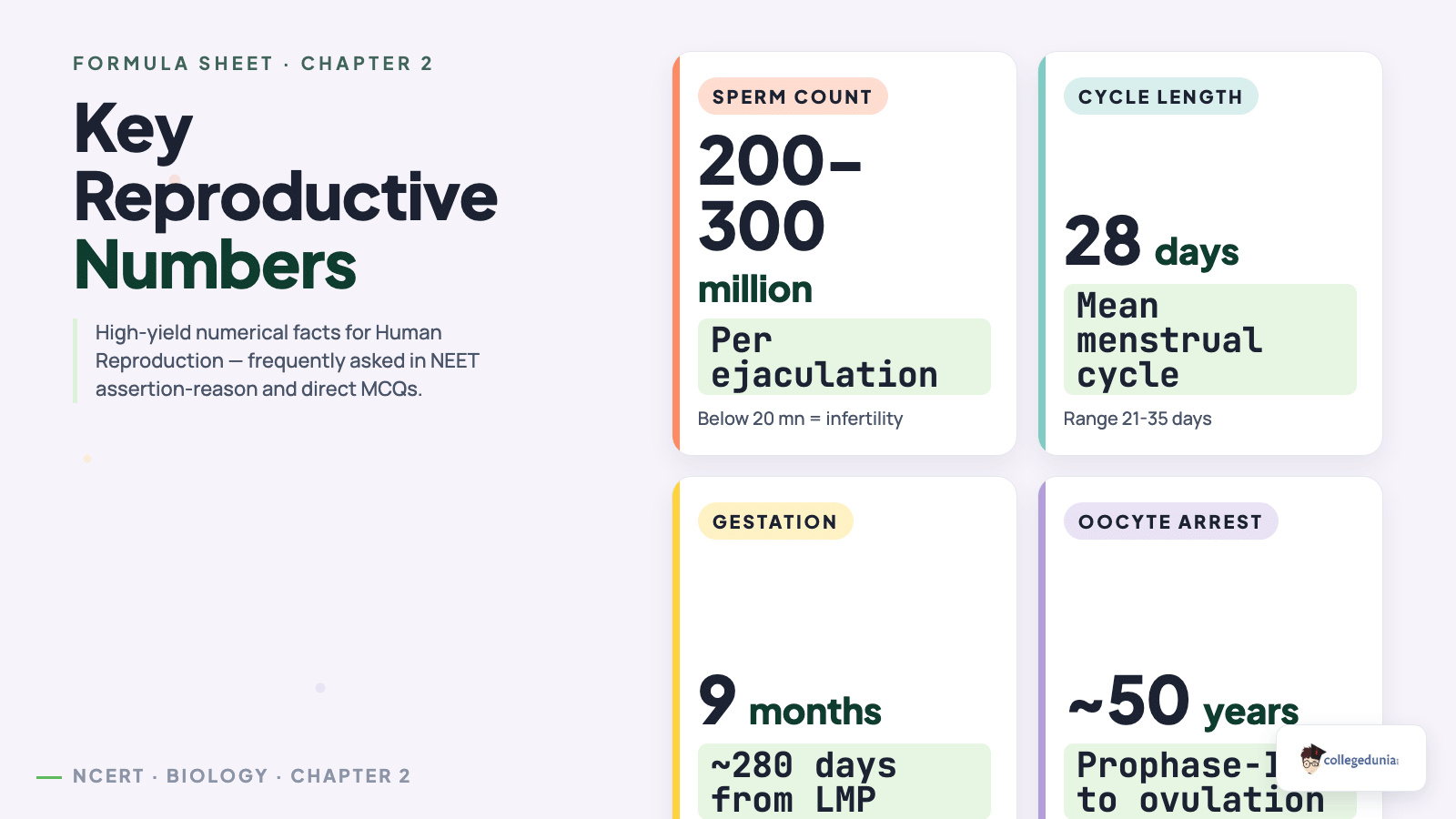
| Sperm count per ejaculation | 200 to 300 million | sperms / ejaculate | 2.4 |
| Normal fertility threshold | ≥ 60% motile, ≥ 60% normal morphology | % | 2.4 |
| Spermatogenesis output | 1 spermatogonium (2n) → 4 sperms (n) | cells | 2.3 |
| Oogenesis output | 1 oogonium (2n) → 1 ovum (n) + 3 polar bodies | cells | 2.3 |
| Primary oocytes at birth | About 2 million (2 × 10⁶) | per ovary pair | 2.3 |
| Menstrual cycle / ovulation day | 28-day cycle; ovulation on day 14 | days | 2.5 |
| Gestation period | About 9 months (40 weeks) | weeks | 2.7 |
| Zygote ploidy | 2n (46 chromosomes) | chromosomes | 2.6 |
| Morula at uterus entry | 8 to 16 cells | cells | 2.6 |
| Blastocyst implantation | Day 6 to 7 post-fertilisation | days | 2.6 |
| Placenta endocrine output | hCG, hPL, oestrogen, progestogens, relaxin | hormones | 2.6 |
| First foetal movement / hair | End of fifth month | month | 2.7 |
The 200 to 300 million sperm count and the 1:4 vs 1:1 output ratio are the two most-repeated NEET single-line stems.
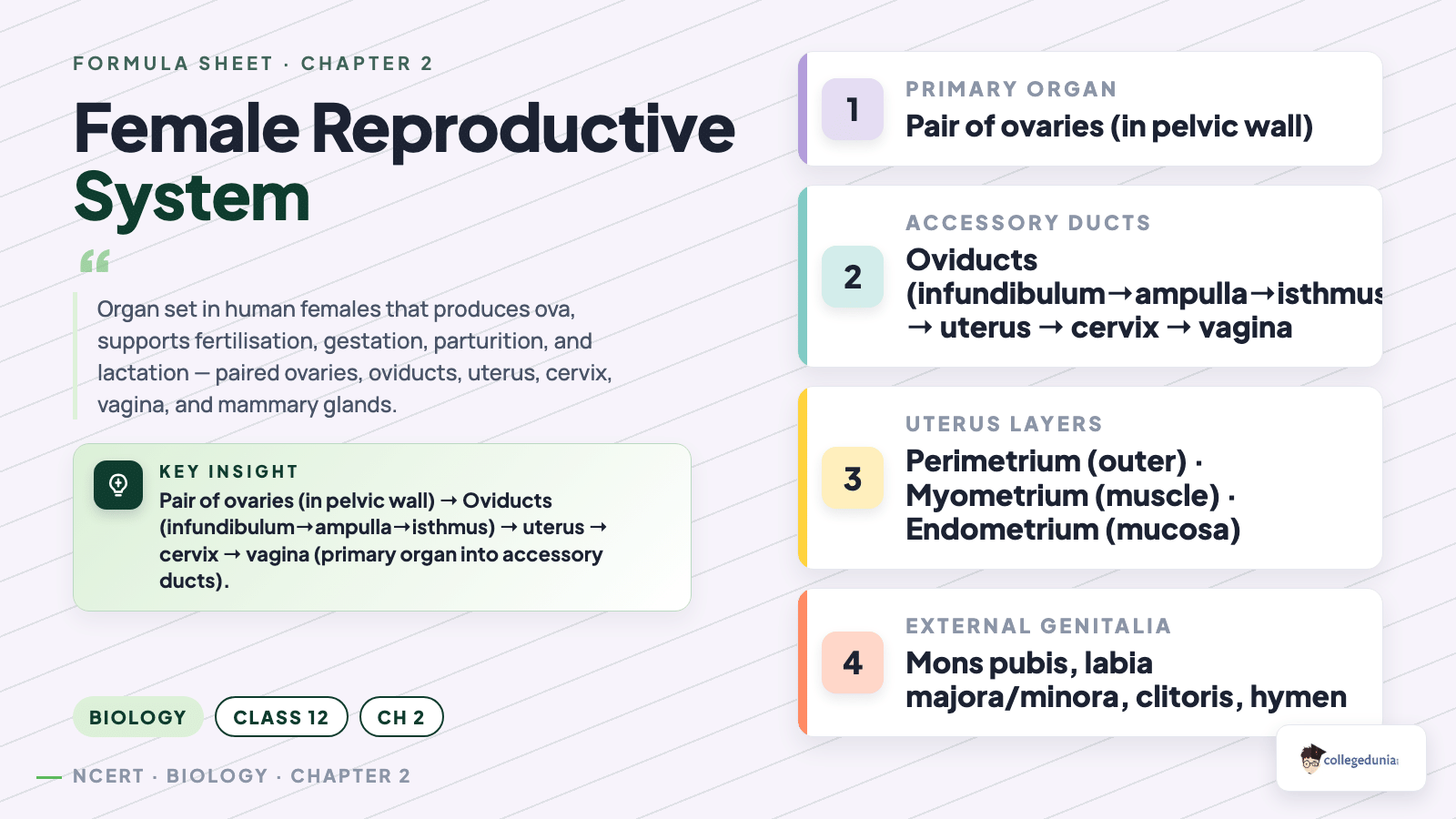
Spermatogenesis vs Oogenesis Comparison Card for Class 12 Biology
The two gametogenesis tracks share a meiosis step but differ in product survival, timing, and cytoplasm allocation.
Oogenesis (ovary, begins in foetal life, paused at prophase-I, completes at fertilisation): oogonium (2n) → mitosis (foetal only) → primary oocyte (2n, arrested) → meiosis-I at puberty → 1 secondary oocyte (n) + 1 polar body → meiosis-II at fertilisation → 1 ovum (n) + 2 more polar bodies. Net: 1 viable ovum per cycle.
Spermatogenesis runs continuously and yields hundreds of millions of sperms per ejaculate. Only one ovum matures per menstrual cycle. This asymmetry is the basis of every "compare male and female gamete formation" 3-mark CBSE question.
When to Use Which Hormone in Human Reproduction
Hormones are the highest-yield fact set in this chapter. Use the decision tree below to pick the right hormone from any stem keyword.
If the stem mentions ovulation or corpus luteum formation: LH surge on day 14. Triggers rupture of the Graafian follicle.
If the stem mentions endometrium thickening or pregnancy maintenance: progesterone from corpus luteum (then placenta after week 12).
If the stem mentions urine-based pregnancy test: hCG (human chorionic gonadotropin), placental.
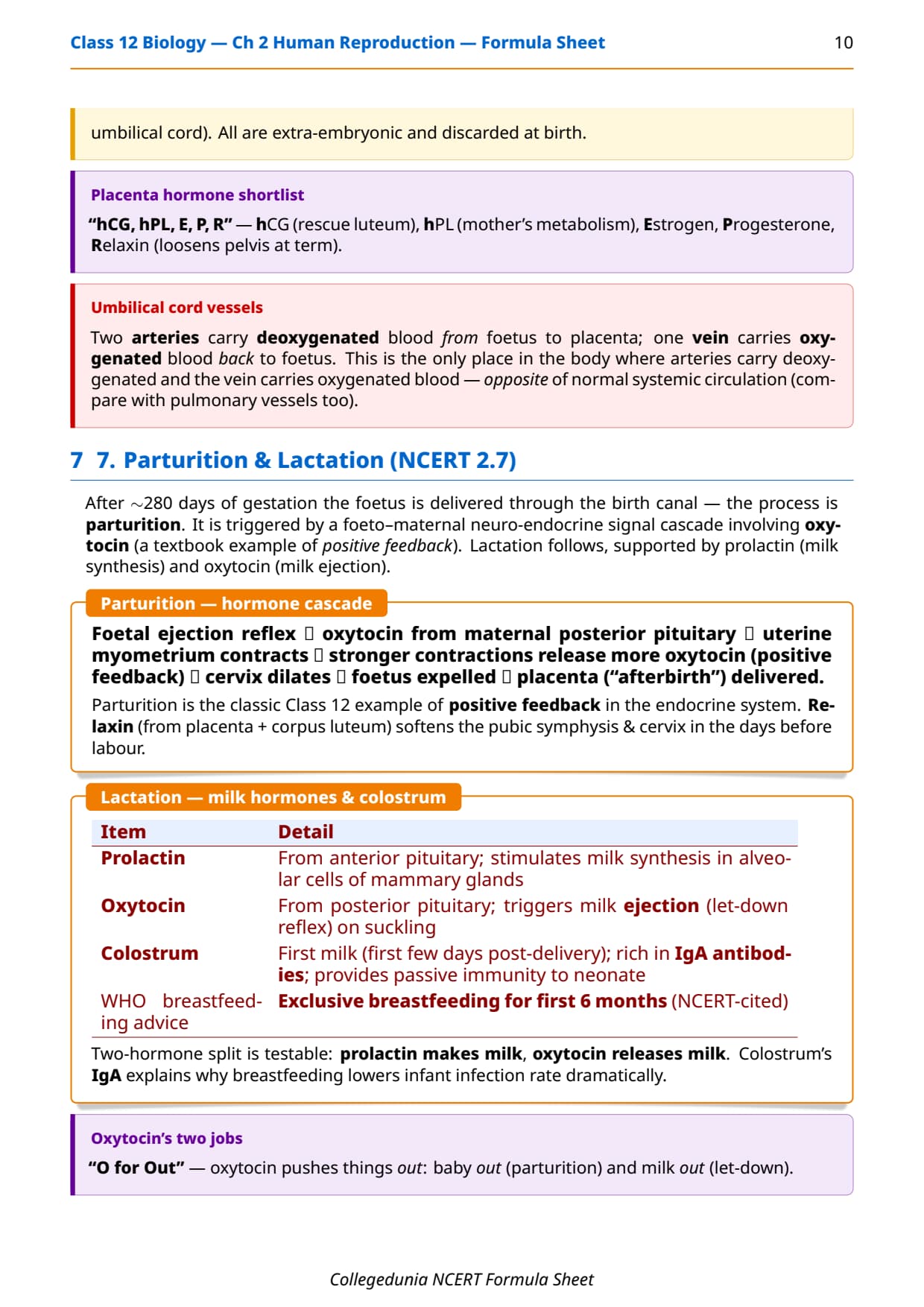
If the stem mentions milk ejection during suckling: oxytocin from posterior pituitary (also drives parturition contractions).
If the stem mentions milk production after parturition: prolactin from anterior pituitary.
If the stem mentions male secondary sexual characters: testosterone from Leydig cells under LH.
These seven decisions cover roughly 90% of every endocrinology-of-reproduction MCQ in the last five NEET papers.
Human Reproduction Menstrual Cycle Timeline Card for NEET Class 12 Biology
The 28-day cycle is the most-asked diagram in this chapter. Match each phase with its dominant hormone and the event inside the ovary or uterus.
| Days | Phase | Dominant hormone | Ovary / uterus event |
|---|---|---|---|
| 1 to 5 | Menstrual | FSH rising | Endometrial shedding; menstrual flow of 50 to 80 mL |
| 6 to 13 | Follicular / proliferative | FSH, oestrogen | Primary follicle → Graafian follicle; endometrium rebuilds |
| 14 | Ovulation | LH surge | Graafian follicle ruptures; secondary oocyte released |
| 15 to 28 | Luteal / secretory | Progesterone | Corpus luteum secretes; endometrium glandular and vascular |
| If no fertilisation | Cycle restarts | Progesterone falls | Corpus luteum regresses; menstruation begins |
Cycle starts at menarche (10 to 14 years) and stops at menopause (around 50 years). The LH surge on day 14, not the FSH rise, is what physically ruptures the follicle.
How Collegedunia's Human Reproduction Formula Sheet Helps for NEET 2027
- Every hormone is tagged with its source organ and trigger event, so FSH and hCG never get swapped.
- Spermatogenesis and oogenesis are drawn as parallel ladders, mirroring NCERT Figure 2.10.
- Day-numbered menstrual cycle map locks the LH-surge-on-day-14 fact.
Fertilisation, Cleavage and Implantation Numerical Card for Class 12 Biology
Cell counts and ploidy values from fertilisation to implantation are tested by both NEET and CBSE every year.
Cleavage: zygote → 2 → 4 → 8 → 16-cell morula inside zona pellucida; mitotic without growth.
Blastocyst: trophoblast (outer) + inner cell mass.
Implantation: day 6 to 7; trophoblast secretes hCG to maintain corpus luteum.
The trophoblast and maternal uterine tissue form the placenta, fully functional by week 12 as the chief source of oestrogen and progesterone.
Pregnancy, Parturition and Lactation Snapshot for 12th Biology
The closing block of the chapter carries easy single-mark NEET questions on foetal milestones and the parturition reflex.
Parturition signal: foetal ejection reflex → oxytocin (posterior pituitary) → uterine contractions → cervical dilation → baby expelled, then placenta.
Lactation: colostrum (first milk, rich in IgA) gives newborn passive immunity. Prolactin maintains milk; oxytocin causes ejection on suckling.
Human Reproduction PYQ Recall Pattern Across CBSE and NEET
Five years of CBSE and NEET tell a clear story: this chapter is recall-tested through diagrams and hormone roles, not derivations.
| Year | NEET focus | CBSE Board focus | Sheet card |
|---|---|---|---|
| 2025 | LH surge day; sperm count threshold | Spermatogenesis vs oogenesis (5 marks) | Menstrual cycle; gametogenesis card |
| 2024 | Placental hormones (hCG); fertilisation site | Menstrual cycle labelled diagram (3 marks) | Hormone tree; menstrual map |
| 2023 | Sertoli vs Leydig roles | Implantation and placentation (5 marks) | Anatomy card; fertilisation card |
| 2022 | Foetal month milestones; ploidy of polar bodies | Parturition (3 marks) | Foetal milestone box; oogenesis card |
| 2021 | Corpus luteum role; oxytocin function | Male reproductive system diagram (5 marks) | Hormone tree; anatomy card |
Student Feedback on Chapter 2 Human Reproduction Class 12 Biology
Student Feedback
In a recent survey of 14,500 Class 12 Biology students, 75% rated the menstrual cycle hormone-graph as the hardest sub-topic, even though it carries the highest marks in CBSE and NEET papers.
- 75% of students surveyed marked the menstrual cycle hormone-graph as the hardest sub-topic.
- 68% reported losing 1-2 marks on spermatogenesis vs oogenesis, even when the rest of their answer was correct.
- 4 out of 5 students said the LH/FSH hormonal-control flowchart was the most-skipped figure in their answer sheet.
- Average student took 6.2 hours for the first read and 2.7 hours for a focused revision pass before boards.
Source: 2025-26 Class 12 Biology student survey. Sample of 14,500 students from CBSE-affiliated schools across 18 states.
Other Resources for Human Reproduction Class 12 Biology
| Resource | Link |
|---|---|
| Formula Sheet | Human Reproduction Formula Sheet |
| NCERT Solutions | Human Reproduction NCERT Solutions |
| Notes | Human Reproduction Class 12 Notes |
| Handwritten Notes | Human Reproduction Handwritten Notes |
| Exemplar Solutions | Human Reproduction Exemplar Solutions |
| NCERT Book PDF | Human Reproduction NCERT Book PDF |
| Exemplar Book PDF | Human Reproduction NCERT Exemplar Book PDF |
Class 12 Biology Formula Sheet: All Chapters
| Chapter | Resource |
|---|---|
| Chapter 1 | Sexual Reproduction in Flowering Plants Formula Sheet |
| Chapter 2 | Human Reproduction Formula Sheet |
| Chapter 3 | Reproductive Health Formula Sheet |
| Chapter 4 | Principles of Inheritance and Variation Formula Sheet |
| Chapter 5 | Molecular Basis of Inheritance Formula Sheet |
| Chapter 6 | Evolution Formula Sheet |
| Chapter 7 | Human Health and Disease Formula Sheet |
| Chapter 8 | Microbes in Human Welfare Formula Sheet |
| Chapter 9 | Biotechnology Principles and Processes Formula Sheet |
| Chapter 10 | Biotechnology and Its Applications Formula Sheet |
| Chapter 11 | Organisms and Populations Formula Sheet |
| Chapter 12 | Ecosystem Formula Sheet |
| Chapter 13 | Biodiversity and Conservation Formula Sheet |
Human Reproduction Class 12 Biology Formula Sheet FAQs
What is the ploidy of the zygote in Class 12 Biology Chapter 2 Human Reproduction?
What is the difference between spermatogenesis and oogenesis in Class 12 Biology?
On which day of the menstrual cycle does ovulation occur and which hormone triggers it?
What is the role of human chorionic gonadotropin (hCG) in pregnancy?
Where does fertilisation occur in the female reproductive tract?
What are Sertoli and Leydig cells in the male reproductive system?
What is colostrum and why is it important for the newborn?
How many marks does Human Reproduction carry in CBSE Class 12 Biology?



Comments