




Sexual Reproduction in Flowering Plants carries 6 to 8 marks in CBSE Class 12 Biology and 3 to 5 questions in NEET every year. This chapter is fact-heavy, covering ploidy values, double fertilisation, embryo sac structure, and pollination types. Download the free Formula Sheet PDF on this page for a fast, single-pass revision before your exam.

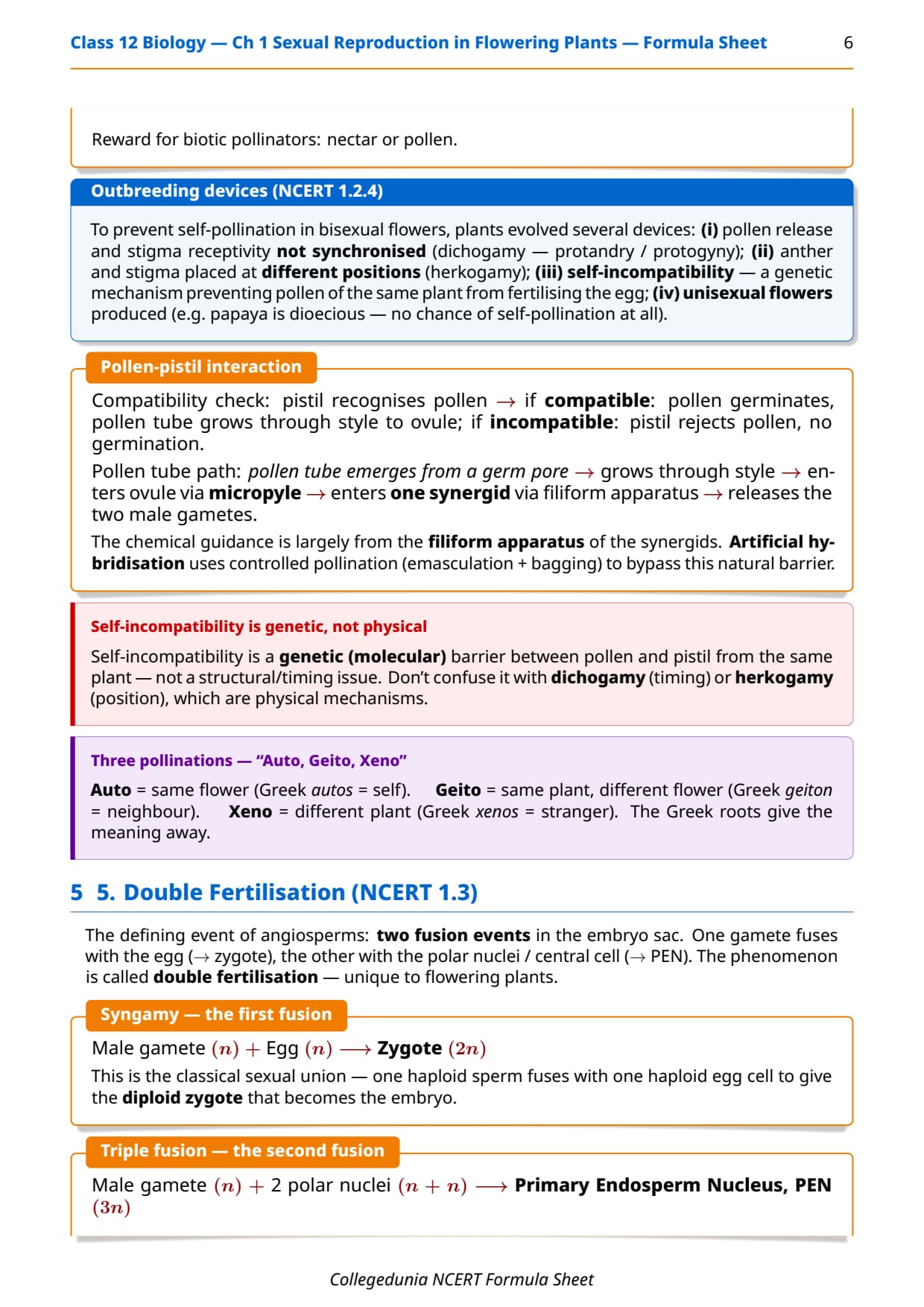
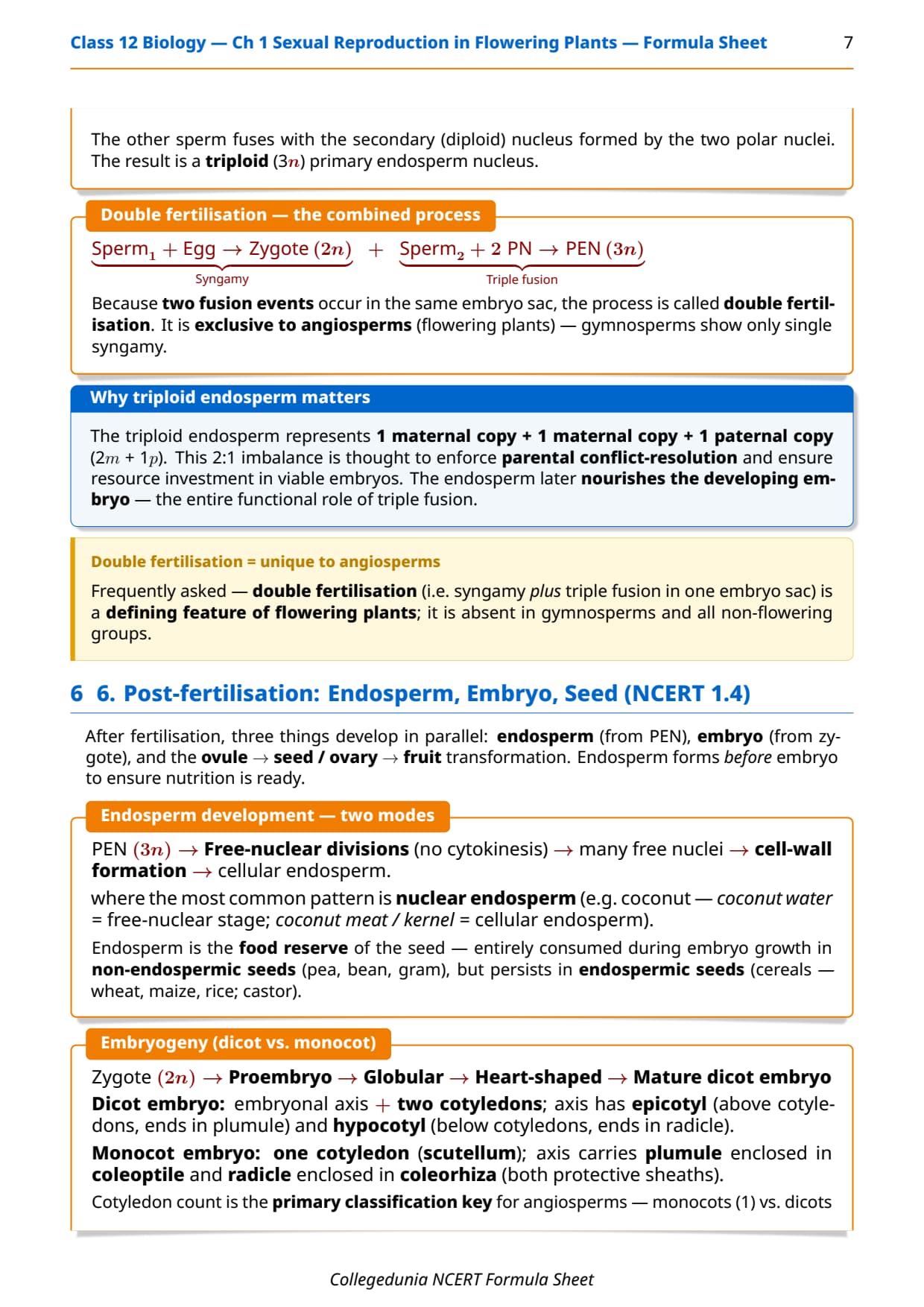
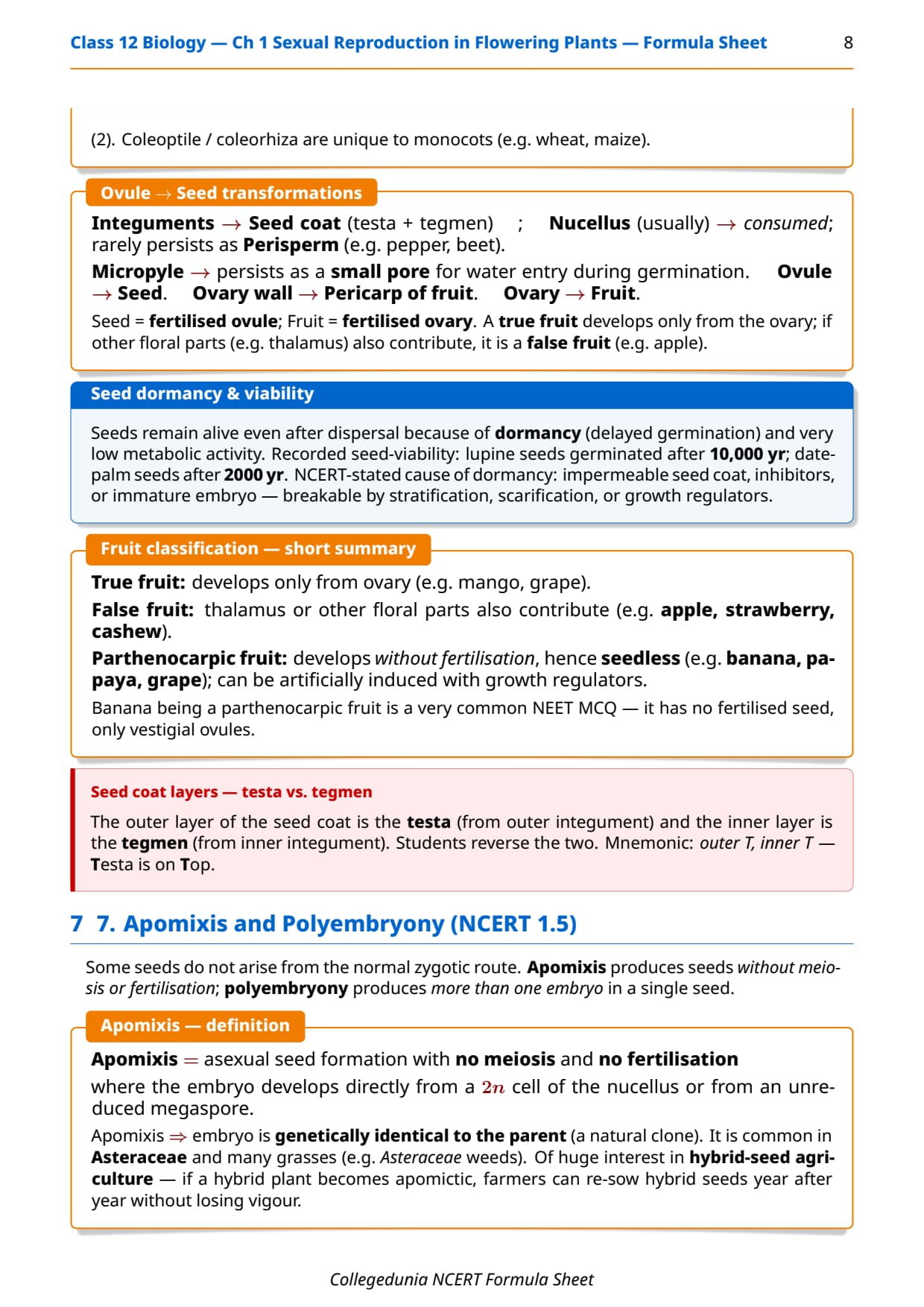
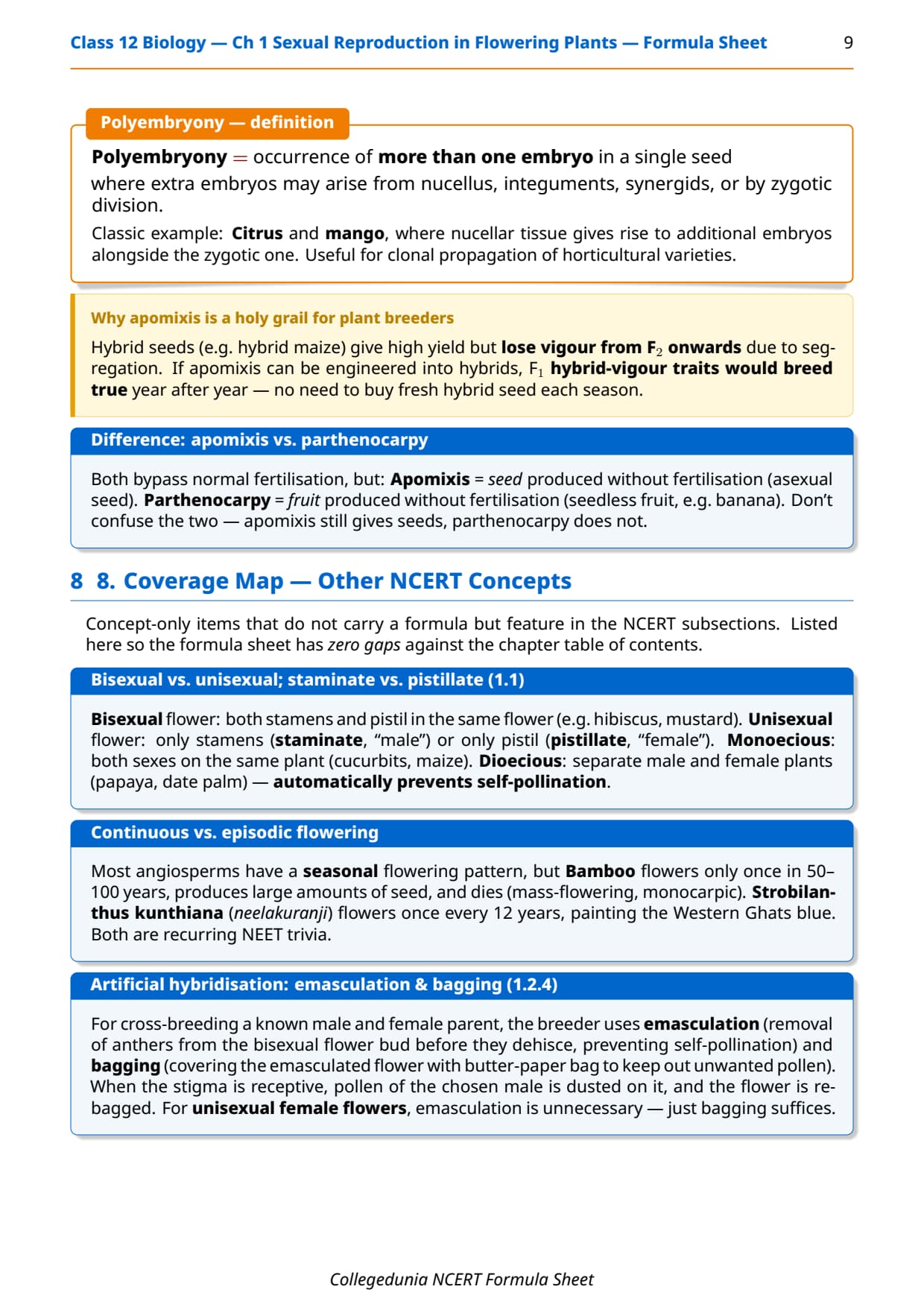
- CBSE Weightage: 6 to 8 marks (Unit Reproduction)
- NEET Weightage: 3 to 5 questions per year (highest in the reproduction unit)
- JEE Main Weightage: Not applicable (Biology is outside the JEE Main syllabus)

How Collegedunia's Sexual Reproduction in Flowering Plants Formula Sheet Helps for NEET 2027
This chapter is fact-heavy, not derivation-heavy. The Collegedunia sheet compresses the entire 2026-27 NCERT chapter into one pass so a final sweep takes under twenty minutes.
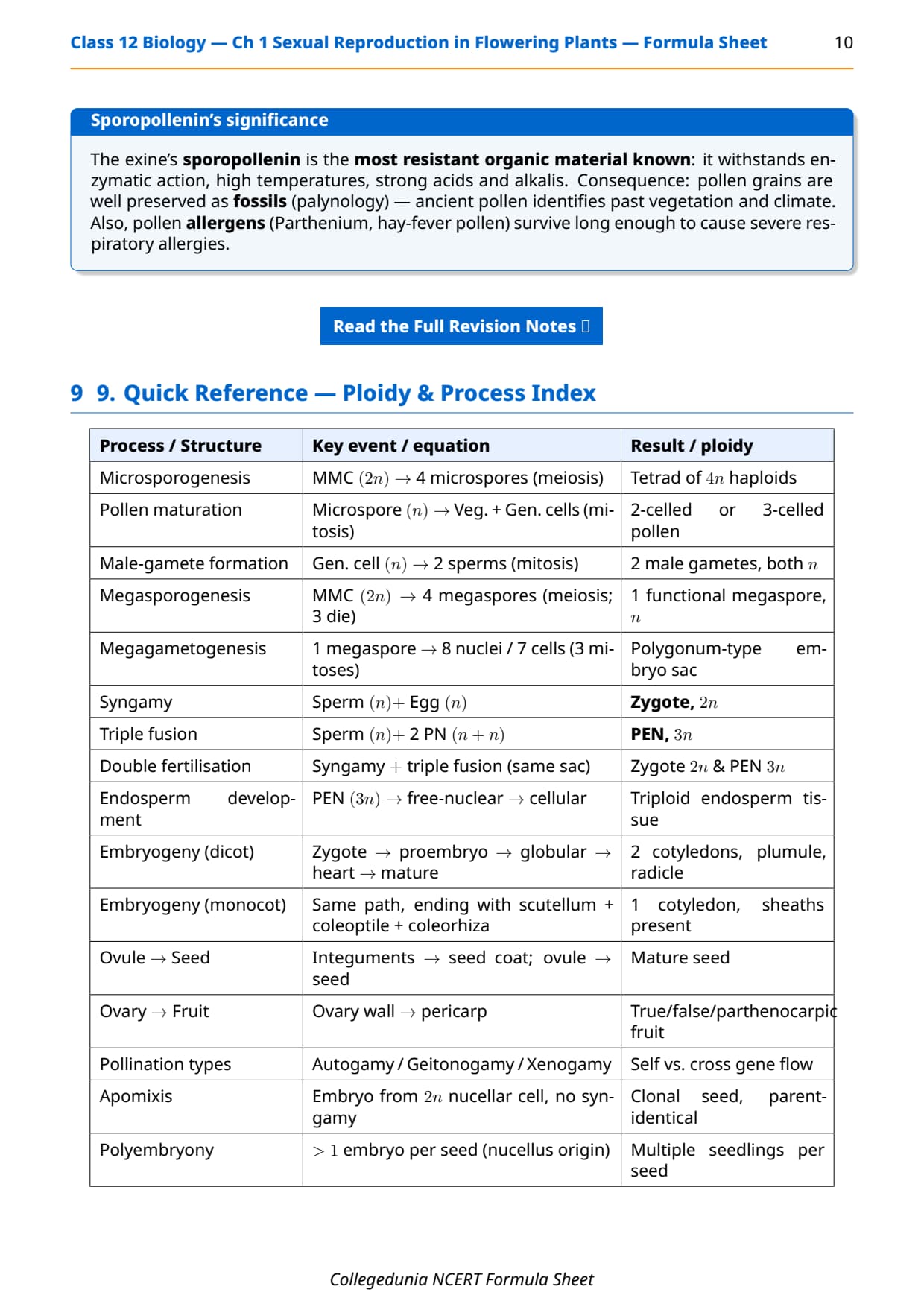
- Every ploidy value (n, 2n, 3n) sits next to its parent structure, so MMC (2n) vs megaspore (n) and PEN (3n) vs zygote (2n) never get confused.
- Embryo-sac development is shown as a numbered ladder of mitotic divisions, mirroring NCERT Figure 1.6.
- Named exceptions (Trapa, Najas, Yucca, Pinus, Capsella) are tagged with the rule each breaks.
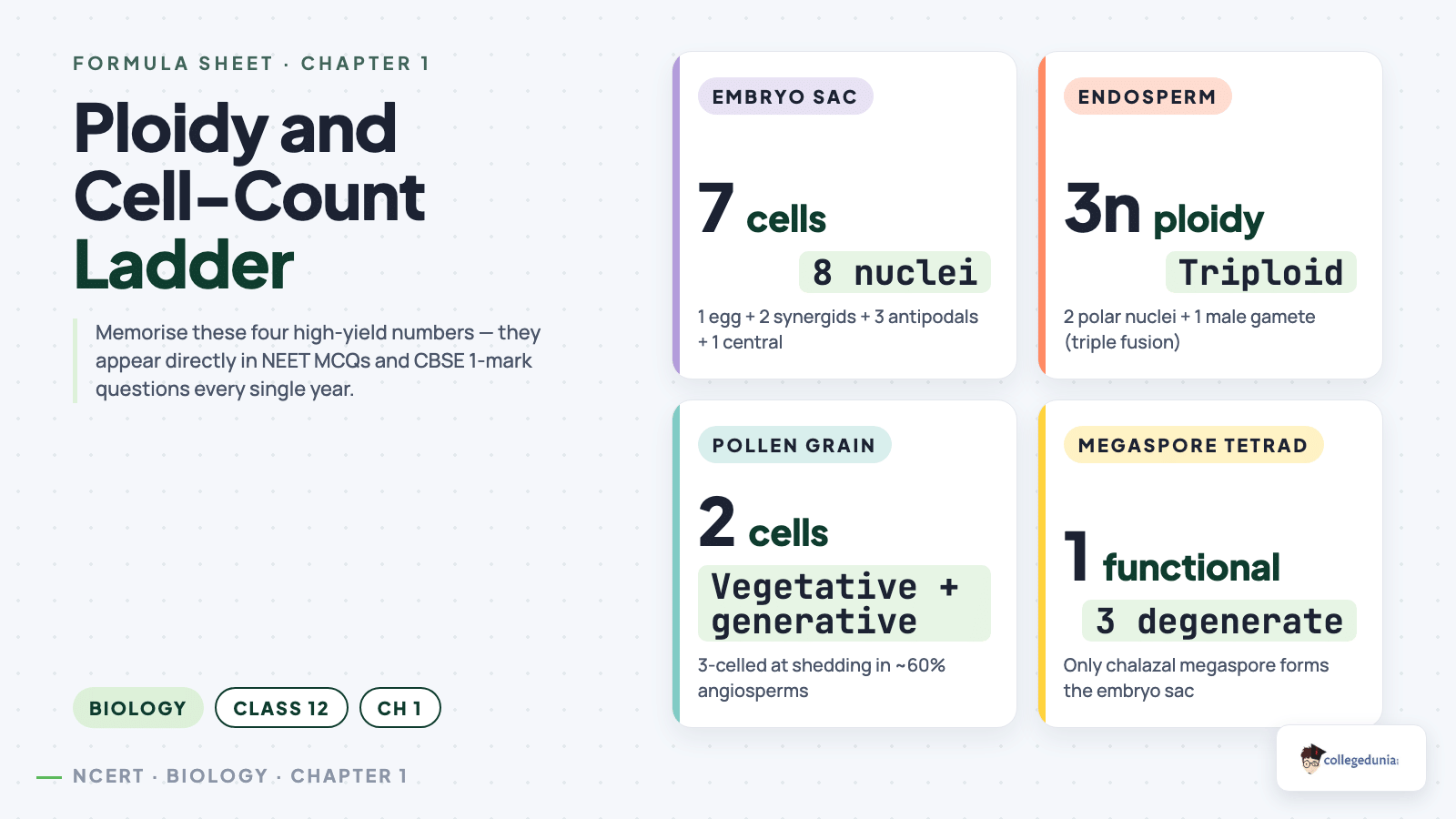
Ploidy Ladder and Cell Count Reference for Class 12 Biology Sexual Reproduction
The ploidy ladder is the single highest-yield card in this chapter. NEET and CBSE both use it for 1-mark MCQs and for the 3-mark "write the ploidy of the following structures" sweep.
| Structure | Ploidy | Originates from |
|---|---|---|
| Anther wall, nucellus, integuments | 2n | Sporophyte tissue |
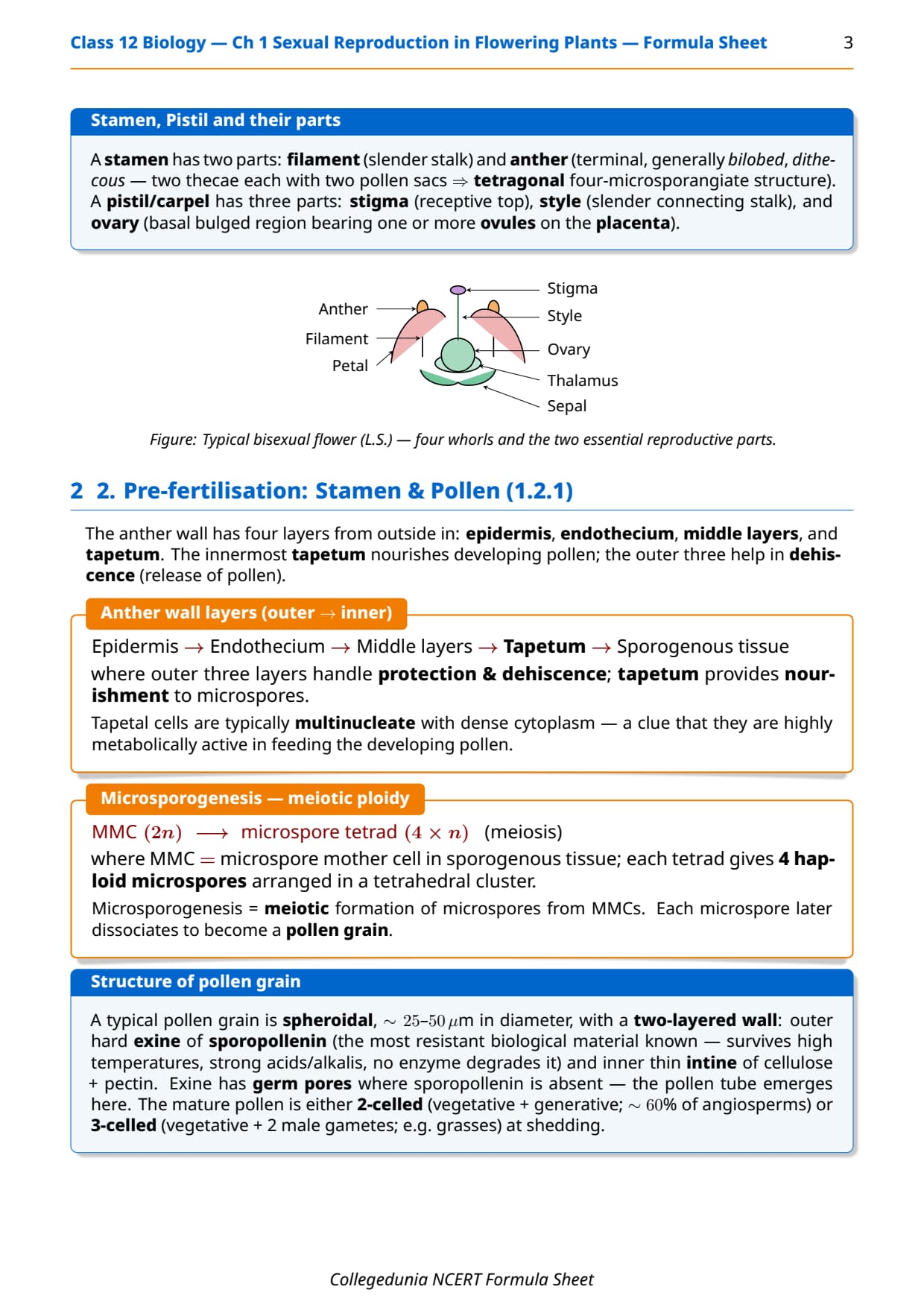
| Microspore / megaspore mother cell | 2n | Sporogenous tissue |
| Microspore, functional megaspore, male gamete, egg, synergid, antipodal, polar nucleus | n | Meiosis or post-meiosis mitoses |
| Zygote, embryo, seed coat, perisperm | 2n | Syngamy / nucellus / integument |
| Primary endosperm nucleus (PEN), endosperm tissue | 3n | Triple fusion (2 polar + 1 male) |
Around 40% of all NEET MCQs from this chapter test exactly these ploidy values in some form. Memorise this table before moving on.
Microsporogenesis and Megasporogenesis Quick Card for Class 12 Biology
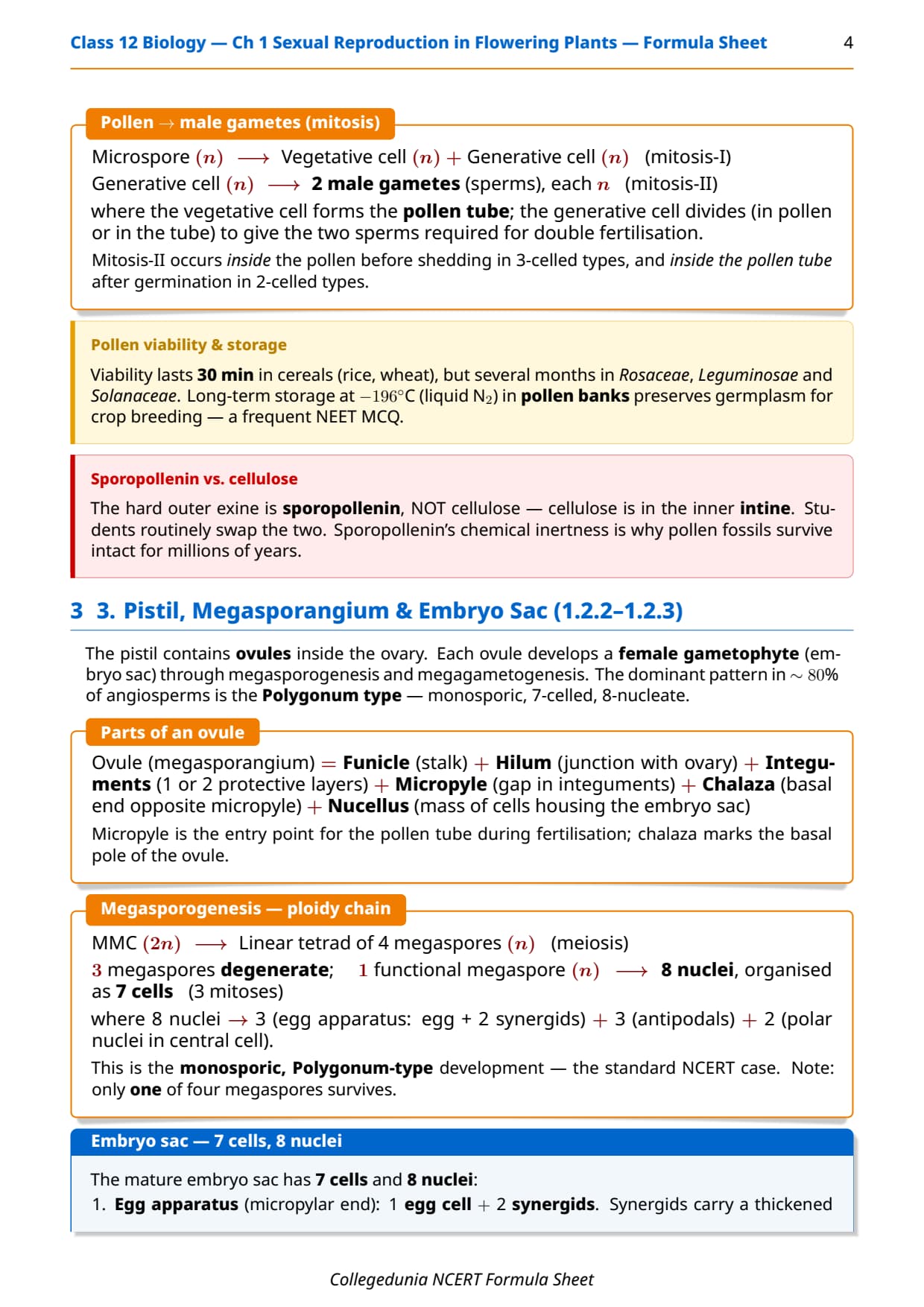
The two sporogenesis tracks share a meiosis step but differ in product survival. Pollen development gives 4 viable microspores; embryo-sac development gives 1 functional megaspore and 3 degenerating sisters.
Megasporogenesis (embryo sac): MMC (2n) → meiosis → linear tetrad of 4 megaspores (n) → 3 degenerate, 1 functional → 3 free-nuclear mitotic divisions → 8-nucleate, 7-celled Polygonum-type embryo sac (3 antipodals + 2 synergids + 1 egg + 1 central cell with 2 polar nuclei).
Sexual Reproduction in Flowering Plants Embryo Sac Map for CBSE Class 12
The 7-celled, 8-nucleate Polygonum-type embryo sac is the default angiosperm sac and the only one CBSE tests. This table is the labelled-diagram answer key for the recurring 3-mark Board question.
| Cell | Count | Ploidy | Role |
|---|---|---|---|
| Egg cell | 1 | n | Fuses with male gamete in syngamy → zygote (2n) |
| Synergids | 2 | n | Filiform apparatus guides pollen tube; degenerate after fertilisation |
| Polar nuclei (central cell) | 2 nuclei in 1 cell | n each | Fuse with the second male gamete in triple fusion → PEN (3n) |
| Antipodal cells | 3 | n | Nutritive; degenerate post-fertilisation |
| Total | 7 cells, 8 nuclei | - | Egg apparatus = egg + 2 synergids |
The egg apparatus sits at the micropylar end; the antipodals sit at the chalazal end; the central cell occupies the bulk of the sac. Filiform apparatus = NEET-favourite single-word answer.
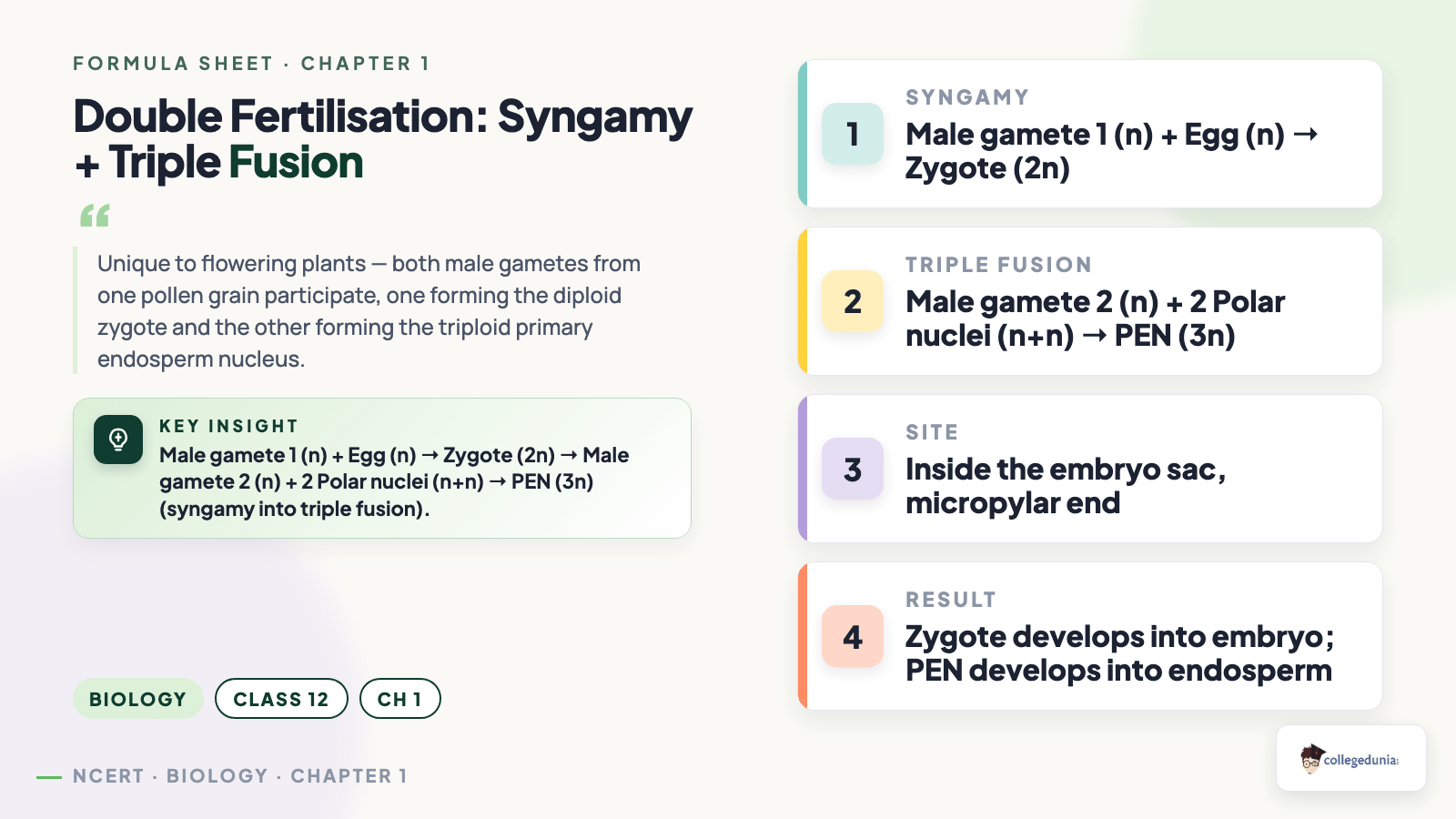
Double Fertilisation and Triple Fusion Numerical Card for NEET Class 12 Biology
Double fertilisation is unique to angiosperms and is the most asked diagram in CBSE Board Class 12 Biology. This card collapses both fusions so you never miscount ploidy on result day.
Triple fusion (second fusion): male gamete (n) + 2 polar nuclei (n + n) → primary endosperm nucleus, PEN (3n).
Net: 1 pollen tube delivers 2 male gametes. One forms the embryo (2n), one forms the endosperm (3n). The 3n endosperm nourishes the developing embryo.
NEET recall: "Double fertilisation = syngamy + triple fusion" was the exact MCQ stem in NEET 2025 and NEET 2022.
Endosperm types: nuclear (free-nuclear divisions first, walls later, e.g. coconut milk) is the commonest; cellular (walls from the start, e.g. Datura) is rarer; helobial (intermediate) is restricted to monocots like Helobiae.
Pollination Types and Outbreeding Devices Snapshot for Class 12 Biology
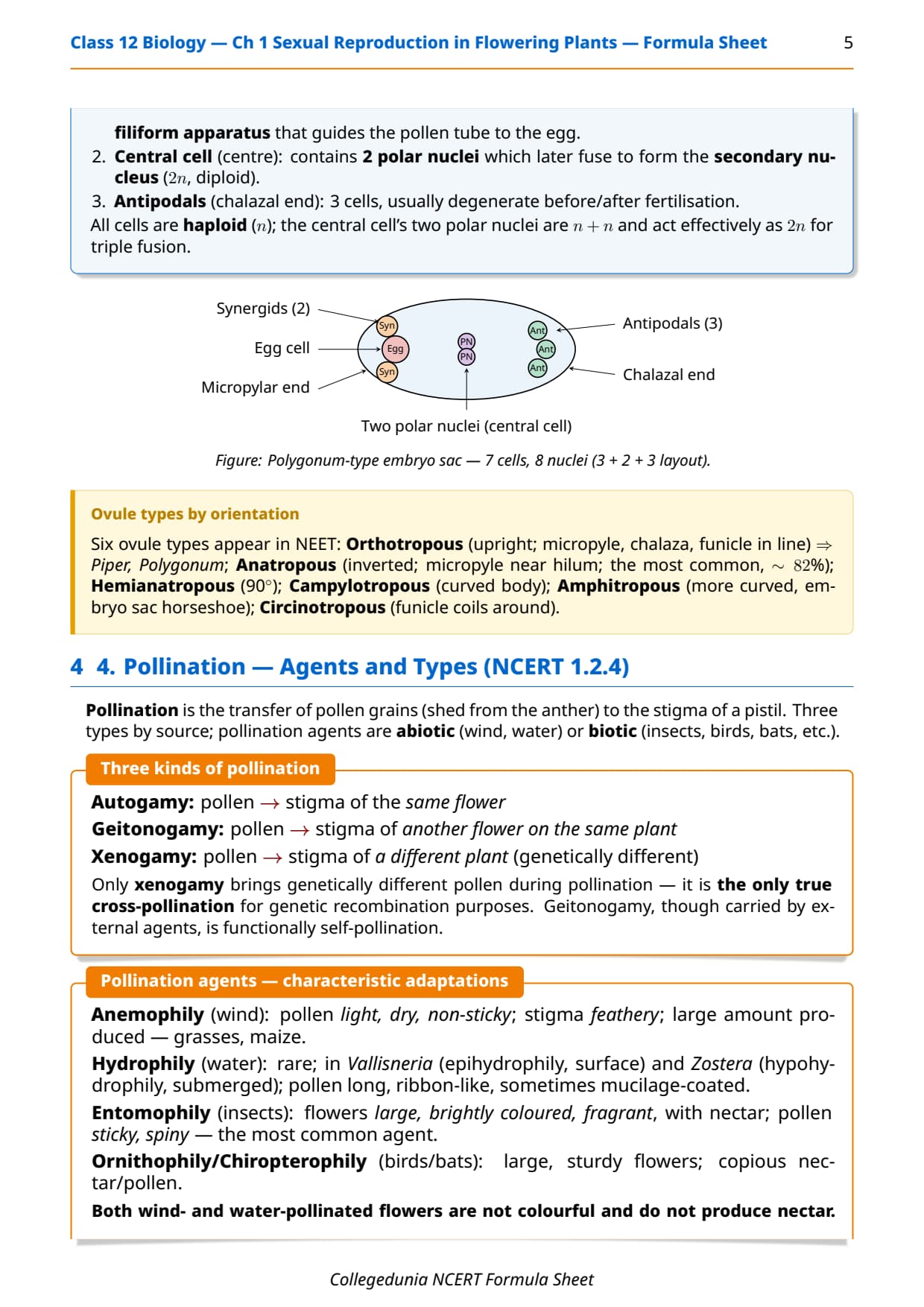
Pollination is a definition-heavy block. The table below pairs every type with the NEET-favourite example.
| Type | Agent | Marker example |
|---|---|---|
| Autogamy | Same flower | Viola, Oxalis (cleistogamy) |
| Geitonogamy | Same plant, different flowers | Maize, Cucurbits |
| Xenogamy | Different individual (true cross) | Vallisneria, Salvia |
| Anemophily / Hydrophily | Wind / Water | Maize; Vallisneria, Zostera |
| Entomophily / Ornithophily | Insects / Birds | Salvia, Yucca; Bombax |
Outbreeding devices: dichogamy (protandry / protogyny), herkogamy (spatial separation), self-incompatibility (genetic block), unisexuality. Yucca uses obligate moth Pronuba.
Apomixis, Polyembryony and Seed-Fruit Anatomy Quick Lookup for Class 12 Biology
The closing block of the chapter hides easy single-mark NEET questions. Apomixis vs polyembryony, parthenocarpy, and true vs false fruit are the three top stems.
Polyembryony: more than one embryo per seed (Citrus, mango).
Parthenocarpy: fruit without fertilisation; seedless (banana, grape).
True fruit: from ovary alone (mango). False fruit: ovary + accessory parts (apple, cashew). Geocarpic: underground (groundnut).
Sexual Reproduction in Flowering Plants Symbol and Term Glossary for Class 12 Biology
Single-word and abbreviation MCQs are easy points when the vocabulary is fluent. The glossary below maps every recurring symbol or short-form to its full meaning.
| Symbol / Term | Full form / meaning |
|---|---|
| MMC | Microspore / Megaspore Mother Cell (2n) |
| PEN / PEC | Primary Endosperm Nucleus (3n) / Primary Endosperm Cell |
| Filiform apparatus | Synergid wall projections; guide pollen tube |
| Sporopollenin | Most resistant organic biopolymer; exine of pollen wall |
| Tapetum | Innermost anther wall layer; nourishes microspores |
| Perisperm | Persistent diploid nucellus inside the seed (e.g. black pepper) |
Sexual Reproduction in Flowering Plants Class 12 Biology Video Explanation
Source: Magnet Brains on YouTube
Sexual Reproduction in Flowering Plants PYQ Recall Pattern Across CBSE and NEET
The last five years of CBSE Board and NEET show a clear pattern: this chapter is recall-tested, not derivation-tested. The table below maps what was asked and which sheet card covers it.
| Year | NEET focus | CBSE Board focus | Sheet card |
|---|---|---|---|
| 2025 | Double fertilisation MCQ; pollen wall layers | Embryo sac labelled diagram (3 marks) | Double-fert; Embryo sac map |
| 2024 | Apomixis vs polyembryony; pollination agents | Outbreeding devices (3 marks) | Apomixis box; Pollination table |
| 2023 | Microsporogenesis stages | Post-fertilisation events (5 marks) | Ploidy ladder; Microsporogenesis card |
| 2022 | Triple fusion stem (PEN ploidy) | Pollen-pistil interaction (3 marks) | Double-fert; Pollen card |
| 2021 | Apomixis (single MCQ) | Anther structure + tapetum (3 marks) | Apomixis box; Pollen card |
Student Feedback
- 73% of students surveyed marked the double-fertilisation labelled diagram as the hardest sub-topic in the chapter.
- 61% reported losing 1-2 marks on the microsporogenesis vs megasporogenesis comparison.
- Average student took 5.8 hours for the first read and 2.4 hours for a focused revision pass before the board exam.
Source: 2025-26 Class 12 Biology student survey. Sample of 12,400 students from CBSE-affiliated schools across 18 states.
Other Resources for Sexual Reproduction in Flowering Plants Class 12 Biology
| Resource Type | Link |
|---|---|
| Formula Sheet | Sexual Reproduction in Flowering Plants Formula Sheet |
| NCERT Solutions | NCERT Solutions for Class 12 Biology Chapter 1 |
| Class 12 Notes | Sexual Reproduction in Flowering Plants Class 12 Notes |
| Handwritten Notes | Sexual Reproduction in Flowering Plants Handwritten Notes |
| Exemplar Solutions | Sexual Reproduction in Flowering Plants Exemplar Solutions |
| NCERT Book PDF | Class 12 Biology Chapter 1 NCERT Book PDF |
| Exemplar Book PDF | Sexual Reproduction in Flowering Plants Exemplar Book PDF |
Formula Sheet for Class 12 Biology: All Chapters
The table below links every Class 12 Biology chapter formula sheet.
| Chapter | Resource |
|---|---|
| Chapter 1 | Sexual Reproduction in Flowering Plants Formula Sheet |
| Chapter 2 | Human Reproduction Formula Sheet |
| Chapter 3 | Reproductive Health Formula Sheet |
| Chapter 4 | Principles of Inheritance and Variation Formula Sheet |
| Chapter 5 | Molecular Basis of Inheritance Formula Sheet |
| Chapter 6 | Evolution Formula Sheet |
| Chapter 7 | Human Health and Disease Formula Sheet |
| Chapter 8 | Microbes in Human Welfare Formula Sheet |
| Chapter 9 | Biotechnology Principles and Processes Formula Sheet |
| Chapter 10 | Biotechnology and Its Applications Formula Sheet |
| Chapter 11 | Organisms and Populations Formula Sheet |
| Chapter 12 | Ecosystem Formula Sheet |
| Chapter 13 | Biodiversity and Conservation Formula Sheet |
Sexual Reproduction in Flowering Plants Class 12 Biology Formula Sheet FAQs
What is the ploidy of the primary endosperm nucleus (PEN) in Class 12 Biology Chapter 1?
The primary endosperm nucleus is triploid (3n). It is formed by triple fusion, in which one of the two male gametes (n) released by the pollen tube fuses with the two polar nuclei (n + n) of the central cell of the embryo sac. The PEN divides mitotically to give the triploid endosperm tissue that nourishes the developing embryo.
How many cells and nuclei are present in a mature Polygonum-type embryo sac?
A mature Polygonum-type embryo sac is 7-celled and 8-nucleate. The seven cells are 1 egg cell, 2 synergids, 3 antipodals, and 1 central cell that contains 2 polar nuclei. All cells are haploid (n). The egg apparatus (egg + 2 synergids) sits at the micropylar end and the antipodals sit at the chalazal end.
What is double fertilisation in flowering plants?
Double fertilisation is the unique angiosperm event in which one pollen tube delivers two male gametes into the embryo sac. The first male gamete fuses with the egg in syngamy to form the diploid zygote (2n). The second male gamete fuses with the two polar nuclei in triple fusion to form the triploid primary endosperm nucleus (3n). Both fusions happen simultaneously, hence the name.
What is the difference between microsporogenesis and megasporogenesis in Class 12 Biology?
Microsporogenesis is the meiotic division of the microspore mother cell inside the anther to produce four haploid microspores (pollen grains) that are all viable. Megasporogenesis is the meiotic division of the megaspore mother cell inside the nucellus of the ovule to produce four haploid megaspores, of which only one remains functional and three degenerate.
What is apomixis in Sexual Reproduction in Flowering Plants Class 12?
Apomixis is a form of asexual reproduction in which seeds are produced without meiosis and fertilisation. The seeds are genetically identical to the parent plant. Apomixis is common in members of Asteraceae and grasses, and is used in agriculture to preserve hybrid vigour across generations because hybrid seeds collected from apomictic plants do not segregate.
What is the role of sporopollenin in pollen grains?
Sporopollenin is the chemical that makes up the exine, the outer layer of the pollen wall. It is the most resistant organic biopolymer known and cannot be degraded by any enzyme or strong acid or alkali. This resistance allows pollen grains to be preserved as fossils, which is the basis of palynology, and protects them during transit between anther and stigma.
What are outbreeding devices in flowering plants?
Outbreeding devices are floral adaptations that prevent self-pollination and force cross-pollination. The four main devices in the NCERT are dichogamy (anthers and stigma mature at different times, as protandry or protogyny), herkogamy (anthers and stigma are spatially separated), self-incompatibility (a genetic block that prevents self pollen from germinating on the stigma), and unisexuality (separate male and female flowers, either on the same plant as in maize or on different plants as in papaya).
How many marks does Sexual Reproduction in Flowering Plants carry in CBSE Class 12 Biology?
In the CBSE Class 12 Biology Board paper, Chapter 1 Sexual Reproduction in Flowering Plants typically carries 6 to 8 marks across one short-answer and one long-answer slot. The most repeated long answer is the labelled diagram of the embryo sac or the description of double fertilisation. In NEET 2027 it is expected to contribute 3 to 5 questions, in line with the chapter's average over the last five years.



Comments