




Class 12 Biology Chapter 2 Human Reproduction is a near-guaranteed NEET scorer and a CBSE Board favourite for 5-mark answers. It sits in the Reproduction unit, which drives close to 18 to 20 percent of the NEET Biology paper. This page hosts the free revision PDF that condenses reproductive anatomy, gametogenesis, the menstrual cycle, fertilisation, pregnancy, and lactation into one download.
- CBSE Weightage: 6 to 8 marks (Unit VI, Reproduction)
- NEET Weightage: 3 to 5 questions per year
- CUET Weightage: 1 to 2 questions, often diagram-based
Why Human Reproduction Is a NEET High-Yield Chapter for Class 12 Biology
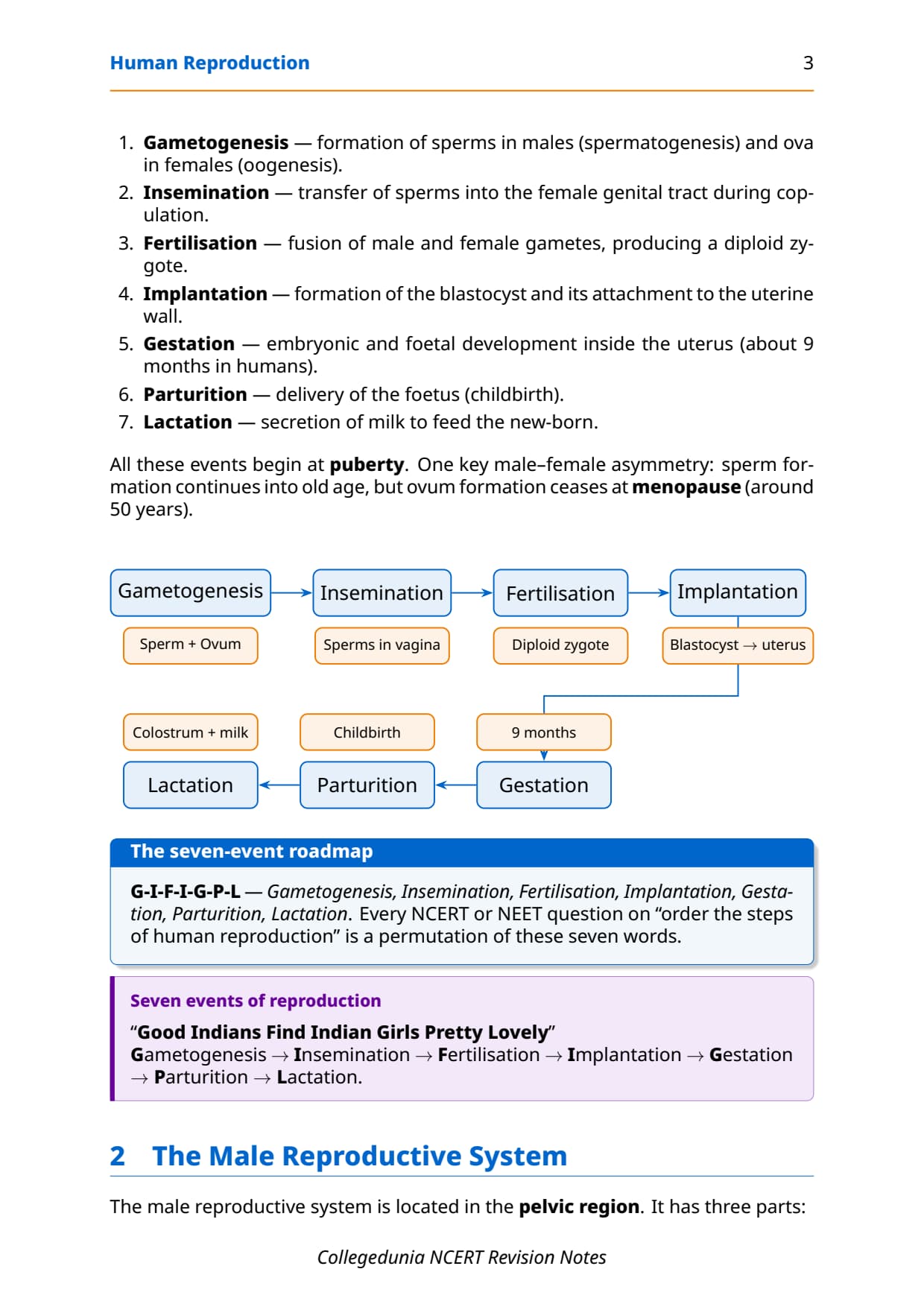
These human reproduction class 12 notes score across every exam. NEET sets 3 to 5 questions a year on gametogenesis, the menstrual cycle, and parturition; CBSE almost always carries one 5-mark menstrual-cycle or placenta diagram. Lock down this chapter and you bank 10 to 14 marks. Every event, from puberty to parturition, is hormone-gated, so the chapter reads as one cause-and-effect chain.
Human Reproduction Video Lecture for Class 12 Biology
Source: Magnet Brains on YouTube
How Collegedunia's Human Reproduction Class 12 Notes Help You
The notes serve two students: a CBSE student who needs a 5-marker, and a NEET aspirant who needs every gametogenesis step.
- 2026-27 NCERT Aligned: Gametogenesis, menstrual cycle, placental hormones, parturition, and lactation are all retained.
- Mnemonics Built In: Long sequences carry a memory hook so recall holds.
- NEET Extras: Sertoli-Leydig table, corpus luteum lifespan, hCG windows.
- Diagram-First: Reproductive systems, hormone chart, and placenta sit beside the prose.
Human Reproduction Glossary for Class 12 Biology
This chapter's MCQs trade on term overlap (Sertoli vs Leydig; oocyte vs ovum). The glossary pins each term to one meaning.
| Term | One-Line Meaning |
|---|---|
| Spermatogenesis | Haploid sperm formed from diploid spermatogonia in seminiferous tubules. |
| Oogenesis | Haploid ovum formed from oogonia; pauses in prophase-I until puberty. |
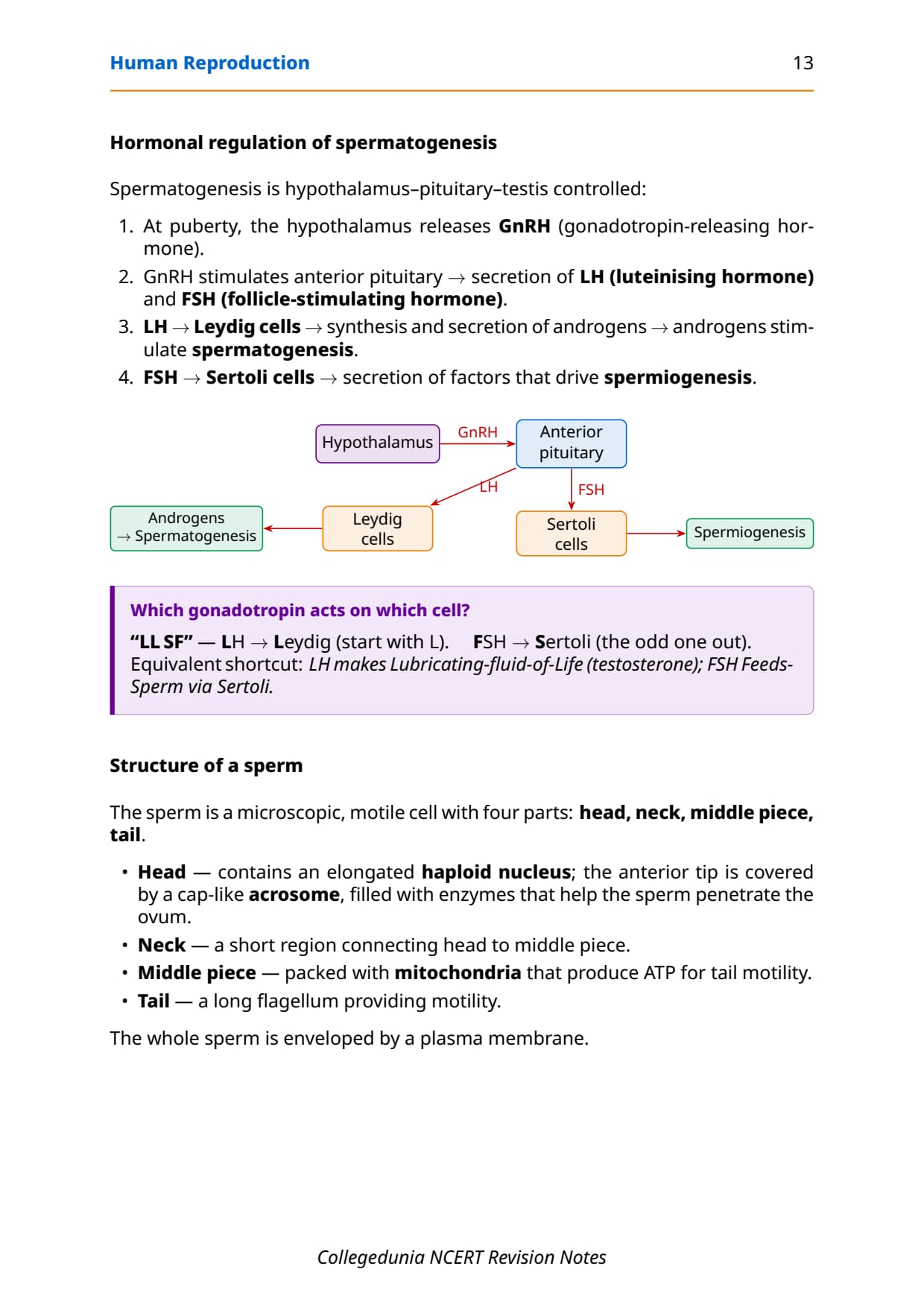
| Sertoli cells | Nurse cells that nourish sperm and secrete inhibin. |
| Leydig cells | Interstitial cells that secrete testosterone under LH. |
| Corpus luteum | Yellow body from the ruptured follicle; secretes progesterone. |
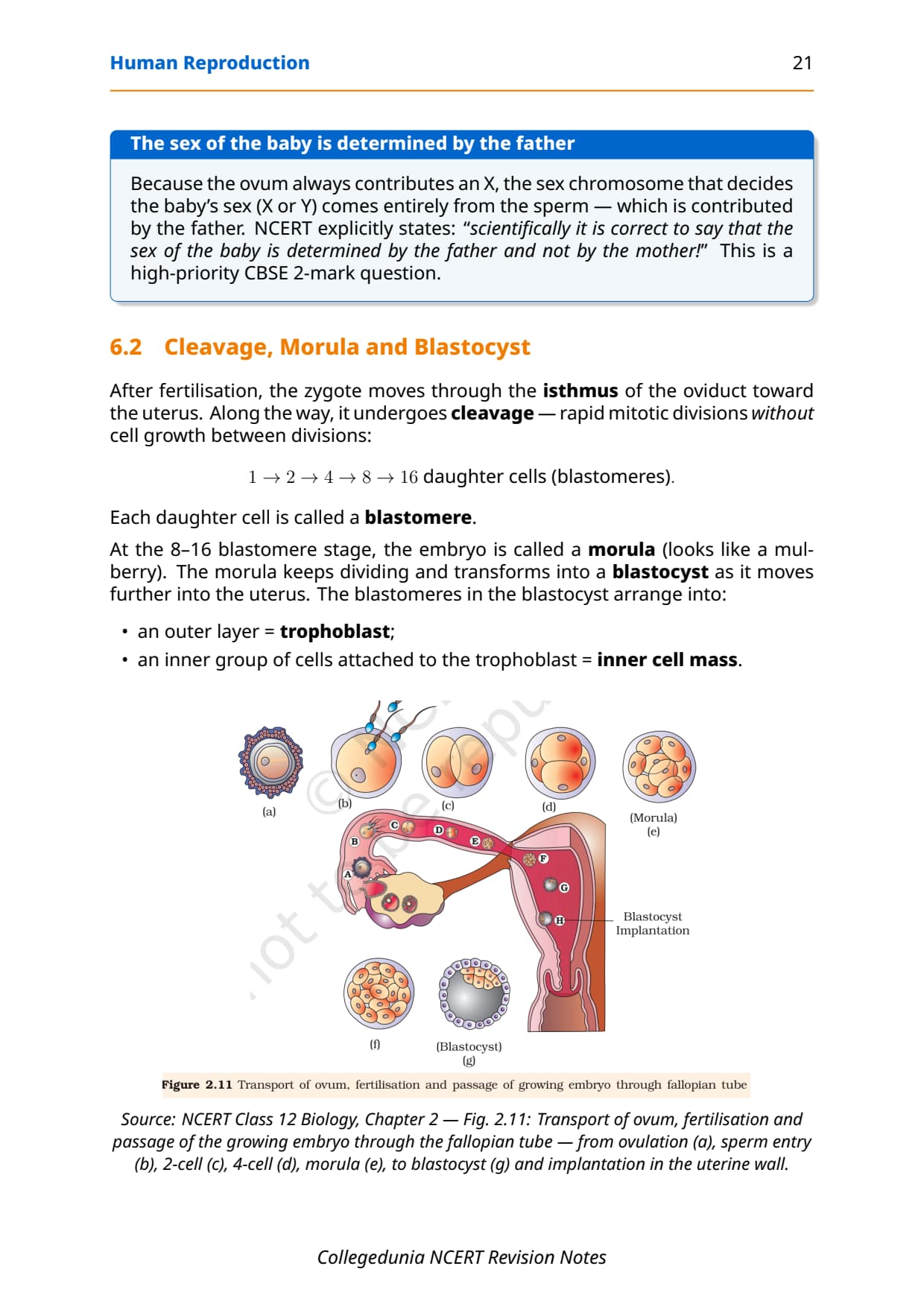
| Implantation | Blastocyst embeds in the endometrium, day 6 to 7. |
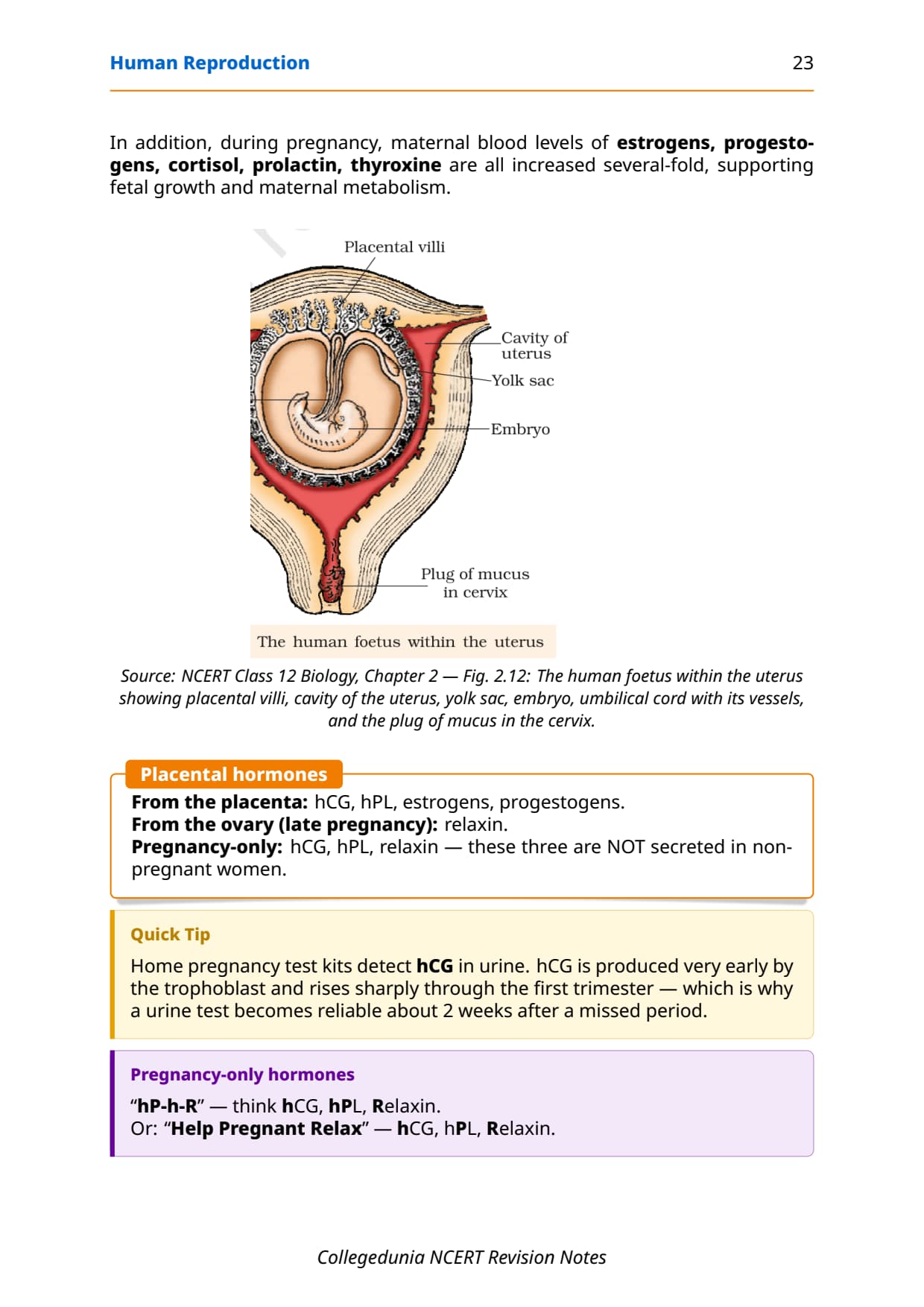
| Placenta | Foeto-maternal organ for exchange and hormones (hCG, hPL). |
Human Reproduction Topic-by-Topic Notes for Class 12 Biology
Male Reproductive System
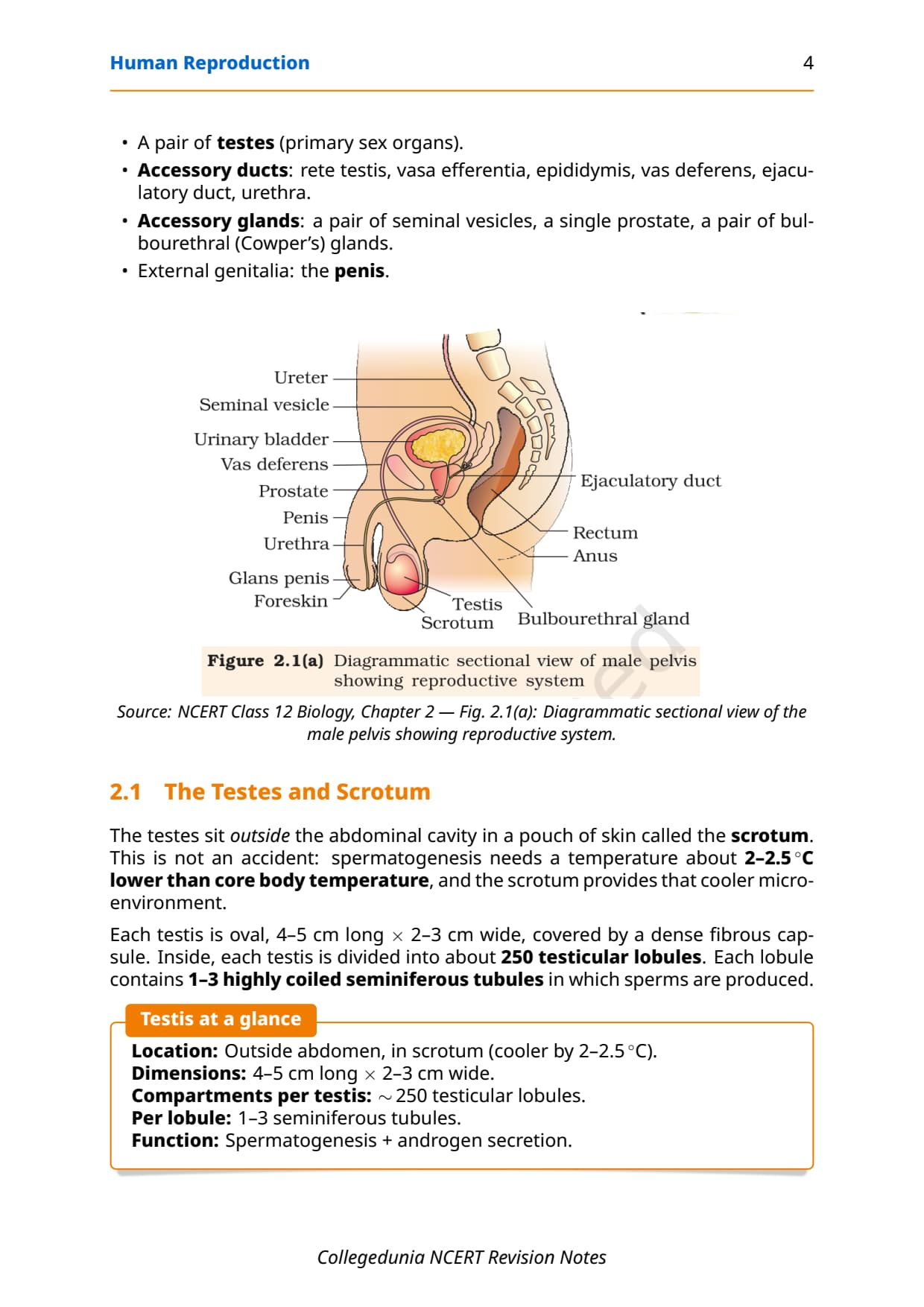
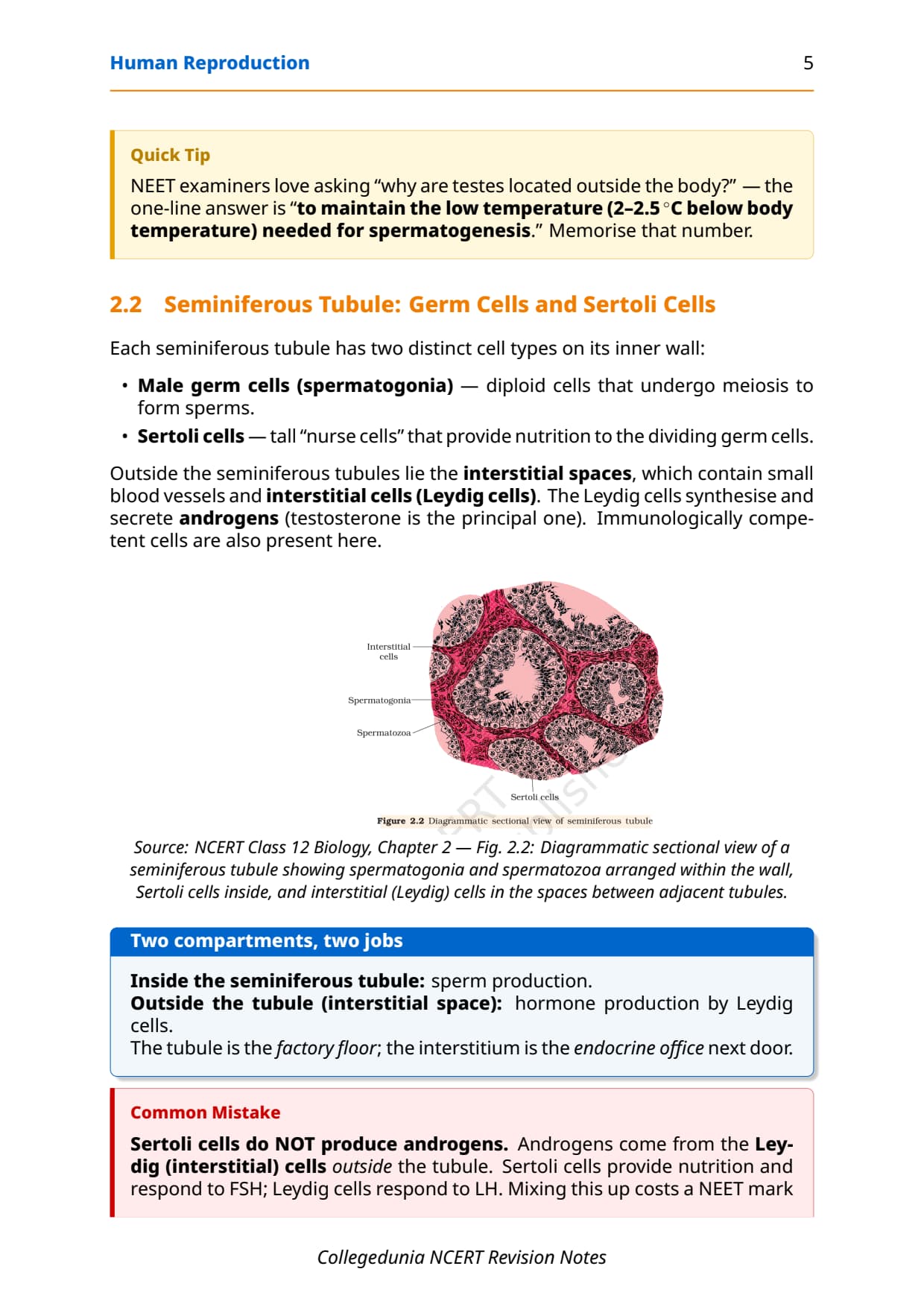
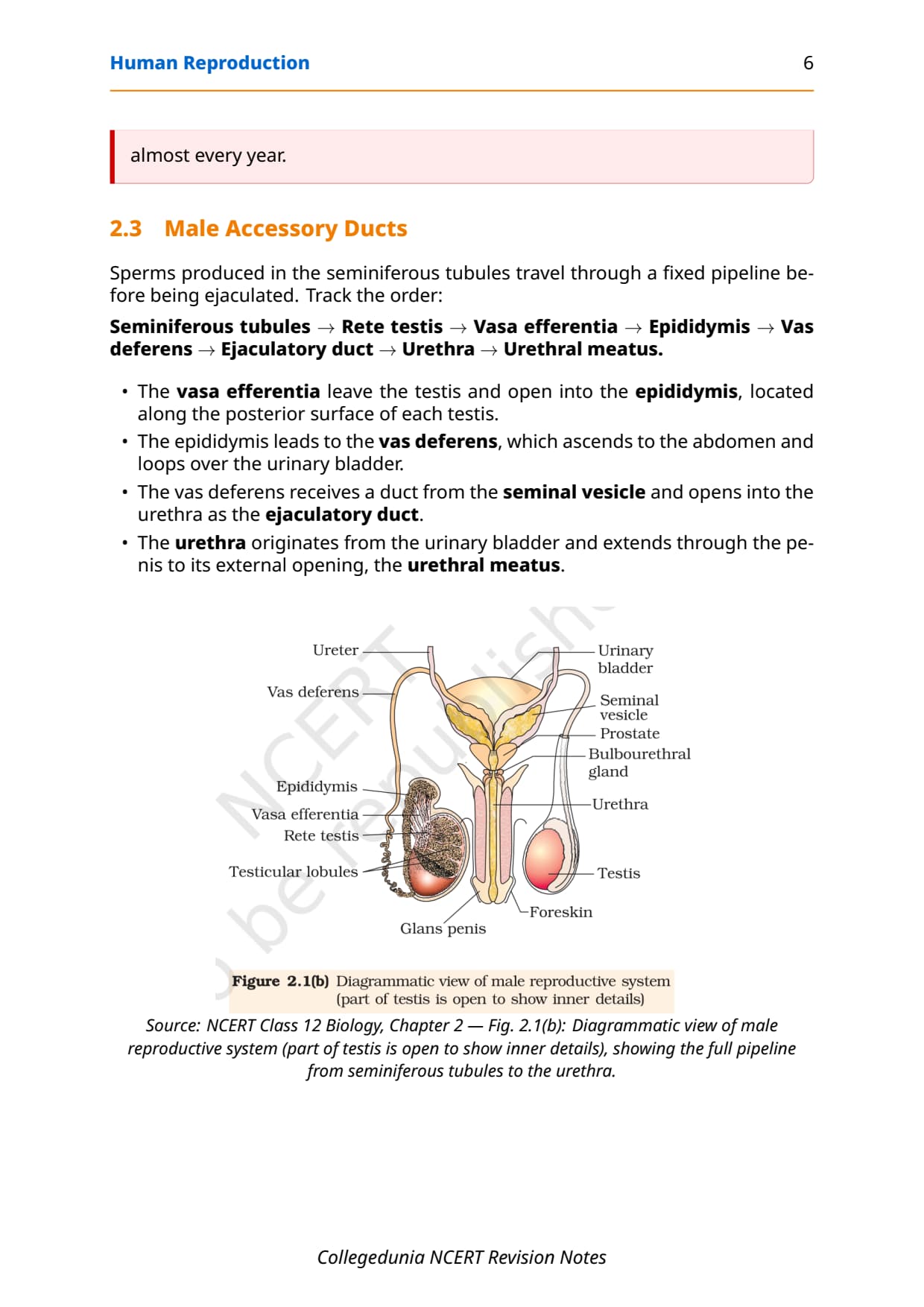
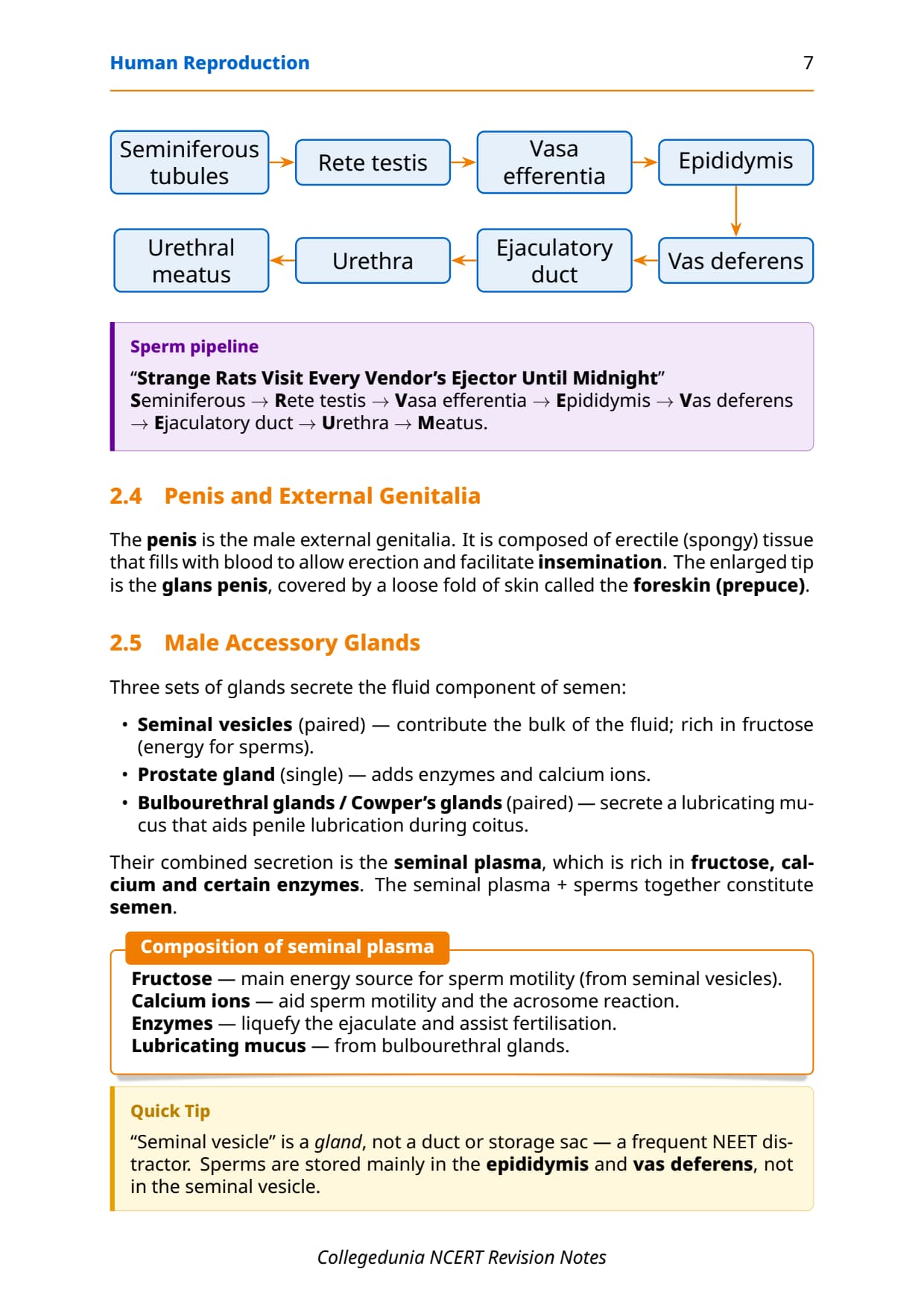
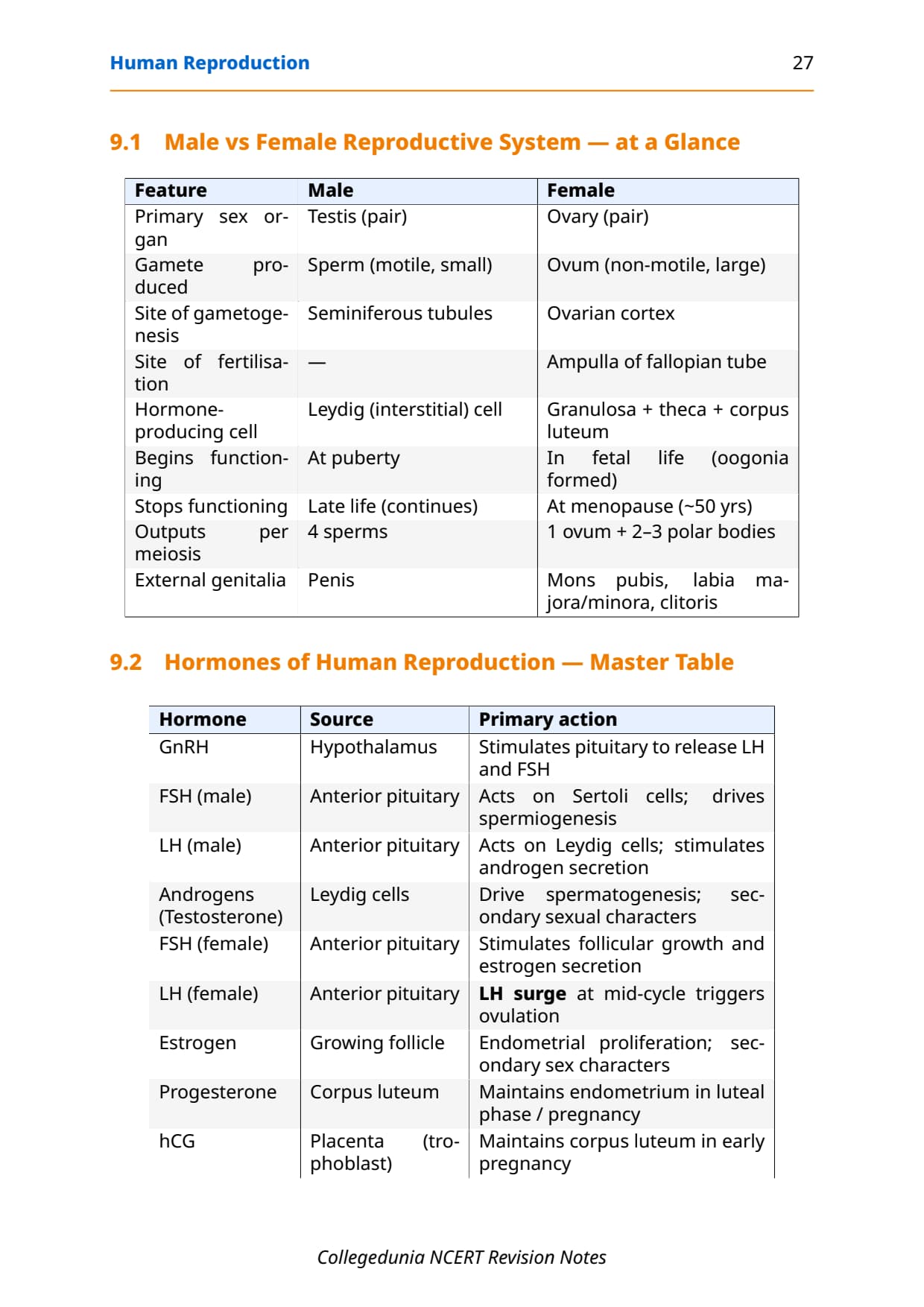
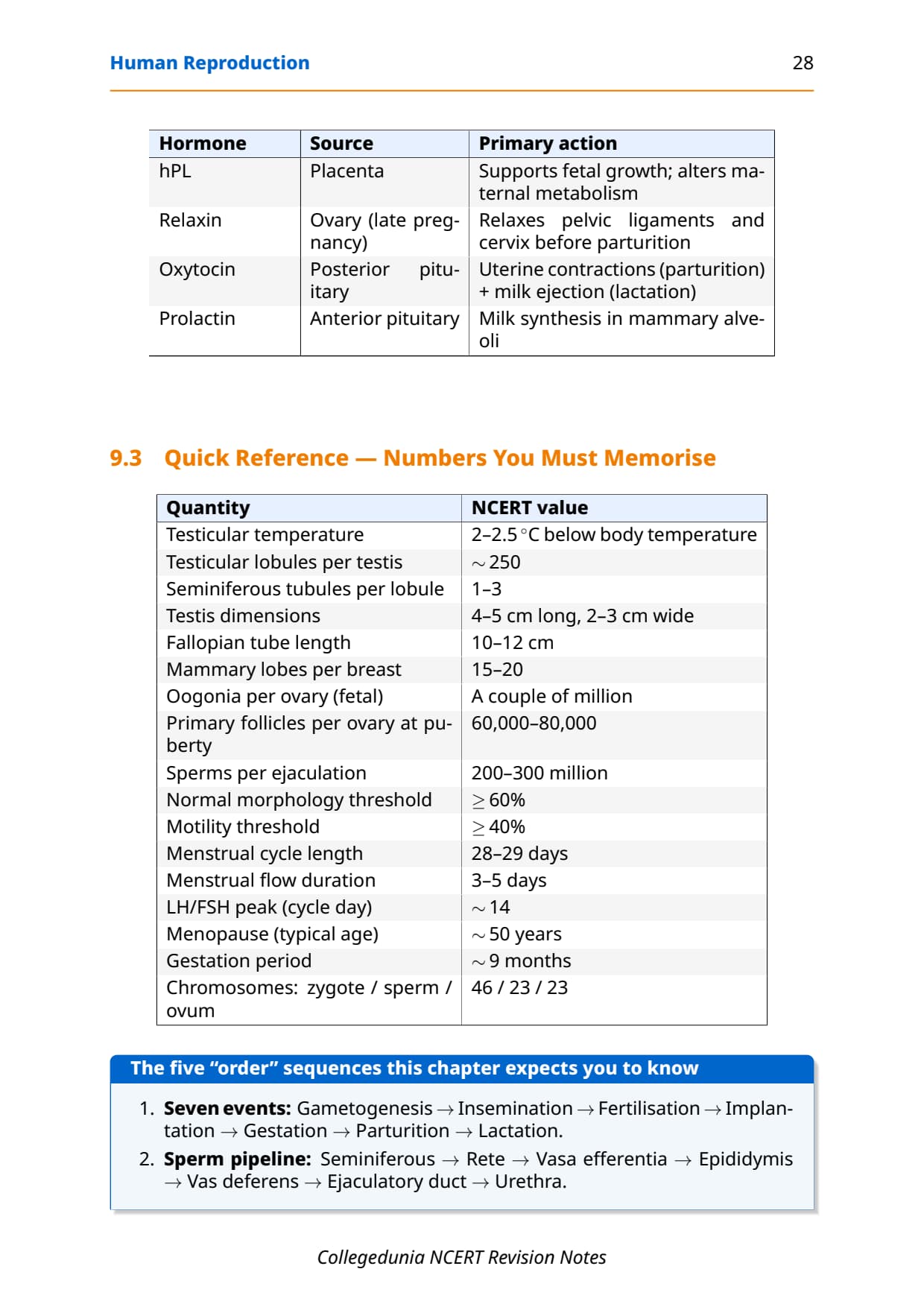
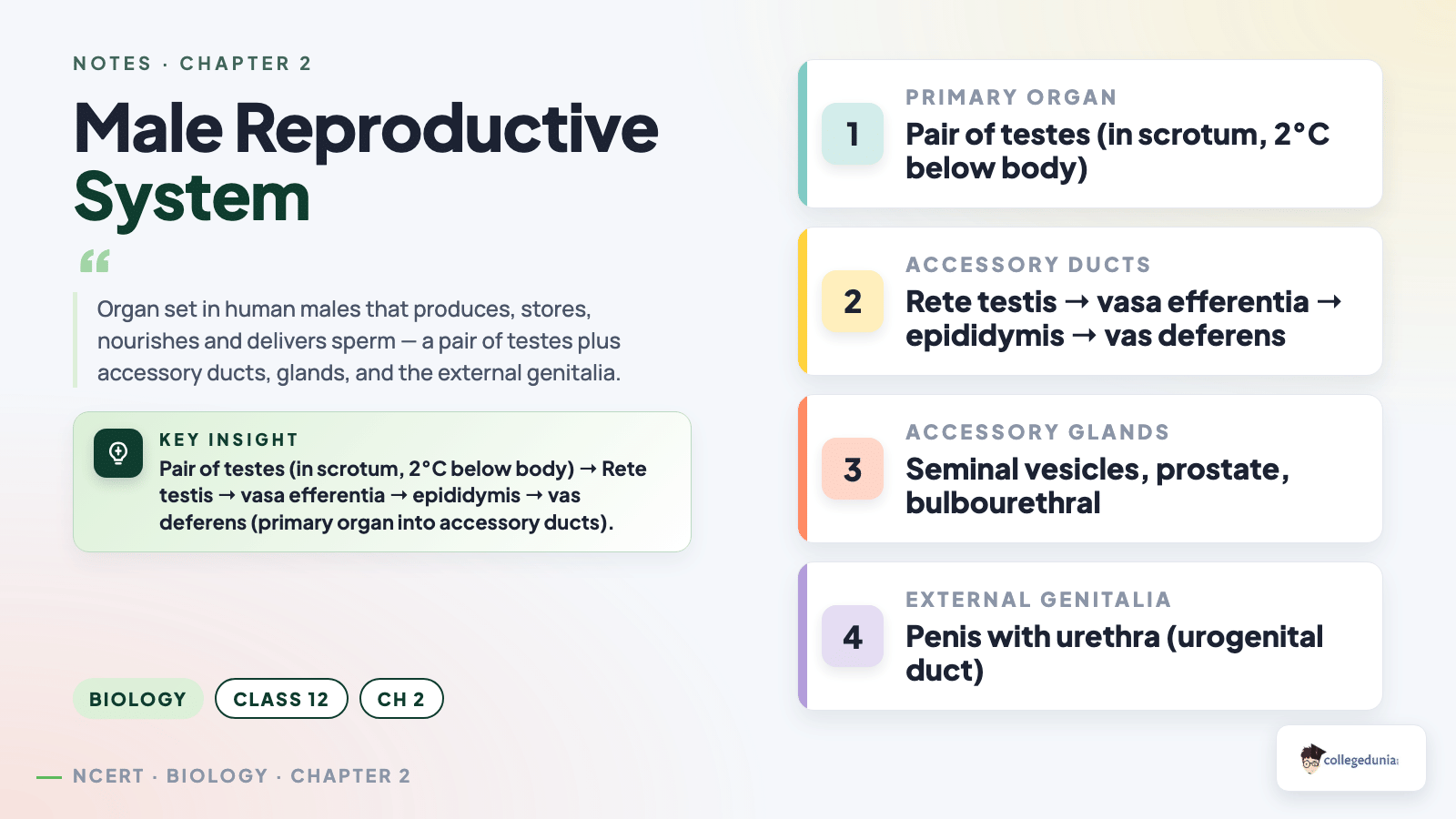
The male system has paired testes (in the scrotum, about 2 degrees below body temperature), accessory ducts (epididymis, vas deferens), accessory glands (seminal vesicles, prostate, bulbourethral), and external genitalia. Each testis has about 250 lobules of coiled seminiferous tubules lined by spermatogonia and Sertoli cells, with Leydig cells in the interstitium.
Female Reproductive System
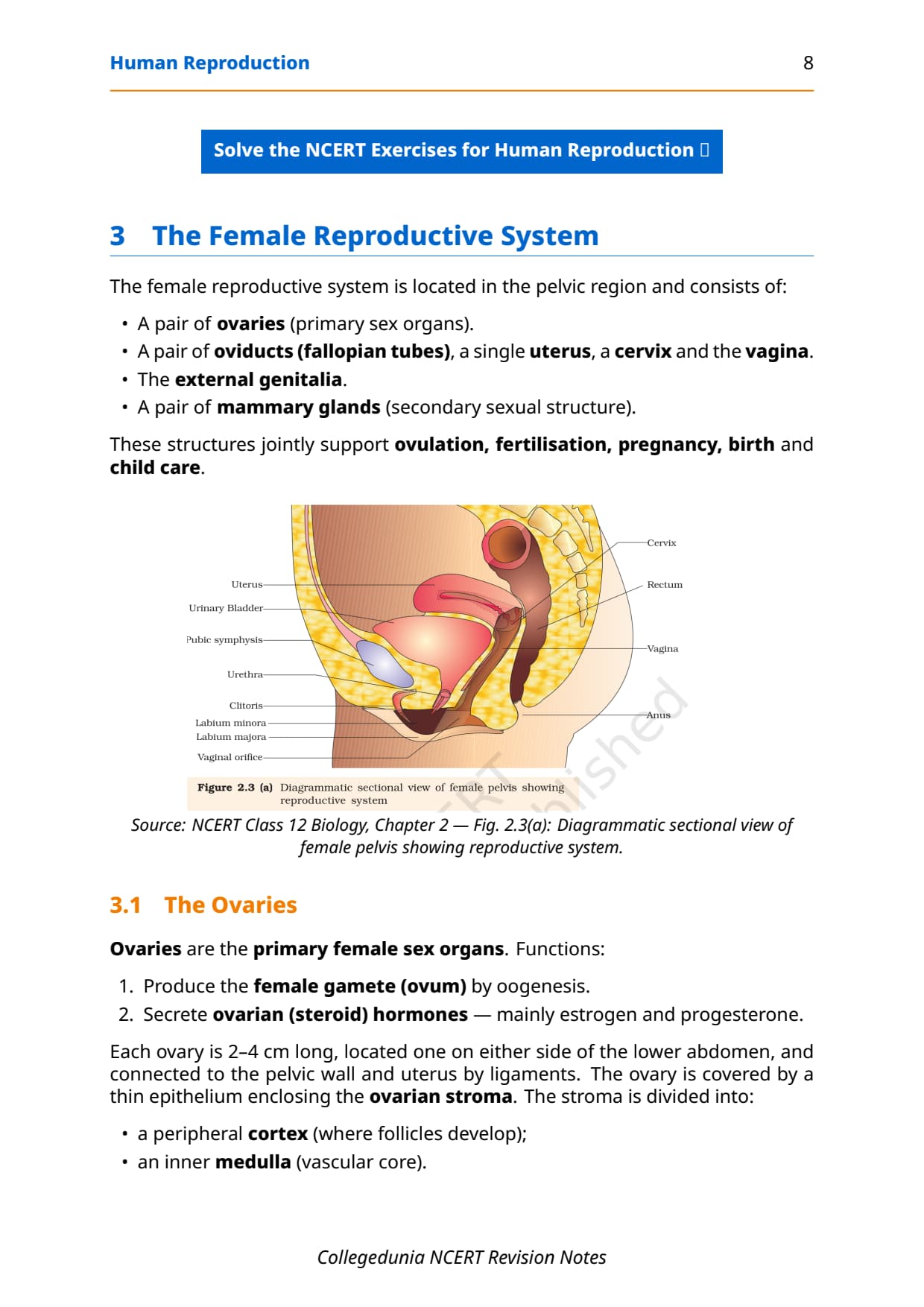
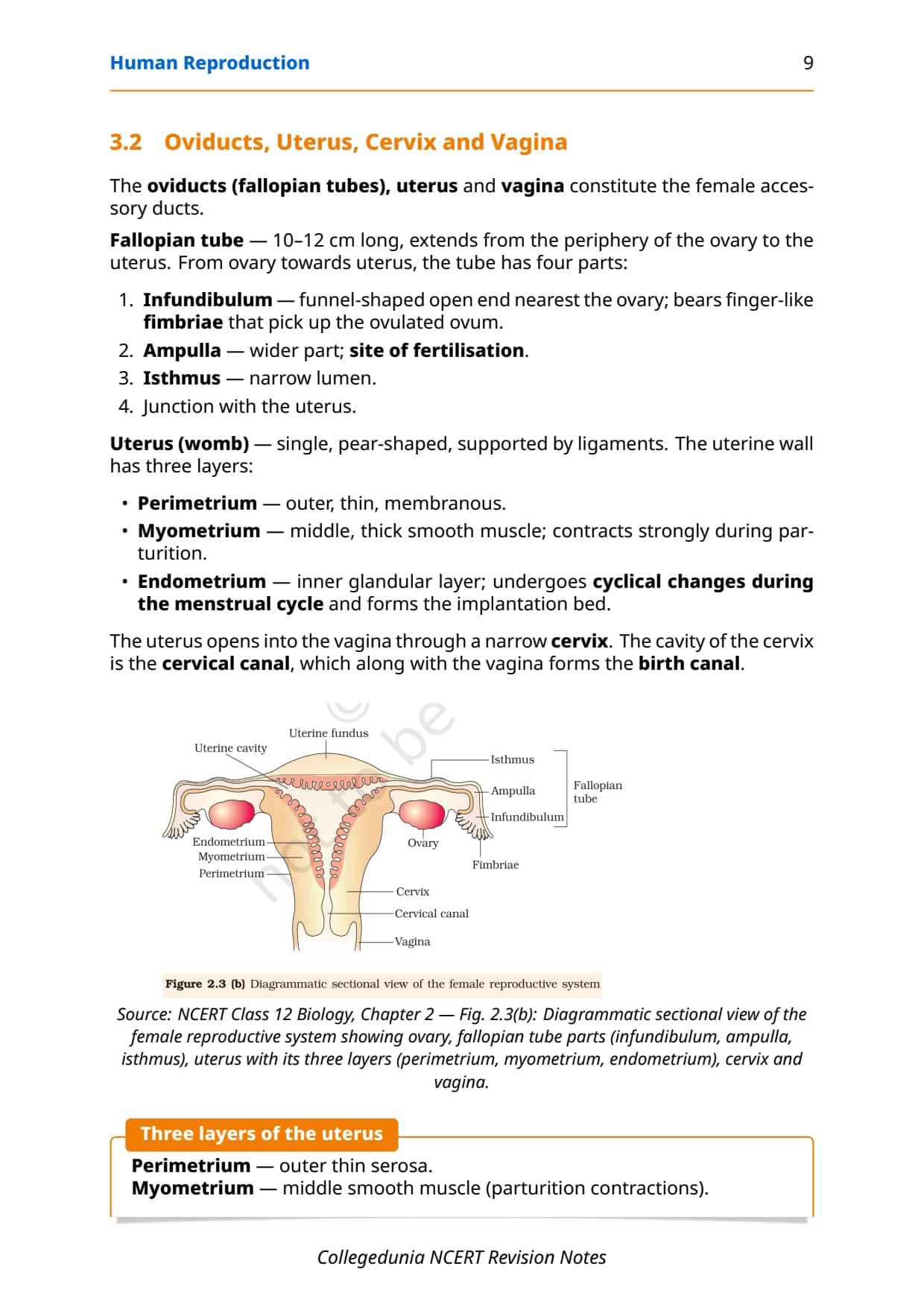
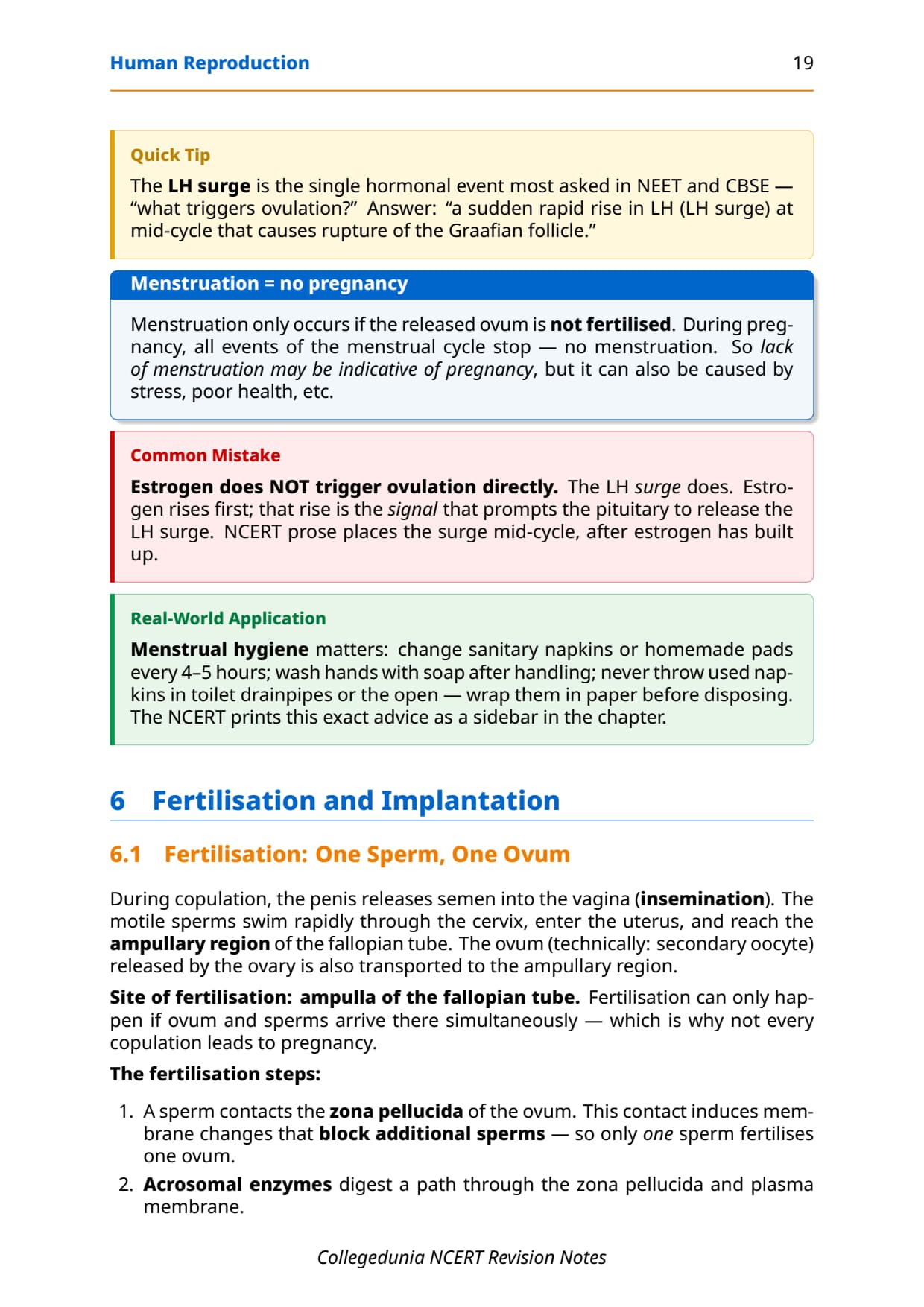
The female system has paired ovaries, the oviducts (infundibulum-ampulla-isthmus), the uterus (three layers), the cervix and vagina, and external genitalia. Fertilisation occurs at the ampullary-isthmic junction. The endometrium is the cyclic lining that thickens, sheds, and rebuilds each cycle.
Gametogenesis: Spermatogenesis and Oogenesis
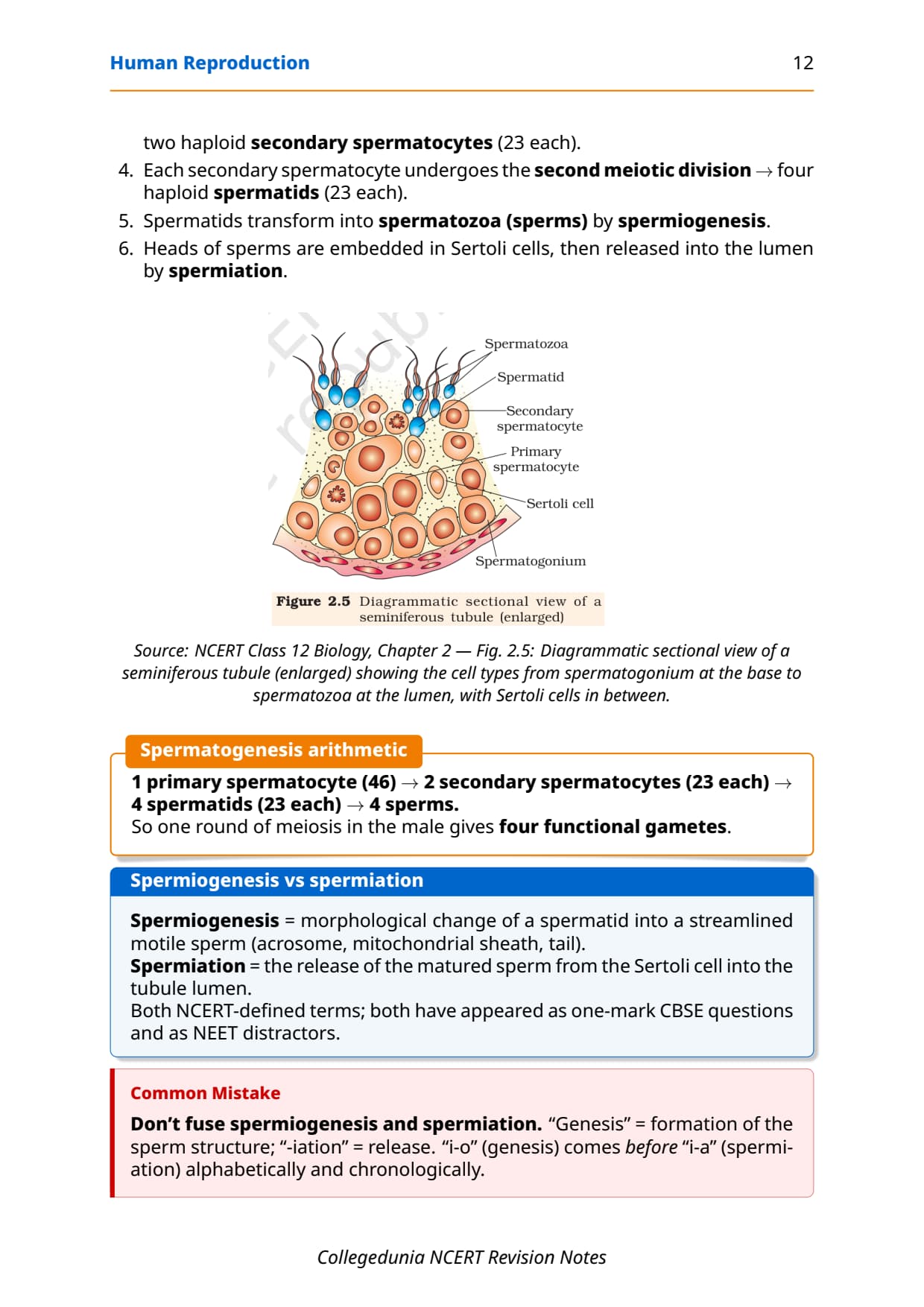
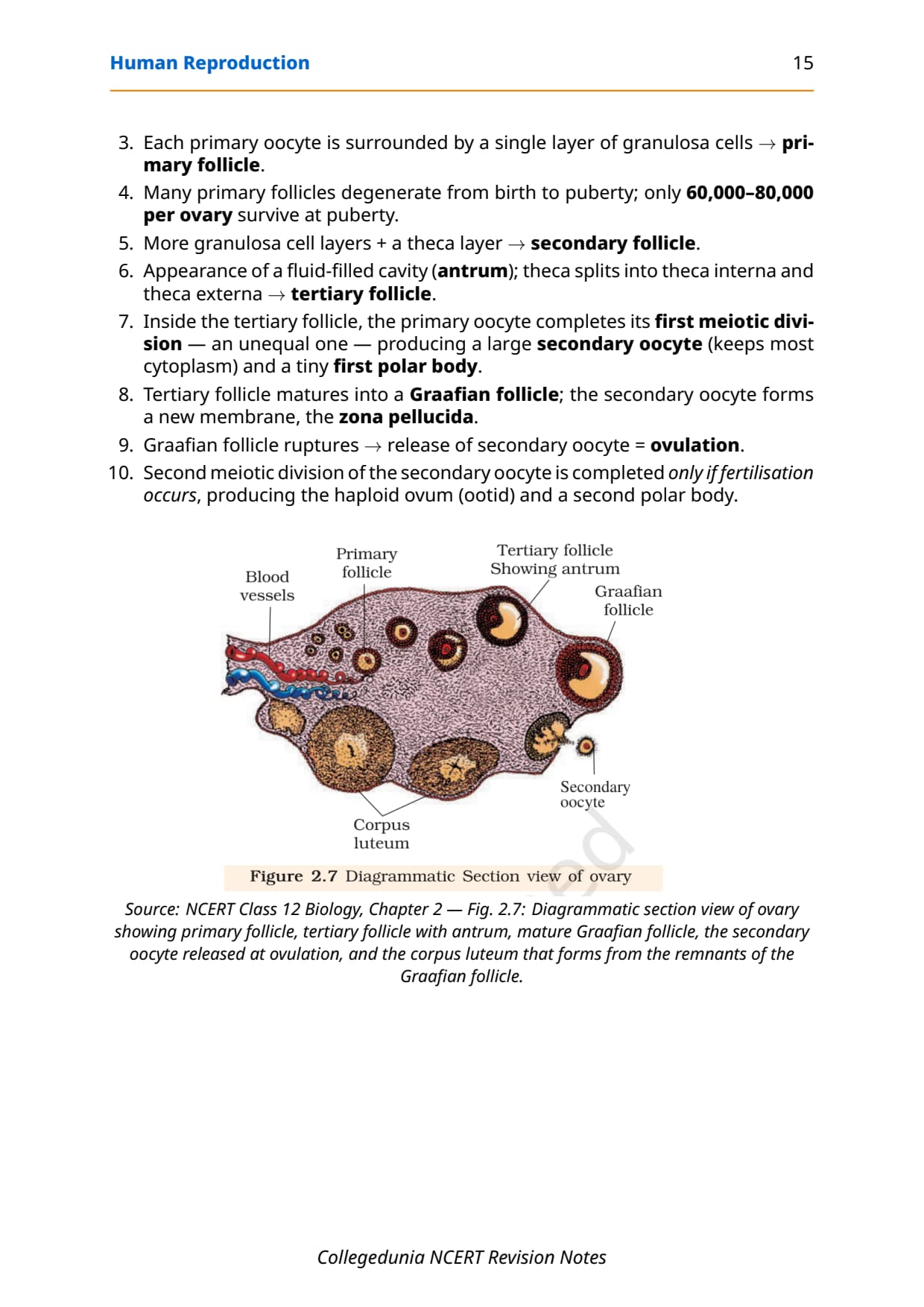
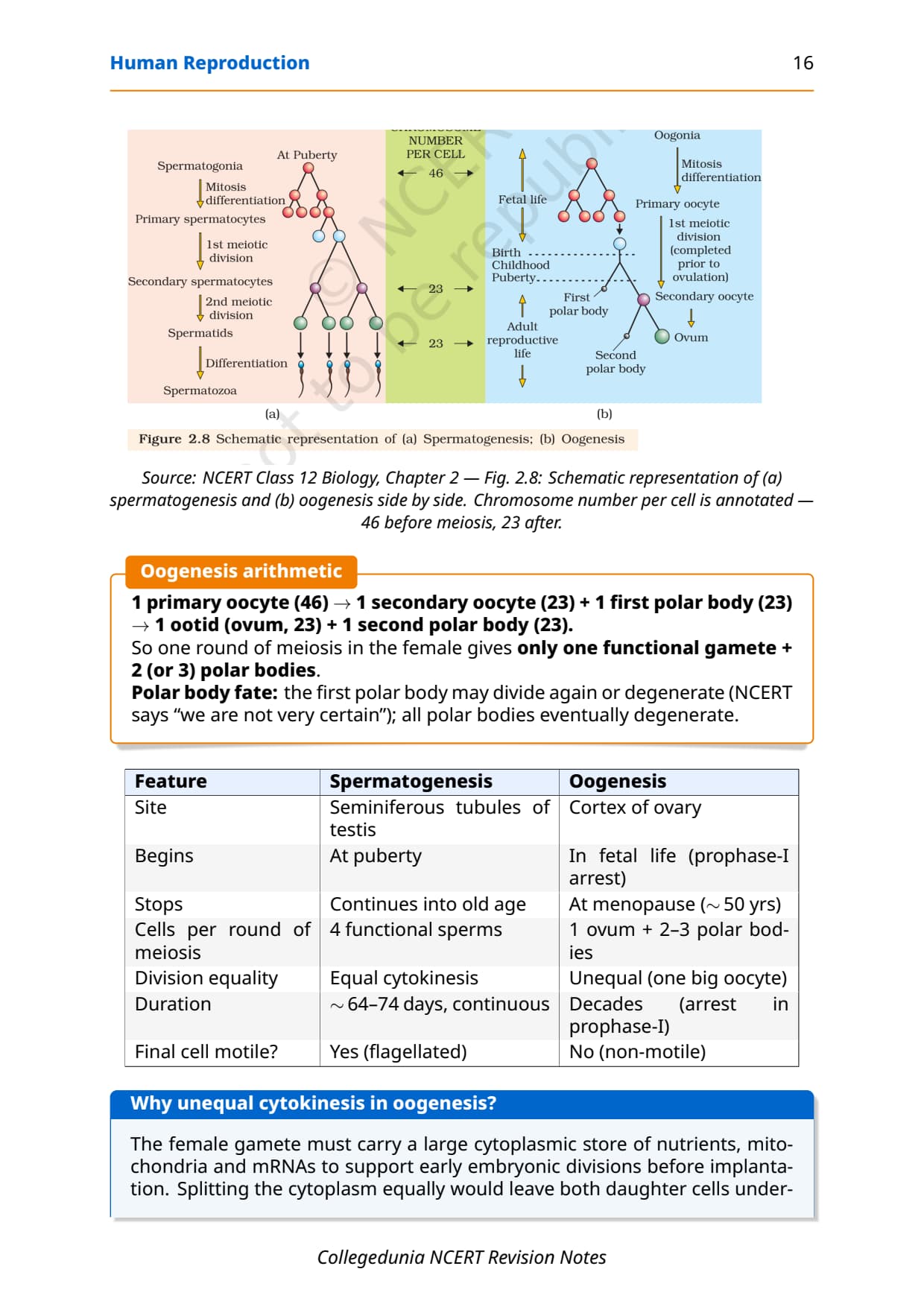
Spermatogenesis starts at puberty and takes about 64 to 74 days: spermatogonia (2n) form primary spermatocytes, then by meiosis two secondary spermatocytes (n) and four spermatids that mature into sperm. Oogenesis begins in the foetal ovary; oogonia pause in prophase-I. At puberty, one primary oocyte per cycle completes meiosis-I to give a secondary oocyte plus first polar body; meiosis-II finishes only if fertilisation occurs.
Menstrual Cycle
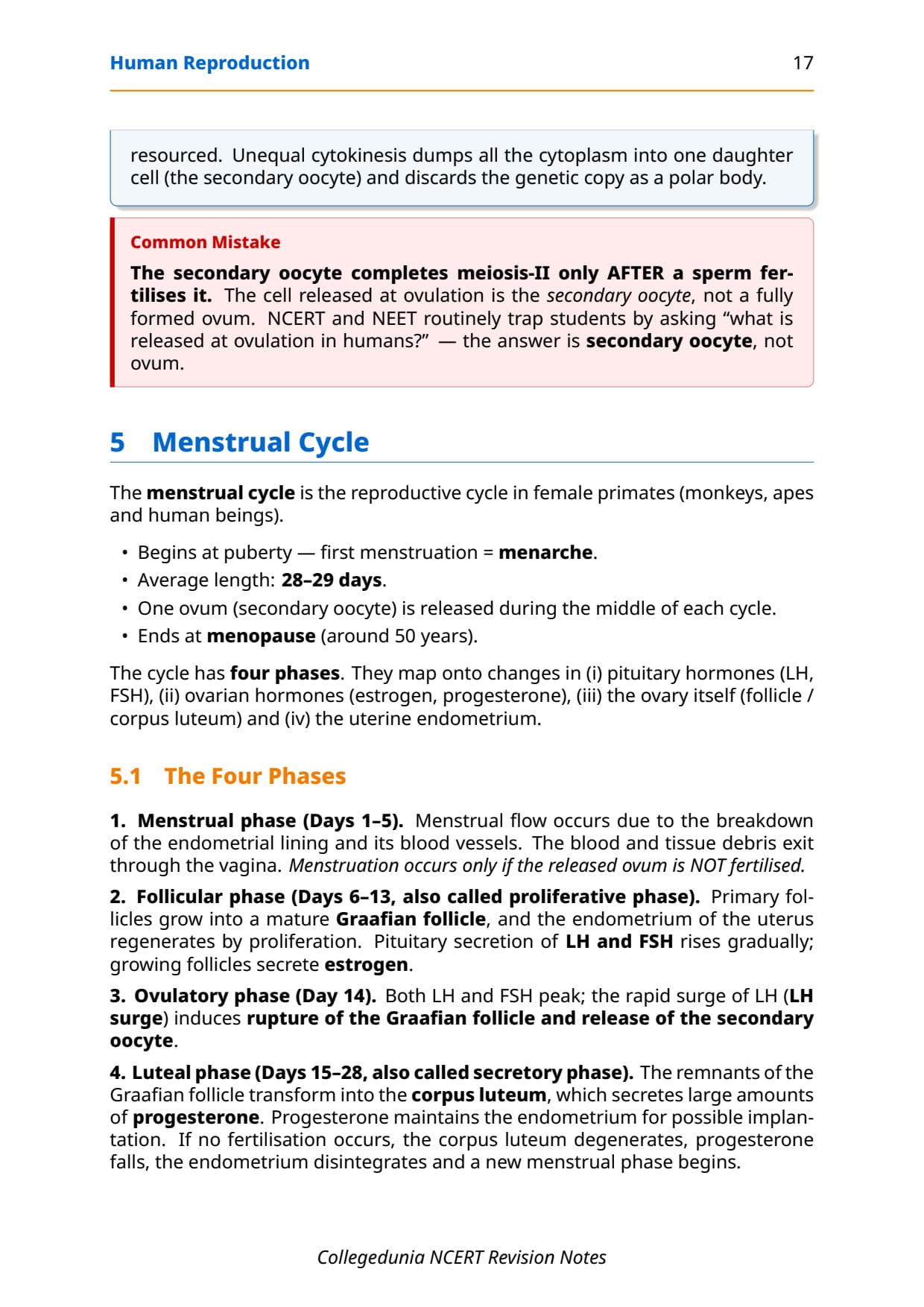
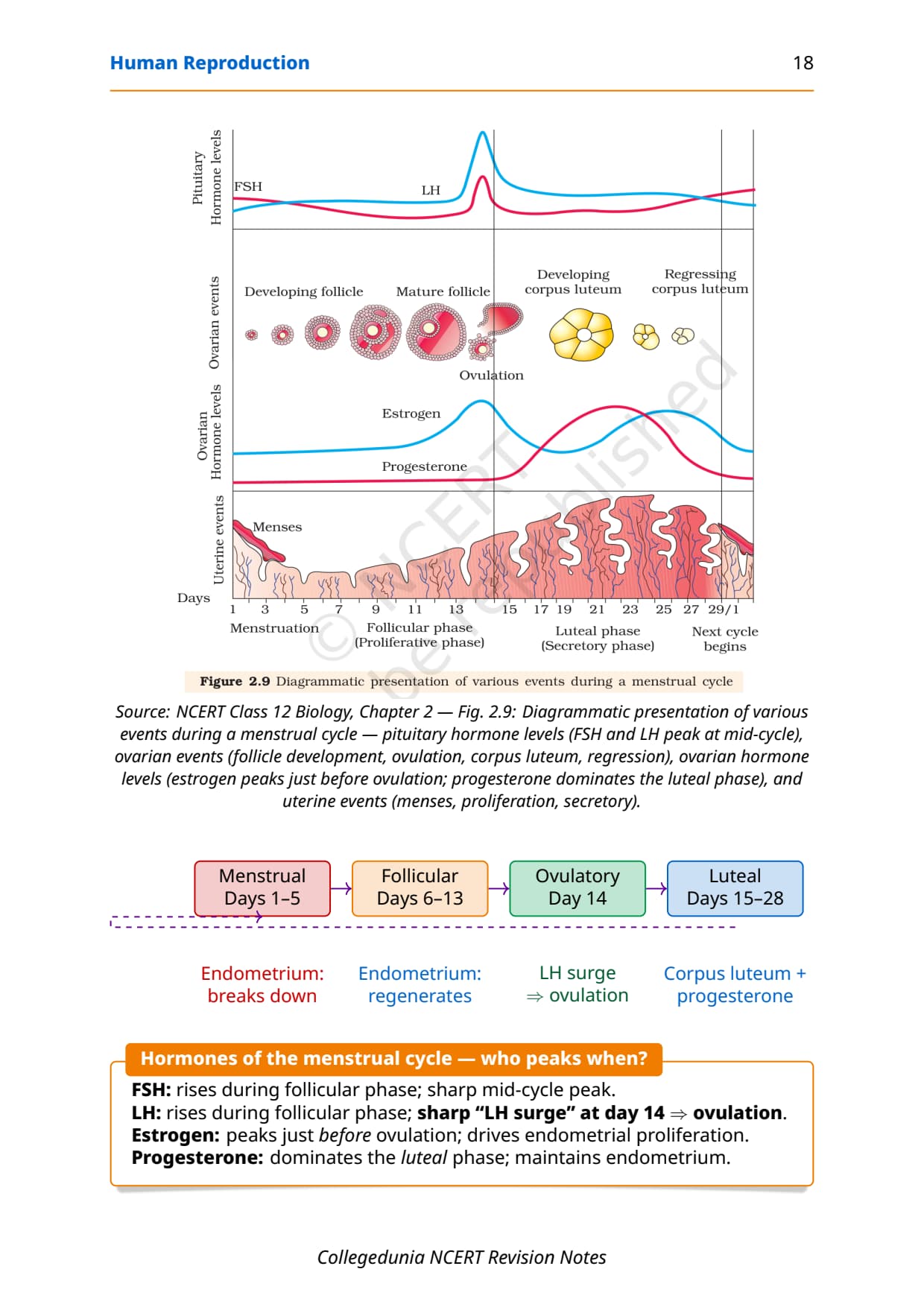
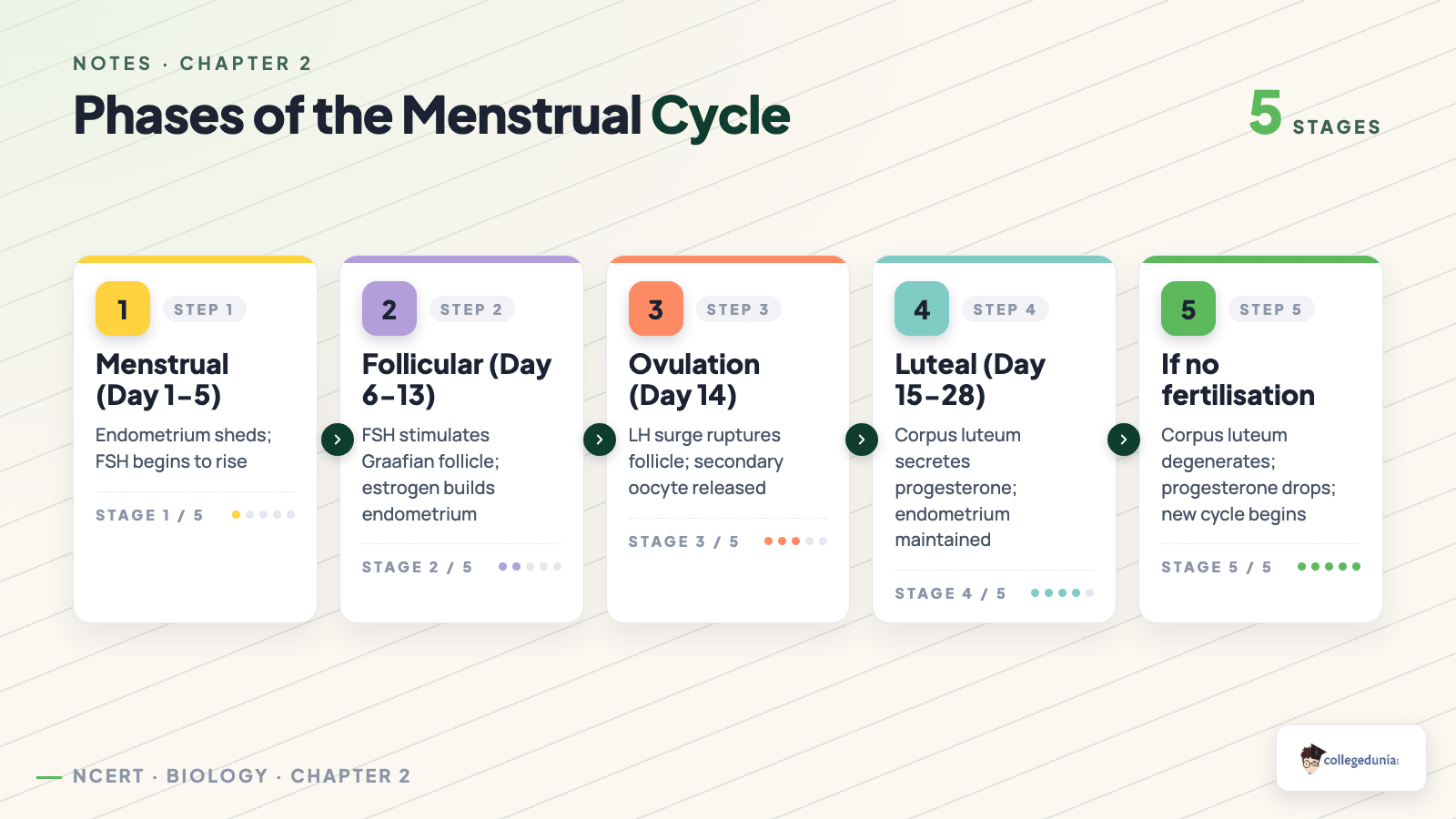
The 28-day cycle has four phases gated by four hormones. The menstrual phase (days 1 to 5) sheds the endometrium. The follicular phase (days 5 to 14) runs on rising FSH, which matures a Graafian follicle and triggers oestrogen. The LH surge on day 14 triggers ovulation. In the luteal phase (days 15 to 28) the corpus luteum secretes progesterone; without fertilisation it regresses. Ovulation on day 14 is the most-asked NEET point here.
Fertilisation and Implantation
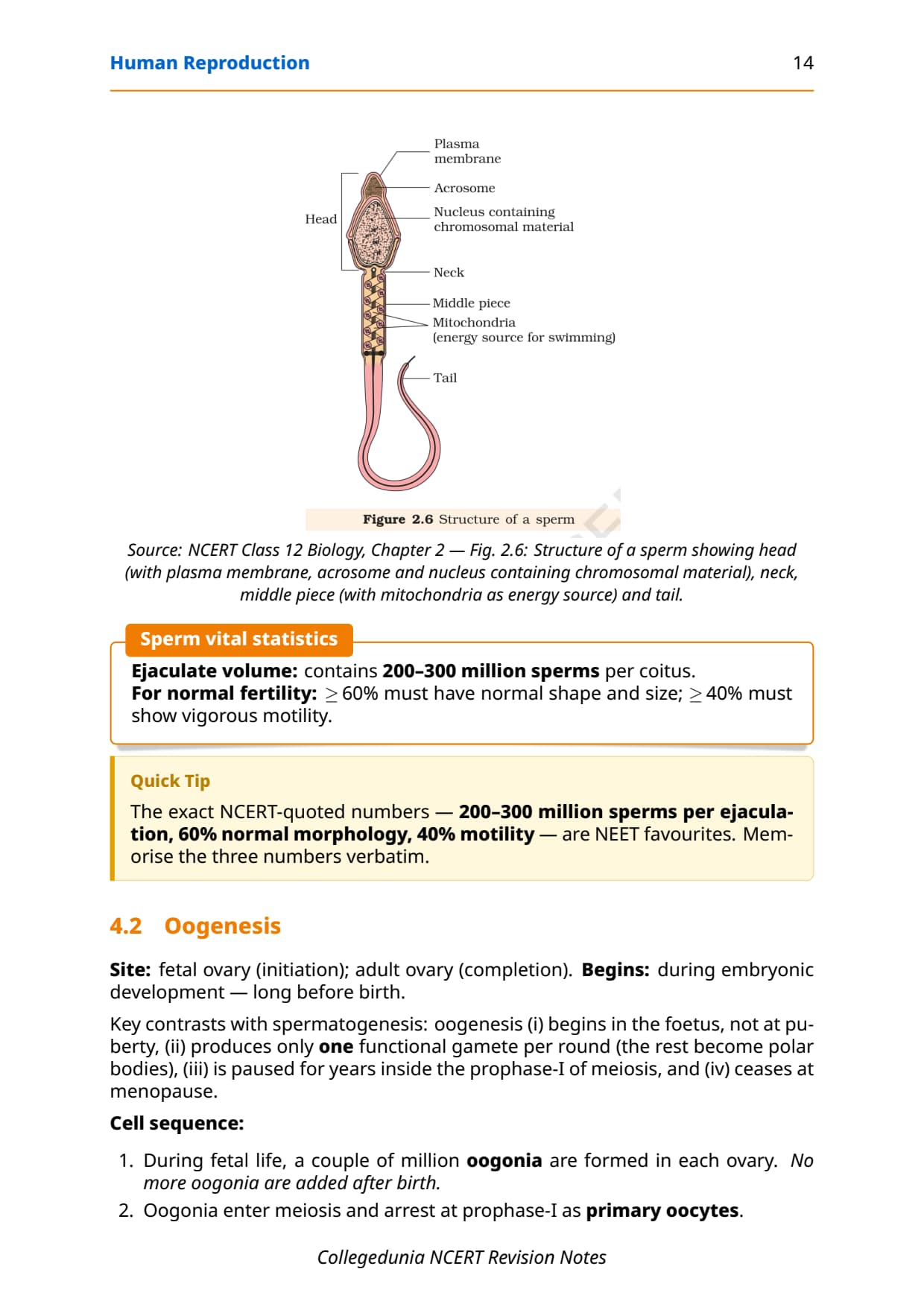
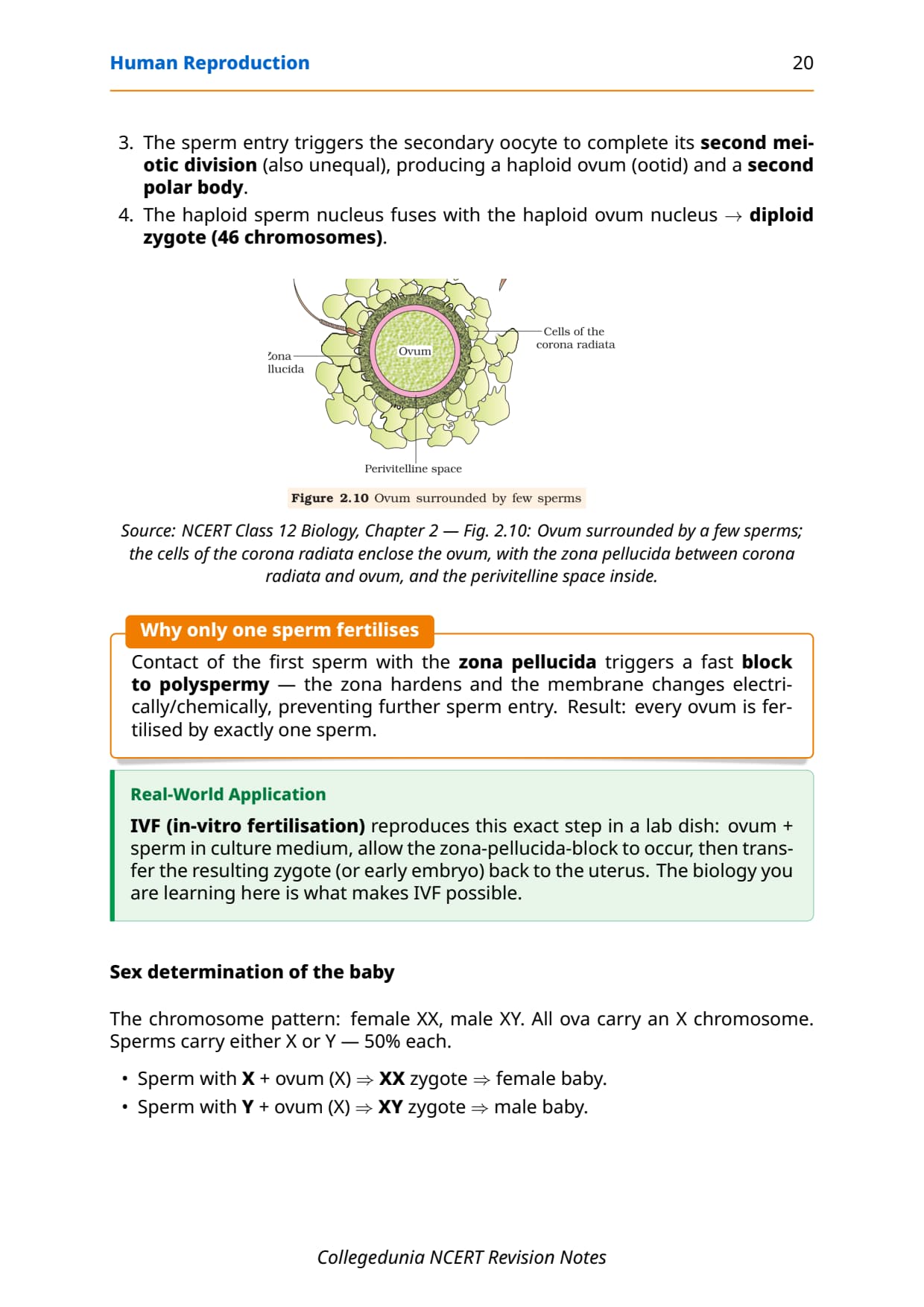
Sperm undergo capacitation in the female tract; the acrosomal reaction digests the zona pellucida. One sperm enters, the oocyte completes meiosis-II, and the zygote (2n) forms by syngamy. Cleavage gives a morula, then a blastocyst, which reaches the uterus around day 6 to 7 and implants. Trophoblast hCG then rescues the corpus luteum.
Pregnancy, Placenta, and Parturition
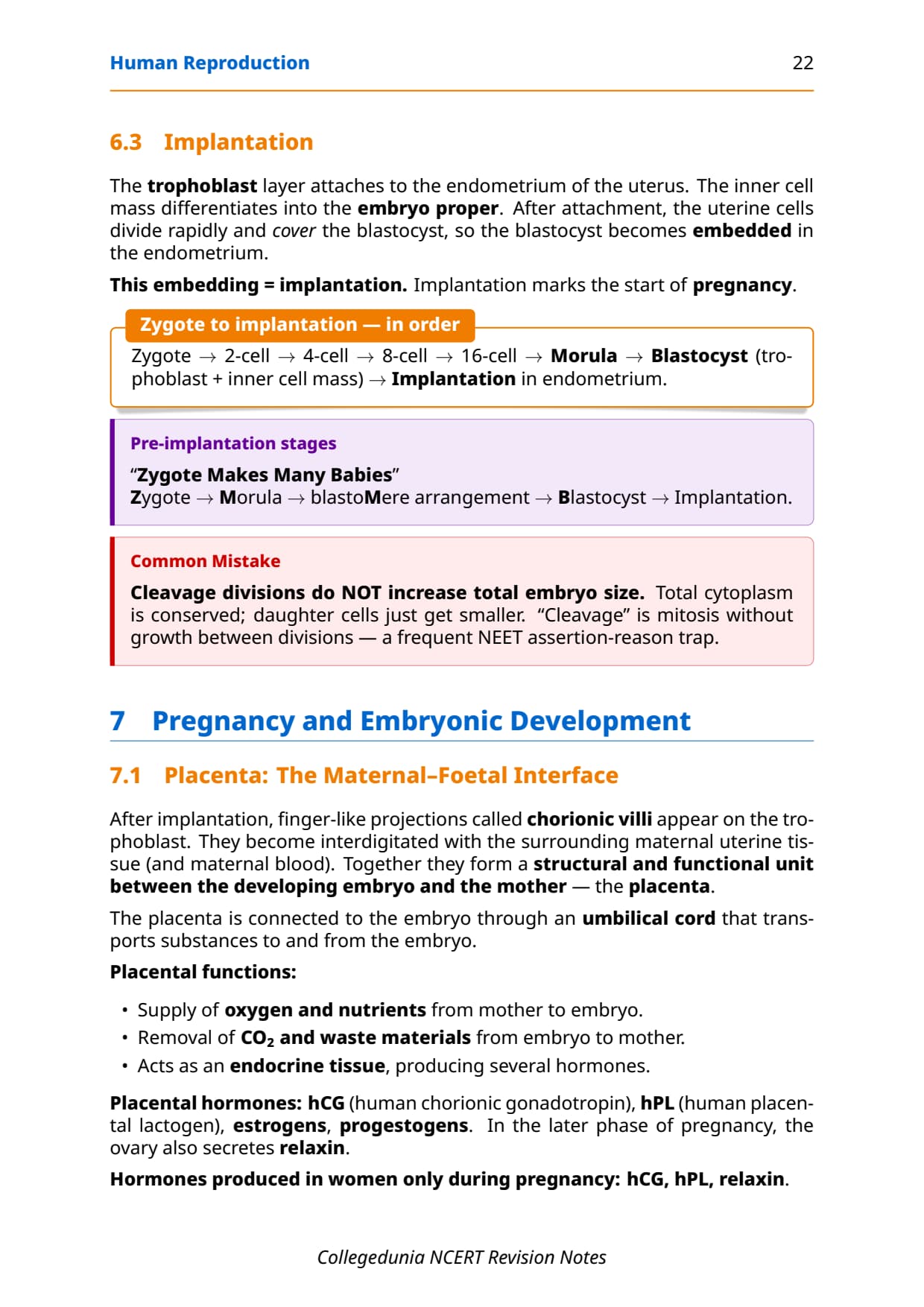
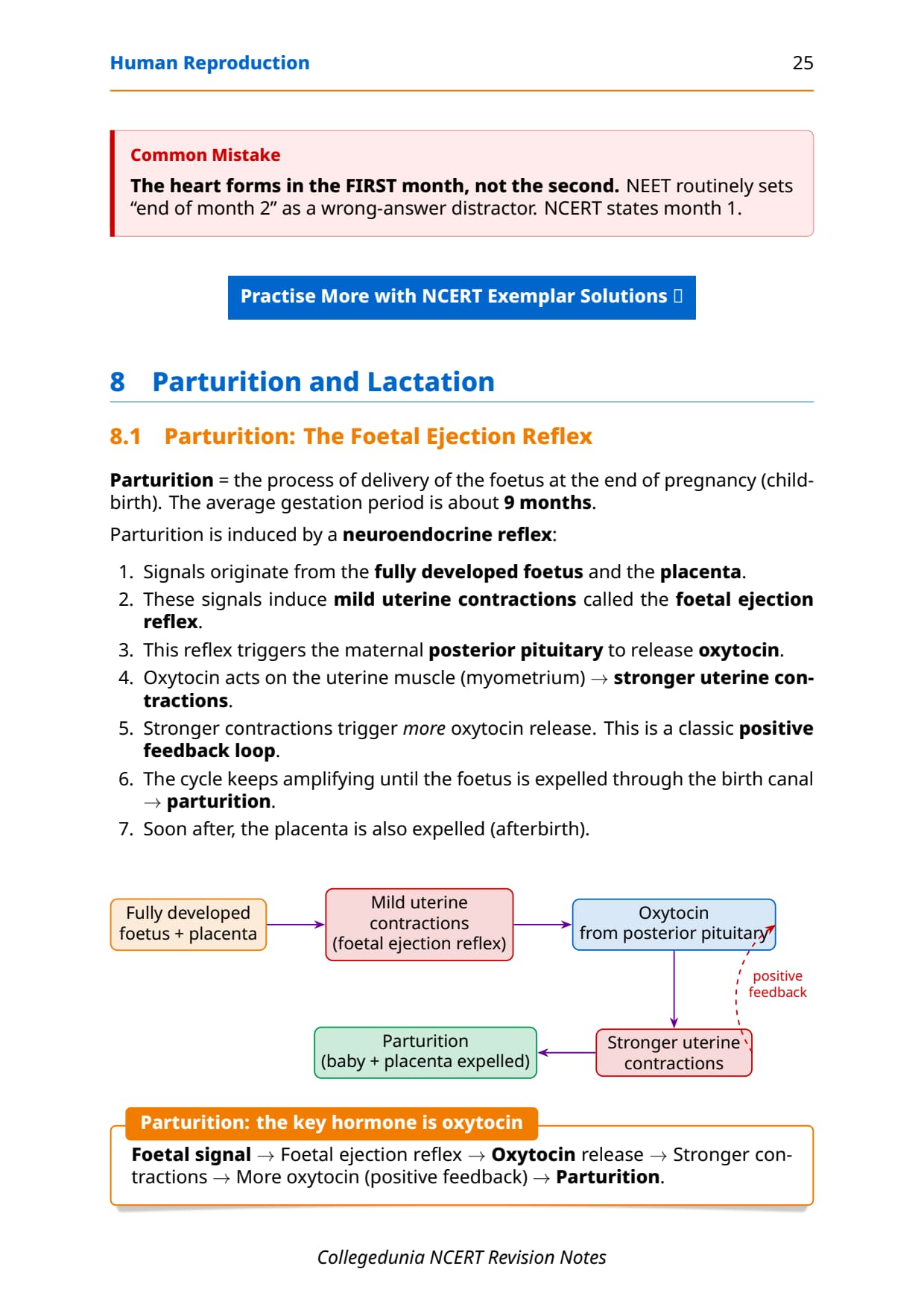
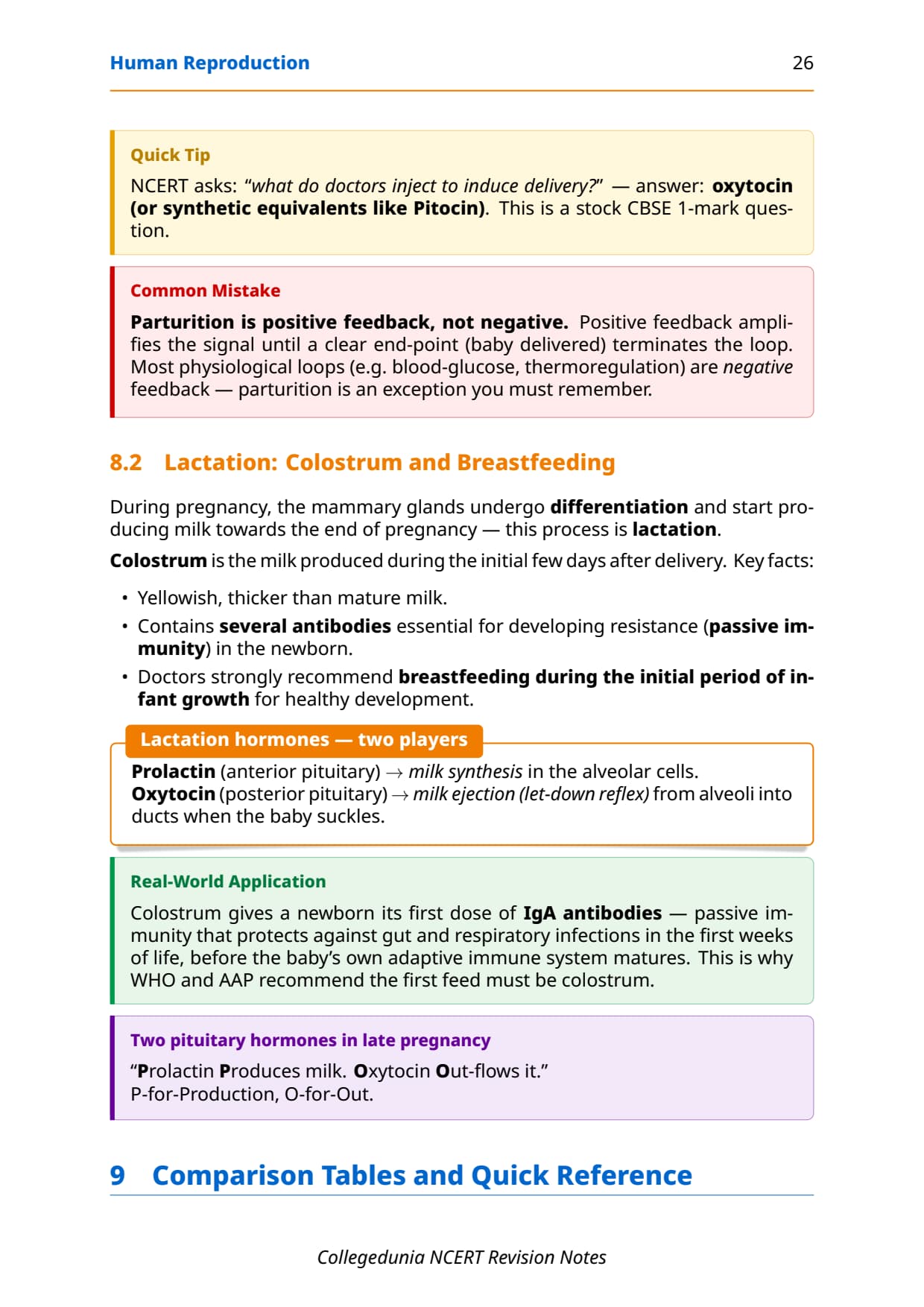
The placenta forms from chorionic villi of the trophoblast in the endometrium. It handles exchange and secretes hCG, hPL, oestrogen, progesterone, and relaxin. hCG peaks in trimester 1 and is the basis of pregnancy tests. Parturition starts with the foetal-ejection reflex, which triggers oxytocin; oxytocin drives uterine contractions in a positive feedback loop until delivery. After birth, mammary glands make antibody-rich colostrum; prolactin maintains lactation and oxytocin drives milk ejection.
Human Reproduction Important Diagrams for Class 12 Boards
Seven high-frequency labelled diagrams. Practise drawing each from memory.
- Male reproductive system. CBSE 2024.
- Female reproductive system. CBSE 2025.
- T.S. of seminiferous tubule. CBSE 2023, NEET 2024.
- T.S. of ovary with follicle stages. NEET 2023.
- 28-day menstrual cycle with hormone curves. CBSE 2025.
- Spermatogenesis-oogenesis comparison with ploidy. NEET 2025.
- Placental anatomy. CBSE 2024.
Human Reproduction Topic-wise Weightage for CBSE Class 12 Biology
The split below uses the last five CBSE and NEET papers.
| Sub-topic | Weightage | Frequency |
|---|---|---|
| Menstrual cycle (phases, hormones) | High | CBSE 5 of last 5 |
| Gametogenesis | High | NEET 5 of last 5 |
| Male and female anatomy | High | CBSE 4 of last 5 |
| Fertilisation and implantation | Medium | NEET 3 of last 5 |
| Placenta and pregnancy hormones | Medium | 3 of last 5 |
| Parturition and lactation | Low-Medium | 2 of last 5 |
Most Repeated Human Reproduction Questions in CBSE Class 12 Boards (2025 to 2021)
The high-confidence repeat set. Use it as a last-day revision target.
- CBSE 2025 (5-mark): Draw and label the 28-day menstrual cycle with the four hormones.
- CBSE 2024 (3-mark): Differentiate spermatogenesis and oogenesis with ploidy.
- CBSE 2024 (5-mark): Structure and functions of the placenta; name two hormones.
- CBSE 2023 (3-mark): Labelled T.S. of seminiferous tubule; Sertoli and Leydig functions.
- CBSE 2022 (5-mark): Trace events from ovulation to implantation.
- CBSE 2021 (3-mark): Role of hCG in pregnancy.
Common Misconceptions in Human Reproduction
Five wrong beliefs examiners exploit every year.
- "Fertilisation occurs in the uterus." No, at the ampullary-isthmic junction.
- "Oogenesis completes at puberty." No, meiosis-II completes only after fertilisation.
- "The corpus luteum lasts all pregnancy." No, about 10 to 12 weeks; the placenta takes over.
- "Sertoli cells secrete testosterone." No, it comes from Leydig cells.
- "Ovulation happens on day 1." No, day 1 is menstrual flow; ovulation is near day 14.
NEET-Only Extensions Beyond the Class 12 NCERT
Five points NEET asks but the textbook skips.
- Sertoli vs Leydig: Sertoli nourishes sperm and secretes inhibin; Leydig secretes testosterone under LH.
- Accessory gland secretions: seminal vesicles (fructose), prostate (citrate, zinc).
- hCG detection: serum by day 8 to 10, urine by day 12 to 14, peak at week 9 to 10.
- Corpus luteum lifespan: 10 to 12 days if no pregnancy; 10 to 12 weeks if it occurs.
- Cleavage timing: 2-cell at 30 h, morula at day 4, blastocyst at day 5 to 6.
Student Feedback on Human Reproduction Class 12 Notes
In a recent survey of 14,500 Class 12 Biology students, the menstrual cycle hormone-graph came out as the hardest sub-topic.
Student Feedback
- 75% of students marked the menstrual cycle hormone-graph as the hardest sub-topic.
- 68% reported losing 1 to 2 marks on spermatogenesis vs oogenesis.
- 4 out of 5 students skipped the LH/FSH control figure in their answer sheet.
- The average student spent 6.2 hours on the first read.
Source: 2025-26 Class 12 Biology student survey, 14,500 students across 18 states.
Other Resources for Human Reproduction Class 12 Biology
| Resource | Link |
|---|---|
| Notes (this page) | Human Reproduction Notes |
| NCERT Solutions | Solutions |
| Handwritten Notes | Handwritten Notes |
| Formula Sheet | Formula Sheet |
| NCERT Book PDF | NCERT Book PDF |
| Exemplar Solutions | Exemplar Solutions |
| Exemplar Book PDF | Exemplar Book PDF |
NCERT Notes for Class 12 Biology: All Chapters
Quick links to the rest of the Class 12 Biology notes.
| Chapter No. | Chapter Notes |
|---|---|
| Chapter 1 | Sexual Reproduction in Flowering Plants Notes |
| Chapter 2 | Human Reproduction Notes |
| Chapter 3 | Reproductive Health Notes |
| Chapter 4 | Principles of Inheritance and Variation Notes |
| Chapter 5 | Molecular Basis of Inheritance Notes |
| Chapter 6 | Evolution Notes |
| Chapter 7 | Human Health and Disease Notes |
| Chapter 8 | Microbes in Human Welfare Notes |
| Chapter 9 | Biotechnology - Principles and Processes Notes |
| Chapter 10 | Biotechnology and Its Applications Notes |
| Chapter 11 | Organisms and Populations Notes |
| Chapter 12 | Ecosystem Notes |
| Chapter 13 | Biodiversity and Conservation Notes |
Human Reproduction Class 12 Biology FAQ Section
Human Reproduction Class 12 Biology Notes FAQs
Ques. Where can I download the Human Reproduction Class 12 Biology Notes PDF?
Ans. You can download the human reproduction class 12 notes PDF directly from this page. Both Normal and HD versions are free.
Ques. Are these human reproduction class 12 notes aligned with the 2026-27 NCERT?
Ans. Yes. These notes reflect the current 2026-27 NCERT for Class 12 Biology Chapter 2 Human Reproduction. Male and female reproductive anatomy, gametogenesis, the menstrual cycle, fertilisation, pregnancy, parturition, and lactation are all retained in the new edition.
Ques. How many pages is the Class 12th Biology Human Reproduction Notes PDF?
Ans. The Notes PDF runs about 25 pages and covers male and female reproductive systems, spermatogenesis and oogenesis, the 28-day menstrual cycle with hormone curves, fertilisation, implantation, placental hormones, parturition, and lactation, plus a quick-reference revision block.
Ques. What is the difference between spermatogenesis and oogenesis?
Ans. Spermatogenesis is the formation of haploid sperm from diploid spermatogonia inside the seminiferous tubules; it starts at puberty, runs continuously, and yields four sperm from one spermatogonium. Oogenesis is the formation of a haploid ovum from oogonia inside the ovary; it begins in the foetal stage, pauses in prophase-I until puberty, completes meiosis-I only after the LH surge, and completes meiosis-II only after fertilisation, yielding one ovum and (up to) three polar bodies.
Ques. Where does fertilisation occur in the human female?
Ans. Fertilisation occurs at the ampullary-isthmic junction of the oviduct (fallopian tube), not in the uterus. After ovulation, the secondary oocyte is captured by the infundibulum and meets the sperm here. The zygote then undergoes cleavage as it travels down the oviduct, becoming a morula and then a blastocyst before implanting in the uterine endometrium around day 6 to 7.
Ques. What are the four phases of the menstrual cycle?
Ans. The four phases are: (1) Menstrual phase (days 1 to 5), endometrial shed, low FSH and LH; (2) Follicular or proliferative phase (days 5 to 14), rising FSH matures a Graafian follicle, oestrogen rebuilds the endometrium; (3) Ovulation (day 14), triggered by the LH surge, releases the secondary oocyte; (4) Luteal or secretory phase (days 15 to 28), the corpus luteum secretes progesterone to maintain the endometrium. If fertilisation does not occur, the corpus luteum regresses and the cycle restarts.
Ques. What is the role of hCG in pregnancy?
Ans. Human chorionic gonadotropin (hCG) is secreted by the trophoblast immediately after implantation. Its main job is to rescue the corpus luteum so it continues to secrete progesterone, which maintains the endometrium and prevents menstruation. hCG is detectable in maternal blood within 8 to 10 days of fertilisation and in urine by day 12 to 14, which is the basis of home pregnancy tests. It peaks around week 9 to 10 of pregnancy.
Ques. Are these notes enough for NEET preparation in Human Reproduction?
Ans. Yes. The notes cover the full NCERT plus the NEET-only extensions (Sertoli versus Leydig cell function, accessory gland secretion composition, hCG detection windows, corpus luteum lifespan, cleavage timing, hormone half-lives). Combined with the chapter glossary, the high-frequency diagram list, and the year-wise PYQ map, the notes match the depth NEET tests on this chapter.



Comments