



NEET 2025 drew at least 2 recall hits from this chapter, one on the lac operon and one on Hershey-Chase labelling. The Class 12 Biology Formula Sheet for Chapter 5 Molecular Basis of Inheritance compresses every number, ratio, and named experiment in the 2026-27 NCERT into one card set, so a full pass before NEET 2027 or the CBSE Board takes minutes.
- CBSE Weightage: 7 to 9 marks (Unit Genetics and Evolution)
- NEET Weightage: 4 to 6 questions per year (one of the highest-yield zoology blocks)
This Molecular Basis of Inheritance formula sheet is curated by Collegedunia subject experts, mapped section by section to the 2026-27 NCERT (Sections 5.1 to 5.10), and refined against the last five years of CBSE Board and NEET papers.
Molecular Basis of Inheritance Video Lecture for Class 12 Biology
Source: Magnet Brains on YouTube
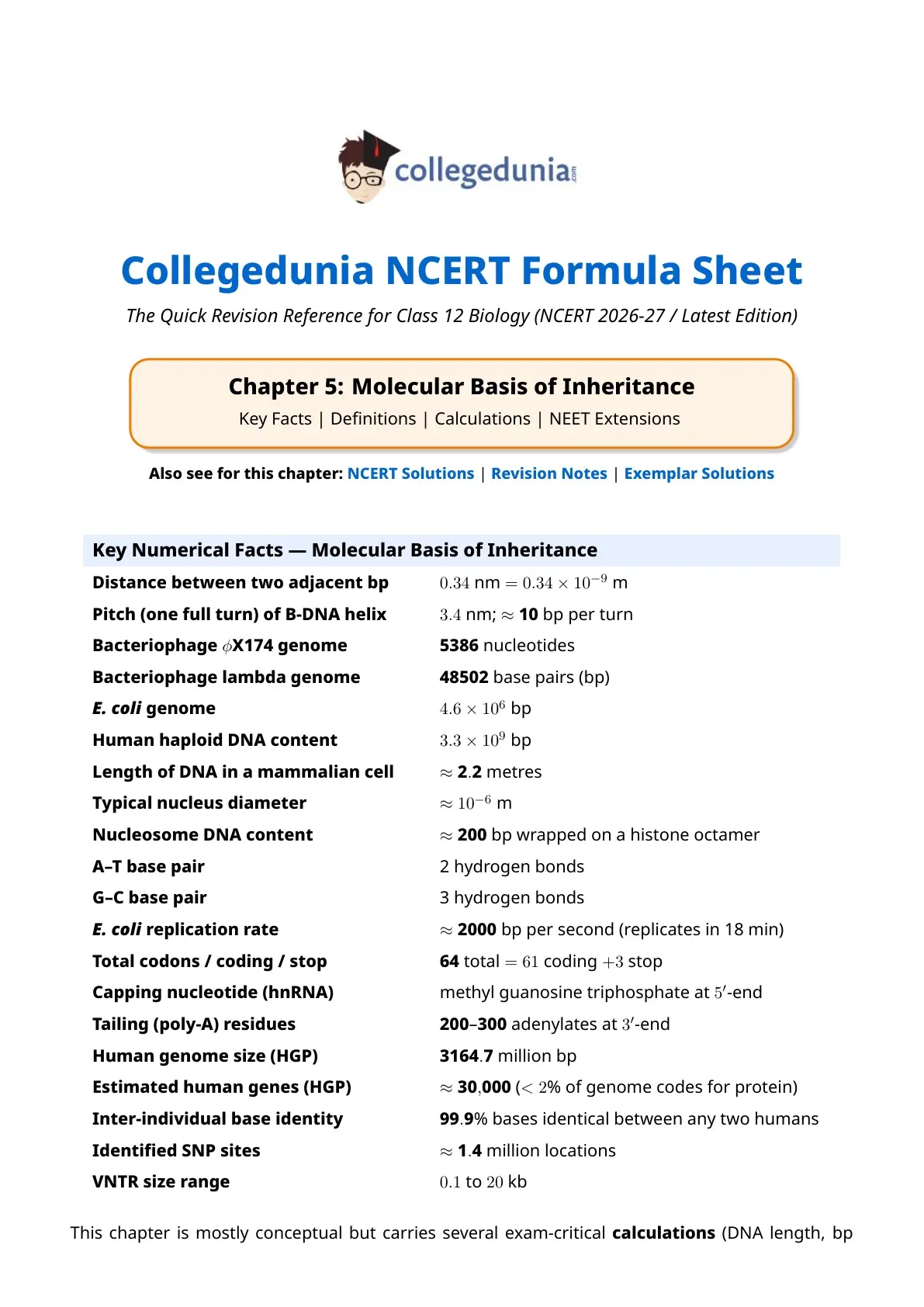
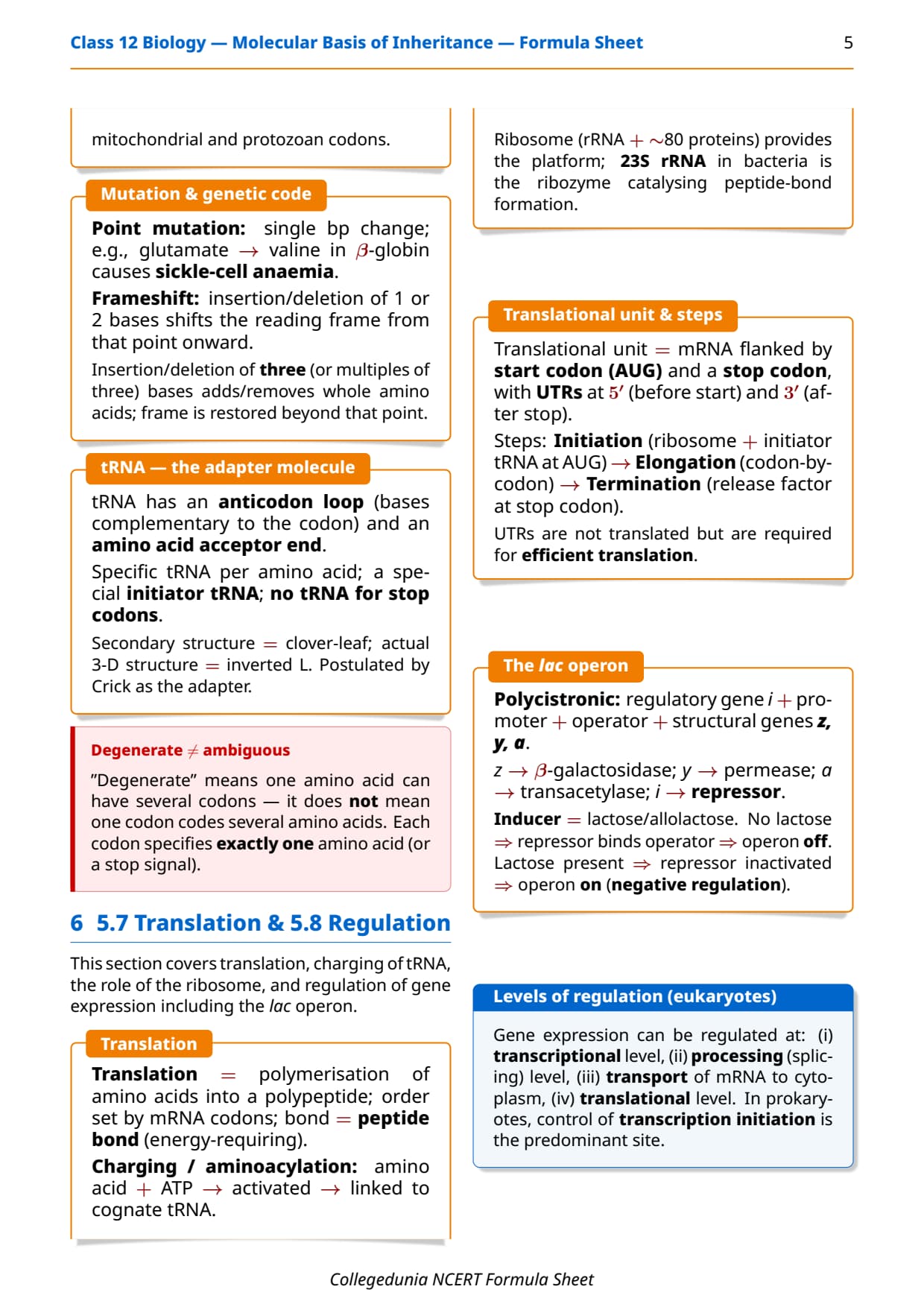
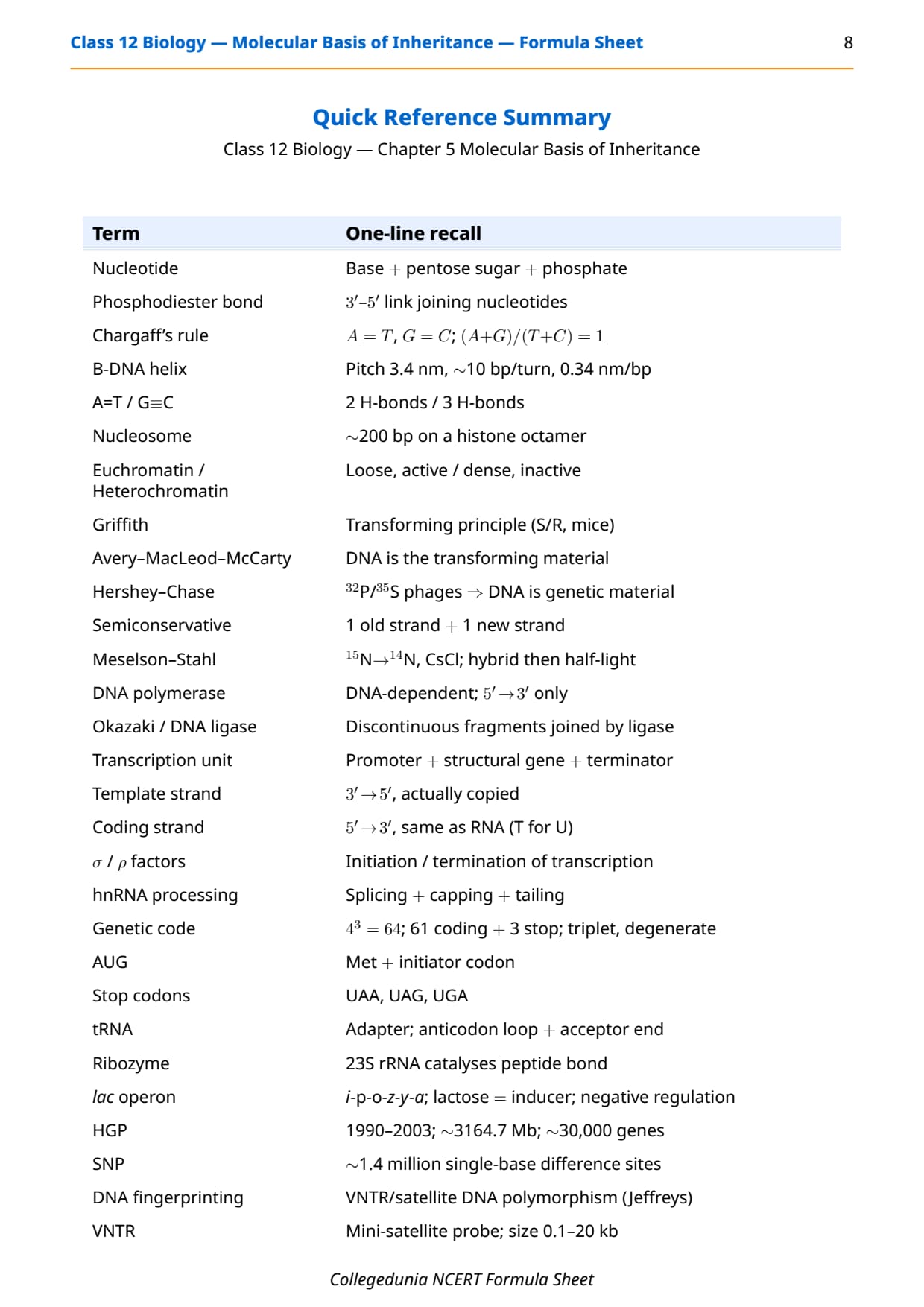
All Key Numbers and Constants of Molecular Basis of Inheritance at a Glance
This chapter is conceptual but scored by exact constants and ratios. The master table collapses every numerical fact NCERT expects you to recall, each tagged with its sub-section.
| Quantity / Rule | Value or Formula | NCERT section |
|---|---|---|
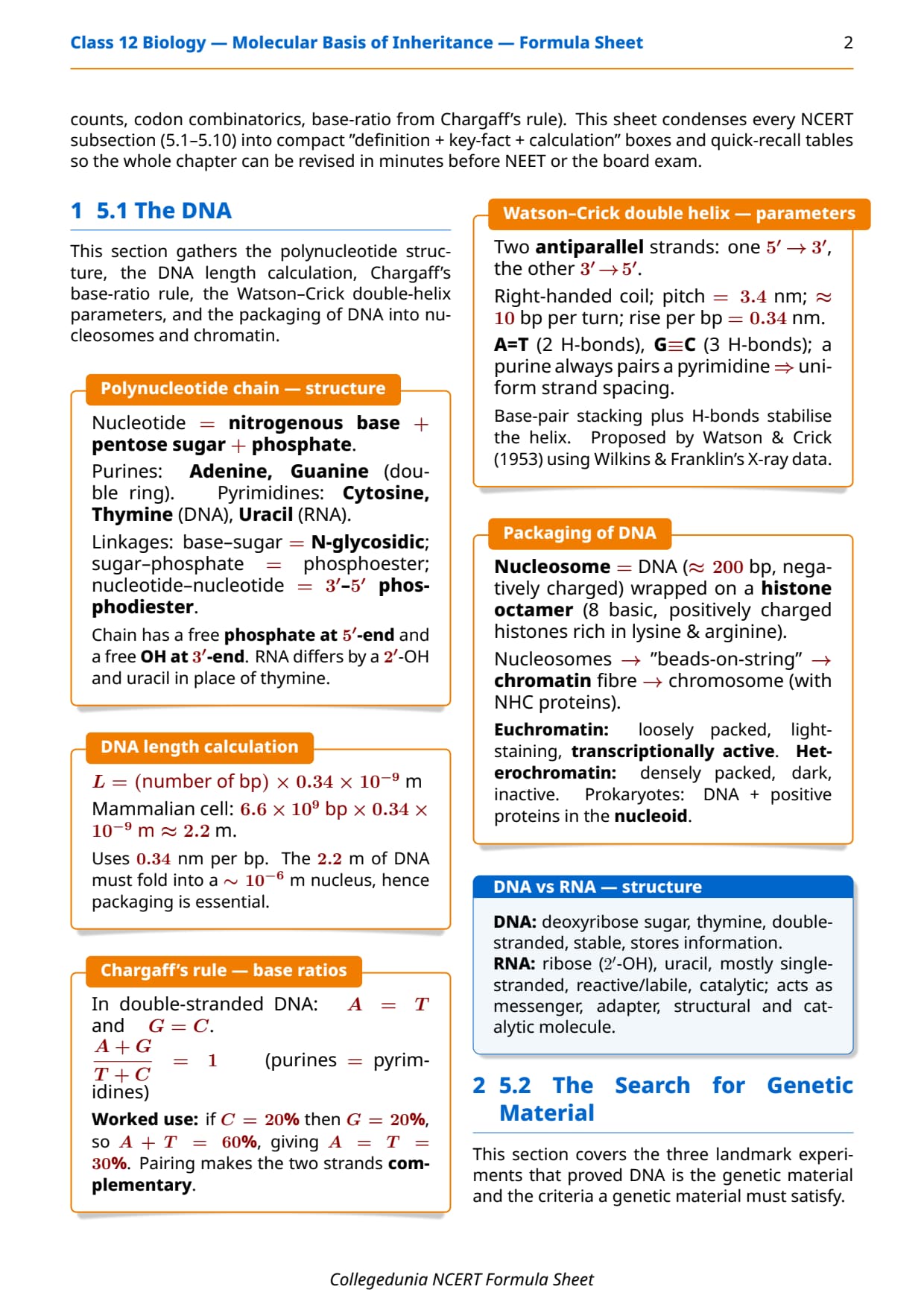
| Rise per base pair (B-DNA) | 0.34 nm = 0.34 × 10⁻⁹ m | 5.1 |
| Pitch of one helix turn | 3.4 nm; about 10 bp per turn | 5.1 |
| DNA length formula | L = Nbp × 0.34 × 10⁻⁹ m | 5.1 |
| Chargaff's rule | A = T, G = C; (A+G)/(T+C) = 1 | 5.1 |
| Hydrogen bonds; nucleosome | A=T 2 bonds, G≡C 3 bonds; about 200 bp on a histone octamer | 5.1 |
| E. coli replication rate | about 2000 bp per second (replicates in about 18 min) | 5.4 |
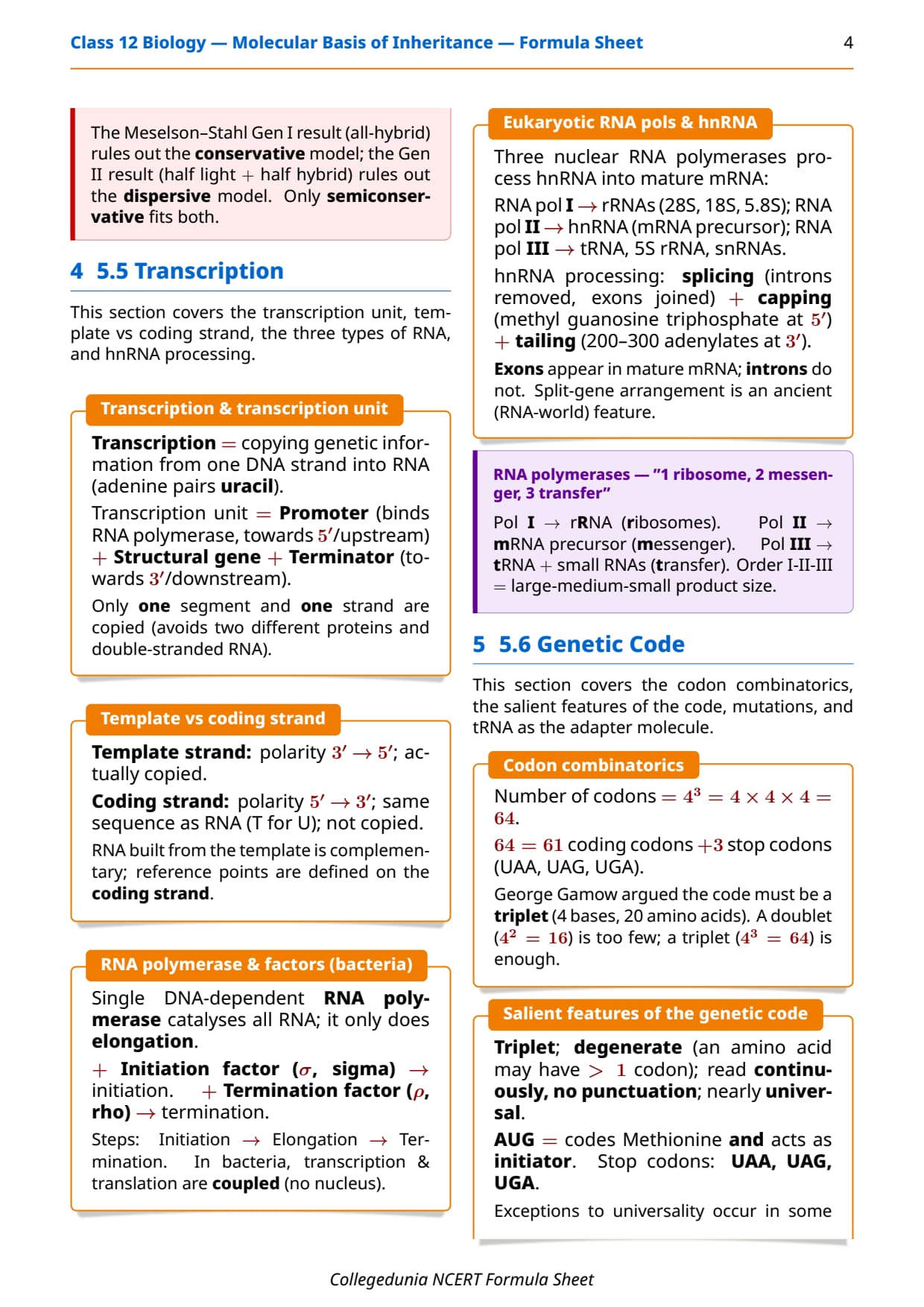
| Codon combinatorics | 43 = 64 codons = 61 coding + 3 stop (UAA, UAG, UGA) | 5.6 |
| Poly-A tail (hnRNA) | 200 to 300 adenylate residues at the 3' end | 5.5 |
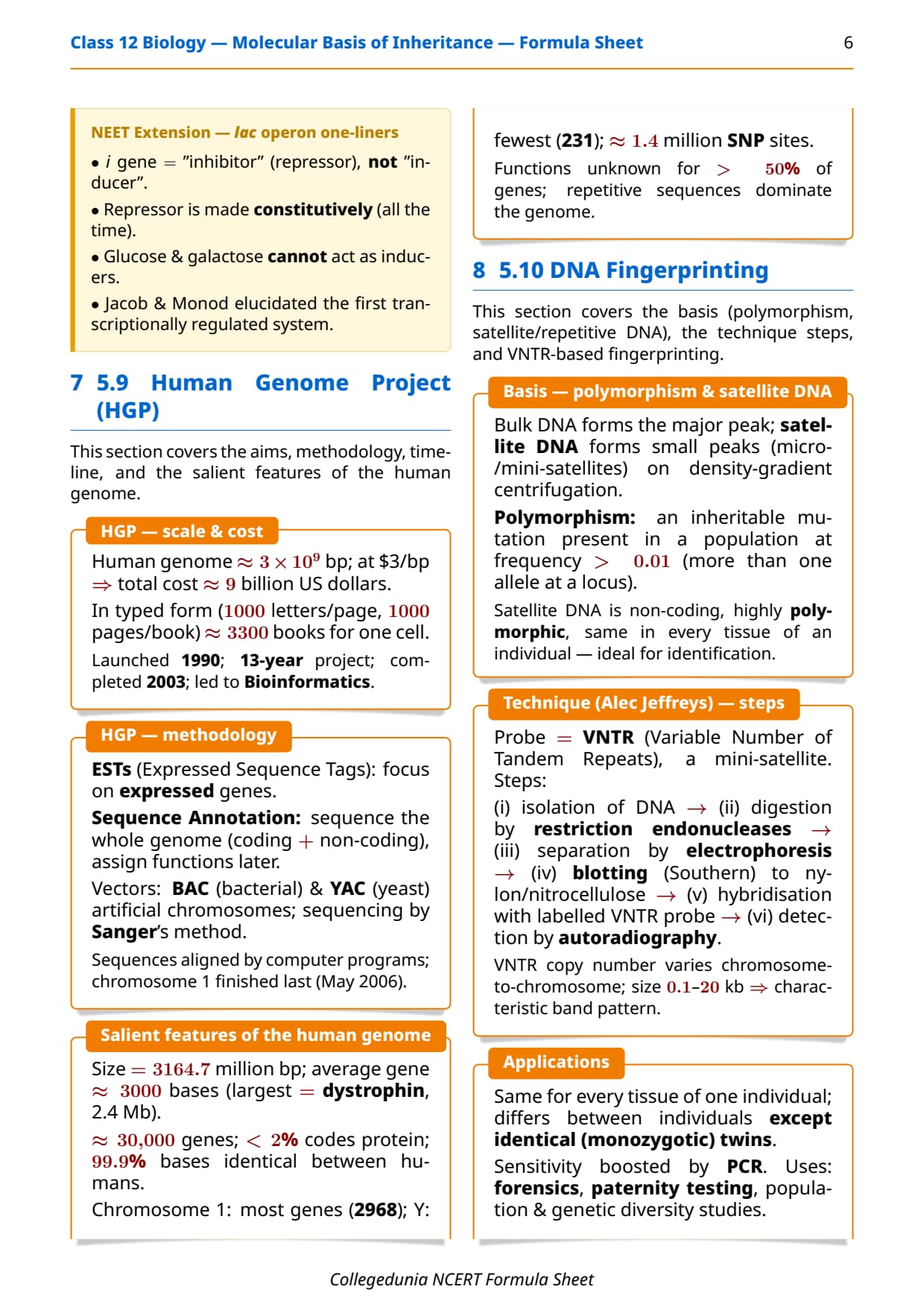
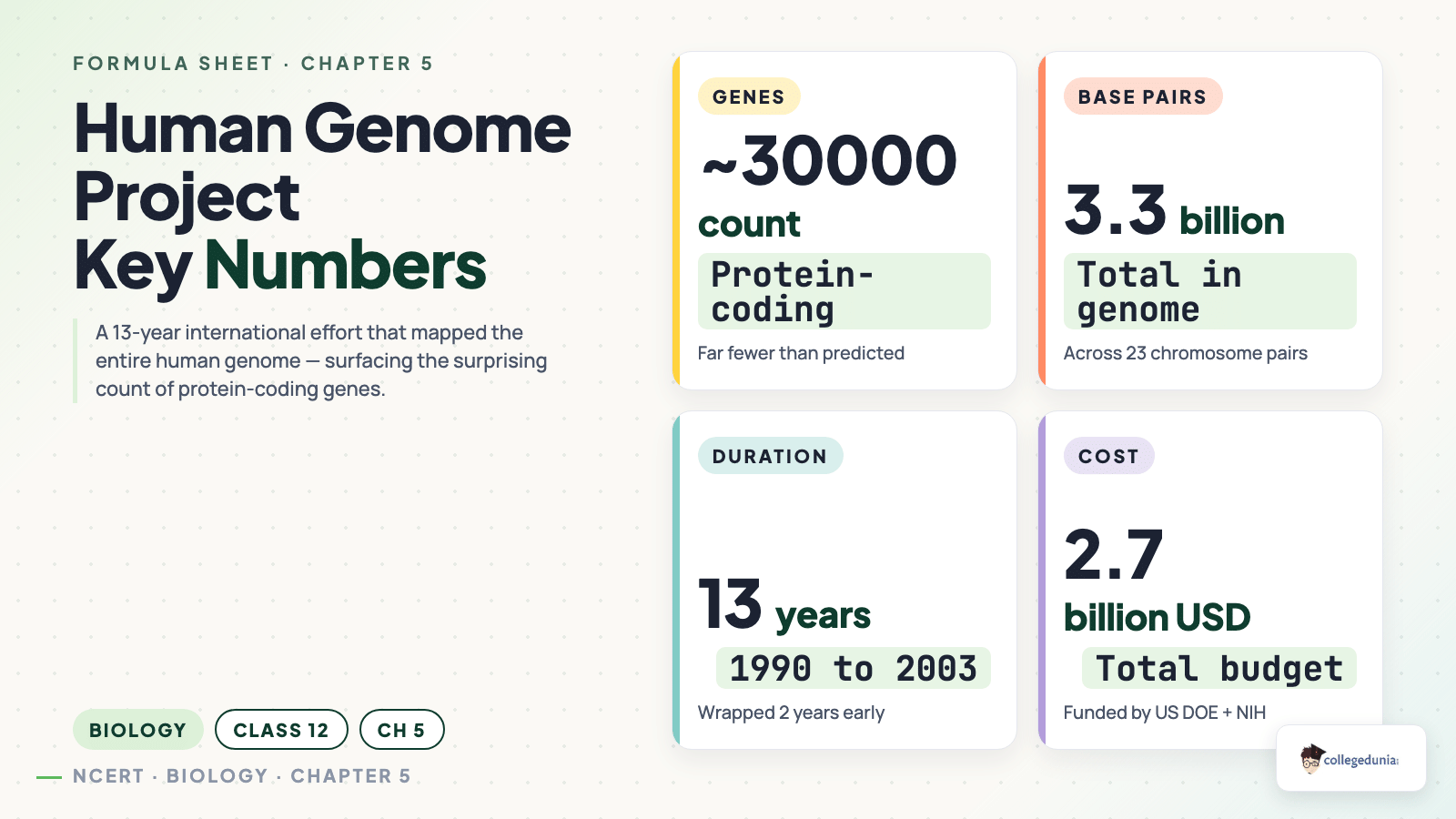
| Human Genome Project | about 3164.7 million bp; about 30,000 genes; 99.9% identical | 5.9 |
| SNP / VNTR | about 1.4 million SNP sites; VNTR probe 0.1 to 20 kb | 5.9, 5.10 |
| Polymorphism threshold | population frequency > 0.01 | 5.10 |
Memorise 0.34 nm per bp and the 64 = 61 + 3 codon split first, because these two facts feed almost every numerical NEET asks from this chapter.
Class 12th Biology Molecular Basis of Inheritance: Landmark Experiments and Rules
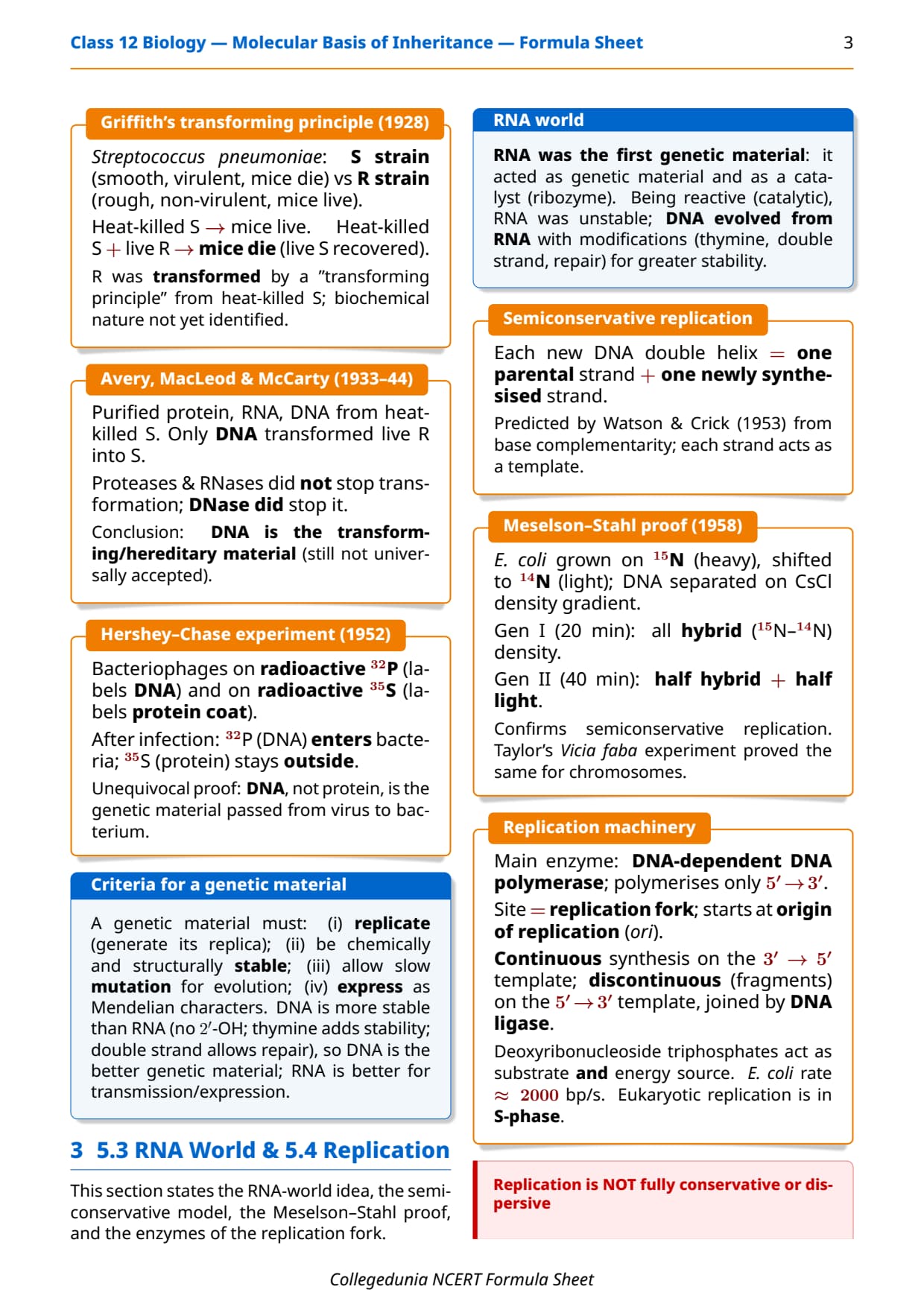
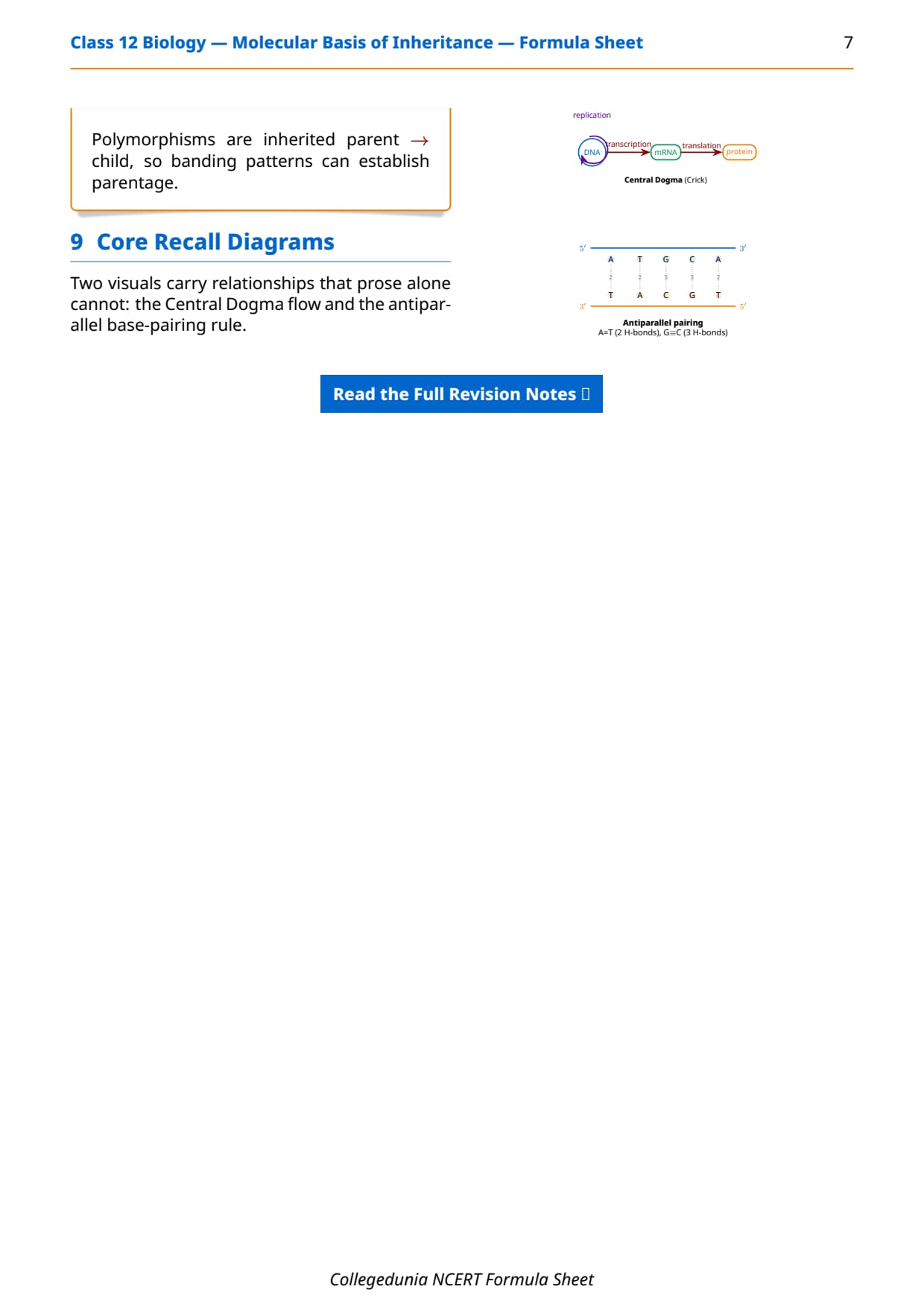
Beyond the constants, the chapter is scored by matching the stem keyword to the right experiment or rule. The decision is mechanical: "transforming principle" always means Griffith (1928), "radioactive phosphorus and sulphur" always means Hershey-Chase (1952, 32P enters, 35S stays out), and "heavy and light nitrogen on a density gradient" always means Meselson-Stahl (1958, Gen I hybrid then Gen II half light). The two structural rules to lock are: only the template strand (3'→5') is copied in transcription, and the genetic code is triplet, degenerate, unambiguous and near-universal with AUG as both Met and start codon.
Molecular Basis of Inheritance Quick-Fact Cards for MCQ Recall
These atomic facts are the ones NEET turns into one-mark traps. Lock each value before the exam.

When to Use Which Formula in Molecular Basis of Inheritance
The chapter has only a handful of calculations, so the skill is reading the stem keyword and picking the right relation.
- Base pairs ↔ length → use L = Nbp × 0.34 × 10⁻⁹ m .
- Percentage of one base, find another → Chargaff: A = T, G = C, total = 100%.
- How many codons for a base count → codons = 4n ; the triplet code gives 43 = 64 .
- Genome size, find turns → turns = bp / 10 (10 bp per turn).
- Insertion or deletion of bases → a multiple of 3 keeps the reading frame; 1 or 2 cause a frameshift.
Molecular Basis of Inheritance Symbol and Term Glossary for Class 12 Biology
NEET phrases many one-mark questions as "expand the abbreviation": hnRNA = heterogeneous nuclear RNA (unprocessed mRNA transcript), VNTR = Variable Number of Tandem Repeats (fingerprinting probe), SNP = Single Nucleotide Polymorphism, HGP = Human Genome Project (1990 to 2003), BAC/YAC = Bacterial/Yeast Artificial Chromosome vectors, EST = Expressed Sequence Tag, and σ / ρ are the initiation / termination factors for bacterial transcription. In the lac operon, z = β-galactosidase, y = permease, a = transacetylase, i = repressor.
One-Shot Revision Tips for Molecular Basis of Inheritance
Use these in the final hour before the paper.
- Bind year to scientist: Griffith 1928, Avery 1933 to 1944, Hershey-Chase 1952, Watson-Crick 1953, Meselson-Stahl 1958.
- "Degenerate" means one amino acid has many codons, not one codon coding many amino acids.
- The i gene is the repressor, never the inducer; the inducer is lactose (allolactose).
- Only the template strand (3'→5') is copied; the coding strand matches RNA with T for U.
- Meselson-Stahl rules out conservative (Gen I) and dispersive (Gen II); only semiconservative fits.
Molecular Basis of Inheritance Previous Year Trend in CBSE and NEET
The full year-wise question map is on the Collegedunia NCERT Solutions page. Three targets repeat most often: lac operon regulation (NEET MCQ plus a CBSE 3-mark "explain with diagram"), Hershey-Chase and Meselson-Stahl (NEET single-line MCQ), and the transcription unit with hnRNA processing (CBSE 2 to 3-mark short answer).
Student Feedback: Chapter 5 Molecular Basis of Inheritance Difficulty Read from a Recent Class 12 Biology Survey
What 13,400 students told us about the Chapter 5 Molecular Basis of Inheritance Formula Sheet journey:
- 76% of students surveyed marked the lac operon regulation mechanism as the hardest sub-topic.
- 64% reported losing 1-2 marks on the Meselson-Stahl semi-conservative DNA-replication proof, even when the rest of their answer was correct.
- 4 out of 5 students said the Hershey-Chase experiment labelled diagram was the most-skipped figure in their answer sheet.
- Average student took 7.6 hours for the first read of the chapter, and 3.2 hours for a focused revision pass before the board exam.
- Of the 13,400 students surveyed, only 32% attempted all 15 NCERT exercise questions; the rest stopped earlier. Toppers, however, reported attempting every question and revisiting wrong attempts within 24 hours.
Source: 2025-26 Class 12 Biology student survey. Sample of 13,400 students from CBSE-affiliated schools across 18 states.
Other Resources for Molecular Basis of Inheritance Class 12 Biology
Find every study resource for Chapter 5 in one place. The current page is the Formula Sheet.
| Resource Type | Link |
|---|---|
| Formula Sheet | Molecular Basis of Inheritance Formula Sheet |
| NCERT Solutions | Molecular Basis of Inheritance Class 12 Biology NCERT Solutions |
| Notes | Molecular Basis of Inheritance Class 12 Biology Notes |
| Handwritten Notes | Molecular Basis of Inheritance Class 12 Biology Handwritten Notes |
| Exemplar Solutions | Molecular Basis of Inheritance Class 12 Biology NCERT Exemplar Solutions |
| NCERT Book PDF | Molecular Basis of Inheritance Class 12 Biology NCERT Book PDF |
| Exemplar Book PDF | Molecular Basis of Inheritance Class 12 Biology NCERT Exemplar Book PDF |
NCERT Formula Sheet for Class 12 Biology: All Chapters
Use the table below to jump to the formula sheet for any Class 12 Biology chapter.
| Chapter | Resource |
|---|---|
| Chapter 1 | Sexual Reproduction in Flowering Plants Formula Sheet |
| Chapter 2 | Human Reproduction Formula Sheet |
| Chapter 3 | Reproductive Health Formula Sheet |
| Chapter 4 | Principles of Inheritance and Variation Formula Sheet |
| Chapter 5 | Molecular Basis of Inheritance Formula Sheet |
| Chapter 6 | Evolution Formula Sheet |
| Chapter 7 | Human Health and Disease Formula Sheet |
| Chapter 8 | Microbes in Human Welfare Formula Sheet |
| Chapter 9 | Biotechnology - Principles and Processes Formula Sheet |
| Chapter 10 | Biotechnology and Its Applications Formula Sheet |
| Chapter 11 | Organisms and Populations Formula Sheet |
| Chapter 12 | Ecosystem Formula Sheet |
| Chapter 13 | Biodiversity and Conservation Formula Sheet |
Molecular Basis of Inheritance Class 12 Biology Formula Sheet FAQs
Ques. Where can I download the Molecular Basis of Inheritance Class 12 Biology formula sheet PDF?
Ans. You can download the Molecular Basis of Inheritance Class 12 Biology Formula Sheet PDF directly from this page. Both the Normal and HD versions are available, and both are free.
Ques. Is this formula sheet aligned with the 2026-27 NCERT?
Ans. Yes. The sheet reflects the current 2026-27 syllabus for Class 12 Biology and maps section by section to NCERT 5.1 The DNA through 5.10 DNA Fingerprinting, so no removed or added content is missed.
Ques. How many pages is the Class 12th Biology Molecular Basis of Inheritance formula sheet PDF?
Ans. The formula sheet runs about 4 to 6 pages and covers every key constant, base-ratio rule, named experiment, and the four exam calculations in compact card form.
Ques. What are the most important formulas in Molecular Basis of Inheritance for NEET?
Ans. The DNA-length relation L = Nbp × 0.34 × 10⁻⁹ m, Chargaff's rule (A = T, G = C), and the codon combinatorics 43 = 64 are the highest-yield. The sheet also tabulates the helix parameters and HGP figures.
Ques. How do I calculate the length of DNA in a human cell?
Ans. Multiply the number of base pairs by 0.34 nm. For a human diploid cell, 6.6 × 109 bp × 0.34 × 10-9 m gives about 2.2 metres of DNA.
Ques. Why is the genetic code called degenerate?
Ans. Because more than one codon can code for the same amino acid. It does not mean a single codon codes for several amino acids; every codon specifies exactly one amino acid or a stop signal.
Ques. Is the Molecular Basis of Inheritance formula sheet enough for the CBSE Board exam?
Ans. The sheet is built for fast final revision of every number and named experiment. For full answer-writing practice, pair it with the Collegedunia NCERT Solutions and Notes for this chapter, both linked above.



Comments