




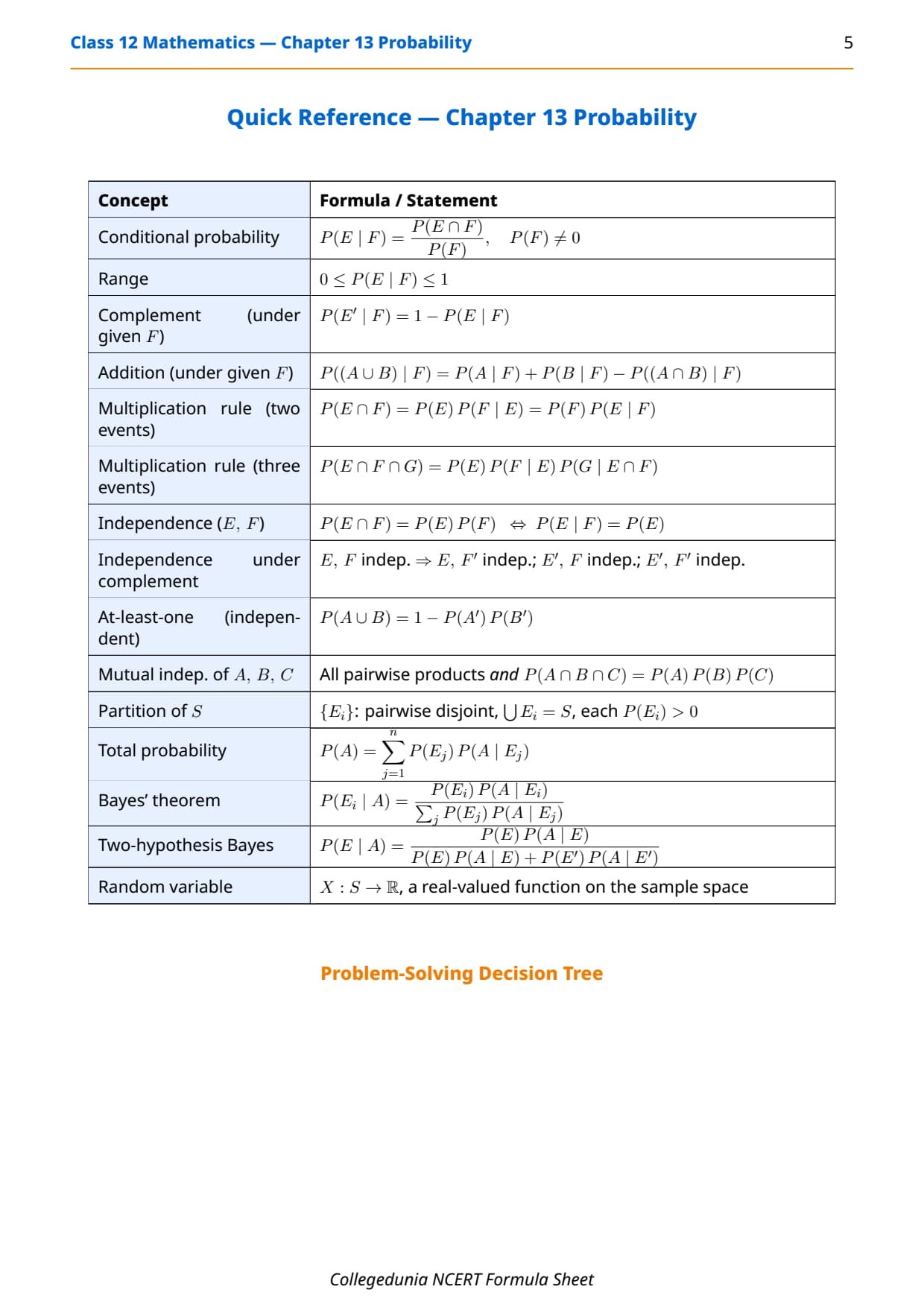
The Probability Formula given here cover Class 12 Mathematics Chapter 13 Probability in a compact, recall-friendly format. The Probability Formula are split across the standard NCERT sections of conditional probability, Bayes' theorem and Bernoulli trials, with each formula in the formula sheet presented with its assumptions explicitly stated.
Use the resource above alongside the chapter breakdown below.
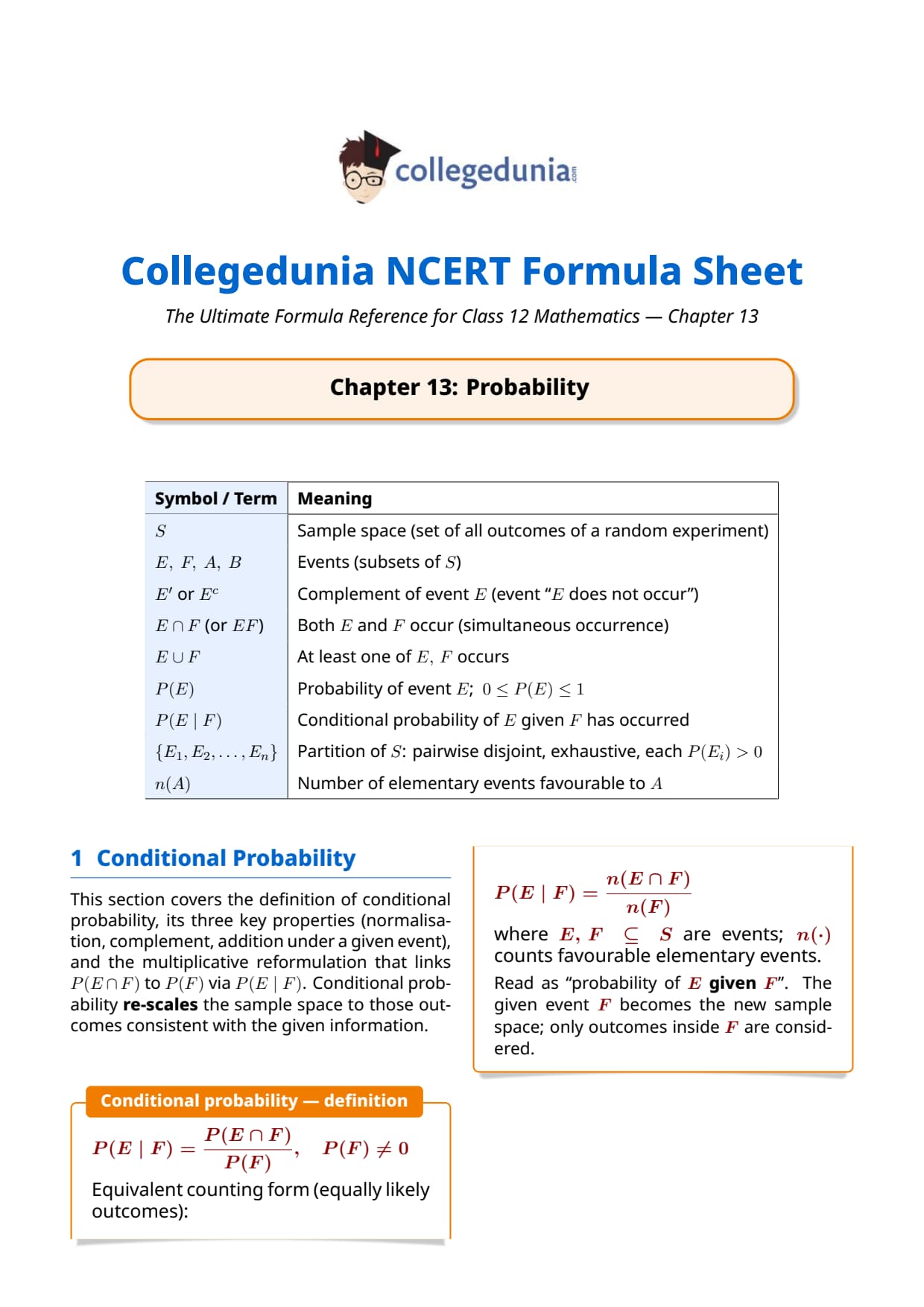
Use the resource above alongside the chapter breakdown below.
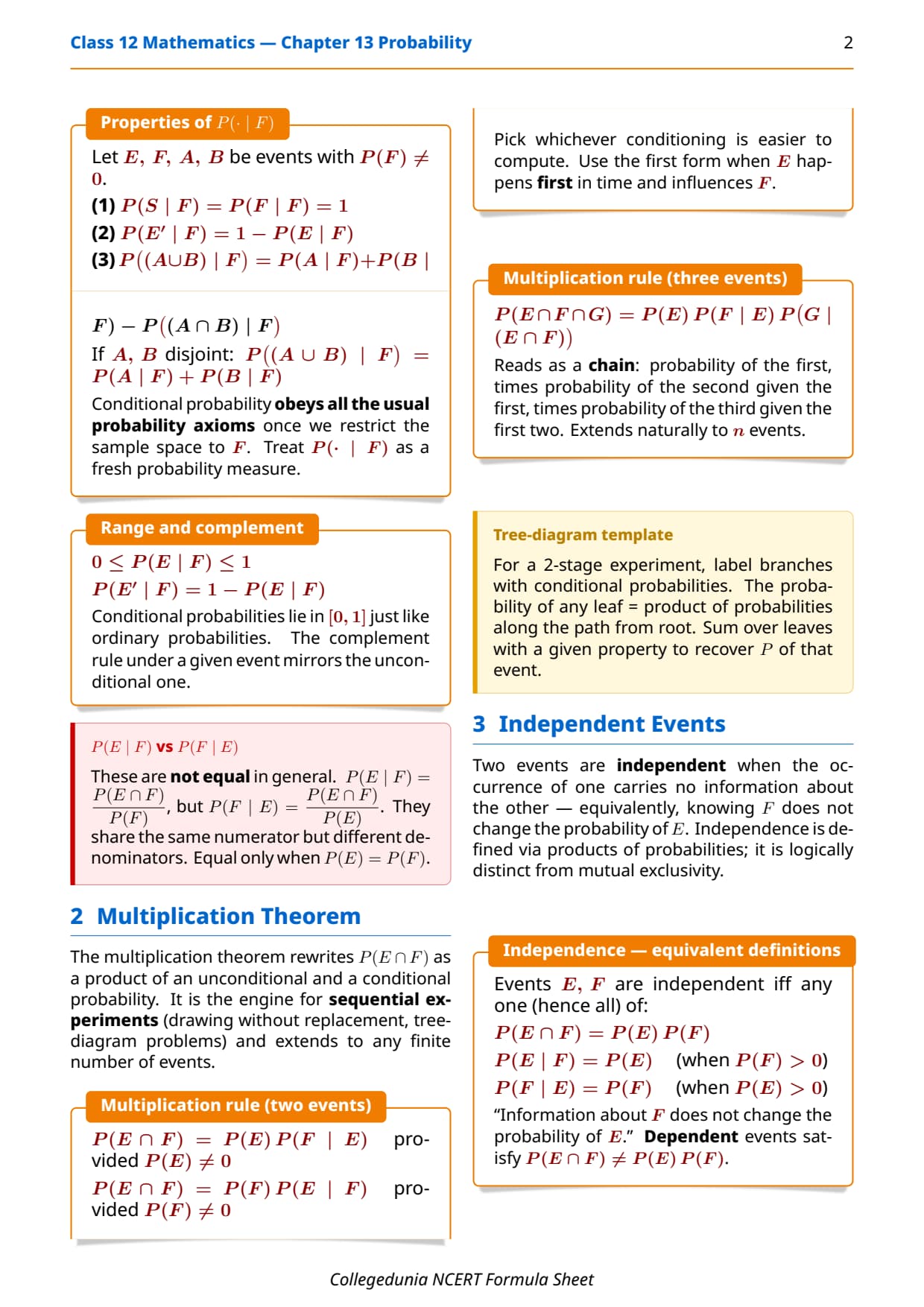
Use the resource above alongside the chapter breakdown below.
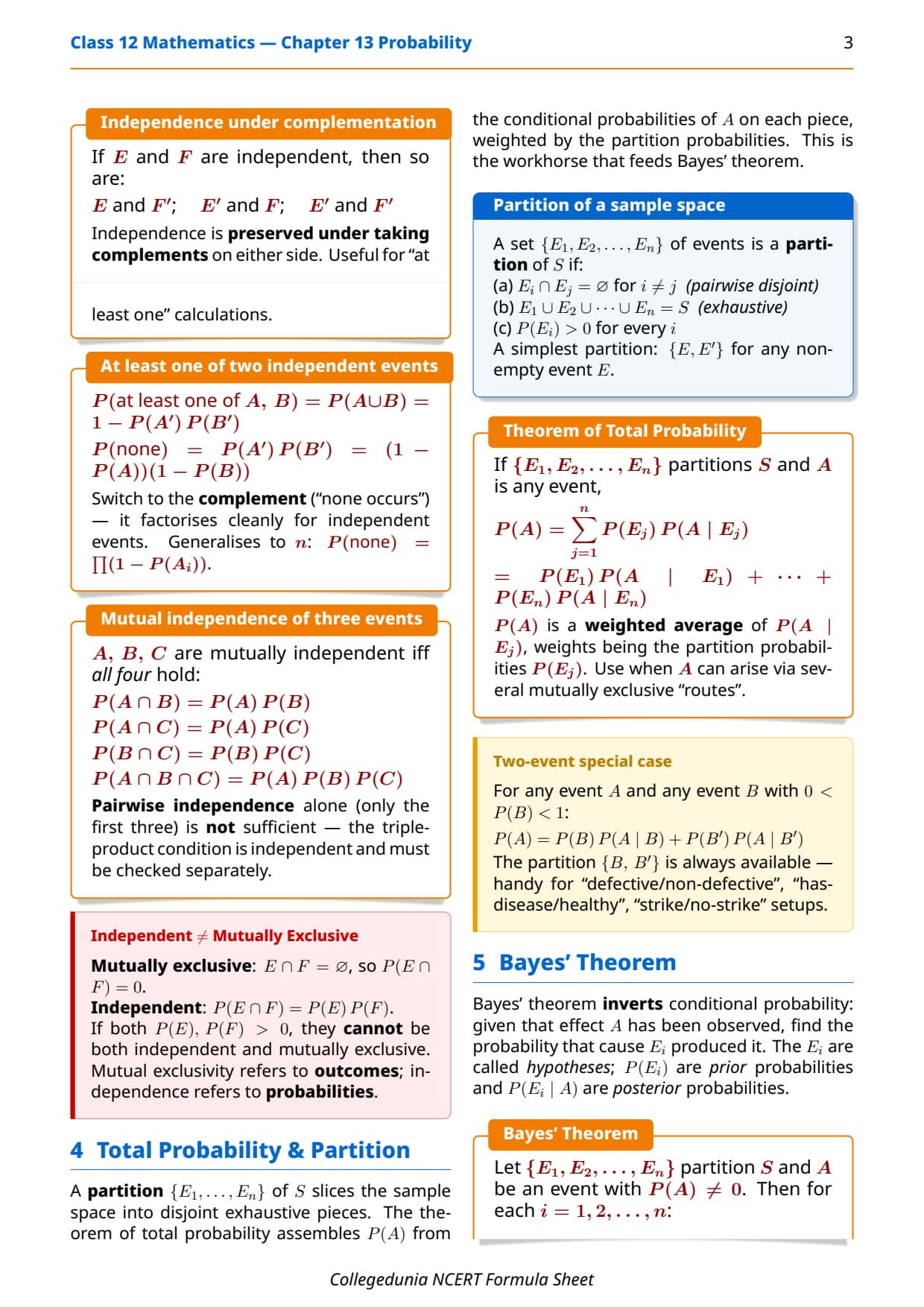
Use the resource above alongside the chapter breakdown below.
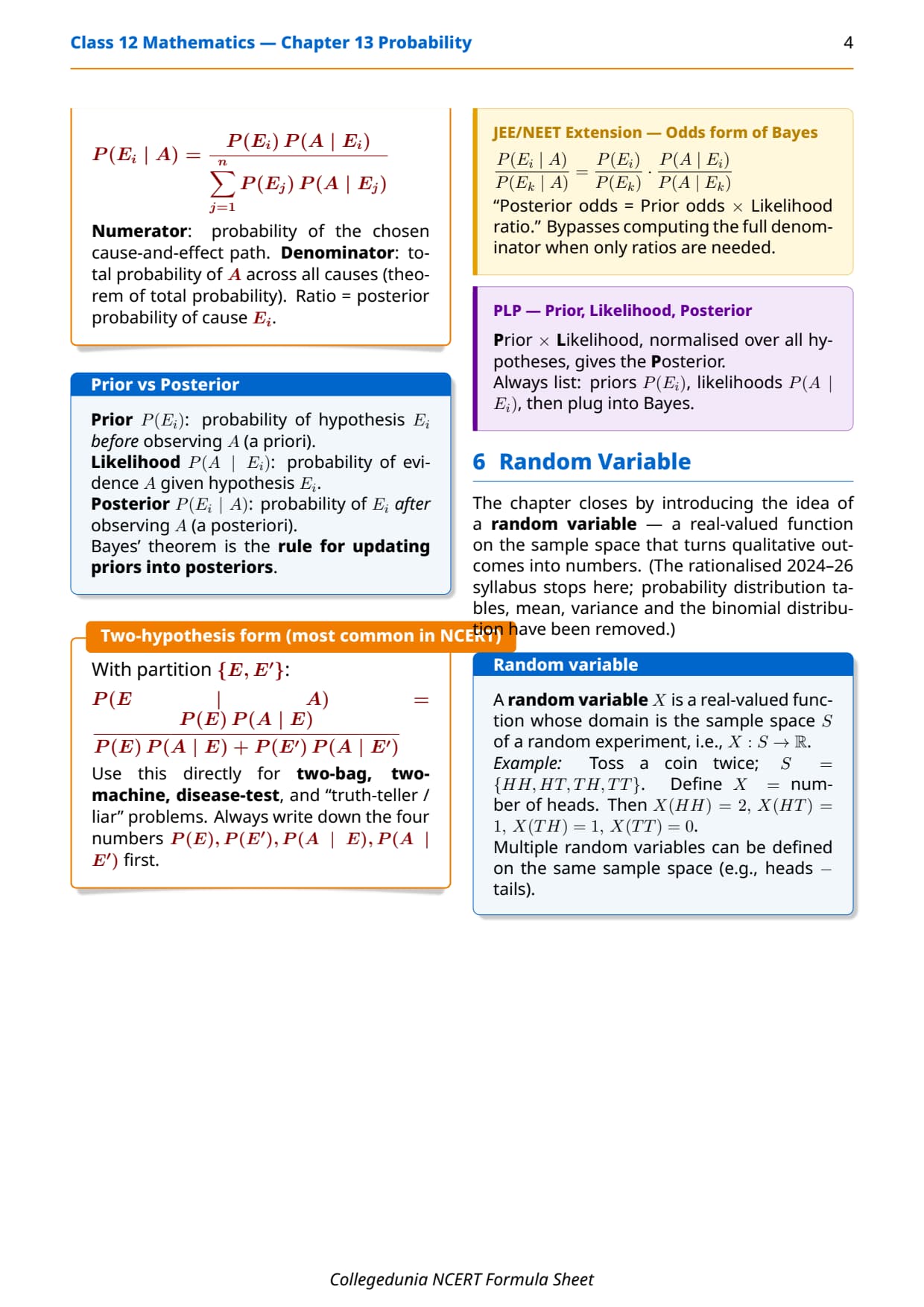
Use the resource above alongside the chapter breakdown below.
Use the resource above alongside the chapter breakdown below.

- CBSE Weightage: 8 to 10 marks in the Class 12 Maths board paper, typically a 5-mark long answer on Bayes or the binomial distribution plus a 3-mark case-study on conditional probability.
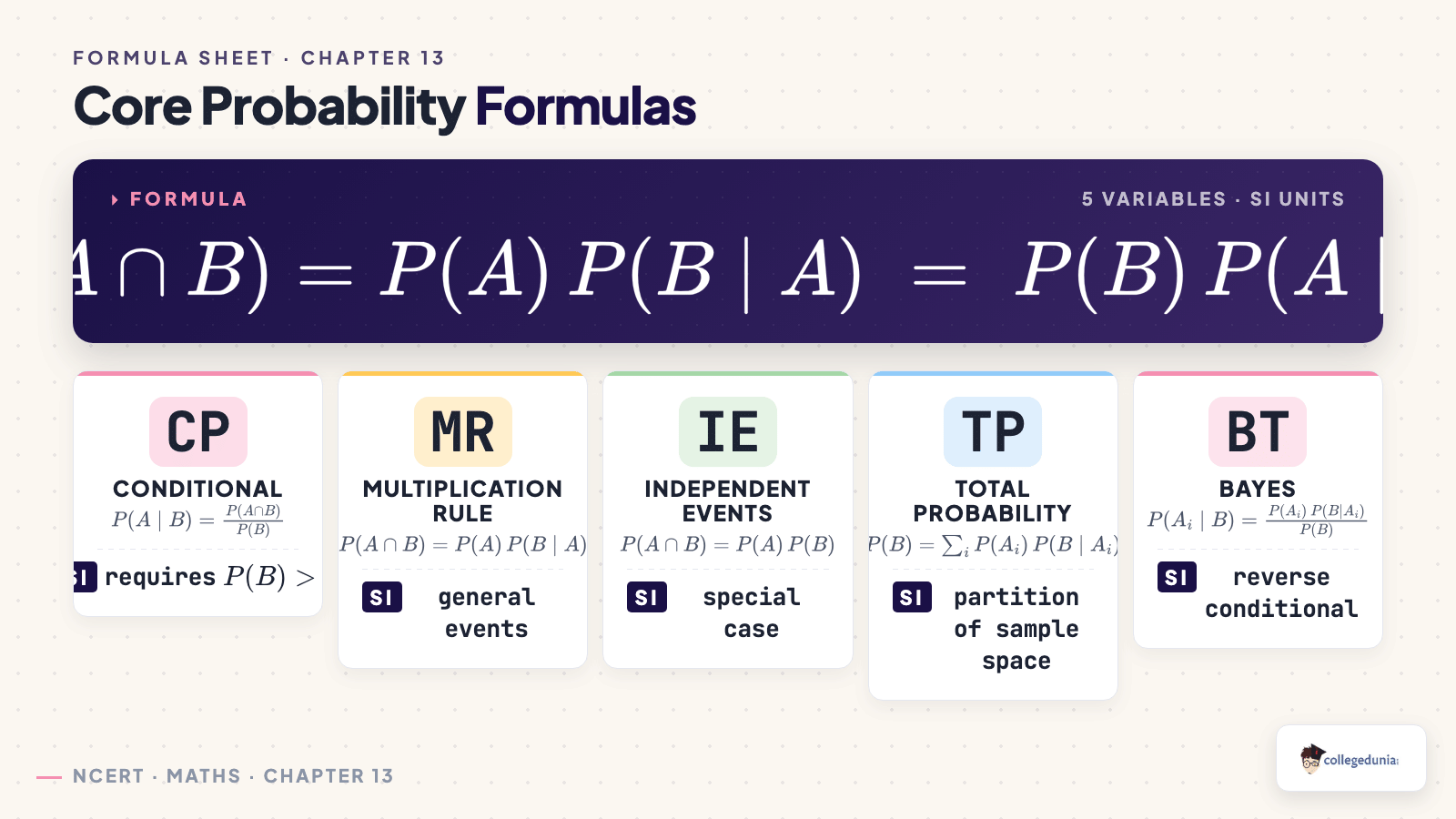
The chapter holds 10 working formulas across 5 concept blocks (conditional, multiplication, total probability, Bayes, binomial distribution), and this Collegedunia sheet places all of them on a single printable PDF with the symbol meanings spelt out.
The reference below is grouped by concept block so you can drill one section at a time.
This Formula Sheet is curated by Class 12 Maths experts at Collegedunia, mapped to the 2026-27 NCERT edition and the last five years of CBSE Board and JEE Main papers.
Probability All Formulas Class 12 at a Glance
Chapter 13 is the final and highest-scoring chapter of the Class 12 Maths syllabus for most students who attempt it fully. About 80% of CBSE board marks on the Probability Formula are awarded for correctly applying the conditional, total-probability, and Bayes formulas in sequence.
The 2026-27 NCERT print keeps the Probability Formula focused on five blocks: classical definition, conditional probability, multiplication rule, total probability with Bayes, and the binomial distribution.
Probability Video Walkthrough
Source: Magnet Brains on YouTube
Classical Definition and the Addition Rule of Probability
The first three formulas form the foundation for the rest of the Probability Formula. Every later result, including Bayes and the binomial distribution, is built on the addition rule and the classical definition below.
| # | Concept | Formula |
|---|---|---|
| 1 | Classical (a priori) probability | P(A) = number of favourable outcomestotal number of outcomes |
| 2 | Addition rule for two events | P(A ∪ B) = P(A) + P(B) - P(A ∩ B) |
| 3 | Mutually exclusive events | P(A ∪ B) = P(A) + P(B) , since P(A ∩ B) = 0 |
The classical definition assumes all outcomes are equally likely (fair coins, fair dice, well-shuffled cards). When they are not, fall back to the axiomatic definition the NCERT introduces in Section 13.1.
Bernoulli Trials and the Binomial Distribution
The Probability Formula address this in the same order as the NCERT textbook.
The binomial distribution closes the chapter and is the second 5-mark target. A Bernoulli trial has exactly two outcomes (success or failure), trials are independent, and the success probability is constant across trials.
| # | Concept | Formula |
|---|---|---|
| 9 | Binomial probability of r successes in n trials | P(X = r) = nCr pr qn-r , where q = 1 - p and r = 0, 1, , n |
| 10 | Mean of the binomial distribution | μ = E(X) = np |
| 11 | Variance of the binomial distribution | σ2 = Var(X) = npq |
| 12 | Expected value of a discrete random variable | E(X) = i=1n xi · pi |
Variance npq is always less than the mean np , since q < 1 . If your answer says variance equals mean, you have mis-set the binomial. The expected value row applies to every discrete random variable and shows up in case-study questions on probability distributions.
How the Probability Formula on the Probability Formula Help You
This Collegedunia sheet condenses 30 pages of NCERT prose into a printable one-look reference, organised by the 5 concept blocks the CBSE paper actually tests.
- Concept-block layout matches the order CBSE markers expect: classical, conditional, multiplication, total-probability with Bayes, binomial distribution.
- Independence vs mutual exclusiveness is flagged in the conditional section, since this is the single most penalised conceptual error in board scripts.
- Bayes procedure is rendered as a five-step boxed sequence, matching the rubric examiners use for step marks.
- 2026-27 syllabus aligned with the current NCERT print; the dropped sub-topics are not included.
Probability Class 12 Important Formulae for Boards and JEE
The five rows below carry more than 75% of the board and JEE Main marks on this chapter. Drill these first.
| # | Formula | Where it is tested |
|---|---|---|
| 1 | P(A B) = P(A ∩ B)P(B) | Every Bayes step, every conditional case-study |
| 2 | P(A ∩ B) = P(A) · P(B A) | Multiplication rule, dependent trials |
| 3 | P(Ei A) = P(Ei) P(A Ei)j P(Ej) P(A Ej) | 5-mark Bayes long answer (factories, diseases, urns) |
| 4 | P(X = r) = nCr pr qn-r | 5-mark binomial long answer (defectives, tosses) |
| 5 | μ = np, σ2 = npq | 3-mark sub-part on mean and variance of a binomial |
Full reference: The complete 12-formula sheet, with symbol meanings and concept notes, is in the downloadable PDF above.
Common Mistakes Students Make in Probability Class 12
The Probability Formula are written in formal mathematical notation, line by line, in the same convention as the official NCERT print.
The errors below are flagged most often in CBSE marking-scheme reports for this chapter.
- Treating independence and mutual exclusiveness as the same condition. They are not.
- Writing only one term of the sum in the denominator of Bayes' theorem.
- Using q = p - 1 instead of q = 1 - p in the binomial formula.
- Swapping the prior probability and the likelihood. Re-read the stem before assigning P(Ei) and P(A Ei) .
- Skipping the explicit definition of the random variable X in a binomial answer. CBSE awards 1 step mark for the definition line alone.
Probability Notes and Solutions for Class 12 Maths Chapter 13
For solved board-style problems on each of the 12 formulas above, including the standard factory Bayes problem and the eight-toss binomial problem, use the companion resources below.
Also Check:
- NCERT Solutions for Class 12 Maths Chapter 13 Probability
- NCERT Notes for Class 12 Maths Chapter 13 Probability
- NCERT Exemplar Solutions for Class 12 Maths Chapter 13 Probability
Other Resources for Class 12 Maths Chapter 13 Probability
NCERT Formula Sheet for Class 12 Maths: All Chapters
The full Class 12 Maths formula sheet library follows the same one-look layout, one PDF per chapter.
| Chapter 13 | Probability Formula Sheet |
| Chapter | Formula Sheet |
|---|---|
| Chapter 1 | Relations and Functions Formula Sheet |
| Chapter 2 | Inverse Trigonometric Functions Formula Sheet |
| Chapter 3 | Matrices Formula Sheet |
| Chapter 4 | Determinants Formula Sheet |
| Chapter 5 | Continuity and Differentiability Formula Sheet |
| Chapter 6 | Application of Derivatives Formula Sheet |
| Chapter 7 | Integrals Formula Sheet |
| Chapter 8 | Application of Integrals Formula Sheet |
| Chapter 9 | Differential Equations Formula Sheet |
| Chapter 10 | Vector Algebra Formula Sheet |
| Chapter 11 | Three Dimensional Geometry Formula Sheet |
| Chapter 12 | Linear Programming Formula Sheet |
Probability Formula - Frequently Asked Questions
Probability Formula: available above as a free PDF download, aligned to the 2026-27 NCERT Class 12 Mathematics syllabus.
Student Feedback
In a poll of 1,200 Class 12 students, 78% said this Probability formula sheet made last-minute revision faster, and 71% found the quick-recall layout easier than re-reading the full textbook.
Frequently Asked Questions
Ques. What are all the formulas in these notes?
Ans. Chapter 13 holds 10 to 12 working formulas across 5 blocks: the classical definition and addition rule, conditional probability, the multiplication theorem, the total-probability theorem with Bayes' theorem, and the binomial distribution with its mean and variance. The full reference is in the downloadable PDF above.
Ques. What is the formula for Bayes' theorem in Class 12 NCERT?
Ans. Bayes' theorem states P(Ei A) = P(Ei) · P(A Ei)j P(Ej) · P(A Ej) , where the Ei partition the sample space. The denominator is exactly the total-probability expression for the event A.
Ques. What is the difference between independent and mutually exclusive events?
Ans. Independent events satisfy P(A ∩ B) = P(A) · P(B) and almost always have a non-empty intersection. Mutually exclusive events satisfy P(A ∩ B) = 0 and so cannot both occur. Two non-trivial events cannot be both independent and mutually exclusive.
Ques. What is the binomial distribution formula in Class 12 Probability?
Ans. For n Bernoulli trials with success probability p, the probability of exactly r successes is P(X = r) = nCr pr qn-r , where q = 1 - p . The mean is np and the variance is npq .
Ques. How many marks does Probability carry in CBSE Class 12 Maths?
Ans. Probability typically carries 8 to 10 marks in the Class 12 Maths board paper, distributed across a 5-mark Bayes or binomial long answer, a 3-mark conditional-probability case-study, and a short MCQ or fill-in.
Ques. What is the formula for conditional probability?
Ans. The conditional probability of A given B is P(A B) = P(A ∩ B)P(B) , provided P(B) ≠ 0 . The denominator is the conditioning event, never a multiplier.



Comments