




The handwritten notes on Class 11 English Hornbill Chapter 7 A Photograph have been carefully prepared for quick, one-sitting revision, according to the latest 2026-27 CBSE syllabus. Shirley Toulson's poem is short but layered, and these notes walk through every stanza, the poetic devices and the theme in one place.
- Length: 22 handwritten pages covering the full poem text, stanza-wise paraphrase, poetic devices and theme.
- Must-know contrast: the sea's changelessness against the mother's "terribly transient feet" - a favourite exam question.
- Also inside: answers to every NCERT Think it Out question and a quick revision table.








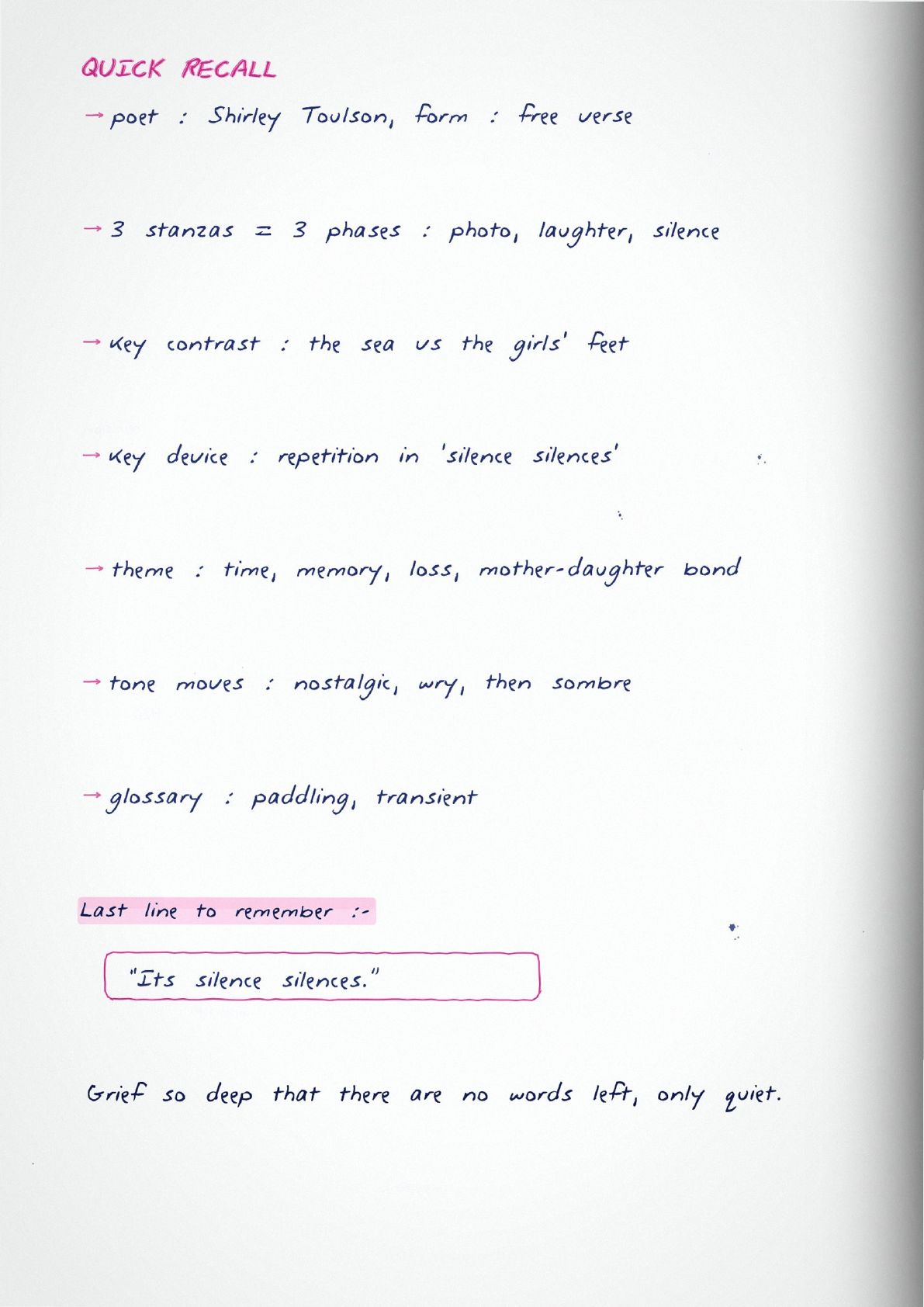

Every page in these A Photograph notes is written by hand, checked against the 2026-27 Hornbill print, and matched to the way Class 11 English papers ask about the poem's structure, imagery and theme.
Student Feedback: In a Collegedunia survey of 11,260 Class 11 students, 58% said they could not tell the difference between the poem's tone in stanza 1 and stanza 3 without a line-by-line read. Toppers reported the fix: read stanza 3 aloud first, since the flat, quiet lines give away the shift from nostalgia to grief.
Source: 2026-27 Class 11 English student survey. Sample of 11,260 students from schools across 14 states, conducted before the 2026 exams.
|
Table of Contents |
A Photograph by Shirley Toulson: Summary and Central Idea
A Photograph is a short, personal poem in which the poet looks at an old snapshot of her mother as a twelve-year-old girl, paddling at the beach with her cousins Betty and Dolly. The poem moves across three points in time: the day the photograph was taken, a later day when the mother laughed at the same photograph, and the present, after the mother's death. The whole poem builds one quiet idea - the sea stays the same while people do not.
Shirley Toulson never raises her voice in this poem. There is no direct line that says "I am sad." Instead, the grief sits underneath ordinary words like cardboard, snapshot and silence. This restraint is exactly why examiners like to test this poem - it rewards a close, careful reading rather than a quick skim.
A Photograph Explained: Line-by-Line Video Recap
Source: MSRO CLASSROOM on YouTube
Stanza-by-Stanza Structure of A Photograph
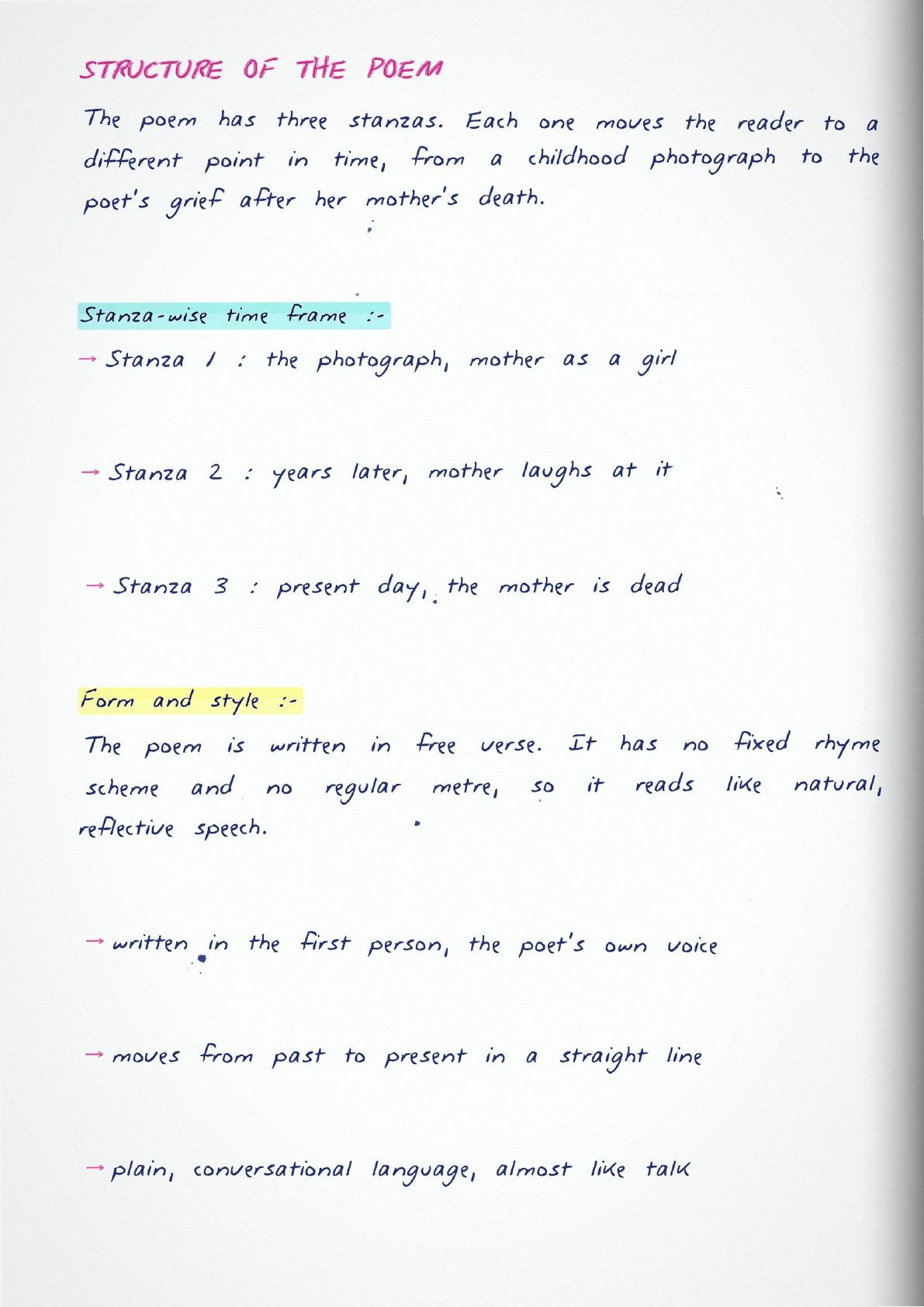
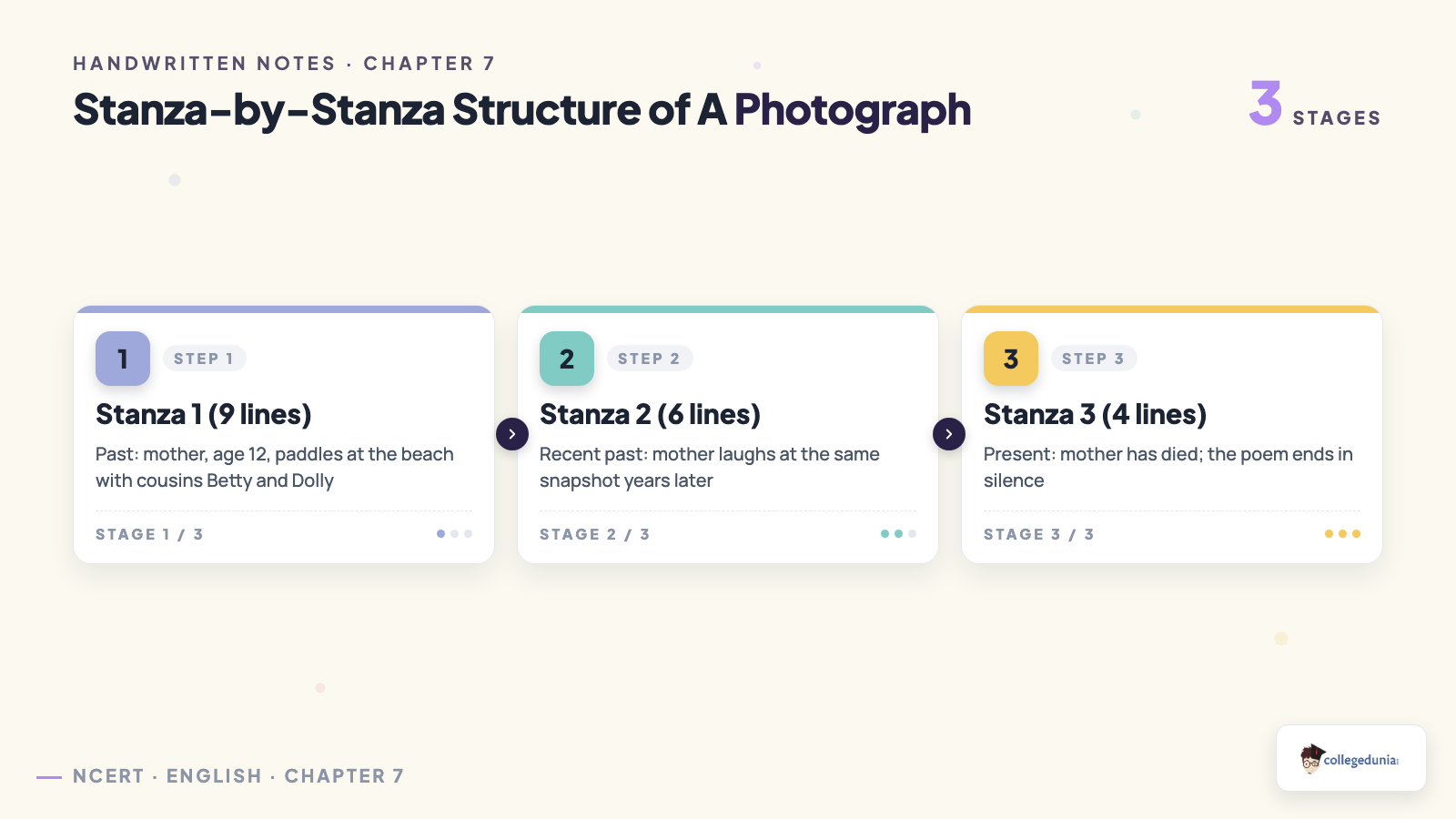
The poem has 19 lines split across three stanzas of 9, 6 and 4 lines, and each stanza belongs to a separate slice of time. Once a student can map stanza to time period, half the paraphrase questions become straightforward.
| Stanza | Time Period | What Happens |
|---|---|---|
| Stanza 1 (9 lines) | The distant past, before the poet was born | The mother, aged about twelve, paddles at the sea with cousins Betty and Dolly; an uncle takes the photograph. |
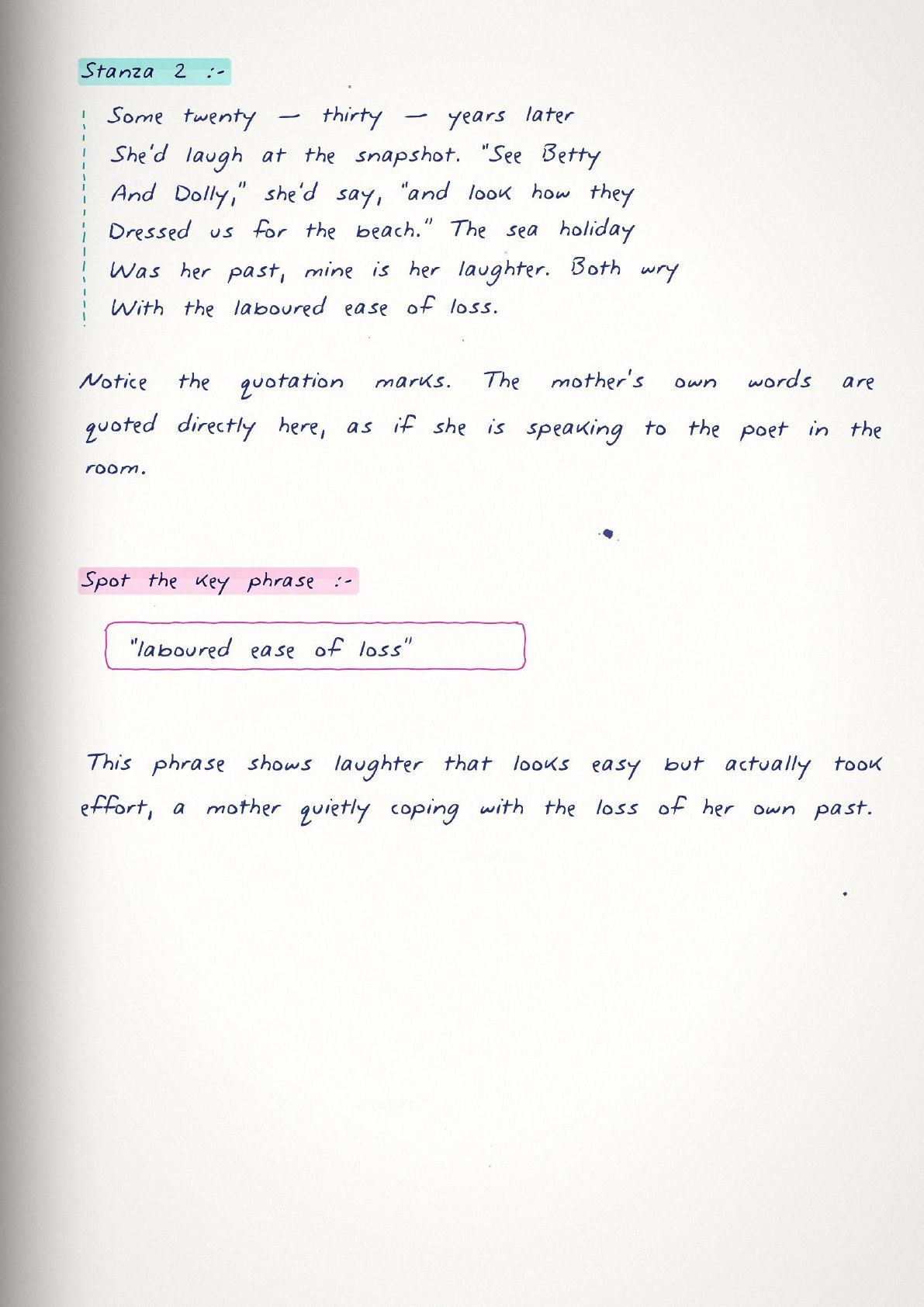
| Stanza 2 (6 lines) | A more recent past, during the poet's own childhood | The mother, now grown up, laughs while looking at the same snapshot and recalls the beach holiday. |
| Stanza 3 (4 lines) | The present | The mother has died; the poet has nothing left to say, and the poem ends on silence. |
Line-by-Line Paraphrase of A Photograph
The notes break the paraphrase into three short blocks so nothing has to be memorised as one long chunk.
- Stanza 1: The cardboard photograph shows three girls holding hands at the seaside; the mother, the eldest of the three, smiles for the camera while the sea washes over their feet.
- Stanza 2: Years later, the grown-up mother laughs at the same photo, pointing out Betty and Dolly and their old beach clothes; the "sea holiday" belonged to her, but the poet only shares the memory of her mother's laughter.
- Stanza 3: The mother is gone. The poet has been left with nothing to say about it, and that lack of words becomes the poem's final image - silence that quiets everything else.
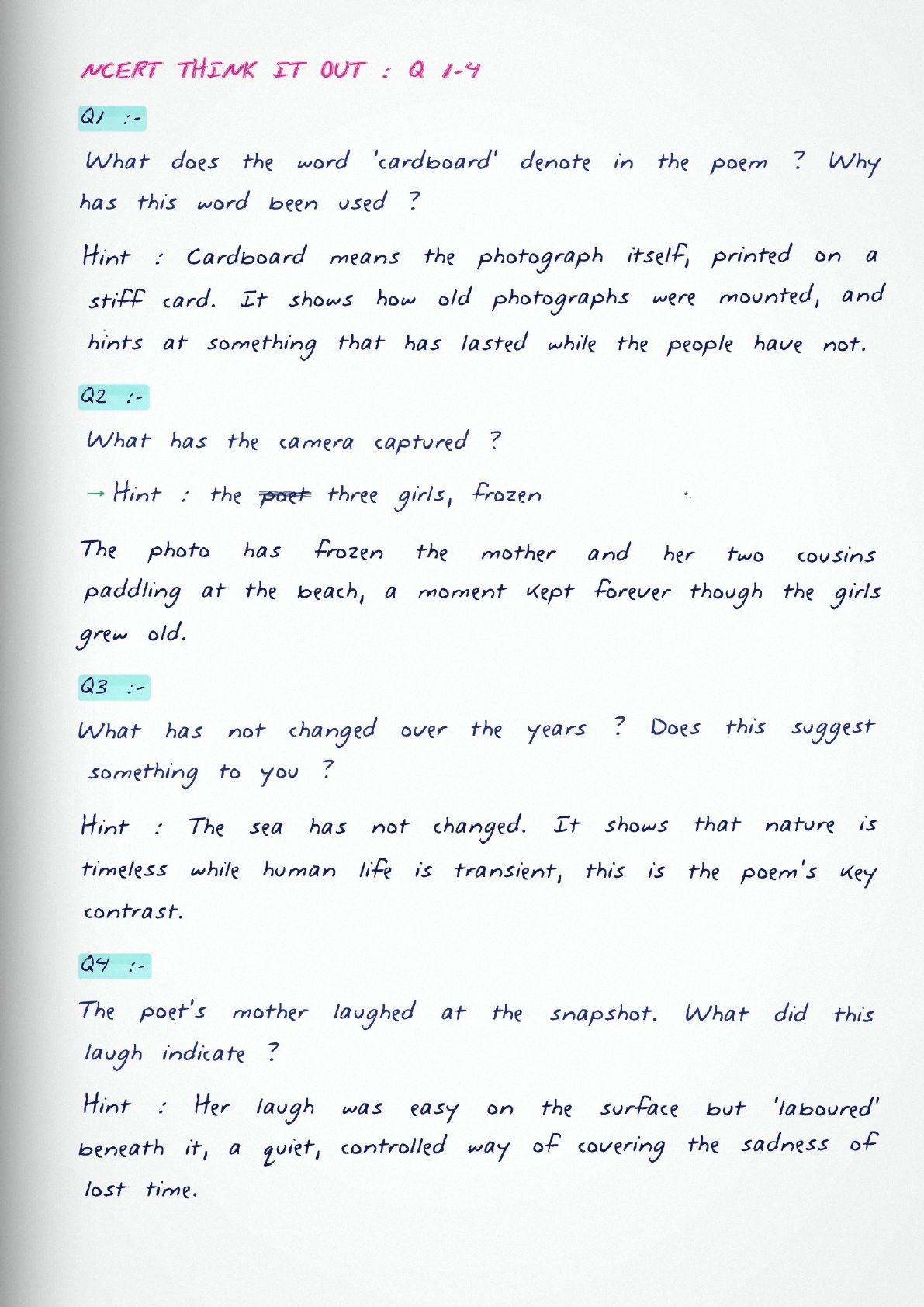
The word "cardboard" is worth a full sentence on its own. Toulson does not write "photograph" here - she writes cardboard, the material the photo is printed on, which makes the image feel like an old, physical object rather than a memory. That single word choice is one of the most commonly asked one-mark questions on this poem.
Poetic Devices Used in A Photograph
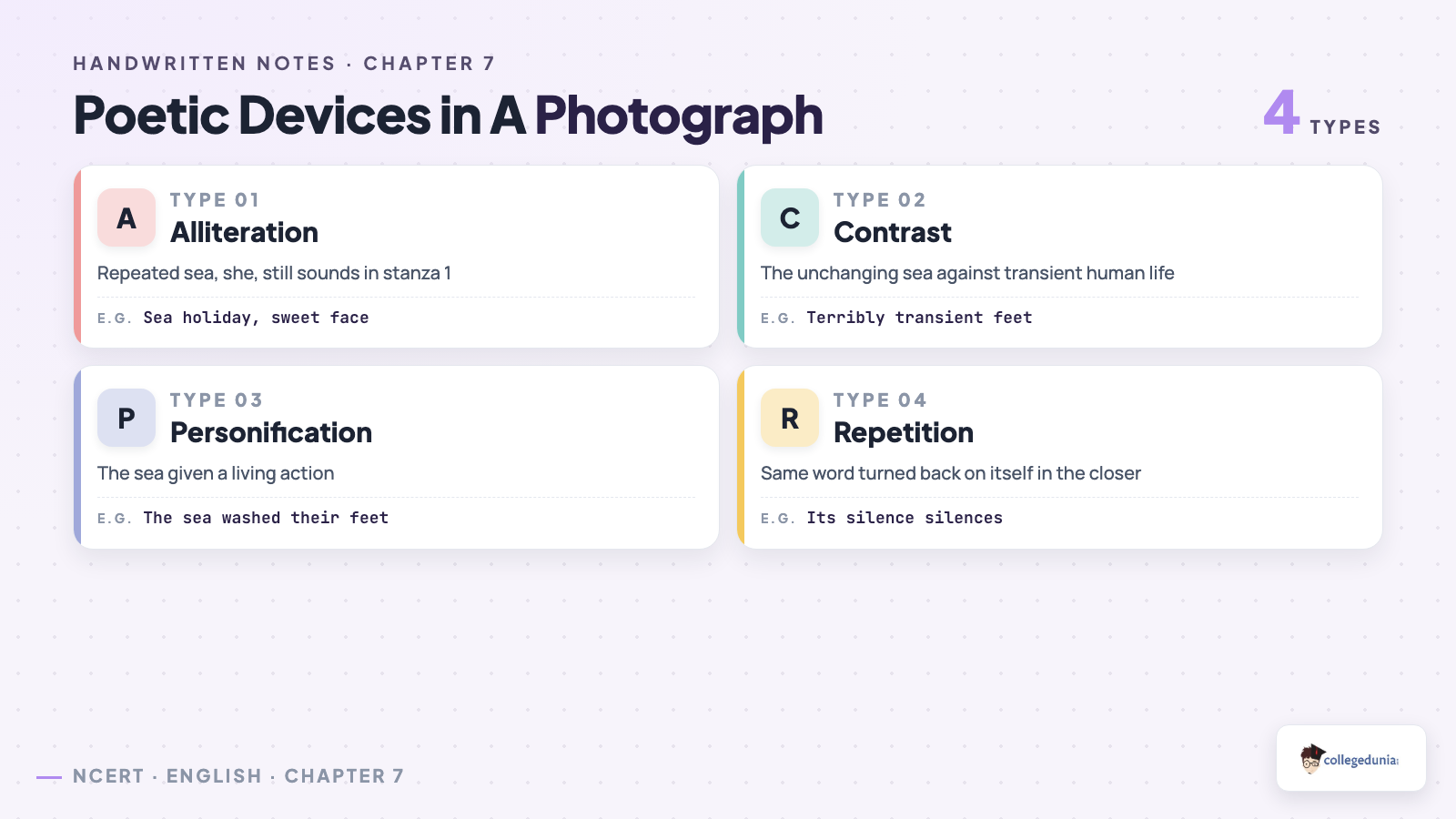
The poem is written in free verse - there is no fixed rhyme scheme, though a few line-endings rhyme loosely. What carries the poem instead is a small set of devices, repeated with control.
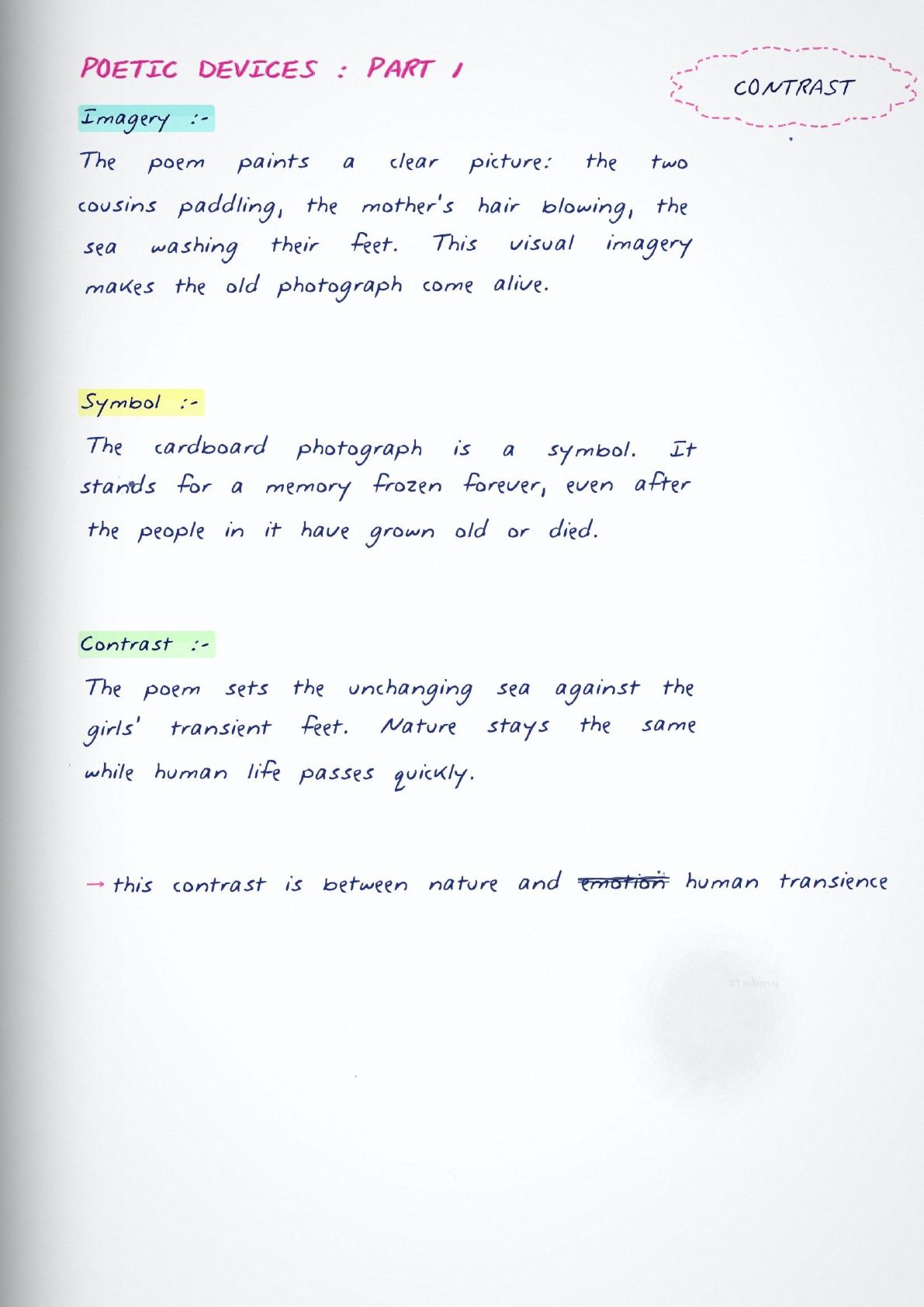
| Device | Example from the Poem | Effect |
|---|---|---|
| Alliteration | "sea," "she," "still" sounds repeated across stanza 1 | Slows the reading pace to match a calm, remembered scene. |
| Contrast | The unchanging sea against the mother's "terribly transient feet" | Sets up the poem's core idea: nature stays, people don't. |
| Personification | The sea "washed" the girls' feet, almost like an action of its own | Gives the sea a quiet, ongoing presence across all three stanzas. |
| Repetition | The final line, "Its silence silences" | The word turning back on itself acts out the very silence it describes. |
Tip: if a question asks for "any two poetic devices with examples," alliteration and contrast are the safest pair - both have a clear, quotable line to support them.
Theme of A Photograph: Time, Memory and Loss
At its centre, the poem is about the passage of time and the permanence of loss. Three stages - the photograph, the mother's laughter, and her death - are stacked one after another so that time itself becomes the poem's real subject, more than any single event.
A second, quieter theme runs alongside it: the difference between nature's time and human time. The sea in the poem barely changes across thirty or forty years, while the mother moves from a twelve-year-old girl to a middle-aged woman to a memory. Toulson never states this comparison directly - the reader has to notice it, which is exactly what "Think it Out" questions on this poem test.
NCERT Think It Out Questions Covered in the A Photograph Notes
The handwritten pages answer every question NCERT places under "Think it Out" for this poem, each written out in full rather than as a one-line hint.
| Question Focus | What the Notes Explain |
|---|---|
| Why "cardboard" instead of "photograph" | The word choice and what it says about how the poet sees the picture as an object |
| What the camera captured | The exact scene: three girls, the sea, an uncle behind the camera |
| What has not changed over the years | The sea, and what that says about time and permanence |
| Why the mother laughed at the snapshot | What her laughter shows about memory and nostalgia |
| What "Now" refers to in stanza 3 | The present moment, after the mother's death |
| Meaning of "Its silence silences" | How grief that cannot be spoken becomes its own kind of quiet |
Common Mistakes Students Make in the A Photograph Chapter
Watch out for these:
- Mixing up which stanza belongs to which time period - always check who is speaking and when.
- Reading "cardboard" as a careless word choice instead of a deliberate one.
- Missing that the mother is never named - only "my mother" throughout, which keeps the poem personal and universal at once.
- Explaining "Its silence silences" as a typo instead of the poem's central device - repetition used on purpose.
How These Handwritten Notes Pair with Other Class 11 English Resources
Also Check: A Photograph is one of five poems in the Hornbill poetry section. The notes below work best alongside the Portrait of a Lady notes, since both poems build a family portrait through memory.
| Resource | Best used for | Open it |
|---|---|---|
| Related chapter, prose section | Another memory-driven family portrait, this time in prose | Portrait of a Lady Class 11 Handwritten Notes |
| NCERT Book PDF | The official Hornbill chapter text with the printed poem | A Photograph Class 11 Book PDF (coming soon) |
| Chapter Notes | Typed revision notes with the full paraphrase explained | A Photograph Class 11 Notes (coming soon) |
| NCERT Solutions | Full answers to the in-text and Think it Out questions | A Photograph Class 11 NCERT Solutions (coming soon) |
NCERT Handwritten Notes for Class 11 English Hornbill: All Chapters
Related Links: handwritten revision notes for the Hornbill textbook, written to the 2026-27 syllabus.
| Chapter | Class 11 English Hornbill Handwritten Notes |
|---|---|
| Chapter 1 | Portrait of a Lady Class 11 Handwritten Notes |
| Chapter 7 | A Photograph Class 11 Handwritten Notes (this page) |
| Chapter 8 | The Laburnum Top Class 11 Handwritten Notes (coming soon) |
| Chapter 9 | The Voice of the Rain Class 11 Handwritten Notes (coming soon) |
| Chapter 10 | Childhood Class 11 Handwritten Notes (coming soon) |
| Chapter 11 | Father to Son Class 11 Handwritten Notes (coming soon) |
A Photograph Class 11 English Handwritten Notes FAQs
Ques. Who wrote the poem A Photograph in Class 11 English Hornbill?
Ans. The poem A Photograph was written by Shirley Toulson. It appears as the first poem in the poetry section of the Class 11 Hornbill textbook and is built around an old snapshot of the poet's mother as a young girl.
Ques. How many stanzas does A Photograph have, and what does each one describe?
Ans. The poem has three stanzas of 9, 6 and 4 lines. Stanza 1 describes the mother as a twelve-year-old girl at the beach; stanza 2 shows her laughing at the photograph years later; stanza 3 moves to the present, after her death.
Ques. Why does the poet use the word "cardboard" instead of "photograph"?
Ans. "Cardboard" points to the physical material the photo is printed on, not just the image it holds. It makes the picture feel like a real, touchable object from the past, which fits the poem's focus on how memory is tied to physical things.
Ques. What is the central theme of A Photograph by Shirley Toulson?
Ans. The central theme is the passage of time and the permanence of loss, set against the changelessness of nature. The sea stays almost the same across decades while the poet's mother moves from childhood to middle age to death.
Ques. What does the last line "Its silence silences" mean?
Ans. The line means that the mother's death leaves nothing more to say. The repetition of "silence" acts out the very quiet it describes - grief that cannot be put into words, so the poem simply stops.
Ques. What poetic devices are used in A Photograph?
Ans. The poem uses alliteration, contrast, personification and repetition. The clearest example is the contrast between the unchanging sea and the mother's "terribly transient feet," which carries the poem's main idea.
Ques. Are the NCERT Think it Out questions for A Photograph included in these handwritten notes?
Ans. Yes. The 22-page PDF includes full, written-out answers to every Think it Out question for this poem, alongside the stanza-wise paraphrase and the poetic devices table.
Ques. Is A Photograph a poem or a prose chapter in Class 11 English?
Ans. A Photograph is a poem, not a prose chapter. It belongs to the poetry section of the Hornbill textbook, separate from prose chapters like The Portrait of a Lady.



Comments