


These Care and Maintenance of Fabrics handwritten notes turn the whole chapter into clean, handwritten pages for fast last-minute revision. They follow the 2026-27 NCERT syllabus and Chapter 11 of Class 11 Home Science. Students get the need for care and maintenance, the five stain types and how to remove each, the full laundry process, the role of hard and soft water, soaps versus detergents, laundry aids like blues and starch, fibre-wise care for cotton, silk, wool and synthetics, care labels and the storage of clothes, all in a pen-on-paper format that is easy to skim before a test.
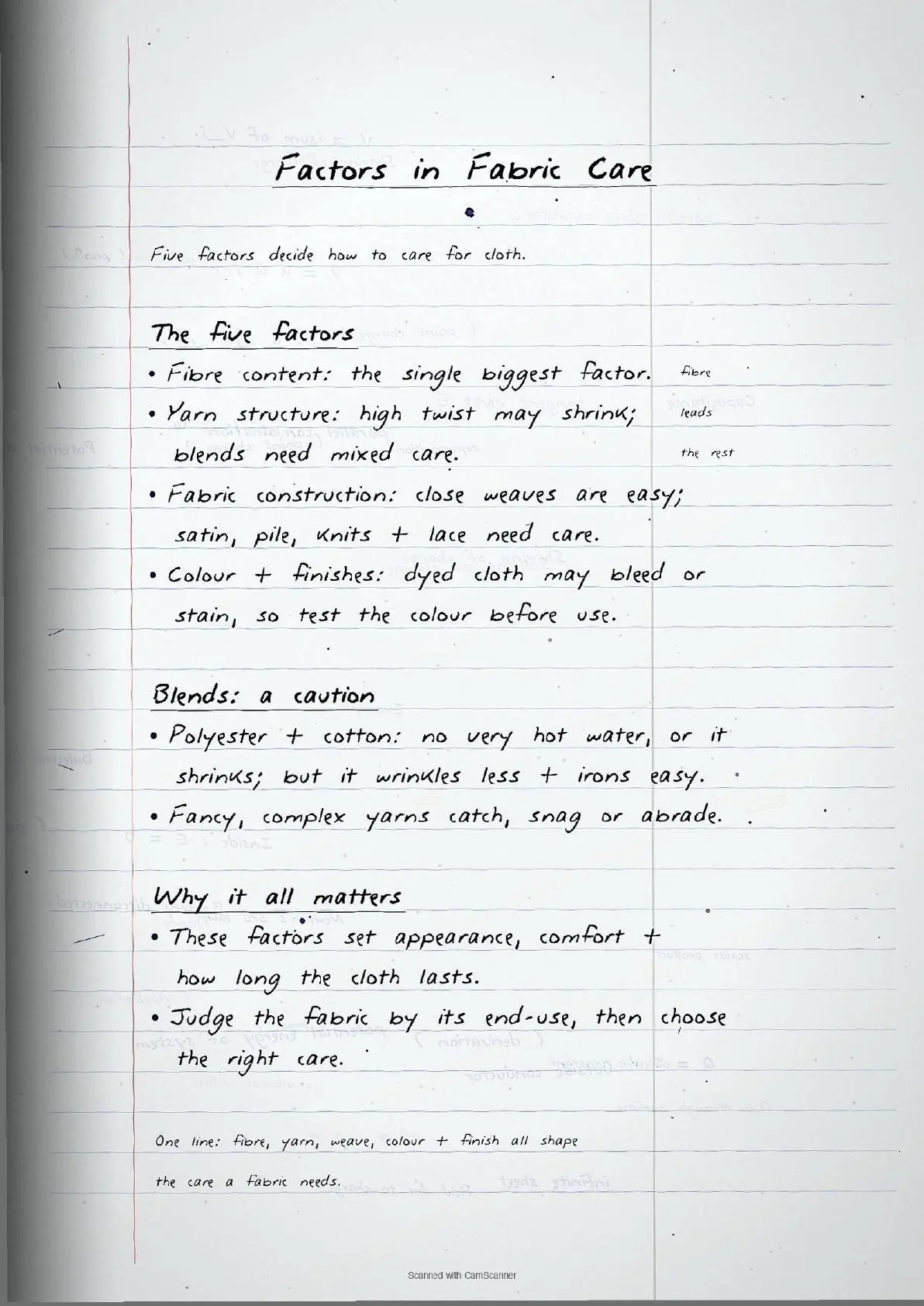
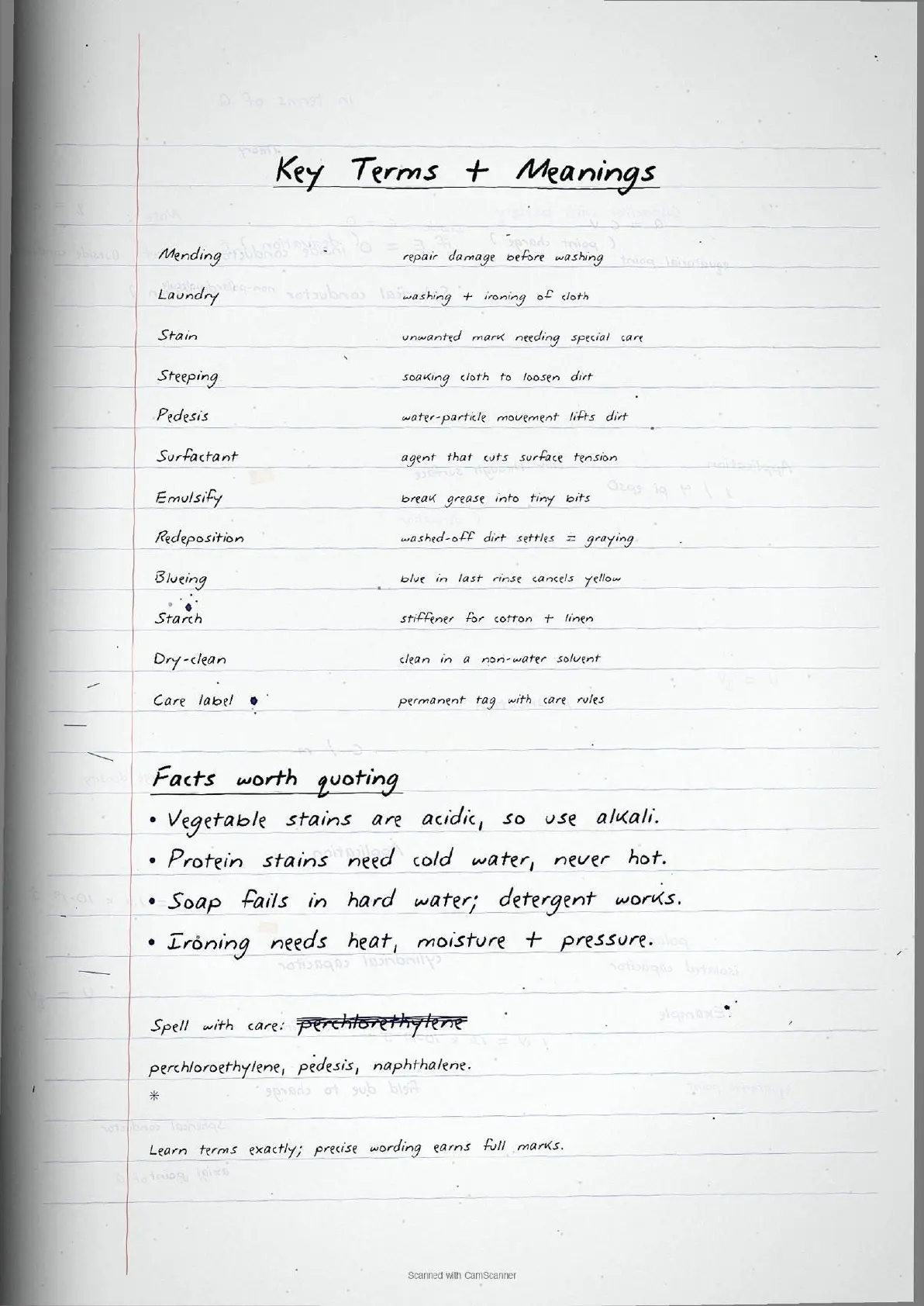
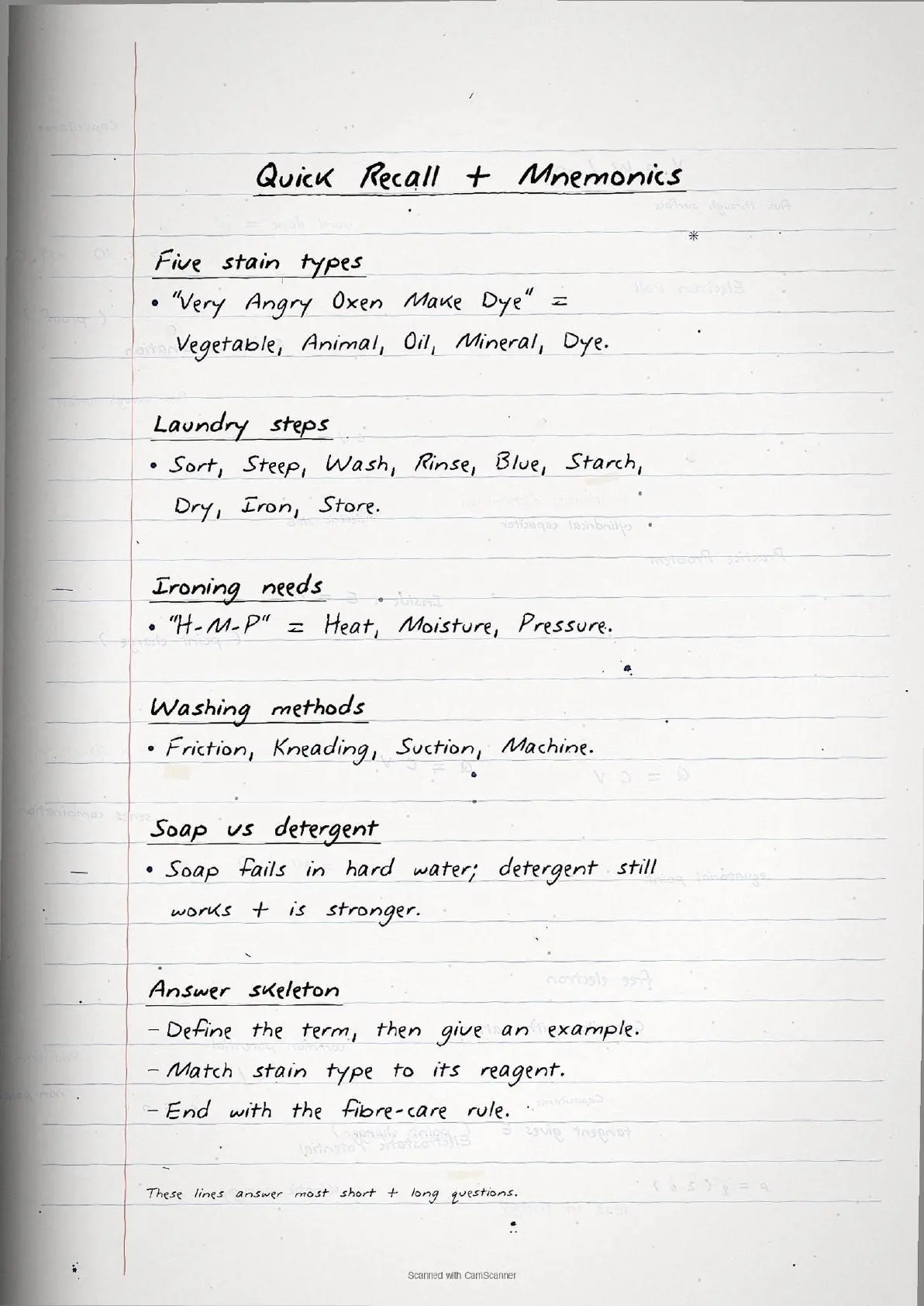
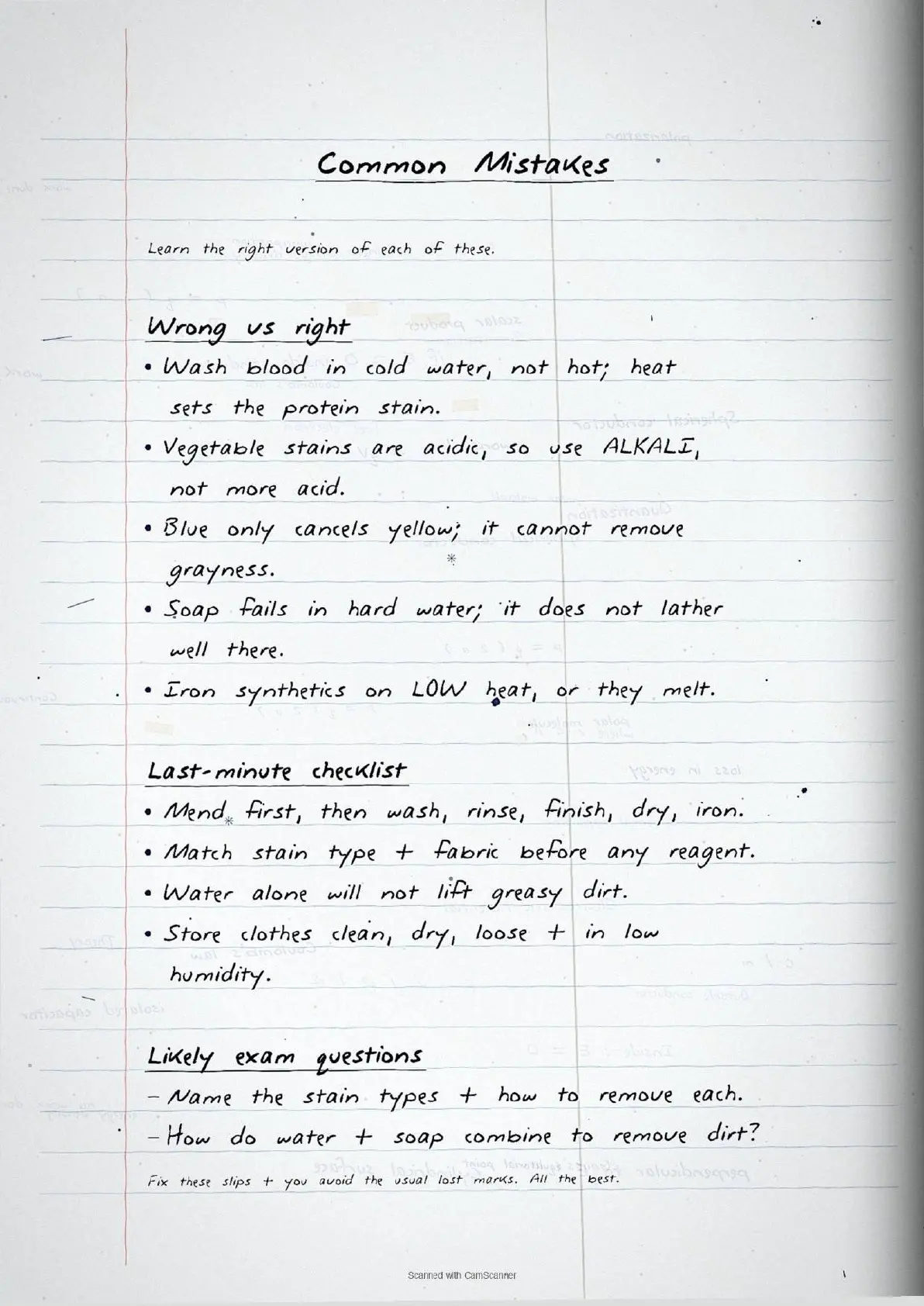
- Handwritten pages with boxed key terms, a stain-versus-treatment table, a laundry-process flow diagram, and colour-coded fibre-care charts.
- This chapter of Class 11 Home Science is highly practical, so its stain rules and laundry steps carry into everyday life and the final exam.
- Pairs with the NCERT Solutions, Notes and Book PDF linked lower on this page.
These Care and Maintenance of Fabrics handwritten notes are prepared from the official NCERT Home Science (Human Ecology and Family Sciences) textbook and checked against recent CBSE Class 11 question papers.
Student Feedback: In a Collegedunia poll of 4,640 Class 11 Home Science students, 78% of students said the handwritten pages helped them recall the five stain types and the laundry-step order faster than printed text, because the stain-versus-treatment table and the flow diagram made the sequence stick.
Source: 2026-27 Class 11 Home Science student poll. Sample of 4,640 students from CBSE schools across 9 states.
What These Care and Maintenance of Fabrics Handwritten Notes Contain
Care and Maintenance of Fabrics is a practical chapter of Class 11 Home Science. It explains why we look after cloth, how to remove stains, how to launder step by step, and how to store clothes so they last. These handwritten notes condense the chapter into handwritten pages that read like a topper's own notebook, with boxes and arrows instead of long paragraphs.
The notes are organised under three threads, each on its own set of pages:
- The need and the process: why care and maintenance matters, mending, and the full laundry cycle from sorting to storage.
- Stains and cleaning: the five stain types, reagents, techniques, and how water plus soap lift dirt from cloth.
- Fibre-wise care: the wash and iron rules for cotton, linen, wool, silk and synthetics, plus care labels and storage.
Because the pages are handwritten, the key terms sit in boxes and tables rather than dense text. A student can flip through the care and maintenance of fabrics class 11 pages in a few minutes and still recall the stain rules, the laundry order and the fibre chart before walking into the exam.
Stain Removal and the Laundry Process in the Pages
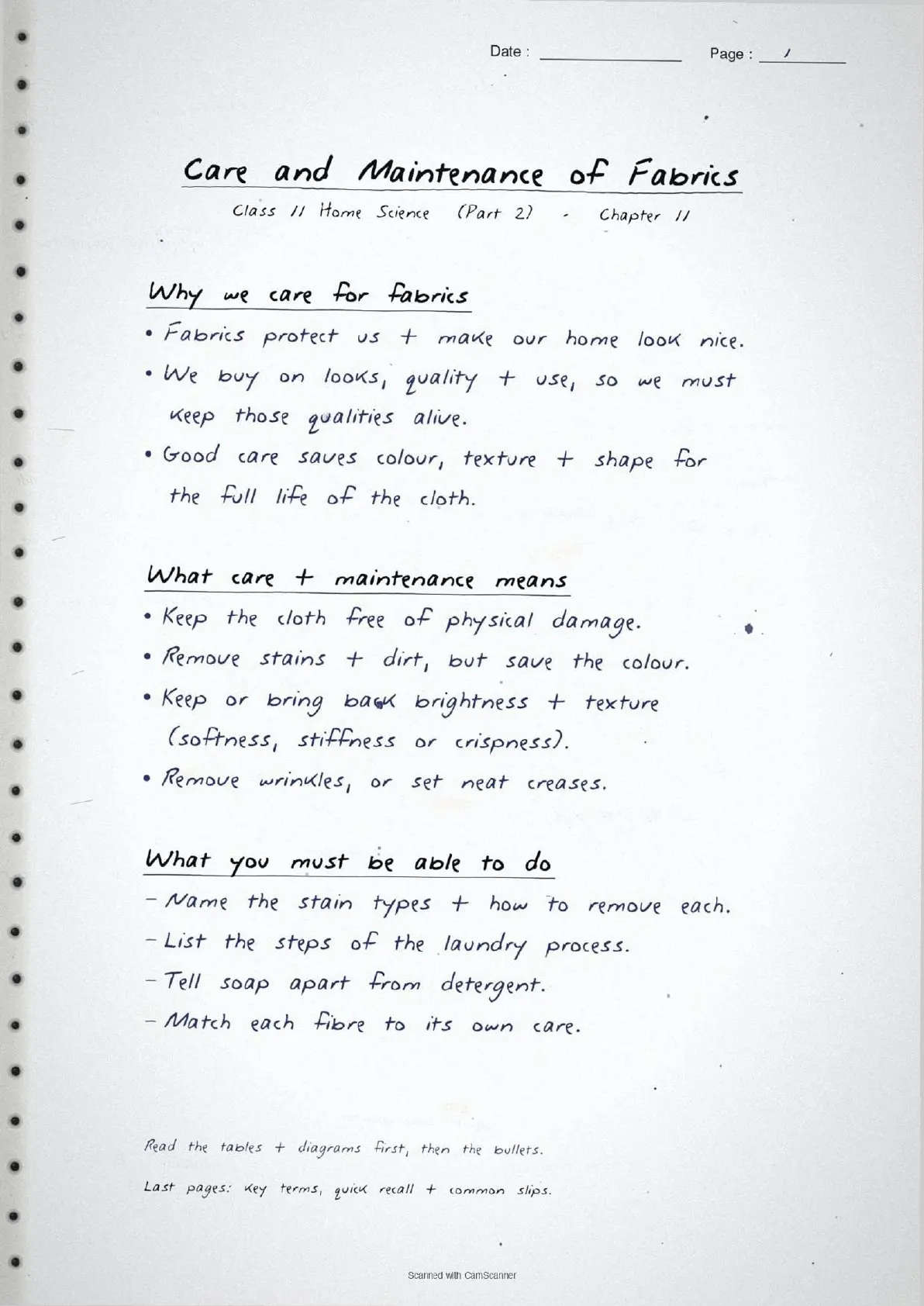
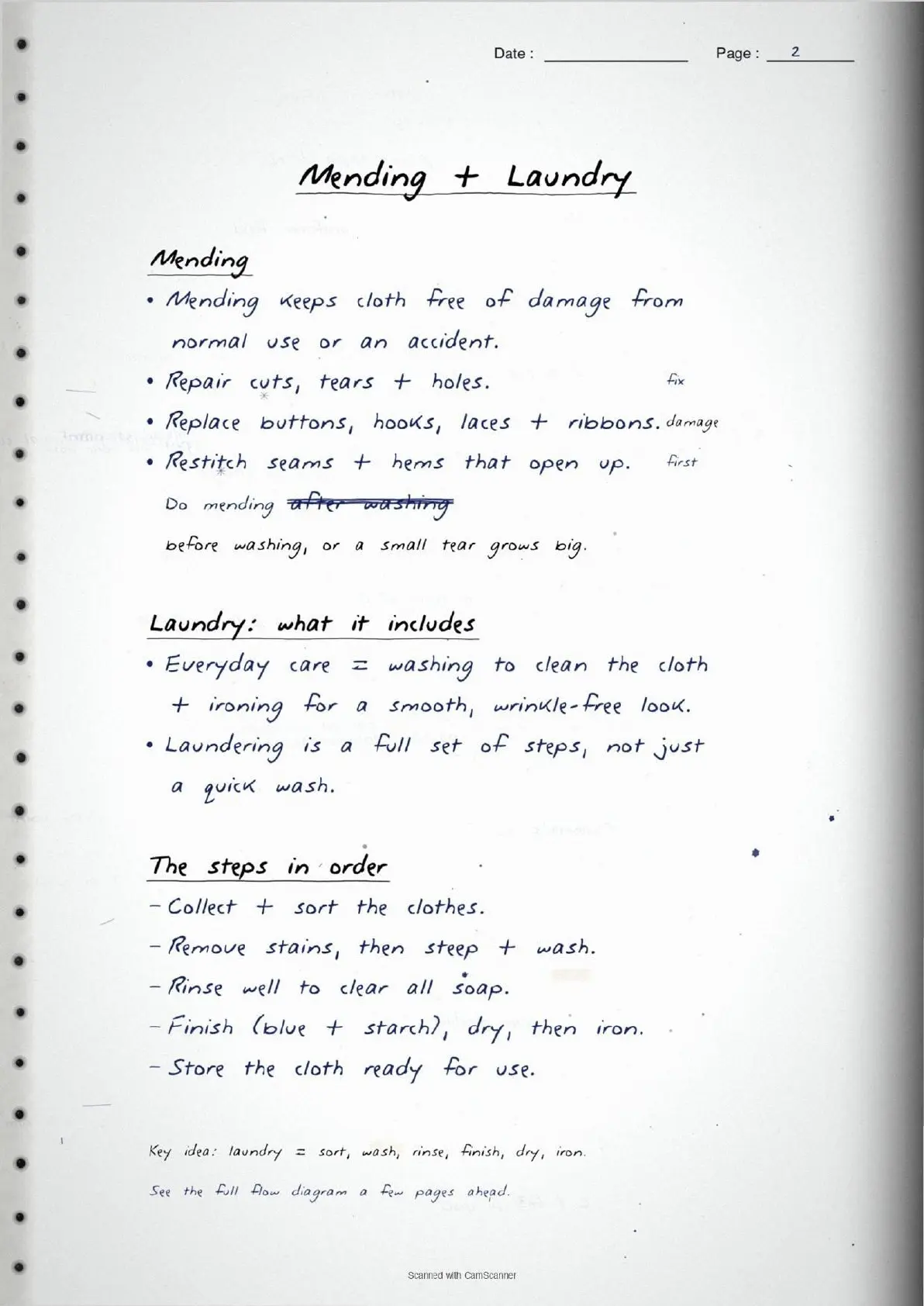
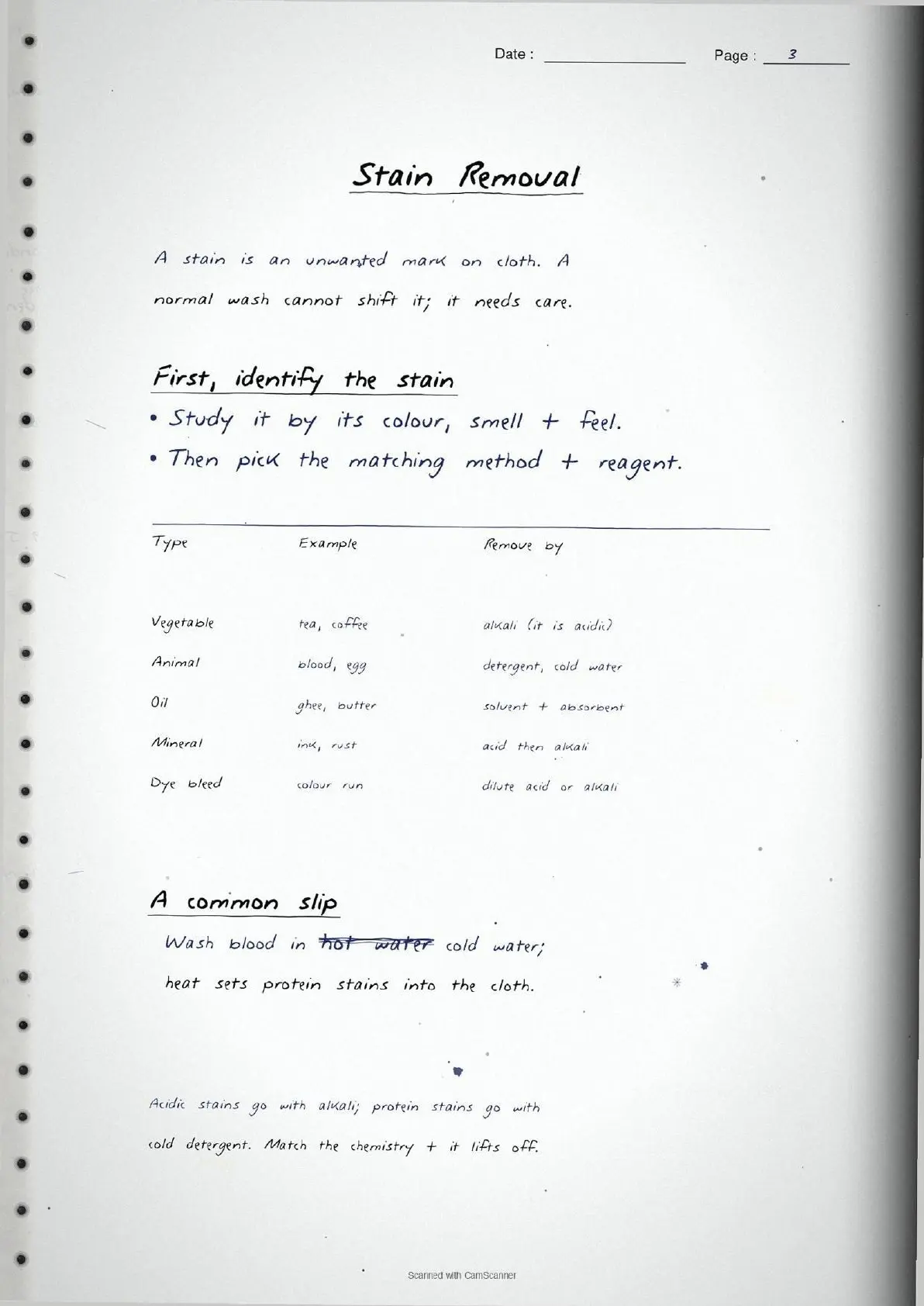
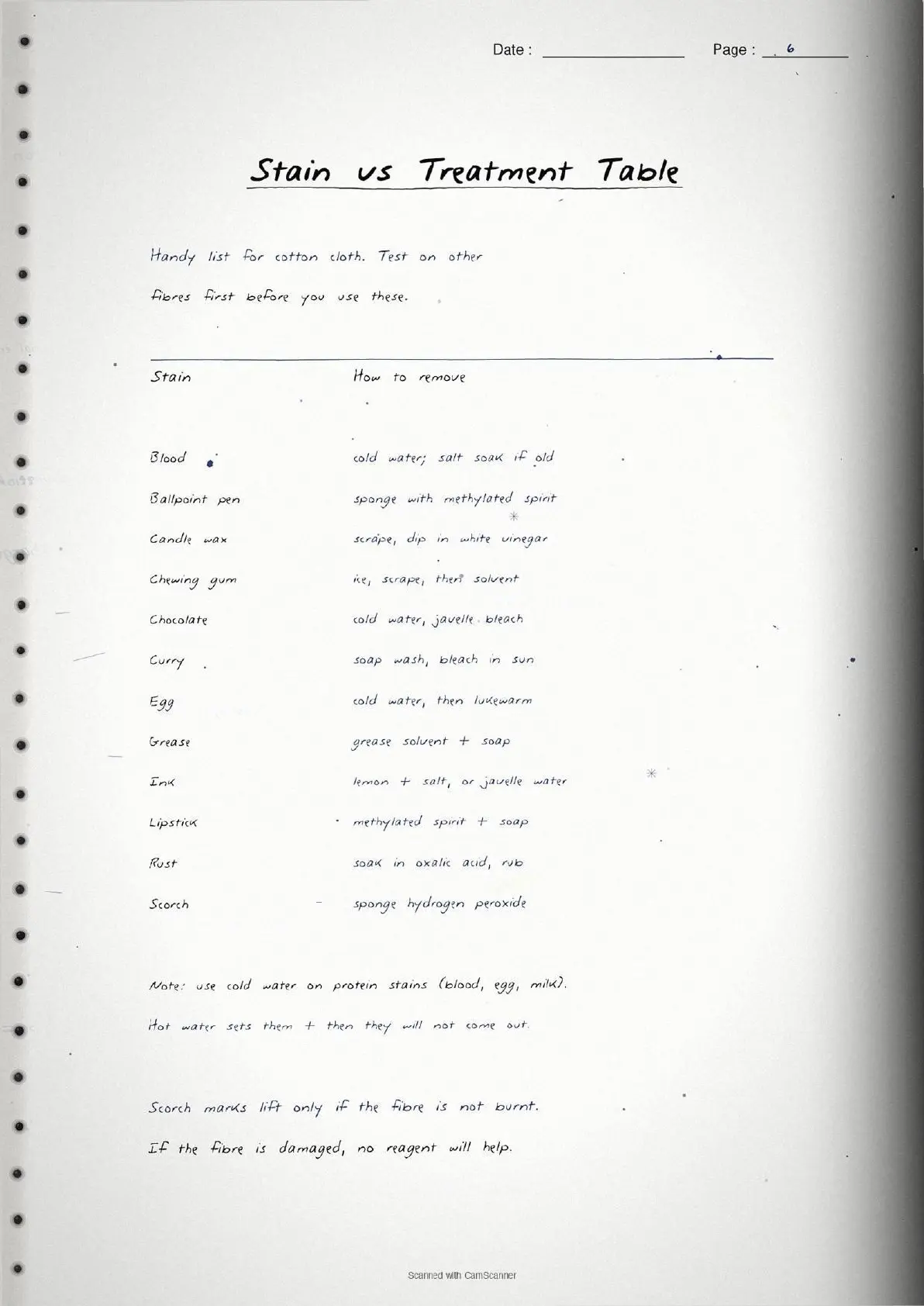
The first set of pages settles what care and maintenance means, then moves into stains and laundering. Care and maintenance means keeping cloth free of damage, removing stains and dirt while saving the colour, keeping the brightness and texture alive, and setting neat creases. Mending, done before washing so a small tear does not grow, comes first. The notes then box a stain chart, because a stain is an unwanted mark that a normal wash cannot shift.
| Stain type | Example | Remove by |
|---|---|---|
| Vegetable | tea, coffee, fruit | alkali, because the stain is acidic |
| Animal (protein) | blood, egg, milk | cold water and detergent, never hot |
| Oil or grease | ghee, butter, oil | a grease solvent plus an absorbent |
| Mineral | ink, rust, medicine | an acid, then an alkali |
| Dye or colour bleed | a colour run in the wash | a dilute acid or alkali |
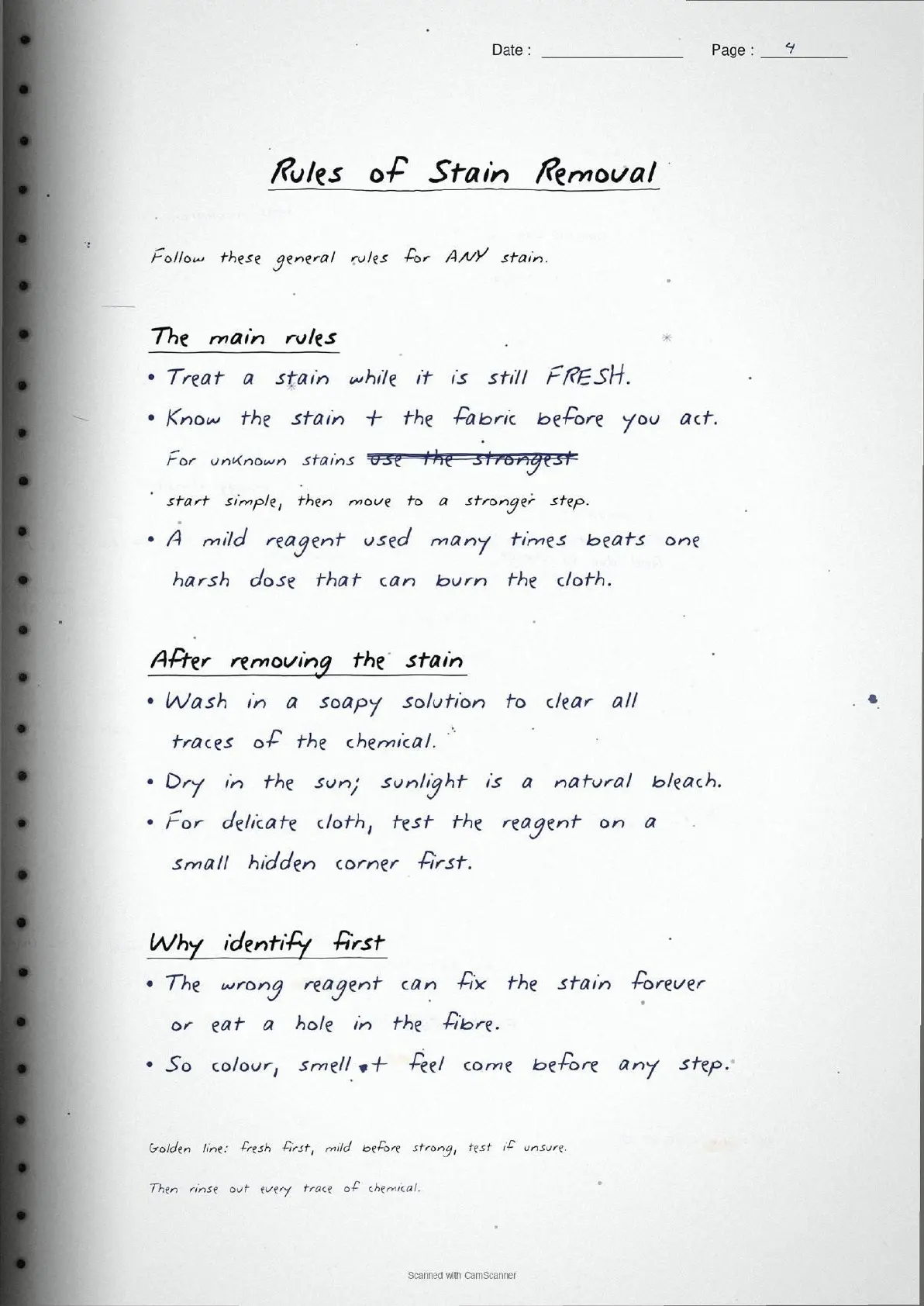
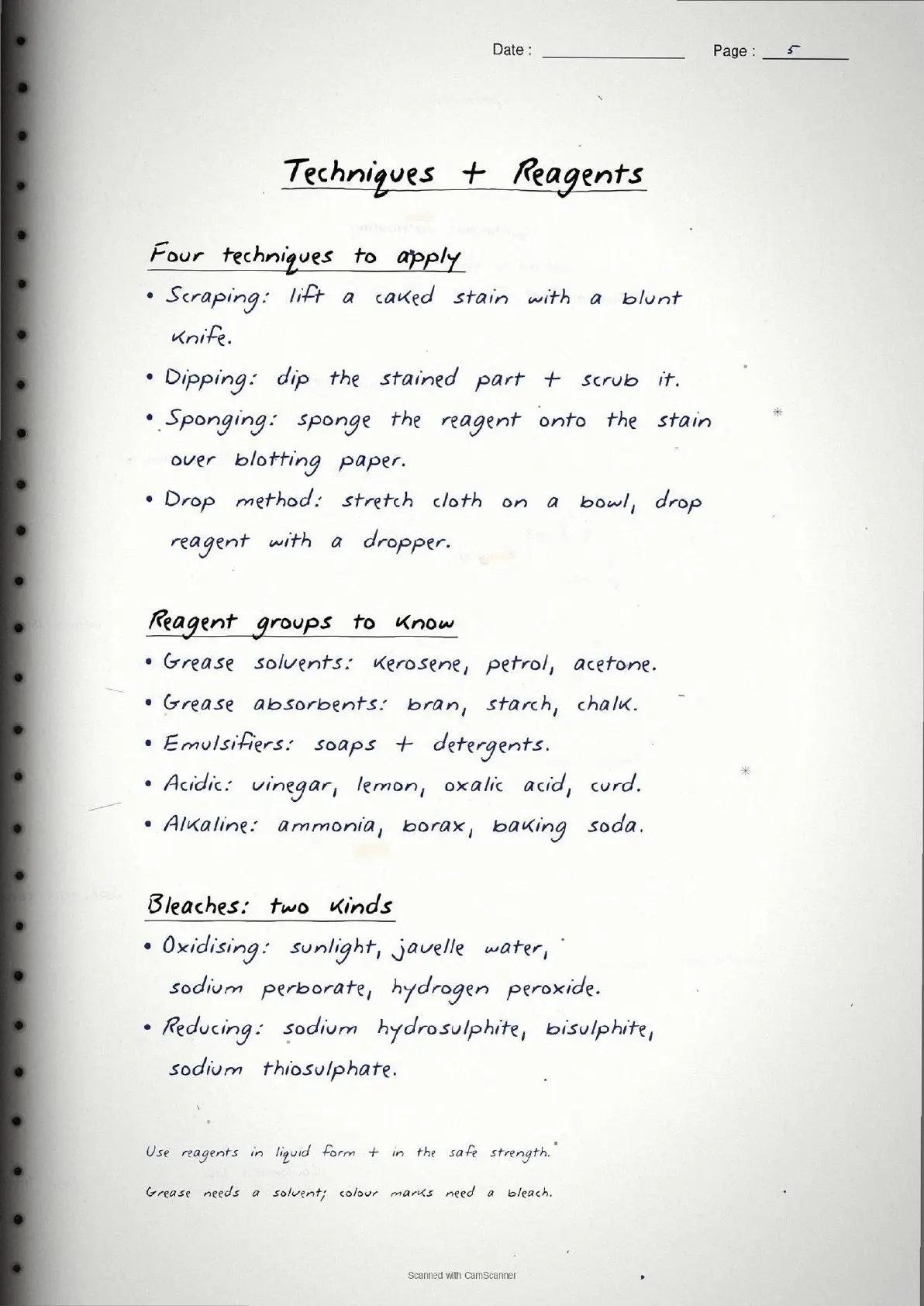
The pages then give the general rules: treat a stain while it is fresh, identify the stain and fabric first, start with a mild reagent and move to a stronger one only if needed, and test on a hidden corner for delicate cloth. Techniques such as scraping, dipping, sponging and the drop method sit beside their reagent groups, which include grease solvents, absorbents, emulsifiers, acids, alkalis and bleaches.
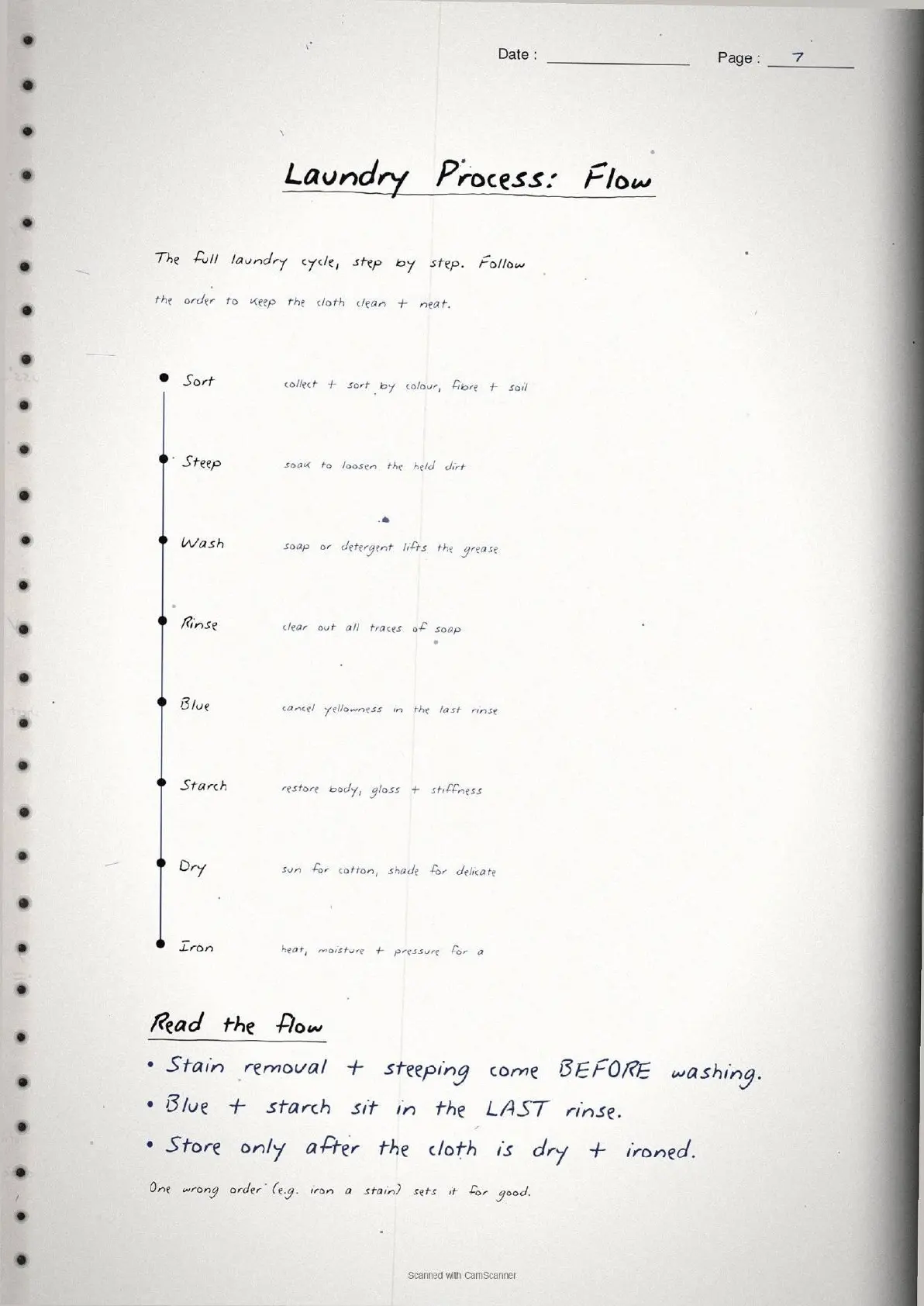
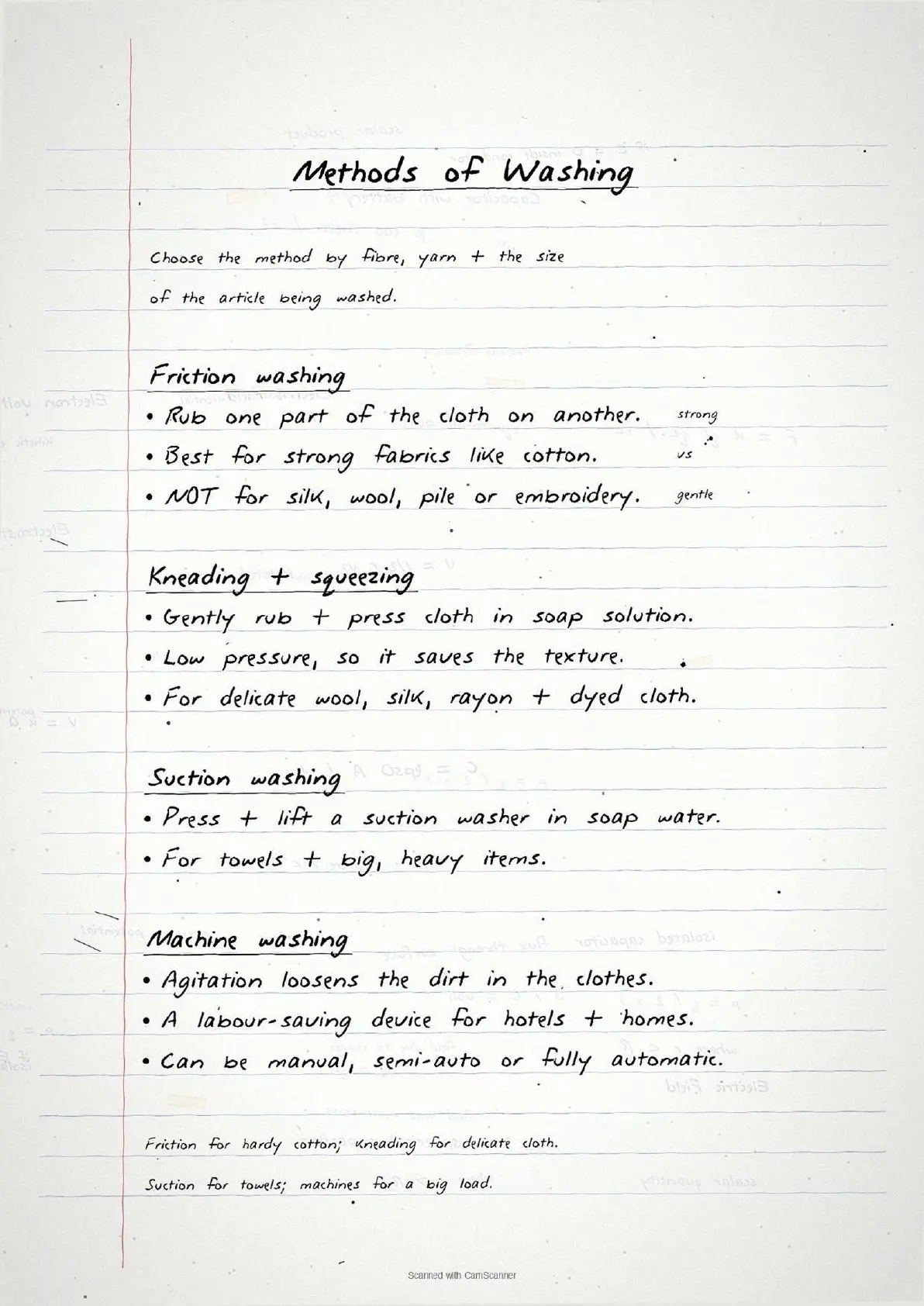
A separate diagram lays out the full laundry process as a vertical flow so the order is easy to fix in memory. The steps run in one line: sort, steep, wash, rinse, blue, starch, dry, iron and store. The notes stress that stain removal and steeping come before washing, that blue and starch sit in the last rinse, and that clothes are stored only once dry and ironed.
Water, Cleansing Agents and Fibre-wise Care
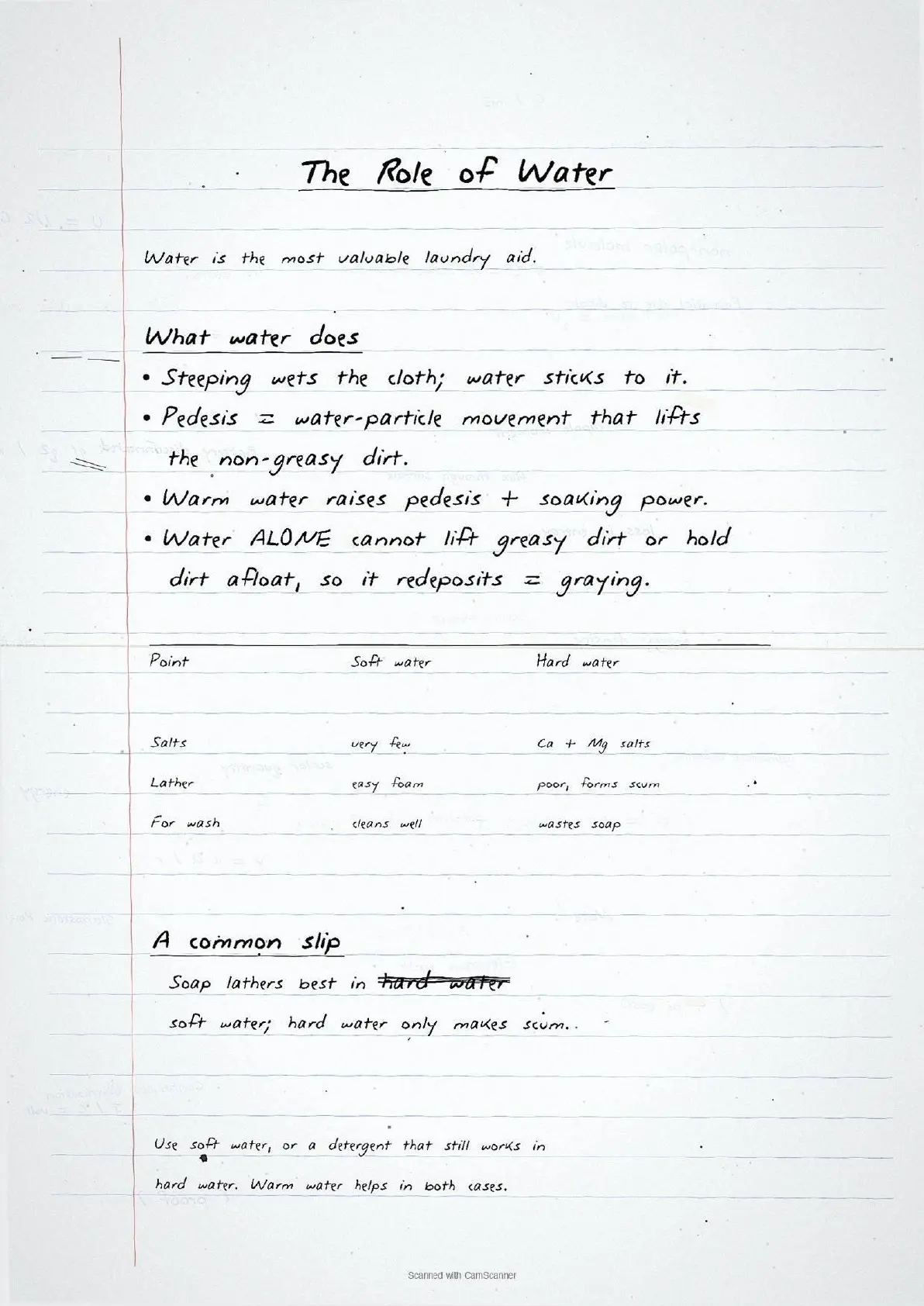
The next pages explain the science of cleaning. Water is the most valuable laundry aid, but it cannot lift greasy dirt on its own, so it needs a cleansing agent. The notes contrast the two water types, since this decides how well soap works.
| Point | Soft water | Hard water |
|---|---|---|
| Salts | very few dissolved salts | calcium and magnesium salts |
| Lather | foams easily with soap | poor lather, forms scum |
| For washing | cleans well, saves soap | wastes soap, greys the cloth |
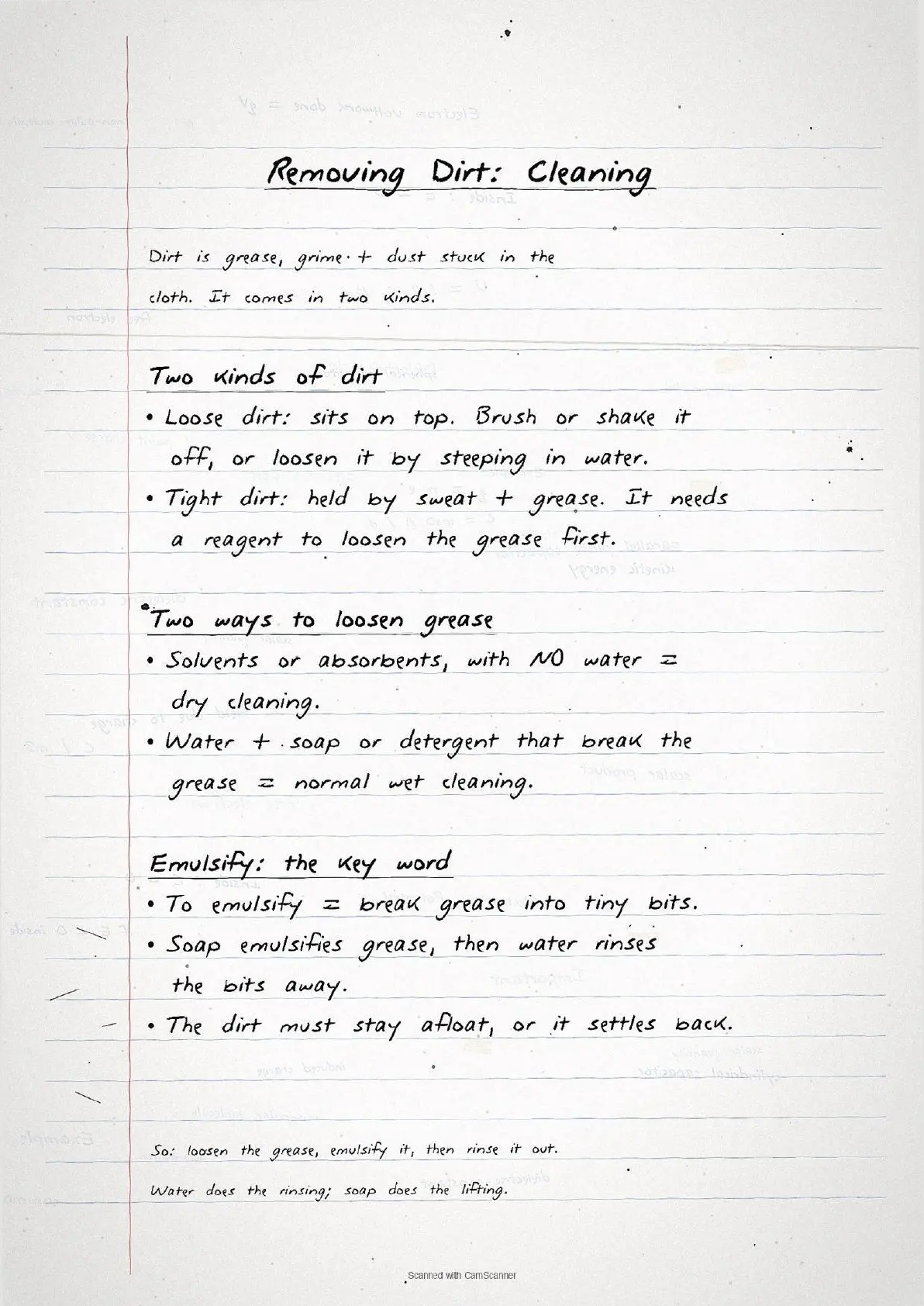
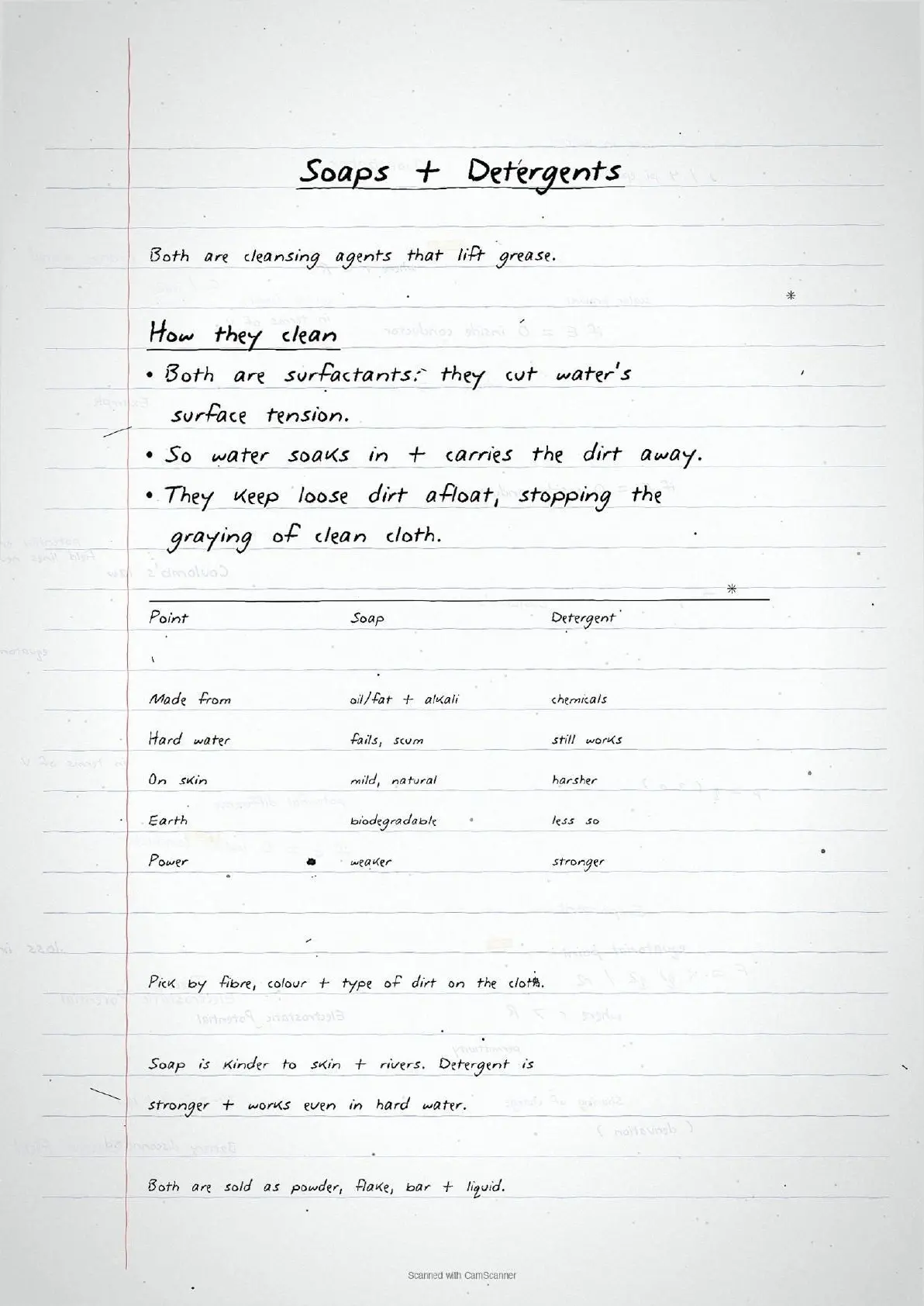
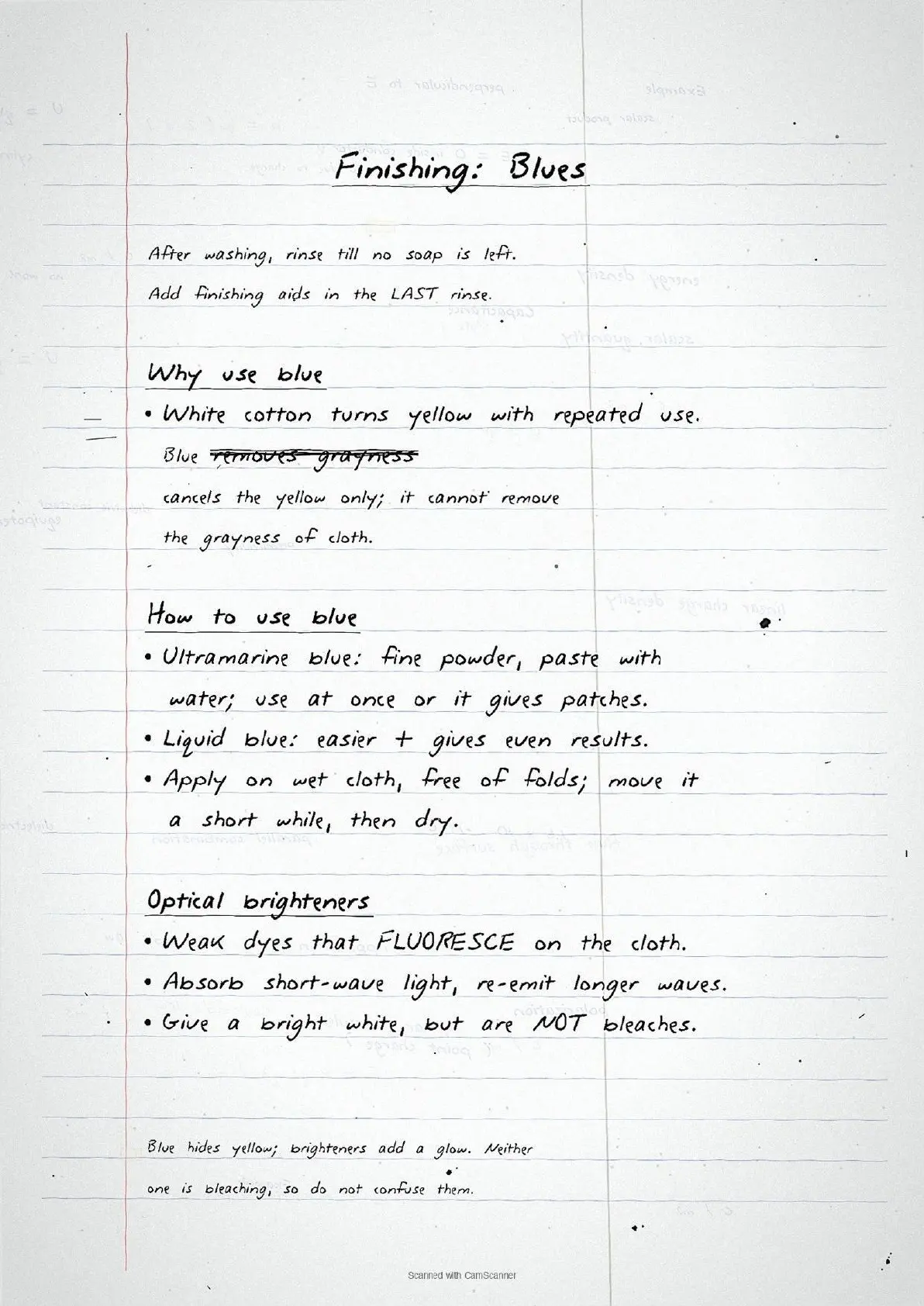
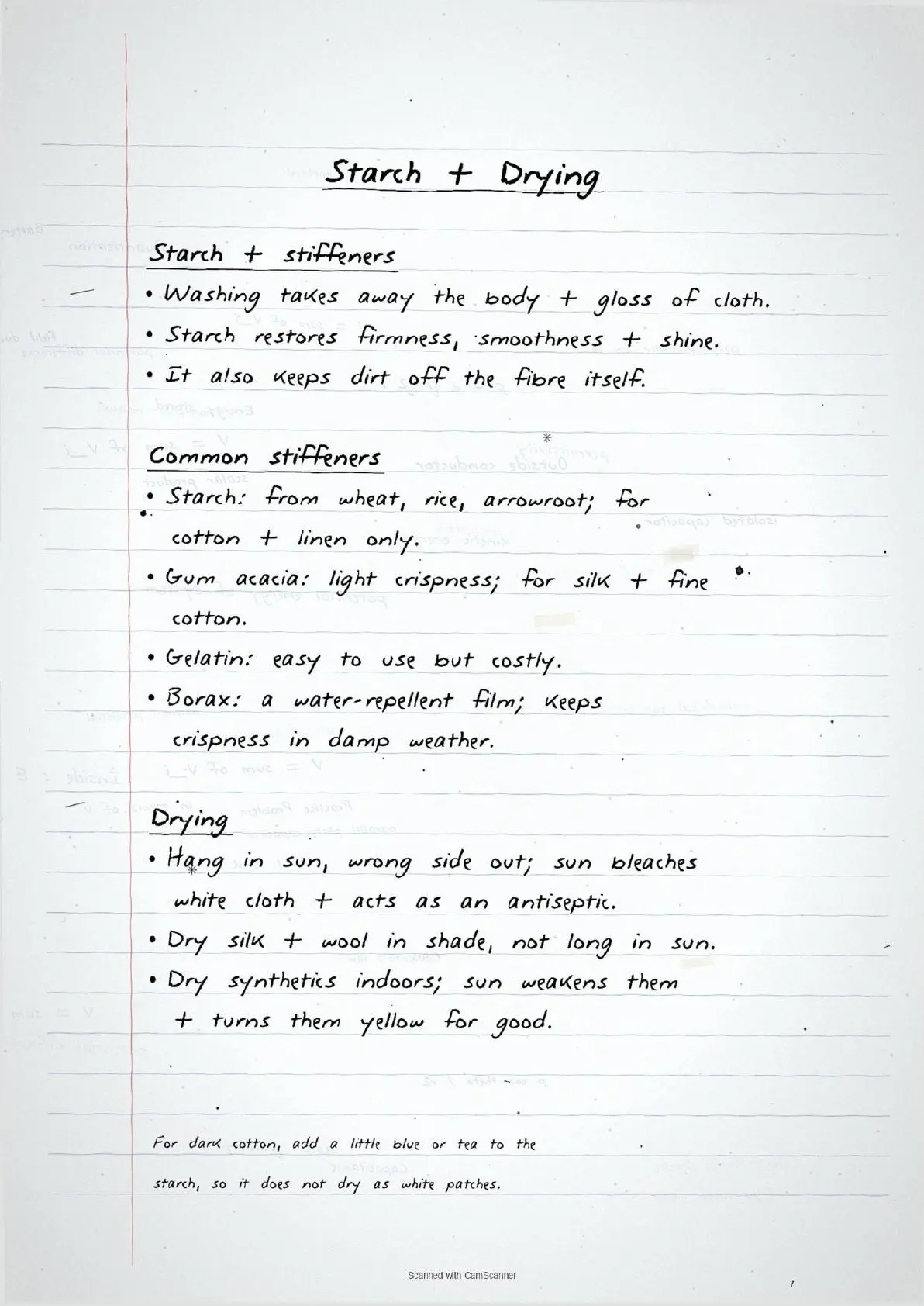
Both soaps and detergents are surfactants that cut surface tension and emulsify grease into tiny bits that rinse away. Soap is made from oil or fat and alkali, is milder and more biodegradable, but fails in hard water, while detergent is made from chemicals, is stronger, and still works in hard water. Finishing aids come next: blue only cancels the yellow tinge of white cotton and does not bleach, optical brighteners fluoresce to add a glow, and starch restores body, gloss and stiffness to cotton and linen.
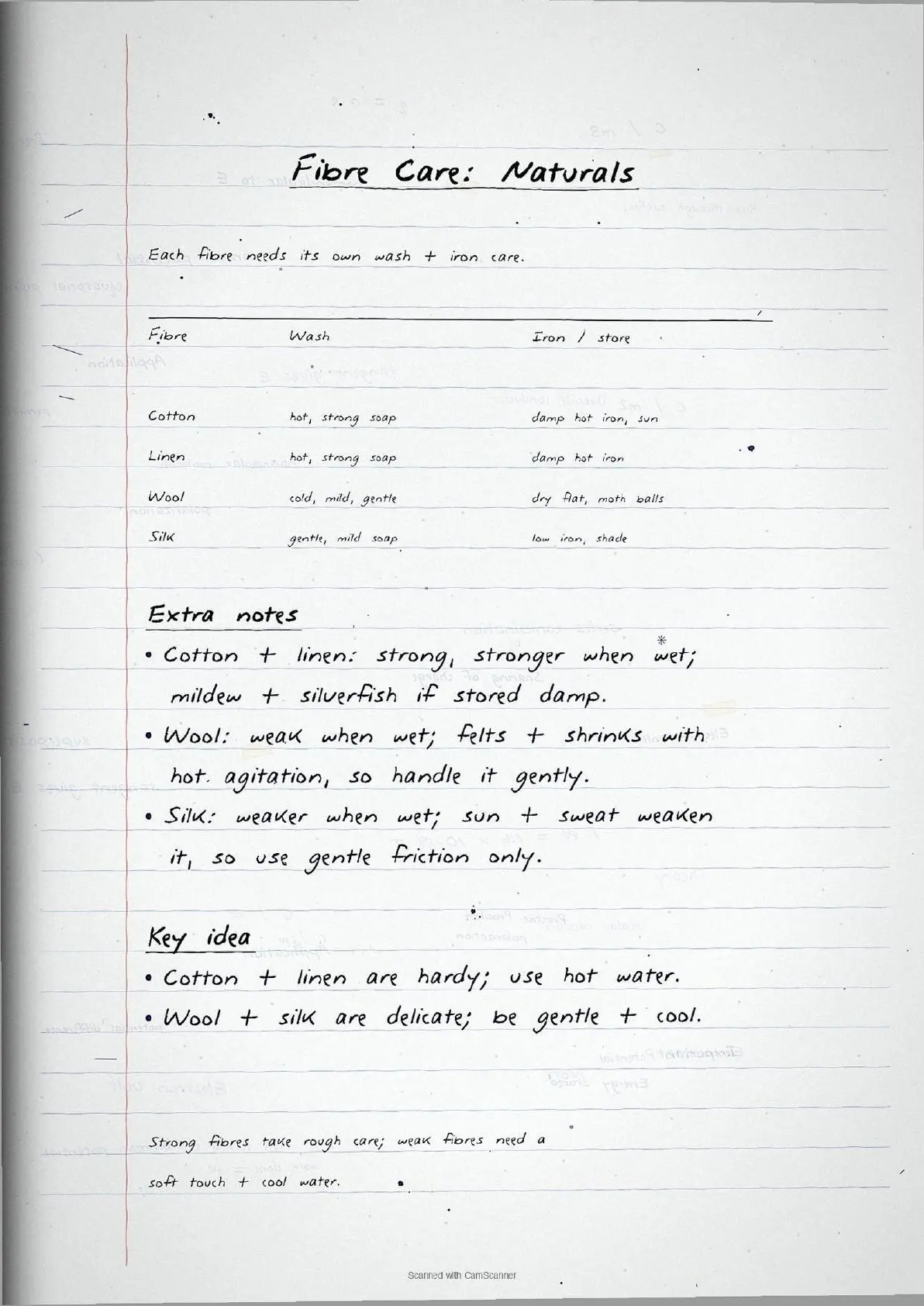
The final pages give the fibre-wise care that most exam questions target. Each fibre needs its own wash and iron setting, so the notes draw a colour-coded chart.
| Fibre | Wash | Iron and care |
|---|---|---|
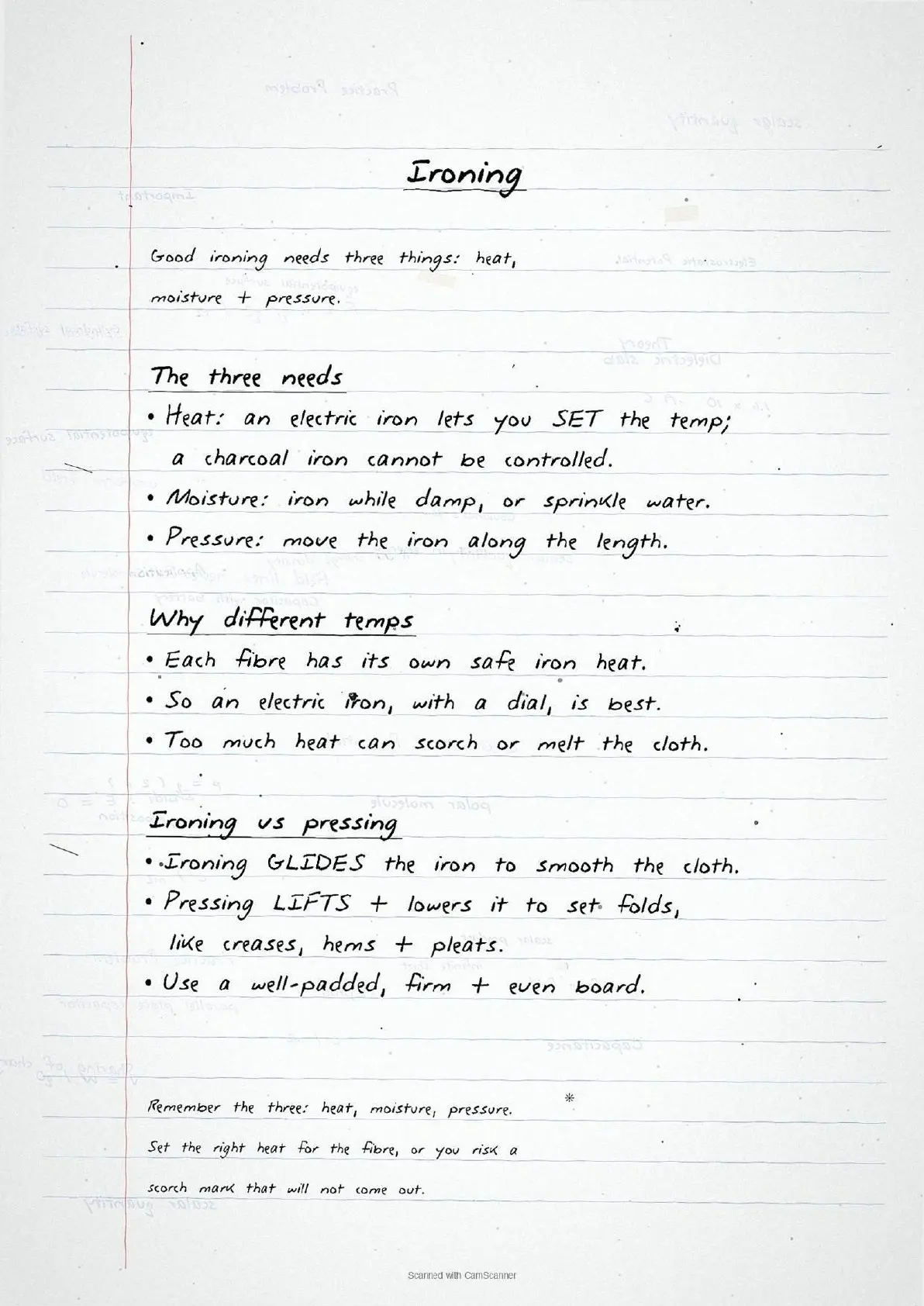
| Cotton and linen | hot water, strong soap | damp hot iron, dry in sun |
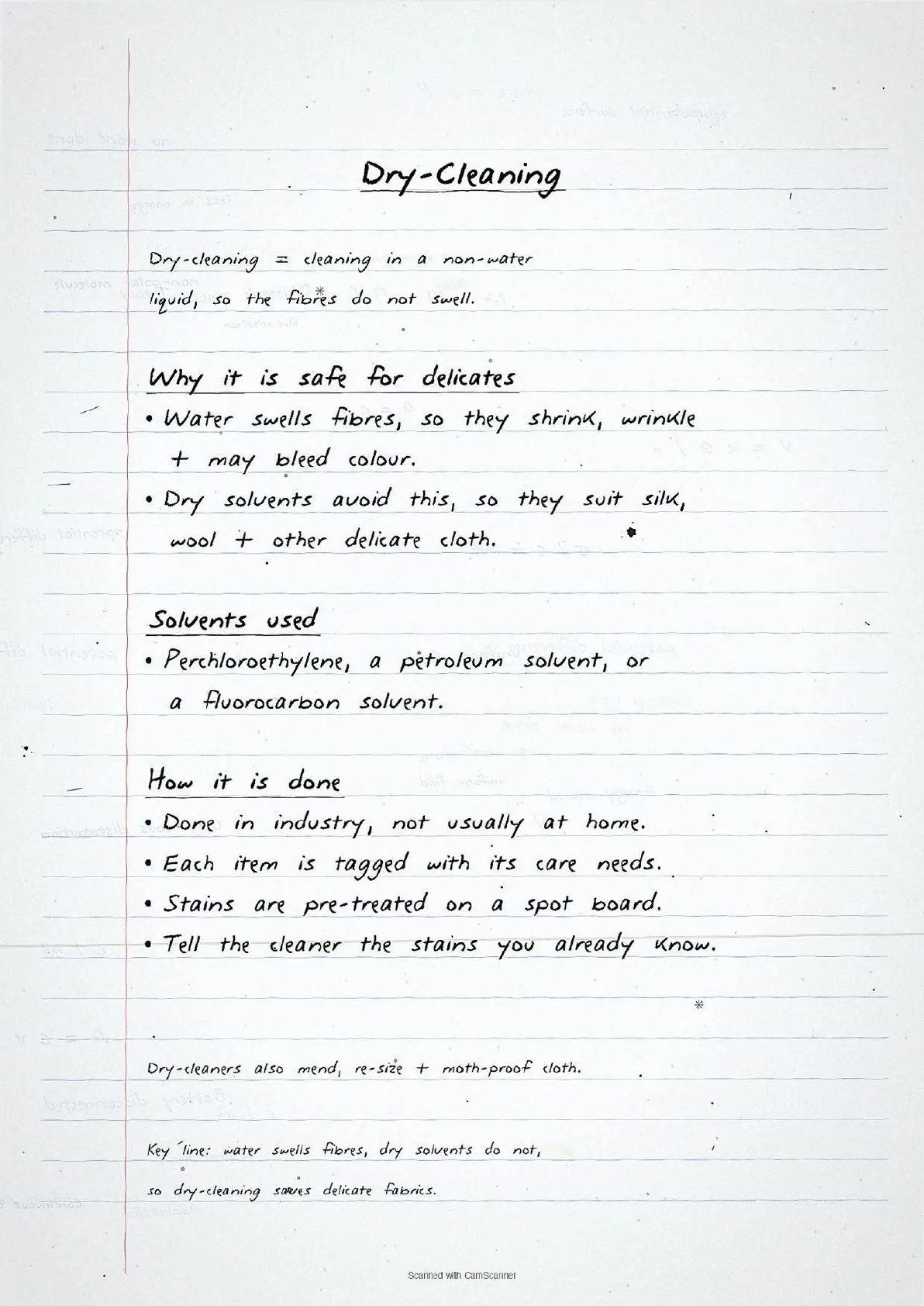
| Wool | cold water, mild, gentle | dry flat, use moth balls |
| Silk | gentle, mild soap | low iron, dry in shade |
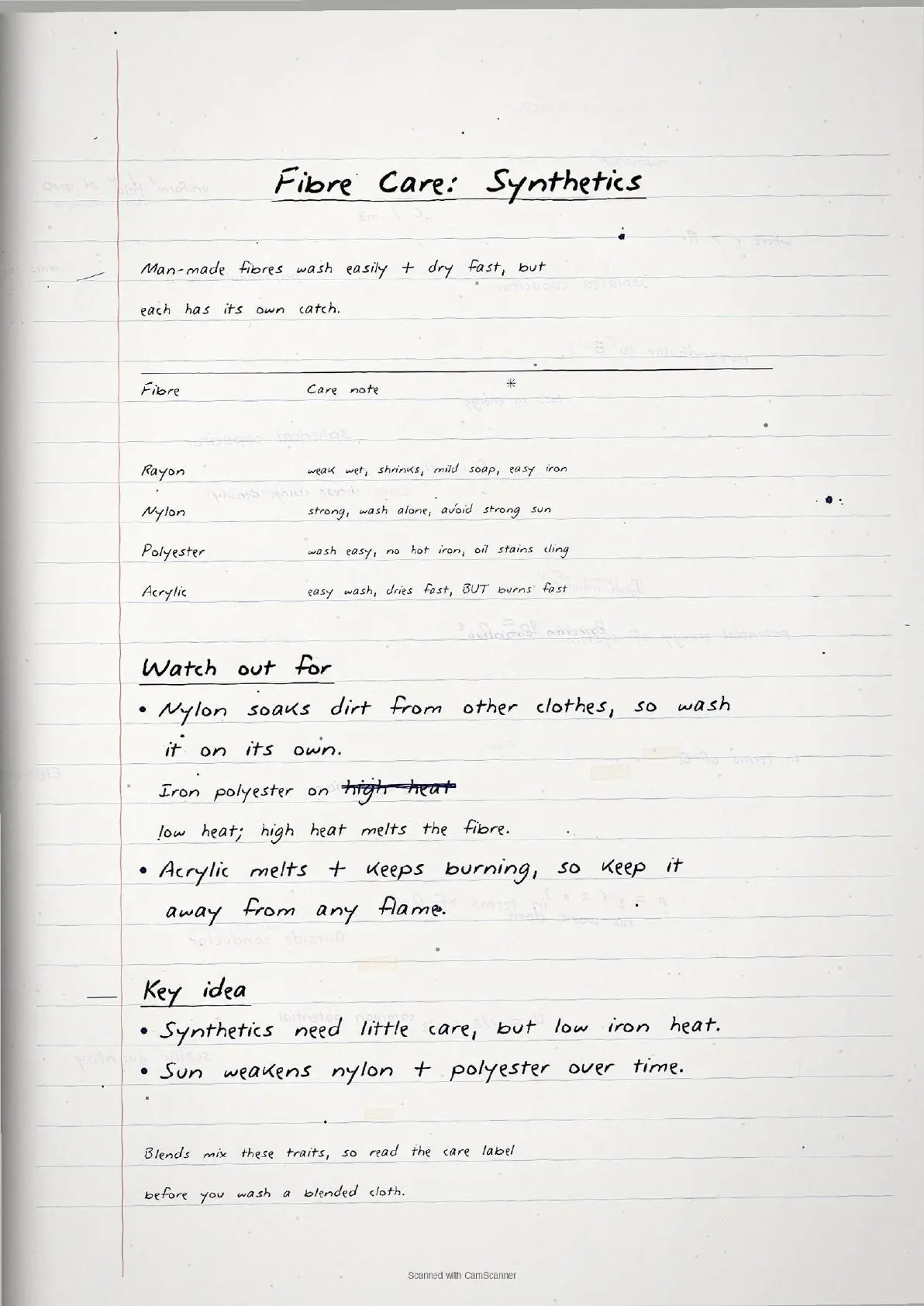
| Synthetics (nylon, polyester, acrylic) | easy wash, dries fast | low iron only, keep from sun and flame |
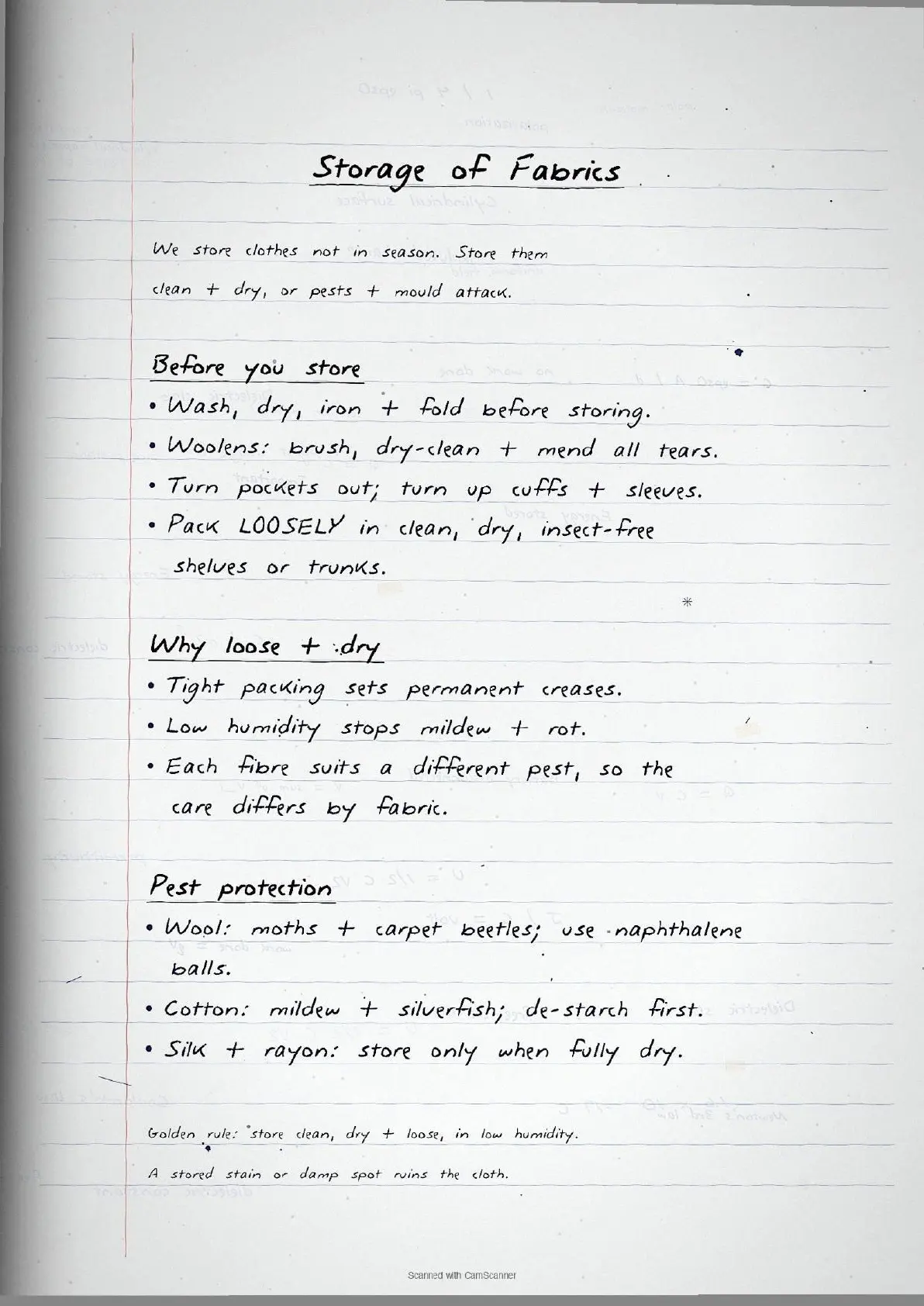
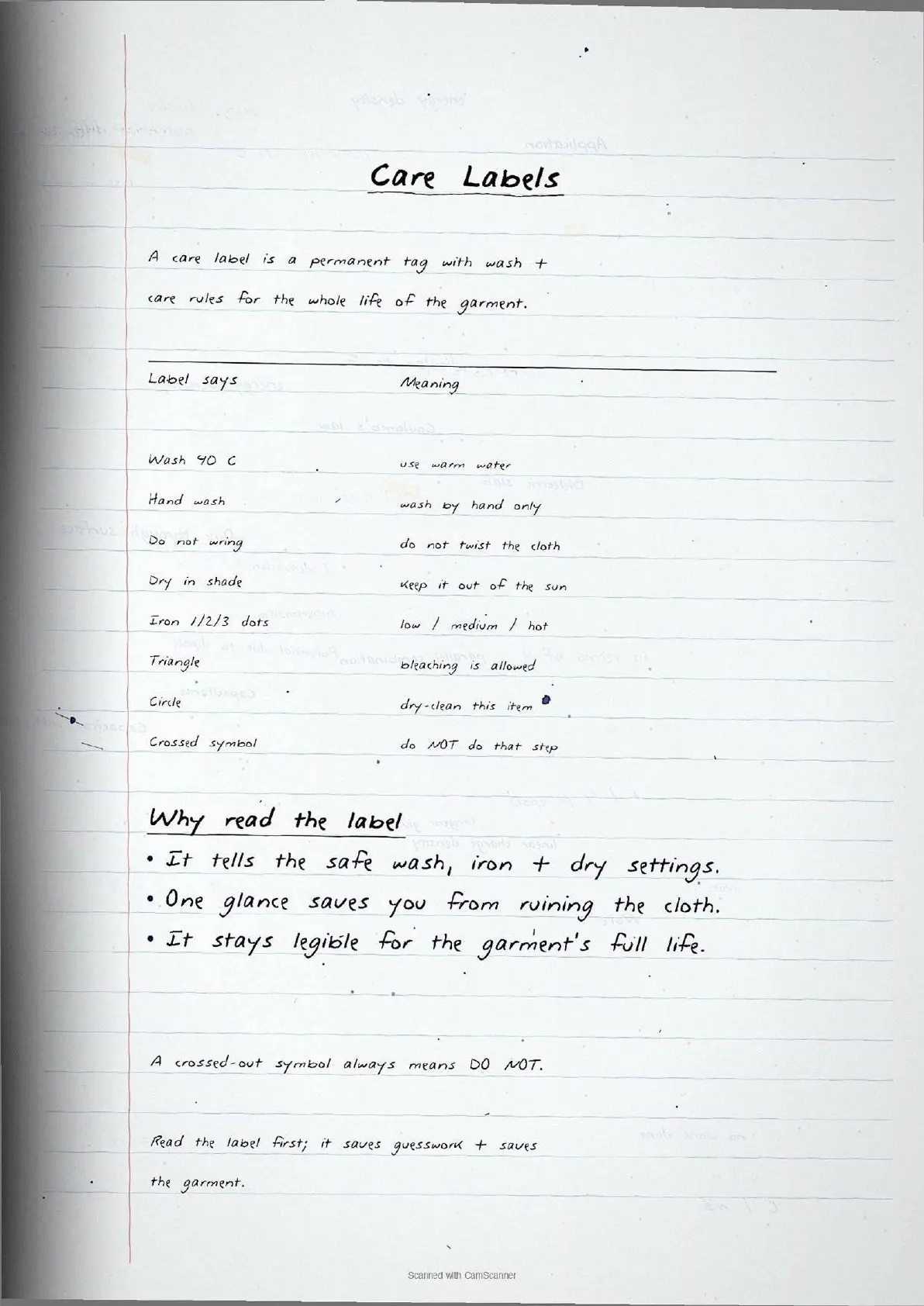
The notes close with care labels, the permanent tags that show safe wash, iron, dry and bleach settings, and the storage of clothes. Clothes are stored clean, dry, loose and in low humidity, with naphthalene balls for woollens and de-starching for cotton against silverfish. A crossed-out symbol on a label always means do not do that step.
How to Use These Handwritten Notes
Handwritten notes work best as a final-revision tool, not a first read. The steps below show how to get the most out of the care and maintenance of fabrics handwritten notes in the last days before a test.
- Download: tap the download card above to save the handwritten pages to your device.
- First read: read the printed Notes once so the handwritten pages act as a refresher, not a first source.
- Recall drill: cover the page and try to write the five stain types and the laundry-step order from memory.
- Night before: flip through the fibre-care chart and the stain table for a quick last-minute recall.
Many students search for class 11 home science chapter 11 notes on their phone the night before a test, so a saved set of handwritten pages means you can revise offline. This chapter also helps with practical, everyday laundry, and a clear grasp of it supports the Home Science section in CUET for students who take that route later.
Common Mistakes These Notes Help You Avoid
A few errors cost marks every year. The handwritten notes flag each one in the margin so you can fix it before the exam. These five are the most common.
- Washing blood in hot water. Protein stains need cold water; heat sets them into the cloth for good.
- Treating vegetable stains with more acid. They are acidic, so you use an alkali, not another acid.
- Thinking blue whitens cloth. Blue only cancels the yellow tinge; it cannot remove grayness and it is not a bleach.
- Expecting soap to lather in hard water. Soap fails in hard water and forms scum; a detergent works there.
- Ironing synthetics on high heat. Nylon, polyester and acrylic melt, so they need a low iron setting.
Students who fix these five points usually move from average to high marks. The handwritten notes box the stain rules and list the fibre-care settings in full, so the soft points are hard to miss when you revise.
How These Handwritten Notes Pair with the Solutions and Book PDF
These handwritten notes are a fast revision tool. To prepare fully, students should use them alongside the other resources for the same chapter, all linked in the table below. Read the printed Notes, test yourself with the solutions, then use these pages for a final recall.
| Resource | Best used for |
|---|---|
| Care and Maintenance of Fabrics NCERT Solutions | Step-by-step answers to all the chapter review questions |
| Care and Maintenance of Fabrics Class 11 Notes | Quick chapter summary with all stain types and fibre-care rules in one place |
| Care and Maintenance of Fabrics NCERT Book PDF | Reading the original NCERT chapter text and figures |
Tip: read the printed Notes first, then attempt the solutions, and keep these handwritten pages for the final night-before flip. Using them for recall, not for the first read, builds memory faster.
All Class 11 Home Science Handwritten Notes by Chapter
The table links the handwritten notes for every chapter in Class 11 Home Science, so students can move across the course in one click. Care and Maintenance of Fabrics is highlighted.
| Chapter | Handwritten Notes |
|---|---|
| Chapter 1 | Human Ecology and Family Sciences |
| Chapter 2 | Understanding the Self |
| Chapter 3 | Food, Nutrition, Health and Fitness |
| Chapter 4 | Management of Resources |
| Chapter 5 | Fabrics Around Us |
| Chapter 6 | Media and Communication Technology |
| Chapter 7 | Concerns and Needs in Diverse Contexts |
| Chapter 8 | Nutrition, Health and Well-being |
| Chapter 9 | Our Apparel |
| Chapter 10 | Financial Management and Planning |
| Chapter 11 | Care and Maintenance of Fabrics |
FAQs on Care and Maintenance of Fabrics Handwritten Notes
Care and Maintenance of Fabrics Class 11 Home Science Handwritten Notes Common Questions
Ques. Where can I download the Care and Maintenance of Fabrics handwritten notes PDF?
Ans. You can download the Care and Maintenance of Fabrics Class 11 Home Science handwritten notes PDF directly from this page. It is free, follows the 2026-27 NCERT, and presents the stain types, the laundry process, the fibre-care chart and the storage rules as handwritten pages.
Ques. What are the five types of stains in Class 11 Chapter 11?
Ans. The five stain types are vegetable stains such as tea and coffee, animal or protein stains such as blood and egg, oil and grease stains, mineral stains such as ink and rust, and dye or colour-bleed stains. The handwritten notes box each type with its matching reagent, such as alkali for acidic vegetable stains and cold water for protein stains.
Ques. What topics do these handwritten notes cover?
Ans. They cover the need for care and maintenance, mending, stain removal with its types and methods, the full laundry process of sorting, steeping, washing, rinsing, drying and finishing, the role of hard and soft water, soaps versus detergents, laundry aids like blues and starch, fibre-wise care for cotton, silk, wool and synthetics, reading care labels, and the storage of clothes.
Ques. Why should blood stains be washed in cold water?
Ans. Blood is a protein or animal stain, and heat sets protein into the fibre so it will not come out. Cold water with a little detergent lifts it, while hot water fixes it for good. The handwritten notes flag this as a common mistake so students avoid losing marks on it.
Ques. How should I use these notes with the other resources?
Ans. Read the printed Notes first, test yourself with the NCERT Solutions, then keep these handwritten pages for the final night-before flip. Using them for recall rather than the first read builds memory faster.



Comments