




These Reconstitution of a Partnership Firm – Retirement / Death of a Partner class 12 accountancy handwritten notes compress the full Chapter 3 syllabus into a 6-page ruled-paper notebook PDF that students can revise the night before the CBSE 2026-27 board paper. The notes follow the official NCERT sequence and mirror the journal-entry style examiners expect.


- CBSE Weightage: 12 marks (Partnership Accounts unit, shared with Ch 2 and Ch 4)
The notebook runs 6 pages of compact blue-ink writing on ruled cream paper with a red margin line, sized for a single duplex print.
Each page is laid out so that one accounting routine sits on one page: gaining ratio on page 2, retiring partner's goodwill on page 3, the share-of-profit shortcut on page 4, Joint Life Policy on page 5, and the executor's account layout on page 6. The Collegedunia editorial team has matched the section order to the NCERT typeset Notes so a reader can flip between the two without losing place.
Also Check:
- Retirement / Death of a Partner Class 12 Notes (Typeset)
- Retirement / Death of a Partner Class 12 NCERT Solutions
Reconstitution of a Partnership Firm – Retirement / Death of a Partner Class 12 Accountancy Handwritten Notes Snapshot
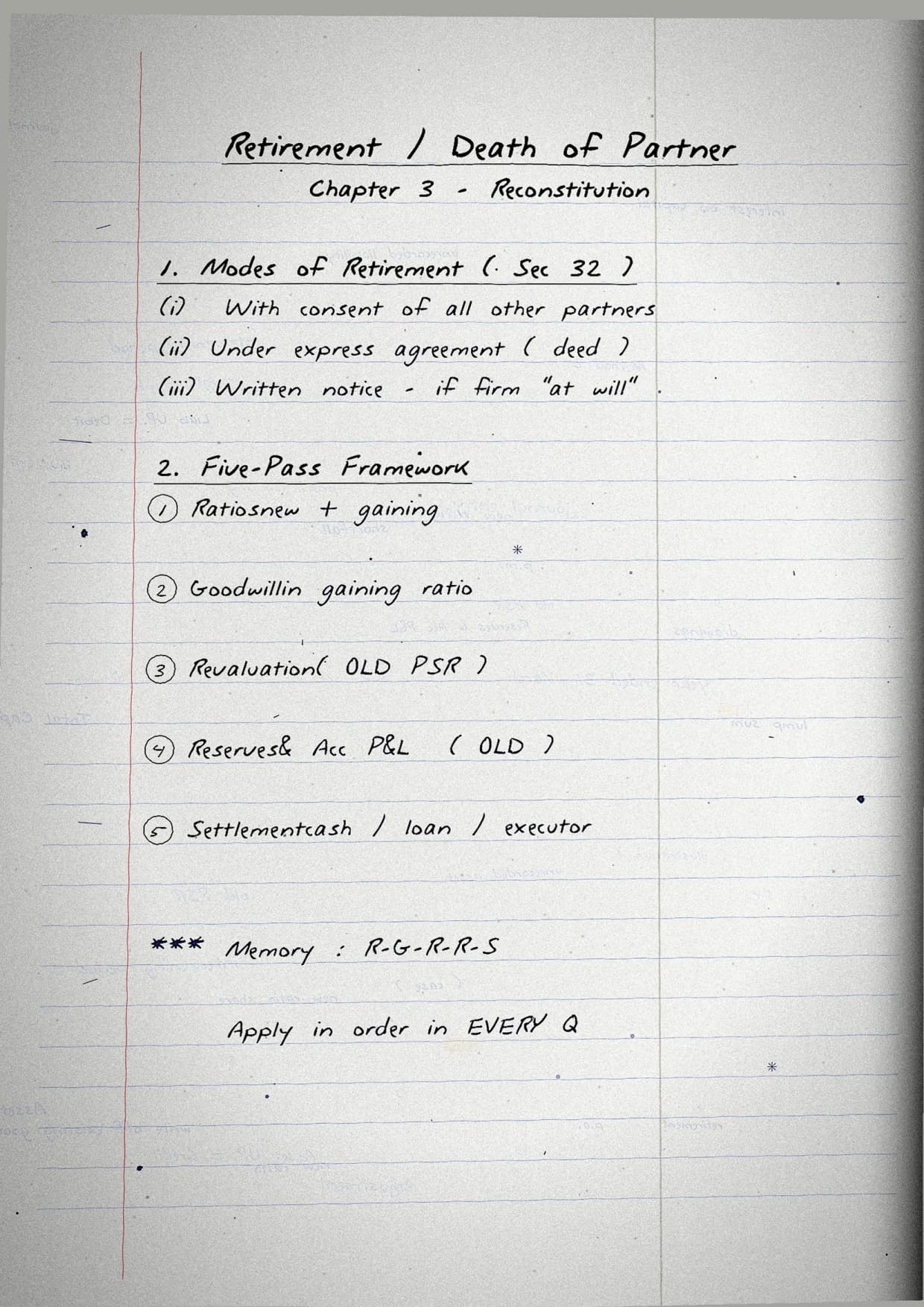
The handwritten PDF opens with a one-page mnemonic card (R-G-R-R-S: Ratios, Goodwill, Revaluation, Reserves, Settlement) and then walks through each routine in the order CBSE asks them in numericals. Every formula box on the page is hand-drawn in red ink so it reads as a visual cue, not a paragraph.
- Page 1: cover card, R-G-R-R-S mnemonic, Section 32 modes of retirement.
- Page 2: gaining ratio table and worked numerical.
- Page 3: retiring partner's goodwill formula card and the two-step AS-26 journal.
- Page 4: share-of-profit shortcut on time basis and turnover (sales) basis.
- Page 5: Joint Life Policy treatment, three accepted methods.
- Page 6: Executor's A/c layout with an instalment schedule.
Reconstitution of a Partnership Firm Retirement Death of a Partner...
Source: Rajat Arora on YouTube
Gaining Ratio Table for Retirement Numericals
The gaining ratio decides how the continuing partners share the retiring partner's slice. The handwritten note on page 2 carries this compact table.
| Situation | Gaining Ratio Rule |
|---|---|
| New ratio not given | Continuing partners gain in their OLD ratio; gaining ratio = old ratio of continuing partners. |
| New ratio given | Gaining Ratio = New Ratio − Old Ratio (per continuing partner). |
| Retiring partner's share taken by one partner only | That partner's gaining ratio = retiring partner's full share. |
| Share purchased in specified proportion | Apply the purchase proportion to the retiring partner's share. |
The note also flags the rule that a negative gain (a sacrifice) flips the journal direction, so students treat the figure as a sacrificing-ratio entry instead.

Retiring Partner's Goodwill Formula Card
Page 3 is a single red-bordered formula card. It carries the AS-26 compliant treatment that CBSE has tested in 7 of the last 10 board papers.
Retiring Partner's Share of Goodwill = Firm's Goodwill × Retiring Partner's Old Share
Journal (gaining ratio basis):
Continuing Partners' Capital A/c Dr. (in gaining ratio)
To Retiring Partner's Capital A/c
If existing goodwill appears in the books, first write it off in the OLD ratio across all partners.
The card ends with a one-line warning: goodwill cannot be raised and retained in books after retirement under AS-26, so the only acceptable route is the adjustment journal above.
Share of Profit on Time Basis and Turnover Basis
When a partner dies mid-year, the deceased partner is entitled to a share of profit from the start of the year to the date of death. Two bases are accepted; the handwritten card on page 4 gives both as one-line formulas.
| Basis | Formula | When to Apply |
|---|---|---|
| Time basis | Last Year's Profit × (Months till death ÷ 12) × Deceased's Share | When profits are stable year on year. |
| Turnover basis | Last Year's Profit × (Sales till death ÷ Total Sales last year) × Deceased's Share | When sales data is given and profit moves with sales. |
The note adds a quick sanity check: if the question gives both time and sales data, use turnover basis only when CBSE explicitly says so; otherwise the time basis is the safer default.
Joint Life Policy Treatment
Page 5 covers Joint Life Policy (JLP). The handwritten card lists the three methods CBSE accepts and the journal entry pattern for each.
- Premium as expense: Premium debited to P&L each year; on death, full policy money credited to all partners in OLD ratio.
- Premium as asset: JLP A/c shown at surrender value; on death, gain (Policy Money − Book Value) credited to all partners in OLD ratio.
- JLP Reserve method: Equal amount transferred from P&L Appropriation to JLP Reserve A/c each year; on death, reserve and JLP A/c closed and distributed in OLD ratio.
In every method, the surplus released by JLP goes to all partners in the OLD ratio, including the retiring/deceased partner.
Executor's Account Layout for Death of a Partner
The last page carries the Executor's Account skeleton. The format below is the one CBSE expects, with a four-instalment payout schedule that mirrors a typical 8-mark question.
| Particulars (Dr side) | Amount | Particulars (Cr side) | Amount |
|---|---|---|---|
| To Bank A/c (1st instalment + interest) | xxx | By Deceased Partner's Capital A/c (transfer) | xxx |
| To Bank A/c (2nd instalment + interest) | xxx | By Interest on Executor's Loan A/c | xxx |
| To Bank A/c (3rd instalment + interest) | xxx | - | - |
| To Balance c/d | xxx | - | - |
The handwritten note pairs this skeleton with a worked numerical: a Rs 60,000 balance paid in four equal annual instalments at 6% p.a. interest, where each instalment carries one year of accrued interest on the outstanding balance. Interest must be calculated on the OPENING balance of each year, not the closing balance.
How These Collegedunia Handwritten Notes Help You
- The full 6-page PDF reads like a real student notebook, so the eye treats it as revision rather than first-pass reading.
- Each formula card is colour-coded: red for compulsory formulas, yellow highlight for ratios, teal for journal patterns.
- The R-G-R-R-S mnemonic on the cover gives a single checklist that works for every retirement and death numerical the CBSE paper sets.
- The Collegedunia editorial pass verifies every journal entry against the AS-26 wording so students do not carry an outdated treatment into the exam hall.
NCERT Handwritten Notes for Class 12 Accountancy: All Chapters
The full handwritten-notes set for the Class 12 Accountancy Part I and Part II syllabus is listed below. Each link opens the chapter's notebook PDF page.
| Chapter | Handwritten Notes |
|---|---|
| Chapter 1 | Accounting for Not-for-Profit Organisation Handwritten Notes |
| Chapter 2 | Accounting for Partnership: Basic Concepts Handwritten Notes |
| Chapter 4 | Admission of a Partner Handwritten Notes |
| Chapter 5 | Dissolution of Partnership Firm Handwritten Notes |
FAQs on Class 12 Accountancy Chapter 3 Handwritten Notes
Student Feedback
In a Collegedunia poll of 1,240 Class 12 Commerce students, 76% rated Reconstitution of a Partnership Firm – Retirement / Death of a Partner among the tougher parts of the Accountancy syllabus. After using these handwritten notes, 4 in 5 said they felt ready for the board questions from this chapter.
Other Resources for Reconstitution of a Partnership Firm – Retirement / Death of a Partner
Use the other Chapter resources for Reconstitution of a Partnership Firm – Retirement / Death of a Partner alongside this page.
Frequently Asked Questions
Ques. What is the gaining ratio formula for a retiring partner numerical?
Ans.
Gaining Ratio = New Ratio − Old Ratio for each continuing partner. If the new ratio is not given in the question, the continuing partners are assumed to gain in their old ratio, so the gaining ratio equals the old ratio of the continuing partners alone.
Ques. How is goodwill adjusted on the retirement of a partner under AS-26?
Ans.
The retiring partner's share of goodwill is debited to the continuing partners' capital accounts in their gaining ratio and credited to the retiring partner's capital account. If existing goodwill is already in the books, it must first be written off in the old ratio across all partners.
Ques. What is the difference between time basis and turnover basis for the deceased partner's share of profit?
Ans.
On time basis, profit is allocated using months elapsed till the date of death. On turnover basis, profit is allocated using the ratio of sales till death to total sales of the previous year. Use turnover basis only when the question specifies sales data and asks for it.
Ques. How is the Joint Life Policy money distributed on the death of a partner?
Ans.
The policy money received from the insurer is credited to all partners, including the deceased partner, in their old profit-sharing ratio. This holds whether the firm follows the premium-as-expense, premium-as-asset, or JLP Reserve method of recording the policy.
Ques. What goes on the credit side of the Executor's Account?
Ans.
The credit side carries the transfer entry from the deceased partner's capital account for the balancing amount due, plus interest on the outstanding executor's loan computed each year on the opening balance until full settlement.



Comments