




The 2026-27 NCERT keeps Class 12 Accountancy Part B Chapter 2 Financial Statements of a Company intact, built around the Companies Act, 2013 and the Schedule III format of the Balance Sheet and Statement of Profit and Loss. These Financial Statements of a Company class 12 accountancy handwritten notes reproduce that prescribed format in scanned blue-ink form for last-day CBSE revision.
| Quick Stat | Value |
|---|---|
| CBSE Weightage (Part B) | 6 to 8 marks |
| CUET / commerce-stream relevance | High (recurring Schedule III stem) |
| Notebook pages in this PDF | 9 pages, scanned blue-ink format |
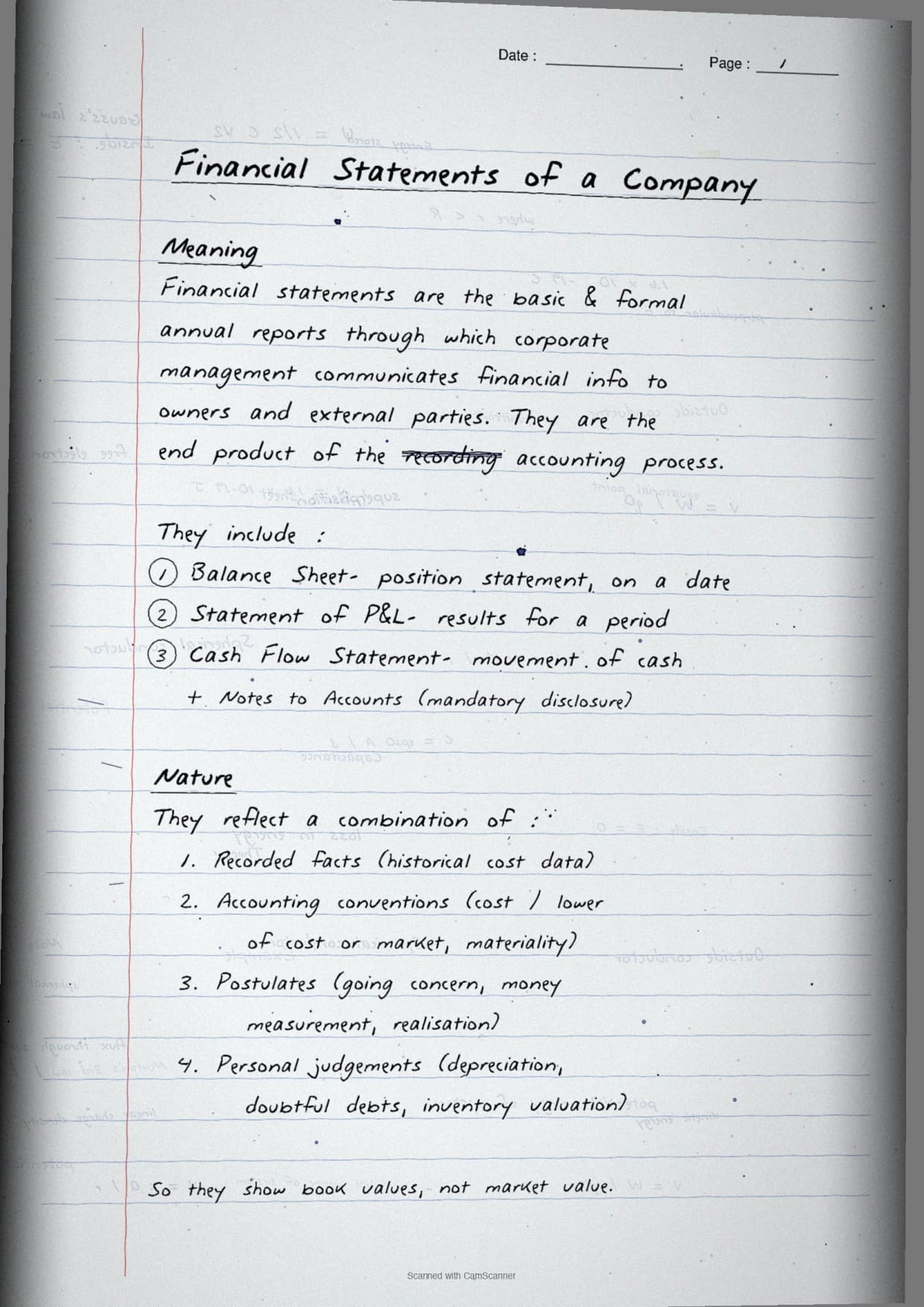


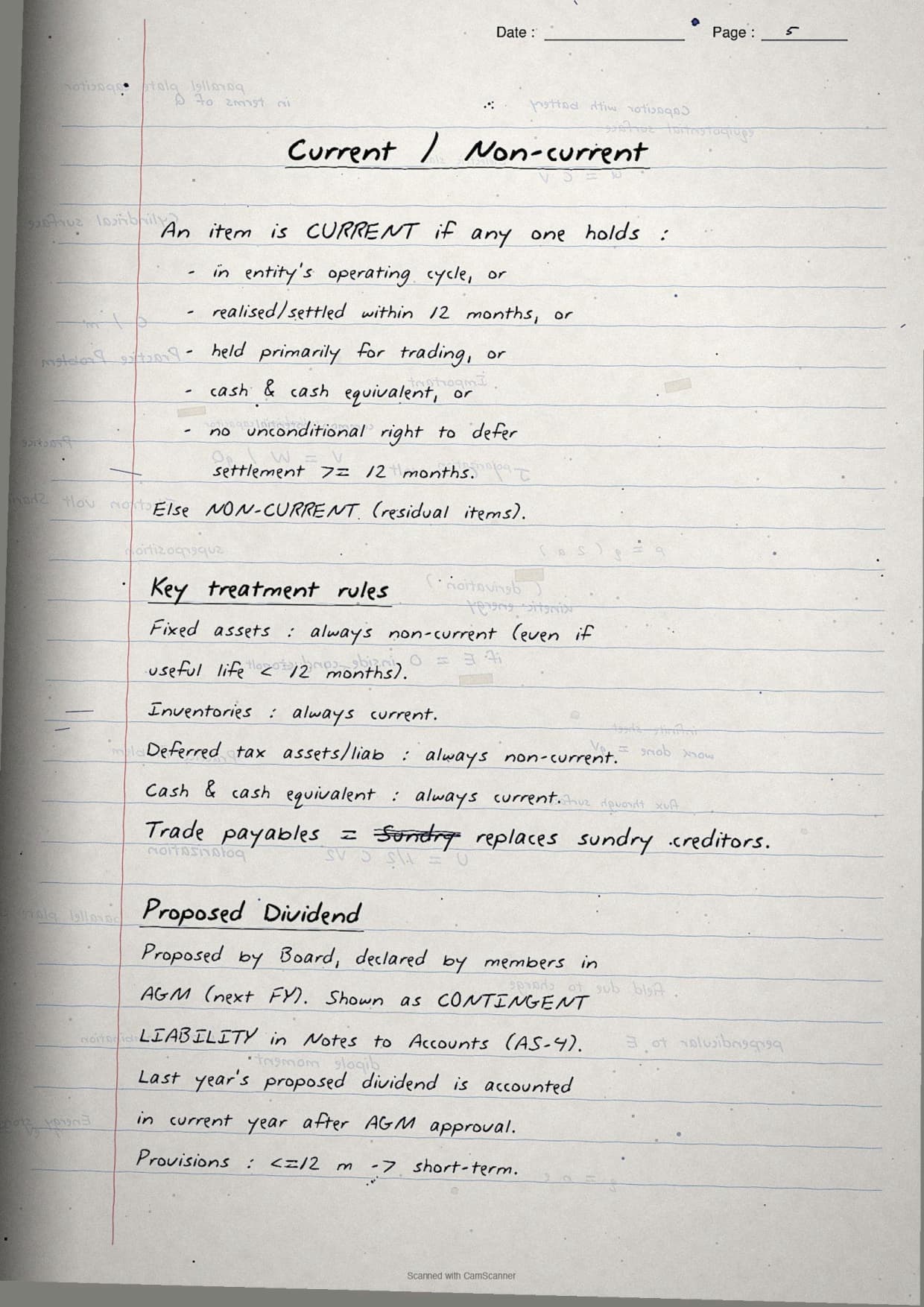
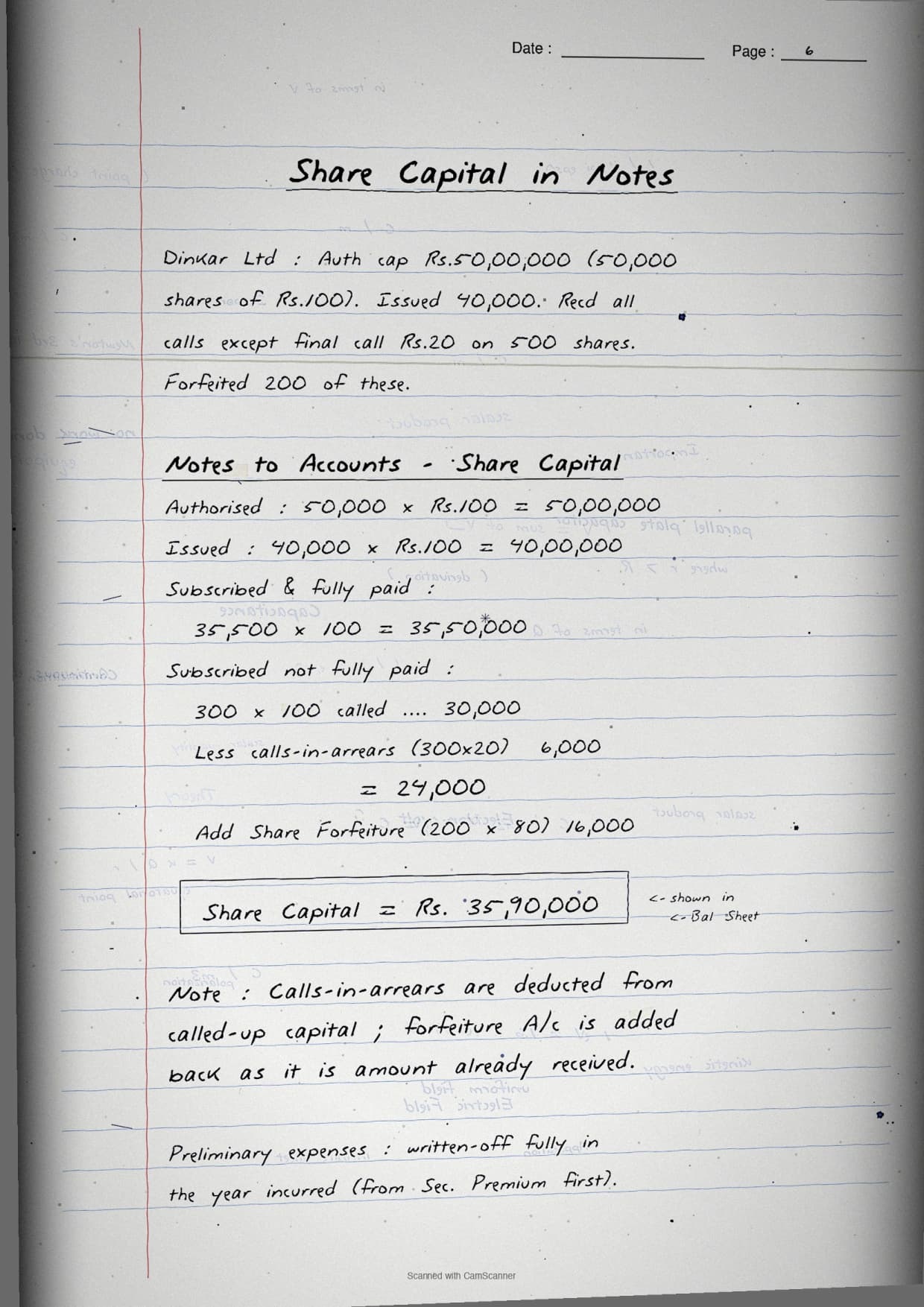

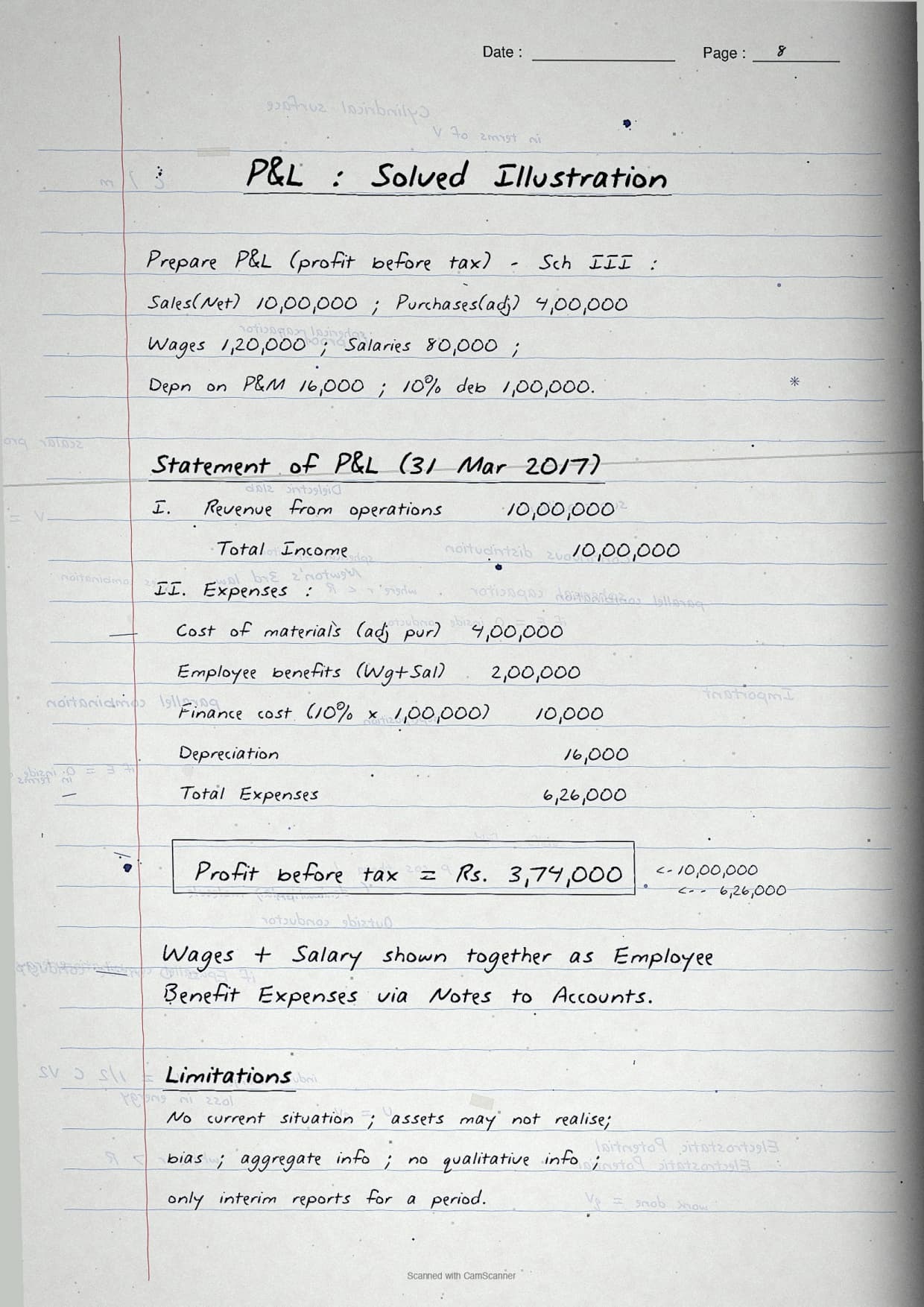
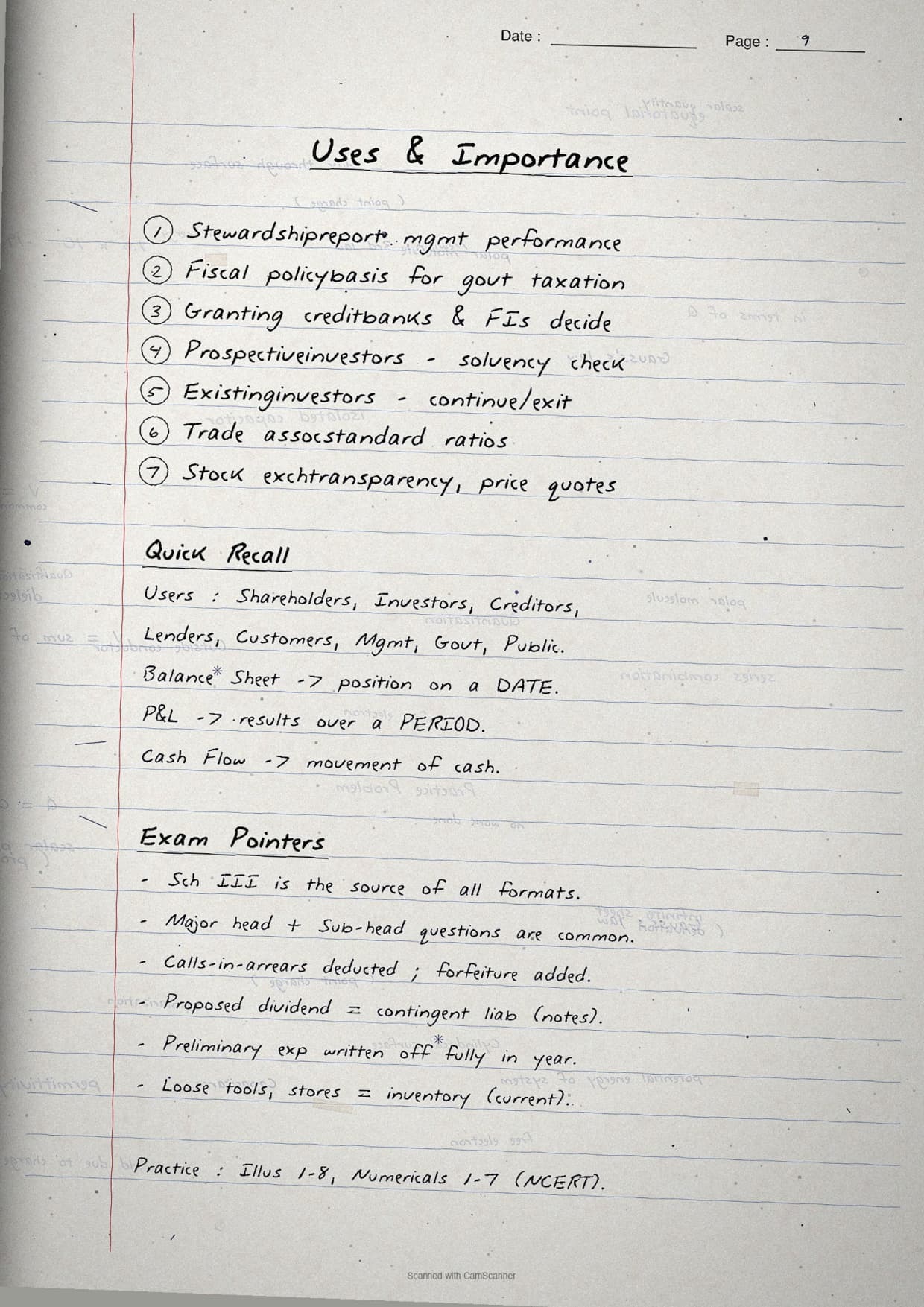
Use the PDF above for a quick skim of the full nine-page booklet. Below, we break down each section and format component in detail.
Related: Typeset Notes • NCERT Book PDF
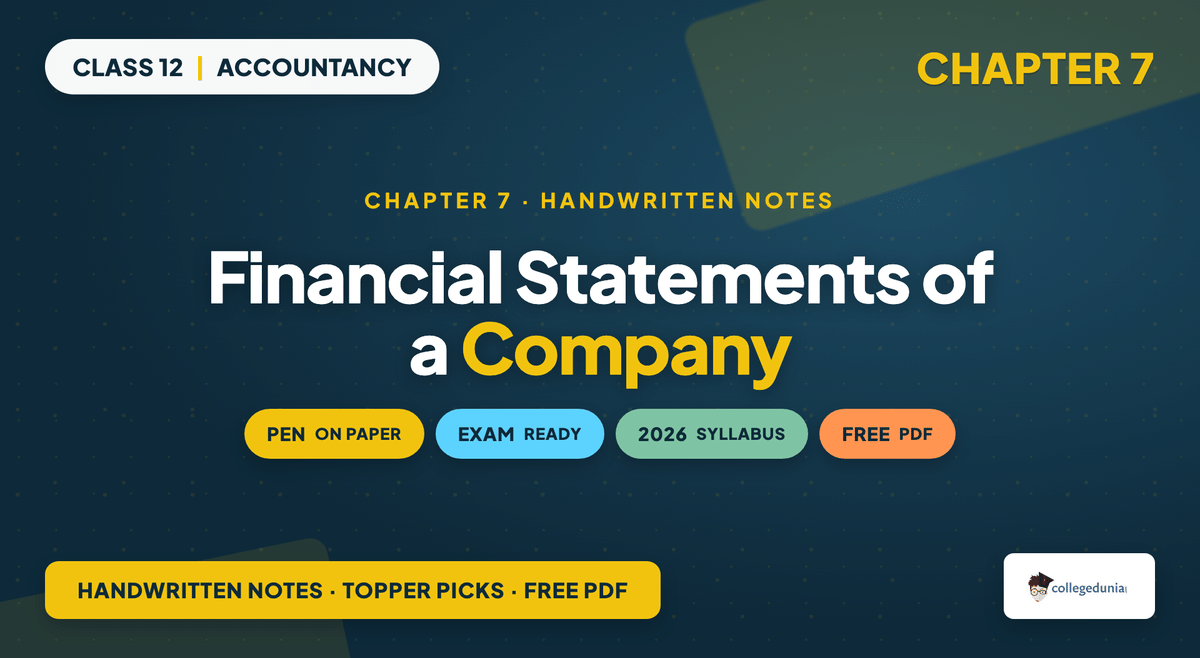
The nine pages break down Schedule III, the Balance Sheet format, P&L essentials, and slip warnings. Each section of this article details what you'll find on each page.
What These Handwritten Notes Cover
- Schedule III Format: Balance Sheet skeleton as per Companies Act, 2013, in the exact order the marker expects.
- 2026-27 NCERT Alignment: All heads and sub-heads match the current edition.
- Notes-to-Accounts: Four pre-drawn working-note templates; fill numbers, not formats.
- Fast Recall: Nine pages for last-day revision after reading the typeset Notes.
Video Overview
Source: Rajat Arora on YouTube
The 9 Pages: Section Breakdown
Each page anchors one format block from the CBSE Part B paper.
| Page | Focus | What you copy first |
|---|---|---|
| Page 1 | Meaning and Companies Act, 2013 framework | Section 2(40) statement list. |
| Page 2 | Schedule III Balance Sheet skeleton | Equity and Liabilities, then Assets. |
| Page 3 | Equity and Liabilities heads | Shareholders' Funds to Current Liabilities. |
| Page 4 | Assets heads | Non-current, then Current Assets. |
| Page 5 | Current versus Non-current test | The twelve-month rule. |
| Page 6 | Statement of Profit and Loss format | Revenue to profit lines. |
| Page 7 | Notes to Accounts templates | Four working-note formats. |
| Page 8 | Limitations and uses of statements | Historical, monetary, price-level limits. |
| Page 9 | Six slip warnings | Red-pen margin arrows. |
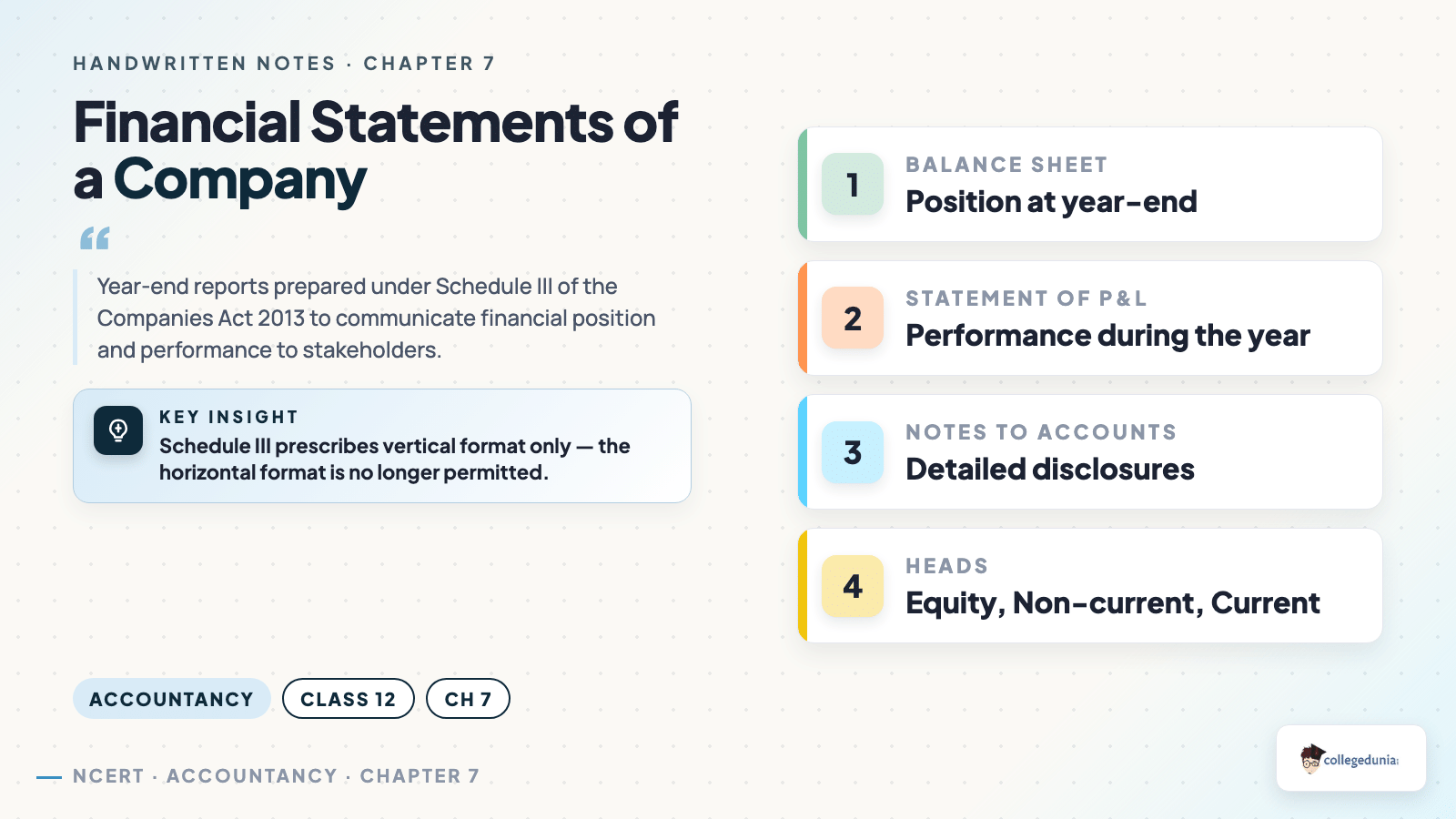
Schedule III Balance Sheet Skeleton
Page 2 draws the Schedule III Balance Sheet as a two-block vertical skeleton. The CBSE paper almost always tests item placement under the correct head, so a wrong head loses the mark even when the figure is right.
| I. Equity and Liabilities | II. Assets |
|---|---|
| Shareholders' Funds (Share Capital, Reserves and Surplus) | Non-current Assets (Fixed Assets, Investments) |
| Share Application Money Pending Allotment | Long-term Loans and Advances |
| Non-current Liabilities (Long-term Borrowings) | Current Assets (Inventories, Receivables, Cash) |
| Current Liabilities (Short-term Borrowings, Trade Payables) | Short-term Loans and Advances |
Page 5 applies the twelve-month test: an item is current if realised/settled within 12 months of reporting date or the normal operating cycle; otherwise non-current. Margin note: "No operating cycle given? Default to 12 months; never leave an item unclassified."
Statement of Profit and Loss Format
Page 6 shows the P&L ladder in fixed Schedule III order. The CBSE paper tests the format or specific profit lines.
| Line | Item | What goes here |
|---|---|---|
| I | Revenue from Operations | Sale of products and services, net of returns. |
| II | Other Income | Interest, dividend, profit on sale of assets. |
| III | Total Revenue (I + II) | - |
| IV | Expenses | Cost of materials, employee benefits, finance and depreciation. |
| V | Profit before Tax (III − IV) | - |
| VI | Profit after Tax | Profit before Tax less tax expense. |
How to Read These Notes (Colour Legend)
Blue ink: format skeletons & heads. Red pen: rules & slip warnings. Green underline: items that shift head (e.g., proposed dividend). Yellow: items most often misplaced by students.
Notes to Accounts: Working-Note Templates
Page 7 pre-draws four standard working notes: Share Capital, Reserves and Surplus, Long-term Borrowings, Fixed Assets. Every face total needs a numbered supporting note.
Self-Assessment Quiz
Final check after your last reading.
Q1. Under which Act is the Schedule III format of the Balance Sheet prescribed?
(a) Companies Act, 1956 (b) Companies Act, 2013 (c) Income Tax Act, 1961 (d) Partnership Act, 1932
Answer: (b) Companies Act, 2013 — Schedule III prescribes the vertical format for the Balance Sheet and the Statement of Profit and Loss.
Q2. Which side of the Schedule III Balance Sheet is presented first?
(a) Assets (b) Equity and Liabilities (c) Either side (d) Notes to Accounts
Answer: (b) Equity and Liabilities is presented first, followed by Assets.
Q3. If no operating cycle is given, what period is used for current classification?
(a) 6 months (b) 9 months (c) 12 months (d) 24 months
Answer: (c) 12 months is taken as the operating cycle when it cannot be identified.
Q4. Under which head is Securities Premium shown?
(a) Share Capital (b) Reserves and Surplus (c) Current Liabilities (d) Other Income
Answer: (b) Reserves and Surplus, under Shareholders' Funds. Provision for Tax, by contrast, is a short-term provision under Current Liabilities.
Last 24-Hour Revision Card
Night-before checklist. Skim before the exam.
- Schedule III head order: Equity and Liabilities, then Assets.
- The twelve-month test for current versus non-current items.
- P&L ladder: Revenue, Other Income, Expenses, Profit before Tax, Profit after Tax.
- Four Notes-to-Accounts templates.
- Items that shift head: proposed dividend, provision for tax, share application money.
Six Frequent Slip Warnings
Page 9 highlights six common mistakes from CBSE scripts. Clearing all six keeps you to one mark lost max.
| # | Slip pattern | Correct treatment |
|---|---|---|
| 1 | Showing Assets before Equity and Liabilities | Equity and Liabilities is always presented first in Schedule III. |
| 2 | Putting Securities Premium under Share Capital | It belongs to Reserves and Surplus under Shareholders' Funds. |
| 3 | Treating proposed dividend as a current liability | Under the current 2026-27 syllabus it is a contingent liability disclosed in notes. |
| 4 | Writing the figure on the face without a note | Every total must be supported by a numbered Note to Accounts. |
| 5 | Booking finance cost below the profit line | Finance cost is part of Expenses, before Profit before Tax. |
| 6 | Leaving a borderline item unclassified | Apply the twelve-month test and place it as current or non-current. |
Secure the format part of this chapter by clearing all six slips. Full walkthrough: Typeset Notes.
Related Chapter Resources
All Class 12 Accountancy Chapters
| Chapter | Resource |
|---|---|
| Chapter 1 | Accounting for Partnership Firms: Fundamentals Handwritten Notes |
| Chapter 2 | Reconstitution: Admission of a Partner Handwritten Notes |
| Chapter 3 | Reconstitution: Retirement or Death of a Partner Handwritten Notes |
| Chapter 4 | Dissolution of Partnership Firm Handwritten Notes |
| Part 2 Chapter 1 | Accounting for Share Capital Handwritten Notes |
| Part 2 Chapter 2 | Issue and Redemption of Debentures Handwritten Notes |
Other Resources for This Chapter
| Resource | Link |
|---|---|
| Notes | Financial Statements of a Company Notes |
| NCERT Book PDF | Financial Statements of a Company NCERT Book PDF |
| Handwritten Notes | Financial Statements of a Company Handwritten Notes |
| Previous Year Questions | Financial Statements of a Company Previous Year Questions |
Student Feedback
In a Collegedunia poll of 1,240 Class 12 Commerce students, 76% rated Financial Statements of a Company among the tougher parts of the Accountancy syllabus. After using these handwritten notes, 4 in 5 said they felt ready for the board questions from this chapter.
Financial Statements of a Company Class 12 Accountancy Handwritten Notes FAQs
Ques. Where can I download the Financial Statements of a Company class 12 accountancy handwritten notes PDF?
Ans. You can download the Financial Statements of a Company Class 12 Accountancy Handwritten Notes PDF directly from this page. The scanned blue-ink booklet runs nine pages and is free, sized for last-day CBSE revision after one read of the typeset Notes.
Ques. What does the Financial Statements of a Company handwritten notes PDF contain?
Ans. Nine ruled pages: the Companies Act, 2013 framework, the Schedule III Balance Sheet skeleton, Equity and Liabilities and Assets heads, the twelve-month current classification test, the Statement of Profit and Loss ladder, four Notes-to-Accounts templates, limitations of financial statements, and six red-pen slip warnings.
Ques. Is this resource aligned with the 2026-27 NCERT?
Ans. Yes. The booklet reflects the current 2026-27 syllabus for Class 12 Accountancy Part B. The Schedule III format, the Companies Act, 2013 framework, and the proposed-dividend treatment as a contingent liability all match the new NCERT edition.
Ques. How many pages is the Class 12th Accountancy Financial Statements of a Company handwritten notes PDF?
Ans. The handwritten notes PDF runs nine pages and covers the full Schedule III Balance Sheet and Statement of Profit and Loss formats, the current versus non-current test, and the Notes-to-Accounts workings the CBSE Part B paper asks for.
Ques. Under which side is Equity and Liabilities shown in the Schedule III Balance Sheet?
Ans. Equity and Liabilities is presented first in the Schedule III vertical format, followed by Assets. The booklet circles this head order in red because reversing the two blocks is the most common presentation slip in this chapter.
Ques. Are handwritten notes enough to cover Financial Statements of a Company for CBSE 2026?
Ans. The handwritten notes are a final-day revision aid, not a first-read resource. Pair them with the Collegedunia typeset Notes PDF and at least six solved Schedule III format questions from the NCERT textbook for full 6 to 8 mark coverage in the Accountancy Part B paper.



Comments