



The handwritten notes for Class 6 Mathematics Ganita Prakash Chapter 2 Lines and Angles are prepared for quick 2026-27 revision. The PDF turns the geometry chapter into clean notebook pages on points, rays, line segments, angle types, protractor use and reflex angles.
- Best use: revise definitions, diagrams and angle rules before class tests.
- PDF focus: naming figures, comparing openings, reading a protractor and classifying angles.
- Chapter value: this chapter builds the geometry language needed for later construction work.
Chapter2LinesandAnglesHandwrittenNotes.pdf?page=1&dpi=150)
Chapter2LinesandAnglesHandwrittenNotes.pdf?page=2&dpi=150)
Chapter2LinesandAnglesHandwrittenNotes.pdf?page=3&dpi=150)
Chapter2LinesandAnglesHandwrittenNotes.pdf?page=4&dpi=150)
Chapter2LinesandAnglesHandwrittenNotes.pdf?page=5&dpi=150)
Chapter2LinesandAnglesHandwrittenNotes.pdf?page=6&dpi=150)
Chapter2LinesandAnglesHandwrittenNotes.pdf?page=7&dpi=150)
Chapter2LinesandAnglesHandwrittenNotes.pdf?page=8&dpi=150)
Chapter2LinesandAnglesHandwrittenNotes.pdf?page=9&dpi=150)
Chapter2LinesandAnglesHandwrittenNotes.pdf?page=10&dpi=150)
Chapter2LinesandAnglesHandwrittenNotes.pdf?page=11&dpi=150)
Chapter2LinesandAnglesHandwrittenNotes.pdf?page=12&dpi=150)
Chapter2LinesandAnglesHandwrittenNotes.pdf?page=13&dpi=150)
Chapter2LinesandAnglesHandwrittenNotes.pdf?page=14&dpi=150)
Chapter2LinesandAnglesHandwrittenNotes.pdf?page=15&dpi=150)
Chapter2LinesandAnglesHandwrittenNotes.pdf?page=16&dpi=150)
Chapter2LinesandAnglesHandwrittenNotes.pdf?page=17&dpi=150)
Chapter2LinesandAnglesHandwrittenNotes.pdf?page=18&dpi=150)
Chapter2LinesandAnglesHandwrittenNotes.pdf?page=19&dpi=150)
Chapter2LinesandAnglesHandwrittenNotes.pdf?page=20&dpi=150)
Chapter2LinesandAnglesHandwrittenNotes.pdf?page=21&dpi=150)
Chapter2LinesandAnglesHandwrittenNotes.pdf?page=22&dpi=150)
Chapter2LinesandAnglesHandwrittenNotes.pdf?page=23&dpi=150)
Chapter2LinesandAnglesHandwrittenNotes.pdf?page=24&dpi=150)
Chapter2LinesandAnglesHandwrittenNotes.pdf?page=25&dpi=150)
Chapter2LinesandAnglesHandwrittenNotes.pdf?page=26&dpi=150)
Chapter2LinesandAnglesHandwrittenNotes.pdf?page=27&dpi=150)
Student Feedback: In a Collegedunia study check of 10,680 Class 6 students before the 2026 school exams, students found angle questions easier after circling the vertex first.
Class 6 Mathematics Chapter 2 Handwritten Notes Overview
Lines and Angles starts with the building blocks of geometry. Students learn points, line segments, lines and rays before they name angles. The handwritten PDF keeps these ideas separate, so a student can revise one concept without mixing it with the next one.
The central idea is that an angle is a turn made by two rays with a common starting point. The vertex letter must stay in the middle when an angle is named with three letters. This small rule prevents many naming mistakes.
Lines and Angles Quick Revision
Source: Magnet Brains on YouTube
What These Lines and Angles Handwritten Notes Cover
The PDF follows the Ganita Prakash order. It begins with point, line segment, line and ray. It then moves to angles, comparing angles, right angles, perpendicular lines, acute angles, obtuse angles, straight angles and reflex angles.
- Geometry basics: points, line segments, lines and rays.
- Angle ideas: vertex, arms, amount of turn and superimposition.
- Measurement: degrees, protractor scale, drawing angles and reflex angles.
Angle Types in Lines and Angles Chapter 2
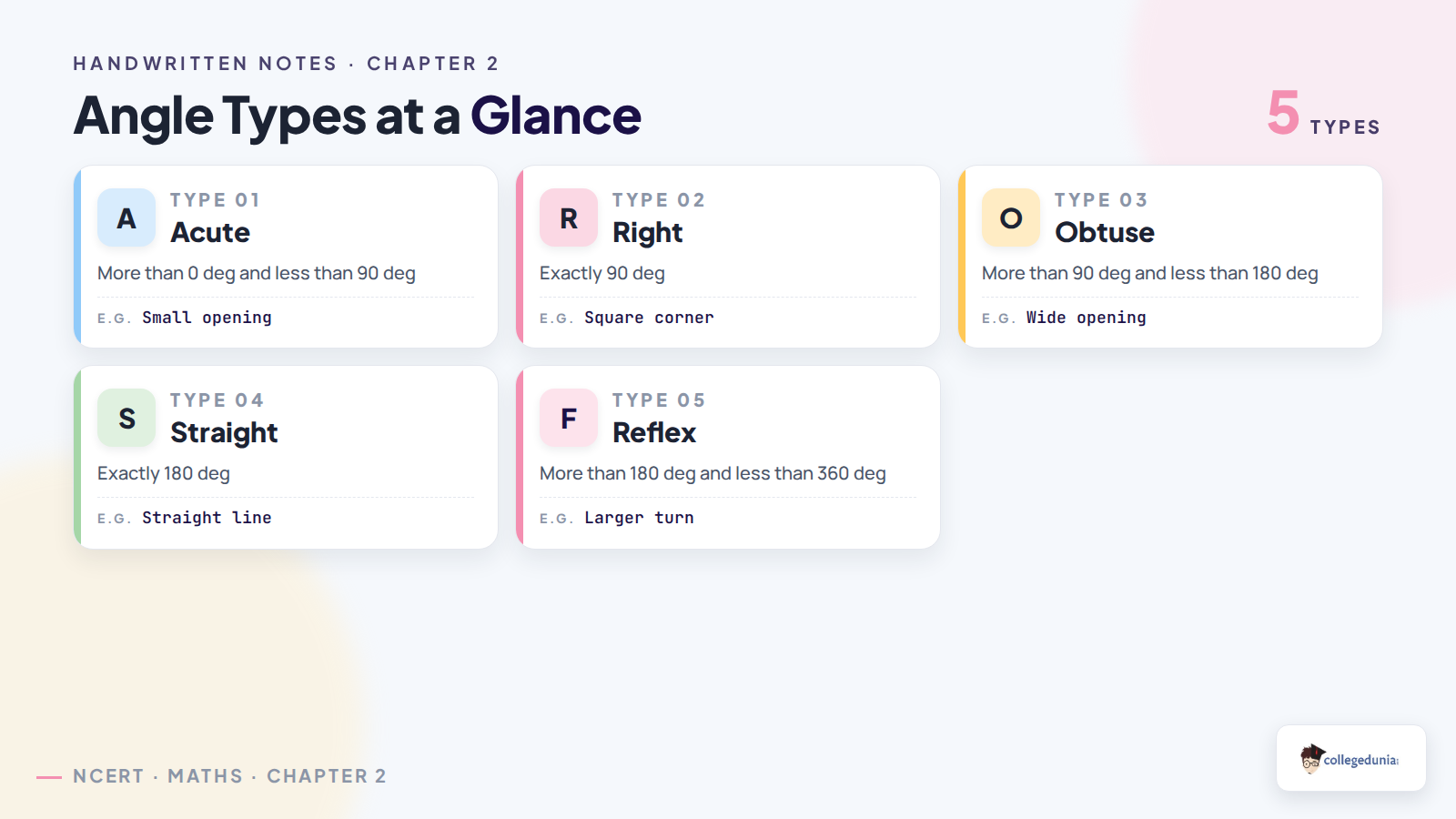
Angle types are easiest to remember by comparing each angle with a right angle and a straight angle. A right angle is exactly 90 deg. A straight angle is exactly 180 deg. These two benchmarks help students classify the rest.
| Angle type | Range or value | Quick check |
|---|---|---|
| Acute angle | More than 0 deg and less than 90 deg | Smaller than a square corner |
| Right angle | Exactly 90 deg | Matches a square corner |
| Obtuse angle | More than 90 deg and less than 180 deg | Wider than a right angle |
| Straight angle | Exactly 180 deg | Makes a straight line |
| Reflex angle | More than 180 deg and less than 360 deg | The larger turn around the vertex |
Do not decide angle size by arm length. A longer arm does not make a larger angle. Only the opening or turn matters.
Drawing an Angle with a Protractor in Class 6
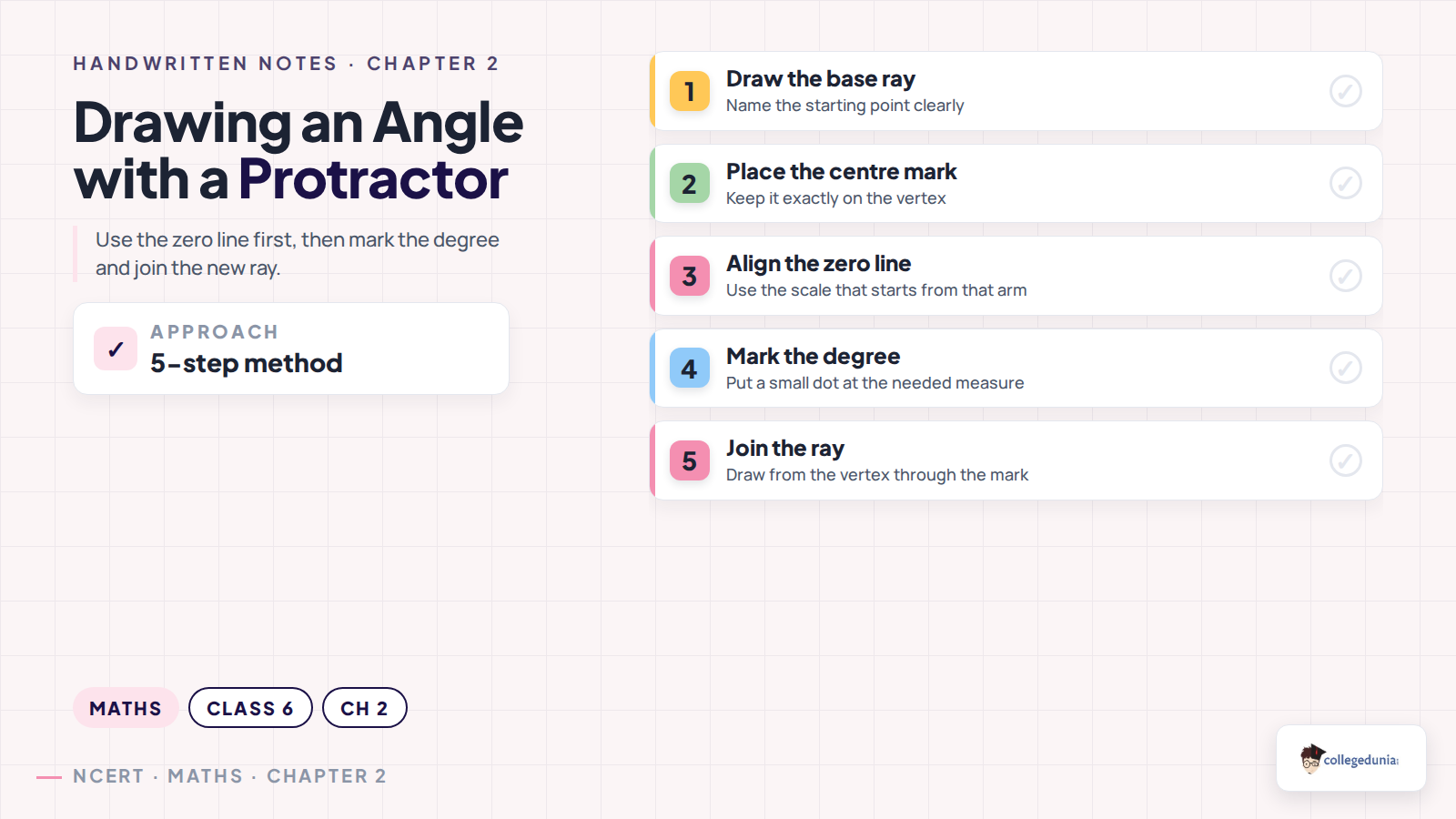
Protractor questions need slow placement. First draw the base ray. Then put the centre mark exactly on the vertex. The zero line must sit on the base ray before any degree mark is read.
- Draw the base ray and name the vertex clearly.
- Place the protractor centre on the vertex.
- Align the base ray with the 0 deg line.
- Mark the required degree on the correct scale.
- Join the vertex to the mark to draw the second ray.
Common Mistakes Students Make in Lines and Angles
- Do not write ray OP as ray PO. The starting point changes.
- Do not place the vertex letter at the side while naming an angle.
- Do not read the protractor scale that starts from the other 0 deg mark.
- Do not call a 180 deg angle obtuse. It is a straight angle.
- Do not forget the lower bound for acute angles. It is more than 0 deg.
For fast revision, students should read one notebook page and redraw the small figure in the margin. This turns the handwritten PDF into a quick geometry practice sheet.
Related NCERT Resources for Lines and Angles Class 6
| Resource | Link |
|---|---|
| NCERT Solutions | Class 6 Mathematics Chapter 2 NCERT Solutions |
| NCERT Notes | Class 6 Mathematics Chapter 2 Notes |
| NCERT Book PDF | Class 6 Mathematics Chapter 2 Book PDF |
More Class 6 Mathematics Handwritten Notes
| Chapter | Handwritten Notes |
|---|---|
| Chapter 1 | Patterns in Mathematics |
| Chapter 2 | Lines and Angles |
| Chapter 3 | Number Play |
| Chapter 4 | Data Handling and Presentation |
Lines and Angles Class 6 Handwritten Notes FAQs
Ques. What is covered in Lines and Angles handwritten notes?
Ans. The notes cover points, line segments, lines, rays, angle naming, angle types, protractor use and reflex angles.
Ques. Are these handwritten notes based on the 2026-27 Ganita Prakash textbook?
Ans. Yes. The PDF follows Class 6 Mathematics Ganita Prakash Chapter 2 for the 2026-27 session.
Ques. How should students revise this chapter from the PDF?
Ans. Students should revise the naming rules first, then practise angle types, protractor placement and drawing-angle steps.
Ques. Why are handwritten notes useful for Lines and Angles?
Ans. Notebook-style notes keep the small diagrams next to the rule, which helps students compare rays, turns and angle types quickly.



Comments