




The handwritten notes for Class 6 Mathematics Ganita Prakash Chapter 3 Number Play are prepared for quick 2026-27 revision. The PDF covers taller-neighbour number games, supercells, digit reversal, palindromes, calendar patterns and mental maths checks.
- Best use: revise the chapter before class tests and homework correction.
- PDF focus: number patterns, local comparison rules, digit tricks and short explanations.
- Chapter value: this chapter builds the reasoning habit needed for later arithmetic and algebra.
Chapter3NumberPlayHandwrittenNotes.pdf?page=1&dpi=150)
Chapter3NumberPlayHandwrittenNotes.pdf?page=2&dpi=150)
Chapter3NumberPlayHandwrittenNotes.pdf?page=3&dpi=150)
Chapter3NumberPlayHandwrittenNotes.pdf?page=4&dpi=150)
Chapter3NumberPlayHandwrittenNotes.pdf?page=5&dpi=150)
Chapter3NumberPlayHandwrittenNotes.pdf?page=6&dpi=150)
Chapter3NumberPlayHandwrittenNotes.pdf?page=7&dpi=150)
Chapter3NumberPlayHandwrittenNotes.pdf?page=8&dpi=150)
Chapter3NumberPlayHandwrittenNotes.pdf?page=9&dpi=150)
Chapter3NumberPlayHandwrittenNotes.pdf?page=10&dpi=150)
Chapter3NumberPlayHandwrittenNotes.pdf?page=11&dpi=150)
Chapter3NumberPlayHandwrittenNotes.pdf?page=12&dpi=150)
Chapter3NumberPlayHandwrittenNotes.pdf?page=13&dpi=150)
Chapter3NumberPlayHandwrittenNotes.pdf?page=14&dpi=150)
Chapter3NumberPlayHandwrittenNotes.pdf?page=15&dpi=150)
Chapter3NumberPlayHandwrittenNotes.pdf?page=16&dpi=150)
Chapter3NumberPlayHandwrittenNotes.pdf?page=17&dpi=150)
Chapter3NumberPlayHandwrittenNotes.pdf?page=18&dpi=150)
Chapter3NumberPlayHandwrittenNotes.pdf?page=19&dpi=150)
Chapter3NumberPlayHandwrittenNotes.pdf?page=20&dpi=150)
Chapter3NumberPlayHandwrittenNotes.pdf?page=21&dpi=150)
Chapter3NumberPlayHandwrittenNotes.pdf?page=22&dpi=150)
Student Feedback: In a Collegedunia study check of 9,840 Class 6 students before the 2026 school exams, students found Number Play easier after writing the rule beside each example.
Class 6 Mathematics Chapter 3 Handwritten Notes Overview
Number Play teaches students to treat numbers like clues. The chapter asks students to notice what a number means in a situation, test small cases, and then explain the rule in words. The handwritten PDF keeps each rule next to a short example, so revision stays fast.
The notes follow the Ganita Prakash chapter flow. They begin with the taller-neighbour game, move to supercells in a row and grid, and then revise digit reversal, palindromes, Kaprekar-style steps, Collatz-type chains and calendar number patterns.
Number Play Class 6 Video Revision
Source: Magnet Brains on YouTube
What These Number Play Handwritten Notes Cover
The PDF has 22 handwritten pages. Each page focuses on one idea, so students can revise a topic without searching through long paragraphs. The main sections cover:
- Taller-neighbour game: how each child counts taller children beside them.
- Supercells: how to compare a number only with adjacent cells.
- Digit puzzles: reverse, subtract, add and look for a pattern.
- Calendar patterns: why dates in one weekday column differ by 7.
How to Revise Number Play Quickly
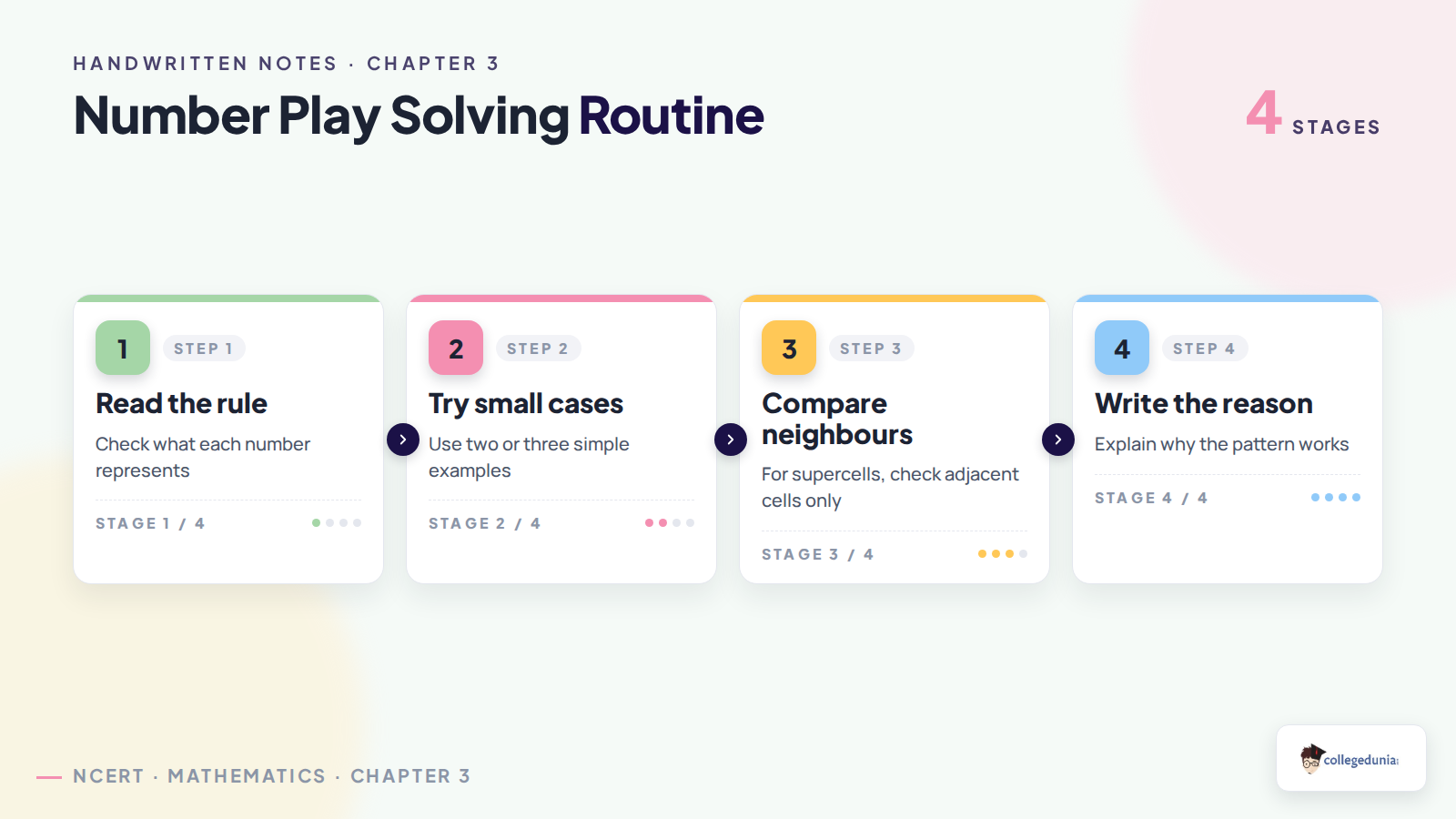
Start every Number Play question by reading the rule carefully. Then try one small example, because a small case often reveals the pattern. After that, explain the reason in one or two lines. This is better than writing only the next number.
| Question Type | Fast Revision Check | Common Trap |
|---|---|---|
| Taller-neighbour sequence | End positions can say only 0 or 1. | Putting 2 at an end. |
| Supercell row | Compare only with left and right cells. | Comparing with the whole row. |
| Supercell grid | Compare left, right, top and bottom. | Counting diagonal cells. |
| Digit reversal | Track place value and carries. | Reversing digits but losing the sign. |
Supercells, Digit Patterns and Palindromes
A supercell is a local winner. It does not need to be the largest number in the whole table. It only needs to be larger than the cells touching it. That is why the largest number will always be a supercell, but some other numbers may also become supercells.
Digit patterns use place value. In a two-digit reverse-subtraction puzzle, the result becomes 9 times the difference between the two digits. In palindrome questions, students reverse and add until the number reads the same from both sides.
Quick check: when a method gives a pattern, test it on two more numbers before writing the final reason.
Common Mistakes in Number Play Class 6
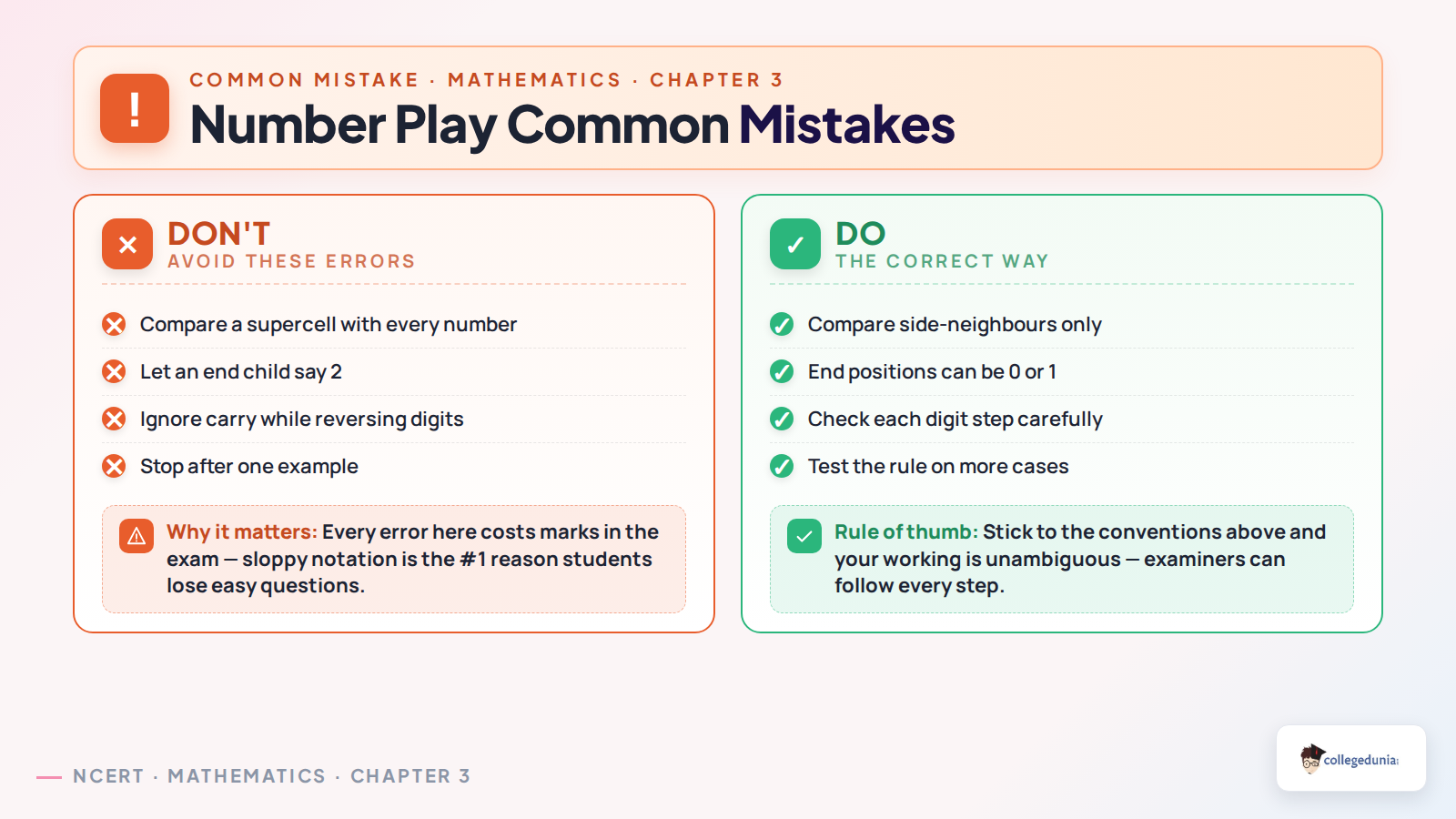
- Do not compare a supercell with every number in the table.
- Do not count diagonal cells as neighbours in the grid rule.
- Do not let an end child say 2 in the taller-neighbour game.
- Do not skip the carry while reversing and adding digits.
- Do not call one example a proof. A rule needs checking.
For fast revision, students should write rule, trial, reason, test at the top of the page. This four-word routine fits almost every puzzle in this chapter.
Related NCERT Resources for Number Play Class 6
| Resource | Link |
|---|---|
| NCERT Solutions | Class 6 Mathematics Chapter 3 NCERT Solutions |
| NCERT Notes | Class 6 Mathematics Chapter 3 Notes |
| NCERT Book PDF | Class 6 Mathematics Chapter 3 Book PDF |
More Class 6 Mathematics Handwritten Notes
| Chapter | Handwritten Notes |
|---|---|
| Chapter 1 | Patterns in Mathematics |
| Chapter 2 | Lines and Angles |
| Chapter 4 | Data Handling and Presentation |
| Chapter 5 | Prime Time |
| Chapter 6 | Perimeter and Area |
Number Play Class 6 Handwritten Notes FAQs
Ques. What is covered in Number Play handwritten notes?
Ans. The notes cover taller-neighbour games, supercells, digit patterns, palindromes, calendar patterns and quick revision checks.
Ques. Are these handwritten notes based on the 2026-27 Ganita Prakash textbook?
Ans. Yes. The PDF follows Class 6 Mathematics Ganita Prakash Chapter 3 for the 2026-27 session.
Ques. How should students revise this chapter from the PDF?
Ans. Students should revise one rule, solve one small example, then write the reason behind the pattern.
Ques. Why are handwritten notes useful for Number Play?
Ans. Handwritten notes keep the rule, trial and example together, which helps students revise number puzzles quickly.



Comments