



The handwritten notes on Class 6 Science Chapter 2 Diversity in the Living World have been prepared for quick 2026-27 revision. These notes cover biodiversity, grouping of plants and animals, roots, venation, habitats, adaptations and biodiversity protection in a short notebook-ready format.
- Best use: revise the chapter after reading the NCERT Curiosity textbook once.
- PDF focus: plant groups, animal movement, habitats, adaptations and conservation examples.
- Chapter value: this chapter builds the observation and grouping skills used in later Science topics.
Chapter2DiversityintheLivingWorldHandwrittenNotes.pdf?page=1&dpi=150)
Chapter2DiversityintheLivingWorldHandwrittenNotes.pdf?page=2&dpi=150)
Chapter2DiversityintheLivingWorldHandwrittenNotes.pdf?page=3&dpi=150)
Chapter2DiversityintheLivingWorldHandwrittenNotes.pdf?page=4&dpi=150)
Chapter2DiversityintheLivingWorldHandwrittenNotes.pdf?page=5&dpi=150)
Chapter2DiversityintheLivingWorldHandwrittenNotes.pdf?page=6&dpi=150)
Chapter2DiversityintheLivingWorldHandwrittenNotes.pdf?page=7&dpi=150)
Chapter2DiversityintheLivingWorldHandwrittenNotes.pdf?page=8&dpi=150)
Chapter2DiversityintheLivingWorldHandwrittenNotes.pdf?page=9&dpi=150)
Chapter2DiversityintheLivingWorldHandwrittenNotes.pdf?page=10&dpi=150)
Chapter2DiversityintheLivingWorldHandwrittenNotes.pdf?page=11&dpi=150)
Chapter2DiversityintheLivingWorldHandwrittenNotes.pdf?page=12&dpi=150)
Chapter2DiversityintheLivingWorldHandwrittenNotes.pdf?page=13&dpi=150)
Chapter2DiversityintheLivingWorldHandwrittenNotes.pdf?page=14&dpi=150)
Chapter2DiversityintheLivingWorldHandwrittenNotes.pdf?page=15&dpi=150)
Chapter2DiversityintheLivingWorldHandwrittenNotes.pdf?page=16&dpi=150)
Chapter2DiversityintheLivingWorldHandwrittenNotes.pdf?page=17&dpi=150)
Chapter2DiversityintheLivingWorldHandwrittenNotes.pdf?page=18&dpi=150)
Chapter2DiversityintheLivingWorldHandwrittenNotes.pdf?page=19&dpi=150)
Chapter2DiversityintheLivingWorldHandwrittenNotes.pdf?page=20&dpi=150)
Chapter2DiversityintheLivingWorldHandwrittenNotes.pdf?page=21&dpi=150)
Chapter2DiversityintheLivingWorldHandwrittenNotes.pdf?page=22&dpi=150)
Chapter2DiversityintheLivingWorldHandwrittenNotes.pdf?page=23&dpi=150)
Chapter2DiversityintheLivingWorldHandwrittenNotes.pdf?page=24&dpi=150)
Chapter2DiversityintheLivingWorldHandwrittenNotes.pdf?page=25&dpi=150)
Chapter2DiversityintheLivingWorldHandwrittenNotes.pdf?page=26&dpi=150)
Chapter2DiversityintheLivingWorldHandwrittenNotes.pdf?page=27&dpi=150)
Student Feedback: In a Collegedunia study check, 73% of Class 6 students said the handwritten tables helped them recall plant groups and habitat examples faster.
|
Table of Contents |
Class 6 Science Chapter 2 Handwritten Notes Overview
Class 6 Science Chapter 2 teaches students how to observe the variety of living things around them. The chapter begins with a nature walk and then moves into the study of biodiversity, plant features, animal movement and habitats.
The handwritten PDF keeps the chapter easy to revise. It uses short points for biodiversity, grouping, herbs, shrubs, trees, roots, venation, monocots, dicots, habitats and adaptations. The key idea is simple: living things look different because their features help them live in different surroundings.
Diversity in the Living World Video Revision
Source: Magnet Brains on YouTube
What These Handwritten Notes Cover
The notes start with Dr Raghu, Maniram chacha and the nature walk from NCERT. Students learn to observe plants, birds, insects, smells, sounds and weather without disturbing living things.
The PDF then turns those observations into exam-ready points. It explains why plants and animals are grouped, how plant features are compared, and how animals can be grouped by movement, food, body parts or habitat.
- Plant focus: stems, leaves, flowers, roots, seeds and branching pattern.
- Animal focus: habitat, food, movement and body parts used for movement.
- Conservation focus: habitat damage, Project Tiger, cheetah restoration and sacred groves.
Grouping Plants and Animals in Diversity in the Living World
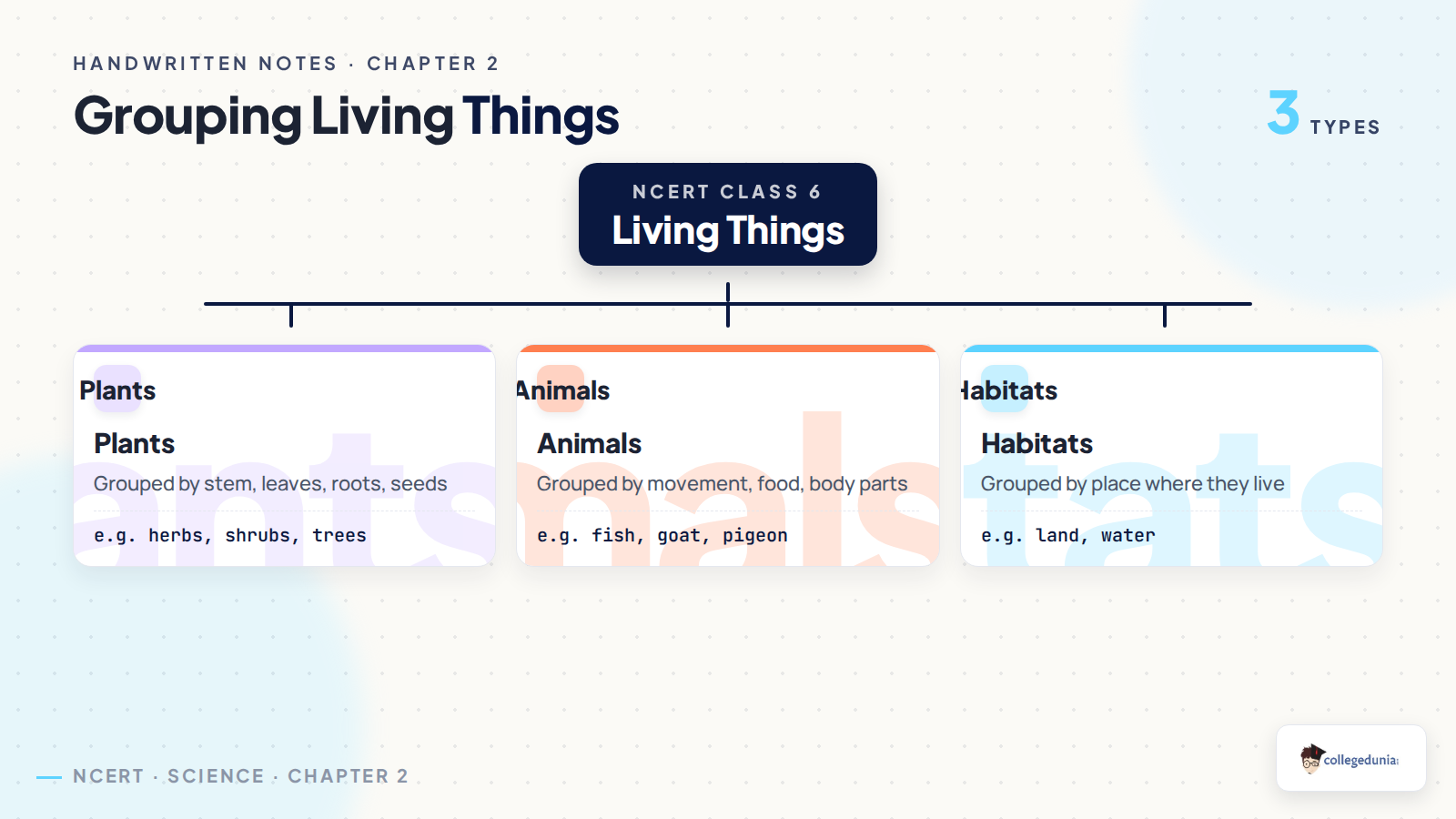
Grouping makes the variety of living things easier to study. Plants may be grouped by height, stem type, flowers, leaves or roots. Animals may be grouped by movement, food, body parts or the place where they live.
| Plant group | Main feature | NCERT example |
|---|---|---|
| Herb | Small plant with soft green stem | Tomato |
| Shrub | Many hard stems, branches close to ground | Rose |
| Tree | Tall plant with hard thick woody stem | Mango |
| Climber | Weak stem, needs support | Money plant type examples |
| Creeper | Weak stem, spreads along ground | Pumpkin type examples |
Venation Roots and Seeds in Class 6 Science Chapter 2
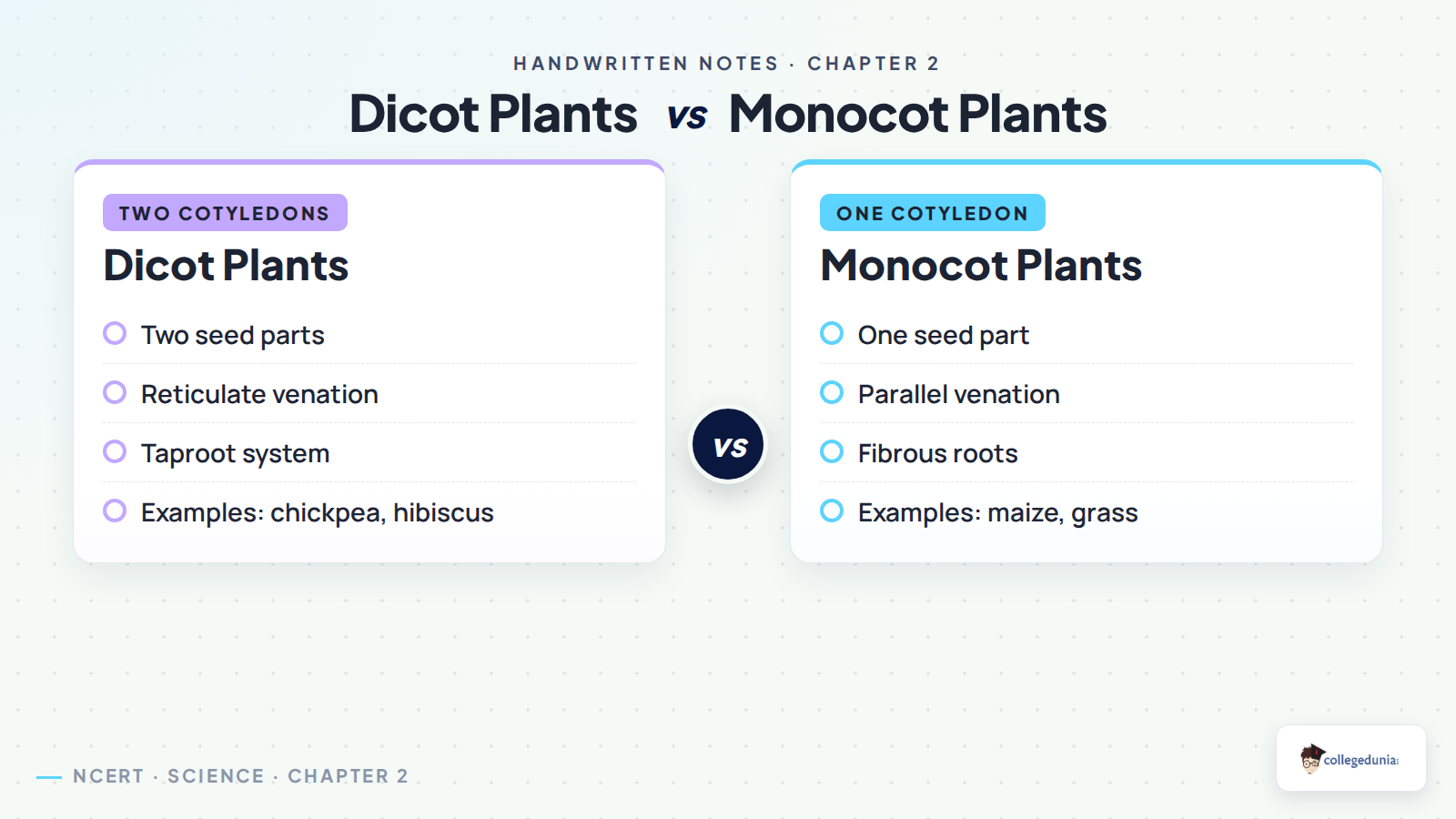
Venation is the pattern of veins on a leaf. Hibiscus leaves show reticulate venation, where veins form a net-like pattern. Banana and grass leaves show parallel venation, where veins run side by side.
Roots usually follow the same pattern. Reticulate venation generally links with taproots, while parallel venation generally links with fibrous roots. The seed link is also important: dicots have two cotyledons, and monocots have one cotyledon.
- Chickpea is a dicot seed and is linked with taproot and reticulate venation.
- Maize is a monocot seed and is linked with fibrous roots and parallel venation.
- Radish is a root, so students should connect it with taproot-type thinking.
Habitats and Adaptations in Diversity in the Living World
A habitat is the place where a plant or animal lives. A habitat provides food, water, air, shelter and other needs. Forests, deserts, grasslands and mountains are terrestrial habitats. Ponds, lakes, rivers and oceans are aquatic habitats.
An adaptation is a special feature that helps a plant or animal survive in a habitat. A cactus has fleshy stems that store water. A deodar tree has a conical shape and sloping branches, so snow slides off easily.
The chapter becomes easier when every adaptation is written with the habitat it helps in.
| Living thing | Habitat | Useful feature |
|---|---|---|
| Fish | Water | Streamlined body and fins |
| Hot desert camel | Rajasthan desert | Long legs, wide hooves, one hump |
| Cold desert camel | Ladakh desert | Shorter legs, two humps, long hair |
| Rhododendron | Mountain regions | Height and leaf size change by region |
Key Takeaways for Quick Revision
Before a test, revise the chapter as a chain. Observe living things, record their features, group them by common features, connect each feature with its habitat, and then explain why biodiversity must be protected.
- Biodiversity means variety of plants and animals in a region.
- Grouping is based on similarities and differences.
- Herbs, shrubs and trees are grouped by height and stem features.
- Dicots usually have taproots and reticulate venation.
- Monocots usually have fibrous roots and parallel venation.
- Habitat damage can reduce biodiversity.
Common Mistakes to Avoid
- Do not confuse biodiversity with only forests. A park or school garden also has biodiversity.
- Do not write only one feature for herbs, shrubs and trees. Mention height, stem and branching.
- Do not mix up reticulate and parallel venation.
- Do not define habitat without saying it gives food, water, air and shelter.
- Do not write adaptation without naming the habitat it helps in.
For strong answers, students should write one example beside every term. For example, cactus with desert, deodar with mountains, fish with water and hibiscus with reticulate venation.
Related NCERT Resources for This Chapter
| Resource | Link |
|---|---|
| NCERT Book PDF | Class 6 Science Chapter 2 Book PDF |
| NCERT Solutions | Class 6 Science Chapter 2 NCERT Solutions |
| NCERT Notes | Class 6 Science Chapter 2 Notes |
More Class 6 Science Handwritten Notes
| Chapter | Handwritten Notes |
|---|---|
| Chapter 1 | The Wonderful World of Science |
| Chapter 2 | Diversity in the Living World |
| Chapter 3 | Mindful Eating: A Path to a Healthy Body |
| Chapter 4 | Exploring Magnets |
Diversity in the Living World Class 6 Handwritten Notes FAQs
Ques. What is covered in Diversity in the Living World handwritten notes?
Ans. The notes cover biodiversity, grouping, herbs, shrubs, trees, venation, roots, monocots, dicots, habitats, adaptations and conservation.
Ques. Are these handwritten notes based on the 2026-27 NCERT Curiosity textbook?
Ans. Yes. The PDF follows Class 6 Science Curiosity Chapter 2 for the 2026-27 syllabus and keeps the NCERT examples in a short revision format.
Ques. How should students revise plant grouping from this PDF?
Ans. Students should revise herbs, shrubs and trees with stem features first, then connect venation, roots and seeds using dicot and monocot examples.



Comments