




The handwritten notes on Class 7 Vocational Education Chapter 6 Family Health Handbook have been carefully prepared for quick 2026-27 project revision. The PDF covers family health factors, health-centre visits, first-aid kit preparation, age-wise health data, water safety, soak pits, preventive action and monthly tracking.
- Best use: revise before filling handbook tables, action trackers and reflection answers.
- PDF focus: first-aid, ORS, H2S water test, emergency contacts and family health data.
- Revision style: topper's handwritten notes with short points, flow charts and diagrams drawn by hand.
Chapter6FamilyHealthHandbookHandwrittenNotes.pdf?page=1&dpi=150)
Chapter6FamilyHealthHandbookHandwrittenNotes.pdf?page=2&dpi=150)
Chapter6FamilyHealthHandbookHandwrittenNotes.pdf?page=3&dpi=150)
Chapter6FamilyHealthHandbookHandwrittenNotes.pdf?page=4&dpi=150)
Chapter6FamilyHealthHandbookHandwrittenNotes.pdf?page=5&dpi=150)
Chapter6FamilyHealthHandbookHandwrittenNotes.pdf?page=6&dpi=150)
Chapter6FamilyHealthHandbookHandwrittenNotes.pdf?page=7&dpi=150)
Chapter6FamilyHealthHandbookHandwrittenNotes.pdf?page=8&dpi=150)
Chapter6FamilyHealthHandbookHandwrittenNotes.pdf?page=9&dpi=150)
Chapter6FamilyHealthHandbookHandwrittenNotes.pdf?page=10&dpi=150)
Chapter6FamilyHealthHandbookHandwrittenNotes.pdf?page=11&dpi=150)
Chapter6FamilyHealthHandbookHandwrittenNotes.pdf?page=12&dpi=150)
Chapter6FamilyHealthHandbookHandwrittenNotes.pdf?page=13&dpi=150)
Chapter6FamilyHealthHandbookHandwrittenNotes.pdf?page=14&dpi=150)
Chapter6FamilyHealthHandbookHandwrittenNotes.pdf?page=15&dpi=150)
Chapter6FamilyHealthHandbookHandwrittenNotes.pdf?page=16&dpi=150)
Chapter6FamilyHealthHandbookHandwrittenNotes.pdf?page=17&dpi=150)
Chapter6FamilyHealthHandbookHandwrittenNotes.pdf?page=18&dpi=150)
Chapter6FamilyHealthHandbookHandwrittenNotes.pdf?page=19&dpi=150)
Chapter6FamilyHealthHandbookHandwrittenNotes.pdf?page=20&dpi=150)
Chapter6FamilyHealthHandbookHandwrittenNotes.pdf?page=21&dpi=150)
Chapter6FamilyHealthHandbookHandwrittenNotes.pdf?page=22&dpi=150)
Chapter6FamilyHealthHandbookHandwrittenNotes.pdf?page=23&dpi=150)
Chapter6FamilyHealthHandbookHandwrittenNotes.pdf?page=24&dpi=150)
Student Feedback: In a Collegedunia review of common Class 7 project doubts from over 8,600 students, Family Health Handbook became easier when students used one table for data and one table for action.
Family Health Handbook Quick Map
The Family Health Handbook project teaches students to connect daily habits with family well-being. The handwritten PDF turns the chapter into short revision pages that students can use before completing activity tables.
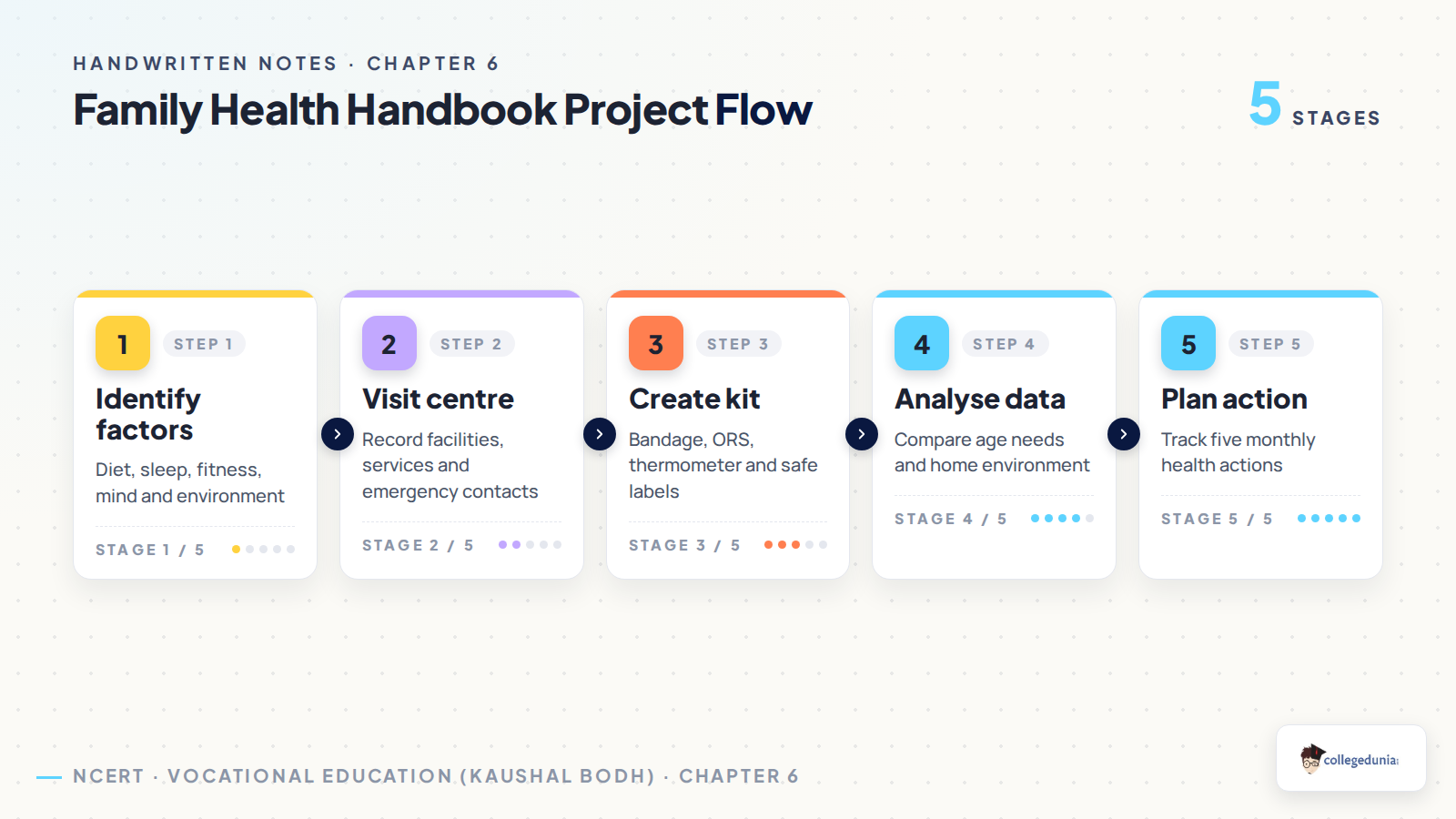
| Project Stage | What Students Do | Output |
|---|---|---|
| Identify factors | Discuss diet, sleep, fitness, mental well-being and environment. | Health-factor list |
| Visit centre | Observe a hospital, PHC or CHC and ask prepared questions. | Visit record |
| Create kit | Prepare a labelled first-aid kit with expert guidance. | First-aid checklist |
| Record data | Collect age-wise health and environment information. | Handbook tables |
| Plan action | Choose realistic preventive steps and track them monthly. | Action tracker |
Factors Affecting Health in Family Health Handbook
Family health means physical, mental and emotional well-being of all members. NCERT explains that good health comes from many connected factors. These include a nutritious diet, regular physical activity, enough sleep, positive attitude, mental well-being and a clean environment.
- Diet and nutrition: eat regular meals, drink enough water and limit processed snacks.
- Sleep pattern: follow a regular schedule and avoid screens before sleep.
- Physical fitness: choose yoga, sports, walking or another activity that can be done often.
- Mental well-being: relax, talk to trusted people and spend time with family or friends.
- Environment: remove stagnant water, manage waste and check air, water and noise concerns.
Revision cue: write the factor first, then write one example and one preventive action.
Health Centre Visit and Expert Interaction
Students visit a hospital, Primary Health Centre or Community Health Centre to understand how healthcare professionals work. They observe patient care, equipment, facilities, emergency support and first-aid demonstration. The visit also helps students collect answers that family members may not know.
| Record Field | What to Write | Why It Matters |
|---|---|---|
| Date and place | Date, time, location and type of centre. | Makes the record complete. |
| Expert details | Name and role of the doctor, nurse or health worker. | Shows the source of information. |
| Facilities | Vaccination, outpatient care, diagnosis or other services. | Helps students understand local healthcare. |
| Emergency contacts | 112 for emergency and 108 for ambulance. | Supports quick action during crisis. |
Students should maintain distance, follow safety instructions and wash hands after the visit.
Family Health Handbook Project Video
Source: NCERT Hindi Tutor on YouTube
First-aid Kit Checklist for Family Health Handbook
A first-aid kit gives immediate help for minor injuries or illness before medical help is available. NCERT asks students to prepare the kit through a workshop conducted by a health professional, teacher or trained parent.
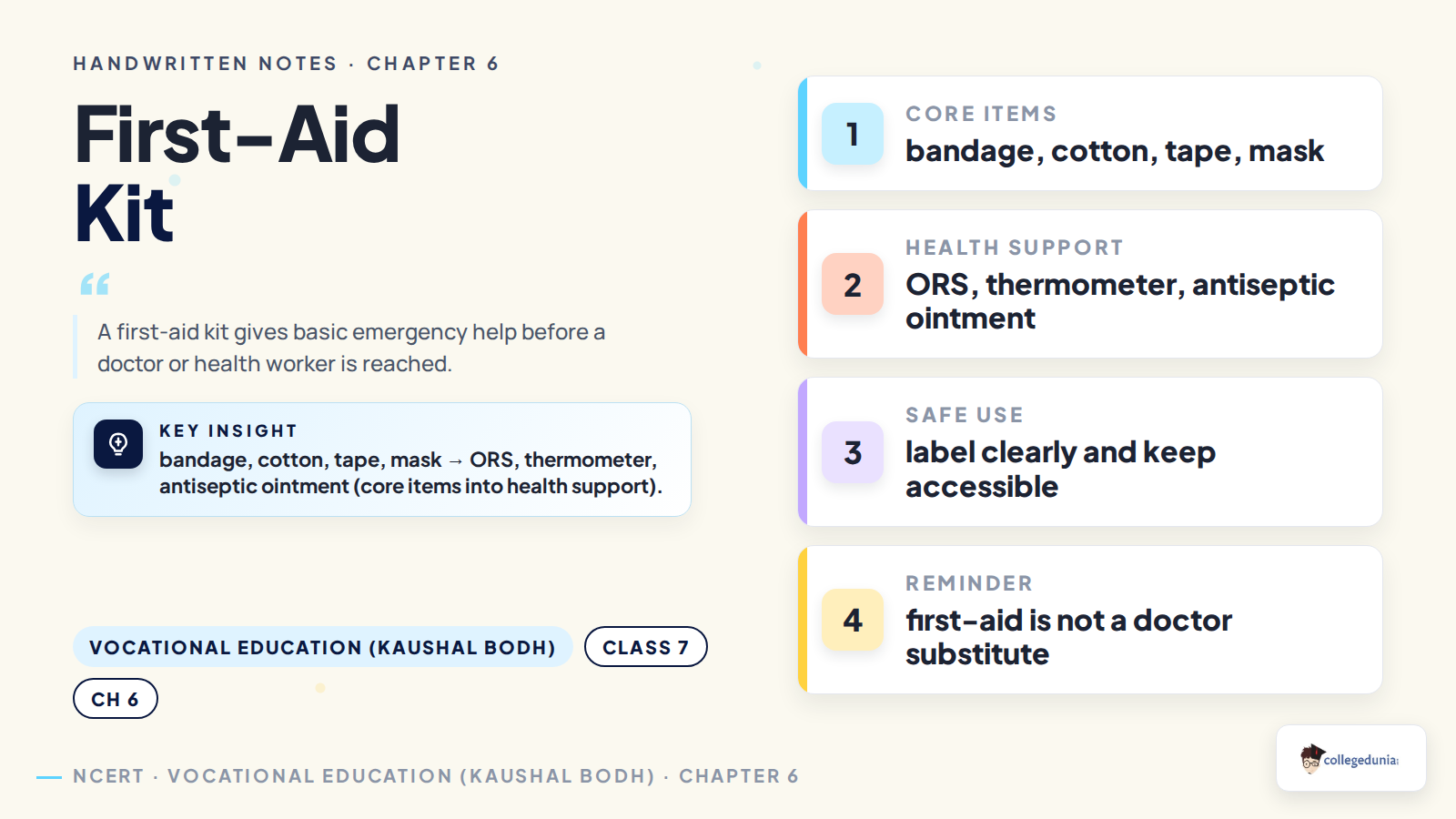
| First-aid Item | Use | Care Point |
|---|---|---|
| Bandages and gauze | Cover minor cuts and wounds. | Use clean material only. |
| Hand sanitiser, masks and gloves | Reduce infection risk. | Dispose used items safely. |
| Thermometer | Check body temperature. | Clean after use. |
| Salt, sugar and ORS | Prepare ORS during dehydration. | Measure carefully with adult guidance. |
Common mistake: do not treat first-aid as final treatment. Serious illness, deep cuts, burns or dehydration need medical advice.
Age-wise Health Data and Environment Survey
The handbook asks students to collect health data for different age groups: below 5 years, 6 to 18 years, 19 to 30 years, 31 to 45 years, 46 to 60 years and above 60 years. If a family does not have a member from one group, students can ask a relative, neighbour or family friend.
- Ask about meals, fruits, vegetables, water intake and processed food.
- Ask about physical activity, exercise type and weekly frequency.
- Ask about sleep hours, nap time, screen use and sleeping area.
- Ask about stress, hobbies, relaxation and support from family or friends.
- Observe drains, stagnant water, garbage, air quality, noise and nearby waste.
Health data is personal. Students should ask politely and never judge anyone by body shape, size, food habit or health condition.
Water Test, Soak Pit and Preventive Action
NCERT includes environmental action because unsafe surroundings can affect family health. Students learn about potable water testing, mosquito prevention and soak pits. In the H2S strip test, golden brown water after 24 to 48 hours means the sample is safe as per the test. Black colour means possible bacterial contamination.
| Preventive Action | Problem It Reduces | Student Role |
|---|---|---|
| Use mosquito nets | Mosquito bites and malaria risk. | Encourage use at home. |
| Remove stagnant water | Mosquito breeding. | Empty small containers and tell elders. |
| Build or report need for soak pit | Waterlogging near washing areas. | Work with adults and local authority. |
| Test drinking water | Unsafe water use. | Record result and discuss cleaning method. |
Soak pit fact: NCERT gives a 1 m by 1 m by 1 m pit with alternating sand and brick layers as an example.
Monthly Action Tracker and Reflection Questions
The final part of the chapter asks students to choose five key actions and track them monthly. Examples include going to bed at 9:30 p.m., eating dinner together and practising yoga. Reflection questions ask what students enjoyed, what challenges they faced, what they would change and how drinking water may get polluted.
- Write the month and date clearly.
- Choose actions that can be repeated and checked.
- Record what worked and what was difficult.
- Review the tracker with family members at month end.
Related Class 7 Kaushal Bodh Resources for Family Health Handbook
Use the links below with the handwritten notes. They help students move between the quick revision PDF, the full notes and the official chapter text.
| Resource | Use It For | Link |
|---|---|---|
| NCERT Notes | Read the chapter summary and key tables. | Open notes |
| NCERT Book PDF | Read the official chapter text and activities. | Open book PDF |
| NCERT Notes | Use the full notes article for detailed chapter revision. | Open detailed notes |
All Class 7 Vocational Education Handwritten Notes
Students revising Kaushal Bodh can move through the handwritten notes chapter by chapter.
| Chapter | Topic | Handwritten notes link |
|---|---|---|
| Chapter 1 | Plant Nursery | Open Chapter 1 notes |
| Chapter 2 | School Habitat Garden | Open Chapter 2 notes |
| Chapter 3 | Tie and Dye | Open Chapter 3 notes |
| Chapter 5 | Storytime with Puppets | Open Chapter 5 notes |
| Chapter 6 | Family Health Handbook | Current page |
Class 7 Family Health Handbook Handwritten Notes FAQs
Ques. What is covered in Family Health Handbook handwritten notes?
Ans. The notes cover health factors, PHC or CHC visit records, first-aid kit items, age-wise health data, environmental survey, water testing, soak pit and monthly action tracker.
Ques. How do these handwritten notes help in the Class 7 project?
Ans. They convert the chapter into short revision pages, so students can fill handbook tables, remember first-aid steps and prepare action plans clearly.
Ques. What are the main health factors in this chapter?
Ans. The main factors are diet and nutrition, physical fitness, sleep pattern, mental well-being and environmental conditions around the home.
Ques. What emergency numbers are mentioned in the chapter?
Ans. The chapter mentions 112 as the national emergency number and 108 as the national ambulance number.



Comments