




NCERT Handwritten Notes for Class 8 Arts (Kriti) Chapter 19 Campaign for Art Awareness have been prepared for quick revision, according to the 2026-27 NCERT syllabus. The PDF covers campaign planning, information collection, brochure making, visual design and class exhibition cues in clear topper-style pages.
- Download a 24-page handwritten revision PDF for Class 8 Arts Chapter 19.
- Revise campaign formats, research prompts, brochure panels, source listing and assessment points.
- Use the notes before activity work, portfolio presentation, class display and self-assessment.
Chapter19CampaignforArtAwarenessHandwrittenNotes.pdf?page=1&dpi=150)
Chapter19CampaignforArtAwarenessHandwrittenNotes.pdf?page=2&dpi=150)
Chapter19CampaignforArtAwarenessHandwrittenNotes.pdf?page=3&dpi=150)
Chapter19CampaignforArtAwarenessHandwrittenNotes.pdf?page=4&dpi=150)
Chapter19CampaignforArtAwarenessHandwrittenNotes.pdf?page=5&dpi=150)
Chapter19CampaignforArtAwarenessHandwrittenNotes.pdf?page=6&dpi=150)
Chapter19CampaignforArtAwarenessHandwrittenNotes.pdf?page=7&dpi=150)
Chapter19CampaignforArtAwarenessHandwrittenNotes.pdf?page=8&dpi=150)
Chapter19CampaignforArtAwarenessHandwrittenNotes.pdf?page=9&dpi=150)
Chapter19CampaignforArtAwarenessHandwrittenNotes.pdf?page=10&dpi=150)
Chapter19CampaignforArtAwarenessHandwrittenNotes.pdf?page=11&dpi=150)
Chapter19CampaignforArtAwarenessHandwrittenNotes.pdf?page=12&dpi=150)
Chapter19CampaignforArtAwarenessHandwrittenNotes.pdf?page=13&dpi=150)
Chapter19CampaignforArtAwarenessHandwrittenNotes.pdf?page=14&dpi=150)
Chapter19CampaignforArtAwarenessHandwrittenNotes.pdf?page=15&dpi=150)
Chapter19CampaignforArtAwarenessHandwrittenNotes.pdf?page=16&dpi=150)
Chapter19CampaignforArtAwarenessHandwrittenNotes.pdf?page=17&dpi=150)
Chapter19CampaignforArtAwarenessHandwrittenNotes.pdf?page=18&dpi=150)
Chapter19CampaignforArtAwarenessHandwrittenNotes.pdf?page=19&dpi=150)
Chapter19CampaignforArtAwarenessHandwrittenNotes.pdf?page=20&dpi=150)
Chapter19CampaignforArtAwarenessHandwrittenNotes.pdf?page=21&dpi=150)
Chapter19CampaignforArtAwarenessHandwrittenNotes.pdf?page=22&dpi=150)
Chapter19CampaignforArtAwarenessHandwrittenNotes.pdf?page=23&dpi=150)
Chapter19CampaignforArtAwarenessHandwrittenNotes.pdf?page=24&dpi=150)
|
Table of Contents |
Campaign for Art Awareness Chapter Snapshot for Class 8 Arts
Chapter 19 explains how an awareness campaign shares one clear message and brings attention to an issue. NCERT connects this idea with arts, culture, artists and local craft practices.
The core task is to create a campaign that helps people participate in, support and appreciate art forms. Students learn to choose a subject, collect material, write the main message and make visuals.
| Campaign Part | What It Means | NCERT Link |
|---|---|---|
| Subject | Artist, art practice, school production or project. | Activity 19.1 |
| Research | Talk, read, visit, observe and collect visuals. | Activity 19.2 |
| Output | Poster, flyer, brochure or exhibition display. | Activity 19.4 |
How to Choose a Campaign Subject in Campaign for Art Awareness
Activity 19.1 asks students to begin with the subject of the campaign. A good subject should be close enough to research and strong enough to interest the school community.
Possible subjects include a painter, sculptor, designer, photographer, local craft community, school production or student project. Discuss the choice in a group of four to five students before finalising it.
- Look for artists and art practices from your region.
- Check if a festival, local craft fair or art school is nearby.
- Visit a museum or gallery if one is available.
- Choose a subject your group can understand and explain clearly.
Collect Information for an Art Awareness Campaign
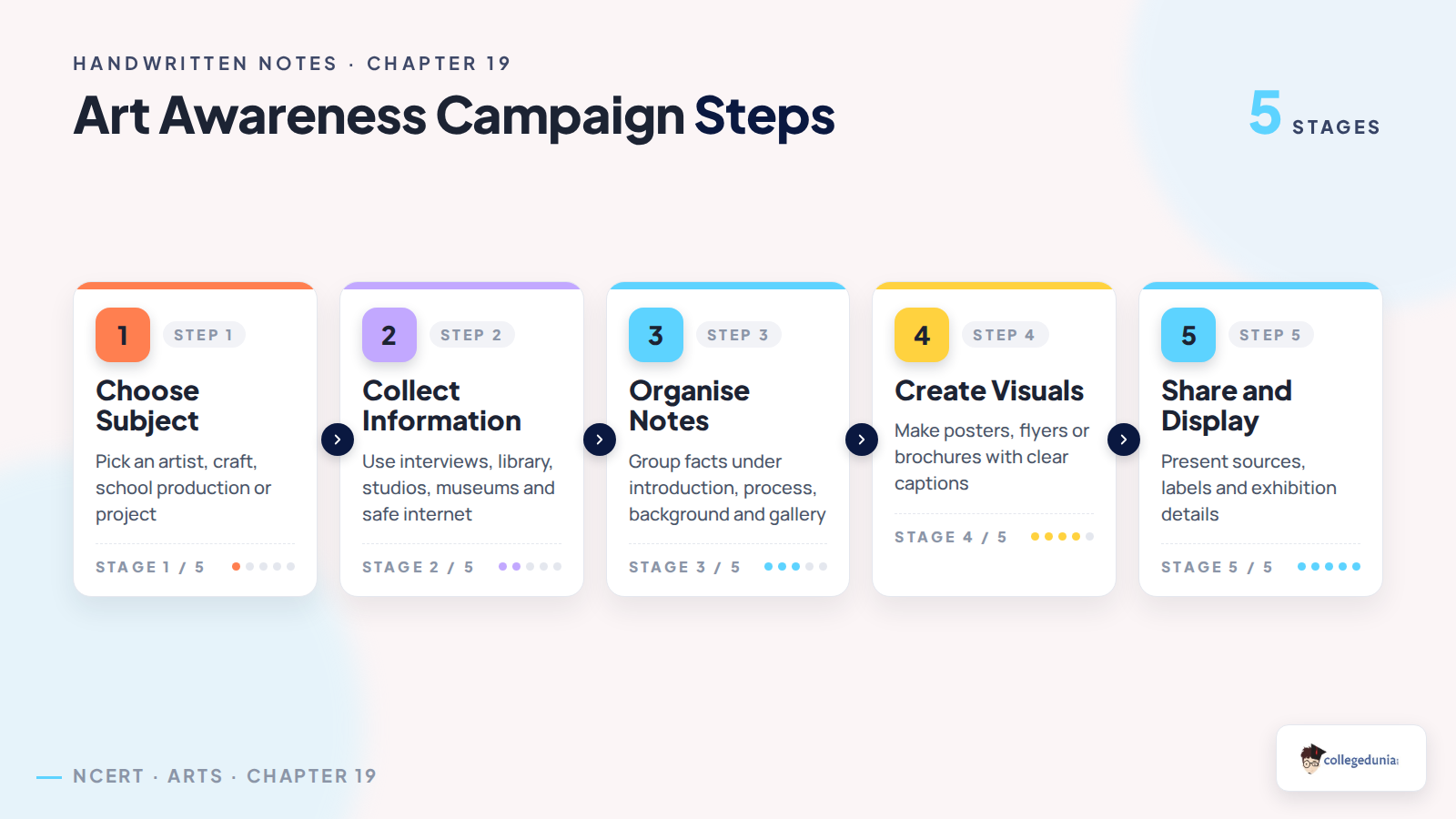
Activity 19.2 focuses on information collection. Students should talk to people, read books and newspapers, visit studios or galleries, and use the internet under adult supervision.
The chapter asks students to present information as stories with visuals. Dates alone are not enough. The campaign should show what makes the artist, artwork or art practice special.
- Ask what contribution the artist or artwork makes to society.
- Find the story behind the artist, artwork or practice.
- Note the materials, tools and techniques used.
- Record social, economic or environmental challenges.
Brochure Planning and Visual Design in Campaign for Art Awareness
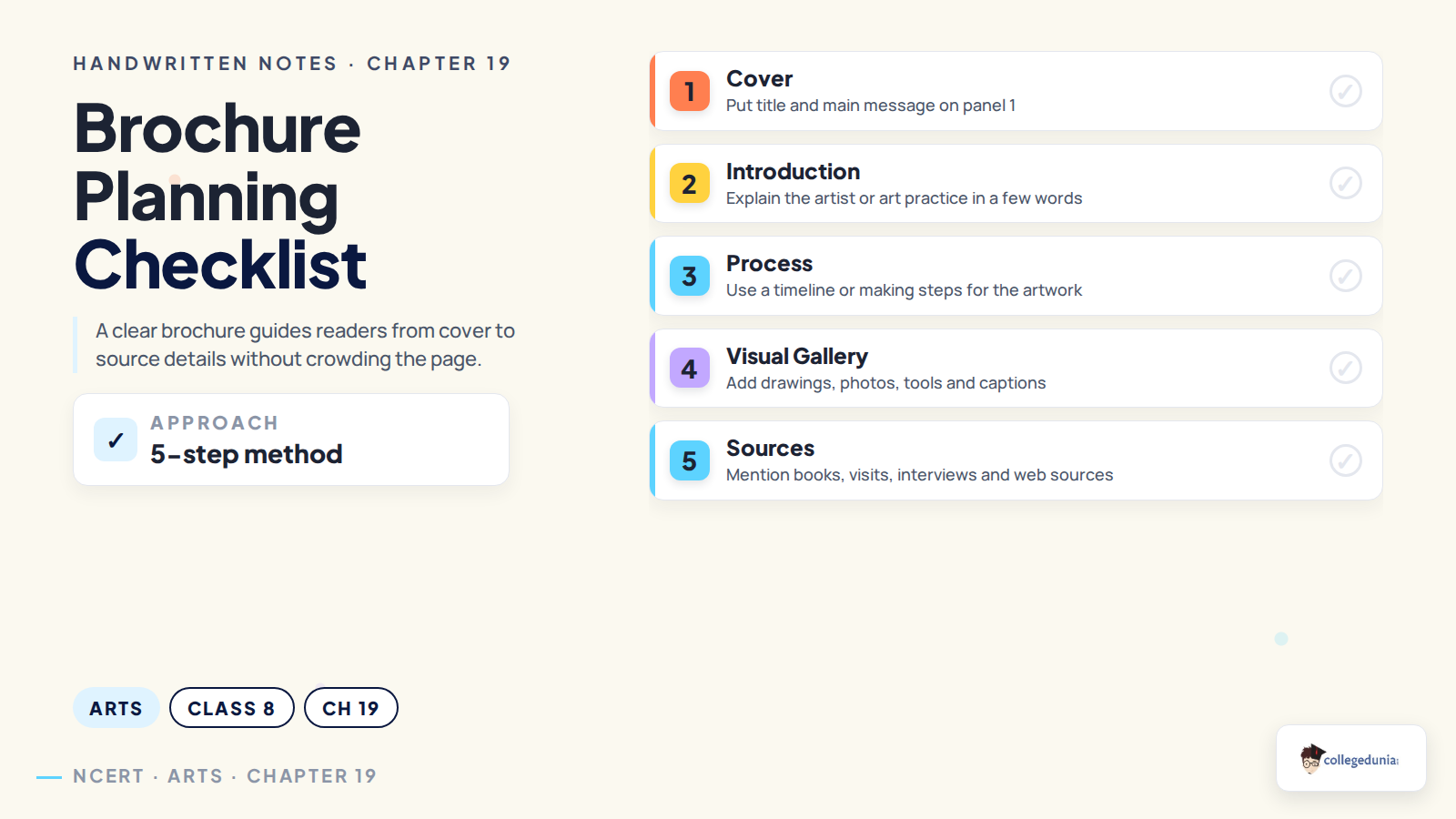
Activity 19.3 asks students to organise information under headings. Useful headings include introduction, process of making, background information and visual gallery.
Activity 19.4 then turns that organised material into a poster, flyer or brochure. For a brochure, NCERT asks students to fold an A4 sheet into three equal parts and plan the six panels.
| Panel | Use |
|---|---|
| Cover page | Put title and main message. |
| Introduction | Explain the topic in a few words and visuals. |
| Process | Add timeline, making steps or background details. |
| Gallery and sources | Show visuals and mention where facts came from. |
Assessment and Exhibition Cues for Campaign for Art Awareness
The assessment checks whether students use visual elements to highlight important information in a brochure. It also checks whether the brochure follows a sequence and whether the chosen artist or art practice is locally relevant.
The summative activity asks students to present a portfolio and plan a class exhibition. Labels matter in the exhibition. Each artwork should carry the student's name, title, medium and date.
- Portfolio: include five artworks that show learning milestones.
- Group display: choose a common theme and title.
- Display format: use design principles while arranging artworks.
- Reflection: include rough sketches and process samples.
Campaign for Art Awareness Audio Recap for Class 8 Arts
Source: ShikshaBank on YouTube
Related NCERT Class 8 Arts Resources
Use these related resources when you want the official book chapter or nearby visual arts handwritten-note chapters.
| Resource | Link |
|---|---|
| NCERT Book PDF | Class 8 Arts Chapter 19 NCERT Book PDF |
| Previous Chapter | Arts of the People Handwritten Notes |
| Chapter 17 | People in Places Handwritten Notes |
All Class 8 Arts (Kriti) Handwritten Notes
| Chapter | Handwritten Notes |
|---|---|
| Chapter 15 Elements and Principles of Visual Art and Design | Download Notes |
| Chapter 16 Still Life in Colour | Download Notes |
| Chapter 17 People in Places | Download Notes |
| Chapter 18 Arts of the People, With the People, For the People | Download Notes |
FAQs on NCERT Class 8 Arts Chapter 19 Handwritten Notes
Ques. What is covered in Class 8 Arts Chapter 19 Campaign for Art Awareness?
Ans. The chapter covers how to choose an art campaign subject, collect information, organise it and create posters, flyers or brochures.
Ques. What should students collect for an art awareness campaign?
Ans. Students should collect stories, visuals, material details, technique notes, artist background and source information.
Ques. What is the brochure fold order in Chapter 19?
Ans. NCERT shows the brochure fold order as 5, 6, 1 on the top row and 2, 3, 4 on the bottom row.
Ques. How do these handwritten notes help with revision?
Ans. The notes turn the chapter into short pages on campaign steps, research prompts, brochure planning and assessment cues.



Comments