




NCERT Handwritten Notes for Class 8 Arts (Kriti) Chapter 18 Arts of the People, With the People, For the People have been carefully prepared for quick revision, according to the 2026-27 NCERT syllabus. The PDF covers living root bridges, knotting, patchwork, papier-mache and community art practices in clear topper-style pages.
- Download a 22-page handwritten revision PDF for Class 8 Arts Chapter 18.
- Revise tie and link, patch and match, pulp and paint, safety notes and assessment cues.
- Use the notes before activity work, class discussion, portfolio writing and self-assessment.
Chapter18ArtsofthePeople,WiththePeople,ForthePeopleHandwrittenNotes.pdf?page=1&dpi=150)
Chapter18ArtsofthePeople,WiththePeople,ForthePeopleHandwrittenNotes.pdf?page=2&dpi=150)
Chapter18ArtsofthePeople,WiththePeople,ForthePeopleHandwrittenNotes.pdf?page=3&dpi=150)
Chapter18ArtsofthePeople,WiththePeople,ForthePeopleHandwrittenNotes.pdf?page=4&dpi=150)
Chapter18ArtsofthePeople,WiththePeople,ForthePeopleHandwrittenNotes.pdf?page=5&dpi=150)
Chapter18ArtsofthePeople,WiththePeople,ForthePeopleHandwrittenNotes.pdf?page=6&dpi=150)
Chapter18ArtsofthePeople,WiththePeople,ForthePeopleHandwrittenNotes.pdf?page=7&dpi=150)
Chapter18ArtsofthePeople,WiththePeople,ForthePeopleHandwrittenNotes.pdf?page=8&dpi=150)
Chapter18ArtsofthePeople,WiththePeople,ForthePeopleHandwrittenNotes.pdf?page=9&dpi=150)
Chapter18ArtsofthePeople,WiththePeople,ForthePeopleHandwrittenNotes.pdf?page=10&dpi=150)
Chapter18ArtsofthePeople,WiththePeople,ForthePeopleHandwrittenNotes.pdf?page=11&dpi=150)
Chapter18ArtsofthePeople,WiththePeople,ForthePeopleHandwrittenNotes.pdf?page=12&dpi=150)
Chapter18ArtsofthePeople,WiththePeople,ForthePeopleHandwrittenNotes.pdf?page=13&dpi=150)
Chapter18ArtsofthePeople,WiththePeople,ForthePeopleHandwrittenNotes.pdf?page=14&dpi=150)
Chapter18ArtsofthePeople,WiththePeople,ForthePeopleHandwrittenNotes.pdf?page=15&dpi=150)
Chapter18ArtsofthePeople,WiththePeople,ForthePeopleHandwrittenNotes.pdf?page=16&dpi=150)
Chapter18ArtsofthePeople,WiththePeople,ForthePeopleHandwrittenNotes.pdf?page=17&dpi=150)
Chapter18ArtsofthePeople,WiththePeople,ForthePeopleHandwrittenNotes.pdf?page=18&dpi=150)
Chapter18ArtsofthePeople,WiththePeople,ForthePeopleHandwrittenNotes.pdf?page=19&dpi=150)
Chapter18ArtsofthePeople,WiththePeople,ForthePeopleHandwrittenNotes.pdf?page=20&dpi=150)
Chapter18ArtsofthePeople,WiththePeople,ForthePeopleHandwrittenNotes.pdf?page=21&dpi=150)
Chapter18ArtsofthePeople,WiththePeople,ForthePeopleHandwrittenNotes.pdf?page=22&dpi=150)
Arts of the People Chapter Snapshot for Class 8 Arts
Chapter 18 shows that art is part of everyday life. Clothes, plates, baskets, quilts and festival objects are not separate from art. They carry the touch of makers and the needs of a community.
The core idea is simple: ordinary materials become meaningful when people work with them patiently. The chapter studies thread, cloth and paper through three activity blocks.
| Activity | Material | Main Learning |
|---|---|---|
| Tie and Link | Thread, roots, fibre | Joining can create strength. |
| Patch and Match | Old fabric | Small pieces can make a shared picture. |
| Pulp and Paint | Old newspaper | Waste paper can become a strong art form. |
Tie and Link: Living Roots and Knotting in Arts of the People
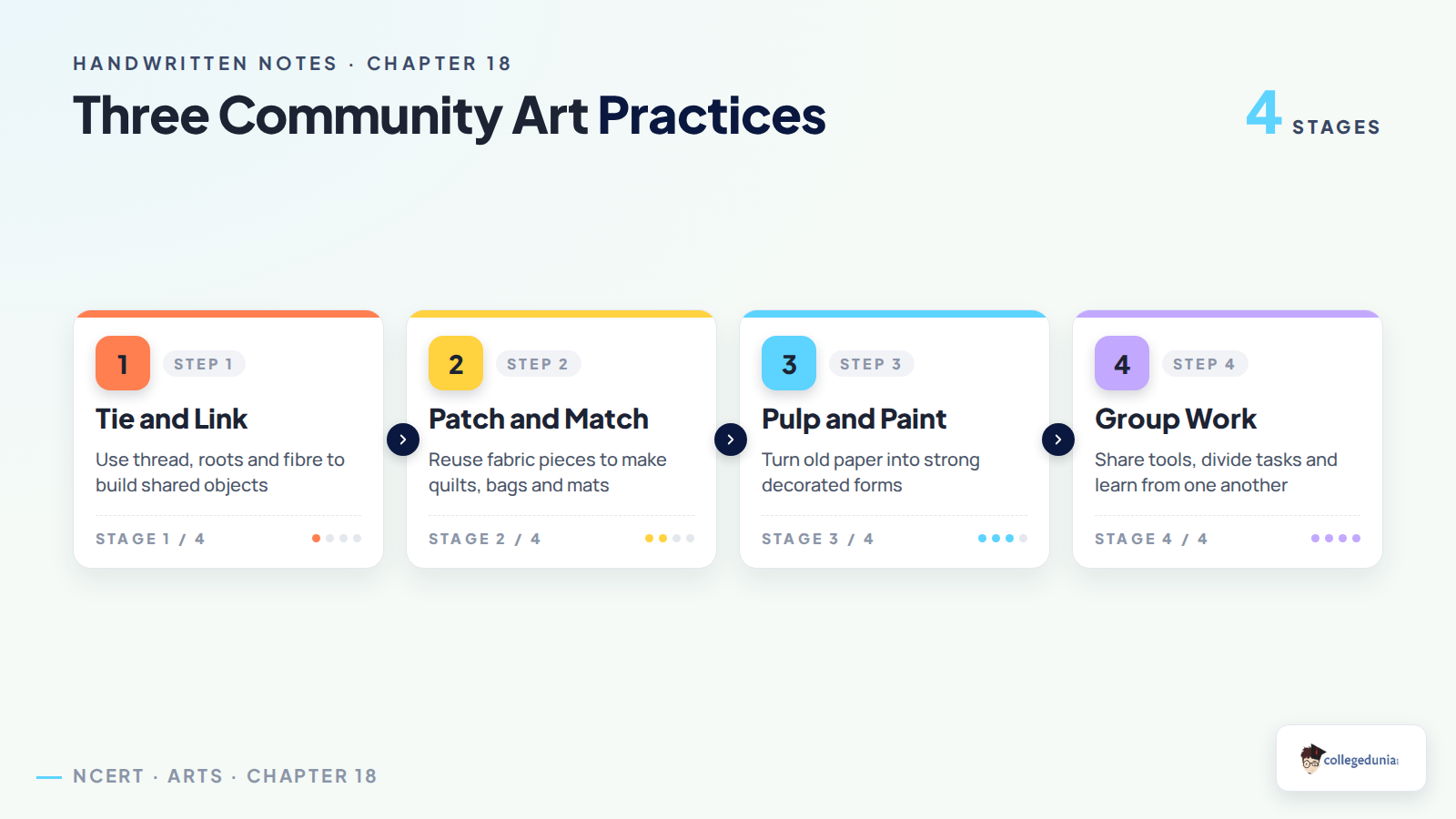
Activity 18.1 begins with natural networks. The chapter uses the living root bridges of Meghalaya to show how people can work with nature instead of replacing it. Roots are trained, twisted and tied, then the bridge becomes stronger over time.
- Key techniques: twisting, knotting, crocheting, knitting and weaving.
- Daily objects: baskets, handloom fabric, fans and charpoy.
- Revision cue: art made by people, with people and for people.
The knotting activity asks students to make a friendship band, wrist band or rakhi. The same pattern can grow into larger pieces such as wall hangings and torans.
Patch and Match: Cloth, Memory and Quilts in Chapter 18
Activity 18.2 explains patchwork. Old fabric pieces are cut, arranged and stitched together. The result can become a blanket, cradle, bag, cushion cover, table mat or dhurrie.
Patchwork is also a social idea. NCERT compares society with a patchwork quilt because each person adds one part to the whole picture.
- Collect unused cloth from home or school.
- Use a base cloth of at least 30 cm by 30 cm.
- Cut smaller pieces into 5 to 6 cm squares or rectangles.
- Sew the patches on the reverse side, then add running stitches.
Pulp and Paint: Papier-Mache Process for Class 8 Arts
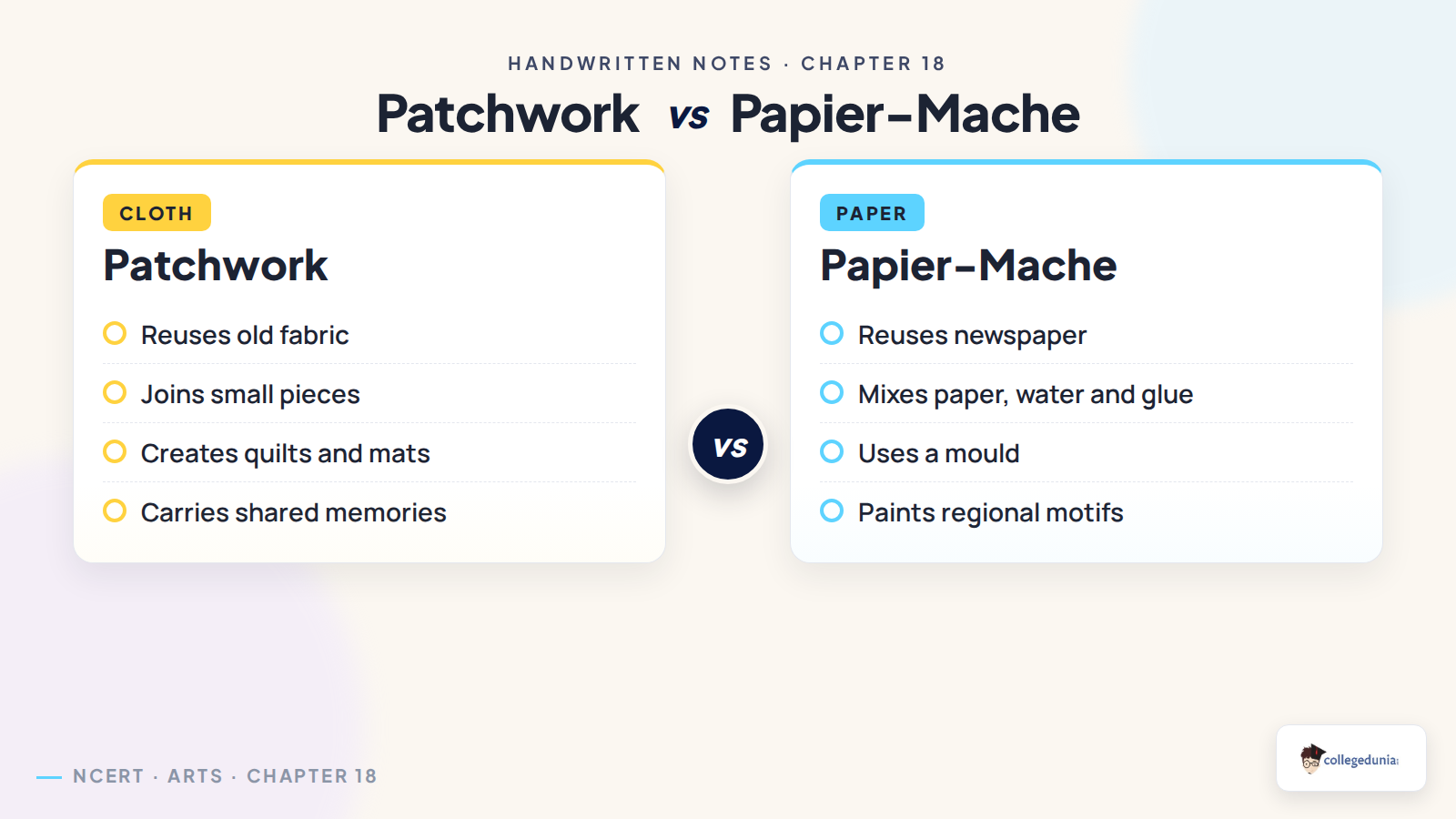
Activity 18.3 turns old newspapers into art. Soft paper, water and glue form a strong mixture. This mixture is called papier-mache, and it can be shaped on a mould.
The final form is painted with regional motifs. A Kashmiri papier-mache box with a Chinar tree motif shows how local surroundings can shape decoration.
- Cut and soak newspaper pieces for a few days.
- Squeeze, mash and mix the pulp with a little glue.
- Grease a mould, overlap damp strips and apply pulp evenly.
- Dry fully, release the mould, sand lightly and decorate.
Activity Safety and Assessment Cues for Arts of the People
The chapter is practical, so safe studio habits matter. Students should handle scissors and needles carefully, store needles in a sponge or thick cloth, and let wet papier-mache dry before painting.
The assessment checks group work, material awareness and familiarity with regional art practices. Participation matters because the chapter is built around collective making.
| Learning Outcome | What Students Should Show |
|---|---|
| Creates in groups | Shares work and respects each member's role. |
| Knows everyday materials | Connects thread, cloth and paper with Indian art practices. |
| Knows regional practices | Recognises local artists, motifs and materials. |
Arts of the People, With the People, For the People Audio Recap
Source: NCERT OFFICIAL on YouTube
Related NCERT Class 8 Arts Resources
Use these related resources when you want the official book chapter or nearby visual arts chapters for the same unit.
| Resource | Link |
|---|---|
| NCERT Book PDF | Class 8 Arts Chapter 18 NCERT Book PDF |
| Previous Chapter | People in Places Handwritten Notes |
| Next Chapter | Campaign for Art Awareness Handwritten Notes |
All Class 8 Arts (Kriti) Handwritten Notes
| Chapter | Handwritten Notes |
|---|---|
| Chapter 15 Elements and Principles of Visual Art and Design | Download Notes |
| Chapter 16 Still Life in Colour | Download Notes |
| Chapter 17 People in Places | Download Notes |
| Chapter 18 Arts of the People, With the People, For the People | Download Notes |
FAQs on NCERT Class 8 Arts Chapter 18 Handwritten Notes
Ques. What is covered in Class 8 Arts Chapter 18 Arts of the People?
Ans. The chapter covers community art practices using thread, cloth and paper, including knotting, patchwork and papier-mache.
Ques. Why are living root bridges included in this chapter?
Ans. Living root bridges show how people can work with nature through time, care and sustainable choices.
Ques. What is papier-mache in Class 8 Arts?
Ans. Papier-mache is a mixture of paper, water and glue, shaped on a mould and painted after drying.
Ques. How do these handwritten notes help students revise?
Ans. The notes turn the chapter into short activity pages with steps, examples, safety points and quick assessment cues.



Comments