




These How I Taught My Grandmother to Read Class 9 English handwritten notes give you the whole chapter in a topper's own handwriting, so the story, characters, and theme stay easy to picture on exam day. Written for Kaveri Unit 1 and matched to the 2026-27 NCERT, they turn Sudha Murty's memoir into quick, colour-marked revision points you can read in minutes.

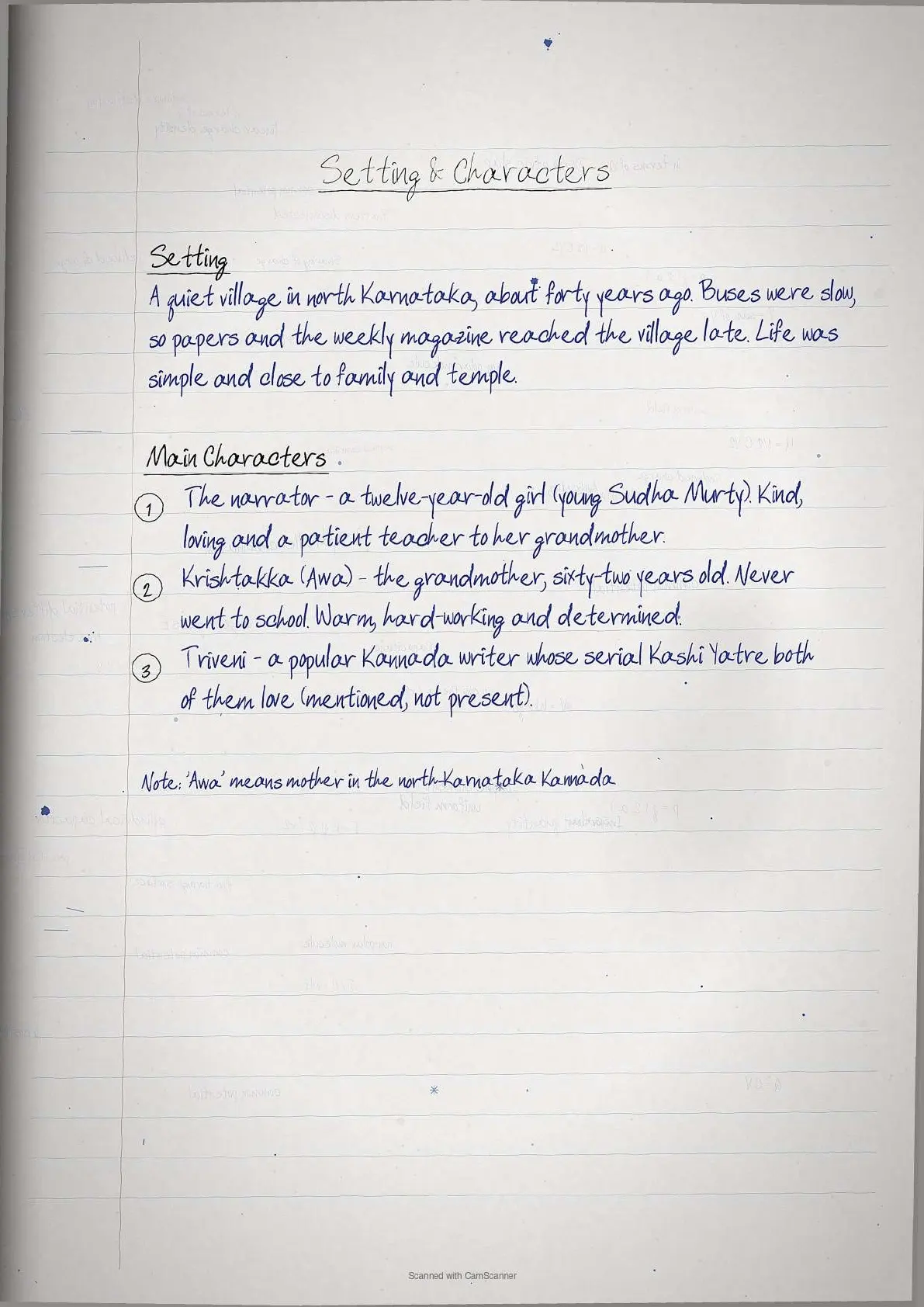


- Handwritten and marked: Key points, character traits, and the theme are underlined and boxed for fast recall.
- Most tested ideas: The grandmother's wish to be independent, her learning at sixty-two, and the feet-touching scene.
- 2026-27 NCERT: Prepared for the new Kaveri textbook, so nothing here is out of syllabus.
These handwritten notes are prepared by Collegedunia's toppers for the 2026-27 NCERT Kaveri textbook, and framed around the questions Class 9 exams ask most.
Also Check:
- How I Taught My Grandmother to Read Class 9 English NCERT Solutions
- How I Taught My Grandmother to Read Class 9 English NCERT Book PDF
What These How I Taught My Grandmother to Read Handwritten Notes Cover
The notes hold everything you need for a last-day revision of Unit 1, written in a clear hand.
- Story in short: The full memoir of the narrator, her grandmother Krishtakka, and the serial Kashi Yatre, trimmed to the key beats.
- Character points: The grandmother and the narrator, with the traits exams ask about.
- Theme and message: Learning has no age bar, and education is the key to independence.
- Poem pointers: The main ideas and one device from the companion poem Bharat: Our Land.
How I Taught My Grandmother to Read Quick Revision at a Glance
This snapshot is the same one written at the top of the notes, so you recall the chapter in seconds.
| Point | Quick Recall |
|---|---|
| Story gist | A grandmother of sixty-two learns the Kannada alphabet so she can read a serial on her own |
| Main characters | Krishtakka the grandmother (determined, self-respecting), the narrator, her granddaughter and teacher |
| Theme | Learning has no age bar, and education brings independence |
| Key value | Determination, self-respect, and gratitude to a teacher |
How I Taught My Grandmother to Read Handwritten Notes: Key Points
These are the exact revision lines from the notes, grouped the way toppers lay them out.
Story in Short
- The narrator, a girl of twelve, reads out the Kannada serial Kashi Yatre to her grandmother every Wednesday.
- The grandmother, Krishtakka, never went to school and cannot read it herself.
- When the narrator goes away for a week, the grandmother cannot follow the story and is found in tears.
- She decides at sixty-two to learn the alphabet, saying, "I want to be independent."
- The narrator teaches her daily, she passes with flying colours, and she touches her granddaughter's feet as a teacher.
Characters at a Glance
- Grandmother (Krishtakka): Strong-willed, hard-working, self-respecting, and eager to learn at any age.
- Narrator: Young, loving, at first laughs at the idea, then becomes a patient teacher.
Theme and Message
- For learning there is no age bar; determination can overcome any obstacle.
- Education, not money, is the real key to independence and self-respect.
How I Taught My Grandmother to Read Companion Poem Bharat: Our Land in Short
- Poet: Subramania Bharati, the Tamil poet and freedom fighter.
- Message: India is peerless, praised through its Himavant, the Ganga, the Upanishads, its warriors, sages, and the teachings of the Buddha.
- One device: The refrain "she's peerless, let's praise her!" and personification, as India is spoken of as "she".
Why Toppers' Handwritten Notes Help for How I Taught My Grandmother to Read
- Faster recall: Colour marks and arrows help you picture the page during the exam.
- Exam-ready length: Points are already trimmed to what a Class 9 answer needs.
- No wasted time: The whole chapter and poem fit in a few pages you can revise in one sitting.
How to Revise How I Taught My Grandmother to Read the Night Before the Exam
- Read the story-in-short points once, then say the plot aloud in your own words.
- Cover the character section and try to recall two traits each for the grandmother and the narrator.
- Learn one line each on the theme of lifelong learning and on the feet-touching scene.
- Glance at the poem points so you can name the poet and one device for Bharat: Our Land.
More How I Taught My Grandmother to Read Class 9 English Resources
Handwritten Notes for Class 9 English Kaveri: All Chapters
Open the handwritten notes for any other Kaveri chapter from this table.
| Chapter | Resource |
|---|---|
| Chapter 1 | How I Taught My Grandmother to Read Handwritten Notes |
| Chapter 2 | The Pot Maker Handwritten Notes |
| Chapter 3 | Winds of Change Handwritten Notes |
| Chapter 4 | Vitamin-M Handwritten Notes |
| Chapter 5 | The World of Limitless Possibilities Handwritten Notes |
| Chapter 6 | Twin Melodies Handwritten Notes |
| Chapter 7 | Carrier of Words Handwritten Notes |
| Chapter 8 | Follow That Dream Handwritten Notes |
How I Taught My Grandmother to Read Class 9 English Handwritten Notes FAQs
Ques. Where can I download the How I Taught My Grandmother to Read Class 9 English Handwritten Notes PDF?
Ans. You can download the How I Taught My Grandmother to Read Class 9 English handwritten notes PDF directly from this page. Both the Normal and HD versions are free.
Ques. What do these handwritten notes cover?
Ans. They cover the full story in short, the character points for the grandmother and the narrator, the theme of lifelong learning, and the companion poem Bharat: Our Land, all in an easy-to-revise hand.
Ques. Are these notes good for last-minute revision?
Ans. Yes. The whole chapter is trimmed to a few marked pages, so you can revise How I Taught My Grandmother to Read in one short sitting before the exam.
Ques. Are these handwritten notes aligned with the 2026-27 syllabus?
Ans. Yes. How I Taught My Grandmother to Read is Unit 1 of the Kaveri textbook in the 2026-27 NCERT syllabus, so these notes are fully valid for the Class 9 exam.
Ques. What is the most important point to revise in How I Taught My Grandmother to Read?
Ans. The idea that learning has no age bar is the key point. The grandmother learns to read at sixty-two to become independent, showing that determination can overcome any obstacle.



Comments