




If you are preparing for the Class 10 Civics board paper, Federalism is one chapter you cannot afford to skip.
Chapter2FederalismNotes.pdf?page=1&dpi=150)
Chapter2FederalismNotes.pdf?page=2&dpi=150)
Chapter2FederalismNotes.pdf?page=3&dpi=150)
Chapter2FederalismNotes.pdf?page=4&dpi=150)
Chapter2FederalismNotes.pdf?page=5&dpi=150)
Chapter2FederalismNotes.pdf?page=6&dpi=150)
Chapter2FederalismNotes.pdf?page=7&dpi=150)
Chapter2FederalismNotes.pdf?page=8&dpi=150)
Chapter2FederalismNotes.pdf?page=9&dpi=150)
Chapter2FederalismNotes.pdf?page=10&dpi=150)
Chapter2FederalismNotes.pdf?page=11&dpi=150)
Chapter2FederalismNotes.pdf?page=12&dpi=150)
Chapter2FederalismNotes.pdf?page=13&dpi=150)
Chapter2FederalismNotes.pdf?page=14&dpi=150)
Chapter2FederalismNotes.pdf?page=15&dpi=150)
Chapter2FederalismNotes.pdf?page=16&dpi=150)
Chapter2FederalismNotes.pdf?page=17&dpi=150)
Chapter2FederalismNotes.pdf?page=18&dpi=150)
Chapter2FederalismNotes.pdf?page=19&dpi=150)
Chapter2FederalismNotes.pdf?page=20&dpi=150)
These class 10th federalism notes cover every idea the CBSE paper tests, from what federalism means to how India became a federal country, according to the latest 2026-27 NCERT Democratic Politics II textbook.
- Board weightage: Federalism usually carries 5 to 6 marks across one short-answer and one long-answer question.
- Key flashcard fact: India has a three-tier government and the 1992 amendments made local self-government constitutional.
- Pair with: the NCERT Solutions and Handwritten Notes for this same chapter, linked in the table near the end.
Every set of class 10th federalism notes in this Collegedunia compilation is curated by Social Science experts, based on the 2026-27 NCERT Democratic Politics II textbook, and checked against the last five years of CBSE board papers.
What Is Federalism in Class 10 Civics Democratic Politics II
Federalism is a system of government in which power is divided between a central authority and the units that make up the country. In India, these units are the states. The key point: two or more levels of government rule the same people, and the Constitution fixes what each level can do.
- Two or more levels of government share power, each with its own area of work written into the Constitution.
- The Constitution is supreme, so one level cannot remove another's powers; courts settle centre-state disputes.
- Money and tax powers are split so each level can run on its own.
This is what makes a federal system different from a unitary one, where only one level holds real power. In a federation, power is genuinely shared, and no single level can take it all back.
Federalism Class 10 Full Chapter Explained in One Video
Source: Magnet Brains on YouTube
Key Features of Federalism Every Class 10 Student Must Know
The CBSE paper loves the feature list, so learn it as a clean checklist of seven points.
- Two or more levels of government: a national level and one or more regional levels.
- Same citizens, different jurisdictions: both levels govern the same people, each with its own powers.
- Constitution-fixed powers: each level's powers are written in the Constitution.
- Constitution is supreme: the sharing of power cannot be changed by one level alone.
- Courts as umpire: courts decide centre-state disputes over power.
- Separate revenue sources: each level has its own sources of money.
- Dual objectives: federalism protects national unity while giving room to regional diversity.
Important: if asked to list features, write these seven with one line of explanation each for full marks.
Two Routes to a Federation: Coming Together and Holding Together
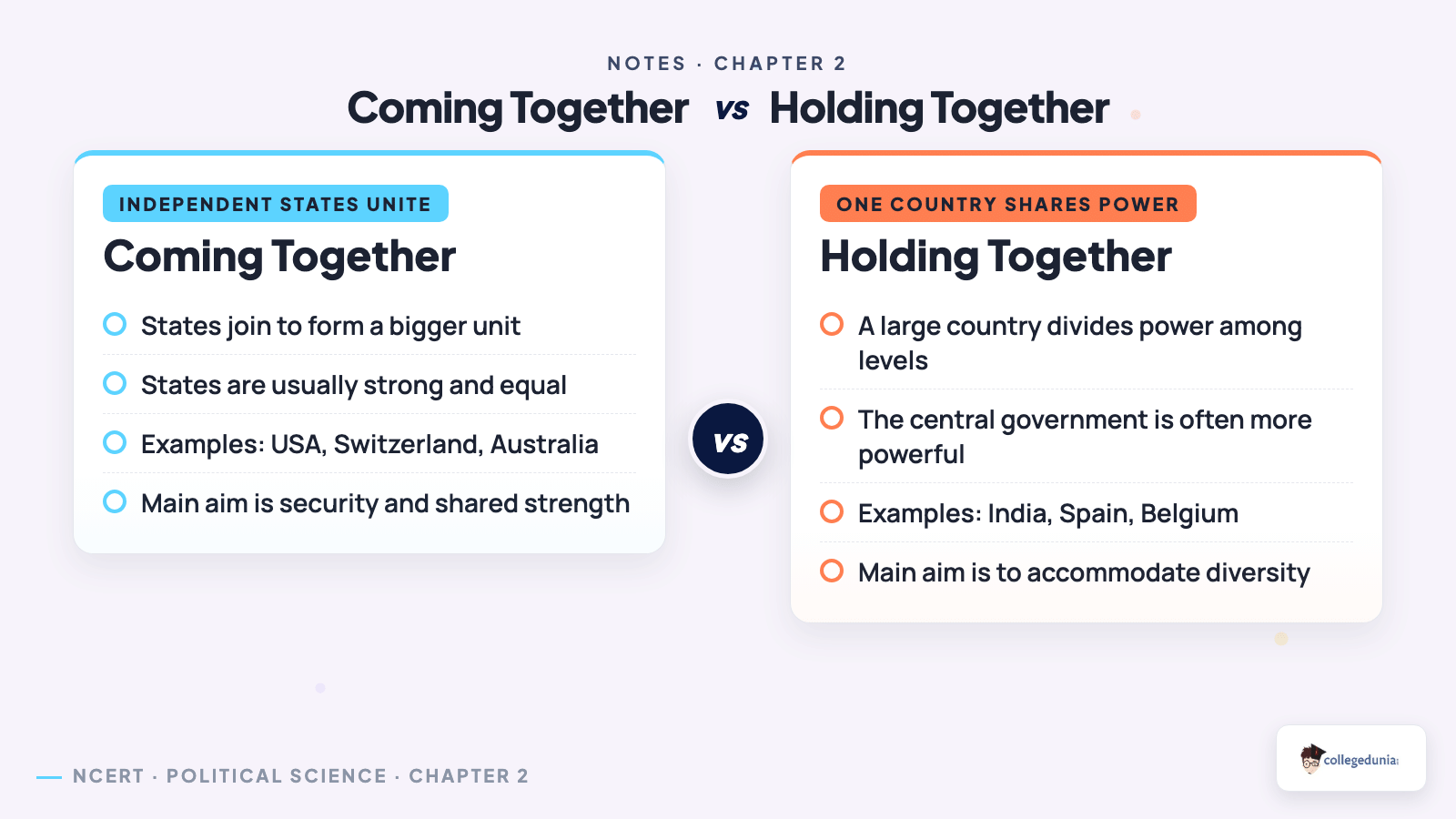
Federations form in two ways, and CBSE often asks for the difference. This table is one of the easiest marks in the chapter.
| Point | Coming Together | Holding Together |
|---|---|---|
| How it forms | Independent states join to form a bigger unit | A large country divides power between states and the centre |
| Power of states | States are usually strong and equal | The central government is often more powerful |
| Examples | USA, Switzerland, Australia | India, Spain, Belgium |
| Main aim | Security and shared strength | Accommodate regional and cultural diversity |
India is a holding-together federation. The states were given power, but the Union government kept more authority to hold the large and diverse country together.
Federalism in India Class 10: The Three Lists of Powers
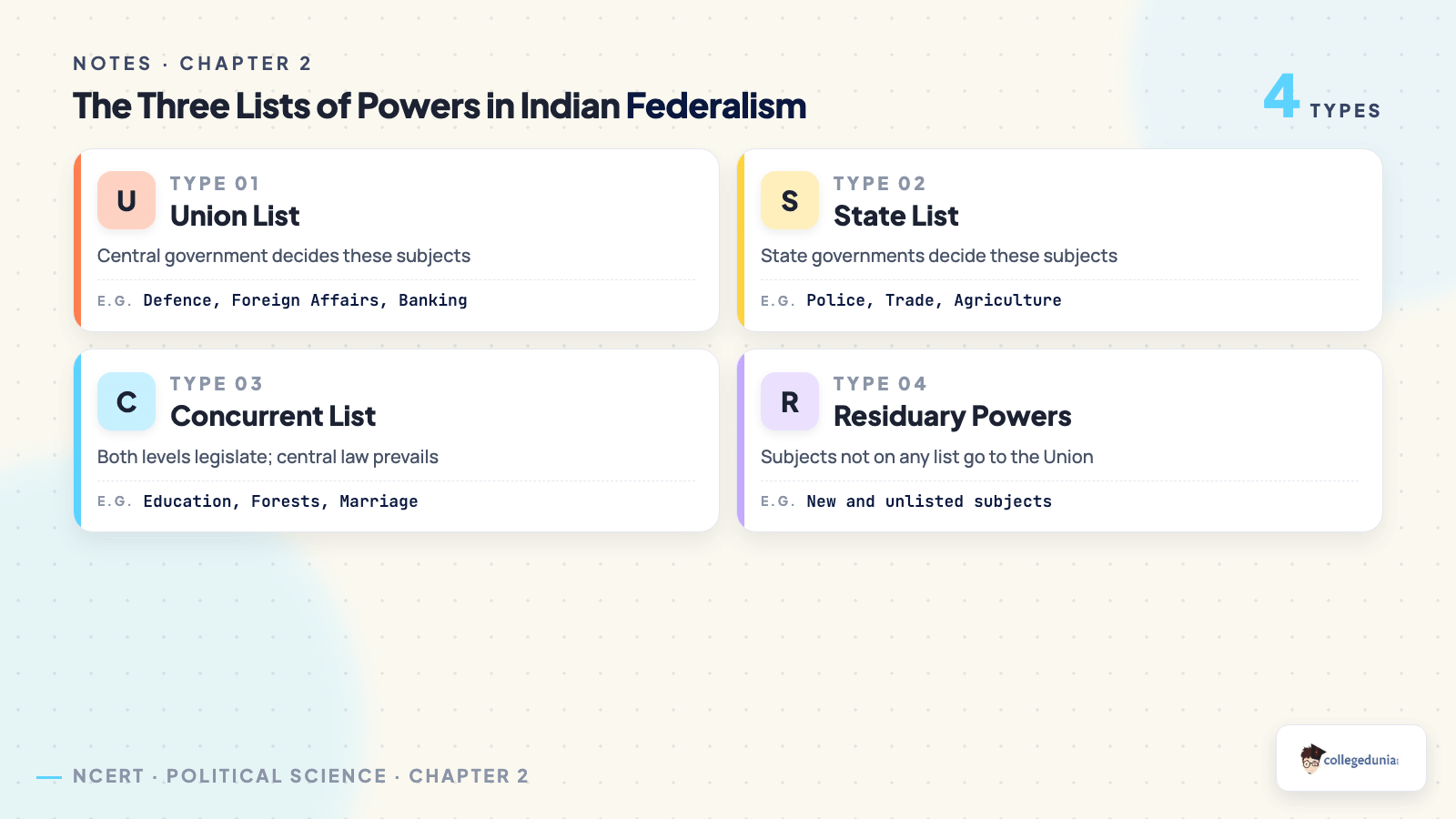
The Constitution sorts every subject into three lists. Learn one or two examples from each, because the paper often asks you to place a subject in the right list.
| List | Who Makes Laws | Example Subjects |
|---|---|---|
| Union List | Only the central government | Defence, foreign affairs, banking, currency, communications |
| State List | Only the state governments | Police, trade, commerce, agriculture, irrigation |
| Concurrent List | Both the centre and the states | Education, forests, trade unions, marriage, adoption |
- If a centre law and a state law clash on a Concurrent List subject, the central law wins.
- Residuary subjects (matters not in any list, like computer software) belong to the Union government.
- Some states like Jammu and Kashmir, Assam and Nagaland have had special provisions.
How India Became Federal in Practice: From Paper to Reality
A Constitution can declare a country federal, but real federalism depends on how politics works. India became a true federation only over time, through three big changes that each made the states stronger.
- Linguistic states: after 1947, state boundaries were redrawn by language, easing administration and keeping the country united.
- Language policy: careful handling of Hindi and other languages stopped India breaking apart over one official language.
- Centre-state relations: regional and coalition governments forced the Union to respect the states more.
Before 1990, one party often ruled at the centre and most states, so the centre frequently misused its power and dismissed state governments. After 1990, the era of coalition governments began, and this strengthened federalism.
Linguistic States and Language Policy in Class 10 Federalism Notes
NCERT treats language as proof that Indian federalism works. The two language decisions held the nation together rather than splitting it.
- Linguistic states: states were formed so people speaking the same language could live under one state government, a bold step that made democracy and administration stronger.
- Hindi is the official language, but the mother tongue of only about 40 percent of Indians, so 22 languages are recognised as Scheduled Languages.
- States can have their own official language, such as Tamil in Tamil Nadu, and English was kept on alongside Hindi so non-Hindi states would not feel sidelined.
Decentralisation and Local Self-Government: Panchayati Raj Class 10
Decentralisation is the third tier of Indian federalism and a CBSE favourite. It means handing power from the centre and the states to local bodies. Before 1992, local bodies had little power, elections were not held on time, and resources were tiny. The 73rd and 74th Constitutional Amendments of 1992 made local self-government a real third level.
- It is now constitutionally compulsory to hold regular local elections.
- Seats are reserved for SCs, STs and OBCs, with at least one-third for women.
- A State Election Commission conducts panchayat and municipal elections.
- State governments must share some powers and revenue with local bodies.
The rural setup, Panchayati Raj, runs in three tiers: the Gram Panchayat (village), the Panchayat Samiti (block), and the Zila Parishad (district). The Gram Sabha, all village voters, checks the Gram Panchayat. In urban areas, the power goes to municipalities and municipal corporations.
Federalism Class 10 Important Questions and How CBSE Tests Them
Across recent boards, the same handful of questions return in slightly different words. Use this list to practise the high-return questions first.
| Question Type | What CBSE Usually Asks | Marks |
|---|---|---|
| 1-mark / MCQ | Year of the 73rd and 74th amendments, which list a subject belongs to | 1 |
| 3-mark short answer | List and explain the features of federalism | 3 |
| 3-mark short answer | How did linguistic states strengthen India | 3 |
| 5-mark long answer | Decentralisation and the importance of the 1992 amendments | 5 |
| 5-mark long answer | How India became a federal country in practice | 5 |
For full marks on long answers, always add one example: Tamil Nadu for language policy, or the Gram Sabha for decentralisation.
Common Mistakes Students Make in the Federalism Chapter
These slips cost easy marks every year. Read them once before the exam.
- Mixing up the three lists. Police is State List, not Union List, and education is Concurrent.
- Forgetting that residuary powers belong to the Union, not the states.
- Writing the wrong year. The local-government amendments are from 1992, the 73rd and 74th.
- Confusing coming-together and holding-together. India is holding-together.
- Saying Hindi is the national language. It is the official language, not the national language.
Student Feedback on the Federalism Chapter
What 11,540 students told us about studying the Federalism chapter. In a Collegedunia survey of 11,540 Class 10 students conducted before the 2026 boards, 78% said the three lists of powers were the easiest marks to score, while decentralisation and the 1992 amendments were rated the part most worth revising twice.
Source: 2026-27 Class 10 Social Science student poll. Sample of 11,540 students from CBSE schools across 14 states.
Related Class 10 Civics Resources for the Federalism Chapter
Use the other resources for this same Federalism chapter to revise from more than one angle.
| Resource Type | Best Used For | Link |
|---|---|---|
| NCERT Solutions | Step-by-step answers to every textbook question | Federalism Class 10 NCERT Solutions |
| Handwritten Notes | Quick one-shot revision in a scanned notebook style | Federalism Class 10 Handwritten Notes |
| NCERT Book PDF | The full original chapter text from the textbook | Federalism Class 10 NCERT Book PDF |
NCERT Notes for All Class 10 Civics Democratic Politics II Chapters
Move through the rest of the Democratic Politics II book with the same notes format.
| Chapter | Topic | Notes Link |
|---|---|---|
| Chapter 1 | Power-sharing | Power-sharing Class 10 Notes |
| Chapter 3 | Democracy and Diversity | Democracy and Diversity Class 10 Notes |
| Chapter 4 | Gender Religion and Caste | Gender Religion and Caste Class 10 Notes |
| Chapter 5 | Popular Struggles and Movements | Popular Struggles and Movements Class 10 Notes |
| Chapter 6 | Political Parties | Political Parties Class 10 Notes |
What is federalism in Class 10 Civics?
Federalism is a system of government where power is shared between a central authority and the states.
Federalism is a system in which power is divided between a central government and several regional or state governments. In India, both levels rule the same people, and the Constitution fixes what each level can do. This idea is the core of the federalism class 10 notes and the most commonly tested definition in the chapter.
What are the key features of federalism for Class 10?
There are seven main features, from two levels of government to courts acting as umpire.
The seven features are: two or more levels of government, the same citizens under different jurisdictions, powers fixed by the Constitution, the Constitution being supreme, courts acting as umpire, separate revenue sources, and the dual aim of unity with diversity. The features of federalism class 10 question is almost always a 3-mark answer.
What are the three lists of powers in federalism in India class 10?
They are the Union List, the State List and the Concurrent List.
The Union List covers subjects like defence and foreign affairs and is decided by the central government. The State List covers police and agriculture and is decided by states. The Concurrent List, such as education and forests, is shared, and the central law wins in case of a clash. Residuary subjects go to the Union.
Why are the 73rd and 74th amendments important in Class 10 Civics?
The 1992 amendments made local self-government a real, constitutional third tier.
The 73rd and 74th Constitutional Amendments of 1992 made it compulsory to hold regular local elections, reserved seats for SCs, STs, OBCs and women, and created a State Election Commission. This is the decentralisation class 10 topic and a frequent 5-mark question.
What is decentralisation in Class 10 federalism notes?
Decentralisation means taking power from the centre and states and giving it to local bodies.
Decentralisation is the third tier of Indian federalism. It hands power to Gram Panchayats, Panchayat Samitis, Zila Parishads and municipalities so that local problems are solved locally. The 1992 amendments gave this tier constitutional backing, which is why the panchayati raj class 10 topic is so important for the board paper.
How did linguistic states strengthen Indian federalism?
Forming states on the basis of language kept the country united and made administration easier.
After 1947, state boundaries were redrawn so that people speaking the same language lived under one state government. This bold step made democracy and administration stronger rather than dividing the country. The linguistic states class 10 topic is a model example of how Indian federalism succeeded.
Where can I download the class 10 federalism notes pdf?
The full notes are available as a free download from the PDF card near the top of this page.
You can download the complete class 10 federalism notes pdf from the download card at the top of this page. It covers every topic from the meaning of federalism to decentralisation, based on the 2026-27 NCERT Democratic Politics II textbook, so you can revise offline before the boards.
Is Hindi the national language of India in Class 10 Civics?
No. Hindi is the official language, not the national language.
NCERT is clear that Hindi is the official language of India, not the national language. It is the mother tongue of only about 40 percent of people, so 22 languages are recognised as Scheduled Languages and English is kept on for official use. This careful language policy is a key reason Indian federalism has worked.



Comments