




Outcomes of Democracy is the concluding chapter of Class 10 Democratic Politics II, and it brings together every test that the CBSE board paper actually sets on democracy.
Chapter5OutcomesofDemocracyNotes.pdf?page=1&dpi=150)
Chapter5OutcomesofDemocracyNotes.pdf?page=2&dpi=150)
Chapter5OutcomesofDemocracyNotes.pdf?page=3&dpi=150)
Chapter5OutcomesofDemocracyNotes.pdf?page=4&dpi=150)
Chapter5OutcomesofDemocracyNotes.pdf?page=5&dpi=150)
Chapter5OutcomesofDemocracyNotes.pdf?page=6&dpi=150)
Chapter5OutcomesofDemocracyNotes.pdf?page=7&dpi=150)
Chapter5OutcomesofDemocracyNotes.pdf?page=8&dpi=150)
Chapter5OutcomesofDemocracyNotes.pdf?page=9&dpi=150)
Chapter5OutcomesofDemocracyNotes.pdf?page=10&dpi=150)
Chapter5OutcomesofDemocracyNotes.pdf?page=11&dpi=150)
Chapter5OutcomesofDemocracyNotes.pdf?page=12&dpi=150)
Chapter5OutcomesofDemocracyNotes.pdf?page=13&dpi=150)
Chapter5OutcomesofDemocracyNotes.pdf?page=14&dpi=150)
Chapter5OutcomesofDemocracyNotes.pdf?page=15&dpi=150)
Chapter5OutcomesofDemocracyNotes.pdf?page=16&dpi=150)
Chapter5OutcomesofDemocracyNotes.pdf?page=17&dpi=150)
Chapter5OutcomesofDemocracyNotes.pdf?page=18&dpi=150)
Chapter5OutcomesofDemocracyNotes.pdf?page=19&dpi=150)
Chapter5OutcomesofDemocracyNotes.pdf?page=20&dpi=150)
Chapter5OutcomesofDemocracyNotes.pdf?page=21&dpi=150)
These outcomes of democracy class 10 notes cover how we judge democracy, its record on accountable government, growth, inequality, social diversity and human dignity, according to the latest 2026-27 NCERT Democratic Politics II textbook.
- Board weightage: Outcomes of Democracy usually carries 5 to 6 marks across one short and one long answer.
- Key flashcard fact: democracy is judged on six outcomes, and its biggest win is legitimacy.
- Pair with: the NCERT Solutions and Handwritten Notes for this chapter, linked near the end.
Every set of outcomes of democracy class 10 notes in this Collegedunia compilation is curated by Social Science experts, based on the 2026-27 NCERT Democratic Politics II textbook, and checked against the last five years of CBSE board papers.
What Outcomes of Democracy Means in Class 10 Civics Democratic Politics II
This chapter asks one honest question: what does democracy actually deliver? These notes weigh the expected results against the actual record to reach a fair verdict.
- Democracy is a form of government, not a magic wand; it creates the conditions for good results, but citizens must use them.
- We judge democracy not by perfection but by whether it does better than its alternatives and keeps improving.
- The chapter is evaluative, so the board rewards a balanced opinion with reasons.
The chapter rides on six themes: how to assess outcomes; accountable government; economic growth; reduction of inequality; accommodation of social diversity; and dignity and freedom of citizens.
Outcomes of Democracy Class 10 Full Chapter Explained in One Video
Source: Magnet Brains on YouTube
How Do We Assess Democracy's Outcomes Every Student Must Know
Democracy is better than dictatorship, but many feel it is good in principle, not in practice. That gap is what these notes investigate. From earlier classes, democracy is the better form for five clear reasons, a high-value short-answer list.
- Promotes equality among citizens.
- Enhances the dignity of the individual.
- Improves the quality of decision-making.
- Provides a method to resolve conflicts.
- Allows room to correct its own mistakes.
The first step is to recognise that democracy is just a form of government. It only creates conditions; citizens must use them. Expect only what it can reasonably deliver.
Accountable, Responsive and Legitimate Government: Democracy's Most Tested Outcome

Democracy must provide a government that people choose and control, the most heavily tested part of the chapter.
| Quality | What It Means |
|---|---|
| Accountable | Government answers to citizens and can be questioned and removed through elections |
| Responsive | Government is attentive to the needs and demands of the people, and acts on them |
| Legitimate | It is the people's own government, formed by fair procedures, so people accept it as rightful |
- Decisions follow norms and procedures, so a citizen can check the process. This is transparency; the Right to Information (RTI) is transparency in action, as in the textbook's Nannu example.
- Yardsticks: regular free and fair elections, open debate, and the right to information.
Democracy may be less efficient as debate causes delay, but a democratic decision is more acceptable. Above all it is a legitimate government, the people's own, which is why support for it is overwhelming worldwide.
Economic Growth and Development Under Democracy
On economic growth, democracy does not clearly outperform dictatorship, so read the data with care.
| Type of regime | Growth Rate (1950 to 2000) |
|---|---|
| All democratic regimes | 3.95% |
| All dictatorial regimes | 4.42% |
| Poor countries under dictatorship | 4.34% |
| Poor countries under democracy | 4.28% |
- The overall gap (3.95 vs 4.42) favours dictatorship, but for poor countries the gap (4.34 vs 4.28) is negligible.
- Development depends on many factors: population size, the global situation, and economic priorities.
- Fair verdict: democracy does not lag significantly behind dictatorship in growth, especially in poor countries.
Democracy does not guarantee development, but saying it harms growth is an overstatement. The tiny gap, plus outcomes like legitimacy and dignity, make it preferable overall.
Reduction of Inequality and Poverty: Democracy's Sharpest Puzzle
Democracies rest on political equality, so we expect them to reduce economic disparities. The record is disappointing, a sharp puzzle.
| Country | Top 20% income share | Bottom 20% income share |
|---|---|---|
| South Africa | 64.8% | 2.9% |
| Brazil | 63.0% | 2.6% |
| USA | 50.0% | 4.0% |
| Denmark | 34.5% | 9.6% |
| Hungary | 34.4% | 10.0% |
- All are democracies, yet the rich-poor gap ranges from extreme (South Africa, Brazil) to relatively fair (Denmark, Hungary).
- Democracy alone does not fix inequality; the policies it chooses make the difference.
- The puzzle: the poor are the majority of voters, yet poverty is not tackled seriously.
Democracy guarantees political equality (the vote) but not economic equality (a fair income share). This gap is the heart of the section.
Accommodation of Social Diversity and the Two Conditions
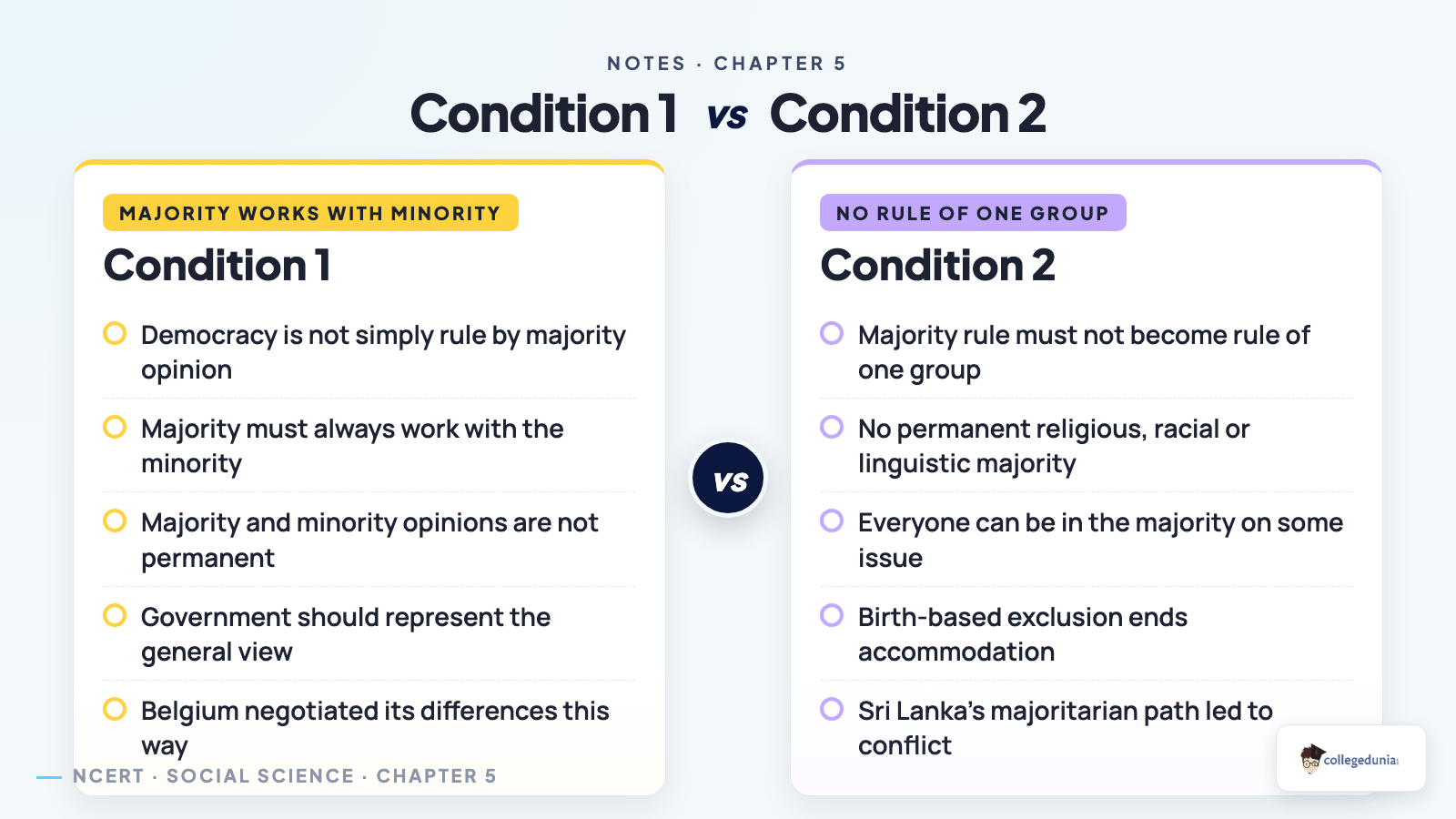
Do democracies let citizens live peacefully despite differences? Democracy shines here, but only if two conditions are met. No society can permanently resolve group conflicts, yet democracy develops procedures to negotiate them.
- Condition 1: the majority must work with the minority, and the two are not permanent.
- Condition 2: majority rule must not become the rule of one religious, racial or linguistic group.
Belgium negotiated its differences through power-sharing, while Sri Lanka's majoritarian approach led to conflict. Accommodation is a choice, not automatic.
Dignity and Freedom of Citizens: Democracy's Greatest Strength
Here democracy is far superior. The passion for respect and freedom is its basis, and democracies recognise this at least in principle.
- Once equal dignity is recognised in principle, the disadvantaged gain a basis to struggle against unfair treatment.
- Women: equal treatment is now seen as necessary, so unfair treatment is unacceptable.
- Caste: democracy has strengthened the claims of discriminated castes; atrocities still occur but lack legal foundations.
Democracy's examination never ends. That people complain is proof of success, showing they have moved from a subject to a citizen.
A Balanced Verdict on the Outcomes of Democracy
Pull the six fronts into one defensible conclusion, the kind a 5-mark evaluate question wants. This scorecard is the best revision tool.
| Outcome tested | Verdict | Key reason |
|---|---|---|
| Accountable, responsive government | Mixed | Good at elections; weak on info-sharing and corruption |
| Legitimate government | Clear win | The people's own government; overwhelming support |
| Economic growth | Draw | Negligible gap with dictatorship, especially for poor countries |
| Inequality and poverty | Weak | Political equality, but growing economic inequality |
| Accommodation of diversity | Win (conditional) | Negotiates differences if two conditions are met |
| Dignity and freedom | Strong win | Recognises equal dignity; subject becomes citizen |
Democracy's record is mixed on economics but decisive on legitimacy, accommodation and dignity. It is the only system that can correct its own mistakes, so judge it against its alternatives.
Outcomes of Democracy Class 10 Important Questions and How CBSE Tests Them
The same questions return in different words. Practise the high-return ones first.
| Topic | Typical Marks | How CBSE Asks It |
|---|---|---|
| Accountable, responsive, legitimate government | 3 to 5 | How does democracy produce it? |
| Conditions for accommodating diversity | 3 to 5 | State the conditions; Sri Lanka example |
| Inequality and poverty (data tables) | 3 to 4 | Data interpretation, give a verdict |
| Dignity and freedom; subject to citizen | 3 to 5 | Why is democracy superior here? |
| Evaluate the outcomes of democracy | 5 | Balanced long answer with reasons |
For full marks, frame long answers in three moves: state the expectation, give the actual record with an example, then a balanced verdict.
Common Mistakes Students Make in the Outcomes of Democracy Chapter
- Writing that democracy harms the economy. The growth gap is tiny and vanishes for poor countries.
- Blaming the idea of democracy when a government fails. Separate the idea from the government.
- Saying democracy means whatever the majority wants. The majority must work with minorities.
- Treating rising complaints as failure. Complaints show people became citizens.
- Forgetting the count. Democracy is judged on six outcomes, and legitimacy is its clearest win.
Student Feedback on the Outcomes of Democracy Chapter
What 11,800 students told us about studying the Outcomes of Democracy chapter. In a Collegedunia survey of 11,800 Class 10 students conducted before the 2026 boards, 78% said the scorecard and the expectation-reality-verdict structure were the easiest way to score the 5-mark answer, while the inequality data tables were rated the part most worth revising twice.
Source: 2026-27 Class 10 Social Science student poll. Sample of 11,800 students from CBSE schools across 16 states.
Related Class 10 Civics Resources for the Outcomes of Democracy Chapter
Use the other resources for this chapter to revise from more angles.
| Resource Type | Best Used For | Link |
|---|---|---|
| NCERT Solutions | Step-by-step answers to textbook questions | Outcomes of Democracy Class 10 NCERT Solutions |
| Handwritten Notes | Quick one-shot revision, scanned style | Outcomes of Democracy Class 10 Handwritten Notes |
| NCERT Book PDF | The full original chapter text | Outcomes of Democracy Class 10 NCERT Book PDF |
NCERT Notes for All Class 10 Civics Democratic Politics II Chapters
Revise the rest of the Democratic Politics II book in this format.
| Chapter | Topic | Notes Link |
|---|---|---|
| Chapter 1 | Power-sharing | Power-sharing Class 10 Notes |
| Chapter 2 | Federalism | Federalism Class 10 Notes |
| Chapter 3 | Gender, Religion and Caste | Gender, Religion and Caste Class 10 Notes |
| Chapter 4 | Political Parties | Political Parties Class 10 Notes |
What are the outcomes of democracy in Class 10 Civics?
Democracy is judged on six outcomes, from accountable government to dignity and freedom of citizens.
The outcomes of democracy class 10 notes test democracy on six fronts: an accountable, responsive and legitimate government; economic growth and development; reduction of inequality and poverty; accommodation of social diversity; and the dignity and freedom of citizens. Across these, democracy clearly wins on legitimacy and dignity, draws on growth, and is weak on reducing inequality.
How does democracy produce an accountable, responsive and legitimate government?
Through free and fair elections, open public debate, transparency, and the citizen's right to information.
Democracy makes decisions follow set norms and procedures, so a citizen can examine whether the right process was followed, which is called transparency. Regular free and fair elections, open debate, and the Right to Information let citizens question and remove the government. Because the government is formed by fair procedures, it is the people's own and therefore legitimate.
Does democracy lead to faster economic growth in Class 10?
No, the data shows democracy does not clearly outgrow dictatorship, but the gap is tiny for poor countries.
Between 1950 and 2000, all dictatorships grew at 4.42% and all democracies at 3.95%. But for poor countries the rates were 4.34% (dictatorship) and 4.28% (democracy), a negligible gap. So democracy does not guarantee faster growth, yet it does not lag significantly behind either, and saying democracy harms the economy is an overstatement.
Why is democracy not able to reduce economic inequality?
Democracy gives political equality, but the policies it chooses do not always reduce growing economic inequality.
Democracy guarantees political equality, one person one vote one value, but parallel to this we find growing economic inequality. The income tables show all democracies, yet the rich-poor gap ranges from extreme in South Africa and Brazil to fairer in Denmark and Hungary. The poor are the majority of voters, but governments do not always tackle poverty seriously, so democracy by itself does not fix inequality.
What are the two conditions for accommodating social diversity?
The majority must work with the minority, and majority rule must not become rule of one religious or linguistic group.
A democracy accommodates diversity if two conditions are met. First, democracy is not simply rule by majority opinion; the majority must always work with the minority, and majority and minority opinions are not permanent. Second, rule by majority must not become the rule of one religious, racial or linguistic group over others. The Belgium and Sri Lanka contrast shows accommodation is a choice, not automatic.
Why is dignity and freedom called democracy's greatest strength?
Because democracy recognises equal dignity in principle, giving the disadvantaged a legal and moral basis to claim rights.
Democracy is far superior to other forms in promoting dignity and freedom. By recognising in principle that all individuals are equal, it lets women and discriminated castes struggle against unfair treatment that is now legally and morally unacceptable. Rising complaints are not failure; they show people have moved from the status of a subject to that of a citizen, which is democracy's deepest outcome.
How do you write a balanced verdict on the outcomes of democracy?
State the expectation, give the actual record with an example, then a balanced conclusion using the scorecard.
Use the expectation-reality-verdict structure. Democracy's record is mixed on efficiency and economics but decisive on legitimacy, accommodation and dignity. Crucially, it is the only system that can correct its own mistakes. Judge it against its alternatives and its own promise, not against perfection, and on both counts it is the better choice. This is exactly how the 5-mark evaluate question should be answered.
Where can I download the outcomes of democracy class 10 notes pdf?
The full notes are available as a free download from the PDF card near the top of this page.
You can download the complete outcomes of democracy class 10 notes pdf from the download card at the top of this page. It covers every topic from how we assess democracy to the six-outcome scorecard and the balanced conclusion, based on the 2026-27 NCERT Democratic Politics II textbook, so you can revise offline before the boards.



Comments