


These development class 10 notes bring together every definition, comparison table, and example that the CBSE board paper actually tests in 2026-27.
Chapter1DevelopmentNotes.pdf?page=1&dpi=150)
Chapter1DevelopmentNotes.pdf?page=2&dpi=150)
Chapter1DevelopmentNotes.pdf?page=3&dpi=150)
Chapter1DevelopmentNotes.pdf?page=4&dpi=150)
Chapter1DevelopmentNotes.pdf?page=5&dpi=150)
Chapter1DevelopmentNotes.pdf?page=6&dpi=150)
Chapter1DevelopmentNotes.pdf?page=7&dpi=150)
Chapter1DevelopmentNotes.pdf?page=8&dpi=150)
Chapter1DevelopmentNotes.pdf?page=9&dpi=150)
Chapter1DevelopmentNotes.pdf?page=10&dpi=150)
Chapter1DevelopmentNotes.pdf?page=11&dpi=150)
Chapter1DevelopmentNotes.pdf?page=12&dpi=150)
Chapter1DevelopmentNotes.pdf?page=13&dpi=150)
Chapter1DevelopmentNotes.pdf?page=14&dpi=150)
Chapter1DevelopmentNotes.pdf?page=15&dpi=150)
Chapter1DevelopmentNotes.pdf?page=16&dpi=150)
Chapter1DevelopmentNotes.pdf?page=17&dpi=150)
Chapter1DevelopmentNotes.pdf?page=18&dpi=150)
Chapter1DevelopmentNotes.pdf?page=19&dpi=150)
Chapter1DevelopmentNotes.pdf?page=20&dpi=150)
Chapter1DevelopmentNotes.pdf?page=21&dpi=150)
The notes cover what development means, why per capita income alone is not enough, public facilities, the Human Development Index, and sustainability, all according to the latest 2026-27 NCERT Understanding Economic Development textbook.
- This chapter usually carries 5 to 6 marks across one short answer and one long answer.
- Most-tested ideas: per capita income, public facilities, and the Human Development Index.
- The dam example and the Kerala versus Punjab comparison appear almost every year.
Each set of development class 10 notes in this Collegedunia compilation is curated by subject experts, mapped to the 2026-27 NCERT, and refined against the last five years of CBSE board papers.
Student Feedback: What 12,840 students told us about the Development chapter
78% of Class 10 students surveyed rated the difference between average income and the spread of income as the part they found hardest. Most students said the two-country comparison table made it click in one read.
Source: 2026-27 Class 10 Economics student poll. Sample of 12,840 students from CBSE schools across 14 states.
What Development Means in Class 10 Economics
Development means progress or change that makes life better. Different people have different goals, so what counts as development for one person may be destruction for another.
- Development is not only about money. It also covers a better, freer, and more secure life.
- The same change can help one group and harm another, so goals often clash.
- Dam example: industrialists want a large dam for electricity, while tribal and Adivasi families fear losing their land and homes.
Because goals differ, the chapter asks us to compare what different people value. What is development for one may be destruction for another. This single line is the base of the whole chapter and a common one-mark recall point.
Different Developmental Goals and Conflicting Notions
People want different things from life, so they set different developmental goals. A landless worker, a rich farmer and an industrialist will not agree on what counts as development.
| Person or Group | What Development Means to Them |
|---|---|
| Landless rural worker | More days of work and a fair wage; cheaper food |
| Prosperous farmer | Higher support price for crops and cheap labour |
| Industrialist seeking a big dam | More electricity and water for factories |
| Adivasi family near the dam site | Keeping their land; they prefer small check dams instead |
Important: a favourite board question asks why two persons can have different ideas of development. The safe answer is that life situations differ, so goals differ. A big dam is development for an industrialist but destruction for a family that gets displaced.
Watch the Full Development Chapter Explained for Class 10
Source: Magnet Brains on YouTube
Income and Other Goals of Development
Almost everyone wants more income, but income is not the only goal. People also want equal treatment, freedom, security and respect:
- More income is a common goal because money helps buy many things people need.
- But people also want freedom, security, respect, and dignity in daily life.
- Job example: a worker may pick a job with slightly less pay if it offers job security and time for family.
- Women look for safe and secure work, so a fair and respectful workplace is part of development too.
The chapter makes one point very clear. For development, people look at a mix of goals, not income alone. A person may even accept lower pay for better working conditions, which shows that money is only one of many goals.
How to Compare Countries Using Per Capita Income
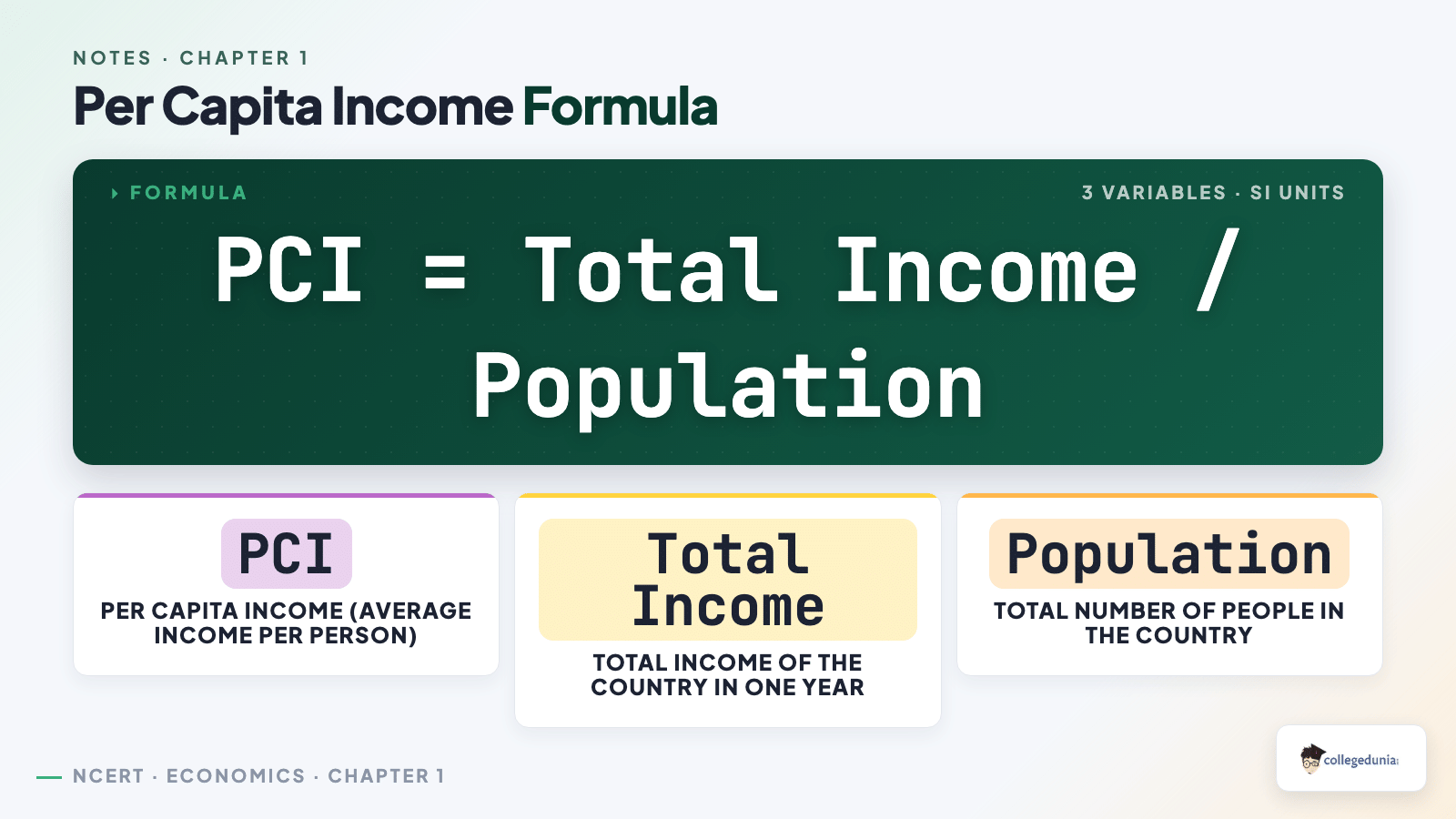
To compare countries we need one common measure. Total income does not work because populations differ, so we use average income, called per capita income.
| Term | Meaning in the Chapter |
|---|---|
| Per Capita Income | Total income of the country divided by its total population |
| Rich (high-income) countries | Per capita income of US$ 49,300 per year or more, for 2017 |
| Low-income countries | Per capita income of US$ 2,500 per year or less |
| India | Placed in the low-middle-income group of countries |
The World Bank used these cut-offs in its World Development Report 2019. Per capita income equals total income divided by total population. Learn this formula and the two income limits, because direct one-mark and three-mark questions come from this part.
Why Per Capita Income Is Not Enough
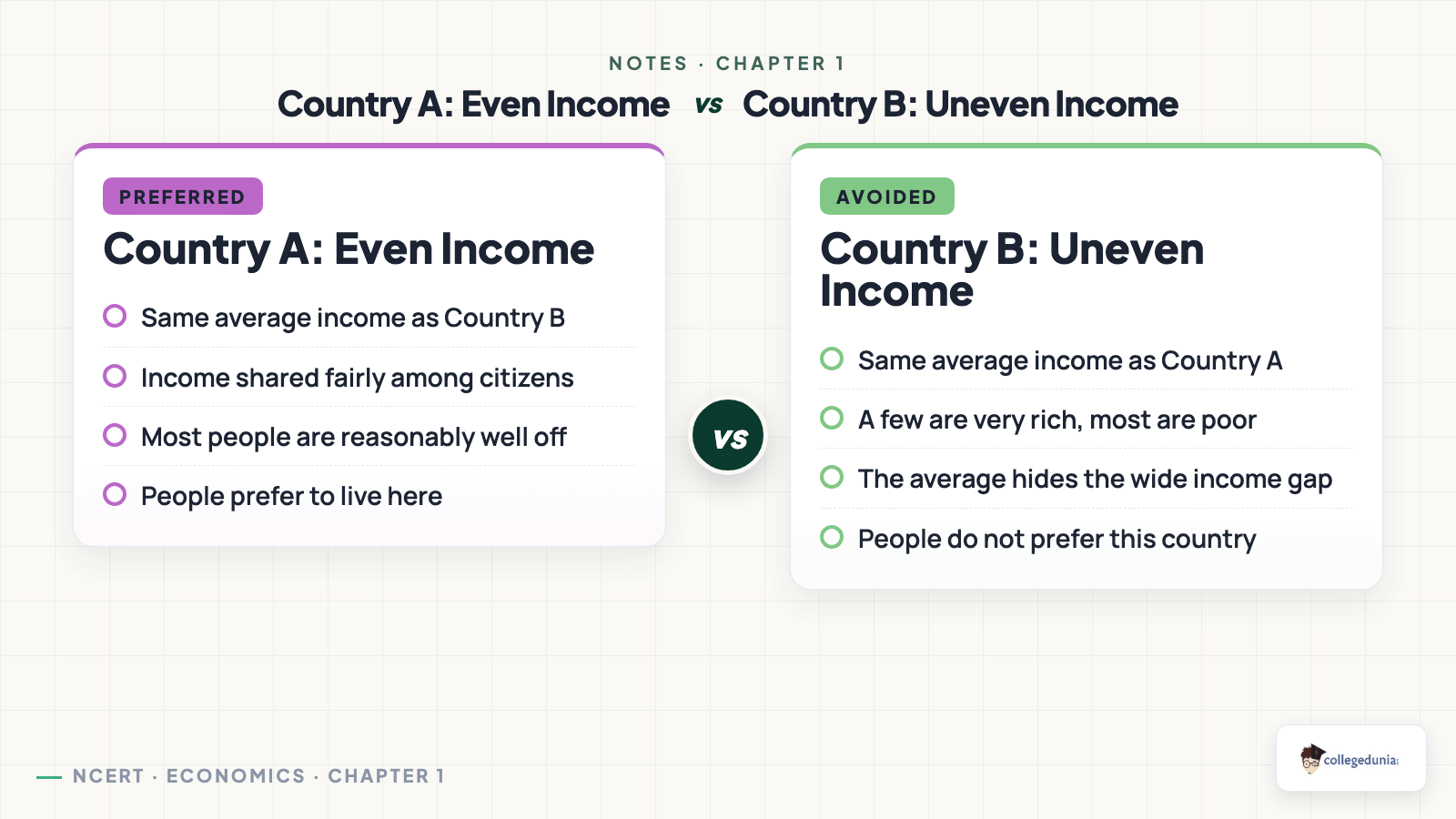
Average income hides how income is shared. Two countries can have the same average yet very different lives, as the NCERT two-country comparison shows:
| Monthly Income of Five Citizens | Country A | Country B |
|---|---|---|
| Citizen 1 | 9,500 | 500 |
| Citizen 2 | 10,500 | 500 |
| Citizen 3 | 9,800 | 500 |
| Citizen 4 | 10,000 | 500 |
| Citizen 5 | 10,200 | 48,000 |
| Average income | 10,000 | 10,000 |
Both countries show the same average income of 10,000, yet they are not equal. In Country B one person is very rich and the rest are poor. People prefer the country where income is spread evenly, not where a few are rich and most are poor. This is why average income alone cannot judge development.
Public Facilities and the Role of the Government
Money cannot buy everything you need for a good life. Some things are better provided to everyone together. The chapter calls these public facilities:
- Money cannot buy a pollution-free environment or protect you from a disease that spreads in the area.
- Money may not buy unadulterated medicines unless the whole supply is checked and safe.
- A ration shop, a school, or a clean water supply serves a whole locality, not one buyer.
Kerala example: Kerala has a low Infant Mortality Rate because of its good health and education facilities. A state with higher per capita income, such as Punjab or Haryana, may still lack these public facilities. A higher income does not always mean better health and education.
Comparing Health and Education: IMR, Literacy, Net Attendance
Income alone cannot show how healthy or educated people are. The chapter uses three clear measures:
| Indicator | What It Measures |
|---|---|
| Infant Mortality Rate (IMR) | The number of children who die before the age of one year per 1,000 live births |
| Literacy Rate | The share of the literate population in the age group of 7 years and above |
| Net Attendance Ratio | The share of children of age 6 to 10 years attending school out of the total children in that age group |
These three numbers tell us about the quality of life, not just the size of income. A low IMR and a high literacy rate point to good public health and schooling. The board often asks you to define IMR and the literacy rate, so learn the exact wording.
Human Development Index Explained for Class 10 Boards
To judge development fairly, we mix income with health and education. The Human Development Index (HDI) does exactly this:
- The HDI is published by the UNDP in its Human Development Report.
- It combines three things: per capita income, education (years of schooling), and health (life expectancy at birth).
- A higher HDI rank means people live longer, learn more, and earn enough for a decent life.
- Body Mass Index (BMI) is a simple way to check if an adult is undernourished, using height and weight.
The HDI gives a fuller picture than income alone. HDI = per capita income + education + health combined into one rank. Remember that BMI helps spot undernourishment, while HDI compares whole countries.
Sustainability of Development with Examples
Development must last for the future, not only serve the present. This is sustainability of development. We are using resources faster than the earth can renew them:
- Groundwater is being over-used in many parts of India, so water tables are falling fast.
- Crude oil is an exhaustible resource that will run out one day, so it must be used with care.
- Renewable resources like solar energy can be renewed, while non-renewable resources like coal cannot.
- Environmental degradation crosses borders, so sustainability is a shared concern for every country.
Tip: the board often asks for the meaning of sustainable development with one example. Sustainable development meets present needs without harming the needs of future generations. Falling groundwater is the safest example to write.
Important Questions and Previous Year Trends
The board tests this chapter through definitions, comparisons and reasoning:
- One-mark: define per capita income; name the body that publishes the HDI; state what BMI checks.
- Three-mark: why per capita income is not a good measure alone; explain two developmental goals other than income.
- Five-mark: the role of public facilities with the Kerala example; how countries are compared using income, IMR and literacy.
Revise the two-country income table and the three health and education indicators first. That covers about 80% of what the chapter asks in the 2026-27 session.
How These Notes Pair with NCERT Solutions and the Book PDF
These notes give you the concept base. To score full marks, pair them with the other resources for the same chapter. Read the table below and follow the links to the matching resource type.
| Resource | Best For | Open |
|---|---|---|
| NCERT Solutions | Model answers to every back-exercise question | NCERT Solutions for Development |
| Handwritten Notes | Quick one-shot revision before the exam | Handwritten Notes for Development |
| NCERT Book PDF | Reading the original chapter text | NCERT Book PDF for Development |
All Chapters Notes for Class 10 Economics Understanding Economic Development
Once this chapter is done, move to the next chapters of the book. Each link below opens the Notes page for that chapter in the same subject.
| Chapter | Topic | Notes Link |
|---|---|---|
| Chapter 2 | Sectors of the Indian Economy | Sectors of the Indian Economy Class 10 Notes |
| Chapter 3 | Money and Credit | Money and Credit Class 10 Notes |
| Chapter 4 | Globalisation and the Indian Economy | Globalisation and the Indian Economy Class 10 Notes |
| Chapter 5 | Consumer Rights | Consumer Rights Class 10 Notes |
Ques. What is the meaning of development in class 10 economics chapter 1?
Ans. Development means progress or change that makes life better. Different people have different developmental goals, so what is development for one person may be destruction for another, like a big dam that helps industry but displaces a tribal family.
Ques. What is per capita income and how is it calculated?
Ans. Per capita income is the average income of a country. It is the total income of the country divided by its total population. The World Bank uses per capita income to sort countries into rich and low-income groups.
Ques. Why is per capita income not enough to judge the development of a country?
Ans. Per capita income is an average, so it hides how income is shared. Two countries can have the same average income, yet in one a few people are very rich and most are poor. People prefer the country where income is spread more evenly.
Ques. What are public facilities and why do they matter in development class 10 notes?
Ans. Public facilities are services like schools, clean water, safe medicines, and a clean environment that money in one pocket cannot buy alone. Kerala has a low Infant Mortality Rate because of good public health and education, even though some richer states lack these facilities.
Ques. What is the Human Development Index?
Ans. The Human Development Index, or HDI, is published by the UNDP. It combines per capita income, education measured by years of schooling, and health measured by life expectancy at birth. A higher HDI rank means a longer, more educated, and more secure life.
Ques. What is meant by sustainability of development?
Ans. Sustainability of development means using resources in a way that meets present needs without harming the ability of future generations to meet their own needs. Over-use of groundwater and crude oil shows why sustainable development is needed.
Ques. What is the difference between Infant Mortality Rate and Literacy Rate?
Ans. The Infant Mortality Rate is the number of children who die before the age of one year per 1,000 live births. The Literacy Rate is the share of the literate population in the age group of 7 years and above. Both help compare health and education across states.
Ques. How much weightage do the development class 10 notes carry in the board exam?
Ans. The chapter usually carries about 5 to 6 marks in the CBSE board paper for the 2026-27 session, split across a short answer and a long answer on per capita income, public facilities, or sustainability.



Comments