




Inside the NCERT notes for Class 10 Economics Chapter 4 Globalisation and the Indian Economy, you will find a clear MNC location-logic map, the four routes by which MNCs interlink production, and the gainers-versus-losers table examiners love, all according to the latest 2026-27 CBSE syllabus.
Chapter4GlobalisationandtheIndianEconomyNotes.pdf?page=1&dpi=150)
Chapter4GlobalisationandtheIndianEconomyNotes.pdf?page=2&dpi=150)
Chapter4GlobalisationandtheIndianEconomyNotes.pdf?page=3&dpi=150)
Chapter4GlobalisationandtheIndianEconomyNotes.pdf?page=4&dpi=150)
Chapter4GlobalisationandtheIndianEconomyNotes.pdf?page=5&dpi=150)
Chapter4GlobalisationandtheIndianEconomyNotes.pdf?page=6&dpi=150)
Chapter4GlobalisationandtheIndianEconomyNotes.pdf?page=7&dpi=150)
Chapter4GlobalisationandtheIndianEconomyNotes.pdf?page=8&dpi=150)
Chapter4GlobalisationandtheIndianEconomyNotes.pdf?page=9&dpi=150)
Chapter4GlobalisationandtheIndianEconomyNotes.pdf?page=10&dpi=150)
Chapter4GlobalisationandtheIndianEconomyNotes.pdf?page=11&dpi=150)
Chapter4GlobalisationandtheIndianEconomyNotes.pdf?page=12&dpi=150)
Chapter4GlobalisationandtheIndianEconomyNotes.pdf?page=13&dpi=150)
Chapter4GlobalisationandtheIndianEconomyNotes.pdf?page=14&dpi=150)
Chapter4GlobalisationandtheIndianEconomyNotes.pdf?page=15&dpi=150)
Chapter4GlobalisationandtheIndianEconomyNotes.pdf?page=16&dpi=150)
Chapter4GlobalisationandtheIndianEconomyNotes.pdf?page=17&dpi=150)
Chapter4GlobalisationandtheIndianEconomyNotes.pdf?page=18&dpi=150)
Chapter4GlobalisationandtheIndianEconomyNotes.pdf?page=19&dpi=150)
Chapter4GlobalisationandtheIndianEconomyNotes.pdf?page=20&dpi=150)
These globalisation and the indian economy class 10 notes turn the whole chapter into quick-recall diagrams, definitions, and a CBSE previous-year trend table.
- CBSE Weightage: 5 to 6 marks per board paper, drawn from Unit 4 Globalisation and the Indian Economy
- Question Spread: one 1-mark MNC or WTO MCQ, one 3-mark difference question, and one 5-mark answer on impact or fair globalisation
Also Check:
- Globalisation and the Indian Economy Class 10 NCERT Solutions
- Money and Credit Class 10 Economics Notes
- CBSE Class 10 Social Science Syllabus 2026-27
Globalisation and the Indian Economy Class 10 Notes Overview
How did the markets of India and the world become joined together? These notes follow the NCERT order: MNCs and how they spread production, foreign trade and the integration of markets, a definition of globalisation, the three enabling factors, the mixed impact in India, and the struggle for fair globalisation.
| Topic | What It Covers | Board Weightage |
|---|---|---|
| MNCs and Location Logic | What an MNC is and why it spreads production | 1 to 3 marks |
| Interlinking Production | The four routes MNCs use | 3 to 5 marks |
| Foreign Trade and Markets | How trade integrates markets (Chinese toys) | 3 marks |
| What Is Globalisation | Definition, four flows, role of MNCs | 1 to 3 marks |
| Enabling Factors | Technology, liberalisation and the WTO | 3 to 5 marks |
| Impact in India | Gainers versus losers (Ravi, Sushila) | 3 to 5 marks |
| Fair Globalisation | Government, WTO, people's organisations | 3 to 5 marks |
The two biggest mark-earners are the three enabling factors and the impact in India comparison; practise both as full 5-mark answers.
Globalisation and the Indian Economy Class 10 Explained in Simple Language
Source: Magnet Brains on YouTube
What the Globalisation and the Indian Economy Class 10 Notes PDF Contains
- MNC location-logic map (CLImB) and the four-routes diagram for interlinking production.
- Chinese-toys flow for how foreign trade integrates two markets, plus definition boxes.
- Three enabling factors (TLW) and the impact-in-India table with Ravi and Sushila.
- Fair globalisation plan, a confused-pairs table, and a glossary with a CBSE PYQ trend table.
MNCs and Why They Spread Production Across Countries
A multinational corporation (MNC) owns or controls production in more than one country, setting up factories where costs are low. At each step it asks where the work is cheapest or best:
- Close to the markets: less transport cost, faster delivery to buyers.
- Low-cost labour: skilled and unskilled workers available cheaply, as in India.
- Inputs assured: raw material, power and other factors of production are reliable.
- Friendly policies: the government looks after the MNC's interests (liberalisation).
For example, an MNC may design in the US, make components in China, assemble in Mexico, sell worldwide and run customer care from India, saving 50 to 60 per cent on cost.
Four Routes MNCs Use to Interlink Production in the Indian Economy
MNCs do not always build everything themselves. The textbook describes four ways they interlink production with local producers:
| Route | How It Works | Example |
|---|---|---|
| Set up on their own | Build their own factories (foreign investment) | An MNC building a new plant in India |
| Joint production | Partner with a local firm; MNC brings money and technology | A local firm tied up with an MNC |
| Buy up local firms | Purchase a local company; the most common route | Cargill buying Parakh Foods |
| Place orders | Order from small producers, sell under the MNC's brand | Garments, footwear, sports goods |
When an MNC places orders with small producers, it has tremendous power: it decides the price, quality, delivery and labour conditions, while the producers have little bargaining power. After buying Parakh Foods, Cargill became India's largest edible-oil producer.
How Foreign Trade Integrates Markets in the Indian Economy
Long before MNCs existed, foreign trade connected countries, letting producers sell beyond their home market and buyers import from abroad:
- Choice rises: buyers pick between local and imported goods.
- Prices move closer: prices of similar goods in two countries tend to become equal.
- Producers compete directly, even thousands of miles apart.
The textbook uses Chinese toys in India: cheaper price and new designs let them win, so buyers gain choice and lower prices, Chinese makers gain business, Indian makers lose sales. This is integration of markets.
What Is Globalisation in Class 10 Economics?
Two forces pull countries together: rising foreign investment by MNCs and rising foreign trade. The result is greater integration of production and markets, called globalisation.
- Definition: the process of rapid integration between countries, driven mainly by MNCs.
- Four flows: goods, services, investment and technology, plus the movement of people.
- Weakest flow: the movement of people, the least free because of immigration restrictions.
Three Factors That Enabled Globalisation
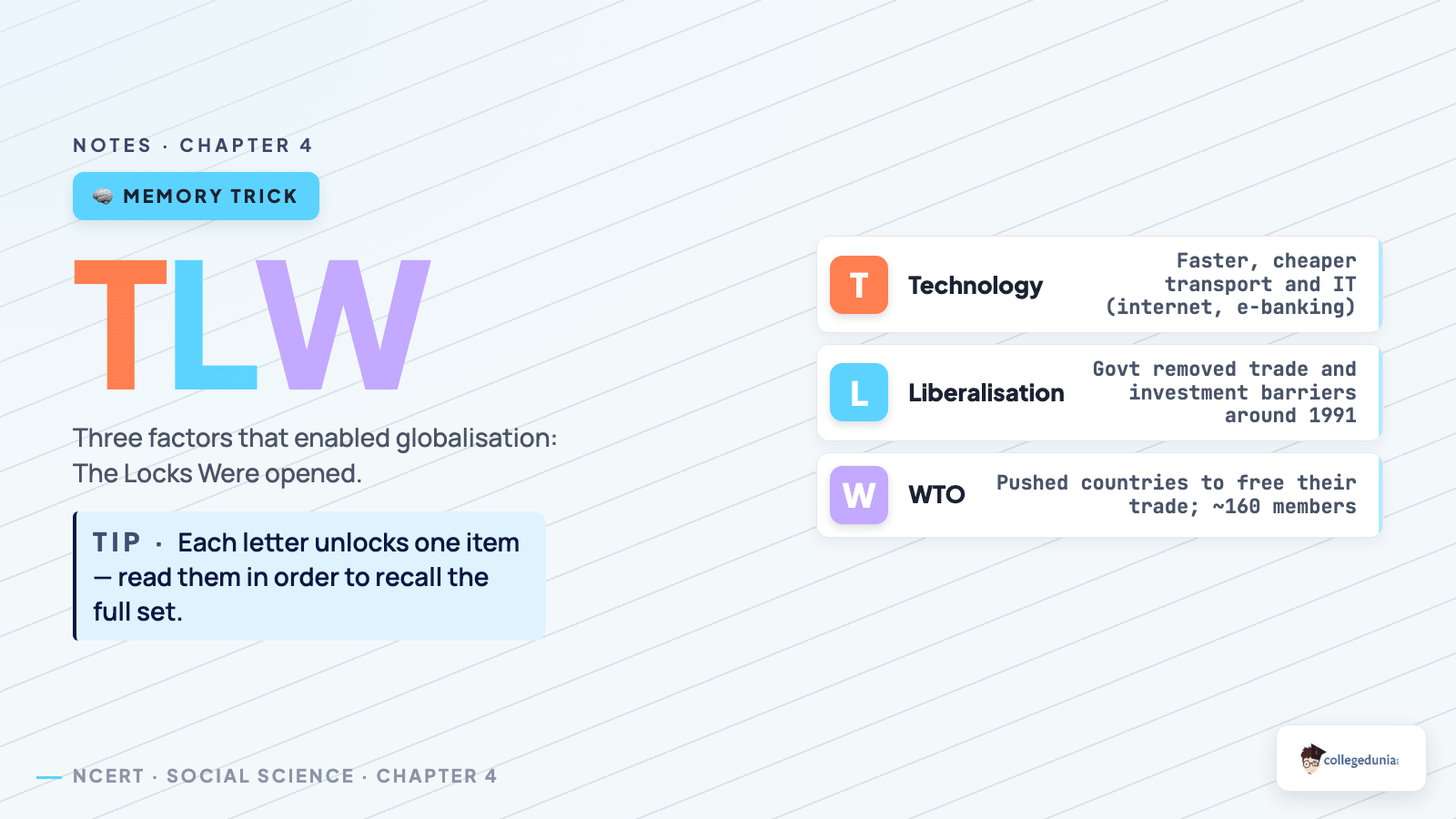
The textbook highlights three enabling factors; a 5-mark question asks for exactly these:
- Technology: faster, cheaper transport (containers, ships, planes) and information technology (telephone, internet, e-banking) moved goods and information cheaply.
- Liberalisation: around 1991 the government removed its barriers on foreign trade and investment, so businesses could decide freely what to import or export.
- WTO: the World Trade Organisation liberalises world trade, sets the rules, and has about 160 members.
One fairness point earns marks: developed countries unfairly kept their own trade barriers, while WTO rules forced developing countries to remove theirs. Never write that the WTO treats all countries equally.
Impact of Globalisation in India: Gainers Versus Losers
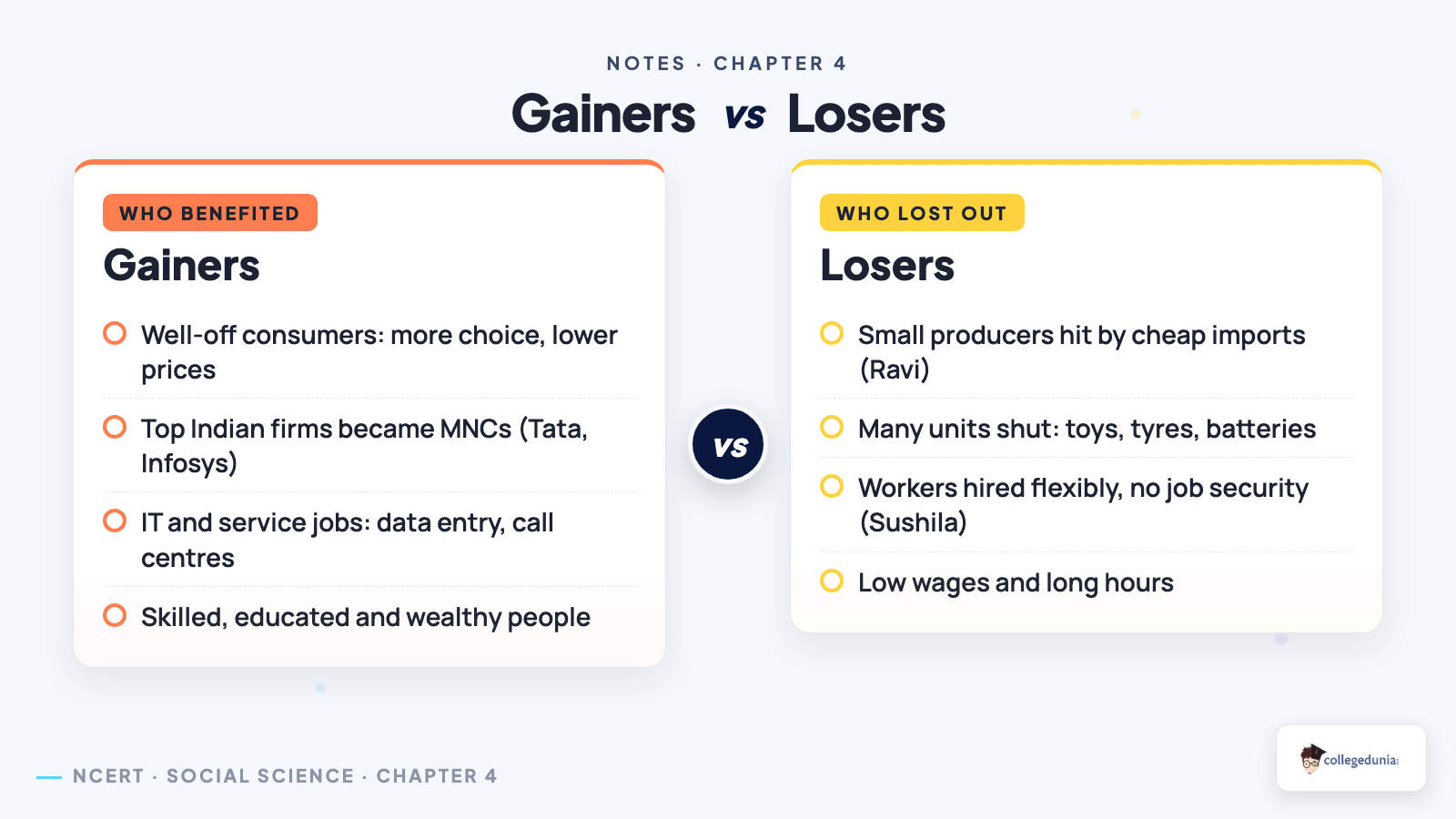
Globalisation has not affected everyone the same way. Sorting winners from losers is the heart of every long-answer question here.
| Group | Effect | Example |
|---|---|---|
| Well-off consumers | Gained: more choice, better quality, lower prices | Cars, cell phones, electronics |
| Top Indian companies | Gained: some grew into MNCs themselves | Tata Motors, Infosys, Asian Paints |
| IT and service firms | Gained: new jobs in data entry, accounting, call centres | Services exported to rich countries |
| Small producers | Lost: cheap imports shut many units down | Ravi's capacitor unit, toys, tyres |
| Ordinary workers | Lost: hired "flexibly", low wages, no security | Sushila the garment worker |
To attract foreign investment, the government set up Special Economic Zones (SEZs) with world-class facilities, a five-year tax holiday, and flexible labour laws, which is why workers like Sushila moved from secure jobs to temporary work.
The Struggle for a Fair Globalisation
Fair globalisation does not mean stopping globalisation; it means spreading its gains more evenly and protecting the vulnerable, through three actors:
- Government: implement labour laws, protect workers, support small producers, and use trade barriers where needed.
- At the WTO: negotiate for fairer rules and align with other developing countries.
- People's organisations: campaigns and representation have already influenced WTO decisions.
Commonly Confused Pairs in the Globalisation Chapter
Four pairs account for most lost marks; the 1-mark MCQs are built on exactly these contrasts:
| Pair | First Term | Second Term |
|---|---|---|
| Trade vs Investment | Foreign trade: goods cross borders | Foreign investment: MNC money buys assets abroad |
| Tax vs Quota | Tax/tariff: raises the price of imports | Quota: limits the quantity of imports |
| Barrier vs Liberalisation | Trade barrier: government puts up a restriction | Liberalisation: government removes it |
| Gainers vs Losers | Consumers, skilled people, big firms | Small producers, ordinary workers |
How to Use the Globalisation Class 10 Notes Page Most Effectively
These notes work best as a three-block revision plan:
- First read: section by section, learning MNCs, the four routes, the definition, and the three enabling factors.
- Second pass: drill the tables and recite the CLImB, S-J-B-O and TLW mnemonics.
- Night before: read the glossary, then attempt last year's PYQ.
Tip: For impact questions, name the examples: Ravi lost his capacitor business to cheap imports, and Sushila moved from a secure job to temporary work.
Related Resources for Class 10 Economics Chapter 4
| Resource | What You Get |
|---|---|
| Globalisation and the Indian Economy Class 10 NCERT Solutions | Step-by-step answers to every NCERT in-text and exercise question |
| Globalisation and the Indian Economy Class 10 Handwritten Notes | Scanned pen-on-paper notes for quick one-shot revision |
| Globalisation and the Indian Economy Class 10 NCERT Book PDF | The original NCERT chapter text for offline reading |
NCERT Notes for Class 10 Economics: All Chapters
| Chapter | Title |
|---|---|
| Chapter 1 | Development Notes |
| Chapter 2 | Sectors of the Indian Economy Notes |
| Chapter 3 | Money and Credit Notes |
| Chapter 5 | Consumer Rights Notes |
Ques. What is globalisation in Class 10 Economics Chapter 4?
Ans. Globalisation is the process of rapid integration or interconnection between countries through greater foreign trade and foreign investment. MNCs are the major force behind it, moving goods, services, investment and technology across borders. It is an ongoing process, not a one-time event.
Ques. What is an MNC and why do MNCs spread production?
Ans. An MNC, or multinational corporation, is a company that owns or controls production in more than one country. MNCs spread production to places that are close to markets, have low-cost labour, assured inputs, and friendly government policies. The CLImB mnemonic captures these four reasons.
Ques. What are the three factors that enabled globalisation?
Ans. The three factors are technology, liberalisation and the WTO. Technology made transport and communication faster and cheaper. Liberalisation, around 1991, removed the government barriers on trade and investment. The WTO pushed countries to free their trade. Remember them with the TLW mnemonic.
Ques. Has globalisation been good for everyone in India?
Ans. No. Well-off consumers, top Indian companies and IT firms gained from more choice, better quality and new jobs. But many small producers lost their businesses to cheap imports, like Ravi's capacitor unit, and workers like Sushila moved to temporary jobs with low wages and no security.
Ques. How can globalisation be made fair?
Ans. Fair globalisation creates opportunities for all and shares benefits better. The government can protect workers and small producers, negotiate fairer rules at the WTO with other developing countries, and people's organisations can campaign for change. Structure a 5-mark answer as Government, WTO and People.
Ques. Are these Class 10 Economics Chapter 4 notes aligned to the 2026-27 syllabus?
Ans. Yes. Every definition, diagram, example and the CBSE previous-year trend table match the latest 2026-27 NCERT textbook and the current CBSE board pattern for Globalisation and the Indian Economy.
Ques. Are these Collegedunia notes free to download?
Ans. Yes. The complete globalisation and the indian economy class 10 notes PDF is free to download from this page, with no signup or paywall.



Comments