




These Class 10 History notes chapter 4 The Age of Industrialisation bring together every term, date and cause-and-effect chain that the CBSE board paper actually tests.
Chapter4TheAgeofIndustrialisationNotes.pdf?page=1&dpi=150)
Chapter4TheAgeofIndustrialisationNotes.pdf?page=2&dpi=150)
Chapter4TheAgeofIndustrialisationNotes.pdf?page=3&dpi=150)
Chapter4TheAgeofIndustrialisationNotes.pdf?page=4&dpi=150)
Chapter4TheAgeofIndustrialisationNotes.pdf?page=5&dpi=150)
Chapter4TheAgeofIndustrialisationNotes.pdf?page=6&dpi=150)
Chapter4TheAgeofIndustrialisationNotes.pdf?page=7&dpi=150)
Chapter4TheAgeofIndustrialisationNotes.pdf?page=8&dpi=150)
Chapter4TheAgeofIndustrialisationNotes.pdf?page=9&dpi=150)
Chapter4TheAgeofIndustrialisationNotes.pdf?page=10&dpi=150)
Chapter4TheAgeofIndustrialisationNotes.pdf?page=11&dpi=150)
Chapter4TheAgeofIndustrialisationNotes.pdf?page=12&dpi=150)
Chapter4TheAgeofIndustrialisationNotes.pdf?page=13&dpi=150)
Chapter4TheAgeofIndustrialisationNotes.pdf?page=14&dpi=150)
Chapter4TheAgeofIndustrialisationNotes.pdf?page=15&dpi=150)
Chapter4TheAgeofIndustrialisationNotes.pdf?page=16&dpi=150)
Chapter4TheAgeofIndustrialisationNotes.pdf?page=17&dpi=150)
Chapter4TheAgeofIndustrialisationNotes.pdf?page=18&dpi=150)
Chapter4TheAgeofIndustrialisationNotes.pdf?page=19&dpi=150)
Chapter4TheAgeofIndustrialisationNotes.pdf?page=20&dpi=150)
Chapter4TheAgeofIndustrialisationNotes.pdf?page=21&dpi=150)
Chapter4TheAgeofIndustrialisationNotes.pdf?page=22&dpi=150)
Chapter4TheAgeofIndustrialisationNotes.pdf?page=23&dpi=150)
The revision notes follow the NCERT textbook India and the Contemporary World II in exact order, from proto-industrialisation in Britain to the survival of handloom weavers in colonial India.
- Carries about 5 to 6 marks in the CBSE Class 10 board paper, from source-based and long-answer questions.
- Covers the key terms: proto-industrialisation, Spinning Jenny, gomastha, fly shuttle and swadeshi in one place.
- Pairs with the NCERT Solutions for The Age of Industrialisation for full answers.
Every fact in these class 10 history notes chapter 4 The Age of Industrialisation is curated by subject experts, checked against the 2026-27 NCERT textbook, and refined using the last five years of CBSE board papers.
What The Age of Industrialisation Is Really About
This chapter overturns the idea that industrialisation was a quick march of factories. Industrial change was slow and uneven, hand labour survived beside steam power, and in colonial India it was shaped and often crushed by colonial rule.
- Britain (first half): proto-industrialisation, the rise of the factory, the slow pace of change, and why hand labour survived.
- India (second half): the decline of Indian textiles, the fate of weavers, the rise of Indian factories, small-scale industry and the new market for goods.
Keeping the two halves clearly separate is the best way to organise a board answer.
The Age of Industrialisation Explained for Class 10 Boards
Source: Magnet Brains on YouTube
Proto-industrialisation: Industry Before the Factory
Before factories, there was already large-scale industrial production for an international market, run from village homes, not mills. Historians call this phase proto-industrialisation.
- Trade guilds controlled production and prices and blocked new producers, so town output could not grow.
- Merchants moved to the countryside, where commons were being enclosed and poor peasants needed extra income.
- Merchants offered advances (money paid in advance); peasants stayed on their plots and added this to shrinking farm earnings.
- At each stage 20 to 25 workers worked for one merchant, so a single clothier could control hundreds.
Work passed through many hands: stapler, spinners, weavers, fullers, then dyers, with finishing in London. Common mistake: proto-industry was not small handicraft but large-scale production for an international market; "proto" means an early form, not a minor one.
The Factory Arrives in Britain
The late eighteenth century saw the factory appear, where machines and workers came together under one roof and one management. The first symbol was cotton.
- In 1760 Britain imported 2.5 million pounds of raw cotton; by 1787 this soared to 22 million pounds.
- Inventions improved carding, twisting, spinning and rolling, letting each worker produce more.
- Richard Arkwright created the cotton mill, where costly machines were bought, set up and supervised under one roof.
The new mills were huge and dramatic, so painters and writers fixed on them and ignored the smaller workshops where much production carried on. That is why historians long told industrialisation as a pure factory story.
The Slow Pace of Industrial Change in Britain
How rapid was industrialisation really? The NCERT gives four answers that puncture the myth of a sudden machine revolution. This is one of the most tested ideas in the chapter.
- Cotton and metals led. Cotton led up to the 1840s; then iron and steel, and by 1873 iron and steel exports were worth about 77 million pounds, double cotton exports.
- New industries could not displace traditional ones. Even by 1900, less than 20 per cent of the workforce was in advanced industry.
- Ordinary sectors grew too: food processing, building, pottery, glass, tanning and furniture.
- Technology spread slowly because new machines were expensive, broke down often and were costly to repair.
Hand Labour and Steam Power: Why Machines Spread Slowly
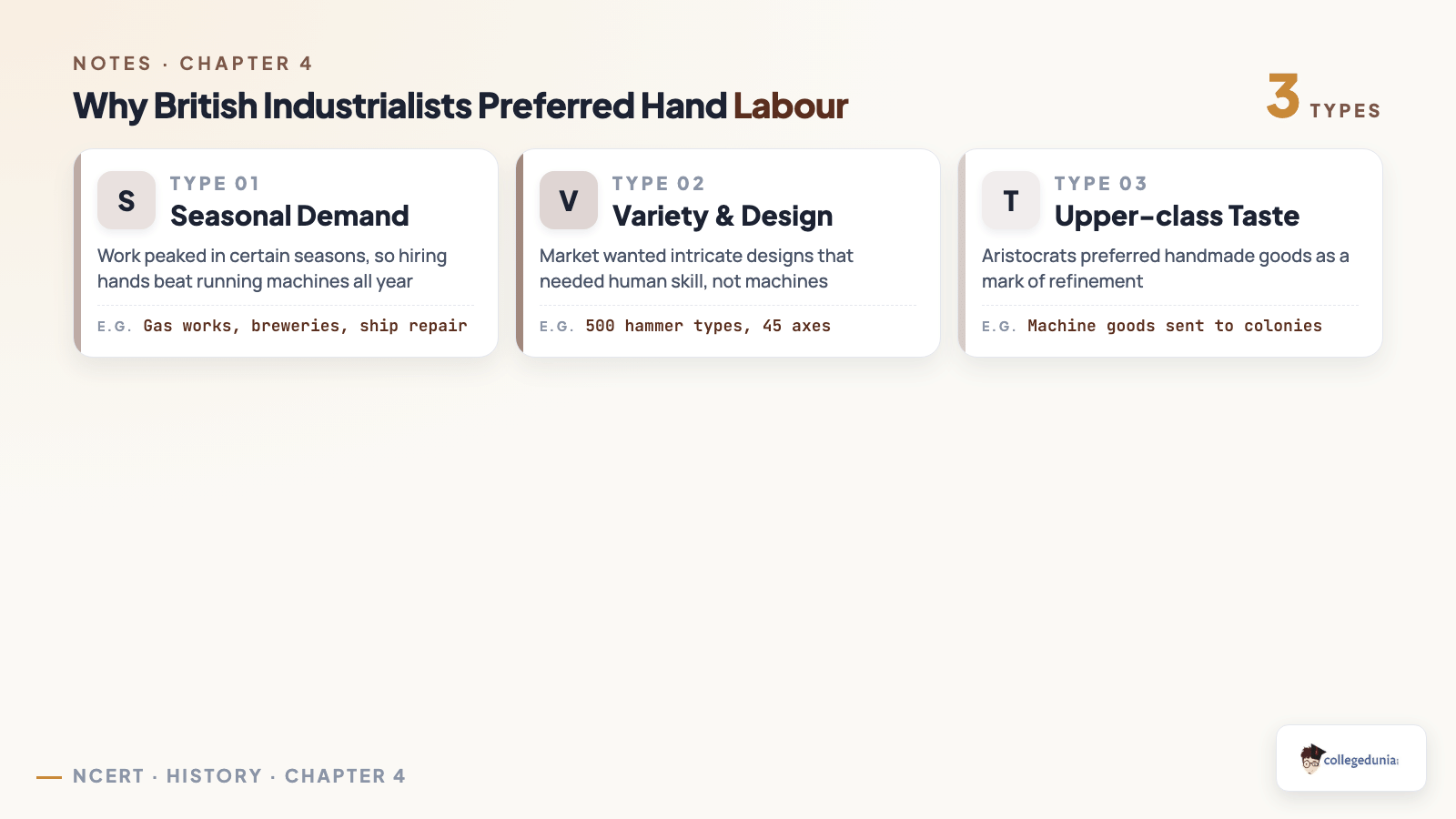
Why did British industrialists keep using hand labour? In Victorian Britain workers were plentiful, so wages were low and there was little reason to spend on machines that replaced cheap labour.
- Seasonal demand: in gas works, breweries, book-binding and ship repair, work peaked in seasons, so hiring hands beat running machines all year.
- Variety and design: the market wanted intricate designs; Britain made 500 varieties of hammers and 45 kinds of axes, needing human skill.
- Upper-class taste: aristocrats preferred handmade goods; machine-made goods went to the colonies.
- The steam engine spread slowly: James Watt patented his engine in 1781, yet by 1800 England had only 321 steam engines.
Of the 321 engines, 80 were in cotton. Workers also feared unemployment: the Spinning Jenny, devised by James Hargreaves in 1764, let one worker turn many spindles, so women who lived by hand spinning attacked it as a threat.
Industrialisation in the Colonies: Indian Textiles and the Weavers
Before machine industries, India was the world's greatest exporter of fine cotton and silk goods. A rich textile trade was first taken over and then crushed under colonial rule.
- Indian textiles travelled the world through ports like Surat, Masulipatam and Hoogly.
- By the 1750s European companies gained power; trade through Surat fell from Rs 16 million to Rs 3 million by the 1740s, while Bombay and Calcutta grew.
- The Company appointed a paid servant, the gomastha, to supervise weavers, collect cloth and check quality.
- Through advances, weavers who took loans had to hand cloth only to the gomastha, losing the freedom to bargain or sell elsewhere.
Gomasthas were outsiders who marched in with sepoys and flogged weavers for delays. Prices were miserably low, so in Carnatic and Bengal many deserted villages or turned to farm labour.
Manchester Comes to India: The Three Blows to the Weaver
By 1800, cotton weavers faced a deadlier problem: cheap machine-made Manchester cloth. In 1772 Company official Henry Patullo had said demand for Indian textiles could never fall. He was proved wrong.
- Export market collapsed: piece-goods fell from 33 per cent of India's exports in 1811-12 to just 3 per cent by 1850-51.
- Local market shrank: cheap Manchester imports glutted India, over 50 per cent of import value by the 1870s.
- Raw-material crisis: in the 1860s the American Civil War cut off US cotton, so Britain bought Indian cotton, prices shot up, and weavers were starved of supplies.
- By the end of the century, Indian factories too flooded the market with machine goods.
Memory aid "Export, Local, Raw". Watch the direction: Indian exports fell, British imports rose. Students often swap the figures or dates in the exam.
Factories Come Up in India: Entrepreneurs and Workers
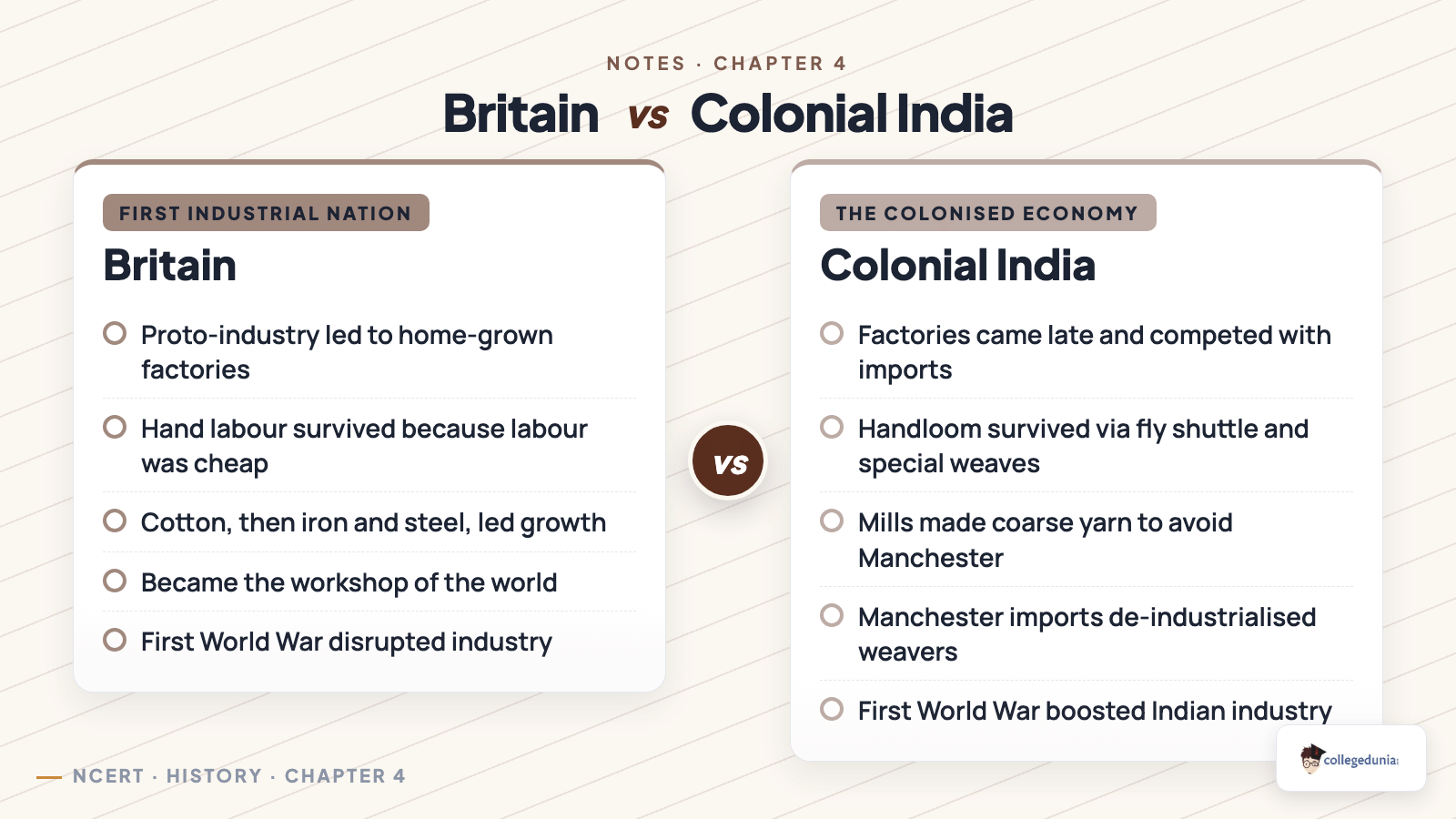
While weavers were ruined, Indian-owned factories rose. The first cotton mill in Bombay came up in 1854, and many early entrepreneurs first made money in trade, often the China trade.
- Dwarkanath Tagore made his fortune in the China trade; in Bombay, Parsis like Dinshaw Petit and Jamsetjee Nusserwanjee Tata built industrial empires.
- Seth Hukumchand, a Marwari, set up the first Indian jute mill in Calcutta in 1917; the Birlas also traded with China.
- European Managing Agencies like Bird Heiglers, Andrew Yule and Jardine Skinner controlled a large sector till the First World War.
- Factory workers rose from 584,000 in 1901 to over 2,436,000 by 1946, recruited through a jobber who could grant or refuse a job.
To avoid clashing with Manchester, early Indian mills made coarse cotton yarn, not cloth. The swadeshi movement and First World War transformed everything: with British mills on war work, Indian factories gained a vast home market.
Small-scale Industries and the Survival of the Handloom
Large factory industries were only a small part of the Indian economy. Only 5 per cent of the industrial labour force worked in registered factories in 1911. The survival of small-scale production is one of the chapter's most tested ideas.
- Cheap machine thread wiped out hand spinning, yet handloom cloth production almost trebled between 1900 and 1940.
- Weavers survived by adopting the fly shuttle, a rope-and-pulley device that let one weaver work a large loom and weave wide cloth.
- Mills could not copy specialised weaves like Banarasi or Baluchari saris.
- Finer cloth was bought by the well-to-do, whose demand survived famines that ruined the market for coarse cloth.
Remember the contrast: machine thread destroyed hand spinning, but handloom weaving survived and grew, thanks to the fly shuttle and special weaves. State both halves for full marks. Yet survival did not mean prosperity.
The Market for Goods: Labels, Calendars and Swadeshi
People must also be persuaded to buy goods. A new consumer culture was built through labels, advertisements, calendars and the message of swadeshi.
- Manchester industrialists put labels reading "MADE IN MANCHESTER" on cloth bundles, marking origin and a promise of quality.
- Labels carried images of Indian gods and goddesses like Krishna and Lakshmi, as if giving divine approval to foreign goods.
- By the late nineteenth century, calendars advertised products even to those who could not read.
- Indian manufacturers used the swadeshi message: if you care for the nation, buy Indian-made products.
Historians read old labels and calendars as evidence of how manufacturers thought and appealed to people. The swadeshi appeal is the ancestor of every modern "buy local" campaign.
Key Dates Timeline for The Age of Industrialisation
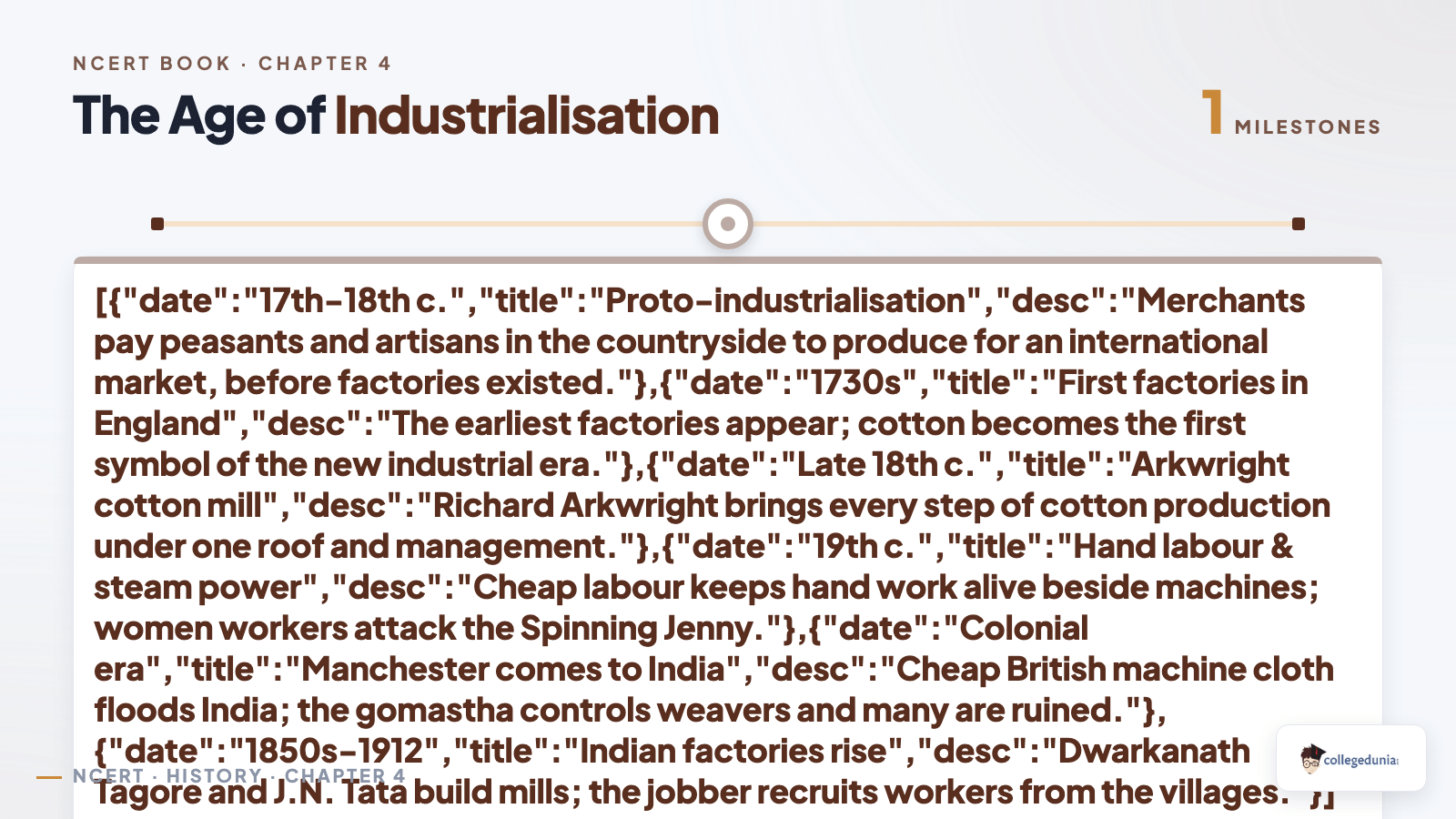
CBSE loves one-mark date questions from this chapter. This timeline puts every must-know year in one place for last-minute revision.
| Year | Event |
|---|---|
| 1760 | Britain imports 2.5 million pounds of raw cotton. |
| 1764 | James Hargreaves devises the Spinning Jenny. |
| 1781 | James Watt patents his improved steam engine. |
| 1811 to 1812 | Indian piece-goods are 33 per cent of exports. |
| 1854 | First cotton mill comes up in Bombay. |
| 1873 | Iron and steel exports worth about 77 million pounds. |
| 1917 | Seth Hukumchand sets up the first Indian jute mill. |
| 1914 to 1918 | The First World War boosts Indian industry. |
Common Mistakes Students Make in The Age of Industrialisation
These notes flag the traps the CBSE examiner sees most often. Most marks are lost not on facts but on small mix-ups.
| Common mistake | The correct idea |
|---|---|
| Saying industrialisation means only factories. | Traditional and small-scale sectors kept growing too. |
| Saying machines spread fast and everywhere. | Less than 20 per cent of the workforce was in advanced industry by 1900. |
| Treating the gomastha as a friendly village merchant. | He was an outsider who used sepoys to flog weavers. |
| Saying Manchester cloth ruined only spinners. | Weavers were hit thrice: export, local market and raw cotton. |
| Saying Indian mills first made fine cloth. | They first made coarse yarn to avoid Manchester. |
| Saying the First World War hurt Indian industry. | It boosted it; Indian mills supplied war goods. |
Student Feedback on This Chapter
In a Collegedunia poll of 11,840 Class 10 students before the 2026 boards, the gomastha system and small-scale industry were rated hardest. 71% of students said the "three blows to the weaver" chain cost them marks until they revised it as a flow.
Source: 2026-27 Class 10 History student poll, 11,840 students across 14 states.
Also See: Other Resources for The Age of Industrialisation
Also Check: the same chapter is available in other formats. Use the table below to jump to the resource you need.
| Resource | Best Used For |
|---|---|
| NCERT Solutions | Model answers to every textbook question. |
| Handwritten Notes | A quick scanned visual recap for last-minute revision. |
| NCERT Book PDF | The full original textbook chapter to read from source. |
All Class 10 History Notes, Chapter by Chapter
Related Links: revise the rest of the syllabus with the Class 10 History notes for every chapter. Each link opens the notes for that chapter.
| Chapter | Notes Link |
|---|---|
| Chapter 1: The Rise of Nationalism in Europe | Rise of Nationalism in Europe Notes |
| Chapter 2: Nationalism in India | Nationalism in India Notes |
| Chapter 3: The Making of a Global World | The Making of a Global World Notes |
| Chapter 4: The Age of Industrialisation | You are here |
| Chapter 5: Print Culture and the Modern World | Print Culture and the Modern World Notes |
| All chapters | Class 10 History Hub |
Ques. What do the class 10 history notes chapter 4 The Age of Industrialisation cover?
Ans. These notes cover proto-industrialisation, the coming of the factory in Britain, the slow pace of industrial change, hand labour and steam power, the decline of Indian textiles under colonial rule, the gomastha system, Manchester imports, the rise of Indian factories, the survival of small-scale industry, and the market for goods, all in NCERT textbook order.
Ques. What is proto-industrialisation?
Ans. Proto-industrialisation was the phase of large-scale industrial production for an international market that existed before the factory. It was based in village homes, not factories. Merchants in towns gave advances to poor peasants in the countryside, who produced goods that passed through many hands, from staplers and spinners to weavers, fullers and dyers.
Ques. Why did hand labour survive in Britain?
Ans. Hand labour survived because labour was cheap and plentiful, so industrialists had no need to spend heavily on machines. Many industries had seasonal demand, the market wanted goods with intricate designs, and the upper classes preferred handmade products. Even by 1900, less than 20 per cent of Britain's workforce was in advanced industry.
Ques. Who was the gomastha and why did weavers oppose him?
Ans. The gomastha was a paid servant of the East India Company who supervised weavers, collected cloth and checked its quality. Weavers opposed him because he was an outsider who acted arrogantly, marched in with sepoys and peons, and flogged weavers for delays. Through the system of advances, weavers lost the freedom to bargain or sell to other buyers.
Ques. What were the three problems that hit Indian weavers?
Ans. Indian weavers were hit by three blows. First, their export market collapsed as piece-goods fell from 33 per cent of exports in 1811-12 to 3 per cent by 1850-51. Second, their local market shrank as cheap Manchester cloth flooded India. Third, a raw cotton crisis followed the American Civil War in the 1860s, when prices shot up.
Ques. How did the handloom survive in India?
Ans. Cheap machine thread wiped out hand spinning, but handloom weaving survived and even grew, almost trebling between 1900 and 1940. Weavers adopted the fly shuttle, a rope-and-pulley device that raised output, and they wove specialised cloth like Banarasi and Baluchari saris that mills could not copy. Survival, however, did not mean prosperity.
Ques. Why did the First World War boost Indian industry?
Ans. During the First World War, British mills were busy with war production, so Manchester imports to India fell sharply. Indian mills suddenly had a vast home market and supplied jute bags, cloth for uniforms, tents, leather boots and saddles. Production boomed, and after the war Manchester never recovered its old position in India.
Ques. How is the Class 10 History chapter 4 notes PDF best used?
Ans. Download the notes PDF for quick revision of the timeline, the key terms and the Britain-versus-India contrast. Then move to the NCERT Solutions for model answers, and use the handwritten notes for a final visual recap. This three-step plan covers concepts and practice together for the 2026-27 boards.
Ques. What is the fly shuttle and why does it matter?
Ans. The fly shuttle is a mechanical device moved by ropes and pulleys that let a single weaver operate a large loom and weave wide cloth. It matters because it raised handloom output cheaply, which is why handloom weaving survived in India even when cheap machine thread had destroyed hand spinning. By 1941 over 35 per cent of handlooms used it.



Comments