




These Class 10 History notes chapter 5 Print Culture and the Modern World bring together every date, named example and cause-and-effect chain that the CBSE board paper actually tests.
Chapter5PrintCultureandtheModernWorldNotes.pdf?page=1&dpi=150)
Chapter5PrintCultureandtheModernWorldNotes.pdf?page=2&dpi=150)
Chapter5PrintCultureandtheModernWorldNotes.pdf?page=3&dpi=150)
Chapter5PrintCultureandtheModernWorldNotes.pdf?page=4&dpi=150)
Chapter5PrintCultureandtheModernWorldNotes.pdf?page=5&dpi=150)
Chapter5PrintCultureandtheModernWorldNotes.pdf?page=6&dpi=150)
Chapter5PrintCultureandtheModernWorldNotes.pdf?page=7&dpi=150)
Chapter5PrintCultureandtheModernWorldNotes.pdf?page=8&dpi=150)
Chapter5PrintCultureandtheModernWorldNotes.pdf?page=9&dpi=150)
Chapter5PrintCultureandtheModernWorldNotes.pdf?page=10&dpi=150)
Chapter5PrintCultureandtheModernWorldNotes.pdf?page=11&dpi=150)
Chapter5PrintCultureandtheModernWorldNotes.pdf?page=12&dpi=150)
Chapter5PrintCultureandtheModernWorldNotes.pdf?page=13&dpi=150)
Chapter5PrintCultureandtheModernWorldNotes.pdf?page=14&dpi=150)
Chapter5PrintCultureandtheModernWorldNotes.pdf?page=15&dpi=150)
Chapter5PrintCultureandtheModernWorldNotes.pdf?page=16&dpi=150)
Chapter5PrintCultureandtheModernWorldNotes.pdf?page=17&dpi=150)
Chapter5PrintCultureandtheModernWorldNotes.pdf?page=18&dpi=150)
Chapter5PrintCultureandtheModernWorldNotes.pdf?page=19&dpi=150)
Chapter5PrintCultureandtheModernWorldNotes.pdf?page=20&dpi=150)
Chapter5PrintCultureandtheModernWorldNotes.pdf?page=21&dpi=150)
Chapter5PrintCultureandtheModernWorldNotes.pdf?page=22&dpi=150)
Chapter5PrintCultureandtheModernWorldNotes.pdf?page=23&dpi=150)
Chapter5PrintCultureandtheModernWorldNotes.pdf?page=24&dpi=150)
Chapter5PrintCultureandtheModernWorldNotes.pdf?page=25&dpi=150)
Chapter5PrintCultureandtheModernWorldNotes.pdf?page=26&dpi=150)
The revision notes follow the NCERT textbook India and the Contemporary World II in exact order, from the first woodblock printing in China to the Vernacular Press Act of 1878 in colonial India.
- Carries about 5 to 6 marks in the CBSE Class 10 board paper, mostly source-based and reason-based questions.
- Covers all key names: Gutenberg, Luther, Menocchio, Mercier, Rammohun Roy and the Vernacular Press Act in one place.
- Pairs with the NCERT Solutions for Print Culture and the Modern World for full answers.
Every fact in these class 10 history notes chapter 5 Print Culture and the Modern World is curated by subject experts, checked against the 2026-27 NCERT textbook, and refined using the last five years of CBSE board papers.
What Print Culture and the Modern World Is Really About
This chapter traces the history of print from East Asia to Europe and then India, asking one question: how did print change reading habits, religion, politics and the idea of the modern world?
- Stage one: hand printing in China, Japan and Korea, many centuries before Europe.
- Stage two: print reaches Europe, Gutenberg builds the press, and the print revolution follows.
- Stage three: print travels to India and becomes a tool for reform, women's reading, nationalism and colonial censorship.
Print was a technology, but its impact was social and political. It created a new reading public and gave dissenting voices a way to spread, frightening those in power.
Print Culture Explained for Class 10 Boards
Source: Digraj Singh Rajput on YouTube
The First Printed Books in East Asia
The earliest print technology was East Asian, not European. China, Japan and Korea developed hand printing centuries before Gutenberg.
- China: from AD 594, books were printed by rubbing paper against inked woodblocks; the imperial state printed exam textbooks in huge numbers.
- Japan: the Diamond Sutra of AD 868 is the oldest printed book, with six sheets of text and woodcut pictures.
- Korea: the Tripitaka Koreana was engraved on about 80,000 woodblocks in the mid-thirteenth century.
- By the seventeenth century, print in China spread to merchants and reading became a leisure activity, including for women.
Do not say print began in Europe: Europe learnt woodblock printing only later, after Marco Polo returned from China.
Print Comes to Europe: Marco Polo to Gutenberg
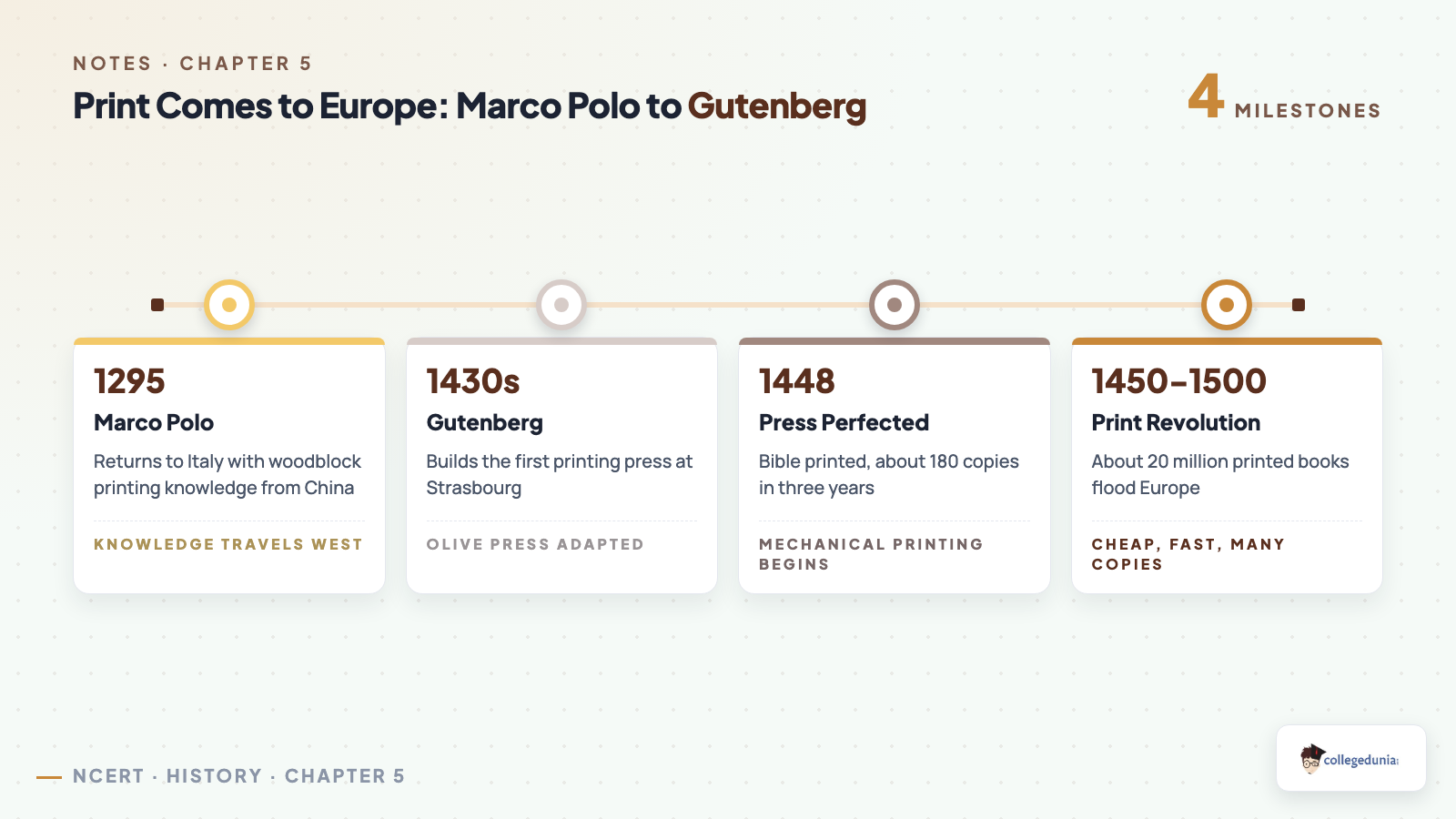
In 1295 Marco Polo returned to Italy with the knowledge of woodblock printing. Demand for books soon outran what hand-copying scribes could supply.
- Handwritten manuscripts were costly, slow and fragile, so a faster method was needed.
- Johann Gutenberg built the first known printing press at Strasbourg in the 1430s, using metal moulds to cast letters.
- By 1448 the press was perfected; the first book printed was the Bible, about 180 copies in three years.
- Between 1450 and 1500, about 20 million printed books flooded Europe.
This shift from hand to mechanical printing is the print revolution. Important: Marco Polo only brought the knowledge from China; the press itself was Gutenberg's later invention.
The Print Revolution and Its Impact
The print revolution changed people's relationship with knowledge and authority. Three effects matter most for the exam:
- A new reading public: a hearing public slowly became a reading public; literacy stayed low, so ballads and folk tales were printed and read aloud.
- Religious debate: in 1517, Martin Luther wrote his Ninety-Five Theses against the Roman Catholic Church, beginning the Protestant Reformation.
- Dissent and fear: Menocchio, an Italian miller, reinterpreted the Bible and was executed by the Inquisition; from 1558 the Church kept an Index of Prohibited Books.
The Church feared print because it spread heresy, while Erasmus feared the flood of cheap books. Censorship is itself proof of print's power.
The Reading Mania and the French Revolution
Through the seventeenth and eighteenth centuries, literacy spread and a reading mania set in. Many historians link this expanding print culture to the French Revolution of 1789.
- By the late eighteenth century, literacy in parts of Europe was as high as 60 to 80 per cent, fed by village schools run by churches.
- New cheap reading appeared: almanacs (ritual calendars), penny chapbooks sold by chapmen in England, and the blue-covered Bibliotheque Bleue in France.
- The novelist Mercier warned, "Tremble, therefore, tyrants of the world!"
- Three reasons print prepared the Revolution (E-D-M): Enlightenment ideas spread, a culture of dialogue and debate grew, and literature mocked the monarchy.
Be careful: print did not directly cause the Revolution; it only opened up the possibility of thinking differently.
The Nineteenth Century: A Wider Reading Public and New Technology
The nineteenth century brought mass literacy, drawing children, women and workers into the reading public, while new technology transformed the press.
- Children: a children's press was set up in France in 1857; the Grimm Brothers published edited folk tales in 1812.
- Women: penny magazines and novels were aimed at women, and Jane Austen, the Bronte sisters and George Eliot defined a new type of woman in fiction.
- Workers: lending libraries educated artisans and white-collar workers, who wrote political tracts and autobiographies.
- Technology: Hoe's power press printed 8,000 sheets an hour, the offset press printed six colours, and during the Great Depression cheap paperbacks appeared.
For the press technology question, remember the sequence Hoe, Offset, Paperback. Each new wave of book buyers created demand for new writing.
India and the World of Print
India already had a rich tradition of handwritten manuscripts, but the press arrived with European missionaries and slowly transformed how ideas spread.
- Indian manuscripts in Sanskrit, Arabic, Persian and vernaculars were costly, fragile and hard to read, so they could not reach a wide public.
- The press first came to Goa with Portuguese missionaries in the mid-sixteenth century; the first Tamil book was printed in 1579 and the first Malayalam book in 1713.
- From 1780, James Augustus Hickey edited the English weekly Bengal Gazette, which annoyed Governor-General Warren Hastings.
- Gangadhar Bhattacharya brought out the first Indian-run newspaper, also called the Bengal Gazette.
Important: two newspapers shared the name Bengal Gazette. Hickey's (1780) was an English weekly with a British editor, while Gangadhar Bhattacharya's was the first Indian-run paper.
Religious Reform and Public Debates in India
From the early nineteenth century, colonial India saw intense debates on religious and social issues, with print as the chief weapon.
- Rammohun Roy published the Sambad Kaumudi from 1821; the Hindu orthodoxy replied with the Samachar Chandrika.
- The Muslim ulama used cheap lithographic presses; the Deoband Seminary (founded 1867) published thousands of fatwas.
- Among Hindus, vernacular religious texts spread: the first printed Ramcharitmanas came out from Calcutta in 1810.
- Newspapers carried news from place to place, slowly building pan-Indian identities and a shared sense of one Indian public.
A tip for the reform debate: Kaumudi for Reform, Chandrika for Conservative. When students in Bombay and Calcutta followed the same printed debates, they began to feel part of one community, which quietly fed the later national movement.
New Forms of Publication: Women, the Poor and Print
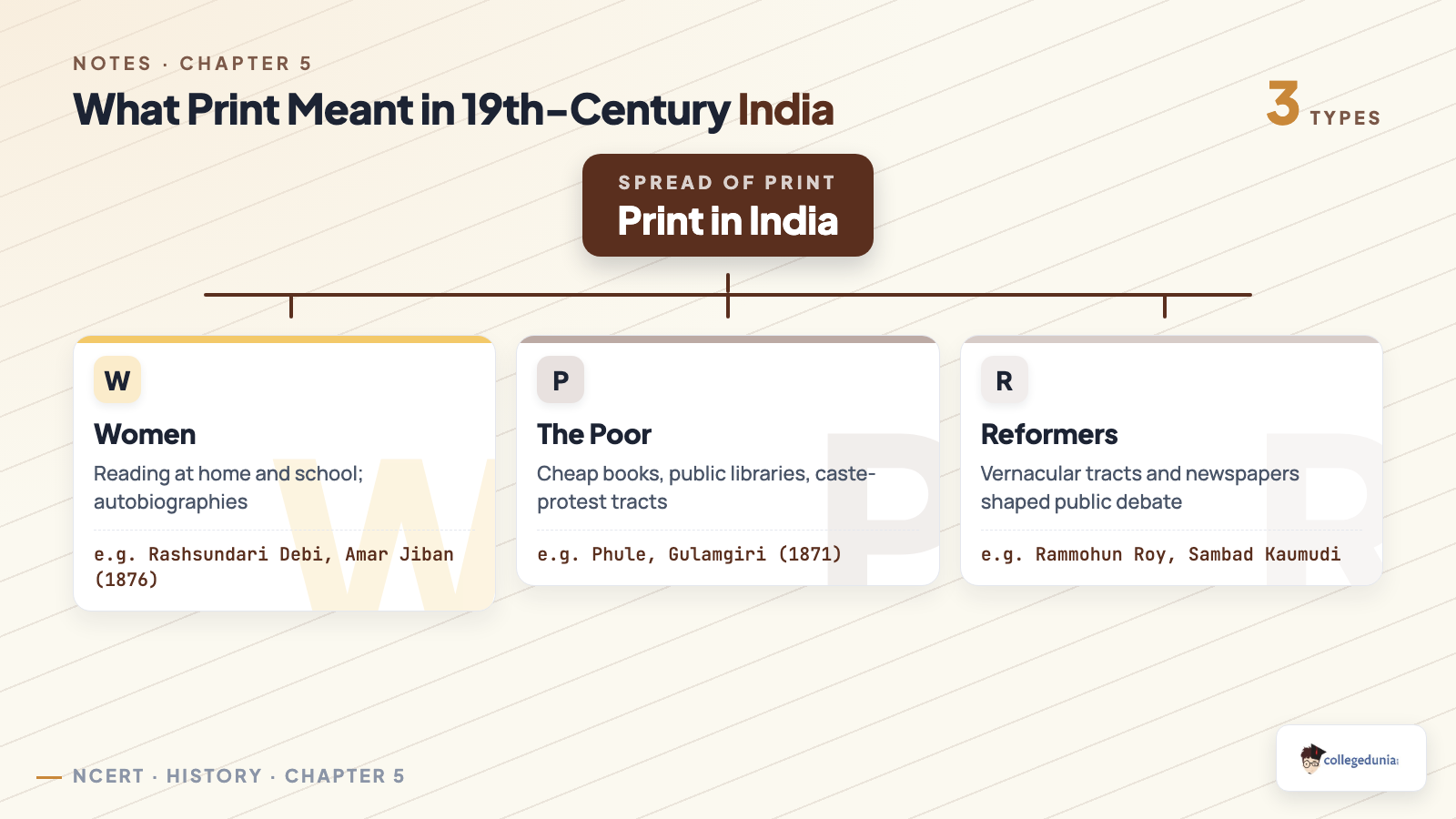
As more people could read, they wanted their own lives reflected in print. New visual forms and a wider reading public, especially women and the poor, reshaped Indian print.
- New forms: the novel, short stories, essays, and the mass-circulation images of painter Raja Ravi Varma; from the 1870s, cartoons commented on politics.
- Women: Rashsundari Debi taught herself to read in secret and wrote Amar Jiban (1876), the first full-length Bengali autobiography; Tarabai Shinde and Pandita Ramabai wrote on widows.
- The poor: cheap books sold at crossroads, public libraries opened, and caste-reform writers Jyotiba Phule (Gulamgiri, 1871), Ambedkar and Periyar reached people all over India.
A favourite 5-mark board question asks what print meant to women, the poor and reformers. Remember the caste-reform trio as Phule, Ambedkar, Periyar. Conservatives feared a literate girl would be widowed, yet women like Rashsundari Debi defied them.
Print and Censorship in Colonial India
In colonial India, the state's attitude to press freedom hardened sharply after the Revolt of 1857, leading to the Vernacular Press Act and a clash with rising nationalism.
- Before 1798, the Company's early controls were aimed at Englishmen in India who criticised Company misrule.
- After the Revolt of 1857, attitudes changed completely, and Englishmen demanded a clamp-down on the "native" press.
- In 1878, the Vernacular Press Act was passed, modelled on the Irish Press Laws, giving the government wide powers to censor.
- If a report was judged seditious, the press was first warned, then seized, and its machinery confiscated.
Remember the punishment chain as Warn, Seize, Confiscate. Despite repression, nationalist papers grew; when Tilak wrote sympathetically in his Kesari, he was imprisoned in 1908. Get the date right: the Vernacular Press Act is 1878, after the 1857 Revolt.
Key Dates Timeline for Print Culture and the Modern World
CBSE loves one-mark date questions from this chapter. This timeline puts every must-know year in one place for last-minute revision.
| Year | Event |
|---|---|
| AD 594 | Woodblock printing begins in China. |
| AD 868 | Diamond Sutra printed in Japan, the oldest printed book. |
| 1295 | Marco Polo returns to Italy with woodblock knowledge. |
| 1448 | Gutenberg press perfected; the Bible is printed. |
| 1517 | Luther's Ninety-Five Theses; the Reformation begins. |
| 1780 | Hickey's Bengal Gazette, the first in colonial India. |
| 1821 | Rammohun Roy publishes the Sambad Kaumudi. |
| 1878 | Vernacular Press Act passed against the native press. |
Common Mistakes Students Make in Print Culture and the Modern World
These notes flag the traps the CBSE examiner sees most often. Most marks are lost not on facts but on small mix-ups.
| Common mistake | The correct idea |
|---|---|
| Saying print began in Europe. | It began in East Asia; Europe learnt it later via Marco Polo. |
| Crediting Marco Polo with inventing the press. | He only brought woodblock knowledge in 1295; Gutenberg built the press. |
| Saying print directly caused the French Revolution. | It only opened up the possibility of thinking differently. |
| Confusing the two Bengal Gazettes. | Hickey's was English; Gangadhar Bhattacharya's was Indian-run. |
| Placing the Vernacular Press Act before 1857. | It was passed in 1878, after the Revolt. |
| Mixing the Church's fear with Erasmus's fear. | Church feared heresy; Erasmus feared the flood of cheap books. |
Student Feedback on This Chapter
In a Collegedunia poll of 11,840 Class 10 students conducted before the 2026 boards, the religious reform debates in India and the censorship dates were rated the hardest part of the chapter. 66% of students said the two Bengal Gazette mix-up cost them marks in practice tests.
The most-skipped sub-topic was the "what print meant to women, the poor and reformers" answer, skipped by about 1 in 4 students until they used a grouped cause-and-effect map like the one in these notes.
Source: 2026-27 Class 10 History student poll. Sample of 11,840 students from CBSE schools across 14 states.
PDF Download and Quick Summary of Print Culture and the Modern World
The Print Culture and the Modern World class 10 notes PDF is built for fast revision. The summary below captures the whole chapter in one glance.
- Print began as hand printing in East Asia (China AD 594, Japan's Diamond Sutra AD 868, Korea's Tripitaka).
- Gutenberg's press (perfected 1448) started the print revolution and a new reading public in Europe.
- Print fuelled the Reformation (Luther, 1517), dissent (Menocchio) and the climate of the French Revolution.
- In India, print drove religious reform (Rammohun Roy), women's and the poor's reading, and the spread of nationalism.
- The colonial state hit back with censorship and the Vernacular Press Act of 1878.
Every one of these points is covered in the PDF, with dates, names and key terms ready to memorise.
Also See: Other Resources for Print Culture and the Modern World
Also Check: the same chapter is available in other formats. Use the table below to jump to the resource you need.
| Resource | Best Used For |
|---|---|
| NCERT Solutions | Model answers to every textbook question. |
| Handwritten Notes | A quick scanned visual recap for last-minute revision. |
| NCERT Book PDF | The full original textbook chapter to read from source. |
All Class 10 History Notes, Chapter by Chapter
Related Links: revise the rest of the syllabus with the Class 10 History notes for every chapter. Each link opens the notes for that chapter.
| Chapter | Notes Link |
|---|---|
| Chapter 1: The Rise of Nationalism in Europe | Rise of Nationalism in Europe Notes |
| Chapter 2: Nationalism in India | Nationalism in India Notes |
| Chapter 3: The Making of a Global World | The Making of a Global World Notes |
| Chapter 4: The Age of Industrialisation | The Age of Industrialisation Notes |
| Chapter 5: Print Culture and the Modern World | You are here |
| All chapters | Class 10 History Hub |
Ques. What do the class 10 history notes chapter 5 Print Culture and the Modern World cover?
Ans. These notes cover the first printed books in East Asia, the arrival of print in Europe and Gutenberg's press, the print revolution and the Reformation, the reading mania and the French Revolution, the nineteenth-century new reading public and technology, print in India, religious reform and public debates, new forms of publication for women and the poor, and print and censorship, all in NCERT textbook order.
Ques. Where did the earliest print technology develop?
Ans. The earliest print technology developed in East Asia, not Europe. China printed books by rubbing paper on inked woodblocks from AD 594. Japan produced the oldest printed book, the Diamond Sutra, in AD 868, and Korea engraved the Tripitaka Koreana on about 80,000 woodblocks. Europe learnt woodblock printing much later, after Marco Polo returned from China in 1295.
Ques. Who invented the printing press and when?
Ans. Johann Gutenberg built the first known printing press at Strasbourg in Germany in the 1430s, perfecting it by 1448. He adapted the olive press and used metal moulds to cast letters. The first book he printed was the Bible, about 180 copies in three years. This shift from hand printing to mechanical printing started the print revolution in Europe.
Ques. How did print help the Protestant Reformation?
Ans. In 1517, Martin Luther wrote his Ninety-Five Theses criticising the Roman Catholic Church, and a printed copy was posted on a church door in Wittenberg. Printed copies spread quickly and widely, leading to a split in the Church and the start of the Protestant Reformation. Luther even called printing the ultimate gift of God because it carried his ideas to thousands.
Ques. Why do historians link print culture to the French Revolution?
Ans. Historians give three arguments. First, print spread Enlightenment ideas that attacked tradition and despotic power. Second, it created a culture of dialogue and debate in which old values were questioned. Third, by the 1780s literature and cartoons mocked the monarchy. But print did not directly cause the Revolution; it only opened up the possibility of people thinking differently.
Ques. How did print come to India?
Ans. The printing press first came to Goa with Portuguese missionaries in the mid-sixteenth century. The first Tamil book was printed in 1579 and the first Malayalam book in 1713. The English press grew late: from 1780 James Augustus Hickey edited the Bengal Gazette. Indians soon began their own papers, the first Indian-run Bengal Gazette being brought out by Gangadhar Bhattacharya.
Ques. What did the spread of print mean for women and the poor in India?
Ans. Print widened reading for women and the poor. Women like Rashsundari Debi taught themselves to read and wrote autobiographies such as Amar Jiban in 1876. Cheap books sold at crossroads and public libraries reached the poor, while caste-reform writers like Jyotiba Phule, Ambedkar and Periyar published works read across India. Print gave new voices a way to be heard.
Ques. What was the Vernacular Press Act of 1878?
Ans. The Vernacular Press Act of 1878 was a colonial censorship law modelled on the Irish Press Laws. Passed after the Revolt of 1857, it gave the government wide powers to censor the vernacular press. If a report was judged seditious, the paper was first warned, then the press was seized and its machinery confiscated. Despite it, nationalist newspapers kept growing.
Ques. How is the Class 10 History chapter 5 notes PDF best used?
Ans. Download the notes PDF for quick revision of the timeline, the named examples and the key terms. Then move to the NCERT Solutions for model answers, and use the handwritten notes for a final visual recap. This three-step plan covers concepts and practice together for the 2026-27 boards.



Comments