




These classification of elements and periodicity in properties class 11 notes pull the whole periodic table, its blocks, and every periodic trend the CBSE Boards, JEE Main, JEE Advanced, NEET and CUET papers test into one place for 2026-27. Revise the genesis of classification, the modern periodic law, and each trend fast, without opening the textbook.
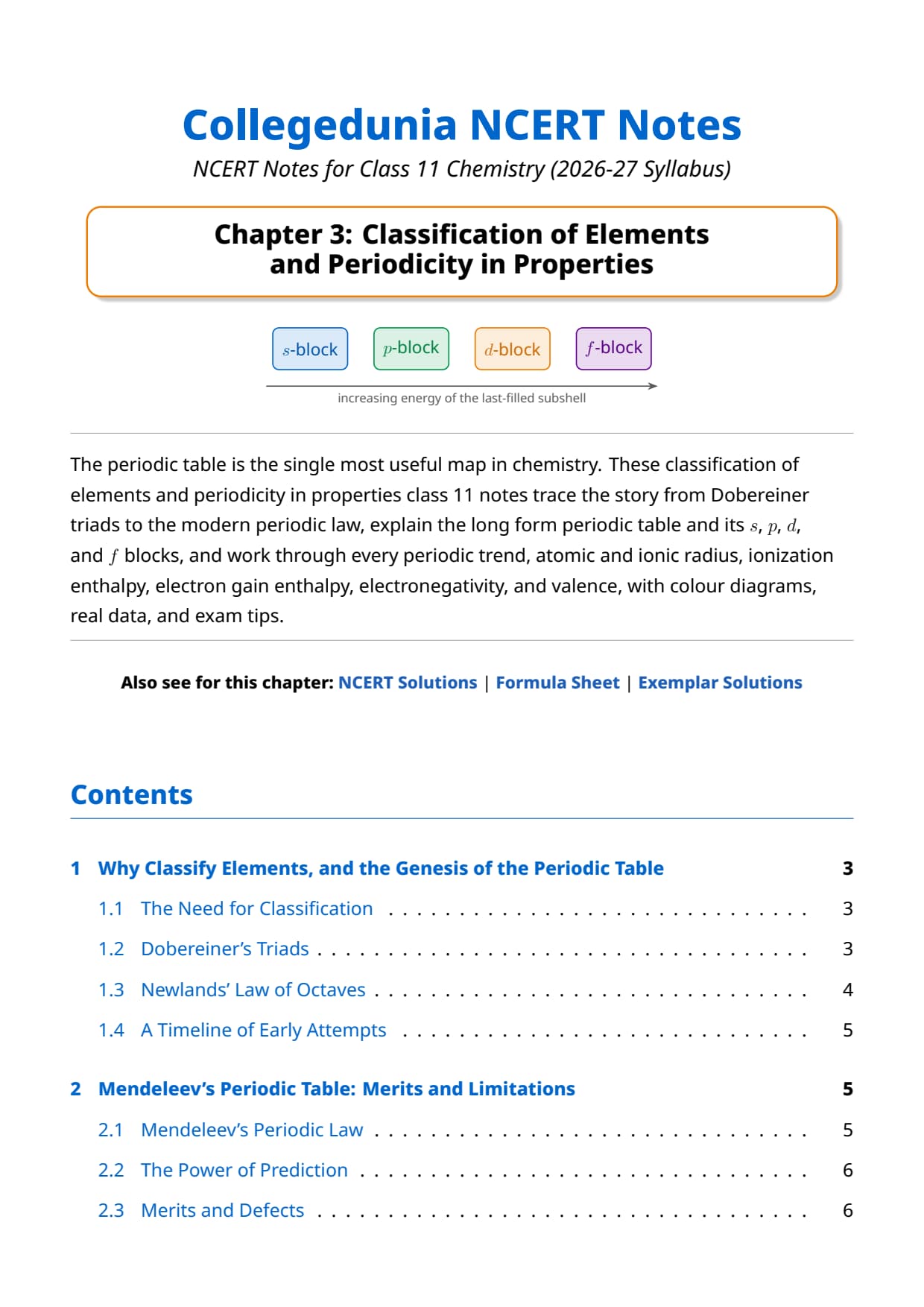
This chapter is the map of chemistry. Once you can read a position in the periodic table, you can predict an element's size, reactivity, and valence.
- CBSE Weightage: 6 to 7 marks, usually one trend-based short answer plus one reasoning question.
- Topics covered: genesis of classification, Mendeleev and the modern periodic law, the long form table, s, p, d and f blocks, and periodic trends.
- Key trends: atomic and ionic radius, ionization enthalpy, electron gain enthalpy, electronegativity, and valence.
These classification of elements and periodicity in properties class 11 notes are curated by subject experts, based on the 2026-27 NCERT textbook, and checked against the last five years of CBSE Board, JEE Main and NEET papers.
Topic-by-Topic Summary of Classification of Elements and Periodicity in Properties
The chapter moves from history to structure to trends. It first shows why chemists needed a table, then fixes the modern law and the shape of the long form table, and finally explains how properties repeat down a group and across a period. Here is the quick map of what each topic gives you.
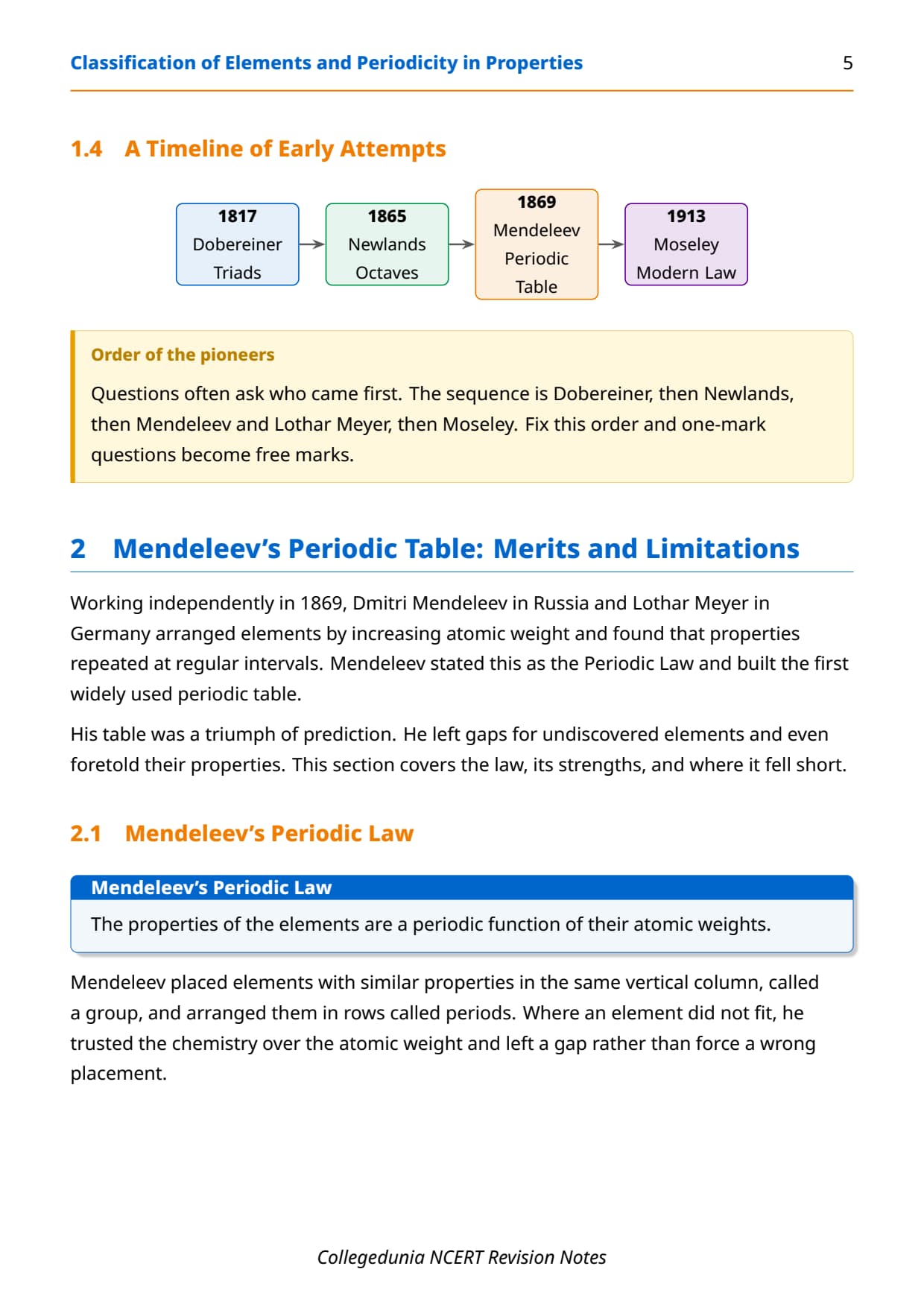
- Genesis of classification: early attempts, from Dobereiner's triads to Newlands' octaves, that led to a working table.
- Mendeleev and the modern periodic law: the shift from atomic mass to atomic number as the basis of order.
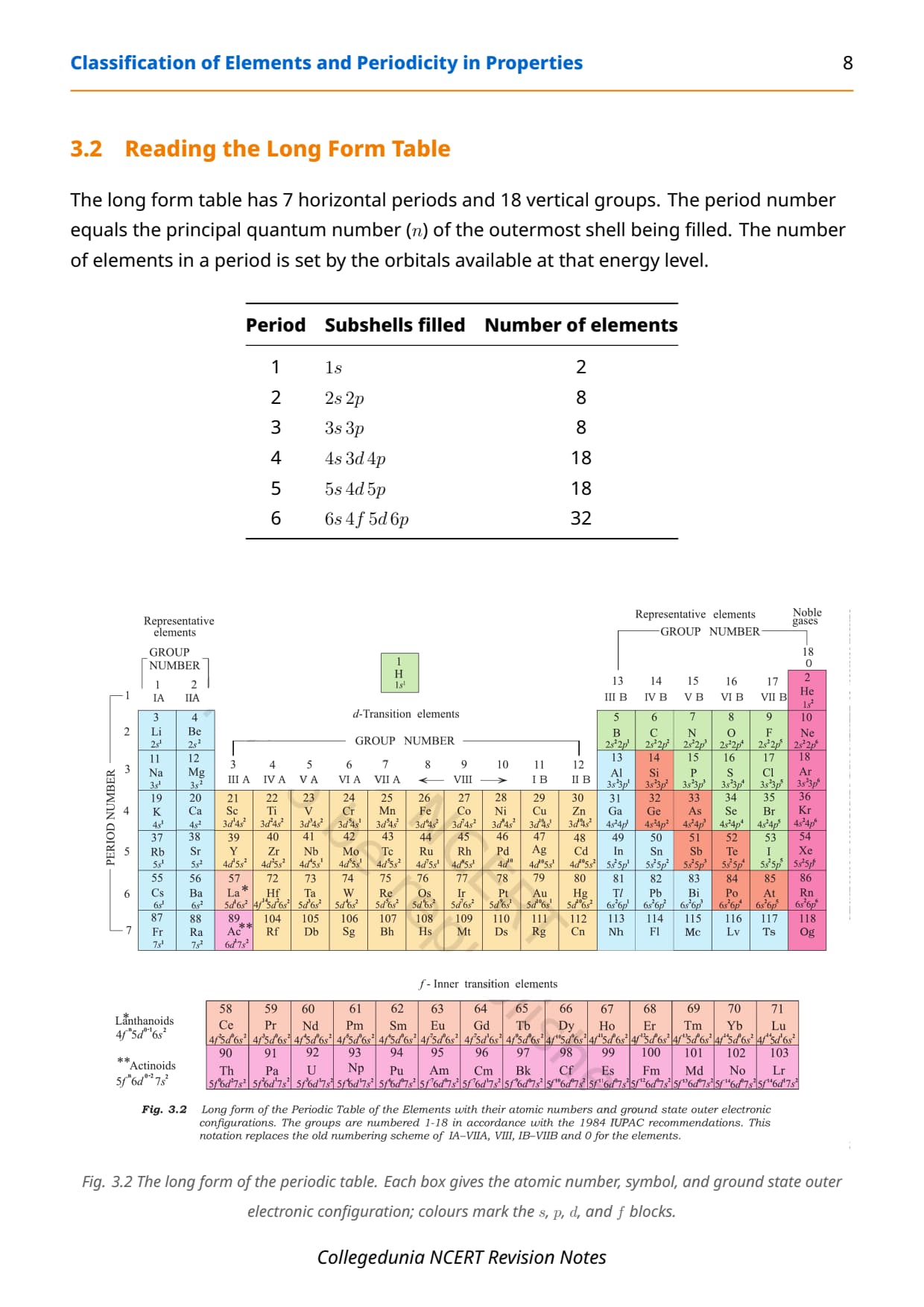
- Long form periodic table: 7 periods and 18 groups arranged by electronic configuration.
- s, p, d and f blocks: the four regions set by the sub-shell that fills last.
- Electronic configuration: how the period number and group decide an element's outer shell.
- Periodic trends: atomic and ionic radius, ionization enthalpy, electron gain enthalpy, electronegativity, and valence.
Revise the topics in this order, because each one uses the one before it. Learn the block structure first, and every periodic trend becomes a simple left-right or top-bottom rule. These classification of elements and periodicity in properties class 11 notes follow the same sequence as the NCERT textbook.
Genesis of Classification and the Modern Periodic Law
Chemists tried to group elements long before the table took its present shape. Early schemes matched similar elements by mass, and each one moved the idea a little closer. Mendeleev's table was the breakthrough, and a later correction fixed its base.
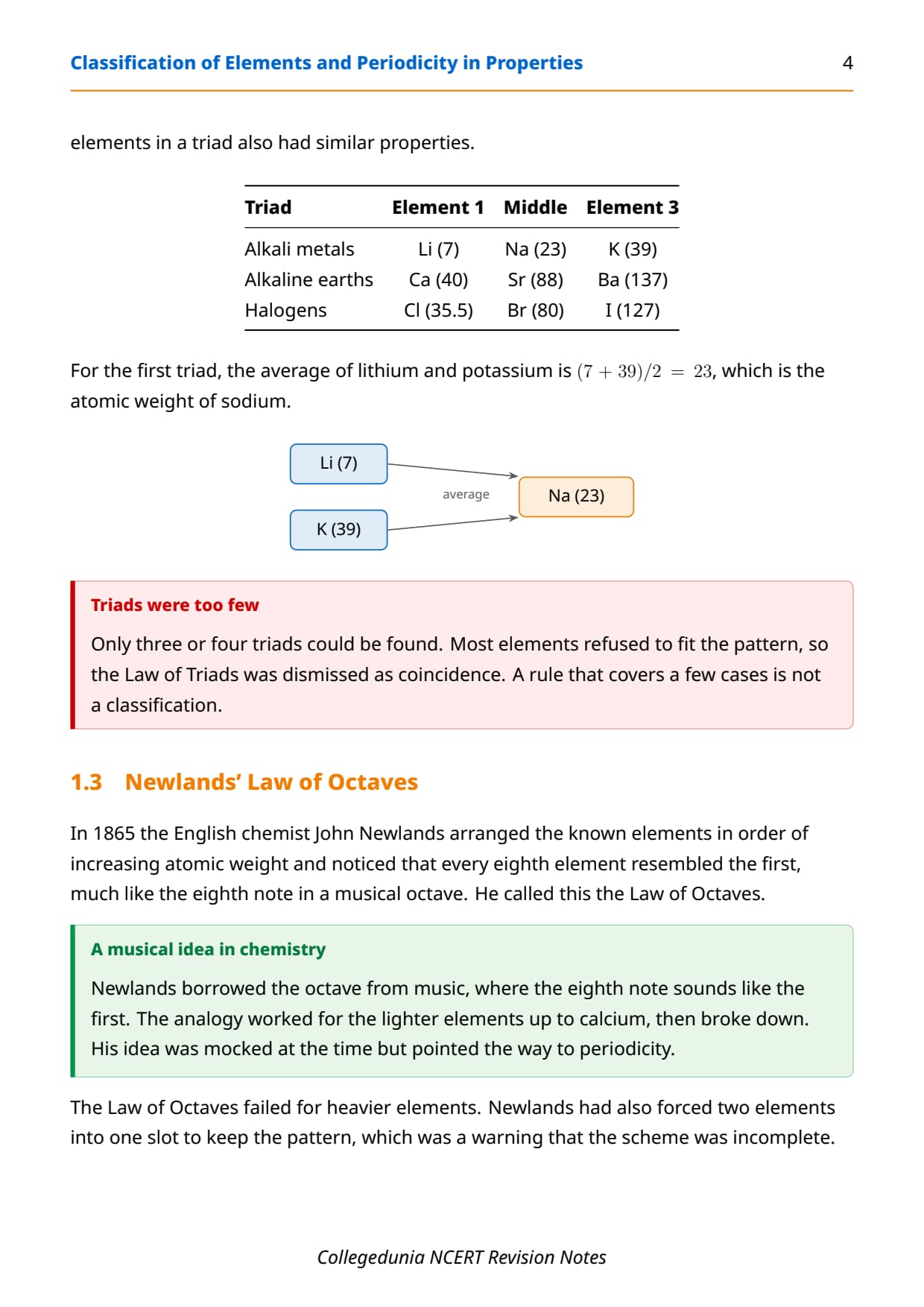
- Dobereiner's triads: groups of three where the middle element's atomic mass is close to the average of the other two.
- Newlands' law of octaves: every eighth element repeats properties, like notes in music, but this failed after calcium.
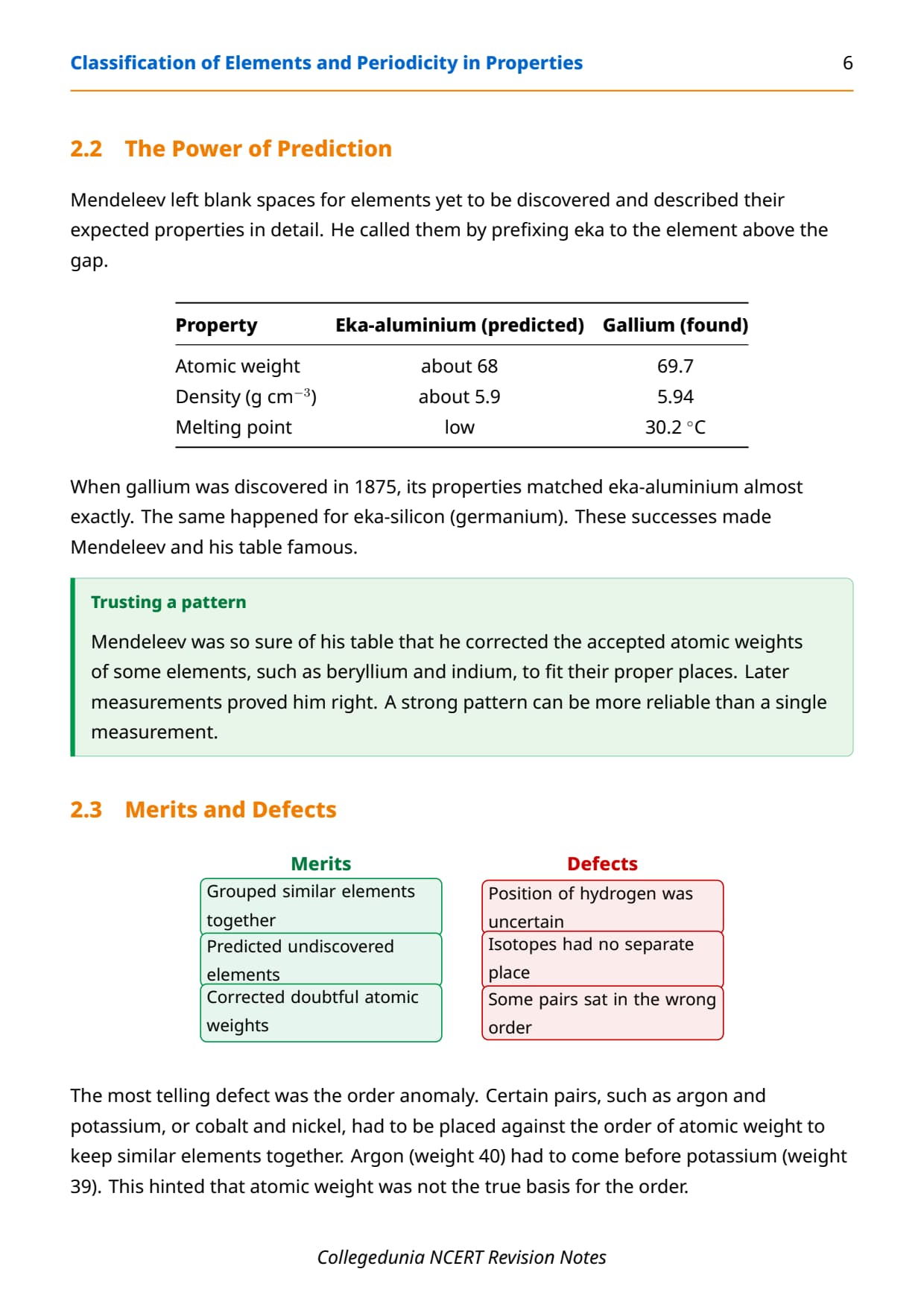
- Mendeleev's periodic table: elements arranged by increasing atomic mass, with gaps left for undiscovered elements like eka-silicon (germanium).
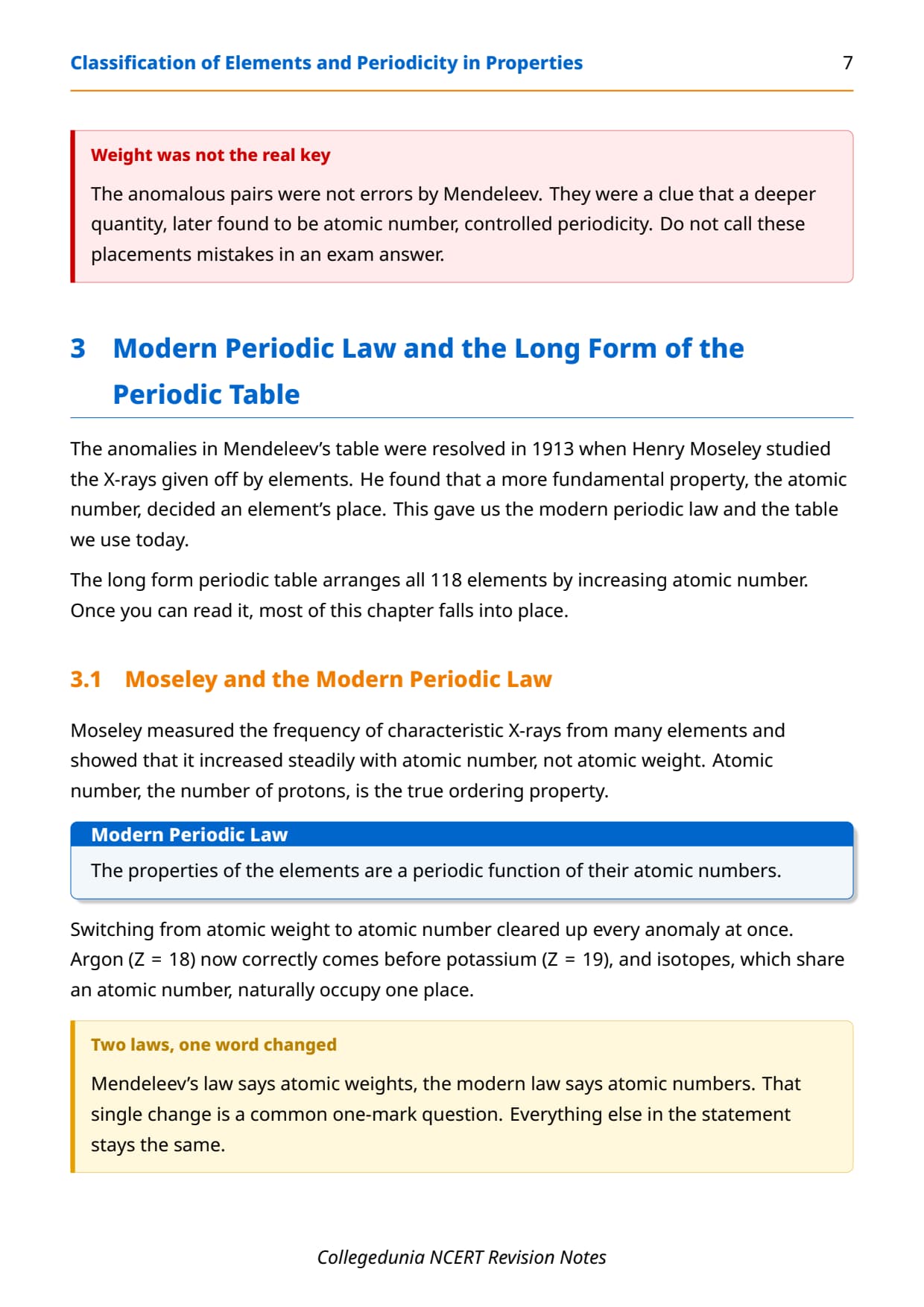
- Modern periodic law: the properties of elements are a periodic function of their atomic numbers.
Mendeleev's periodic law first stated that properties are a periodic function of atomic mass. This left problems, such as the position of argon and potassium, where the mass order and the property order disagreed. Moseley's work on X-rays showed that atomic number, not atomic mass, is the true basis of periodicity. That single change gave the modern periodic law and removed every anomaly of the older table.
Long Form Periodic Table and the s, p, d, f Blocks
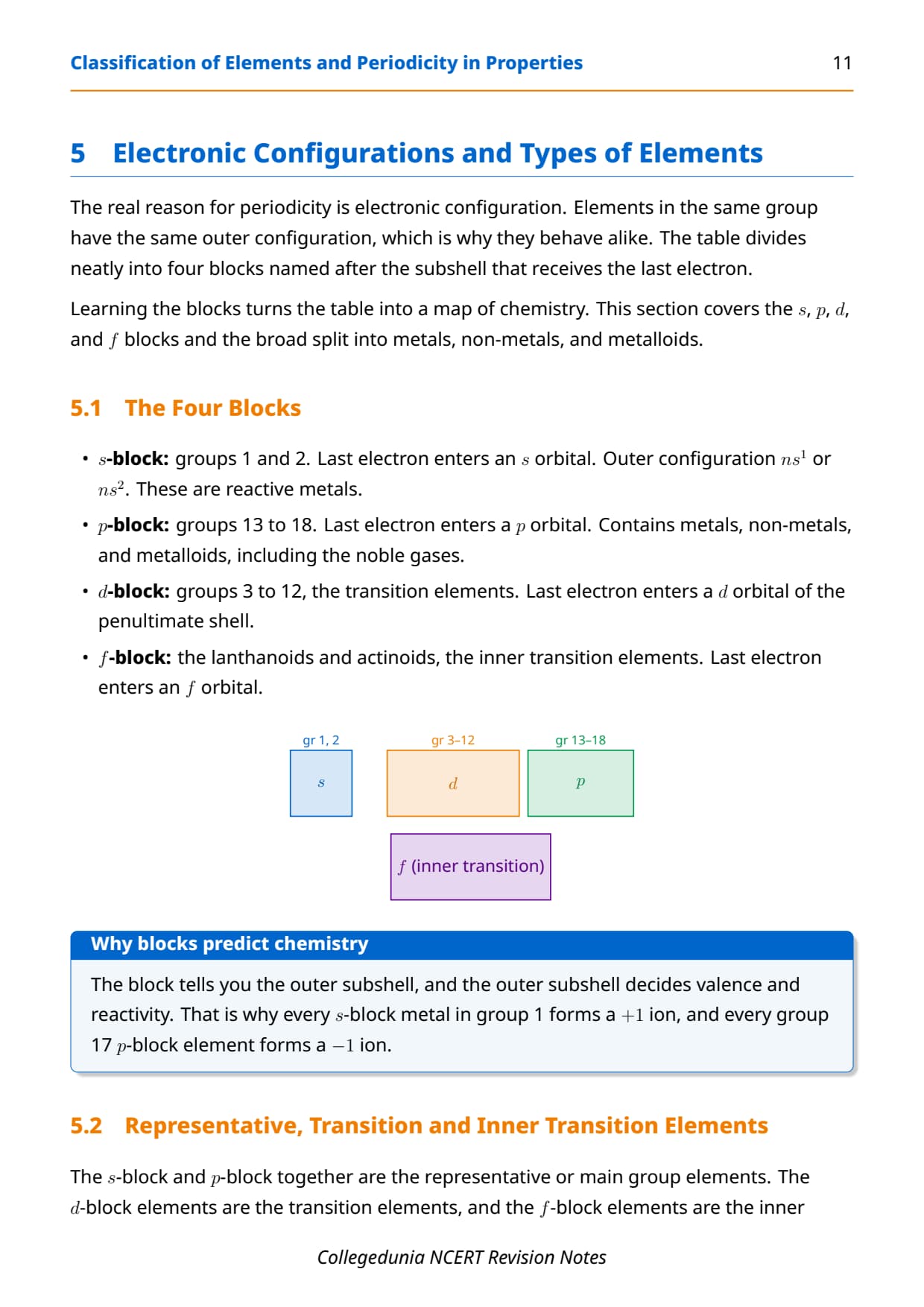
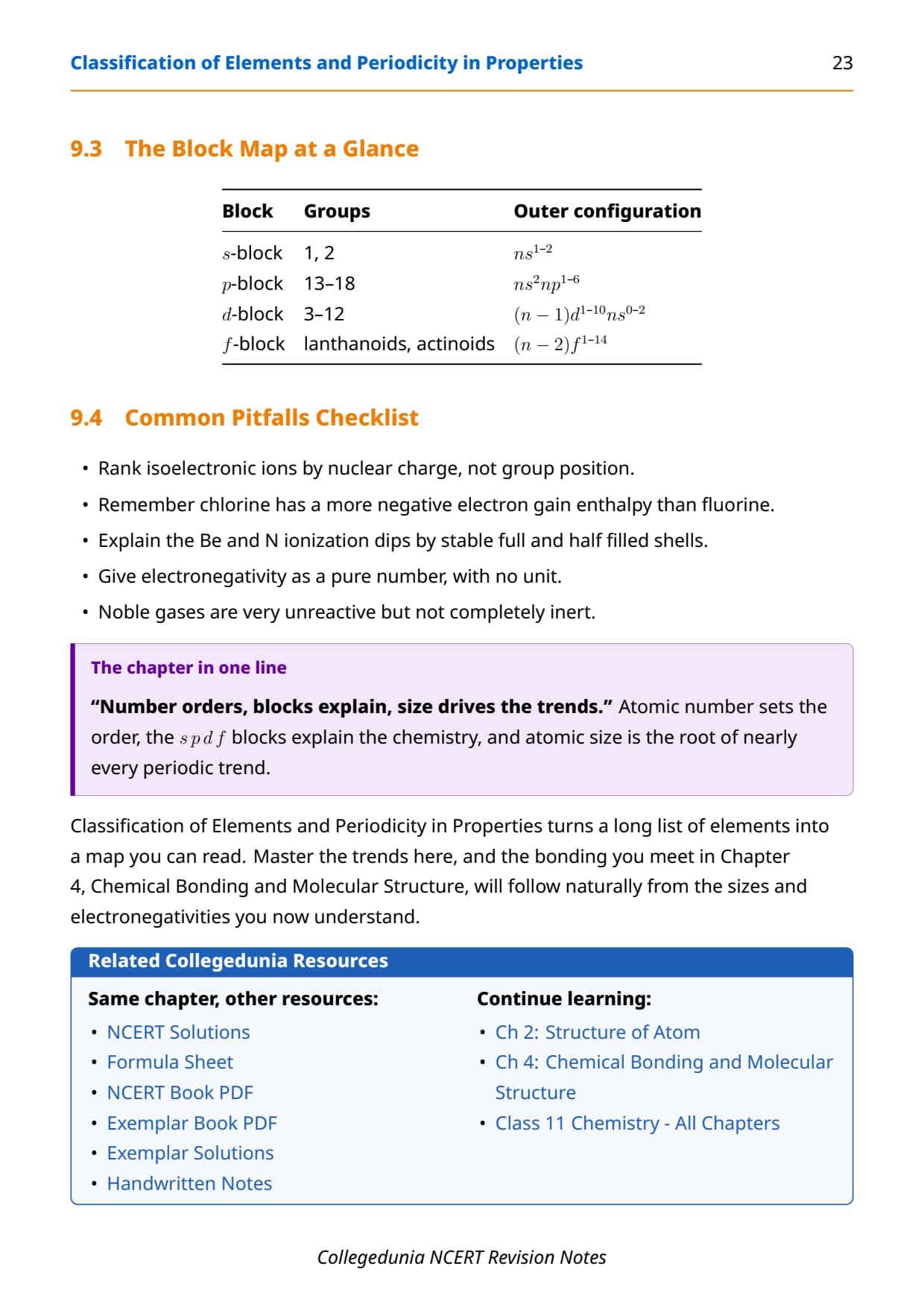
The modern long form table arranges all elements by increasing atomic number into 7 periods and 18 groups. Elements are then split into four blocks, named for the sub-shell that receives the last electron. The block tells you the chemistry of the element at a glance.
| Block | Outer configuration | Which elements |
|---|---|---|
| s-block | ns1 to ns2 | Groups 1 and 2, the alkali and alkaline earth metals |
| p-block | ns2 np1 to ns2 np6 | Groups 13 to 18, including the noble gases |
| d-block | (n-1)d1-10 ns0-2 | Groups 3 to 12, the transition metals |
| f-block | (n-2)f1-14 | Lanthanoids and actinoids, the inner transition metals |
The s and p blocks together make the representative or main group elements. The d block sits between them as the transition series, and the f block is placed separately at the foot of the table. Noble gases end each period with a stable ns2 np6 shell, except helium, which is 1s2 yet still sits in group 18 for its inert behaviour.
Electronic Configuration, Periods and Groups
The position of an element in the table is set entirely by its electronic configuration. The period number tells you the highest principal quantum number, and the group tells you the number of valence electrons. This link is the reason the table predicts properties so well.
- Period number: equal to the highest value of the principal quantum number n in the atom.
- Number of elements per period: fixed by the sub-shells that fill, so 2, 8, 8, 18, 18 and 32.
- Group of s-block: equal to the number of valence electrons, so 1 or 2.
- Group of p-block: equal to 10 plus the number of valence electrons.
For example, sodium is 1s2 2s2 2p6 3s1, so n is 3 and it sits in period 3, group 1. Elements in the same group have the same outer-shell configuration, which is why they show similar chemistry. Reading a configuration straight into a table position is a skill these classification of elements and periodicity in properties class 11 notes drill hard, since it decides half the marks in the chapter.
Periodic Trends: Radius, Ionization Enthalpy, Electron Gain Enthalpy and Electronegativity
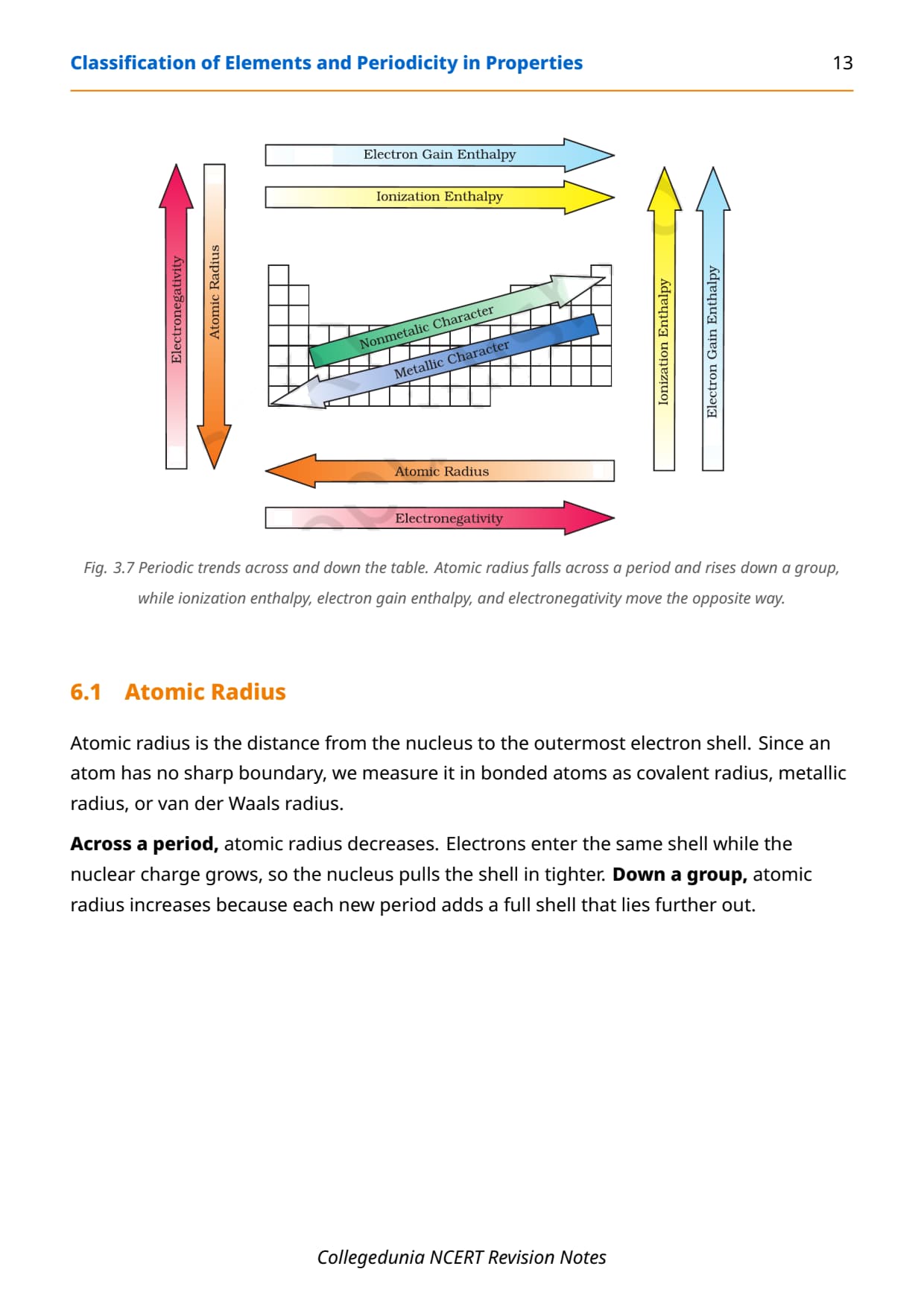
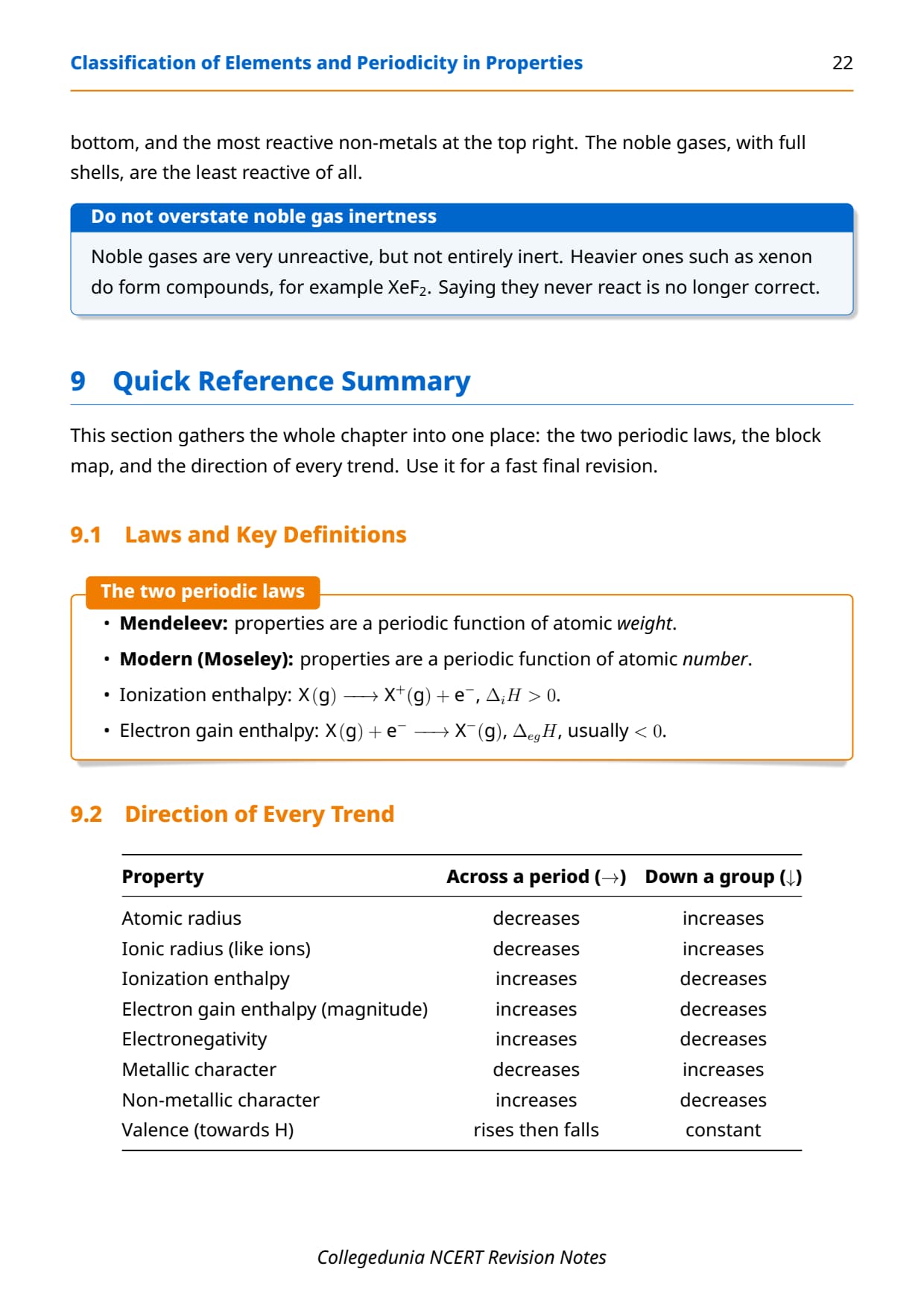
Once the table is in place, the properties of elements change in clear patterns. These periodic trends are the heart of the chapter and the source of almost every reasoning question. Each trend follows from two forces: nuclear charge, which pulls electrons in, and shielding, which pushes the effect down.
| Property | Across a period (left to right) | Down a group |
|---|---|---|
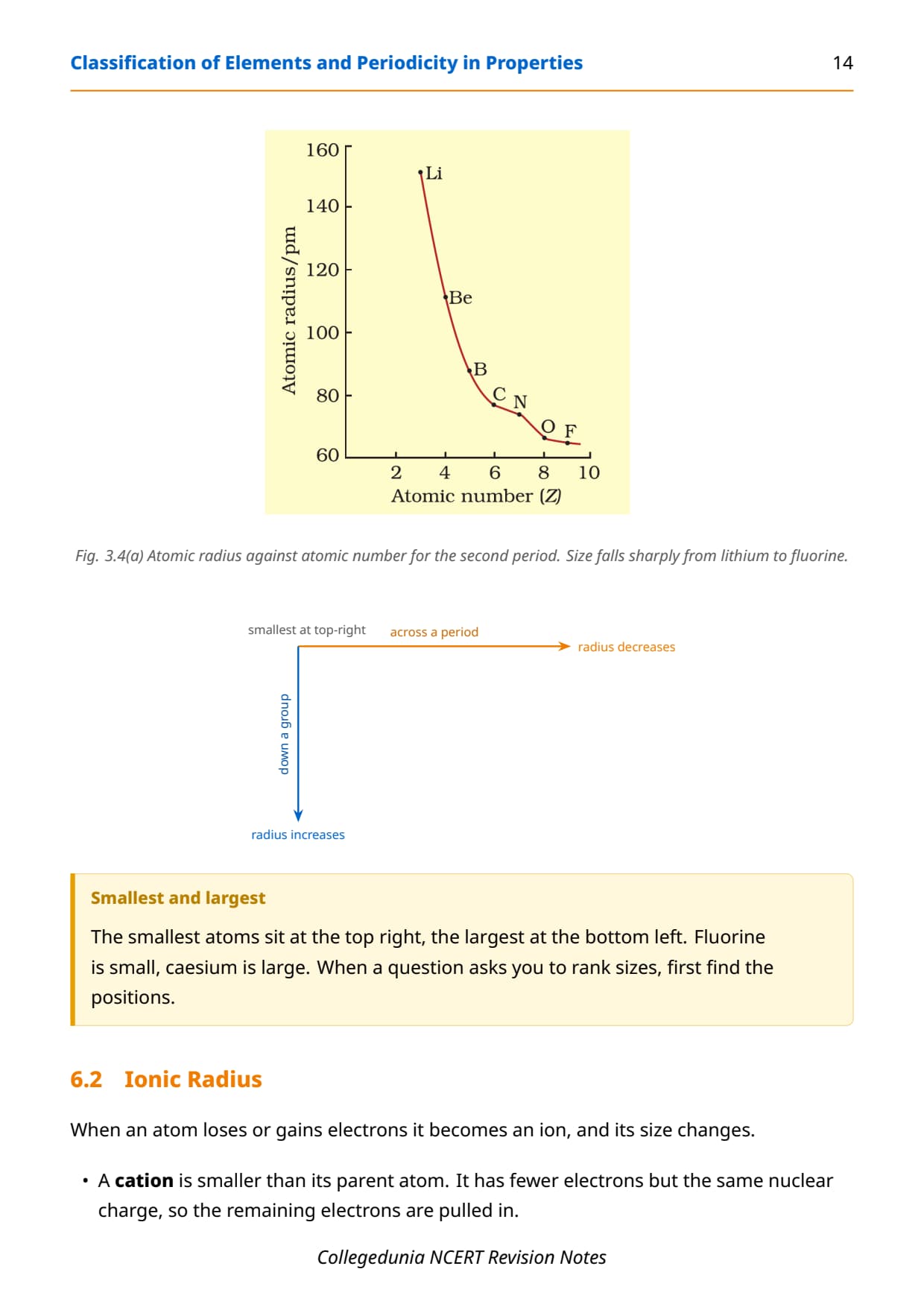
| Atomic radius | Decreases, as nuclear charge rises | Increases, as a new shell is added |
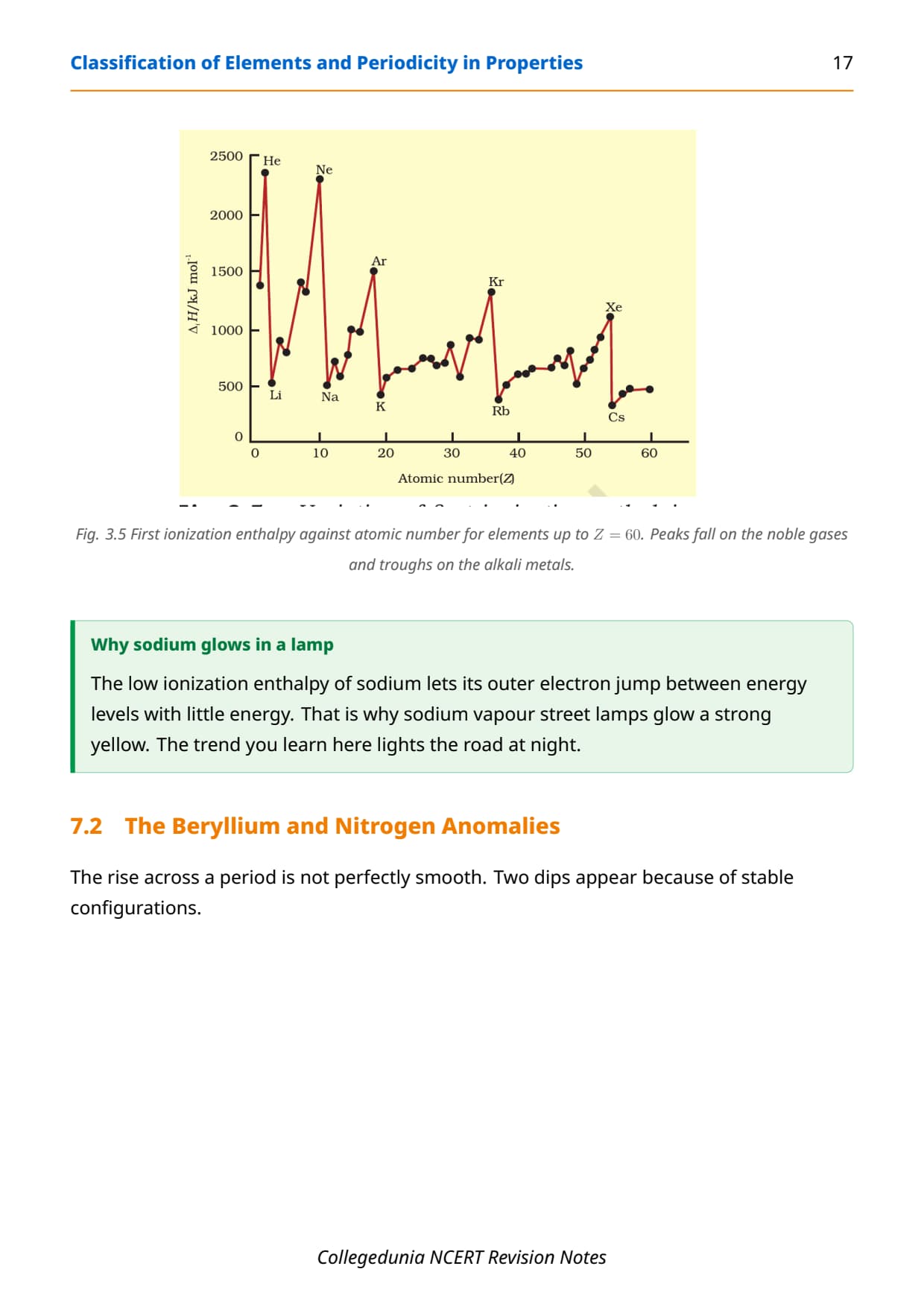
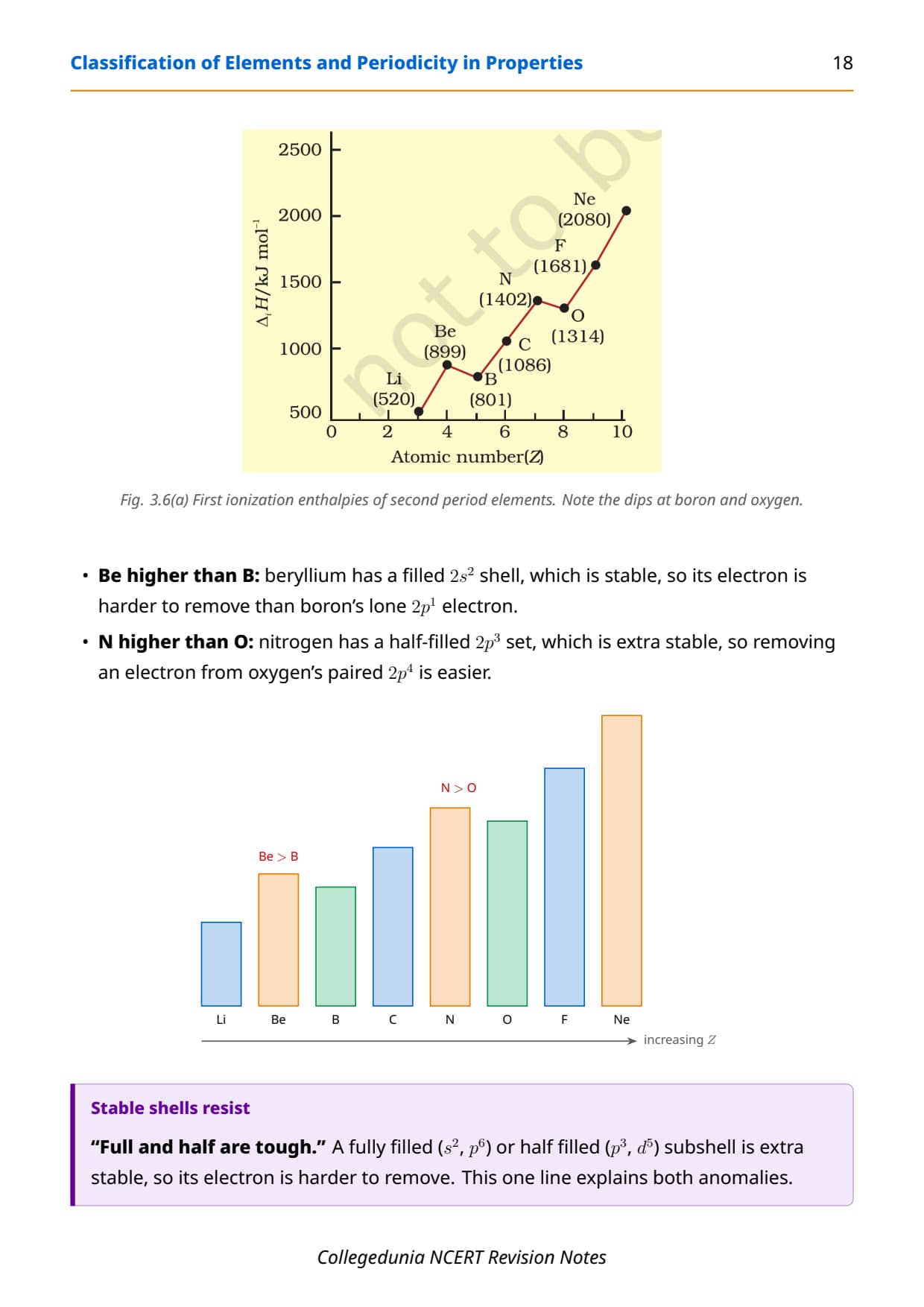
| Ionization enthalpy | Increases | Decreases |
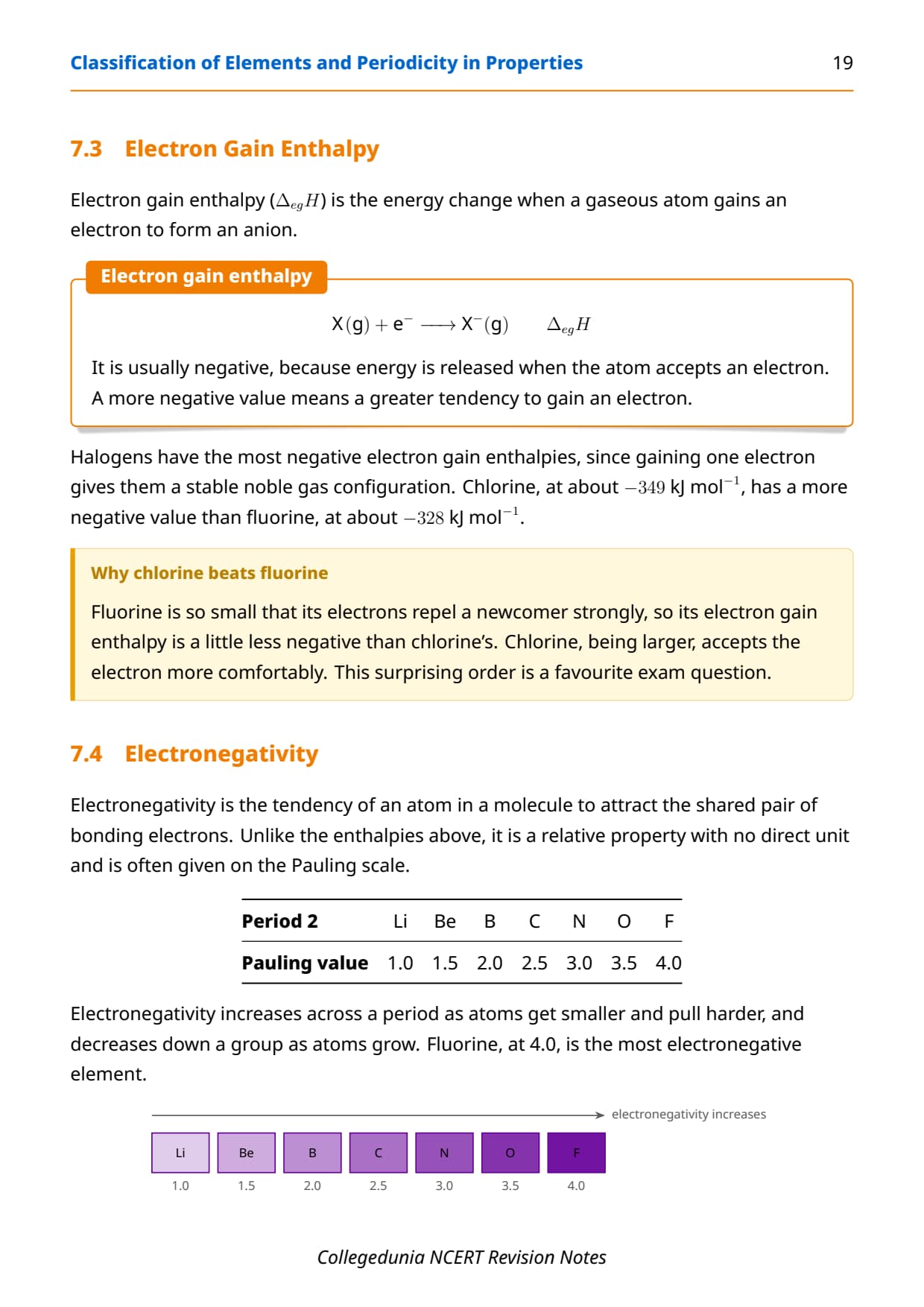
| Electron gain enthalpy | Becomes more negative | Becomes less negative |
| Electronegativity | Increases | Decreases |
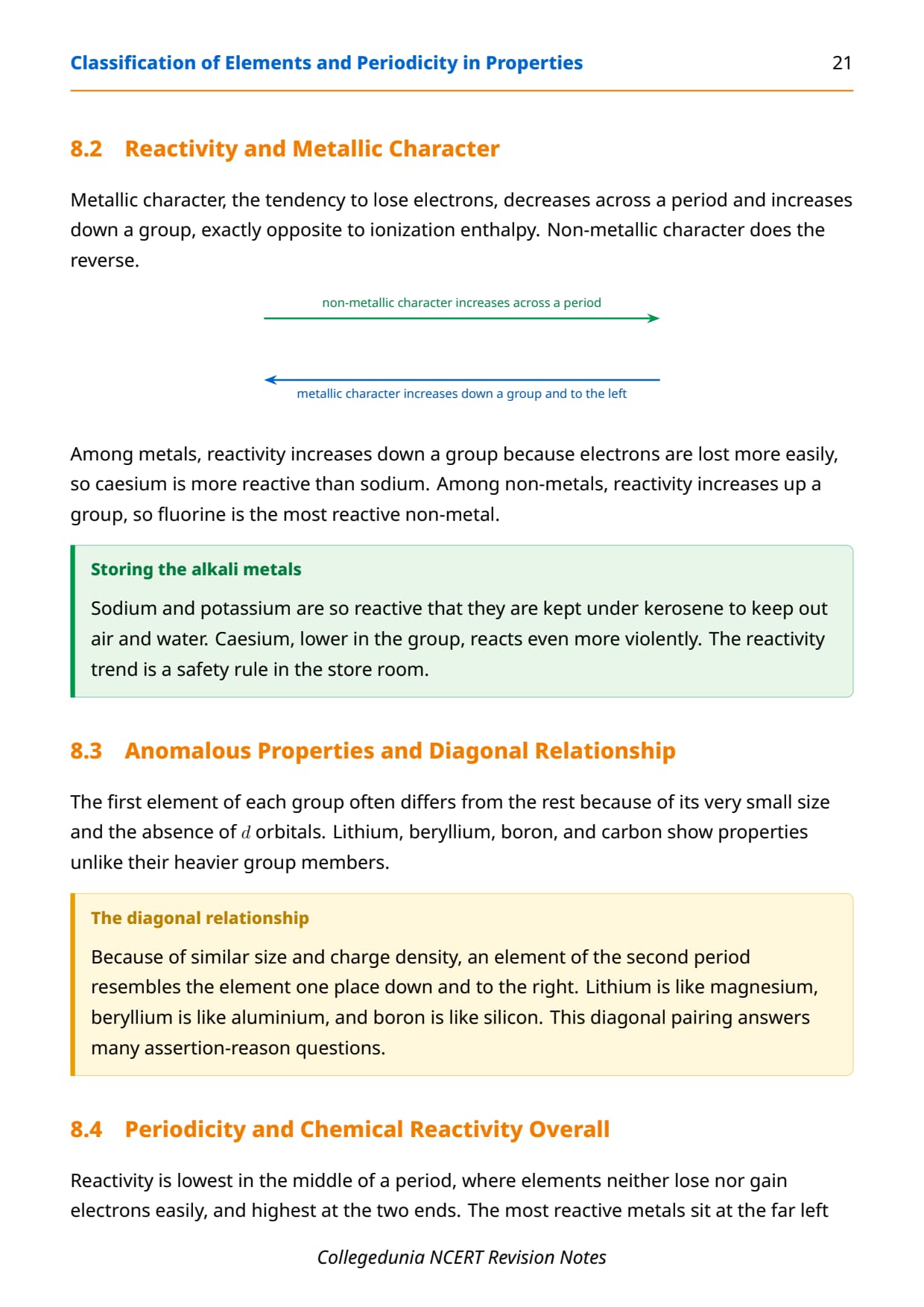
| Metallic character | Decreases | Increases |
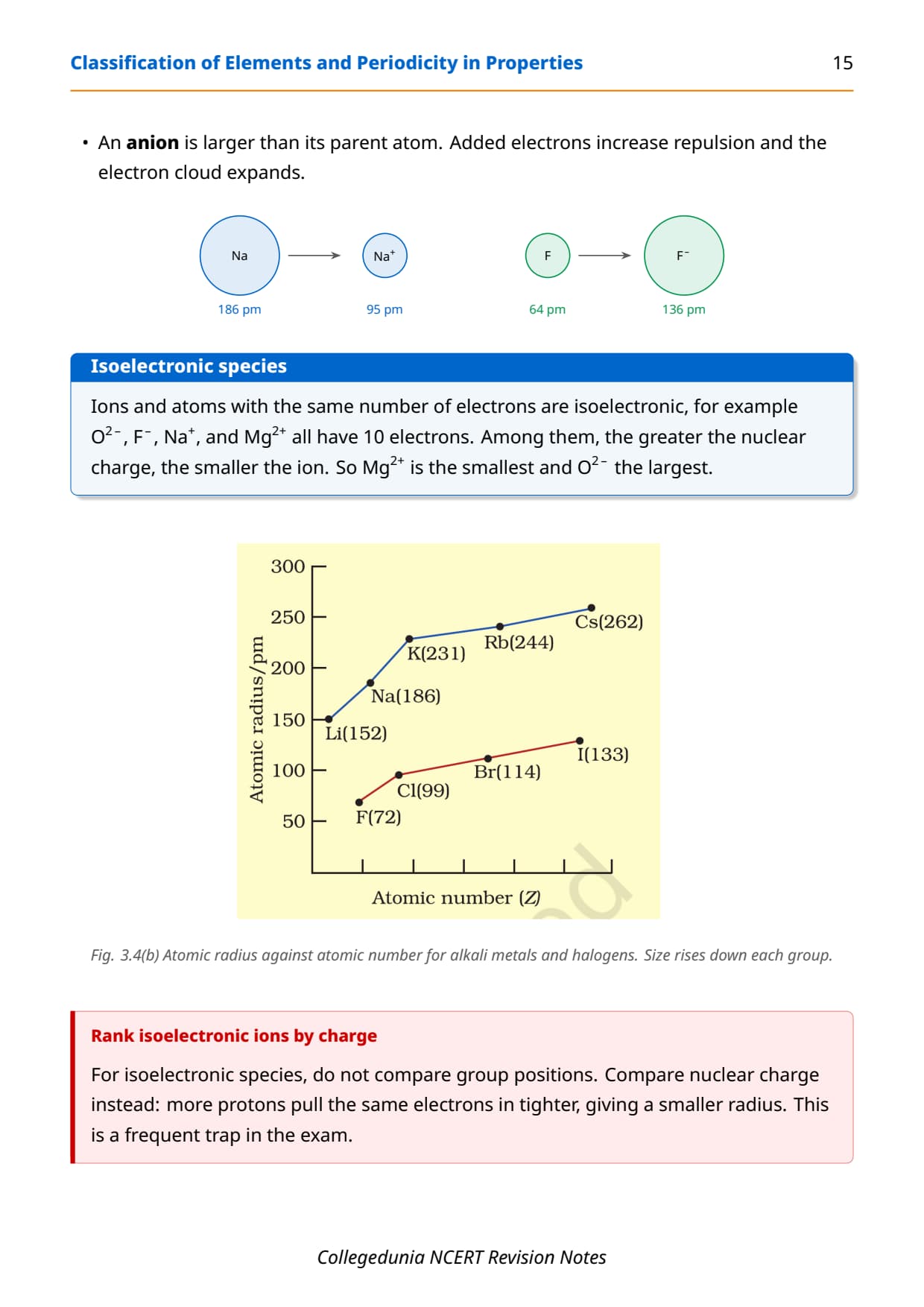
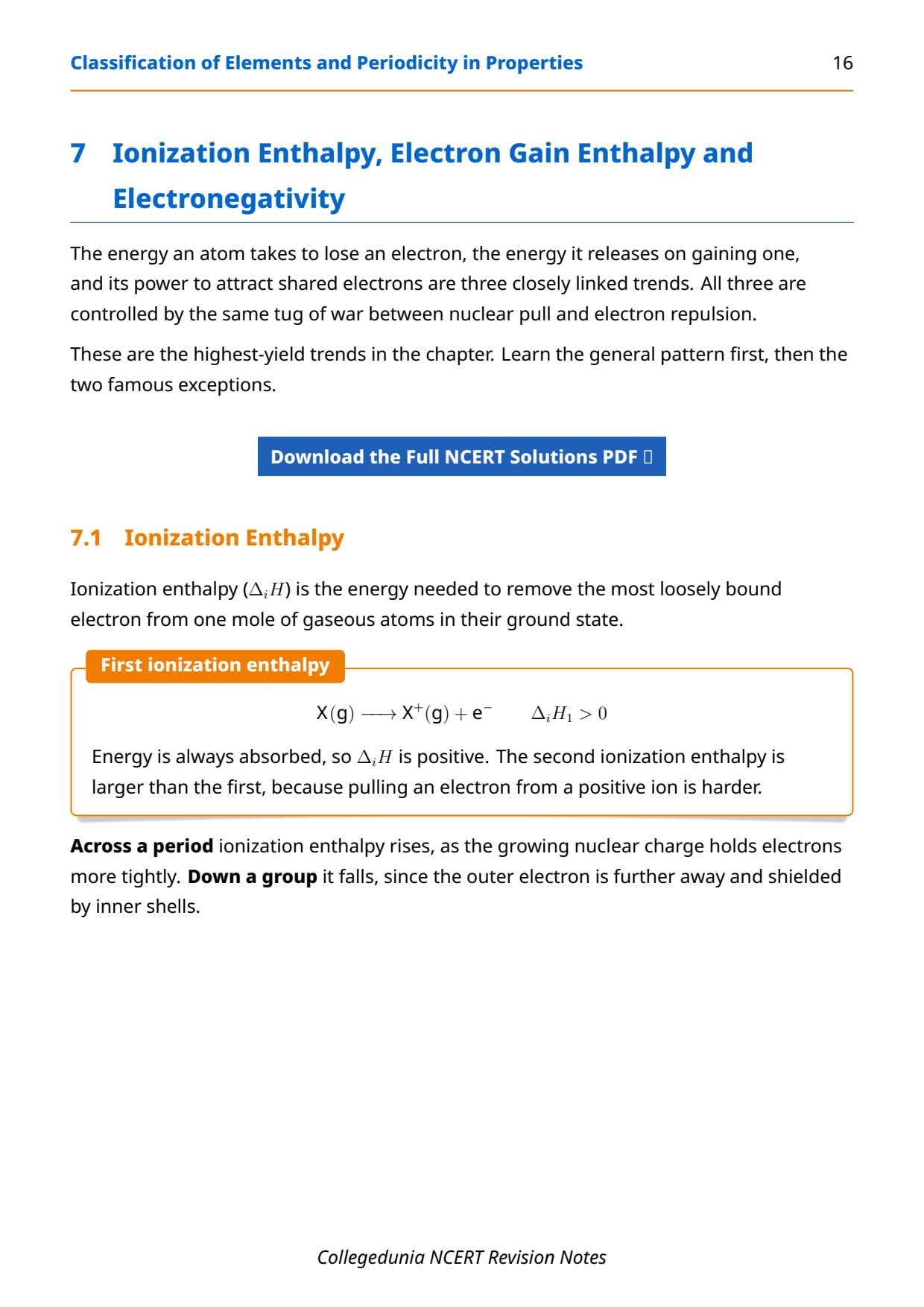
Ionization enthalpy is the energy needed to remove the most loosely held electron from a gaseous atom. It rises across a period because the atom gets smaller and holds its electrons tighter. Electron gain enthalpy is the energy released when a gaseous atom gains an electron, and it is most negative for the halogens. Electronegativity is the tendency of an atom in a bond to attract the shared pair of electrons, and fluorine is the most electronegative element. A cation is always smaller than its parent atom, while an anion is always larger.
Valence, Anomalous Properties and Diagonal Relationships
The chapter closes with valence and a few departures from the smooth trends. Valence is the combining power of an element, set by its valence electrons. The first element of each group and the diagonal pairs behave a little differently, and examiners love to test these exceptions.
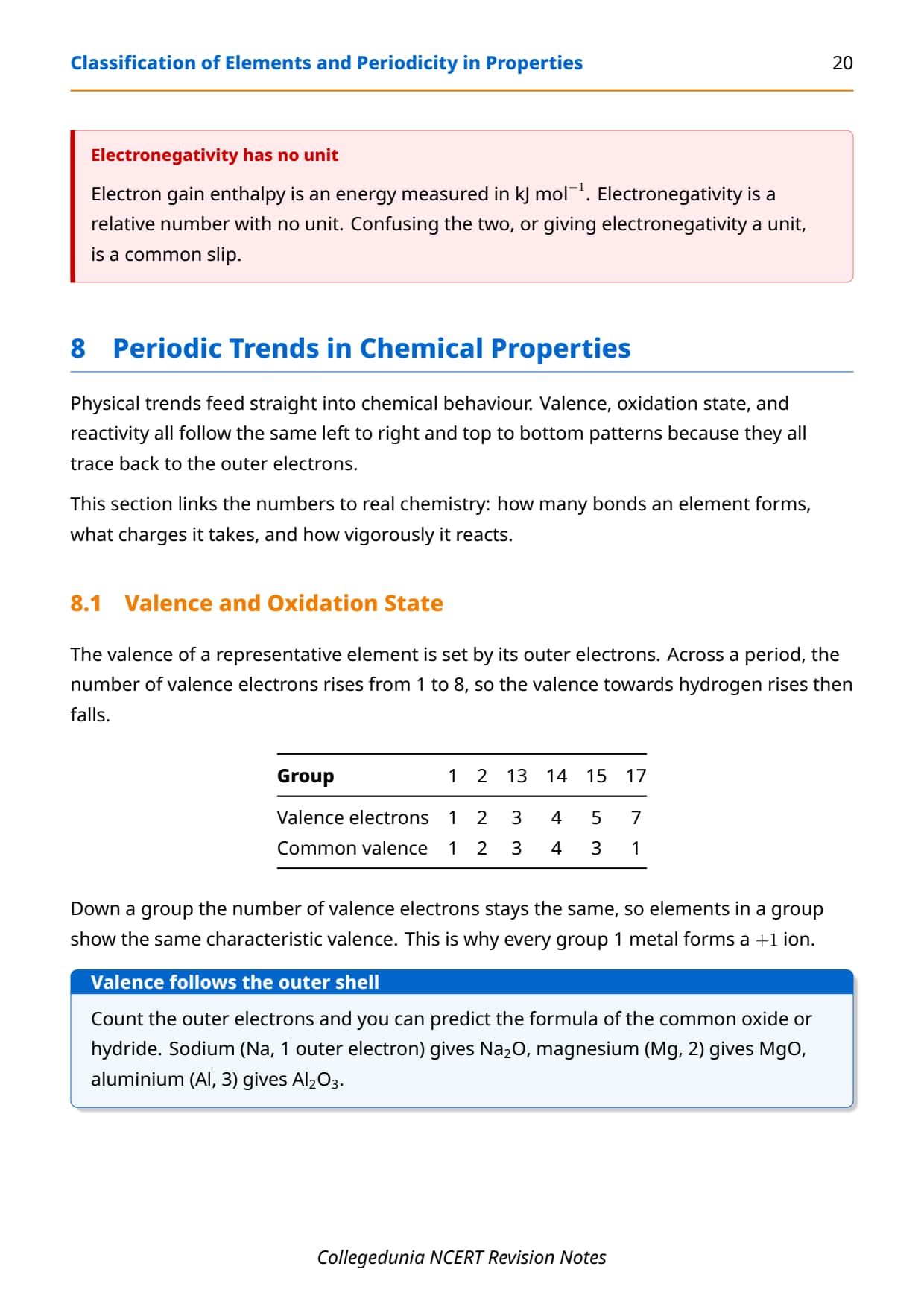
- Valence: for main group elements it equals the number of valence electrons, or 8 minus that number for non-metals.
- Anomalous first member: lithium, beryllium, boron and so on differ from the rest of their group due to small size and no d orbitals.
- Diagonal relationship: lithium resembles magnesium, and beryllium resembles aluminium, because size and charge density are alike.
- Inert pair effect: heavier p-block elements favour a valence two less than the group value, as the s electrons resist removal.
Nature of oxides also shifts across a period. Metal oxides on the left are basic, non-metal oxides on the right are acidic, and the middle ones are amphoteric, like aluminium oxide. This acid-base trend ties the whole chapter together, because it follows directly from metallic character falling across the period.
Important Values and Trends for Classification of Elements and Periodicity in Properties
Every trend direction and key value you need for the chapter sits in one table below, with what it means. Learn the radius and ionization rows first, since those carry the most reasoning marks in both Boards and entrance papers.
| Quantity or rule | What it means |
|---|---|
| Modern periodic law | Properties are a periodic function of atomic number, not atomic mass |
| Periods = 7, Groups = 18 | The layout of the long form periodic table |
| Elements per period: 2, 8, 8, 18, 18, 32 | Set by the sub-shells that fill in each period |
| Atomic radius trend | Decreases across a period, increases down a group |
| Ionization enthalpy trend | Increases across a period, decreases down a group |
| Most electronegative element | Fluorine, on the Pauling scale value of 4.0 |
| Cation vs anion size | Cation smaller than the atom, anion larger than the atom |
| Nature of oxides across a period | Basic on the left, amphoteric in the middle, acidic on the right |
State the reason with every trend answer. Writing "because nuclear charge increases while shielding stays about the same" is what earns the mark, not just the direction. Keep this table open while you solve the back-exercise questions in these revision notes.
Key Definitions in Classification of Elements and Periodicity in Properties
Board short-answer questions often ask for a clean definition in one or two lines. Learn these word-for-word, because a vague definition loses easy marks. Each one also sets up a reasoning question you can be asked to explain.
| Term | Definition |
|---|---|
| Modern periodic law | The properties of elements are a periodic function of their atomic numbers. |
| Atomic radius | Half the distance between the nuclei of two bonded atoms of the same element. |
| Ionization enthalpy | The energy needed to remove the outermost electron from an isolated gaseous atom. |
| Electron gain enthalpy | The energy change when a gaseous atom gains an electron to form an anion. |
| Electronegativity | The tendency of an atom in a bond to attract the shared pair of electrons. |
| Isoelectronic species | Atoms or ions that have the same number of electrons. |
A common question asks you to order isoelectronic species by size. For the same electron count, higher nuclear charge means a smaller radius, so O2- is larger than F-, which is larger than Na+. Learning these definitions makes the wording of every board question familiar.
Common Mistakes Students Make in Classification of Elements and Periodicity in Properties
These slips happen while reasoning about trends, not because the concept is unclear. Each one costs 1 to 2 marks in the paper, so watch for them at the exact step.
Mistake 1: Confusing ionization enthalpy and electron gain enthalpy. Ionization is energy absorbed to remove an electron; electron gain is energy released when one is added.
Mistake 2: Saying atomic size increases across a period. It decreases, because the added electrons enter the same shell while nuclear charge grows.
Mistake 3: Forgetting that a cation is smaller and an anion is larger than the neutral atom.
Mistake 4: Treating fluorine as having the most negative electron gain enthalpy. That is chlorine, because fluorine's small size crowds the incoming electron.
Classification of Elements and Periodicity in Properties Weightage in CBSE Boards, JEE and NEET
This chapter is high-yield and mostly conceptual. It rarely needs a numerical, yet it shows up every year as reasoning and assertion questions. Here is how the marks split across the main exams for 2026-27.
| Exam | Typical weightage | What is asked |
|---|---|---|
| CBSE Boards | 6 to 7 marks | Trend reasoning, block identification, and one assertion-reason question |
| JEE Main | 1 to 2 questions | Ionization enthalpy order, radius comparison, and configuration to position |
| NEET | 2 to 3 questions | Periodic trends, electronegativity, and s, p, d, f block identification |
| CUET | 1 to 2 objective questions | Modern periodic law, groups and periods, and trend directions |
Periodic trends are the single most tested idea from this chapter across all four exams. Master the radius and ionization trends first, then electron gain enthalpy and electronegativity, then the block structure, in that order of return on effort.
How to Revise Classification of Elements and Periodicity in Properties Quickly
Use these classification of elements and periodicity in properties class 11 notes for a fast, ordered recap the night before a test. The checklist below takes about 30 minutes and hits every marks-heavy idea.
- First 10 minutes: write the modern periodic law and sketch the four blocks with their outer configurations from memory.
- Next 10 minutes: write each periodic trend across a period and down a group, with the one-line reason.
- Last 10 minutes: practise turning three electronic configurations into their period and group.
Close the loop by ordering one set of isoelectronic species by size. If you can do all three blocks without notes, the chapter is exam-ready. Keep the Important Values table beside you for the first pass only, then try it closed-book.
Student Feedback on the Classification of Elements and Periodicity in Properties Notes
What 12,860 students told us about their Classification of Elements and Periodicity in Properties revision:
- 68% of students rated electron gain enthalpy as the hardest trend to reason about.
- Most-skipped step: stating the reason with every trend answer, missed by about 3 in 10 students.
- Students who learnt the block structure first said the rest of the chapter felt far easier.
Source: 2026-27 Class 11 Chemistry student poll. Sample of 12,860 students from CBSE schools across 15 states, conducted before the 2026 boards.
Other Classification of Elements and Periodicity in Properties Class 11 Chemistry Resources
Pair these notes with the solved answers and the textbook PDF for the same chapter.
| Resource | Link |
|---|---|
| NCERT Solutions | Classification of Elements and Periodicity in Properties Class 11 NCERT Solutions |
| NCERT Book PDF | Classification of Elements and Periodicity in Properties Class 11 Book PDF |
NCERT Notes for Class 11 Chemistry: All Chapters
Jump to the revision notes for any other Class 11 Chemistry chapter below.
| Chapter | NCERT Notes |
|---|---|
| Chapter 1 | Some Basic Concepts of Chemistry |
| Chapter 2 | Structure of Atom |
| Chapter 3 | Classification of Elements and Periodicity in Properties |
| Chapter 4 | Chemical Bonding and Molecular Structure |
| Chapter 5 | Thermodynamics |
| Chapter 6 | Equilibrium |
| Chapter 7 | Redox Reactions |
| Chapter 8 | Organic Chemistry Some Basic Principles and Techniques |
| Chapter 9 | Hydrocarbons |
FAQs on Classification of Elements and Periodicity in Properties Class 11 Chemistry Notes
Classification of Elements and Periodicity in Properties Notes - Frequently Asked Questions
Ques. What topics do the classification of elements and periodicity in properties class 11 notes cover?
Ans. These notes cover the early attempts at classification, Mendeleev's table, the modern periodic law based on atomic number, the long form periodic table with 7 periods and 18 groups, the s, p, d and f blocks, electronic configuration to position, and every periodic trend such as atomic and ionic radius, ionization enthalpy, electron gain enthalpy, electronegativity and valence. Each key value and definition is included for fast revision.
Ques. What is the modern periodic law?
Ans. The modern periodic law states that the physical and chemical properties of elements are a periodic function of their atomic numbers. It replaced Mendeleev's law, which used atomic mass, after Moseley showed that atomic number is the fundamental property of an element. This change fixed the earlier anomalies, such as the positions of argon and potassium.
Ques. How are the s, p, d and f blocks defined?
Ans. The blocks are set by the sub-shell that fills last. s-block elements are groups 1 and 2, p-block elements are groups 13 to 18, d-block elements are the transition metals in groups 3 to 12, and f-block elements are the lanthanoids and actinoids. The block instantly tells you the outer configuration and the general chemistry of the element.
Ques. How does atomic radius change across a period and down a group?
Ans. Across a period, atomic radius decreases because nuclear charge rises while electrons enter the same shell, so the nucleus pulls them in tighter. Down a group, atomic radius increases because each new period adds a fresh electron shell, which outweighs the higher nuclear charge. A cation is smaller than its parent atom, and an anion is larger.
Ques. What is the difference between ionization enthalpy and electron gain enthalpy?
Ans. Ionization enthalpy is the energy required to remove the outermost electron from an isolated gaseous atom, and it increases across a period. Electron gain enthalpy is the energy change when a gaseous atom gains an electron to form an anion, and it is most negative for the halogens. The two describe opposite processes, so students should not mix their trends.
Ques. What is the weightage of this chapter in the CBSE board exam?
Ans. Classification of Elements and Periodicity in Properties carries about 6 to 7 marks in the CBSE Class 11 Chemistry paper, usually one trend-based short answer plus one reasoning or assertion question. It also appears in JEE Main, NEET and CUET as objective questions on periodic trends, block identification, and configuration to position.
Ques. Which is the most electronegative element and why?
Ans. Fluorine is the most electronegative element, with a Pauling scale value of 4.0. Its small atomic size and high effective nuclear charge let it attract the shared pair of electrons in a bond very strongly. Electronegativity increases across a period and decreases down a group, so the top right of the table, near fluorine, holds the most electronegative elements.
Ques. How do I revise Classification of Elements and Periodicity in Properties quickly for a test?
Ans. Start by writing the modern periodic law and sketching the four blocks with their outer configurations. Then write each periodic trend across a period and down a group with a one-line reason. Finish by turning three electronic configurations into their period and group. The quick-revision checklist in these classification of elements and periodicity in properties class 11 notes covers all of this in about 30 minutes.



Comments