




These chemical bonding and molecular structure class 11 notes pull together every bonding theory, shape rule, and formula that the CBSE Boards, JEE Main, JEE Advanced, NEET and CUET papers test in 2026-27. Revise the whole chapter fast, from the Kossel-Lewis idea to VSEPR shapes, hybridization and molecular orbital theory, in one place.
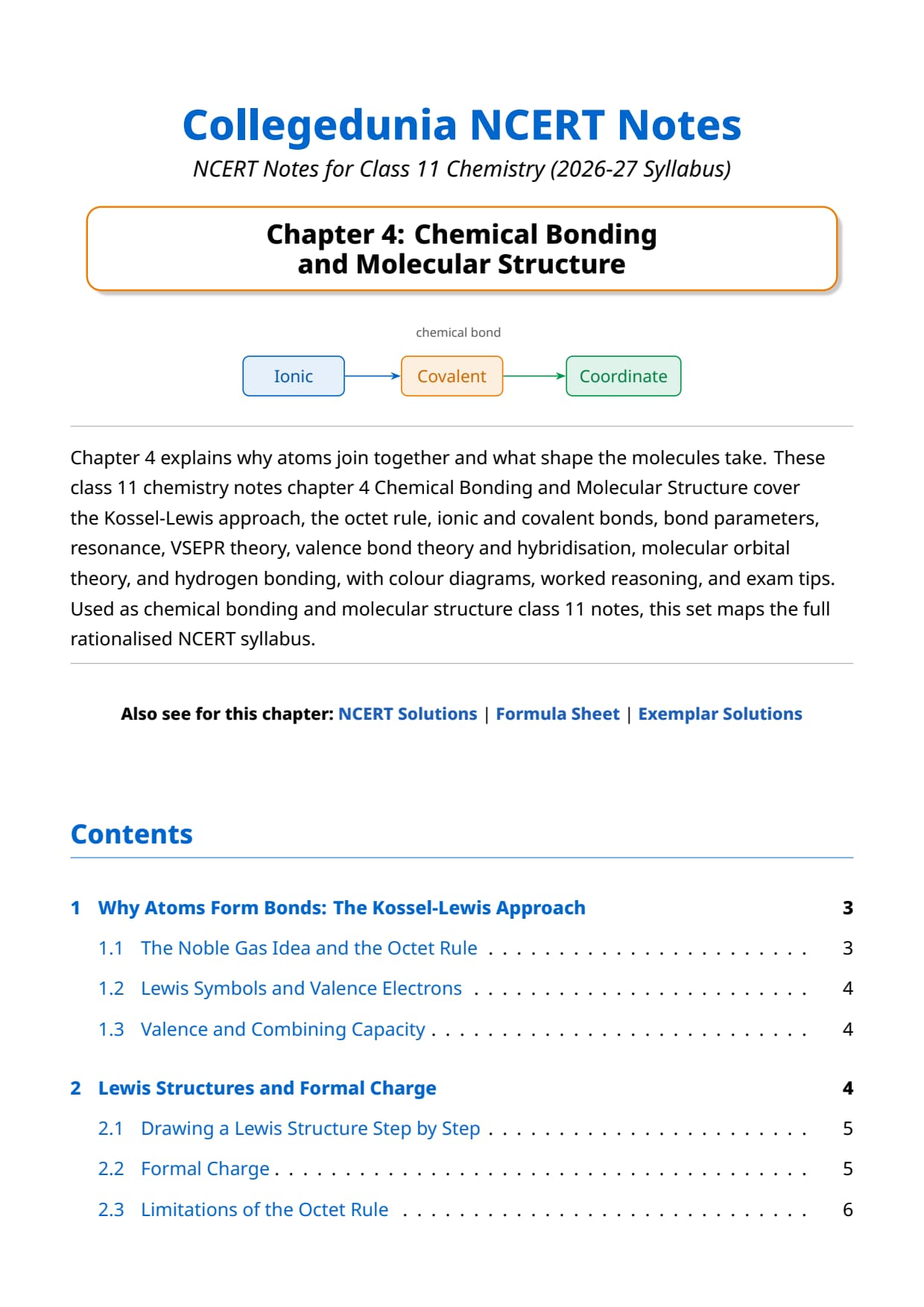
This is one of the most concept-heavy chapters of Class 11, and the bonding ideas here run through every organic and inorganic reaction you study later.
- CBSE Weightage: 7 to 9 marks, usually one shape or hybridization question plus one short answer on bonding.
- Topics covered: Kossel-Lewis approach, octet rule and its limits, ionic and covalent bonds, bond parameters, Lewis structures, formal charge, VSEPR theory, valence bond theory, hybridization, molecular orbital theory, and hydrogen bonding.
- Key ideas: formal charge, dipole moment, bond order, and predicting molecular shape from electron pairs.
These chemical bonding and molecular structure class 11 notes are curated by subject experts, based on the 2026-27 NCERT textbook, and checked against the last five years of CBSE Board, JEE Main and NEET papers.
Topic-by-Topic Summary of Chemical Bonding and Molecular Structure
The chapter explains why atoms join and what shape the resulting molecule takes. It starts with the simple electron-count idea, then builds three deeper theories that predict shape, bond strength and magnetic behaviour. Here is the quick map of what each topic gives you.
- Kossel-Lewis approach: atoms bond to reach a stable eight-electron (octet) arrangement.
- Ionic and covalent bonds: the two main ways atoms share or transfer electrons.
- Bond parameters: bond length, bond angle, bond enthalpy, bond order and dipole moment.
- VSEPR theory: predicts molecular shape from the number of electron pairs.
- Valence bond theory and hybridization: explains bonding through orbital overlap and mixing.
- Molecular orbital theory: gives bond order and explains magnetic character.
- Hydrogen bonding: a weak bond that decides the boiling points of water and HF.
Revise these topics in the order above, because each theory fixes a gap in the one before it. Learn to predict shape with VSEPR first, then use hybridization and molecular orbital theory to explain it. These chemical bonding and molecular structure class 11 notes follow the same sequence as the NCERT textbook.
Kossel-Lewis Approach, Octet Rule and Its Limitations
Bonding starts with a simple counting rule. Kossel and Lewis proposed that atoms combine to gain the stable electron arrangement of the nearest noble gas. Lewis pictured the atom as a core plus valence electrons shown as dots, which is where Lewis symbols come from.
- Octet rule: atoms tend to form bonds until they are surrounded by eight valence electrons.
- Kossel's idea: a bond forms when one atom transfers electrons to another, giving an ionic bond.
- Lewis's idea: a bond forms when two atoms share a pair of electrons, giving a covalent bond.
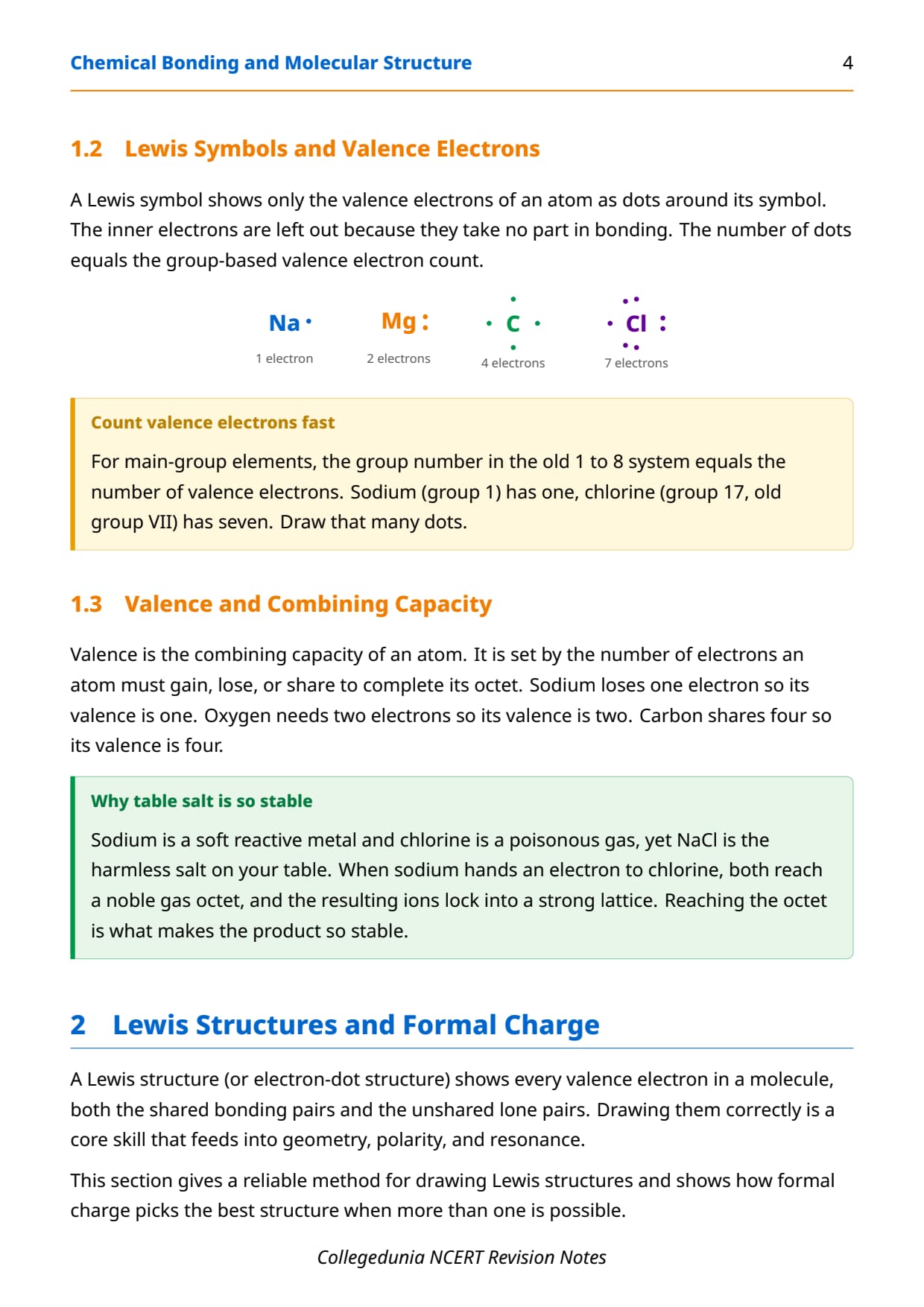
- Lewis symbol: the element symbol with its valence electrons drawn as dots around it.
The octet rule works well for the lighter elements but has clear exceptions. Three important limitations show up often in exams. The incomplete octet appears in BeCl2 and BF3, where the central atom has fewer than eight electrons. The expanded octet appears in SF6 and PF5, where it has more than eight. Odd-electron molecules such as NO and NO2 can never satisfy the octet. The rule also fails to explain molecular shape or the actual strength of a bond.
Ionic and Covalent Bonds with Bond Parameters
Once atoms decide to bond, they do it in one of two main ways. An ionic bond forms by full electron transfer, while a covalent bond forms by electron sharing. The measurable features of a covalent bond are called bond parameters, and they carry direct marks in the paper.
- Ionic bond: forms between a metal of low ionisation enthalpy and a non-metal of high electron gain enthalpy, helped by a high lattice enthalpy.
- Covalent bond: a shared pair gives a single bond, two shared pairs a double bond, three a triple bond.
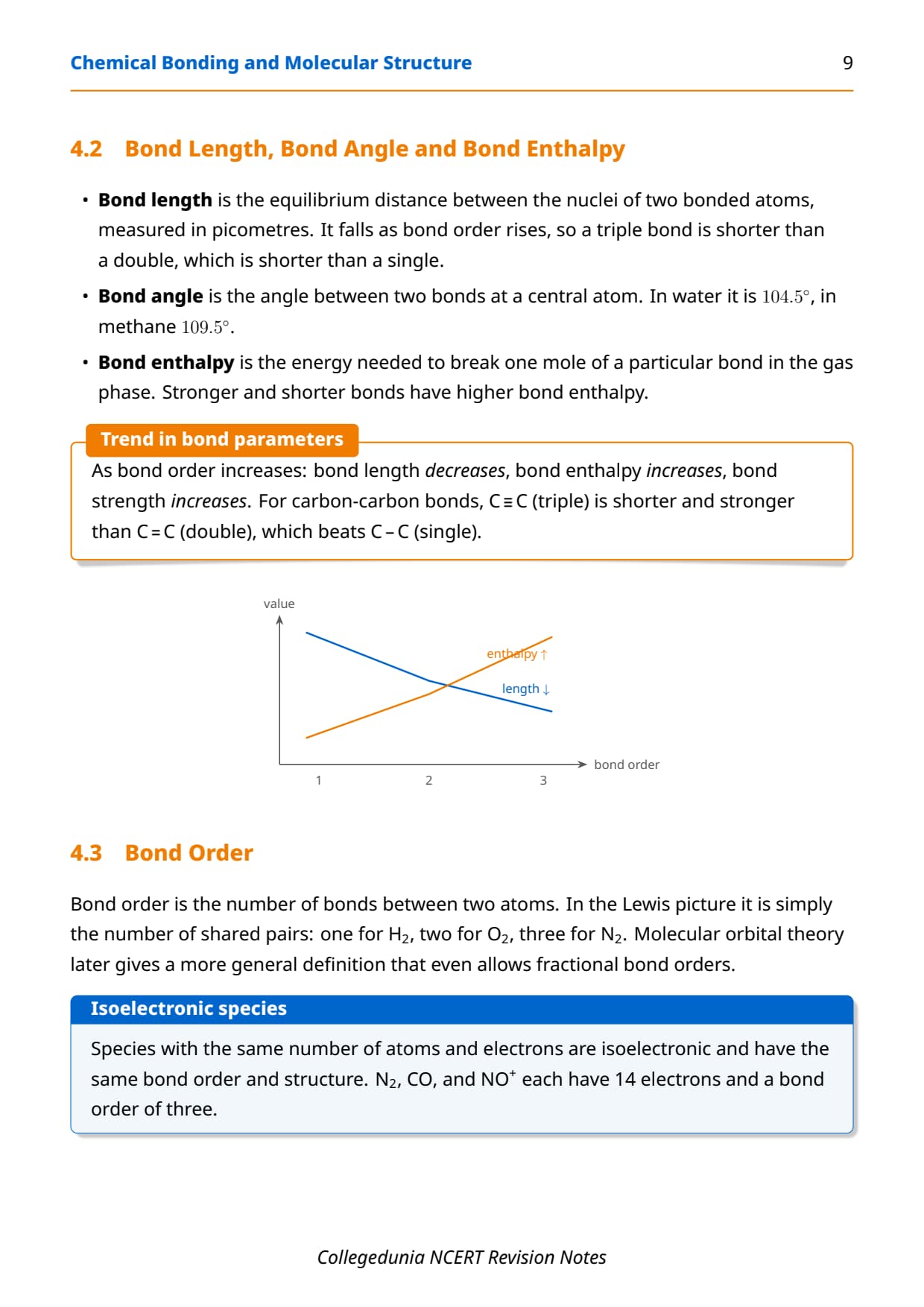
- Bond length: the equilibrium distance between the nuclei of two bonded atoms.
- Bond enthalpy: the energy needed to break one mole of a bond in the gas phase.
- Bond order: the number of bonds between two atoms; a higher order means a shorter, stronger bond.
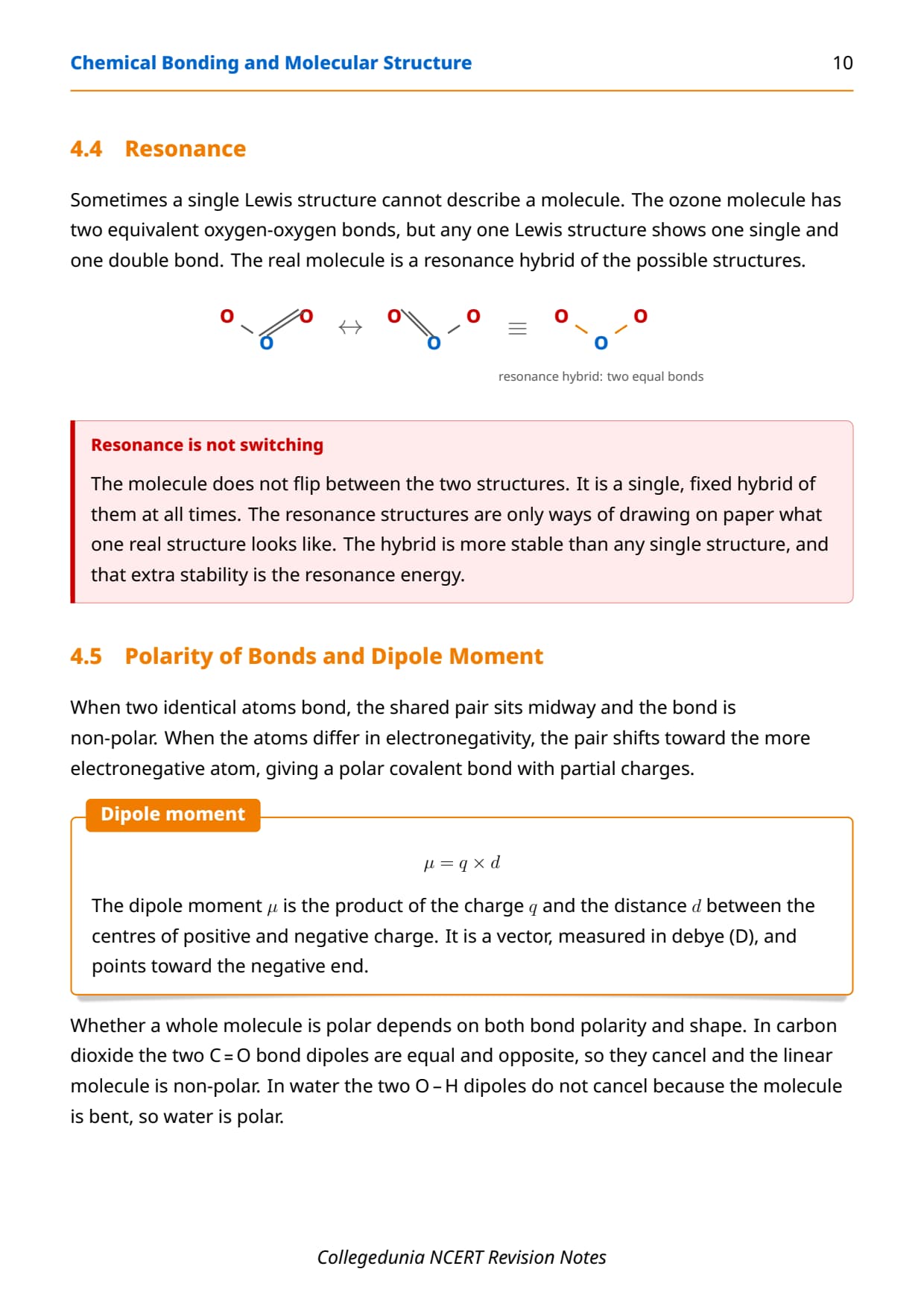
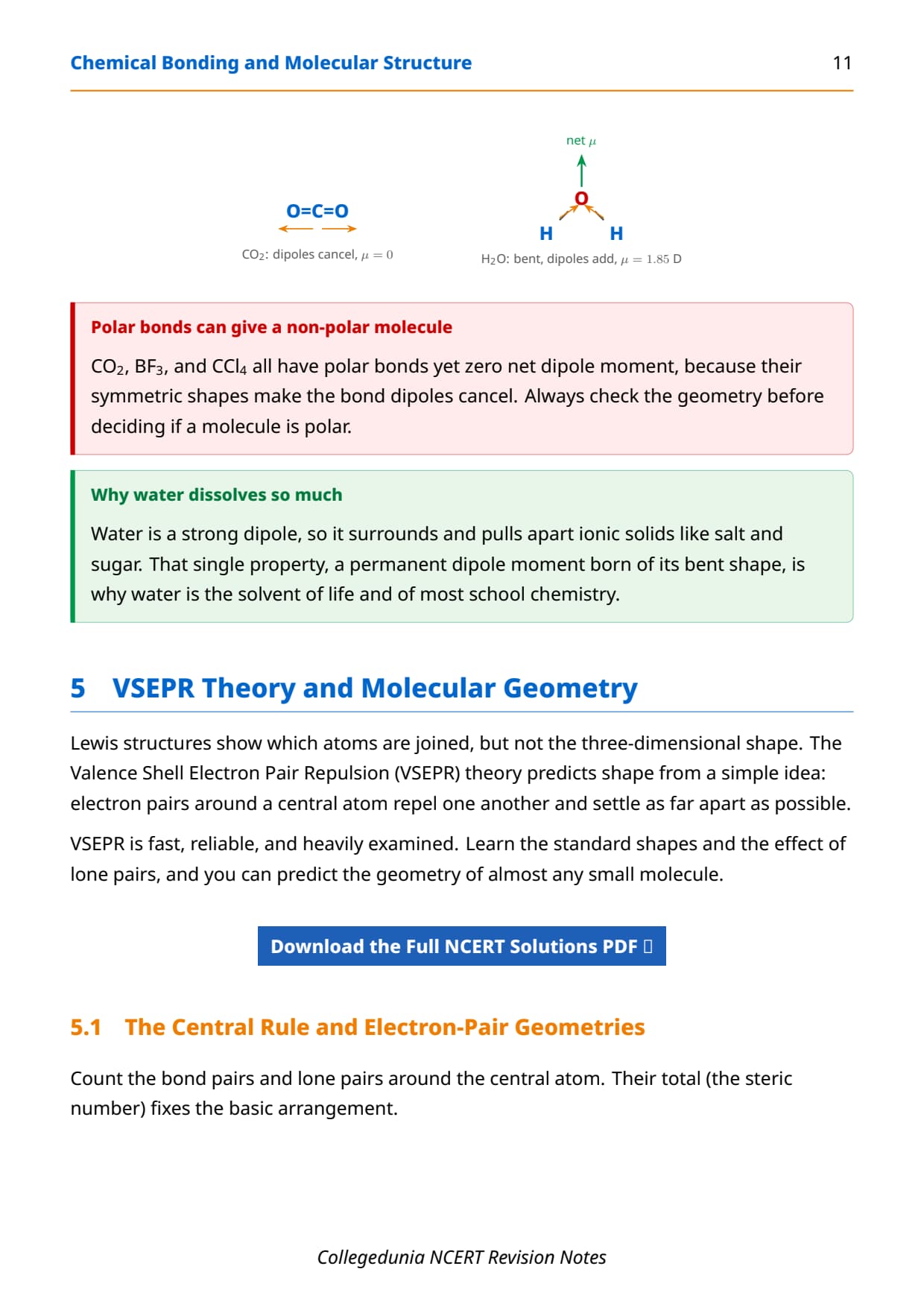
Bond polarity is measured by the dipole moment, found as µ = q × d, where q is the charge and d is the distance between the charges. It is measured in debye (D). CO2 is non-polar because its two bond dipoles cancel, while H2O is polar because its bent shape leaves a net dipole. Resonance is used when one Lewis structure cannot describe a molecule such as O3, and the real structure is a resonance hybrid.
Lewis Structures and the Formal Charge Method
A Lewis structure shows how the valence electrons of every atom are arranged as bonds and lone pairs. Drawing it correctly is the first step in predicting shape, so this is a guaranteed 1 to 2 mark skill. The formal charge then tells you which of several structures is the most stable.
- Add up the total valence electrons of all atoms, adding or removing for any ion charge.
- Place the least electronegative atom in the centre and join the others with single bonds.
- Complete the octets of the outer atoms first, then the central atom, using lone pairs.
- Form double or triple bonds if the central atom still lacks an octet.
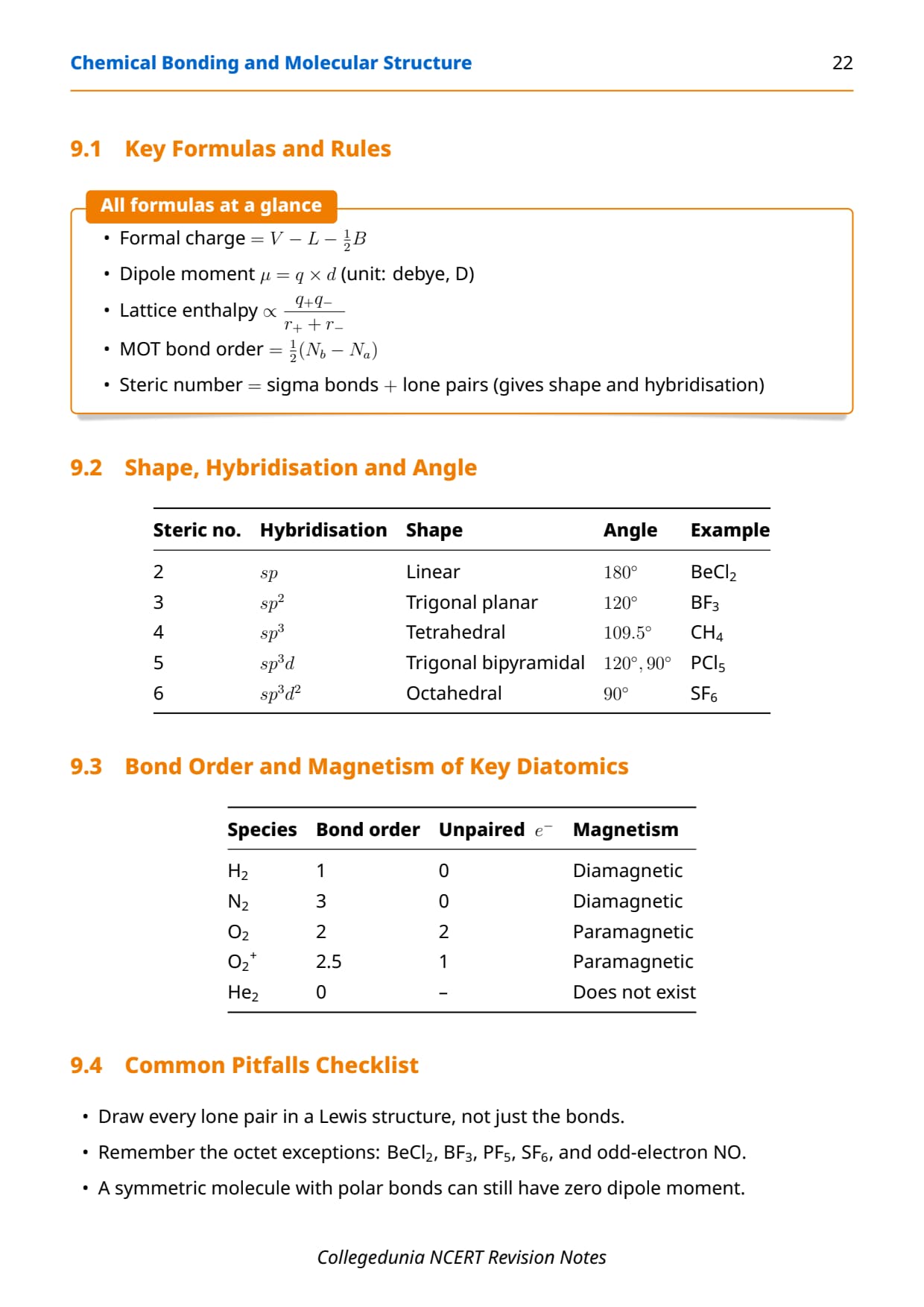
The formal charge on an atom is formal charge = (valence electrons) − (non-bonding electrons) − ½(bonding electrons). The most stable Lewis structure is the one where formal charges are closest to zero. A negative formal charge should sit on the more electronegative atom. Formal charge is a bookkeeping tool, so remember it does not show a real charge separation in the molecule.
VSEPR Theory and the Shapes of Molecules
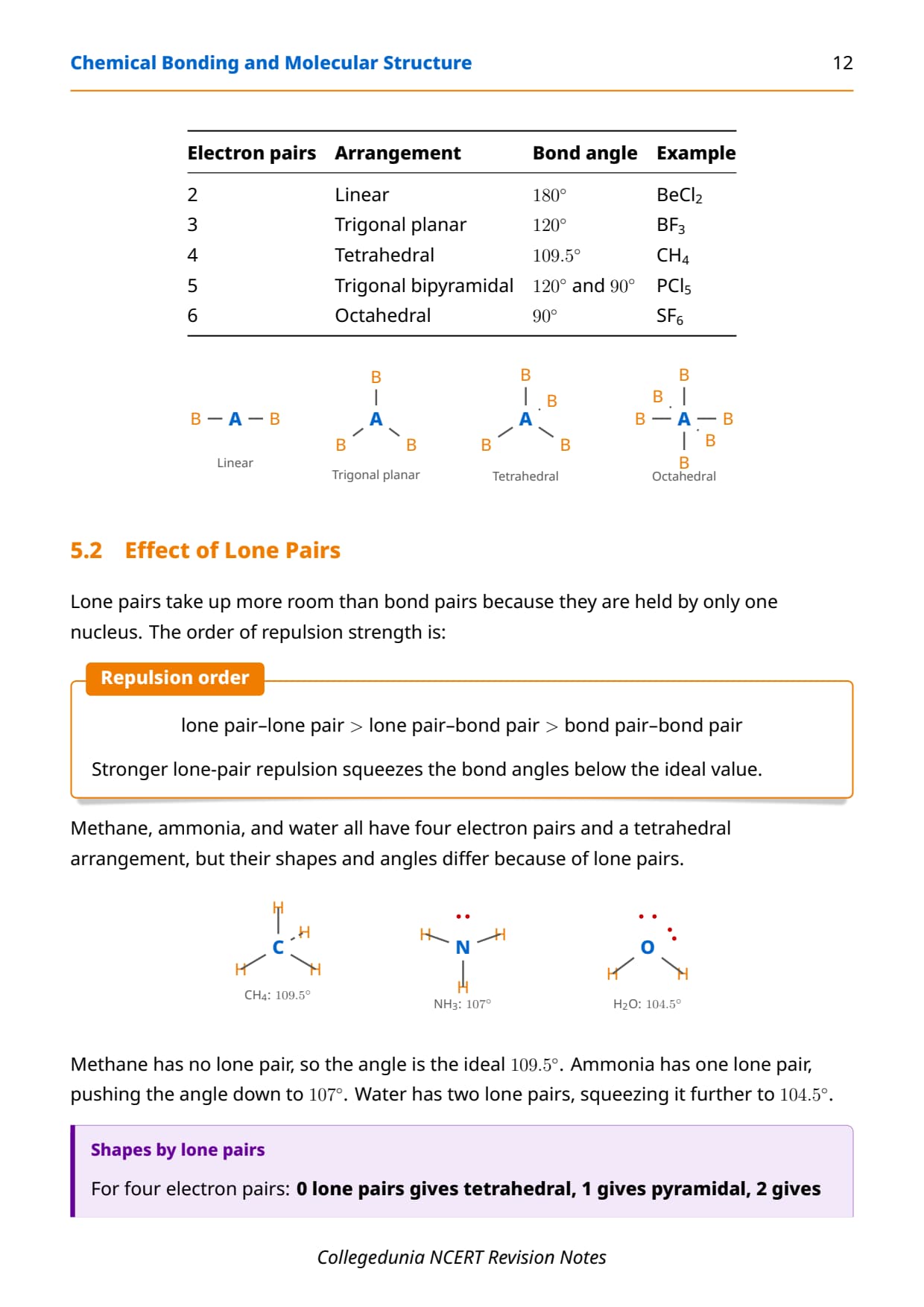
The VSEPR theory (Valence Shell Electron Pair Repulsion) predicts the shape of a molecule from the number of electron pairs around the central atom. Electron pairs arrange themselves as far apart as possible to reduce repulsion. This is the single most tested idea from these chemical bonding and molecular structure class 11 notes.
| Bond pairs + lone pairs | Shape | Example (bond angle) |
|---|---|---|
| 2 + 0 | Linear | BeCl2 (180°) |
| 3 + 0 | Trigonal planar | BF3 (120°) |
| 4 + 0 | Tetrahedral | CH4 (109.5°) |
| 3 + 1 | Trigonal pyramidal | NH3 (107°) |
| 2 + 2 | Bent | H2O (104.5°) |
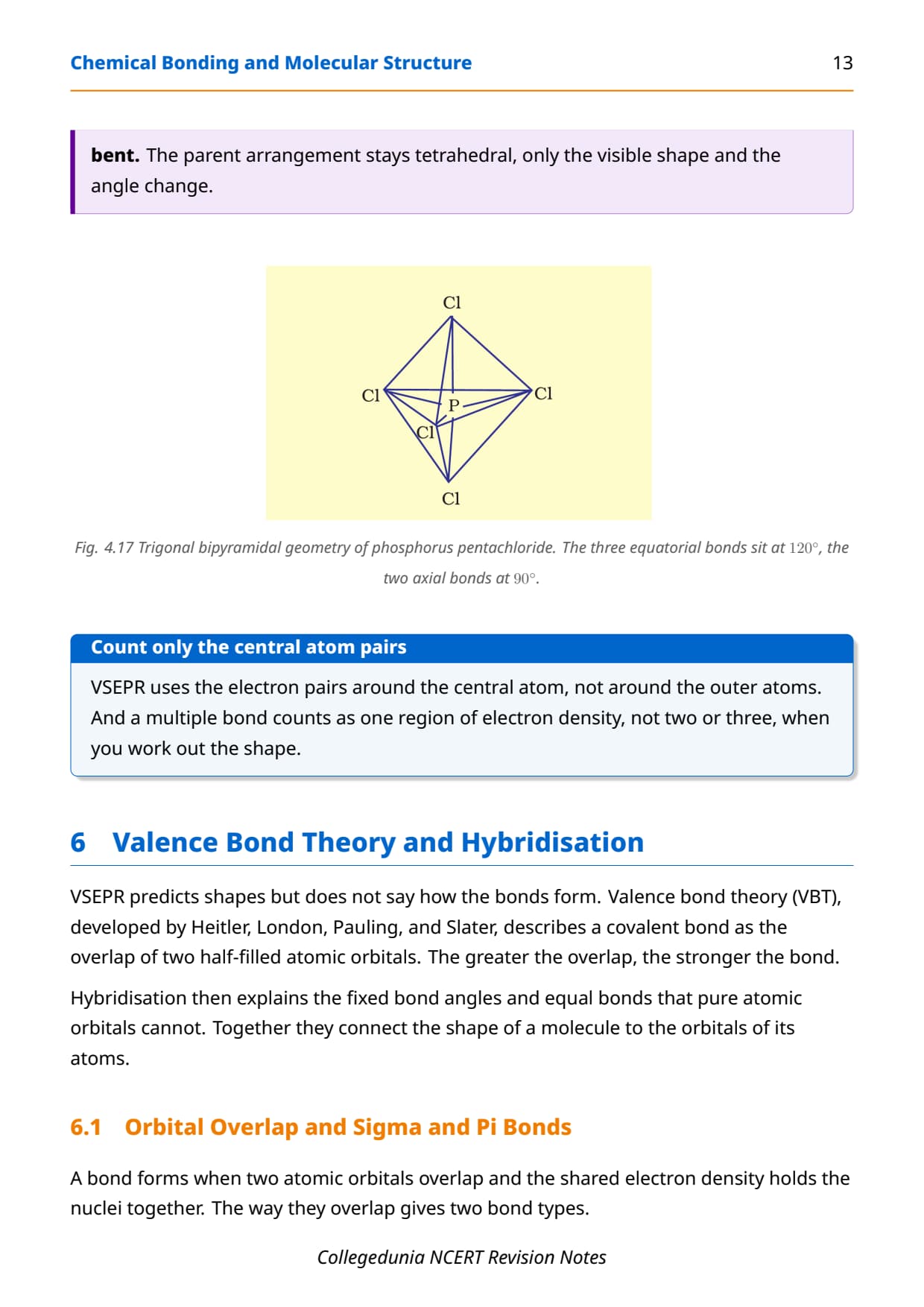
| 5 + 0 | Trigonal bipyramidal | PCl5 (90°, 120°) |
| 6 + 0 | Octahedral | SF6 (90°) |
The order of repulsion is lone pair-lone pair > lone pair-bond pair > bond pair-bond pair. This is why the bond angle drops from 109.5° in CH4 to 107° in NH3 and 104.5° in H2O, as lone pairs push the bonds closer. Count lone pairs first, because they decide how much the ideal angle shrinks.
Valence Bond Theory and Hybridization in Chemical Bonding and Molecular Structure
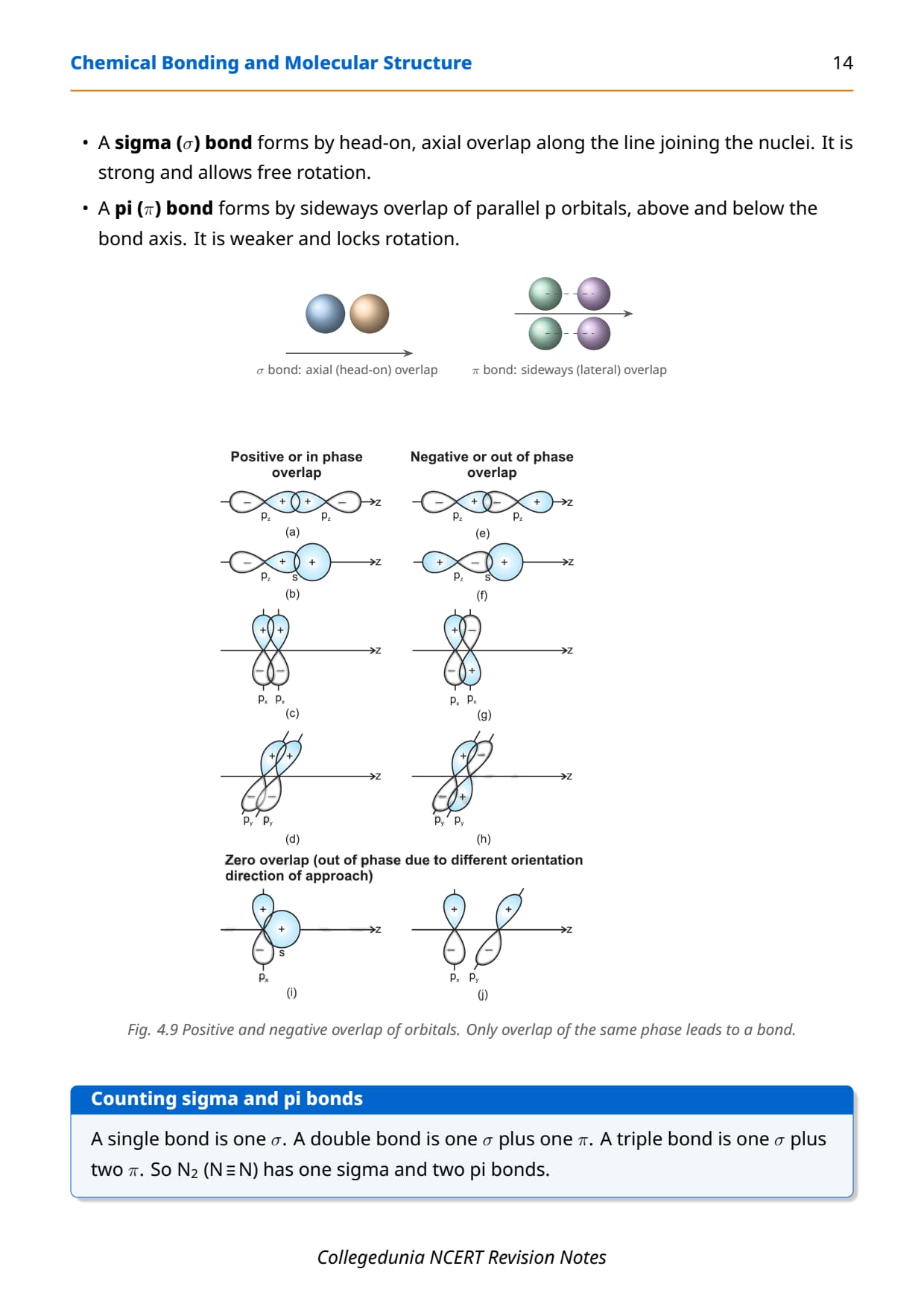
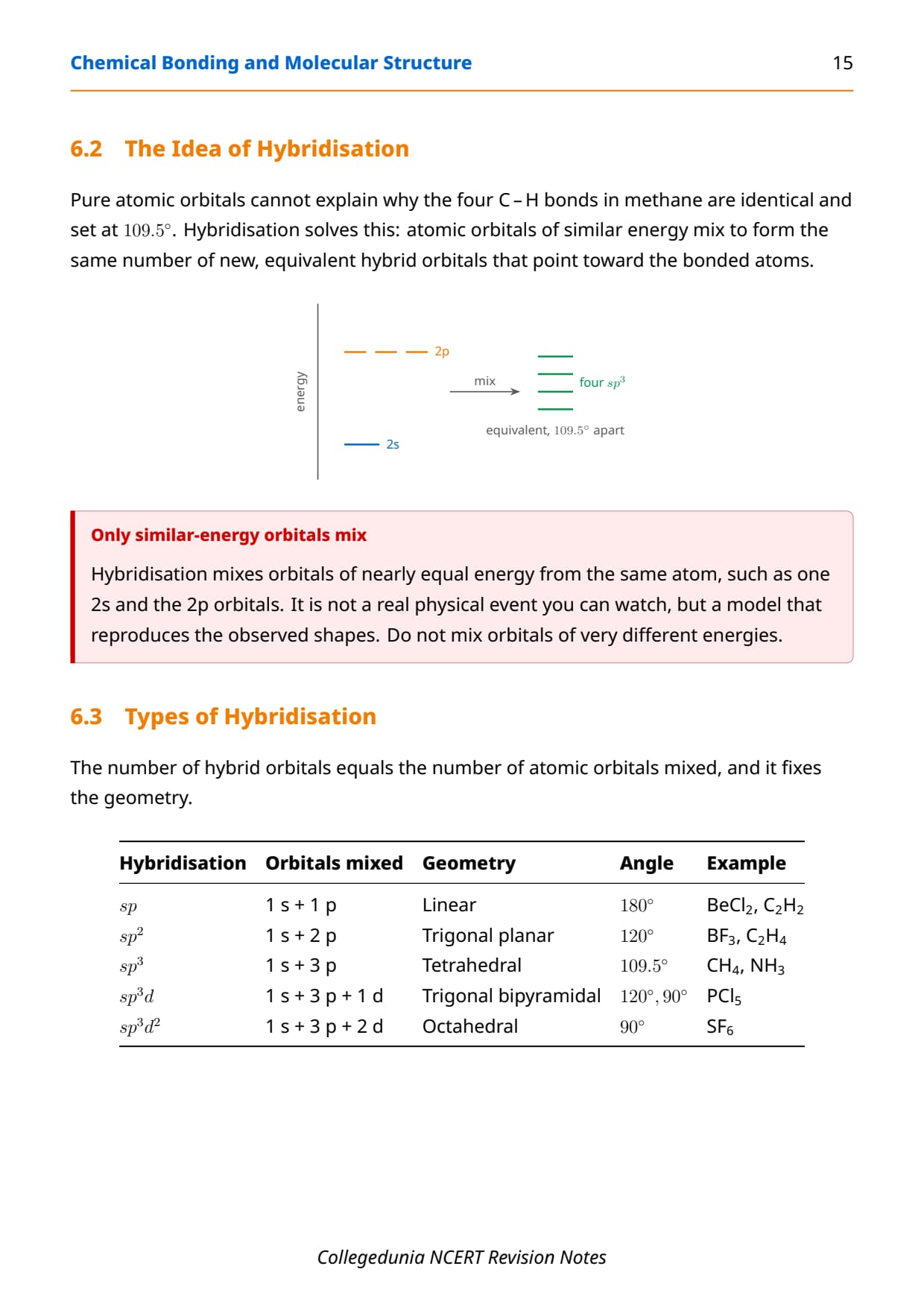
The valence bond theory explains a covalent bond as the overlap of two half-filled atomic orbitals. A head-on overlap gives a strong sigma (σ) bond, and a sidewise overlap gives a weaker pi (π) bond. To explain equal bond angles, atoms mix their orbitals in a process called hybridization.
| Hybridization | Shape and angle | Example |
|---|---|---|
| sp | Linear, 180° | BeCl2, C2H2 |
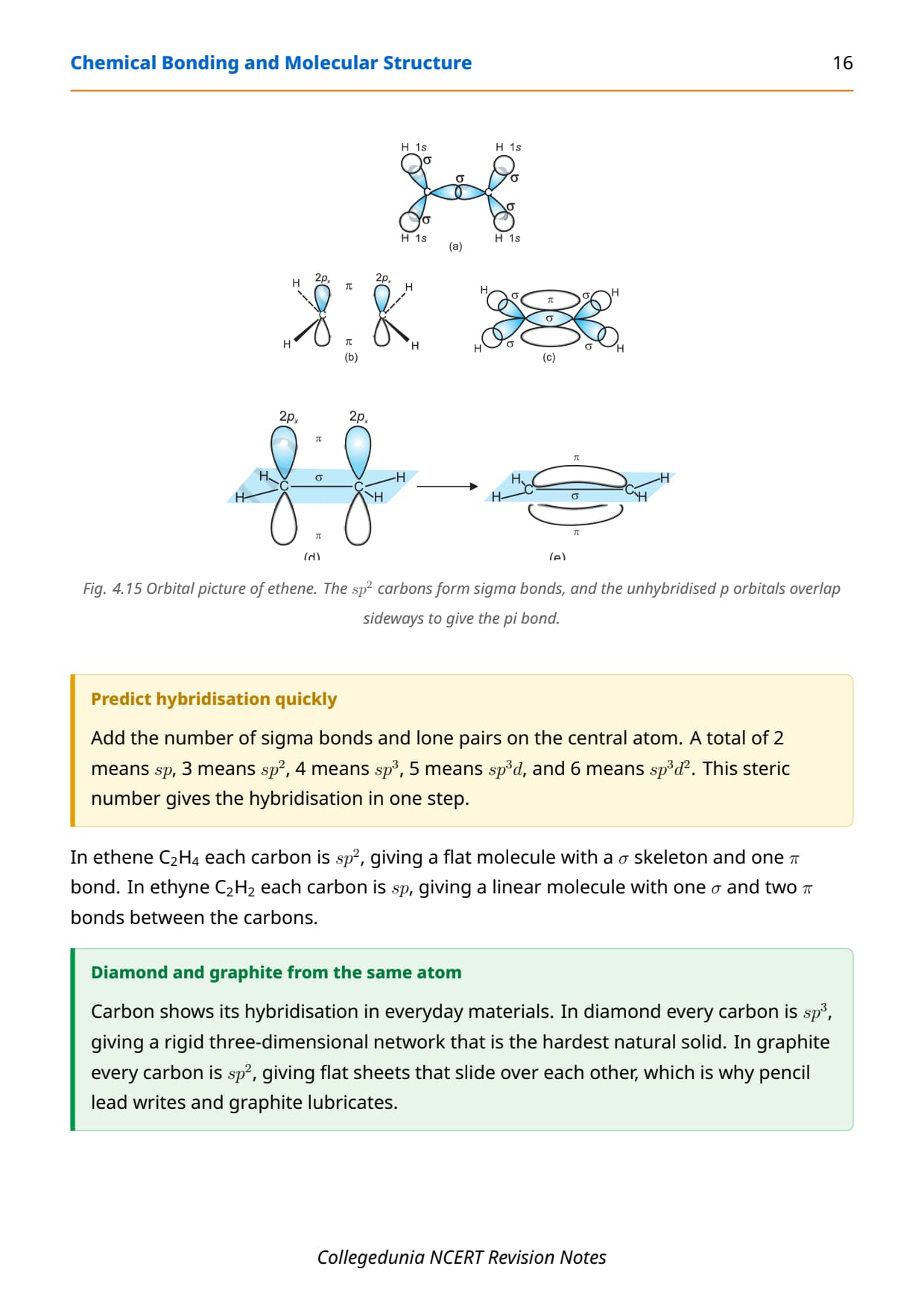
| sp2 | Trigonal planar, 120° | BF3, C2H4 |
| sp3 | Tetrahedral, 109.5° | CH4, NH3 |
| sp3d | Trigonal bipyramidal | PCl5 |
| sp3d2 | Octahedral | SF6 |
A single bond is always one sigma bond. A double bond is one sigma plus one pi bond, and a triple bond is one sigma plus two pi bonds. The d-orbital hybrids, sp3d and sp3d2, explain the expanded octets in PCl5 and SF6. To find the hybridization quickly, add the number of sigma bonds and lone pairs on the central atom. A sum of 2 means sp, 3 means sp2, 4 means sp3, and so on.
Molecular Orbital Theory: Bond Order and Magnetic Character
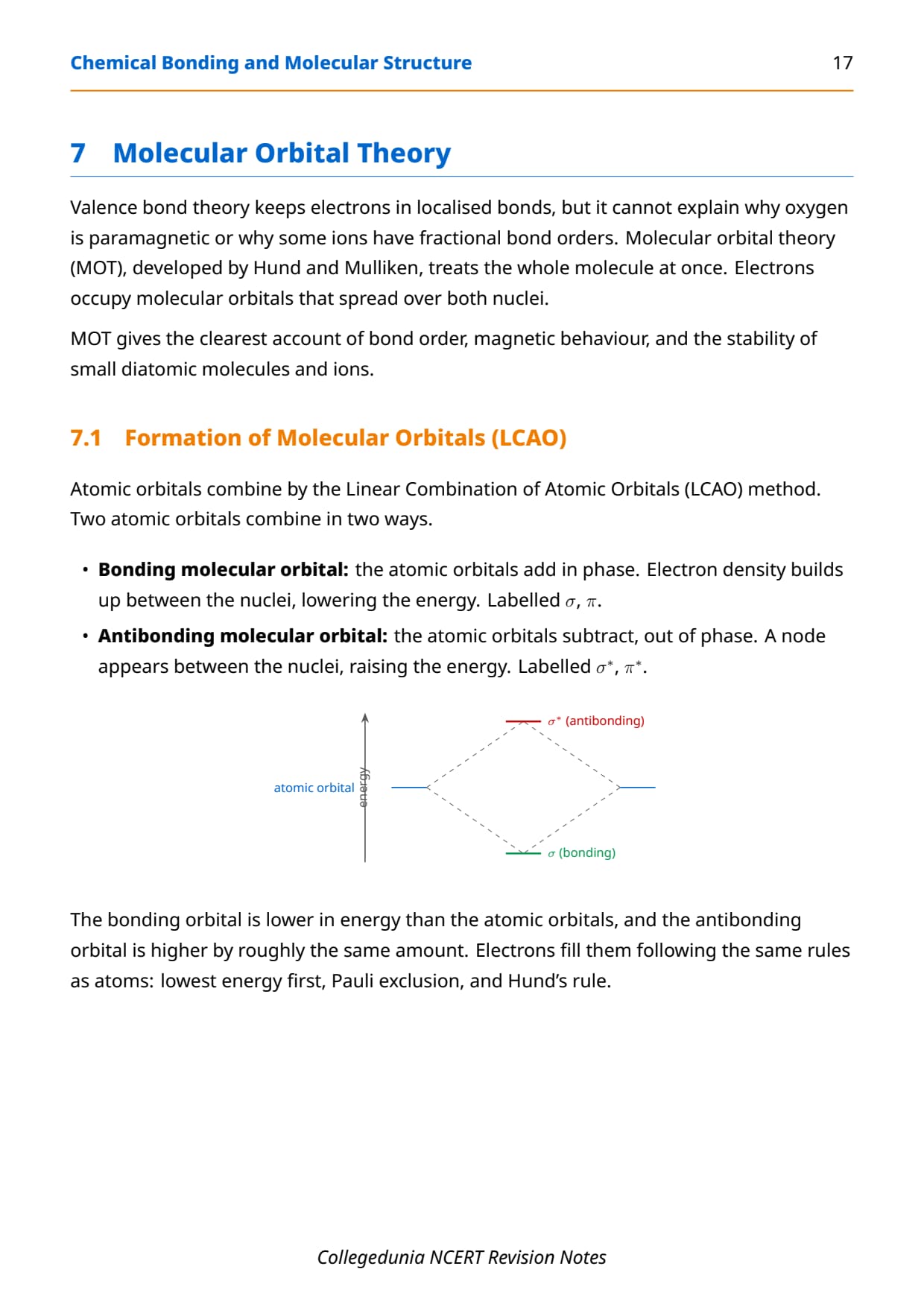
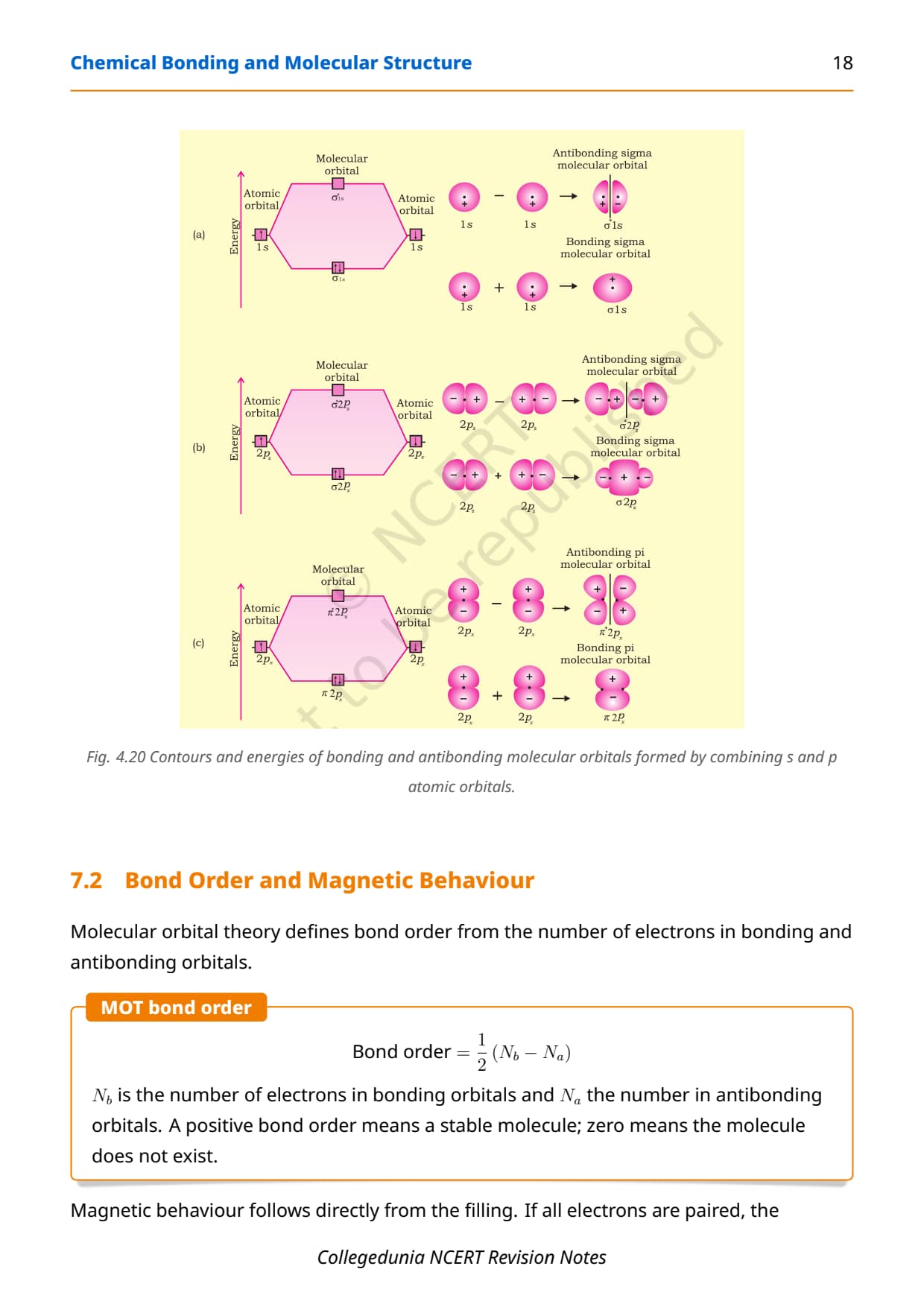
The molecular orbital theory (MOT) treats a molecule as a single unit where atomic orbitals combine into molecular orbitals. Two atomic orbitals give one lower-energy bonding orbital and one higher-energy antibonding orbital. This theory succeeds where valence bond theory fails, especially in explaining magnetic behaviour.
- Bonding orbital: electrons here lower the energy and hold the molecule together.
- Antibonding orbital: marked with a star, electrons here weaken the bond.
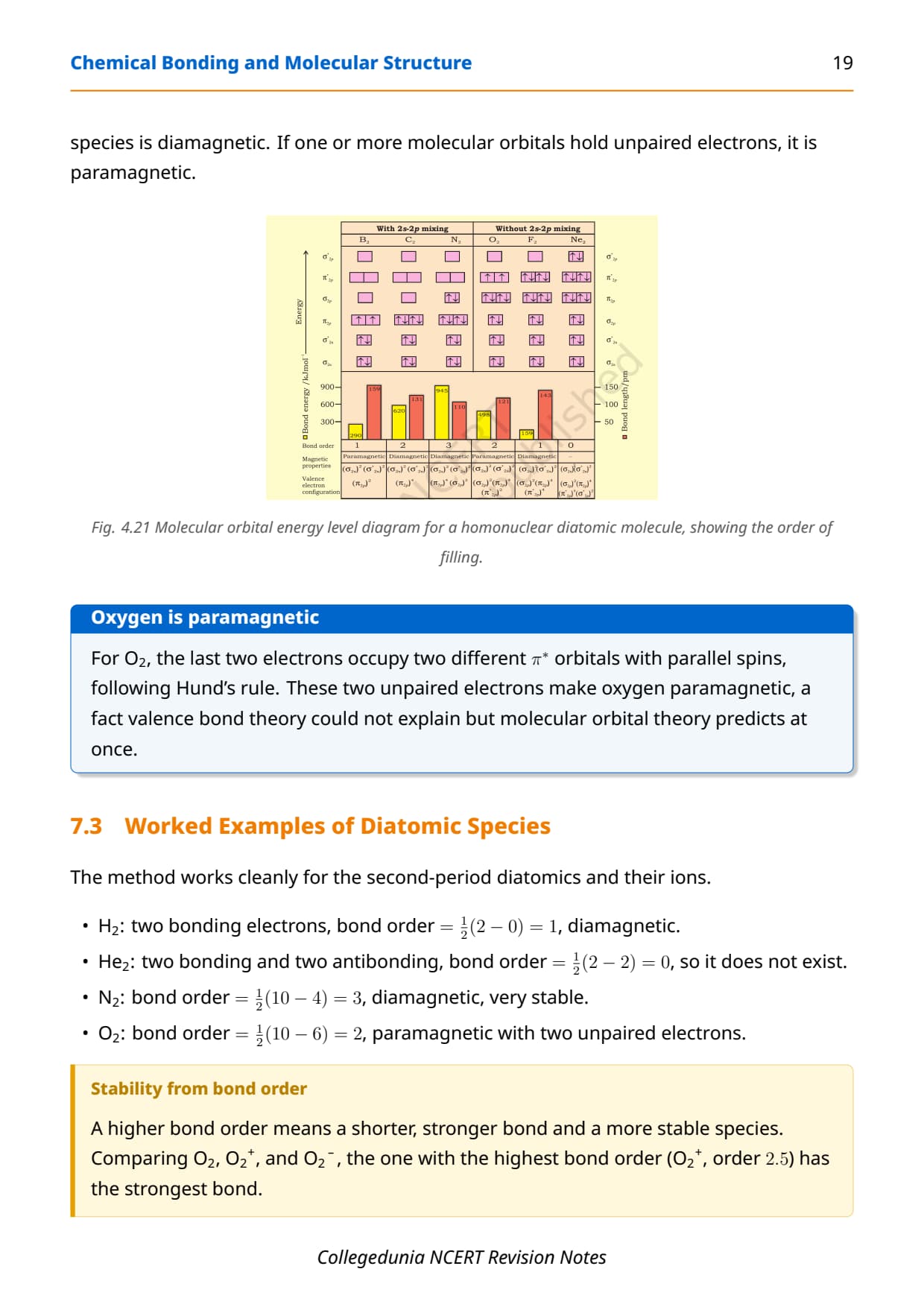
- Bond order: found as bond order = ½ (Nb − Na), where Nb and Na are bonding and antibonding electrons.
- Magnetic character: unpaired electrons make a molecule paramagnetic, while all-paired electrons make it diamagnetic.
A positive bond order means the molecule exists, and a higher value means a stronger bond. N2 has a bond order of 3, which is why it is so stable and unreactive. The big win for MOT is O2, which has two unpaired electrons and is therefore paramagnetic. No Lewis structure can show that, so this is a favourite exam point. He2 has a bond order of zero, which correctly predicts that it does not exist.
Hydrogen Bonding and Its Effect on Physical Properties
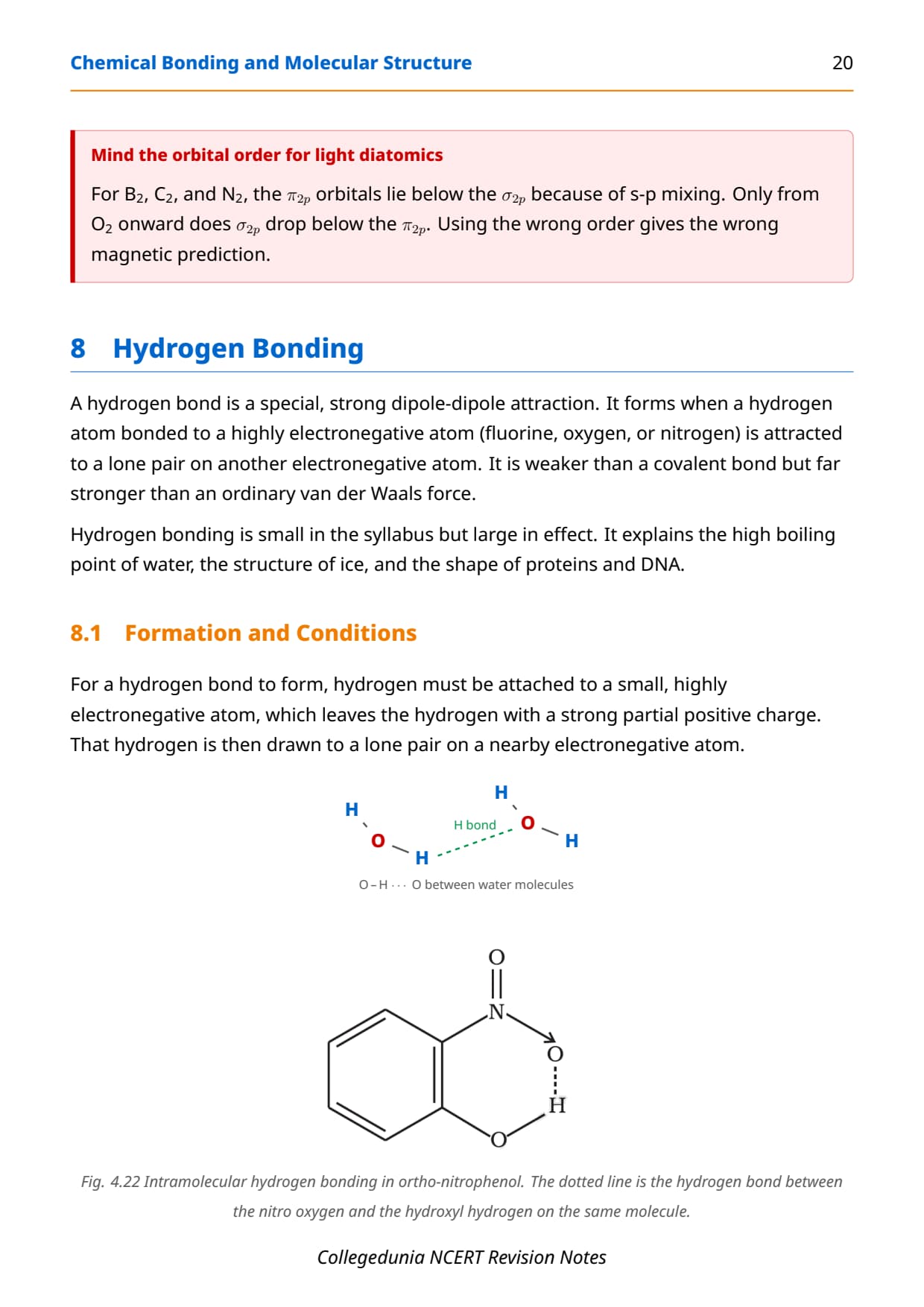
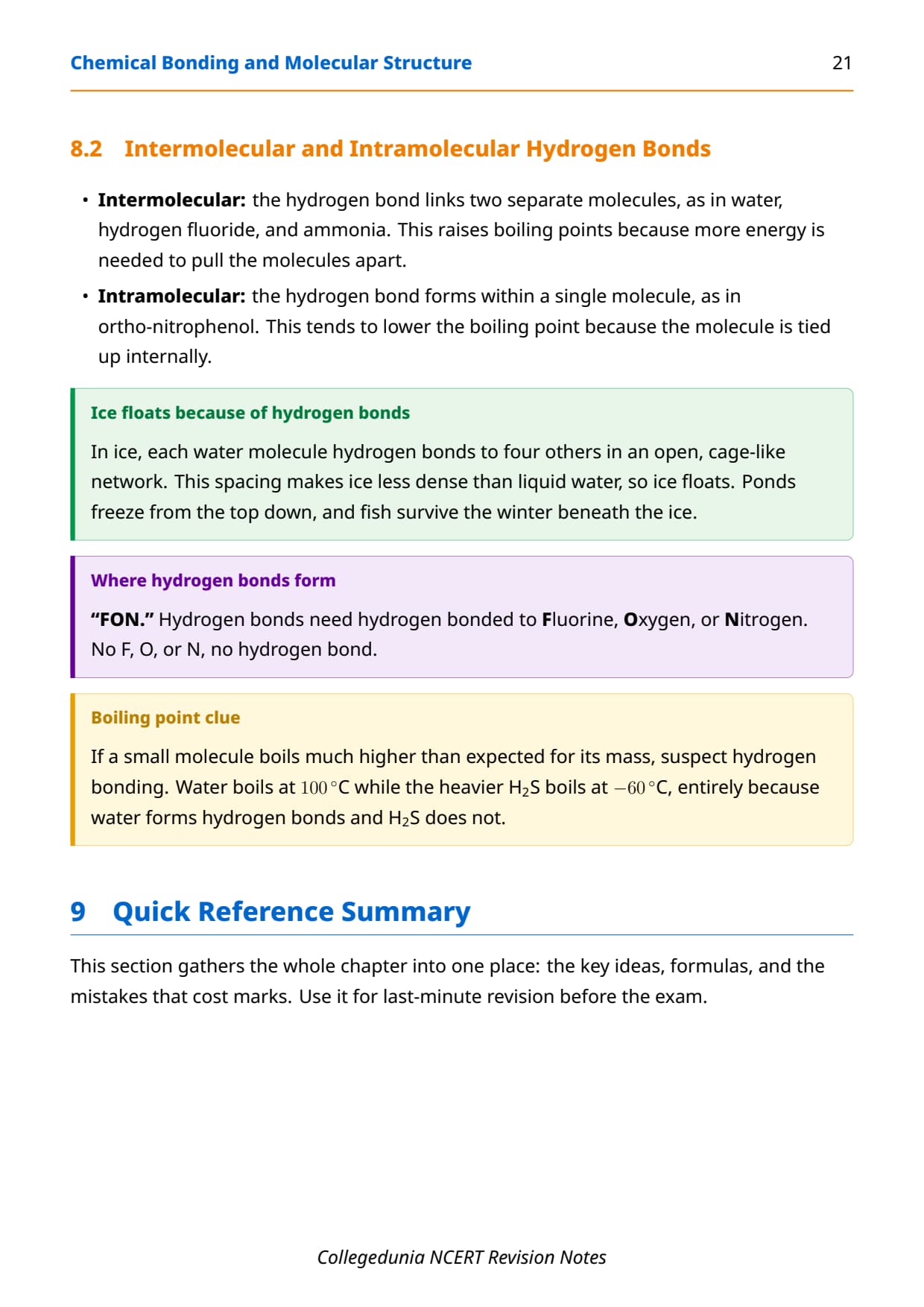
A hydrogen bond is a weak attraction between a hydrogen atom bonded to a highly electronegative atom (F, O or N) and a nearby electronegative atom. It is weaker than a covalent bond but strong enough to change boiling points and solubility. This topic links the chapter to the properties of water and alcohols.
- Intermolecular hydrogen bond: forms between two separate molecules, as in water and HF.
- Intramolecular hydrogen bond: forms within one molecule, as in ortho-nitrophenol.
- Effect on boiling point: water and HF have unusually high boiling points because of hydrogen bonding.
Hydrogen bonding is why ice floats on water. The bonds hold the molecules in an open cage, making solid ice less dense than liquid water. The strength order of bonds is covalent > hydrogen bond > van der Waals forces. Remember that the electronegative atom must carry a lone pair to accept the hydrogen bond.
Important Formulas and Values for Chemical Bonding and Molecular Structure
Every formula and value you need for the chapter sits in one table below, with what it means. Learn the formal charge and bond order rows first, since those carry the most marks in both Boards and entrance papers.
| Formula or value | What it means |
|---|---|
| Formal charge = (valence e−) − (non-bonding e−) − ½(bonding e−) | Charge bookkeeping on an atom in a Lewis structure |
| Bond order = ½ (Nb − Na) | Number of bonds from molecular orbital theory |
| Dipole moment µ = q × d | Measure of bond or molecular polarity, in debye |
| Bond angle in CH4 = 109.5° | Ideal tetrahedral (sp3) angle |
| Bond angle in NH3 = 107°, H2O = 104.5° | Angles reduced by lone-pair repulsion |
| Hybridization sum = sigma bonds + lone pairs | 2 = sp, 3 = sp2, 4 = sp3, 5 = sp3d, 6 = sp3d2 |
| Bond order of N2 = 3, O2 = 2 | Explains why N2 is stronger than O2 |
Write the sigma-plus-lone-pair count next to the central atom on every shape question. It gives you the hybridization and the shape in one step. Keep this table open while you solve the back-exercise questions in these revision notes.
Key Definitions in Chemical Bonding and Molecular Structure
Board short-answer questions often ask for a clean definition in one or two lines. Learn these word-for-word, because a vague definition loses easy marks. Each one also sets up a shape or bonding question you can be asked to explain.
| Term | Definition |
|---|---|
| Octet rule | Atoms bond so that each is surrounded by eight valence electrons. |
| Ionic bond | A bond formed by the complete transfer of electrons from one atom to another. |
| Covalent bond | A bond formed by the sharing of one or more electron pairs between atoms. |
| Bond enthalpy | The energy needed to break one mole of a bond in the gas phase. |
| Hybridization | The mixing of atomic orbitals of similar energy to form new equivalent orbitals. |
| Hydrogen bond | A weak attraction between H bonded to F, O or N and a nearby electronegative atom. |
A common question asks you to compare two molecules, such as the shapes of NH3 and H2O. Always state the hybridization, the number of lone pairs, and the final shape in that order. Learning these definitions makes the wording of every board question familiar.
Common Mistakes Students Make in Chemical Bonding and Molecular Structure
These slips happen while applying the rules, not because the concept is unclear. Each one costs 1 to 3 marks in the paper, so watch for them at the exact step.
Mistake 1: Counting lone pairs as bond pairs when finding shape. Only sigma bonds and lone pairs on the central atom set the geometry.
Mistake 2: Forgetting that a double bond counts as one sigma bond for hybridization, not two.
Mistake 3: Calling CO2 polar. Its bond dipoles are equal and opposite, so the net dipole is zero.
Mistake 4: Mixing up bonding and antibonding electrons in the bond order formula, which flips the sign of the answer.
Chemical Bonding and Molecular Structure Weightage in CBSE Boards, JEE and NEET
This chapter is high-scoring and appears every year across all four exams. It carries both objective and short-answer questions, and the shape and hybridization part is almost guaranteed. Here is how the marks split for 2026-27.
| Exam | Typical weightage | What is asked |
|---|---|---|
| CBSE Boards | 7 to 9 marks | Shape and hybridization plus one short answer on bonding or dipole moment |
| JEE Main | 2 to 3 questions | Bond order, hybridization, and molecular orbital theory |
| NEET | 2 to 3 questions | VSEPR shapes, hybridization, and hydrogen bonding |
| CUET | 1 to 2 objective questions | Octet rule, bond parameters, and shapes of molecules |
Hybridization and molecular shape together are the most tested part of this chapter across all four exams. Master VSEPR and hybridization first, then bond order and magnetic character, then hydrogen bonding, in that order of return on effort.
How to Revise Chemical Bonding and Molecular Structure Quickly
Use these chemical bonding and molecular structure class 11 notes for a fast, ordered recap the night before a test. The checklist below takes about 30 minutes and hits every marks-heavy idea.
- First 10 minutes: draw the Lewis structures of CO2, NH3 and H2O and mark their shapes.
- Next 10 minutes: write the hybridization of CH4, BF3, PCl5 and SF6 from memory.
- Last 10 minutes: calculate the bond order of N2 and O2 and state which one is paramagnetic.
Close the loop by explaining why water has a higher boiling point than H2S. If you can do all three blocks without notes, the chapter is exam-ready. Keep the Important Formulas table beside you for the first pass only, then try it closed-book.
Student Feedback on the Chemical Bonding and Molecular Structure Notes
What 14,260 students told us about their Chemical Bonding and Molecular Structure revision:
- 68% of students rated molecular orbital theory as the hardest sub-topic in the chapter.
- Most-skipped step: drawing the correct Lewis structure before deciding molecular shape, missed by about 3 in 10 students.
- Students who learned the sigma-plus-lone-pair count first said hybridization questions felt far easier.
Source: 2026-27 Class 11 Chemistry student poll. Sample of 14,260 students from CBSE schools across 15 states, conducted before the 2026 boards.
Other Chemical Bonding and Molecular Structure Class 11 Chemistry Resources
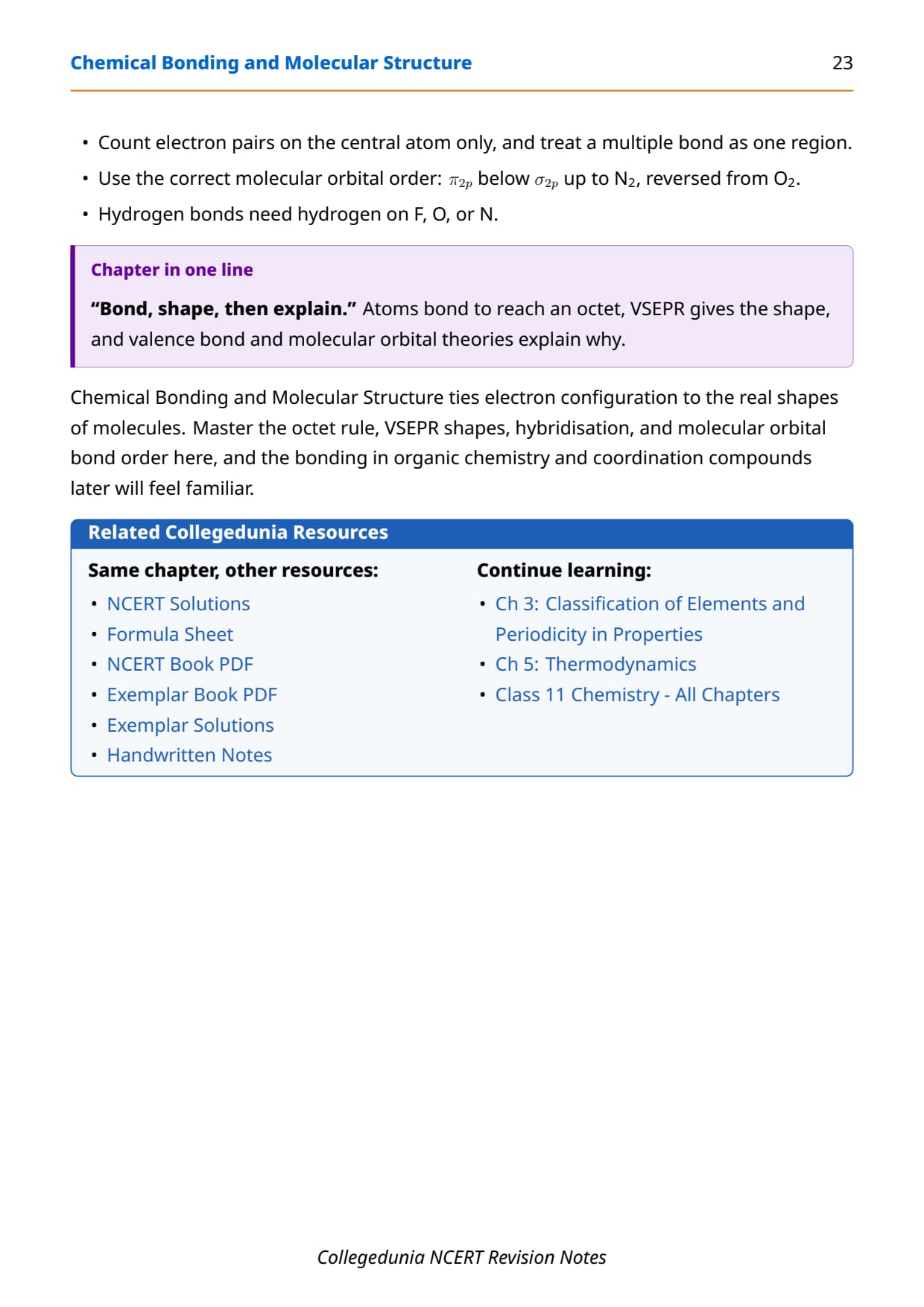
Pair these notes with the solved answers and the textbook PDF for the same chapter.
| Resource | Link |
|---|---|
| NCERT Solutions | Chemical Bonding and Molecular Structure Class 11 NCERT Solutions |
| NCERT Book PDF | Chemical Bonding and Molecular Structure Class 11 Book PDF |
NCERT Notes for Class 11 Chemistry: All Chapters
Jump to the revision notes for any other Class 11 Chemistry chapter below.
| Chapter | NCERT Notes |
|---|---|
| Chapter 1 | Some Basic Concepts of Chemistry |
| Chapter 2 | Structure of Atom |
| Chapter 3 | Classification of Elements and Periodicity in Properties |
| Chapter 4 | Chemical Bonding and Molecular Structure |
| Chapter 5 | Thermodynamics |
| Chapter 6 | Equilibrium |
| Chapter 7 | Redox Reactions |
| Chapter 8 | Organic Chemistry Some Basic Principles and Techniques |
| Chapter 9 | Hydrocarbons |
FAQs on Chemical Bonding and Molecular Structure Class 11 Chemistry Notes
Chemical Bonding and Molecular Structure Notes - Frequently Asked Questions
Ques. What topics do the chemical bonding and molecular structure class 11 notes cover?
Ans. These chemical bonding and molecular structure class 11 notes cover the Kossel-Lewis approach, the octet rule and its limitations, ionic and covalent bonds, bond parameters, Lewis structures and formal charge, VSEPR theory and molecular shapes, valence bond theory, hybridization, molecular orbital theory with bond order, and hydrogen bonding. Every key formula and definition is included for fast revision.
Ques. What is the octet rule and what are its limitations?
Ans. The octet rule states that atoms combine so that each has eight electrons in its valence shell. Its main limitations are the incomplete octet in molecules like BeCl2 and BF3, the expanded octet in SF6 and PF5, and odd-electron molecules like NO and NO2. It also fails to explain molecular shape and bond strength.
Ques. How do I predict the shape of a molecule using VSEPR theory?
Ans. Draw the Lewis structure and count the sigma bonds and lone pairs on the central atom. Their total gives the electron geometry, such as tetrahedral for four pairs. Lone pairs then bend the shape because lone pair-lone pair repulsion is greater than bond pair-bond pair repulsion. This is why NH3 is pyramidal and H2O is bent.
Ques. How do I calculate the formal charge on an atom?
Ans. The formal charge on an atom equals its valence electrons minus its non-bonding (lone pair) electrons minus half of its bonding electrons. The best Lewis structure is the one where formal charges are closest to zero, with any negative charge on the more electronegative atom. Formal charge is a bookkeeping tool and does not show a real charge on the atom.
Ques. Why is O2 paramagnetic according to molecular orbital theory?
Ans. In molecular orbital theory, the last two electrons of O2 go singly into two equal-energy antibonding pi orbitals. These two unpaired electrons make O2 paramagnetic, which no Lewis structure can explain. Its bond order is 2. This success in predicting magnetic character is the main advantage of molecular orbital theory over valence bond theory.
Ques. What is the weightage of this chapter in the CBSE board exam?
Ans. Chemical Bonding and Molecular Structure carries about 7 to 9 marks in the CBSE Class 11 Chemistry paper, usually a shape or hybridization question plus one short answer on bonding or dipole moment. It also appears in JEE Main, NEET and CUET as objective questions on VSEPR shapes, hybridization, bond order, and hydrogen bonding.
Ques. What is a hydrogen bond and why is it important?
Ans. A hydrogen bond is a weak attraction between a hydrogen atom bonded to a highly electronegative atom such as fluorine, oxygen or nitrogen and a nearby electronegative atom. It explains the high boiling points of water and HF, and why ice is less dense than water. Hydrogen bonds can be intermolecular, as in water, or intramolecular, as in ortho-nitrophenol.



Comments