




These structure of atom class 11 notes pull together every model, formula, and quantum rule that the CBSE Boards, JEE Main, JEE Advanced, NEET and CUET papers test in 2026-27. Revise the whole chapter fast, with the subatomic particles, the atomic models, and the full quantum picture in one place.
This is the second chapter of the NCERT textbook, and the quantum ideas you build here decide how you read the periodic table and bonding in every later chapter.
- CBSE Weightage: 6 to 7 marks, usually one numerical on energy or wavelength plus one short answer on quantum numbers.
- Topics covered: subatomic particles, Thomson, Rutherford and Bohr models, electromagnetic radiation, photoelectric effect, dual nature, Heisenberg uncertainty, quantum numbers, orbital shapes, and electronic configuration.
- Key formulas: E = hν, c = νλ, Bohr energy of the nth orbit, de Broglie wavelength, and the Heisenberg relation.
These structure of atom class 11 notes are curated by subject experts, based on the 2026-27 NCERT textbook, and checked against the last five years of CBSE Board, JEE Main and NEET papers.
Topic-by-Topic Summary of Structure of Atom
The chapter moves from the particles inside an atom to the way electrons are arranged around the nucleus. It starts with the discovery of the electron, proton and neutron, then tests one atomic model after another, and ends with the quantum mechanical model. Here is the quick map of what each topic gives you.
- Subatomic particles: the electron, proton and neutron, with their charge and mass.
- Atomic models: Thomson, Rutherford and Bohr, each fixing a flaw in the one before.
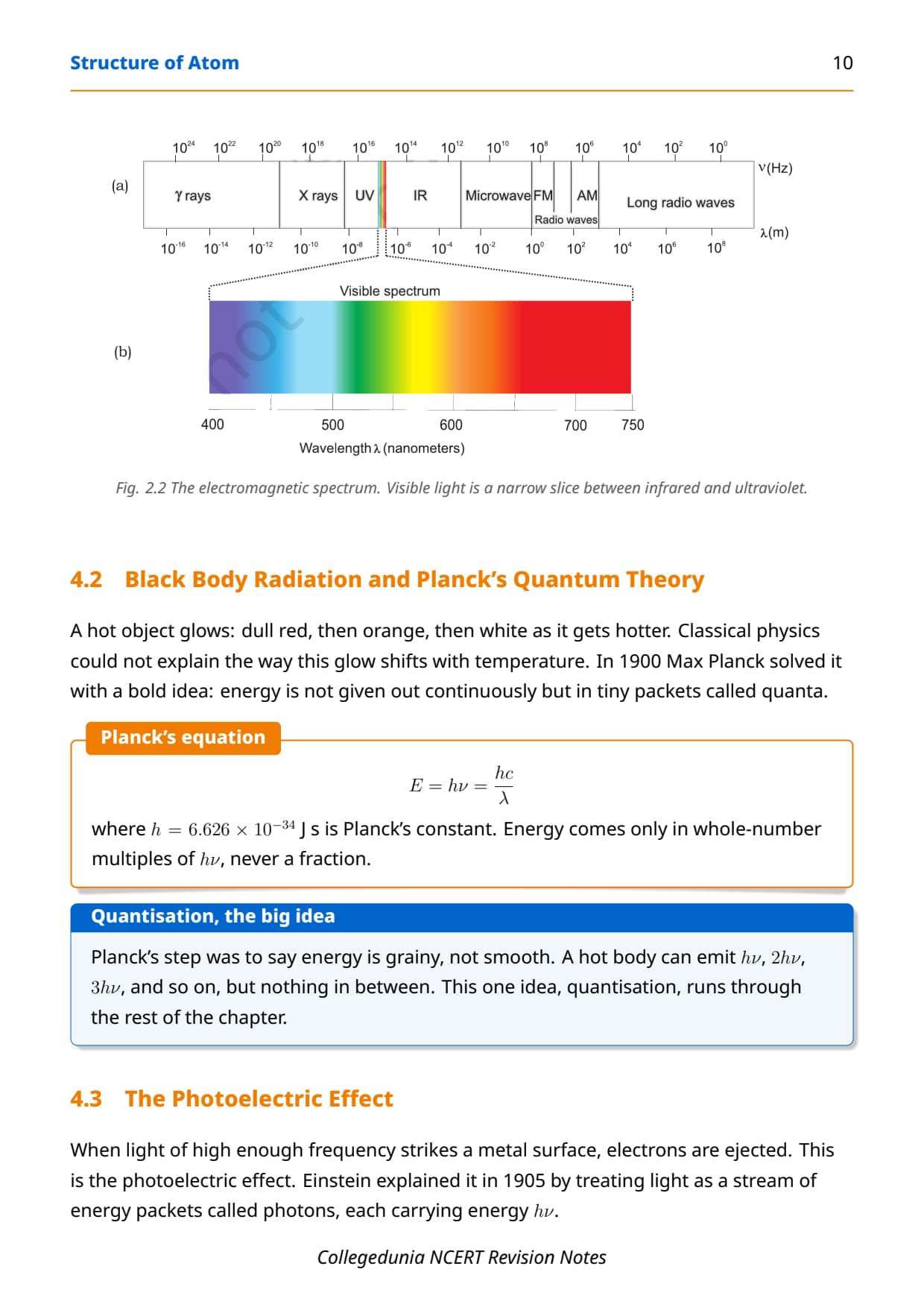
- Electromagnetic radiation: the wave and particle nature of light, and the spectrum of hydrogen.
- Photoelectric effect and dual nature: light and matter both behave as wave and particle.
- Heisenberg uncertainty: why an electron cannot have a fixed path around the nucleus.
- Quantum numbers and orbitals: the four numbers that name an electron, and the shapes of s, p and d orbitals.
- Electronic configuration: filling orbitals using the Aufbau principle, Pauli's rule and Hund's rule.
Revise the topics in this order, because each model exists to repair the one before it. Master the Bohr model and quantum numbers first, and the rest of the chapter falls into place. These structure of atom class 11 notes follow the same sequence as the NCERT textbook.
Subatomic Particles and the Early Atomic Models of Thomson and Rutherford
An atom is not the smallest particle. It is built from three subatomic particles, and two early models tried to explain how they sit together. These experiments appear as short-answer and assertion-reason questions almost every year.
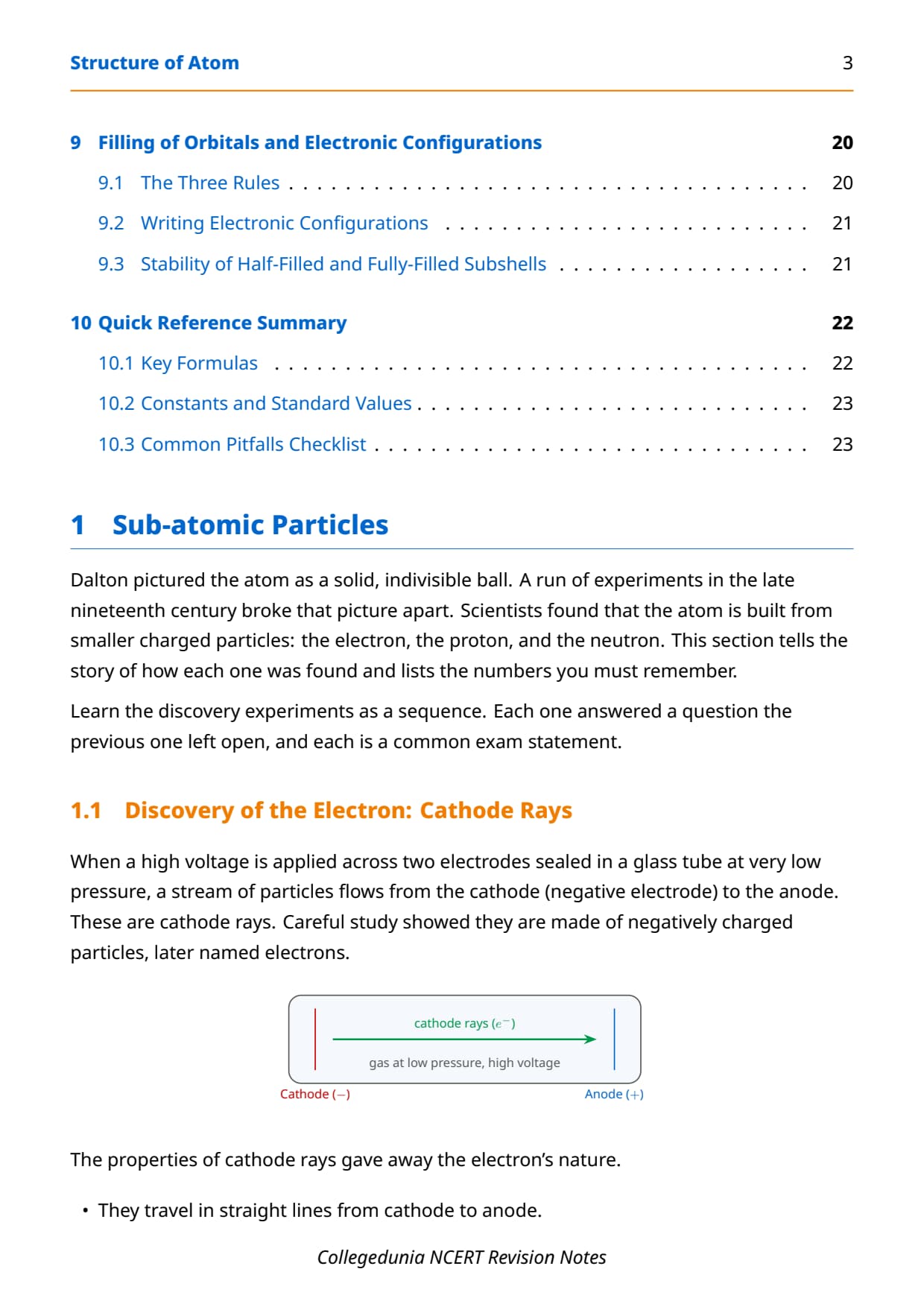
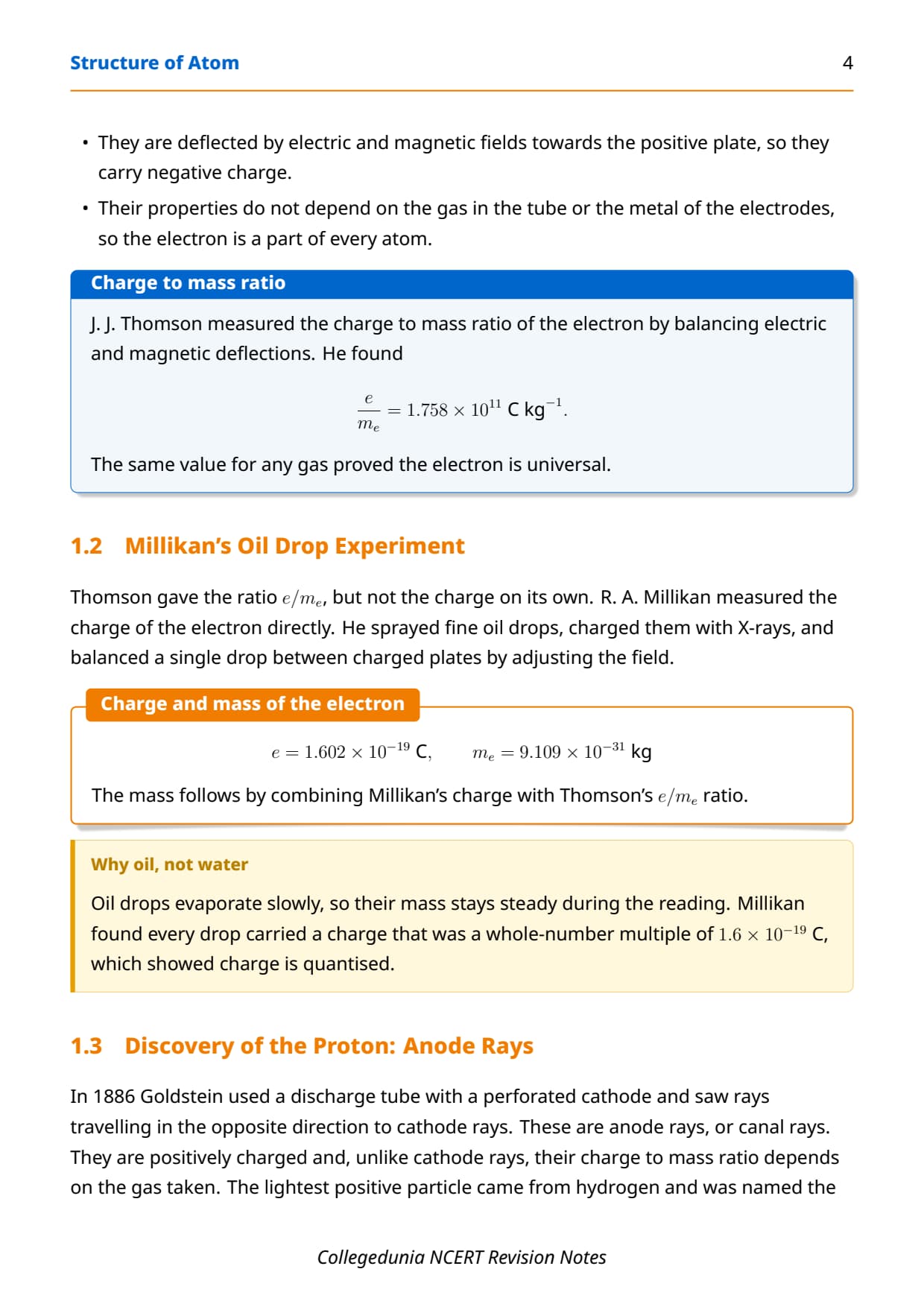
- Electron: charge −1.6 × 10⁻¹⁹ C and mass 9.1 × 10⁻³¹ kg, found by J.J. Thomson in the cathode ray tube.
- Proton: charge +1.6 × 10⁻¹⁹ C and mass about 1.67 × 10⁻²⁷ kg, found in the anode ray experiment.
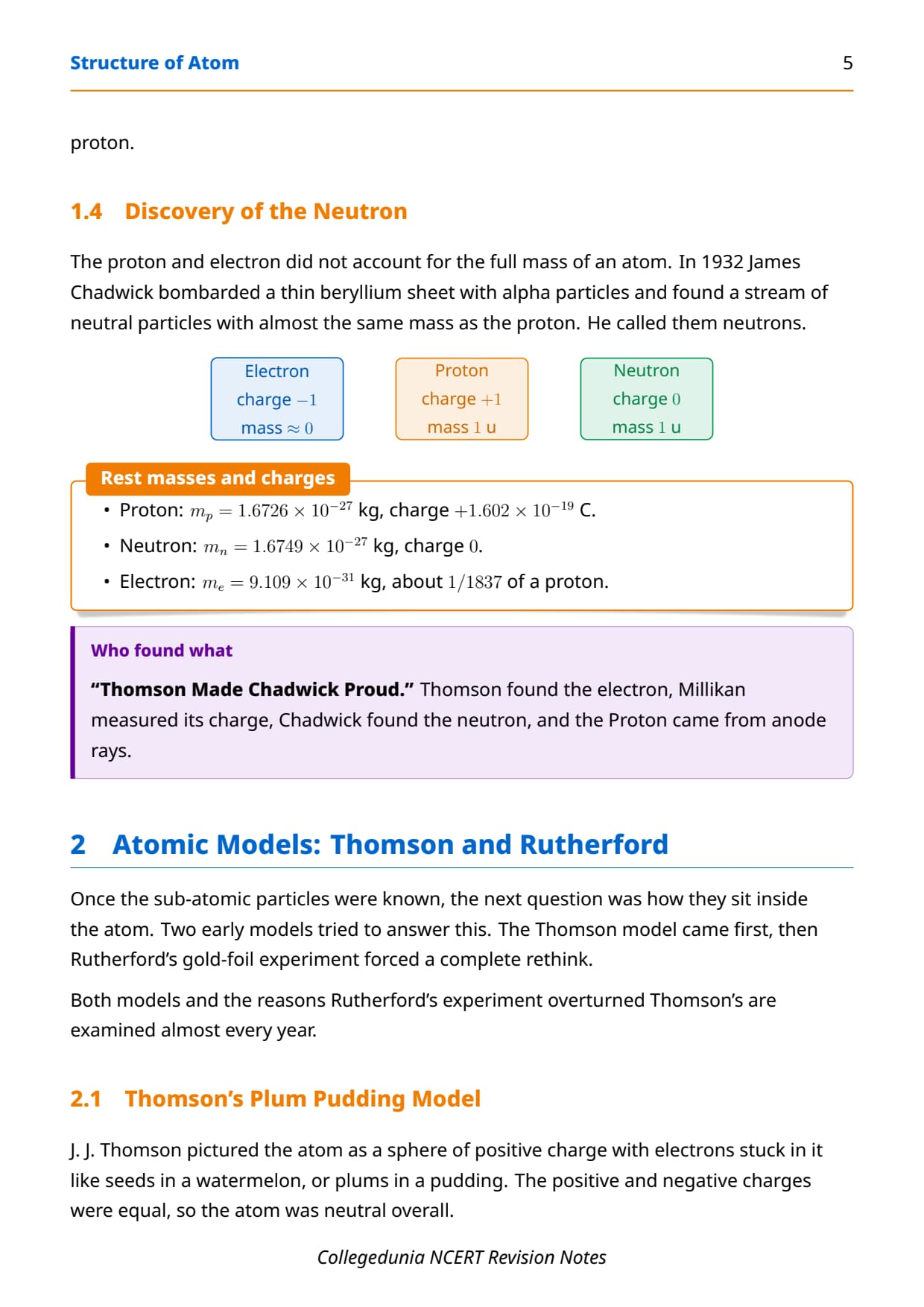
- Neutron: no charge and mass close to the proton, found by James Chadwick.
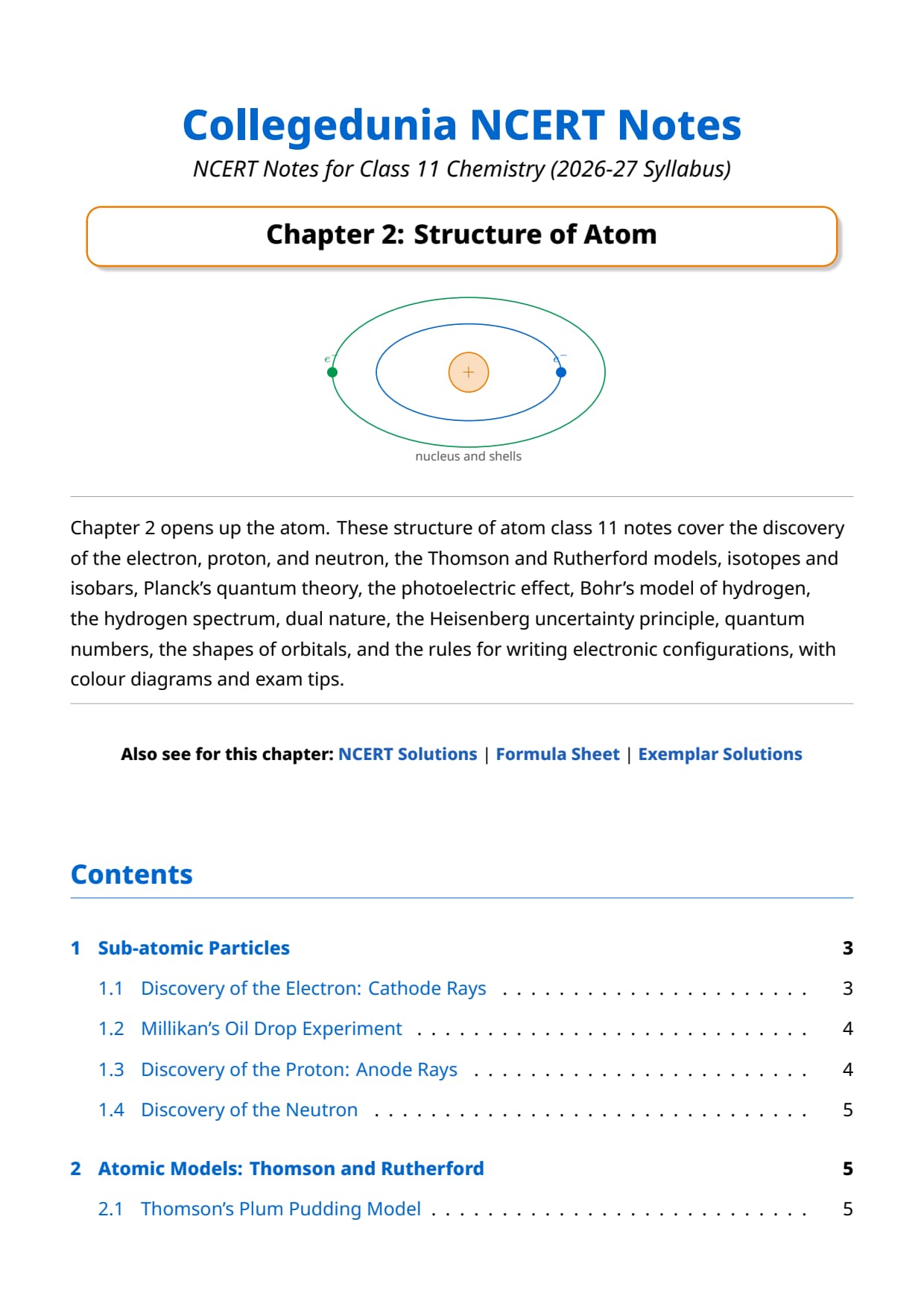
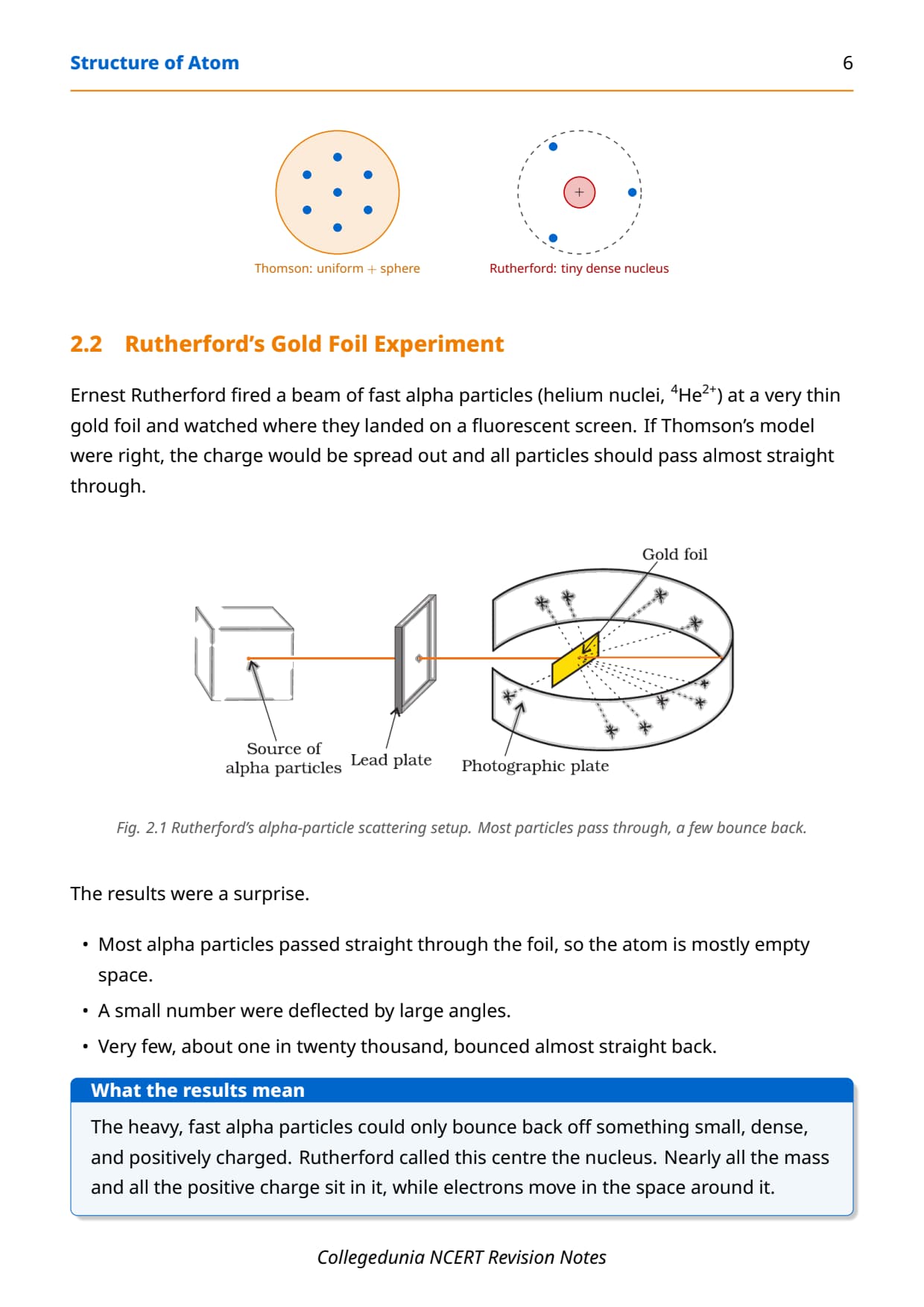
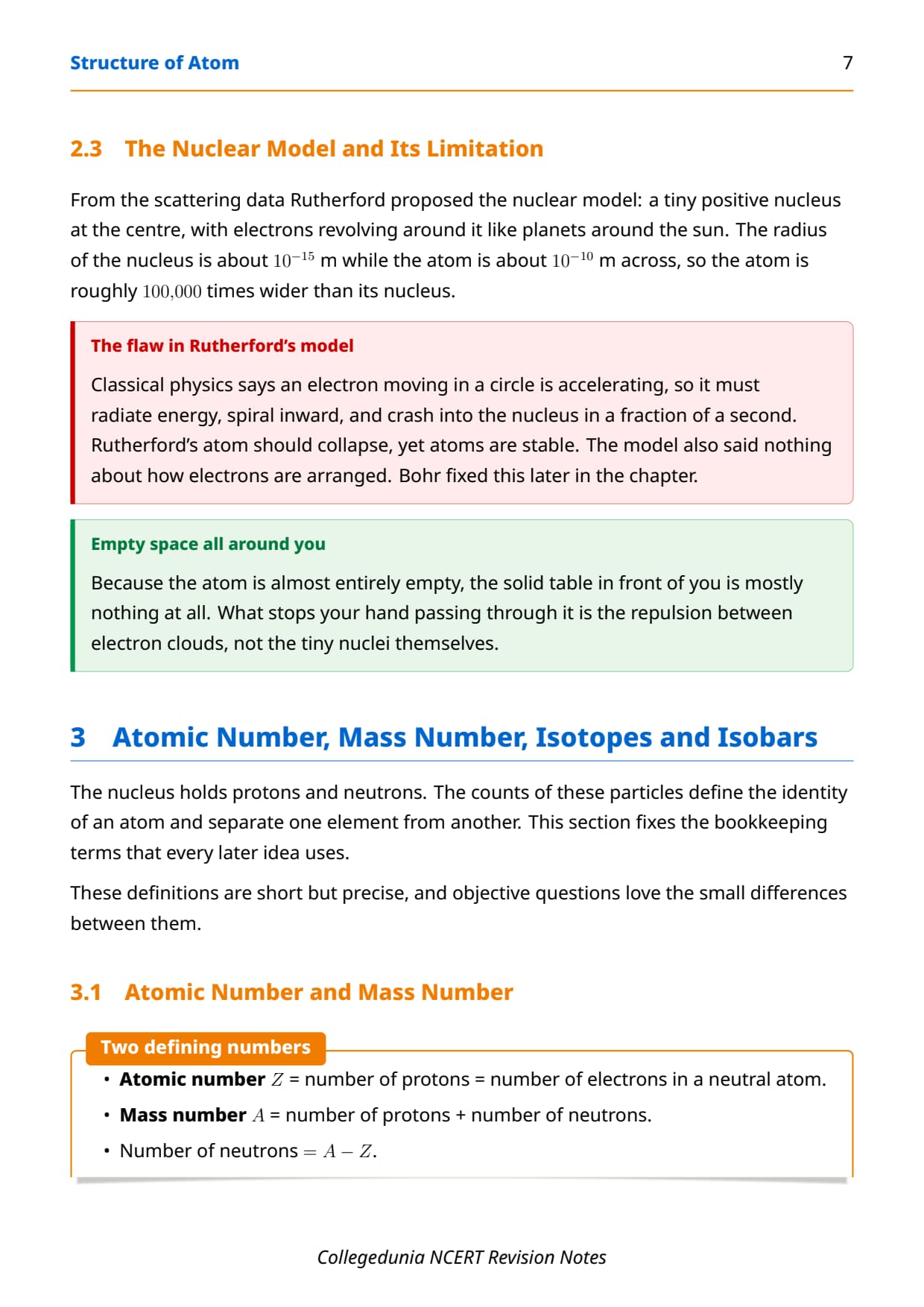
Thomson's model pictured the atom as a sphere of positive charge with electrons stuck in it, like seeds in a watermelon. It could not explain the scattering that Rutherford saw. Rutherford's alpha-particle scattering showed the atom is mostly empty space with a tiny, dense, positive nucleus at the centre. Electrons move around this nucleus, and almost all the mass sits in it. The atomic number Z equals the number of protons, and the mass number A equals protons plus neutrons.
Bohr Model and the Hydrogen Line Spectrum
Rutherford's model could not say why the electron does not spiral into the nucleus. Niels Bohr fixed this for the hydrogen atom by allowing only fixed circular orbits. This model explains the line spectrum of hydrogen, a favourite numerical in both Boards and entrance papers.
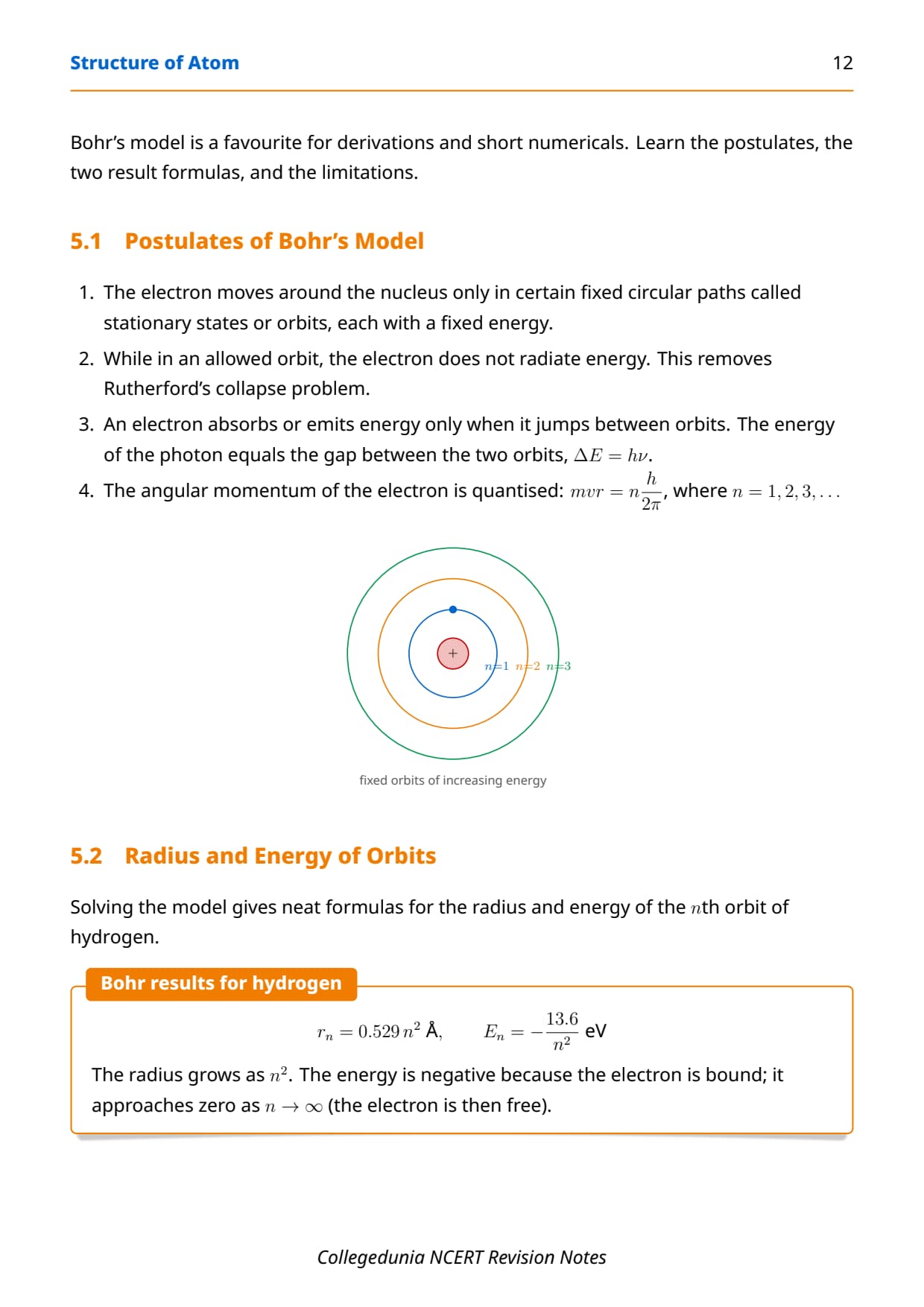
- Electrons revolve only in fixed orbits of definite energy, called stationary states, without radiating energy.
- The energy of an orbit is En = −13.6 / n2 eV for the hydrogen atom.
- Energy is absorbed or emitted only when an electron jumps between orbits, as ΔE = E2 − E1 = hν.
- The radius of the nth orbit grows as n2, and the first orbit radius is 52.9 pm.
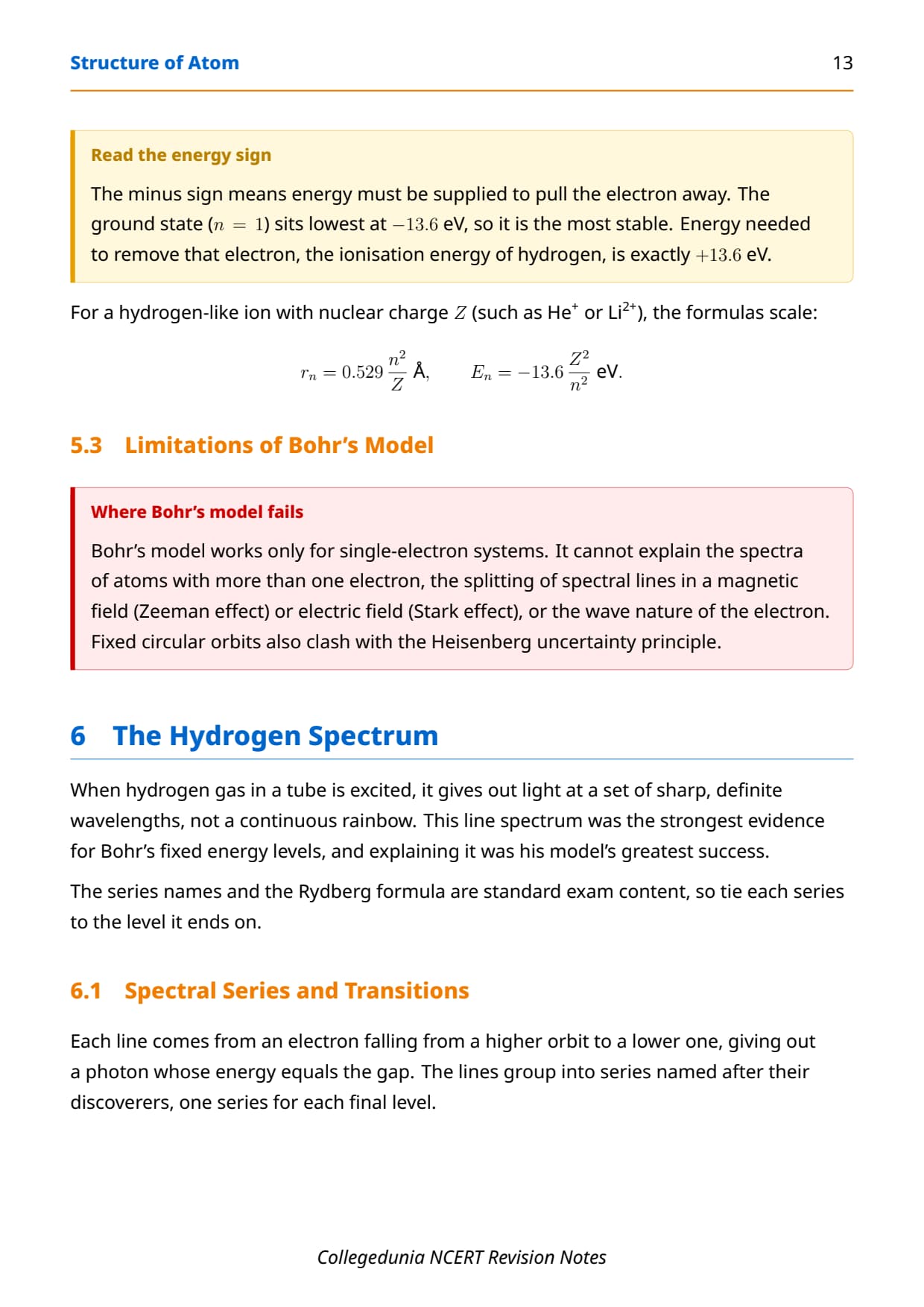
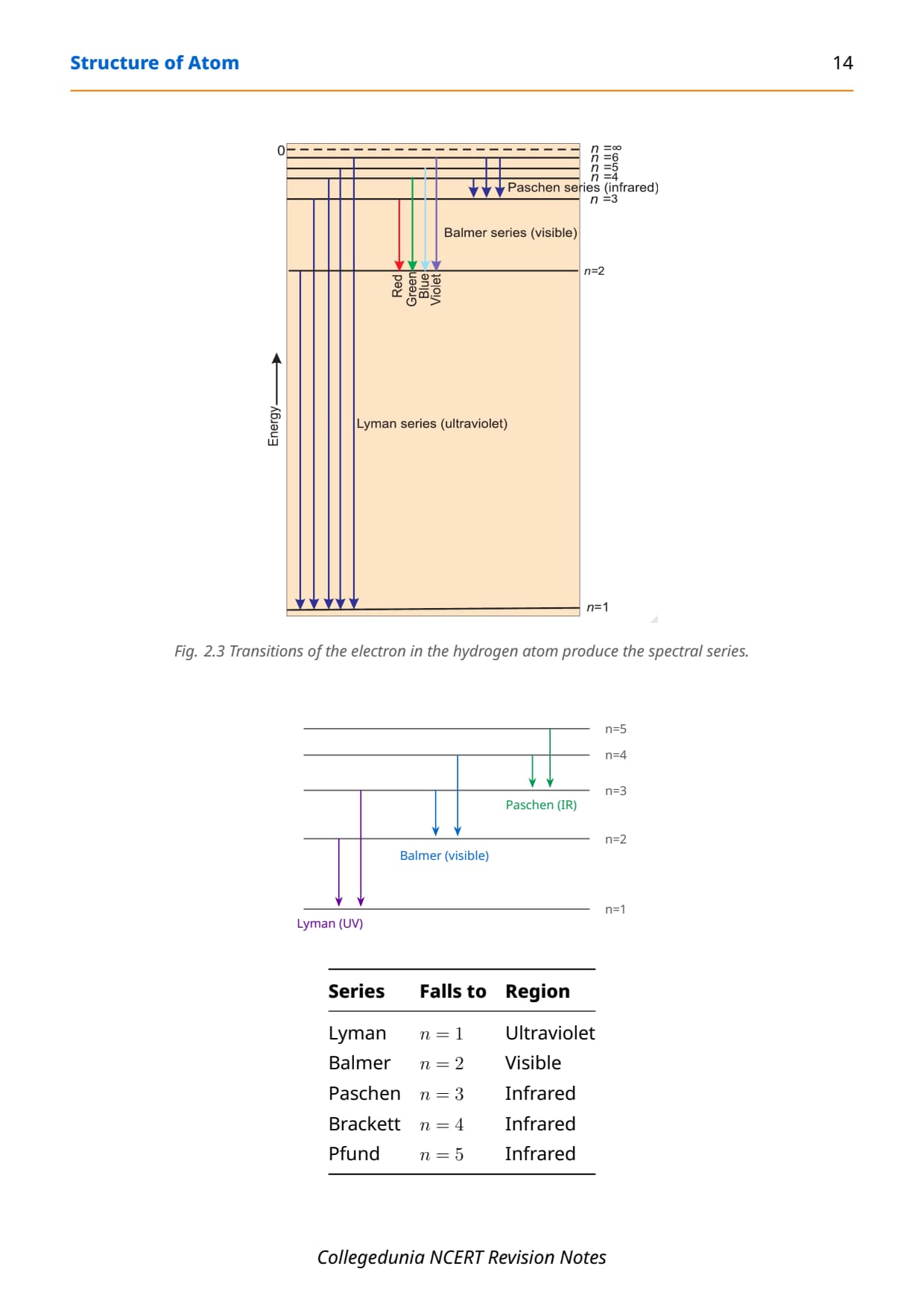
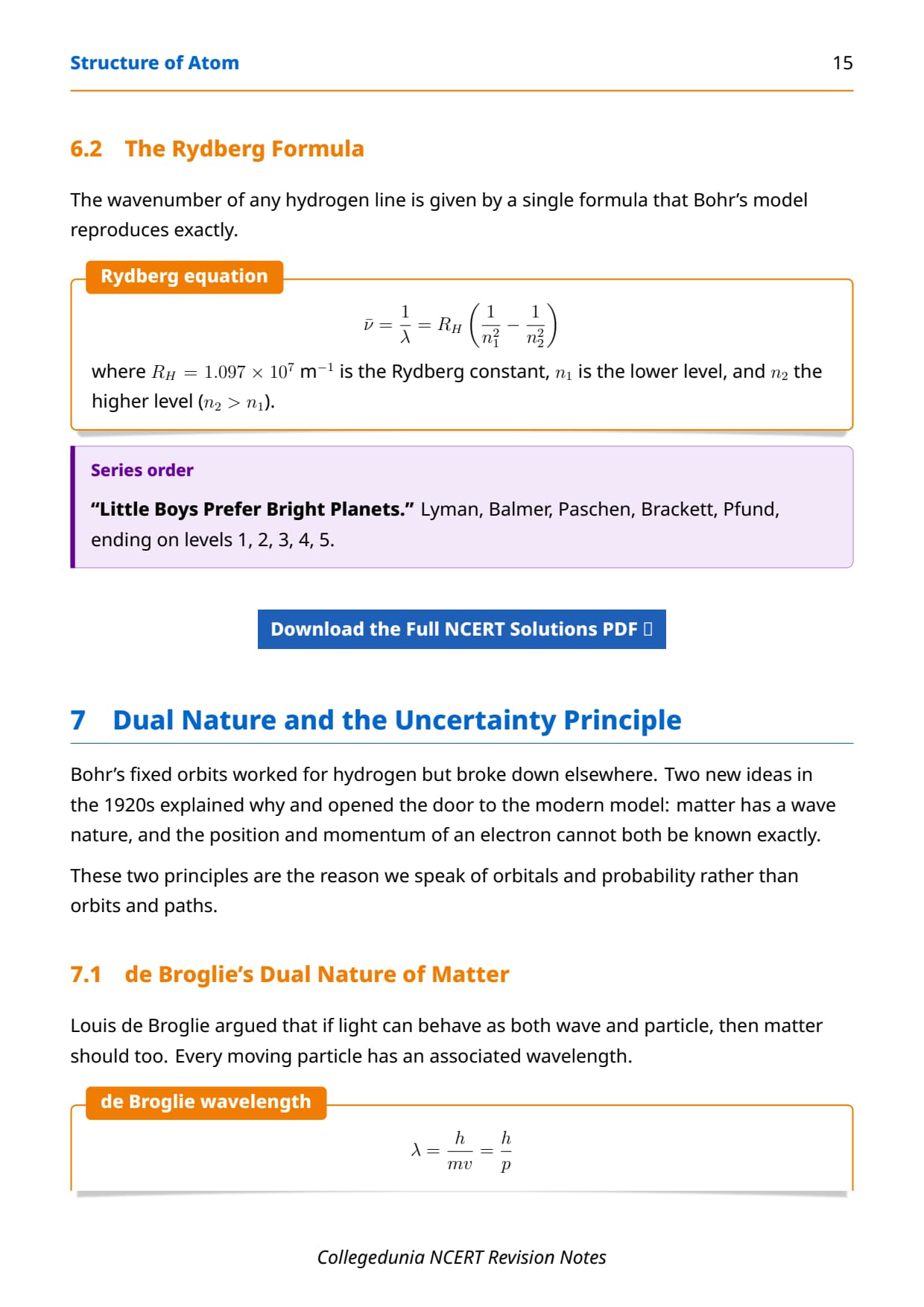
When an excited electron falls back, it emits light of a fixed frequency, which is why hydrogen gives a line spectrum and not a continuous one. The lines fall into series named Lyman, Balmer, Paschen, Brackett and Pfund. The Balmer series lies in the visible region and is the one drawn most often in exams. Bohr's model works well for hydrogen and one-electron ions, but fails for atoms with many electrons.
Electromagnetic Radiation, the Photoelectric Effect and the Dual Nature of Matter
Light carries energy as an electromagnetic wave, but some experiments only make sense if light is also a stream of particles. This section links the wave picture, the particle picture, and the same idea applied to matter.
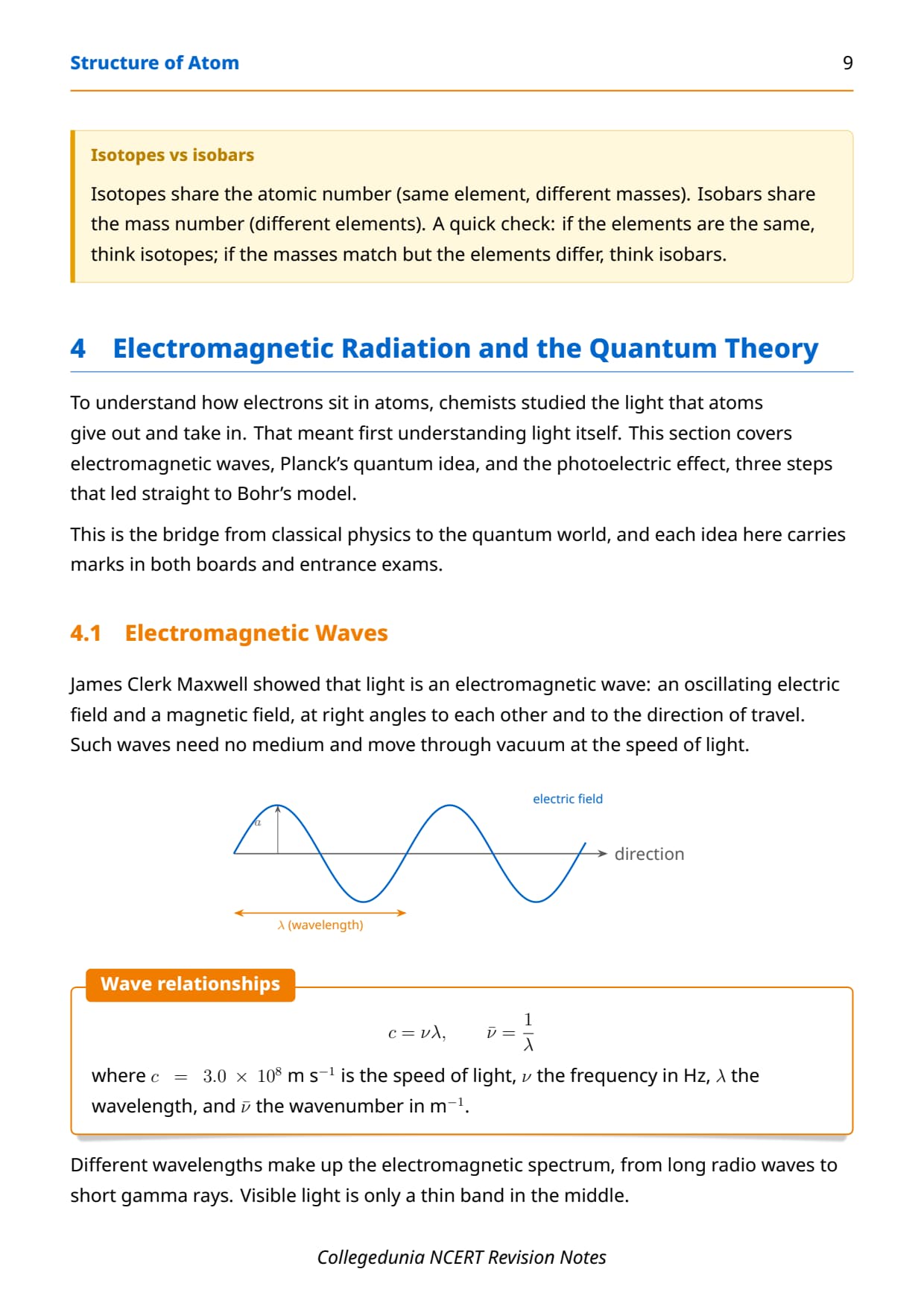
- Wave nature: speed c = νλ, where frequency and wavelength are inversely related for light in vacuum.
- Particle nature: light travels in packets called photons, each of energy E = hν, where h is Planck's constant.
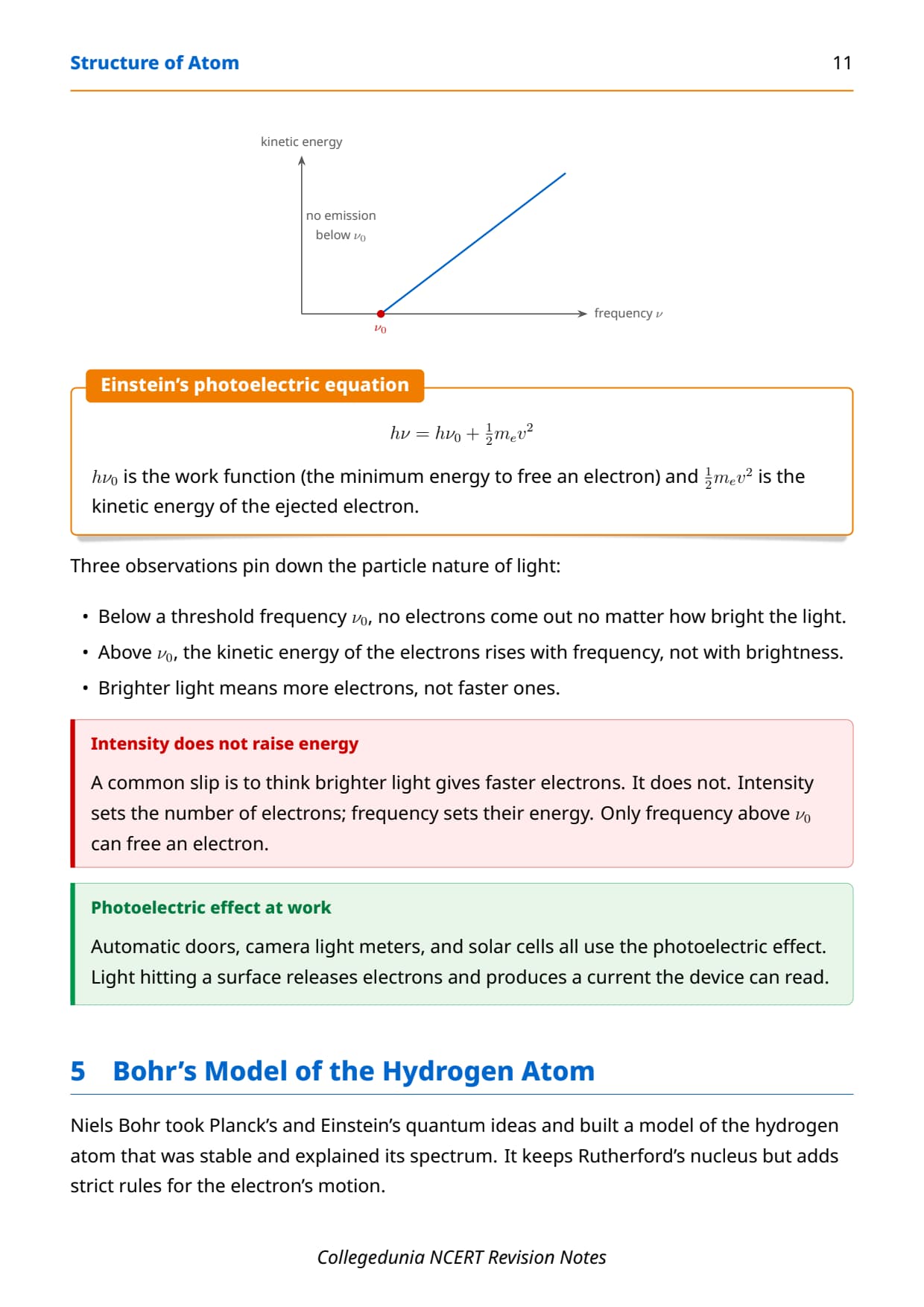
- Photoelectric effect: light above a threshold frequency knocks electrons out of a metal, and the electron energy depends on frequency, not intensity.
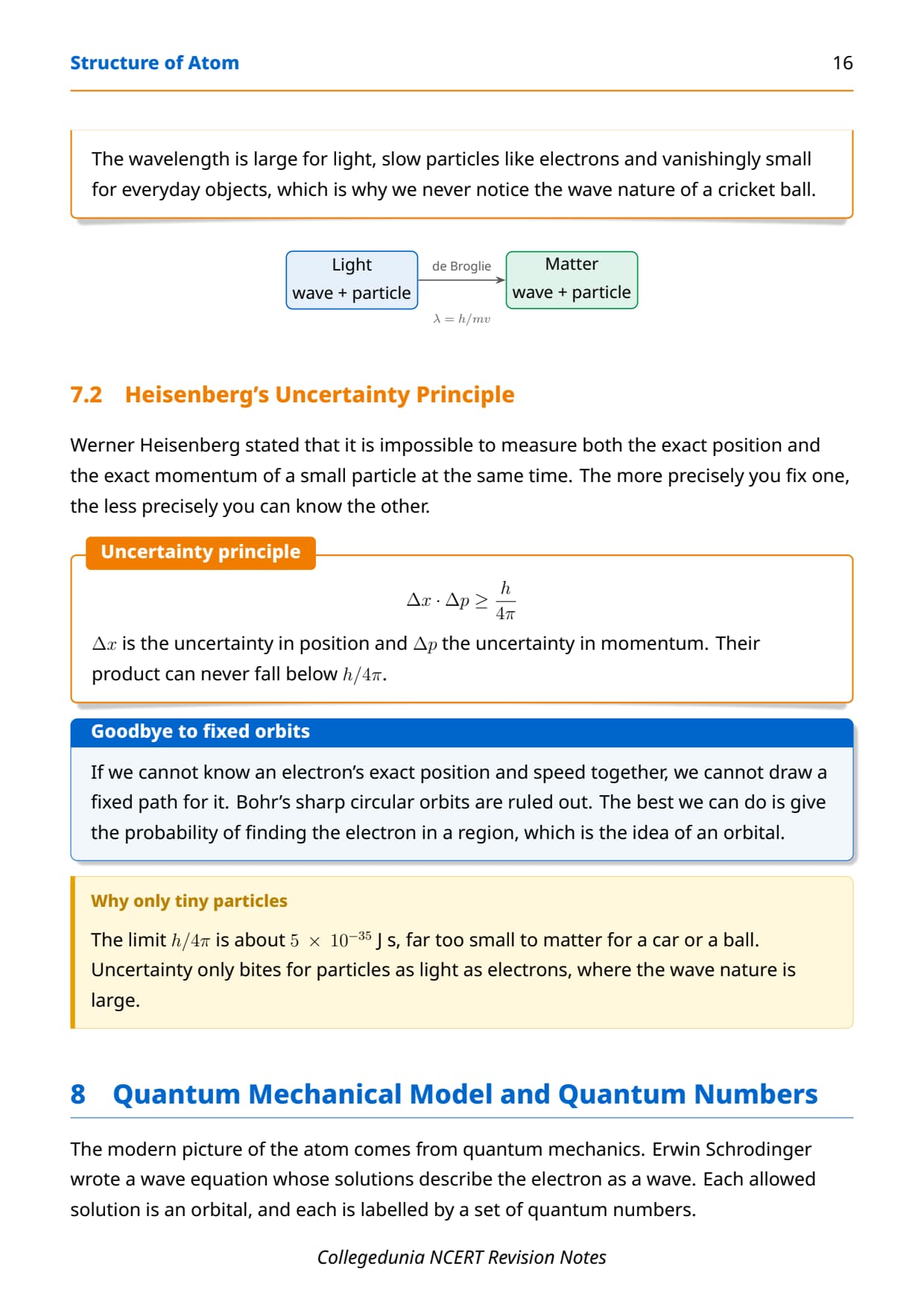
- de Broglie relation: every moving particle has a wavelength λ = h / mv, so matter has a dual nature too.
The photoelectric effect is the proof that light behaves as particles. Below the threshold frequency, no electron comes out however bright the light is, which the wave model cannot explain. Einstein explained it with hν = W + kinetic energy, where W is the work function of the metal. Louis de Broglie then argued that if waves act as particles, particles should act as waves, and his relation was confirmed for electrons. These structure of atom class 11 notes keep the photon energy formula at the centre, because it feeds every wavelength and energy numerical.
Quantum Mechanical Model: Heisenberg Uncertainty and the Four Quantum Numbers
The modern model drops fixed orbits and describes the electron by a probability region called an orbital. Two ideas define this model: the Heisenberg uncertainty principle, and the set of four quantum numbers that name every electron.
- Heisenberg uncertainty principle: you cannot know the exact position and momentum of an electron at the same time, written as Δx · Δp ≥ h / 4π.
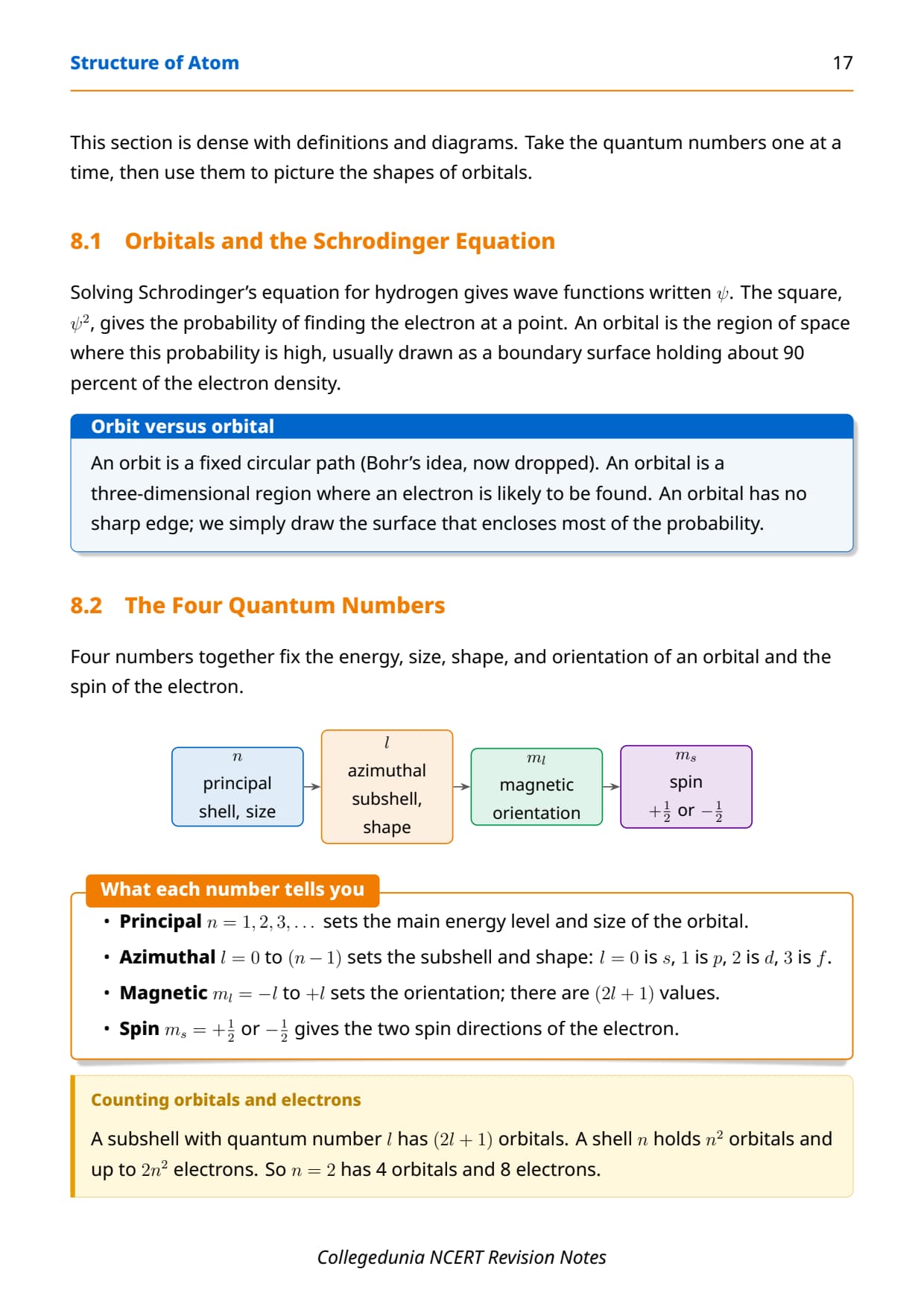
- Principal quantum number (n): the shell number, fixing the size and energy of the orbital.
- Azimuthal quantum number (l): the subshell, from 0 to n−1, deciding the shape (s, p, d, f).
- Magnetic quantum number (ml): the orbital orientation, from −l to +l.
- Spin quantum number (ms): the spin of the electron, either +½ or −½.
The uncertainty principle is exactly why the Bohr orbit idea fails, since a fixed orbit would need both a known position and a known speed. An orbital is the region around the nucleus where the chance of finding an electron is highest. The four quantum numbers together act like a full address for an electron, and no two electrons in an atom can share all four. This is the single most tested idea from the second half of the chapter.
Shapes of Orbitals and Electronic Configuration Using Aufbau, Pauli and Hund Rules
Once you can name an orbital, you need its shape and the rule for filling it with electrons. The shapes come from the azimuthal quantum number, and three rules decide the order and pairing of electrons.
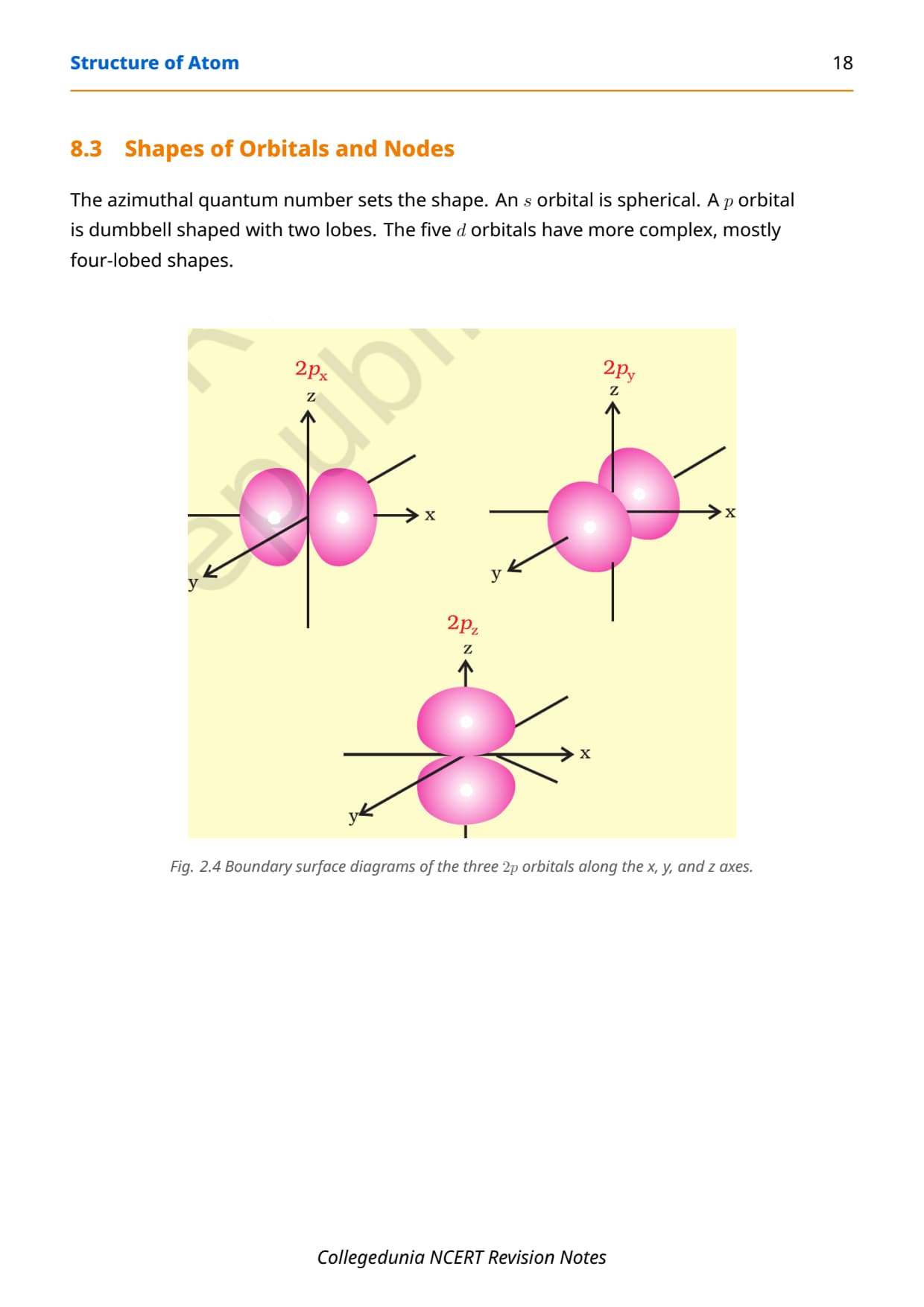
- s orbital: spherical, one orientation, holds 2 electrons.
- p orbital: dumb-bell shaped, three orientations, holds 6 electrons in total.
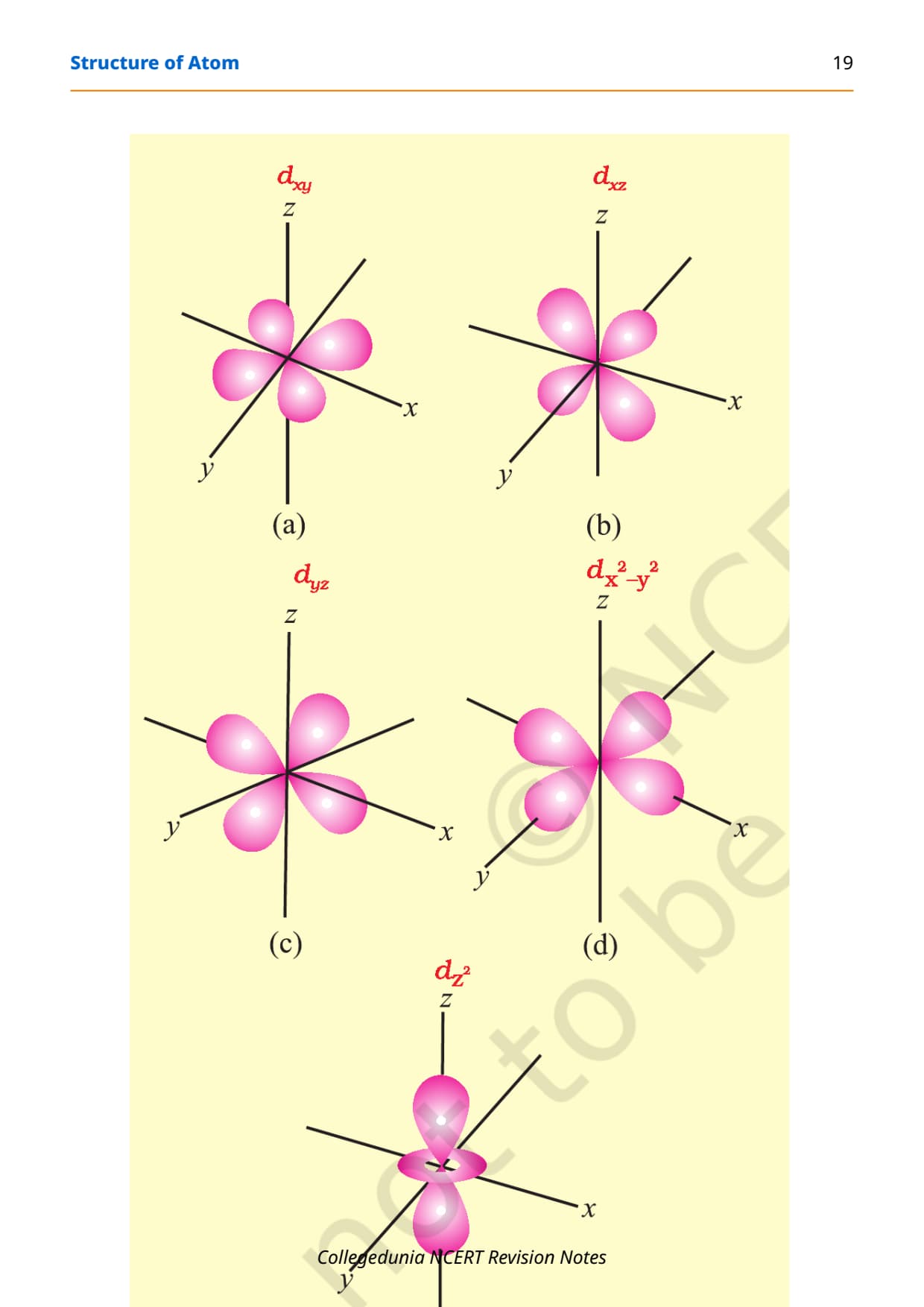
- d orbital: mostly double dumb-bell, five orientations, holds 10 electrons in total.
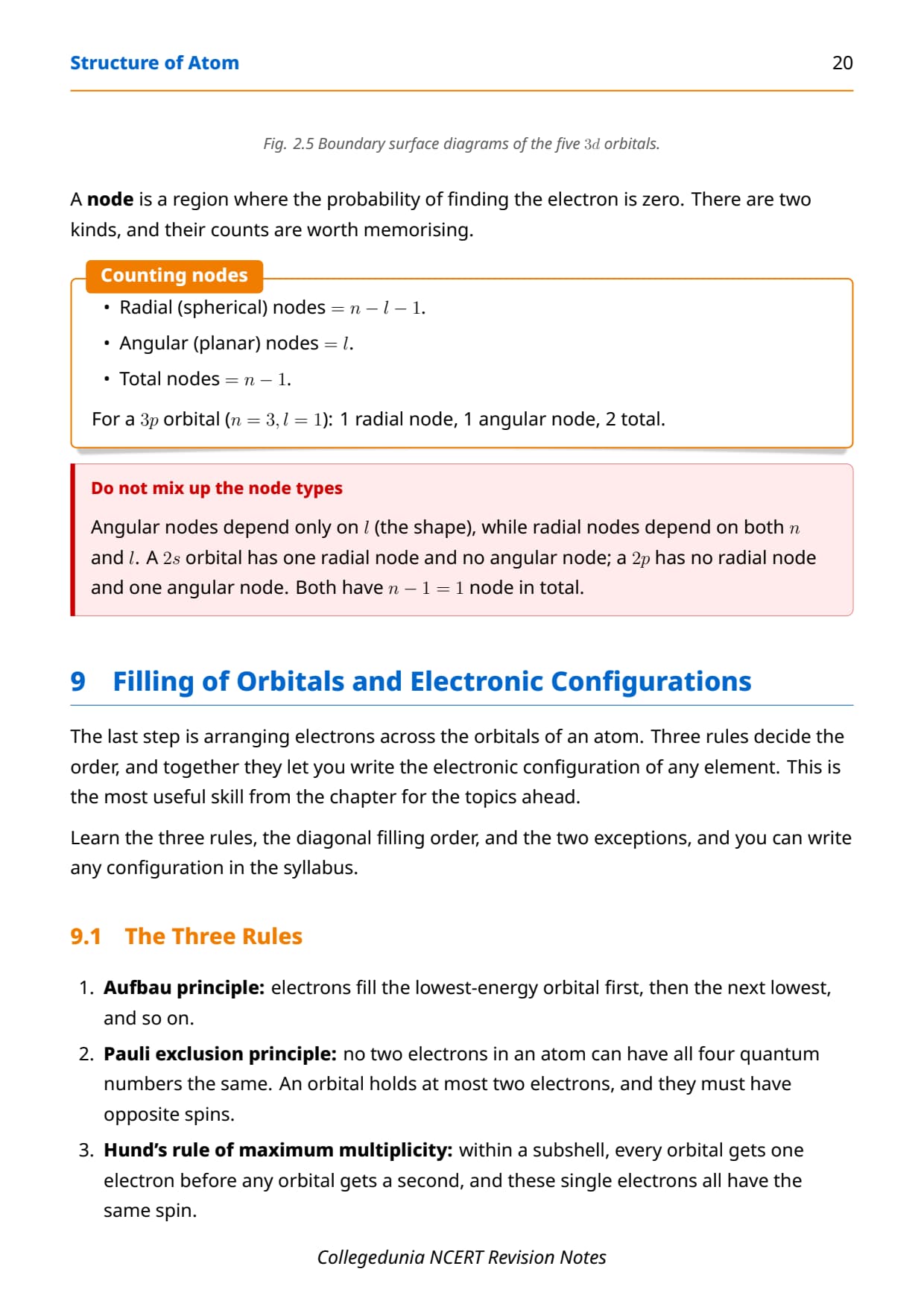
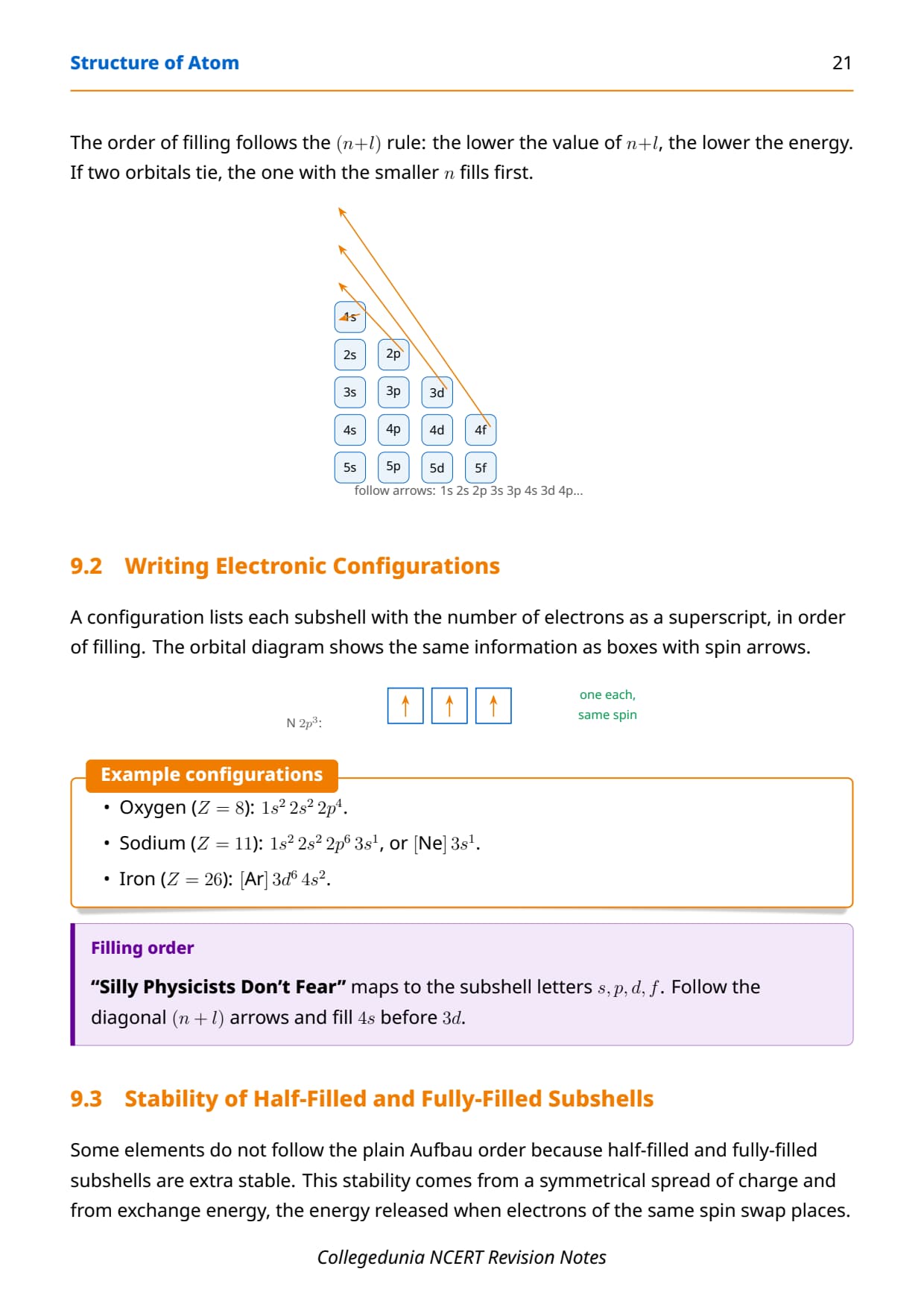
- Aufbau principle: electrons fill the lowest-energy orbital first, following the order set by the (n + l) rule.
- Pauli exclusion principle: an orbital holds at most two electrons, and they must have opposite spins.
- Hund's rule: electrons fill each orbital of a subshell singly before any pairing begins.
A subshell with l gives 2l + 1 orbitals, so a shell of number n has n2 orbitals and holds a maximum of 2n2 electrons. Writing an electronic configuration means placing electrons one by one using these three rules. Half-filled and fully-filled subshells, such as d5 and d10, have extra stability, which is why chromium and copper break the simple filling order. Getting the configuration right is what makes the periodic table in the next chapter easy to read.
Important Formulas and Values for Structure of Atom
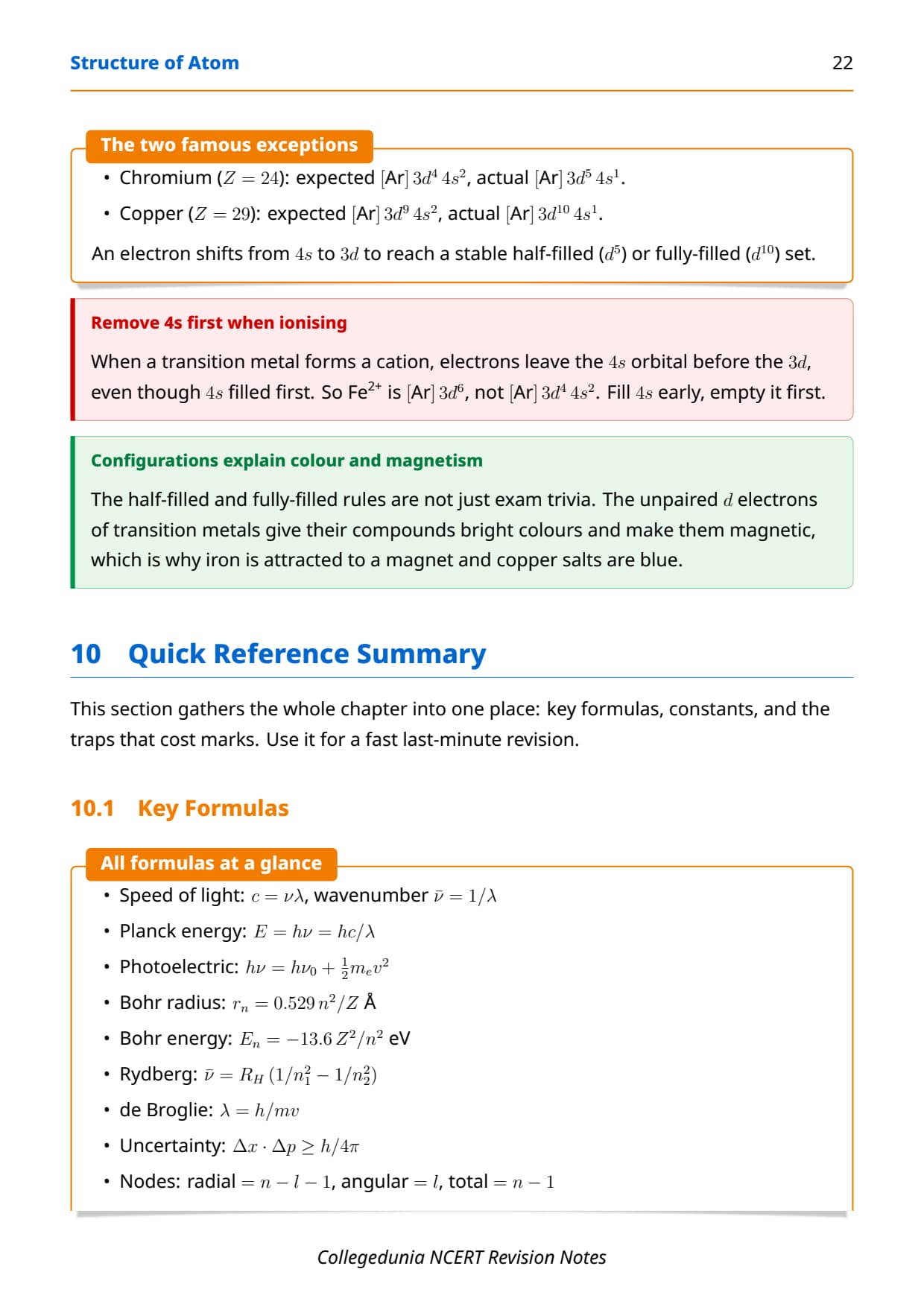
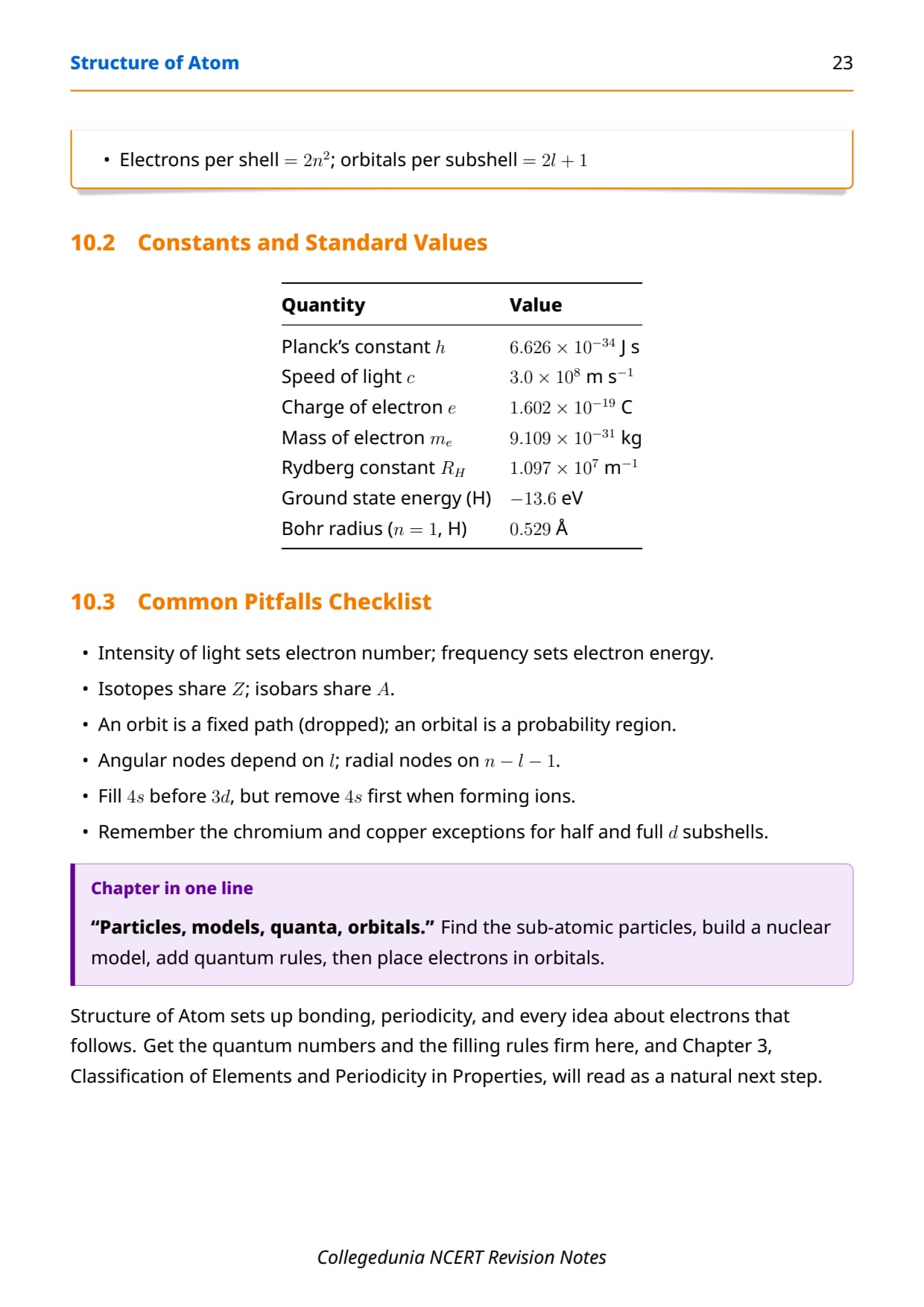
Every formula and constant you need for the chapter sits in one table below, with what it means. Learn the photon energy and Bohr energy rows first, since those carry the most marks in both Boards and entrance papers.
| Formula or value | What it means |
|---|---|
| E = hν | Energy of one photon, with h = 6.626 × 10⁻³⁴ J s |
| c = νλ | Speed of light links frequency and wavelength (c = 3 × 10⁸ m s-1) |
| Wavenumber = 1 / λ | Number of waves per unit length |
| En = −13.6 / n2 eV | Energy of the nth Bohr orbit of the hydrogen atom |
| rn = 52.9 × n2 pm | Radius of the nth Bohr orbit of hydrogen |
| λ = h / mv | de Broglie wavelength of a moving particle |
| Δx · Δp ≥ h / 4π | Heisenberg uncertainty relation |
| Orbitals in a shell = n2 | Total orbitals for principal quantum number n |
| Maximum electrons in a shell = 2n2 | Electron capacity of the nth shell |
Carry the unit on every line of your working. A wavelength in nanometres and one in metres differ by a factor of 109, and mixing them is the fastest way to lose a numerical. Keep this table open while you solve the back-exercise problems in these revision notes.
Key Definitions in Structure of Atom
Board short-answer questions often ask for a clean definition in one or two lines. Learn these word-for-word, because a vague definition loses easy marks. Each one also sets up a numerical or a diagram you can be asked for.
| Term | Definition |
|---|---|
| Atomic number (Z) | The number of protons in the nucleus of an atom. |
| Mass number (A) | The total number of protons and neutrons in the nucleus. |
| Orbital | The region around the nucleus where the chance of finding an electron is highest. |
| Photon | A packet of light energy equal to hν. |
| Work function | The minimum energy needed to remove an electron from a metal surface. |
| Aufbau principle | Electrons fill the lowest-energy orbital available first. |
A common numerical asks you to find the wavelength of light emitted when an electron falls between two Bohr orbits. Find the energy gap first, then use E = hν and c = νλ to reach the wavelength. Learning these definitions makes the wording of every board question familiar.
Common Mistakes Students Make in Structure of Atom
These slips happen while calculating or naming, not because the concept is unclear. Each one costs 1 to 3 marks in the paper, so watch for them at the exact step.
Mistake 1: Mixing units of wavelength. Convert nanometres and angstroms to metres before putting a value into c = νλ.
Mistake 2: Forgetting the minus sign in En = −13.6 / n2 eV. The energy of a bound electron is always negative.
Mistake 3: Setting the azimuthal quantum number l wrong. For a shell n, l runs from 0 to n−1, not up to n.
Mistake 4: Pairing electrons too early. By Hund's rule, every orbital of a subshell gets one electron before any pairing starts.
Structure of Atom Weightage in CBSE Boards, JEE and NEET
This chapter is a steady scorer. It carries a numerical plus an objective question in almost every exam, and the quantum-number part is a reliable source of easy marks. Here is how the marks split across the main exams for 2026-27.
| Exam | Typical weightage | What is asked |
|---|---|---|
| CBSE Boards | 6 to 7 marks | One energy or wavelength numerical plus one short answer on quantum numbers or models |
| JEE Main | 1 to 2 questions | Bohr model, de Broglie wavelength, and quantum numbers |
| NEET | 2 to 3 questions | Quantum numbers, electronic configuration, and the photoelectric effect |
| CUET | 1 to 2 objective questions | Atomic models, subatomic particles, and orbital shapes |
Quantum numbers and electronic configuration are the most tested ideas from this chapter across all four exams. Master the Bohr model first, then quantum numbers, then the filling rules, in that order of return on effort.
How to Revise Structure of Atom Quickly
Use these structure of atom class 11 notes for a fast, ordered recap the night before a test. The checklist below takes about 30 minutes and hits every marks-heavy idea.
- First 10 minutes: write E = hν, c = νλ, and the Bohr energy formula from memory, then do one wavelength numerical.
- Next 10 minutes: list the four quantum numbers with their allowed values and write the configuration of two elements.
- Last 10 minutes: sketch the s and p orbital shapes and restate the Aufbau, Pauli and Hund rules in one line each.
Close the loop by writing the electronic configuration of chromium and copper, the two elements that break the simple order. If you can do all three blocks without notes, the chapter is exam-ready. Keep the Important Formulas table beside you for the first pass only, then try it closed-book.
Student Feedback on the Structure of Atom Notes
What 14,260 students told us about their Structure of Atom revision:
- 68% of students rated quantum numbers and orbital shapes as the hardest part of the chapter.
- Most-skipped step: converting wavelength units before using c = νλ, missed by about 3 in 10 students.
- Students who learned the four quantum numbers first said electronic configuration became far easier.
Source: 2026-27 Class 11 Chemistry student poll. Sample of 14,260 students from CBSE schools across 15 states, conducted before the 2026 boards.
Other Structure of Atom Class 11 Chemistry Resources
Pair these notes with the solved answers and the textbook PDF for the same chapter.
| Resource | Link |
|---|---|
| NCERT Solutions | Structure of Atom Class 11 NCERT Solutions |
| NCERT Book PDF | Structure of Atom Class 11 Book PDF |
NCERT Notes for Class 11 Chemistry: All Chapters
Jump to the revision notes for any other Class 11 Chemistry chapter below.
| Chapter | NCERT Notes |
|---|---|
| Chapter 1 | Some Basic Concepts of Chemistry |
| Chapter 2 | Structure of Atom |
| Chapter 3 | Classification of Elements and Periodicity in Properties |
| Chapter 4 | Chemical Bonding and Molecular Structure |
| Chapter 5 | Thermodynamics |
| Chapter 6 | Equilibrium |
| Chapter 7 | Redox Reactions |
| Chapter 8 | Organic Chemistry Some Basic Principles and Techniques |
| Chapter 9 | Hydrocarbons |
FAQs on Structure of Atom Class 11 Chemistry Notes
Structure of Atom Notes - Frequently Asked Questions
Ques. What topics do the structure of atom class 11 notes cover?
Ans. These structure of atom class 11 notes cover the electron, proton and neutron, the Thomson, Rutherford and Bohr models, electromagnetic radiation, the photoelectric effect, the dual nature of matter, the Heisenberg uncertainty principle, the four quantum numbers, the shapes of s, p and d orbitals, and electronic configuration using the Aufbau, Pauli and Hund rules. Every key formula and definition is included for fast revision.
Ques. What are the four quantum numbers in Class 11 Chemistry?
Ans. The principal quantum number n gives the shell and energy. The azimuthal quantum number l gives the subshell shape and runs from 0 to n−1. The magnetic quantum number ml gives the orbital orientation and runs from −l to +l. The spin quantum number ms is +½ or −½. No two electrons in an atom can have all four the same.
Ques. What is the difference between the Bohr model and the quantum mechanical model?
Ans. The Bohr model places the electron in fixed circular orbits of definite energy and works only for hydrogen and one-electron ions. The quantum mechanical model drops fixed paths, because the Heisenberg uncertainty principle says position and momentum cannot both be known exactly. Instead it describes the electron by an orbital, the region where the chance of finding it is highest.
Ques. What is the photoelectric effect?
Ans. The photoelectric effect is the ejection of electrons from a metal when light of a high enough frequency falls on it. Below a threshold frequency no electron comes out, however bright the light is, which proves light behaves as particles called photons. Einstein explained it with hν = W + kinetic energy, where W is the work function of the metal.
Ques. What is the weightage of Structure of Atom in the CBSE board exam?
Ans. Structure of Atom carries about 6 to 7 marks in the CBSE Class 11 Chemistry paper, usually one energy or wavelength numerical plus one short answer on quantum numbers or the atomic models. It also appears in JEE Main, NEET and CUET as objective questions on the Bohr model, de Broglie wavelength, quantum numbers and electronic configuration.
Ques. How do I write the electronic configuration of an element?
Ans. Start with the lowest-energy orbital and fill upward in the order set by the (n + l) rule, which is the Aufbau principle. By Pauli's rule, each orbital holds at most two electrons with opposite spins. By Hund's rule, every orbital of a subshell gets one electron before any pairing begins. Half-filled and fully-filled subshells are extra stable, which is why chromium and copper break the simple order.
Ques. How should I revise Structure of Atom quickly for a test?
Ans. Start by writing E = hν, c = νλ and the Bohr energy formula from memory and solving one wavelength numerical. Then list the four quantum numbers with their allowed values and write two configurations. Finish with the s and p orbital shapes and the Aufbau, Pauli and Hund rules. The quick-revision checklist in these structure of atom class 11 notes covers all of this in about 30 minutes.



Comments