




The NCERT Notes Class 11 Geography Chapter 2 The Origin and Evolution of the Earth bring together every theory, stage and timeline number that the CBSE Class 11 exam actually tests, according to the latest 2026-27 NCERT.
- CBSE Weightage: 4 to 6 marks, tested through short-answer and one-mark questions almost every year.
- UPSC and State PSC Relevance: a frequently asked topic in prelims general studies papers.
- Format: a 23-page PDF with colour diagrams, formula boxes and a mnemonic-based quick revision section.
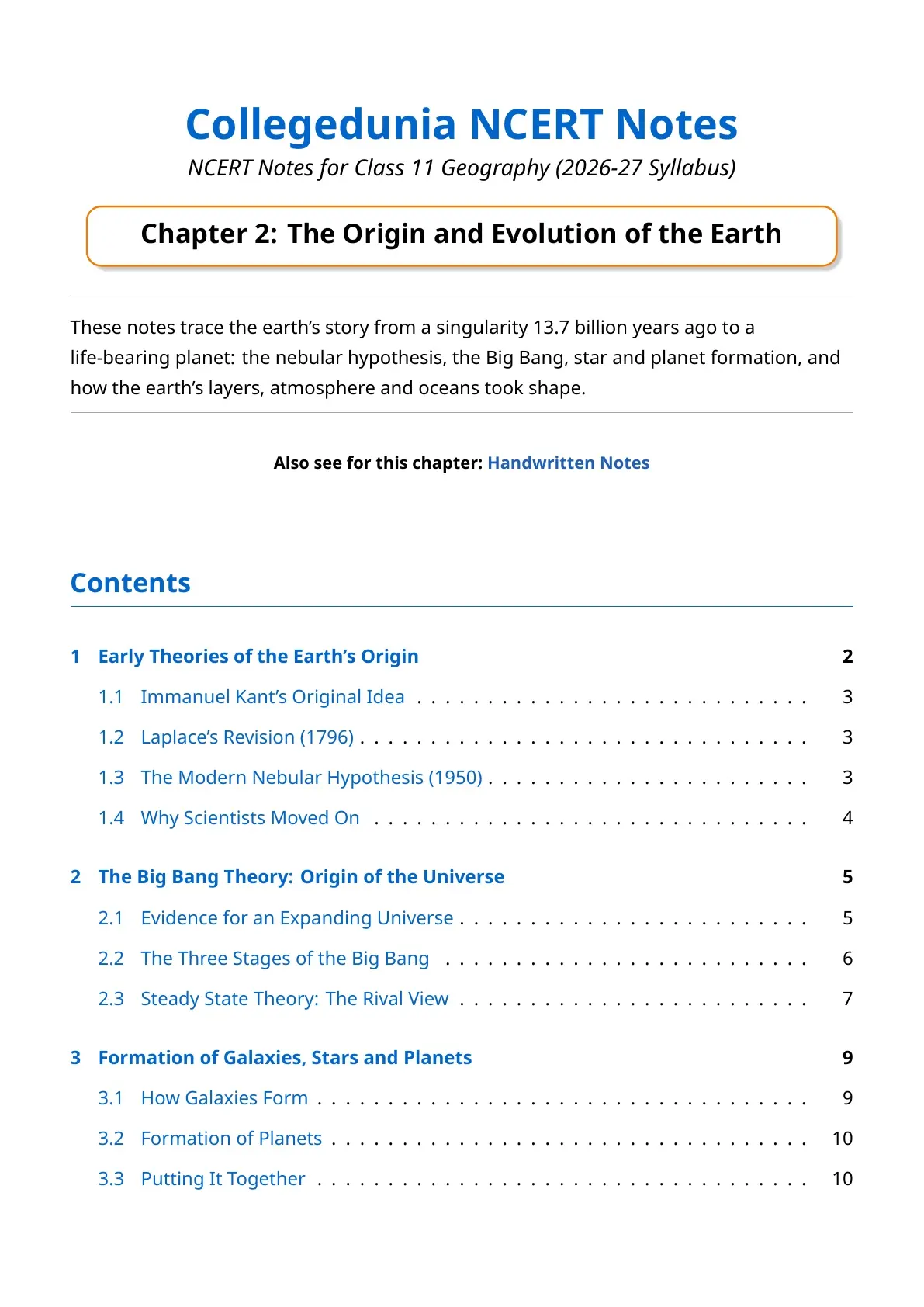
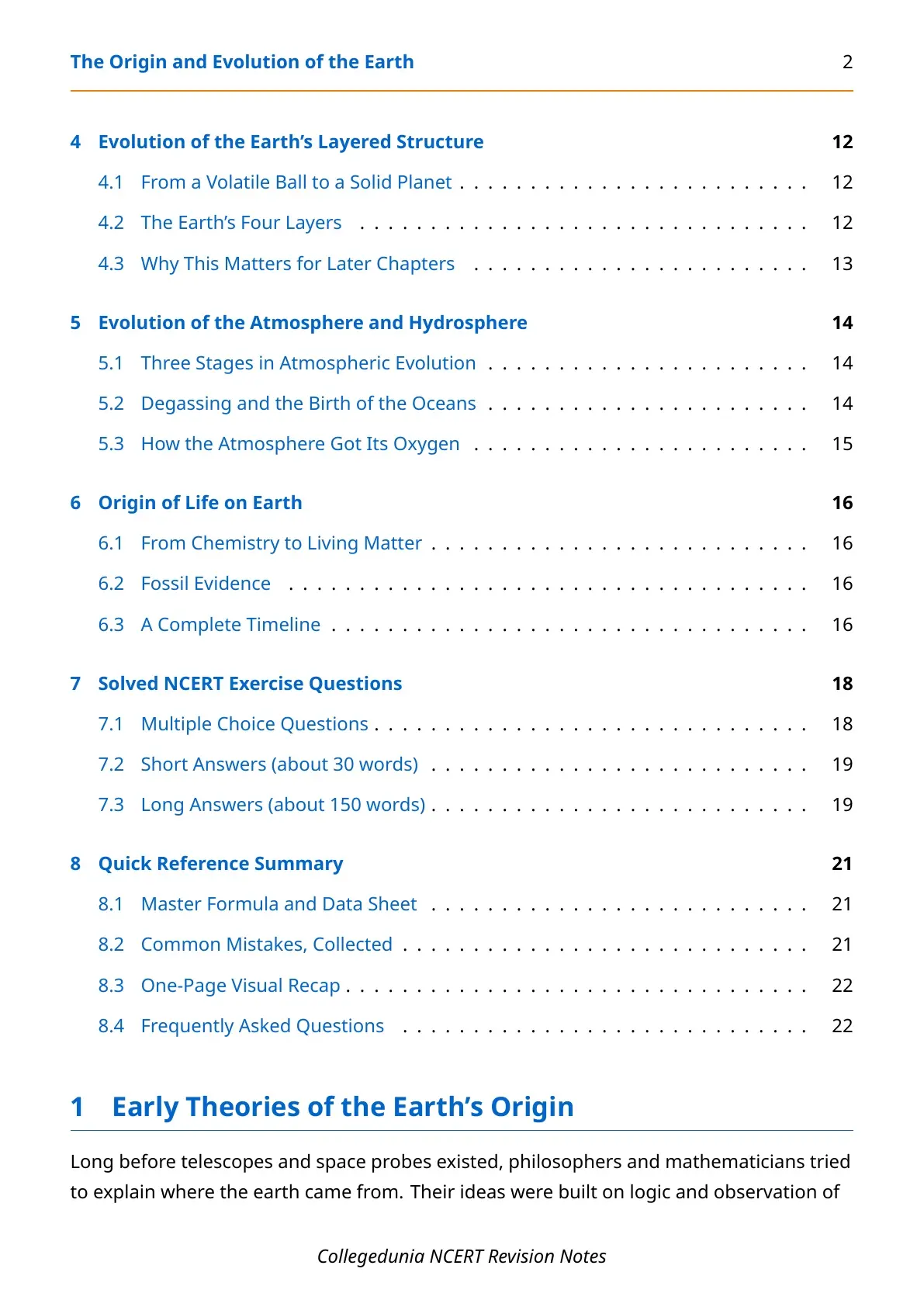
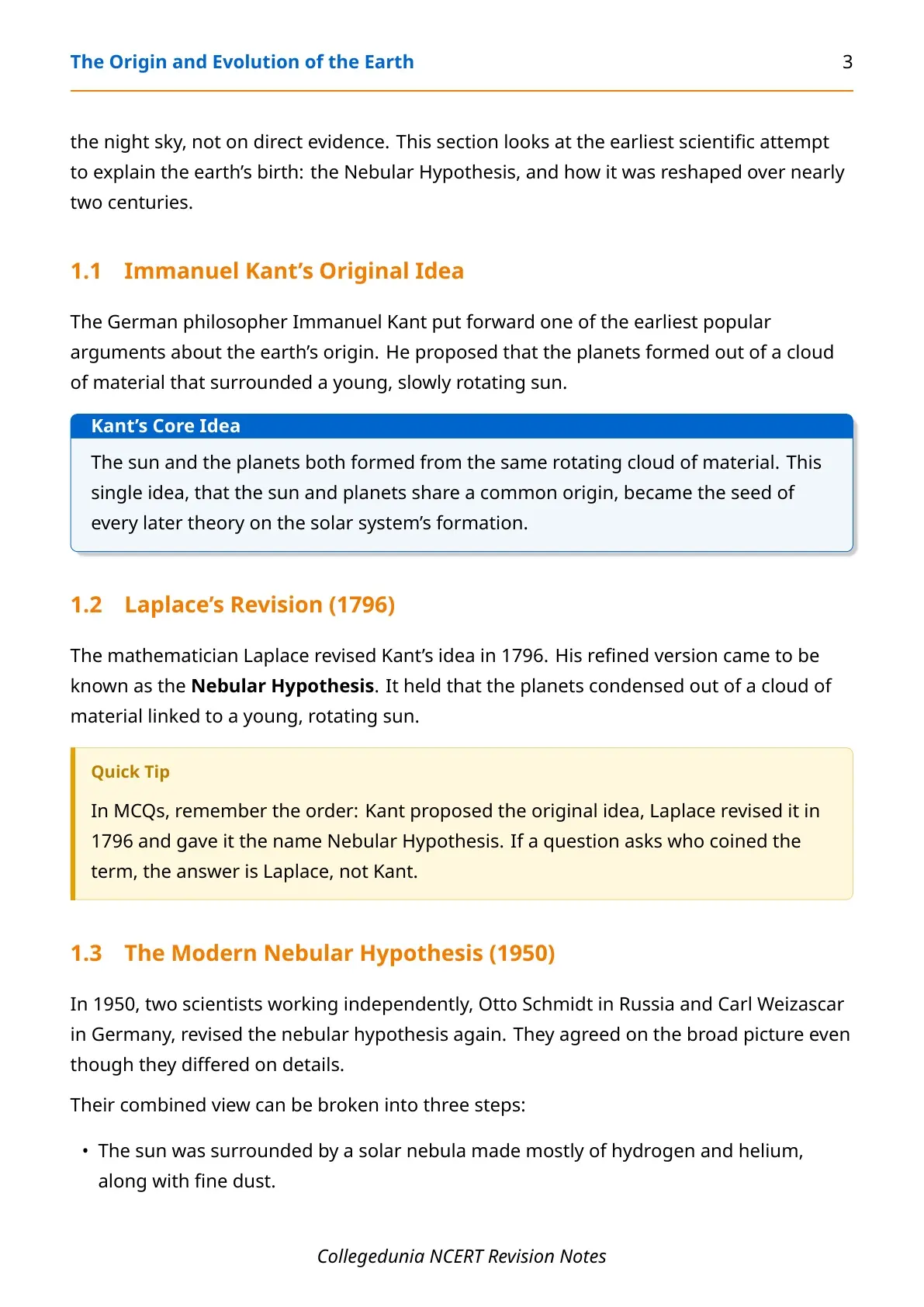
These NCERT Notes Class 11 Geography Chapter 2 The Origin and Evolution of the Earth are curated by subject experts, checked against the 2026-27 NCERT textbook, and organised the same way the chapter itself flows: from the Big Bang to the first signs of life on Earth.
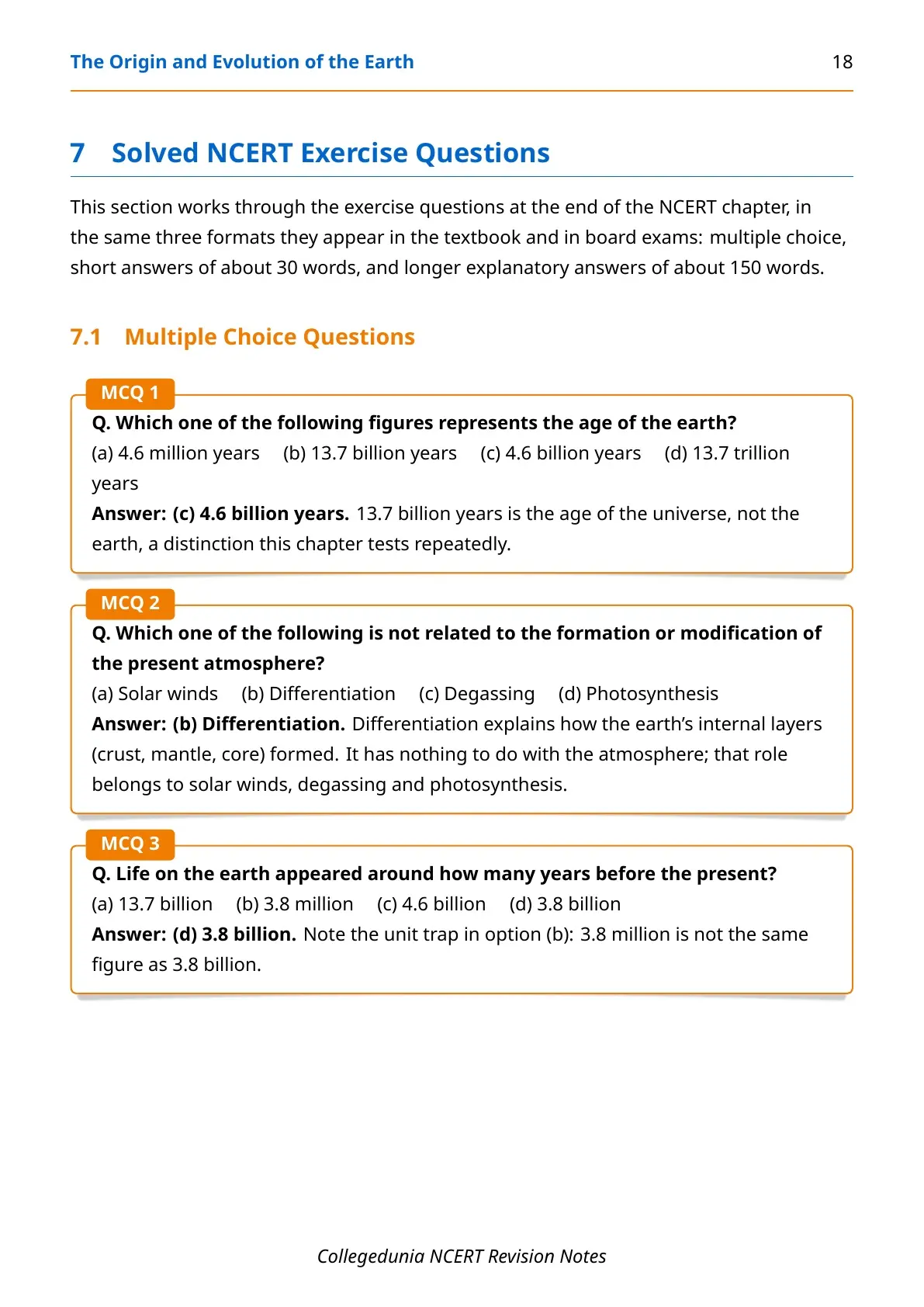
What 12,410 students told us about this chapter. In a Collegedunia poll of 12,410 Class 11 Geography students conducted before their 2026-27 annual exams, 68% said the hardest part of this chapter was keeping the timeline numbers straight, not the theories themselves. Confusing 13.7 billion years (the universe) with 4.6 billion years (the earth) was the single most common mistake reported.
What The Origin and Evolution of the Earth Chapter Covers
The NCERT Notes Class 11 Geography Chapter 2 The Origin and Evolution of the Earth tell the story of the universe and the earth in order, from a single point of infinite density to a planet with oceans and living cells. It moves through six stages, and each one builds on the one before it.
- Early theories: Kant's original idea, Laplace's 1796 Nebular Hypothesis, and its 1950 revision by Schmidt and Weizascar.
- The Big Bang Theory: Edwin Hubble's evidence for an expanding universe and the three stages of the Big Bang.
- Formation of galaxies, stars and planets: nebula, light years, planetesimals and accretion.
- Evolution of the earth's layers: how differentiation built the crust, mantle, outer core and inner core.
- Evolution of the atmosphere and oceans: degassing, condensation and the birth of the hydrosphere.
- Origin of life: the chemical origin of life and fossil evidence from blue-green algae.
The Origin and Evolution of the Earth Crash Course
Source: Magnet Brains on YouTube
Early Theories of the Earth's Origin: Kant, Laplace and the Nebular Hypothesis
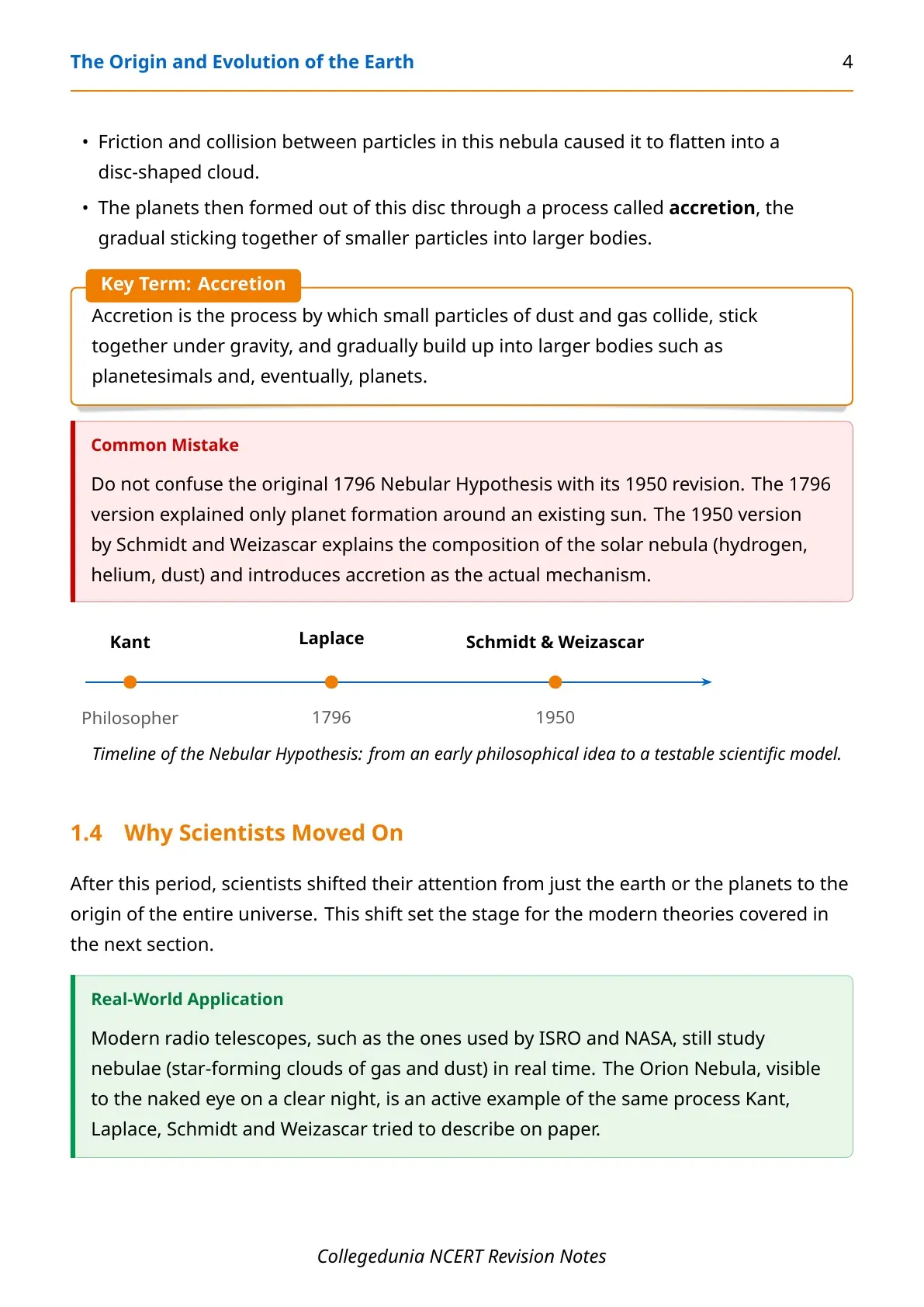
The German philosopher Immanuel Kant first argued that the sun and planets formed from the same rotating cloud of material. The mathematician Laplace revised this idea in 1796 and gave it the name Nebular Hypothesis.
In 1950, Otto Schmidt and Carl Weizascar revised the hypothesis again. Their version explains three things in order: the sun was surrounded by a solar nebula of hydrogen, helium and dust; friction between particles flattened this cloud into a disc; and the planets then formed through accretion, particles sticking together under gravity.
| Scientist | Contribution | Year |
|---|---|---|
| Immanuel Kant | First proposed the sun and planets share a common origin | 18th century |
| Laplace | Revised Kant's idea and named it the Nebular Hypothesis | 1796 |
| Otto Schmidt and Carl Weizascar | Introduced solar nebula composition and accretion | 1950 |
The Big Bang Theory and the Birth of the Universe
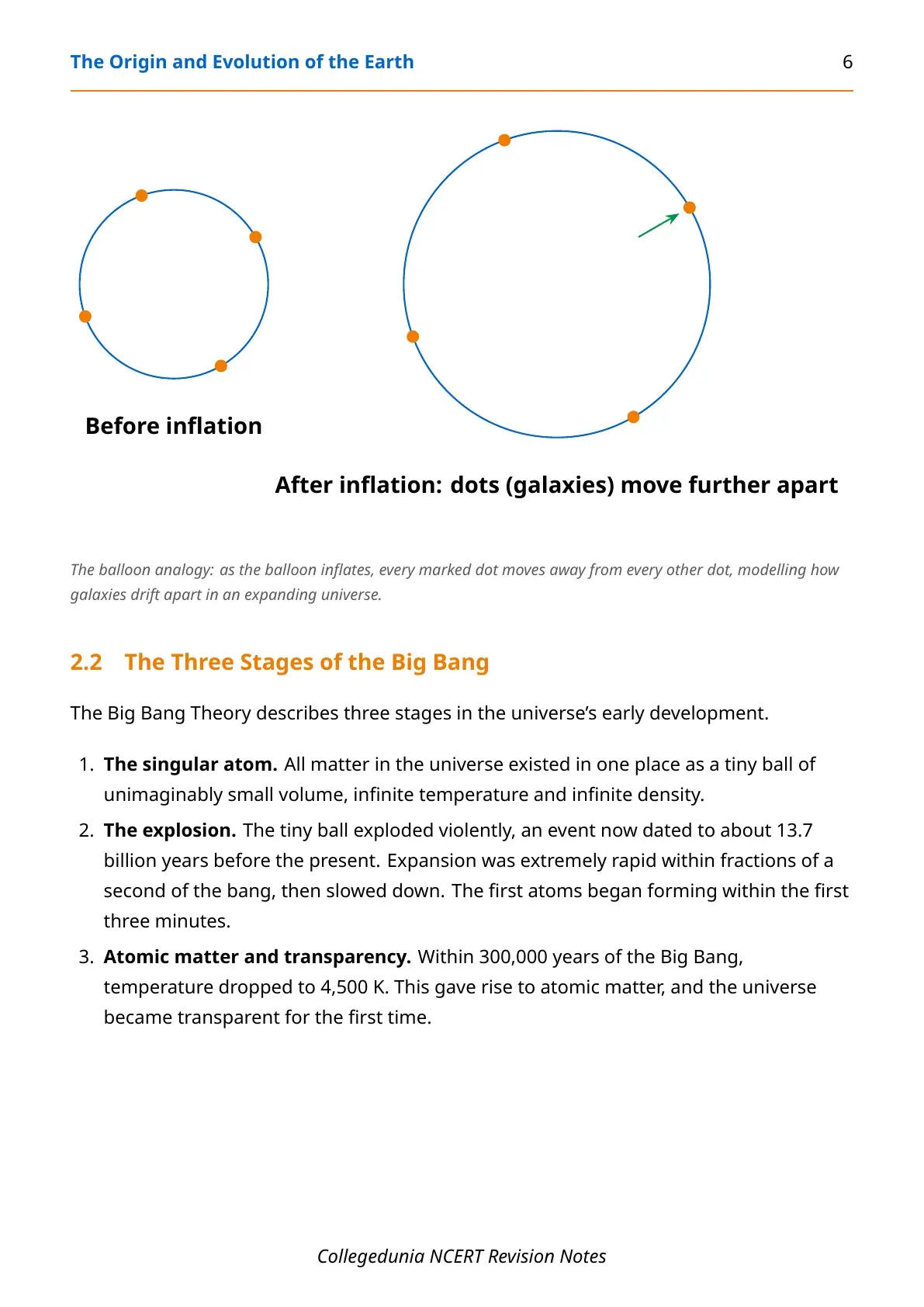
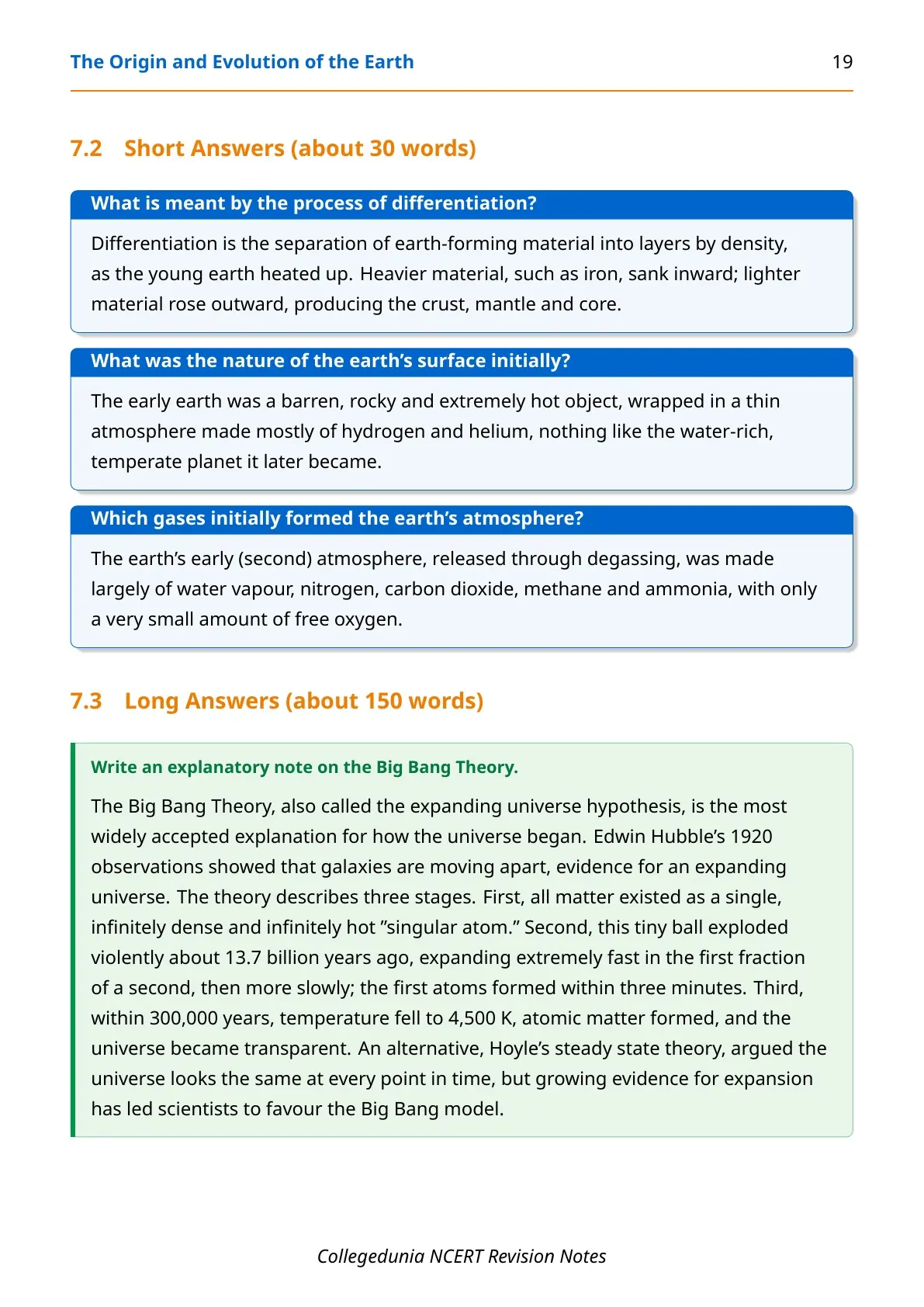
The Big Bang Theory is the most widely accepted explanation for how the universe began. Astronomer Edwin Hubble showed in 1920 that galaxies are moving apart, evidence that the universe is expanding.
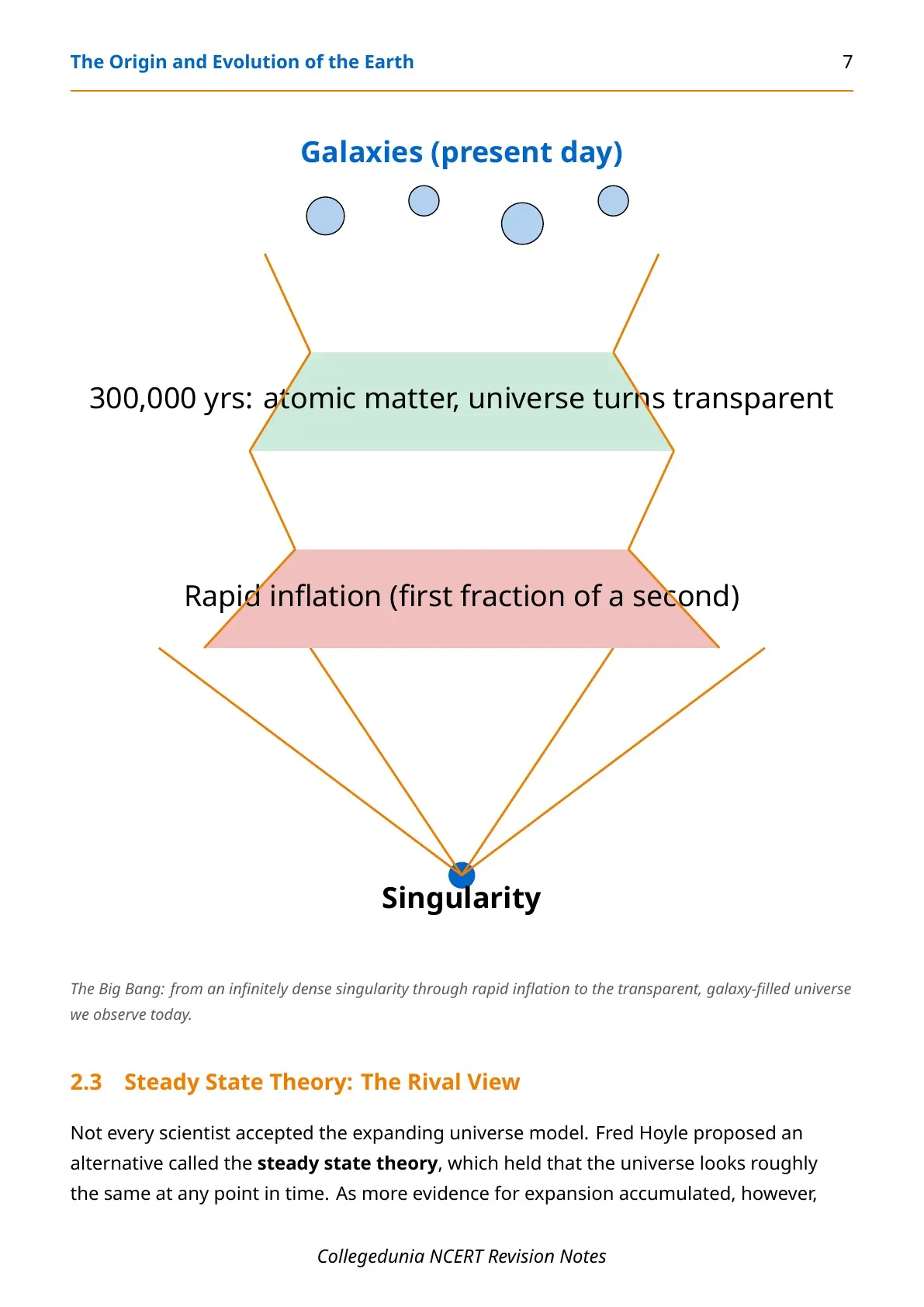
The theory describes three stages: a singular atom of infinite density and temperature; a violent explosion around 13.7 billion years ago with rapid early expansion; and, within 300,000 years, a drop in temperature to 4,500 K that made the universe transparent for the first time. Fred Hoyle's rival steady-state theory argued the universe looks the same at every point in time, but the weight of evidence now favours the expanding-universe model.
Formation of Galaxies, Stars and Planets
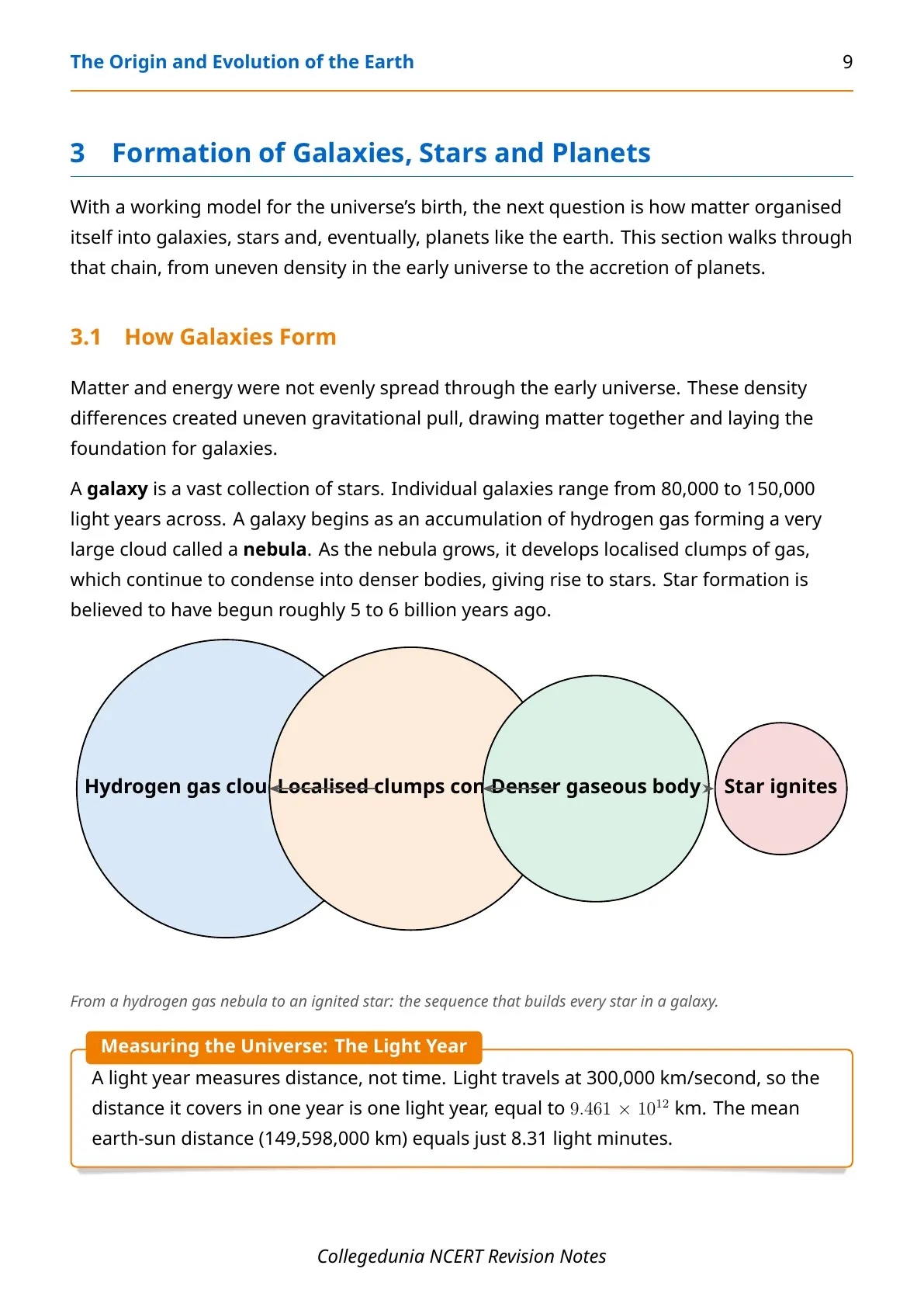
Uneven density in the early universe pulled matter together into galaxies. A galaxy is a vast collection of stars, and individual galaxies span 80,000 to 150,000 light years. Stars form when a hydrogen gas cloud, called a nebula, condenses into denser clumps.
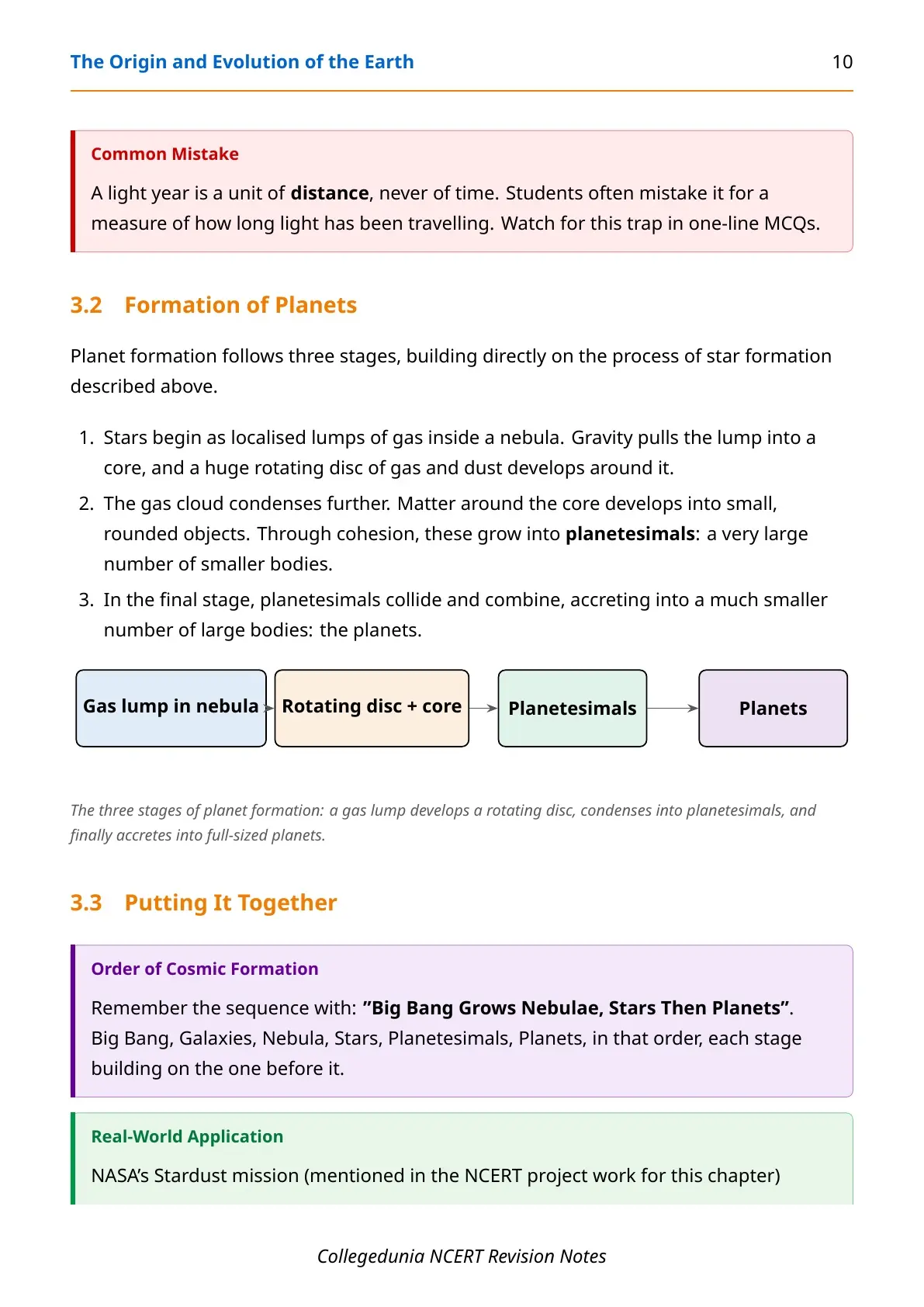
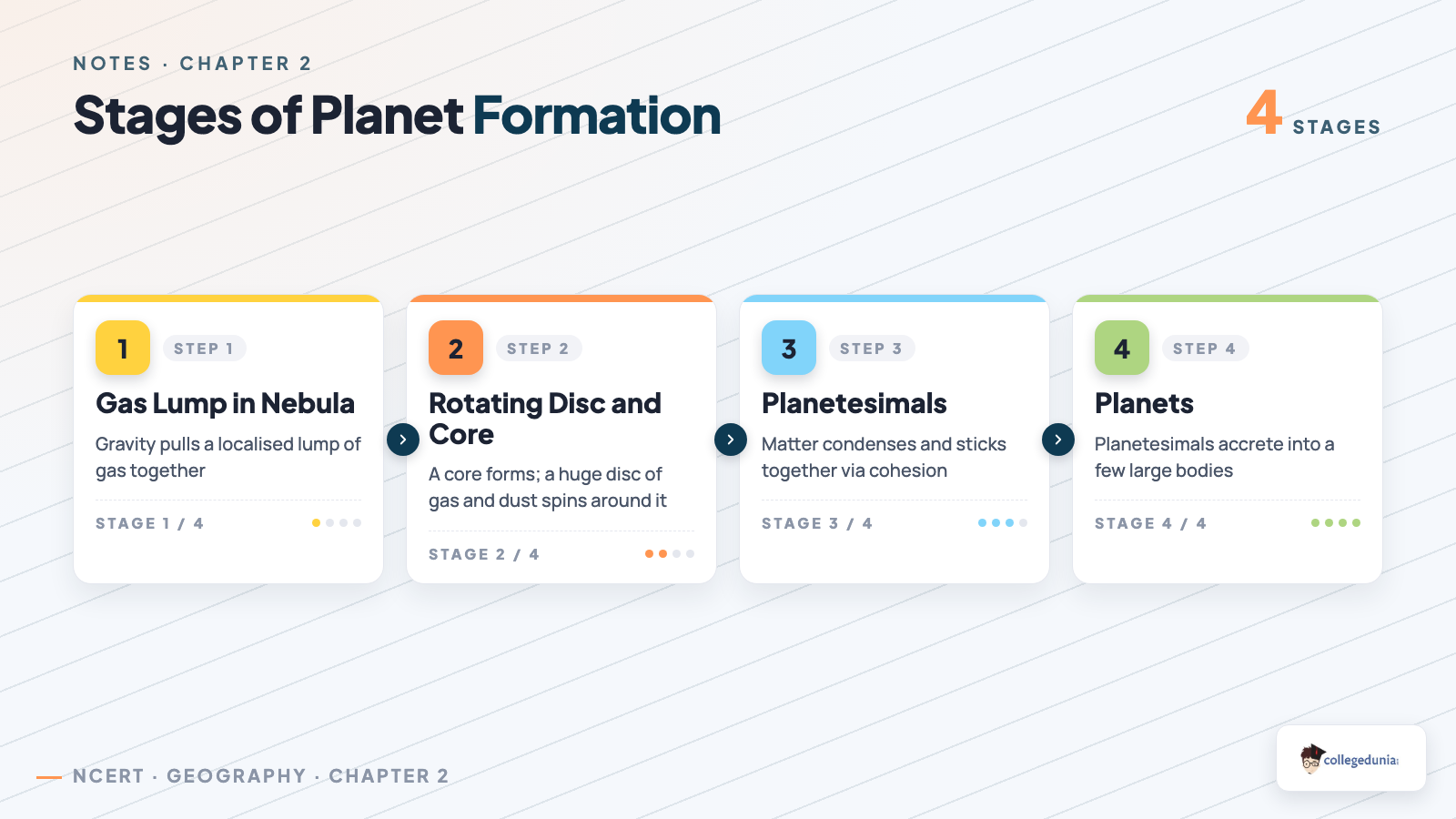
Planet formation follows three steps: a gas lump develops a core and a rotating disc, the disc's matter condenses into planetesimals, and these planetesimals collide and combine into full-sized planets.
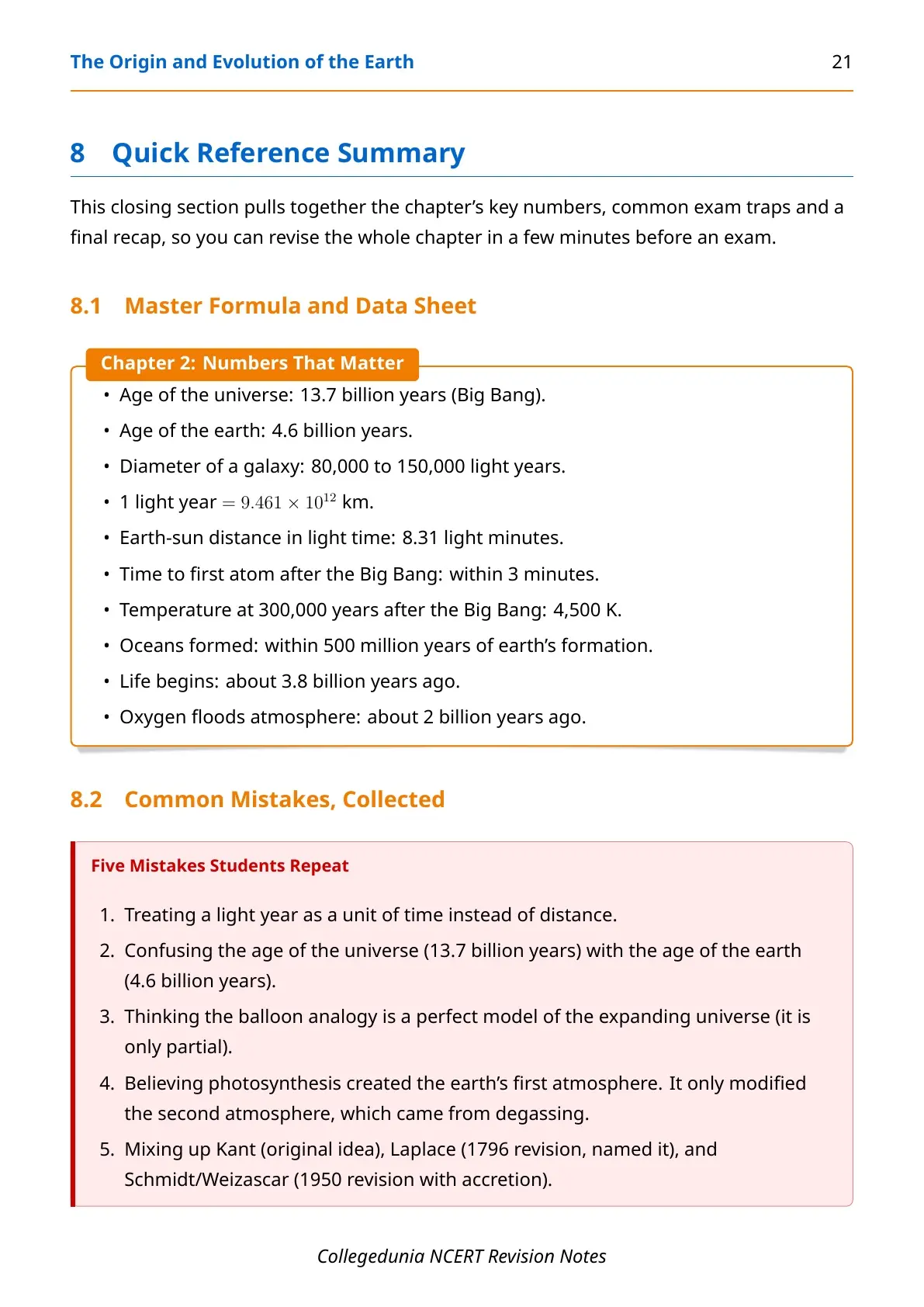
- A light year measures distance, not time: it equals 9.461 × 10¹² km.
- Star formation is believed to have begun 5 to 6 billion years ago.
- The earth-sun distance equals just 8.31 light minutes.
How the Earth's Crust, Mantle and Core Formed
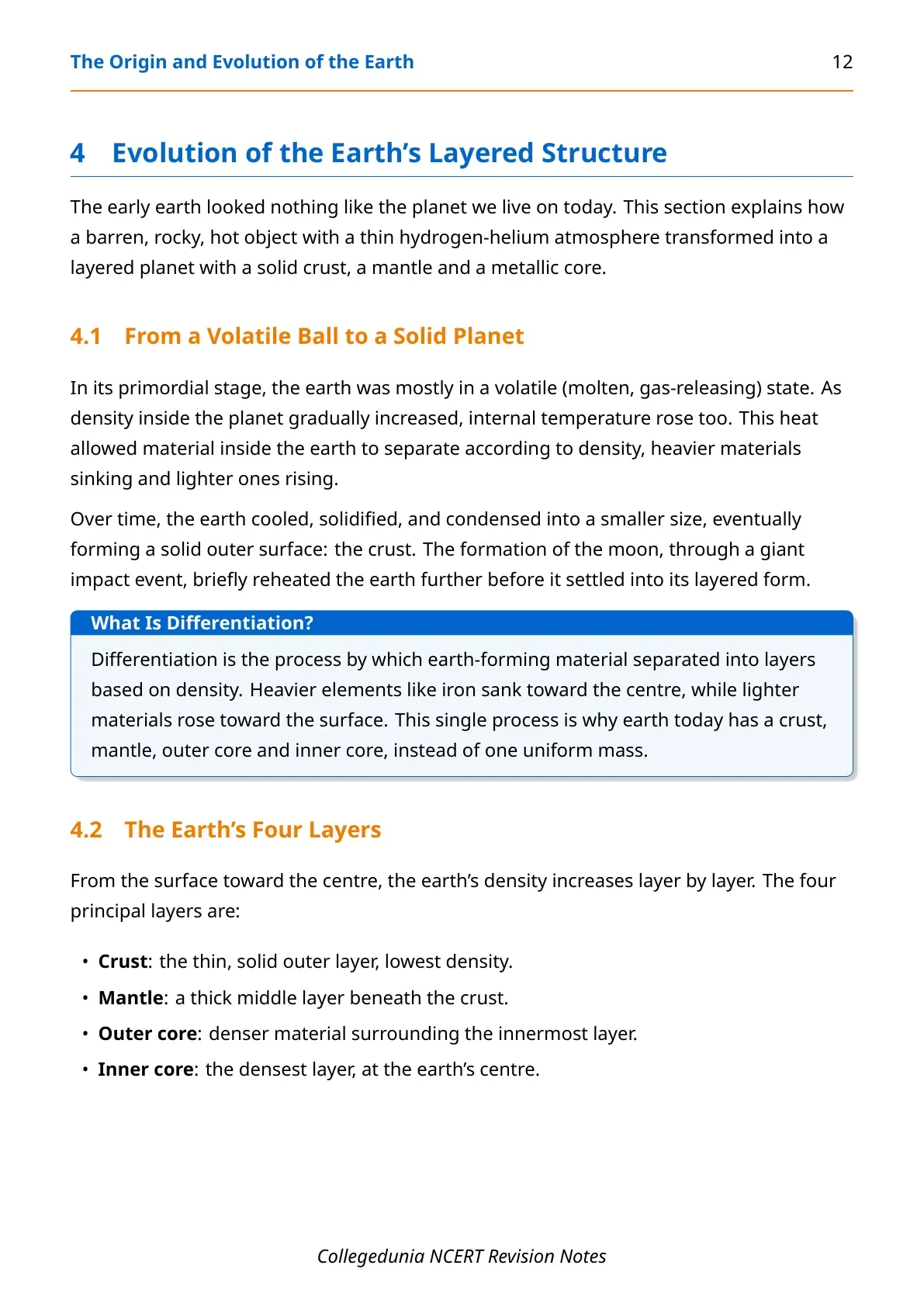
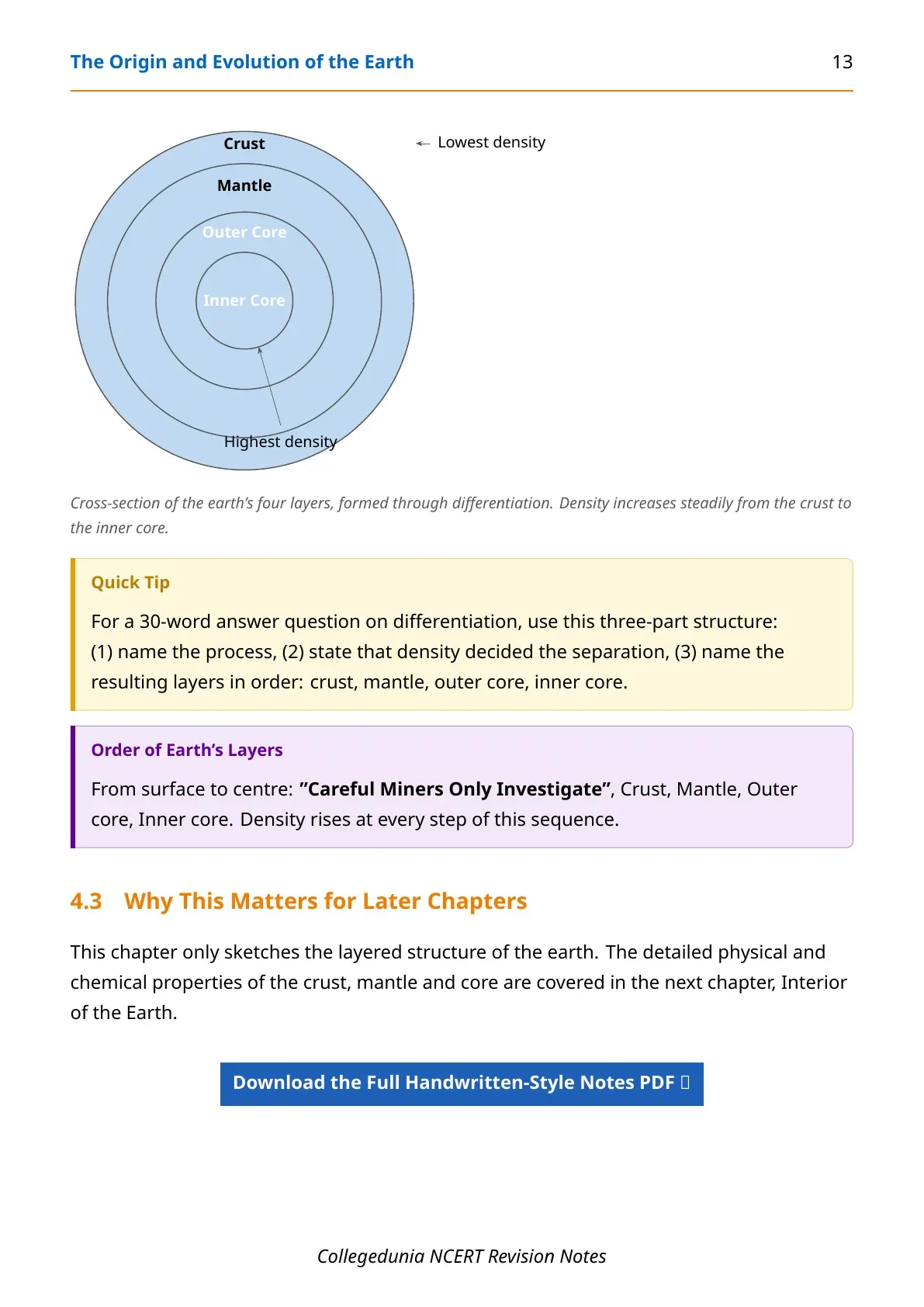
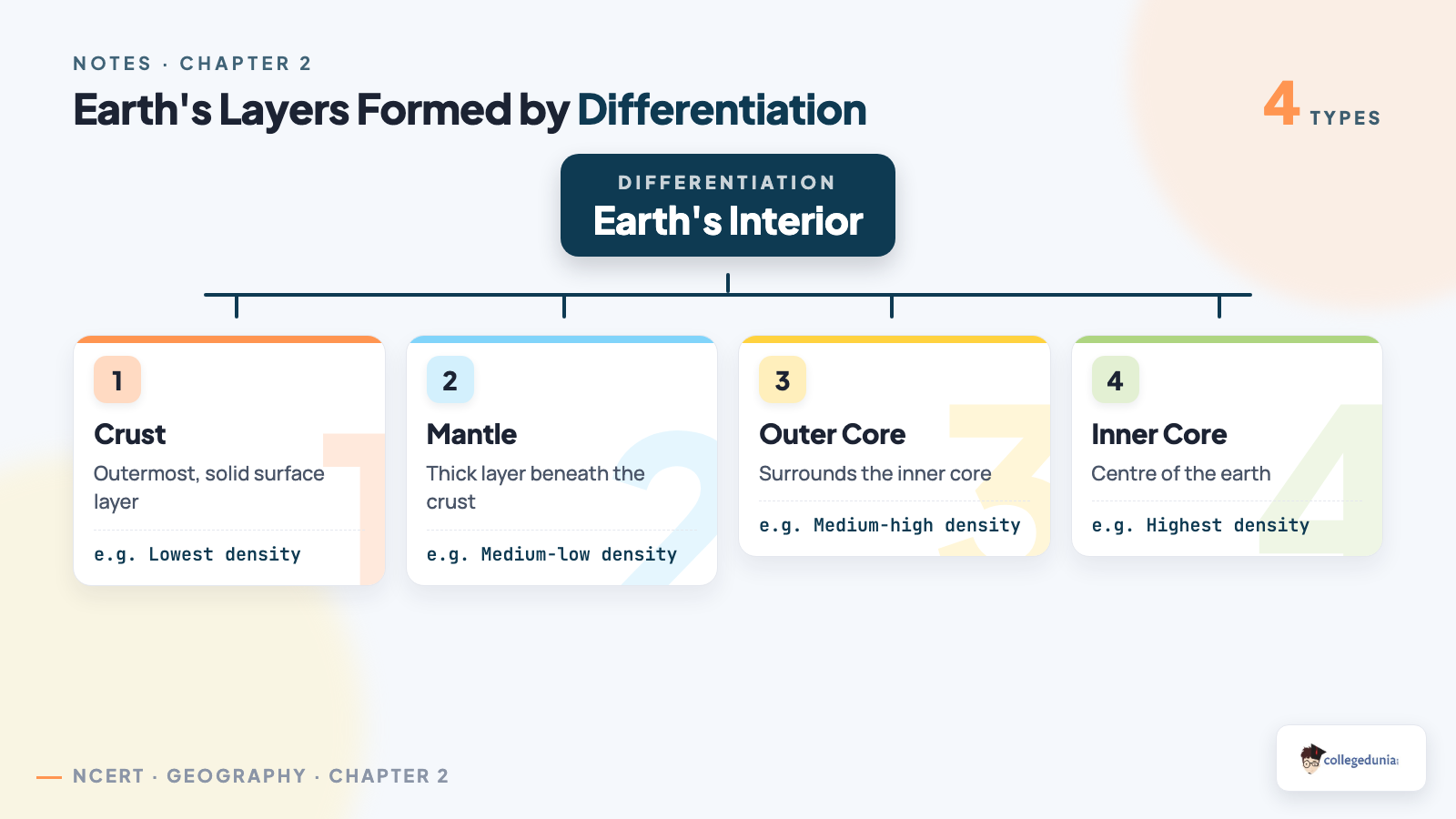
The early earth was a hot, volatile, barren object. As internal heat rose, material separated by density, a process called differentiation. Heavier material like iron sank toward the centre, and lighter material rose toward the surface.
This single process explains why the earth today has four distinct layers, arranged by increasing density from the surface inward.
| Layer | Position | Relative Density |
|---|---|---|
| Crust | Outermost, solid surface | Lowest |
| Mantle | Below the crust | Medium-low |
| Outer Core | Surrounds the inner core | Medium-high |
| Inner Core | Centre of the earth | Highest |
The moon's formation, through a giant impact, briefly reheated the young earth before it settled into this layered structure. The next chapter, Interior of the Earth, covers each layer's properties in detail.
Evolution of the Atmosphere and Oceans on Early Earth
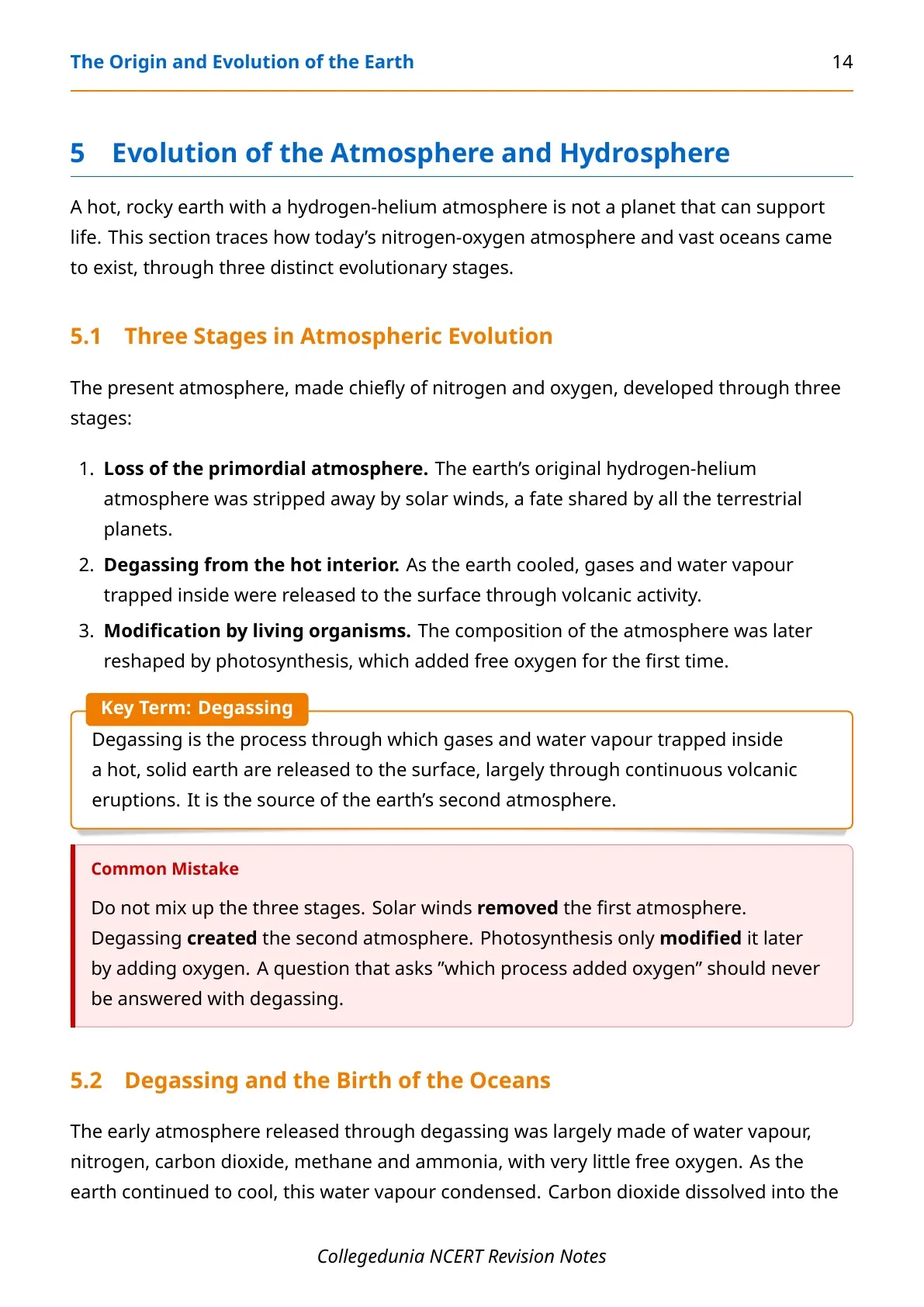
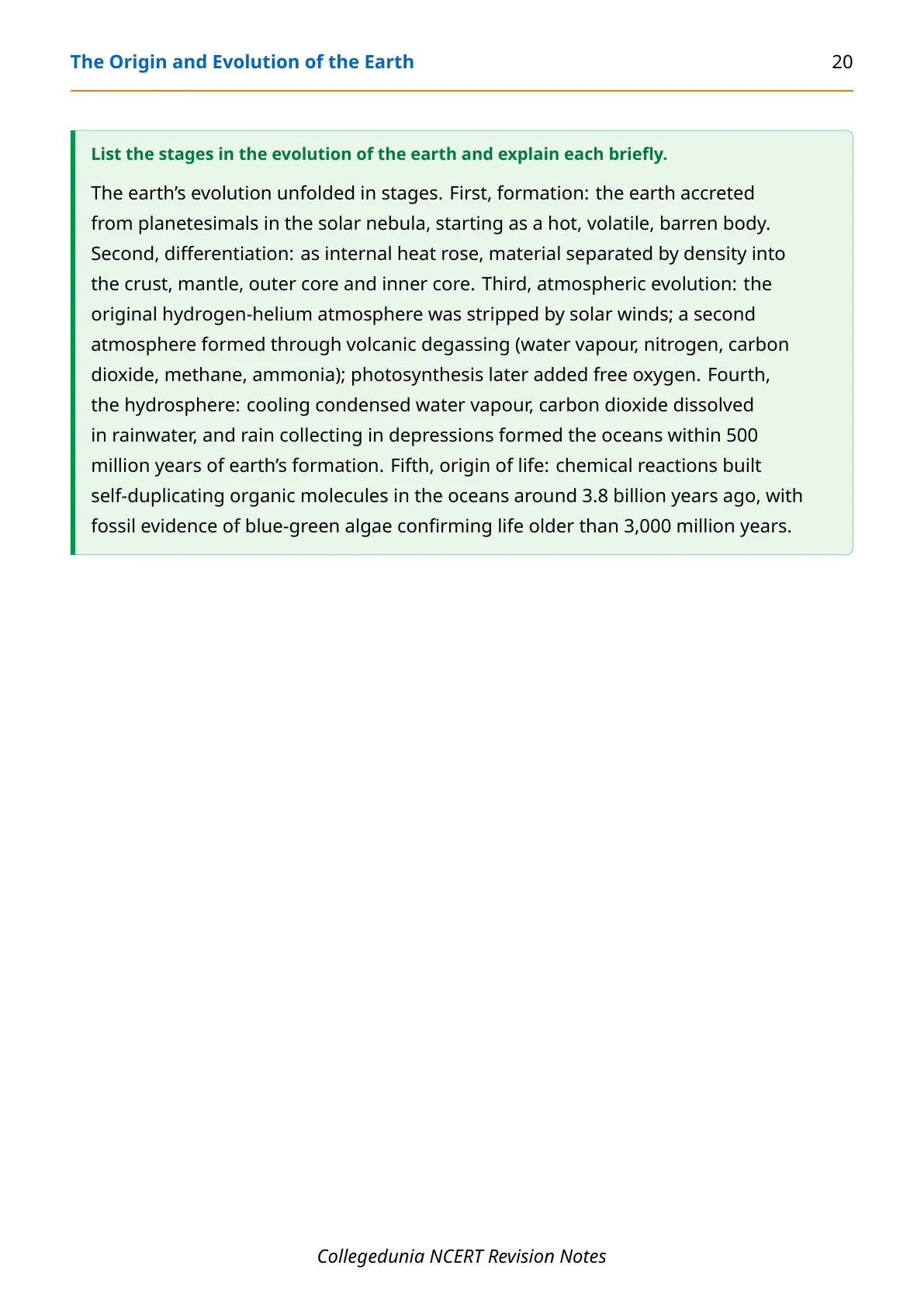
Today's nitrogen-oxygen atmosphere took three stages to build. Solar winds first stripped away the earth's original hydrogen-helium atmosphere. Volcanic degassing then released water vapour, nitrogen, carbon dioxide, methane and ammonia to build a second atmosphere. Finally, photosynthesis added free oxygen much later.
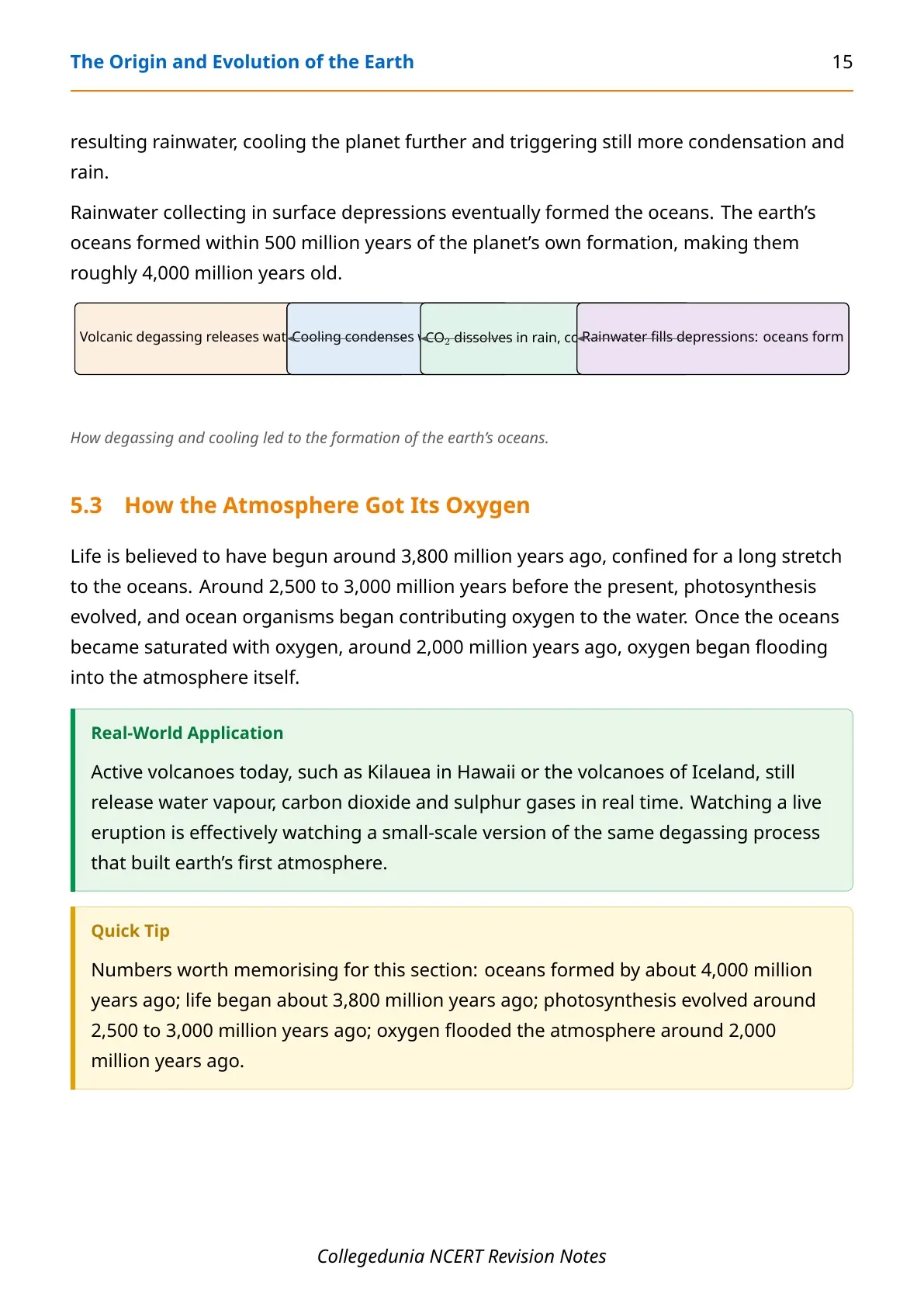
As the earth cooled, water vapour condensed and rain collected in surface depressions, forming the oceans within 500 million years of the earth's own formation.
- Oceans formed by about 4,000 million years ago.
- Life began to evolve around 3,800 million years ago.
- Oxygen flooded the atmosphere around 2,000 million years ago, once oceans were oxygen-saturated.
Origin of Life: From Chemistry to the First Fossils
Modern scientists describe the origin of life as a chain of chemical reactions that built complex organic molecules capable of copying themselves. The earliest fossil evidence comes from microscopic structures resembling blue-green algae, found in rock formations older than 3,000 million years.
Based on this fossil record, scientists place the start of life at roughly 3.8 billion years ago, more than a billion years before oxygen became common in the atmosphere.
Common Mistakes Students Make in This Chapter
- Treating a light year as a unit of time instead of distance.
- Mixing up the age of the universe (13.7 billion years) with the age of the earth (4.6 billion years).
- Believing the balloon analogy for the expanding universe is fully accurate; it only partially models real galaxy movement.
- Assuming photosynthesis created the earth's first atmosphere, when it only modified the second one built by degassing.
Timeline of the Earth's Origin and Evolution
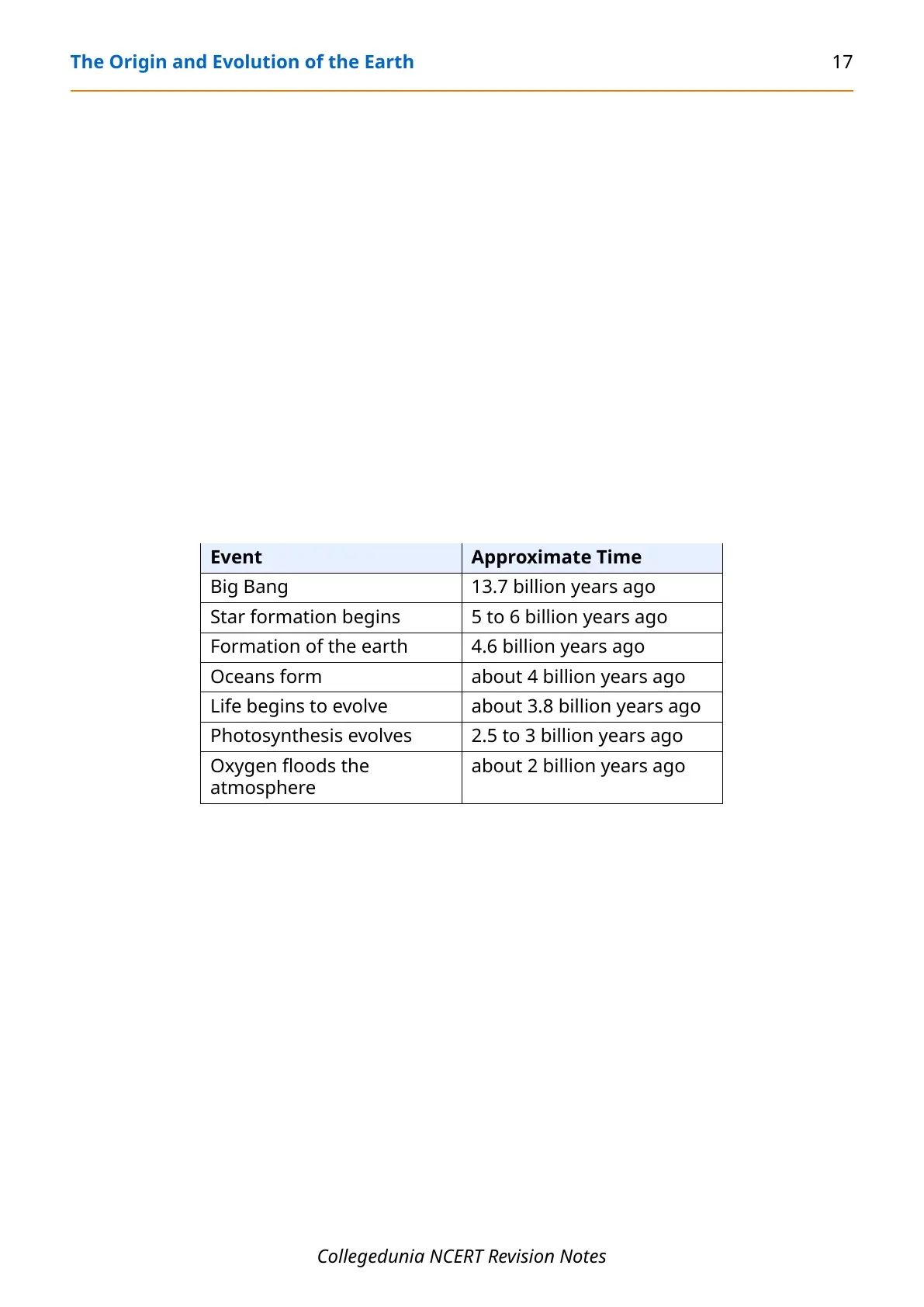
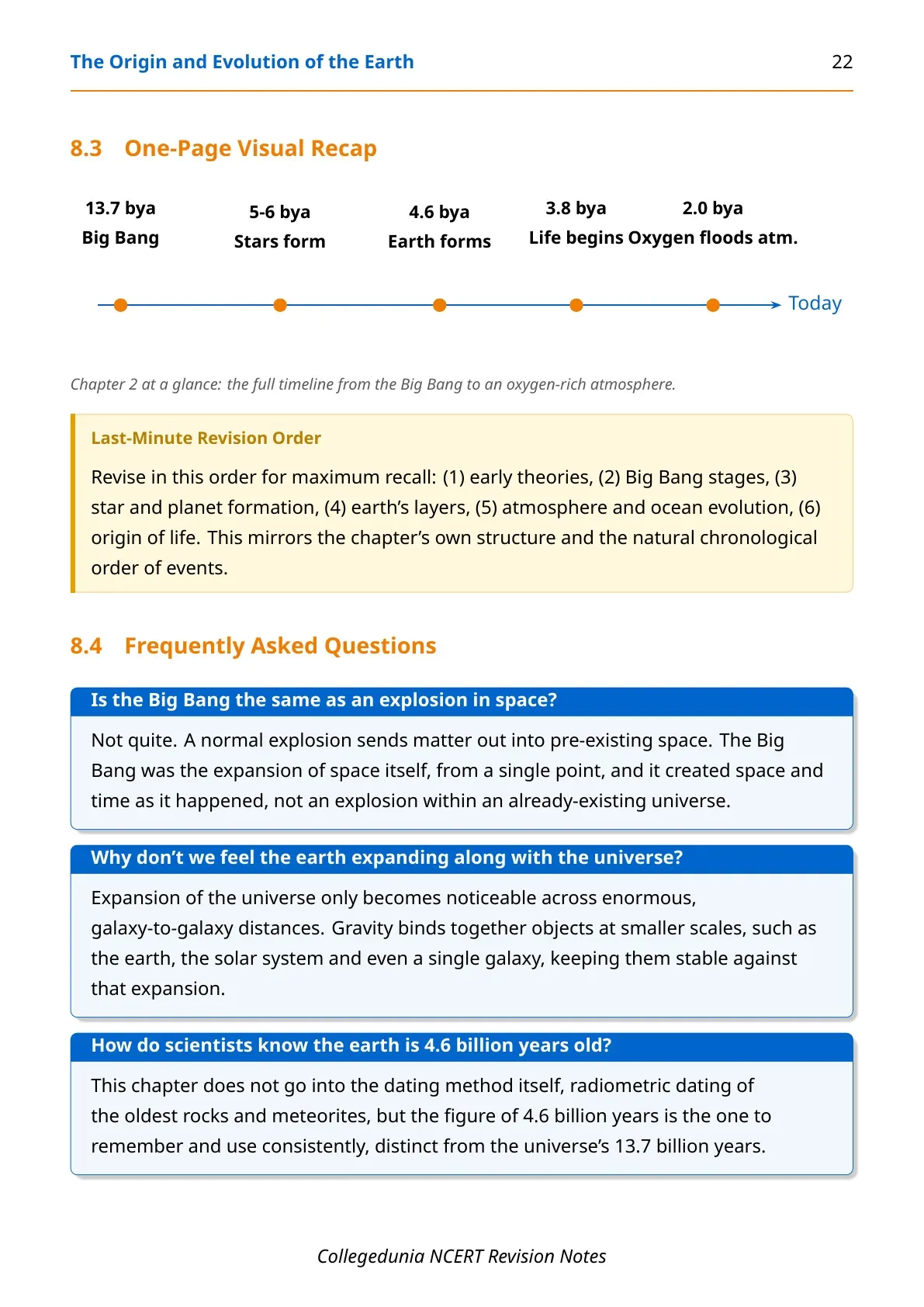
This one table covers every number examiners pull questions from. Keep it as your final revision anchor.
| Event | Approximate Time Before Present |
|---|---|
| Big Bang | 13.7 billion years |
| Star formation begins | 5 to 6 billion years |
| Earth forms | 4.6 billion years |
| Oceans form | about 4 billion years |
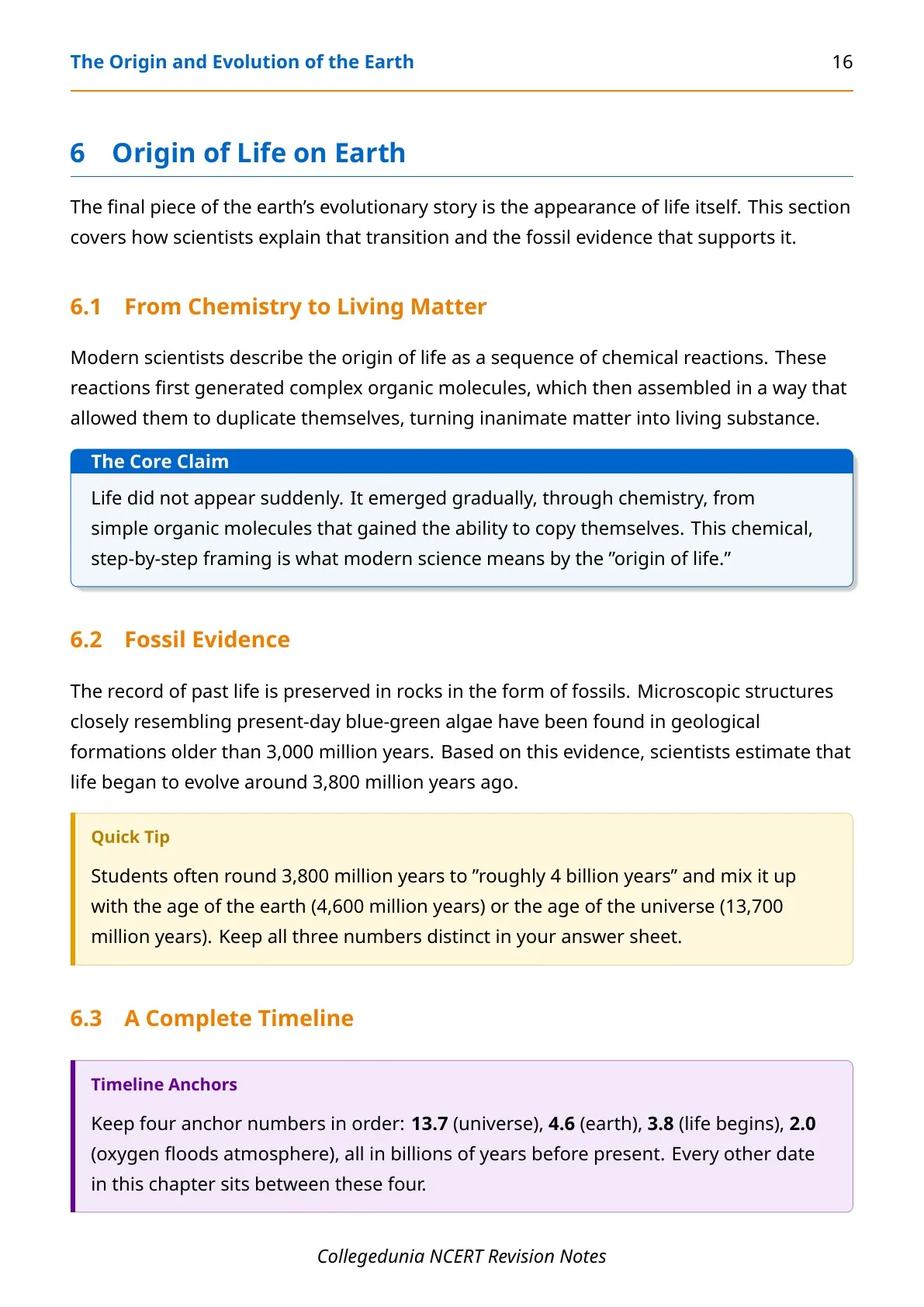
| Life begins | 3.8 billion years |
| Photosynthesis evolves | 2.5 to 3 billion years |
| Oxygen floods the atmosphere | about 2 billion years |
How to Use These Notes Most Effectively
The NCERT Notes Class 11 Geography Chapter 2 The Origin and Evolution of the Earth work best read in the same order as the chapter, since each stage explains the one that follows it.
- First pass: read the six-stage summary and the timeline table to fix the order of events.
- Second pass: work through each section's diagrams and formula boxes for the finer detail.
- Final revision: use the Common Mistakes box and the timeline table the night before the exam.
Other NCERT Resources for The Origin and Evolution of the Earth
The table below lists every Collegedunia resource for this chapter, including the page you are reading.
| Resource | Link |
|---|---|
| Notes (this page) | The Origin and Evolution of the Earth Class 11 Geography Notes |
| Handwritten Notes | The Origin and Evolution of the Earth Class 11 Handwritten Notes |
| NCERT Solutions | (coming soon) |
| NCERT Book PDF | (coming soon) |
NCERT Notes for Class 11 Geography: All Chapters
Use this table to move to any other Class 11 Geography chapter's notes once this chapter is done.
| Chapter | Resource |
|---|---|
| Chapter 1 | Geography as a Discipline Notes (coming soon) |
| Chapter 2 | The Origin and Evolution of the Earth Notes |
| Chapter 3 | Interior of the Earth Notes (coming soon) |
| Chapter 4 | Distribution of Oceans and Continents Notes (coming soon) |
| All Chapters | Class 11 Geography, All Chapters |
The Origin and Evolution of the Earth Class 11 Geography Notes FAQs
Ques. Where can I download the Class 11 Geography Chapter 2 Notes PDF?
Ans. You can download The Origin and Evolution of the Earth Class 11 Geography Notes PDF directly from this page, free of cost.
Ques. Are these notes based on the 2026-27 NCERT syllabus?
Ans. Yes. These notes follow the current 2026-27 NCERT textbook for Class 11 Geography, chapter by chapter, in the same order as the printed book.
Ques. How many pages is the Class 11th Geography Chapter 2 Notes PDF?
Ans. The Notes PDF runs about 23 pages and covers early theories of the earth's origin, the Big Bang Theory, planet formation, the earth's layers, atmosphere and hydrosphere evolution, and the origin of life.
Ques. What is the Big Bang Theory?
Ans. The Big Bang Theory says the universe began from a single point of infinite density and temperature, which exploded about 13.7 billion years ago and has been expanding ever since.
Ques. What is the Nebular Hypothesis?
Ans. The Nebular Hypothesis, named by Laplace in 1796, says the sun and planets formed out of the same rotating cloud of gas and dust. Otto Schmidt and Carl Weizascar revised it in 1950 to include accretion.
Ques. What is meant by differentiation in this chapter?
Ans. Differentiation is the process by which earth-forming material separated into layers by density as the young earth heated up, producing the crust, mantle, outer core and inner core.
Ques. What is the age of the earth according to this chapter?
Ans. The earth is about 4.6 billion years old, distinct from the age of the universe, which is about 13.7 billion years.
Ques. When did life begin on earth?
Ans. Life is believed to have begun evolving around 3.8 billion years ago, based on fossil evidence of blue-green algae found in rocks older than 3,000 million years.



Comments