



Inside these Class 11 revision notes on Understanding Health you will find the full WHO definition and all six dimensions of health. You also get the health needs of children and adolescents, plus the SMART goal checklist the textbook prints. Everything follows the 2026-27 NCERT Health and Physical Education book for Class 11.
- Covers all six dimensions of health the textbook names, with the WHO definition of 1948.
- Understanding Health usually carries 10 to 14 marks in the annual paper.
- Written according to the 2026-27 NCERT Health and Physical Education textbook for Class 11.
Every note on this page is curated by Class 11 Physical Education teachers, checked line by line against the 2026-27 NCERT print, and refined against the last five years of school question papers.
Student Feedback: In a Collegedunia poll of 13,180 Class 11 Physical Education students taken before the 2026-27 school exams, 68% said the six dimensions of health was the easiest section to score in. Only 31% could list the health needs of adolescents without checking the book first.
Source: 2026-27 Class 11 Physical Education student poll. Sample of 13,180 students from CBSE schools across 18 states.
What the Class 11 Understanding Health Notes Cover
This is a theory chapter with no numericals. Marks come from recall of exact terms, exact lists and exact numbers. These notes are built around that, so every list is grouped and every number is kept as the textbook prints it.
- The meaning of health, the old idea of it and the full WHO definition of 1948.
- All six dimensions of health, plus the seven ways the chapter gives for good mental health.
- The health needs of children, of adolescents and of the differently abled, kept separate.
- The India data block on child health, with the numbers you can quote in a long answer.
- The MDG and SDG comparison, plus SDG 3 and universal health coverage.
- The SMART goal method and the WHO activity minutes for each age group.
Tip: Learn the numbers, not just the words. A paper will ask "how much of India's population is disabled" or "how many minutes of activity does WHO advise for a 15 year old". Those marks are free if the figure is right.
WHO Definition and Dimensions of Health Explained
Source: Magnet Brains on YouTube
Meaning of Health and How the Definition Changed Over Time
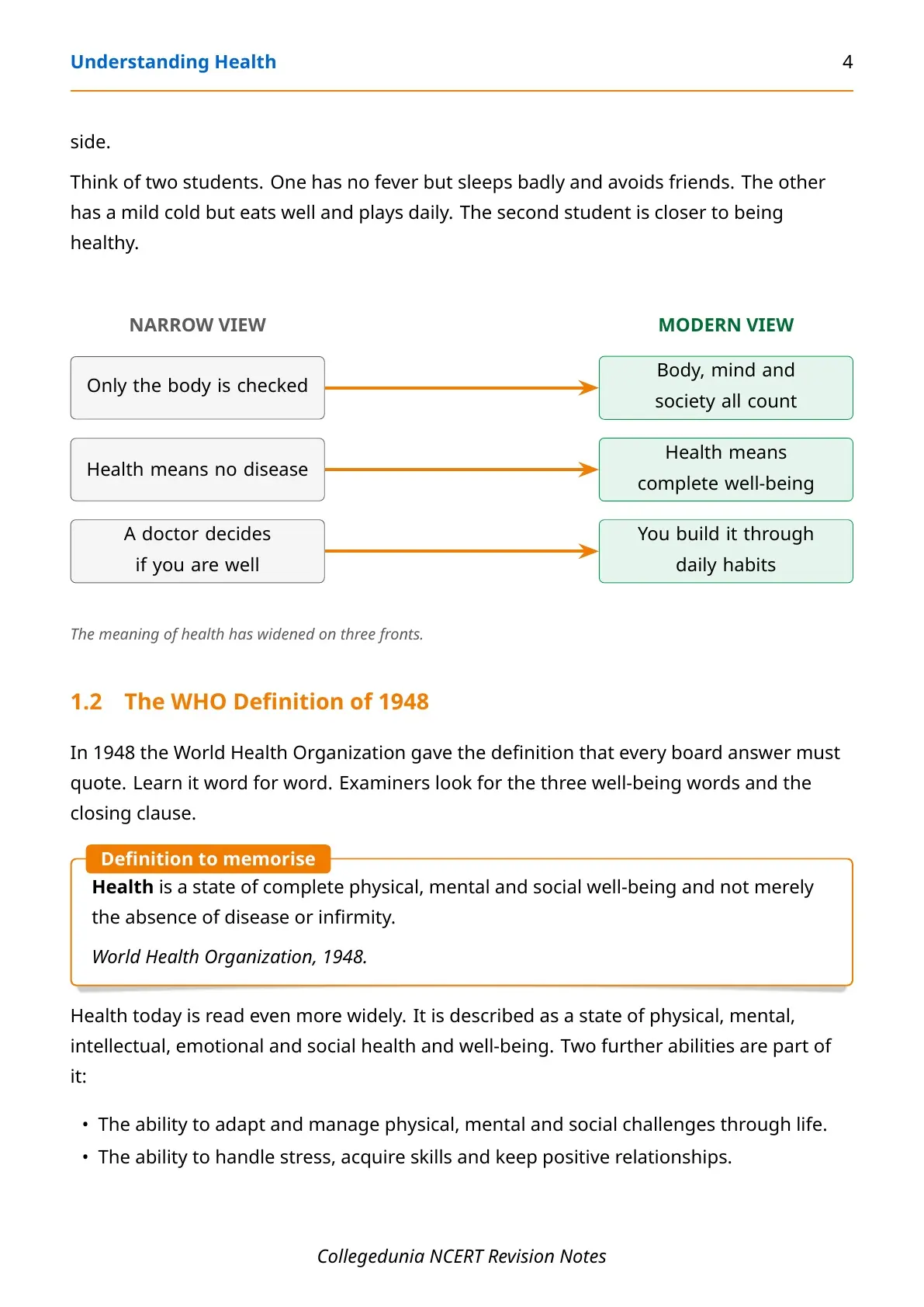
Health is commonly understood as the absence of disease. The chapter says straight away that this idea is partial. It looks only at whether the body works, and it ignores the mind, the feelings and the people around you.
The meaning has widened over time. In 1948 the World Health Organization defined health as a state of complete physical, mental and social well-being and not merely the absence of disease or infirmity. Health today is read even wider than that: physical, mental, intellectual, emotional and social well-being together.
| Idea of health | What it says | Why it is limited or wide |
|---|---|---|
| The common idea | Health is the absence of disease | Partial. It covers only the ability of the body to function, which disease disturbs from time to time. |
| WHO, 1948 | A state of complete physical, mental and social well-being and not merely the absence of disease or infirmity | Wide. It adds the mind and social life to the body, and it is the definition school papers ask for. |
| The present reading | Physical, mental, intellectual, emotional and social health and well-being | Widest. It is the ability to adapt and manage physical, mental and social challenges through life. |
Health is also about what a person can do, not only what a person does not have. The chapter names three abilities: handling stress, acquiring skills and maintaining positive relationships. Keep those three in any answer that asks you to explain the modern meaning of health.
What Decides the Health of a Whole Population
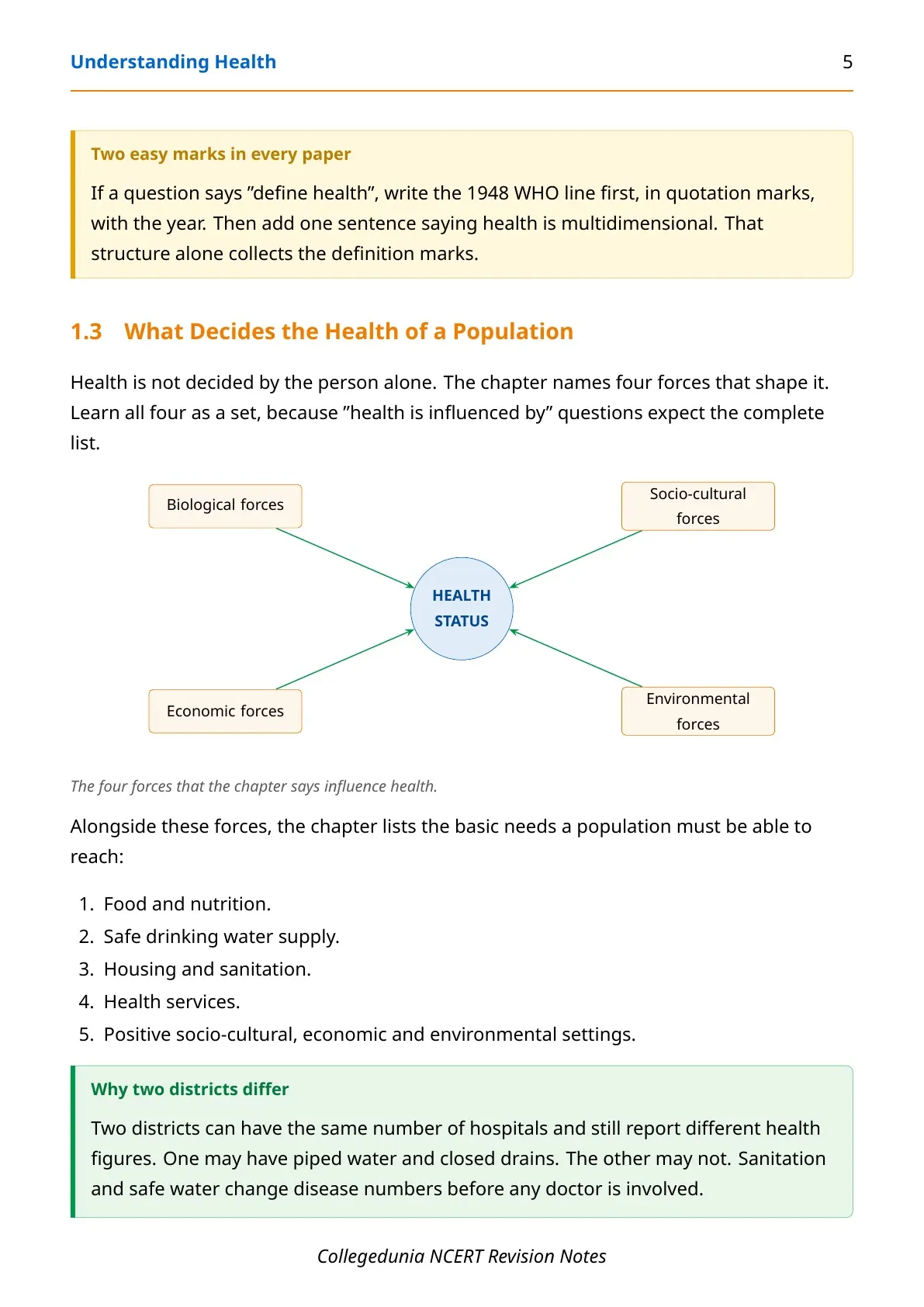
Health is not only a personal matter. The chapter says it is shaped by four groups of forces, and by whether basic services actually reach people.
- Biological forces, such as the body a person is born with.
- Socio-cultural forces, such as customs, family setting and community habits.
- Economic forces, such as income and what a family can afford.
- Environmental forces, such as pollution levels and living conditions.
- Access to food, safe drinking water, housing, sanitation and health services decides the health status of a population.
Six Dimensions of Health Every Class 11 Student Must Know
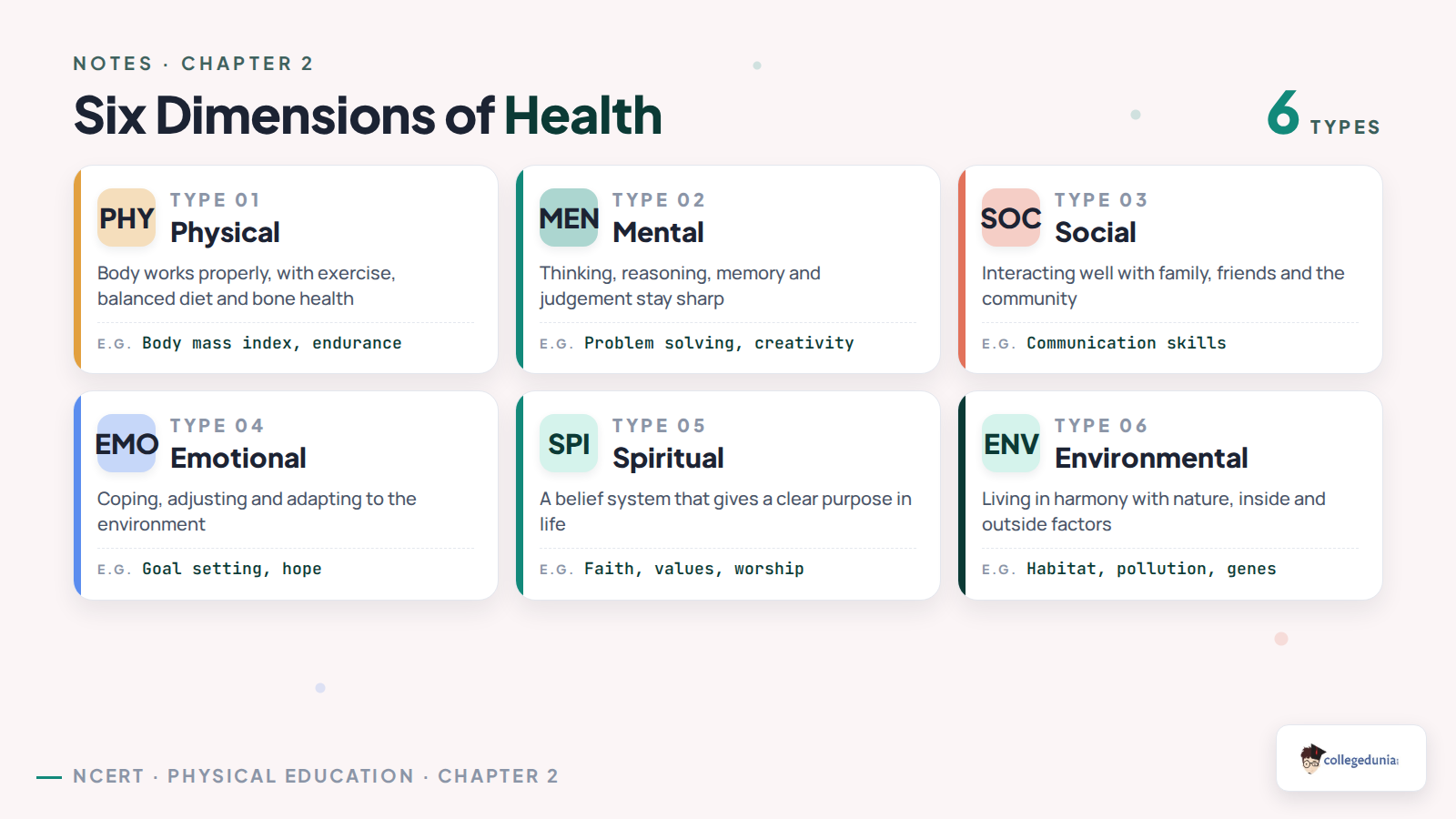
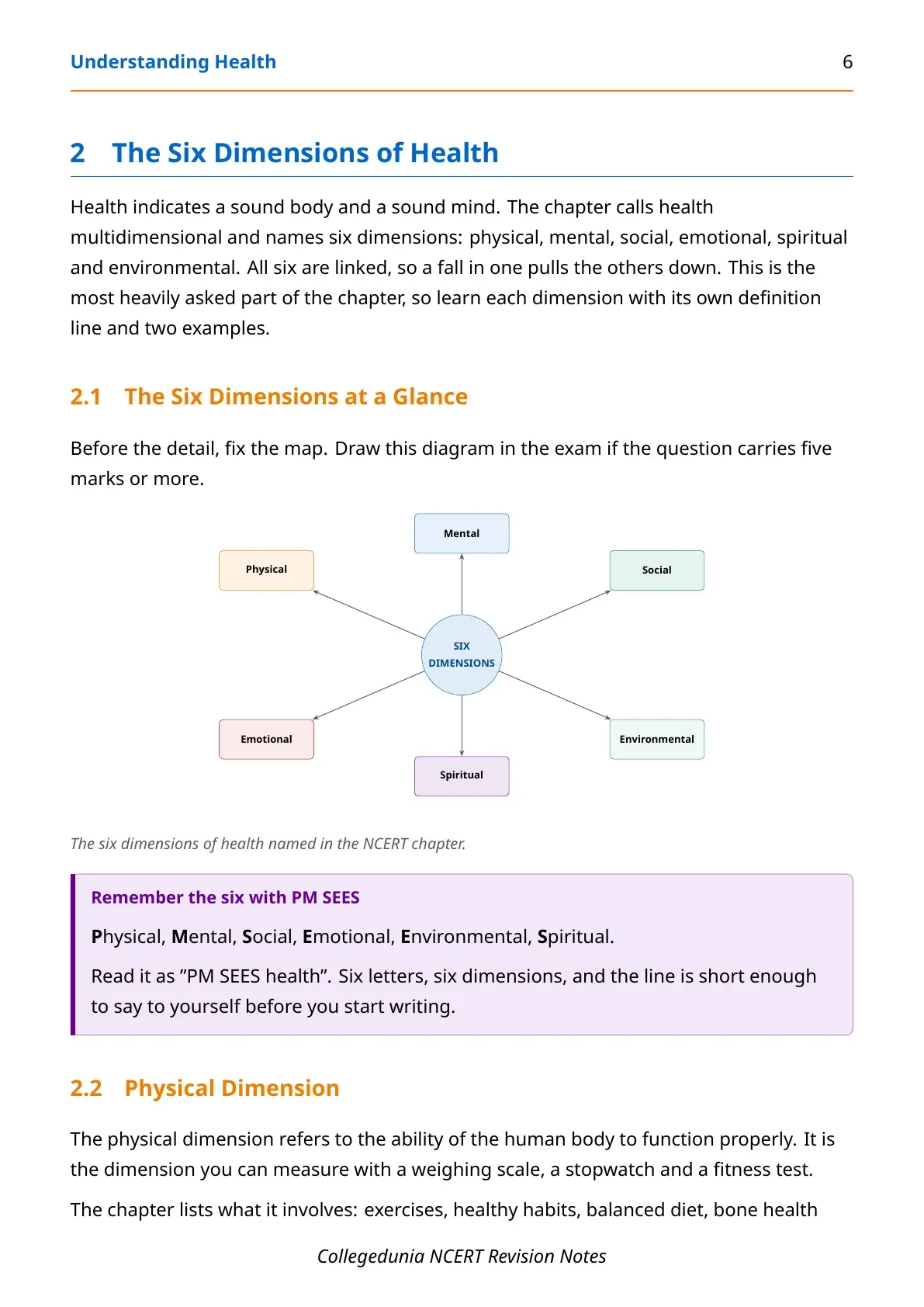
Health indicates a sound body and a sound mind. The chapter calls it multidimensional and names six dimensions. All six are interrelated, so a change in one shows up in the others. This is the highest scoring section in the chapter.
| Dimension | What it means | What the chapter says about it |
|---|---|---|
| Physical | The ability of the human body to function properly | Covers exercise, healthy habits, balanced diet, bone health and body mass index. Physical wellness means getting through daily activities without undue fatigue or physical stress. It builds strength, flexibility, coordinative ability and endurance. |
| Mental | The cognitive side of health | Thinking, reasoning, remembering, imagining and learning words. It rests on perception, memory, judgment and reasoning. It grows with critical questioning, creative work and problem solving, and it depends first on more physical activity. |
| Social | The ability to interact with others in the socio-cultural setting | Building and keeping healthy relationships with family, neighbourhood, friends, peers, teachers and community. Good communication skills set up sound relationships. A poor social life can push a person towards isolation and depression. |
| Emotional | The ability to cope, adjust and adapt to the environment | People with a positive mindset tend to be more successful. Friends shape personality, which is why the chapter quotes the line that individuals become the type of person their friends are. |
| Spiritual | A belief system that gives a sense of purpose in life | A person who has a purpose in life is said to be healthier than one who does not. Purpose helps in reaching goals, keeping perspective and getting over hardship. Meeting others around a shared purpose also improves social health. |
| Environmental | Living in a way that is good for the surroundings | The external environment is habitat, occupation and pollution levels. The internal environment is genetic composition. Its core principle is respect for nature and every species living in it. |
Memory hook: read the six as P M S E S E (Physical, Mental, Social, Emotional, Spiritual, Environmental). That is the order the chapter explains them in, and an examiner marks in the same order.
How to Get Good Mental Health, as the Chapter Lists It
The textbook prints this as a box, which makes it an easy question to set. There are seven points and each one needs a single supporting line.
- Eat healthy food. A healthy diet has enough essential nutrients and the right calories to keep a healthy weight.
- Express your feelings. Talking about feelings when stressed keeps mental health in good shape.
- Play games and sports you like. Hockey, cricket or chess boosts self esteem and helps you concentrate and sleep.
- Get enough sleep. The body needs to rest and heal, so about eight hours of sleep is a must, especially for children.
- Spend time with friends and family. They make you feel cared for and offer a different view of the problem.
- Ask for help. Nobody is perfect in all aspects, so do not hesitate when things get too much.
- Do not consume tobacco or alcohol. Both cause illness in proportion to how much is consumed. Learn to say no to friends.
Also Check: A 5 mark question often says "list all the dimensions of health and explain any two briefly". Name all six first, then write the two you know best. Naming carries its own marks.
Health Needs of Children, Adolescents and the Differently Abled
The chapter treats these three groups together because all three need a response built around their age and their family situation. Health, nutrition and education decide whether a child grows into an empowered member of society.
| Group | Age range in the chapter | Core health need |
|---|---|---|
| Children | Toddlers, infants and kids up to 9 years | Food and nutrition, immunity, and a positive family and social environment through the pre-natal, post-natal and childhood stages |
| Adolescents | 10 to 19 years | Guidance through body and mind changes, counselling, healthcare advice and treatment |
| Differently abled | Found in both age groups above | An end to discrimination, plus care of physical, social and emotional well-being |
Health Needs of Children
Childhood is the stage where the foundation of a healthy life is laid. Physical, mental and social health needs all matter at once.
- Children in India still lose their lives to vaccine preventable diseases, and measles remains the biggest killer.
- The major causes of death and illness are diarrhoea, pneumonia and fevers, because treatment is delayed and services are not available.
- Poor living conditions and no response to basic needs make the same diseases worse.
- Children who survive may reach school underweight, malnourished and open to repeated illness.
- The fix is a multi-pronged strategy: quality health and nutrition services, lower mortality rates, and better access to education and skill development.
- All children must complete the entire course of vaccination, and the process must continue without a break.
Health Needs of Adolescents
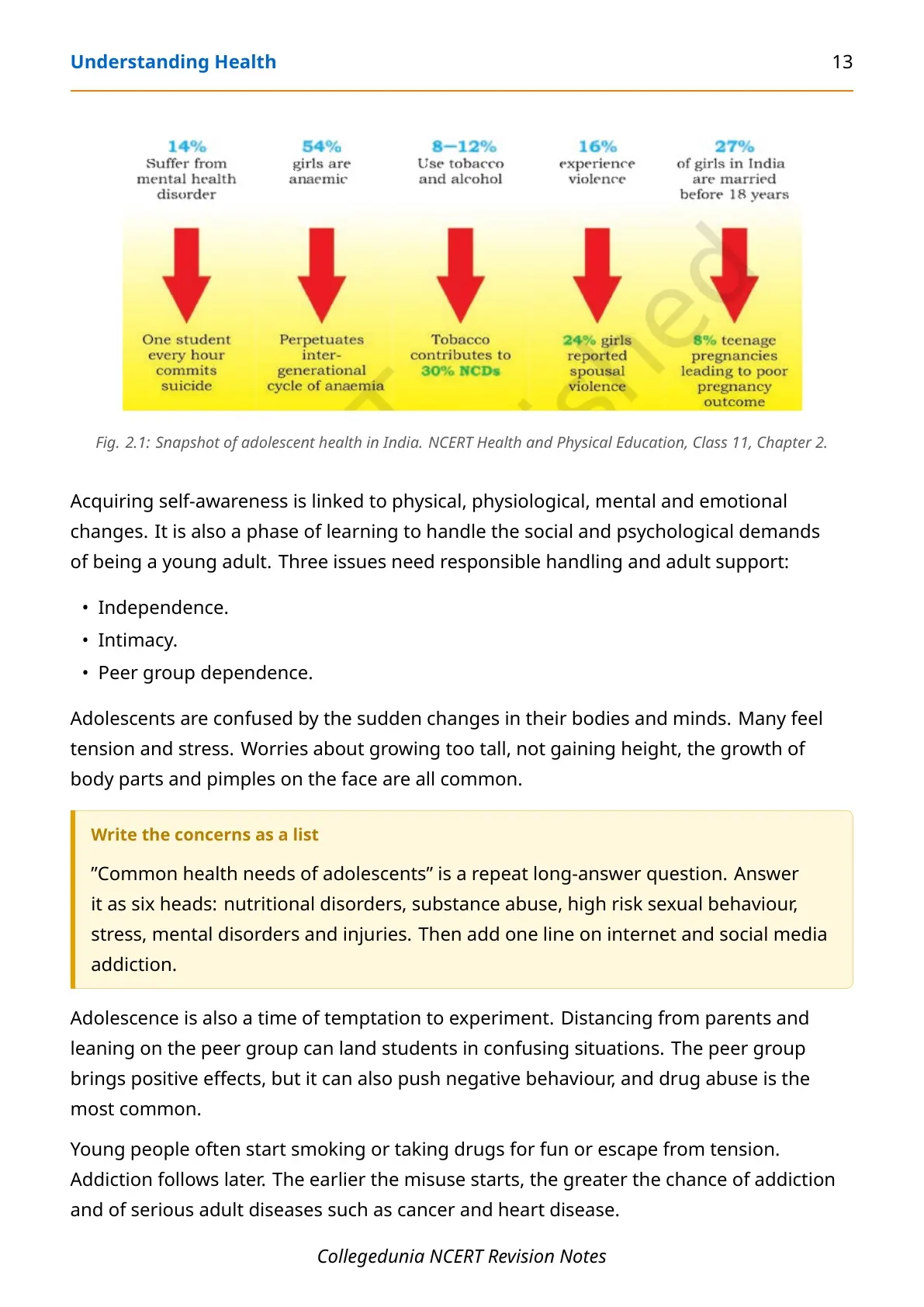
Adolescents make up about one fifth of India's population. Adolescence is the move from childhood to adulthood and the critical period for building self identity. Physical, physiological, mental and emotional changes all arrive together, which is why confusion is normal at this age.
Common worries the chapter names are growing too tall, not gaining height, the growth of body parts and pimples on the face. Adolescents also face the pull of experimenting, and moving away from parents towards a peer group can lead them into risky behaviour.
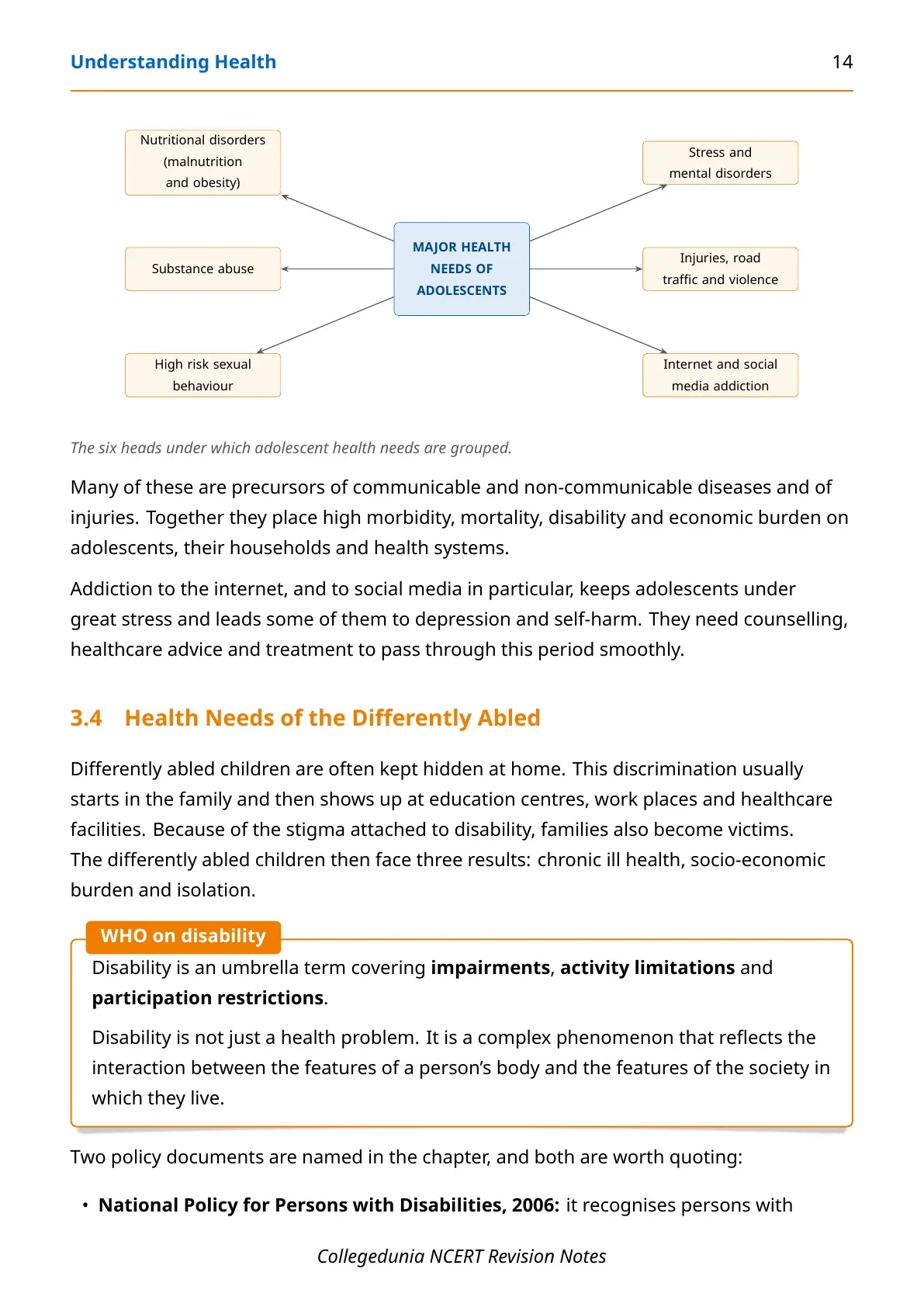
| Health need or problem | What it looks like |
|---|---|
| Nutritional disorders | Malnutrition at one end and obesity at the other |
| Substance abuse | Smoking and drugs, taken first for fun, relaxation or to escape tension, then turning into addiction |
| High risk sexual behaviour | Behaviour that can lead to infection and other long term harm |
| Stress and mental disorders | Tension that varies from day to day, and disorders that follow it |
| Injuries | Road traffic injuries, suicides and different types of violence |
| Internet and social media addiction | Constant stress that leads to depression and self harm |
The chapter gives a clear warning worth quoting: the earlier a person gets into substance misuse, the greater the chance of addiction and of serious diseases such as cancer and heart disease in adult life.
Health Needs of the Differently Abled
Differently abled children are often kept hidden at home. That discrimination usually starts inside the family and then spreads to education centres, workplaces and healthcare facilities. Because of the stigma, families become victims too, and the children face chronic ill health, socio-economic burden and isolation.
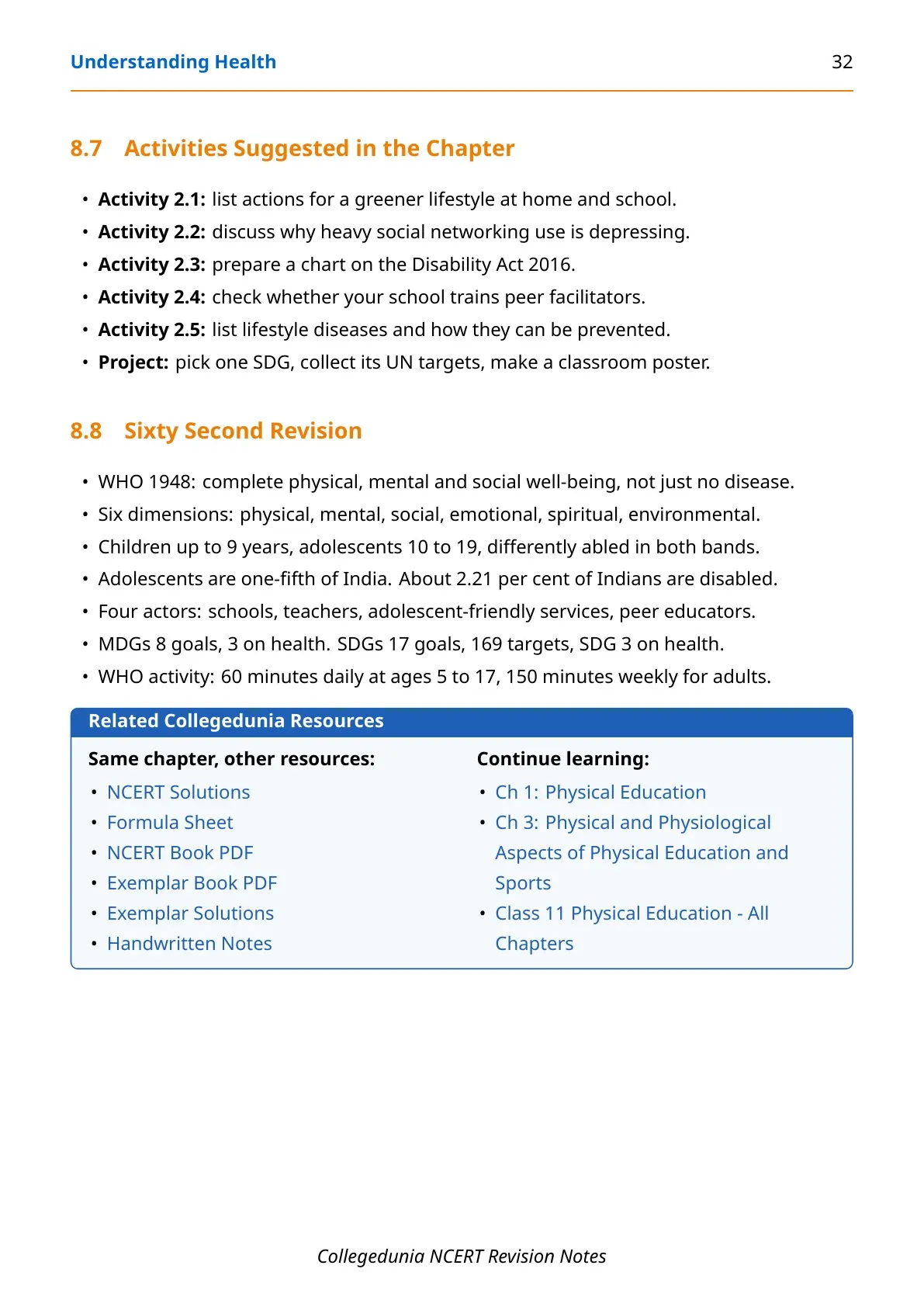
- WHO calls disability an umbrella term, covering impairments, activity limitations and participation restrictions.
- Disability is not just a health problem. It is the interaction between a person's body and the society they live in.
- The National Policy for Persons with Disabilities (2006) treats persons with disabilities as valuable human resources for the country.
- The policy seeks equal opportunities, protection of rights and full participation in society.
- The 2030 Agenda for Sustainable Development also flags persons with disabilities and persons in vulnerable situations.
- The focus today is inclusive development and inclusive education, which the chapter calls a milestone towards sustainable development.
Do You Know: about 2.21 per cent of India's total population is disabled. Uttar Pradesh has the highest number of disabled persons, and 7.62 per cent of them are in the 0 to 6 age group. The source is Census 2011.
Health Status of Children in India at a Glance
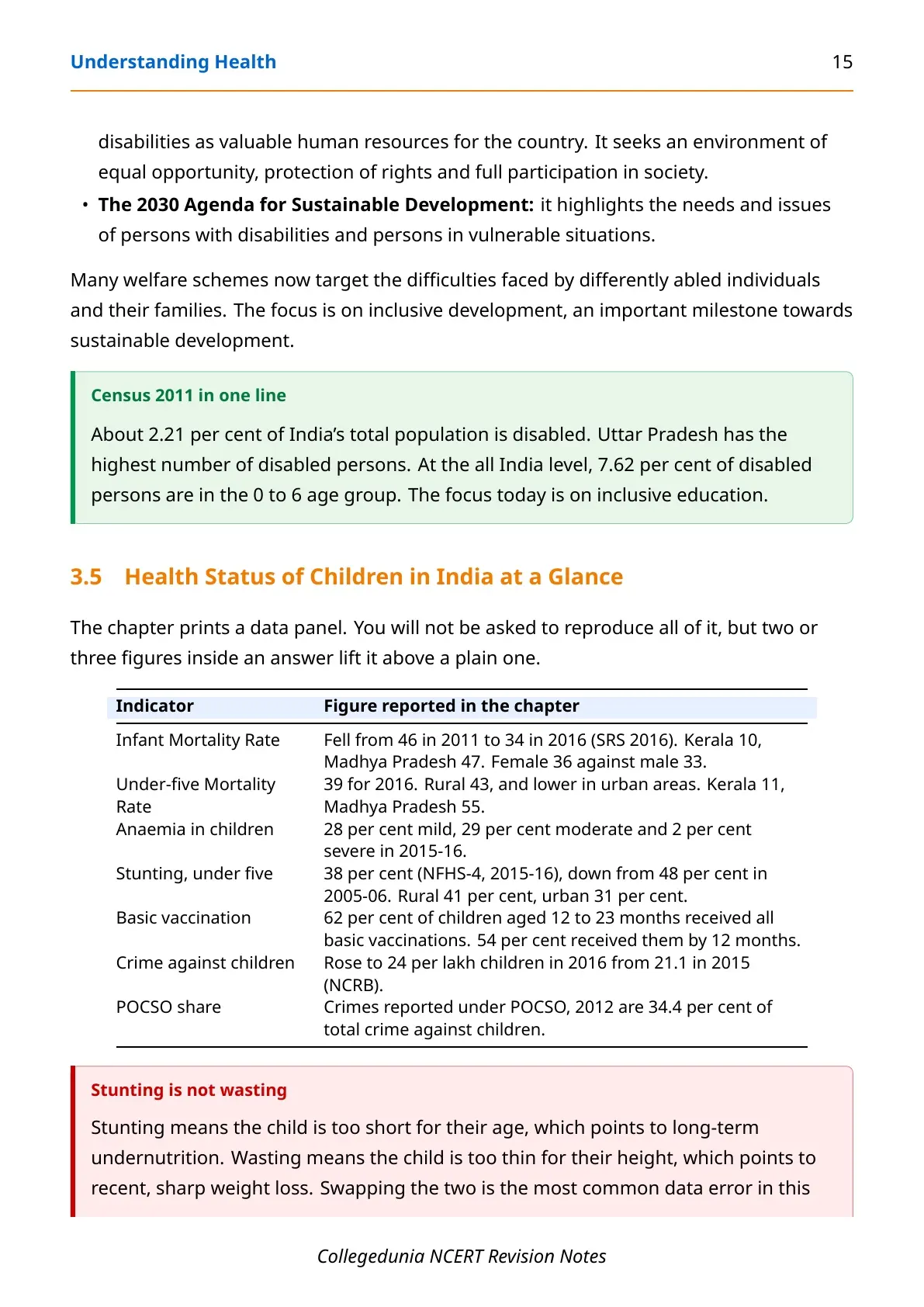
This data box is the easiest place in the chapter to lose marks, because students remember the trend but not the figure. Learn the table row by row and quote two or three numbers in any long answer on child health.
| Indicator | All India figure | Range across states |
|---|---|---|
| Sex ratio, 0 to 6 years | 918 (916 for 0 to 14 years, 943 for all ages) | Not favourable to females in many states and union territories |
| Infant Mortality Rate, SRS 2016 | Down from 46 in 2011 to 34 in 2016. Female 36 against male 33 | 10 in Kerala to 47 in Madhya Pradesh |
| Under-five Mortality Rate, 2016 | 39, with rural at 43 | 11 in Kerala to 55 in Madhya Pradesh |
| Anaemia in children | 28 per cent mild, 29 per cent moderate, 2 per cent severe | Highest in Haryana at 72 per cent, lowest in Mizoram at 19 per cent for ages 6 to 59 months |
| Stunting, under five years (NFHS-4) | 38 per cent, improved from 48 per cent in the earlier round. Rural 41 per cent, urban 31 per cent | Bihar 48, Uttar Pradesh 46, Jharkhand 45, Meghalaya 44. Lowest in Kerala and Goa at 20 each |
| Wasting, under five years | 21 per cent | 6 per cent in Mizoram to 29 per cent in Jharkhand |
| Basic vaccination, 12 to 23 months | 62 per cent at any time, 54 per cent by 12 months of age | Reported by NFHS-4 |
| Crime against children (NCRB) | Rate rose to 24 per lakh children in 2016 from 21.1 in 2015 | POCSO Act, 2012 crimes are 34.4 per cent of all crime against children |
Two numbers carry most of the marks here. Infant Mortality Rate fell from 46 to 34, and stunting fell from 48 per cent to 38 per cent. Both show progress, and both still leave a wide gap between Kerala and Madhya Pradesh.
Addressing the Health Needs of Children Through Schools, Teachers and Peers
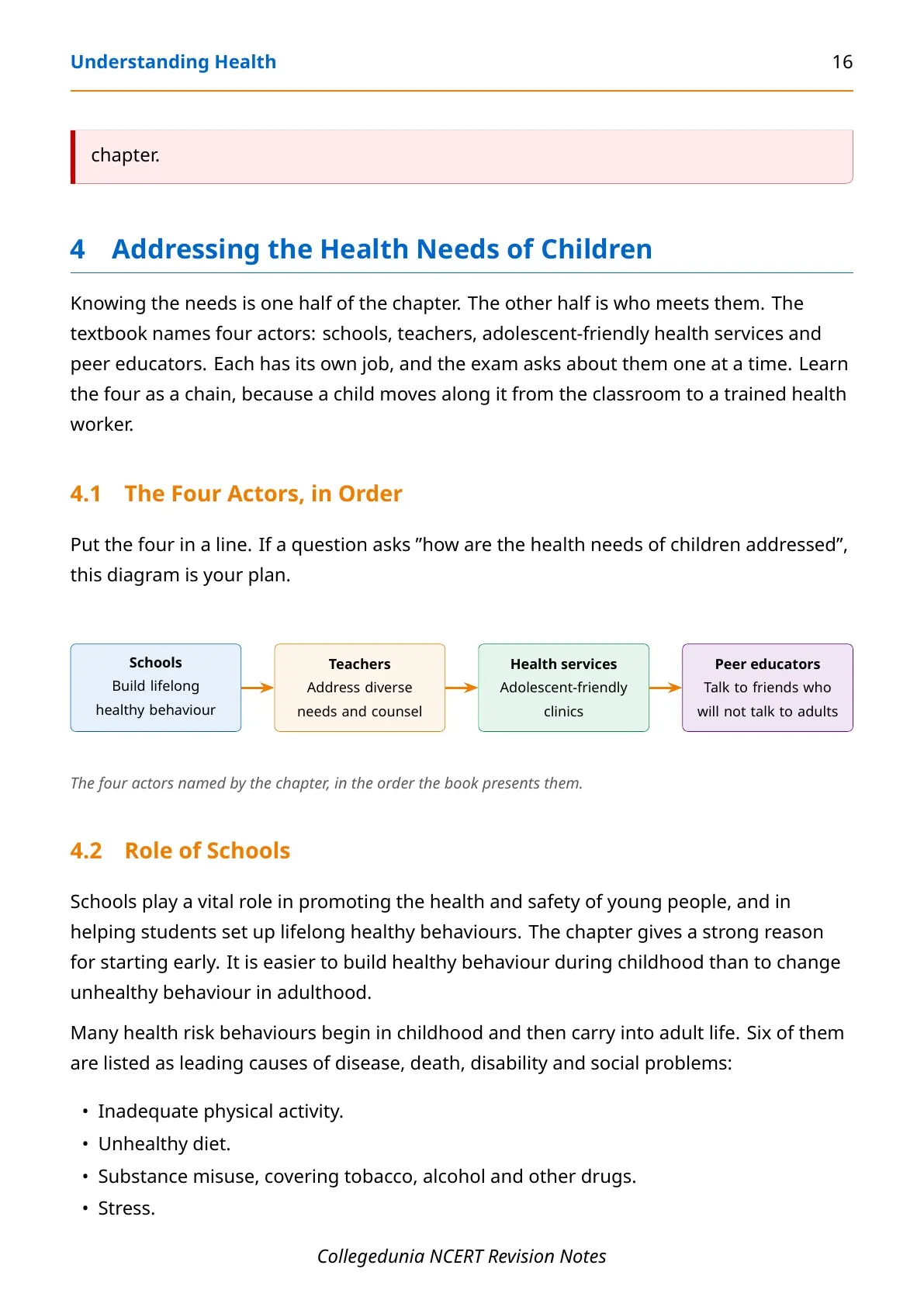
The chapter names four agents who address these needs. Each one has its own short list, and a question usually asks for the role of just one of them.
| Agent | Role the chapter gives it |
|---|---|
| Schools | Promote health and safety, and help young people build lifelong healthy behaviours. Building a healthy habit in childhood is easier than changing an unhealthy one in adulthood. Regular physical education classes help children build a healthy lifestyle. |
| Teachers | Understand and address diverse student needs through new teaching methods, counselling and referral to specialists. Work closely with parents and the community on sensitive issues, and plan need based health promotion programmes. |
| Adolescent-friendly health services | Trained healthcare workers run adolescent-friendly health clinics set up by the government, and make the services easy for young people to use. |
| Peer educators or peer facilitators | Senior class students are trained to help, educate and counsel other adolescents, and to remove the shyness that stops them talking to parents and teachers. |
The Six Leading Causes of Disease, Death and Social Problems
The chapter lists these under the role of schools, because most of them begin in childhood and then continue into adult life.
- Inadequate physical activity
- Unhealthy diet
- Substance misuse, meaning tobacco, alcohol and other drug use
- Stress
- Behaviours that lead to unintentional injury and violence
- Risky behaviours that can cause HIV infection, other sexually transmitted infections and unintended pregnancy
Why Adolescents Avoid Health Services, and What a Peer Facilitator Needs
This pair of lists is a favourite short answer. Adolescents are usually a healthy group, so they rarely have a medical problem. What they want is information, and when they do not get it they feel lost and can be misled.
| Why adolescents do not use health services | What a peer group educator must be |
|---|---|
| Lack of privacy or confidentiality | A good listener |
| Lack of patience and sensitivity among health workers | Knowledgeable about adolescent health issues |
| Lack of friendly behaviour from health workers | Friendly, influential and acceptable to other adolescents |
| Shyness, and the fear that parents and teachers will get upset | Trusted, truthful and non-judgmental |
| The belief that adults will not be sensitive to their concerns | Creative in approach, able to keep confidentiality, and a good role model |
One caution the chapter adds is worth a line in the answer. A peer facilitator must know their own limits on sensitive issues and refer the case to a teacher or an adolescent-friendly service.
Lifestyle and Wellness: Setting Health Goals That Actually Last
A healthy lifestyle does not arrive in an instant. The chapter calls it a series of choices we make every day, consciously and continuously. The first few weeks are hard, but if a person keeps at it the choice turns into a habit.
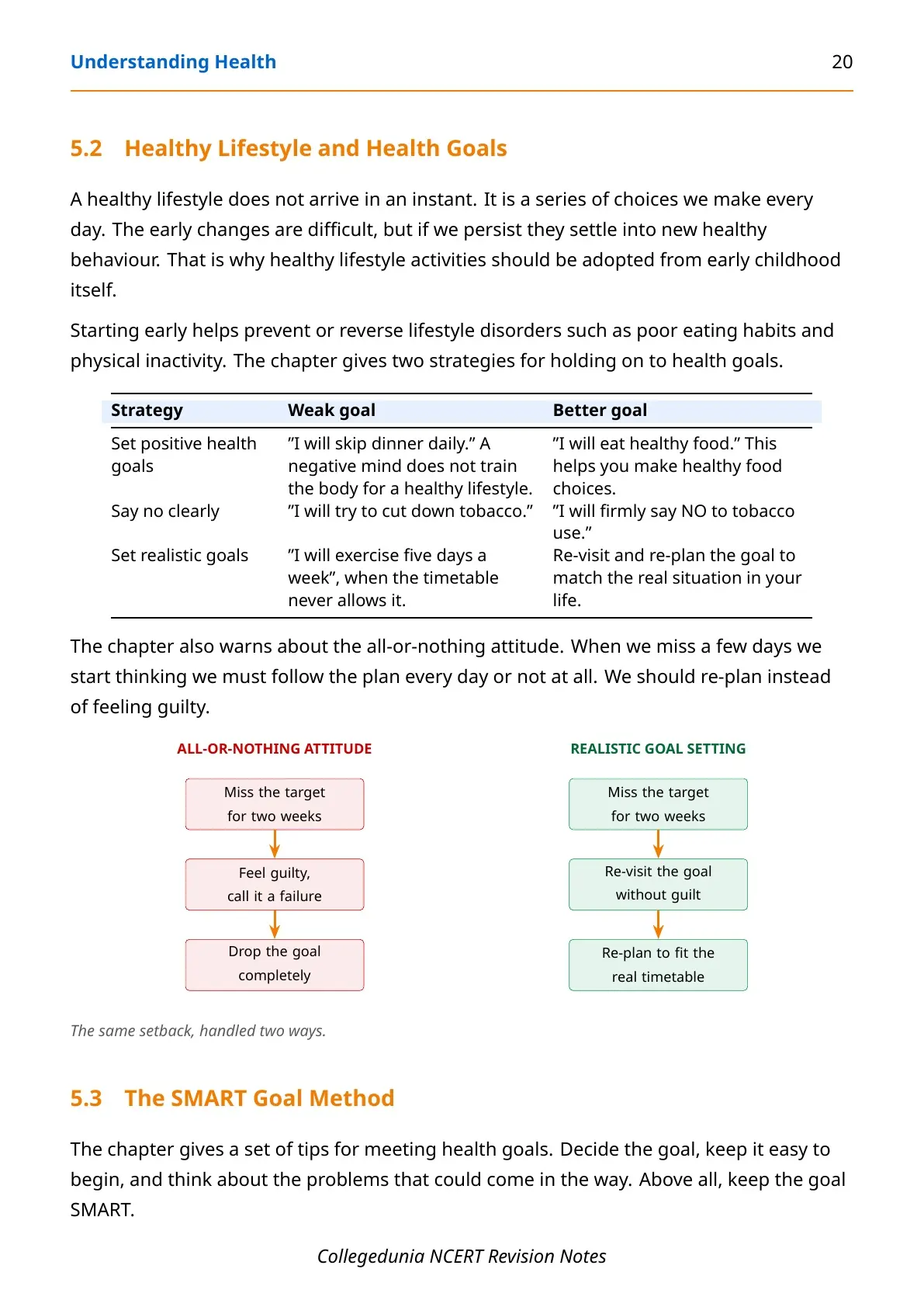
Starting early matters. Healthy lifestyle activities adopted in childhood and adolescence help prevent or reverse lifestyle disorders such as poor eating habits and physical inactivity. The chapter then gives two rules for setting goals.
| Rule | Weak goal | Better goal, and why |
|---|---|---|
| Set positive health goals | "I will skip dinner daily" | "I will eat healthy food". A negative goal does not train the mind for a healthy lifestyle. A positive one reinforces good behaviour for the long term. |
| Set realistic goals | "I will exercise five days a week", then two weeks pass with nothing done | Re-visit and re-plan the goal against your real situation. Do not feel guilty about failure, and do not slip into the all or nothing attitude. |
The SMART Checklist for Meeting a Health Goal
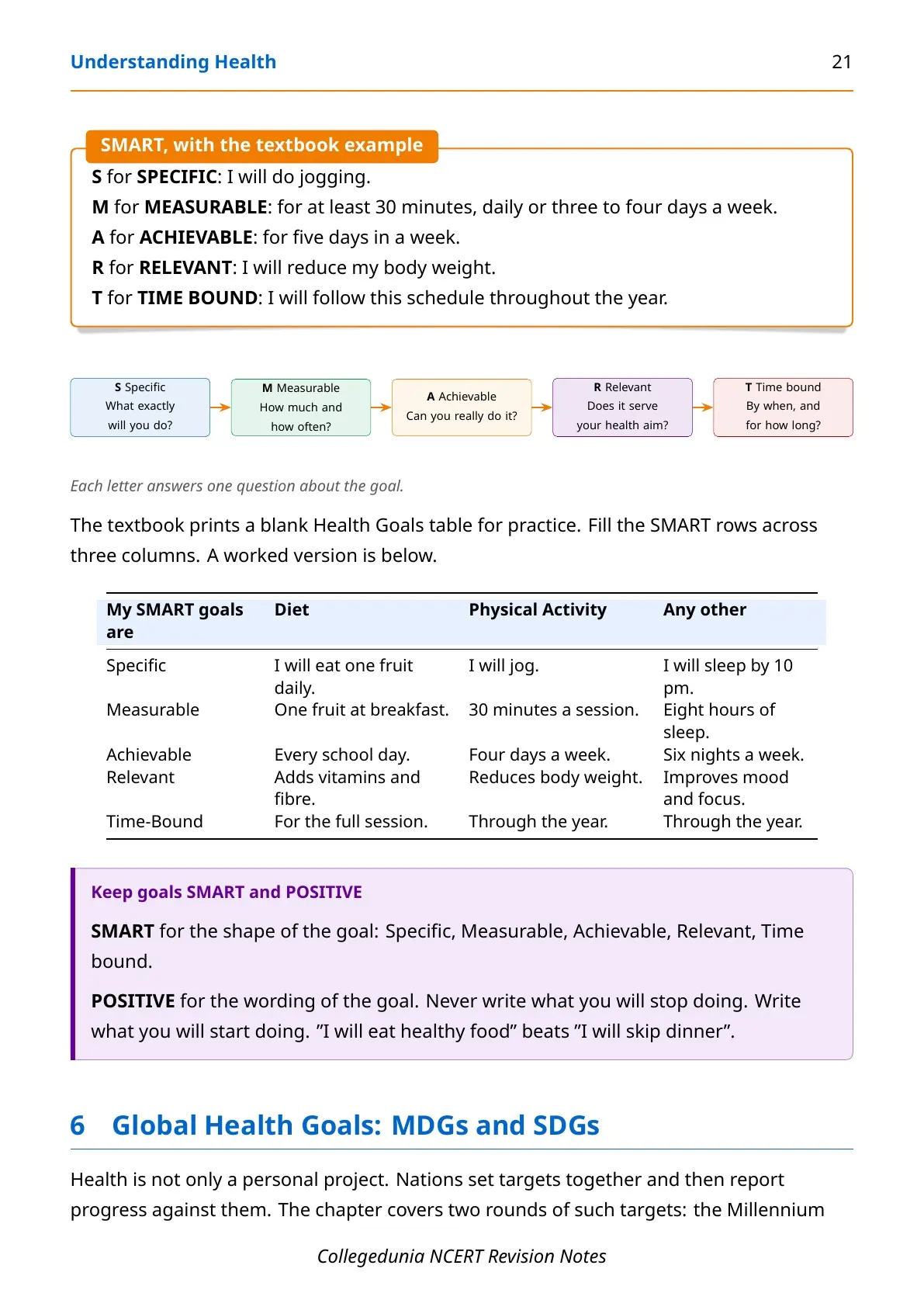
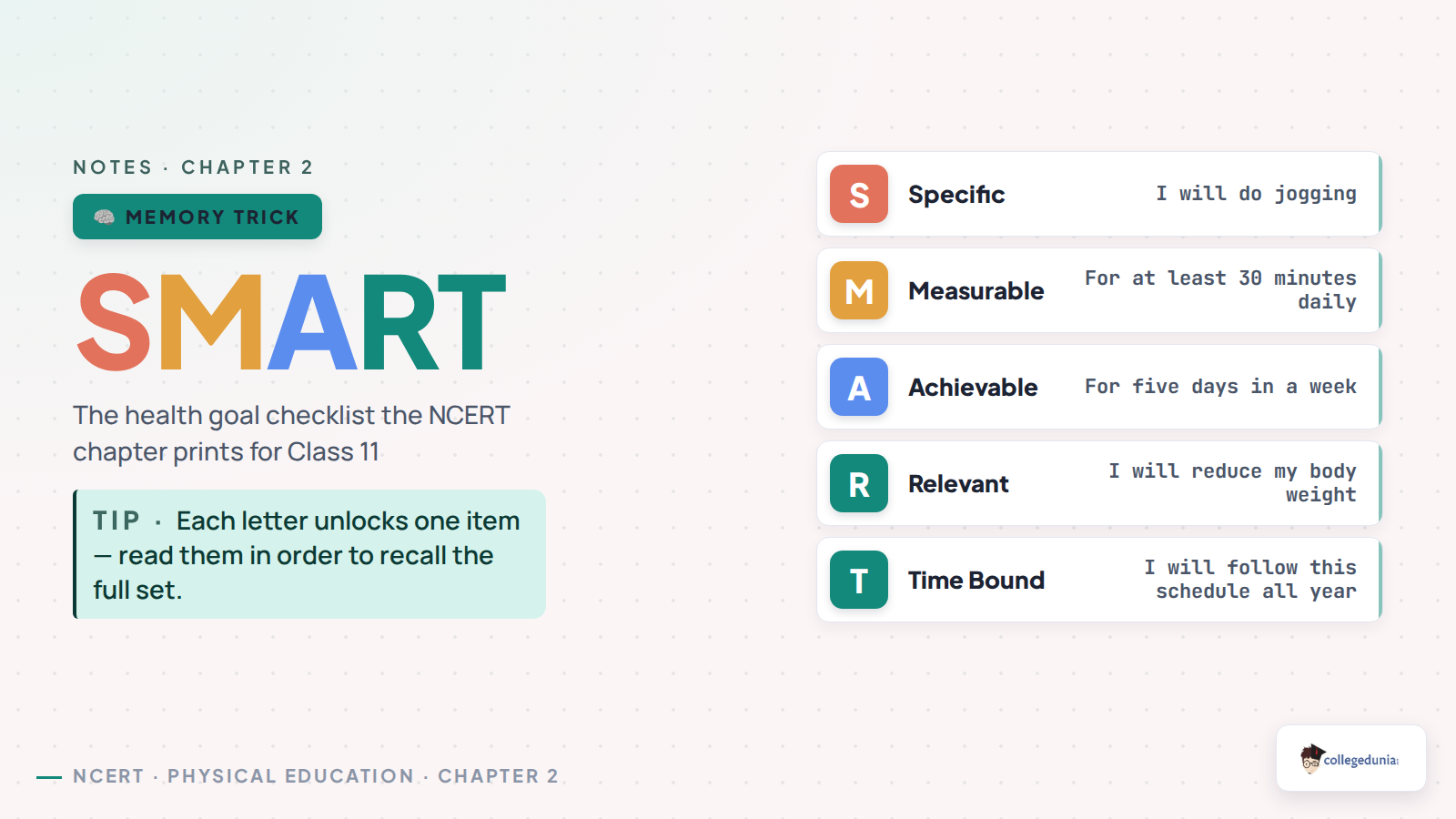
The chapter prints the SMART method with a jogging example. Reproduce the example exactly and the mark is safe.
- S is Specific: I will do jogging.
- M is Measurable: for at least 30 minutes, daily or three to four days in a week.
- A is Achievable: for five days in a week.
- R is Relevant: I will reduce my body weight.
- T is Time Bound: I will follow this schedule throughout the year.
The textbook also asks you to fill a Health Goals table across diet, physical activity, weight and any other area. Practise that table once, because a skill based question can ask you to write your own SMART goal in the paper.
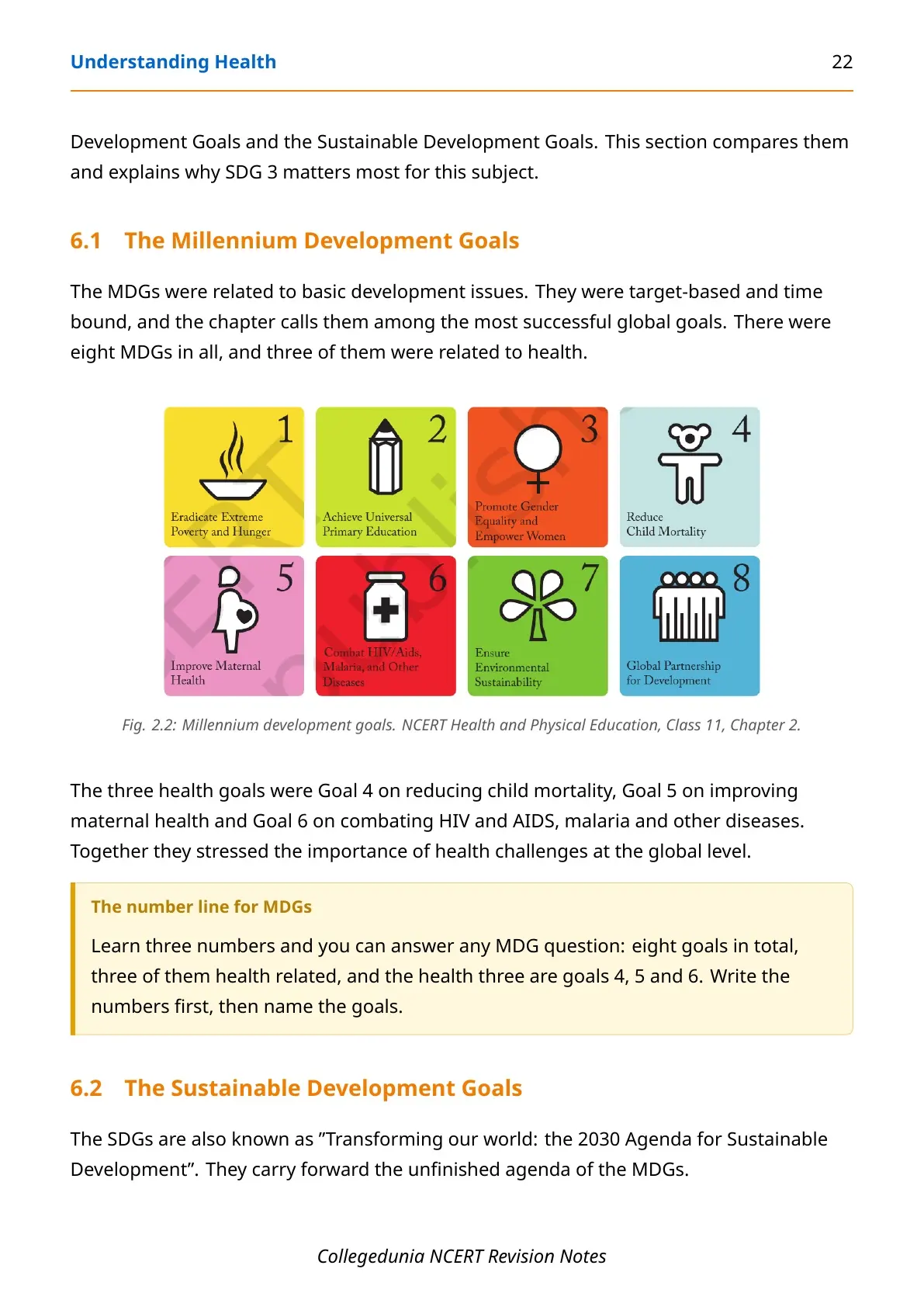
MDGs and SDGs: Health Goals at the International Level
This section is short in the book but it carries a full long answer. Keep the two sets separate, then link them, because the question usually asks what they are and why they matter.
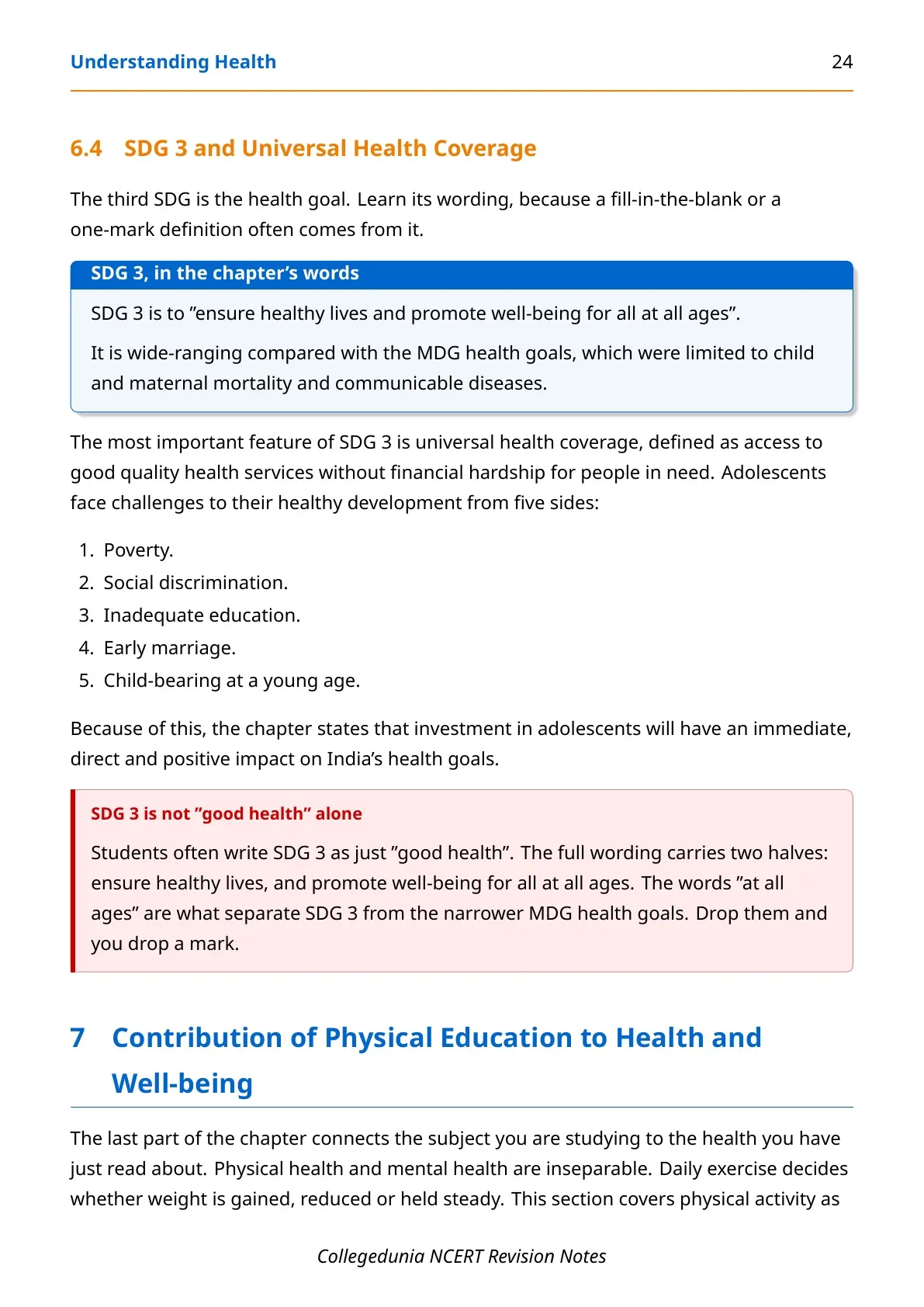
| Point | Millennium Development Goals | Sustainable Development Goals |
|---|---|---|
| What they cover | Basic development issues, target based and time bound | Known as Transforming our world: the 2030 Agenda for Sustainable Development |
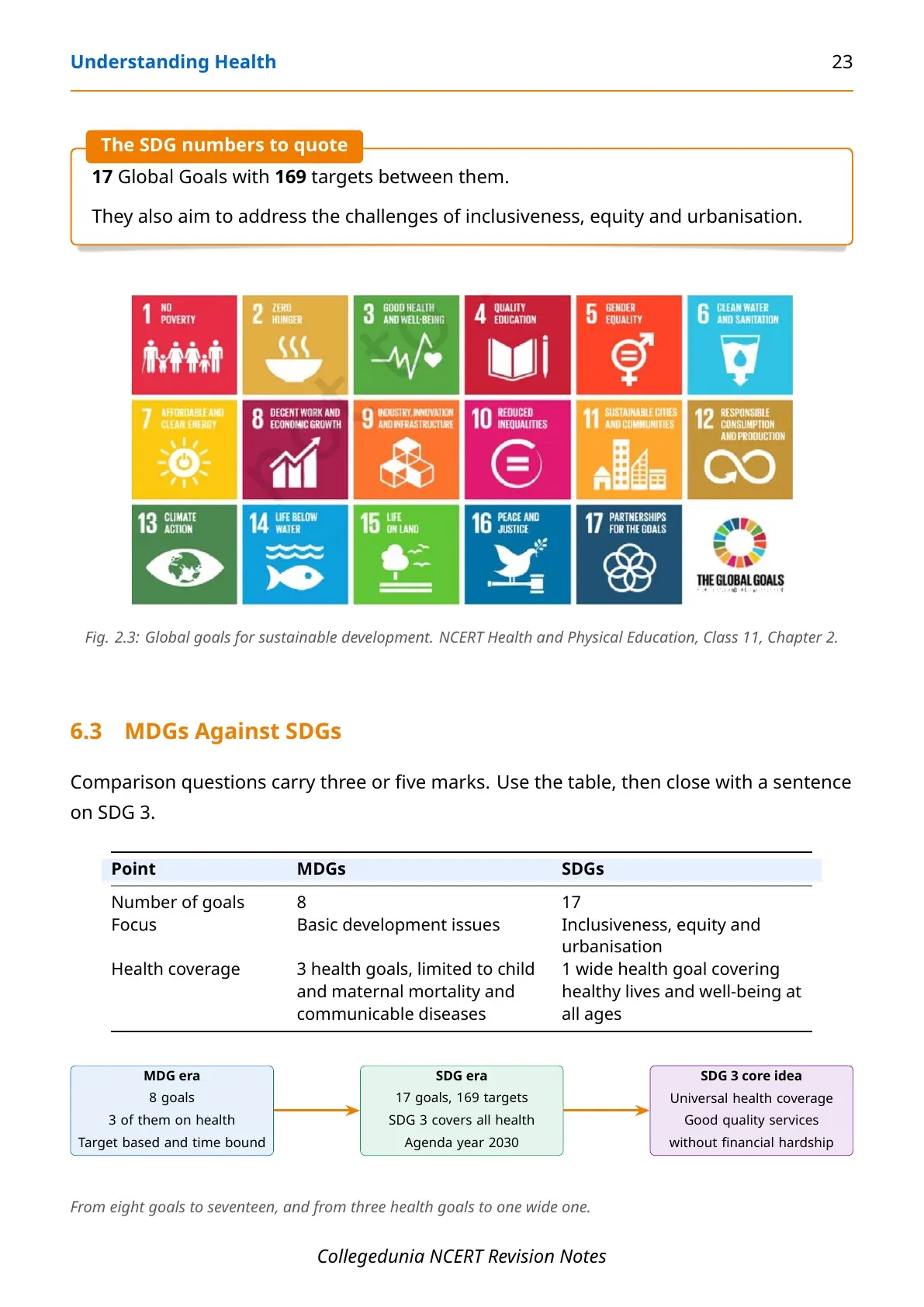
| How many | 8 goals, of which 3 were related to health | 17 Global Goals with 169 targets |
| Health focus | Reduce child mortality, improve maternal health, combat HIV and AIDS, malaria and other diseases | SDG 3: ensure healthy lives and promote well-being for all at all ages |
| Standing | Among the most successful global goals | Carry forward the unfinished agenda of the MDGs to sustain the momentum |
| Extra aims | Stressed health challenges at the global level | Address inclusiveness, equity and urbanisation |
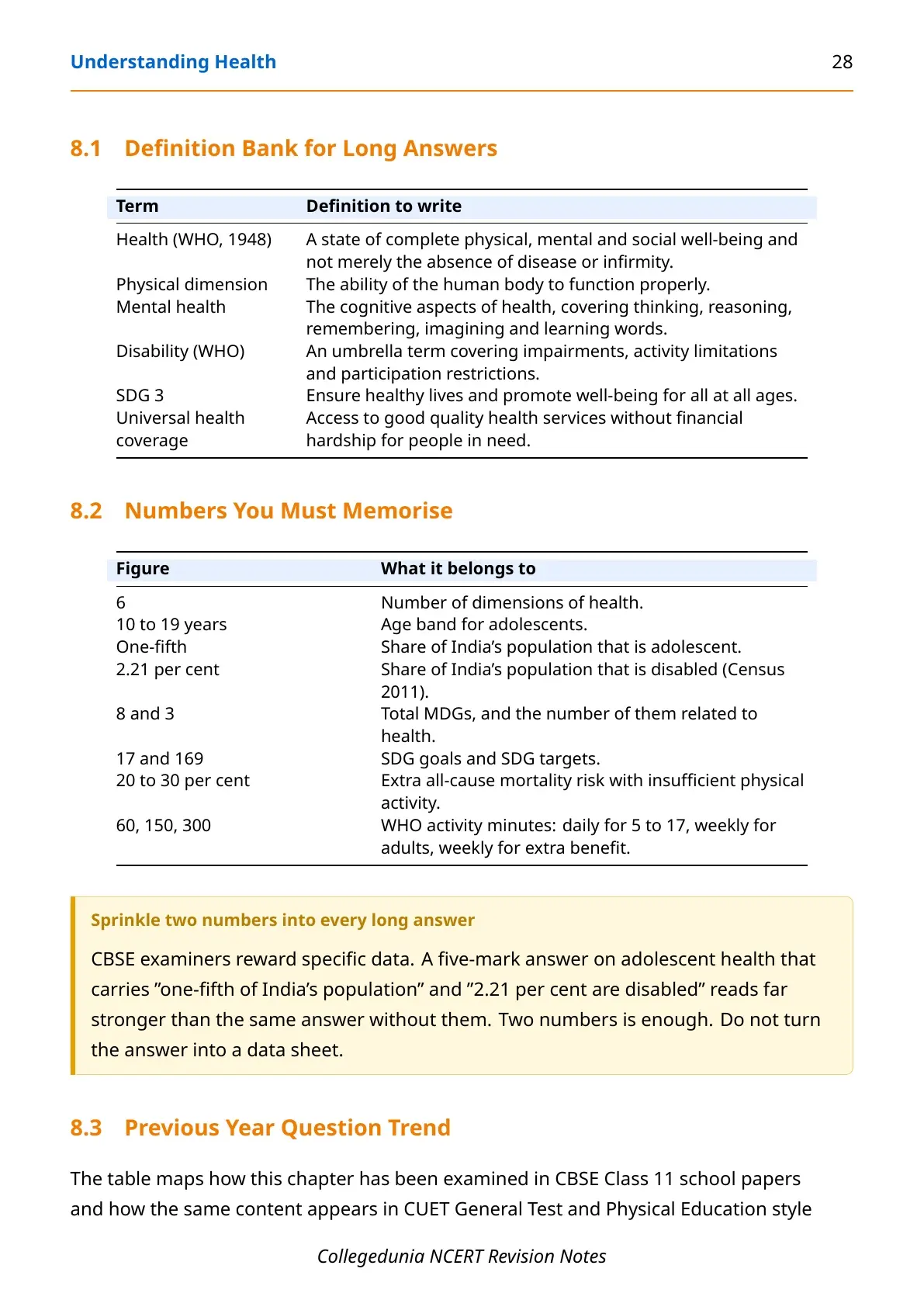
The most important feature of SDG 3 is universal health coverage. The chapter defines it as access to good quality health services without financial hardship for people in need. SDG 3 is also wider than the MDG health goals, which stopped at child mortality, maternal mortality and communicable diseases.
The chapter closes the section on adolescents. Poverty, social discrimination, inadequate education, early marriage and child-bearing all block their healthy development. Investment in adolescents is expected to have an immediate and direct effect on India's health goals.
Contribution of Physical Education to Health and Well-being
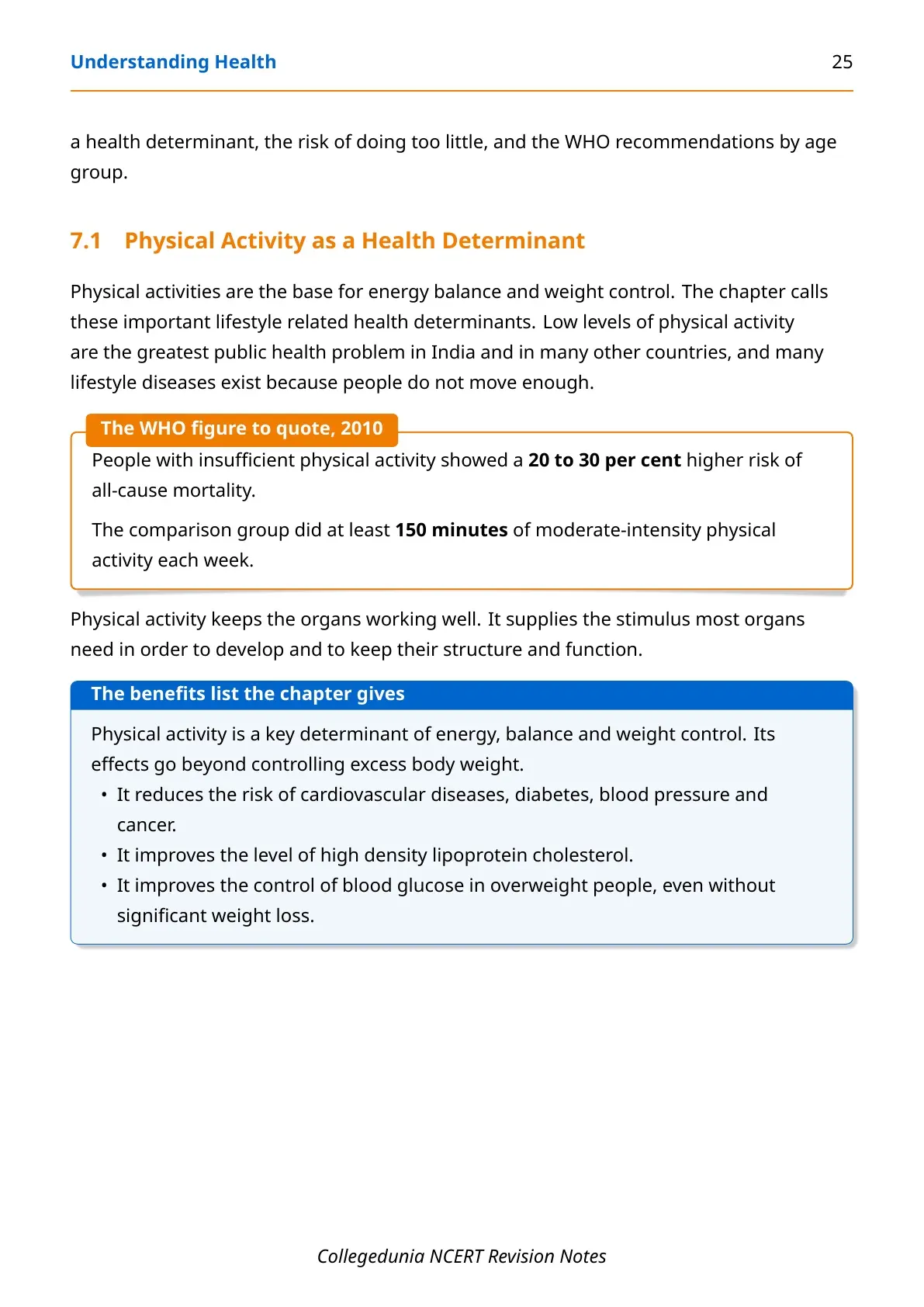
The chapter opens this section with one sentence you should quote: physical health and mental health are inseparable. Daily exercise decides whether a person gains, reduces or maintains weight, and physical activity is the key to energy balance and weight control.
Low levels of physical activity are called the greatest public health problem in India and in many other countries. Many lifestyle diseases today come from the same cause.
| Effect of regular physical activity | What the chapter reports |
|---|---|
| Mortality risk | A 20 to 30 per cent higher risk of all-cause mortality was seen in people with insufficient activity, against those doing at least 150 minutes of moderate-intensity activity each week (WHO, 2010) |
| Organ function | Activity maintains or improves the working of the organs, and gives the stimulus most organs need to build and keep their structure |
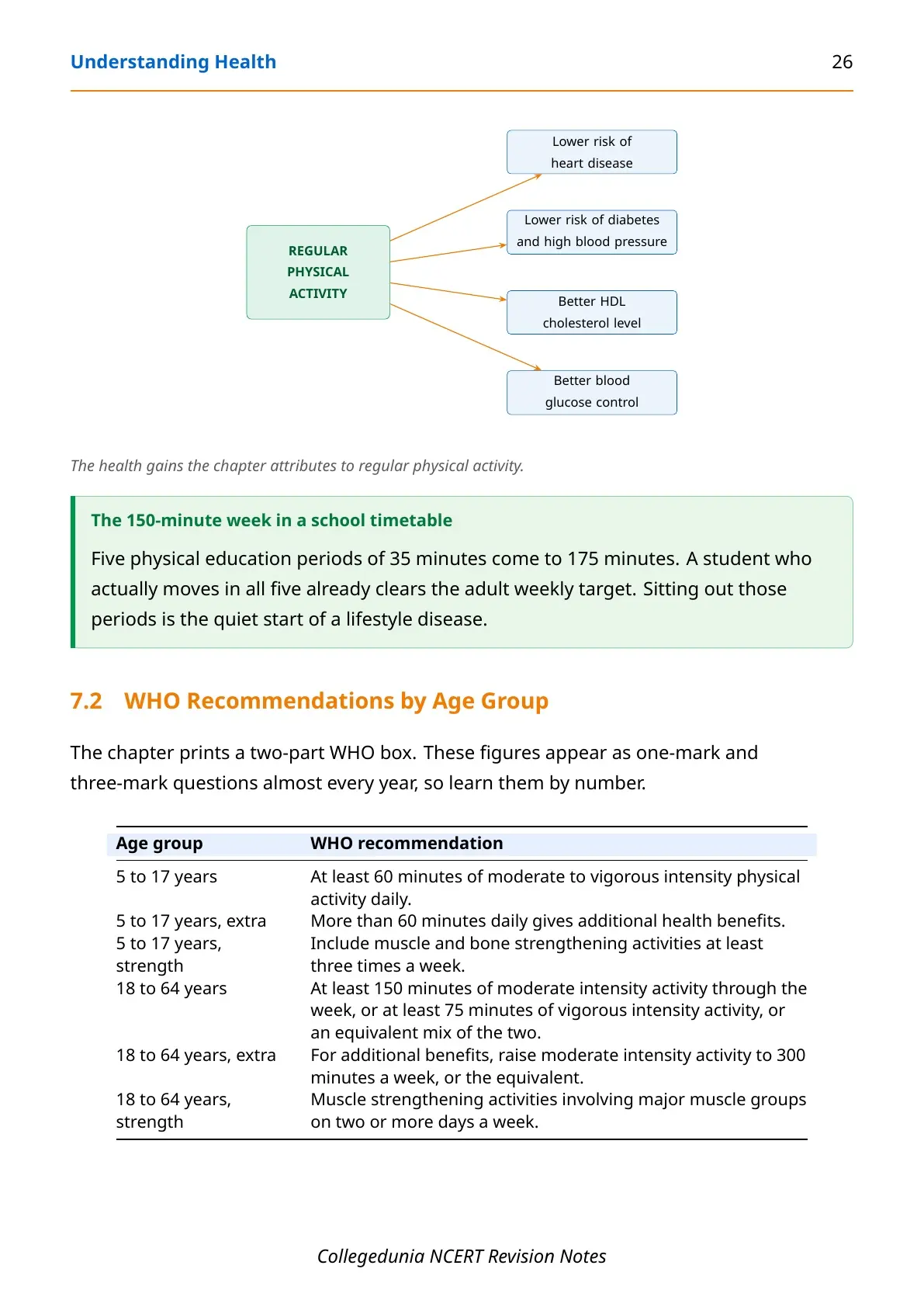
| Disease risk | Reduces the risk of cardiovascular disease, diabetes, blood pressure and cancer |
| Blood profile | Improves high density lipoprotein cholesterol, and improves blood glucose control in overweight people even without much weight loss |
WHO Activity Recommendations by Age Group
These minutes are the most quotable numbers in the chapter. Learn both age bands, because a question can ask for either.
| Age group | Minimum activity | For extra benefit |
|---|---|---|
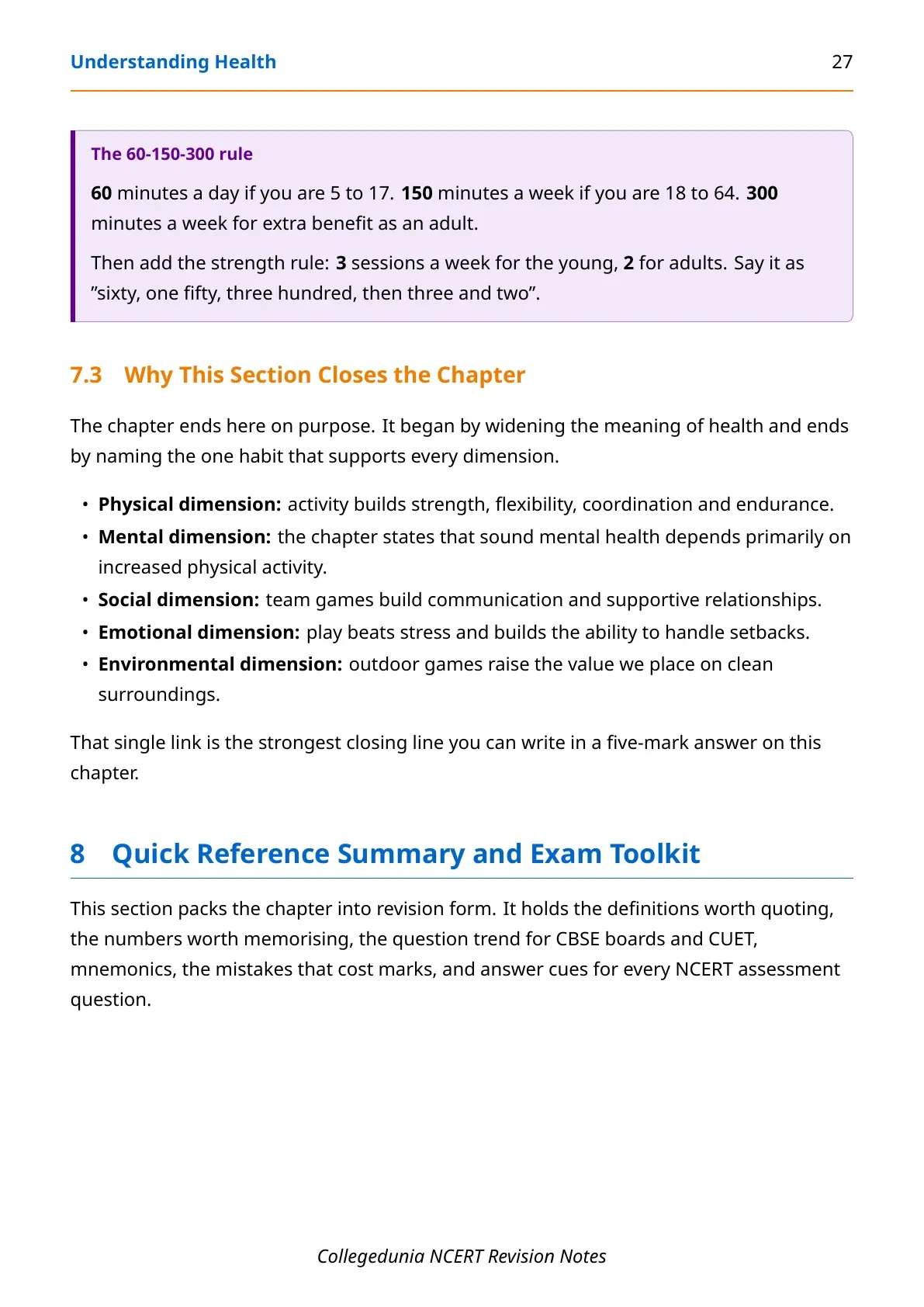
| 5 to 17 years | At least 60 minutes of moderate to vigorous-intensity activity daily | More than 60 minutes daily. Include muscle and bone strengthening activity at least three times a week |
| 18 to 64 years | At least 150 minutes of moderate-intensity activity a week, or 75 minutes of vigorous-intensity activity, or an equivalent mix | Raise moderate-intensity activity to 300 minutes a week. Do muscle-strengthening work on two or more days a week |
Common Mistakes Students Make in the Understanding Health Chapter
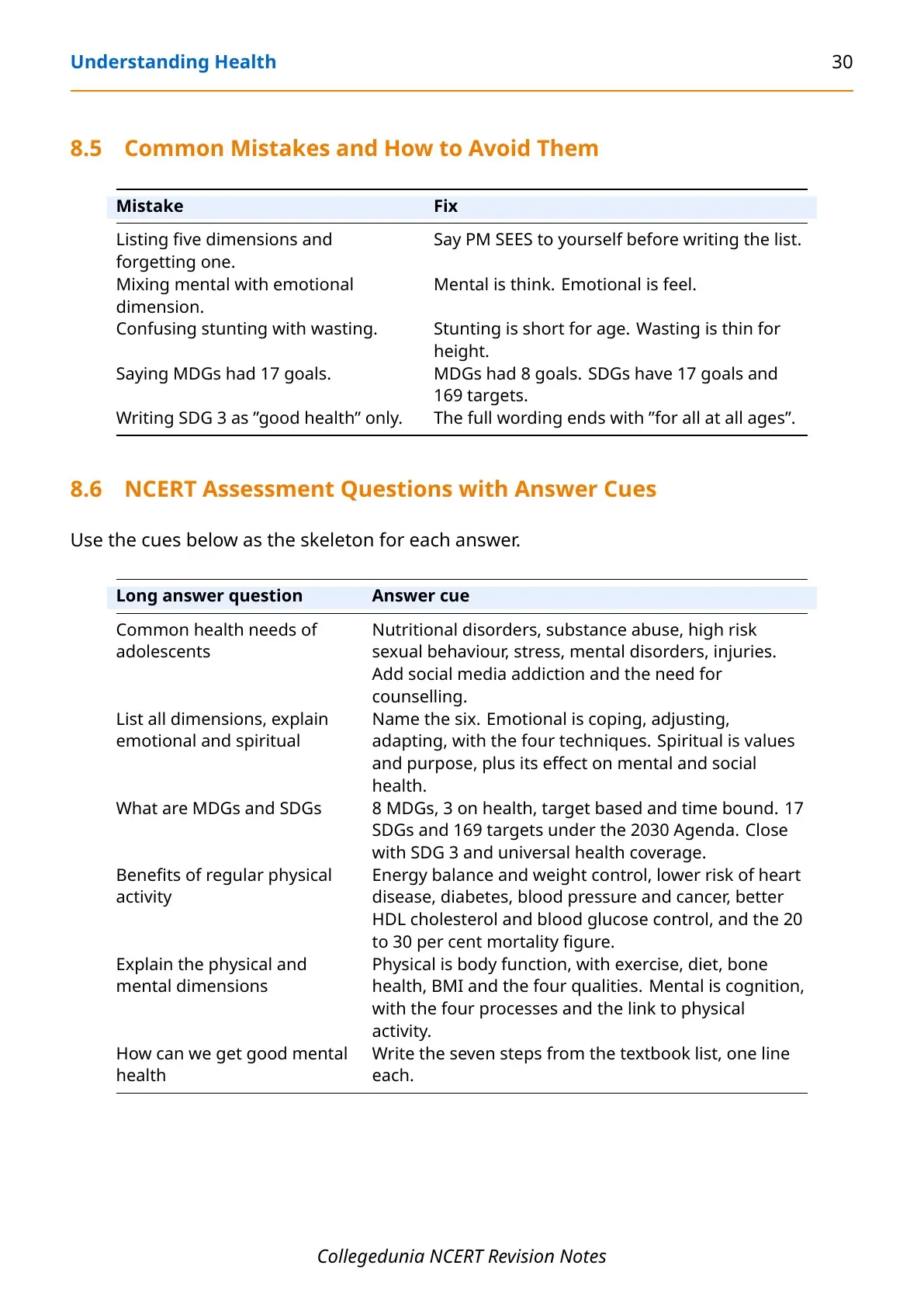
- Naming only five dimensions. There are six. The one most often dropped is environmental, and sometimes spiritual.
- Giving the WHO definition without the year. Write 1948, and write the full line including "not merely the absence of disease or infirmity".
- Mixing up the age brackets. Children run up to 9 years and adolescents from 10 to 19 years. Do not swap them.
- Confusing MDGs with SDGs. MDGs are 8 goals with 3 on health. SDGs are 17 goals with 169 targets.
- Quoting activity minutes for the wrong age. 60 minutes daily is for 5 to 17 years. 150 minutes a week is for 18 to 64 years.
- Writing a negative health goal. "I will skip dinner" is the weak example in the book, not the model answer.
- Calling typhoid or malaria a lifestyle disease. The textbook true or false question marks that statement false.
In the same student poll, the India child health data box was the single biggest source of lost marks, ahead of both the dimensions question and the SDG question.
Understanding Health Textbook Assessment Questions Answered
The chapter ends with five question types. Here is what each is testing and where the answer sits in these notes.
| Question type | What the textbook asks | Where the answer sits |
|---|---|---|
| Long answer 1 | Common health needs of adolescents | The adolescent health needs table |
| Long answer 2 | List all dimensions of health, explain the emotional and spiritual ones | The six dimensions table |
| Long answer 3 | What are MDGs and SDGs, and why do they matter | The MDG versus SDG comparison table |
| Long answer 4 | Benefits of regular physical activity for adolescents and the young | The contribution of physical education section |
| Short answers | Why adolescents skip health services, signs of stress, causes of lifestyle disease, benefits of positive goals, share of disabled population | The peer facilitator table, the adolescent table and the Do You Know figure |
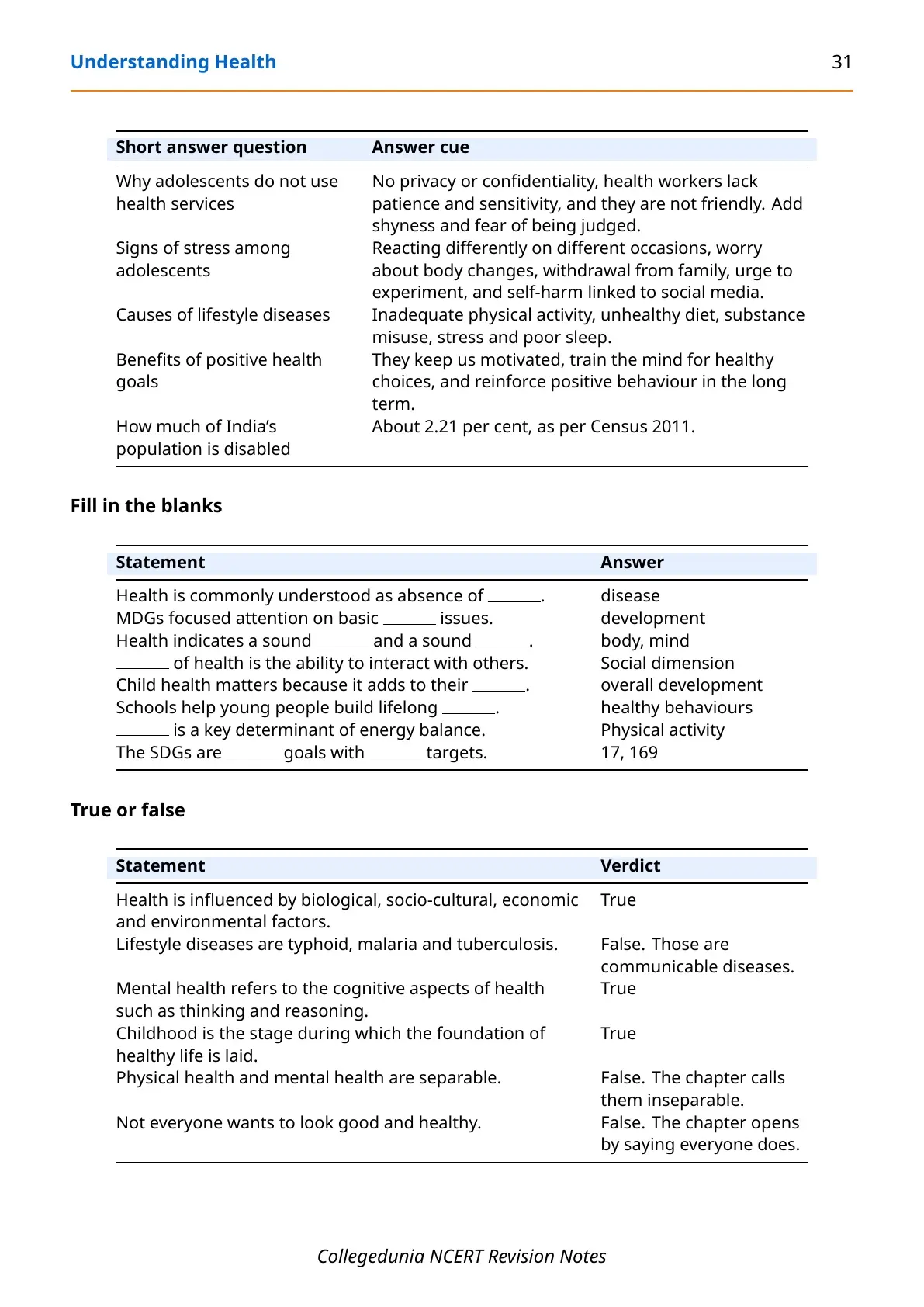
Fill in the Blanks and True or False, Solved
- Health is commonly understood as a state of absence of disease.
- The Millennium Development Goals helped focus global attention and resources on basic development issues.
- Health indicates a sound body and a sound mind.
- The social dimension of health refers to the ability of individuals to interact with others in the socio-cultural environment.
- Health of children is a critical concern for all societies, since it contributes to their overall development.
- Schools help young people establish lifelong healthy behaviours.
- Physical activity is a key determinant of energy expenditure, energy balance and weight control.
- The SDGs are a set of 17 Global Goals with 169 targets between them.
- Health is influenced by biological, socio-cultural, economic and environmental factors: True.
- Lifestyle diseases are typhoid, malaria and tuberculosis: False, those are communicable diseases.
- Mental health refers to the cognitive aspects of health including thinking, reasoning and remembering: True.
- Childhood is the stage during which the foundation of healthy life is laid: True.
- Physical health and mental health are separable: False, the chapter calls them inseparable.
- Not everyone wants to look good and healthy: False, the chapter opens the lifestyle section with the opposite.
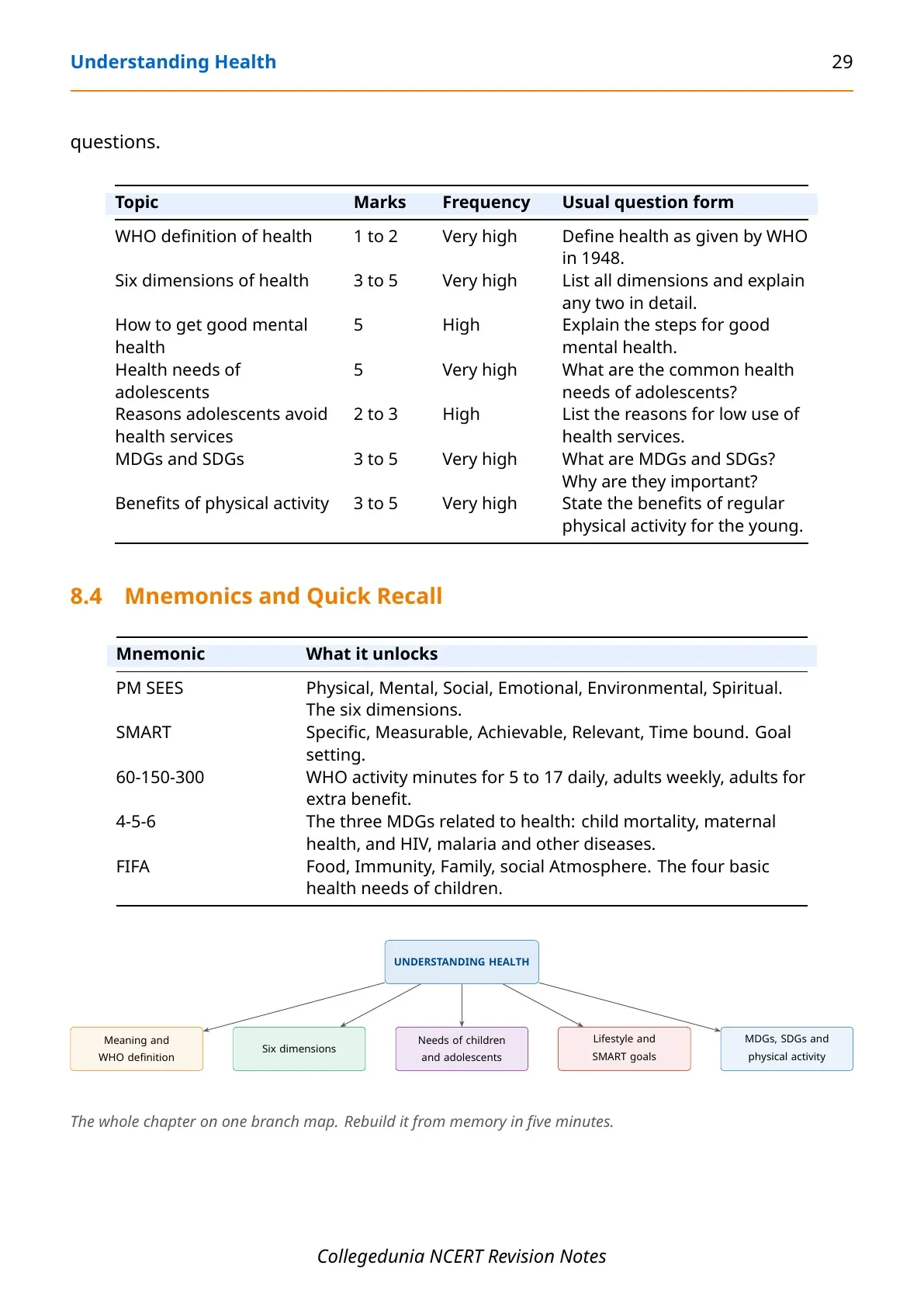
How the Understanding Health Chapter Appears in the Class 11 Paper
This is a data rich chapter, so it carries more weight than the opening chapter. In the annual paper it usually contributes one long answer and three shorter ones.
| Question type | Marks | Typical ask |
|---|---|---|
| Very short answer | 1 | How much of India's population is disabled, or how many SDG targets are there |
| Short answer | 2 to 3 | Reasons adolescents do not use health services, or the benefits of positive health goals |
| Short answer | 3 | Causes of lifestyle diseases, or the qualities of a peer facilitator |
| Long answer | 5 | All six dimensions of health, or the common health needs of adolescents |
Together that is roughly 10 to 14 marks from one chapter. Understanding Health also feeds the CUET Physical Education paper, where the dimensions of health and the WHO activity minutes appear as direct one mark questions.
How to Revise the Understanding Health Chapter in One Sitting
Students in the poll reported an average of 85 minutes for this chapter and its questions. Split the time in three blocks and one pass will be enough.
- First 25 minutes: learn the meaning of health, the WHO definition of 1948 and the six dimensions table. These are the shortest answers and the quickest marks.
- Next 35 minutes: write the health needs of children, adolescents and the differently abled from memory, then check against the tables. Add the India data box afterwards.
- Last 25 minutes: learn the SMART checklist, the MDG and SDG comparison and the WHO activity minutes. Finish by writing one 5 mark answer without looking.
Also Check: The night before the paper, revise only the six dimensions table, the adolescent health needs table and the two WHO activity figures. Those three blocks cover most of what an examiner can set from this chapter.
Class 11 Understanding Health Resources Beyond These Notes
These notes handle revision. For the textbook questions in full, for a last minute recap and for the original chapter text, use the other three pages for the same chapter.
| Resource | Best used for | Link |
|---|---|---|
| Understanding Health Class 11 NCERT Solutions | Every textbook assessment question answered in the exam format | Read the Understanding Health Class 11 NCERT Solutions |
| Understanding Health Class 11 Handwritten Notes | Last minute revision the night before the paper | Read the Understanding Health Handwritten Notes |
| Class 11 Physical Education Book PDF | The original NCERT chapter with its Do You Know box and activities | Download the Understanding Health Book PDF |
NCERT Notes for All Class 11 Physical Education Chapters
The Class 11 Health and Physical Education book runs across eleven chapters. Each page follows the same shape as this one, with tables, a common mistakes block and a downloadable PDF.
| Chapter | Title | Revision Notes |
|---|---|---|
| Chapter 1 | Physical Education | Physical Education Class 11 Notes |
| Chapter 2 | Understanding Health | You are here |
| Chapter 3 | Physical and Physiological Aspects of Physical Education and Sports | Physical and Physiological Aspects Class 11 Notes |
| Chapter 4 | Individual Games | Individual Games Class 11 Notes |
| Chapter 5 | Team Games | Team Games Class 11 Notes |
| Chapter 6 | Yoga and its Relevance in the Modern Times | Yoga and its Relevance Class 11 Notes |
| Chapter 7 | Safety and Security | Safety and Security Class 11 Notes |
| Chapter 8 | Health Related Physical Fitness | Health Related Physical Fitness Class 11 Notes |
| Chapter 9 | Measurement and Evaluation | Measurement and Evaluation Class 11 Notes |
| Chapter 10 | Tournaments and Competitions | Tournaments and Competitions Class 11 Notes |
Class 11 Physical Education Chapter 2 Understanding Health Notes FAQs
Ques. How does the WHO define health?
Ans. In 1948 the World Health Organization defined health as a state of complete physical, mental and social well-being and not merely the absence of disease or infirmity. Write the year along with the line, because school papers usually award a mark for it.
Ques. What are the six dimensions of health in Class 11 Physical Education?
Ans. Physical, mental, social, emotional, spiritual and environmental. The chapter calls health multidimensional and says all six are interrelated, so a change in one dimension shows up in the others.
Ques. Why is the common idea of health called partial?
Ans. Because it treats health only as the absence of disease. That looks at whether the body can function and ignores mental, emotional and social well-being. The chapter uses this point to introduce the wider WHO definition.
Ques. What are the common health needs of adolescents?
Ans. Nutritional disorders covering both malnutrition and obesity, substance abuse, high risk sexual behaviour, stress and mental disorders, and injuries such as road traffic injuries, suicides and violence. Addiction to the internet and social media is added as a growing cause of depression and self harm.
Ques. How can we get good mental health according to the chapter?
Ans. Eat healthy food, express your feelings, play games and sports you enjoy, get about eight hours of sleep, spend time with friends and family, ask for help when things get too much, and avoid tobacco and alcohol.
Ques. How much of India's population is disabled?
Ans. About 2.21 per cent, according to Census 2011. Uttar Pradesh has the highest number of disabled persons in India, and 7.62 per cent of all disabled persons fall in the 0 to 6 year age group. The focus today is on inclusive education.
Ques. What is the difference between MDGs and SDGs?
Ans. The Millennium Development Goals were 8 target based goals on basic development, of which 3 were health goals. The Sustainable Development Goals are 17 Global Goals with 169 targets, known as Transforming our world: the 2030 Agenda for Sustainable Development. The SDGs carry forward the unfinished agenda of the MDGs.
Ques. What does SDG 3 say and what is universal health coverage?
Ans. SDG 3 is to ensure healthy lives and promote well-being for all at all ages. Its most important feature is universal health coverage, which the chapter defines as access to good quality health services without financial hardship for people in need.
Ques. How much physical activity does WHO recommend for a Class 11 student?
Ans. A student aged 5 to 17 years should do at least 60 minutes of moderate to vigorous-intensity activity every day. More than 60 minutes gives extra benefit. Muscle and bone strengthening activity should be included at least three times a week.
Ques. What is a SMART health goal?
Ans. A goal that is Specific, Measurable, Achievable, Relevant and Time Bound. The textbook example is jogging: I will do jogging, for at least 30 minutes daily or three to four days a week, for five days in a week, to reduce my body weight, followed throughout the year.
Ques. Why do adolescents avoid using health services?
Ans. Because of a lack of privacy or confidentiality, a lack of patience and sensitivity among health workers, and a lack of friendly behaviour from them. Adolescents also feel shy, scared or ashamed to raise personal concerns with parents, family members and teachers.
Ques. Are these Class 11 Understanding Health notes according to the current syllabus?
Ans. Yes. Every definition, dimension, figure and list on this page follows the 2026-27 reprint of the NCERT Health and Physical Education textbook for Class 11. The assessment questions at the end of the chapter are unchanged in this edition, so the notes apply to the current session and to CUET Physical Education preparation.



Comments