




The Class 11 Physical Education revision notes for the opening chapter bring together every definition, objective, myth and career route that the school paper actually asks about. Chapter 1 sets the base for the whole book, so the terms you learn here come back in almost every later chapter.
- Covers all 6 definitions the textbook prints, from the 1956 National Plan to Charles A. Bucher.
- Chapter 1 usually carries 8 to 12 marks across short and long answers.
- Written according to the 2026-27 NCERT Health and Physical Education textbook for Class 11.
Every note on this page is curated by Class 11 Physical Education teachers, checked line by line against the 2026-27 NCERT print, and refined against the last five years of school question papers.
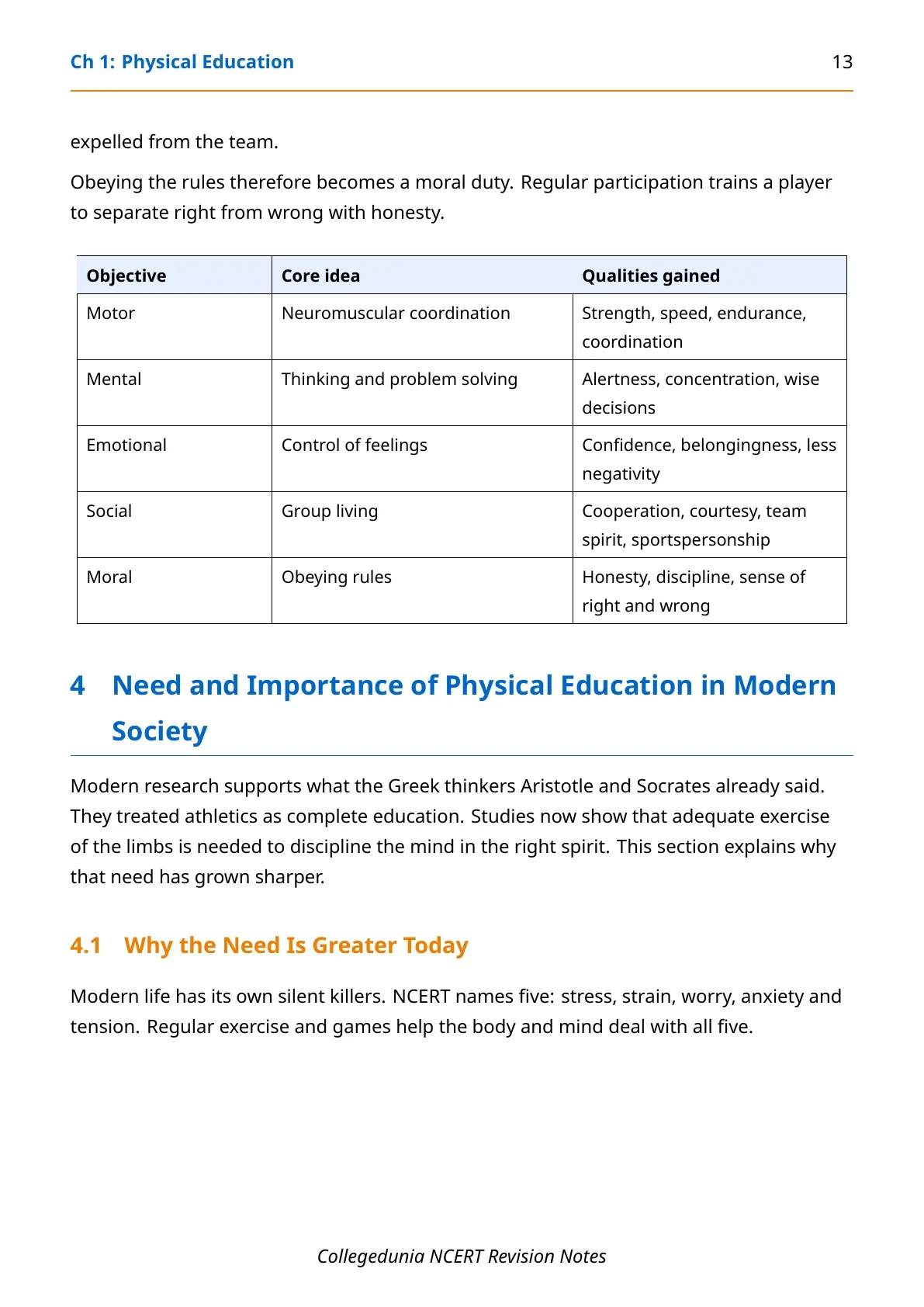
Student Feedback: In a Collegedunia poll of 12,460 Class 11 Physical Education students taken before the 2026-27 school exams, 71% said the career options section was the easiest part of Chapter 1 to score in. Only 38% could name all five objectives of physical education without looking.
Source: 2026-27 Class 11 Physical Education student poll. Sample of 12,460 students from CBSE schools across 16 states.
What the Class 11 Physical Education Chapter 1 Notes Cover
Chapter 1 is a theory chapter with no numericals and no diagrams to label. Marks come from recall: the exact definition, the exact objective name, the exact career family. These notes are built around that.
- The meaning of physical education in one line, plus the six printed definitions with their sources.
- The five objectives (motor, mental, emotional, social, moral) with one example each.
- All 14 need and importance points the textbook lists, grouped so they are easier to recall.
- The 11 misconceptions and the correction for each one.
- Every term from game and sport down to drill, recreation and physical culture.
- All six career families in physical education, sports and allied areas.
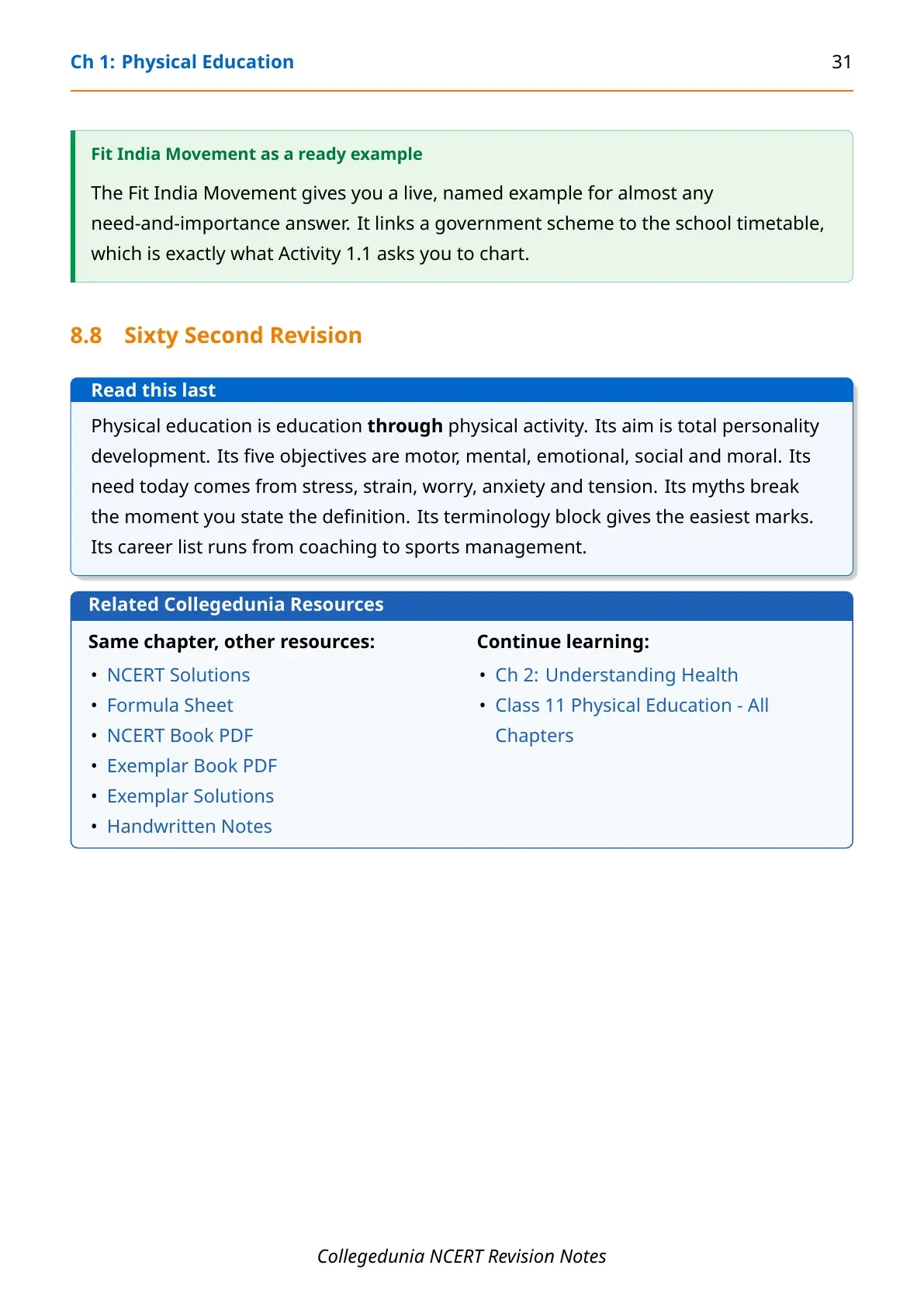
Tip: Learn the source name along with the definition. A school paper often asks "Who defined physical education as an integral part of the total educational process?" and the mark sits on the name, not the wording.
Meaning and Definition of Physical Education for Class 11
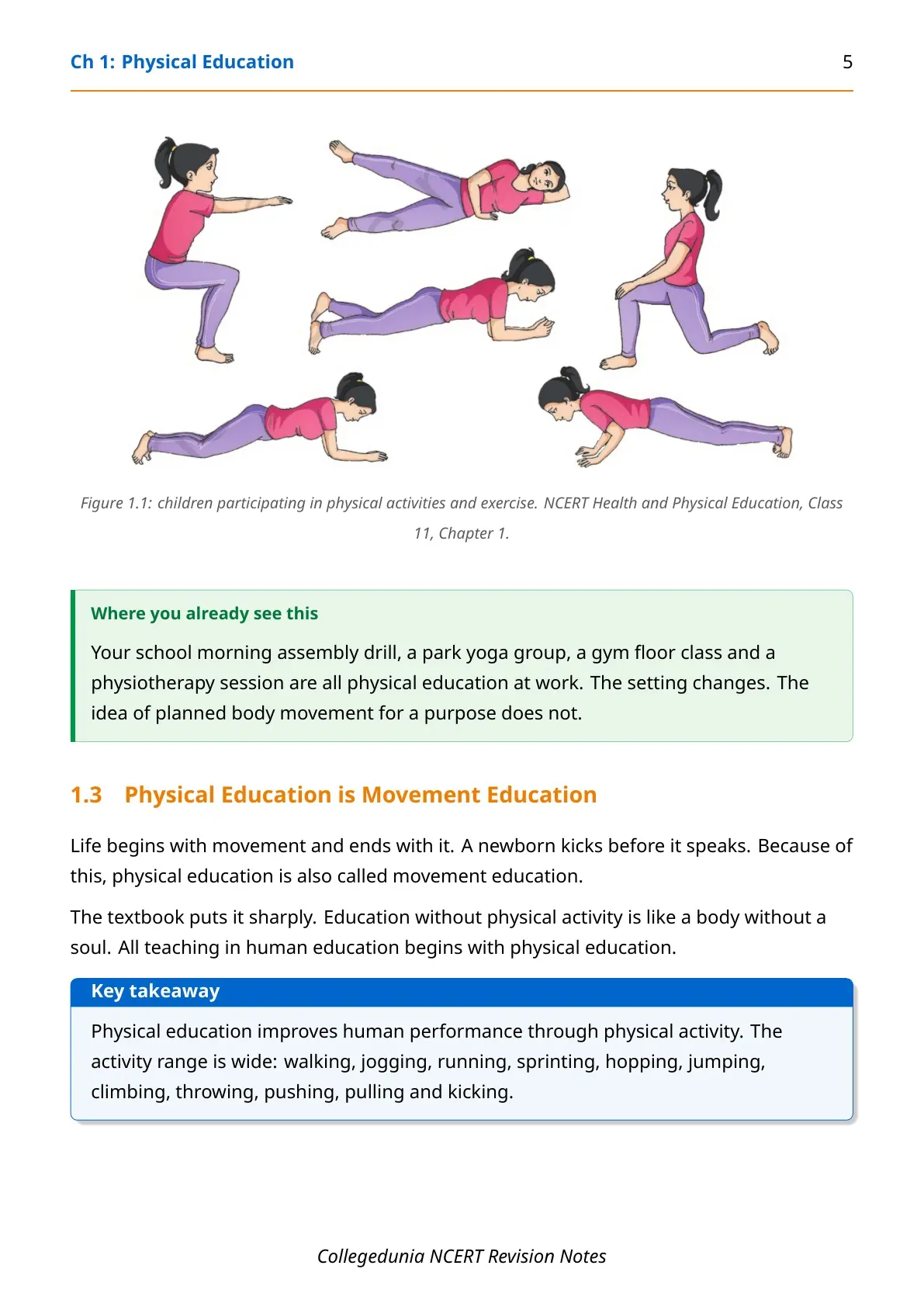
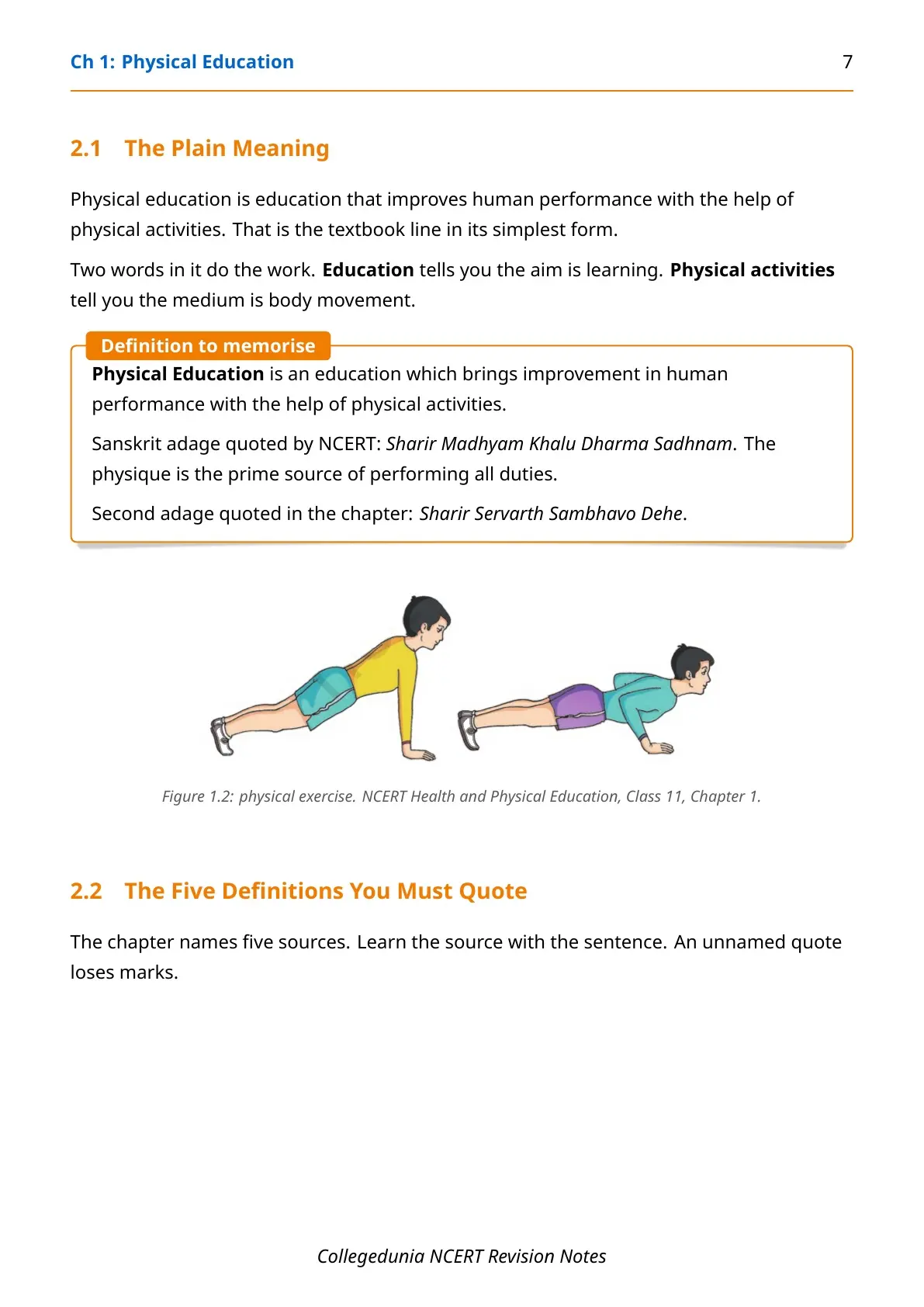
Physical education is education that improves human performance through physical activity. Those activities run from simple walking to jogging, running, sprinting, hopping, jumping, climbing, throwing, pushing, pulling and kicking. The textbook puts it sharply: education without physical activities is like a body without a soul.
Physical education is also called movement education, because life itself begins with movement. A child moves from birth until the end of life. Mental, intellectual, emotional and social growth all depend on how the body grows, so a physically fit person tends to be mentally sharp, emotionally stable and socially well adjusted.
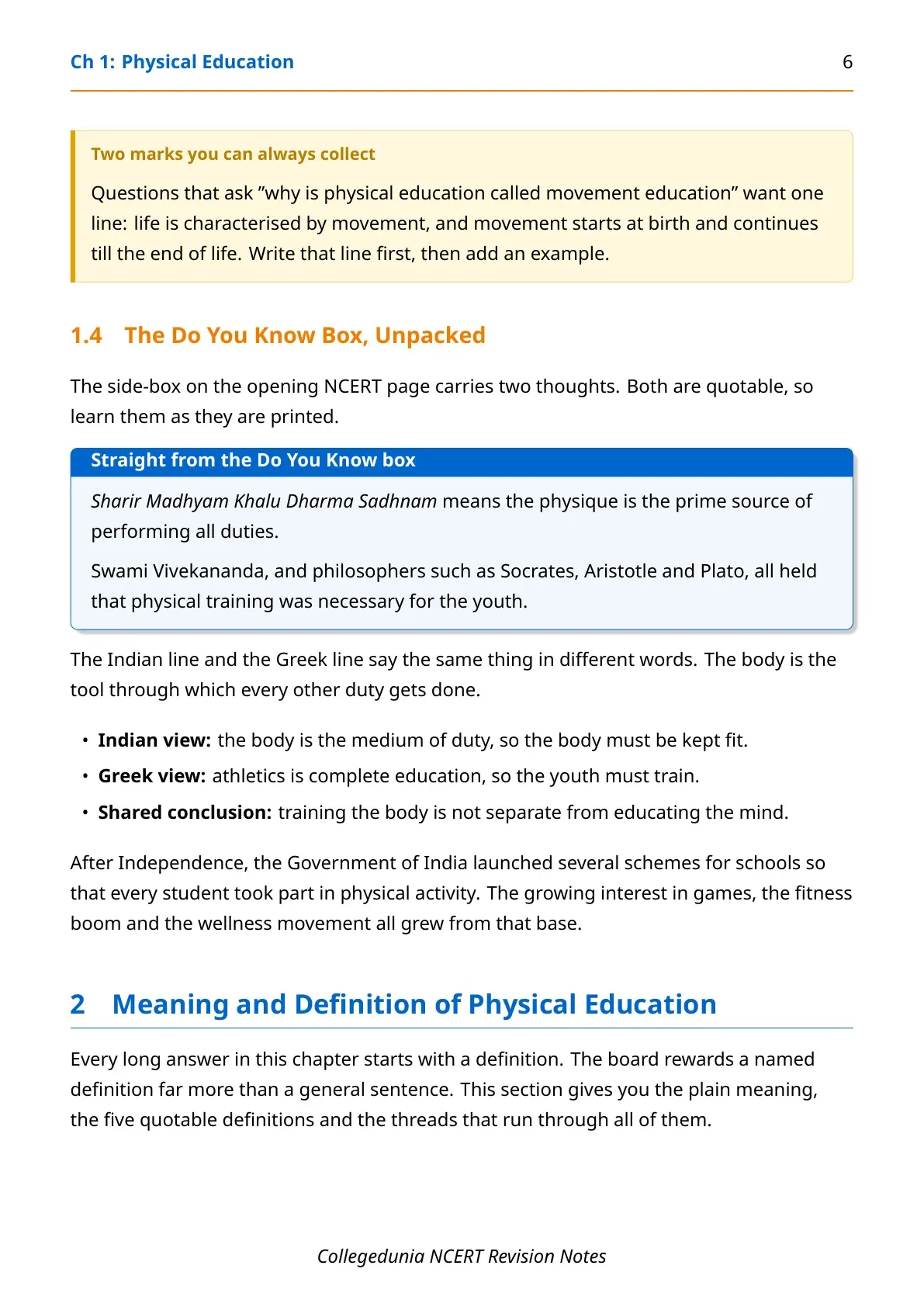
The idea is not new. It has roots in the ancient period, and different people at different points in history attached different meanings to the words. The Sanskrit adage Sharir Madhyam Khalu Dharma Sadhnam means the physique is the prime source of performing all duties. Swami Vivekananda, and philosophers such as Socrates, Aristotle and Plato, all held that physical training was necessary for the youth.
The Six Definitions Printed in the NCERT Chapter
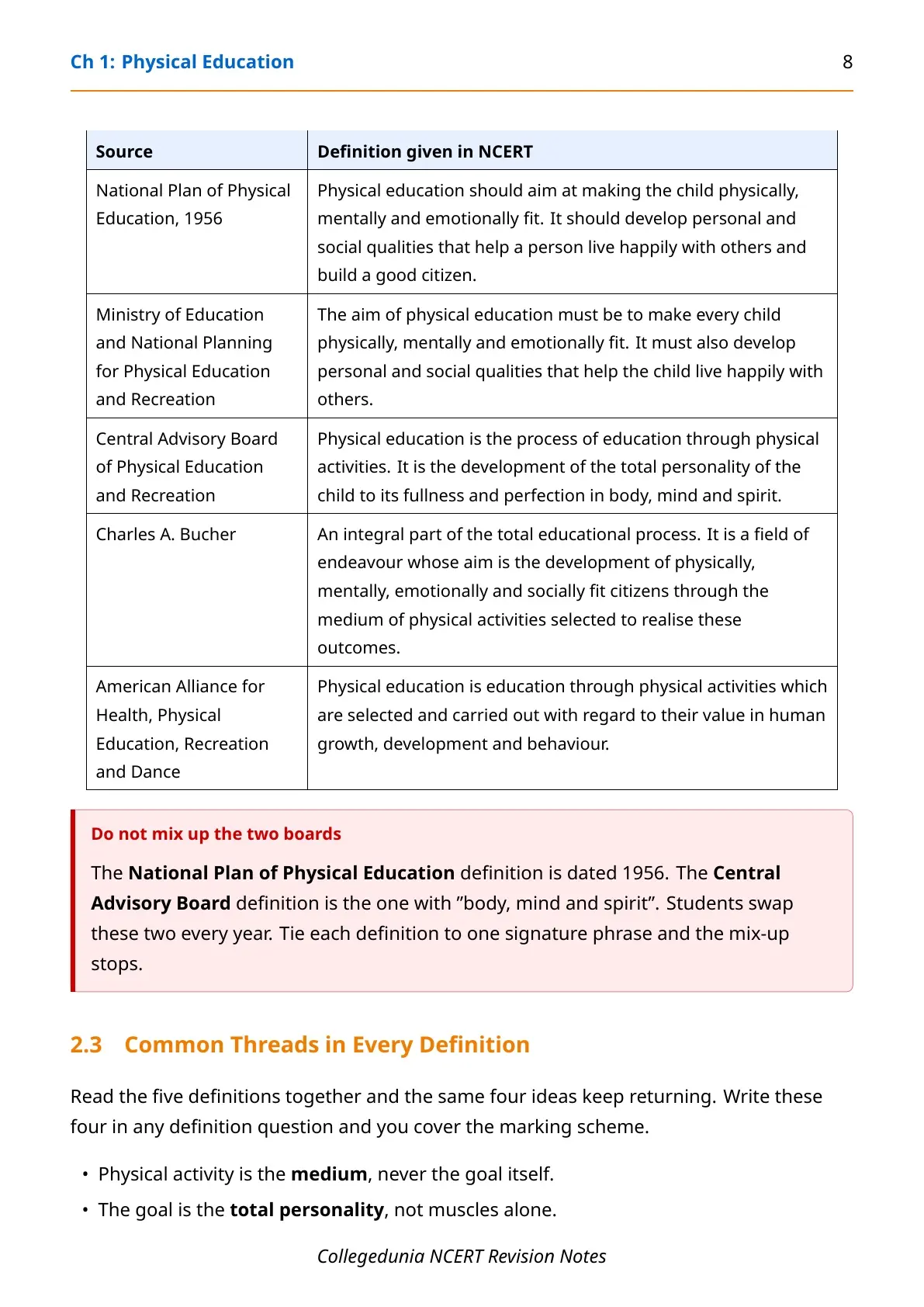
| Source | Definition in short |
|---|---|
| Ancient Indian adage | Sharir Servarth Sambhavo Dehe. The body is the means of achieving everything. |
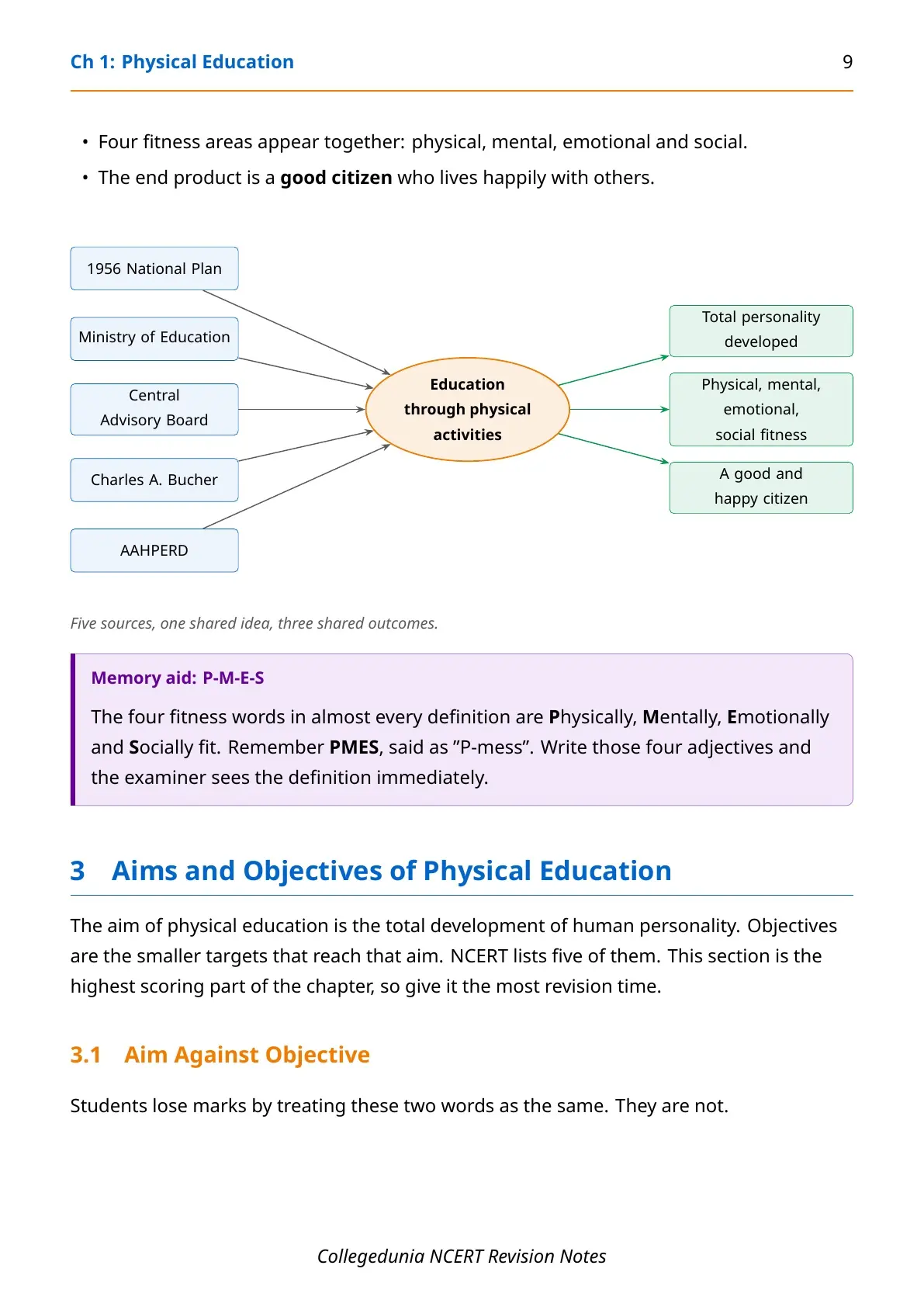
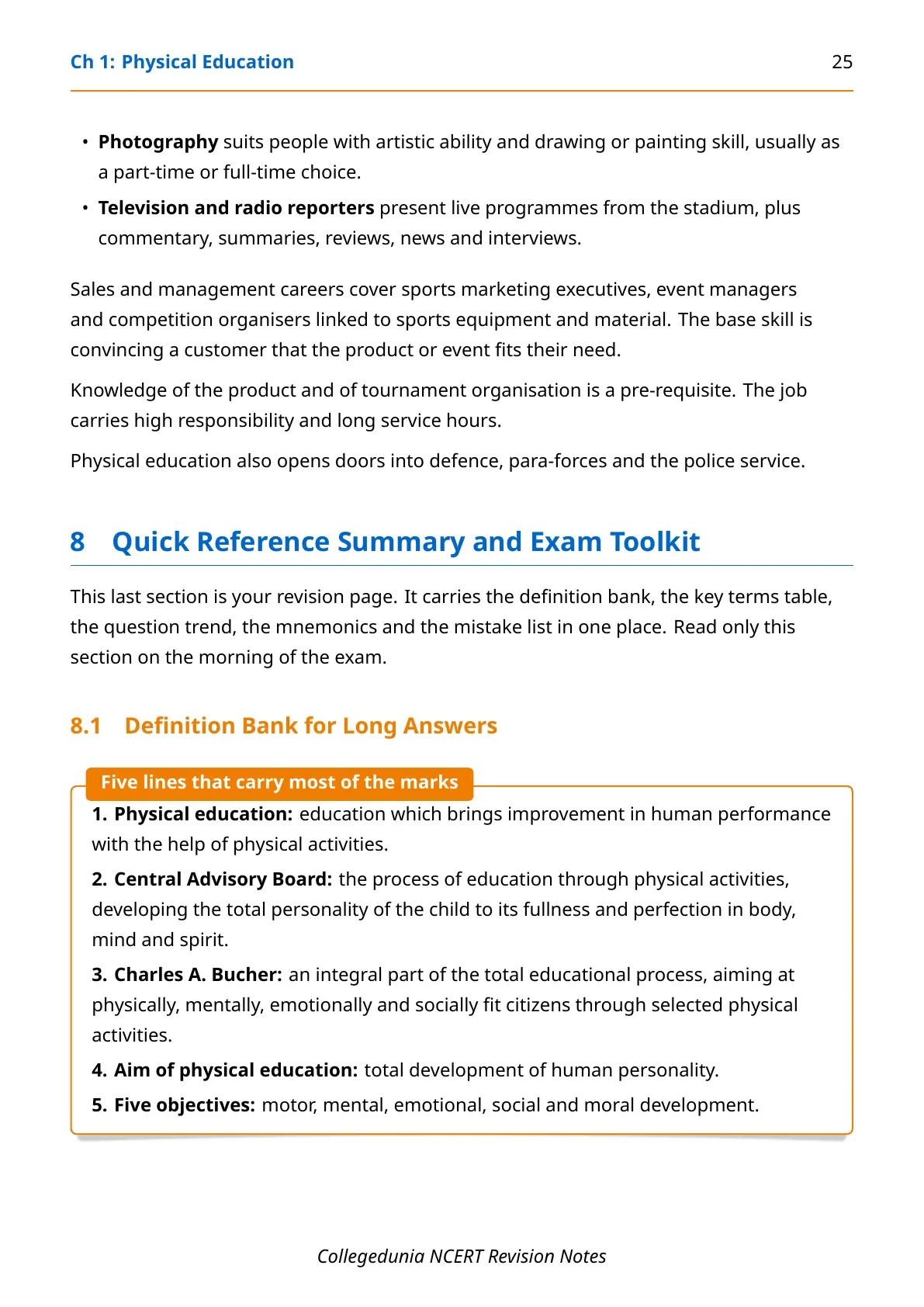
| National Plan of Physical Education (1956) | Physical education should aim at making the child physically, mentally and emotionally fit, and at developing personal and social qualities that help a person live happily with others and become a good citizen. |
| Ministry of Education and National Planning for Physical Education and Recreation | The aim must be to make every child physically, mentally and emotionally fit, and to develop personal and social qualities. The programme should also aim to build good citizens of the country. |
| Central Advisory Board of Physical Education and Recreation | Physical education is the process of education through physical activities. It is the development of the total personality of the child to its fullness and perfection in body, mind and spirit. |
| Charles A. Bucher | An integral part of the total educational process, a field of endeavour whose aim is the development of physically, mentally, emotionally and socially fit citizens through the medium of physical activities selected to realise these outcomes. |
| American Alliance for Health, Physical Education, Recreation and Dance | Education through physical activities which are selected and carried out with regard to value in human growth, development and behaviour. |
All six say the same thing in different words: development of the whole personality through physical activity. If a 5 mark question asks you to define physical education, write one line of your own, then quote Bucher and the Central Advisory Board. Two named sources are enough.
Physical Education Chapter 1 One Shot Revision
Source: Magnet Brains on YouTube
Aims and Objectives of Physical Education: The Five Development Areas
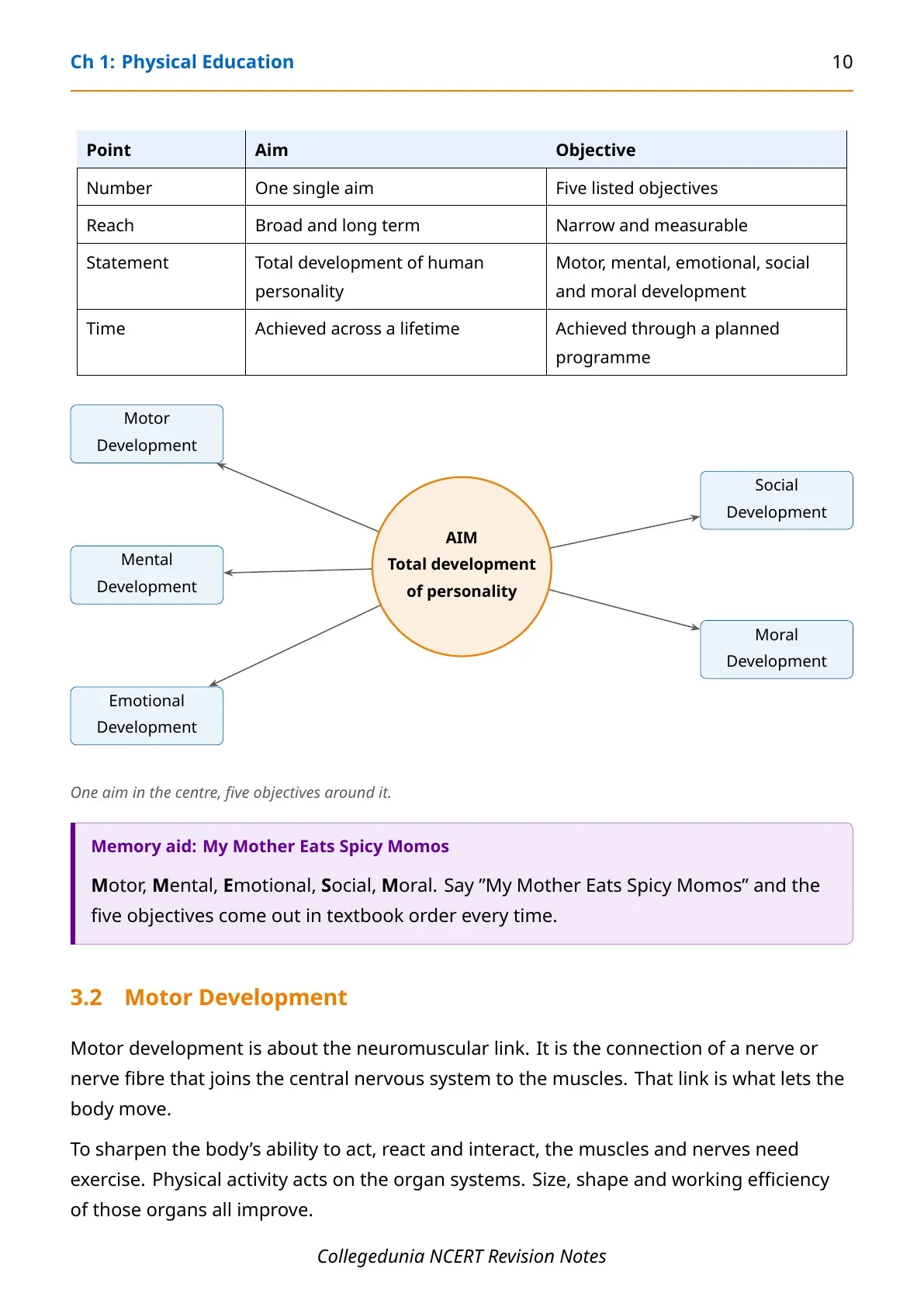
The aim of physical education is the total development of human personality. The final target is a person who is physically, mentally and emotionally fit, and who has the personal and social qualities needed to live happily with others. The chapter splits that aim into five objectives.
| Objective | What it means | How the chapter explains it |
|---|---|---|
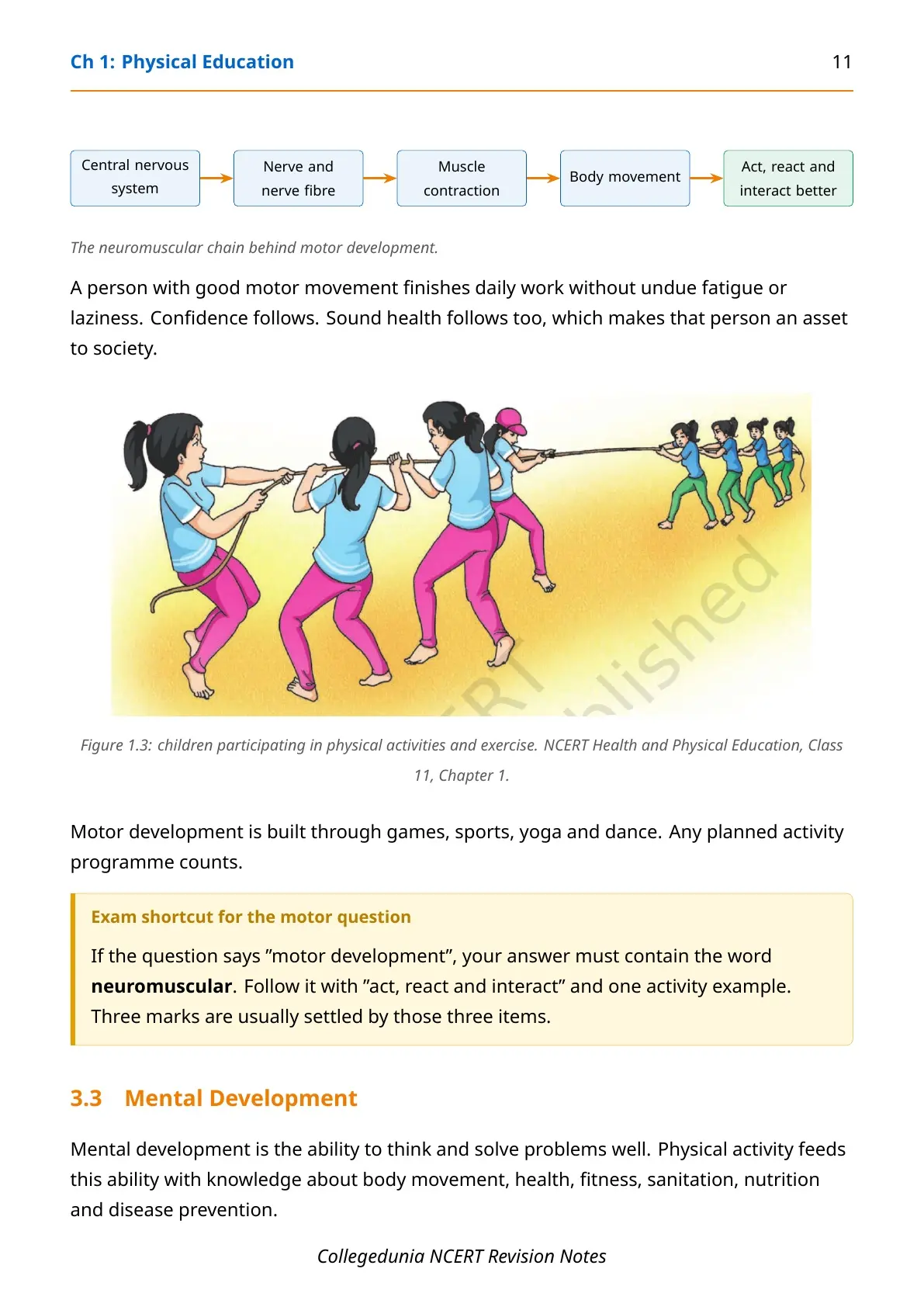
| Motor development | The link between nerve fibres and muscles that lets the body move | Exercising muscles and nerves improves the size, shape and efficiency of body organs. A person with good motor movement finishes daily work without undue fatigue. |
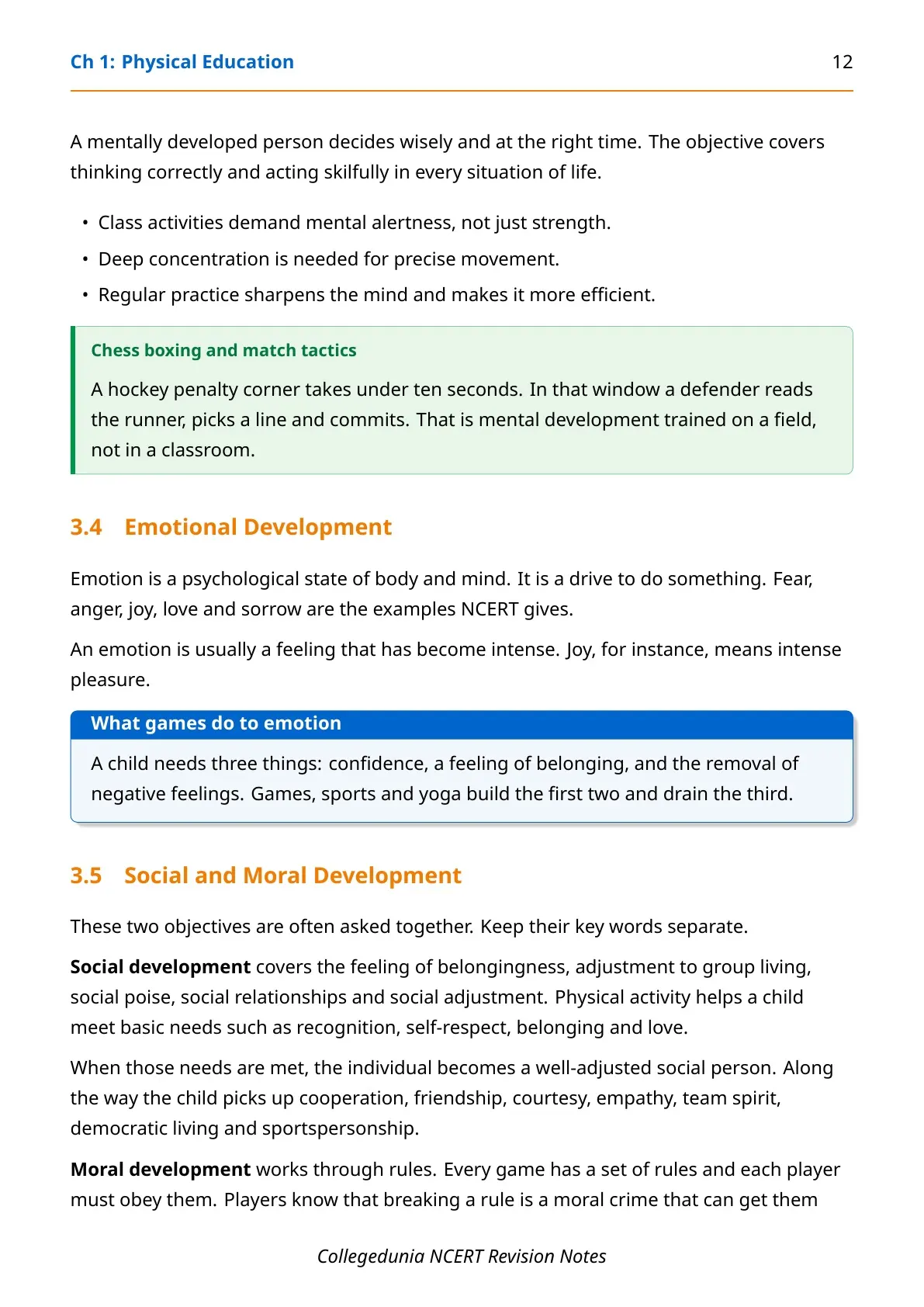
| Mental development | The ability to think and solve problems well | Physical activity teaches body movement, health, fitness, sanitation, nutrition and disease prevention. Games need alertness, deep concentration and precise movement, so the mind sharpens too. |
| Emotional development | The state of body and mind that drives a person to act | Emotion covers fear, anger, joy, love and sorrow. Games, sports and yoga build confidence and belonging, and remove negative feelings. |
| Social development | Fitting into group living and building relationships | Activity meets basic needs like recognition, self respect, belonging and love. Players pick up cooperation, friendship, courtesy, empathy, team spirit, democratic living and sportspersonship. |
| Moral development | Knowing right from wrong and acting honestly | Every game has rules. Breaking one is treated as a moral offence and can get a player thrown out of the team, so obeying rules becomes a moral duty. |
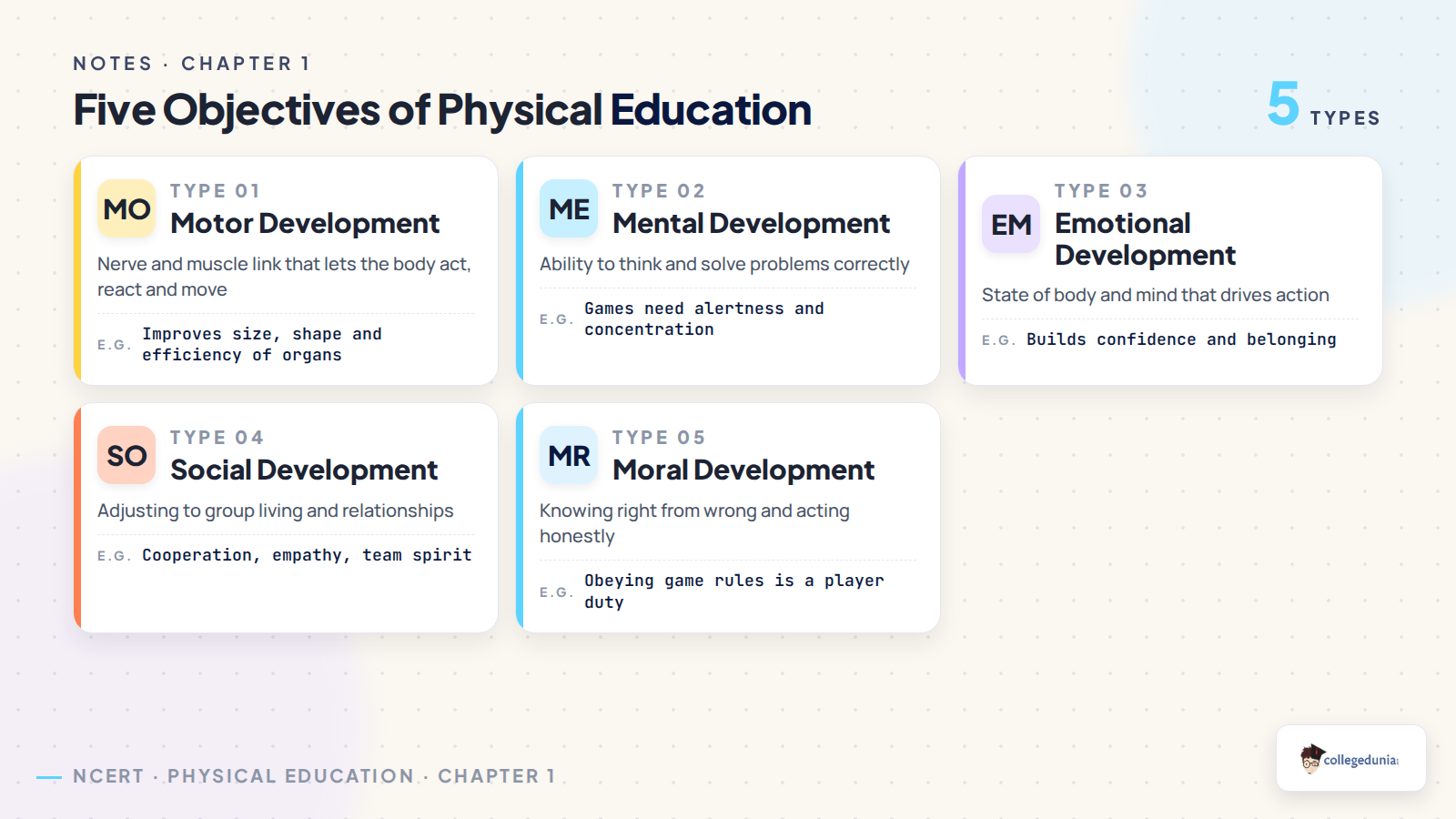
Memory hook: the five objectives spell M M E S M (Motor, Mental, Emotional, Social, Moral). Write them in that order every time, because the textbook explains them in that order and an examiner marks in that order.
Also Check: A 4 mark question usually says "explain any four objectives". Pick motor, mental, social and moral. Emotional development is the shortest section in the book and gives you the least to write.
Need and Importance of Physical Education in Modern Society
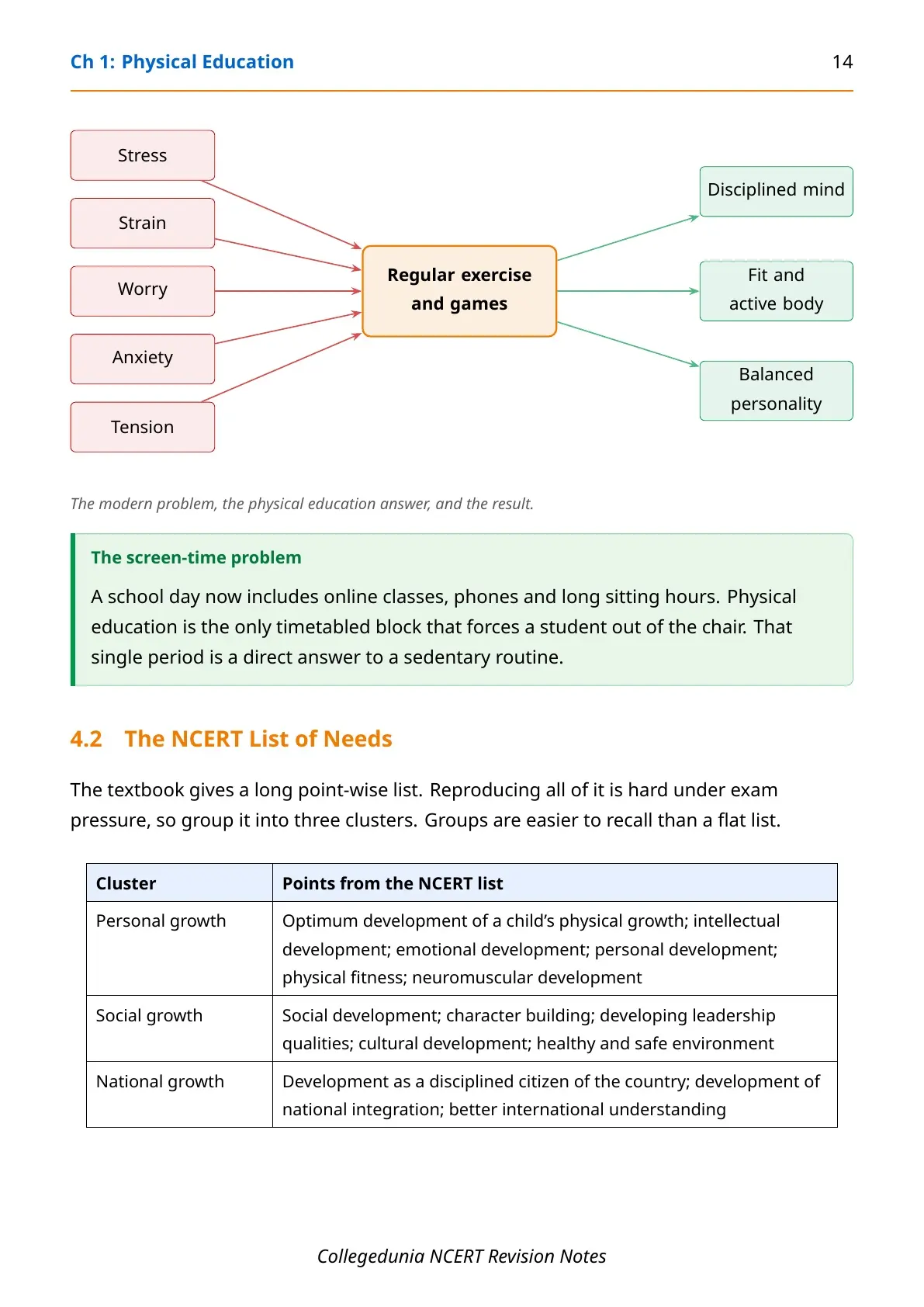
Modern research supports what the Greek philosophers Aristotle and Socrates argued, that athletics is complete education. Enough exercise of the limbs disciplines the mind. Regular exercise and games also help the body handle what the chapter calls the modern day silent killers: stress, strain, worry, anxiety and tension.
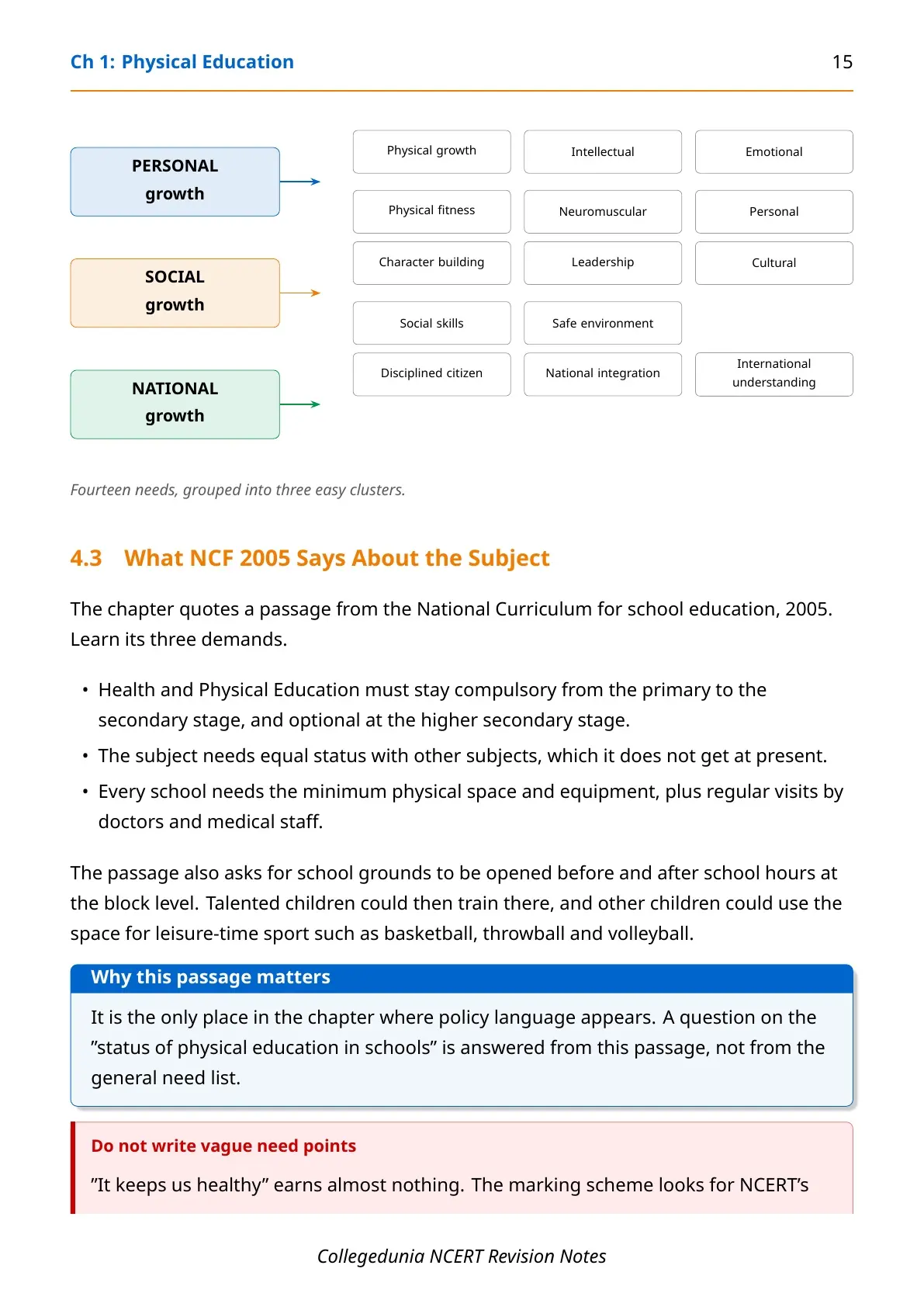
The textbook then lists 14 reasons why every section of society needs physical education. They are easier to remember in four groups.
| Group | Points from the textbook list |
|---|---|
| Growth of the individual | Optimum development of a child's physical growth, physical fitness, neuromuscular development |
| Mind and feelings | Intellectual development, emotional development, personal development |
| Living with others | Social development, character building, developing leadership qualities, healthy and safe environment |
| The nation and the world | Development as a disciplined citizen of the country, cultural development, development of national integration, better international understanding |
Sports and games matter to personality growth. The chapter says plainly that they are no less important than food and fresh water, and points out that most developed countries run nurseries and training centres for games.
What the National Curriculum Framework Says
The chapter quotes the National Curriculum Framework 2005 in a source box. This is a favourite 3 mark question, so learn the four asks.
- Health and Physical Education stays compulsory from the primary to the secondary stage, and optional at the higher secondary stage.
- It must be given equal status with other subjects, a status it does not get at present.
- Every school needs the minimum essential physical space and equipment, and doctors and medical staff must visit regularly.
- School grounds should open before and after school hours, and in vacations, so talented children can train and others can use them for leisure sport.
The framework names basketball, throwball, volleyball and local forms of sport as the team games such space should support.
Misconceptions About Physical Education and Sports That Class 11 Students Must Correct
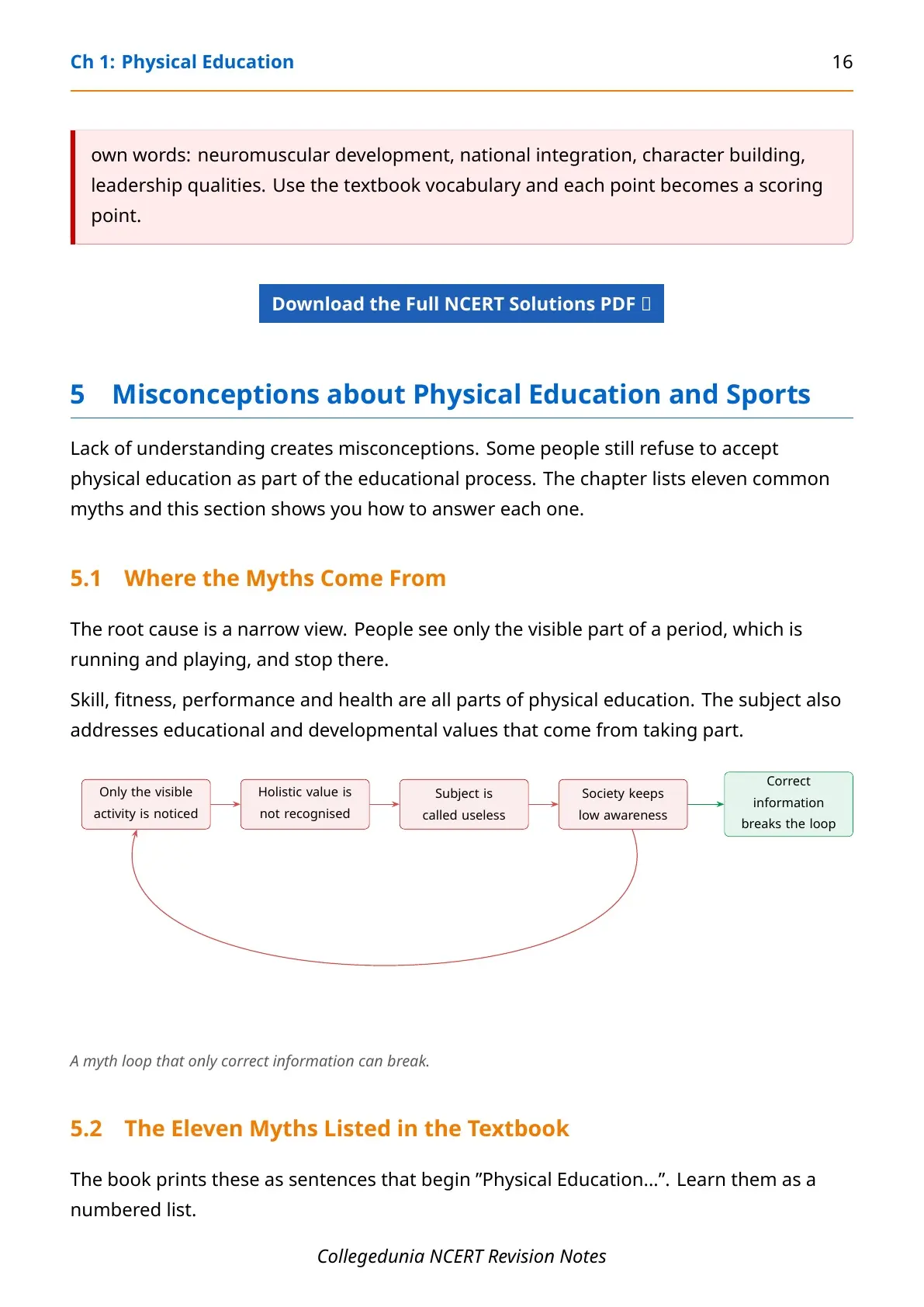
Misconceptions come from one root cause: people do not understand what physical education actually covers. Skill, fitness, performance and health are all parts of it, and taking part builds a cooperative attitude, good character and a balanced personality. When people miss that wider view, myths take over.
The 11 myths the textbook lists. Physical education:
- is all about physical training only
- is only about participation in games
- is about building the body
- is performing drill
- is play
- has poor social status
- has no job or career prospects
- leads to indiscipline
- is a wastage of money only
- has rest periods, so there is no physical or mental learning
- is taken up by the left out group only
Each myth has a one line correction, and that is what earns the mark in a long answer.
- Not training alone: training is one method. Physical education also carries health knowledge, values and social learning.
- Not games alone: games are one medium. Yoga, dance, gymnastics and recreation count too.
- Not body building: shaping muscles is physical culture, which is only one narrow part of the subject.
- Not a dead end: the same chapter lists six full career families, from coaching to sports medicine to sports journalism.
- Not indiscipline: every game runs on rules, and obeying them is exactly how moral development happens.
Terminology Used in Physical Education: Game, Sport, Drill and Recreation
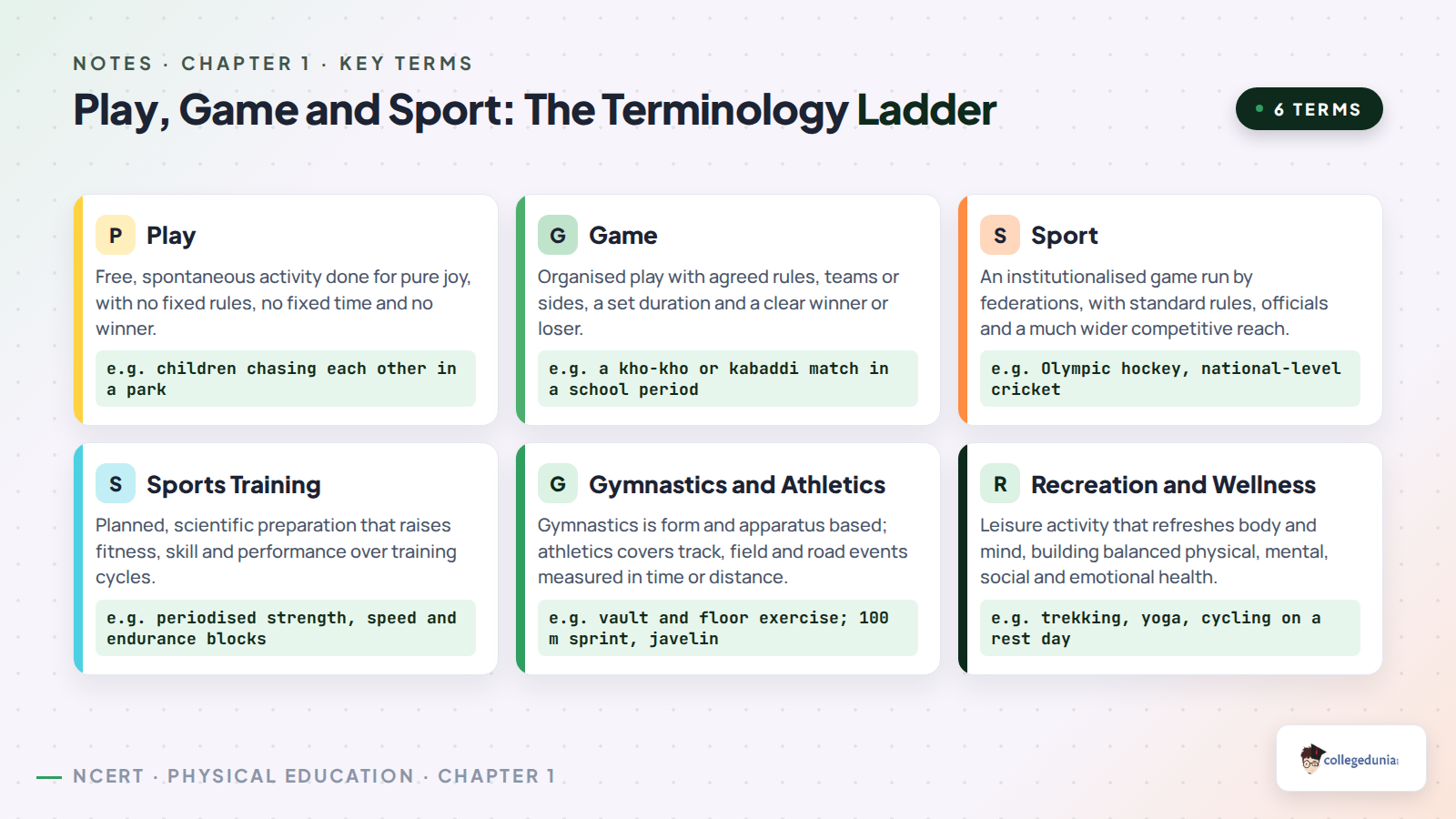
This is the highest scoring part of Chapter 1 because the answers are short and fixed. Two or three of these terms show up as 2 mark questions in nearly every school paper.
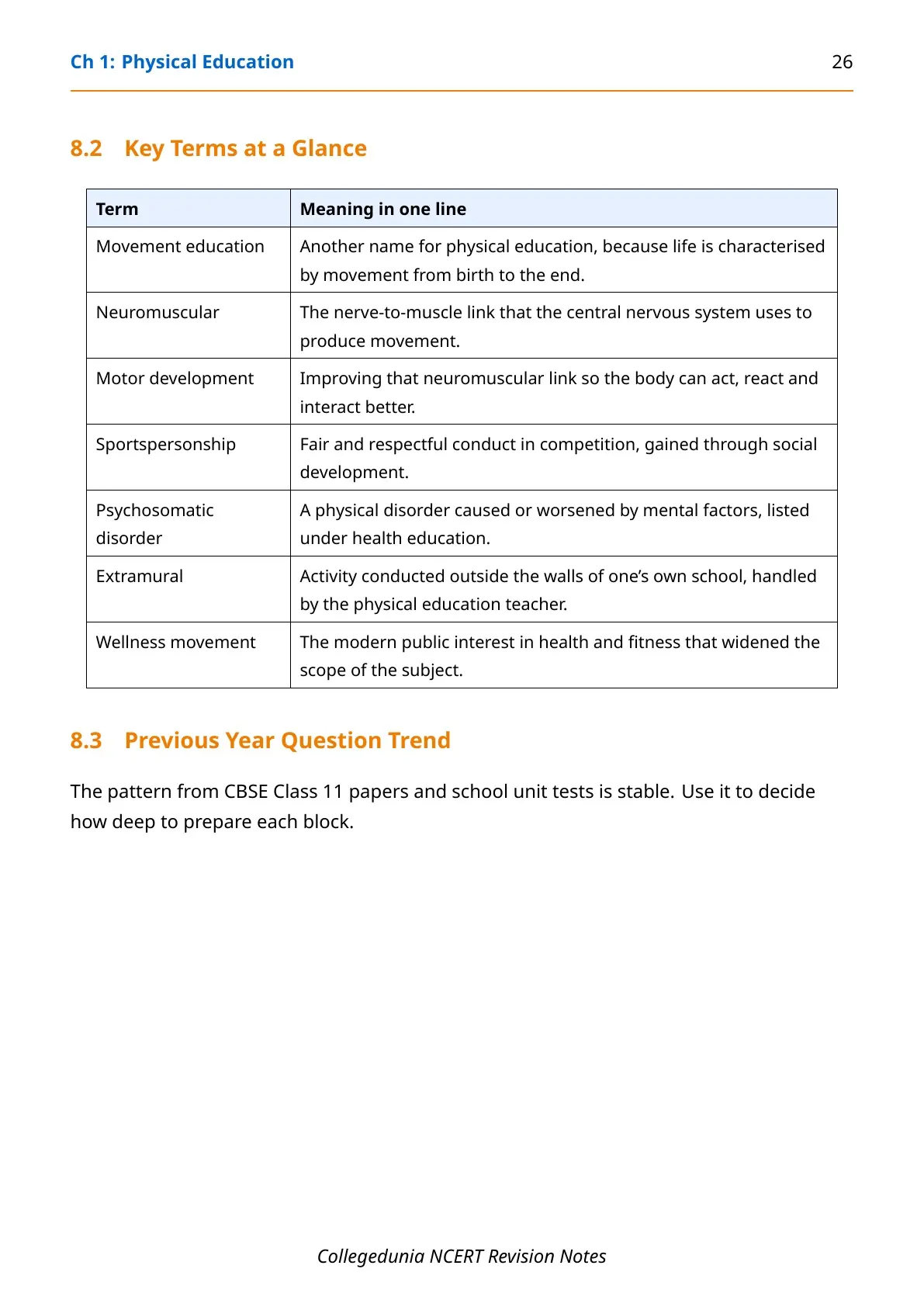
| Term | Meaning as given in the NCERT chapter |
|---|---|
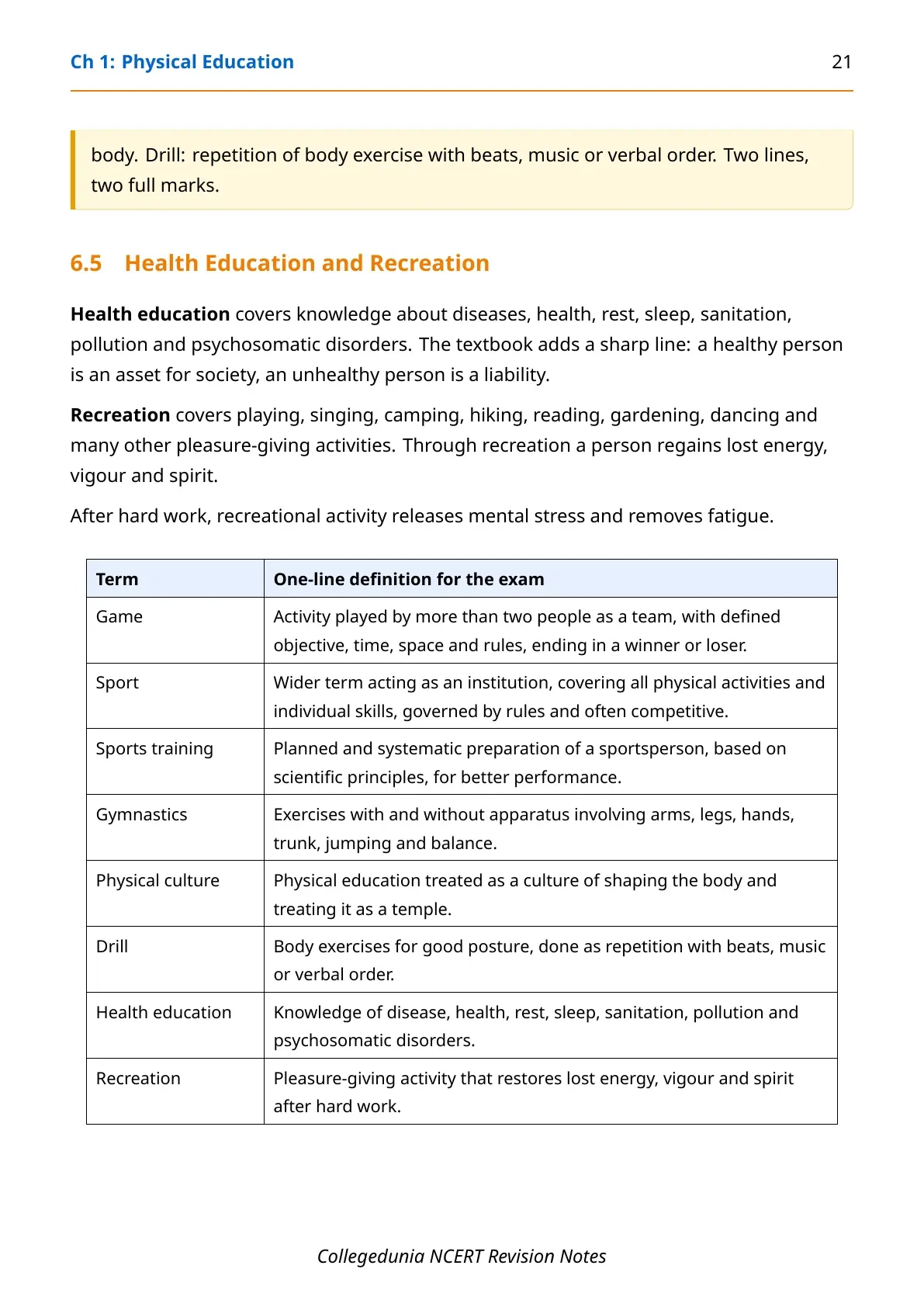
| Game | An activity played by more than two people combined as a team, with a defined objective, time, space, rules and a limited pattern of behaviour, whose outcome decides a winner or a loser. |
| Sport | A wider term that acts as an institution covering all physical activities and individual skills, governed by a set of rules and often taken up competitively. |
| Sports training | A planned and systematic process of preparing a sportsperson for better performance, based on scientific principles. It improves specific fitness, skills, techniques and tactics. |
| Gymnastics | Exercises with and without apparatus, using arm, leg, hand and trunk movements, jumping and balance. Apparatus includes parallel bars, horizontal bar, beam, pommel horse and rings. |
| Physical culture | The name some countries use for physical education. It treats the body as a temple and uses weight training and high intensity exercise to shape the muscles. |
| Drill | Body exercises that build good posture for standing, walking and fighting, and that discipline body and mind. In sport it is the repetition of an activity to beats, music or a verbal order. |
| Health education | Knowledge about disease, health, rest, sleep, sanitation, pollution and psychosomatic disorders. A healthy person is an asset to society, an unhealthy one a liability. |
| Recreation | Pleasure giving activity such as playing, singing, camping, hiking, reading, gardening and dancing. It restores lost energy, vigour and spirit, and clears mental stress and fatigue. |
Difference Between a Game and a Sport
The textbook sets this as a short answer question, so keep the contrast in three clean rows.
| Point | Game | Sport |
|---|---|---|
| Scope | A single activity with fixed rules | An institution covering many physical activities |
| Players | More than two people, usually as teams | Individual skill or team play, both count |
| Outcome | Always decides a winner and a loser | Competitive, but the wider aim is skill and fitness |
Three more words come up in school papers even though the chapter does not define them in a box. Play is free, self chosen activity with no fixed rules and no winner. Athletics covers track and field events such as running, jumping and throwing. Wellness is the active choice of habits that keep a person healthy, and the chapter refers to the wellness movement in its opening lines.
Career Options in Physical Education, Sports and Allied Areas
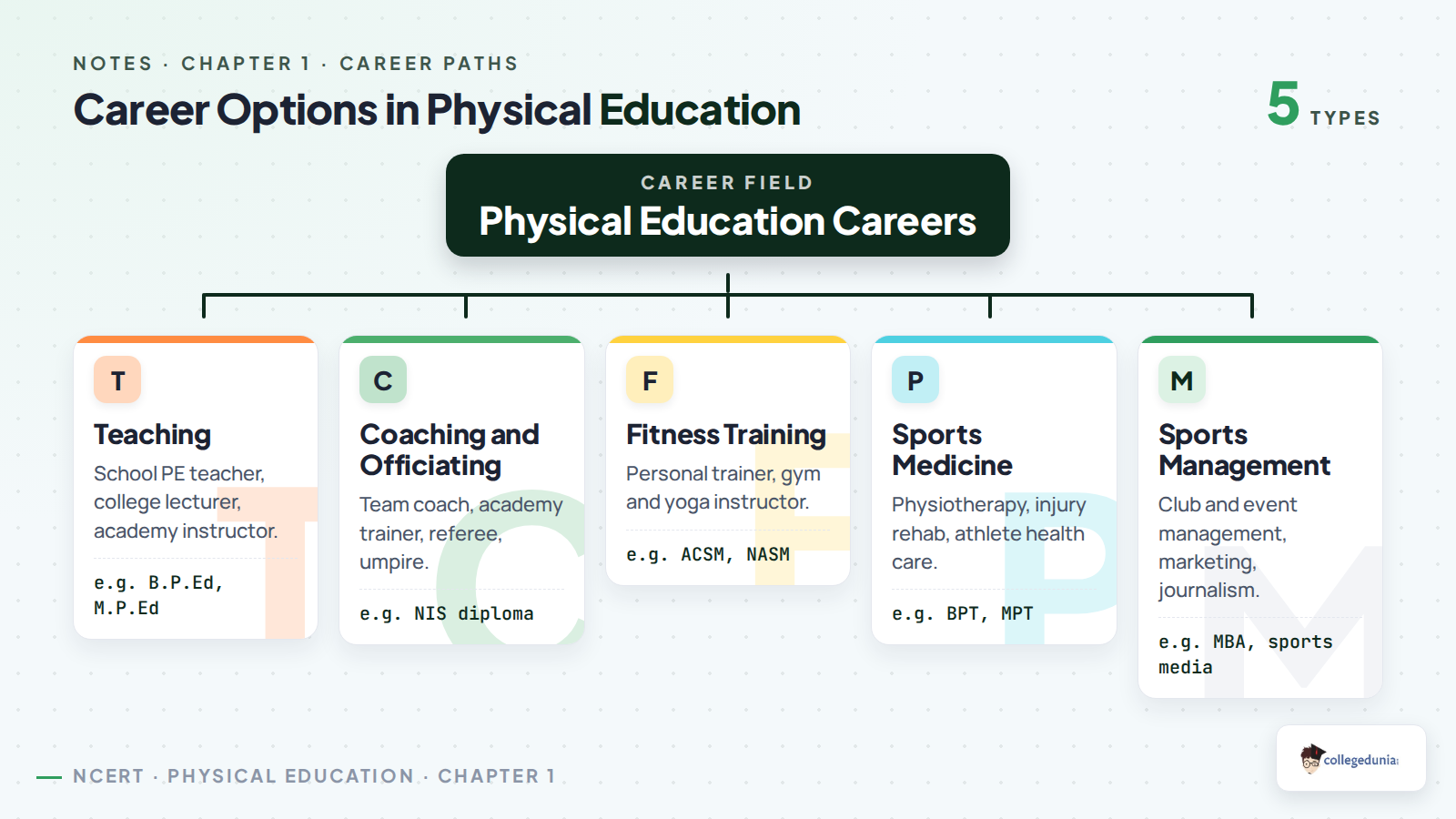
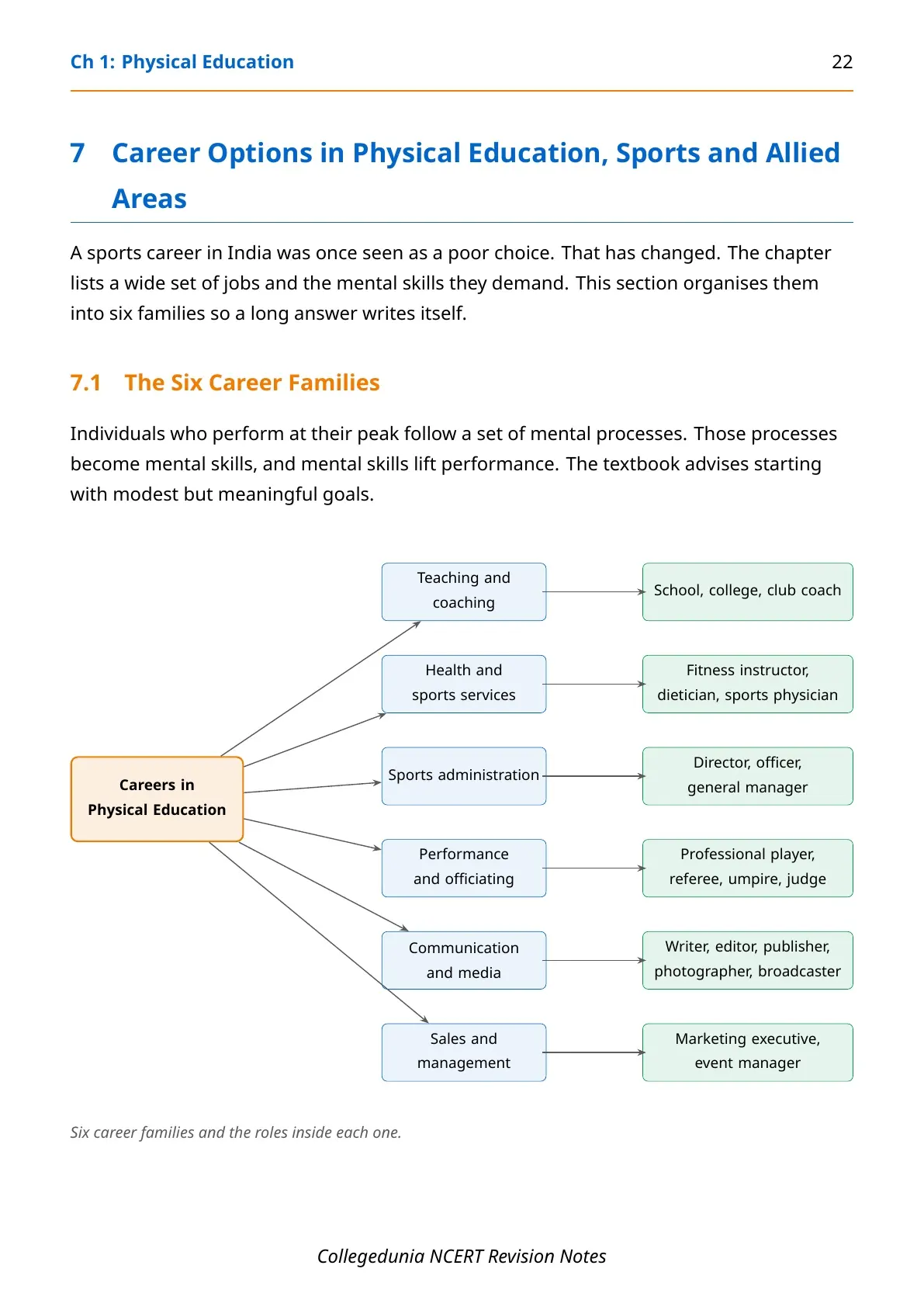
A sports career in India was once seen as unrewarding. That has changed, and the chapter treats careers as a serious section rather than a footnote. High performers in sport follow a set of mental processes that produce good results again and again, and those processes can be trained. Self confidence is named as the one key to success, and the chapter advises starting with modest goals that are meaningful but reachable.
| Career family | Roles inside it | What the work involves |
|---|---|---|
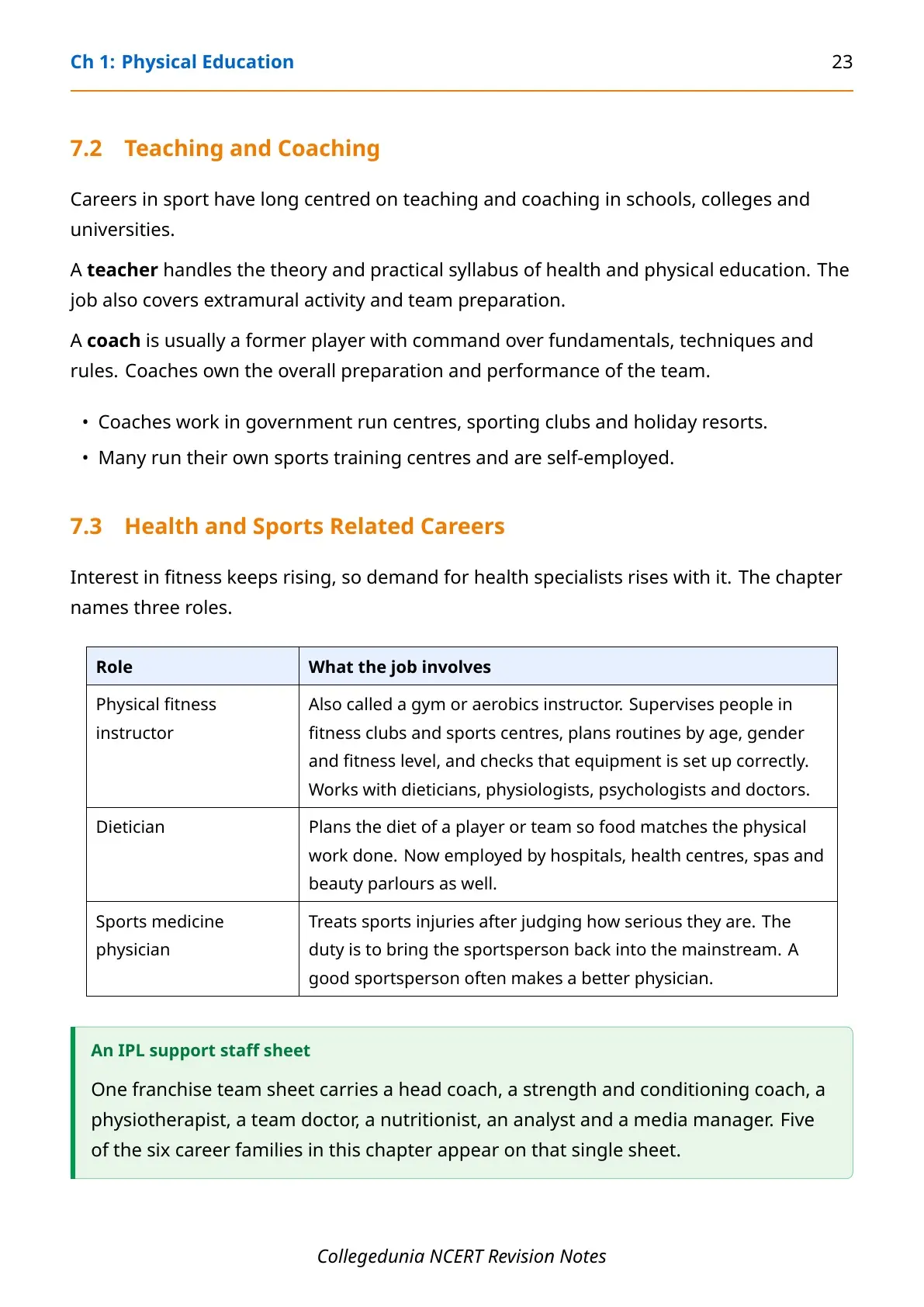
| Teaching and coaching | School, college and university teachers; coaches | Teachers run the theory and practical syllabus, extramural activity and team preparation. Coaches handle fundamentals, techniques, rules and overall team performance, in schools, government centres, clubs, resorts or their own training centres. |
| Health and fitness | Physical fitness instructor, dietician, sports medicine physician | Instructors plan routines by age, gender and fitness level, and check that equipment is set up correctly. Dieticians plan balanced food for a player or team. Sports medicine physicians treat sports injuries and bring the player back to the mainstream. |
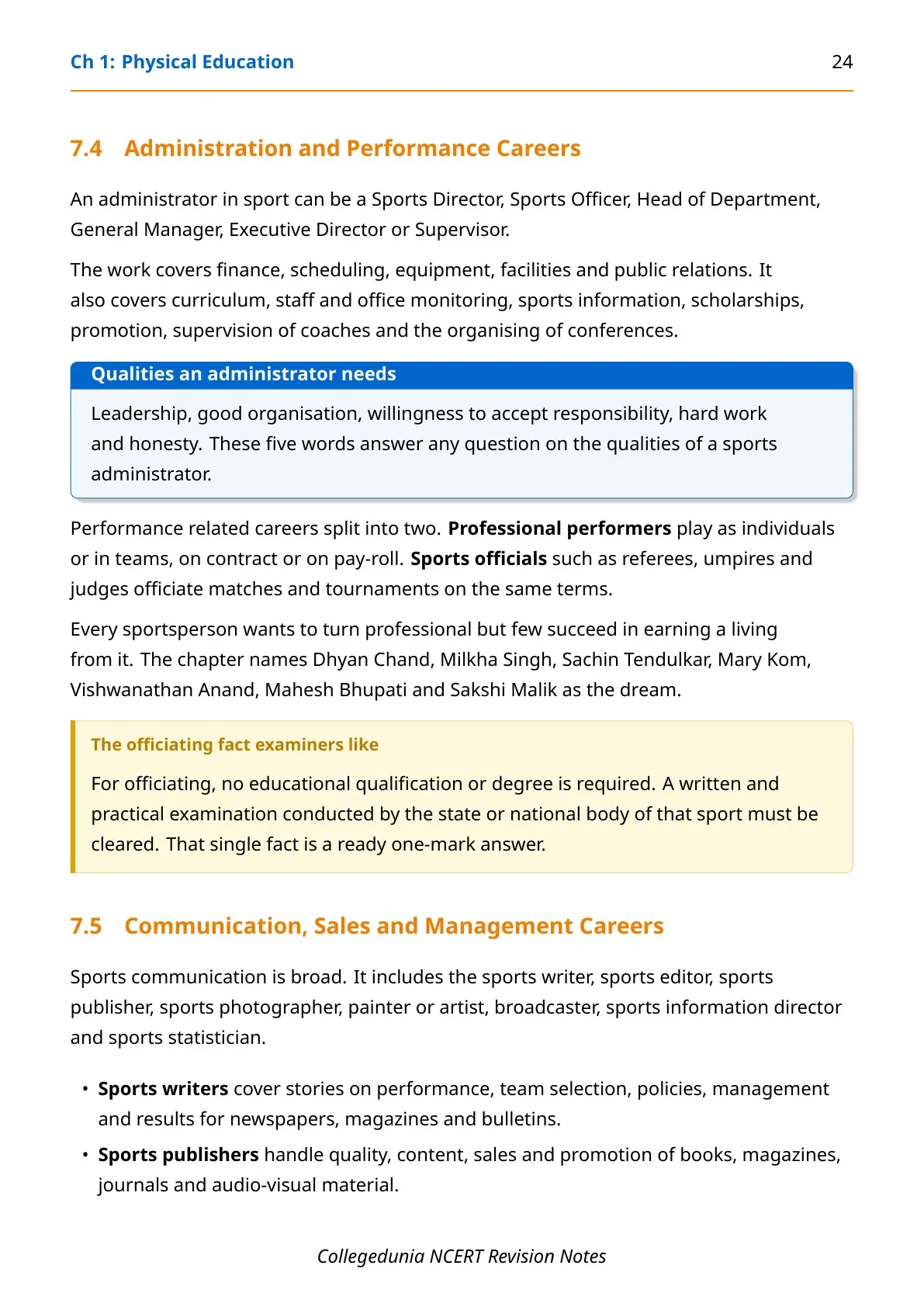
| Sports administration | Sports Director, Sports Officer, Head of Department, General Manager, Executive Director, Supervisor | Finance, scheduling, equipment, facilities, public relations, curriculum, staff monitoring, scholarships, supervision of coaches and organising competitions and conferences. |
| Performance | Professional players; officials such as referee, umpire and judge | Players compete for organisations on contract or pay roll. Officials run the match or tournament. Officiating needs no degree, only a written and practical examination set by the state or national body of that sport. |
| Communication | Sports writer, editor, publisher, photographer, artist, broadcaster, information director, statistician | Writers cover performance, team selection, policy, management and results. Publishers handle quality, content and sales of sports books and magazines. Television and radio reporters present live coverage, commentary, reviews, news and interviews. |
| Sales and management | Sports marketing executive, sports event manager, competition organiser | Selling equipment and events. Needs product knowledge, tournament organising skill, high responsibility and long service hours. |
The chapter names Dhyan Chand, Milkha Singh, Sachin Tendulkar, Mary Kom, Vishwanathan Anand, Mahesh Bhupati and Sakshi Malik as the professional performers students dream of becoming. It also notes that very few earn a living this way, which is why the other five families matter. Physical education also opens doors in defence, the para forces and the police service.
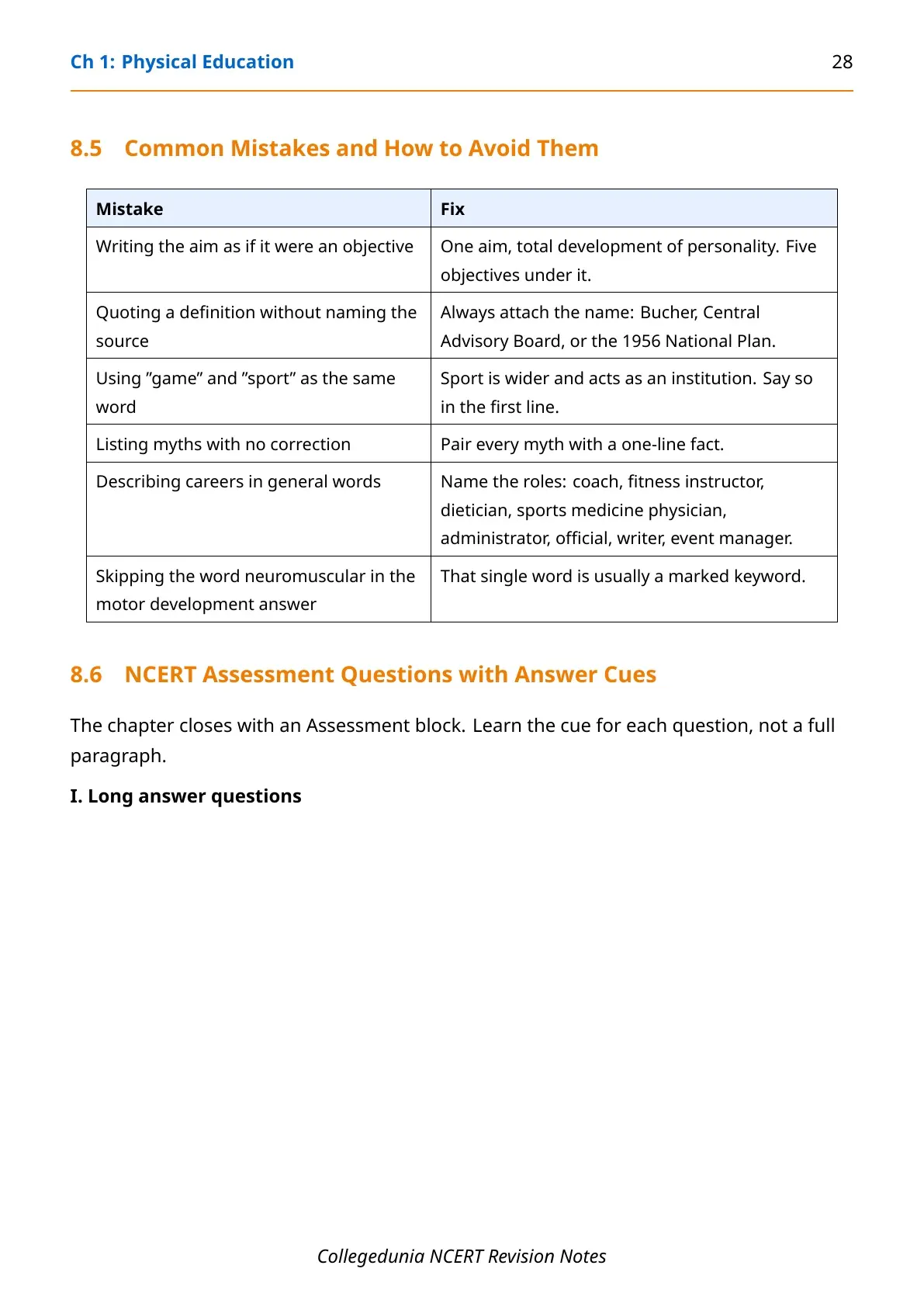
Common Mistakes Students Make in the Physical Education Chapter
- Mixing up the objective names. Motor development is about nerves and muscles. Physical fitness is a need and importance point, not one of the five objectives.
- Giving a definition with no source. Half the mark sits on naming Bucher, the 1956 National Plan or the Central Advisory Board.
- Calling drill the same as gymnastics. Drill is posture and repetition to a beat. Gymnastics uses apparatus and balance.
- Listing myths without correcting them. A misconception question wants the myth and the fact. Half answers get half marks.
- Naming only two careers. The question asks for career options, so give the family name first, then two roles inside it.
- Writing that physical education is a new idea. The textbook states the opposite: its roots are in the ancient period.
In the same student poll, the definitions question was the single biggest source of lost marks, ahead of both the objectives and the careers questions.
Physical Education Chapter 1 Textbook Assessment Questions Answered
The chapter ends with four question types. Here is what each one is really testing, plus the short answers you can check yourself against.
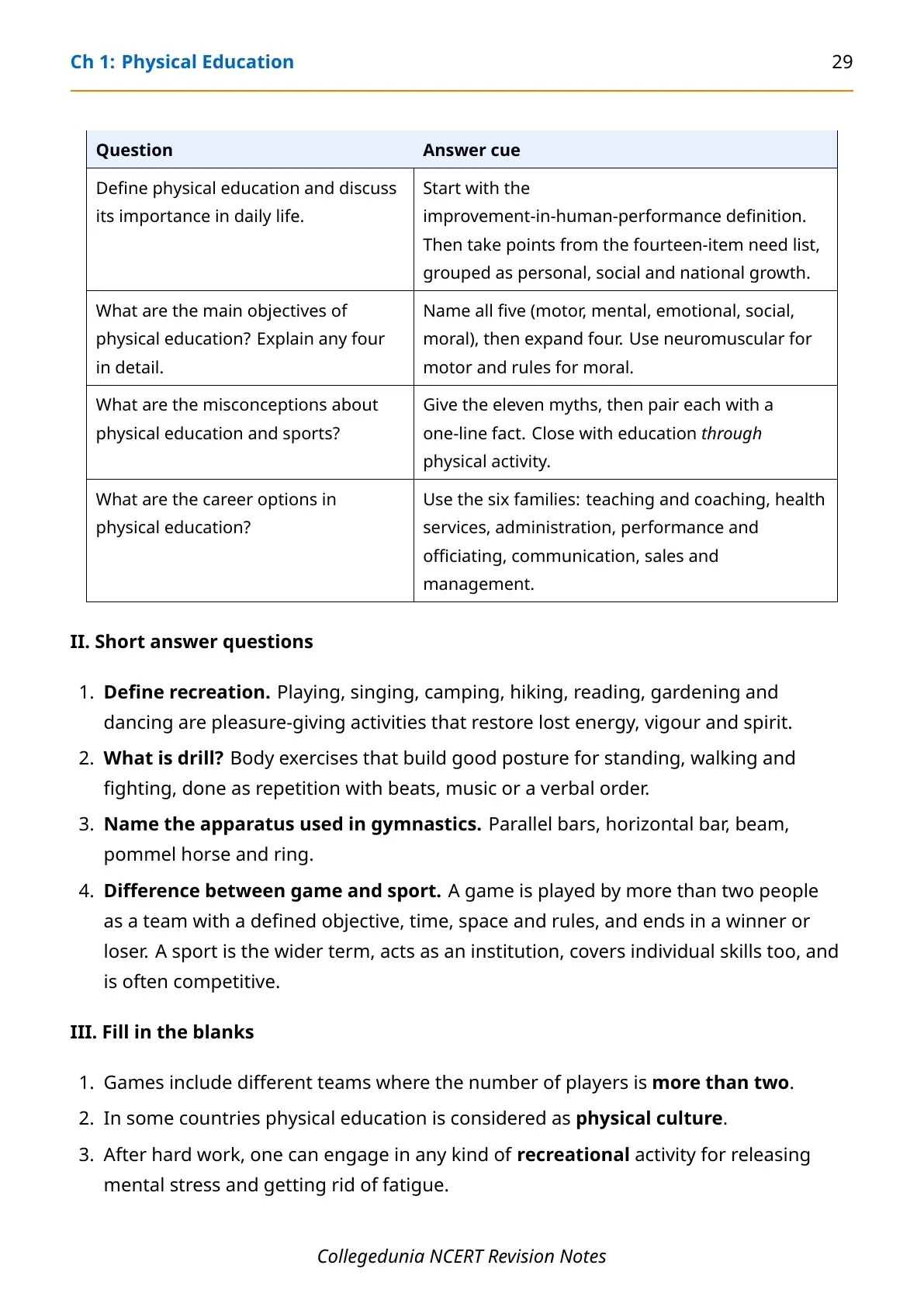
| Question type | What the textbook asks | Where the answer sits in these notes |
|---|---|---|
| Long answer 1 | Define physical education and discuss its importance in daily life | Meaning and definition table, plus the 14 need and importance points |
| Long answer 2 | Main objectives of physical education, explain any four | The five development areas table |
| Long answer 3 | Misconceptions about physical education and sports | The 11 myths box and the correction list |
| Long answer 4 | Career options in physical education | The six career families table |
| Short answers | Define recreation, explain drill, name gymnastics apparatus, difference between game and sport | The terminology table and the game versus sport table |
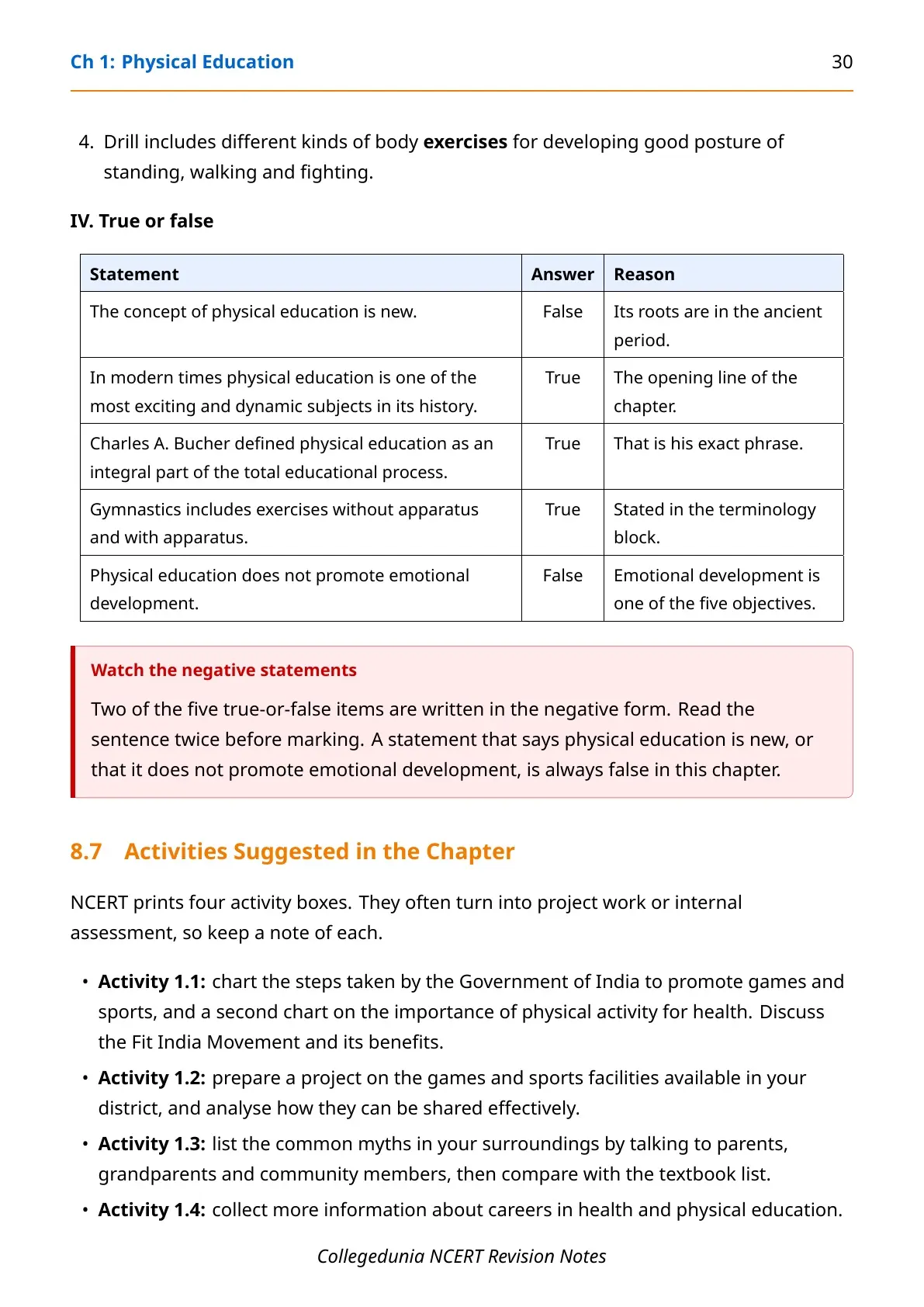
Fill in the Blanks and True or False, Solved
- Games include different teams where the number of players is more than two.
- In some countries physical education is considered as physical culture.
- After hard work, one can engage in any kind of recreational activity to release mental stress and get rid of fatigue.
- Drill includes different kinds of body exercises for developing good posture of standing, walking and fighting.
- The concept of physical education is new: False, its roots lie in the ancient period.
- In modern times physical education is one of the most exciting and dynamic subjects: True.
- Charles A. Bucher defined physical education as an integral part of the total educational process: True.
- Gymnastics includes exercises with and without apparatus: True.
- Physical education does not promote emotional development: False, emotional development is one of the five objectives.
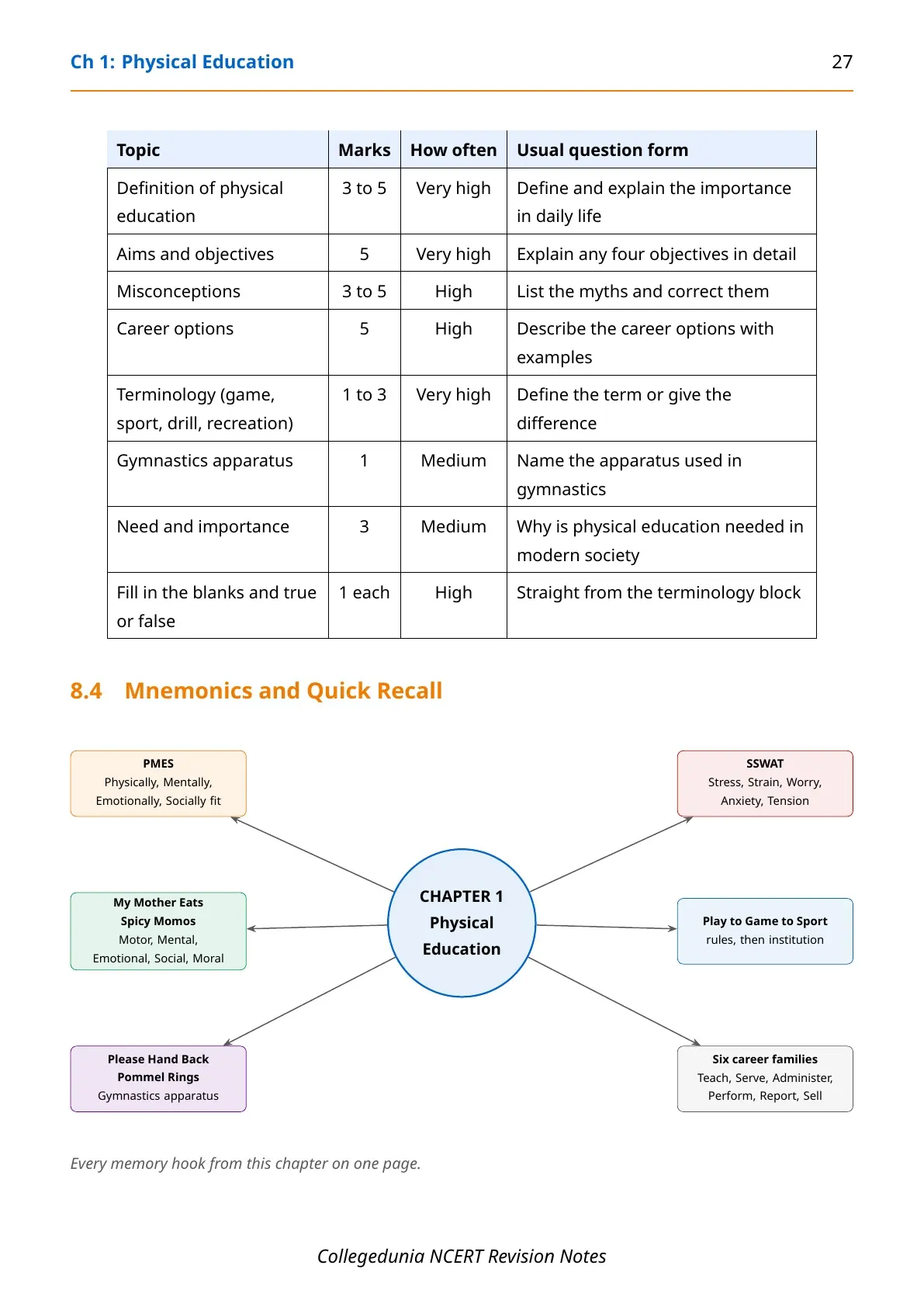
How Chapter 1 Appears in the Class 11 Physical Education Paper
Chapter 1 is the theory opener, so it rarely carries a full long answer on its own in a unit test. In the annual paper it usually contributes one long answer and two or three short ones.
| Question type | Marks | Typical ask |
|---|---|---|
| Very short answer | 1 | Define recreation, or name any two gymnastic apparatus |
| Short answer | 2 to 3 | Difference between a game and a sport, or the meaning of drill |
| Long answer | 5 | Objectives of physical education, or the misconceptions and their corrections |
| Long answer | 5 | Career options in physical education, sports and allied areas |
Together that is roughly 8 to 12 marks from one chapter, which is high for an opening chapter. The terminology alone can hand you 4 easy marks if the words are learnt exactly.
How to Revise the Physical Education Chapter in One Sitting
Students in the poll reported an average of 70 minutes to finish this chapter and its questions. Split the time in three blocks and you will not need a second pass.
- First 20 minutes: read the meaning section and learn the terminology table. These are the shortest answers and the quickest marks.
- Next 30 minutes: write the five objectives from memory with one example each, then check them against the table above. Repeat for the six career families.
- Last 20 minutes: learn the 14 need and importance points in the four groups, and the 11 misconceptions with their corrections. Test yourself by writing one 5 mark answer without looking.
Also Check: The night before the paper, revise only the terminology table, the five objectives and the career families table. Those three blocks cover most of what an examiner can set from Chapter 1.
Class 11 Physical Education Chapter 1 Resources Beyond These Notes
These notes handle revision. For the textbook questions in full, for a last minute recap and for the original chapter text, use the other three pages for the same chapter.
| Resource | Best used for | Link |
|---|---|---|
| Physical Education Class 11 NCERT Solutions | Every textbook assessment question answered in the exam format | Read the Physical Education Class 11 NCERT Solutions |
| Physical Education Class 11 Handwritten Notes | Last minute revision the night before the paper | Read the Physical Education Handwritten Notes |
| Class 11 Physical Education Book PDF | The original NCERT chapter with its Do You Know boxes and activities | Download the Class 11 Physical Education Book PDF |
NCERT Notes for All Class 11 Physical Education Chapters
The Class 11 Health and Physical Education book runs across ten chapters on this list. Each page follows the same shape as this one, with tables, a myth and mistake block and a downloadable PDF.
| Chapter | Title | Revision Notes |
|---|---|---|
| Chapter 1 | Physical Education | You are here |
| Chapter 2 | Understanding Health | Understanding Health Class 11 Notes |
| Chapter 3 | Physical and Physiological Aspects of Physical Education and Sports | Physical and Physiological Aspects Class 11 Notes |
| Chapter 4 | Individual Games | Individual Games Class 11 Notes |
| Chapter 5 | Team Games | Team Games Class 11 Notes |
| Chapter 6 | Yoga and its Relevance in the Modern Times | Yoga and its Relevance Class 11 Notes |
| Chapter 7 | Safety and Security | Safety and Security Class 11 Notes |
| Chapter 8 | Health Related Physical Fitness | Health Related Physical Fitness Class 11 Notes |
| Chapter 9 | Measurement and Evaluation | Measurement and Evaluation Class 11 Notes |
| Chapter 10 | Tournaments and Competitions | Tournaments and Competitions Class 11 Notes |
Class 11 Physical Education Chapter 1 Physical Education Notes FAQs
Ques. What is physical education according to the Class 11 NCERT chapter?
Ans. Physical education is education that improves human performance through physical activity. Those activities range from walking and jogging to running, jumping, climbing, throwing and kicking. The chapter also calls it movement education, because life itself begins with movement and continues through it.
Ques. How did Charles A. Bucher define physical education?
Ans. Bucher called it an integral part of the total educational process, a field of endeavour whose aim is the development of physically, mentally, emotionally and socially fit citizens, through the medium of physical activities selected to realise those outcomes. This is the definition most often asked in school papers.
Ques. What are the five objectives of physical education in Class 11?
Ans. Motor development, mental development, emotional development, social development and moral development. Motor development covers the nerve and muscle link that lets the body move. Moral development comes from obeying the rules of a game, which the chapter treats as a player's duty.
Ques. What is the difference between a game and a sport?
Ans. A game is a single activity played by more than two people as a team, with a defined objective, time, space and rules, and it produces a winner and a loser. Sport is the wider institution that covers all physical activities and individual skills, governed by rules and often taken up competitively.
Ques. What is recreation in physical education?
Ans. Recreation is pleasure giving activity such as playing, singing, camping, hiking, reading, gardening and dancing. Through recreation a person regains lost energy, vigour and spirit. After hard work, recreational activity releases mental stress and clears fatigue.
Ques. What is drill and how is it different from gymnastics?
Ans. Drill is a set of body exercises that build good posture for standing, walking and fighting, and that discipline body and mind. In sport it means repeating an activity to beats, music or a verbal order. Gymnastics uses apparatus such as parallel bars, beam, pommel horse and rings, and focuses on agility, jumping and balance.
Ques. What are the main misconceptions about physical education and sports?
Ans. The textbook lists eleven. The common ones are that physical education is only physical training, only games, only body building, only drill, or simply play. Others claim it has poor social status, no career prospects, leads to indiscipline, wastes money, or is taken up only by students left out of other subjects.
Ques. What are the career options in physical education, sports and allied areas?
Ans. Six families: teaching and coaching, health and fitness (fitness instructor, dietician, sports medicine physician), sports administration, performance (professional players and officials such as referee, umpire and judge), communication (sports writer, publisher, photographer, broadcaster) and sales and management. Physical education also helps in defence, para force and police service.
Ques. Do you need a degree to become a sports official?
Ans. No. The chapter states that officiating needs no educational qualification or degree. A candidate has to clear a written and practical examination conducted by the state or national sports organisation of that particular sport.
Ques. What does the National Curriculum Framework say about Health and Physical Education?
Ans. It says the subject should stay compulsory from the primary to the secondary stage and be optional at the higher secondary stage, with equal status to other subjects. Schools need the minimum essential space and equipment, regular visits by doctors, and grounds open before and after school hours for special training and leisure sport.
Ques. What is physical culture in physical education?
Ans. Physical culture is the name some countries use for physical education. It links to social belief and custom, and treats the body as a temple. It includes shaping the body through weight training devices and sharp, high intensity exercise so the muscles look developed and in good shape.
Ques. Are these Class 11 Physical Education notes according to the current syllabus?
Ans. Yes. Every definition, objective, term and career family on this page follows the 2026-27 reprint of the NCERT Health and Physical Education textbook for Class 11. The assessment questions at the end of the chapter are unchanged in this edition, so the notes apply to the current session.



Comments