




Inside these Class 12 Business Studies Chapter 7 Directing notes you get the four elements of directing, supervision, motivation, leadership and communication, plus Maslow's need hierarchy and the incentive types, in one 2026-27 revision file.
- CBSE Weightage: 6 to 10 marks (Unit 1, Principles and Functions of Management)
- Sections Covered: 11 concept blocks + 10-point cheat sheet (directing, Maslow, leadership, communication)
These notes suit a Class 12 student meeting the chapter for the first time and a board candidate revising in the last week. Every concept comes with a definition, its key features and a one-line takeaway. Mnemonics, quick tips and case-study spotters sit exactly where students usually slip.
Directing Class 12 Notes: Topic Map
| Section | What is Covered | Why It Matters in the Exam |
|---|---|---|
| 1. Meaning of Directing | Instructing, guiding, motivating, leading | 1 to 3-mark definition |
| 2. Importance of Directing | Five-point list (initiates, integrates, motivates, change, stability) | 3 to 4-mark; mnemonic I-I-M-F-S |
| 3. Eight Principles | Max contribution, harmony, unity of command... | 3 to 4-mark "explain any three" question |
| 4. Four Elements | Supervision, motivation, leadership, communication | 2-mark naming question |
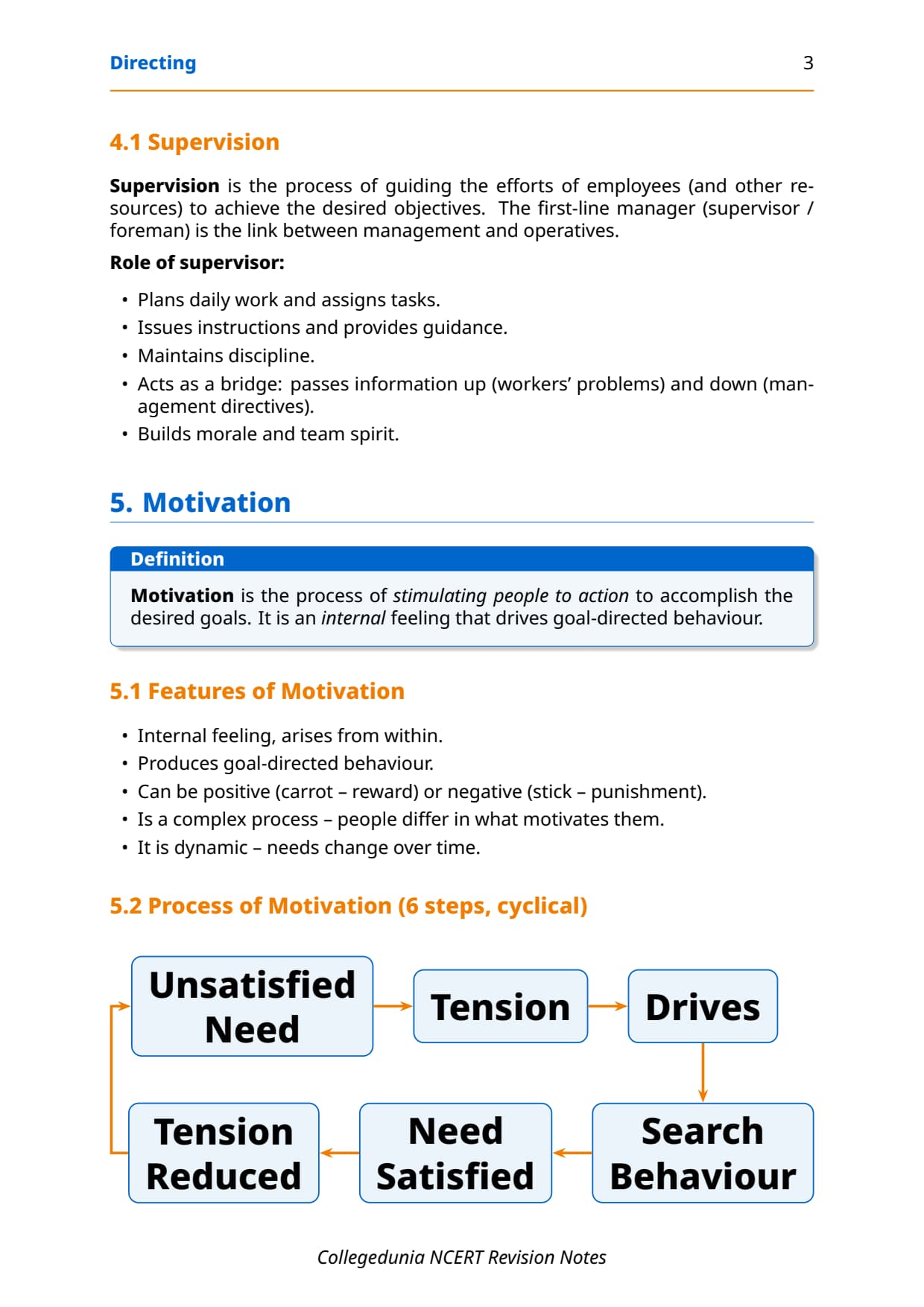
| 5. Motivation Process | 6-stage cyclical chain with diagram | 4 to 6-mark "process of motivation with diagram" |
| 6. Maslow Need Hierarchy | Five levels: P-S-S-E-S; financial vs non-financial mapping | 6 to 8-mark long-answer favourite |
| 7. Incentives | Financial (7 items) vs non-financial (8 items) | 4 to 6-mark; case-study (welfare = non-financial) |
| 8. Leadership Styles | Autocratic, democratic, laissez-faire | Case-study: inflexible boss, free-rein |
| 9. Communication Process | 7 elements: S-E-M-C-R-D-F | Encoding is the most-asked single element |
| 10. Formal vs Grapevine | Comparison + four grapevine networks | 3 to 4-mark; networks question |
| 11. Communication Barriers | Four families + eight measures to overcome | 6 to 8-mark long answer |
Directing Video Walkthrough
Source: Magnet Brains on YouTube
What the Class 12 Business Studies Chapter 7 Notes PDF Contains
- Concept-card for every named concept with a one-line definition followed by the textbook gloss.
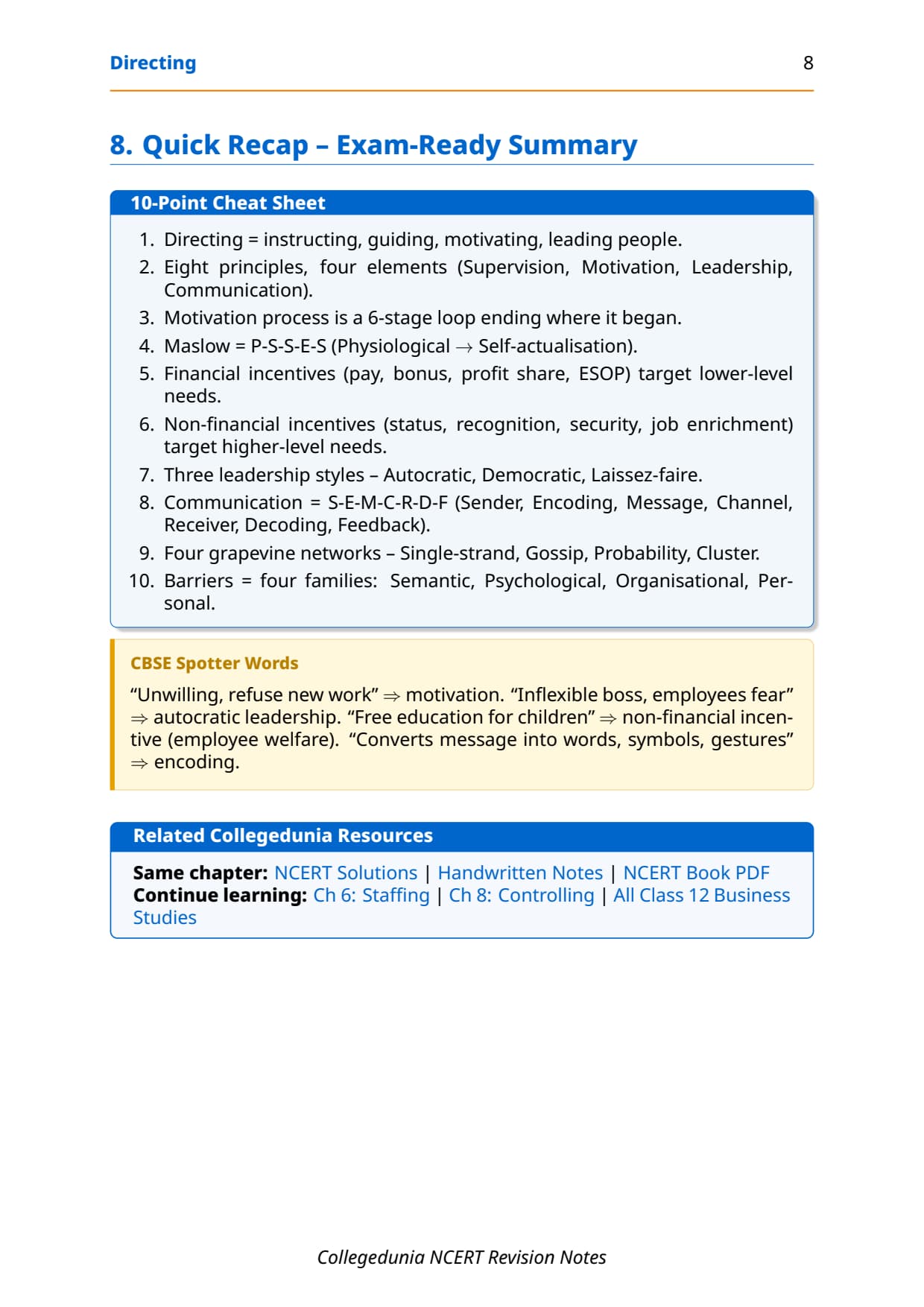
- Mnemonics for the staffing process, selection procedure (P-T-I-R-S-M-O-C), Maslow (P-S-S-E-S) and importance of directing (I-I-M-F-S).
- Quick tips mapping case-study cues to the right NCERT term.
- Comparison tables for recruitment vs selection, training vs development, formal vs informal communication, leadership styles.
- Diagrams for the staffing cycle, motivation process, Maslow's pyramid, communication process and grapevine networks.
- Real-world boxes tying NCERT theory to recognisable examples (TCS Initial Learning Programme, IT firm stand-ups).
Directing Class 12 Concept Capsule: Every Named List You Will Be Tested On
Five Features (Characteristics) of Directing
- Initiates action - other functions only prepare the setting; directing actually sets people in motion.
- Takes place at every level - top, middle and supervisory; every manager directs subordinates.
- Continuous process - lasts the entire life of the organisation, not a one-time act.
- Flows from top to bottom - instructions move down the chain of authority; each superior directs the subordinate immediately below.
- Integrates the four management functions (planning, organising, staffing, controlling) by translating plans into people-led action.
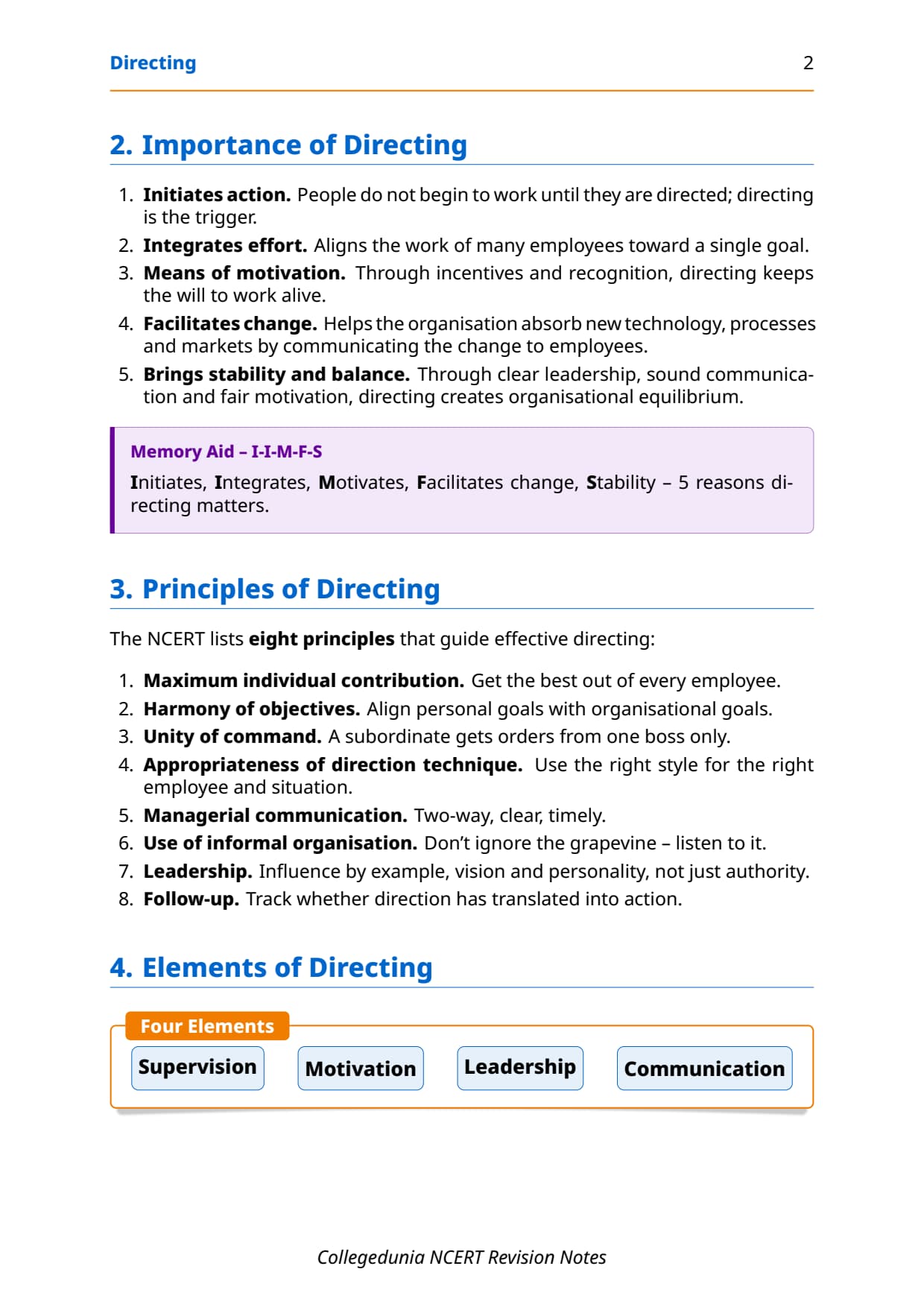
Four Elements of Directing
- Supervision - first-line guidance and oversight of operatives; ensures work follows the plan.
- Motivation - the internal drive to act; managers stimulate subordinates' willingness to perform.
- Leadership - influencing people to strive willingly for group goals.
- Communication - exchange of facts, ideas and opinions to build shared understanding.
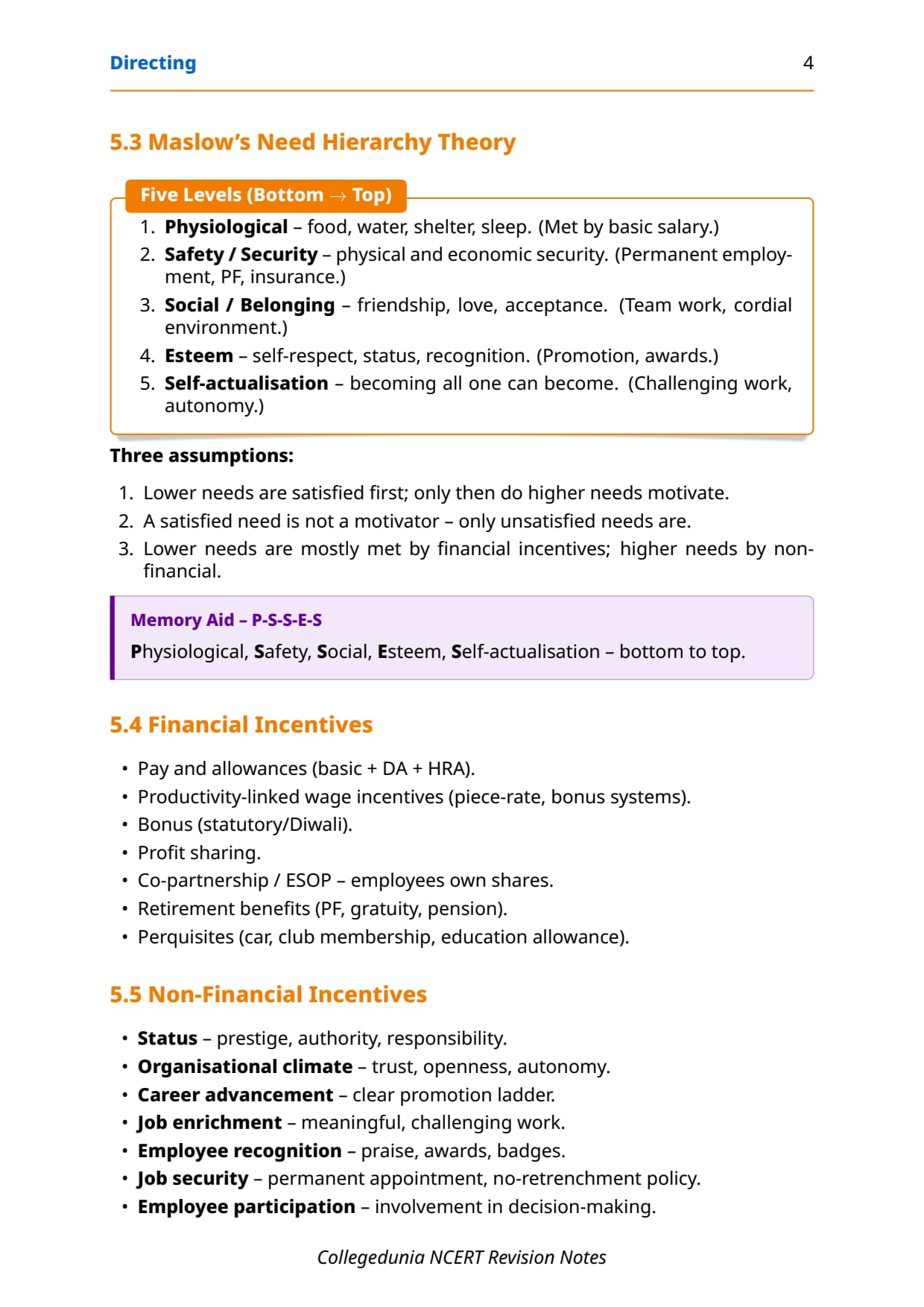
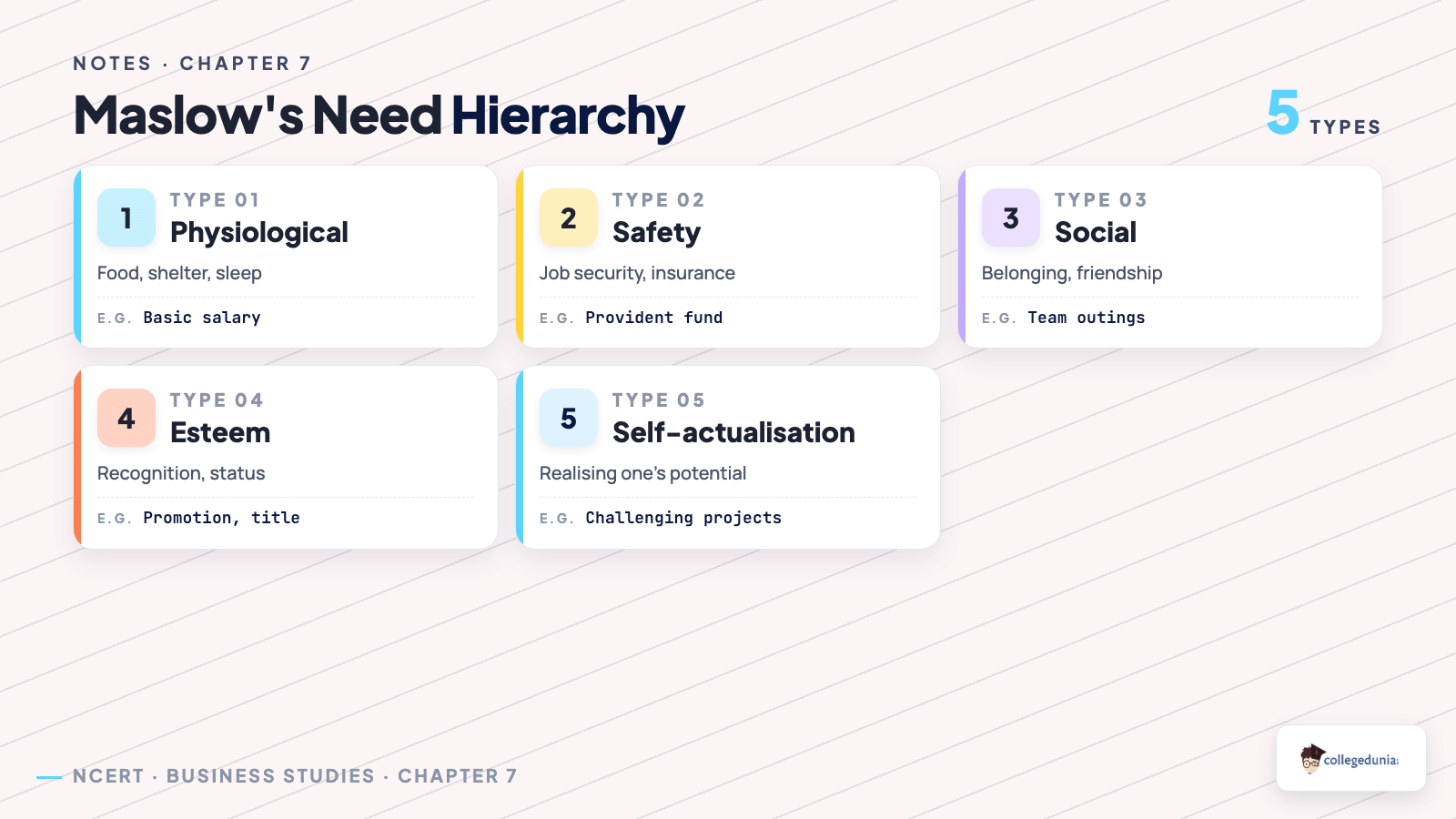
Maslow's Need-Hierarchy (P-S-S-E-S)
- Physiological - food, water, shelter, clothing, sleep (met by basic salary).
- Safety/Security - job security, stable income, protection from harm (met by PF, gratuity, permanent jobs).
- Social/Affiliation - friendship, belonging, acceptance (met by team work, group activities).
- Esteem - self-respect, status, recognition (met by titles, promotions, awards).
- Self-Actualisation - realising one's full potential (met by challenging assignments, autonomy).
Financial Incentives (7)
- Pay and Allowances
- Productivity-Linked Wage Incentives
- Bonus
- Profit Sharing
- Co-partnership / Stock Option
- Retirement Benefits (PF, gratuity, pension)
- Perquisites (car, housing, medical reimbursement)
Non-Financial Incentives (8)
- Status
- Organisational Climate
- Career Advancement Opportunity
- Job Enrichment
- Employee Recognition Programmes
- Job Security
- Employee Participation
- Employee Empowerment
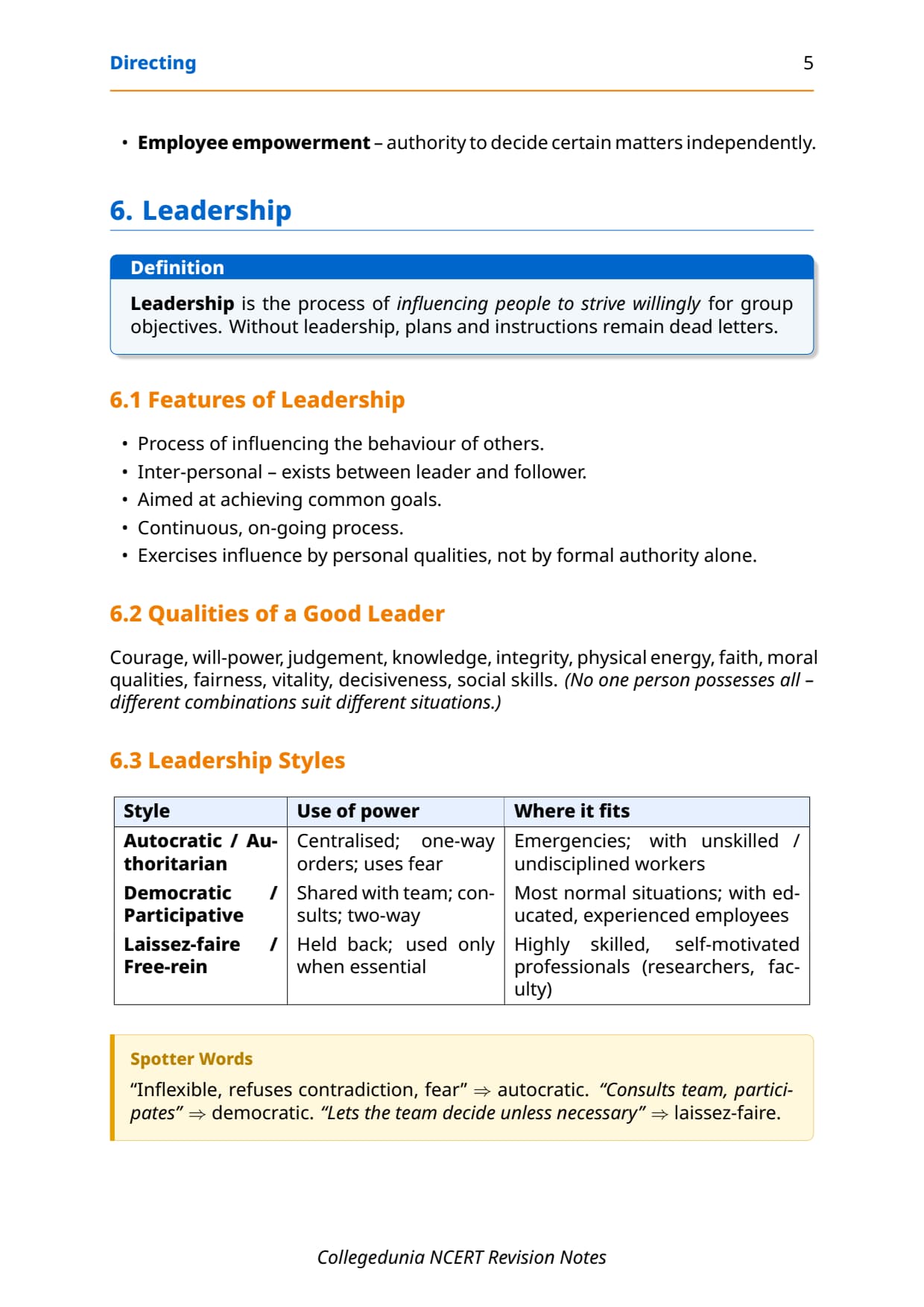
Three Leadership Styles
- Autocratic - leader centralises decision-making, gives orders, expects compliance; suits emergencies and unskilled workers.
- Democratic / Participative - leader consults subordinates and decides by consensus; suits knowledge workers and complex problems.
- Laissez-Faire / Free-Rein - leader delegates fully and intervenes minimally; suits highly skilled, self-motivated professionals (scientists, designers).
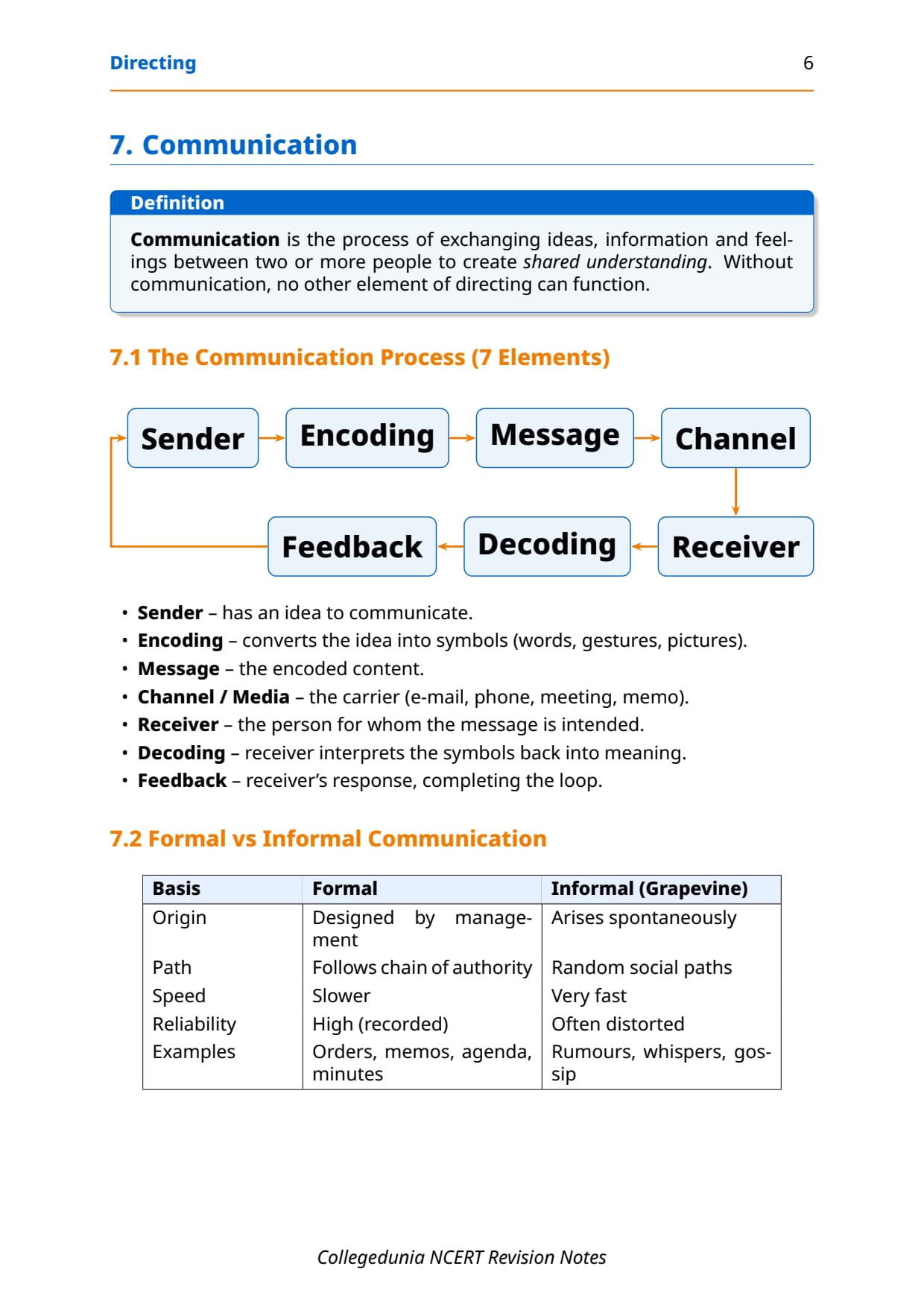
Seven Elements of Communication (S-E-M-C-R-D-F) plus Noise
- Sender - originator of the message.
- Encoding - converting the idea into symbols, words or gestures.
- Message - the encoded content actually sent.
- Channel / Media - the carrier (letter, e-mail, phone, face-to-face).
- Receiver - the person who gets the message.
- Decoding - converting the symbols back into meaning.
- Feedback - receiver's response confirming understanding.
Noise is any disturbance (technical, semantic or psychological) that distorts the message anywhere in the chain - poor handwriting, language gap, bias, ambient sound.
Formal Communication - Three Directions
- Vertical - between superiors and subordinates; further split into downward (orders, instructions) and upward (reports, suggestions).
- Horizontal / Lateral - between people at the same level (two production managers coordinating).
- Diagonal / Crosswise - between people at different levels in different departments (a sales executive directly e-mailing the finance manager).
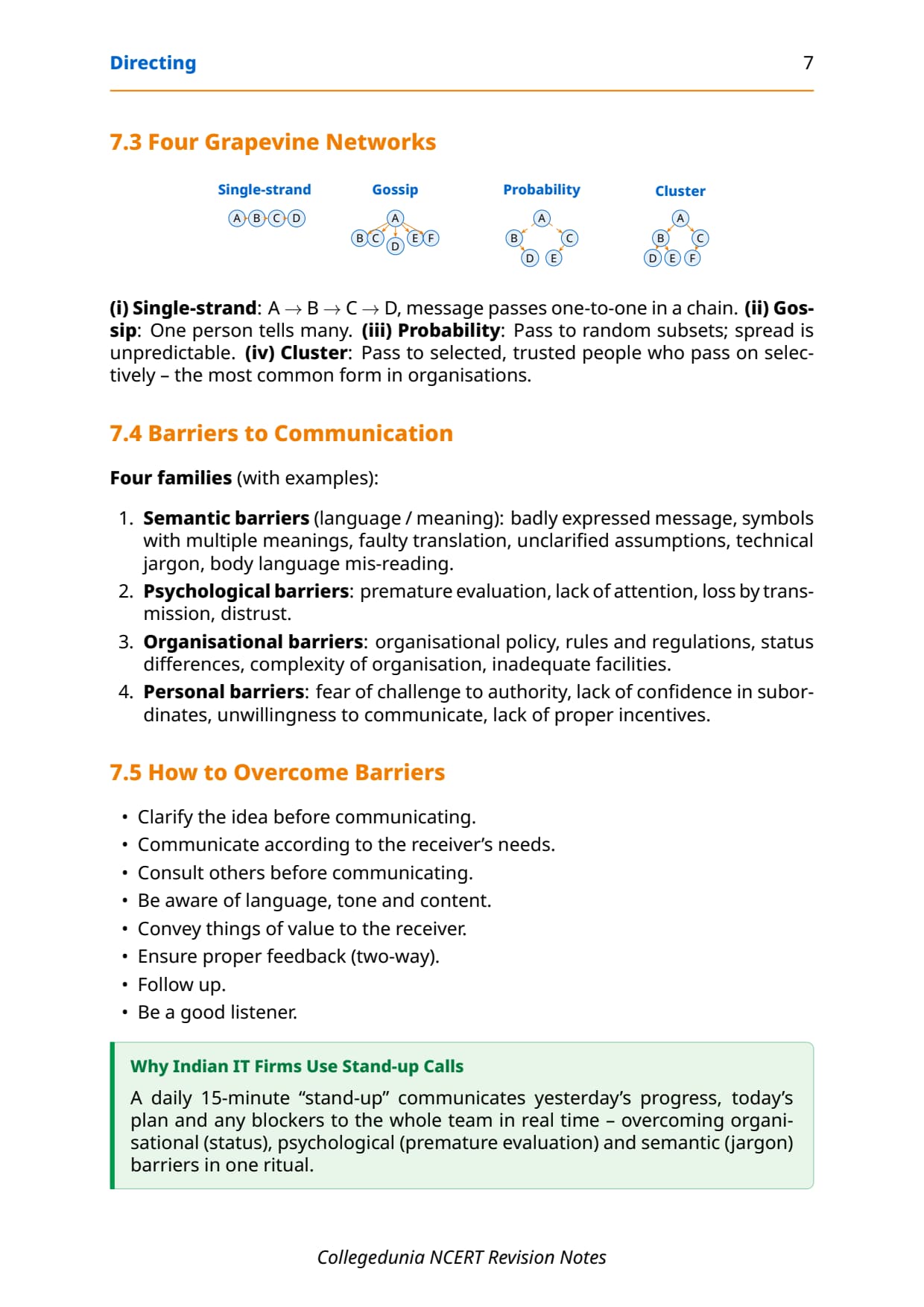
Grapevine - Four Network Patterns
- Single Strand - A tells B, B tells C, C tells D, in a single chain.
- Gossip - one person tells everyone else (hub and spoke).
- Probability - information is passed randomly to anyone the person meets.
- Cluster - one person tells a chosen few, who in turn tell a few more (most common in practice).
Four Barrier Families to Communication
- Semantic - badly expressed message, wrong translation, unclarified assumptions, technical jargon.
- Psychological - premature evaluation, lack of attention, loss by transmission, distrust.
- Organisational - rigid hierarchy, long chain of command, rules and regulations, status differences.
- Personal - lack of confidence of the superior in the subordinate, fear of challenge to authority, lack of incentive to communicate.
Continue Learning: Class 12 Business Studies Chapters
- Ch 6: Staffing Class 12 Notes
- Ch 8: Controlling Class 12 Notes
- All Class 12 Business Studies Chapters
Student Feedback
In a Collegedunia poll of 640 Class 12 Commerce students, 82% said the Maslow and communication-process diagrams in these Directing notes made the long-answer questions easier to attempt. 3 in 4 said the "unable vs unwilling" exam anchor stopped them from mixing up training with motivation.
Other Resources for Class 12 Business Studies Chapter 7 Directing
| Resource | Link |
|---|---|
| NCERT Solutions | Directing NCERT Solutions |
| Revision Notes | Directing Class 12 Notes |
| Handwritten Notes | Directing Handwritten Notes |
| NCERT Book PDF | Directing NCERT Book PDF |
Directing Class 12 - Frequently Asked Questions
Directing Class 12 - Frequently Asked Questions
What is directing in Class 12 Business Studies Chapter 7?
Directing is the management function of instructing, guiding, counselling, motivating and leading people in the organisation to achieve its objectives. It is the fourth function of management and converts plans on paper into actual goal-directed action.
What are the four elements of directing?
The four elements of directing are supervision, motivation, leadership and communication. Supervision is the first-line guidance of operatives; motivation stimulates the will to work; leadership influences people to strive willingly for group objectives; communication creates shared understanding.
What is Maslow's need hierarchy theory?
Abraham Maslow (1943) proposed that human needs follow a five-level hierarchy: (1) physiological, (2) safety, (3) social, (4) esteem, (5) self-actualisation. Lower needs are satisfied first; once satisfied, they stop motivating and the next higher need becomes the active motivator.
What is the difference between formal and informal communication?
Formal communication follows the chain of authority designed by management (orders, memos, agenda, minutes); it is slower but reliable. Informal communication (or grapevine) arises spontaneously out of social ties (rumours, whispers); it is very fast but often distorted.
Where can I download the Class 12 Business Studies Chapter 7 Directing Notes PDF?
You can download the Collegedunia Class 12 Business Studies Chapter 7 Directing Notes PDF free of cost from this page. The PDF is aligned to the NCERT Reprint 2026-27 syllabus and includes all the concepts, comparisons, diagrams and case-study spotters you need for the board exam.



Comments