



The Trees Class 12 notes explain Emily Dickinson's NCERT Kaleidoscope poem for the 2026-27 reprint. Use this page to revise summer imagery, personification, psalteries, hindered flags, the capitalised Sun and NCERT answer cues before downloading the full PDF.
- Download the Class 12 English Supplementary Chapter 10 notes PDF for quick revision.
- Revise the poem through imagery groups, language study support and answer routes.
- Student focus: the chapter tests close observation, phrase explanation and poetic effect.
Chapter10Kaleidoscope:TreesNotes.pdf?page=1&dpi=150)
Chapter10Kaleidoscope:TreesNotes.pdf?page=2&dpi=150)
Chapter10Kaleidoscope:TreesNotes.pdf?page=3&dpi=150)
Chapter10Kaleidoscope:TreesNotes.pdf?page=4&dpi=150)
Chapter10Kaleidoscope:TreesNotes.pdf?page=5&dpi=150)
Chapter10Kaleidoscope:TreesNotes.pdf?page=6&dpi=150)
Chapter10Kaleidoscope:TreesNotes.pdf?page=7&dpi=150)
Chapter10Kaleidoscope:TreesNotes.pdf?page=8&dpi=150)
Chapter10Kaleidoscope:TreesNotes.pdf?page=9&dpi=150)
Chapter10Kaleidoscope:TreesNotes.pdf?page=10&dpi=150)
Chapter10Kaleidoscope:TreesNotes.pdf?page=11&dpi=150)
Chapter10Kaleidoscope:TreesNotes.pdf?page=12&dpi=150)
Chapter10Kaleidoscope:TreesNotes.pdf?page=13&dpi=150)
Chapter10Kaleidoscope:TreesNotes.pdf?page=14&dpi=150)
Chapter10Kaleidoscope:TreesNotes.pdf?page=15&dpi=150)
Chapter10Kaleidoscope:TreesNotes.pdf?page=16&dpi=150)
Chapter10Kaleidoscope:TreesNotes.pdf?page=17&dpi=150)
Chapter10Kaleidoscope:TreesNotes.pdf?page=18&dpi=150)
Chapter10Kaleidoscope:TreesNotes.pdf?page=19&dpi=150)
Chapter10Kaleidoscope:TreesNotes.pdf?page=20&dpi=150)
Chapter10Kaleidoscope:TreesNotes.pdf?page=21&dpi=150)
Chapter10Kaleidoscope:TreesNotes.pdf?page=22&dpi=150)
Chapter10Kaleidoscope:TreesNotes.pdf?page=23&dpi=150)
Chapter10Kaleidoscope:TreesNotes.pdf?page=24&dpi=150)
Chapter10Kaleidoscope:TreesNotes.pdf?page=25&dpi=150)
Chapter10Kaleidoscope:TreesNotes.pdf?page=26&dpi=150)
Chapter10Kaleidoscope:TreesNotes_flat_MobileCard.pdf?page=1&dpi=150)
Chapter10Kaleidoscope:TreesNotes_flat_MobileCard.pdf?page=2&dpi=150)
Chapter10Kaleidoscope:TreesNotes_flat_MobileCard.pdf?page=3&dpi=150)
Chapter10Kaleidoscope:TreesNotes_flat_MobileCard.pdf?page=4&dpi=150)
Chapter10Kaleidoscope:TreesNotes_flat_MobileCard.pdf?page=5&dpi=150)
Chapter10Kaleidoscope:TreesNotes_flat_MobileCard.pdf?page=6&dpi=150)
Chapter10Kaleidoscope:TreesNotes_flat_MobileCard.pdf?page=7&dpi=150)
Chapter10Kaleidoscope:TreesNotes_flat_MobileCard.pdf?page=8&dpi=150)
Chapter10Kaleidoscope:TreesNotes_flat_MobileCard.pdf?page=9&dpi=150)
Chapter10Kaleidoscope:TreesNotes_flat_MobileCard.pdf?page=10&dpi=150)
Chapter10Kaleidoscope:TreesNotes_flat_MobileCard.pdf?page=11&dpi=150)
Chapter10Kaleidoscope:TreesNotes_flat_MobileCard.pdf?page=12&dpi=150)
Chapter10Kaleidoscope:TreesNotes_flat_MobileCard.pdf?page=13&dpi=150)
Chapter10Kaleidoscope:TreesNotes_flat_MobileCard.pdf?page=14&dpi=150)
Chapter10Kaleidoscope:TreesNotes_flat_MobileCard.pdf?page=15&dpi=150)
Chapter10Kaleidoscope:TreesNotes_flat_MobileCard.pdf?page=16&dpi=150)
Chapter10Kaleidoscope:TreesNotes_flat_MobileCard.pdf?page=17&dpi=150)
Chapter10Kaleidoscope:TreesNotes_flat_MobileCard.pdf?page=18&dpi=150)
Chapter10Kaleidoscope:TreesNotes_flat_MobileCard.pdf?page=19&dpi=150)
Chapter10Kaleidoscope:TreesNotes_flat_MobileCard.pdf?page=20&dpi=150)
Chapter10Kaleidoscope:TreesNotes_flat_MobileCard.pdf?page=21&dpi=150)
Chapter10Kaleidoscope:TreesNotes_flat_MobileCard.pdf?page=22&dpi=150)
Chapter10Kaleidoscope:TreesNotes_flat_MobileCard.pdf?page=23&dpi=150)
Chapter10Kaleidoscope:TreesNotes_flat_MobileCard.pdf?page=24&dpi=150)
Chapter10Kaleidoscope:TreesNotes_flat_MobileCard.pdf?page=25&dpi=150)
Chapter10Kaleidoscope:TreesNotes_flat_MobileCard.pdf?page=26&dpi=150)
Chapter10Kaleidoscope:TreesNotes_flat_MobileCard.pdf?page=27&dpi=150)
Chapter10Kaleidoscope:TreesNotes_flat_MobileCard.pdf?page=28&dpi=150)
Chapter10Kaleidoscope:TreesNotes_flat_MobileCard.pdf?page=29&dpi=150)
Chapter10Kaleidoscope:TreesNotes_flat_MobileCard.pdf?page=30&dpi=150)
Chapter10Kaleidoscope:TreesNotes_flat_MobileCard.pdf?page=31&dpi=150)
Chapter10Kaleidoscope:TreesNotes_flat_MobileCard.pdf?page=32&dpi=150)
These Class 12 English Supplementary Trees notes are checked against the 2026-27 NCERT chapter and built for fast poem revision.
Student Feedback on Trees
In a Collegedunia poll of 12,740 Class 12 English students using NCERT literature resources, many students understood the nature theme but needed help linking each image to its poetic effect.
- 77% wanted a clearer split between sight, sound, motion and scent images.
- 68% needed support with psalteries, dulcimer and the Language Study task.
- 59% found the hindered flags and capitalised Sun questions hard to frame.
Source: 2026-27 Class 12 English student poll. Sample of 12,740 students using NCERT-aligned study resources.
|
Table of Contents |
Trees Summary for Class 12 Kaleidoscope
Trees by Emily Dickinson presents a summer day as a living performance. Trees swing like tassels, tiny creatures make music, the Sun appears and hides, and flowers rise like colourful flags.
- Main idea: poetry grows from exact observation of ordinary nature.
- Central mood: wonder, freshness and delicacy.
- Answer cue: quote a phrase, explain the image, then write its effect.
Trees Class 12 Video Recap
Source: Magnet Brains on YouTube
Poem versus Painting in Trees
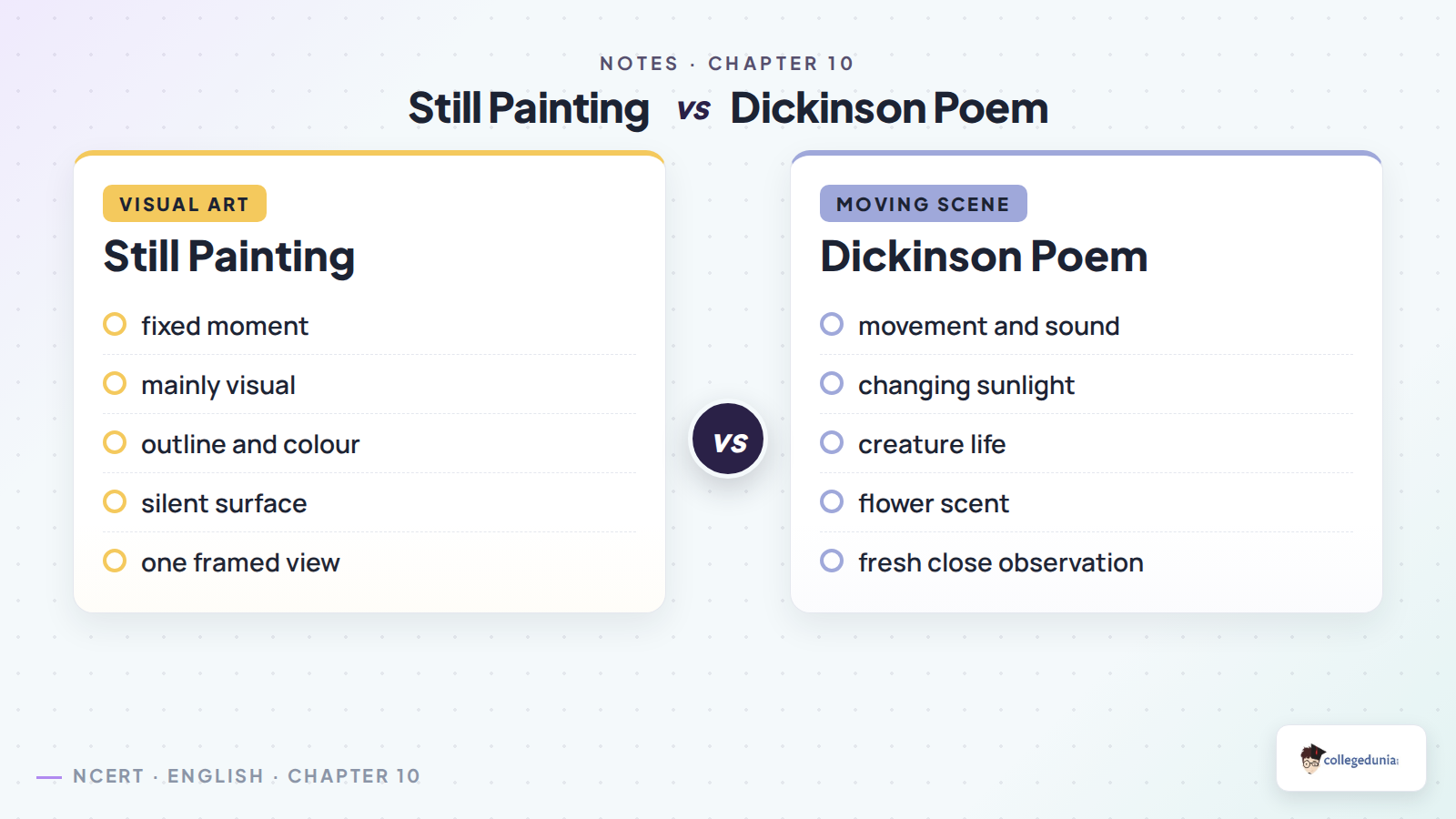
The NCERT question about Vandyke asks why Dickinson's poem can be richer than a painter's delineation. A painting can show a beautiful view, but the poem gives movement, sound, changing light, scent and creature life.
| Point | Painting | Dickinson's poem |
|---|---|---|
| Time | One fixed moment | A changing summer scene |
| Sense field | Mainly visual detail | Sight, sound, motion and scent |
| Effect | Surface beauty | Living energy and close observation |
Summer Imagery and Sensory Details in Trees
The poem's strongest answers come from grouping images by sense. Dickinson does not only say that summer is beautiful. She makes the day move, sound and breathe.
| Image group | Poem examples | Revision cue |
|---|---|---|
| Sight | Trees, Sun, cloud estates, bird, snake, flowers | Sharp small details make the scene visible. |
| Sound | Tune and psalteries | Summer becomes delicate natural music. |
| Motion | Hit, swung, winding, soared, hoisted | The scene feels active rather than still. |
| Scent | Spices in the hem | Flowers suggest fragrance as well as colour. |
Personification and the Capitalised Sun in Trees
Personification makes the natural world feel social and alive. Birds gossip, tiny creatures accompany the tune, and the Sun is treated with dignity through capitalised pronouns.
- Creatures: birds and tiny lives seem to behave like people in a summer gathering.
- Sun: words such as Himself and His make the Sun majestic and active.
- Effect: nature is not background scenery; it becomes a set of living presences.
Exam cue: do not only define personification. Name the phrase and explain what human quality appears.
Hindered Flags and Language Study in Trees
The phrase hindered flags compares flowers to flags rising on stems. The flowers are hindered because petals emerge slowly through the calyx before displaying colour.
| Term | Simple meaning | How to use it |
|---|---|---|
| Calyx | Green outer covering of a flower bud | Explains the slow opening of flowers. |
| Hindered flags | Flowers rising with colour after delay | Shows blooming as small ceremony. |
| Psaltery | A stringed instrument | Turns summer sound into refined music. |
| Dulcimer | A related stringed instrument | Compare shape and playing method in Language Study. |
NCERT Questions Answer Plan for Trees
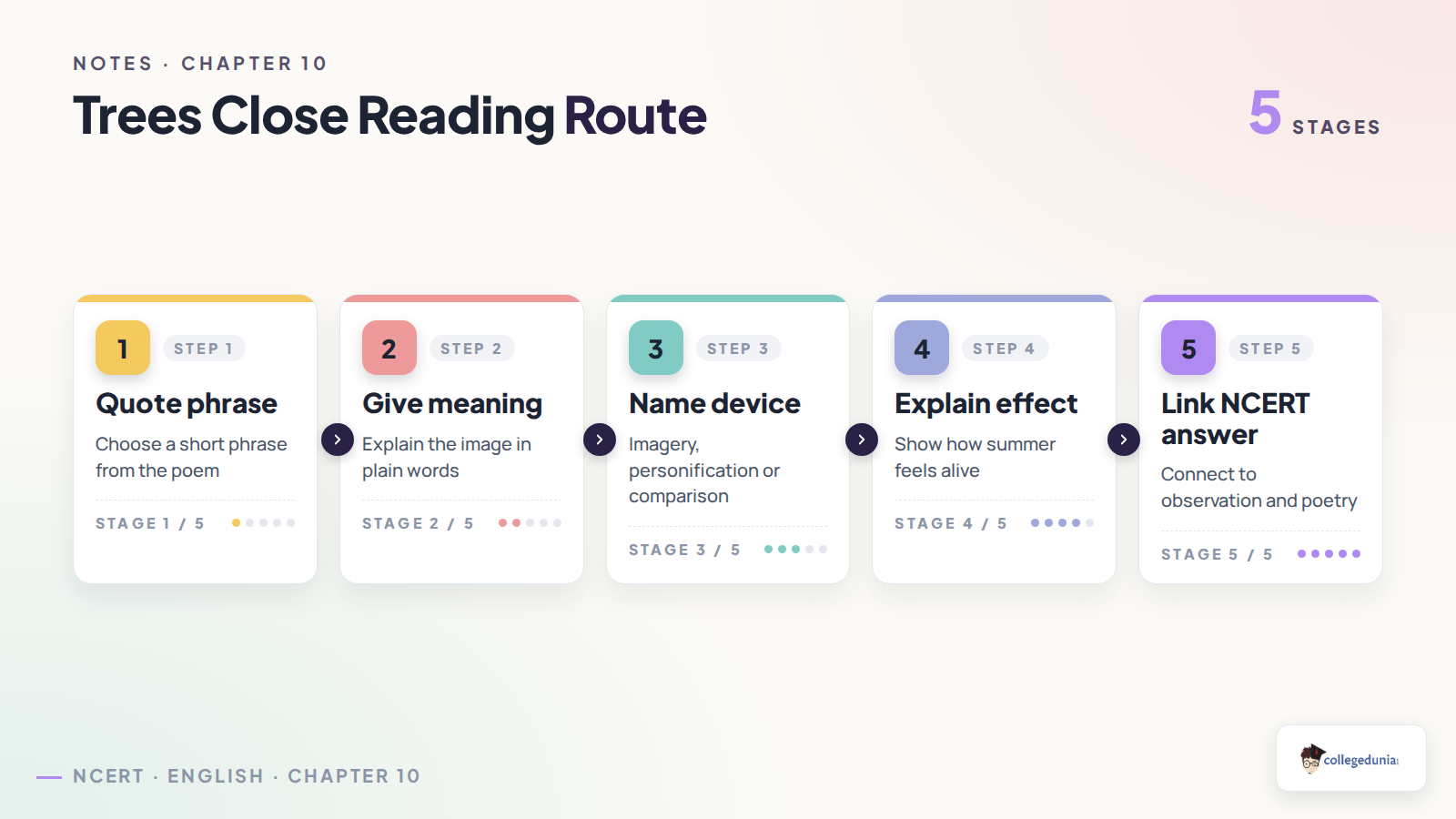
Write every answer with the same route: phrase, meaning, device and effect. This keeps answers precise and prevents general lines about nature from taking over.
| Question focus | What to include | Final effect |
|---|---|---|
| Imagery | Sight, sound, motion and scent examples | Poetry feels richer than a still painting. |
| Psalteries | Instrument meaning plus natural music | Summer sound feels delicate and distant. |
| Personification | Birds, creatures, snake and Sun | Nature feels alive and intimate. |
| Close observation | Trees, light, birds, snake and flowers | Exact seeing becomes poetry. |
Related Resources for Trees Class 12 English
| Resource | Use it for | Link |
|---|---|---|
| NCERT Solutions | Full textbook answers for Chapter 10 | Open NCERT Solutions |
All Class 12 English Supplementary Notes Chapters
| Chapter | Notes link |
|---|---|
| Chapter 6: Kaleidoscope: A Lecture upon the Shadow | Open Notes |
| Chapter 7: Kaleidoscope: Poems by Milton | Open Notes |
| Chapter 8: Kaleidoscope: Poems by Blake | Open Notes |
| Chapter 9: Kaleidoscope: Kubla Khan | Open Notes |
Trees Class 12 English Notes FAQs
Ques. What is Trees by Emily Dickinson about?
Ans. Trees is about a summer day seen through close observation. Dickinson turns trees, creatures, the Sun, birds and flowers into a lively poetic scene.
Ques. What does psalteries of summer mean in Trees?
Ans. Psalteries of summer means the delicate natural music of summer. The word psaltery makes small sounds feel refined and instrument-like.
Ques. Why are the flowers called hindered flags?
Ans. Flowers are called hindered flags because they rise on stems and display colour after slowly pushing through the calyx, like flags being hoisted.
Ques. How should students revise Trees notes?
Ans. Students should revise image groups, personification, the capitalised Sun, hindered flags, psaltery and dulcimer comparison, and the phrase-meaning-effect answer route.



Comments