NCERT Solutions for Class 12 English (Suppl.) Chapter 10 Kaleidoscope: Trees give students clear answers for the 2026-27 poem questions. The PDF below explains summer imagery, psalteries, personification, hindered flags, Sun capitalisation, close observation and the psaltery versus dulcimer language-study task in simple exam-ready steps.
Includes all 7 solved tasks from Responding to the Poem and Language Study.
Matches the full NCERT 2026-27 Kaleidoscope question order for Class 12 English Elective revision.
Focuses on image-based answers, creature personification, musical language and precise close reading.
The downloadable PDF keeps the NCERT sequence intact and adds expert solution tabs for deeper poetry interpretation.
Student Feedback: In a Collegedunia survey of 12,640 Class 12 English students conducted before the 2026 boards, many students said they confused the poem's nature images with general description. This page separates the exact image, its poetic device and the exam answer point.
Scope note: This page is for the complete NCERT Kaleidoscope poem Trees by Emily Dickinson. If your school uses an internal chapter list, check whether this poetry unit is included before treating it as test-only revision.
Trees turns a short summer scene into a layered picture of movement, sound, light and small living actions. The answers here stay close to the NCERT prompts and show how each image creates the poem's beauty.
The main skill is to move from image to effect. Students should first name the image, then explain what it adds: movement in the trees, music in the psalteries, social life in the creatures and colour in the flowers. Every answer should connect the detail with the feeling it creates.
NCERT area
What students answer
Best answer cue
Responding to the Poem
Imagery, psalteries, personification, hindered flags and capital letters
Quote the image, then explain its effect.
Close reading
How small natural details become poetry
Use trees, birds, snake, flowers and sunlight as evidence.
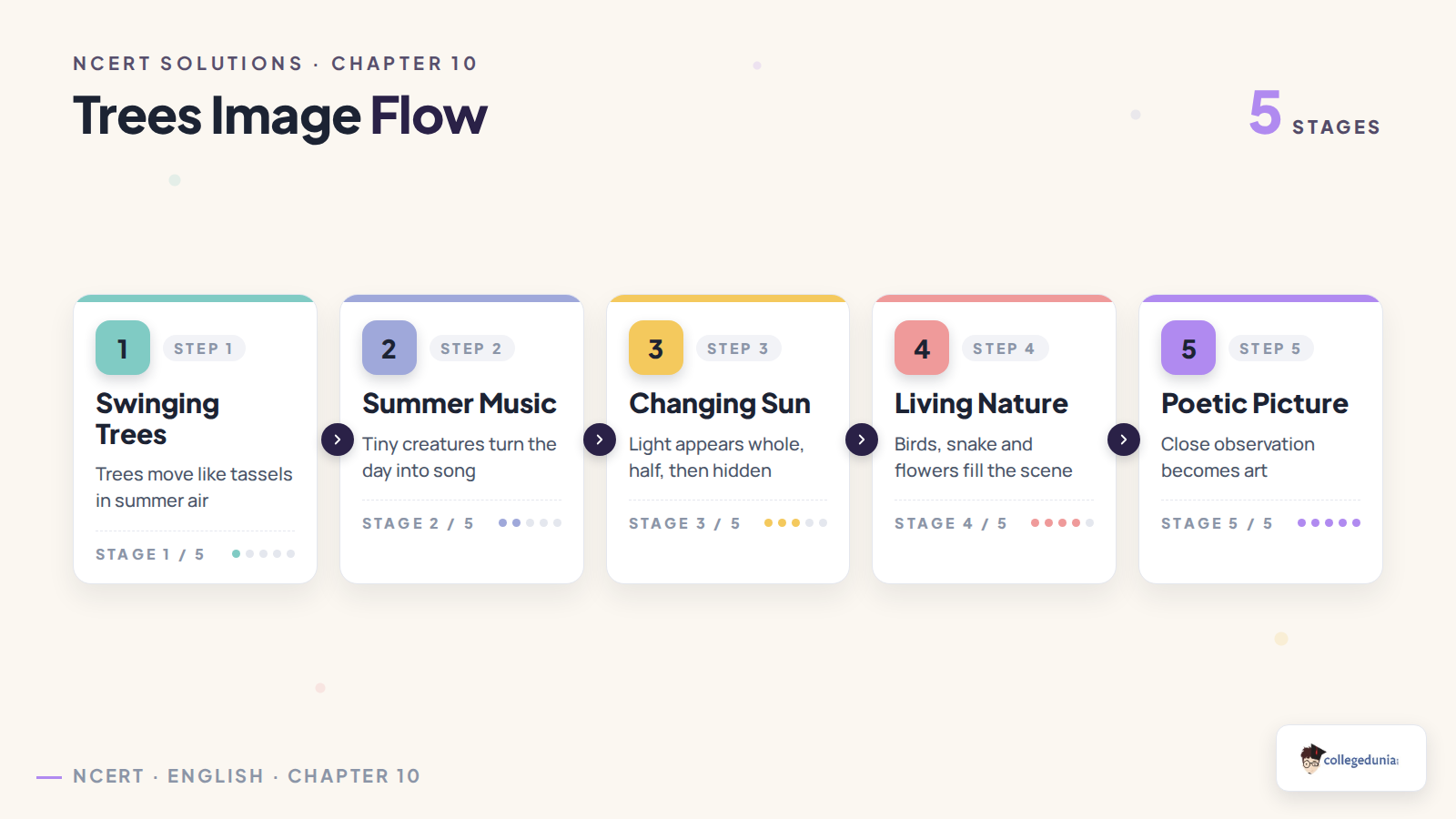
The poem moves from swinging trees to hidden music, changing sunlight, living creatures and blooming flowers. A strong answer follows that movement instead of listing images randomly.
Trees and tassels make the day feel mobile from the opening line.
Miniature creatures and psalteries turn summer sound into music.
Birds, snake and flowers bring the summer scene close to daily observation.
Psaltery and Dulcimer Comparison in Trees
The language-study task asks students to compare two stringed instruments after checking illustrations. The safest answer names their shared base first, then separates shape and playing method.
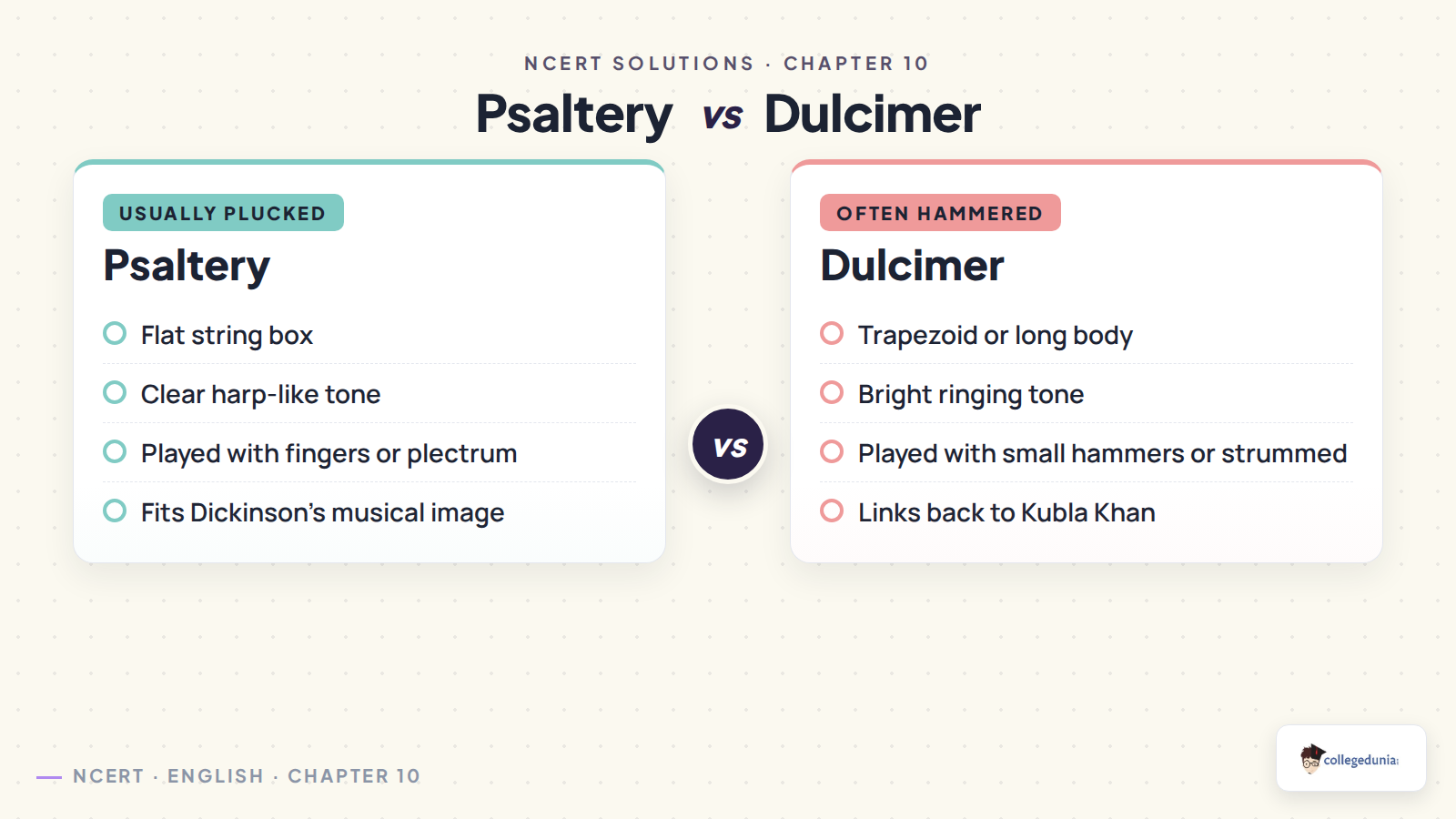
A psaltery is generally plucked, while a hammered dulcimer is struck with light hammers. Both have strings and a resonating body, but their usual forms and hand actions differ. This comparison also helps students understand why Dickinson's word psalteries makes summer sound delicate and musical.
How to Write Better Trees Answers
Begin each answer with the exact NCERT demand. If the question asks about imagery, group the images by sight, sound and movement. If it asks about personification, keep the answer on the creature-lines. If it asks about close observation, use precise details from the poem.
Do not reduce the poem to one broad statement about nature.
Use short textual references only when they support the explanation directly.
For personification, mention miniature creatures, the careless bird, the gossiping bird and the charmed snake.
For the language-study task, compare instruments by shape, string layout and playing action.
Class 12 English Supplementary Chapter 10 Resource Links
Use these related resources when you want the same chapter in another format. The table is placed above the FAQ so students can move from solutions to notes, book PDF and handwritten revision without losing the chapter context.
All NCERT Solutions for Class 12 English Supplementary Chapters
The table below keeps the same resource type together, so students can move chapter by chapter through the Class 12 English supplementary Kaleidoscope question set.
All NCERT Solutions for Class 12 English (Suppl.) Chapter 10 Kaleidoscope: Trees with Step-by-Step Solutions
The expandable cards below reproduce the full solution set from the PDF. Use the Solution tab for a direct exam-ready answer and the Expert Solution tab for a deeper reading of Dickinson's images, music and observation.
Q 10.1
What imagery does the poet use to delineate Summer's day more picturesquely than any painter could?
Concept used. Imagery is word-painting that appeals to sight, sound, movement, and touch. Dickinson uses images from trees, music, sunlight, birds, flowers, and colour to make the summer day feel alive.
Image map
Group the answer by sense images. It keeps the explanation tidy and close to the poem.
The trees are compared to tassels that hit and swing in the air.
This gives the opening a visual image of movement.
A tune seems to rise from tiny creatures moving with the sun.
The phrase psalteries of summer turns natural sounds into music.
The sun appears in parts: whole, half, hidden, and then visible again.
Clouds are imagined as estates that can fold the sun away from view.
Birds, a snake, stones, flowers, calyx, stem, and spice fill the scene with small details.
Flowers opening on stems are compared to flags being hoisted.
These images make the day richer than a flat painting because they show motion, sound, light, scent, and surprise.
The poet uses moving trees, summer music, shifting sunlight, clouds, birds, a snake, stones, flowers, stems, flags, and spices. These images make summer look and sound alive, so the poem becomes more vivid than any still painting.
AS
Aditi Sharma
M.A English, University of Delhi
Verified Expert
Quick reading. Dickinson does not describe summer as a broad landscape only. She breaks the day into exact small signs, then lets each sign move, sing, open, or glow.
The tassel image gives the trees a light swinging motion.
The tune from miniature creatures gives the day a hidden sound track.
The psalteries image makes that sound feel like delicate music.
The changing sun creates a moving play of brightness and shade.
The birds and snake show the day through living creatures.
The flowers rising from their calyx bring colour and scent into the frame.
The flag image makes blooming look ceremonial and lively.
Because the poem includes sight, sound, movement, and scent, it goes beyond painting.
A painter can show one moment. Dickinson makes the student feel a whole summer day changing in time. That is why the poem's verbal picture feels fuller than a canvas.
Dickinson's summer imagery is made from swinging trees, natural music, shifting light, active creatures, opening flowers, and spicy fragrance. The images are vivid because they move and sound as well as look beautiful.
Q 10.2
What do you understand by '`Psalteries of Summer"?
Concept used. A psaltery is a stringed musical instrument. In the poem, psalteries of summer means the delicate music made by tiny summer creatures, wind, leaves, and the season itself.
Psaltery
A psaltery is plucked or struck to make a soft string sound. Dickinson uses it as a musical image.
The phrase comes after the poet hears a tune rising from miniature creatures.
These creatures are not named in a plain scientific way.
The poet hears them as if they are playing fine instruments.
Summer therefore becomes an orchestra of small natural sounds.
The word far suggests that the music feels distant, subtle, and hard to fully catch.
The music enchants the ear, but never fully satisfies it.
This makes the sound of summer beautiful, teasing, and endless.
'`Psalteries of Summer" means the soft, far-reaching music of summer. Dickinson imagines the sounds of tiny creatures, leaves, and air as if the season itself were playing delicate stringed instruments.
RM
Rahul Menon
M.A English, EFLU Hyderabad
Verified Expert
Structural observation. The phrase turns sound into metaphor. Dickinson does not say that insects merely make noise. She hears summer as music played on many hidden instruments.
Psalteries are musical instruments, so the word gives the line a sacred and delicate sound.
Summer is personified as a season that can produce music.
The tiny creatures become musicians in this imagined scene.
The ear is charmed, which shows the pleasure of listening.
The sound is still remote, so the listener wants more of it.
This mixture of nearness and distance deepens the charm.
The phrase captures one of Dickinson's main skills: she makes a small natural sound feel magical.
The answer should therefore avoid a bare dictionary meaning. The dictionary explains psaltery, but the poem uses it to express summer's delicate music and the speaker's longing to hear it fully.
The phrase means the musical life of summer. The season's small sounds seem like distant psalteries that charm the ear but remain beyond complete grasp.
Q 10.3
In which lines are creatures attributed with human qualities? How does this add to the beauty of the Summer's day?
Concept used. Personification gives human qualities, actions, or moods to non-human beings. In this question, the focus is on creatures: miniature creatures, birds, and the snake.
Quote and effect
For personification questions, name the line-image first. Then write what it adds to the scene.
Miniature creatures seem to accompany the sun, as if they are taking part in a procession.
A bird sits carelessly on the fence, as if it has a relaxed human mood.
Another bird gossips in the lane, which is a clearly human social action.
The snake is charmed as it winds round a stone, so even its movement feels touched by music.
These details turn the summer day into a scene of movement, talk, music, and companionship.
The beauty of the day comes from this lively closeness, not from still scenery alone.
The creature-lines include miniature creatures accompanying the sun, a bird sitting carelessly, another bird gossiping in the lane, and a snake being charmed as it winds round a stone. These details make the summer day lively, social, musical, and intimate.
MK
Meera Krishnan
Ph.D English, University of Hyderabad
Verified Expert
Strategic angle. Personification is the poem's way of making observation warmer. The speaker does not only see objects. She sees a small community of actions in nature.
The tiny creatures are not passive background details.
They seem to accompany the sun, so the day gains rhythm and companionship.
The bird on the fence looks careless, which gives it a human attitude.
The gossiping bird turns birdsong into social talk.
The snake is not just a shape in the landscape; it is charmed by the bright, silver scene.
Each creature image adds motion, humour, music, or tenderness to the summer day.
This makes the scene more beautiful because it is not distant scenery. The living creatures behave like companions inside the landscape. The student feels that every small creature has a role in the day's charm.
Dickinson gives human-like action or mood to miniature creatures, birds, and the snake. It beautifies summer by making the day feel active, expressive, musical, and companionable.
Q 10.4
How would you explain the image of the 'Hindered Flags'?
Concept used. A simile compares one thing with another. Dickinson compares opening flowers to flags, but calls them hindered because they rise slowly through the calyx and are held by the stem.
Blooming as ceremony
The image turns a small flower opening into a public act of colour, like a flag being raised.
The line describes bright flowers as they break out of the calyx.
The calyx is the green outer covering that protects the flower bud.
When the flower opens, it seems to slit or push through that covering.
The petals then rise on the stem like a flag going up a pole.
The flag is hindered because the flower is delayed and partly held by the bud covering.
The word also suggests a soft struggle in blooming.
The image gives flowers colour, movement, and a sense of triumph.
'`Hindered Flags" refers to flowers opening on their stems. They look like flags being raised, but their movement is slowed by the calyx and the natural effort of blooming.
NR
Nandini Rao
M.A English, Jadavpur University
Verified Expert
Quick reading. The image works because a flower and a flag both display colour. Dickinson adds hindered to show that the display is not instant.
A closed flower is first hidden inside the calyx.
As it opens, the petals push outward.
The stem holds the flower upright, much like a pole holds a flag.
A flag rises by human action, while a flower rises by natural growth.
Hindered suggests resistance, delay, or difficulty.
So the blooming flower seems to fight gently before it is fully seen.
The phrase makes the act of flowering dramatic without making it heavy.
The image also suits the poem's summer mood. A flower is a small detail, but Dickinson turns it into a bright signal. The scene becomes full of tiny ceremonies of nature.
The image means that flowers look like colourful flags rising on stems, but their rise is slowed by the calyx. Dickinson uses it to make blooming vivid and active.
Q 10.5
Why are the pronouns referring to the Sun capitalised?
Concept used. Capitalisation can give special importance to a word. Dickinson capitalises pronouns for the sun to personify it and make it appear powerful, free, and almost divine.
Capital letters
In Dickinson's poetry, capitals often make common words feel charged with special meaning.
The poem refers to the sun through capitalised pronouns such as Himself and His.
This makes the sun seem like a person rather than an object.
The sun appears whole, half, and hidden at intervals.
The wording suggests that he can choose whether to reveal himself.
Clouds are imagined as estates that belong to him or surround him.
Capital letters give the sun dignity and authority.
They may also suggest a godlike presence in the summer scene.
The effect fits the poem's sense that nature is alive and powerful.
The pronouns for the sun are capitalised to personify the sun and give it dignity. The sun seems like a powerful being who may appear, hide, or let the orchards grow by choice.
AS
Arjun Sen
M.A English, University of Calcutta
Verified Expert
Structural observation. The capital letters are not a typing accident. They guide the student to read the sun as a presence with agency.
Ordinary grammar would not require capital letters for pronouns referring to the sun.
Dickinson chooses capitals to make the sun stand above ordinary description.
The sun becomes a character in the summer day.
The phrase about being optional suggests choice.
The cloud estates suggest possession, shelter, and command.
The whim of the sun suggests freedom and mood.
This raises the natural image into a spiritual or royal image.
The capitalisation also matches Dickinson's poetic habit. She often uses capitals to stress abstract or natural forces. Here the choice helps the sun dominate the scene without any long explanation.
The capitalised pronouns personify the sun and make it seem majestic. They show the sun as an active power in the summer scene, not just a source of light.
Q 10.6
Give examples from the poem to show that great poetry is a result of close observation of natural phenomena.
Concept used. Close observation means noticing small natural details with care. Great poetry often begins with such details, then gives them emotional, musical, or symbolic force.
Use exact examples
Do not write only that the poet observes nature. Mention the small details she notices.
Dickinson notices the way trees swing like tassels.
She hears tiny summer creatures as if they are making music.
She observes the changing sunlight: full, half-seen, and hidden by cloud.
She watches birds sitting, moving, and seeming to gossip.
She notices a snake winding around a stone.
She sees flowers split the calyx and rise upon the stem.
She connects the flowers with flags and spice, so sight and scent work together.
These examples show that the poem grows from exact natural observation.
The greatness lies in transforming those small details into fresh images.
The poem shows close observation through swinging trees, tiny creature-sounds, changing sunlight, cloud cover, birds, a snake, stones, flowers, calyx, stems, and scent. Dickinson turns these precise details into memorable poetry.
IM
Ira Mukherjee
M.A English, Presidency University
Verified Expert
Strategic angle. The poem proves that observation is not mere looking. Dickinson watches small changes until they reveal pattern, movement, and music.
The tree image depends on noticing motion, not only shape.
The tune from tiny creatures depends on attentive listening.
The sun image depends on watching light move in and out of cloud.
The bird images depend on noticing posture and sound.
The snake image depends on seeing a small curved motion around stone.
The flower image depends on knowing how a bud opens from the calyx.
The spice image adds scent to sight and movement.
These details are ordinary, but Dickinson's comparisons make them newly visible.
The answer should stress this change from observation to art. The poet first notices accurately. Then she chooses images that let the student feel the freshness of the summer day.
Great poetry comes from close observation because exact details become fresh images. Trees, sunlight, creatures, birds, snakes, and flowers are carefully seen, then reshaped into art.
Q 10.7
You came across '`dulcimer" in the poem '`Kubla Khan". Did you note down '`Psaltery" as another musical instrument? They are very similar. Look up the illustrations for the two in an illustrated dictionary. Find out in what ways they are different from one another.
Concept used. A comparison answer should name the common base first, then list clear points of difference. Dulcimer and psaltery are both stringed instruments, but their shapes and playing methods differ.
Comparison method
Use common points, then differences. This prevents the answer from becoming two separate notes.
Common point: Both instruments have strings stretched over a resonating body.
Both can produce bright, ringing tones.
Both appear in older musical traditions and in folk or historical music contexts.
Psaltery: A psaltery is often a flat or shallow box-shaped instrument.
It is commonly plucked with fingers or a plectrum.
Its sound is light, clear, and harp-like.
Dulcimer: A dulcimer is also a stringed instrument, often with a trapezoid or long box form depending on the type.
A hammered dulcimer is played by striking the strings with small hammers.
A mountain dulcimer is placed on the lap and played by strumming or plucking.
The main difference is therefore in playing style: psaltery is usually plucked, while a hammered dulcimer is struck.
A psaltery and a dulcimer are both stringed instruments, but a psaltery is usually plucked, while a hammered dulcimer is struck with small hammers. Their shapes also differ, though both give a clear ringing sound.
DN
Devika Nair
Ph.D English, JNU
Verified Expert
Quick reading. The task asks for observed differences from illustrations. So the best answer compares shape, position, and playing action rather than giving a long history.
In an illustration, the psaltery usually appears as a shallow sound box with strings across it.
The player often plucks those strings directly.
The dulcimer may look wider or more trapezoid in its hammered form.
The hammered dulcimer is played with two light hammers, so the hand action is different.
A mountain dulcimer has a long narrow body and is often played on the lap.
The psaltery's tone suggests a plucked shimmer.
The hammered dulcimer's tone suggests a struck ringing pattern.
Both instruments help students understand why Dickinson's psalteries image feels musical and delicate.
This comparison also links the language-study task back to the poem. The word psalteries is not casual. It gives summer a refined, string-like sound that differs from ordinary noise.
The two instruments are similar because both use strings and resonance. They differ mainly in shape and technique: the psaltery is generally plucked, while the hammered dulcimer is struck with light hammers.
Class 12 English Supplementary Chapter 10 Trees FAQs
Ques. How many questions are solved in Class 12 English Supplementary Chapter 10 Trees?
Ans. This page includes 7 solved NCERT tasks from Responding to the Poem and Language Study for Kaleidoscope: Trees.
Ques. What is the main idea of Trees by Emily Dickinson?
Ans. The poem presents summer as a living scene full of movement, music, light, birds, flowers and close observation.
Ques. What does Psalteries of Summer mean in the poem?
Ans. It means the delicate music of summer, imagined as if tiny natural sounds were played on stringed instruments.
Ques. Why should students use the PDF with the article?
Ans. The PDF keeps the full NCERT order and adds stepwise long answers plus expert solution support for quick 2026-27 revision.





Chapter10Kaleidoscope:TreesSolutions.pdf?page=1&dpi=150)
Chapter10Kaleidoscope:TreesSolutions.pdf?page=2&dpi=150)
Chapter10Kaleidoscope:TreesSolutions.pdf?page=3&dpi=150)
Chapter10Kaleidoscope:TreesSolutions.pdf?page=4&dpi=150)
Chapter10Kaleidoscope:TreesSolutions.pdf?page=5&dpi=150)
Chapter10Kaleidoscope:TreesSolutions.pdf?page=6&dpi=150)
Chapter10Kaleidoscope:TreesSolutions.pdf?page=7&dpi=150)
Chapter10Kaleidoscope:TreesSolutions.pdf?page=8&dpi=150)
Chapter10Kaleidoscope:TreesSolutions.pdf?page=9&dpi=150)
Chapter10Kaleidoscope:TreesSolutions.pdf?page=10&dpi=150)
Chapter10Kaleidoscope:TreesSolutions.pdf?page=11&dpi=150)
Chapter10Kaleidoscope:TreesSolutions.pdf?page=12&dpi=150)
Chapter10Kaleidoscope:TreesSolutions.pdf?page=13&dpi=150)
Chapter10Kaleidoscope:TreesSolutions_flat_MobileCard.pdf?page=1&dpi=150)
Chapter10Kaleidoscope:TreesSolutions_flat_MobileCard.pdf?page=2&dpi=150)
Chapter10Kaleidoscope:TreesSolutions_flat_MobileCard.pdf?page=3&dpi=150)
Chapter10Kaleidoscope:TreesSolutions_flat_MobileCard.pdf?page=4&dpi=150)
Chapter10Kaleidoscope:TreesSolutions_flat_MobileCard.pdf?page=5&dpi=150)
Chapter10Kaleidoscope:TreesSolutions_flat_MobileCard.pdf?page=6&dpi=150)
Chapter10Kaleidoscope:TreesSolutions_flat_MobileCard.pdf?page=7&dpi=150)
Chapter10Kaleidoscope:TreesSolutions_flat_MobileCard.pdf?page=8&dpi=150)
Chapter10Kaleidoscope:TreesSolutions_flat_MobileCard.pdf?page=9&dpi=150)
Chapter10Kaleidoscope:TreesSolutions_flat_MobileCard.pdf?page=10&dpi=150)
Chapter10Kaleidoscope:TreesSolutions_flat_MobileCard.pdf?page=11&dpi=150)
Chapter10Kaleidoscope:TreesSolutions_flat_MobileCard.pdf?page=12&dpi=150)
Chapter10Kaleidoscope:TreesSolutions_flat_MobileCard.pdf?page=13&dpi=150)
Chapter10Kaleidoscope:TreesSolutions_flat_MobileCard.pdf?page=14&dpi=150)
Chapter10Kaleidoscope:TreesSolutions_flat_MobileCard.pdf?page=15&dpi=150)
Chapter10Kaleidoscope:TreesSolutions_flat_MobileCard.pdf?page=16&dpi=150)
Chapter10Kaleidoscope:TreesSolutions_flat_MobileCard.pdf?page=17&dpi=150)
Chapter10Kaleidoscope:TreesSolutions_flat_MobileCard.pdf?page=18&dpi=150)
Chapter10Kaleidoscope:TreesSolutions_flat_MobileCard.pdf?page=19&dpi=150)
Chapter10Kaleidoscope:TreesSolutions_flat_MobileCard.pdf?page=20&dpi=150)
Chapter10Kaleidoscope:TreesSolutions_flat_MobileCard.pdf?page=21&dpi=150)
Chapter10Kaleidoscope:TreesSolutions_flat_MobileCard.pdf?page=22&dpi=150)
Chapter10Kaleidoscope:TreesSolutions_flat_MobileCard.pdf?page=23&dpi=150)
Chapter10Kaleidoscope:TreesSolutions_flat_MobileCard.pdf?page=24&dpi=150)
Chapter10Kaleidoscope:TreesSolutions_flat_MobileCard.pdf?page=25&dpi=150)



Comments