



The The Wild Swans at Coole Class 12 notes explain W. B. Yeats's NCERT Kaleidoscope poem for the 2026-27 reprint. Use this page to revise the autumn setting, swan symbolism, sore heart contrast, rhyme scheme and NCERT answer cues before downloading the full PDF.
- Download the Class 12 English Supplementary Chapter 11 notes PDF for quick revision.
- Revise the poem through time, ageing, swan vitality, mystery and stanza-form tables.
- Student focus: the chapter tests close reading of images and concise explanation of phrases.
Chapter11Kaleidoscope:TheWildSwansatCooleNotes.pdf?page=1&dpi=150)
Chapter11Kaleidoscope:TheWildSwansatCooleNotes.pdf?page=2&dpi=150)
Chapter11Kaleidoscope:TheWildSwansatCooleNotes.pdf?page=3&dpi=150)
Chapter11Kaleidoscope:TheWildSwansatCooleNotes.pdf?page=4&dpi=150)
Chapter11Kaleidoscope:TheWildSwansatCooleNotes.pdf?page=5&dpi=150)
Chapter11Kaleidoscope:TheWildSwansatCooleNotes.pdf?page=6&dpi=150)
Chapter11Kaleidoscope:TheWildSwansatCooleNotes.pdf?page=7&dpi=150)
Chapter11Kaleidoscope:TheWildSwansatCooleNotes.pdf?page=8&dpi=150)
Chapter11Kaleidoscope:TheWildSwansatCooleNotes.pdf?page=9&dpi=150)
Chapter11Kaleidoscope:TheWildSwansatCooleNotes.pdf?page=10&dpi=150)
Chapter11Kaleidoscope:TheWildSwansatCooleNotes.pdf?page=11&dpi=150)
Chapter11Kaleidoscope:TheWildSwansatCooleNotes.pdf?page=12&dpi=150)
Chapter11Kaleidoscope:TheWildSwansatCooleNotes.pdf?page=13&dpi=150)
Chapter11Kaleidoscope:TheWildSwansatCooleNotes.pdf?page=14&dpi=150)
Chapter11Kaleidoscope:TheWildSwansatCooleNotes.pdf?page=15&dpi=150)
Chapter11Kaleidoscope:TheWildSwansatCooleNotes.pdf?page=16&dpi=150)
Chapter11Kaleidoscope:TheWildSwansatCooleNotes.pdf?page=17&dpi=150)
Chapter11Kaleidoscope:TheWildSwansatCooleNotes.pdf?page=18&dpi=150)
Chapter11Kaleidoscope:TheWildSwansatCooleNotes.pdf?page=19&dpi=150)
Chapter11Kaleidoscope:TheWildSwansatCooleNotes.pdf?page=20&dpi=150)
Chapter11Kaleidoscope:TheWildSwansatCooleNotes.pdf?page=21&dpi=150)
Chapter11Kaleidoscope:TheWildSwansatCooleNotes_flat_MobileCard.pdf?page=1&dpi=150)
Chapter11Kaleidoscope:TheWildSwansatCooleNotes_flat_MobileCard.pdf?page=2&dpi=150)
Chapter11Kaleidoscope:TheWildSwansatCooleNotes_flat_MobileCard.pdf?page=3&dpi=150)
Chapter11Kaleidoscope:TheWildSwansatCooleNotes_flat_MobileCard.pdf?page=4&dpi=150)
Chapter11Kaleidoscope:TheWildSwansatCooleNotes_flat_MobileCard.pdf?page=5&dpi=150)
Chapter11Kaleidoscope:TheWildSwansatCooleNotes_flat_MobileCard.pdf?page=6&dpi=150)
Chapter11Kaleidoscope:TheWildSwansatCooleNotes_flat_MobileCard.pdf?page=7&dpi=150)
Chapter11Kaleidoscope:TheWildSwansatCooleNotes_flat_MobileCard.pdf?page=8&dpi=150)
Chapter11Kaleidoscope:TheWildSwansatCooleNotes_flat_MobileCard.pdf?page=9&dpi=150)
Chapter11Kaleidoscope:TheWildSwansatCooleNotes_flat_MobileCard.pdf?page=10&dpi=150)
Chapter11Kaleidoscope:TheWildSwansatCooleNotes_flat_MobileCard.pdf?page=11&dpi=150)
Chapter11Kaleidoscope:TheWildSwansatCooleNotes_flat_MobileCard.pdf?page=12&dpi=150)
Chapter11Kaleidoscope:TheWildSwansatCooleNotes_flat_MobileCard.pdf?page=13&dpi=150)
Chapter11Kaleidoscope:TheWildSwansatCooleNotes_flat_MobileCard.pdf?page=14&dpi=150)
Chapter11Kaleidoscope:TheWildSwansatCooleNotes_flat_MobileCard.pdf?page=15&dpi=150)
Chapter11Kaleidoscope:TheWildSwansatCooleNotes_flat_MobileCard.pdf?page=16&dpi=150)
Chapter11Kaleidoscope:TheWildSwansatCooleNotes_flat_MobileCard.pdf?page=17&dpi=150)
Chapter11Kaleidoscope:TheWildSwansatCooleNotes_flat_MobileCard.pdf?page=18&dpi=150)
Chapter11Kaleidoscope:TheWildSwansatCooleNotes_flat_MobileCard.pdf?page=19&dpi=150)
Chapter11Kaleidoscope:TheWildSwansatCooleNotes_flat_MobileCard.pdf?page=20&dpi=150)
Chapter11Kaleidoscope:TheWildSwansatCooleNotes_flat_MobileCard.pdf?page=21&dpi=150)
Chapter11Kaleidoscope:TheWildSwansatCooleNotes_flat_MobileCard.pdf?page=22&dpi=150)
Chapter11Kaleidoscope:TheWildSwansatCooleNotes_flat_MobileCard.pdf?page=23&dpi=150)
Chapter11Kaleidoscope:TheWildSwansatCooleNotes_flat_MobileCard.pdf?page=24&dpi=150)
Chapter11Kaleidoscope:TheWildSwansatCooleNotes_flat_MobileCard.pdf?page=25&dpi=150)
These Class 12 English Supplementary The Wild Swans at Coole notes are checked against the 2026-27 NCERT chapter and built for fast poem revision.
Student Feedback on The Wild Swans at Coole
In a Collegedunia poll of 12,860 Class 12 English students using NCERT literature resources, many students understood the lake scene but needed help linking it to ageing, memory and mystery.
- 79% wanted a clearer split between autumn beauty and the speaker's changed life.
- 72% needed support with the light tread and sore heart contrast.
- 63% found the rhyme scheme and final question hard to frame in short answers.
Source: 2026-27 Class 12 English student poll. Sample of 12,860 students using NCERT-aligned study resources.
The Wild Swans at Coole Summary for Class 12
The Wild Swans at Coole by W. B. Yeats presents a speaker who returns to Coole Park after many years and counts the swans again. The autumn lake is beautiful, but the memory of earlier visits makes the speaker aware of ageing and emotional change.
- Main idea: the swans appear unchanged while the speaker feels time passing.
- Central mood: admiration mixed with loss and wonder.
- Answer cue: explain the image first, then connect it to human change or swan vitality.
The Wild Swans at Coole Video Recap
Source: Magnet Brains on YouTube
Theme Flow for The Wild Swans at Coole
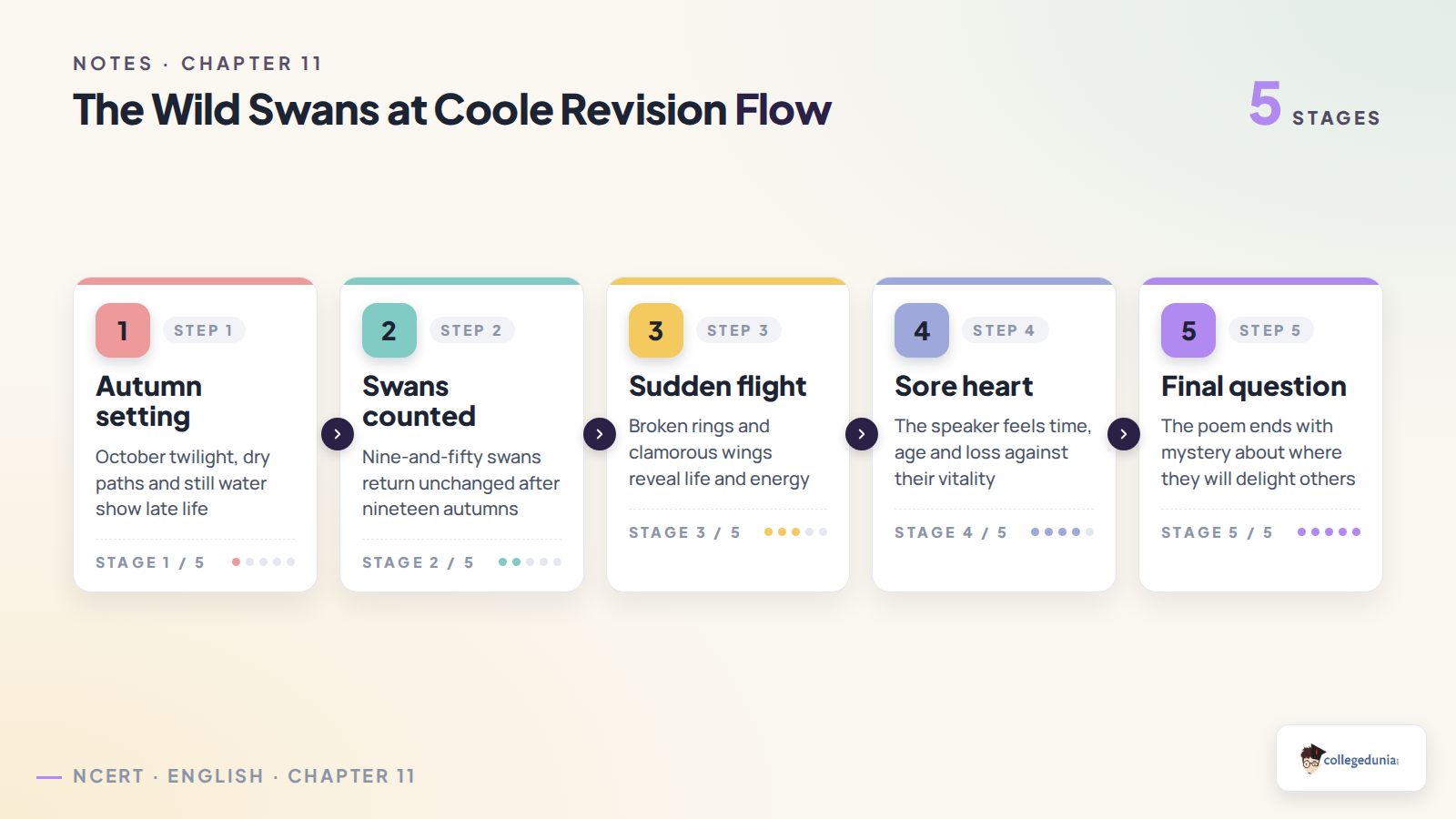
The poem moves from a calm autumn setting to personal memory, sudden swan movement and a final question. The strongest answers track this movement instead of treating the poem as a simple bird description.
| Stage | Poem detail | Revision cue |
|---|---|---|
| Setting | Autumn paths, twilight and still water | Beauty already carries lateness. |
| Memory | Nineteen autumns have passed | The scene becomes personal history. |
| Contrast | Light tread becomes sore heart | The speaker feels changed by time. |
| Mystery | The swans may delight other eyes | Beauty remains free and unknowable. |
Autumn Setting and Speaker's Life
The first stanza is not just decorative. Dry paths, October twilight, still sky and brimming water create a late, quiet beauty. This setting prepares the speaker's recognition that his own life has changed.
| Image | Literal meaning | Effect in answer |
|---|---|---|
| Autumn | A late season | Suggests maturity, fading and the approach of winter. |
| Twilight | Evening light | Points toward lateness in the speaker's life. |
| Still water | Calm lake surface | Allows memory and reflection to enter the poem. |
| Nine-and-fifty swans | An exact count | Shows careful observation and repeated return. |
Exam cue: pair autumn beauty with the speaker's changed life. This gives a complete NCERT answer.
Human Time versus Swan Vitality
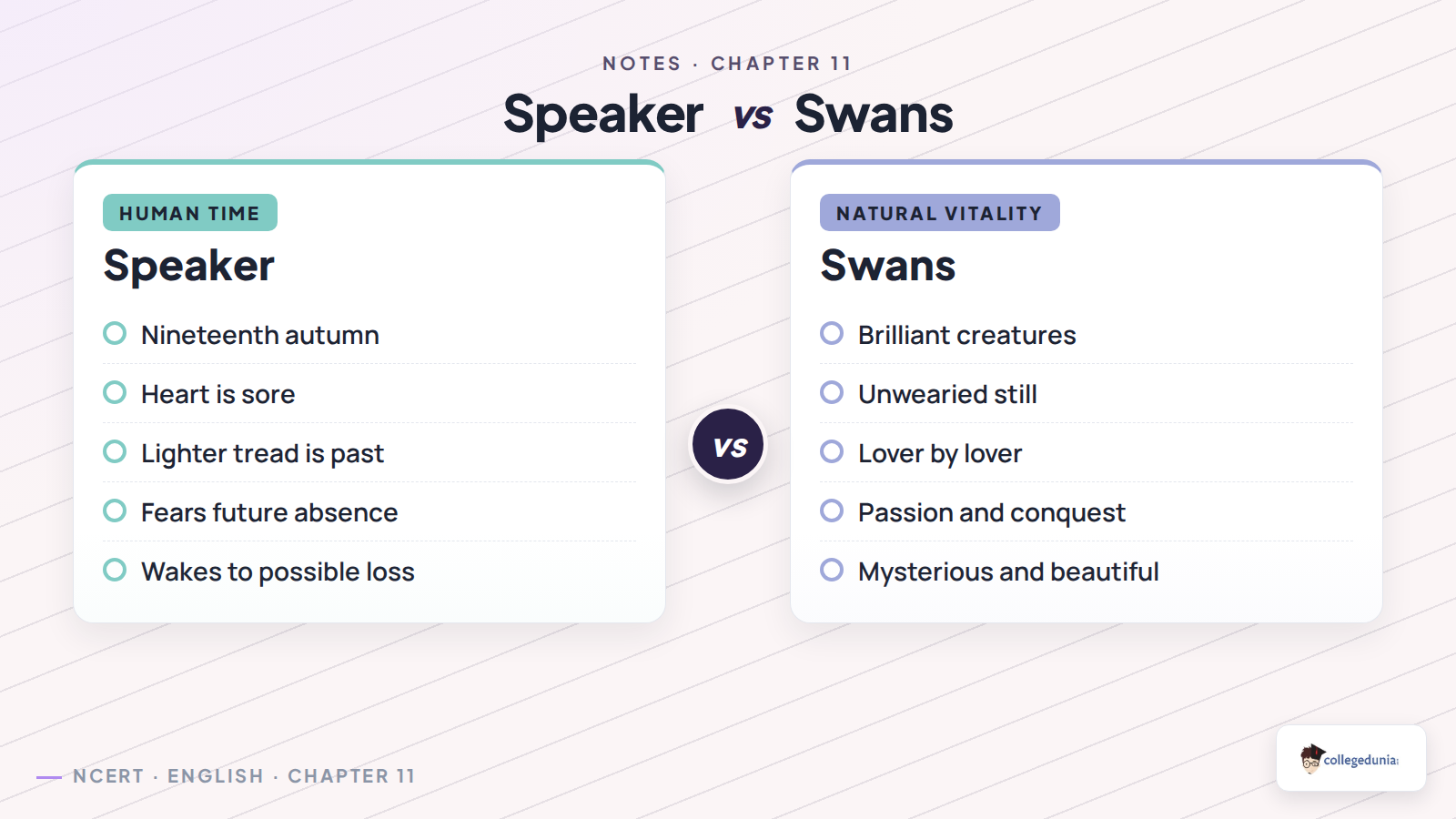
The poem's main contrast is between the speaker and the swans. He has a sore heart after nineteen autumns, while the swans remain brilliant, passionate and unwearied.
| Speaker | Swans | Answer value |
|---|---|---|
| Feels the burden of years | Appear unwearied still | Shows contrast between human ageing and natural vitality. |
| Remembers his lighter tread | Rise suddenly with clamorous wings | Makes swan energy sharper. |
| Fears their possible absence | May build by another lake or pool | Keeps the ending open and mysterious. |
Rhyme Scheme and Language Study
The Language Study task asks students to observe rhyme scheme. Start with the NCERT model for the first stanza, A B C B D E, then mark the remaining stanzas by listening to the final sound of each line.
- Step 1: write the last word of each line.
- Step 2: mark a new sound with a new letter.
- Step 3: repeat the earlier letter when the sound repeats.
- Step 4: check by sound, not spelling alone.
Later stanzas often move closer to an A B C B D D sound pattern, but the safest NCERT answer is to scan each stanza rather than copy a pattern without checking.
NCERT Questions Answer Plan
Write every answer with a phrase, meaning and effect. This keeps answers precise and prevents broad comments about nature from taking over.
| Question focus | What to include | Final effect |
|---|---|---|
| Autumn beauty and life | Dry paths, twilight, still water and nineteen autumns | Beauty is linked with ageing. |
| Light tread and sore heart | Earlier youth versus present pain | The same scene reveals change. |
| Swan liveliness | Brilliant creatures, broken rings and clamorous wings | Swans feel energetic beside human life. |
| Beauty and mystery | Lover by lover, passion, final question | The swans remain free and unknowable. |
Related Resources for The Wild Swans at Coole Class 12 English
| Resource | Use it for | Link |
|---|---|---|
| NCERT Solutions | Full textbook answers for Chapter 11 | Open NCERT Solutions |
| NCERT Book PDF | Read the official poem text | Open NCERT Book PDF |
| Handwritten Notes | Revise from concise handwritten notes | Open Handwritten Notes |
All Class 12 English Supplementary Notes Chapters
| Chapter | Notes link |
|---|---|
| Chapter 7: Kaleidoscope: Poems by Milton | Open Notes |
| Chapter 8: Kaleidoscope: Poems by Blake | Open Notes |
| Chapter 9: Kaleidoscope: Kubla Khan | Open Notes |
| Chapter 10: Kaleidoscope: Trees | Open Notes |
The Wild Swans at Coole Class 12 English Notes FAQs
Ques. What is The Wild Swans at Coole about?
Ans. The poem is about a speaker returning to Coole Park, admiring the swans and realising that his own life has changed with time.
Ques. Why does the autumn setting matter in The Wild Swans at Coole?
Ans. Autumn creates beauty and lateness together. It suits the speaker's awareness of ageing, memory and emotional loss.
Ques. What do the swans symbolise in the poem?
Ans. The swans suggest beauty, passion, energy, continuity and mystery. They seem unchanged while the speaker feels changed.
Ques. How should students revise The Wild Swans at Coole notes?
Ans. Students should revise the autumn setting, nineteen autumns, light tread, sore heart, broken rings, unwearied swans, final question and rhyme scheme.



Comments