NCERT Solutions for Class 12 English (Suppl.) Chapter 11 Kaleidoscope: The Wild Swans at Coole give students clear answers for the 2026-27 poem questions. The PDF below explains autumn imagery, the poet's sore heart, the swans' liveliness, their mystery and the rhyme scheme in simple exam-ready steps.
Includes all 5 solved tasks from Responding to the Poem and Language Study.
Matches the full NCERT 2026-27 Kaleidoscope question order for Class 12 English Elective revision.
Focuses on theme-based answers, ageing, memory, contrast, mystery and poetic form.
The downloadable PDF keeps the NCERT sequence intact and adds expert solution tabs for deeper poetry interpretation.
Student Feedback: In a Collegedunia survey of 12,580 Class 12 English students conducted before the 2026 boards, many students said they could explain the swans but missed how autumn, memory and rhyme work together. This page separates each image, its feeling and the answer point.
Scope note: This page covers the NCERT Kaleidoscope poem The Wild Swans at Coole by W. B. Yeats. If your school uses an internal chapter list, confirm that this poetry unit is included before treating it as test-only revision.
What The Wild Swans at Coole Class 12 Solutions Cover
The Wild Swans at Coole is a reflective poem where a beautiful natural scene makes the poet aware of time. The answers here stay close to the NCERT prompts and show how each image points to ageing, memory and the swans' untouched energy.
The main skill is to move from image to mood. Students should first name the autumn detail, then explain what it adds to the poet's inner life. Every answer should connect the scene with the feeling it creates.
NCERT area
What students answer
Best answer cue
Responding to the Poem
Autumn setting, light tread, sore heart, swan vitality and mystery
Theme Flow for The Wild Swans at Coole NCERT Answers
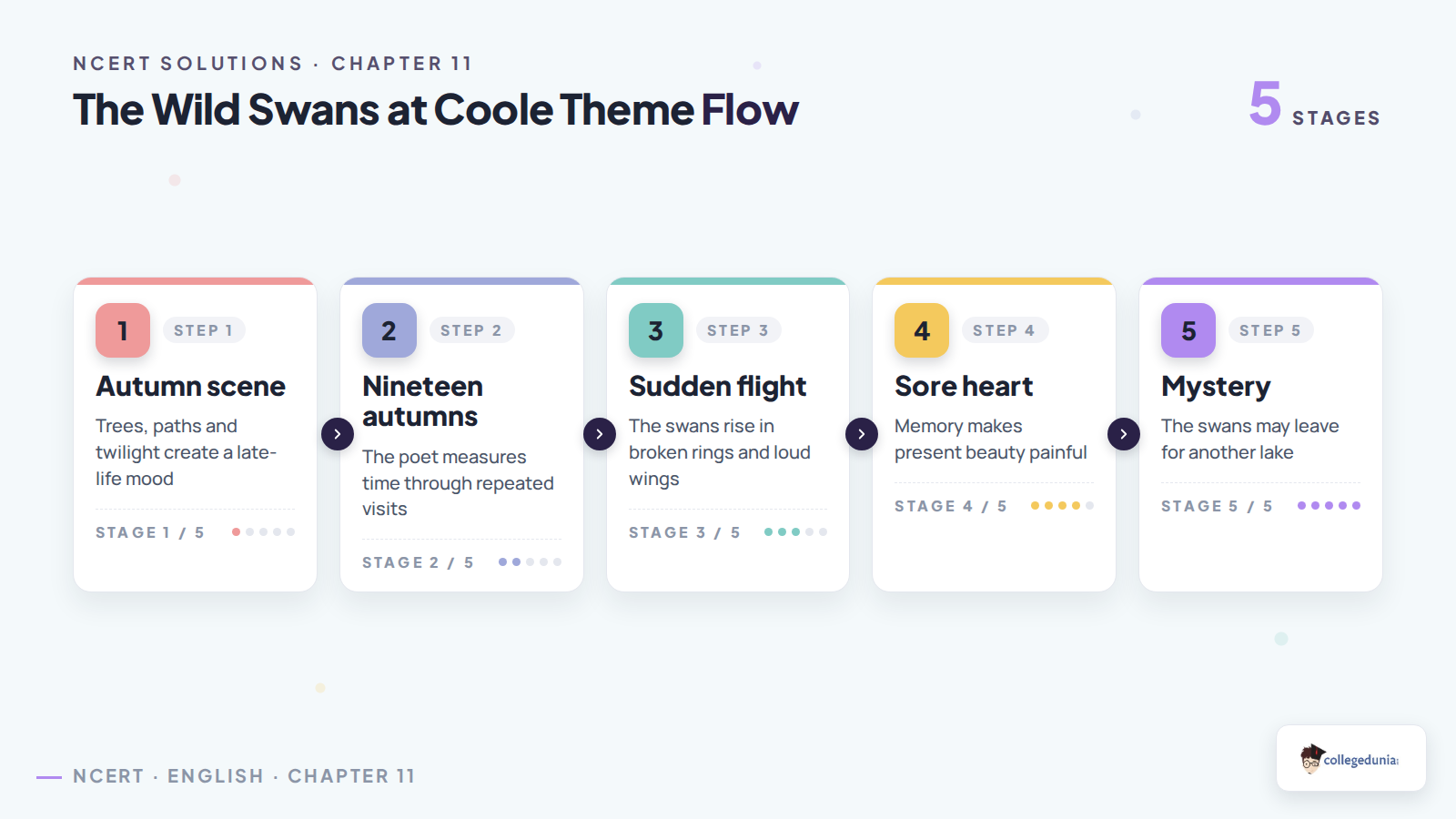
The poem moves from a quiet autumn landscape to the sudden flight of the swans, then to the poet's memory of his younger self. A strong answer follows that movement instead of giving a general note on nature.
Autumn scene gives beauty a late and reflective tone.
Nineteen autumns make the poet measure time through repeated visits.
Sudden flight makes the swans look free, musical and full of energy.
Sore heart shows how memory turns beauty into pain.
Swans and Human Life in Class 12 English Chapter 11
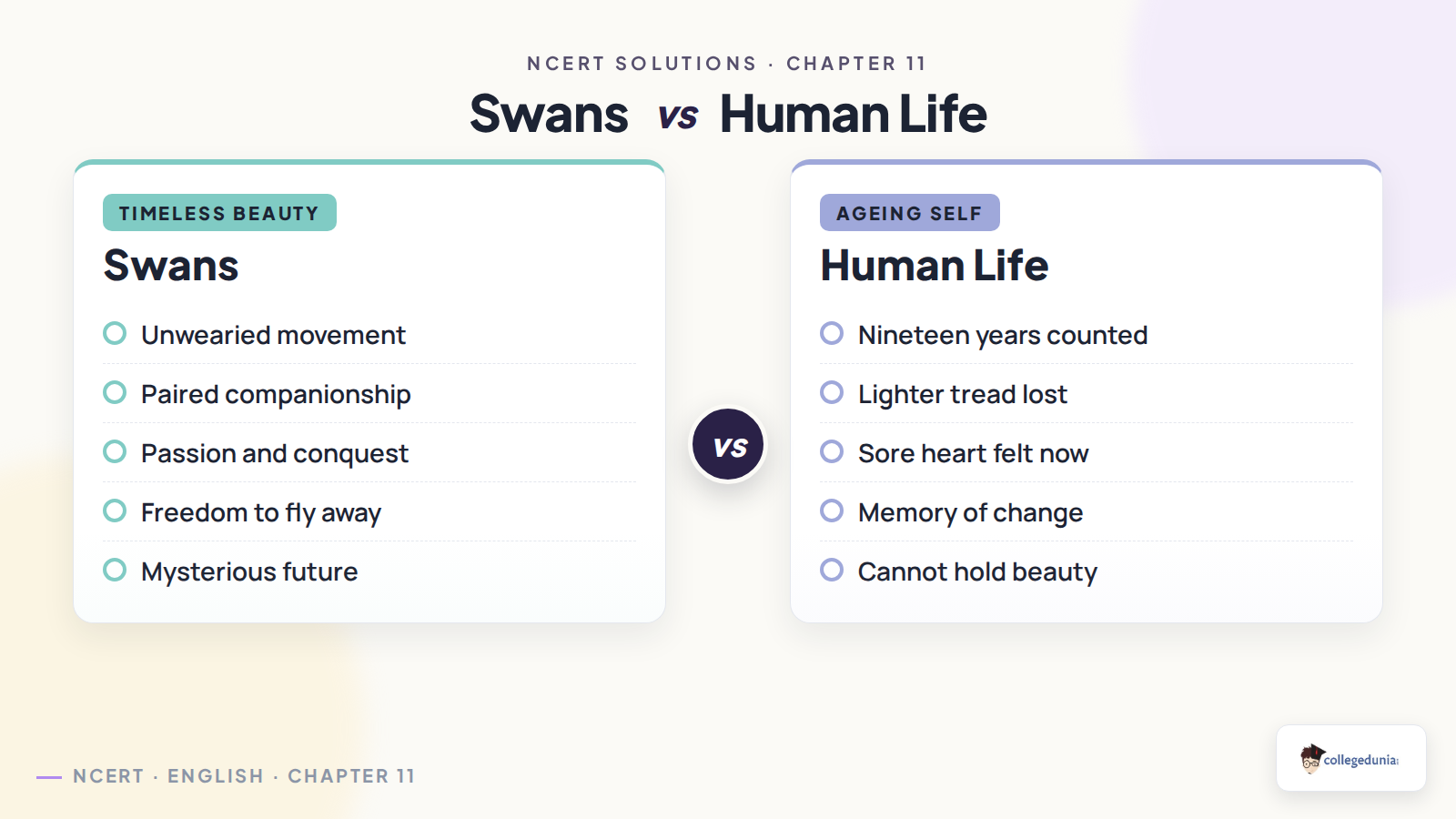
The central contrast is simple but powerful. The swans appear passionate, paired, tireless and free, while human life moves through ageing, loss and emotional change. Students should not write that the poet dislikes the swans. He admires them, but their vitality also reminds him of what human life cannot keep forever.
Swans
Human life
Unwearied movement
Energy changes with age
Paired companionship
Memory can make beauty painful
Freedom to fly away
The poet cannot hold the scene forever
How to Write Better The Wild Swans at Coole Answers
Begin each answer with the exact NCERT demand. If the question asks about the setting, discuss autumn, dry paths, twilight and the still sky. If it asks about the swans, use words like brilliant, clamorous, unwearied, paired and mysterious. If it asks about rhyme, write the line-end sounds before assigning letters.
Do not reduce the poem to one broad statement about nature.
Use short textual references only when they support the explanation directly.
For contrast, show both sides: the swans' vitality and the poet's human sorrow.
For rhyme scheme, repeat letters only when the end sounds match.
Class 12 English Supplementary Chapter 11 Resource Links
Use these related resources when you want the same chapter in another format. The table is placed above the FAQ so students can move from solutions to notes, book PDF and handwritten revision without losing the chapter context.
All NCERT Solutions for Class 12 English Supplementary Chapters
The table below keeps the same resource type together, so students can move chapter by chapter through the Class 12 English supplementary Kaleidoscope question set.
All NCERT Solutions for Class 12 English (Suppl.) Chapter 11 Kaleidoscope: The Wild Swans at Coole with Step-by-Step Solutions
The expandable cards below reproduce the full solution set from the PDF. Use the Check Solution tab for a direct exam-ready answer and the Expert Solution tab for a deeper reading of Yeats's autumn imagery, contrast and form.
Q 11.1
How do the `trees in their autumn beauty', `dry woodland paths', `October twilight', `still sky' connect to the poet's own life?
Quick Solution. Concept: setting symbolism. Chapter: The Wild Swans at Coole. Link autumn, dry paths, twilight, and still sky with the poet's ageing memory. Answer: they mirror beauty touched by late-life quietness and sorrow.
Concept used. Setting is not just background in a lyric poem. A poet can use season, light, silence, and landscape to reflect an inner condition.
Read the season
Autumn often suggests maturity, decline, and memory. Here it quietly prepares us for the poet's ageing self.
The trees are beautiful, but they are in autumn, the season after fullness.
This connects with the poet's own sense of passing time.
The dry woodland paths suggest stillness, absence, and a lack of fresh growth.
October twilight places the scene between day and night.
That half-light matches a mind looking back over many years.
The still sky reflected in water creates calm beauty.
The calm outside makes the poet's inward change feel sharper.
He remembers that nineteen autumns have passed since his first count of the swans.
The landscape therefore mirrors his mature, reflective, and slightly lonely stage of life.
The autumn trees, dry paths, October twilight, and still sky connect with the poet's ageing life. They show beauty, but also lateness, memory, quietness, and the passing of youthful energy.
AR
Aditi Rao
M.A English, University of Delhi
Verified Expert
Strategic angle. Yeats begins with a landscape, but the scene soon becomes autobiographical. The outer autumn prepares the student for the poet's inner autumn.
Autumn beauty shows that something can be lovely even when it is moving toward decline.
The poet is also in a later phase of life, after many earlier hopes have changed.
Dry paths suggest a world that is calm, bare, and no longer fresh with spring growth.
October twilight suggests an in-between hour.
That hour fits the poet's mood because he stands between memory and present loss.
The still sky reflected in water gives the scene a quiet surface.
Against this quiet surface, the swans appear brilliant and alive.
The contrast makes the poet more aware of his own changed heart.
The setting is therefore symbolic. It does not simply tell us where the poet is standing. It tells us how his life now feels: beautiful, reflective, late, and touched by sorrow.
These natural details mirror the poet's life in its later, reflective stage. Autumn, dryness, twilight, and stillness suggest ageing, memory, and quiet sorrow beneath beauty.
Q 11.2
What do `the light tread' and `the sore heart' refer to?
Quick Solution. Concept: poetic contrast. Chapter: The Wild Swans at Coole. Pair the poet's earlier light tread with his present sore heart. Answer: youth felt light and hopeful, while later life feels burdened by memory and change.
Concept used. Contrast helps a poem show change. Yeats contrasts his earlier lightness with his present pain to mark the distance between youth and age.
Pair the phrases
Explain both phrases together. One belongs to the poet's earlier self, and the other belongs to his present self.
The light tread refers to the poet's younger self.
When he first heard the swans' wings, he walked with more ease and hope.
The phrase suggests youth, energy, and a less burdened heart.
The sore heart refers to his present emotional pain.
He has watched nineteen autumns pass since that first visit.
Much in his life has changed during those years.
The swans still seem passionate and unwearied.
This makes the poet feel his own losses more strongly.
The two phrases together show the movement from youthful brightness to mature sorrow.
The light tread refers to the poet's youthful ease and hope when he first saw the swans. The sore heart refers to his present sadness after years of change, loss, and ageing.
RM
Rahul Menon
M.A English, EFLU Hyderabad
Verified Expert
Quick reading. The phrases are emotional markers. Yeats uses the body, a tread and a heart, to show how time has changed him.
A light tread suggests that the younger poet moved without heavy inward pressure.
He was open to beauty and had not yet felt the full burden of change.
The sound of wings was then thrilling rather than painful.
In the present, the same scene produces a sore heart.
The soreness is not physical pain only.
It is emotional hurt caused by memory, ageing, and disappointed desire.
The swans have not lost their energy.
The poet feels that he has changed while they remain brilliant and companionable.
So the answer should stress time. The poem does not say that the place has become ugly. It says that the poet now meets the same beauty with a changed heart.
The light tread is the poet's earlier youthful spirit. The sore heart is his present sorrow as he compares that youth with his changed life.
Q 11.3
What is the contrast between the liveliness of the swans and human life?
Quick Solution. Concept: contrast. Chapter: The Wild Swans at Coole. Compare the swans' tireless passion with human ageing. Answer: the swans seem free and unchanged, while human life grows older, sorrowful, and aware of loss.
Concept used. A poetic contrast places two different states side by side. Here Yeats contrasts the swans' lasting vitality with the human experience of ageing and change.
The central contrast
The poem hurts because the swans look unchanged while the poet knows that human life cannot stay unchanged.
The swans are described as brilliant creatures.
They suddenly mount and scatter in broken rings.
Their wings are clamorous, so they are full of sound and motion.
They remain unwearied even after many years.
They move lover by lover, suggesting companionship and passion.
Their hearts have not grown old.
Human life is different because people age, lose energy, and suffer emotional change.
The poet's heart is sore because he feels this human change.
The swans seem to keep the passion, freedom, and beauty that humans cannot hold forever.
The swans appear lively, tireless, passionate, and unchanged. Human life, by contrast, is marked by ageing, sorrow, memory, and loss. Their vitality makes the poet feel his own change more deeply.
MK
Meera Krishnan
Ph.D English, University of Hyderabad
Verified Expert
Structural observation. Yeats builds the contrast through verbs of movement and words of feeling. The swans mount, scatter, paddle, and climb, while the poet looks back with a sore heart.
The swans belong to water and air, so their movement feels free.
Their sudden flight gives the poem energy.
Their pairing, lover by lover, suggests continuing passion.
The line about hearts not growing old gives them a timeless quality.
The poet, however, counts the years.
Nineteen autumns remind us that human time is measurable and painful.
His lighter tread has become a sore heart.
The swans therefore become an image of vitality beyond ordinary human ageing.
The contrast is not simple envy. The poet admires the swans, but their beauty also wounds him. They show him what seems permanent in nature and what feels fragile in human life.
The swans seem free, passionate, and tireless, while human life grows older and more sorrowful. Their liveliness throws the poet's human vulnerability into sharp relief.
Q 11.4
What contributes to the beauty and mystery of the swans' lives?
Quick Solution. Concept: beauty and mystery. Chapter: The Wild Swans at Coole. Separate what the poet sees from what he cannot know. Answer: movement, sound, pairing, freedom, and future departure make the swans beautiful and mysterious.
Concept used. Mystery in poetry often comes from things that are seen clearly but not fully possessed. The poet sees the swans, yet their future movement remains beyond him.
Concept recall: Beauty and mystery
Beauty comes from what the poet can see. Mystery comes from what he cannot know or keep.
The swans are beautiful because they shine against the still autumn water.
Their number, nine-and-fifty, makes the scene precise and memorable.
Their sudden flight creates dramatic movement.
Their wings make a bell-beat sound above the poet's head.
They paddle in companionable streams and climb the air.
Their pairing suggests love, passion, and continuity.
Their hearts have not grown old, which makes them seem almost timeless.
Their mystery comes from their independence.
The poet wonders where they will build and whose eyes they will delight.
He knows that one day he may awake and find they have flown away.
The swans' beauty comes from their brilliance, movement, music, companionship, and passion. Their mystery comes from their freedom: they may leave, build elsewhere, and delight unknown people in unknown places.
NJ
Nandini Joshi
M.A English, Jadavpur University
Verified Expert
Picture-first. The final stanza shows the swans clearly on still water, but the questions about their future make them unreachable. That mix creates mystery.
The still water frames the swans like a calm mirror.
Their whiteness and movement make them appear brilliant.
Their sound adds another layer of beauty.
Their paired movement suggests love and harmony.
Their tirelessness makes their life seem untouched by age.
Yet the poet cannot control them.
He cannot know among what rushes they will build.
He cannot know by what lake or pool they will later be seen.
Their ability to vanish makes their beauty more precious.
The swans are therefore both present and elusive. The poet can count them and admire them, but he cannot own their future. This is why they remain mysterious.
Their beauty lies in their brightness, motion, sound, pairing, and youthful energy. Their mystery lies in their free, unknowable future and the possibility that they may suddenly leave.
Q 11.5
Notice the rhyme scheme in the poem. Do you notice a consistent pattern? We use a new letter for every new sound at the end of the lines. The rhyme scheme for the first stanza is given alongside the lines. Do it for the rest of the poem.
Quick Solution. Concept: rhyme scheme. Chapter: The Wild Swans at Coole. Compare end sounds stanza by stanza. Answer: F G H G I I; J K L K M M; N O P O Q Q; R S T S U U.
Concept used. A rhyme scheme records end sounds with letters. A new end sound gets a new letter, while a repeated end sound repeats the earlier letter.
Check line endings
Read only the last word of each line first. Then match the sounds, not only the spelling.
The first stanza is already marked as A B C B D E.
In the second stanza, count rhymes with mount, and rings rhymes with wings.
So the second stanza can be marked F G H G I I.
In the third stanza, sore rhymes with shore, and head rhymes with tread.
So the third stanza can be marked J K L K M M.
In the fourth stanza, cold rhymes with old, and will rhymes with still.
So the fourth stanza can be marked N O P O Q Q.
In the fifth stanza, beautiful rhymes with pool, and day rhymes with away.
So the fifth stanza can be marked R S T S U U.
The broad pattern is consistent after the first line group: the second and fourth lines rhyme, and the fifth and sixth lines form a couplet.
The remaining rhyme scheme may be written as: stanza 2, F G H G I I; stanza 3, J K L K M M; stanza 4, N O P O Q Q; stanza 5, R S T S U U. A consistent pattern appears in lines 2 and 4, then lines 5 and 6.
DN
Devika Nair
Ph.D English, JNU
Verified Expert
Quick reading. The poem uses six-line stanzas. In most stanzas, the middle rhyme and closing couplet give the stanza its shape.
Stanza 2 ends with me, count, finished, mount, rings, wings.
Count and mount rhyme, so the second and fourth lines share a letter.
Rings and wings rhyme, so the last two lines form a couplet.
Stanza 3 ends with creatures, sore, twilight, shore, head, tread.
Sore and shore rhyme, while head and tread rhyme.
Stanza 4 ends with lover, cold, air, old, will, still.
Cold and old rhyme, while will and still rhyme.
Stanza 5 ends with water, beautiful, build, pool, day, away.
Beautiful and pool rhyme by sound, and day rhymes with away.
This shows a repeated design, even though the exact letters change because new sounds appear in each stanza. The pattern helps the poem feel musical without making it too regular.
The scheme after stanza 1 is F G H G I I; J K L K M M; N O P O Q Q; R S T S U U. The repeated design is that lines 2 and 4 rhyme, and lines 5 and 6 close as a couplet.
Frequently Asked Questions
Ques. How many questions are solved in NCERT Solutions for Class 12 English Chapter 11 The Wild Swans at Coole?
Ans. The PDF and article solve all 5 NCERT tasks for the poem, including Responding to the Poem and the Language Study rhyme-scheme question.
Ques. What is the main contrast in The Wild Swans at Coole?
Ans. The poem contrasts the swans' lasting energy, beauty and companionship with the poet's ageing, memory and sore heart.
Ques. Does this Class 12 English solution page follow the 2026-27 NCERT order?
Ans. Yes. The questions are arranged in the same NCERT Kaleidoscope order for the 2026-27 Class 12 English supplementary text.
Ques. What should students remember for the rhyme scheme answer?
Ans. Match the end sounds of each line, not only the spelling. The later stanzas repeat the pattern in which lines 2 and 4 rhyme and lines 5 and 6 close as a couplet.





Chapter11Kaleidoscope:TheWildSwansatCooleSolutions.pdf?page=1&dpi=150)
Chapter11Kaleidoscope:TheWildSwansatCooleSolutions.pdf?page=2&dpi=150)
Chapter11Kaleidoscope:TheWildSwansatCooleSolutions.pdf?page=3&dpi=150)
Chapter11Kaleidoscope:TheWildSwansatCooleSolutions.pdf?page=4&dpi=150)
Chapter11Kaleidoscope:TheWildSwansatCooleSolutions.pdf?page=5&dpi=150)
Chapter11Kaleidoscope:TheWildSwansatCooleSolutions.pdf?page=6&dpi=150)
Chapter11Kaleidoscope:TheWildSwansatCooleSolutions.pdf?page=7&dpi=150)
Chapter11Kaleidoscope:TheWildSwansatCooleSolutions.pdf?page=8&dpi=150)
Chapter11Kaleidoscope:TheWildSwansatCooleSolutions.pdf?page=9&dpi=150)
Chapter11Kaleidoscope:TheWildSwansatCooleSolutions.pdf?page=10&dpi=150)
Chapter11Kaleidoscope:TheWildSwansatCooleSolutions.pdf?page=11&dpi=150)
Chapter11Kaleidoscope:TheWildSwansatCooleSolutions_flat_MobileCard.pdf?page=1&dpi=150)
Chapter11Kaleidoscope:TheWildSwansatCooleSolutions_flat_MobileCard.pdf?page=2&dpi=150)
Chapter11Kaleidoscope:TheWildSwansatCooleSolutions_flat_MobileCard.pdf?page=3&dpi=150)
Chapter11Kaleidoscope:TheWildSwansatCooleSolutions_flat_MobileCard.pdf?page=4&dpi=150)
Chapter11Kaleidoscope:TheWildSwansatCooleSolutions_flat_MobileCard.pdf?page=5&dpi=150)
Chapter11Kaleidoscope:TheWildSwansatCooleSolutions_flat_MobileCard.pdf?page=6&dpi=150)
Chapter11Kaleidoscope:TheWildSwansatCooleSolutions_flat_MobileCard.pdf?page=7&dpi=150)
Chapter11Kaleidoscope:TheWildSwansatCooleSolutions_flat_MobileCard.pdf?page=8&dpi=150)
Chapter11Kaleidoscope:TheWildSwansatCooleSolutions_flat_MobileCard.pdf?page=9&dpi=150)
Chapter11Kaleidoscope:TheWildSwansatCooleSolutions_flat_MobileCard.pdf?page=10&dpi=150)
Chapter11Kaleidoscope:TheWildSwansatCooleSolutions_flat_MobileCard.pdf?page=11&dpi=150)
Chapter11Kaleidoscope:TheWildSwansatCooleSolutions_flat_MobileCard.pdf?page=12&dpi=150)
Chapter11Kaleidoscope:TheWildSwansatCooleSolutions_flat_MobileCard.pdf?page=13&dpi=150)
Chapter11Kaleidoscope:TheWildSwansatCooleSolutions_flat_MobileCard.pdf?page=14&dpi=150)
Chapter11Kaleidoscope:TheWildSwansatCooleSolutions_flat_MobileCard.pdf?page=15&dpi=150)
Chapter11Kaleidoscope:TheWildSwansatCooleSolutions_flat_MobileCard.pdf?page=16&dpi=150)
Chapter11Kaleidoscope:TheWildSwansatCooleSolutions_flat_MobileCard.pdf?page=17&dpi=150)
Chapter11Kaleidoscope:TheWildSwansatCooleSolutions_flat_MobileCard.pdf?page=18&dpi=150)
Chapter11Kaleidoscope:TheWildSwansatCooleSolutions_flat_MobileCard.pdf?page=19&dpi=150)
Chapter11Kaleidoscope:TheWildSwansatCooleSolutions_flat_MobileCard.pdf?page=20&dpi=150)



Comments