



Lines and Angles Class 6 notes help students revise points, line segments, rays, angle types, protractor use, drawing angles, and reflex angles from the 2026-27 NCERT Ganita Prakash book. These notes keep the geometry words clear and connect every angle rule with classroom drawing practice.
- Core focus: naming figures, comparing turns, measuring angles, and drawing given angles.
- Best use: read one section, copy the diagram habit, then solve the NCERT question.
- Exam habit: always mark the vertex and choose the correct protractor scale.
Chapter2LinesandAnglesNotes.pdf?page=1&dpi=150)
Chapter2LinesandAnglesNotes.pdf?page=2&dpi=150)
Chapter2LinesandAnglesNotes.pdf?page=3&dpi=150)
Chapter2LinesandAnglesNotes.pdf?page=4&dpi=150)
Chapter2LinesandAnglesNotes.pdf?page=5&dpi=150)
Chapter2LinesandAnglesNotes.pdf?page=6&dpi=150)
Chapter2LinesandAnglesNotes.pdf?page=7&dpi=150)
Chapter2LinesandAnglesNotes.pdf?page=8&dpi=150)
Chapter2LinesandAnglesNotes.pdf?page=9&dpi=150)
Chapter2LinesandAnglesNotes.pdf?page=10&dpi=150)
Chapter2LinesandAnglesNotes.pdf?page=11&dpi=150)
Chapter2LinesandAnglesNotes.pdf?page=12&dpi=150)
Chapter2LinesandAnglesNotes.pdf?page=13&dpi=150)
Chapter2LinesandAnglesNotes.pdf?page=14&dpi=150)
Chapter2LinesandAnglesNotes.pdf?page=15&dpi=150)
Chapter2LinesandAnglesNotes.pdf?page=16&dpi=150)
Chapter2LinesandAnglesNotes.pdf?page=17&dpi=150)
Chapter2LinesandAnglesNotes.pdf?page=18&dpi=150)
Chapter2LinesandAnglesNotes.pdf?page=19&dpi=150)
Chapter2LinesandAnglesNotes.pdf?page=20&dpi=150)
Chapter2LinesandAnglesNotes.pdf?page=21&dpi=150)
Chapter2LinesandAnglesNotes.pdf?page=22&dpi=150)
Chapter2LinesandAnglesNotes.pdf?page=23&dpi=150)
Chapter2LinesandAnglesNotes.pdf?page=24&dpi=150)
Chapter2LinesandAnglesNotes_flat_MobileCard.pdf?page=1&dpi=150)
Chapter2LinesandAnglesNotes_flat_MobileCard.pdf?page=2&dpi=150)
Chapter2LinesandAnglesNotes_flat_MobileCard.pdf?page=3&dpi=150)
Chapter2LinesandAnglesNotes_flat_MobileCard.pdf?page=4&dpi=150)
Chapter2LinesandAnglesNotes_flat_MobileCard.pdf?page=5&dpi=150)
Chapter2LinesandAnglesNotes_flat_MobileCard.pdf?page=6&dpi=150)
Chapter2LinesandAnglesNotes_flat_MobileCard.pdf?page=7&dpi=150)
Chapter2LinesandAnglesNotes_flat_MobileCard.pdf?page=8&dpi=150)
Chapter2LinesandAnglesNotes_flat_MobileCard.pdf?page=9&dpi=150)
Chapter2LinesandAnglesNotes_flat_MobileCard.pdf?page=10&dpi=150)
Chapter2LinesandAnglesNotes_flat_MobileCard.pdf?page=11&dpi=150)
Chapter2LinesandAnglesNotes_flat_MobileCard.pdf?page=12&dpi=150)
Chapter2LinesandAnglesNotes_flat_MobileCard.pdf?page=13&dpi=150)
Chapter2LinesandAnglesNotes_flat_MobileCard.pdf?page=14&dpi=150)
Chapter2LinesandAnglesNotes_flat_MobileCard.pdf?page=15&dpi=150)
Chapter2LinesandAnglesNotes_flat_MobileCard.pdf?page=16&dpi=150)
Chapter2LinesandAnglesNotes_flat_MobileCard.pdf?page=17&dpi=150)
Chapter2LinesandAnglesNotes_flat_MobileCard.pdf?page=18&dpi=150)
Chapter2LinesandAnglesNotes_flat_MobileCard.pdf?page=19&dpi=150)
Chapter2LinesandAnglesNotes_flat_MobileCard.pdf?page=20&dpi=150)
Chapter2LinesandAnglesNotes_flat_MobileCard.pdf?page=21&dpi=150)
Chapter2LinesandAnglesNotes_flat_MobileCard.pdf?page=22&dpi=150)
Chapter2LinesandAnglesNotes_flat_MobileCard.pdf?page=23&dpi=150)
Chapter2LinesandAnglesNotes_flat_MobileCard.pdf?page=24&dpi=150)
Chapter2LinesandAnglesNotes_flat_MobileCard.pdf?page=25&dpi=150)
Chapter2LinesandAnglesNotes_flat_MobileCard.pdf?page=26&dpi=150)
Chapter2LinesandAnglesNotes_flat_MobileCard.pdf?page=27&dpi=150)
Chapter2LinesandAnglesNotes_flat_MobileCard.pdf?page=28&dpi=150)
Chapter2LinesandAnglesNotes_flat_MobileCard.pdf?page=29&dpi=150)
Each note follows the 2026-27 NCERT Ganita Prakash chapter and keeps angle measurement easy to revise.
Student Feedback: In a Collegedunia poll of 10,920 Class 6 students conducted before the 2026 school exams, most students said Chapter 2 became easier after they separated points, arms, vertex, and protractor scale into four different checks.
Source: 2026-27 Class 6 Mathematics student poll.
Lines and Angles Ideas Every Class 6 Student Should Know
Chapter 2 starts with simple geometry language. A point marks a position, a line segment has two endpoints, a ray has one starting point, and a line extends in both directions. These words look easy, but they decide how every diagram is named.
| Figure | What it means | How students should name it |
|---|---|---|
| Point | An exact position shown by a dot. | Use a capital letter like A. |
| Line segment | A straight path with two fixed endpoints. | Use both endpoints, such as AB. |
| Ray | A straight path with one fixed starting point. | Write the starting point first. |
| Line | A straight path that extends endlessly both ways. | Show arrows on both ends. |
The vertex letter must come in the middle when an angle is named with three letters. For example, angle AOB has O as the vertex.
Lines and Angles Class 6 Quick Video Recap
Source: Magnet Brains on YouTube
Angle Types in Lines and Angles Notes
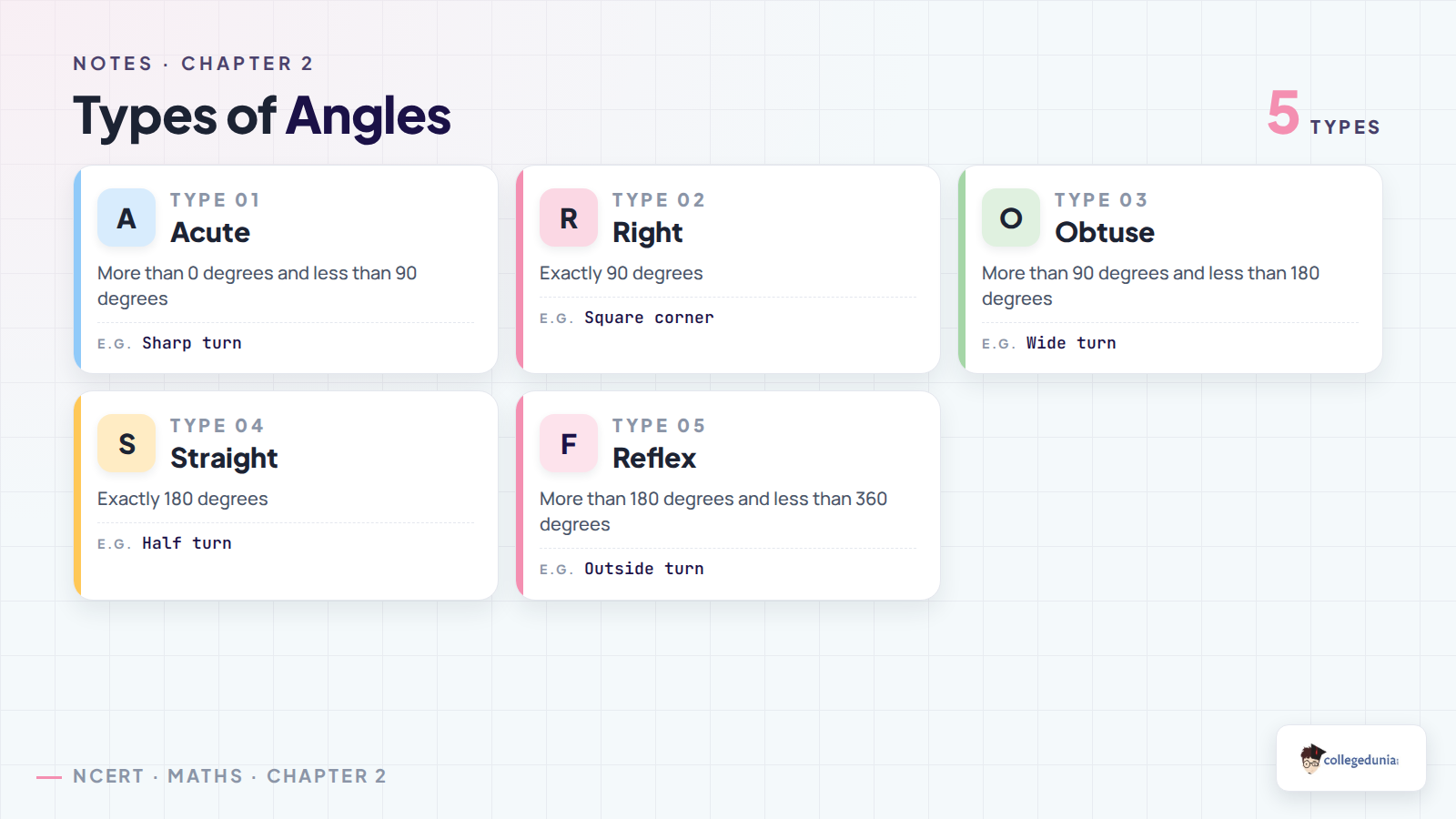
An angle is formed by two rays that start from the same point. The common starting point is the vertex, and the two rays are the arms. Angle size depends on the amount of turn, not on the length of the arms.
- Acute angle: more than 0 degrees and less than 90 degrees.
- Right angle: exactly 90 degrees.
- Obtuse angle: more than 90 degrees and less than 180 degrees.
- Straight angle: exactly 180 degrees.
- Reflex angle: more than 180 degrees and less than 360 degrees.
Compare every angle with 90 degrees first, then with 180 degrees. This two-step check prevents most classification mistakes.
Measuring and Drawing Angles with a Protractor
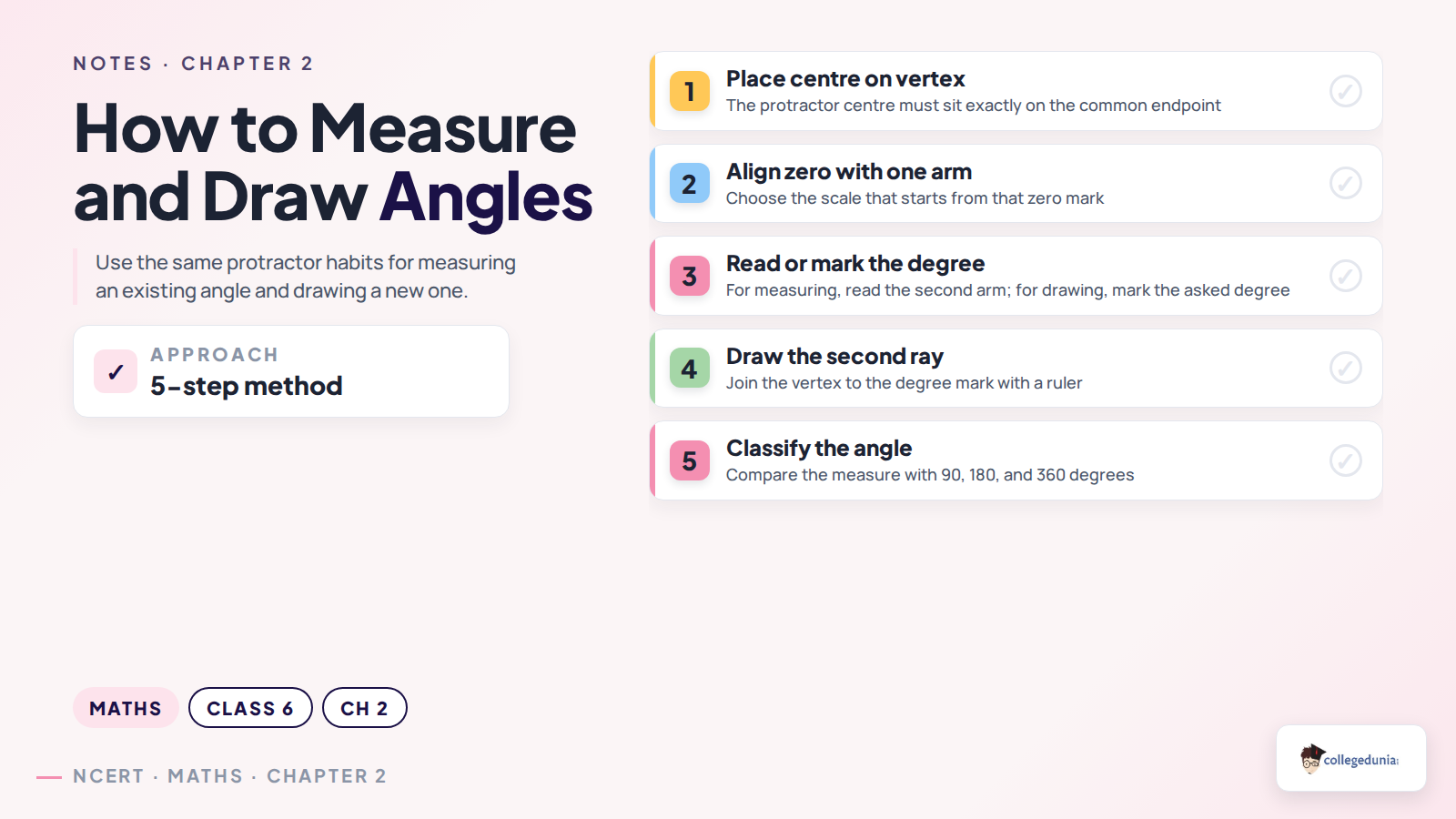
Protractor work has one fixed habit. Place the centre on the vertex, align zero with one arm, and then read the correct scale. The same habit is used in reverse when students draw a given angle.
- Draw or identify the base ray.
- Put the protractor centre exactly on the vertex.
- Align the zero mark with the base ray.
- Read the other arm or mark the required degree.
- Join the vertex to the mark when drawing.
The most common error is reading the wrong scale. If the base ray starts from the right zero, use the scale that starts from the right zero.
Common Mistakes in Lines and Angles Notes
Most mistakes in this chapter happen because the drawing is named too quickly. Students should slow down and ask what object is present before writing the answer.
- Do not call a line segment a line if there are fixed endpoints.
- Do not reverse the starting point of a ray.
- Do not put the vertex letter at the end of a three-letter angle name.
- Do not classify 0 degrees as acute.
- Do not forget reflex angles when the turn is greater than 180 degrees.
For angle names, the middle letter is the safest clue. Circle the vertex before writing the final answer.
How to Use These Class 6 Mathematics Notes for Revision
Use the notes as a first revision round before solving the textbook exercises. Read one page, redraw one diagram, and then answer one NCERT question without looking back.
- Spend 10 minutes on points, segments, rays, and lines.
- Spend 10 minutes on angle names and vertex checks.
- Spend 15 minutes on measuring and drawing angles.
- Spend 10 minutes on acute, right, obtuse, straight, and reflex angles.
Revision works best when the diagram is copied by hand. Geometry becomes clearer when students draw the figure instead of only reading the words.
Related Resources for Lines and Angles Class 6
| Resource | How it helps |
|---|---|
| Lines and Angles Class 6 NCERT Solutions | Step-by-step answers to NCERT questions. |
| Lines and Angles NCERT Book PDF | Official chapter text and classroom activities. |
| Lines and Angles Handwritten Notes | Quick one-shot revision in notebook style. |
NCERT Notes for Class 6 Mathematics Ganita Prakash: All Chapters
| Chapter | NCERT Notes |
|---|---|
| Chapter 1 | Patterns in Mathematics Notes |
| Chapter 2 | Lines and Angles Notes |
| Chapter 3 | Number Play Notes |
| Chapter 4 | Data Handling and Presentation Notes |
| Chapter 5 | Prime Time Notes |
| Chapter 6 | Perimeter and Area Notes |
| Chapter 7 | Fractions Notes |
| Chapter 8 | Playing with Constructions Notes |
| Chapter 9 | Symmetry Notes |
| Chapter 10 | The Other Side of Zero Notes |
Lines and Angles Class 6 Notes FAQs
Ques. What do Lines and Angles Class 6 notes cover?
Ans. These notes cover points, line segments, rays, lines, angle names, angle types, protractor measurement, drawing angles, and reflex angles.
Ques. What is an angle in Class 6 Mathematics?
Ans. An angle is formed by two rays that start from the same point. The common starting point is called the vertex.
Ques. How should students measure an angle with a protractor?
Ans. Place the centre on the vertex, align zero with one arm, and read the correct scale where the other arm meets the protractor.
Ques. What is a reflex angle?
Ans. A reflex angle is more than 180 degrees and less than 360 degrees. It is larger than a straight angle but smaller than a full turn.
Ques. Are these notes based on the 2026-27 NCERT book?
Ans. Yes. The notes follow Class 6 Mathematics Ganita Prakash Chapter 2 for the 2026-27 session.



Comments