




Playing with Constructions Class 6 notes help students revise compass use, circles, arcs, squares, rectangles, diagonals, and equal-distance points from the 2026-27 NCERT Ganita Prakash book. The PDF turns each construction into a rough-sketch, known-data, instrument-step, and property-check routine.
- Core focus: compass radius, square and rectangle construction, diagonals, and equal-distance arcs.
- Best use: read one step, draw it with instruments, then check the property.
- Revision habit: always make a rough figure before using the ruler and compass.
Chapter8PlayingwithConstructionsNotes.pdf?page=1&dpi=150)
Chapter8PlayingwithConstructionsNotes.pdf?page=2&dpi=150)
Chapter8PlayingwithConstructionsNotes.pdf?page=3&dpi=150)
Chapter8PlayingwithConstructionsNotes.pdf?page=4&dpi=150)
Chapter8PlayingwithConstructionsNotes.pdf?page=5&dpi=150)
Chapter8PlayingwithConstructionsNotes.pdf?page=6&dpi=150)
Chapter8PlayingwithConstructionsNotes.pdf?page=7&dpi=150)
Chapter8PlayingwithConstructionsNotes.pdf?page=8&dpi=150)
Chapter8PlayingwithConstructionsNotes.pdf?page=9&dpi=150)
Chapter8PlayingwithConstructionsNotes.pdf?page=10&dpi=150)
Chapter8PlayingwithConstructionsNotes.pdf?page=11&dpi=150)
Chapter8PlayingwithConstructionsNotes.pdf?page=12&dpi=150)
Chapter8PlayingwithConstructionsNotes.pdf?page=13&dpi=150)
Chapter8PlayingwithConstructionsNotes.pdf?page=14&dpi=150)
Chapter8PlayingwithConstructionsNotes.pdf?page=15&dpi=150)
Chapter8PlayingwithConstructionsNotes.pdf?page=16&dpi=150)
Chapter8PlayingwithConstructionsNotes.pdf?page=17&dpi=150)
Chapter8PlayingwithConstructionsNotes.pdf?page=18&dpi=150)
Chapter8PlayingwithConstructionsNotes.pdf?page=19&dpi=150)
Chapter8PlayingwithConstructionsNotes.pdf?page=20&dpi=150)
Chapter8PlayingwithConstructionsNotes_flat_MobileCard.pdf?page=1&dpi=150)
Chapter8PlayingwithConstructionsNotes_flat_MobileCard.pdf?page=2&dpi=150)
Chapter8PlayingwithConstructionsNotes_flat_MobileCard.pdf?page=3&dpi=150)
Chapter8PlayingwithConstructionsNotes_flat_MobileCard.pdf?page=4&dpi=150)
Chapter8PlayingwithConstructionsNotes_flat_MobileCard.pdf?page=5&dpi=150)
Chapter8PlayingwithConstructionsNotes_flat_MobileCard.pdf?page=6&dpi=150)
Chapter8PlayingwithConstructionsNotes_flat_MobileCard.pdf?page=7&dpi=150)
Chapter8PlayingwithConstructionsNotes_flat_MobileCard.pdf?page=8&dpi=150)
Chapter8PlayingwithConstructionsNotes_flat_MobileCard.pdf?page=9&dpi=150)
Chapter8PlayingwithConstructionsNotes_flat_MobileCard.pdf?page=10&dpi=150)
Chapter8PlayingwithConstructionsNotes_flat_MobileCard.pdf?page=11&dpi=150)
Chapter8PlayingwithConstructionsNotes_flat_MobileCard.pdf?page=12&dpi=150)
Chapter8PlayingwithConstructionsNotes_flat_MobileCard.pdf?page=13&dpi=150)
Chapter8PlayingwithConstructionsNotes_flat_MobileCard.pdf?page=14&dpi=150)
Chapter8PlayingwithConstructionsNotes_flat_MobileCard.pdf?page=15&dpi=150)
Chapter8PlayingwithConstructionsNotes_flat_MobileCard.pdf?page=16&dpi=150)
Chapter8PlayingwithConstructionsNotes_flat_MobileCard.pdf?page=17&dpi=150)
Chapter8PlayingwithConstructionsNotes_flat_MobileCard.pdf?page=18&dpi=150)
Chapter8PlayingwithConstructionsNotes_flat_MobileCard.pdf?page=19&dpi=150)
Chapter8PlayingwithConstructionsNotes_flat_MobileCard.pdf?page=20&dpi=150)
Chapter8PlayingwithConstructionsNotes_flat_MobileCard.pdf?page=21&dpi=150)
Chapter8PlayingwithConstructionsNotes_flat_MobileCard.pdf?page=22&dpi=150)
Chapter8PlayingwithConstructionsNotes_flat_MobileCard.pdf?page=23&dpi=150)
Chapter8PlayingwithConstructionsNotes_flat_MobileCard.pdf?page=24&dpi=150)
Chapter8PlayingwithConstructionsNotes_flat_MobileCard.pdf?page=25&dpi=150)
Chapter8PlayingwithConstructionsNotes_flat_MobileCard.pdf?page=26&dpi=150)
Chapter8PlayingwithConstructionsNotes_flat_MobileCard.pdf?page=27&dpi=150)
Chapter8PlayingwithConstructionsNotes_flat_MobileCard.pdf?page=28&dpi=150)
Student Feedback: In a Collegedunia poll of 8,940 Class 6 students using Ganita Prakash, 69% said construction questions became easier after they first drew a rough figure and then copied the steps with a compass.
Source: 2026-27 Class 6 Mathematics student poll.
In This Article
Playing with Constructions Ideas Every Class 6 Student Should Know
Playing with Constructions is a geometry chapter about drawing exact figures, not guessing shapes by eye. Students learn how a compass fixes equal distances and how a ruler helps draw straight sides. The most important habit is to plan the figure before touching the instruments.
| Idea | Meaning | Quick check |
|---|---|---|
| Circle | All points at a fixed distance from a centre. | Measure any radius. |
| Arc | Part of a circle drawn with a compass. | Keep the compass opening fixed. |
| Square | Four equal sides and four right angles. | Check side length and angle. |
| Rectangle | Opposite sides equal and four right angles. | Check opposite sides. |
Playing with Constructions Class 6 Video for Compass Practice
Source: Magnet Brains on YouTube
Compass, Centre and Radius in Playing with Constructions
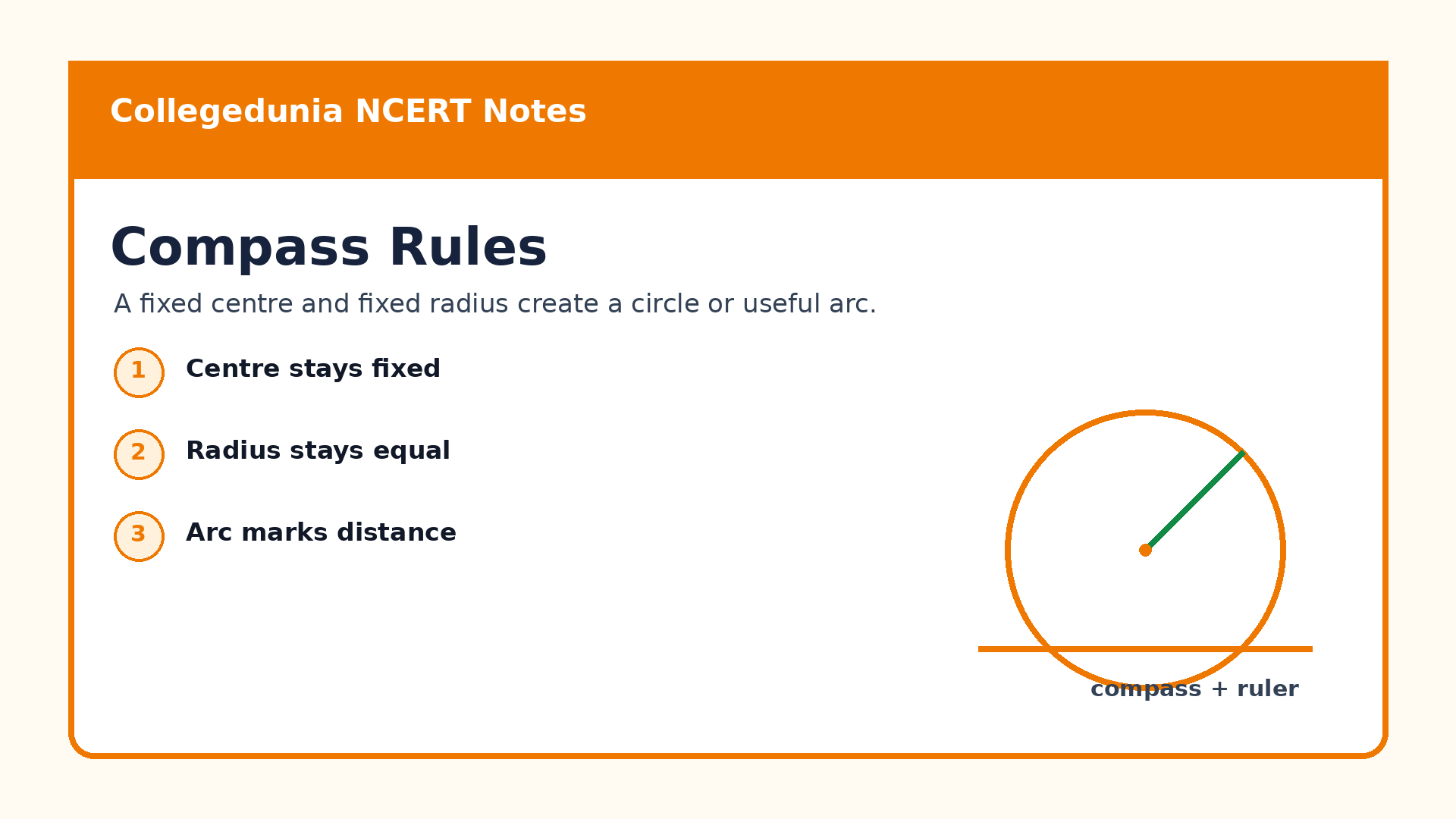
A compass is used to draw all points at the same distance from a fixed centre. If the compass opening is 4 cm and the fixed tip is placed at point P, the pencil end traces a circle of radius 4 cm.
- Centre: the fixed point where the compass tip stays.
- Radius: the distance from centre to any point on the circle.
- Arc: a useful part of a circle when the full circle is not needed.
For equal arcs, keep the compass opening unchanged. This is why waves, eyes, and equal-distance roof points can be drawn neatly.
Squares, Rectangles and Diagonals in Chapter 8
Squares and rectangles are checked by properties. A square has all sides equal and every angle equal to 90 degrees. A rectangle has opposite sides equal and every angle equal to 90 degrees. Rotating either figure does not change these properties.
| Construction | Start with | Then use |
|---|---|---|
| Square of side 6 cm | Draw one 6 cm side. | Perpendiculars and equal side length. |
| Rectangle of 4 cm by 6 cm | Draw one given side. | Perpendicular side and opposite side equality. |
| Rectangle with side and diagonal | Draw the known side. | Arc from opposite endpoint to locate the corner. |
Diagonals join opposite corners. In a rectangle, diagonal measurements and angle splits help students decide whether the figure has special square-like behaviour.
Equal-Distance Points and Arc Intersections
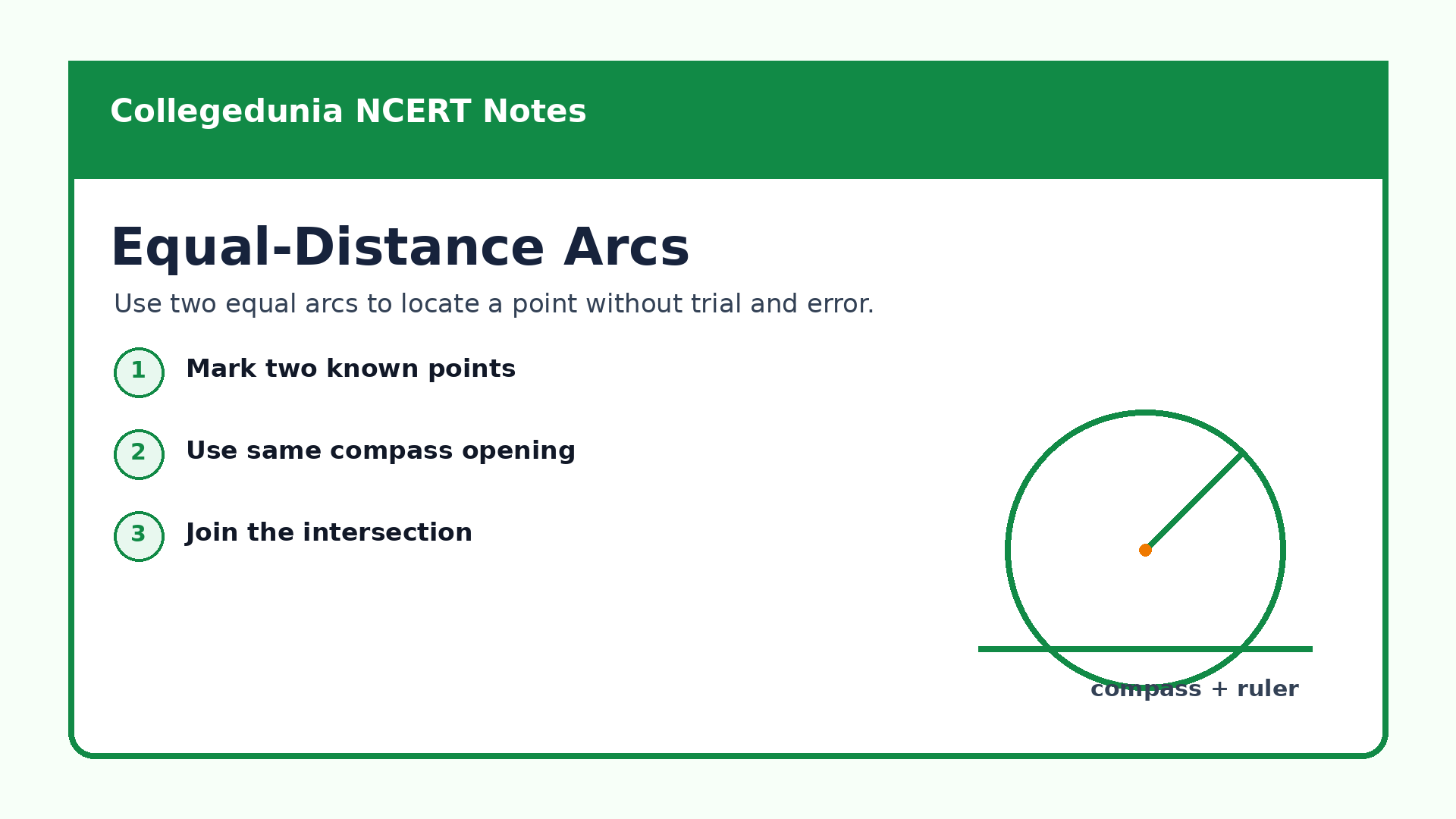
The house construction uses a key compass idea. A point that is 5 cm from B lies on a circle centred at B. A point that is also 5 cm from C lies on a circle centred at C. The intersection gives the roof point.
- Mark the two known points.
- Set the same compass radius from each point.
- Draw the two arcs near the expected intersection.
- Join the intersection to both known points.
Common Mistakes in Playing with Constructions Notes
Students often make the figure look right but forget to verify the defining property. Construction answers need both drawing steps and checks. For example, a square must have equal sides and right angles, not just a square-like appearance.
- Do not change the compass opening when equal arcs are required.
- Do not name a rectangle by jumping across the boundary.
- Do not skip the rough figure when a diagonal or angle split is given.
- Do not draw a full circle when a small arc is enough.
Related Resources for Playing with Constructions Class 6
| Resource | How it helps |
|---|---|
| Playing with Constructions Class 6 NCERT Solutions | Step-by-step answers to NCERT construction questions. |
| Playing with Constructions NCERT Book PDF | Official chapter text, figures, and activities. |
| Playing with Constructions Handwritten Notes | Notebook-style revision for construction steps. |
NCERT Notes for Class 6 Mathematics Ganita Prakash: All Chapters
| Chapter | NCERT Notes |
|---|---|
| Chapter 1 | Patterns in Mathematics Notes |
| Chapter 2 | Lines and Angles Notes |
| Chapter 3 | Number Play Notes |
| Chapter 4 | Data Handling and Presentation Notes |
| Chapter 5 | Prime Time Notes |
| Chapter 6 | Perimeter and Area Notes |
| Chapter 7 | Fractions Notes |
| Chapter 8 | Playing with Constructions Notes |
| Chapter 9 | Symmetry Notes |
| Chapter 10 | The Other Side of Zero Notes |
Playing with Constructions Class 6 Notes FAQs
Ques. What do Playing with Constructions Class 6 notes cover?
Ans. These notes cover compass use, circles, arcs, squares, rectangles, diagonals, and equal-distance points from Ganita Prakash Chapter 8.
Ques. What is the centre of a circle?
Ans. The centre is the fixed point from which every point on the circle is at the same distance.
Ques. What is the radius in construction?
Ans. The radius is the fixed distance between the centre and any point on the circle or arc.
Ques. How should students construct a square?
Ans. Students should draw one side, construct perpendiculars, mark equal side lengths, and check all right angles.
Ques. Are these notes based on the 2026-27 NCERT book?
Ans. Yes. The notes follow Class 6 Mathematics Ganita Prakash Chapter 8 Playing with Constructions for the 2026-27 session.



Comments