




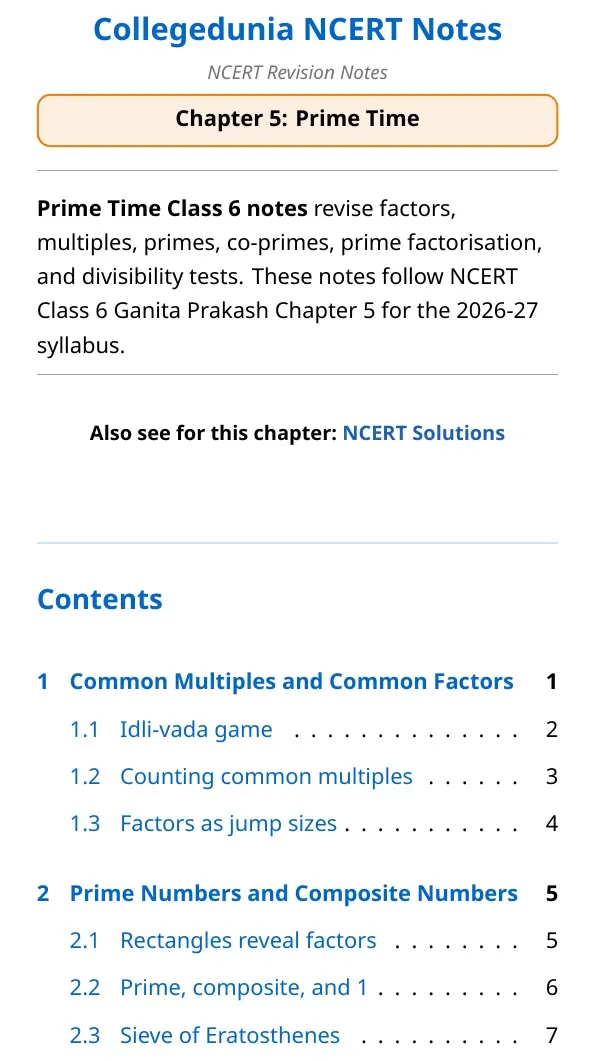
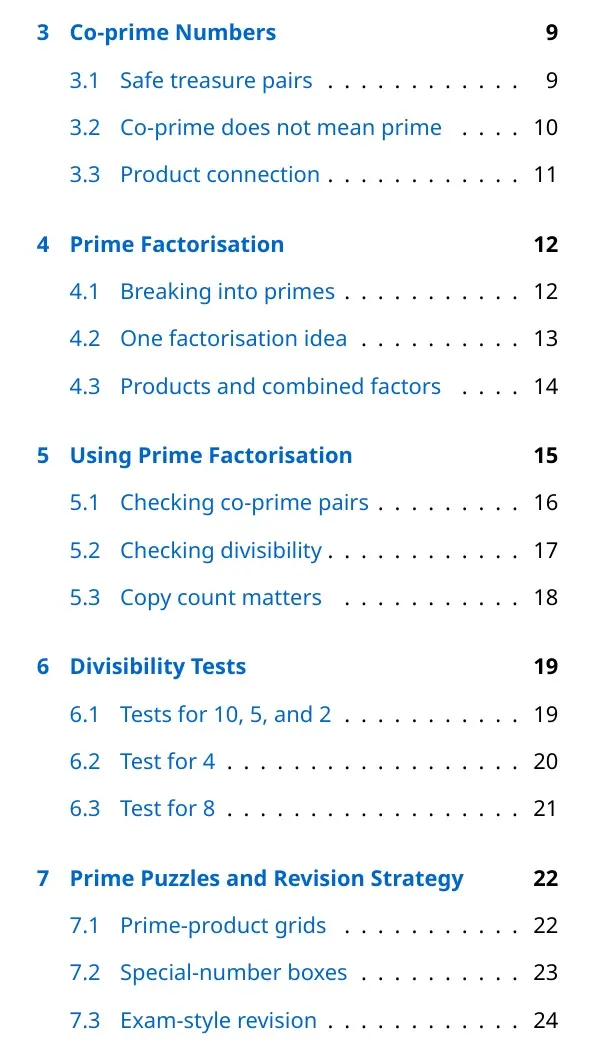
Prime Time Class 6 notes help students revise factors, multiples, prime numbers, co-prime pairs, prime factorisation, and divisibility tests from the 2026-27 NCERT Ganita Prakash book. The PDF keeps every rule short and connects each idea with the Idli-vada game, Jump Jackpot, and prime-product puzzles.
- Core focus: common multiples, common factors, primes, composites, co-primes, and divisibility.
- Best use: read one rule, test two examples, then solve the matching NCERT question.
- Revision habit: write factor lists before deciding whether a number is prime or composite.
Student Feedback: In a Collegedunia poll of 10,420 Class 6 students preparing with Ganita Prakash, 72% said Prime Time became easier after they separated multiples, factors, and prime factorisation into three checklists.
Source: 2026-27 Class 6 Mathematics student poll.
|
Table of Contents |
Prime Time Ideas Every Class 6 Student Should Know
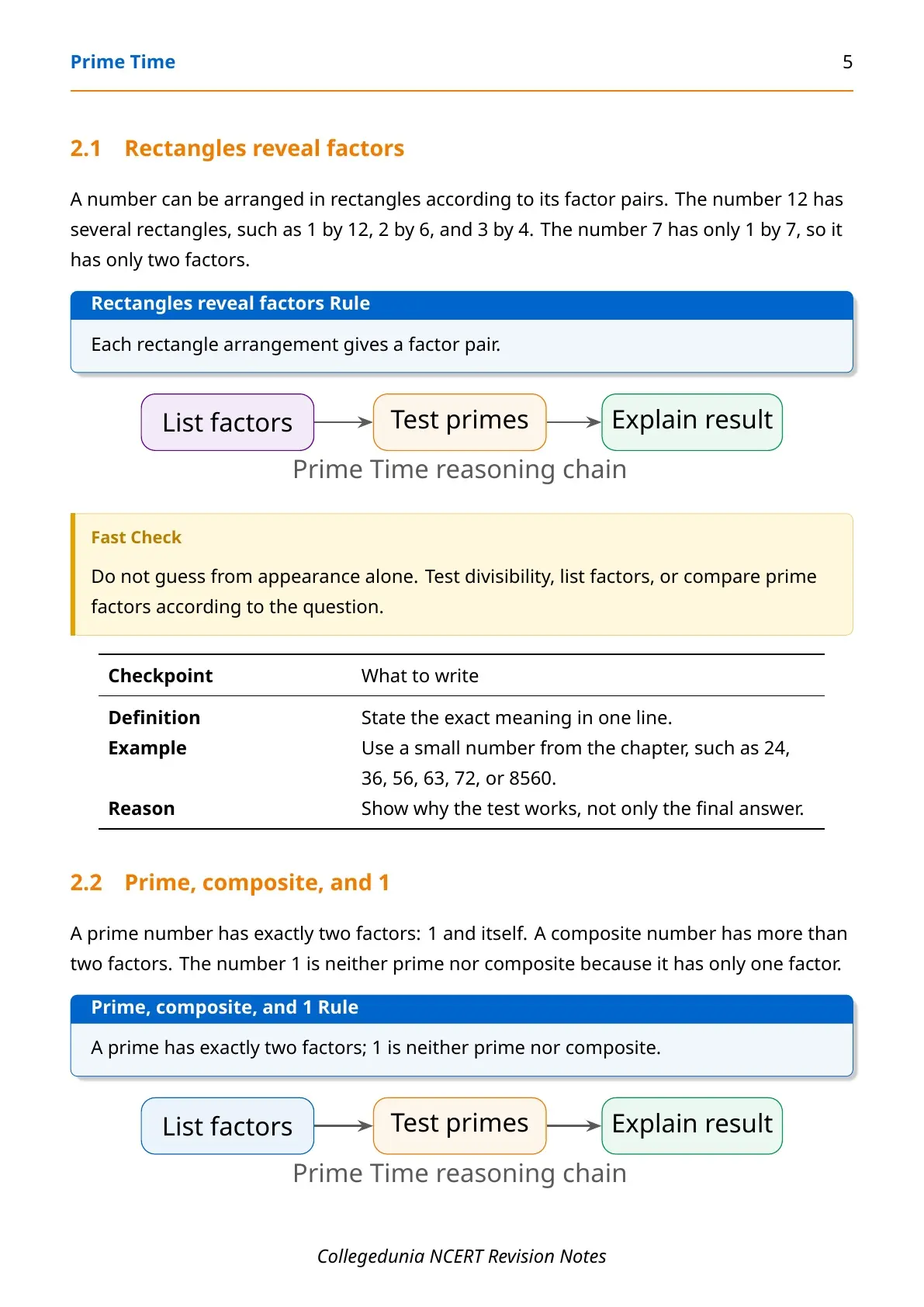
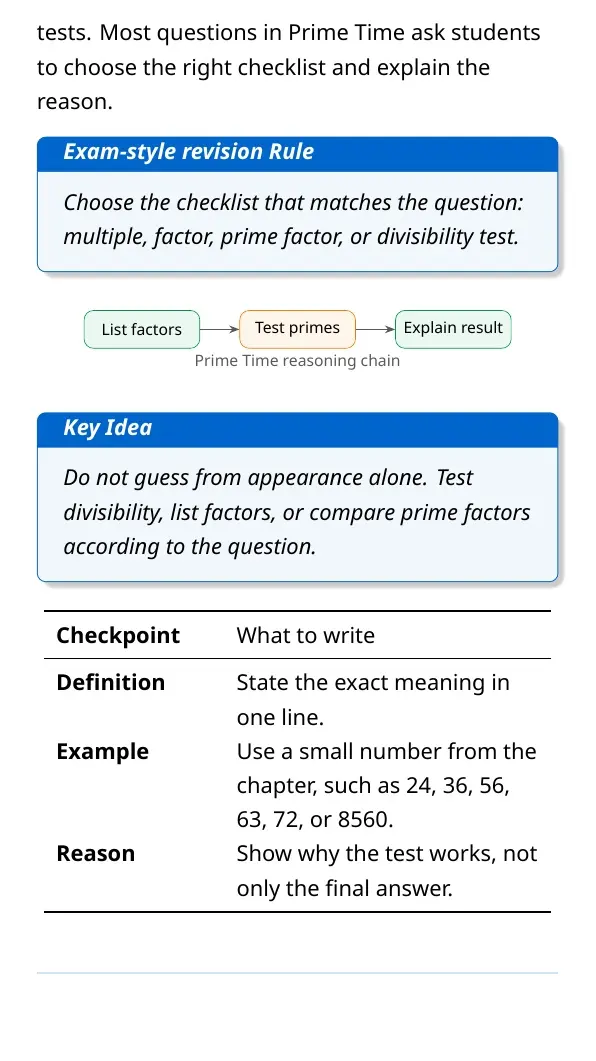
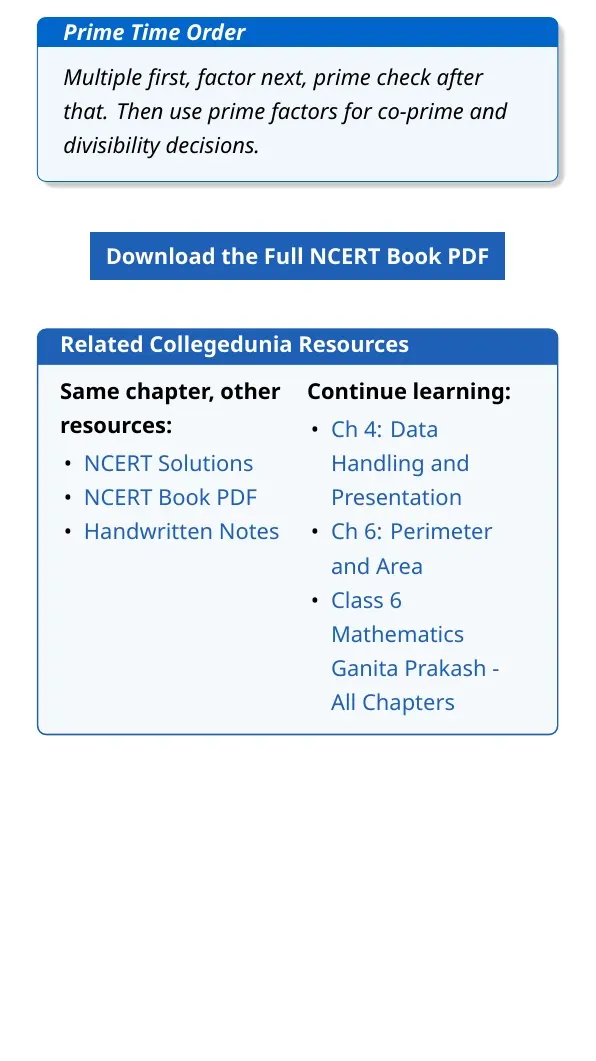
Prime Time is a chapter about the hidden structure of whole numbers. It starts with games and then builds the language of factors, multiples, primes, composites, co-prime pairs, and divisibility tests. Every answer becomes easier when students first ask whether the question is about a multiple or a factor.
| Idea | Meaning | Quick example |
|---|---|---|
| Multiple | Reached by repeated equal jumps. | 15 is a multiple of 3 and 5. |
| Factor | Divides a number exactly. | 6 is a factor of 24. |
| Prime | Exactly two factors. | 2, 3, 5, 7, 11. |
| Co-prime | Only common factor is 1. | 4 and 9. |
Prime Time Class 6 Video for Prime Factorisation
Source: Magnet Brains on YouTube
Common Multiples and Common Factors in Prime Time
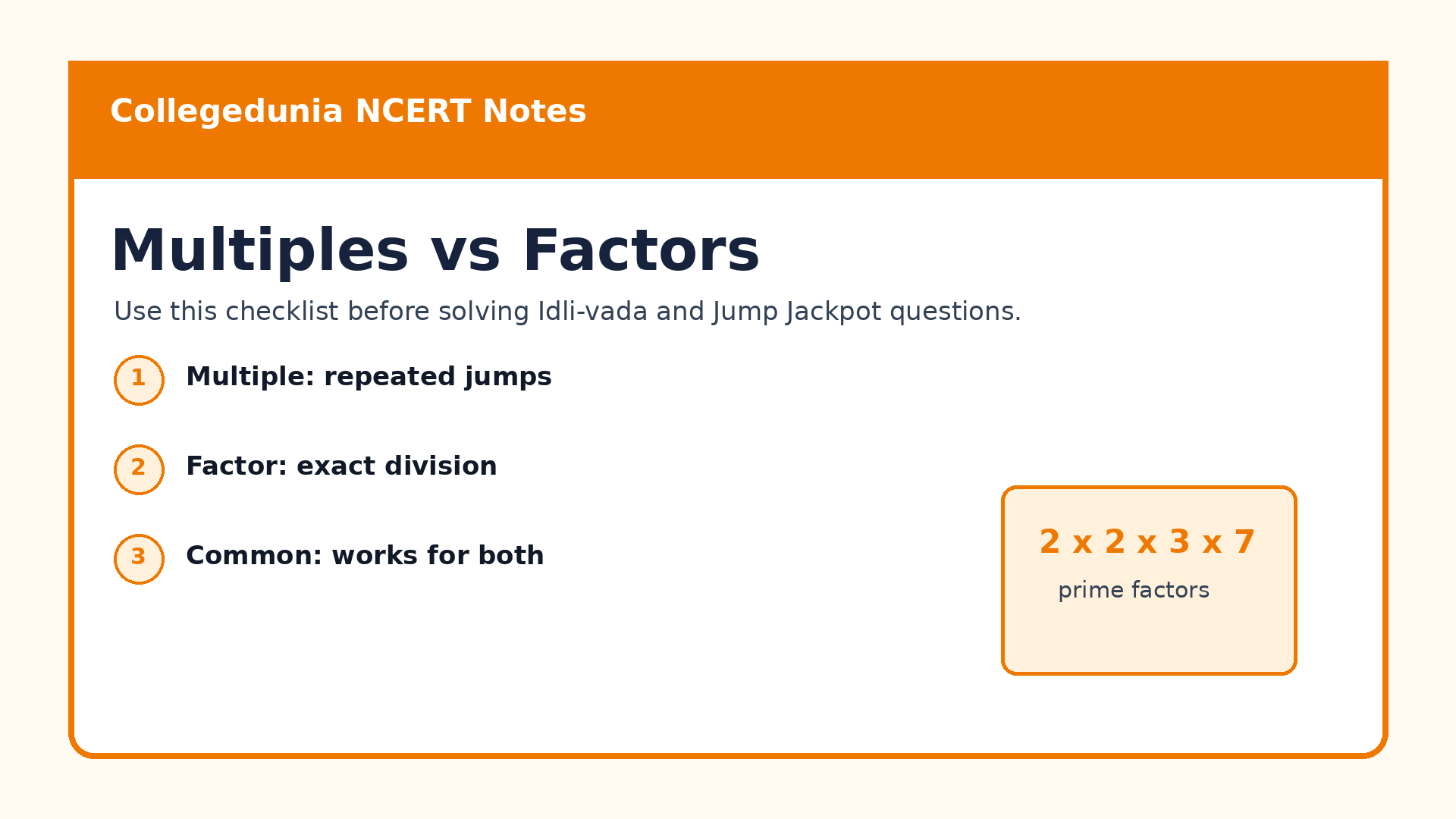
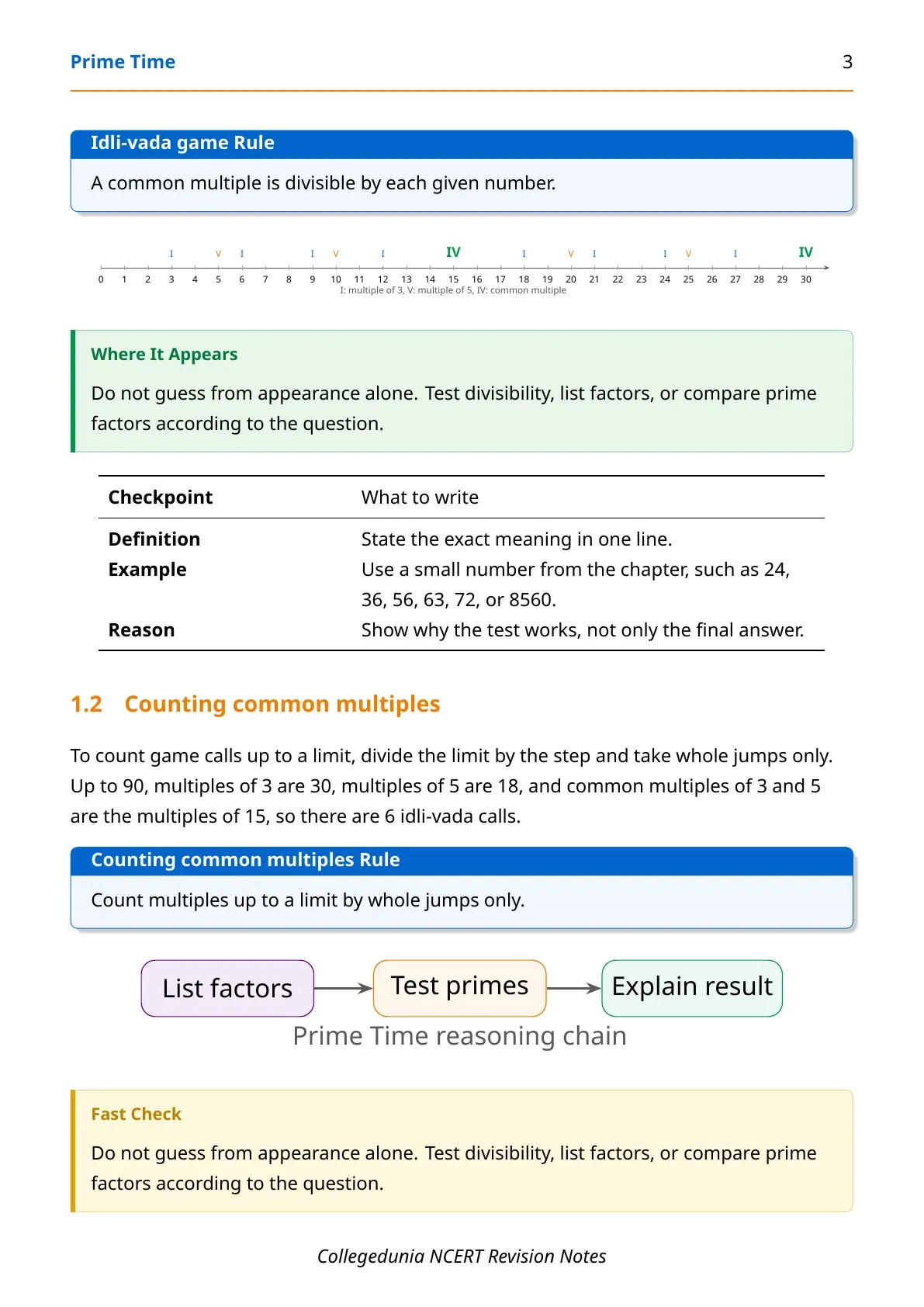
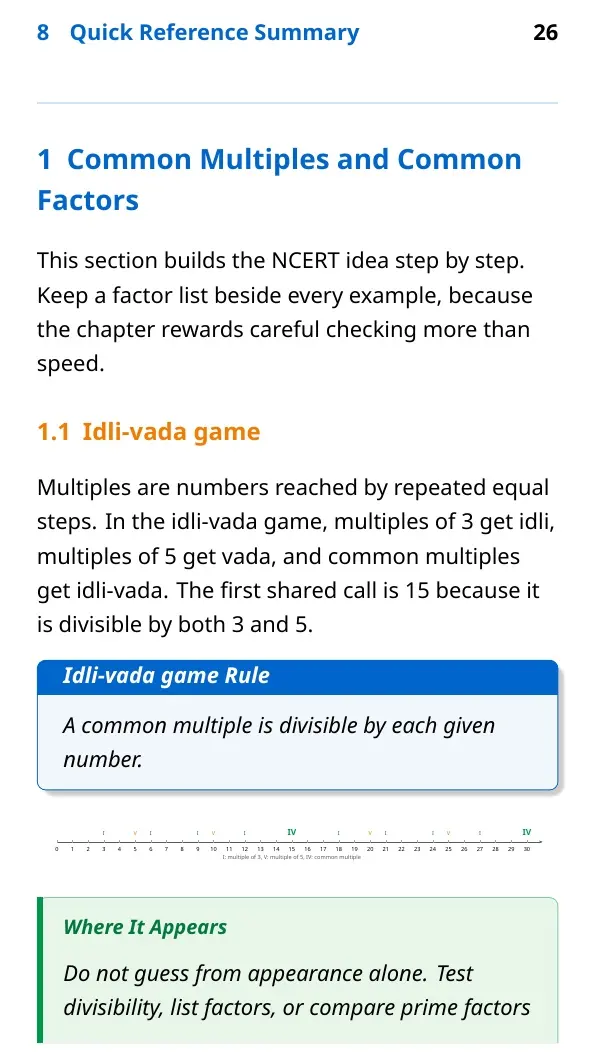
The Idli-vada game teaches common multiples. Players say idli on multiples of 3, vada on multiples of 5, and idli-vada on common multiples. The first common multiple is 15. The next ones are 30, 45, 60, and so on.
- Counting multiples: up to 90, multiples of 3 are counted by 90 divided by 3.
- Common multiple check: a number must divide exactly by both given numbers.
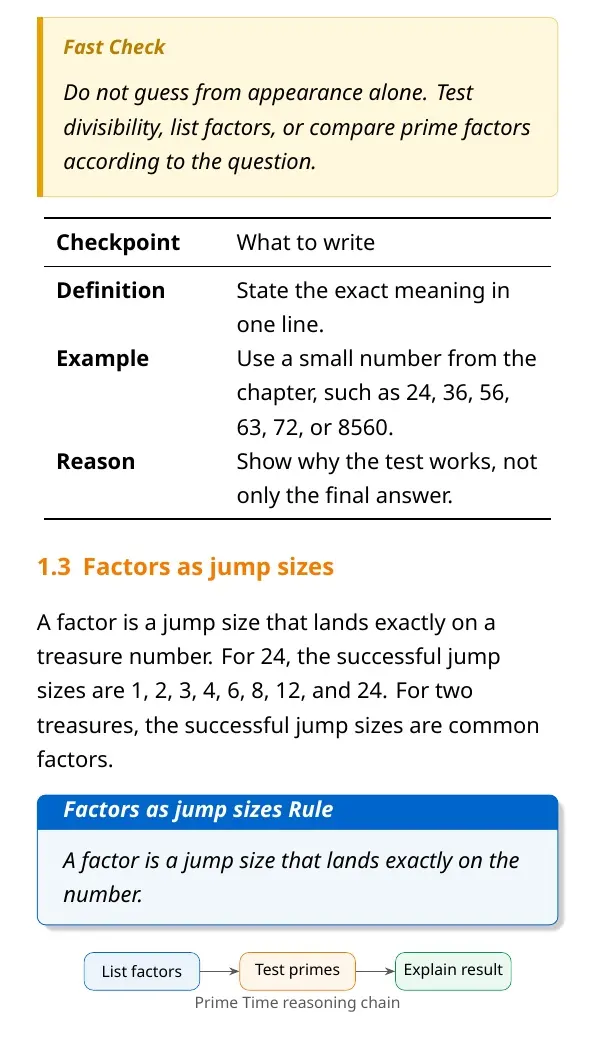
- Factor check: a jump size is a factor if it lands exactly on the treasure number.
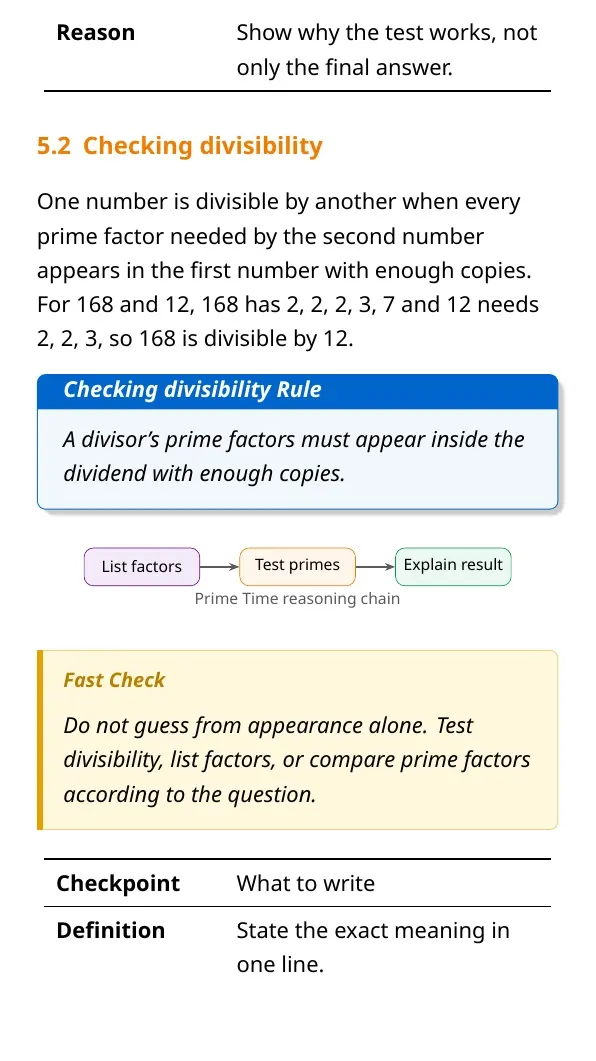
In Jump Jackpot, a jump size that reaches both 28 and 70 must be a common factor. The useful jump sizes are 1, 2, 7, and 14.
Prime Numbers, Composite Numbers, and the Sieve
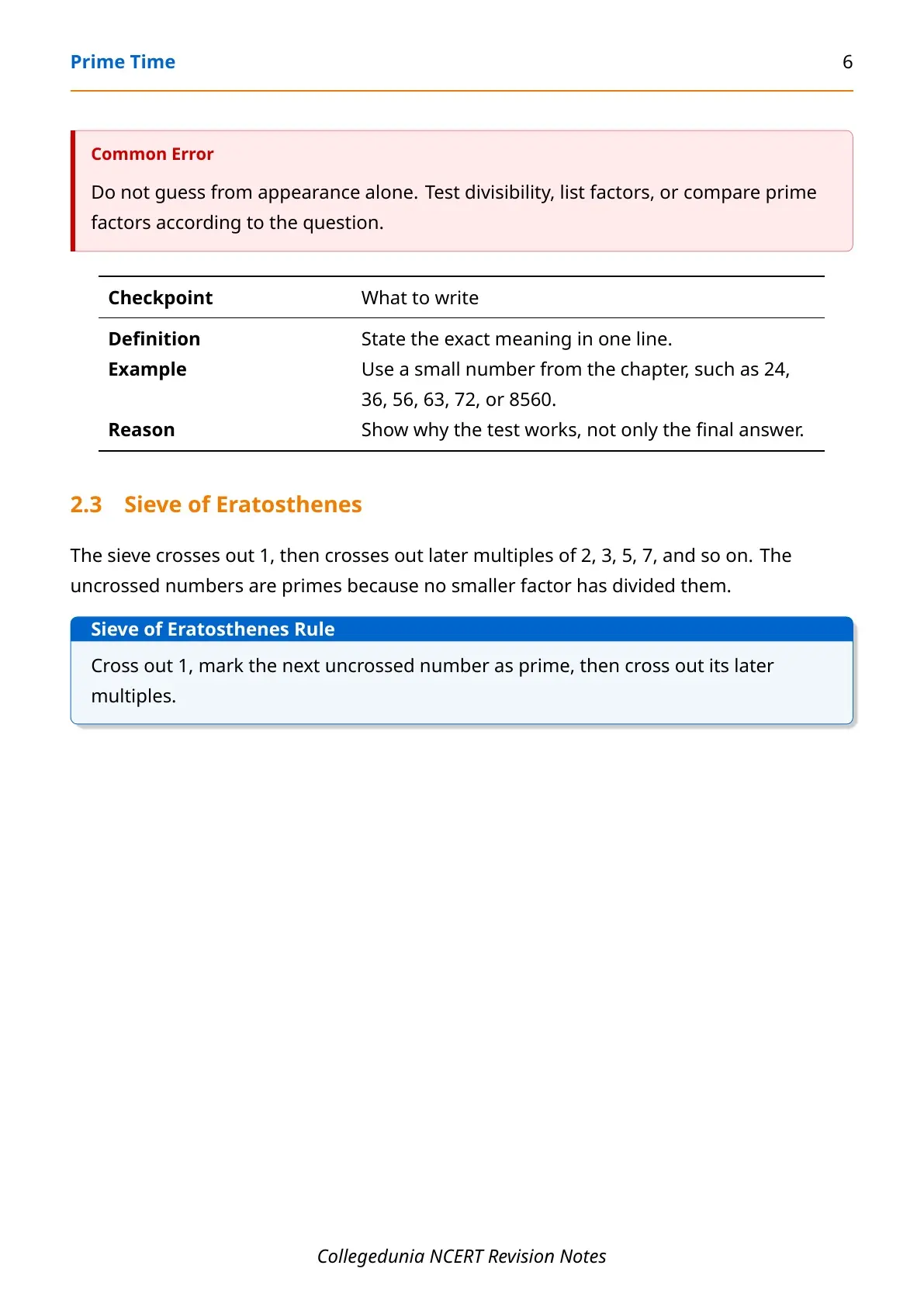
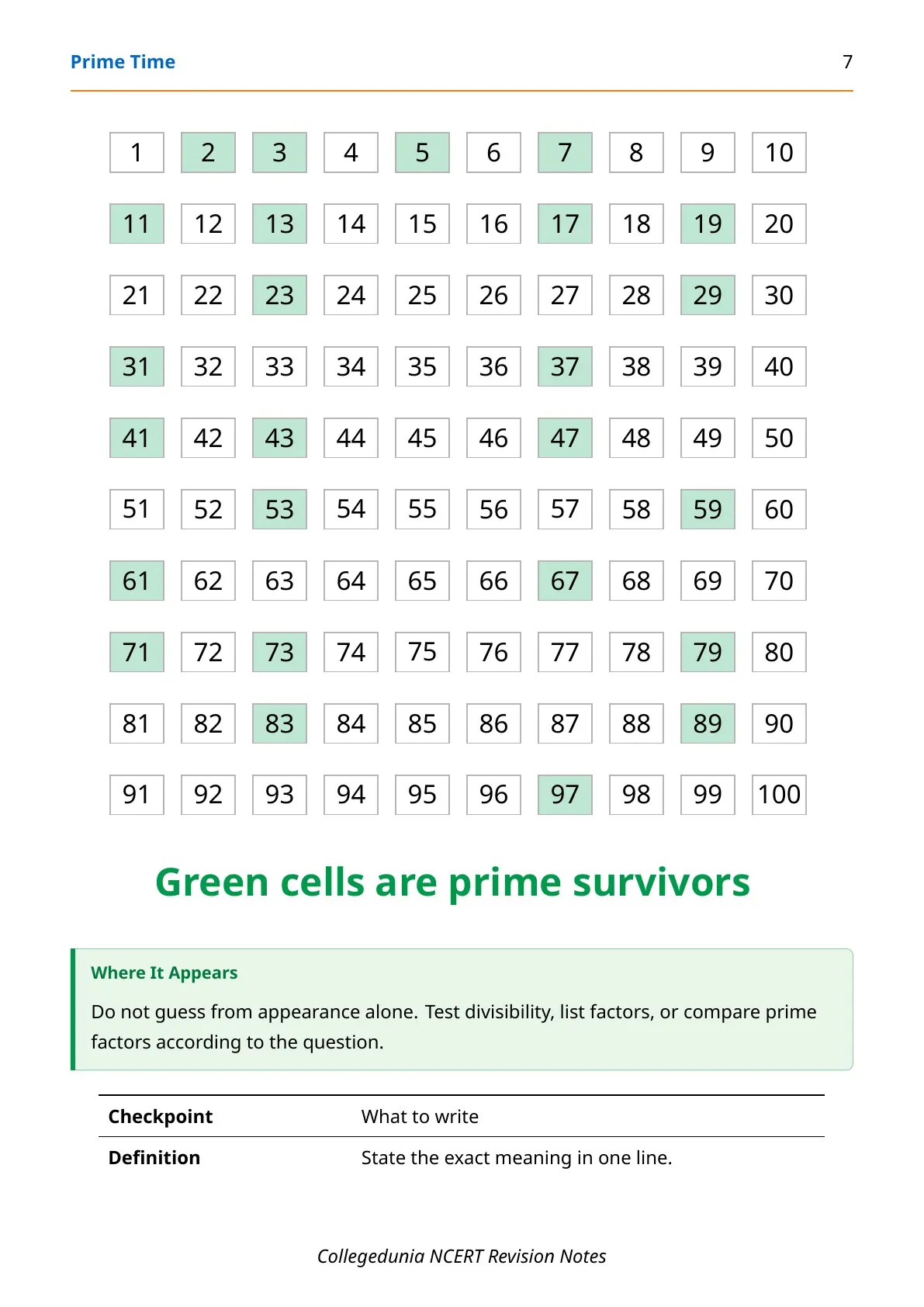
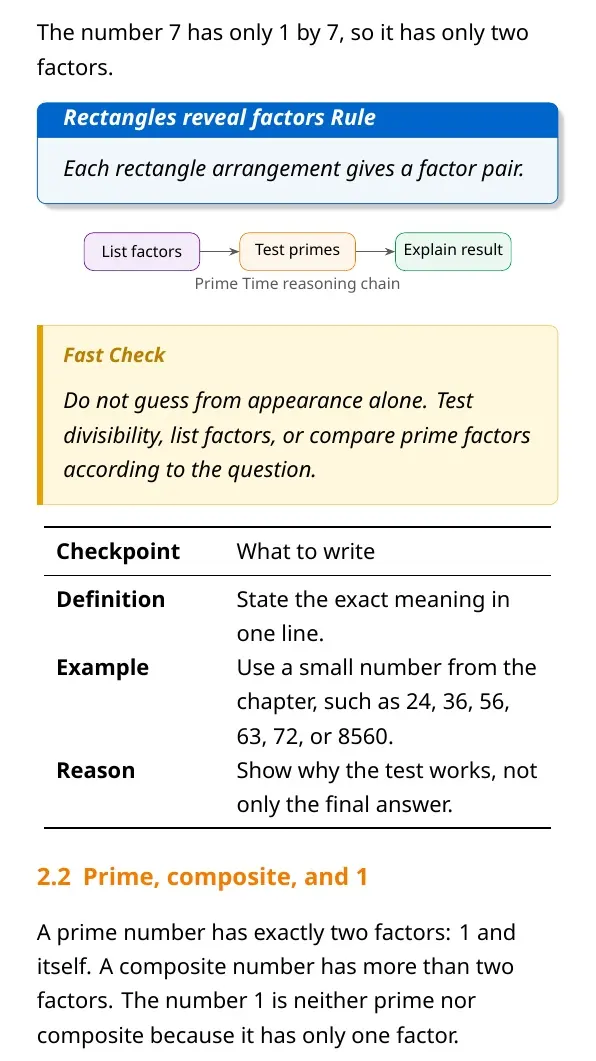
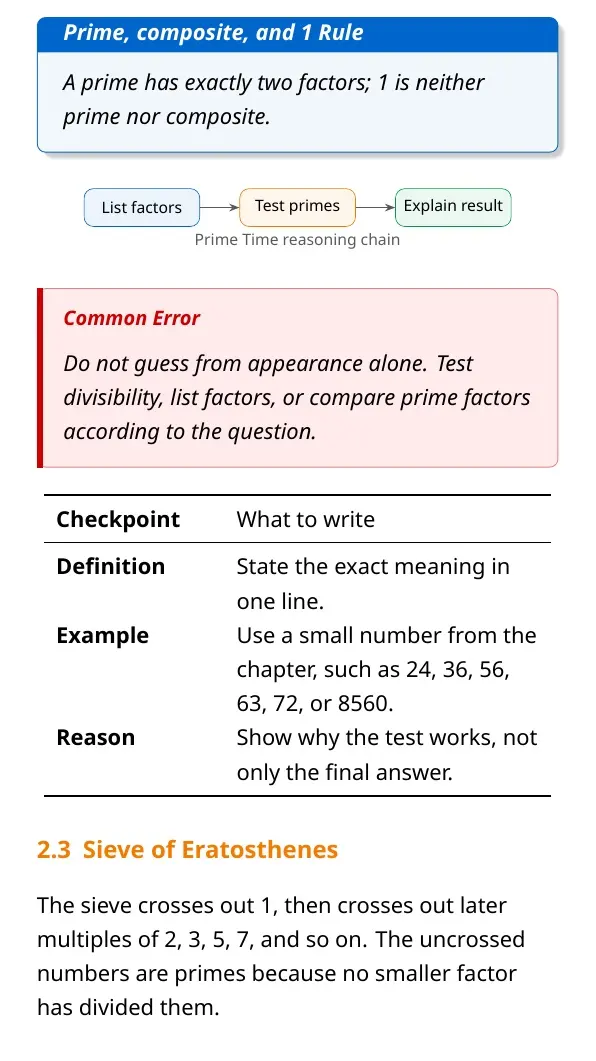
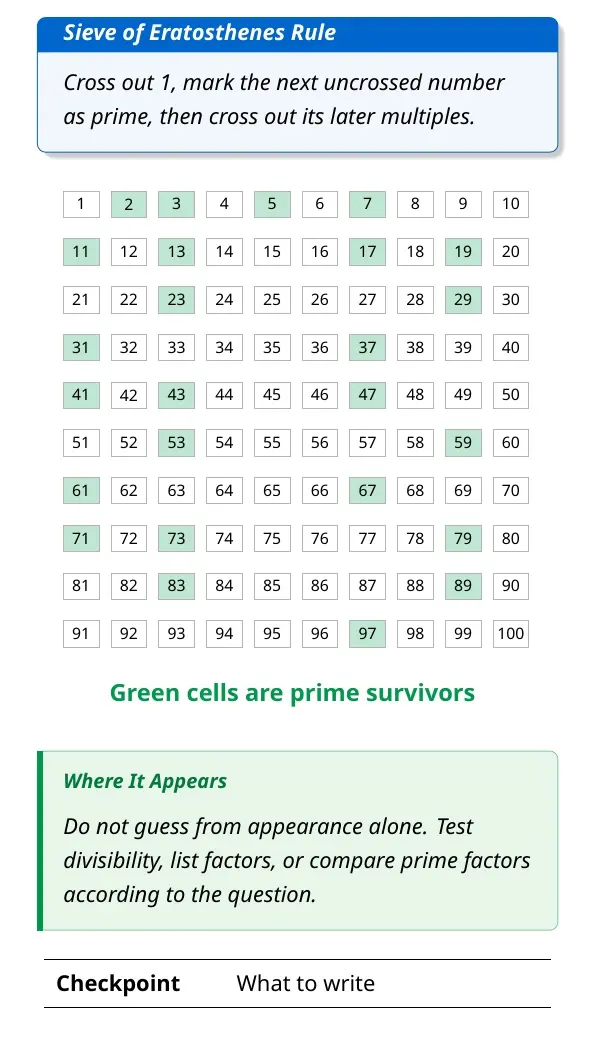
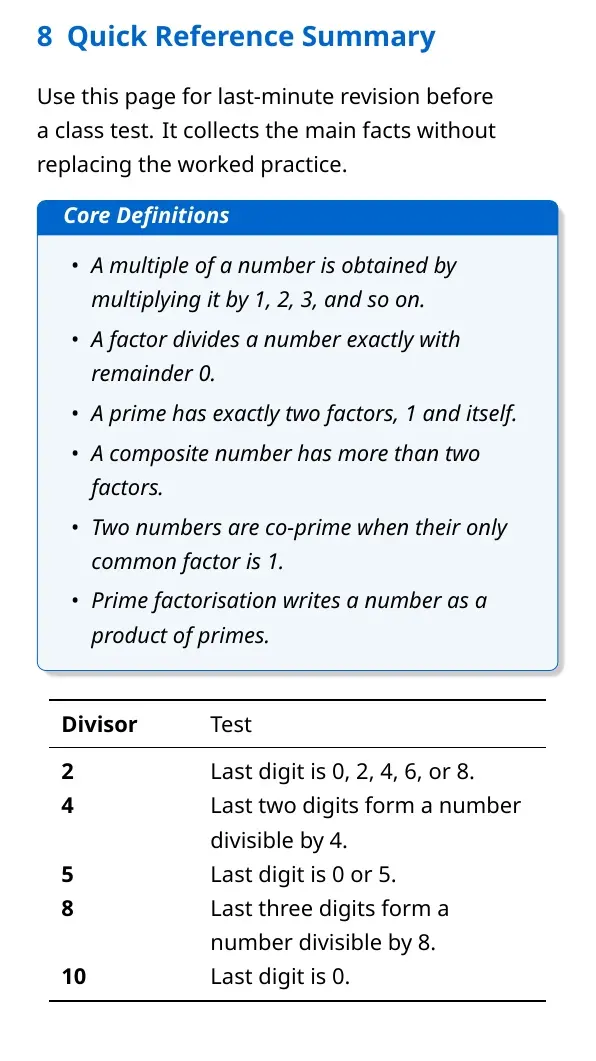
A prime number has exactly two factors: 1 and itself. A composite number has more than two factors. The number 1 is neither prime nor composite because it has only one factor. The Sieve of Eratosthenes finds primes by crossing out multiples of known primes.
| Number | Factor list | Type |
|---|---|---|
| 7 | 1, 7 | Prime |
| 12 | 1, 2, 3, 4, 6, 12 | Composite |
| 23 | 1, 23 | Prime |
| 26 | 1, 2, 13, 26 | Composite |
2 is the only even prime number. Every other even number has 2 as a factor along with 1 and itself, so it is composite.
Co-prime Numbers and Safe Treasure Pairs
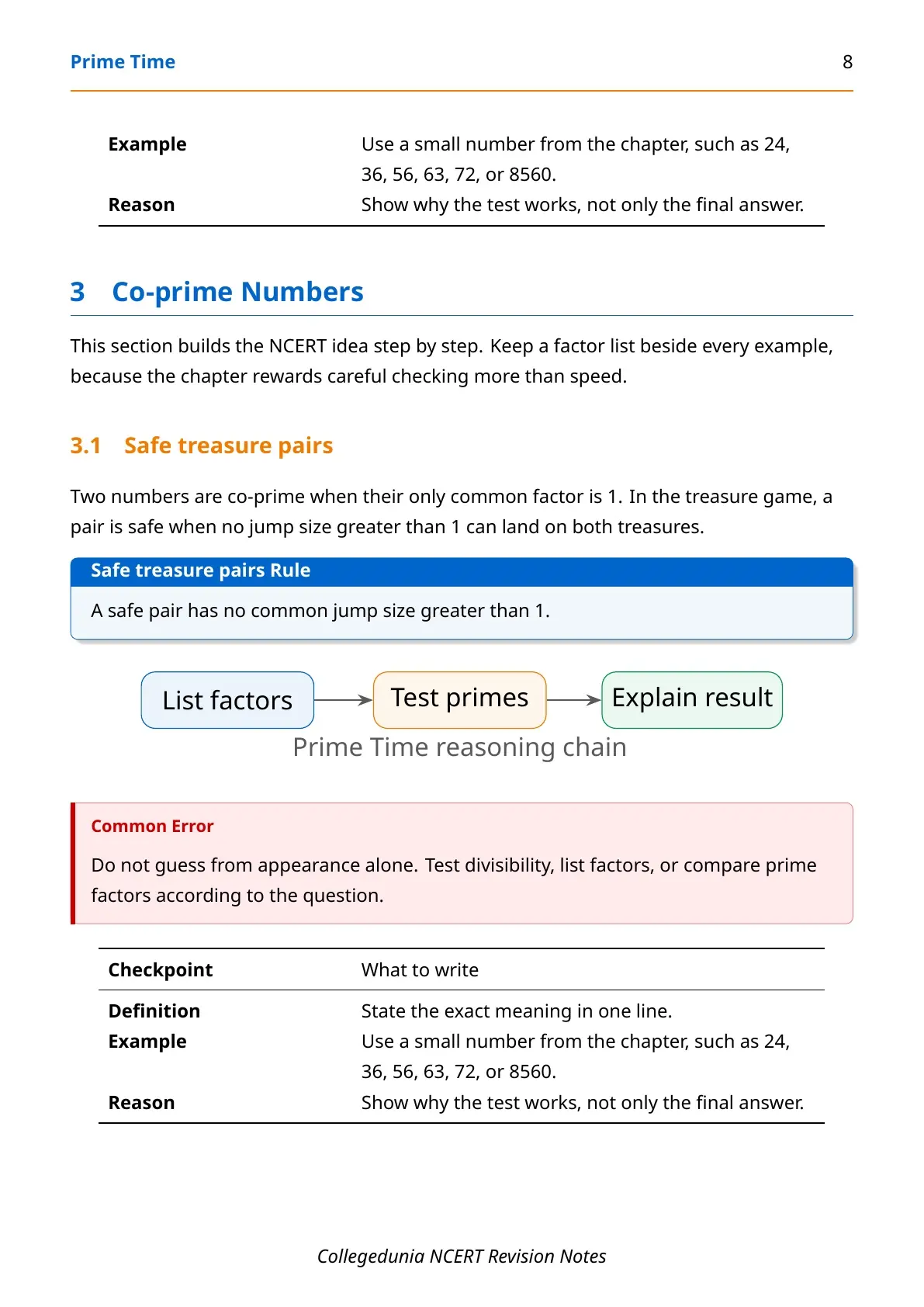
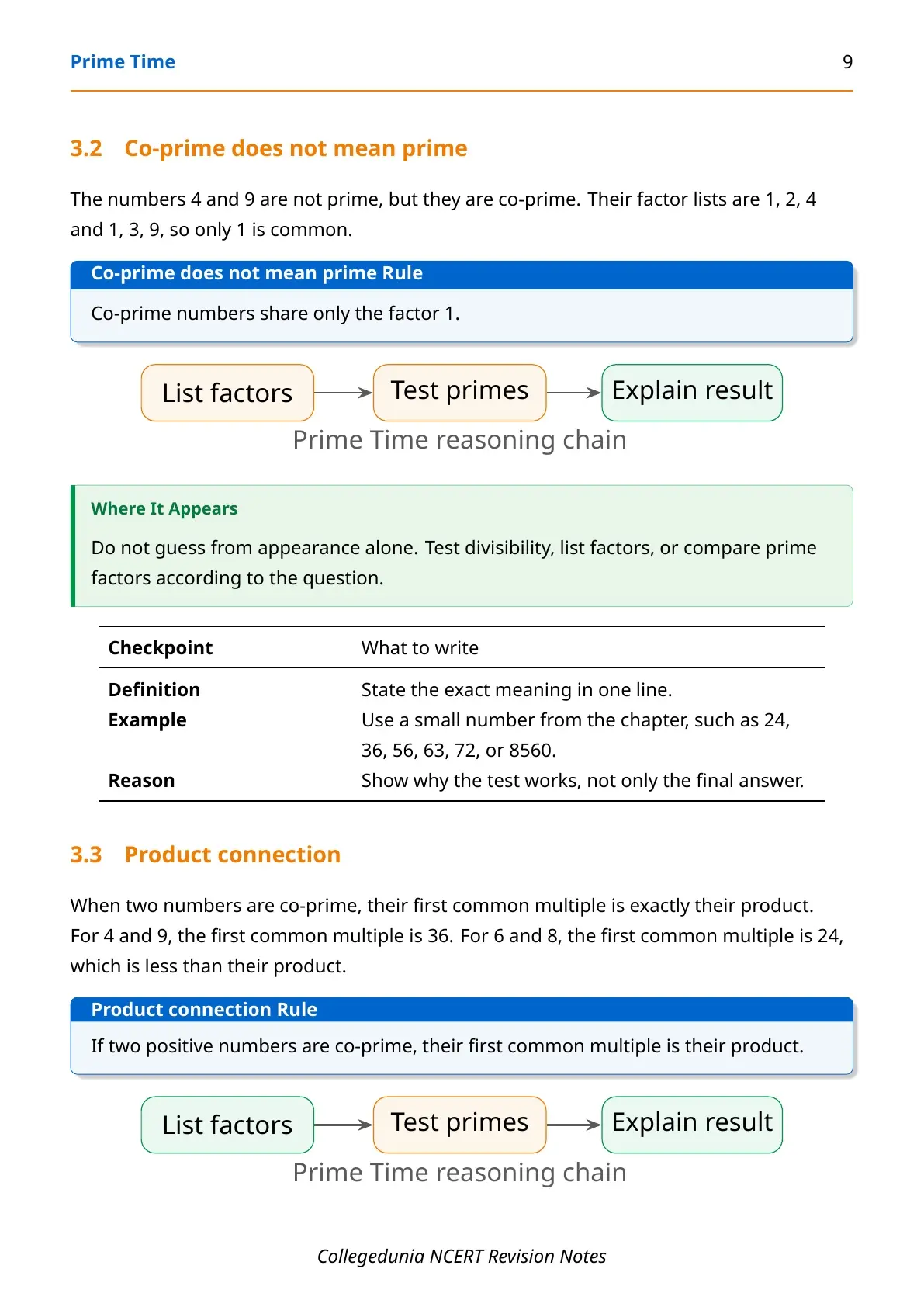
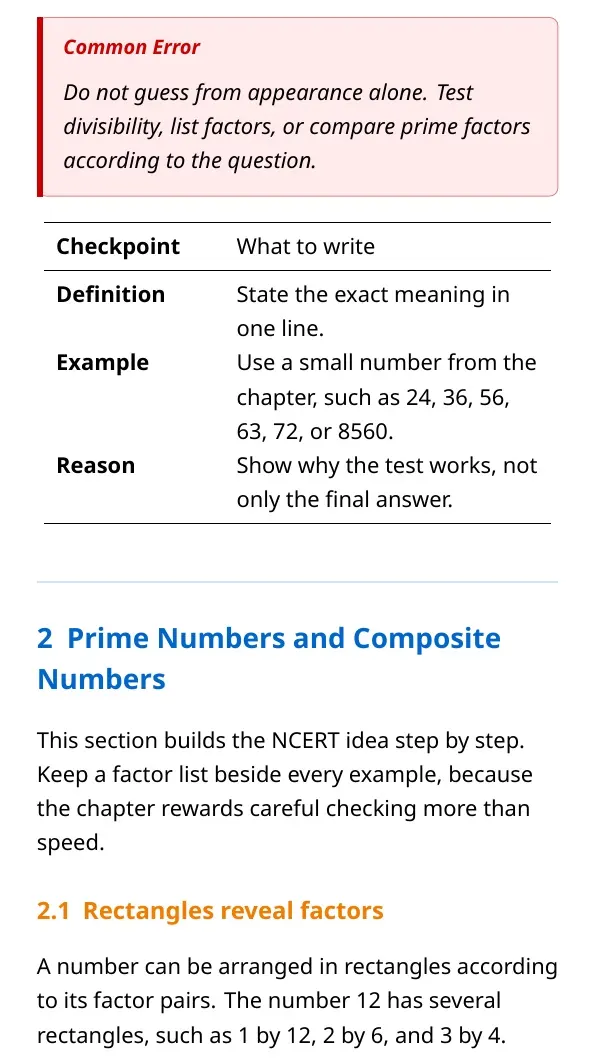
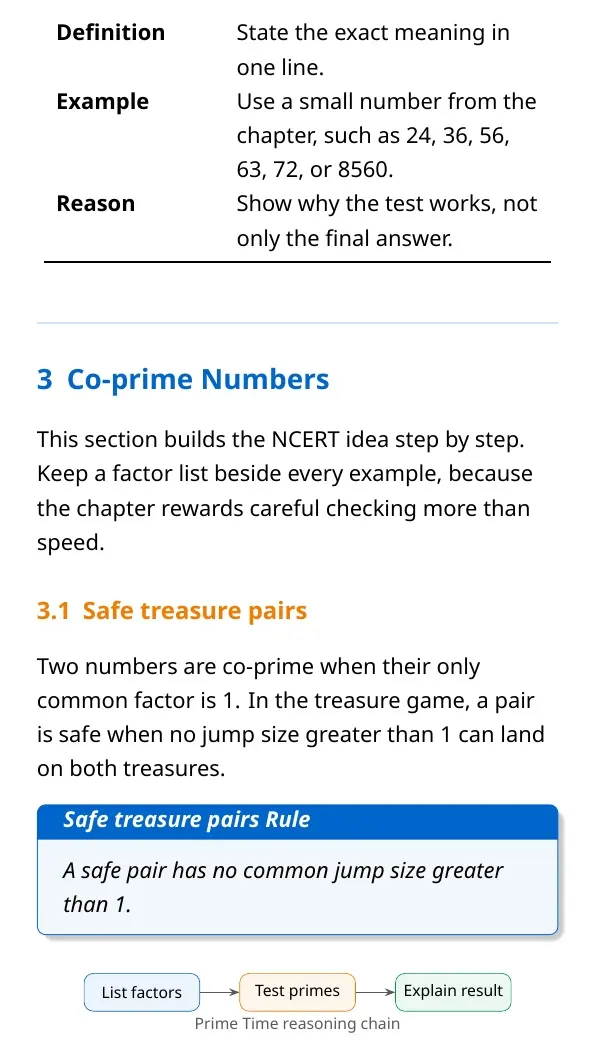
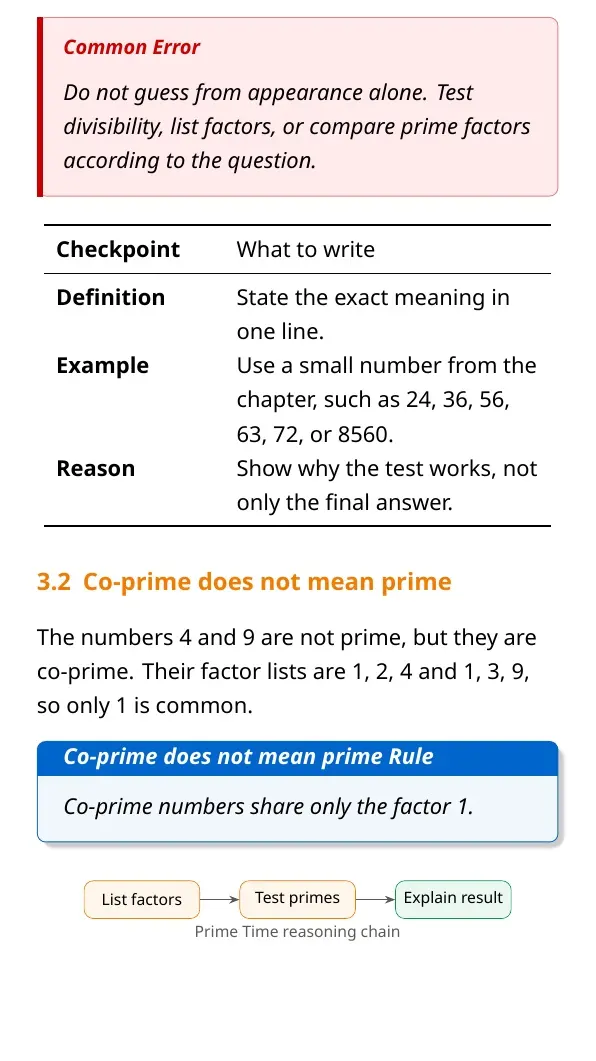
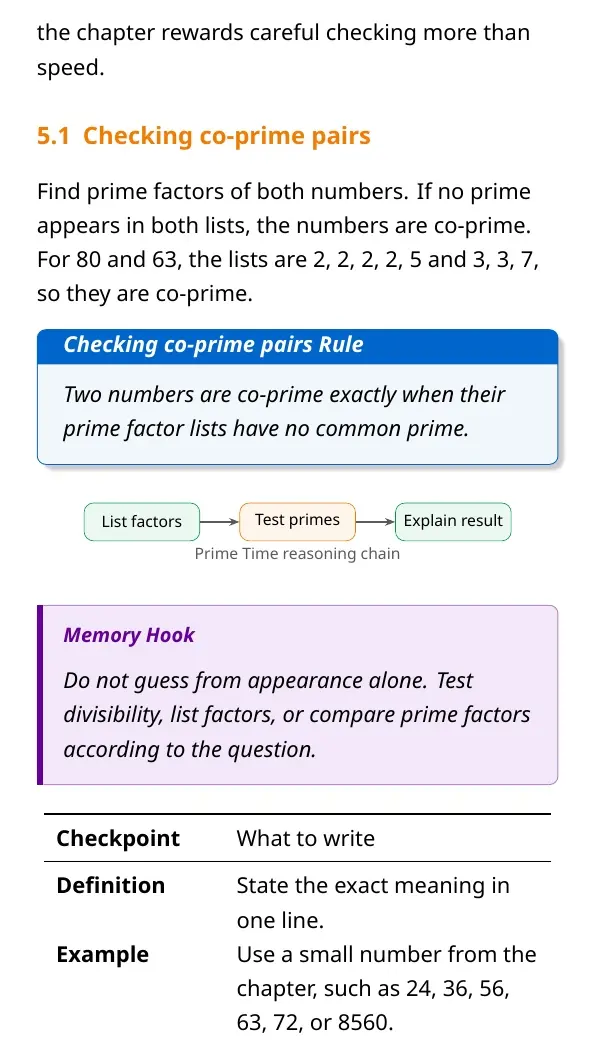
Two numbers are co-prime when their only common factor is 1. They do not both need to be prime. For example, 4 and 9 are co-prime because their factor lists share only 1. But 15 and 39 are not co-prime because both have 3 as a factor.
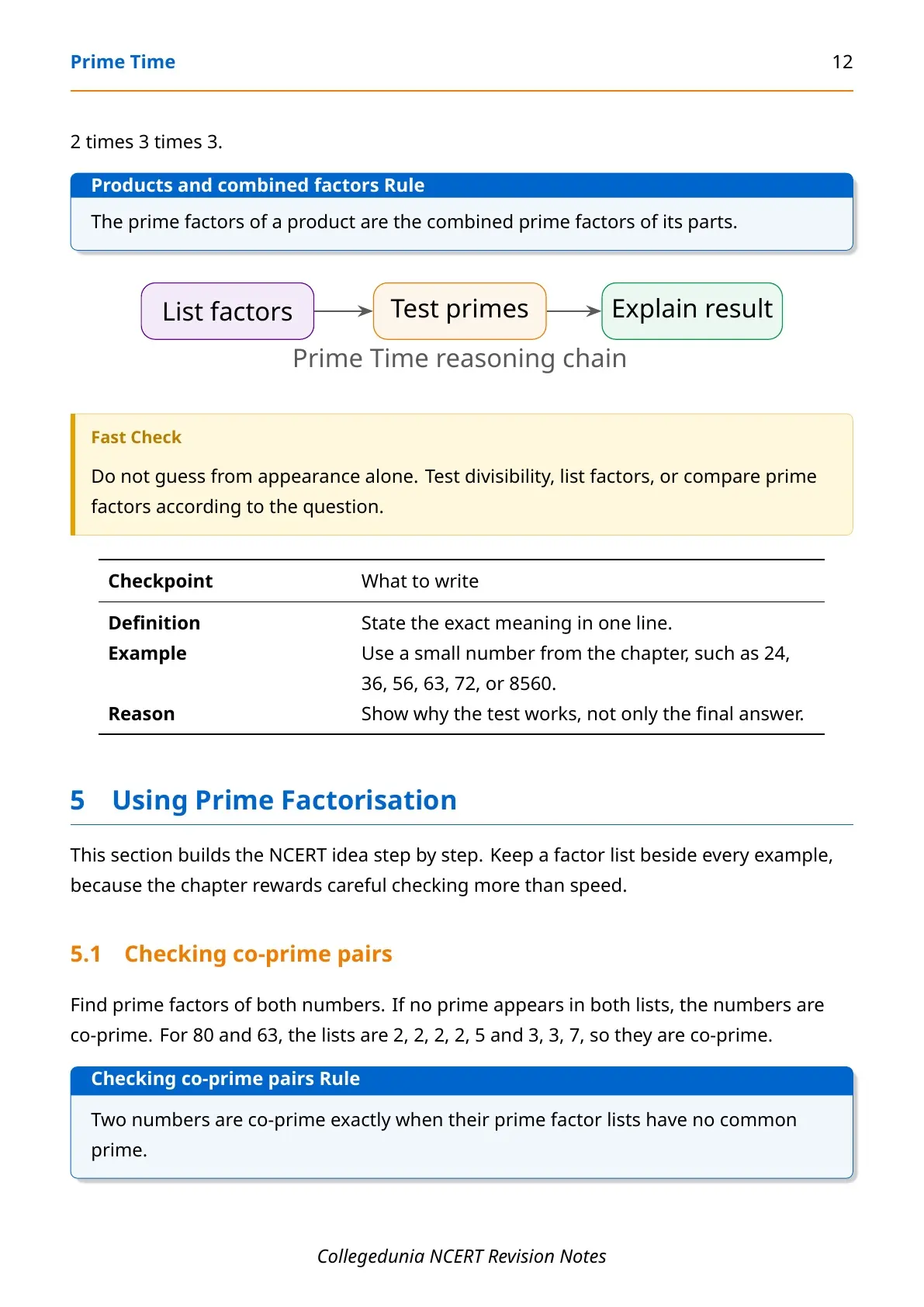
- 18 and 35 are co-prime because no prime factor is common.
- 15 and 37 are co-prime because 37 is prime and does not divide 15.
- 81 and 18 are not co-prime because both have 3 as a factor.
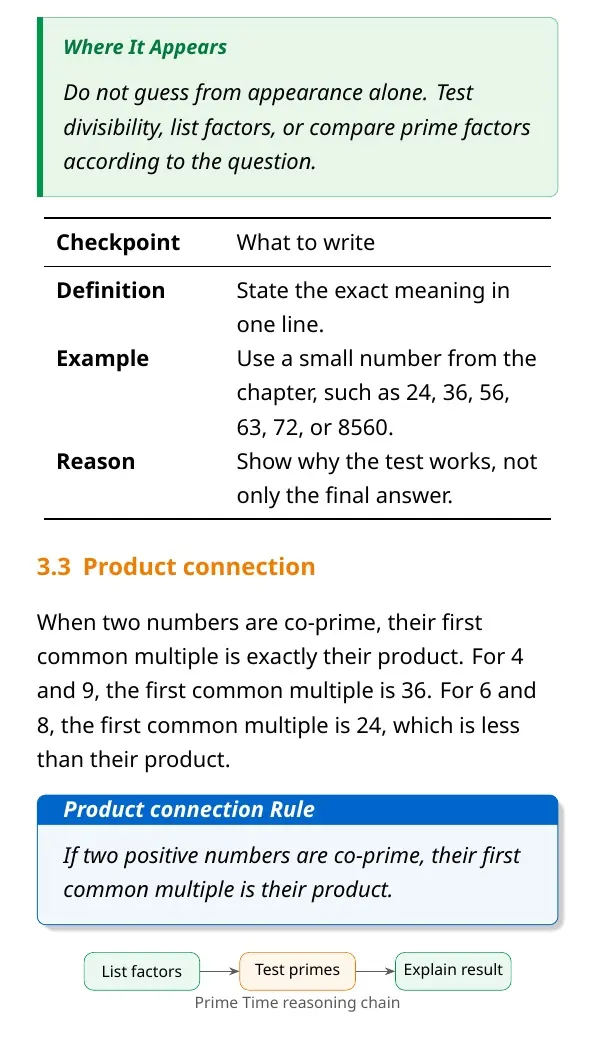
This idea explains the exact rule: when two numbers are co-prime, their first common multiple is the product of the two numbers.
Prime Factorisation Method in Class 6 Notes
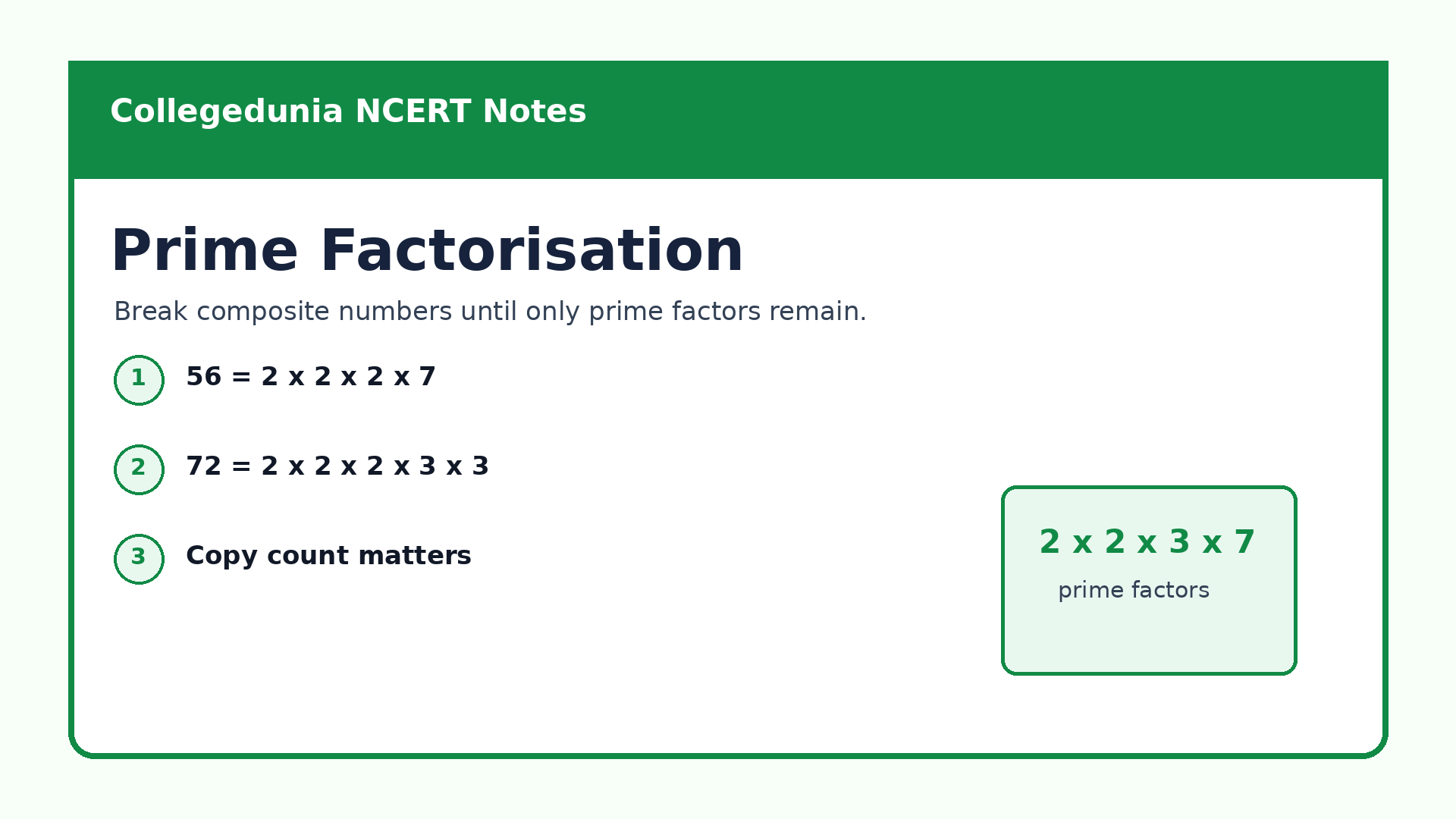
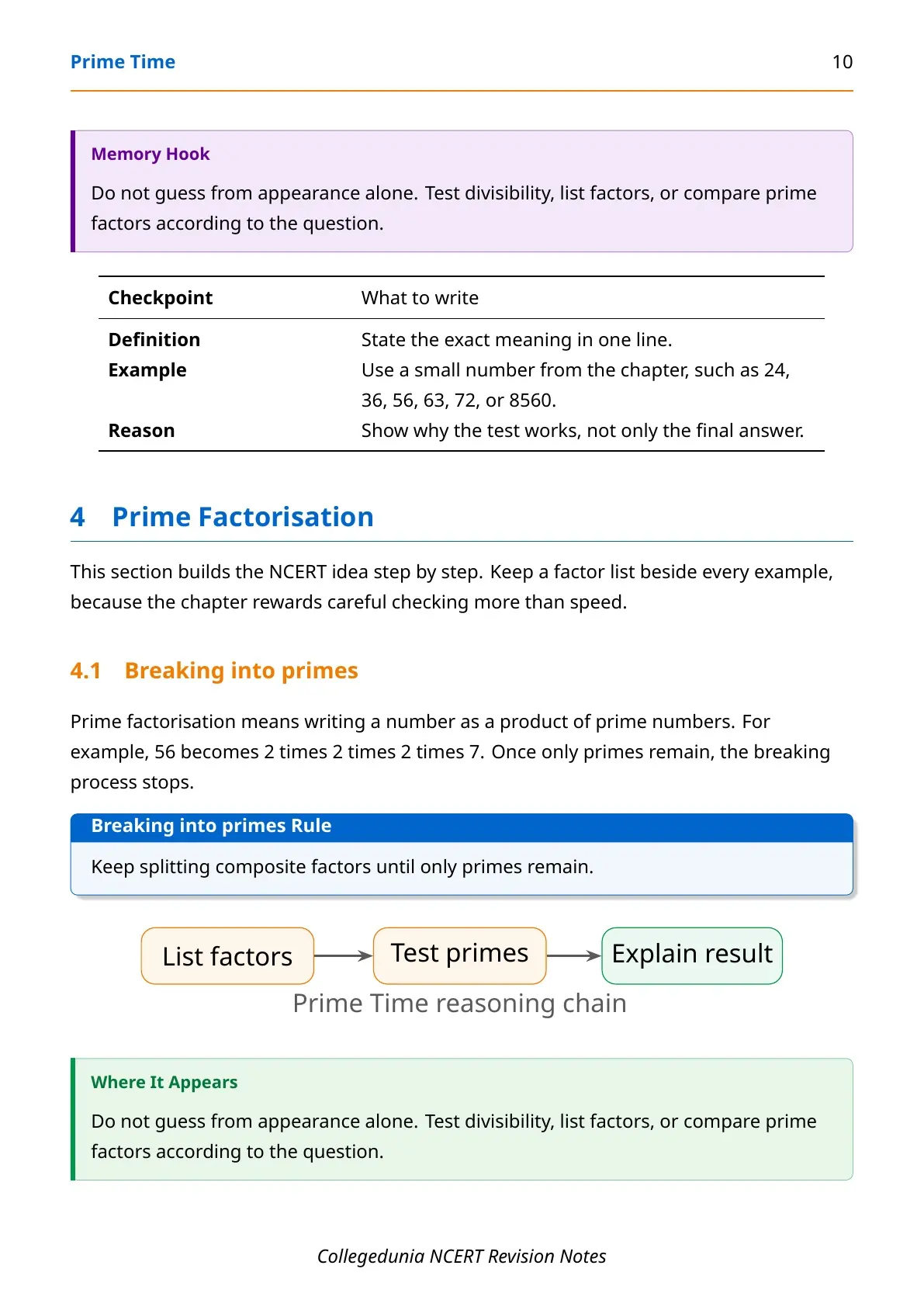
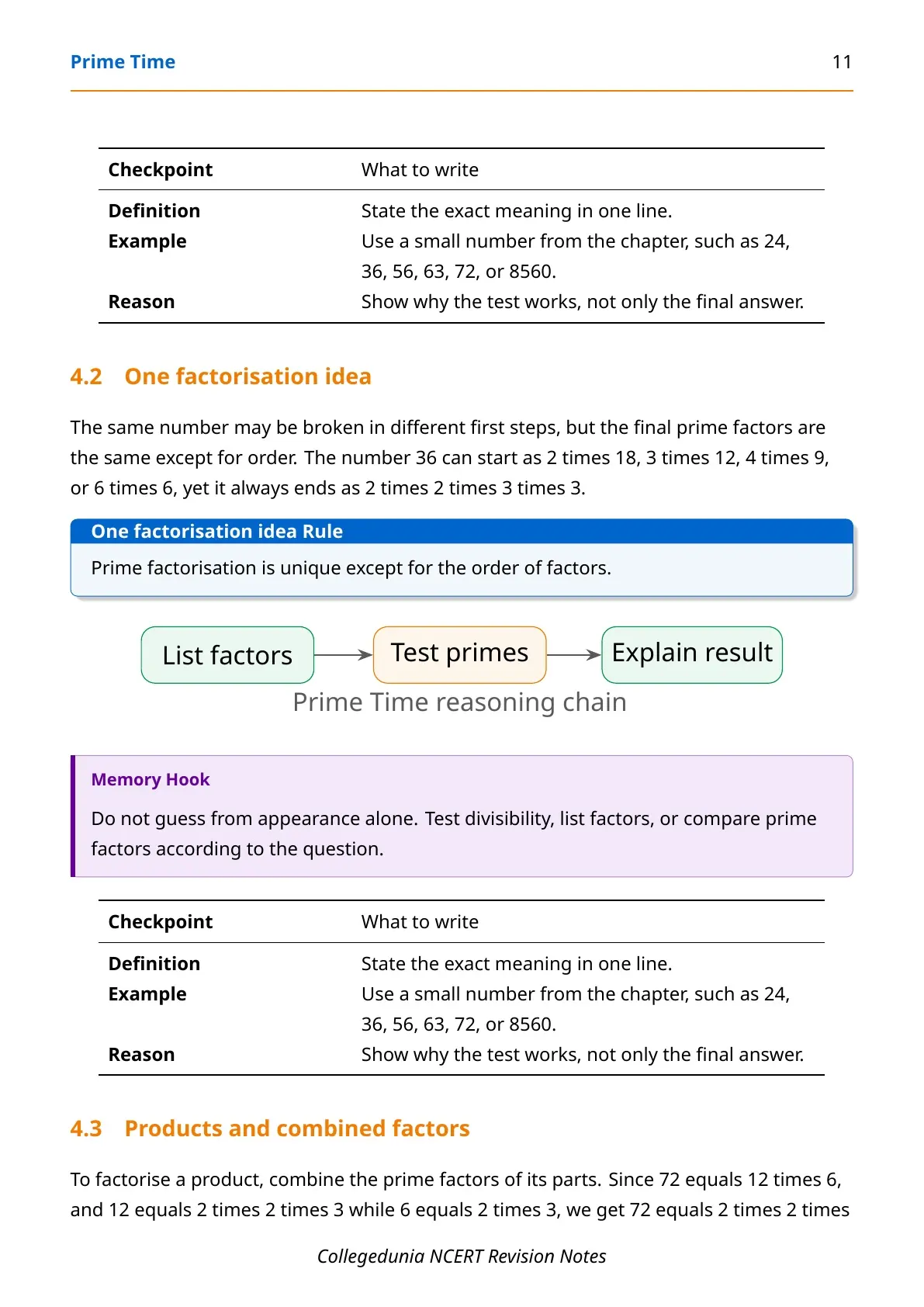
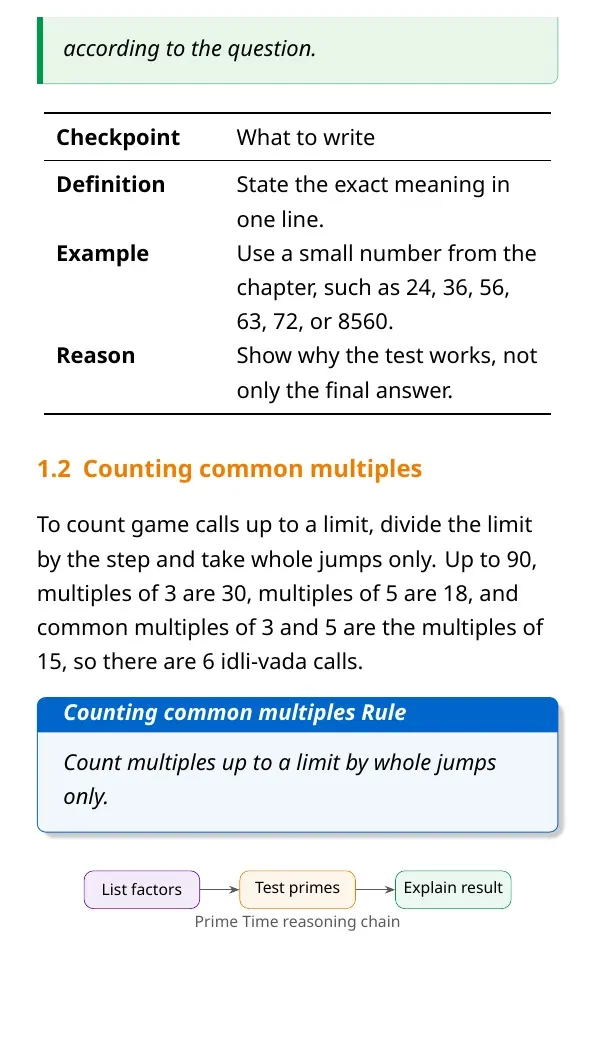
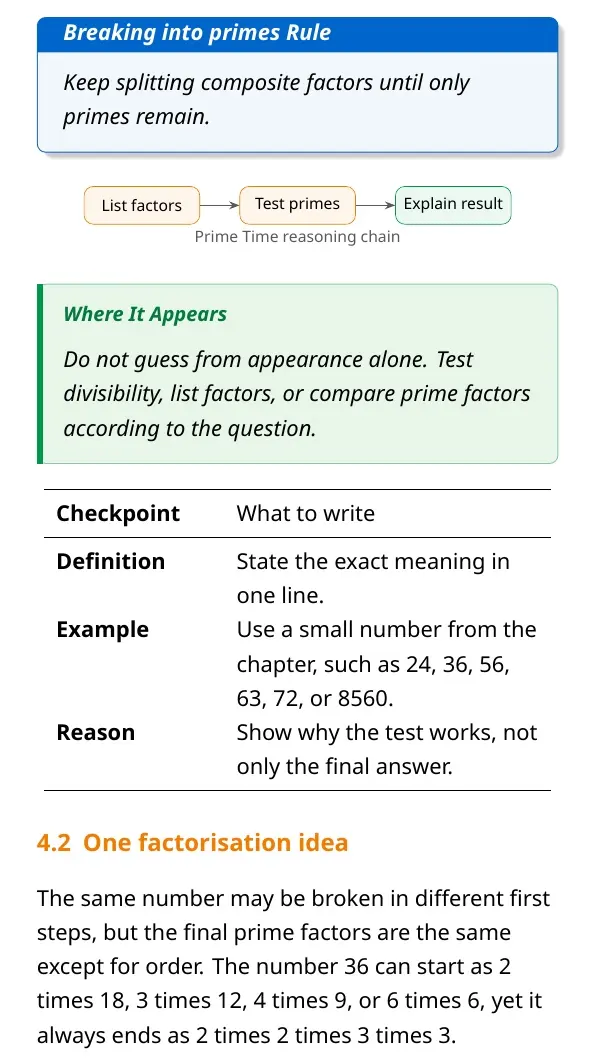
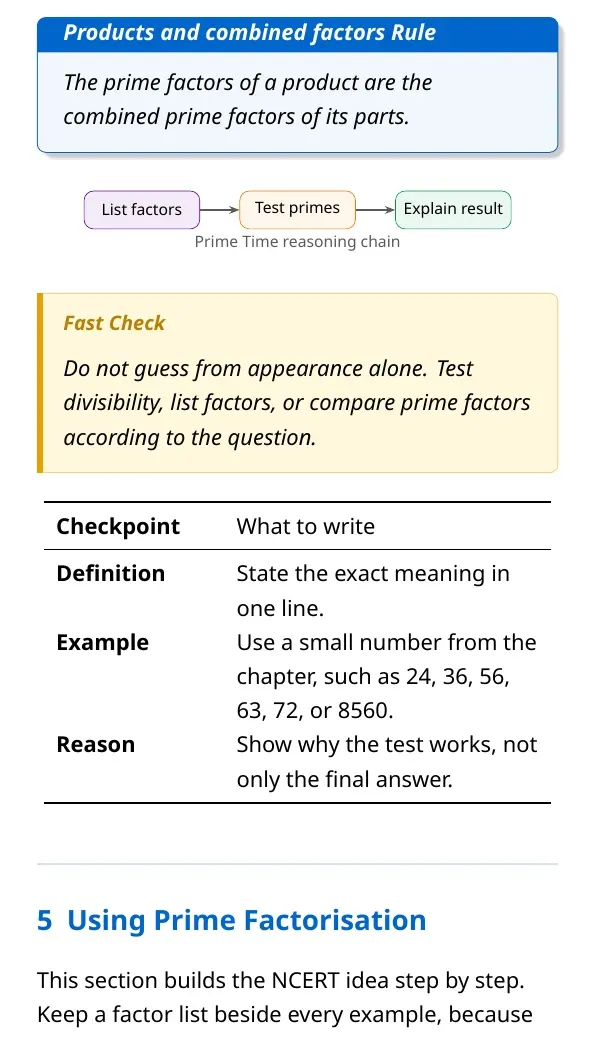
Prime factorisation writes a number as a product of prime numbers. Keep breaking composite factors until only primes remain. For example, 56 equals 2 times 2 times 2 times 7, and 72 equals 2 times 2 times 2 times 3 times 3.
- Start with any useful factor pair.
- Break each composite factor again.
- Stop when every factor is prime.
- Write the primes in increasing order.
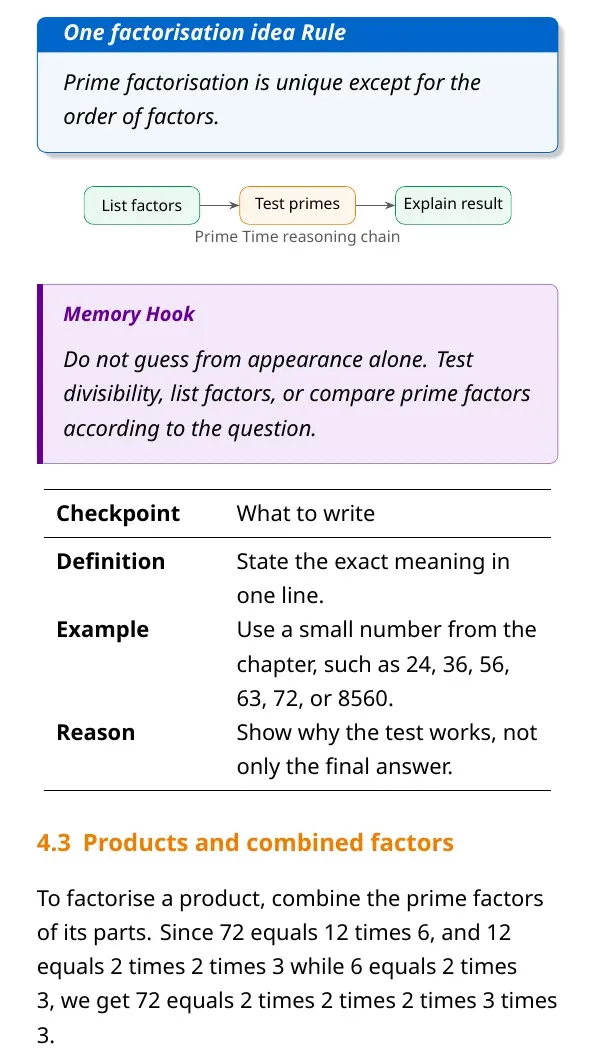
The order of prime factors can change, but the final collection of primes stays the same. This is why 36 always gives two 2s and two 3s.
Divisibility Tests for 2, 4, 5, 8, and 10
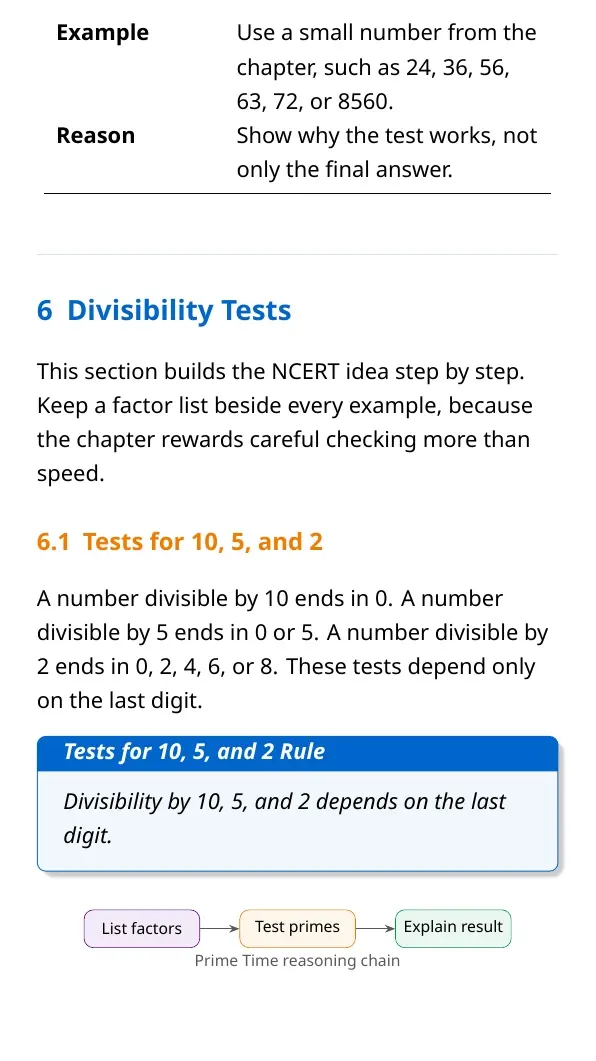
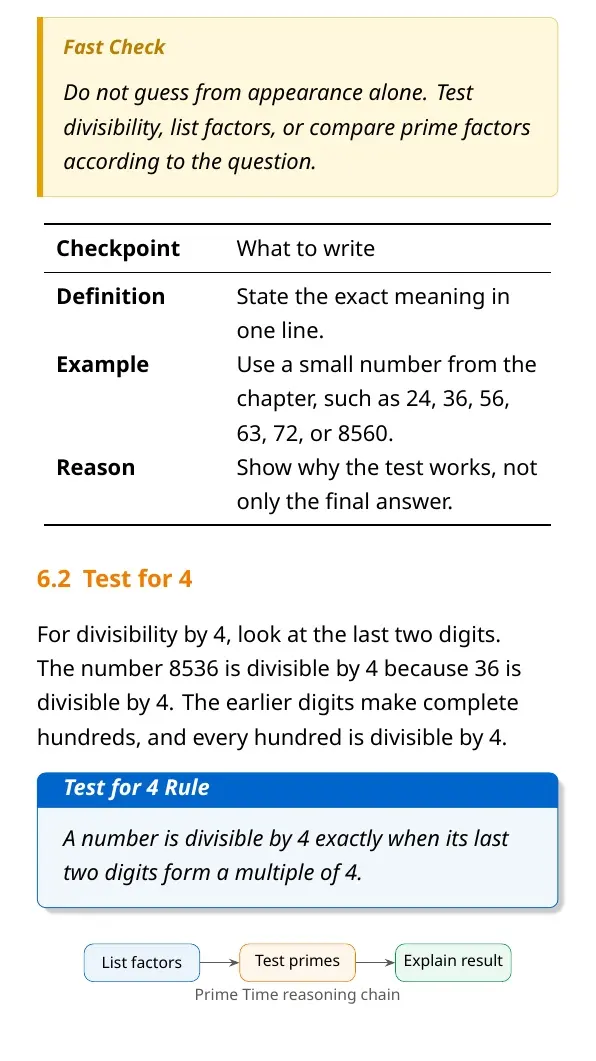
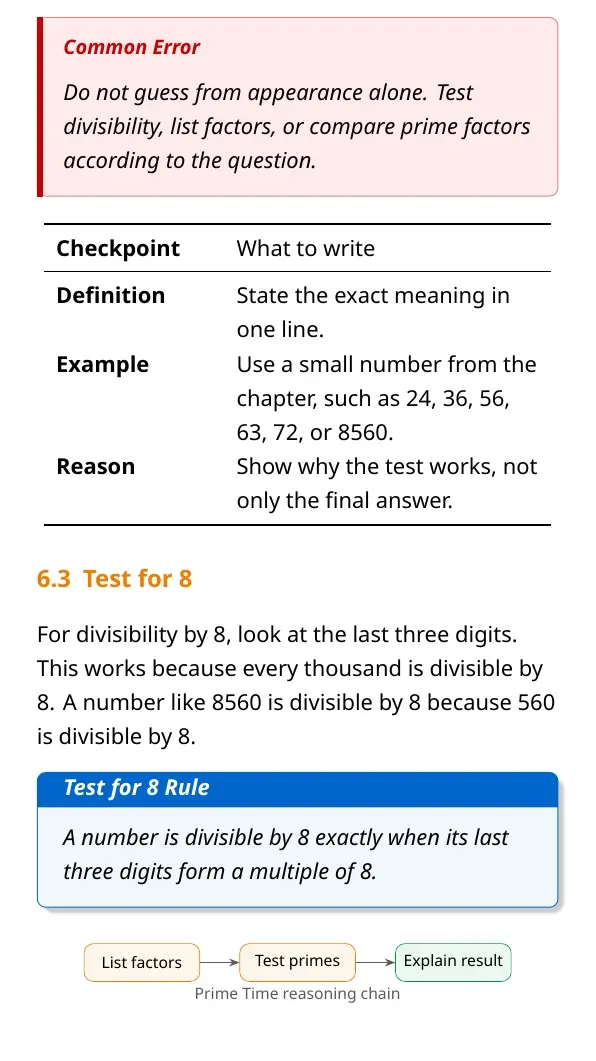
Divisibility tests save time when the number is large. The chapter focuses on tests for 10, 5, 2, 4, and 8. These tests work because powers of 10 have predictable remainders with these divisors.
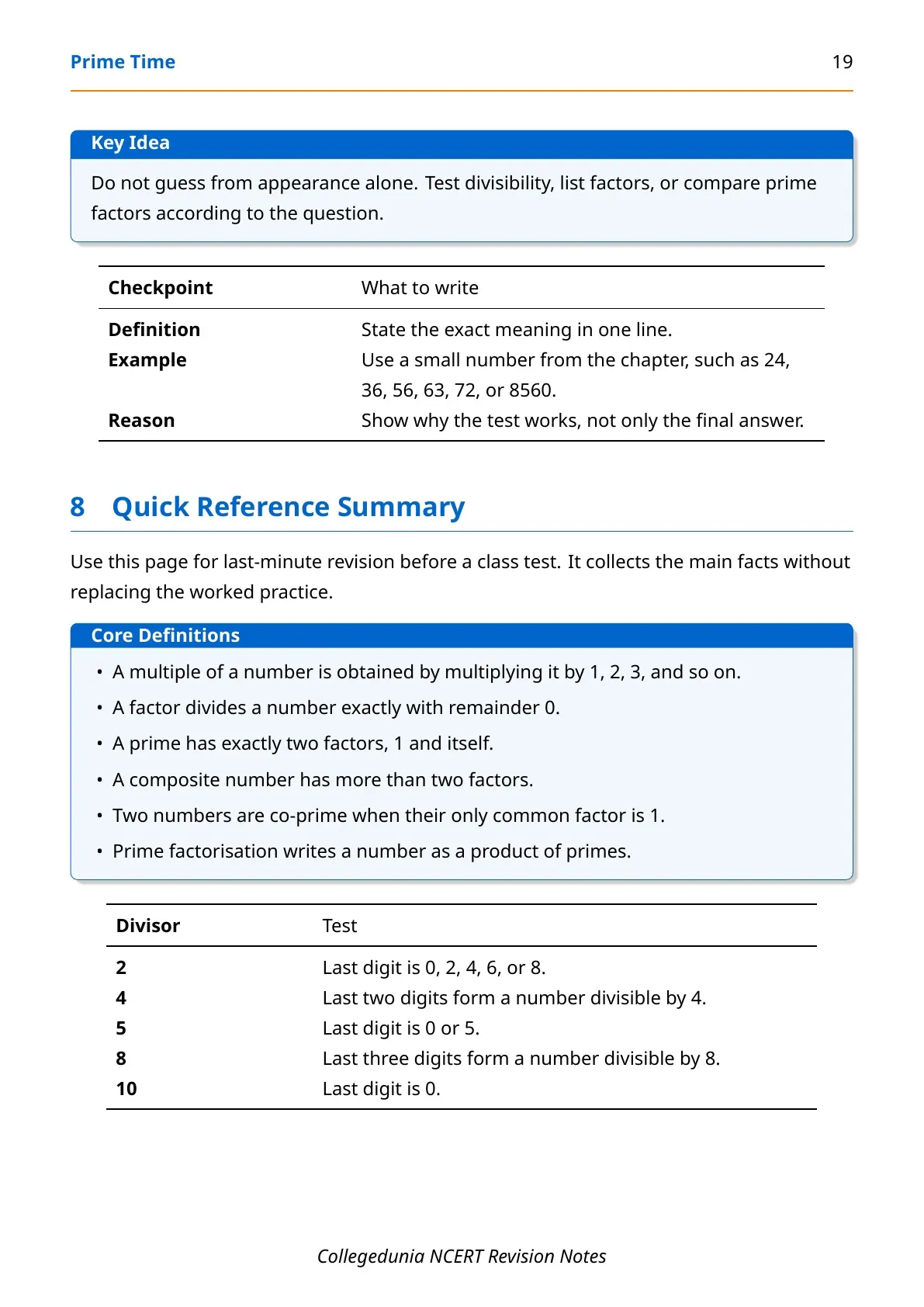
| Divisor | Test | Example |
|---|---|---|
| 2 | Last digit is 0, 2, 4, 6, or 8. | 8560 is divisible by 2. |
| 4 | Last two digits form a multiple of 4. | 8536 is divisible by 4. |
| 5 | Last digit is 0 or 5. | 2345 is divisible by 5. |
| 8 | Last three digits form a multiple of 8. | 8560 is divisible by 8. |
| 10 | Last digit is 0. | 14560 is divisible by 10. |
Common Mistakes in Prime Time Notes
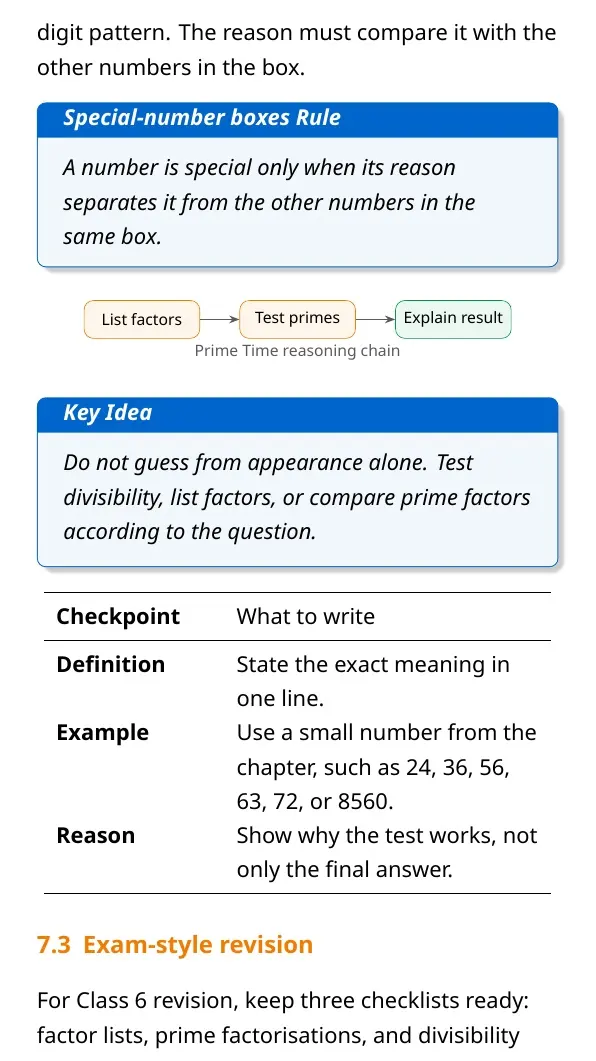
Students often mix factor questions with multiple questions. A multiple grows away from the number, while a factor divides the number. Another common mistake is calling 1 a prime number. NCERT clearly treats 1 as neither prime nor composite.
- Do not call every odd number prime. 9, 15, 21, and 25 are odd composites.
- Do not stop after one factor pair when checking co-prime numbers.
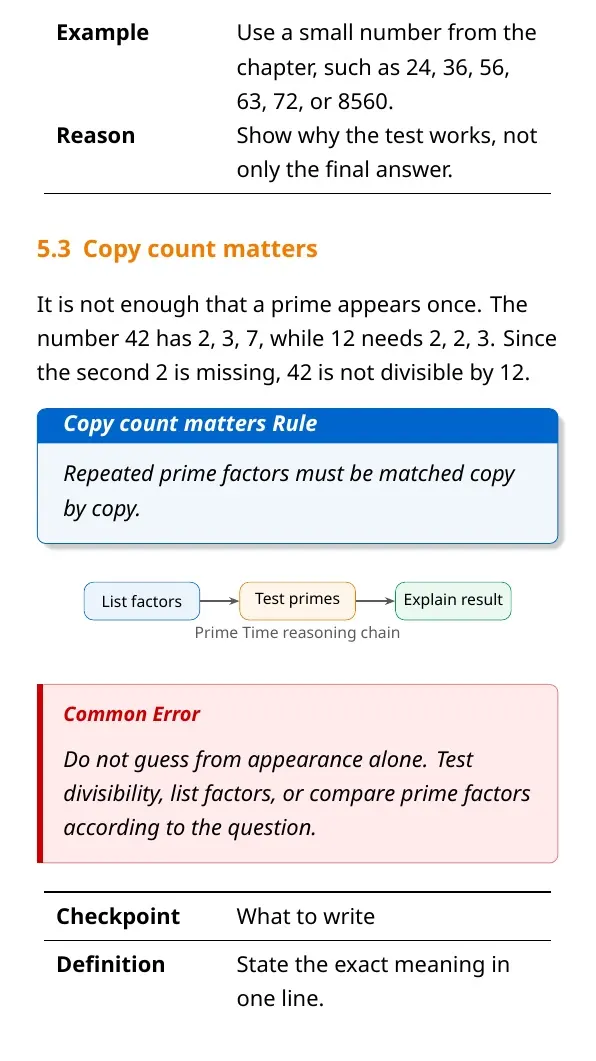
- Do not forget repeated prime factors. 12 needs two 2s and one 3.
- Do not use the test for 4 when the question asks for the test for 8.
Related Resources for Prime Time Class 6
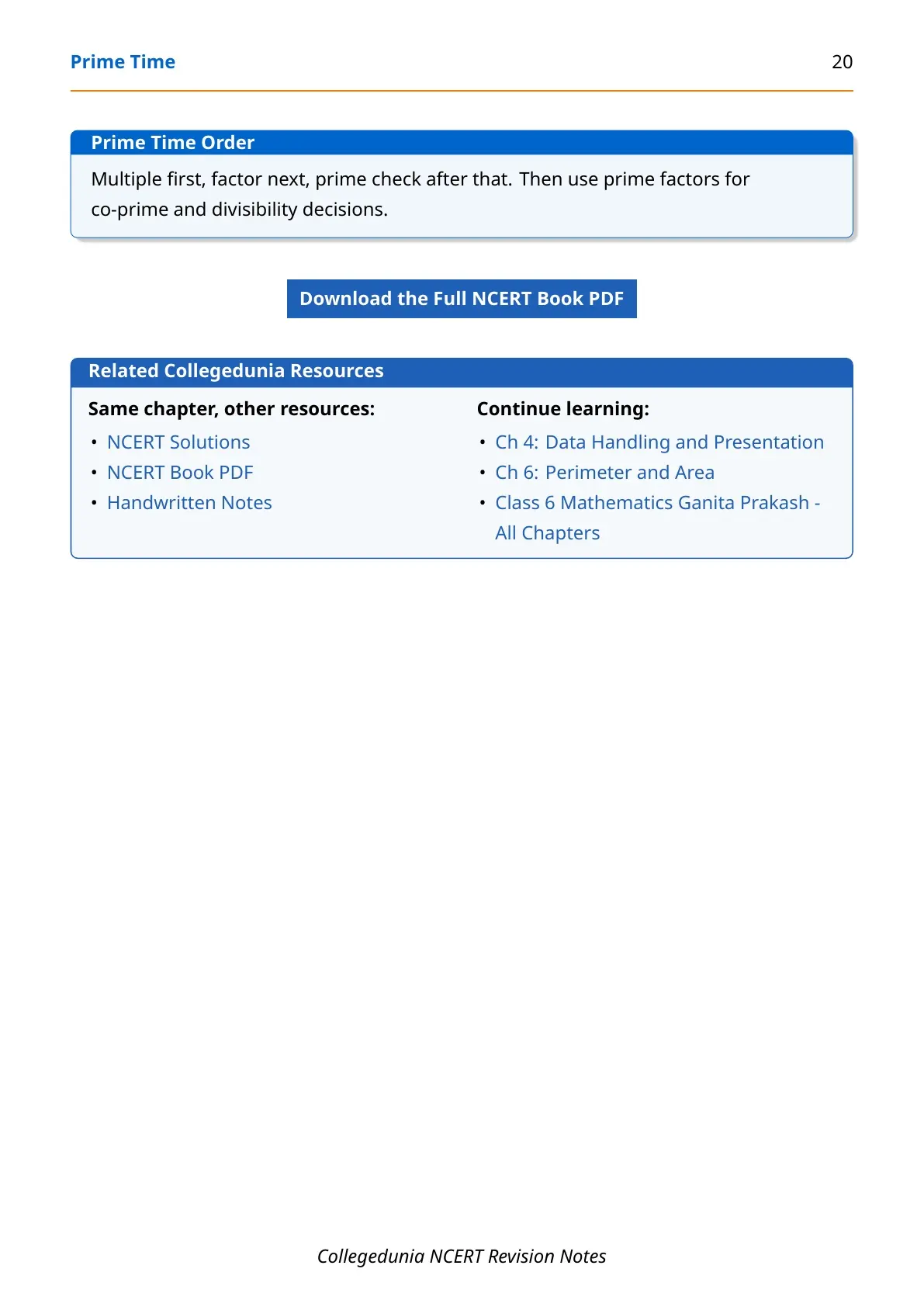
| Resource | How it helps |
|---|---|
| Prime Time Class 6 NCERT Solutions | Step-by-step answers to NCERT questions. |
| Prime Time NCERT Book PDF | Official chapter text and classroom activities. |
| Prime Time Handwritten Notes | Quick revision in notebook style. |
NCERT Notes for Class 6 Mathematics Ganita Prakash: All Chapters
| Chapter | NCERT Notes |
|---|---|
| Chapter 1 | Patterns in Mathematics Notes |
| Chapter 2 | Lines and Angles Notes |
| Chapter 3 | Number Play Notes |
| Chapter 4 | Data Handling and Presentation Notes |
| Chapter 5 | Prime Time Notes |
| Chapter 6 | Perimeter and Area Notes |
| Chapter 7 | Fractions Notes |
| Chapter 8 | Playing with Constructions Notes |
| Chapter 9 | Symmetry Notes |
| Chapter 10 | The Other Side of Zero Notes |
Prime Time Class 6 Notes FAQs
Ques. What do Prime Time Class 6 notes cover?
Ans. These notes cover factors, multiples, prime numbers, composite numbers, co-prime pairs, prime factorisation, and divisibility tests from Ganita Prakash Chapter 5.
Ques. What is the difference between a factor and a multiple?
Ans. A factor divides a number exactly. A multiple is reached by multiplying a number by 1, 2, 3, and so on.
Ques. Is 1 a prime number?
Ans. No. 1 is neither prime nor composite because it has only one factor, while a prime number must have exactly two factors.
Ques. How should students revise Prime Time?
Ans. Students should practise factor lists, prime factorisation, co-prime checks, and divisibility tests with small examples before solving NCERT questions.
Ques. Are these notes based on the 2026-27 NCERT book?
Ans. Yes. The notes follow Class 6 Mathematics Ganita Prakash Chapter 5 Prime Time for the 2026-27 session.



Comments