



Perimeter and Area Class 6 notes help students revise boundary length, rectangle and square formulas, grid-based area, tangram comparisons, and triangle area from the 2026-27 NCERT Ganita Prakash book. The PDF keeps every rule short and connects each idea with fencing, carpets, tracks, house plans, and unit-square puzzles.
Chapter6PerimeterandAreaNotes.pdf?page=1&dpi=150)
Chapter6PerimeterandAreaNotes.pdf?page=2&dpi=150)
Chapter6PerimeterandAreaNotes.pdf?page=3&dpi=150)
Chapter6PerimeterandAreaNotes.pdf?page=4&dpi=150)
Chapter6PerimeterandAreaNotes.pdf?page=5&dpi=150)
Chapter6PerimeterandAreaNotes.pdf?page=6&dpi=150)
Chapter6PerimeterandAreaNotes.pdf?page=7&dpi=150)
Chapter6PerimeterandAreaNotes.pdf?page=8&dpi=150)
Chapter6PerimeterandAreaNotes.pdf?page=9&dpi=150)
Chapter6PerimeterandAreaNotes.pdf?page=10&dpi=150)
Chapter6PerimeterandAreaNotes.pdf?page=11&dpi=150)
Chapter6PerimeterandAreaNotes.pdf?page=12&dpi=150)
Chapter6PerimeterandAreaNotes.pdf?page=13&dpi=150)
Chapter6PerimeterandAreaNotes.pdf?page=14&dpi=150)
Chapter6PerimeterandAreaNotes.pdf?page=15&dpi=150)
Chapter6PerimeterandAreaNotes.pdf?page=16&dpi=150)
Chapter6PerimeterandAreaNotes.pdf?page=17&dpi=150)
Chapter6PerimeterandAreaNotes.pdf?page=18&dpi=150)
Chapter6PerimeterandAreaNotes.pdf?page=19&dpi=150)
Chapter6PerimeterandAreaNotes.pdf?page=20&dpi=150)
Chapter6PerimeterandAreaNotes_flat_MobileCard.pdf?page=1&dpi=150)
Chapter6PerimeterandAreaNotes_flat_MobileCard.pdf?page=2&dpi=150)
Chapter6PerimeterandAreaNotes_flat_MobileCard.pdf?page=3&dpi=150)
Chapter6PerimeterandAreaNotes_flat_MobileCard.pdf?page=4&dpi=150)
Chapter6PerimeterandAreaNotes_flat_MobileCard.pdf?page=5&dpi=150)
Chapter6PerimeterandAreaNotes_flat_MobileCard.pdf?page=6&dpi=150)
Chapter6PerimeterandAreaNotes_flat_MobileCard.pdf?page=7&dpi=150)
Chapter6PerimeterandAreaNotes_flat_MobileCard.pdf?page=8&dpi=150)
Chapter6PerimeterandAreaNotes_flat_MobileCard.pdf?page=9&dpi=150)
Chapter6PerimeterandAreaNotes_flat_MobileCard.pdf?page=10&dpi=150)
Chapter6PerimeterandAreaNotes_flat_MobileCard.pdf?page=11&dpi=150)
Chapter6PerimeterandAreaNotes_flat_MobileCard.pdf?page=12&dpi=150)
Chapter6PerimeterandAreaNotes_flat_MobileCard.pdf?page=13&dpi=150)
Chapter6PerimeterandAreaNotes_flat_MobileCard.pdf?page=14&dpi=150)
Chapter6PerimeterandAreaNotes_flat_MobileCard.pdf?page=15&dpi=150)
Chapter6PerimeterandAreaNotes_flat_MobileCard.pdf?page=16&dpi=150)
Chapter6PerimeterandAreaNotes_flat_MobileCard.pdf?page=17&dpi=150)
Chapter6PerimeterandAreaNotes_flat_MobileCard.pdf?page=18&dpi=150)
Chapter6PerimeterandAreaNotes_flat_MobileCard.pdf?page=19&dpi=150)
Chapter6PerimeterandAreaNotes_flat_MobileCard.pdf?page=20&dpi=150)
Chapter6PerimeterandAreaNotes_flat_MobileCard.pdf?page=21&dpi=150)
Chapter6PerimeterandAreaNotes_flat_MobileCard.pdf?page=22&dpi=150)
Chapter6PerimeterandAreaNotes_flat_MobileCard.pdf?page=23&dpi=150)
Chapter6PerimeterandAreaNotes_flat_MobileCard.pdf?page=24&dpi=150)
Chapter6PerimeterandAreaNotes_flat_MobileCard.pdf?page=25&dpi=150)
Chapter6PerimeterandAreaNotes_flat_MobileCard.pdf?page=26&dpi=150)
Chapter6PerimeterandAreaNotes_flat_MobileCard.pdf?page=27&dpi=150)
Chapter6PerimeterandAreaNotes_flat_MobileCard.pdf?page=28&dpi=150)
Chapter6PerimeterandAreaNotes_flat_MobileCard.pdf?page=29&dpi=150)
- Core focus: perimeter formulas, area formulas, grid counting, triangle area, and mixed-shape reasoning.
- Best use: revise one formula, solve two NCERT examples, then check the matching Figure it Out task.
- Common pitfall: perimeter uses length units, while area uses square units.
Student Feedback: In a Collegedunia poll of 9,860 Class 6 students using Ganita Prakash, 74% said Perimeter and Area became easier after they separated boundary questions from surface questions.
Source: 2026-27 Class 6 Mathematics student poll.
|
Table of Contents |
Perimeter and Area Ideas Every Class 6 Student Should Know
Perimeter measures the total boundary length of a closed figure. Area measures the surface covered inside that boundary. Most mistakes in this chapter happen when students use the right number with the wrong unit.
| Idea | Meaning | Quick example |
|---|---|---|
| Perimeter | Distance around a closed figure. | A 12 cm by 8 cm rectangle has perimeter 40 cm. |
| Area | Region covered by a closed figure. | A 5 m by 4 m floor has area 20 sq m. |
| Regular polygon | All sides and all angles are equal. | Hexagon perimeter equals 6 times side. |
| Grid estimate | Count full and more-than-half squares. | Irregular regions can be estimated on graph paper. |
Perimeter and Area Class 6 Video Revision
Source: Magnet Brains on YouTube
Perimeter Formulas for Rectangles, Squares, and Triangles
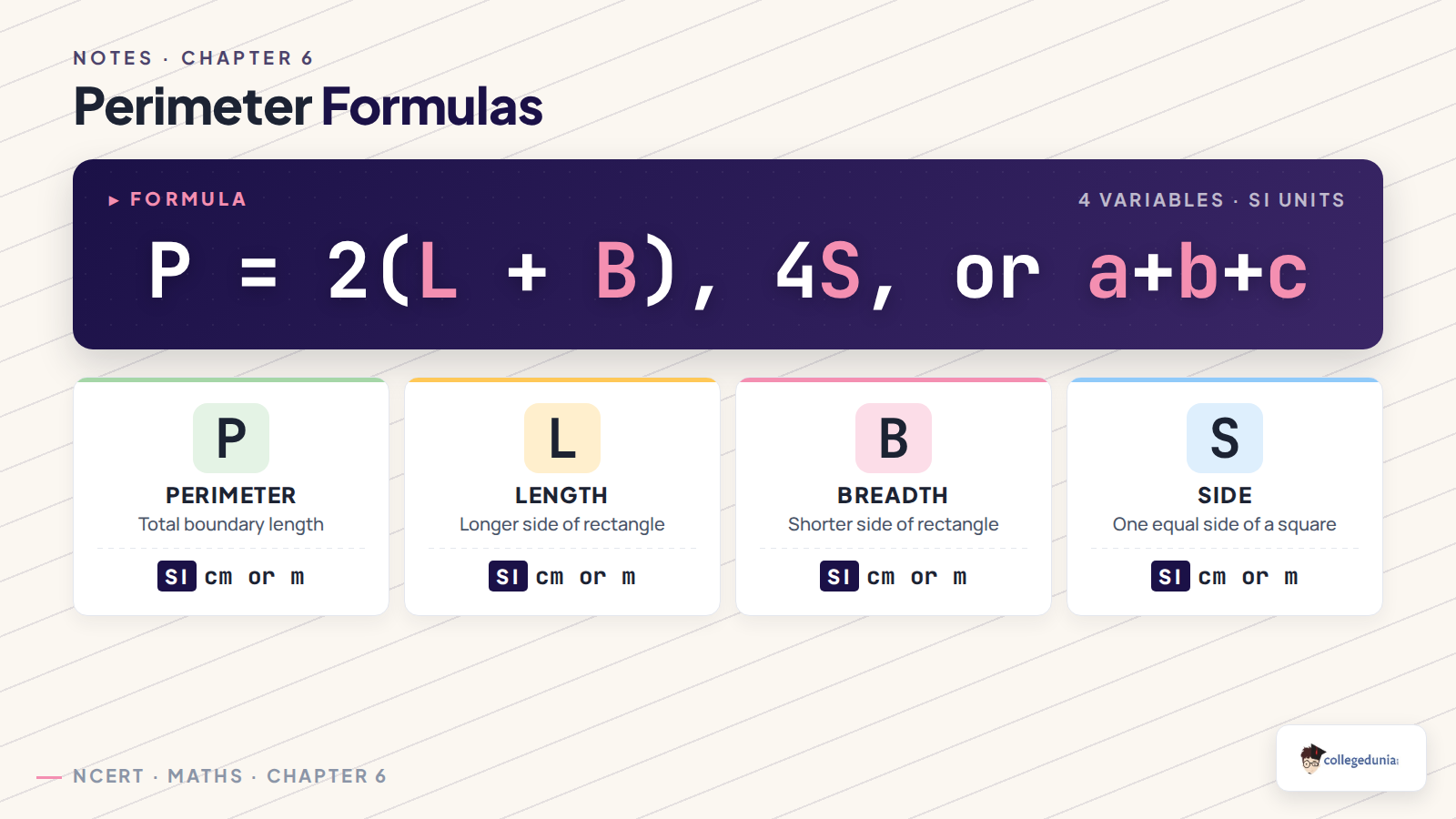
The rectangle formula comes from adding the four sides: length, breadth, length, breadth. Since opposite sides are equal, the sum becomes 2 times (length plus breadth). A square is simpler because all four sides match.
- Rectangle: perimeter equals 2 times (length plus breadth).
- Square: perimeter equals 4 times one side.
- Triangle: perimeter equals the sum of its three sides.
If a rectangular park is 150 m long and 120 m wide, one round is 2 times (150 plus 120), or 540 m. If fencing costs Rs. 40 per metre, the cost is 540 times 40, or Rs. 21600.
Area Formulas and Grid Counting in Ganita Prakash
Area uses square units because squares fit together without gaps. A rectangle with 5 columns and 4 rows has 20 small squares, so its area is 20 square units. A square with side 3 m has area 9 sq m.
| Shape or task | Formula or method | Unit |
|---|---|---|
| Rectangle | length times breadth | sq cm, sq m |
| Square | side times side | sq cm, sq m |
| Uncovered area | whole area minus covered area | square units |
| Irregular region | count grid squares using the half-square rule | square units |
The floor and carpet example uses subtraction: 20 sq m minus 9 sq m gives 11 sq m uncovered area.
Perimeter vs Area: How to Choose the Right Method
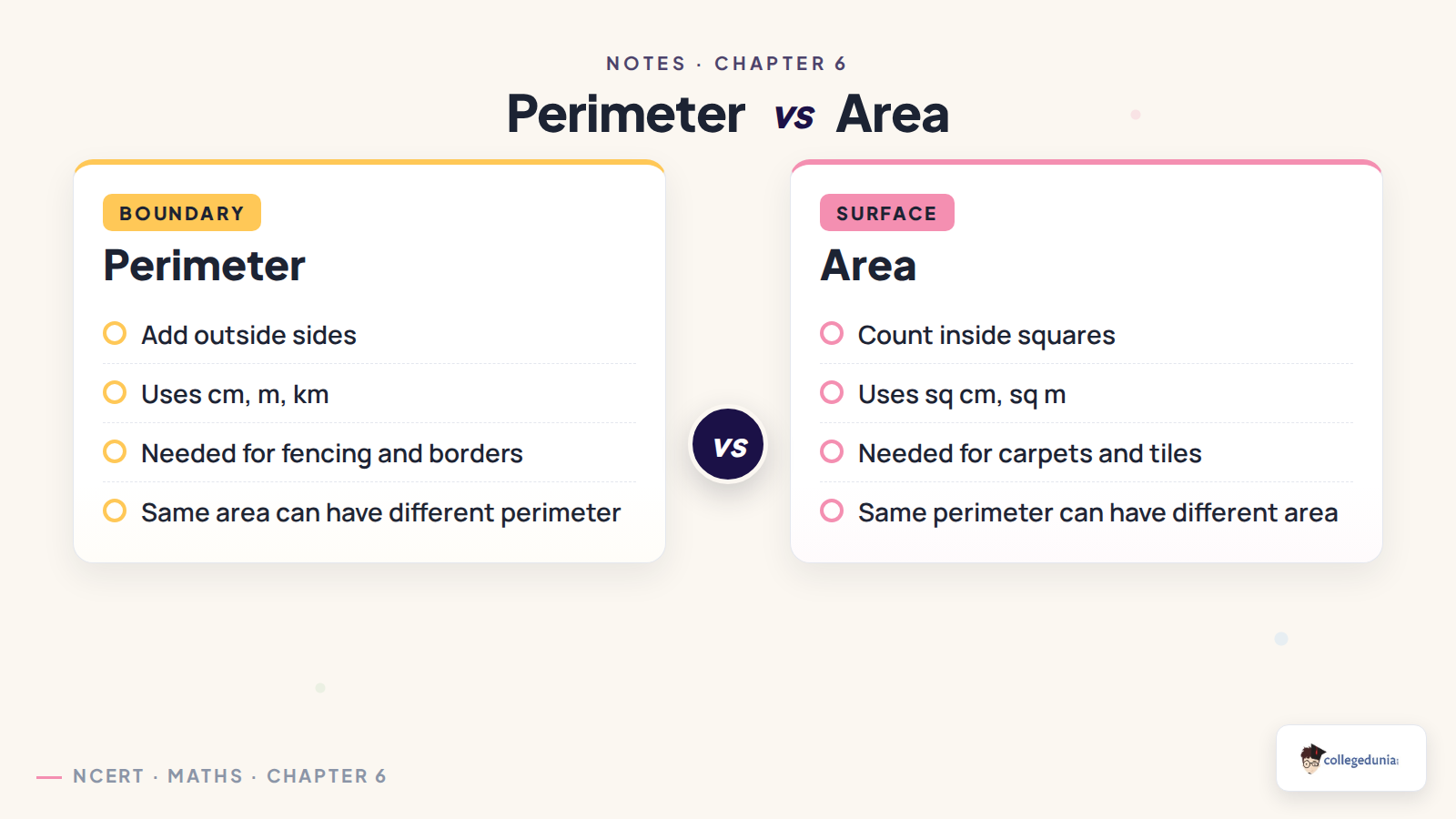
Words in the question usually reveal the method. Around, boundary, lace, fence, rope, track, and border point to perimeter. Covered, carpet, tile, floor, garden, lawn, and region point to area.
- Use perimeter for a photo-frame tape question.
- Use area for a carpet or tiling question.
- Use both when a house plan asks for room areas and boundary comparisons.
Two figures can have the same area but different perimeters. Nine unit squares can form a compact 3 by 3 square or a long strip. The area stays 9 square units, but the boundary changes.
Triangle Area from a Rectangle
NCERT explains triangle area by cutting a rectangle along a diagonal. The two triangles match exactly, so each triangle has half the area of the rectangle. This gives a clear reason for using half of a matching rectangle.
| Step | What to do |
|---|---|
| 1 | Draw a rectangle and one diagonal. |
| 2 | Notice that the two triangles overlap exactly. |
| 3 | Find the rectangle area. |
| 4 | Take half for one triangle. |
Important: triangles that look different can still have the same area when they share the same base and height.
Common Mistakes in Perimeter and Area Notes
Students often mix formulas because the numbers look similar. A rectangle that is 5 m by 4 m has perimeter 18 m, but area 20 sq m. The difference comes from what is being measured.
- Do not write square units for perimeter answers.
- Do not use 2(length plus breadth) for a triangle.
- Do not count only full grid squares when estimating an irregular area.
- Do not forget to multiply by the number of rounds in track and rope questions.
A quick drawing prevents most formula errors. Label length, breadth, side, and height before starting arithmetic.
Related Resources for Perimeter and Area Class 6
| Resource | How it helps |
|---|---|
| Perimeter and Area Class 6 NCERT Solutions | Step-by-step answers to NCERT questions. |
| Perimeter and Area NCERT Book PDF | Official chapter text and classroom activities. |
| Perimeter and Area Handwritten Notes | Notebook-style revision for formulas and examples. |
NCERT Notes for Class 6 Mathematics Ganita Prakash: All Chapters
| Chapter | NCERT Notes |
|---|---|
| Chapter 1 | Patterns in Mathematics Notes |
| Chapter 2 | Lines and Angles Notes |
| Chapter 3 | Number Play Notes |
| Chapter 4 | Data Handling and Presentation Notes |
| Chapter 5 | Prime Time Notes |
| Chapter 6 | Perimeter and Area Notes |
| Chapter 7 | Fractions Notes |
| Chapter 8 | Playing with Constructions Notes |
| Chapter 9 | Symmetry Notes |
| Chapter 10 | The Other Side of Zero Notes |
Perimeter and Area Class 6 Notes FAQs
Ques. What do Perimeter and Area Class 6 notes cover?
Ans. These notes cover perimeter formulas, area formulas, grid counting, regular polygons, triangle area, tangram comparisons, and house-plan questions from Ganita Prakash Chapter 6.
Ques. What is the difference between perimeter and area?
Ans. Perimeter is the distance around a closed figure. Area is the region covered inside the figure.
Ques. Which units are used for area?
Ans. Area uses square units such as sq cm, sq m, or square units. Perimeter uses length units such as cm or m.
Ques. How is triangle area explained in this chapter?
Ans. The chapter shows that a rectangle cut along a diagonal gives two equal-area triangles, so one triangle has half the area of the rectangle.
Ques. Are these notes based on the 2026-27 NCERT book?
Ans. Yes. The notes follow Class 6 Mathematics Ganita Prakash Chapter 6 Perimeter and Area for the 2026-27 session.



Comments