



NCERT Class 6 Science Curiosity Chapter 3 Mindful Eating: A Path to a Healthy Body Notes cover food diversity, nutrients, deficiency diseases, food tests, balanced diet, millets and food miles for the 2026-27 syllabus.
- Download the Chapter 3 Notes PDF for quick revision before school tests.
- Revise carbohydrates, fats, proteins, vitamins, minerals, roughage, water and balanced diet in one place.
- Answer focus: write the nutrient, its function, one source and one health link.
Chapter3MindfulEating:APathtoaHealthyBodyNotes.pdf?page=1&dpi=150)
Chapter3MindfulEating:APathtoaHealthyBodyNotes.pdf?page=2&dpi=150)
Chapter3MindfulEating:APathtoaHealthyBodyNotes.pdf?page=3&dpi=150)
Chapter3MindfulEating:APathtoaHealthyBodyNotes.pdf?page=4&dpi=150)
Chapter3MindfulEating:APathtoaHealthyBodyNotes.pdf?page=5&dpi=150)
Chapter3MindfulEating:APathtoaHealthyBodyNotes.pdf?page=6&dpi=150)
Chapter3MindfulEating:APathtoaHealthyBodyNotes.pdf?page=7&dpi=150)
Chapter3MindfulEating:APathtoaHealthyBodyNotes.pdf?page=8&dpi=150)
Chapter3MindfulEating:APathtoaHealthyBodyNotes.pdf?page=9&dpi=150)
Chapter3MindfulEating:APathtoaHealthyBodyNotes.pdf?page=10&dpi=150)
Chapter3MindfulEating:APathtoaHealthyBodyNotes.pdf?page=11&dpi=150)
Chapter3MindfulEating:APathtoaHealthyBodyNotes.pdf?page=12&dpi=150)
Chapter3MindfulEating:APathtoaHealthyBodyNotes.pdf?page=13&dpi=150)
Chapter3MindfulEating:APathtoaHealthyBodyNotes.pdf?page=14&dpi=150)
Chapter3MindfulEating:APathtoaHealthyBodyNotes.pdf?page=15&dpi=150)
Chapter3MindfulEating:APathtoaHealthyBodyNotes.pdf?page=16&dpi=150)
Chapter3MindfulEating:APathtoaHealthyBodyNotes.pdf?page=17&dpi=150)
Chapter3MindfulEating:APathtoaHealthyBodyNotes.pdf?page=18&dpi=150)
Chapter3MindfulEating:APathtoaHealthyBodyNotes.pdf?page=19&dpi=150)
Chapter3MindfulEating:APathtoaHealthyBodyNotes.pdf?page=20&dpi=150)
Chapter3MindfulEating:APathtoaHealthyBodyNotes.pdf?page=21&dpi=150)
Chapter3MindfulEating:APathtoaHealthyBodyNotes_flat_MobileCard.pdf?page=1&dpi=150)
Chapter3MindfulEating:APathtoaHealthyBodyNotes_flat_MobileCard.pdf?page=2&dpi=150)
Chapter3MindfulEating:APathtoaHealthyBodyNotes_flat_MobileCard.pdf?page=3&dpi=150)
Chapter3MindfulEating:APathtoaHealthyBodyNotes_flat_MobileCard.pdf?page=4&dpi=150)
Chapter3MindfulEating:APathtoaHealthyBodyNotes_flat_MobileCard.pdf?page=5&dpi=150)
Chapter3MindfulEating:APathtoaHealthyBodyNotes_flat_MobileCard.pdf?page=6&dpi=150)
Chapter3MindfulEating:APathtoaHealthyBodyNotes_flat_MobileCard.pdf?page=7&dpi=150)
Chapter3MindfulEating:APathtoaHealthyBodyNotes_flat_MobileCard.pdf?page=8&dpi=150)
Chapter3MindfulEating:APathtoaHealthyBodyNotes_flat_MobileCard.pdf?page=9&dpi=150)
Chapter3MindfulEating:APathtoaHealthyBodyNotes_flat_MobileCard.pdf?page=10&dpi=150)
Chapter3MindfulEating:APathtoaHealthyBodyNotes_flat_MobileCard.pdf?page=11&dpi=150)
Chapter3MindfulEating:APathtoaHealthyBodyNotes_flat_MobileCard.pdf?page=12&dpi=150)
Chapter3MindfulEating:APathtoaHealthyBodyNotes_flat_MobileCard.pdf?page=13&dpi=150)
Chapter3MindfulEating:APathtoaHealthyBodyNotes_flat_MobileCard.pdf?page=14&dpi=150)
Chapter3MindfulEating:APathtoaHealthyBodyNotes_flat_MobileCard.pdf?page=15&dpi=150)
Chapter3MindfulEating:APathtoaHealthyBodyNotes_flat_MobileCard.pdf?page=16&dpi=150)
Chapter3MindfulEating:APathtoaHealthyBodyNotes_flat_MobileCard.pdf?page=17&dpi=150)
Chapter3MindfulEating:APathtoaHealthyBodyNotes_flat_MobileCard.pdf?page=18&dpi=150)
Chapter3MindfulEating:APathtoaHealthyBodyNotes_flat_MobileCard.pdf?page=19&dpi=150)
Chapter3MindfulEating:APathtoaHealthyBodyNotes_flat_MobileCard.pdf?page=20&dpi=150)
Chapter3MindfulEating:APathtoaHealthyBodyNotes_flat_MobileCard.pdf?page=21&dpi=150)
Chapter3MindfulEating:APathtoaHealthyBodyNotes_flat_MobileCard.pdf?page=22&dpi=150)
Chapter3MindfulEating:APathtoaHealthyBodyNotes_flat_MobileCard.pdf?page=23&dpi=150)
Chapter3MindfulEating:APathtoaHealthyBodyNotes_flat_MobileCard.pdf?page=24&dpi=150)
Chapter3MindfulEating:APathtoaHealthyBodyNotes_flat_MobileCard.pdf?page=25&dpi=150)
Chapter3MindfulEating:APathtoaHealthyBodyNotes_flat_MobileCard.pdf?page=26&dpi=150)
Chapter3MindfulEating:APathtoaHealthyBodyNotes_flat_MobileCard.pdf?page=27&dpi=150)
Chapter3MindfulEating:APathtoaHealthyBodyNotes_flat_MobileCard.pdf?page=28&dpi=150)
Chapter3MindfulEating:APathtoaHealthyBodyNotes_flat_MobileCard.pdf?page=29&dpi=150)
Chapter3MindfulEating:APathtoaHealthyBodyNotes_flat_MobileCard.pdf?page=30&dpi=150)
Chapter3MindfulEating:APathtoaHealthyBodyNotes_flat_MobileCard.pdf?page=31&dpi=150)
Chapter3MindfulEating:APathtoaHealthyBodyNotes_flat_MobileCard.pdf?page=32&dpi=150)
These notes follow the 2026-27 NCERT Curiosity textbook and keep food components, classroom tests and balanced diet examples in simple revision order.
Student Feedback on Mindful Eating
In a Collegedunia revision check with 12,180 Class 6 students, most students said this chapter became easier after nutrients and food tests were revised through tables.
Mindful Eating Notes PDF Overview
The chapter starts with the idea that food gives life to living beings. It then connects daily meals with health, culture, crops and the work done by farmers and cooks.
- Mindful eating means eating wholesome food in the right amount.
- Nutrients help the body get energy, grow, repair and stay protected.
- Food miles remind students to value local food and avoid waste.
Food Diversity and Cooking Practices in Class 6 Science Chapter 3
India has many food habits because crops, soil, climate, taste and traditions change from region to region. Traditional food is often based on locally grown crops.
| Region idea | Crops or base food | Traditional examples |
|---|---|---|
| Punjab | maize, wheat, pulses | makki di roti, sarson da saag, chhole |
| Karnataka | rice, ragi, coconut | idli, dosa, ragi mudde, rasam |
| Manipur | rice, bamboo, soya bean | eromba, singju, kangsoi |
Cooking practices have also changed. Many homes moved from chulha to gas stove, and from sil-batta to electric grinder. Compare time, effort, fuel and convenience when writing this answer.
Food Components and Nutrients in Mindful Eating
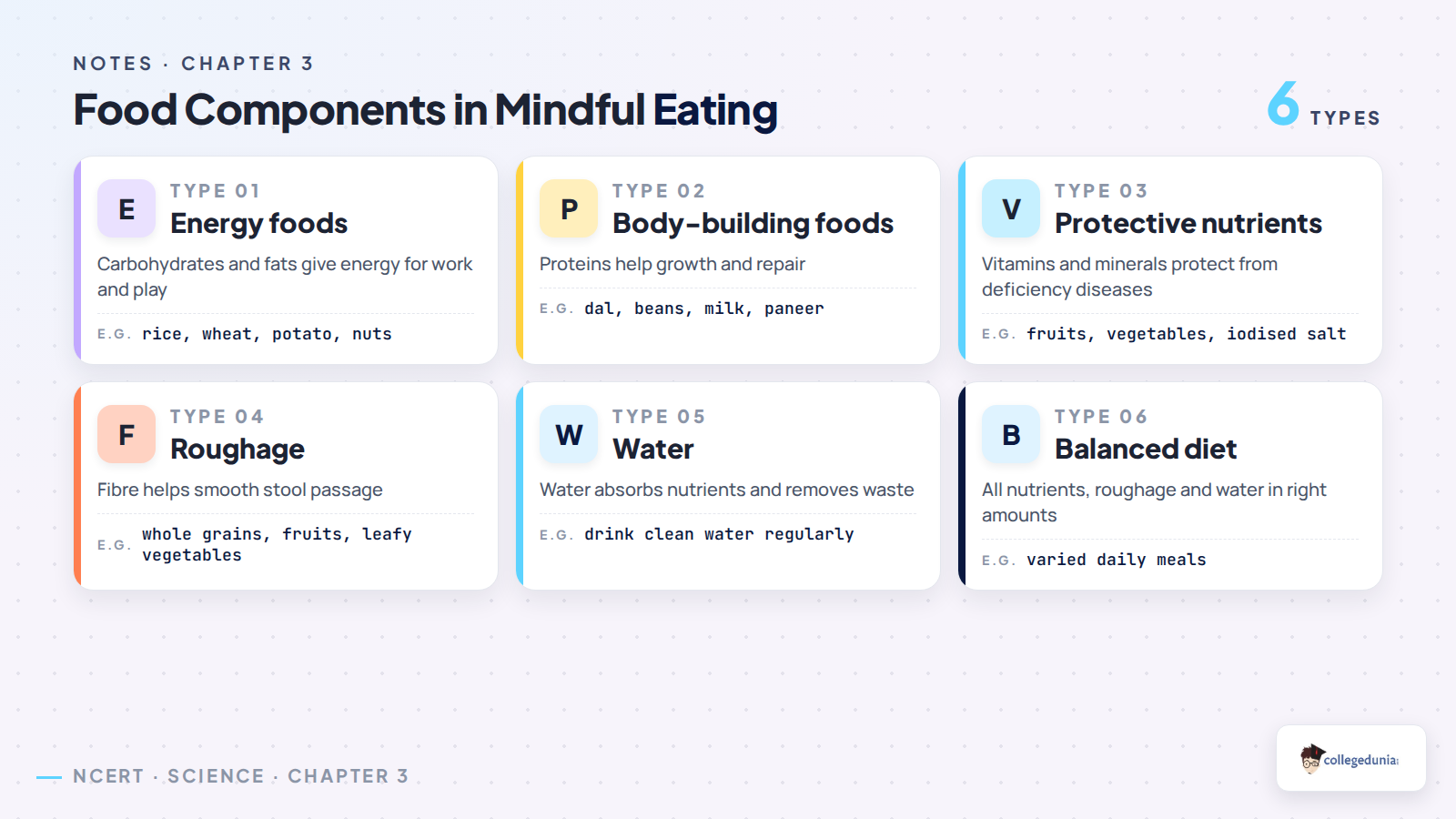
Food components that help body functions are called nutrients. Carbohydrates and fats give energy. Proteins help growth and repair. Vitamins and minerals protect the body from deficiency diseases.
| Nutrient | Main function | Common sources |
|---|---|---|
| Carbohydrates | quick energy | rice, wheat, maize, potato, banana |
| Fats | stored energy and warmth | ghee, oil, nuts, seeds, butter |
| Proteins | growth and repair | dal, beans, milk, paneer, eggs |
| Vitamins and minerals | protection from diseases | fruits, vegetables, milk, iodised salt |
| Roughage and water | digestion and waste removal | whole grains, leafy vegetables, fruits, clean water |
Mindful Eating Class 6 Video Revision
Source: Science Class 6 on YouTube
Use the video after reading the PDF to revise food diversity, food components, balanced diet, millets and food miles with a spoken explanation.
Food Tests for Starch, Fat and Protein
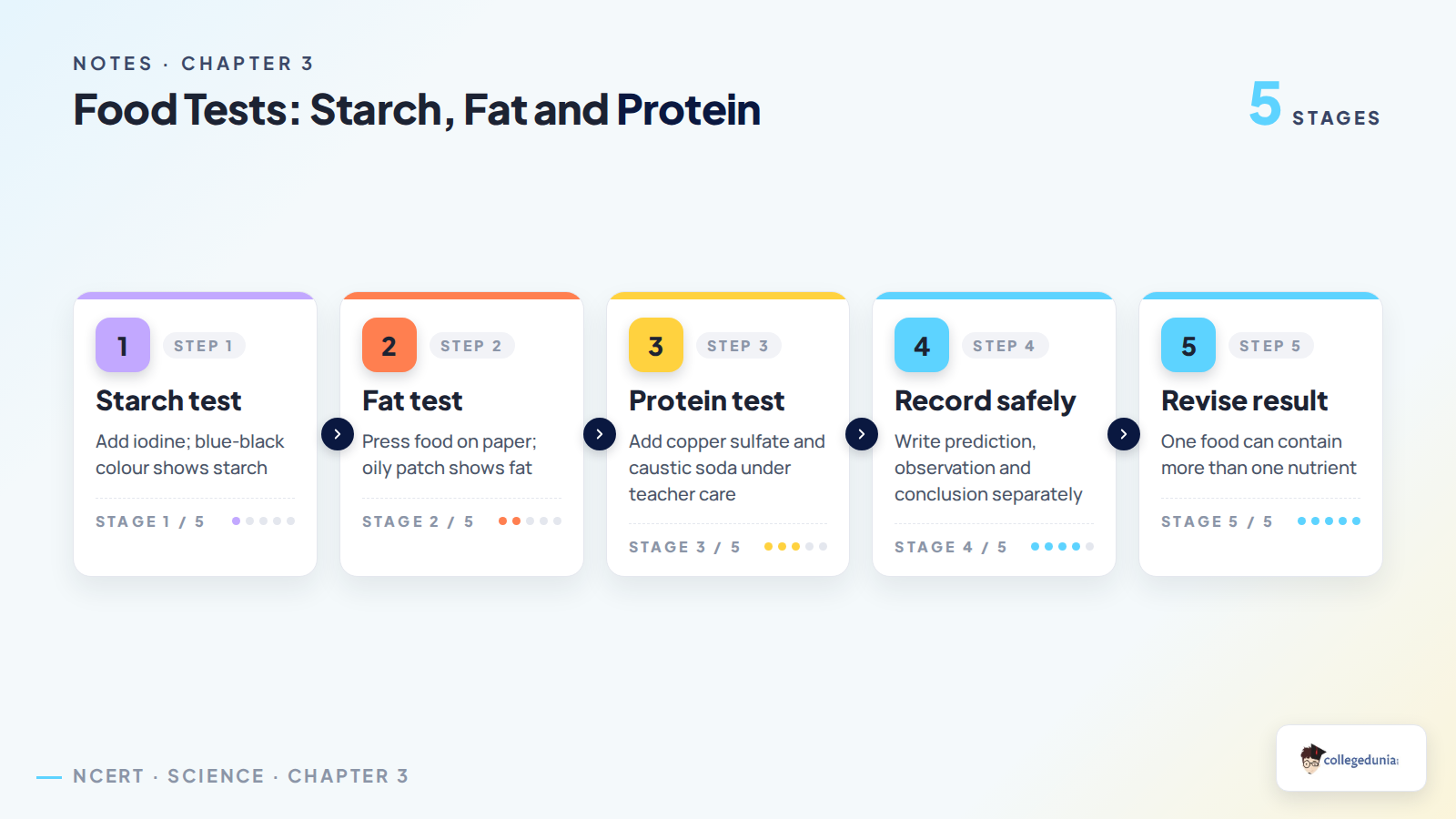
The chapter gives simple tests for starch, fat and protein. The protein test uses chemicals and should be done only as a teacher demonstration.
| Test | Positive observation | Conclusion |
|---|---|---|
| Starch test | iodine makes food blue-black | starch is present |
| Fat test | oily patch remains on paper | fat is present |
| Protein test | mixture turns violet | protein is present |
Balanced Diet, Millets and Food Miles
A balanced diet gives all essential nutrients, roughage and water in the right amount. The amount needed changes with age, activity, health and lifestyle.
- Junk food is high in sugar or fat and low in protective nutrients.
- Millets like jowar, bajra, ragi and sanwa are called nutri-cereals.
- Food miles are the distance travelled by food from producer to consumer.
- Local food can reduce transport pollution and support local farmers.
Take only as much food as you can eat. This reduces waste and respects everyone who helped bring food to the plate.
How to Write Answers from Mindful Eating
Most questions from this chapter ask for reasons, comparisons, symptoms or test design. A complete answer should use the correct term and one NCERT example.
| Question type | What to include | Common mistake |
|---|---|---|
| Deficiency question | disease, missing nutrient and food sources | naming the disease only |
| Food test question | sample, reagent, observation and conclusion | skipping observation |
| Balanced diet question | nutrients, roughage and water | writing only fruits and vegetables |
| Millet question | nutrition value and need for variety | claiming millets alone are enough |
Related Resources for Class 6 Science Chapter 3
| Resource | Use it for | Link |
|---|---|---|
| NCERT Notes | Revise this chapter quickly | Open Notes |
| NCERT Book PDF | Read the official chapter | Open Book PDF |
| Handwritten Notes | Revise with compact notes | Open Handwritten Notes |
All Class 6 Science Curiosity Notes Chapters
| Chapter | Notes Link |
|---|---|
| Chapter 1 The Wonderful World of Science | Open Notes |
| Chapter 2 Diversity in the Living World | Open Notes |
| Chapter 3 Mindful Eating: A Path to a Healthy Body | Current Notes |
Mindful Eating Class 6 Notes FAQs
Ques. What are nutrients in Class 6 Science Chapter 3?
Ans. Nutrients are food components needed for body functions. Carbohydrates, fats, proteins, vitamins and minerals are major nutrients.
Ques. Why are carbohydrates and fats called energy-giving foods?
Ans. Carbohydrates and fats give energy for work, play and body functions. Fats also store energy for later use.
Ques. What is a balanced diet?
Ans. A balanced diet has all essential nutrients, roughage and water in the right amount for growth and development.
Ques. What are food miles?
Ans. Food miles are the distance travelled by a food item from the place of production to the consumer.



Comments