



NCERT Class 6 Science Curiosity Chapter 4 Exploring Magnets Notes cover magnetic and non-magnetic materials, poles, compasses, attraction, repulsion and safe storage for the 2026-27 syllabus.
- Download the Chapter 4 Notes PDF for quick revision before school tests.
- Revise magnet poles, compass direction, like poles and unlike poles in one place.
- Answer focus: write the observation first, then the magnetic rule it proves.
Chapter4ExploringMagnetsNotes.pdf?page=1&dpi=150)
Chapter4ExploringMagnetsNotes.pdf?page=2&dpi=150)
Chapter4ExploringMagnetsNotes.pdf?page=3&dpi=150)
Chapter4ExploringMagnetsNotes.pdf?page=4&dpi=150)
Chapter4ExploringMagnetsNotes.pdf?page=5&dpi=150)
Chapter4ExploringMagnetsNotes.pdf?page=6&dpi=150)
Chapter4ExploringMagnetsNotes.pdf?page=7&dpi=150)
Chapter4ExploringMagnetsNotes.pdf?page=8&dpi=150)
Chapter4ExploringMagnetsNotes.pdf?page=9&dpi=150)
Chapter4ExploringMagnetsNotes.pdf?page=10&dpi=150)
Chapter4ExploringMagnetsNotes.pdf?page=11&dpi=150)
Chapter4ExploringMagnetsNotes.pdf?page=12&dpi=150)
Chapter4ExploringMagnetsNotes.pdf?page=13&dpi=150)
Chapter4ExploringMagnetsNotes.pdf?page=14&dpi=150)
Chapter4ExploringMagnetsNotes.pdf?page=15&dpi=150)
Chapter4ExploringMagnetsNotes.pdf?page=16&dpi=150)
Chapter4ExploringMagnetsNotes.pdf?page=17&dpi=150)
Chapter4ExploringMagnetsNotes.pdf?page=18&dpi=150)
Chapter4ExploringMagnetsNotes.pdf?page=19&dpi=150)
Chapter4ExploringMagnetsNotes.pdf?page=20&dpi=150)
Chapter4ExploringMagnetsNotes.pdf?page=21&dpi=150)
Chapter4ExploringMagnetsNotes_flat_MobileCard.pdf?page=1&dpi=150)
Chapter4ExploringMagnetsNotes_flat_MobileCard.pdf?page=2&dpi=150)
Chapter4ExploringMagnetsNotes_flat_MobileCard.pdf?page=3&dpi=150)
Chapter4ExploringMagnetsNotes_flat_MobileCard.pdf?page=4&dpi=150)
Chapter4ExploringMagnetsNotes_flat_MobileCard.pdf?page=5&dpi=150)
Chapter4ExploringMagnetsNotes_flat_MobileCard.pdf?page=6&dpi=150)
Chapter4ExploringMagnetsNotes_flat_MobileCard.pdf?page=7&dpi=150)
Chapter4ExploringMagnetsNotes_flat_MobileCard.pdf?page=8&dpi=150)
Chapter4ExploringMagnetsNotes_flat_MobileCard.pdf?page=9&dpi=150)
Chapter4ExploringMagnetsNotes_flat_MobileCard.pdf?page=10&dpi=150)
Chapter4ExploringMagnetsNotes_flat_MobileCard.pdf?page=11&dpi=150)
Chapter4ExploringMagnetsNotes_flat_MobileCard.pdf?page=12&dpi=150)
Chapter4ExploringMagnetsNotes_flat_MobileCard.pdf?page=13&dpi=150)
Chapter4ExploringMagnetsNotes_flat_MobileCard.pdf?page=14&dpi=150)
Chapter4ExploringMagnetsNotes_flat_MobileCard.pdf?page=15&dpi=150)
Chapter4ExploringMagnetsNotes_flat_MobileCard.pdf?page=16&dpi=150)
Chapter4ExploringMagnetsNotes_flat_MobileCard.pdf?page=17&dpi=150)
Chapter4ExploringMagnetsNotes_flat_MobileCard.pdf?page=18&dpi=150)
Chapter4ExploringMagnetsNotes_flat_MobileCard.pdf?page=19&dpi=150)
Chapter4ExploringMagnetsNotes_flat_MobileCard.pdf?page=20&dpi=150)
Chapter4ExploringMagnetsNotes_flat_MobileCard.pdf?page=21&dpi=150)
Chapter4ExploringMagnetsNotes_flat_MobileCard.pdf?page=22&dpi=150)
Chapter4ExploringMagnetsNotes_flat_MobileCard.pdf?page=23&dpi=150)
Chapter4ExploringMagnetsNotes_flat_MobileCard.pdf?page=24&dpi=150)
Chapter4ExploringMagnetsNotes_flat_MobileCard.pdf?page=25&dpi=150)
Chapter4ExploringMagnetsNotes_flat_MobileCard.pdf?page=26&dpi=150)
Chapter4ExploringMagnetsNotes_flat_MobileCard.pdf?page=27&dpi=150)
Chapter4ExploringMagnetsNotes_flat_MobileCard.pdf?page=28&dpi=150)
Chapter4ExploringMagnetsNotes_flat_MobileCard.pdf?page=29&dpi=150)
Chapter4ExploringMagnetsNotes_flat_MobileCard.pdf?page=30&dpi=150)
Chapter4ExploringMagnetsNotes_flat_MobileCard.pdf?page=31&dpi=150)
Chapter4ExploringMagnetsNotes_flat_MobileCard.pdf?page=32&dpi=150)
These notes follow the 2026-27 NCERT Curiosity textbook and keep magnet activities, observations and rules in a simple revision order.
Student Feedback on Exploring Magnets
In a Collegedunia revision check with 11,640 Class 6 students, most students said this chapter became easier after poles, compass direction and attraction rules were revised through tables.
Exploring Magnets Notes PDF Overview
The chapter starts with Reshma's story about sailors who need directions when stars are not visible. The story introduces the magnetic compass and then moves to classroom activities with magnets.
- Magnetic materials are attracted by magnets.
- Poles are the strongest parts of a magnet.
- A freely suspended magnet rests along the north-south direction.
Magnetic and Non-magnetic Materials in Class 6 Science Chapter 4
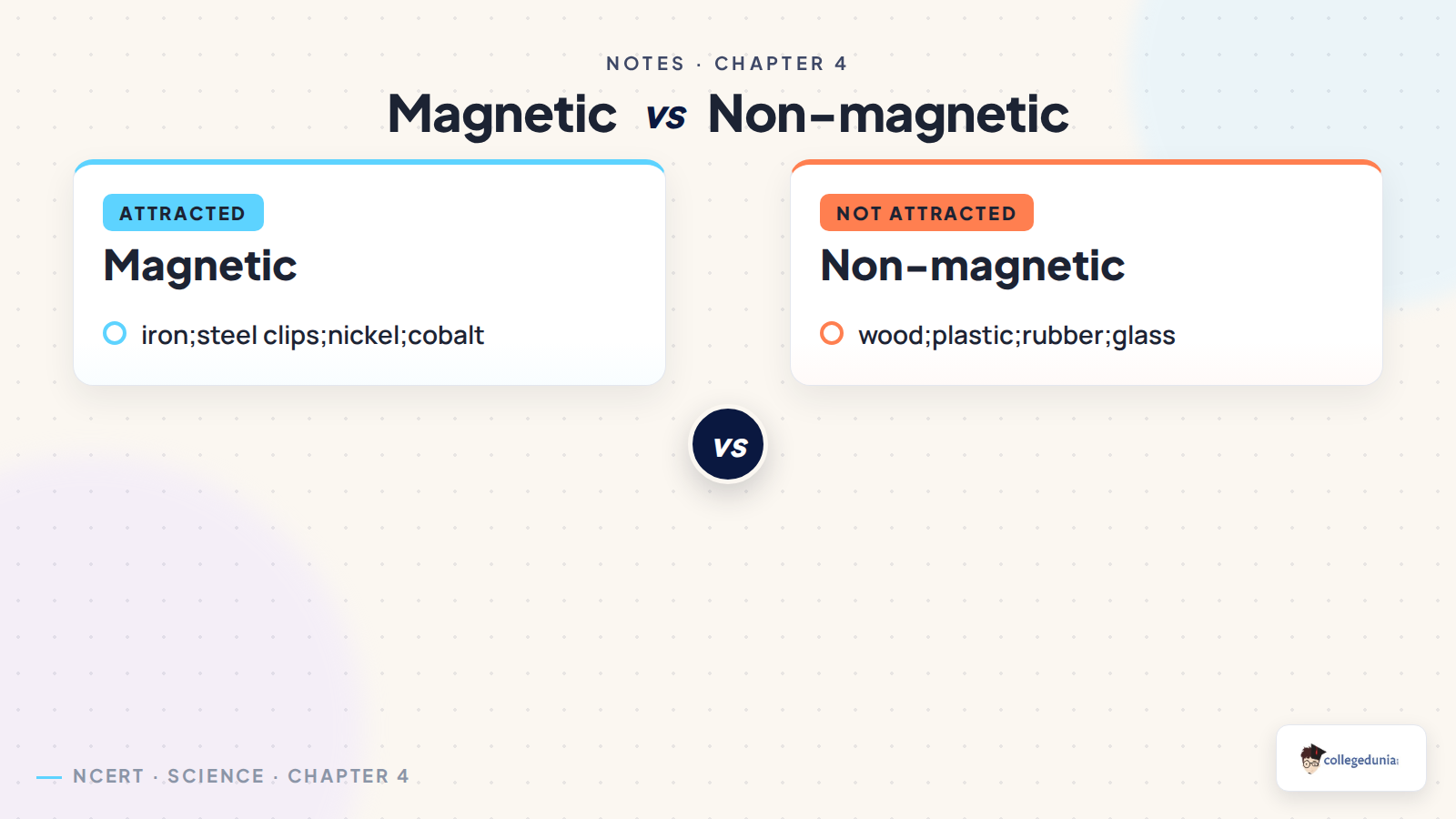
A magnet does not attract every object. It attracts materials like iron, nickel, cobalt and many steels. Materials like wood, plastic, rubber, paper and glass are not attracted.
| Material type | Examples | Observation near magnet |
|---|---|---|
| Magnetic | iron nail, steel clip, nickel, cobalt | gets attracted |
| Non-magnetic | wood, plastic, rubber, glass | does not get attracted |
| Mixed material | coin, coated clip, metal toy | test and record result |
Do not decide by colour or shine. A shiny object may be non-magnetic, while a dull iron object can be magnetic.
Poles of a Magnet and Iron Filings Activity
The ends of a magnet are called poles. Most iron filings gather near the two ends of a bar magnet, so the magnetic effect is strongest near the poles.
| Part of bar magnet | Magnetic pull | Expected observation |
|---|---|---|
| North pole end | strong | many pins or filings stick |
| Middle part | weak | few pins or filings stick |
| South pole end | strong | many pins or filings stick |
Every magnet has a North pole and a South pole. If a magnet is broken, each smaller piece still has both poles.
Exploring Magnets Class 6 Video Revision
Source: Magnet Brains on YouTube
Use the video after reading the PDF to revise magnetic materials, poles, compass direction, attraction and repulsion with a spoken explanation.
Finding Directions and Making a Simple Compass
A freely suspended bar magnet comes to rest along the north-south direction. The end that points north is called the North pole. The other end is called the South pole.
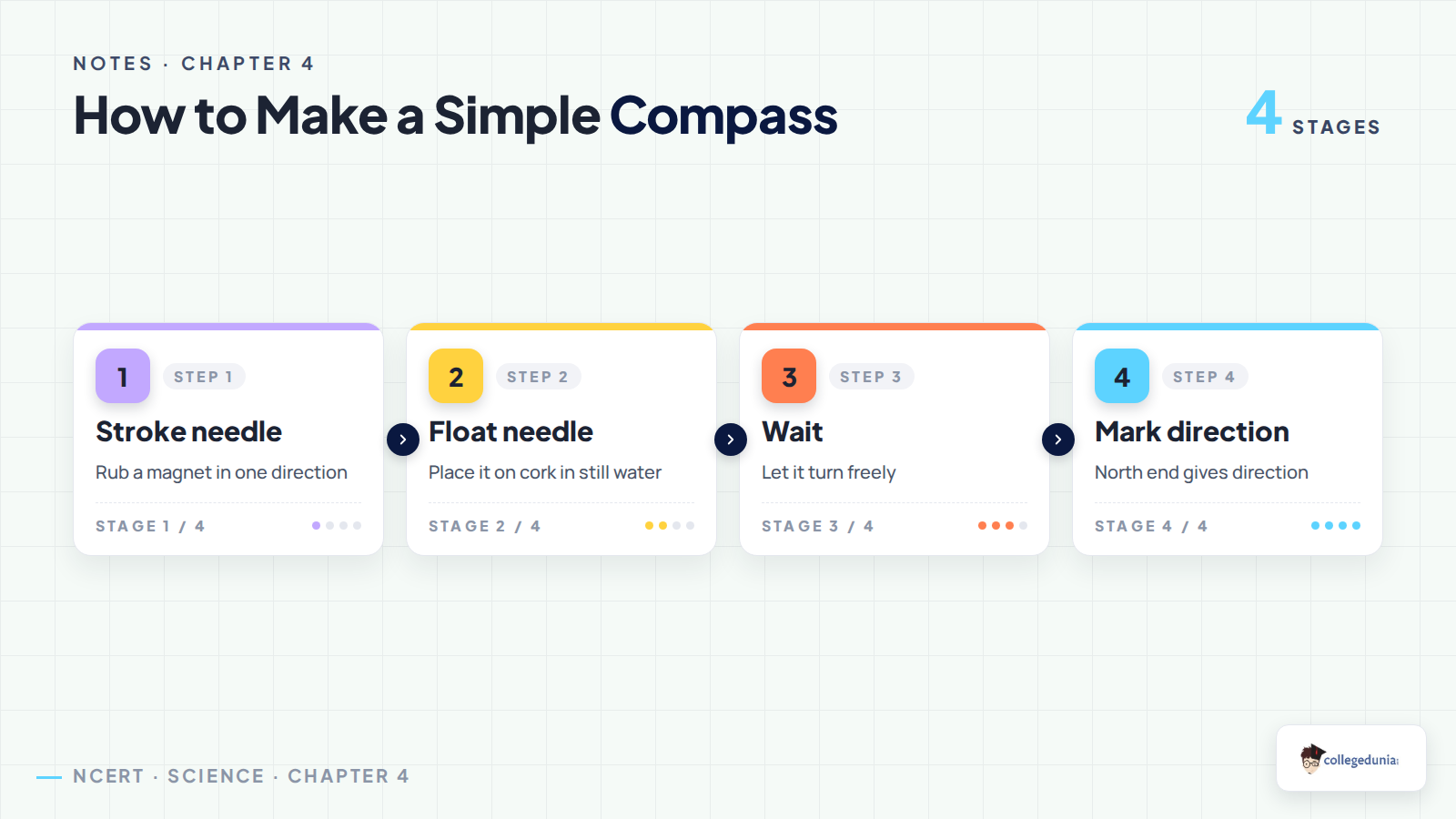
To make a simple compass, stroke an iron needle with one pole of a magnet in one direction several times. Float it on cork in still water and wait for it to settle.
- Stroke in one direction: do not rub the magnet back and forth.
- Float carefully: moving water can disturb the needle.
- Mark direction: the north-pointing end gives the North pole.
Attraction and Repulsion Between Magnets
Two magnets can attract or repel each other. The result depends on the poles that face each other.
| Poles facing each other | Result | Rule |
|---|---|---|
| North and South | attraction | unlike poles attract |
| North and North | repulsion | like poles repel |
| South and South | repulsion | like poles repel |
Repulsion is the sure test of magnetism. A magnet can attract iron, so attraction alone does not prove that both objects are magnets.
How to Write Answers from Exploring Magnets
Most questions from this chapter ask for observations, reasons or pole rules. A complete answer should name the setup and then state the rule.
| Question type | What to include | Common mistake |
|---|---|---|
| Material test | object, material and whether it is attracted | deciding by colour |
| Poles question | North pole, South pole and pair rule | claiming one pole can exist alone |
| Compass question | free movement and north-south rest direction | forgetting the magnet must turn freely |
| Attraction question | like or unlike poles and result | using attraction as the only proof |
Related Resources for Class 6 Science Chapter 4
| Resource | Use it for | Link |
|---|---|---|
| NCERT Solutions | Check textbook answers | Open Solutions |
| NCERT Book PDF | Read the official chapter | Open Book PDF |
| Handwritten Notes | Revise with compact notes | Open Handwritten Notes |
All Class 6 Science Curiosity Notes Chapters
| Chapter | Notes Link |
|---|---|
| Chapter 1 The Wonderful World of Science | Open Notes |
| Chapter 2 Diversity in the Living World | Open Notes |
| Chapter 3 Mindful Eating: A Path to a Healthy Body | Open Notes |
| Chapter 4 Exploring Magnets | Current Notes |
Exploring Magnets Class 6 Notes FAQs
Ques. What are magnetic materials in Class 6 Science Chapter 4?
Ans. Magnetic materials are materials attracted by a magnet. Iron, nickel, cobalt and many steels are magnetic materials.
Ques. Where is the magnetic pull strongest in a bar magnet?
Ans. The magnetic pull is strongest near the two ends of a bar magnet. These ends are called poles.
Ques. What direction does a freely suspended magnet show?
Ans. A freely suspended magnet comes to rest along the north-south direction. This property is used in a compass.
Ques. What happens when like poles of two magnets face each other?
Ans. Like poles repel each other. North-North and South-South pairs show repulsion.



Comments