



NCERT Class 6 Science Curiosity Chapter 5 Measurement of Length and Motion Notes cover body-part units, standard units, metre scale reading, curved length, reference point and types of motion for the 2026-27 syllabus.
- Download the Chapter 5 Notes PDF for quick school-test revision.
- Revise metre, centimetre, millimetre, kilometre, scale reading and motion types.
- Answer focus: write the measured number with the correct unit and mention the method used.
Chapter5MeasurementofLengthandMotionNotes.pdf?page=1&dpi=150)
Chapter5MeasurementofLengthandMotionNotes.pdf?page=2&dpi=150)
Chapter5MeasurementofLengthandMotionNotes.pdf?page=3&dpi=150)
Chapter5MeasurementofLengthandMotionNotes.pdf?page=4&dpi=150)
Chapter5MeasurementofLengthandMotionNotes.pdf?page=5&dpi=150)
Chapter5MeasurementofLengthandMotionNotes.pdf?page=6&dpi=150)
Chapter5MeasurementofLengthandMotionNotes.pdf?page=7&dpi=150)
Chapter5MeasurementofLengthandMotionNotes.pdf?page=8&dpi=150)
Chapter5MeasurementofLengthandMotionNotes.pdf?page=9&dpi=150)
Chapter5MeasurementofLengthandMotionNotes.pdf?page=10&dpi=150)
Chapter5MeasurementofLengthandMotionNotes.pdf?page=11&dpi=150)
Chapter5MeasurementofLengthandMotionNotes.pdf?page=12&dpi=150)
Chapter5MeasurementofLengthandMotionNotes.pdf?page=13&dpi=150)
Chapter5MeasurementofLengthandMotionNotes.pdf?page=14&dpi=150)
Chapter5MeasurementofLengthandMotionNotes.pdf?page=15&dpi=150)
Chapter5MeasurementofLengthandMotionNotes.pdf?page=16&dpi=150)
Chapter5MeasurementofLengthandMotionNotes.pdf?page=17&dpi=150)
Chapter5MeasurementofLengthandMotionNotes.pdf?page=18&dpi=150)
Chapter5MeasurementofLengthandMotionNotes.pdf?page=19&dpi=150)
Chapter5MeasurementofLengthandMotionNotes.pdf?page=20&dpi=150)
Chapter5MeasurementofLengthandMotionNotes.pdf?page=21&dpi=150)
Chapter5MeasurementofLengthandMotionNotes.pdf?page=22&dpi=150)
Chapter5MeasurementofLengthandMotionNotes.pdf?page=23&dpi=150)
Chapter5MeasurementofLengthandMotionNotes.pdf?page=24&dpi=150)
Chapter5MeasurementofLengthandMotionNotes.pdf?page=25&dpi=150)
Chapter5MeasurementofLengthandMotionNotes.pdf?page=26&dpi=150)
Chapter5MeasurementofLengthandMotionNotes_flat_MobileCard.pdf?page=1&dpi=150)
Chapter5MeasurementofLengthandMotionNotes_flat_MobileCard.pdf?page=2&dpi=150)
Chapter5MeasurementofLengthandMotionNotes_flat_MobileCard.pdf?page=3&dpi=150)
Chapter5MeasurementofLengthandMotionNotes_flat_MobileCard.pdf?page=4&dpi=150)
Chapter5MeasurementofLengthandMotionNotes_flat_MobileCard.pdf?page=5&dpi=150)
Chapter5MeasurementofLengthandMotionNotes_flat_MobileCard.pdf?page=6&dpi=150)
Chapter5MeasurementofLengthandMotionNotes_flat_MobileCard.pdf?page=7&dpi=150)
Chapter5MeasurementofLengthandMotionNotes_flat_MobileCard.pdf?page=8&dpi=150)
Chapter5MeasurementofLengthandMotionNotes_flat_MobileCard.pdf?page=9&dpi=150)
Chapter5MeasurementofLengthandMotionNotes_flat_MobileCard.pdf?page=10&dpi=150)
Chapter5MeasurementofLengthandMotionNotes_flat_MobileCard.pdf?page=11&dpi=150)
Chapter5MeasurementofLengthandMotionNotes_flat_MobileCard.pdf?page=12&dpi=150)
Chapter5MeasurementofLengthandMotionNotes_flat_MobileCard.pdf?page=13&dpi=150)
Chapter5MeasurementofLengthandMotionNotes_flat_MobileCard.pdf?page=14&dpi=150)
Chapter5MeasurementofLengthandMotionNotes_flat_MobileCard.pdf?page=15&dpi=150)
Chapter5MeasurementofLengthandMotionNotes_flat_MobileCard.pdf?page=16&dpi=150)
Chapter5MeasurementofLengthandMotionNotes_flat_MobileCard.pdf?page=17&dpi=150)
Chapter5MeasurementofLengthandMotionNotes_flat_MobileCard.pdf?page=18&dpi=150)
Chapter5MeasurementofLengthandMotionNotes_flat_MobileCard.pdf?page=19&dpi=150)
Chapter5MeasurementofLengthandMotionNotes_flat_MobileCard.pdf?page=20&dpi=150)
Chapter5MeasurementofLengthandMotionNotes_flat_MobileCard.pdf?page=21&dpi=150)
Chapter5MeasurementofLengthandMotionNotes_flat_MobileCard.pdf?page=22&dpi=150)
Chapter5MeasurementofLengthandMotionNotes_flat_MobileCard.pdf?page=23&dpi=150)
Chapter5MeasurementofLengthandMotionNotes_flat_MobileCard.pdf?page=24&dpi=150)
Chapter5MeasurementofLengthandMotionNotes_flat_MobileCard.pdf?page=25&dpi=150)
Chapter5MeasurementofLengthandMotionNotes_flat_MobileCard.pdf?page=26&dpi=150)
Chapter5MeasurementofLengthandMotionNotes_flat_MobileCard.pdf?page=27&dpi=150)
Chapter5MeasurementofLengthandMotionNotes_flat_MobileCard.pdf?page=28&dpi=150)
Chapter5MeasurementofLengthandMotionNotes_flat_MobileCard.pdf?page=29&dpi=150)
Chapter5MeasurementofLengthandMotionNotes_flat_MobileCard.pdf?page=30&dpi=150)
Chapter5MeasurementofLengthandMotionNotes_flat_MobileCard.pdf?page=31&dpi=150)
Chapter5MeasurementofLengthandMotionNotes_flat_MobileCard.pdf?page=32&dpi=150)
Chapter5MeasurementofLengthandMotionNotes_flat_MobileCard.pdf?page=33&dpi=150)
Chapter5MeasurementofLengthandMotionNotes_flat_MobileCard.pdf?page=34&dpi=150)
Chapter5MeasurementofLengthandMotionNotes_flat_MobileCard.pdf?page=35&dpi=150)
Chapter5MeasurementofLengthandMotionNotes_flat_MobileCard.pdf?page=36&dpi=150)
Chapter5MeasurementofLengthandMotionNotes_flat_MobileCard.pdf?page=37&dpi=150)
These notes follow the 2026-27 NCERT Curiosity textbook and keep units, scale reading and motion examples in a simple revision order.
Student Feedback on Measurement of Length and Motion
In a Collegedunia revision check with 11,380 Class 6 students, most students said this chapter became easier after they separated unit conversion, scale reading and motion examples into three tables.
Measurement of Length and Motion Notes PDF Overview
The chapter begins with Deepa's uniform, cloth measurement and handspan activity. It shows why rough body-part units can give different readings and why standard units are needed for clear communication.
- Measurement means comparing a length with a chosen unit.
- Standard units help different people get comparable results.
- Motion means change in position with respect to a reference point with time.
Standard Units and Unit Conversion in Class 6 Science Chapter 5
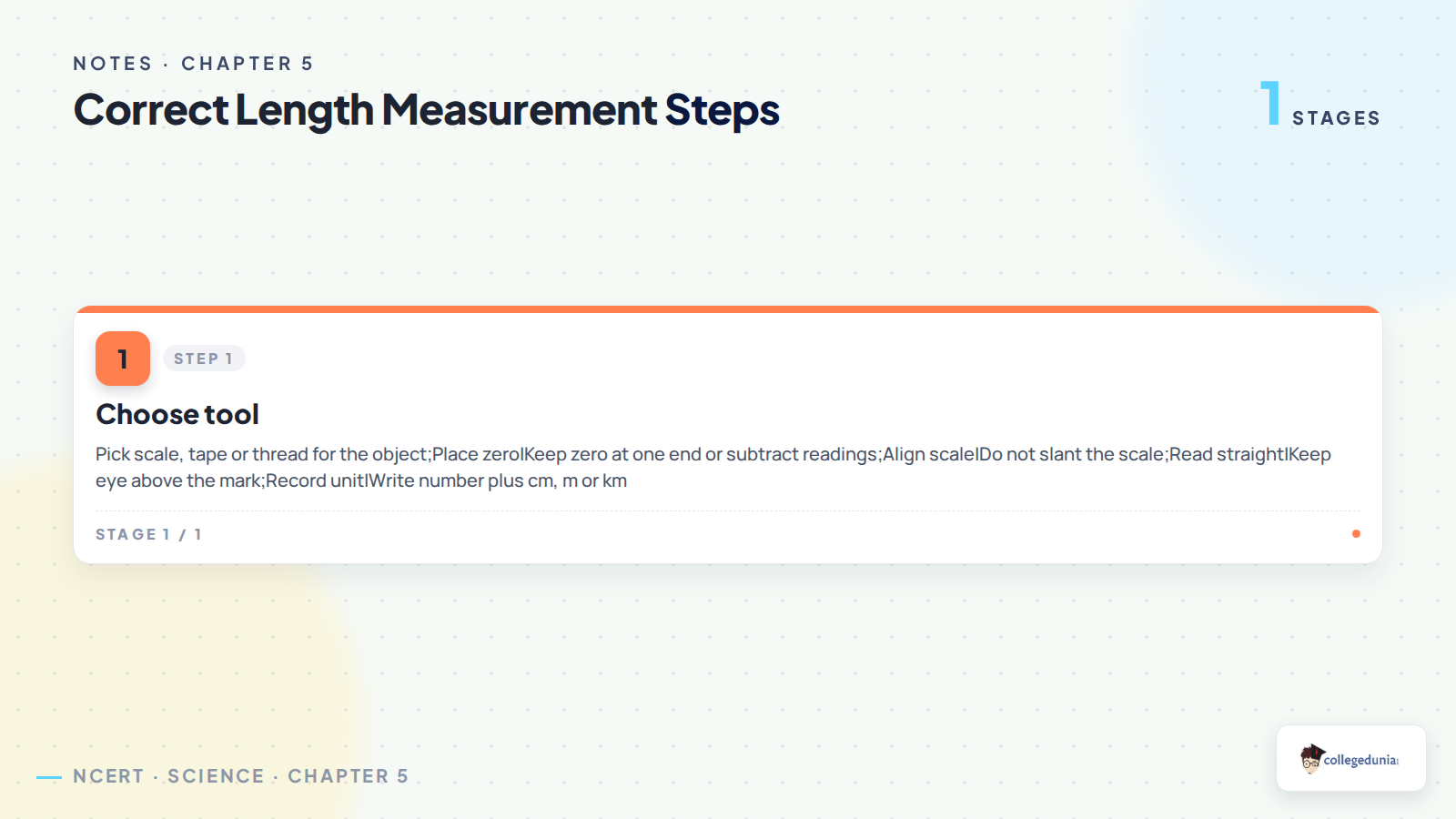
The SI unit of length is metre. Smaller lengths are usually measured in centimetres or millimetres. Larger lengths, such as road distance, are measured in kilometres.
| Unit | Relation | Best used for |
|---|---|---|
| kilometre | 1 km = 1000 m | roads, railway tracks, city distances |
| metre | 1 m = 100 cm | rooms, cloth, classroom tables |
| centimetre | 1 cm = 10 mm | pencils, notebooks, small objects |
| millimetre | 1 mm = 0.1 cm | thin marks and small gaps |
How to Measure Correctly with a Scale
Place the scale along the object. If the zero mark is clear, start from zero. If the scale edge is broken, place another mark at one end and subtract the two readings.
- Avoid slanting: the scale should lie along the length.
- Avoid parallax: keep your eye vertically above the mark.
- Write the unit: a number without cm, m or km is incomplete.
Measurement of Length and Motion Class 6 Video Revision
Source: Magnet Brains on YouTube
Use the video after reading the PDF to revise unit conversion, scale reading, reference point and examples of motion.
Reference Point and Types of Motion
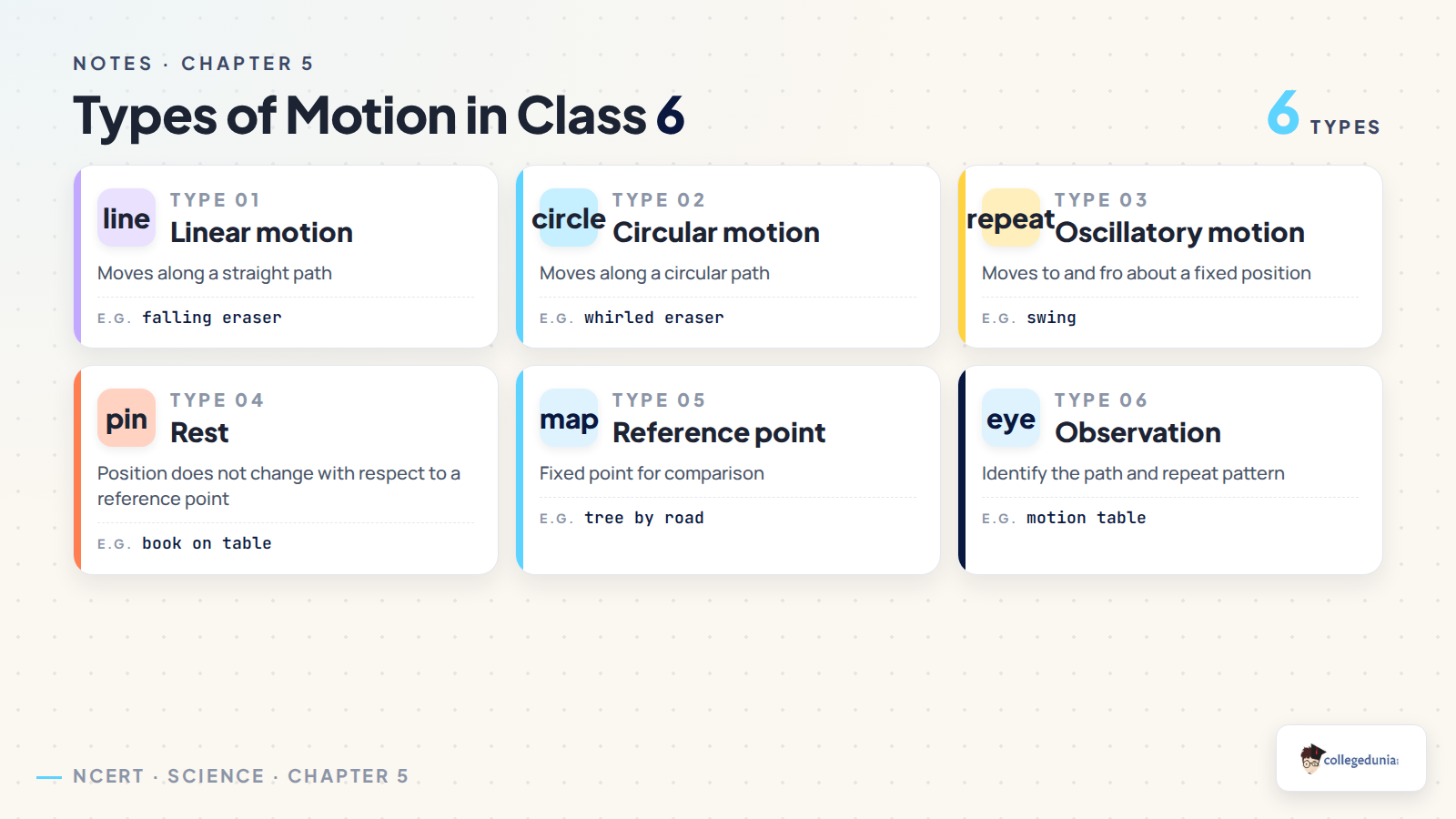
An object is said to be in motion when its position changes with respect to a reference point with time. If there is no such change, it is at rest for that reference point.
| Motion type | Meaning | Example |
|---|---|---|
| Linear motion | motion along a straight line | drawer sliding out |
| Circular motion | motion along a circular path | whirled eraser or merry-go-round |
| Oscillatory motion | to-and-fro motion about a fixed position | swing moving to and fro |
How to Write Answers from Measurement of Length and Motion
Most textbook questions ask for reasons, correct methods or examples. A complete answer should include the observation, the unit or tool and the rule learned from the activity.
| Question type | What to include | Common mistake |
|---|---|---|
| Handspan activity | different handspans give different readings | forgetting person-to-person variation |
| Unit conversion | write the relation before calculating | mixing cm and mm |
| Scale reading | zero mark, alignment and eye position | reading from a slanting scale |
| Motion example | path, reference point and time change | naming motion without reason |
Related Resources for Class 6 Science Chapter 5
| Resource | Use it for | Link |
|---|---|---|
| NCERT Solutions | Check textbook answers | Open Solutions |
| NCERT Book PDF | Read the official chapter | Open Book PDF |
| Handwritten Notes | Revise with compact notes | Open Handwritten Notes |
All Class 6 Science Curiosity Notes Chapters
| Chapter | Notes Link |
|---|---|
| Chapter 1 The Wonderful World of Science | Open Notes |
| Chapter 2 Diversity in the Living World | Open Notes |
| Chapter 3 Mindful Eating: A Path to a Healthy Body | Open Notes |
| Chapter 4 Exploring Magnets | Open Notes |
| Chapter 5 Measurement of Length and Motion | Current Notes |
Measurement of Length and Motion Class 6 Notes FAQs
Ques. Why are handspan and footstep not standard units?
Ans. They are not standard units because their size changes from person to person, so different people get different measurements.
Ques. What is the SI unit of length?
Ans. The SI unit of length is metre. Its symbol is m.
Ques. How should we avoid parallax error while reading a scale?
Ans. Keep the eye vertically above the mark being read. Do not look from the side.
Ques. What is motion in Class 6 Science Chapter 5?
Ans. Motion is change in the position of an object with respect to a reference point with time.



Comments